Dr. B.R. AMBEDKAR UNIVERSITY AGRA
(Formerly: Agra University, Agra)
Institute of Social Science, Paliwal Park, Agra
Department of Social Work
SWM- 305(A) INDIAN LABOUR PROBLEMS AND LEGISLATIONS
PPT ON
EMPLOYEES STATE INSURANCE
ACT,1948
PRESENTED BY:-
SHEKHAR UPADHYAYA
MSW IIIrd SEMESTER
INTRODUCTION
◦ Employees’ State Insurance Scheme of India, is a
multidimensional social security system tailored to
provide socio-economic protection to worker
population and their dependents covered under the
scheme.
◦ The scheme was inaugurated in Kanpur on 24th
February 1952. The comprehensive and multi-pronged
social security programme is administered by an apex
corporate body called the Employees' State Insurance
Corporation
APPLICABILITY OF THE ACT
Under Section 1(4) of the Act, the implementation of the scheme is
territorial. The Act applies in the first instance to all factories using power
and employing 20 or more persons on wages.
◦ The provisions of the Act have also been extended, or are being
gradually extended, under Section 1(5) of the Act to cover
◦ a) Smaller power-using factories employing 10 to 19 persons;
◦ b) Non-power using factories employing 20 or more persons;
◦ c) Shops;
◦ d) Hotels and restaurants;
◦ e) Cinemas, including preview theatres;
◦ f) Newspaper establishments; and
◦ g) Road motor transport undertakings employing 20 or more persons.
The Act, however, does not apply to a mine or
railway running shed,. and specified seasonal
factories.
The State Government may extend the
provisions of the Act to cover other
establishments or class of establishments,
industrial, commercial, agricultural or otherwise,
in consultation with the Corporation and with
the approval of the Central Government, after
giving six months notice of its intention to do so
in the Official Gazette.
ADMINISTRATION
◦ The Hqrs. of the ESI Corporation is located at Delhi and has 66
Field Offices
◦ which include 23 Regional Offices,
◦ 37 Sub-Regional Offices,
◦ 1 Divisional Office,
◦ 2 Camp Offices and 3 Liaison Offices throughout the country.
◦ Besides, there are 627 Branch Offices and 185 Pay Offices for
administration of 2 cash benefits to Insured Persons.
◦ For inspection and coverage of factories/Establishment, 422
Inspection Offices are also set up across the Country.
CONTRIBUTION
◦ E.S.I. Scheme being contributory in nature, all the
employees in the factories or establishments to which the
Act applies shall be insured in a manner provided by the
Act.
◦ The contribution payable to the Corporation in respect of an
employee shall comprise of employer's contribution and
employee's contribution at a specified rate.
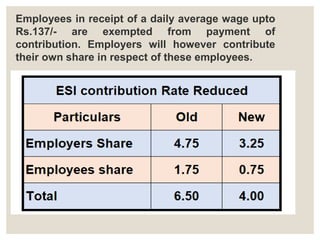
◦ The rates are revised from time to time. Currently, the
employee's contribution rate (w.e.f. 01.07.2019) is 0.75% of
the wages and that of employer's is 3.25% of the wages
paid/payable in respect of the employees in every wage
period.
Employees in receipt of a daily average wage upto
Rs.137/- are exempted from payment of
contribution. Employers will however contribute
their own share in respect of these employees.
Collection of
Contribution
An employer is liable to pay his contribution in respect of
every employee and deduct employees contribution from
wages bill and shall pay these contributions at the above
specified rates to the Corporation within 15 days of the last
day of the Calendar month in which the contributions fall
due.
The Corporation has authorized designated branches of
the State Bank of India and some other banks to receive
the payments on its behalf.
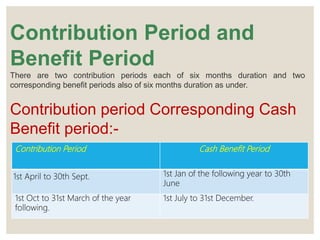
Contribution Period and
Benefit Period
There are two contribution periods each of six months duration and two
corresponding benefit periods also of six months duration as under.
Contribution period Corresponding Cash
Benefit period:-
Contribution Period Cash Benefit Period
1st April to 30th Sept. 1st Jan of the following year to 30th
June
1st Oct to 31st March of the year
following.
1st July to 31st December.
REGISTRATION
◦ The registration of a factory/establishment with the
Employees' State Insurance Corporation is a statutory
responsibility of the employer under Section 2-A of the
Act, read with Regulation10-B.
◦ The owner of a factory/establishment to which the Act
applies for the first time is liable to furnish to the
appropriate regional office, within 15 days after the Act
becomes applicable, a declaration of registration in Form
01.. On receipt of the 01 Form] the regional office will
examine the coverage; and after it is satisfied that the Act
applies-to the factory/establishment, will allot a code
number to the employer.
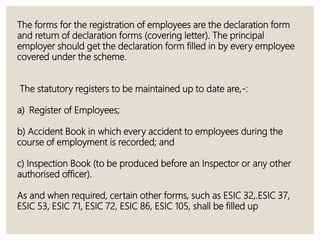
The forms for the registration of employees are the declaration form
and return of declaration forms (covering letter). The principal
employer should get the declaration form filled in by every employee
covered under the scheme.
The statutory registers to be maintained up to date are,-:
a) Register of Employees;
b) Accident Book in which every accident to employees during the
course of employment is recorded; and
c) Inspection Book (to be produced before an Inspector or any other
authorised officer).
As and when required, certain other forms, such as ESIC 32,.ESIC 37,
ESIC 53, ESIC 71, ESIC 72, ESIC 86, ESIC 105, shall be filled up
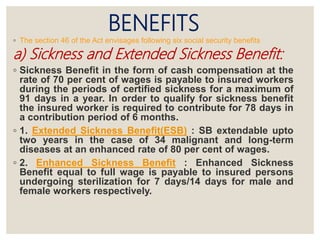
BENEFITS
◦ The section 46 of the Act envisages following six social security benefits
a) Sickness and Extended Sickness Benefit:
◦ Sickness Benefit in the form of cash compensation at the
rate of 70 per cent of wages is payable to insured workers
during the periods of certified sickness for a maximum of
91 days in a year. In order to qualify for sickness benefit
the insured worker is required to contribute for 78 days in
a contribution period of 6 months.
◦ 1. Extended Sickness Benefit(ESB) : SB extendable upto
two years in the case of 34 malignant and long-term
diseases at an enhanced rate of 80 per cent of wages.
◦ 2. Enhanced Sickness Benefit : Enhanced Sickness
Benefit equal to full wage is payable to insured persons
undergoing sterilization for 7 days/14 days for male and
female workers respectively.
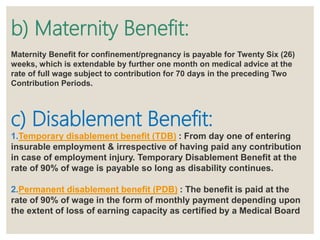
b) Maternity Benefit:
Maternity Benefit for confinement/pregnancy is payable for Twenty Six (26)
weeks, which is extendable by further one month on medical advice at the
rate of full wage subject to contribution for 70 days in the preceding Two
Contribution Periods.
c) Disablement Benefit:
1.Temporary disablement benefit (TDB) : From day one of entering
insurable employment & irrespective of having paid any contribution
in case of employment injury. Temporary Disablement Benefit at the
rate of 90% of wage is payable so long as disability continues.
2.Permanent disablement benefit (PDB) : The benefit is paid at the
rate of 90% of wage in the form of monthly payment depending upon
the extent of loss of earning capacity as certified by a Medical Board
d) Dependents' Benefit:
DB paid at the rate of 90% of wage in the form of
monthly payment to the dependants of a deceased
Insured person in cases where death occurs due
to employment injury or occupational hazards
e) Funeral Benefit:
An amount of Rs.15,000/- is payable to the
dependents or to the person who performs last
rites from day one of entering insurable
employment.
f) Medical Benefit:
The kingpin of the scheme is, medical benefit, which consists of free medical
attendance and* treatment of insured persons and their families.
This benefit has been divided into three parts
i) Restricted Medical Care: it consists of out-patient medical care at
dispensaries or panel clinics.
ii) Expanded Medical Care: This consists of consultation with specialists and
supply of such medicines and drugs as may be prescribed by them.
iii) Full Medical Care It consists of hospitalisation facilities, services of
specialists and such drugs and diet as are required for in-patients.
An insured person and members of his family are entitled to medical care of
all the above three varieties.
RESTRICTIONS
◦ When a person is entitled to- any of the benefits provided
under this Act, he shall not be entitled to receive any similar
benefit under any other enactment.
◦ An insured person will not be entitled to receive for the same
period.
◦ Both sickness benefit and maternity benefit; or
◦ Both sickness benefit and disablement benefit for temporary
disablement; or
◦ Both maternity benefit and disablement benefit for temporary
disablement.
◦ Where a person is entitled to more than one of the benefits, he
has an option to select' any one of them. .
PROTECTION
◦ The employer cannot dismiss, discharge or
otherwise punish an employee during the, period
he/she is in receipt of sickness benefit or maternity
benefit, or of disablement, benefit, or. is under
medical treatment for sickness; or is absent from
work as a result of illness which arises out of
pregnancy or confinement: Any notice of dismissal,
discharge or reduction during the period specified
above is invalid and inoperative.
An employer can discharge or punish an employee on due
notice if
i) He/she has received temporary disablement benefit and
remained absent for six months or more continuously;
ii) He/she is under medical treatment for sickness, otherwise
than T.B. or a disease arising out of pregnancy, and has
remained absent continuously for six months or more; and
23 Insurance, Act, 1948
iii) He/she is under medical treatment for T.B. or 6:
malignant disease and has remained absent continuously for
18 months or more (Section 73 and Regulation 98).
PENALTIES AND DAMAGES
◦ The Act provides for penalties and damages for various
offences. It also provides that if any person commits any
offence after having been convicted by the court, he will
be punishable, for every such subsequent offence, with
imprisonment for a term which may extend up to Rs.
2,000 or both.
◦ If the subsequent offence is for failure to pay any
contribution, then for every such subsequent offence a
person is liable to punishment for a term of imprisonment
which may extend up to one year and which shall not be
less than 3 months; and he will also be liable to pay. a.
fine up to Rs. 4,000
Any contribution due under the Act and not paid can be
recovered through the District Collector under Section 45-
B of the Act as arrears of land revenue. The employer can
raise any dispute for adjudication in the Employees'
Insurance Court of the area, set up under Section 74 of the
Act.
Under Regulation 31-A, the employer is liable to pay
interest at the rate of 6 per cent per annum for each day
of default or delay in the payment of his contribution. In
addition, under Section 85-B of the Act, the Corporation is
empowered to recover damages from the employer who
fails to pay the contribution or delays payment. The
amount of damages, however, cannot exceed the amount
of contribution. The damages can also be recovered as
arrears of land revenue.
MISCELLANEOUS
◦ Cash benefits payable under the Employees' State Insurance
Act are not liable to attachment or sale in execution of any
court decree or order. Also, the right to receive any benefit is
not transferable or assignable.
◦ Where a dispute arises under the provisions of the Act, that
matter has to be decided by the Employees' Insurance Court
and not by a civil court.
◦ An appeal will lie to the High Court from an order of the
Employees' Insurance Court if it involves a substantial question
of law. The period of limitation for appeal is 60 days. The delay
can be condoned for sufficient reasons.
Esi act,1948

Esi act,1948

  • 1.
    Dr. B.R. AMBEDKARUNIVERSITY AGRA (Formerly: Agra University, Agra) Institute of Social Science, Paliwal Park, Agra Department of Social Work SWM- 305(A) INDIAN LABOUR PROBLEMS AND LEGISLATIONS PPT ON EMPLOYEES STATE INSURANCE ACT,1948 PRESENTED BY:- SHEKHAR UPADHYAYA MSW IIIrd SEMESTER
  • 2.
    INTRODUCTION ◦ Employees’ StateInsurance Scheme of India, is a multidimensional social security system tailored to provide socio-economic protection to worker population and their dependents covered under the scheme. ◦ The scheme was inaugurated in Kanpur on 24th February 1952. The comprehensive and multi-pronged social security programme is administered by an apex corporate body called the Employees' State Insurance Corporation
  • 3.
    APPLICABILITY OF THEACT Under Section 1(4) of the Act, the implementation of the scheme is territorial. The Act applies in the first instance to all factories using power and employing 20 or more persons on wages. ◦ The provisions of the Act have also been extended, or are being gradually extended, under Section 1(5) of the Act to cover ◦ a) Smaller power-using factories employing 10 to 19 persons; ◦ b) Non-power using factories employing 20 or more persons; ◦ c) Shops; ◦ d) Hotels and restaurants; ◦ e) Cinemas, including preview theatres; ◦ f) Newspaper establishments; and ◦ g) Road motor transport undertakings employing 20 or more persons.
  • 4.
    The Act, however,does not apply to a mine or railway running shed,. and specified seasonal factories. The State Government may extend the provisions of the Act to cover other establishments or class of establishments, industrial, commercial, agricultural or otherwise, in consultation with the Corporation and with the approval of the Central Government, after giving six months notice of its intention to do so in the Official Gazette.
  • 5.
    ADMINISTRATION ◦ The Hqrs.of the ESI Corporation is located at Delhi and has 66 Field Offices ◦ which include 23 Regional Offices, ◦ 37 Sub-Regional Offices, ◦ 1 Divisional Office, ◦ 2 Camp Offices and 3 Liaison Offices throughout the country. ◦ Besides, there are 627 Branch Offices and 185 Pay Offices for administration of 2 cash benefits to Insured Persons. ◦ For inspection and coverage of factories/Establishment, 422 Inspection Offices are also set up across the Country.
  • 6.
    CONTRIBUTION ◦ E.S.I. Schemebeing contributory in nature, all the employees in the factories or establishments to which the Act applies shall be insured in a manner provided by the Act. ◦ The contribution payable to the Corporation in respect of an employee shall comprise of employer's contribution and employee's contribution at a specified rate. ◦ The rates are revised from time to time. Currently, the employee's contribution rate (w.e.f. 01.07.2019) is 0.75% of the wages and that of employer's is 3.25% of the wages paid/payable in respect of the employees in every wage period.
  • 7.
    Employees in receiptof a daily average wage upto Rs.137/- are exempted from payment of contribution. Employers will however contribute their own share in respect of these employees.
  • 8.
    Collection of Contribution An employeris liable to pay his contribution in respect of every employee and deduct employees contribution from wages bill and shall pay these contributions at the above specified rates to the Corporation within 15 days of the last day of the Calendar month in which the contributions fall due. The Corporation has authorized designated branches of the State Bank of India and some other banks to receive the payments on its behalf.
  • 9.
    Contribution Period and BenefitPeriod There are two contribution periods each of six months duration and two corresponding benefit periods also of six months duration as under. Contribution period Corresponding Cash Benefit period:- Contribution Period Cash Benefit Period 1st April to 30th Sept. 1st Jan of the following year to 30th June 1st Oct to 31st March of the year following. 1st July to 31st December.
  • 10.
    REGISTRATION ◦ The registrationof a factory/establishment with the Employees' State Insurance Corporation is a statutory responsibility of the employer under Section 2-A of the Act, read with Regulation10-B. ◦ The owner of a factory/establishment to which the Act applies for the first time is liable to furnish to the appropriate regional office, within 15 days after the Act becomes applicable, a declaration of registration in Form 01.. On receipt of the 01 Form] the regional office will examine the coverage; and after it is satisfied that the Act applies-to the factory/establishment, will allot a code number to the employer.
  • 11.
    The forms forthe registration of employees are the declaration form and return of declaration forms (covering letter). The principal employer should get the declaration form filled in by every employee covered under the scheme. The statutory registers to be maintained up to date are,-: a) Register of Employees; b) Accident Book in which every accident to employees during the course of employment is recorded; and c) Inspection Book (to be produced before an Inspector or any other authorised officer). As and when required, certain other forms, such as ESIC 32,.ESIC 37, ESIC 53, ESIC 71, ESIC 72, ESIC 86, ESIC 105, shall be filled up
  • 12.
    BENEFITS ◦ The section46 of the Act envisages following six social security benefits a) Sickness and Extended Sickness Benefit: ◦ Sickness Benefit in the form of cash compensation at the rate of 70 per cent of wages is payable to insured workers during the periods of certified sickness for a maximum of 91 days in a year. In order to qualify for sickness benefit the insured worker is required to contribute for 78 days in a contribution period of 6 months. ◦ 1. Extended Sickness Benefit(ESB) : SB extendable upto two years in the case of 34 malignant and long-term diseases at an enhanced rate of 80 per cent of wages. ◦ 2. Enhanced Sickness Benefit : Enhanced Sickness Benefit equal to full wage is payable to insured persons undergoing sterilization for 7 days/14 days for male and female workers respectively.
  • 13.
    b) Maternity Benefit: MaternityBenefit for confinement/pregnancy is payable for Twenty Six (26) weeks, which is extendable by further one month on medical advice at the rate of full wage subject to contribution for 70 days in the preceding Two Contribution Periods. c) Disablement Benefit: 1.Temporary disablement benefit (TDB) : From day one of entering insurable employment & irrespective of having paid any contribution in case of employment injury. Temporary Disablement Benefit at the rate of 90% of wage is payable so long as disability continues. 2.Permanent disablement benefit (PDB) : The benefit is paid at the rate of 90% of wage in the form of monthly payment depending upon the extent of loss of earning capacity as certified by a Medical Board
  • 14.
    d) Dependents' Benefit: DBpaid at the rate of 90% of wage in the form of monthly payment to the dependants of a deceased Insured person in cases where death occurs due to employment injury or occupational hazards e) Funeral Benefit: An amount of Rs.15,000/- is payable to the dependents or to the person who performs last rites from day one of entering insurable employment.
  • 15.
    f) Medical Benefit: Thekingpin of the scheme is, medical benefit, which consists of free medical attendance and* treatment of insured persons and their families. This benefit has been divided into three parts i) Restricted Medical Care: it consists of out-patient medical care at dispensaries or panel clinics. ii) Expanded Medical Care: This consists of consultation with specialists and supply of such medicines and drugs as may be prescribed by them. iii) Full Medical Care It consists of hospitalisation facilities, services of specialists and such drugs and diet as are required for in-patients. An insured person and members of his family are entitled to medical care of all the above three varieties.
  • 16.
    RESTRICTIONS ◦ When aperson is entitled to- any of the benefits provided under this Act, he shall not be entitled to receive any similar benefit under any other enactment. ◦ An insured person will not be entitled to receive for the same period. ◦ Both sickness benefit and maternity benefit; or ◦ Both sickness benefit and disablement benefit for temporary disablement; or ◦ Both maternity benefit and disablement benefit for temporary disablement. ◦ Where a person is entitled to more than one of the benefits, he has an option to select' any one of them. .
  • 17.
    PROTECTION ◦ The employercannot dismiss, discharge or otherwise punish an employee during the, period he/she is in receipt of sickness benefit or maternity benefit, or of disablement, benefit, or. is under medical treatment for sickness; or is absent from work as a result of illness which arises out of pregnancy or confinement: Any notice of dismissal, discharge or reduction during the period specified above is invalid and inoperative.
  • 18.
    An employer candischarge or punish an employee on due notice if i) He/she has received temporary disablement benefit and remained absent for six months or more continuously; ii) He/she is under medical treatment for sickness, otherwise than T.B. or a disease arising out of pregnancy, and has remained absent continuously for six months or more; and 23 Insurance, Act, 1948 iii) He/she is under medical treatment for T.B. or 6: malignant disease and has remained absent continuously for 18 months or more (Section 73 and Regulation 98).
  • 19.
    PENALTIES AND DAMAGES ◦The Act provides for penalties and damages for various offences. It also provides that if any person commits any offence after having been convicted by the court, he will be punishable, for every such subsequent offence, with imprisonment for a term which may extend up to Rs. 2,000 or both. ◦ If the subsequent offence is for failure to pay any contribution, then for every such subsequent offence a person is liable to punishment for a term of imprisonment which may extend up to one year and which shall not be less than 3 months; and he will also be liable to pay. a. fine up to Rs. 4,000
  • 20.
    Any contribution dueunder the Act and not paid can be recovered through the District Collector under Section 45- B of the Act as arrears of land revenue. The employer can raise any dispute for adjudication in the Employees' Insurance Court of the area, set up under Section 74 of the Act. Under Regulation 31-A, the employer is liable to pay interest at the rate of 6 per cent per annum for each day of default or delay in the payment of his contribution. In addition, under Section 85-B of the Act, the Corporation is empowered to recover damages from the employer who fails to pay the contribution or delays payment. The amount of damages, however, cannot exceed the amount of contribution. The damages can also be recovered as arrears of land revenue.
  • 21.
    MISCELLANEOUS ◦ Cash benefitspayable under the Employees' State Insurance Act are not liable to attachment or sale in execution of any court decree or order. Also, the right to receive any benefit is not transferable or assignable. ◦ Where a dispute arises under the provisions of the Act, that matter has to be decided by the Employees' Insurance Court and not by a civil court. ◦ An appeal will lie to the High Court from an order of the Employees' Insurance Court if it involves a substantial question of law. The period of limitation for appeal is 60 days. The delay can be condoned for sufficient reasons.