
The Employees State Insurance
Act,1948
Introduction
• Social insurance of india
• The Adakar plan- Workmen’s State Insurance
Bill, 1946
• A social welfare legislation with the objective
of providing benefits to employees- sickness,
maternity and employment injury.
• Act tries to attain socio-economic justice
enshrined in DPSP under part IV of the
constitution
Benefits of the Act
To Insured Person:
• Sickness Benefit
• Maternity Benefit
• Disablement Benefit
• Dependents Benefit
• Medical Benefit
• Funeral Expenses
• Different from Factories Act
• Extensive regulations have been framed under
this act to identify the employees who would
be entitled to the benefits.
• ESI Corporation
Applicability of the Act
• Under Section 1(4), implementation of the scheme is
territorial
• The act applies to all factories using power and employing
20 or more persons on wages
• Provisions have also been extended to:
o Smaller power using factories employing 10-19 persons
o Non-Power using factories employing 20 or more persons
o Shops
o Hotels and Restaurants
o Cinemas, including preview theatres
o Newspaper Establishments
o Road motor undertaking employing 20 or more persons
• Does not apply to:
• Mine or railway shed
• Specified seasonal factories
Some Definitions
• Employee- under Section 2(9), to any person employed on
wages, in connection with the work of a factory to which
this act applies.
• Remuneration excluding over time does not exceed
Rs.6500 pm are covered
• No distinction between casual and temporary or between
technical or non technical employees
• Employed by the principal employer or contractor on the
factory premises or outside by the principal employer are
all included in this act
• Includes Administrative staff and persons engaged in the
raw materials or the distribution or the sale of the products
Wages
• Remuneration paid in cash, if the terms of the contract
are fulfilled and includes any payment in any period of
authorized leave, lockout or strike which is not illegal
or lay off and includes other remuneration paid at
intervals not exceeding two months.
• It does not include:
• Contribution paid to the PF or Pension Fund
• Travelling allownace or value of travelling concession
• Sum paid to defray special expenses
• Gratuity payable on discharge
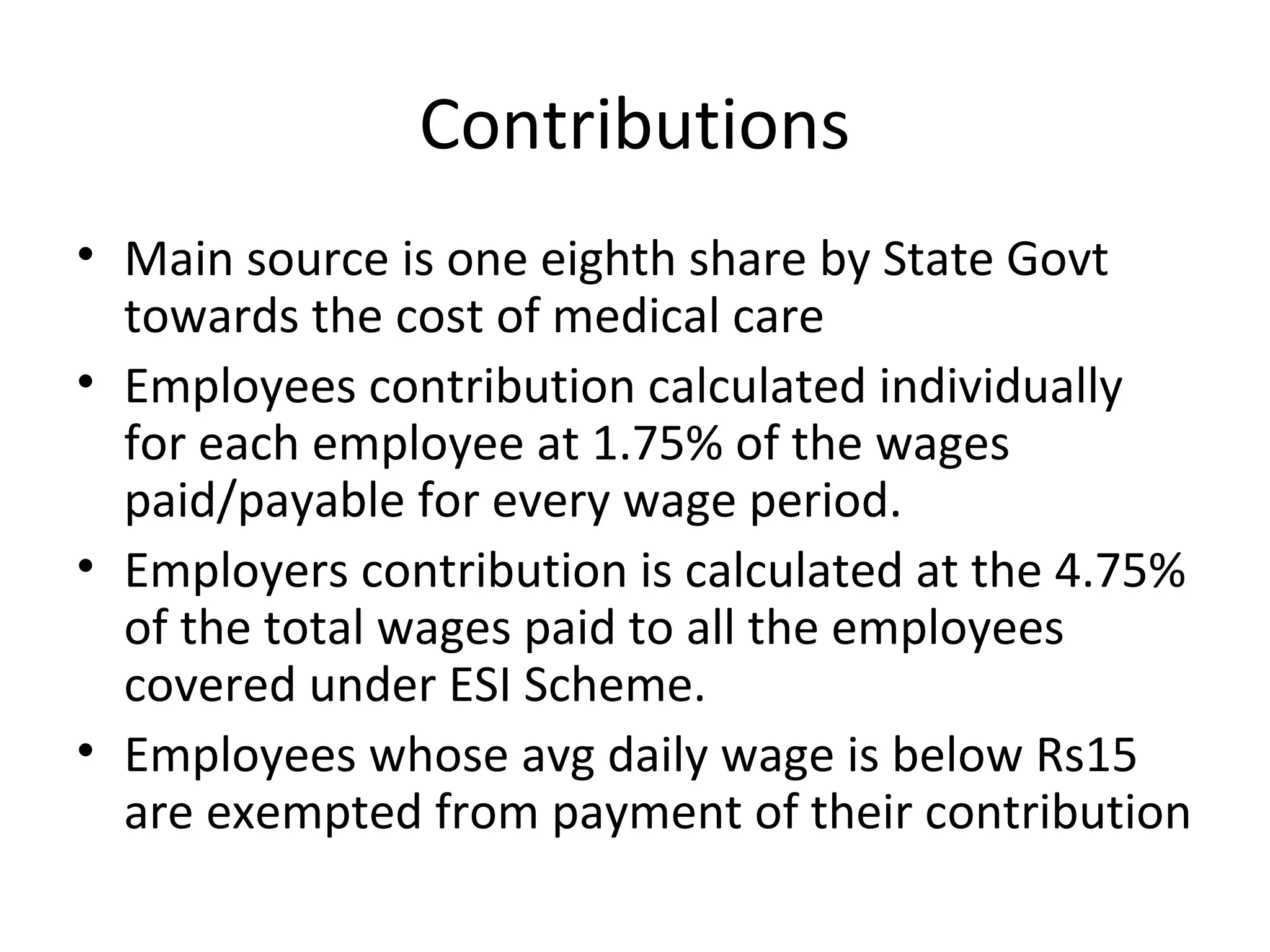
Contributions
• Main source is one eighth share by State Govt
towards the cost of medical care
• Employees contribution calculated individually
for each employee at 1.75% of the wages
paid/payable for every wage period.
• Employers contribution is calculated at the 4.75%
of the total wages paid to all the employees
covered under ESI Scheme.
• Employees whose avg daily wage is below Rs15
are exempted from payment of their contribution
• Contribution period and benefit period is fixed
for the purpose of paying contributions
• Contribution benefit period from 1st
April to
30th
September, the corresponding period will
be from 1st
Oct to 31st
March of the following
year, the corresponding benefit period shall
be from 1st
july to 31st
December.
• For newly employed person, first contribution
period commences on the expiry of 9 months
from the said sate.
Registration
• Registration of a establishment with ESI is the
responsibility of the employer under Section 2-A
of the act
• Within 15 days after the act becomes applicable
the owner is liable to furnish to the appropriate
regional office.
• Form 01
• Forms for the registration of employees are the
declaration form and rerun of the declaration
forms.
• The statutory registers to be maintained up to
date are:
o Register of Employees
o Accident Book in which every accident to
employees during the course of employment
is recorded
o Inspection Book
• As and when required certain other forms
such as ESIC32, ESIC37, ESIC53, ESIC71,
ESIC72, ESIC 86, ESIC105
Administration
• The scheme is administered by a corporate body called
ESIC
• Comprises of- employees, employers, the parliament,
central and state governments and medical profession.
• Responsible for- policy planning, decision making and
overseeing the functioning of the scheme through a
standing committee drawn from main corporate body.
• Headed by- Union Minister of Labour as its Chairman
• CEO is the DG who is the ex-officio member of the
corporation and its standing committee.
• Responsible for- formulation of policy, overall supervision,
co-ordination and liaison with Central and State Govt.
• ESIC has setup local offices all over the country for the
implementation of the scheme.
Benefits
• Sickness and extended sickness benefit-
• Standard benefit rate for 91 days in any two
consecutive benefit period.
• Eligibility criteria
• Extended sickness benefit for special long term
ailment like T.B, leprosy, mental disease
• Benefit at a rate which is 40% higher than the
standard benefit rate, rounded to the next higher
multiple of 5 paise for a period of 124/309 days.
• For Deserving cases duration may increase from
400 days to a maximum period of 2 years
Maternity Benefit
• Only insured woman is entitled to this benefit
• At double the standard benefit rate
• Equal to full wages for a period of 12 weeks of which not
more than 6 weeks shall precede the expected date
• Additional benefit in case of miscarriage.
• In case of sickness arising out of miscarriage, pregnancy,
confinement and premature birth additional benefit is given
for a period of one month
• Eligibility- 80 days in one or more preceding contribution
periods of one year
Disablement Benefit
• Member suffering injury in the course of employment will
receive free medical treatment and temporary disablement
benefit in cash.
• It is 70% of the wages as long as temporary disablement lasts,
provided it has lasted for not less than 3 days excluding the
day of accident.
• In case of permanent disablement life pension at full rate that
is 70% of his wages.
• Wages are paid on Sundays as well
Dependent’s Benefit
• Timely help to the eligible dependents of an insured member
who dies as a result of an accident or an occupational disease
arising out of in the course of employment.
• 40% pension rate more than the standard benefit rate i.e.
70% of wages will be paid periodically to the widow and
children.
• Available to the widow as long as she lives or until she
marries, to sons and daughters upto the age of 18 without
any proof of education.
• If widow, child is not left then benefit is given to parents or
grandparents but equivalent to 3/10ths of the full rate.
• 2 or more parents and grandparents the benefit is divided
equally between them.
Funeral and Medical Benefit
• 1968- funeral benefit
• Amount not exceeding Rs.1500 is payable to the eldest
surviving member of the deceased insured person. Time
period is 3 months from the death.
• Medical benefit consists of free medical attendance and
treatment of insured persons and their families.
• Benefits is divided into 3 parts:
o Restricted Medical Care
o Expanded Medical Care
o Full Medical Care
Restrictions
• Receiving any benefits provided under this act, he is not
entitled to receive any similar benefit.
• The insured person will not be entitled to receive for the
same period:
o Both sickness and maternity benefits
o Both sickness and disablement benefit for temporary
disablement
o Both maternity and disablement benefit for temporary
disablement
• If a person is entitled to more than one benefits he has an
option to select any one of them
Protection
• The employer cannot dismiss, discharge or punish any
employee during the period that person is in receipt of
sickness, maternity or disablement benefit.
• An employer can discharge or dismiss an employee on due
notice if:
o He/she received temporary disablement and remained
absent for 6 or more months continuously
o He/she is under medical treatment for sickness other than T.B
or a disease arising out of pregnancy and has remained
absent continuously for 6 months or more
o He/she is under medical treatment for T.B. or a malignant
disease and has remained absent continuously for 18 months
Penalties and Damages
• A person commits an offence after having been convicted by
court he will be punishable for every such subsequent offence
with imprisonment for a term which may extend upto 2000rs
or both
• Subsequent offence is for failure to pay any contribution then
person is liable for a term of imprisonment which may extend
to 1 year and not less than 3 months and fine of Rs4000
Miscellaneous
• Cash benefits payable under the ESIC are not liable to
attachment or sale in execution of any court decree or order.
• Any dispute arises under this Act, the matter is decided by the
Employee Insurance Court and not by Civil Court
• An appeal will lie in the High Court from an order of the
Employees Insurance Court, it it involves substancial question
of law.
• Period of limitation for appeal is 60 days.

The employees state insurance act,1948

  • 1.
    The Employees StateInsurance Act,1948
  • 2.
    Introduction • Social insuranceof india • The Adakar plan- Workmen’s State Insurance Bill, 1946 • A social welfare legislation with the objective of providing benefits to employees- sickness, maternity and employment injury. • Act tries to attain socio-economic justice enshrined in DPSP under part IV of the constitution
  • 3.
    Benefits of theAct To Insured Person: • Sickness Benefit • Maternity Benefit • Disablement Benefit • Dependents Benefit • Medical Benefit • Funeral Expenses
  • 4.
    • Different fromFactories Act • Extensive regulations have been framed under this act to identify the employees who would be entitled to the benefits. • ESI Corporation
  • 5.
    Applicability of theAct • Under Section 1(4), implementation of the scheme is territorial • The act applies to all factories using power and employing 20 or more persons on wages • Provisions have also been extended to: o Smaller power using factories employing 10-19 persons o Non-Power using factories employing 20 or more persons o Shops o Hotels and Restaurants o Cinemas, including preview theatres o Newspaper Establishments o Road motor undertaking employing 20 or more persons
  • 6.
    • Does notapply to: • Mine or railway shed • Specified seasonal factories
  • 7.
    Some Definitions • Employee-under Section 2(9), to any person employed on wages, in connection with the work of a factory to which this act applies. • Remuneration excluding over time does not exceed Rs.6500 pm are covered • No distinction between casual and temporary or between technical or non technical employees • Employed by the principal employer or contractor on the factory premises or outside by the principal employer are all included in this act • Includes Administrative staff and persons engaged in the raw materials or the distribution or the sale of the products
  • 8.
    Wages • Remuneration paidin cash, if the terms of the contract are fulfilled and includes any payment in any period of authorized leave, lockout or strike which is not illegal or lay off and includes other remuneration paid at intervals not exceeding two months. • It does not include: • Contribution paid to the PF or Pension Fund • Travelling allownace or value of travelling concession • Sum paid to defray special expenses • Gratuity payable on discharge
  • 9.
    Contributions • Main sourceis one eighth share by State Govt towards the cost of medical care • Employees contribution calculated individually for each employee at 1.75% of the wages paid/payable for every wage period. • Employers contribution is calculated at the 4.75% of the total wages paid to all the employees covered under ESI Scheme. • Employees whose avg daily wage is below Rs15 are exempted from payment of their contribution
  • 10.
    • Contribution periodand benefit period is fixed for the purpose of paying contributions • Contribution benefit period from 1st April to 30th September, the corresponding period will be from 1st Oct to 31st March of the following year, the corresponding benefit period shall be from 1st july to 31st December. • For newly employed person, first contribution period commences on the expiry of 9 months from the said sate.
  • 11.
    Registration • Registration ofa establishment with ESI is the responsibility of the employer under Section 2-A of the act • Within 15 days after the act becomes applicable the owner is liable to furnish to the appropriate regional office. • Form 01 • Forms for the registration of employees are the declaration form and rerun of the declaration forms.
  • 12.
    • The statutoryregisters to be maintained up to date are: o Register of Employees o Accident Book in which every accident to employees during the course of employment is recorded o Inspection Book • As and when required certain other forms such as ESIC32, ESIC37, ESIC53, ESIC71, ESIC72, ESIC 86, ESIC105
  • 13.
    Administration • The schemeis administered by a corporate body called ESIC • Comprises of- employees, employers, the parliament, central and state governments and medical profession. • Responsible for- policy planning, decision making and overseeing the functioning of the scheme through a standing committee drawn from main corporate body. • Headed by- Union Minister of Labour as its Chairman • CEO is the DG who is the ex-officio member of the corporation and its standing committee. • Responsible for- formulation of policy, overall supervision, co-ordination and liaison with Central and State Govt. • ESIC has setup local offices all over the country for the implementation of the scheme.
  • 14.
    Benefits • Sickness andextended sickness benefit- • Standard benefit rate for 91 days in any two consecutive benefit period. • Eligibility criteria • Extended sickness benefit for special long term ailment like T.B, leprosy, mental disease • Benefit at a rate which is 40% higher than the standard benefit rate, rounded to the next higher multiple of 5 paise for a period of 124/309 days. • For Deserving cases duration may increase from 400 days to a maximum period of 2 years
  • 15.
    Maternity Benefit • Onlyinsured woman is entitled to this benefit • At double the standard benefit rate • Equal to full wages for a period of 12 weeks of which not more than 6 weeks shall precede the expected date • Additional benefit in case of miscarriage. • In case of sickness arising out of miscarriage, pregnancy, confinement and premature birth additional benefit is given for a period of one month • Eligibility- 80 days in one or more preceding contribution periods of one year
  • 16.
    Disablement Benefit • Membersuffering injury in the course of employment will receive free medical treatment and temporary disablement benefit in cash. • It is 70% of the wages as long as temporary disablement lasts, provided it has lasted for not less than 3 days excluding the day of accident. • In case of permanent disablement life pension at full rate that is 70% of his wages. • Wages are paid on Sundays as well
  • 17.
    Dependent’s Benefit • Timelyhelp to the eligible dependents of an insured member who dies as a result of an accident or an occupational disease arising out of in the course of employment. • 40% pension rate more than the standard benefit rate i.e. 70% of wages will be paid periodically to the widow and children. • Available to the widow as long as she lives or until she marries, to sons and daughters upto the age of 18 without any proof of education. • If widow, child is not left then benefit is given to parents or grandparents but equivalent to 3/10ths of the full rate. • 2 or more parents and grandparents the benefit is divided equally between them.
  • 18.
    Funeral and MedicalBenefit • 1968- funeral benefit • Amount not exceeding Rs.1500 is payable to the eldest surviving member of the deceased insured person. Time period is 3 months from the death. • Medical benefit consists of free medical attendance and treatment of insured persons and their families. • Benefits is divided into 3 parts: o Restricted Medical Care o Expanded Medical Care o Full Medical Care
  • 19.
    Restrictions • Receiving anybenefits provided under this act, he is not entitled to receive any similar benefit. • The insured person will not be entitled to receive for the same period: o Both sickness and maternity benefits o Both sickness and disablement benefit for temporary disablement o Both maternity and disablement benefit for temporary disablement • If a person is entitled to more than one benefits he has an option to select any one of them
  • 20.
    Protection • The employercannot dismiss, discharge or punish any employee during the period that person is in receipt of sickness, maternity or disablement benefit. • An employer can discharge or dismiss an employee on due notice if: o He/she received temporary disablement and remained absent for 6 or more months continuously o He/she is under medical treatment for sickness other than T.B or a disease arising out of pregnancy and has remained absent continuously for 6 months or more o He/she is under medical treatment for T.B. or a malignant disease and has remained absent continuously for 18 months
  • 21.
    Penalties and Damages •A person commits an offence after having been convicted by court he will be punishable for every such subsequent offence with imprisonment for a term which may extend upto 2000rs or both • Subsequent offence is for failure to pay any contribution then person is liable for a term of imprisonment which may extend to 1 year and not less than 3 months and fine of Rs4000
  • 22.
    Miscellaneous • Cash benefitspayable under the ESIC are not liable to attachment or sale in execution of any court decree or order. • Any dispute arises under this Act, the matter is decided by the Employee Insurance Court and not by Civil Court • An appeal will lie in the High Court from an order of the Employees Insurance Court, it it involves substancial question of law. • Period of limitation for appeal is 60 days.