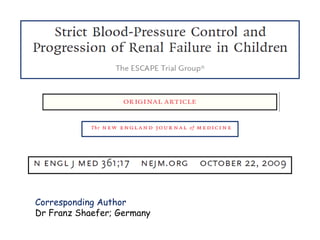
Corresponding Author Dr Franz Shaefer; Germany
Background Children <1% of total CKD  congenital kidney malformations, urinary tract disorders, or genetic disorders Hypertension 50% of children with CKD High BP & proteinuria predictors of the progression of renal disease  Rationale for pharmacologic therapy
Effective BP Control  Delays the CKD progression in adults  Inhibitors of RAS :  superior renoprotection Antiproteinuric Antiinflammatory Antifibrotic properties
MDRD Trial The Effects of Dietary Protein Restriction and Blood-Pressure Control on the Progression of Chronic Renal Disease Saulo Klahr, Andrew S. Levey, Gerald J. Beck, Arlene W. Caggiula, Lawrence Hunsicker, John W. Kusek, and Gary Striker for the Modification of Diet in Renal Disease Study Group N Engl J Med 1994; 330:877-884
Proteinuria: a marker and mechanism of progressive kidney disease MDRD trial.   For each 1 g/d proteinuria decline, GFR decline reduced by 1 ml/min/yr REIN study.  Similar reduction in proteinuria, GFR decline reduced by 2 ml/min/yr Reduce proteinuria; <300 mg/m 2 /d
AASK: African-American Study of Kidney Disease and Hypertension Effect of Blood Pressure Lowering and Antihypertensive Drug Class on Progression of Hypertensive Kidney Disease Results From the AASK Trial  Jackson T. Wright, Jr, MD, PhD; George Bakris, MD; Tom Greene, PhD; Larry Y. Agodoa, MD; Lawrence J. Appel, MD, MPH; Jeanne Charleston, RN; DeAnna Cheek, MD; Janice G. Douglas-Baltimore, MD; Jennifer Gassman, PhD; Richard Glassock, MD; Lee Hebert, MD; Kenneth Jamerson, MD; Julia Lewis, MD; Robert A. Phillips, MD, PhD; Robert D. Toto, MD; John P. Middleton, MD; Stephen G. Rostand, MD;  for the African American Study of Kidney Disease and Hypertension Study Group  JAMA.  2002;288:2421-2431.
Research Question Whether intensified blood pressure control aimed at achieving 24-hour blood-pressure levels in the low range of normal would slow the progression of renal disease among children with chronic renal disease who were receiving fixed-dose ACE-inhibition therapy?
Study Design The  E ffect of  S trict Blood Pressure  C ontrol and  A CE Inhibition on the  P rogression of CRF in P e diatric Patients (ESCAPE) trial  Investigator initiated, randomized, controlled clinical trial
To evaluate the antihypertensive, antiproteinuric and renoprotective efficacy of  fixed-dose ACE inhibition  in children with CKD stage II-IV To evaluate the renoprotective efficacy of  intensified blood pressure control , targeting to low- normal 24h BP, in children receiving fixed-dose ACE inhibition Main Objectives of ESCAPE Trial E S C A P E
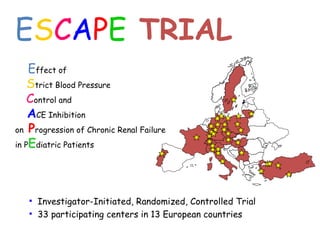
E S C A P E   TRIAL E ffect   of S trict Blood Pressure   C ontrol and  A CE Inhibition on  P rogression   of Chronic Renal Failure in P E diatric Patients Investigator-Initiated, Randomized, Controlled Trial  33 participating centers in 13 European countries
Duration Originally planned as a 3-yr study, with a single interim analysis after 2 yrs. Pre-specified stopping criteria  Significant difference in the incidence of progression to the end point at the interim analysis  Significantly accelerated progression of renal failure  Increased incidence of adverse events in either group Interim analysis Slower overall rate of progression than that anticipated Study period was extended to 5 years
Study Plan Approval  central ethics committee University of Heidelberg  Parents  written informed consent Data collected   local investigators  Analyzed  central location  On site monitoring  independent clinical research organization Aventis Pharmaceuticals (now Sanofi-Aventis)  supplied ramipril financed audit But had no other role design of the study, the accrual or analysis of the data,  the preparation and submission of the manuscript
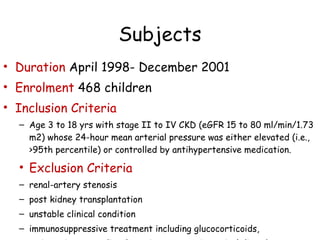
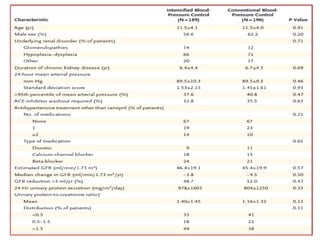
Subjects Duration  April 1998- December 2001 Enrolment  468 children Inclusion Criteria  Age 3 to 18 yrs with stage II to IV CKD (eGFR 15 to 80 ml/min/1.73 m2) whose 24-hour mean arterial pressure was either elevated (i.e., >95th percentile) or controlled by antihypertensive medication.  Exclusion Criteria renal-artery stenosis  post kidney transplantation  unstable clinical condition immunosuppressive treatment including glucocorticoids, major primary cardiac, hepatic, or gastrointestinal disorders.
Premature Withdrawl Withdrawn from study  severe adverse events occurred, a major concomitant disease developed, noncompliant with the protocol, requested to be withdrawn.
Run-in period Visits Ambulatory BP monitoring at screening,  Clinic visits every 2 months for 6 months. End of the run-in period 385 patients met the eligibility criteria Baseline examinations Randomly assigned
Dose ACE inhibitor Ramipril  (Delix, Aventis Pharmaceuticals)  highest antihypertensive dose approved in adults (10 mg per day) adapted for body size — 6 mg/square meter/day. Increased gradually over first 2 mths 1.25-6 mg/square meter/day  Adjusted for the patient’s growth
Stratification and Randomisation Stratification   According to the underlying-disease group  Annualized decrease in the GFR (run-in period)  (Fast decrease, ≥3 ml/min/1.73 m 2 / yr;  Slow decrease, <3 ml ml/min/1.73 m 2 / yr)  Randomly assigned Sequence generation; Allocation concealment; Assignment- NOT Described Non Blinded A blocked randomization scheme block size of four for each center.
Measurements during the study 5-year study period  Every 2 months Blood pressure  outpatient clinic auscultory or oscillometric techniques,  Glomerular filtration rate,  Urinary protein excretion Every 6 months  Ambulatory blood-pressure monitoring
Dose Adjustment As per 24-hr mean arterial pressure to achieve the target levels Any antihypertensive agents except for other antagonists of RAS allowed  A standardized drug-escalation protocol suggested
Outcome Measures Primary efficacy measure  Time from attainment of the full dose (month 2) to the first event of the composite end point (50% reduction in the GFR or progression to ESRD (GFR <10 ml/minute/1.73 m2 or start of RRT) An acute decrease in the GFR (<25%) expected after the start of ACE-inhibitor GFR recorded 2 months after the initiation Secondary end points Changes in  BP GFR Urinary protein excretion.
Laboratory Assessment Central Lab Serum and urinary creatinine  urinary protein eGFR Schwartz formula Proteinuria Up/Ucr  24-hour samples.  If not feasible owing to the patient’s age or to enuresis, Spot (14%)
Statistical Analysis Sample Size Estimated 183 subjects in each gp 80% power  Clinically relevant difference of 12.5 % in the delay of the progression of renal disease  (estimated rate of 85.0% in the group receiving intensified blood-pressure control vs. 72.5% in the group receiving conventional blood-pressure control), Alpha level of 5%.  Anticipated 30% cumulative dropout rate  Screen 475 patients
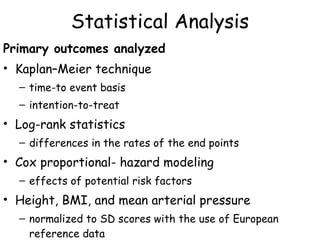
Statistical Analysis Primary outcomes analyzed  Kaplan–Meier technique  time-to event basis  intention-to-treat Log-rank statistics  differences in the rates of the end points  Cox proportional- hazard modeling  effects of potential risk factors Height, BMI, and mean arterial pressure  normalized to SD scores with the use of European reference data Results as means ±SD, unless otherwise stated.
 
 
Primary End Point 46/182 patients in intensified control group 69/190 in conventional-control group,  progressed to the primary end point, corresponding to an  5-year rate of delay in the progression of renal disease of 70.1% vs 58.3%  (P = 0.02 log-rank test) Hazard ratio for progression to the end point with intensified control 0.65 (95% CI], 0.44- 0.94; P = 0.02)
Increased risk of reaching the primary end point Low baseline GFR  (hazard ratio for high GFR, 0.92; 95% CI, 0.91 to 0.94; P<0.001), Greater degree of proteinuria  (hazard ratio, 1.46; 95% CI, 1.35 to 1.59; P<0.001),  Higher 24-hour MAP  (hazard ratio, 1.23; 95% CI, 1.13 to 1.33; P<0.001),  Older age  (hazard ratio, 1.07; 95% CI, 1.02 to 1.12; P = 0.002).  The reduction in risk achieved with intensified BP control remained significant after adjustment for these covariates
Time to event analysis Cox proportional hazards regression  Used to describe the outcome of drug studies The hazard ratio  Odds that an individual in the group with the higher hazard reaches the endpoint first.  E.g. trial examining time to disease resolution Define:  the odds that a treated patient will resolve symptoms before a control patient.
 
Kaplan Meier Curves
 
Proteinuria and Progression Initial 50% reduction in proteinuria within the first 2 mths after initiation of ramipril  highly predictive of a delay in the progression of renal disease  (hazard ratio, 0.46; 95% CI, 0.27 to 0.79;  P = 0.005)
 
Updated version of Lewis and Ellis's original plot showing effect of β blockers on mortality. Lewis S , Clarke M BMJ 2001;322:1479-1480 ©2001 by British Medical Journal Publishing Group
Intervention group does better than control  OR = 1.0 (no effect) Intervention group does worse than control
i. Probably a small study, with a wide confidence interval, crossing the line of no effect (OR = 1). Unable to say if the intervention works
ii. Probably a small study, wide confidence interval , but does not cross OR = 1; suggests intervention works but weak evidence
iii. Larger study, narrow confidence interval: but crosses OR = 1; no evidence that intervention works
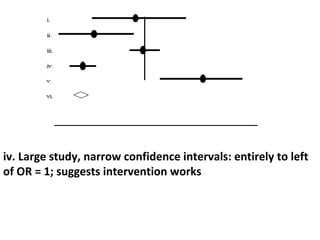
iv. Large study, narrow confidence intervals: entirely to left of OR = 1; suggests intervention works
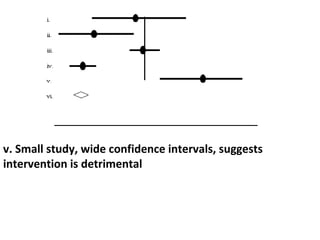
v. Small study, wide confidence intervals, suggests intervention is detrimental
vi. Meta-analysis of all identified studies: suggests intervention works.
 
Secondary Outcomes BP 24-hour mean arterial pressure continued to be reduced during the 5-year study pd, mean 81.8±7.5 mm Hg (SDS of 0.02±1.3) (P<0.001) Mean dose ramipril  5.2±1.3 mg/square meter/day intensified-control group  5.1±1.4 mg per square meter per day conventional-control group (P = 0.50).  Adherence-repetitive plasma ACE activity, decreased from 58±29 IU/liter baseline 13±10 IU/liter during treatment excellent compliance
Secondary Outcomes Mean number of antihypertensive drugs prescribed per patient in addition to ramipril 0.9±1.1 in the intensified-control group,  0.5±0.9 in the conventional-control group  (P = 0.003).
Target Mean BP reached Intensified-control group 60% of the patients at 12 months 73% at 24 months  71% at 36 months 72% at 48 months  74% at 60 months Conventional-control group , 24-hour mean arterial pressure dropped below the 50th percentile even with ramipril monotherapy in more than 50% of the patients. (P = 0.002 to 0.03).
 
 
Secondary Outcomes Reduction in GFR The acute change during the initiation of ramipril therapy (months 0 to 2)  − 2.1±6.9 ml per minute per 1.73 m2 No significant difference  change of −1.6±7.2 in the intensified-control group  − 2.6±6.5 in the conventional-control group, P = 0.22).  Annual reduction in the GFR 1.1±7.8 ml per minute per 1.73 m2 intensified- control group  2.5±5.9 in the conventional-control group (P = 0.29).
Secondary Outcomes Median proteinuria reduction (First 6 mths) From 0.82 g of protein/ gm creatinine (interquartile range, 0.27 to 1.74)  to 0.36 g of protein/gm creatinine (interquartile range, 0.11 to 0.95) (P<0.001). In contrast to the persistently excellent BP control,  proteinuria gradually increased again over time proteinuria after 36 months did not differ significantly from that at baseline
 
Discussion Intensified blood-pressure control delays the progression of renal disease in CKD on fixed high dose ACE inhibitor. Target blood pressure in the low range of normal  35% reduction in the relative risk of losing 50% of renal function or progression to ESRD within 5 years after the initiation  Underlying glomerulopathy or renal hypoplasia or dysplasia The dose of ramipril used  the highest antihypertensive dose approved in adults,  higher by a factor of four than that used any renoprotective effect of intensified BP control would be independent of and additive to that of inhibition of the renin–angiotensin system.
Comparison previous studies Consistent with the results of the Modification of Diet in Renal Disease (MDRD) trial involving patients with CKD & proteinuria Mean follow-up period longer than previous adult trials No difference between the treatment  groups would have been detected if 3 years!
Late Proteinuria increase “ Aldosterone breakthrough” phenomenon,  40% of adults receiving long-term ACE-inhibitor therapy up-regulation of other enzymes such as chymase.  intrarenal vasoactive mediators up-regulated over time to compensate for the reduced angiotensin tone.  Preliminary results among participants  up-regulation of urinary excretion of endothelin- 1 that parallels the rise in proteinuria. Reflect the natural course of the underlying kidney disorders
ET-1 TGF  UPCR ** ** * *** *** * *** **
Aldosterone Breakthrough Most favored explanation  Non-ACE enzymes are capable of cleaving angiotensin I to angiotensin II
In CKD, a high, fixed dose of an ACE inhibitor,  progression slowed significantly by intensified BP control targeting to low-normal 24h MAP.  Risk of losing 50% GFR or attaining ESRD within 5 yrs reduced by almost 50 %  (renal survival 70.1    83.6 %). Although more prominent in glomerulopathies, the renoprotective benefit from intensified BP control also significant in hypo/dysplastic kidney disease.  Ongoing or recurrent proteinuria is a risk factor for progressive renal failure even with excellent BP control.  Conclusions
Future Prospects Proteinuria clearly inversely associated preservation of kidney function  rate of decline in the GFR  Follow-up strategies needed to treat patients in whom secondary proteinuria resistant to ACE-inhibitor therapy ESCAPE II- Telmisartan add on
Critical Appraisal Well written Randomised controlled Trial Consort guidelines Primary, Secondary Outcomes Sample size calculation Randomisation; Allocation Concealment Statisitical Analysis
Strengths RCT design; consort guidelines Use of consistent standardized protocols Ambulatory BP used First study in pediatric CKD on progression Longer follow up than any trial; even adults Used samples for further experiments Well Planned The largest pharmacological trial that has ever been accomplished in paediatric nephrology

Escape

  • 1.
    Corresponding Author DrFranz Shaefer; Germany
  • 2.
    Background Children <1%of total CKD congenital kidney malformations, urinary tract disorders, or genetic disorders Hypertension 50% of children with CKD High BP & proteinuria predictors of the progression of renal disease Rationale for pharmacologic therapy
  • 3.
    Effective BP Control Delays the CKD progression in adults Inhibitors of RAS : superior renoprotection Antiproteinuric Antiinflammatory Antifibrotic properties
  • 4.
    MDRD Trial TheEffects of Dietary Protein Restriction and Blood-Pressure Control on the Progression of Chronic Renal Disease Saulo Klahr, Andrew S. Levey, Gerald J. Beck, Arlene W. Caggiula, Lawrence Hunsicker, John W. Kusek, and Gary Striker for the Modification of Diet in Renal Disease Study Group N Engl J Med 1994; 330:877-884
  • 5.
    Proteinuria: a markerand mechanism of progressive kidney disease MDRD trial. For each 1 g/d proteinuria decline, GFR decline reduced by 1 ml/min/yr REIN study. Similar reduction in proteinuria, GFR decline reduced by 2 ml/min/yr Reduce proteinuria; <300 mg/m 2 /d
  • 6.
    AASK: African-American Studyof Kidney Disease and Hypertension Effect of Blood Pressure Lowering and Antihypertensive Drug Class on Progression of Hypertensive Kidney Disease Results From the AASK Trial Jackson T. Wright, Jr, MD, PhD; George Bakris, MD; Tom Greene, PhD; Larry Y. Agodoa, MD; Lawrence J. Appel, MD, MPH; Jeanne Charleston, RN; DeAnna Cheek, MD; Janice G. Douglas-Baltimore, MD; Jennifer Gassman, PhD; Richard Glassock, MD; Lee Hebert, MD; Kenneth Jamerson, MD; Julia Lewis, MD; Robert A. Phillips, MD, PhD; Robert D. Toto, MD; John P. Middleton, MD; Stephen G. Rostand, MD; for the African American Study of Kidney Disease and Hypertension Study Group JAMA.  2002;288:2421-2431.
  • 7.
    Research Question Whetherintensified blood pressure control aimed at achieving 24-hour blood-pressure levels in the low range of normal would slow the progression of renal disease among children with chronic renal disease who were receiving fixed-dose ACE-inhibition therapy?
  • 8.
    Study Design The E ffect of S trict Blood Pressure C ontrol and A CE Inhibition on the P rogression of CRF in P e diatric Patients (ESCAPE) trial Investigator initiated, randomized, controlled clinical trial
  • 9.
    To evaluate theantihypertensive, antiproteinuric and renoprotective efficacy of fixed-dose ACE inhibition in children with CKD stage II-IV To evaluate the renoprotective efficacy of intensified blood pressure control , targeting to low- normal 24h BP, in children receiving fixed-dose ACE inhibition Main Objectives of ESCAPE Trial E S C A P E
  • 10.
    E S CA P E TRIAL E ffect of S trict Blood Pressure C ontrol and A CE Inhibition on P rogression of Chronic Renal Failure in P E diatric Patients Investigator-Initiated, Randomized, Controlled Trial 33 participating centers in 13 European countries
  • 11.
    Duration Originally plannedas a 3-yr study, with a single interim analysis after 2 yrs. Pre-specified stopping criteria Significant difference in the incidence of progression to the end point at the interim analysis Significantly accelerated progression of renal failure Increased incidence of adverse events in either group Interim analysis Slower overall rate of progression than that anticipated Study period was extended to 5 years
  • 12.
    Study Plan Approval central ethics committee University of Heidelberg Parents written informed consent Data collected local investigators Analyzed central location On site monitoring independent clinical research organization Aventis Pharmaceuticals (now Sanofi-Aventis) supplied ramipril financed audit But had no other role design of the study, the accrual or analysis of the data, the preparation and submission of the manuscript
  • 13.
    Subjects Duration April 1998- December 2001 Enrolment 468 children Inclusion Criteria Age 3 to 18 yrs with stage II to IV CKD (eGFR 15 to 80 ml/min/1.73 m2) whose 24-hour mean arterial pressure was either elevated (i.e., >95th percentile) or controlled by antihypertensive medication. Exclusion Criteria renal-artery stenosis post kidney transplantation unstable clinical condition immunosuppressive treatment including glucocorticoids, major primary cardiac, hepatic, or gastrointestinal disorders.
  • 14.
    Premature Withdrawl Withdrawnfrom study severe adverse events occurred, a major concomitant disease developed, noncompliant with the protocol, requested to be withdrawn.
  • 15.
    Run-in period VisitsAmbulatory BP monitoring at screening, Clinic visits every 2 months for 6 months. End of the run-in period 385 patients met the eligibility criteria Baseline examinations Randomly assigned
  • 16.
    Dose ACE inhibitorRamipril (Delix, Aventis Pharmaceuticals) highest antihypertensive dose approved in adults (10 mg per day) adapted for body size — 6 mg/square meter/day. Increased gradually over first 2 mths 1.25-6 mg/square meter/day Adjusted for the patient’s growth
  • 17.
    Stratification and RandomisationStratification According to the underlying-disease group Annualized decrease in the GFR (run-in period) (Fast decrease, ≥3 ml/min/1.73 m 2 / yr; Slow decrease, <3 ml ml/min/1.73 m 2 / yr) Randomly assigned Sequence generation; Allocation concealment; Assignment- NOT Described Non Blinded A blocked randomization scheme block size of four for each center.
  • 18.
    Measurements during thestudy 5-year study period Every 2 months Blood pressure outpatient clinic auscultory or oscillometric techniques, Glomerular filtration rate, Urinary protein excretion Every 6 months Ambulatory blood-pressure monitoring
  • 19.
    Dose Adjustment Asper 24-hr mean arterial pressure to achieve the target levels Any antihypertensive agents except for other antagonists of RAS allowed A standardized drug-escalation protocol suggested
  • 20.
    Outcome Measures Primaryefficacy measure Time from attainment of the full dose (month 2) to the first event of the composite end point (50% reduction in the GFR or progression to ESRD (GFR <10 ml/minute/1.73 m2 or start of RRT) An acute decrease in the GFR (<25%) expected after the start of ACE-inhibitor GFR recorded 2 months after the initiation Secondary end points Changes in BP GFR Urinary protein excretion.
  • 21.
    Laboratory Assessment CentralLab Serum and urinary creatinine urinary protein eGFR Schwartz formula Proteinuria Up/Ucr 24-hour samples. If not feasible owing to the patient’s age or to enuresis, Spot (14%)
  • 22.
    Statistical Analysis SampleSize Estimated 183 subjects in each gp 80% power Clinically relevant difference of 12.5 % in the delay of the progression of renal disease (estimated rate of 85.0% in the group receiving intensified blood-pressure control vs. 72.5% in the group receiving conventional blood-pressure control), Alpha level of 5%. Anticipated 30% cumulative dropout rate Screen 475 patients
  • 23.
    Statistical Analysis Primaryoutcomes analyzed Kaplan–Meier technique time-to event basis intention-to-treat Log-rank statistics differences in the rates of the end points Cox proportional- hazard modeling effects of potential risk factors Height, BMI, and mean arterial pressure normalized to SD scores with the use of European reference data Results as means ±SD, unless otherwise stated.
  • 24.
  • 25.
  • 26.
    Primary End Point46/182 patients in intensified control group 69/190 in conventional-control group, progressed to the primary end point, corresponding to an 5-year rate of delay in the progression of renal disease of 70.1% vs 58.3% (P = 0.02 log-rank test) Hazard ratio for progression to the end point with intensified control 0.65 (95% CI], 0.44- 0.94; P = 0.02)
  • 27.
    Increased risk ofreaching the primary end point Low baseline GFR (hazard ratio for high GFR, 0.92; 95% CI, 0.91 to 0.94; P<0.001), Greater degree of proteinuria (hazard ratio, 1.46; 95% CI, 1.35 to 1.59; P<0.001), Higher 24-hour MAP (hazard ratio, 1.23; 95% CI, 1.13 to 1.33; P<0.001), Older age (hazard ratio, 1.07; 95% CI, 1.02 to 1.12; P = 0.002). The reduction in risk achieved with intensified BP control remained significant after adjustment for these covariates
  • 28.
    Time to eventanalysis Cox proportional hazards regression Used to describe the outcome of drug studies The hazard ratio Odds that an individual in the group with the higher hazard reaches the endpoint first. E.g. trial examining time to disease resolution Define: the odds that a treated patient will resolve symptoms before a control patient.
  • 29.
  • 30.
  • 31.
  • 32.
    Proteinuria and ProgressionInitial 50% reduction in proteinuria within the first 2 mths after initiation of ramipril highly predictive of a delay in the progression of renal disease (hazard ratio, 0.46; 95% CI, 0.27 to 0.79; P = 0.005)
  • 33.
  • 34.
    Updated version ofLewis and Ellis's original plot showing effect of β blockers on mortality. Lewis S , Clarke M BMJ 2001;322:1479-1480 ©2001 by British Medical Journal Publishing Group
  • 35.
    Intervention group doesbetter than control OR = 1.0 (no effect) Intervention group does worse than control
  • 36.
    i. Probably asmall study, with a wide confidence interval, crossing the line of no effect (OR = 1). Unable to say if the intervention works
  • 37.
    ii. Probably asmall study, wide confidence interval , but does not cross OR = 1; suggests intervention works but weak evidence
  • 38.
    iii. Larger study,narrow confidence interval: but crosses OR = 1; no evidence that intervention works
  • 39.
    iv. Large study,narrow confidence intervals: entirely to left of OR = 1; suggests intervention works
  • 40.
    v. Small study,wide confidence intervals, suggests intervention is detrimental
  • 41.
    vi. Meta-analysis ofall identified studies: suggests intervention works.
  • 42.
  • 43.
    Secondary Outcomes BP24-hour mean arterial pressure continued to be reduced during the 5-year study pd, mean 81.8±7.5 mm Hg (SDS of 0.02±1.3) (P<0.001) Mean dose ramipril 5.2±1.3 mg/square meter/day intensified-control group 5.1±1.4 mg per square meter per day conventional-control group (P = 0.50). Adherence-repetitive plasma ACE activity, decreased from 58±29 IU/liter baseline 13±10 IU/liter during treatment excellent compliance
  • 44.
    Secondary Outcomes Meannumber of antihypertensive drugs prescribed per patient in addition to ramipril 0.9±1.1 in the intensified-control group, 0.5±0.9 in the conventional-control group (P = 0.003).
  • 45.
    Target Mean BPreached Intensified-control group 60% of the patients at 12 months 73% at 24 months 71% at 36 months 72% at 48 months 74% at 60 months Conventional-control group , 24-hour mean arterial pressure dropped below the 50th percentile even with ramipril monotherapy in more than 50% of the patients. (P = 0.002 to 0.03).
  • 46.
  • 47.
  • 48.
    Secondary Outcomes Reductionin GFR The acute change during the initiation of ramipril therapy (months 0 to 2) − 2.1±6.9 ml per minute per 1.73 m2 No significant difference change of −1.6±7.2 in the intensified-control group − 2.6±6.5 in the conventional-control group, P = 0.22). Annual reduction in the GFR 1.1±7.8 ml per minute per 1.73 m2 intensified- control group 2.5±5.9 in the conventional-control group (P = 0.29).
  • 49.
    Secondary Outcomes Medianproteinuria reduction (First 6 mths) From 0.82 g of protein/ gm creatinine (interquartile range, 0.27 to 1.74) to 0.36 g of protein/gm creatinine (interquartile range, 0.11 to 0.95) (P<0.001). In contrast to the persistently excellent BP control, proteinuria gradually increased again over time proteinuria after 36 months did not differ significantly from that at baseline
  • 50.
  • 51.
    Discussion Intensified blood-pressurecontrol delays the progression of renal disease in CKD on fixed high dose ACE inhibitor. Target blood pressure in the low range of normal 35% reduction in the relative risk of losing 50% of renal function or progression to ESRD within 5 years after the initiation Underlying glomerulopathy or renal hypoplasia or dysplasia The dose of ramipril used the highest antihypertensive dose approved in adults, higher by a factor of four than that used any renoprotective effect of intensified BP control would be independent of and additive to that of inhibition of the renin–angiotensin system.
  • 52.
    Comparison previous studiesConsistent with the results of the Modification of Diet in Renal Disease (MDRD) trial involving patients with CKD & proteinuria Mean follow-up period longer than previous adult trials No difference between the treatment groups would have been detected if 3 years!
  • 53.
    Late Proteinuria increase“ Aldosterone breakthrough” phenomenon, 40% of adults receiving long-term ACE-inhibitor therapy up-regulation of other enzymes such as chymase. intrarenal vasoactive mediators up-regulated over time to compensate for the reduced angiotensin tone. Preliminary results among participants up-regulation of urinary excretion of endothelin- 1 that parallels the rise in proteinuria. Reflect the natural course of the underlying kidney disorders
  • 54.
    ET-1 TGF UPCR ** ** * *** *** * *** **
  • 55.
    Aldosterone Breakthrough Mostfavored explanation Non-ACE enzymes are capable of cleaving angiotensin I to angiotensin II
  • 56.
    In CKD, ahigh, fixed dose of an ACE inhibitor, progression slowed significantly by intensified BP control targeting to low-normal 24h MAP. Risk of losing 50% GFR or attaining ESRD within 5 yrs reduced by almost 50 % (renal survival 70.1  83.6 %). Although more prominent in glomerulopathies, the renoprotective benefit from intensified BP control also significant in hypo/dysplastic kidney disease. Ongoing or recurrent proteinuria is a risk factor for progressive renal failure even with excellent BP control. Conclusions
  • 57.
    Future Prospects Proteinuriaclearly inversely associated preservation of kidney function rate of decline in the GFR Follow-up strategies needed to treat patients in whom secondary proteinuria resistant to ACE-inhibitor therapy ESCAPE II- Telmisartan add on
  • 58.
    Critical Appraisal Wellwritten Randomised controlled Trial Consort guidelines Primary, Secondary Outcomes Sample size calculation Randomisation; Allocation Concealment Statisitical Analysis
  • 59.
    Strengths RCT design;consort guidelines Use of consistent standardized protocols Ambulatory BP used First study in pediatric CKD on progression Longer follow up than any trial; even adults Used samples for further experiments Well Planned The largest pharmacological trial that has ever been accomplished in paediatric nephrology

Editor's Notes

  • #35 Updated version of Lewis and Ellis&apos;s original plot (fig 1) showing effect of β blockers on mortality