Influenza Virus Definitions Introduction History  Spread/Transmission  Timeline/Facts Response  Status Update Case-Definitions Guidelines  Treatment Other Protective Measures Summary Timeline of Emergence Conclusion & Recommendations OUTLINE
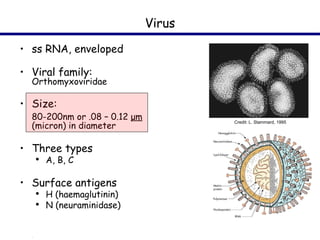
Virus Credit: L. Stammard, 1995 ss RNA, enveloped Viral family:  Orthomyxoviridae Size:  80-200nm or .08 – 0.12  μm  (micron) in diameter Three types A, B, C Surface antigens H (haemaglutinin) N (neuraminidase)
 
Epidemic  –  a located cluster of cases Pandemic  –  worldwide epidemic Antigenic drift Changes in proteins by genetic point mutation & selection  Ongoing and basis for change in vaccine each year Antigenic shift   Changes in proteins through genetic reassortment Produces viruses not covered by annual vaccine Definitions  Aaa a Aaa a
Survival of Influenza Virus  Surfaces and Affect of Humidity & Temperature* Hard non-porous surfaces 24-48 hours Plastic, stainless steel Recoverable for > 24 hours Transferable to hands up to 24 hours Cloth, paper & tissue Recoverable for 8-12 hours Transferable to hands 15 minutes Viable on hands <5 minutes only at high viral titers * Humidity 35-40%, Temperature 28 C (82 F) Affects of humidity on infectivity influenza, Loosli et al, 1943 Source: Bean B, et al. JID 1982;146:47-51 Aaa aa Aaa aa
Seasonal Influenza Globally:  250,000 to 500,000 deaths per year US  (per year) ~35,000 deaths >200,000 Hospitalizations $37.5 billion economic cost (influenza & pneumonia) Pandemic Influenza An ever present threat Influenza  The Normal Burden of Disease
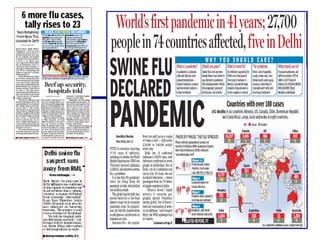
Swine Influenza A(H1N1)   Introduction Outbreaks of influenza among pigs Do not normally infect humans Human cases of swine flu in people around pigs Human-to-human spread documented
Swine Influenza A(H1N1)  History in US New Jersey, USA 1976 –  > 200 cases with serious illness & one death >40 million vaccinated Program stopped after 500 cases of Guillain-Barre syndrome 30 people died as a direct result of the vaccination 1988- 1 female died Dec 2005 – Feb 2009- 12 human cases
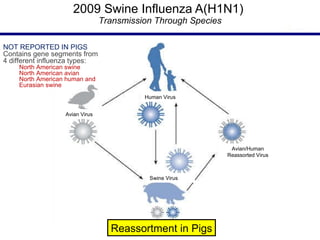
2009 Swine Influenza A(H1N1)  T ransmission Through Species Reassortment in Pigs NOT REPORTED IN PIGS Contains gene segments from  4 different influenza types:  North American swine North American avian North American human and  Eurasian swine Avian Virus Human Virus Swine Virus Avian/Human Reassorted Virus
Swine Influenza A(H1N1)  US Response Congress asked for an additional $1.5 billion April 27, 2009-  CDC travel advisory against all non-essential travel to Mexico  Source: CDC
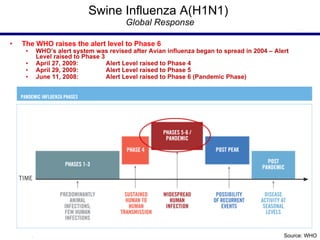
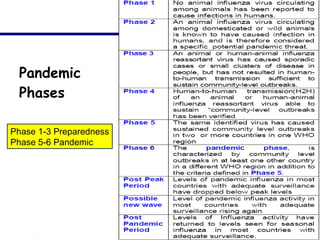
Swine Influenza A(H1N1)  Global Response The WHO raises the alert level to Phase 6 WHO’s alert system was revised after Avian influenza began to spread in 2004 – Alert Level raised to Phase 3 April 27, 2009:  Alert Level raised to Phase 4 April 29, 2009:  Alert Level raised to Phase 5 June 11, 2008: Alert Level raised to Phase 6 (Pandemic Phase) Source: WHO
Pandemic  Phases Phase 1-3 Preparedness Phase 5-6 Pandemic
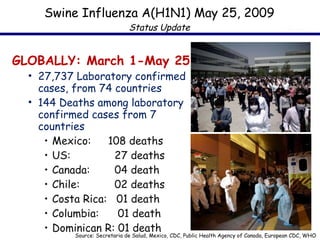
Swine Influenza A(H1N1) May 25, 2009 Status Update GLOBALLY: March 1-May 25 27,737 Laboratory confirmed cases, from 74 countries 144 Deaths among laboratory confirmed cases from 7 countries Mexico:  108 deaths US:    27 deaths Canada:    04 death Chile:   02 deaths Costa Rica:  01 death Columbia:   01 death Dominican R: 01 death Source: Secretaria de Salud, Mexico, CDC, Public Health Agency of Canada, European CDC, WHO
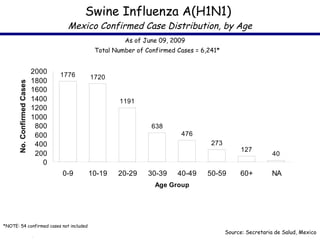
Swine Influenza A(H1N1)  Mexico Confirmed Case Distribution, by Age Total Number of Confirmed Cases = 6,241* As of June 09, 2009 Source: Secretaria de Salud, Mexico *NOTE: 54 confirmed cases not included
Swine Influenza A(H1N1)  Mexico Confirmed Cases & Death, by Age Groups Total Number of Confirmed Cases = 6,241* Deaths = 108 As of June 09, 2009 Source: Secretaria de Salud, Mexico *NOTE: 43 confirmed cases not included 71.3% Deaths
Clinical features Fever Myalgia Headache Cough; respiratory symptoms progress with disease Complications Primary viral pneumonia Secondary bacterial pneumonia Exacerbation of bronchial asthma
Case Definitions Case under Investigation   An individual after 17th of April 2009**, presenting with  a. high fever >38°C,  AND  b. One or more of the following respiratory symptoms: cough, shortness of breath, body ache, difficulty in breathing,  AND  c. One or more of the following: close contact with a person diagnosed as Influenza A/H1N1  OR  recent travel to an area reporting cases of confirmed Influenza A/H1N1
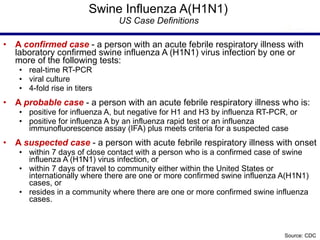
Swine Influenza A(H1N1)  US   Case Definitions  A  confirmed case   - a person with an acute febrile respiratory illness with laboratory confirmed swine influenza A (H1N1) virus infection by one or more of the following tests:  real-time RT-PCR  viral culture  4-fold rise in titers A  probable case   - a person with an acute febrile respiratory illness who is: positive for influenza A, but negative for H1 and H3 by influenza RT-PCR, or  positive for influenza A by an influenza rapid test or an influenza immunofluorescence assay (IFA) plus meets criteria for a suspected case   A  suspected case   - a person with acute febrile respiratory illness with onset  within 7 days of close contact with a person who is a confirmed case of swine influenza A (H1N1) virus infection, or  within 7 days of travel to community either within the United States or internationally where there are one or more confirmed swine influenza A(H1N1) cases, or  resides in a community where there are one or more confirmed swine influenza cases.  Source: CDC
Other definitions Infectious period   1 day prior to the case’s illness onset to 7 days after onset.  Close contact   within about 6 feet of an ill person who is a confirmed or suspected case of influenza A H1N1 virus infection during the case’s infectious period. Acute respiratory illness   recent onset of at least two of the following: rhinorrhea, sore throat, cough (with or without fever / feverishness) High-risk groups :  the same for seasonal influenza
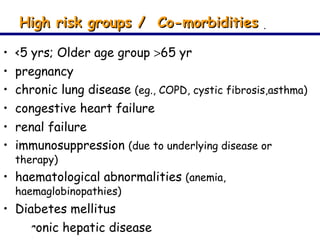
High risk groups /  Co-morbidities  <5 yrs; Older age group   65 yr pregnancy chronic lung disease  (eg., COPD, cystic fibrosis,asthma) congestive heart failure renal failure immunosuppression  (due to underlying disease or therapy) haematological abnormalities  (anemia, haemaglobinopathies) Diabetes mellitus Chronic hepatic disease
Swine Influenza A(H1N1)  Consider swine influenza virus infections in patients presenting with febrile respiratory illness who  live in areas where human cases of swine influenza A(H1N1) have been identified OR  have traveled to an area where human cases of swine influenza A(H1N1) has been identified OR have been in contact with ill persons from these areas in the 7 days prior to their illness onset Source: CDC
Infectiousness & Incubation period From 1-7 days; more likely 1-4 days.  More contagious than seasonal influenza.  2° attack rate of seasonal influenza  5- 15%.  2° attack rate of H1N1  22- 33%.
Samples for diagnosis Respiratory specimens including: bronchoalveolar lavage, tracheal aspirates, nasopharyngeal or oropharyngeal aspirates as washes, and  nasopharyngeal or oropharyngeal swabs
When to collect samples As soon as possible after symptoms begin (preferably first 4-5 days; 10 days- children) Before antiviral medications administration Even if symptoms began more than 1 wk ago Multiple specimens on multiple days could be collected if patient access available
Personal Protective Equipment Before initiating collection of sample; a full complement of PPE should be worn PPE Masks (N-95) Gloves Protective eye wear (goggles) Hair covers Boot or shoe covers Protective clothing (gown or apron )
Surgical masks  High-filtration respiratory mask  Special microstructure filter disc to flush out particles bigger than 0.3 micron. • oil proof • oil resistant • not resistant to oil The more a mask is resistant to oil, the better it is N95 mask has 95% efficiency in filtering out particles greater than 0.3 micron under normal rate of respiration. Next generation of masks  use Nano-technology (blocking particles as small as 0.027 micron) Types of Protective Masks
How to Store Specimens Store specimens at 4 °C before & during transportation within 48 hours Store specimens at -70 °C beyond 48 hours Do not store in standard freezer – keep on ice or in refrigerator Avoid freeze-thaw cycles Better to keep on ice for a week than to have repeat freeze and thaw
 
Swine Influenza A (H1N1)  Guidelines for General Population Covering nose and mouth with a tissue when coughing or sneezing Dispose the tissue in the trash after use.  Hand washing with soap and water Especially after coughing or sneezing.  Cleaning hands with alcohol-based hand cleaners  Avoiding close contact with sick people Avoiding touching eyes, nose or mouth with unwashed hands
Treatment principles Early implementation of infection control Precautions to minimize spread Early identification & Prompt treatment to prevent severe disease
Critical Measures Avoiding crowding patients together Hand hygiene PPE Isolation for patient & close contacts
Anti Viral medications Resistant to Amanatidine and Rimanatidine Neuraminidase inhibitors available Oseltamivir  (Tamiflu)  [ Rs 2250 for ten tablets] Zanamivir (Relenza)
Swine Influenza A(H1N1)  Treatment No vaccine available  Use of anti-virals  illness milder and recovery faster  Prevent serious flu complications Work best if started soon after getting sick (within 2 days of symptoms) Warning!  Do  NOT  give aspirin or aspirin-containing products   to children or teenagers (up to 18 years old) -- Reye’s syndrome.  Source: CDC
Indications of anti-virals Oseltamivir To treat cases. To be given to all suspect cases and to provide chemoprophylaxis to immediate family and social contacts .  
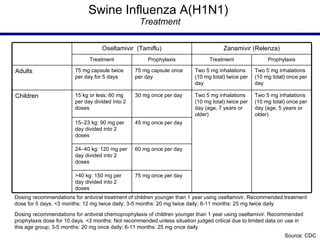
Swine Influenza A(H1N1)  Treatment Source: CDC Dosing recommendations for antiviral treatment of children younger than 1 year using oseltamivir. Recommended treatment dose for 5 days. <3 months: 12 mg twice daily; 3-5 months: 20 mg twice daily; 6-11 months: 25 mg twice daily Dosing recommendations for antiviral chemoprophylaxis of children younger than 1 year using oseltamivir. Recommended prophylaxis dose for 10 days. <3 months: Not recommended unless situation judged critical due to limited data on use in this age group; 3-5 months: 20 mg once daily; 6-11 months: 25 mg once daily Oseltamivir  (Tamiflu) Zanamivir (Relenza) Treatment Prophylaxis Treatment Prophylaxis Adults 75 mg capsule twice per day for 5 days 75 mg capsule once per day Two 5 mg inhalations (10 mg total) twice per day Two 5 mg inhalations (10 mg total) once per day Children 15 kg or less: 60 mg per day divided into 2 doses 30 mg once per day Two 5 mg inhalations (10 mg total) twice per day (age, 7 years or older) Two 5 mg inhalations (10 mg total) once per day (age, 5 years or older) 15–23 kg: 90 mg per day divided into 2 doses 45 mg once per day 24–40 kg: 120 mg per day divided into 2 doses 60 mg once per day >40 kg: 150 mg per day divided into 2 doses 75 mg once per day
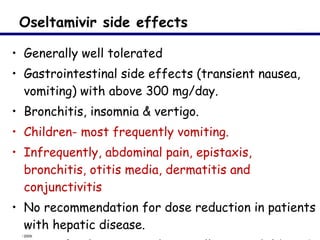
Oseltamivir side effects Generally well tolerated Gastrointestinal side effects (transient nausea, vomiting) with above 300 mg/day.  Bronchitis, insomnia & vertigo. Children- most frequently vomiting.  Infrequently, abdominal pain, epistaxis, bronchitis, otitis media, dermatitis and conjunctivitis  No recommendation for dose reduction in patients with hepatic disease.  Rare - fatal neuro-psychiatric illness in children & adolescents but  no scientific evidence
Discharge policy Adults 7 days after symptoms subside Children 14 days after symptoms subside
Managing close contacts Close Contacts (suspected, probable & confirmed cases)  Advise to remain home (voluntary home quarantine) for at least 7 days after the last contact with the case. Monitor fever for at least 7 days.  Prompt testing and hospitalization when symptoms reported.
Infection Control Measures Prevention of pig to human transmission Health facility measures for human cases
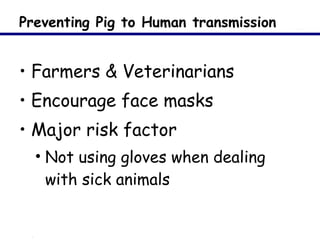
Preventing Pig to Human transmission Farmers & Veterinarians Encourage face masks Major risk factor Not using gloves when dealing with sick animals
Managing Human Cases Pre Hospital Care Patient 3-layer surgical mask Personnel & Driver Full PPE & mask Ambulance Sanitise Sodium hypochlorite; Quaternary ammonium compounds Avoid aerosol generating procedures
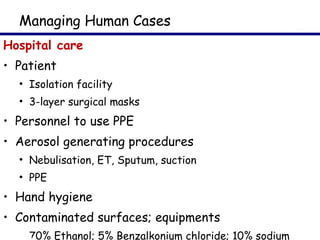
Hospital care Patient Isolation facility 3-layer surgical masks Personnel to use PPE Aerosol generating procedures Nebulisation, ET, Sputum, suction PPE Hand hygiene Contaminated surfaces; equipments 70% Ethanol; 5% Benzalkonium chloride; 10% sodium hypochlorite Managing Human Cases
Swine Influenza A(H1N1)  O ther Protective Measures Isolation :  sequestration of  symptomatic  patents either in the home or hospital so that they will not infect others Quarantine :  separation from circulation in the community of  asymptomatic  persons that may have been exposed to infection Social-Distancing :  range of non-quarantine measures that might serve to reduce contact between persons, such as, closing of schools or prohibiting large gatherings Source: CDC
New strain No-one vaccinated or naturally immunised Reassortment virus Vaccine distant Human to human transmission known Unlike Bird Flu Pandemic concerns
MOHFW- Oseltamivir chemoprophylaxis Chemoprophylaxis for health care workers at high risk Chemoprophylaxis is advised for contacts with high risk
MOHFW- Oseltamivir Mass Chemoprophylaxis The strategy of containment by geographic approach by giving oseltamivir to every individual in a prescribed geographic limit of 5 km from the epicenter would be applied  If the virus is lethal and causing severe morbidity and high mortality and  If the cluster is limited by natural geographic boundaries
Timeline of Emergence Influenza A Viruses in Humans 1918 1957 1968 1977 1997 1998/9 2003 H1 H1 H3 H2 H7 H5 H5 H9 Spanish Influenza H1N1 Asian Influenza H2N2 Russian Influenza Avian Influenza Hong  Kong Influenza H3N2 2009 H1 Reassorted Influenza virus (Swine Flu) 1976 Swine Flu Outbreak, Ft. Dix
Conclusion/Recommendations At present most of the deaths due to H1N1 strain has been reported from Mexico.   The disease, though spreading rapidly across the globe, is of a mild form (exception Mexico)
Conclusion/Recommendations “ Times-have-changed ”  We are much better prepared than 1918. Better surveillance, communication, understanding of infection control, anti-virals, antibiotics and  advancement in science & resources to produce an affective vaccine
Identified isolation facilities  DELHI Yellow Fever Quarantine Centre, Near AAI Residential Colony, New Delhi [APHO- 25652129, Dr S.K Singh:09868252314]   Influenza Ward, Ward no 5, Second Floor, New Building, RML Hospital, Delhi-1
Delhi Nodal Officer DHS Office Tel:22307145 (24X7) Dr.R.P.Vashist (09212222456)

H1N1

  • 1.
  • 2.
    Influenza Virus DefinitionsIntroduction History Spread/Transmission Timeline/Facts Response Status Update Case-Definitions Guidelines Treatment Other Protective Measures Summary Timeline of Emergence Conclusion & Recommendations OUTLINE
  • 3.
    Virus Credit: L.Stammard, 1995 ss RNA, enveloped Viral family: Orthomyxoviridae Size: 80-200nm or .08 – 0.12 μm (micron) in diameter Three types A, B, C Surface antigens H (haemaglutinin) N (neuraminidase)
  • 4.
  • 5.
    Epidemic – a located cluster of cases Pandemic – worldwide epidemic Antigenic drift Changes in proteins by genetic point mutation & selection Ongoing and basis for change in vaccine each year Antigenic shift Changes in proteins through genetic reassortment Produces viruses not covered by annual vaccine Definitions Aaa a Aaa a
  • 6.
    Survival of InfluenzaVirus Surfaces and Affect of Humidity & Temperature* Hard non-porous surfaces 24-48 hours Plastic, stainless steel Recoverable for > 24 hours Transferable to hands up to 24 hours Cloth, paper & tissue Recoverable for 8-12 hours Transferable to hands 15 minutes Viable on hands <5 minutes only at high viral titers * Humidity 35-40%, Temperature 28 C (82 F) Affects of humidity on infectivity influenza, Loosli et al, 1943 Source: Bean B, et al. JID 1982;146:47-51 Aaa aa Aaa aa
  • 7.
    Seasonal Influenza Globally: 250,000 to 500,000 deaths per year US (per year) ~35,000 deaths >200,000 Hospitalizations $37.5 billion economic cost (influenza & pneumonia) Pandemic Influenza An ever present threat Influenza The Normal Burden of Disease
  • 8.
    Swine Influenza A(H1N1) Introduction Outbreaks of influenza among pigs Do not normally infect humans Human cases of swine flu in people around pigs Human-to-human spread documented
  • 9.
    Swine Influenza A(H1N1) History in US New Jersey, USA 1976 – > 200 cases with serious illness & one death >40 million vaccinated Program stopped after 500 cases of Guillain-Barre syndrome 30 people died as a direct result of the vaccination 1988- 1 female died Dec 2005 – Feb 2009- 12 human cases
  • 10.
    2009 Swine InfluenzaA(H1N1) T ransmission Through Species Reassortment in Pigs NOT REPORTED IN PIGS Contains gene segments from 4 different influenza types: North American swine North American avian North American human and Eurasian swine Avian Virus Human Virus Swine Virus Avian/Human Reassorted Virus
  • 11.
    Swine Influenza A(H1N1) US Response Congress asked for an additional $1.5 billion April 27, 2009- CDC travel advisory against all non-essential travel to Mexico Source: CDC
  • 12.
    Swine Influenza A(H1N1) Global Response The WHO raises the alert level to Phase 6 WHO’s alert system was revised after Avian influenza began to spread in 2004 – Alert Level raised to Phase 3 April 27, 2009: Alert Level raised to Phase 4 April 29, 2009: Alert Level raised to Phase 5 June 11, 2008: Alert Level raised to Phase 6 (Pandemic Phase) Source: WHO
  • 13.
    Pandemic PhasesPhase 1-3 Preparedness Phase 5-6 Pandemic
  • 14.
    Swine Influenza A(H1N1)May 25, 2009 Status Update GLOBALLY: March 1-May 25 27,737 Laboratory confirmed cases, from 74 countries 144 Deaths among laboratory confirmed cases from 7 countries Mexico: 108 deaths US: 27 deaths Canada: 04 death Chile: 02 deaths Costa Rica: 01 death Columbia: 01 death Dominican R: 01 death Source: Secretaria de Salud, Mexico, CDC, Public Health Agency of Canada, European CDC, WHO
  • 15.
    Swine Influenza A(H1N1) Mexico Confirmed Case Distribution, by Age Total Number of Confirmed Cases = 6,241* As of June 09, 2009 Source: Secretaria de Salud, Mexico *NOTE: 54 confirmed cases not included
  • 16.
    Swine Influenza A(H1N1) Mexico Confirmed Cases & Death, by Age Groups Total Number of Confirmed Cases = 6,241* Deaths = 108 As of June 09, 2009 Source: Secretaria de Salud, Mexico *NOTE: 43 confirmed cases not included 71.3% Deaths
  • 17.
    Clinical features FeverMyalgia Headache Cough; respiratory symptoms progress with disease Complications Primary viral pneumonia Secondary bacterial pneumonia Exacerbation of bronchial asthma
  • 18.
    Case Definitions Caseunder Investigation An individual after 17th of April 2009**, presenting with a. high fever >38°C, AND b. One or more of the following respiratory symptoms: cough, shortness of breath, body ache, difficulty in breathing, AND c. One or more of the following: close contact with a person diagnosed as Influenza A/H1N1 OR recent travel to an area reporting cases of confirmed Influenza A/H1N1
  • 19.
    Swine Influenza A(H1N1) US Case Definitions A confirmed case - a person with an acute febrile respiratory illness with laboratory confirmed swine influenza A (H1N1) virus infection by one or more of the following tests: real-time RT-PCR viral culture 4-fold rise in titers A probable case - a person with an acute febrile respiratory illness who is: positive for influenza A, but negative for H1 and H3 by influenza RT-PCR, or positive for influenza A by an influenza rapid test or an influenza immunofluorescence assay (IFA) plus meets criteria for a suspected case A suspected case - a person with acute febrile respiratory illness with onset within 7 days of close contact with a person who is a confirmed case of swine influenza A (H1N1) virus infection, or within 7 days of travel to community either within the United States or internationally where there are one or more confirmed swine influenza A(H1N1) cases, or resides in a community where there are one or more confirmed swine influenza cases. Source: CDC
  • 20.
    Other definitions Infectiousperiod 1 day prior to the case’s illness onset to 7 days after onset. Close contact within about 6 feet of an ill person who is a confirmed or suspected case of influenza A H1N1 virus infection during the case’s infectious period. Acute respiratory illness recent onset of at least two of the following: rhinorrhea, sore throat, cough (with or without fever / feverishness) High-risk groups : the same for seasonal influenza
  • 21.
    High risk groups/ Co-morbidities <5 yrs; Older age group  65 yr pregnancy chronic lung disease (eg., COPD, cystic fibrosis,asthma) congestive heart failure renal failure immunosuppression (due to underlying disease or therapy) haematological abnormalities (anemia, haemaglobinopathies) Diabetes mellitus Chronic hepatic disease
  • 22.
    Swine Influenza A(H1N1) Consider swine influenza virus infections in patients presenting with febrile respiratory illness who live in areas where human cases of swine influenza A(H1N1) have been identified OR have traveled to an area where human cases of swine influenza A(H1N1) has been identified OR have been in contact with ill persons from these areas in the 7 days prior to their illness onset Source: CDC
  • 23.
    Infectiousness & Incubationperiod From 1-7 days; more likely 1-4 days. More contagious than seasonal influenza. 2° attack rate of seasonal influenza 5- 15%. 2° attack rate of H1N1 22- 33%.
  • 24.
    Samples for diagnosisRespiratory specimens including: bronchoalveolar lavage, tracheal aspirates, nasopharyngeal or oropharyngeal aspirates as washes, and nasopharyngeal or oropharyngeal swabs
  • 25.
    When to collectsamples As soon as possible after symptoms begin (preferably first 4-5 days; 10 days- children) Before antiviral medications administration Even if symptoms began more than 1 wk ago Multiple specimens on multiple days could be collected if patient access available
  • 26.
    Personal Protective EquipmentBefore initiating collection of sample; a full complement of PPE should be worn PPE Masks (N-95) Gloves Protective eye wear (goggles) Hair covers Boot or shoe covers Protective clothing (gown or apron )
  • 27.
    Surgical masks High-filtration respiratory mask Special microstructure filter disc to flush out particles bigger than 0.3 micron. • oil proof • oil resistant • not resistant to oil The more a mask is resistant to oil, the better it is N95 mask has 95% efficiency in filtering out particles greater than 0.3 micron under normal rate of respiration. Next generation of masks use Nano-technology (blocking particles as small as 0.027 micron) Types of Protective Masks
  • 28.
    How to StoreSpecimens Store specimens at 4 °C before & during transportation within 48 hours Store specimens at -70 °C beyond 48 hours Do not store in standard freezer – keep on ice or in refrigerator Avoid freeze-thaw cycles Better to keep on ice for a week than to have repeat freeze and thaw
  • 29.
  • 30.
    Swine Influenza A(H1N1) Guidelines for General Population Covering nose and mouth with a tissue when coughing or sneezing Dispose the tissue in the trash after use. Hand washing with soap and water Especially after coughing or sneezing. Cleaning hands with alcohol-based hand cleaners Avoiding close contact with sick people Avoiding touching eyes, nose or mouth with unwashed hands
  • 31.
    Treatment principles Earlyimplementation of infection control Precautions to minimize spread Early identification & Prompt treatment to prevent severe disease
  • 32.
    Critical Measures Avoidingcrowding patients together Hand hygiene PPE Isolation for patient & close contacts
  • 33.
    Anti Viral medicationsResistant to Amanatidine and Rimanatidine Neuraminidase inhibitors available Oseltamivir (Tamiflu) [ Rs 2250 for ten tablets] Zanamivir (Relenza)
  • 34.
    Swine Influenza A(H1N1) Treatment No vaccine available Use of anti-virals illness milder and recovery faster Prevent serious flu complications Work best if started soon after getting sick (within 2 days of symptoms) Warning! Do NOT give aspirin or aspirin-containing products to children or teenagers (up to 18 years old) -- Reye’s syndrome. Source: CDC
  • 35.
    Indications of anti-viralsOseltamivir To treat cases. To be given to all suspect cases and to provide chemoprophylaxis to immediate family and social contacts .  
  • 36.
    Swine Influenza A(H1N1) Treatment Source: CDC Dosing recommendations for antiviral treatment of children younger than 1 year using oseltamivir. Recommended treatment dose for 5 days. <3 months: 12 mg twice daily; 3-5 months: 20 mg twice daily; 6-11 months: 25 mg twice daily Dosing recommendations for antiviral chemoprophylaxis of children younger than 1 year using oseltamivir. Recommended prophylaxis dose for 10 days. <3 months: Not recommended unless situation judged critical due to limited data on use in this age group; 3-5 months: 20 mg once daily; 6-11 months: 25 mg once daily Oseltamivir (Tamiflu) Zanamivir (Relenza) Treatment Prophylaxis Treatment Prophylaxis Adults 75 mg capsule twice per day for 5 days 75 mg capsule once per day Two 5 mg inhalations (10 mg total) twice per day Two 5 mg inhalations (10 mg total) once per day Children 15 kg or less: 60 mg per day divided into 2 doses 30 mg once per day Two 5 mg inhalations (10 mg total) twice per day (age, 7 years or older) Two 5 mg inhalations (10 mg total) once per day (age, 5 years or older) 15–23 kg: 90 mg per day divided into 2 doses 45 mg once per day 24–40 kg: 120 mg per day divided into 2 doses 60 mg once per day >40 kg: 150 mg per day divided into 2 doses 75 mg once per day
  • 37.
    Oseltamivir side effectsGenerally well tolerated Gastrointestinal side effects (transient nausea, vomiting) with above 300 mg/day. Bronchitis, insomnia & vertigo. Children- most frequently vomiting. Infrequently, abdominal pain, epistaxis, bronchitis, otitis media, dermatitis and conjunctivitis No recommendation for dose reduction in patients with hepatic disease. Rare - fatal neuro-psychiatric illness in children & adolescents but no scientific evidence
  • 38.
    Discharge policy Adults7 days after symptoms subside Children 14 days after symptoms subside
  • 39.
    Managing close contactsClose Contacts (suspected, probable & confirmed cases) Advise to remain home (voluntary home quarantine) for at least 7 days after the last contact with the case. Monitor fever for at least 7 days. Prompt testing and hospitalization when symptoms reported.
  • 40.
    Infection Control MeasuresPrevention of pig to human transmission Health facility measures for human cases
  • 41.
    Preventing Pig toHuman transmission Farmers & Veterinarians Encourage face masks Major risk factor Not using gloves when dealing with sick animals
  • 42.
    Managing Human CasesPre Hospital Care Patient 3-layer surgical mask Personnel & Driver Full PPE & mask Ambulance Sanitise Sodium hypochlorite; Quaternary ammonium compounds Avoid aerosol generating procedures
  • 43.
    Hospital care PatientIsolation facility 3-layer surgical masks Personnel to use PPE Aerosol generating procedures Nebulisation, ET, Sputum, suction PPE Hand hygiene Contaminated surfaces; equipments 70% Ethanol; 5% Benzalkonium chloride; 10% sodium hypochlorite Managing Human Cases
  • 44.
    Swine Influenza A(H1N1) O ther Protective Measures Isolation : sequestration of symptomatic patents either in the home or hospital so that they will not infect others Quarantine : separation from circulation in the community of asymptomatic persons that may have been exposed to infection Social-Distancing : range of non-quarantine measures that might serve to reduce contact between persons, such as, closing of schools or prohibiting large gatherings Source: CDC
  • 45.
    New strain No-onevaccinated or naturally immunised Reassortment virus Vaccine distant Human to human transmission known Unlike Bird Flu Pandemic concerns
  • 46.
    MOHFW- Oseltamivir chemoprophylaxisChemoprophylaxis for health care workers at high risk Chemoprophylaxis is advised for contacts with high risk
  • 47.
    MOHFW- Oseltamivir MassChemoprophylaxis The strategy of containment by geographic approach by giving oseltamivir to every individual in a prescribed geographic limit of 5 km from the epicenter would be applied If the virus is lethal and causing severe morbidity and high mortality and If the cluster is limited by natural geographic boundaries
  • 48.
    Timeline of EmergenceInfluenza A Viruses in Humans 1918 1957 1968 1977 1997 1998/9 2003 H1 H1 H3 H2 H7 H5 H5 H9 Spanish Influenza H1N1 Asian Influenza H2N2 Russian Influenza Avian Influenza Hong Kong Influenza H3N2 2009 H1 Reassorted Influenza virus (Swine Flu) 1976 Swine Flu Outbreak, Ft. Dix
  • 49.
    Conclusion/Recommendations At presentmost of the deaths due to H1N1 strain has been reported from Mexico. The disease, though spreading rapidly across the globe, is of a mild form (exception Mexico)
  • 50.
    Conclusion/Recommendations “ Times-have-changed” We are much better prepared than 1918. Better surveillance, communication, understanding of infection control, anti-virals, antibiotics and advancement in science & resources to produce an affective vaccine
  • 51.
    Identified isolation facilities DELHI Yellow Fever Quarantine Centre, Near AAI Residential Colony, New Delhi [APHO- 25652129, Dr S.K Singh:09868252314]   Influenza Ward, Ward no 5, Second Floor, New Building, RML Hospital, Delhi-1
  • 52.
    Delhi Nodal OfficerDHS Office Tel:22307145 (24X7) Dr.R.P.Vashist (09212222456)

Editor's Notes

  • #4 The internal antigens (M1 and NP proteins) are the type-specific proteins (type-specific antigens) used to determine if a particular virus is A, B or C. The M1 proteins of all members of each type show cross reactivity. The NP proteins of all members of each type also show cross reactivity. The external antigens (HA and NA) show more variation and are the subtype and strain-specific antigens. These are used to determine the particular strain of influenza A responsible for an outbreak Flu strains are named after their types of hemagglutinin and neuraminidase surface proteins, so they will be called, for example, H3N2 for type-3 hemagglutinin and type-2 neuraminidase. If two different strains of influenza infect the same cell simultaneously, their protein capsids and lipid envelopes are removed, exposing their RNA, which is then transcribed to mRNA. The host cell then forms new viruses that combine antigens; for example, H3N2 and H5N1 can form H5N2 this way. Because the human immune system has difficulty recognizing the new influenza strain, it may be highly dangerous.
  • #5 Influenza A viruses are found in many different animals, including ducks, chickens, pigs, whales, horses, and seals. There are 16 different haemaglutinin subtypes and 9 different neuraminidase subtypes, all of which have been found among influenza A viruses in wild birds. Wild birds are the primary natural reservoir for all subtypes of influenza A viruses and are thought to be the source of influenza A viruses in all other animals. Most influenza viruses cause asymptomatic or mild infection in birds; however, the range of symptoms in birds varies greatly depending on the strain of virus. Infection with certain avian influenza A viruses (for example, some strains of H5 and H7 viruses) can cause widespread disease and death among some species of wild and especially domestic birds such as chickens and turkeys. Pigs can be infected with both human and avian influenza viruses in addition to swine influenza viruses. Infected pigs get symptoms similar to humans, such as cough, fever, and runny nose. Because pigs are susceptible to avian, human and swine influenza viruses, they potentially may be infected with influenza viruses from different species (e.g., ducks and humans) at the same time. If this happens, it is possible for the genes of these viruses to mix and create a new virus.
  • #11 Reassortment, or Viral Subunit Reassortment, is the exchange of DNA between viruses inside a host cell. Two or more viruses of different strains (but usually the same species) infect a single cell and pool their genetic material creating numerous genetically diverse progeny viruses. It is a type of genetic recombination. Reassortment can lead to a viral shifts under some conditions.
  • #13 WHO Definition of Phases Phase 4 is characterized by verified human-to-human transmission of an animal or human-animal influenza reassortant virus able to cause “community-level outbreaks.” The ability to cause sustained disease outbreaks in a community marks a significant upwards shift in the risk for a pandemic. Any country that suspects or has verified such an event should urgently consult with WHO so that the situation can be jointly assessed and a decision made by the affected country if implementation of a rapid pandemic containment operation is warranted. Phase 4 indicates a significant increase in risk of a pandemic but does not necessarily mean that a pandemic is a forgone conclusion. Phase 5 is characterized by human-to-human spread of the virus into at least two countries in one WHO region. While most countries will not be affected at this stage, the declaration of Phase 5 is a strong signal that a pandemic is imminent and that the time to finalize the organization, communication, and implementation of the planned mitigation measures is short. Phase 6, the pandemic phase, is characterized by community level outbreaks in at least one other country in a different WHO region in addition to the criteria defined in Phase 5. Designation of this phase will indicate that a global pandemic is under way. During the post-peak period , pandemic disease levels in most countries with adequate surveillance will have dropped below peak observed levels. The post-peak period signifies that pandemic activity appears to be decreasing; however, it is uncertain if additional waves will occur and countries will need to be prepared for a second wave. Previous pandemics have been characterized by waves of activity spread over months. Once the level of disease activity drops, a critical communications task will be to balance this information with the possibility of another wave. Pandemic waves can be separated by months and an immediate “at-ease” signal may be premature. In the post-pandemic period , influenza disease activity will have returned to levels normally seen for seasonal influenza. It is expected that the pandemic virus will behave as a seasonal influenza A virus. At this stage, it is important to maintain surveillance and update pandemic preparedness and response plans accordingly. An intensive phase of recovery and evaluation may be required.
  • #16 There seems to be a protective affect with increase in age, suggesting past exposure and immunity in people above the age of 60 years.
  • #17 Highest % Case-Fatality (77.5%) was observed in the 20-54 year age group.
  • #35 For more information about Reye’s syndrome, visit the National Institute of Health website at http://www.ninds.nih.gov/disorders/reyes_syndrome/reyes_syndrome.htm For information on homecare visit: http://www.cdc.gov/swineflu/guidance_homecare.htm
  • #37 Pregnant Women Oseltamivir and zanamivir are &amp;quot;Pregnancy Category C&amp;quot; medications, indicating that no clinical studies have been conducted to assess the safety of these medications for pregnant women. Because of the unknown effects of influenza antiviral drugs on pregnant women and their fetuses, oseltamivir or zanamivir should be used during pregnancy only if the potential benefit justifies the potential risk to the embryo or fetus; the manufacturers&apos; package inserts should be consulted. However, no adverse effects have been reported among women who received oseltamivir or zanamivir during pregnancy or among infants born to women who have received oseltamivir or zanamivir. Pregnancy should not be considered a contraindication to oseltamivir or zanamivir use. Because of its systemic activity, oseltamivir is preferred for treatment of pregnant women.  The drug of choice for prophylaxis is less clear.  Zanamivir may be preferable because of its limited systemic absorption; however, respiratory complications that may be associated with zanamivir because of its inhaled route of administration need to be considered, especially in women at risk for respiratory problems. Adverse Events: http://www.cdc.gov/flu/professionals/antivirals/side-effects.htm
  • #50 Two candidate vaccine the CDC is analyzing contain a mix of genes from the new swine flu virus with components of other viruses that allow them to grow better in the eggs that manufacturers use to produce vaccine. If one or both prove usable, manufacturers could begin producing pilot lots for testing this summer to see if the shots are safe, trigger immune protection and require one dose or two.