UNIT II
1
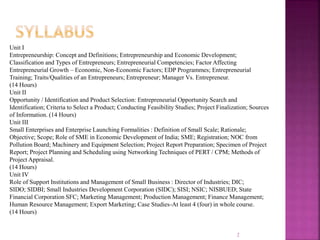
Unit I
Entrepreneurship: Concept and Definitions; Entrepreneurship and Economic Development;
Classification and Types of Entrepreneurs; Entrepreneurial Competencies; Factor Affecting
Entrepreneurial Growth – Economic, Non-Economic Factors; EDP Programmes; Entrepreneurial
Training; Traits/Qualities of an Entrepreneurs; Entrepreneur; Manager Vs. Entrepreneur.
(14 Hours)
Unit II
Opportunity / Identification and Product Selection: Entrepreneurial Opportunity Search and
Identification; Criteria to Select a Product; Conducting Feasibility Studies; Project Finalization; Sources
of Information. (14 Hours)
Unit III
Small Enterprises and Enterprise Launching Formalities : Definition of Small Scale; Rationale;
Objective; Scope; Role of SME in Economic Development of India; SME; Registration; NOC from
Pollution Board; Machinery and Equipment Selection; Project Report Preparation; Specimen of Project
Report; Project Planning and Scheduling using Networking Techniques of PERT / CPM; Methods of
Project Appraisal.
(14 Hours)
Unit IV
Role of Support Institutions and Management of Small Business : Director of Industries; DIC;
SIDO; SIDBI; Small Industries Development Corporation (SIDC); SISI; NSIC; NISBUED; State
Financial Corporation SFC; Marketing Management; Production Management; Finance Management;
Human Resource Management; Export Marketing; Case Studies-At least 4 (four) in whole course.
(14 Hours)
2
3
 Opportunity identification is central to
entrepreneurship and involves:
 The creative pursuit of ideas
 The innovation process
 The first step for any entrepreneur is the
identification of a “good idea.”
 The search for good ideas is never easy.
 Opportunity recognition can lead to both personal and
societal wealth.
4
 How entrepreneurs do what they do:
 Creative thinking + systematic analysis = success
 Seek out unique opportunities to fill needs and wants
 Turn problems into opportunities
 Recognize that problems are to solutions what demand is to
supply
Ideas are not the same as opportunities
Ideas Opportunities
Last for ever are perishable
Are free require work
5
What is an opportunity??
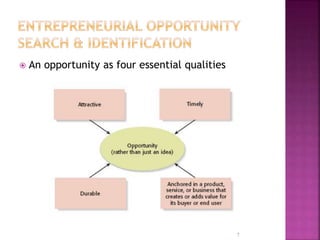
 An idea that is timely, attractive, durable anchored
in a product or service that creates or adds value
for its buyer and user.
 An opportunity is a favorable set of circumstances
that creates the need for a new product, service,
or business idea.
 An idea, as we defined it, is “Something imagined
or pictured in the mind”. The difference is that an
idea may or may not represent an opportunity.
6
 An opportunity as four essential qualities
7
 Window of Opportunity
 The term “window of opportunity” is a metaphor
describing the time period in which a firm can
realistically enter a new market.
 Once the market for a new product is established,
its window of opportunity opens, and new entrants
flow in.
 At some point, the market matures, and the
window of opportunity (for new entrants) closes.
8
 Three Ways to Identify An Opportunity:
 1. Observing Trends
 The first approach to identifying opportunities is to
observe trends and study how they create
opportunities for entrepreneurs to pursue.
 There are two ways that entrepreneurs can get a
handle on changing environmental trends:
 They can carefully study and observe them.
 They can purchase customized forecasts and
market analyses from independent research firms.
9
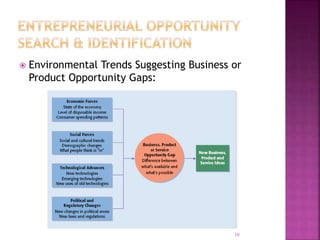
 Environmental Trends Suggesting Business or
Product Opportunity Gaps:
10
 Economic Forces
 Economic forces affect consumers’ level of disposable income.
 When studying how economic forces affect opportunities, it is
important to evaluate who has money to spend and who is
trying to cut costs.
 An increase in the number of women in the workforce and
their related increase in disposable income is largely
responsible for the number of boutique clothing stores
targeting professional women that have opened in the past
several years.
 Many large firms are trying to cut costs. Entrepreneurs have
taken advantage of this trend by starting firms that help other
firms control costs.
11
 Social Forces
 Changes in social trends provide openings for new businesses
on an ongoing basis.
 The continual proliferation of fast-food restaurants, for
example, isn’t happening because people love fast food. It is
happening because people are busy, and have disposable
income.
 Similarly, the Sony Walkman was developed not because
consumers wanted smaller radios but because people wanted
to listen to music while on the go.
12
 Technological Advances
 Given the rapid pace of technological change, it is vital that
entrepreneurs keep on top of how new technologies affect
current and future business opportunities.
 Entire industries have emerged as the result of technological
advances.
 Examples include the computer industry, the Internet,
biotechnology, and digital photography.
 Once a new technology is created, new businesses form to
take the technology to a higher level.
 For example, RealNetworks was started to add audio
capability to the Internet.
13
 Political and Regulatory Changes
 Political and regulatory changes provide the basis for new
business opportunities.
 For example, laws that protect the environment have created
opportunities for entrepreneurs to start firms that help other
firms comply with environmental laws and regulations.
 Similarly, many entrepreneurial firms have been started to
help companies comply with the Sarbanes-Oxley Act of 2002.
The act requires certain companies to keep all their records,
including e-mail messages and electronic documents, for
at least five years.
14
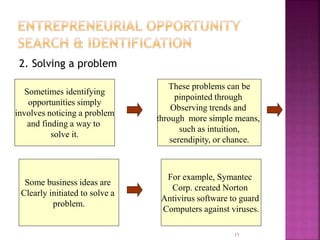
2. Solving a problem
15
Sometimes identifying
opportunities simply
involves noticing a problem
and finding a way to
solve it.
These problems can be
pinpointed through
Observing trends and
through more simple means,
such as intuition,
serendipity, or chance.
Some business ideas are
Clearly initiated to solve a
problem.
For example, Symantec
Corp. created Norton
Antivirus software to guard
Computers against viruses.
3. Finding gaps in the market place
 A third approach to identifying opportunities is to find a gap in
the marketplace.
 A gap in the marketplace is often created when a product or
service is needed by a specific group of people but doesn’t
represent a large enough market to be of interest to
mainstream retailers or manufacturers.
 This is the reason that small clothing boutiques and specialty
shops exist.
 The small boutiques, which often sell designer clothes or
clothing for hard-to-fit people, are willing to carry
merchandise that doesn’t sell in large enough quantities for
Wal-Mart, GAP, or JC Penney to carry.
16
 Undertaking a business venture is a big
investment requiring adequate planning. Just
as investment opportunities are many and diverse,
products or services options for an entrepreneur
are uncountable. However, the selection of
required product or service is the first step towards
success.
 product is anything that can be offered to a
marketer for acquisition, use or consumption.
 products provide the business with the most
important and visible contact with buyers i.e.
consumers. Products to the consumers
represent psychological symbols of personal
attributes, goal and social patterns
17
 In selecting product for a business venture, the following
factors must be taken into consideration:
 Supply-gap: The size of the unsatisfied market demand
which constitute a source of business opportunity will dictate,
to a great extent the need to select a particular product. The
product with the highest chances of success as reflected in its
demand will be selected. In essence, there must be existing
obvious demand for the selected product.
 Fund: The size of the funds that can be mobilized is another
important factor. Adequate fund is needed to develop,
produce, promote, sell and distribute the product selected.
18
 Availability of and Access to Raw Materials:
Different products require different raw materials. The source
quality and quantity of the raw materials needed are factors
to be seriously considered, Are the raw materials available in
sufficient quantities? Where are the sources of raw materials
located? Are they accessible? Could they be sources locally or
imported? Satisfactory answers should be provided to these
and many other relevant questions.
 Technical Implications: The production process for the
product needs to be considered. There is need to know the
technical implications of the selected product on the existing
production line, available technology and even the labour
force. The choice of a particular product may require either
acquisition of the machineries or refurbishing of the old ones.
The product itself must be technically satisfactory and
acceptable to the user. 19
 Profitability/Marketability: Most often, the
product that has the highest profit potential is
often selected. However, a product may be
selected on the basis of its ability to utilize idle
capacity or complement the sale of the existing
products. The product must be marketable.
 Availability of Qualified Personnel: Qualified
personnel to handle the production and marketing
of the product must he available. The cost of
producing the product must be kept to the
minimum by reducing wastages. This is achievable
through competent hands.
20
 Government Policies: This is quite often an
uncontrollable factor. The focuses of government
policies can significantly influence the selection of
product. For instance, a package of incentives from
government for a product with 100% local input
contents can change the direction of the business’s
R & D and hence the product selected.
 Government objectives: The contributions of
the product to the realization of the company’s
short and long range objectives must be considered
before selection. For instance, the company goal
maybe the achievement of sale growth, sales
stability or enhancement of the company’s social
value. 21
 Feasibility study is done to find whether the
proposed project (considering the above discussed
environment appraisal) would be feasible or not.
 Feasibility study is dependent on environment
appraisal yet it is far more descriptive.
 The variable/dimensions of feasibility analysis -
1. Market Analysis
2. Technical/Operational Analysis
3. Financial feasibility
4. Drawing functional plan
22
1. Market Analysis
 M A is conducted to estimate the demand and market share of
the proposed product/service in future.
 Demand analysis and market share is based on number of
factors - consumption pattern, availability of substitute
goods/service, competition etc.
 A preliminary discussions with consumers, retailers,
distributors, competitors, suppliers is carried to understand
consumer preferences, existing and potential demands,
strategy of competitors, and practices of distributors,
retailers etc., present and prospective consumers, geographic
and seasonality distribution of the demand, marketing mix of
competitors, accepted marketing mix of consumers.
23
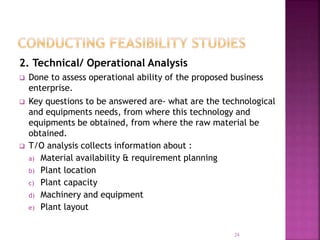
2. Technical/ Operational Analysis
 Done to assess operational ability of the proposed business
enterprise.
 Key questions to be answered are- what are the technological
and equipments needs, from where this technology and
equipments be obtained, from where the raw material be
obtained.
 T/O analysis collects information about :
a) Material availability & requirement planning
b) Plant location
c) Plant capacity
d) Machinery and equipment
e) Plant layout
24
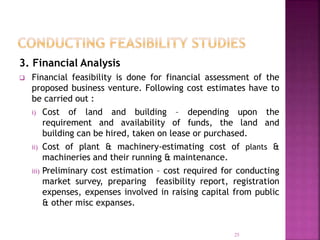
3. Financial Analysis
 Financial feasibility is done for financial assessment of the
proposed business venture. Following cost estimates have to
be carried out :
i) Cost of land and building – depending upon the
requirement and availability of funds, the land and
building can be hired, taken on lease or purchased.
ii) Cost of plant & machinery-estimating cost of plants &
machineries and their running & maintenance.
iii) Preliminary cost estimation – cost required for conducting
market survey, preparing feasibility report, registration
expenses, expenses involved in raising capital from public
& other misc expanses.
25
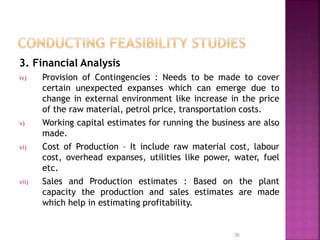
3. Financial Analysis
iv) Provision of Contingencies : Needs to be made to cover
certain unexpected expanses which can emerge due to
change in external environment like increase in the price
of the raw material, petrol price, transportation costs.
v) Working capital estimates for running the business are also
made.
vi) Cost of Production – It include raw material cost, labour
cost, overhead expanses, utilities like power, water, fuel
etc.
vii) Sales and Production estimates : Based on the plant
capacity the production and sales estimates are made
which help in estimating profitability.
26
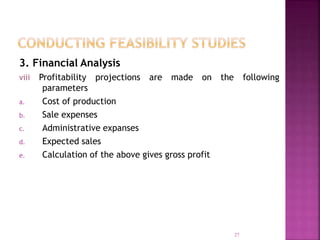
3. Financial Analysis
viii Profitability projections are made on the following
parameters
a. Cost of production
b. Sale expenses
c. Administrative expanses
d. Expected sales
e. Calculation of the above gives gross profit
27
4. Drawing Functional Plan
 After feasibility study, functional plans are drawn which
means developing plans and strategies for all operational
areas : marketing, finance, HR and production.
a) Marketing Plan : MP lays down the strategies of marketing
(Marketing mix) which can lead to success of business. From
the market feasibility study and marketing research,
potential/present demand of customers, which helps in
laying down the strategies for market segmentation,
identification of target market and laying down strategies
for the target market.
b) Production/operation Plan : Production plans are drawn for
manufacturing whereas operational plans are for service
sector. It includes strategies for following parameters :
28
1. Location and reasons for selecting the locations
2. Physical layout
3. Cost & availability of machinery, equipments,
raw material
4. List of suppliers and if possible, distributors.
5. Cost of manufacturing / running operations
6. Quality management
7. Production scheduling, capacity mgt,inventory
mgt
29
c) Organisational Plan : Defines the type of
ownership, organization structure and proposes
HRM practices that would govern the successful
running of proposed business enterprise.
d) Financial Plan : Financial Plan indicates the
financial requirement of the proposed business
1. Cost incurred in smooth running of all the plans –
financial, marketing, operations and HRs.
 For eg. Cost incurred in the marketing plan
would include forecasting sales, for production
plan it includes cost of goods, for organizational
plans it includes cost of compensation to
employees.
30
2. Projected cash flows.
3. Projected income statement
4. Projected break-even point
5. Projected ratios.
6. Projected Balance sheet.
31

Esbd unit ii 1

  • 1.
  • 2.
    Unit I Entrepreneurship: Conceptand Definitions; Entrepreneurship and Economic Development; Classification and Types of Entrepreneurs; Entrepreneurial Competencies; Factor Affecting Entrepreneurial Growth – Economic, Non-Economic Factors; EDP Programmes; Entrepreneurial Training; Traits/Qualities of an Entrepreneurs; Entrepreneur; Manager Vs. Entrepreneur. (14 Hours) Unit II Opportunity / Identification and Product Selection: Entrepreneurial Opportunity Search and Identification; Criteria to Select a Product; Conducting Feasibility Studies; Project Finalization; Sources of Information. (14 Hours) Unit III Small Enterprises and Enterprise Launching Formalities : Definition of Small Scale; Rationale; Objective; Scope; Role of SME in Economic Development of India; SME; Registration; NOC from Pollution Board; Machinery and Equipment Selection; Project Report Preparation; Specimen of Project Report; Project Planning and Scheduling using Networking Techniques of PERT / CPM; Methods of Project Appraisal. (14 Hours) Unit IV Role of Support Institutions and Management of Small Business : Director of Industries; DIC; SIDO; SIDBI; Small Industries Development Corporation (SIDC); SISI; NSIC; NISBUED; State Financial Corporation SFC; Marketing Management; Production Management; Finance Management; Human Resource Management; Export Marketing; Case Studies-At least 4 (four) in whole course. (14 Hours) 2
  • 3.
  • 4.
     Opportunity identificationis central to entrepreneurship and involves:  The creative pursuit of ideas  The innovation process  The first step for any entrepreneur is the identification of a “good idea.”  The search for good ideas is never easy.  Opportunity recognition can lead to both personal and societal wealth. 4
  • 5.
     How entrepreneursdo what they do:  Creative thinking + systematic analysis = success  Seek out unique opportunities to fill needs and wants  Turn problems into opportunities  Recognize that problems are to solutions what demand is to supply Ideas are not the same as opportunities Ideas Opportunities Last for ever are perishable Are free require work 5
  • 6.
    What is anopportunity??  An idea that is timely, attractive, durable anchored in a product or service that creates or adds value for its buyer and user.  An opportunity is a favorable set of circumstances that creates the need for a new product, service, or business idea.  An idea, as we defined it, is “Something imagined or pictured in the mind”. The difference is that an idea may or may not represent an opportunity. 6
  • 7.
     An opportunityas four essential qualities 7
  • 8.
     Window ofOpportunity  The term “window of opportunity” is a metaphor describing the time period in which a firm can realistically enter a new market.  Once the market for a new product is established, its window of opportunity opens, and new entrants flow in.  At some point, the market matures, and the window of opportunity (for new entrants) closes. 8
  • 9.
     Three Waysto Identify An Opportunity:  1. Observing Trends  The first approach to identifying opportunities is to observe trends and study how they create opportunities for entrepreneurs to pursue.  There are two ways that entrepreneurs can get a handle on changing environmental trends:  They can carefully study and observe them.  They can purchase customized forecasts and market analyses from independent research firms. 9
  • 10.
     Environmental TrendsSuggesting Business or Product Opportunity Gaps: 10
  • 11.
     Economic Forces Economic forces affect consumers’ level of disposable income.  When studying how economic forces affect opportunities, it is important to evaluate who has money to spend and who is trying to cut costs.  An increase in the number of women in the workforce and their related increase in disposable income is largely responsible for the number of boutique clothing stores targeting professional women that have opened in the past several years.  Many large firms are trying to cut costs. Entrepreneurs have taken advantage of this trend by starting firms that help other firms control costs. 11
  • 12.
     Social Forces Changes in social trends provide openings for new businesses on an ongoing basis.  The continual proliferation of fast-food restaurants, for example, isn’t happening because people love fast food. It is happening because people are busy, and have disposable income.  Similarly, the Sony Walkman was developed not because consumers wanted smaller radios but because people wanted to listen to music while on the go. 12
  • 13.
     Technological Advances Given the rapid pace of technological change, it is vital that entrepreneurs keep on top of how new technologies affect current and future business opportunities.  Entire industries have emerged as the result of technological advances.  Examples include the computer industry, the Internet, biotechnology, and digital photography.  Once a new technology is created, new businesses form to take the technology to a higher level.  For example, RealNetworks was started to add audio capability to the Internet. 13
  • 14.
     Political andRegulatory Changes  Political and regulatory changes provide the basis for new business opportunities.  For example, laws that protect the environment have created opportunities for entrepreneurs to start firms that help other firms comply with environmental laws and regulations.  Similarly, many entrepreneurial firms have been started to help companies comply with the Sarbanes-Oxley Act of 2002. The act requires certain companies to keep all their records, including e-mail messages and electronic documents, for at least five years. 14
  • 15.
    2. Solving aproblem 15 Sometimes identifying opportunities simply involves noticing a problem and finding a way to solve it. These problems can be pinpointed through Observing trends and through more simple means, such as intuition, serendipity, or chance. Some business ideas are Clearly initiated to solve a problem. For example, Symantec Corp. created Norton Antivirus software to guard Computers against viruses.
  • 16.
    3. Finding gapsin the market place  A third approach to identifying opportunities is to find a gap in the marketplace.  A gap in the marketplace is often created when a product or service is needed by a specific group of people but doesn’t represent a large enough market to be of interest to mainstream retailers or manufacturers.  This is the reason that small clothing boutiques and specialty shops exist.  The small boutiques, which often sell designer clothes or clothing for hard-to-fit people, are willing to carry merchandise that doesn’t sell in large enough quantities for Wal-Mart, GAP, or JC Penney to carry. 16
  • 17.
     Undertaking abusiness venture is a big investment requiring adequate planning. Just as investment opportunities are many and diverse, products or services options for an entrepreneur are uncountable. However, the selection of required product or service is the first step towards success.  product is anything that can be offered to a marketer for acquisition, use or consumption.  products provide the business with the most important and visible contact with buyers i.e. consumers. Products to the consumers represent psychological symbols of personal attributes, goal and social patterns 17
  • 18.
     In selectingproduct for a business venture, the following factors must be taken into consideration:  Supply-gap: The size of the unsatisfied market demand which constitute a source of business opportunity will dictate, to a great extent the need to select a particular product. The product with the highest chances of success as reflected in its demand will be selected. In essence, there must be existing obvious demand for the selected product.  Fund: The size of the funds that can be mobilized is another important factor. Adequate fund is needed to develop, produce, promote, sell and distribute the product selected. 18
  • 19.
     Availability ofand Access to Raw Materials: Different products require different raw materials. The source quality and quantity of the raw materials needed are factors to be seriously considered, Are the raw materials available in sufficient quantities? Where are the sources of raw materials located? Are they accessible? Could they be sources locally or imported? Satisfactory answers should be provided to these and many other relevant questions.  Technical Implications: The production process for the product needs to be considered. There is need to know the technical implications of the selected product on the existing production line, available technology and even the labour force. The choice of a particular product may require either acquisition of the machineries or refurbishing of the old ones. The product itself must be technically satisfactory and acceptable to the user. 19
  • 20.
     Profitability/Marketability: Mostoften, the product that has the highest profit potential is often selected. However, a product may be selected on the basis of its ability to utilize idle capacity or complement the sale of the existing products. The product must be marketable.  Availability of Qualified Personnel: Qualified personnel to handle the production and marketing of the product must he available. The cost of producing the product must be kept to the minimum by reducing wastages. This is achievable through competent hands. 20
  • 21.
     Government Policies:This is quite often an uncontrollable factor. The focuses of government policies can significantly influence the selection of product. For instance, a package of incentives from government for a product with 100% local input contents can change the direction of the business’s R & D and hence the product selected.  Government objectives: The contributions of the product to the realization of the company’s short and long range objectives must be considered before selection. For instance, the company goal maybe the achievement of sale growth, sales stability or enhancement of the company’s social value. 21
  • 22.
     Feasibility studyis done to find whether the proposed project (considering the above discussed environment appraisal) would be feasible or not.  Feasibility study is dependent on environment appraisal yet it is far more descriptive.  The variable/dimensions of feasibility analysis - 1. Market Analysis 2. Technical/Operational Analysis 3. Financial feasibility 4. Drawing functional plan 22
  • 23.
    1. Market Analysis M A is conducted to estimate the demand and market share of the proposed product/service in future.  Demand analysis and market share is based on number of factors - consumption pattern, availability of substitute goods/service, competition etc.  A preliminary discussions with consumers, retailers, distributors, competitors, suppliers is carried to understand consumer preferences, existing and potential demands, strategy of competitors, and practices of distributors, retailers etc., present and prospective consumers, geographic and seasonality distribution of the demand, marketing mix of competitors, accepted marketing mix of consumers. 23
  • 24.
    2. Technical/ OperationalAnalysis  Done to assess operational ability of the proposed business enterprise.  Key questions to be answered are- what are the technological and equipments needs, from where this technology and equipments be obtained, from where the raw material be obtained.  T/O analysis collects information about : a) Material availability & requirement planning b) Plant location c) Plant capacity d) Machinery and equipment e) Plant layout 24
  • 25.
    3. Financial Analysis Financial feasibility is done for financial assessment of the proposed business venture. Following cost estimates have to be carried out : i) Cost of land and building – depending upon the requirement and availability of funds, the land and building can be hired, taken on lease or purchased. ii) Cost of plant & machinery-estimating cost of plants & machineries and their running & maintenance. iii) Preliminary cost estimation – cost required for conducting market survey, preparing feasibility report, registration expenses, expenses involved in raising capital from public & other misc expanses. 25
  • 26.
    3. Financial Analysis iv)Provision of Contingencies : Needs to be made to cover certain unexpected expanses which can emerge due to change in external environment like increase in the price of the raw material, petrol price, transportation costs. v) Working capital estimates for running the business are also made. vi) Cost of Production – It include raw material cost, labour cost, overhead expanses, utilities like power, water, fuel etc. vii) Sales and Production estimates : Based on the plant capacity the production and sales estimates are made which help in estimating profitability. 26
  • 27.
    3. Financial Analysis viiiProfitability projections are made on the following parameters a. Cost of production b. Sale expenses c. Administrative expanses d. Expected sales e. Calculation of the above gives gross profit 27
  • 28.
    4. Drawing FunctionalPlan  After feasibility study, functional plans are drawn which means developing plans and strategies for all operational areas : marketing, finance, HR and production. a) Marketing Plan : MP lays down the strategies of marketing (Marketing mix) which can lead to success of business. From the market feasibility study and marketing research, potential/present demand of customers, which helps in laying down the strategies for market segmentation, identification of target market and laying down strategies for the target market. b) Production/operation Plan : Production plans are drawn for manufacturing whereas operational plans are for service sector. It includes strategies for following parameters : 28
  • 29.
    1. Location andreasons for selecting the locations 2. Physical layout 3. Cost & availability of machinery, equipments, raw material 4. List of suppliers and if possible, distributors. 5. Cost of manufacturing / running operations 6. Quality management 7. Production scheduling, capacity mgt,inventory mgt 29
  • 30.
    c) Organisational Plan: Defines the type of ownership, organization structure and proposes HRM practices that would govern the successful running of proposed business enterprise. d) Financial Plan : Financial Plan indicates the financial requirement of the proposed business 1. Cost incurred in smooth running of all the plans – financial, marketing, operations and HRs.  For eg. Cost incurred in the marketing plan would include forecasting sales, for production plan it includes cost of goods, for organizational plans it includes cost of compensation to employees. 30
  • 31.
    2. Projected cashflows. 3. Projected income statement 4. Projected break-even point 5. Projected ratios. 6. Projected Balance sheet. 31