CREATIVITY
 Creativity is the ability to develop
new ideas and to discover new ways
      of looking at problems.

  Innovation is the ability to apply
 creative solutions to problems and
opportunities to enrich people’s life.
CREATIVITY
Creativity is THINKING about new things.
               Where as
Innovation is DOING new things.
Entrepreneurs succeed by thinking and doing
  new things or old things in new ways.
Ex: Polaroid instant camera – Edwin Land
    Ruff Rider – Carl Goldberg
CREATIVITY
BARRIERS TO CREATIVITY
1.Searching for one right answer.
Ex: Farmer
2.Focusing on being logical.
Ex: Sea water
3.Blindly following the rules.
Ex: Sholes & co – Type Writer
4. Fearing mistakes & failure
CREATIVITY
5.Constantly being practical.
Ex: Thomas Edison
6. Becoming overly specialized.
7.Fearing looking foolish.
Ex: Farmer- apple tree
8.I am not creative
9. Avoiding ambiguity
10. Viewing play as frivolous
How to generate Business Ideas?

• Problem solving / situation Analysis Approach. This
  approach highlight the need which give rise to many
  Business opportunities.

• Thinking of new product / services not in existence.

• Developing the existing products and services, in terms
  of design, specializations etc.,
• Selecting products / services which are being
  manufactured / offered.
Where to look for opportunities.
Where things are changing
  - New knowledge
    Micro Biology – Biotech Enterprises.
  - Technology (change)
           - Tele medicine.
           - online education.
           - online Tuition.
Where to look for opportunities
- Regulatory change.
      - Tele communications.
      - Retailing
      - Airlines
      - Insurance
      - Finance
Where to look for opportunities
- social turmoil and civic failures
         - Education
         - Home security systems
         - Car alarms.
Where to look for opportunities
- Changing tastes/preferences of customers.
     - F M Radio
     - Darshini Hotels
     - PVR Cinema
Opportunity Evaluation
•   Is there a target market segment in which we offer the
    customer clear and compelling benefits, at a price he
    or she is willing to pay?
•   Are these benefits, in the customer’s minds, different
    from and superior in some way –to what’s currently
    offered by other solutions?
•   How large is this segment and how fast is it growing
•   Entry in to this segment will provide entry in to other
    segments in the future?
Opportunity Evaluation

• How large is the market?
• How quickly can it grow in the next 6 months or 2/3/5
  years?
• What trends can be identified in the environment and
  how will it affect the business?
Opportunity Evaluation
• Is it difficult for companies to enter this industry?
• Do suppliers to this industry have the power to set terms
  and conditions?
• Do buyers have the power to set terms and conditions?
• Is it easy or difficult for substitute products to steal the
  market?
• Is competitive rivalry intense or moderate?
Opportunity Evaluation
•   Do you require proprietary elements - patents, trade
    secrets so that other firms cannot likely duplicate or
    imitate?
•   Can your business develop and employ superior
    organizational processes, capabilities or resources that
    others would have difficulty in duplicating or imitating?
•   Is your business model economically viable i.e. can you
    show that your company won’t run out of cash
    quickly?
Opportunity Evaluation
•   What level of aspirations do you have for your
    entrepreneurial dream?
•   What sorts of risk are you and are you not willing to
    take?
•   What are the Critical Success Factors required in this
    Industry?
•   Does your team have it?
•   Who do you and your team know across the value-
    chain among your customers, suppliers, competitors
    and substitutes?
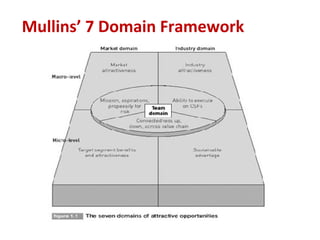
What is meant by Market & Industry?
• A market consists of a group of current and/or potential
  customers having the willingness and ability to buy
  products to satisfy wants or needs
• Thus, markets consist of buyers - people or organizations
  and their needs - not products
•
      “ Markets consist of buyers, not products ”

• An industry consists of sellers - typically organizations -
  that offer products that are similar and close substitutes
  for one another

      “ An Industry consists of sellers ”
Mullins’ 7 Domain Framework
Ideas -Dos and Don’ts
• Having a flow of new ideas is critical to successful
  entrepreneurship but having a love affair with one idea
  does not help
• It is always better to detach from emotions while
  assessing an idea; sacrificing or letting go of an idea will
  not be a huge problem then
• It is ok to share ideas in a forum. An opportunity is
  ideally derived from an idea which is executed with a
  great plan by an excellent team. So most often no one
  can steal an idea
What defines a good opportunity?
An opportunity is characterized by the following:

• There are customers willing and able to purchase your
  product that either solves their problem or satisfies a
  need
• A large enough number of customers exist
• The industry allows you to start and build - no monopoly,
  no supplier domination
• An ability to differentiate your offering from your
  competitors
• A good match with your own and your team's interests,
  abilities, and network

Business opportunity

  • 1.
    CREATIVITY Creativity isthe ability to develop new ideas and to discover new ways of looking at problems. Innovation is the ability to apply creative solutions to problems and opportunities to enrich people’s life.
  • 2.
    CREATIVITY Creativity is THINKINGabout new things. Where as Innovation is DOING new things. Entrepreneurs succeed by thinking and doing new things or old things in new ways. Ex: Polaroid instant camera – Edwin Land Ruff Rider – Carl Goldberg
  • 3.
    CREATIVITY BARRIERS TO CREATIVITY 1.Searchingfor one right answer. Ex: Farmer 2.Focusing on being logical. Ex: Sea water 3.Blindly following the rules. Ex: Sholes & co – Type Writer 4. Fearing mistakes & failure
  • 4.
    CREATIVITY 5.Constantly being practical. Ex:Thomas Edison 6. Becoming overly specialized. 7.Fearing looking foolish. Ex: Farmer- apple tree 8.I am not creative 9. Avoiding ambiguity 10. Viewing play as frivolous
  • 5.
    How to generateBusiness Ideas? • Problem solving / situation Analysis Approach. This approach highlight the need which give rise to many Business opportunities. • Thinking of new product / services not in existence. • Developing the existing products and services, in terms of design, specializations etc., • Selecting products / services which are being manufactured / offered.
  • 6.
    Where to lookfor opportunities. Where things are changing - New knowledge Micro Biology – Biotech Enterprises. - Technology (change) - Tele medicine. - online education. - online Tuition.
  • 7.
    Where to lookfor opportunities - Regulatory change. - Tele communications. - Retailing - Airlines - Insurance - Finance
  • 8.
    Where to lookfor opportunities - social turmoil and civic failures - Education - Home security systems - Car alarms.
  • 9.
    Where to lookfor opportunities - Changing tastes/preferences of customers. - F M Radio - Darshini Hotels - PVR Cinema
  • 10.
    Opportunity Evaluation • Is there a target market segment in which we offer the customer clear and compelling benefits, at a price he or she is willing to pay? • Are these benefits, in the customer’s minds, different from and superior in some way –to what’s currently offered by other solutions? • How large is this segment and how fast is it growing • Entry in to this segment will provide entry in to other segments in the future?
  • 11.
    Opportunity Evaluation • Howlarge is the market? • How quickly can it grow in the next 6 months or 2/3/5 years? • What trends can be identified in the environment and how will it affect the business?
  • 12.
    Opportunity Evaluation • Isit difficult for companies to enter this industry? • Do suppliers to this industry have the power to set terms and conditions? • Do buyers have the power to set terms and conditions? • Is it easy or difficult for substitute products to steal the market? • Is competitive rivalry intense or moderate?
  • 13.
    Opportunity Evaluation • Do you require proprietary elements - patents, trade secrets so that other firms cannot likely duplicate or imitate? • Can your business develop and employ superior organizational processes, capabilities or resources that others would have difficulty in duplicating or imitating? • Is your business model economically viable i.e. can you show that your company won’t run out of cash quickly?
  • 14.
    Opportunity Evaluation • What level of aspirations do you have for your entrepreneurial dream? • What sorts of risk are you and are you not willing to take? • What are the Critical Success Factors required in this Industry? • Does your team have it? • Who do you and your team know across the value- chain among your customers, suppliers, competitors and substitutes?
  • 15.
    What is meantby Market & Industry? • A market consists of a group of current and/or potential customers having the willingness and ability to buy products to satisfy wants or needs • Thus, markets consist of buyers - people or organizations and their needs - not products • “ Markets consist of buyers, not products ” • An industry consists of sellers - typically organizations - that offer products that are similar and close substitutes for one another “ An Industry consists of sellers ”
  • 16.
  • 17.
    Ideas -Dos andDon’ts • Having a flow of new ideas is critical to successful entrepreneurship but having a love affair with one idea does not help • It is always better to detach from emotions while assessing an idea; sacrificing or letting go of an idea will not be a huge problem then • It is ok to share ideas in a forum. An opportunity is ideally derived from an idea which is executed with a great plan by an excellent team. So most often no one can steal an idea
  • 18.
    What defines agood opportunity? An opportunity is characterized by the following: • There are customers willing and able to purchase your product that either solves their problem or satisfies a need • A large enough number of customers exist • The industry allows you to start and build - no monopoly, no supplier domination • An ability to differentiate your offering from your competitors • A good match with your own and your team's interests, abilities, and network

Editor's Notes

  • #11 a) Micro level questions about target markets Is there a target market segment where we might enter the market in which we offer the customer clear and compelling benefits, at a price he or she is willing to pay? Are these benefits, in the customer’s minds, different from and superior in some way – better, faster, cheaper or whatever – to what’s currently offered by other solutions? How large is this segment, and how fast is it growing? Is it likely that our entry into this segment will provide us entry into other segments that we may wish to target in the future? b) Three ways to define market segments Who the customers are i.e demographic terms (age, gender, education, income etc) if it is business to business, then it will refer to the industry in which the customers do business, plus firm size and firm characteristics. Where the customers are in geographical terms? By how the customers behave (life style terms) or in business to business how the products may be used. c) The micro market test What customer pain will your offering resolve? How strong an incentive do customers have to give you their money? Will customers buy what you propose to offer? Who precisely are the customers that have the pain? Do you have detailed accurate information about who they are, where they live or do business or what they do? What benefits does your offering provide that other solutions don’t? Does the target market have the potential to grow? Are there other segments that could benefit from a related offering? Can capabilities that are transferable from one segment to another be developed? Information from secondary sources – library materials, internet, newspapers, and publications on recent industry trends should suffice to answer the following questions. The macro market test What sort of business is sought? One with potential to become a huge business, or a small lifestyle operation? This along with the answers to the following question will determine the need for venture capital. A high potential business in a huge, rapidly growing market will require venture capital whereas a small lifestyle operation in a niche market will not need any. Trends can be economic, demographic, socio cultural, technological, regulatory or natural trends can be identified
  • #15 What’s your entrepreneurial mission: To serve a particular market? To change a particular industry? To market a particular product? Is the passion really there? What level of aspirations do you have for your entrepreneurial dream: To work for yourself? To build something small or something big? To do? To manage? To lead? To change the world in some way? What sorts of risk are you and are you not willing to take: Will you risk a secure salary and the things that go along with your current employment? For how long? Will you risk losing control of your business? Will you put your own money at risk? How much? Will you risk your home or time with your family or loved ones? Do those you love accept the risks you will take? Who do you and your team know up the value chain in the companies that are likely suppliers to your proposed business and to your competitors? In suppliers to companies in other industries that offer substitute products for yours? Be sure you have names, titles and contact info. Who do you and your team know down the value-chain among customers you will target, both today and tomorrow? Names, titles and contact info, please. Who do you and your team know across the value-chain among your competitors and substitutes? Names, titles and contact info, please.