Enterprise Resource Planning (ERP)
space for
your logo
Contents
1.1 Introduction
1.2 What is ERP?
1.3 Why ERP Required?
1.4 Definitions of ERP
1.5 Benefits of ERP
1.1 INTRODUCTION
Enterprise Resource Planning, or ERP, is a system that is used to combine all of
the information or operations of a company into a single unit. The goal of ERP is to
unify the various functions of an institution.
However, the use of Enterprise Resource Planning is not simply limited to
corporations. It is commonly used by non-profit organizations government
agencies, and other institutions.
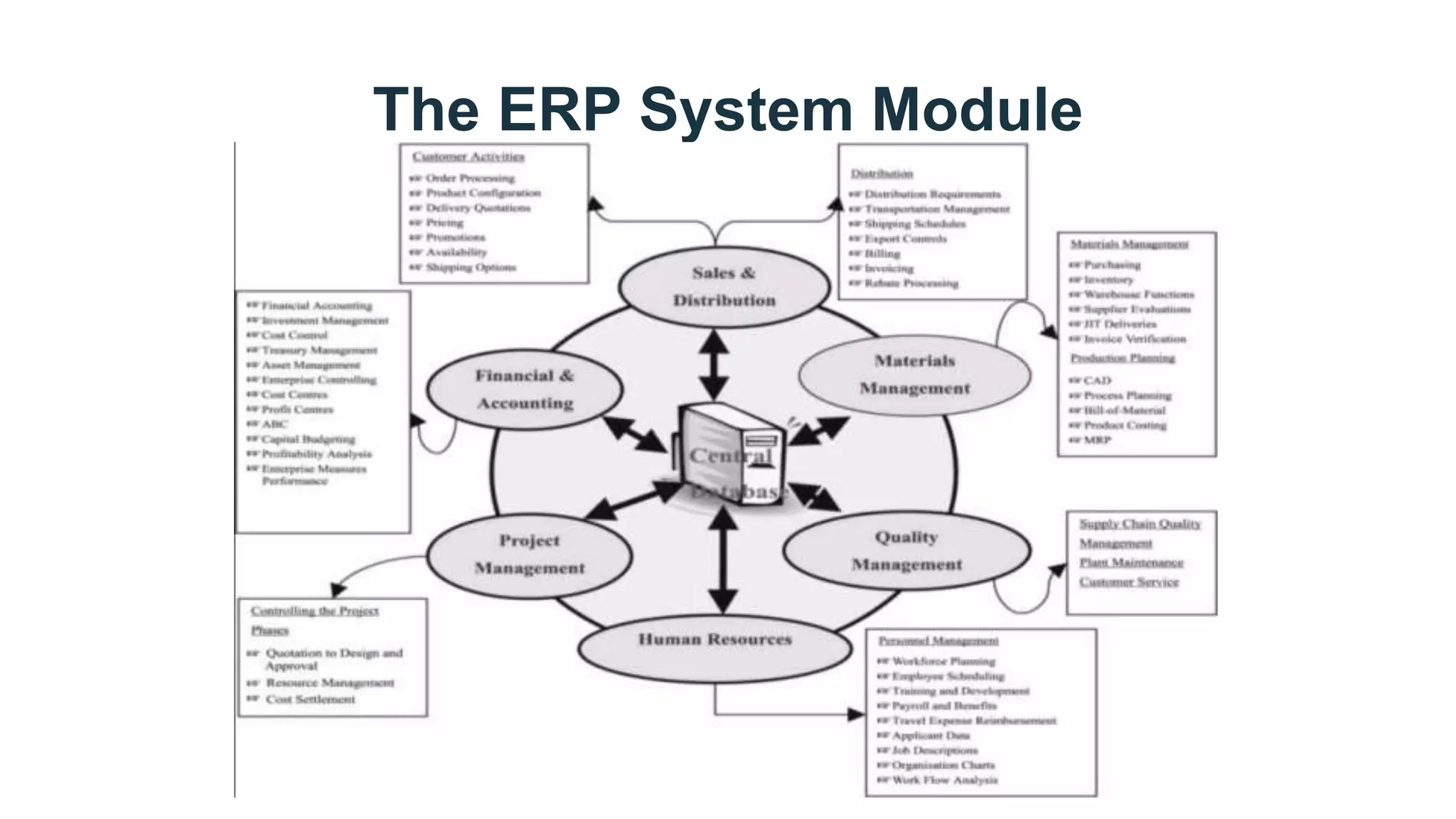
The ERP System Module
1.2 What is ERP?
Enterprise Resource Planning
(ERP) covers the techniques and
concepts employed for the
integrated management of
businesses by the effective use of
management resources, to
improve the efficiency of an
enterprise.
ERP packages are integrated
(covering all business functions)
software packages that support the
above ERP concepts.
1.2 What is ERP?
ERP software applications can be
used to manage product planning,
parts purchasing, inventories,
interacting with suppliers providing
customer service, and tracking
orders.
ERP can also include application
modules for the finance and human
resources aspects of a business.
Typically, an ERP system uses or is
integrated with a relational database
ERP Application Tools
Large ERP vendors are competing with
their smaller counterparts by either
buying them out or forming
strategic alliances with them.
A number of consultants within large
firms are specializing in various areas.
They will analyze the process that needs
to be reengineered, and once this is
done, they will decide how the
ERP software must be used.
The most important areas for ERP
applications are finance, human resources,
and manufacturing
“
ERP Benefits
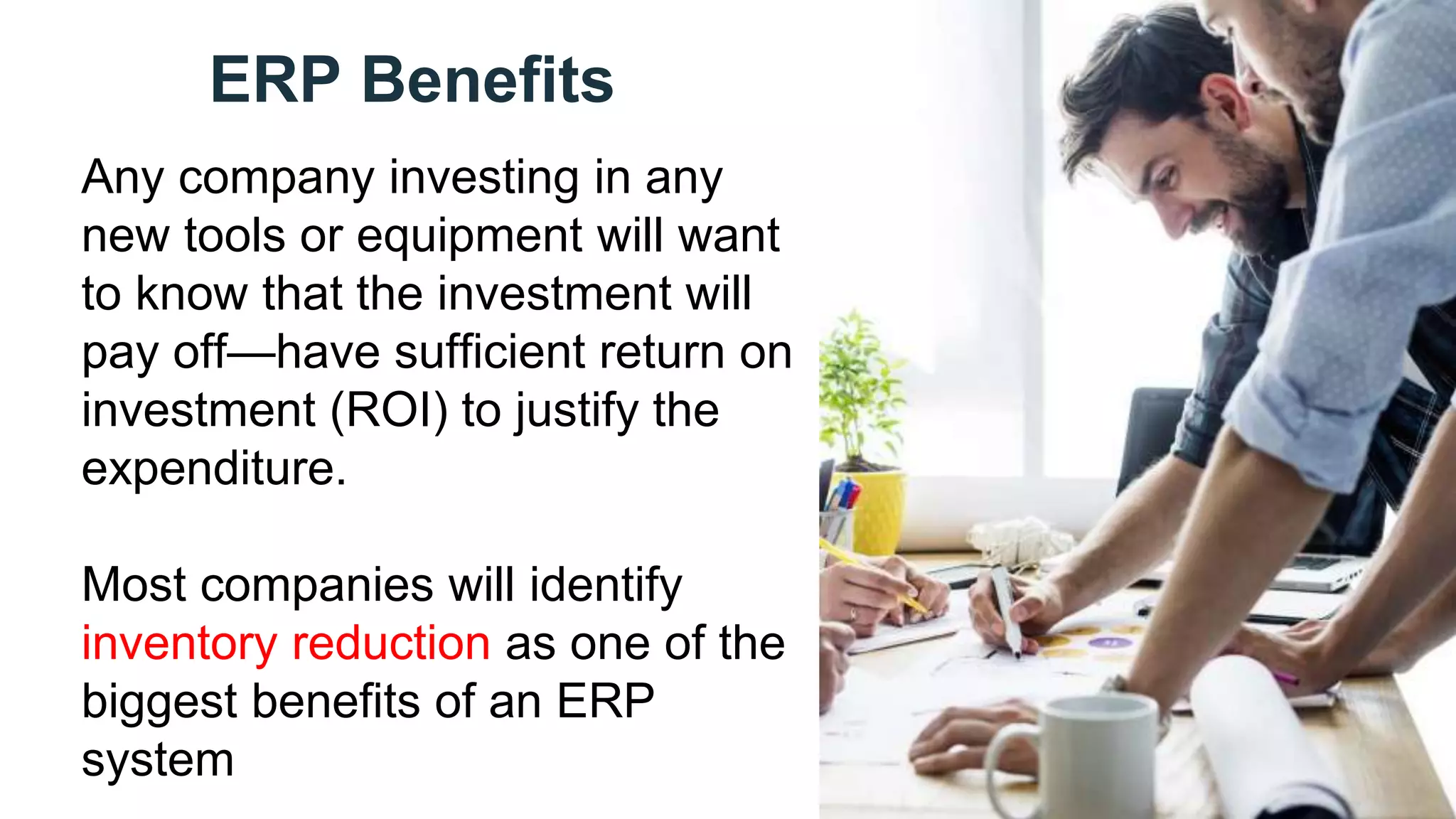
Any company investing in any
new tools or equipment will want
to know that the investment will
pay off—have sufficient return on
investment (ROI) to justify the
expenditure.
Most companies will identify
inventory reduction as one of the
biggest benefits of an ERP
system
ERP Benefits
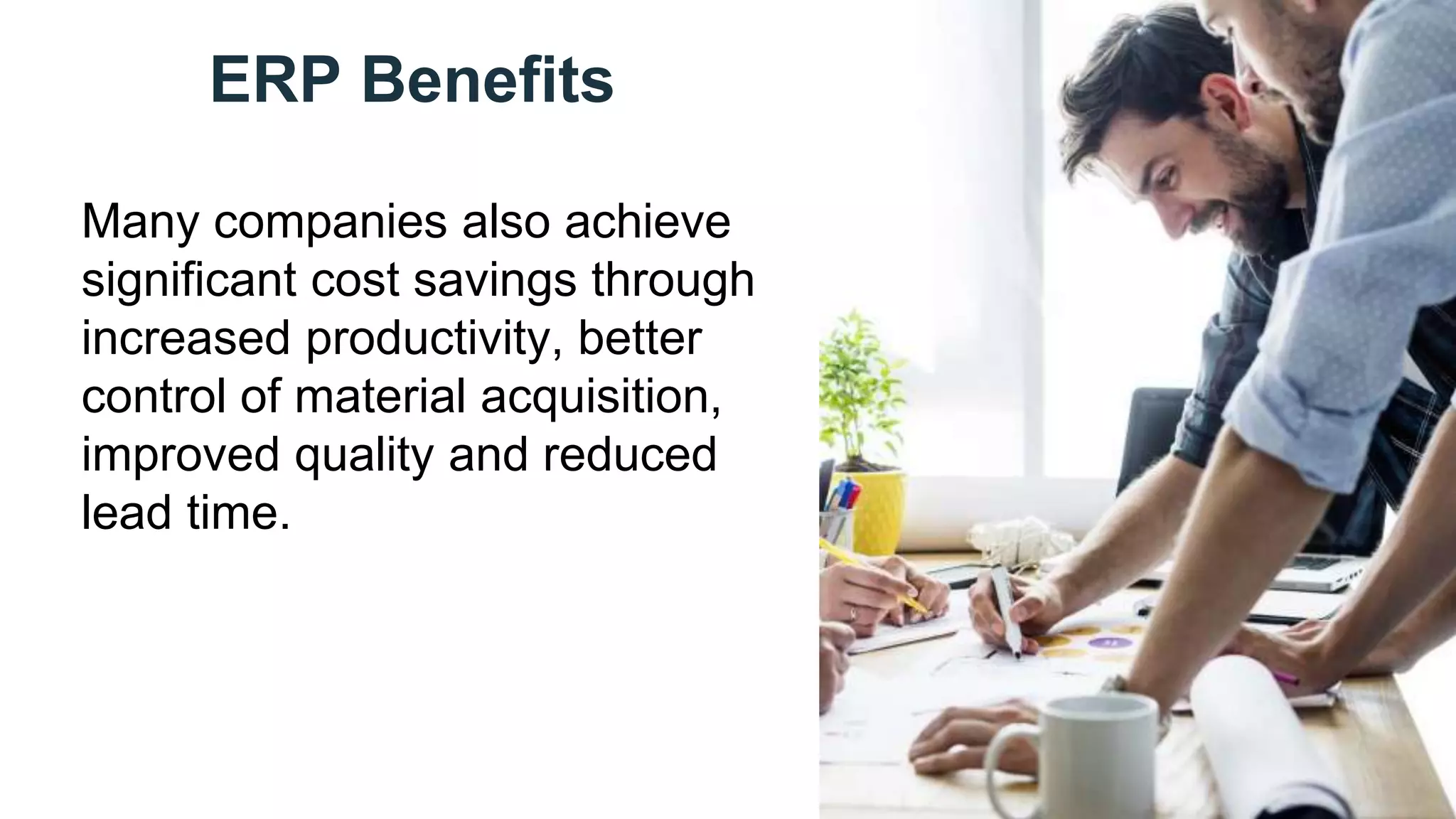
Many companies also achieve
significant cost savings through
increased productivity, better
control of material acquisition,
improved quality and reduced
lead time.
Key Benefits of ERP
Day 2
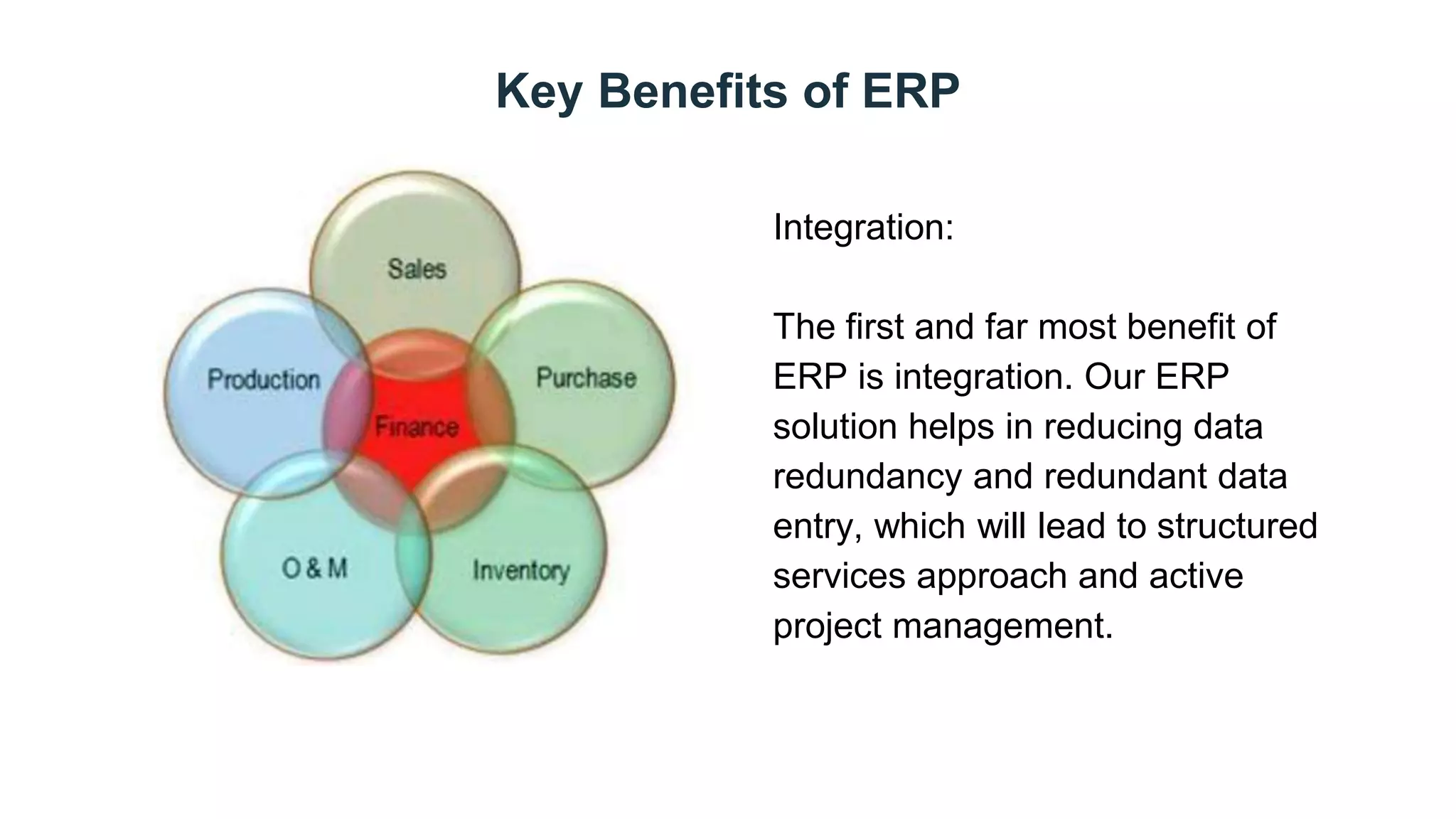
Integration:
The first and far most benefit of
ERP is integration. Our ERP
solution helps in reducing data
redundancy and redundant data
entry, which will lead to structured
services approach and active
project management.
Key Benefits of ERP
Day 2
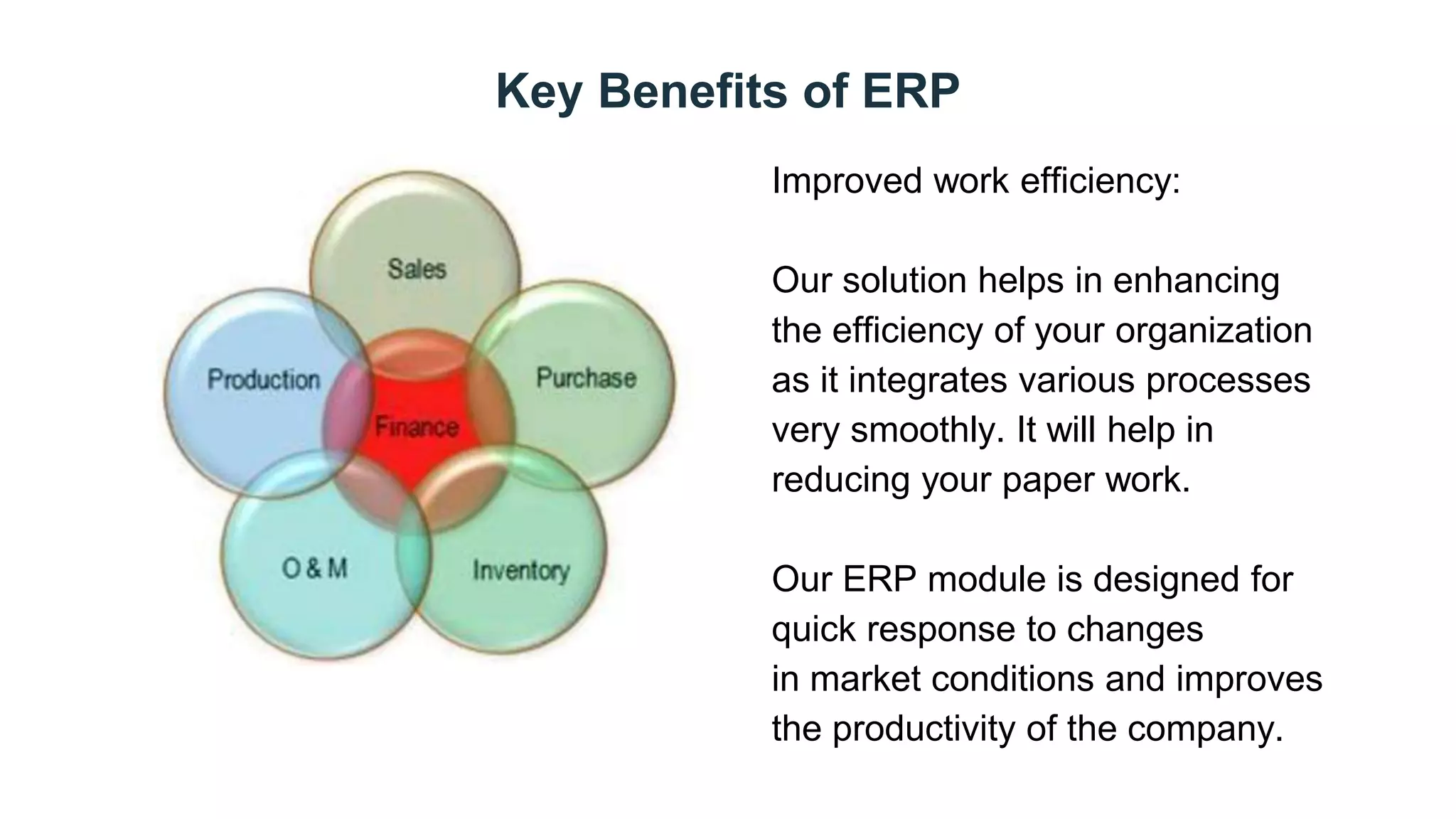
Improved work efficiency:
Our solution helps in enhancing
the efficiency of your organization
as it integrates various processes
very smoothly. It will help in
reducing your paper work.
Our ERP module is designed for
quick response to changes
in market conditions and improves
the productivity of the company.
Key Benefits of ERP
Day 2
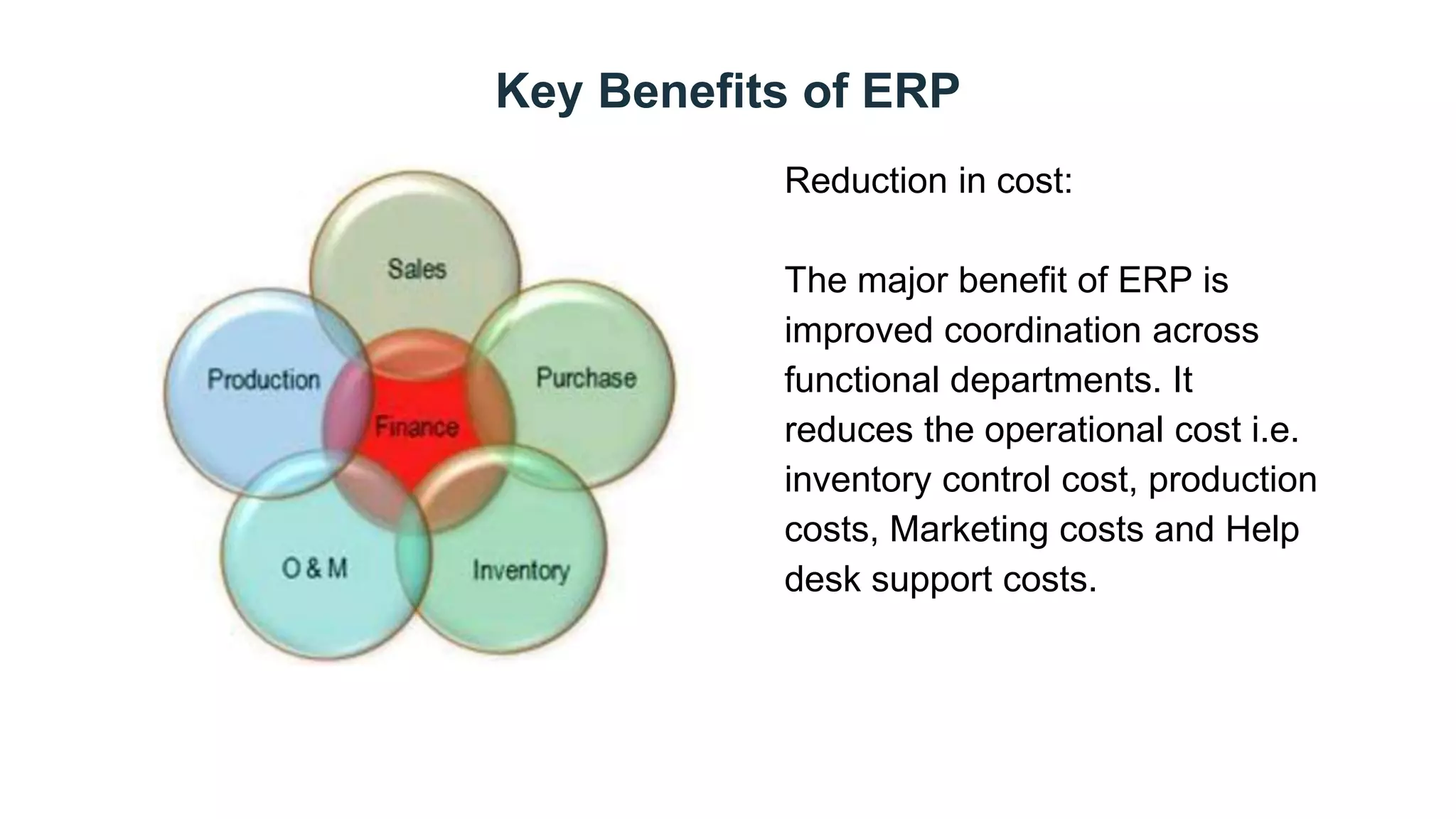
Reduction in cost:
The major benefit of ERP is
improved coordination across
functional departments. It
reduces the operational cost i.e.
inventory control cost, production
costs, Marketing costs and Help
desk support costs.
1.3 Why ERP Required
A number of trends drove the growth
of the enterprise software market.
First, integrated information
architecture improves business
performance. Once a major company
in an industry adopts enterprise
software, competitors may be
compelled to follow suit to stay
competitive.
1.3 Why ERP Required
Second, there has been a
major shift towards the use of
packaged applications.
This is partly related to the “Y2K bug”
and the European Union’s conversion
to a single currency, which induced
companies to replace their legacy
systems with packaged software
effectively “outsourcing” the solution
to the ERP vendor.
1.3 Why ERP Required
Third, many companies were
abandoning legacy software due to
the demands of electronic commerce
and front office applications on the
front end and linking to suppliers and
business partners at the back end.
1.3 Why ERP Required
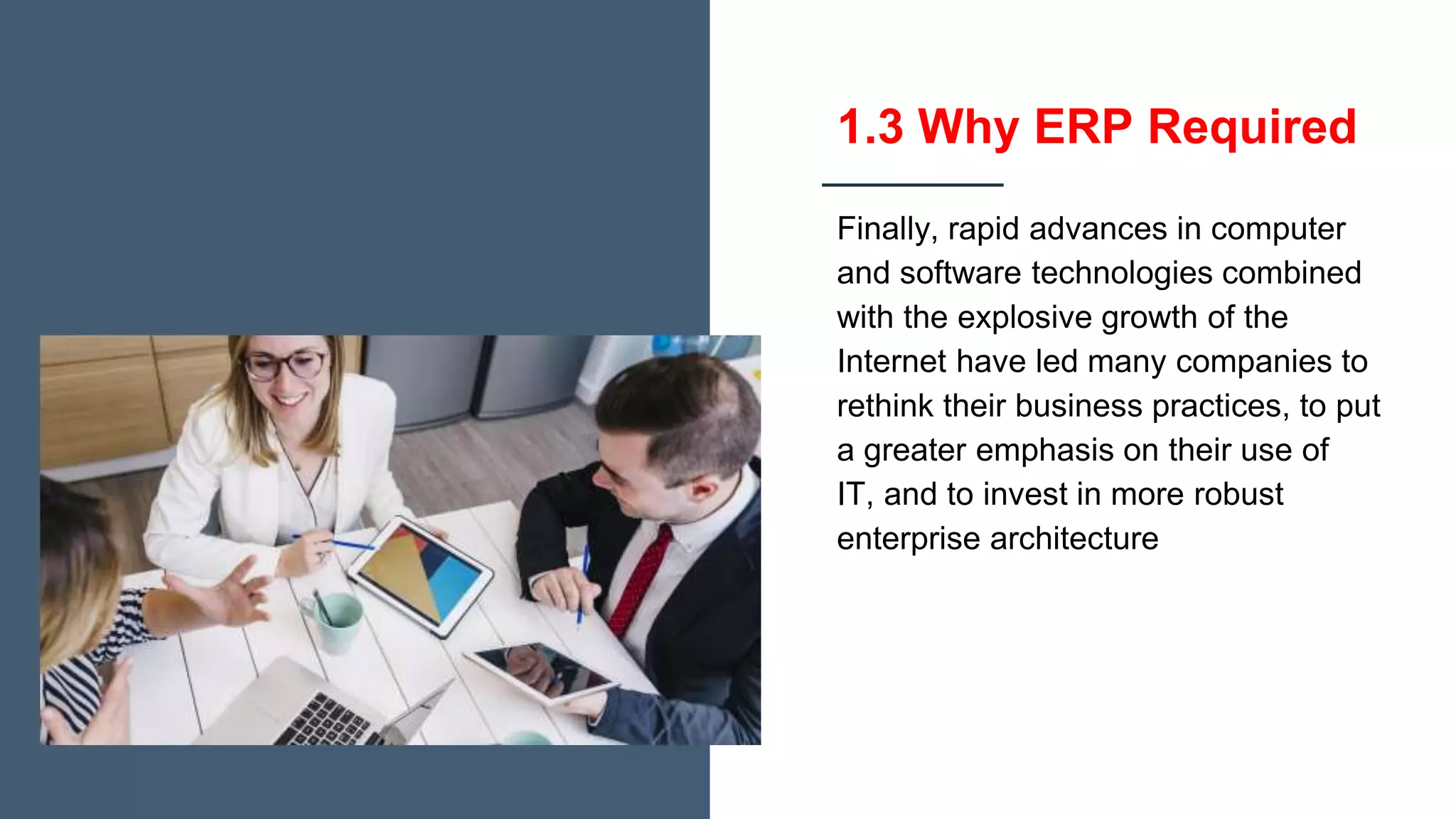
Finally, rapid advances in computer
and software technologies combined
with the explosive growth of the
Internet have led many companies to
rethink their business practices, to put
a greater emphasis on their use of
IT, and to invest in more robust
enterprise architecture
1.4 Definition of ERP
The term ERP abbreviated from
“Enterprise Resource Planning”,
was introduced by the Gartner
Group in the early 1990s and
represent computer and software
systems that combine and
integrate all related processes of
the enterprise, and serve users
for the management of all
functions within the enterprise.
1.4 Definition of ERP
Kumar et al. (2000) define
enterprise resource planning
(ERP) systems as “configurable
information systems
packages that integrate
information and information-
based processes within and
across functional areas in an
organization”.
1.4 Definition of ERP
Nah et al. (2001) defines ERP as “An
enterprise resource planning (ERP)
system is typically defined as a
packaged business software system
that facilitates a corporation to manage
the efficient and effective use of
resources (materials, human resources,
finance, etc.) by providing a total
integrated solution for the organization’s
information- processing requests,
through aprocess-oriented view
consistent across the company.
1.4 Definition of ERP
Botta-Genoulaz and Millet(2006)
described ERP system as an
integrated software packages
comprising of set
of functional modules (Production,
Human resources, Sales, Finance
etc.) and integrate all departmental
functions across organizations into
one single system fulfilling the needs
of all departments
1.4 Definition of ERP
Davenport(1998) also described ERP
an information strategy that merge all
information within an organization
and create a comprehensive
information infrastructure involving all
organizational units and functions.
Based on the different viewpoints of the authors, the concept of ERP system
may be expressed as “Business management systems, comprises of set of
integrated software packages, with a common database that controls the flow of
integrated information in real time and manage all processes across functional
areas within the organization.
1.5 Benefits of ERP
Some of the benefits are
quantitative (tangible) while others
are non-quantitative (intangible).
Tangible benefits are those
measured in monetary terms and
intangible benefits cannot be
measured in monetary terms but
they do have a very significant
business impact.
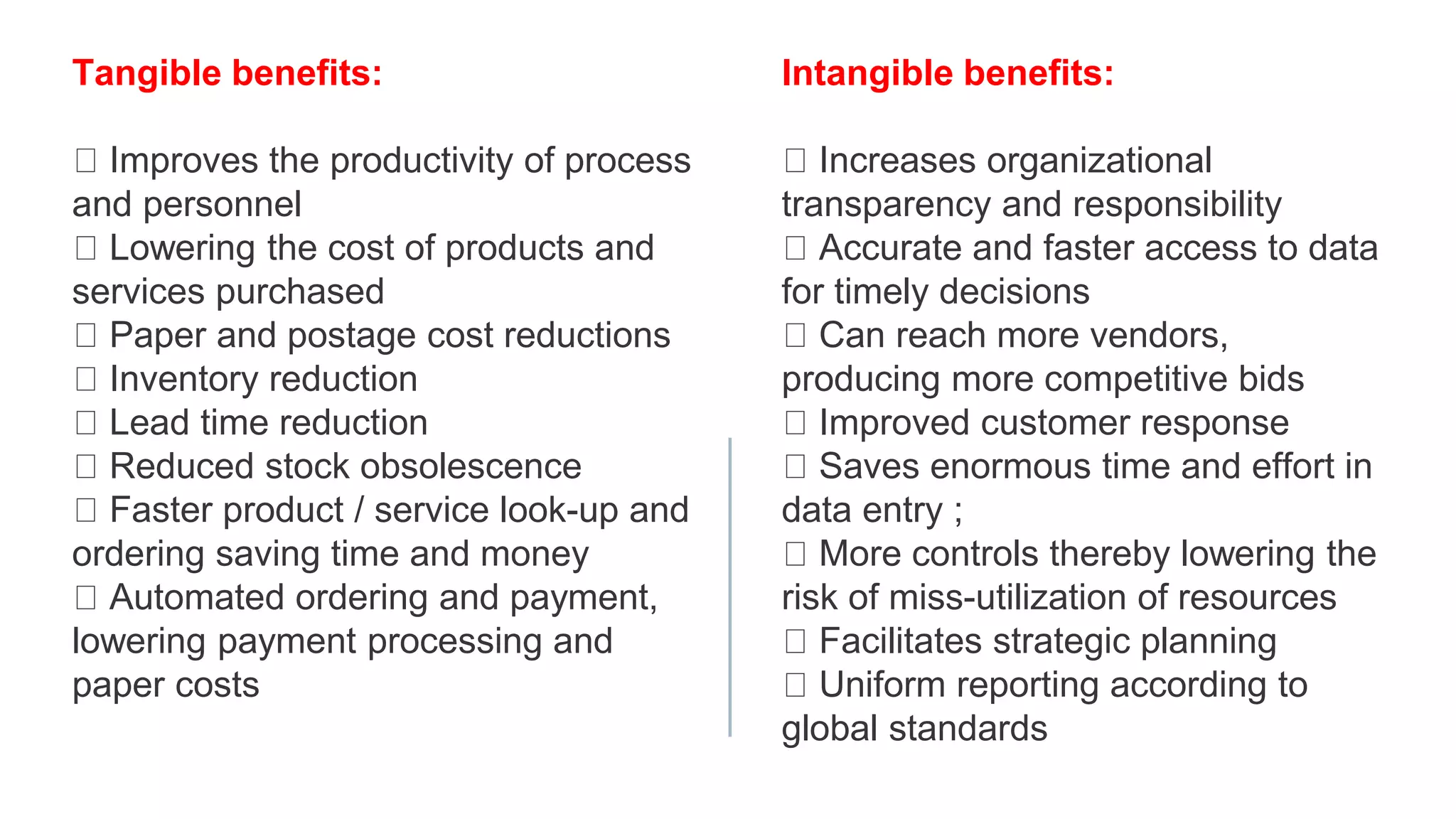
Tangible benefits:
Improves the productivity of process
and personnel
Lowering the cost of products and
services purchased
Paper and postage cost reductions
Inventory reduction
Lead time reduction
Reduced stock obsolescence
Faster product / service look-up and
ordering saving time and money
Automated ordering and payment,
lowering payment processing and
paper costs
Intangible benefits:
Increases organizational
transparency and responsibility
Accurate and faster access to data
for timely decisions
Can reach more vendors,
producing more competitive bids
Improved customer response
Saves enormous time and effort in
data entry ;
More controls thereby lowering the
risk of miss-utilization of resources
Facilitates strategic planning
Uniform reporting according to
global standards
Installing an ERP system has many advantages both direct and
indirect. The direct advantages include improved efficiency,
information integration for better decision making, faster response time
to customer queries, etc. The indirect benefits include better corporate
image, improved customer goodwill, customer
satisfaction, and so on.
The following are some of the direct benefits of an ERP system:
1. Business Integration
2. Flexibility
3. Better Analysis and Planning Capabilities
4. Use of Latest Technology.
Did you know?
In 1990 Gartner Group first
employed the acronym ERP as
an extension of material
requirements planning
(MRP), later manufacturing
resource planning and
computer-integrated
manufacturing.
Caution
High switching costs associated with
ERP can increase the ERP vendor's
negotiating power which can result in
higher support, maintenance, and
upgrade expenses.
THANK YOU!

Unit 1- Introduction to ERP.pptx

  • 1.
    Enterprise Resource Planning(ERP) space for your logo
  • 2.
    Contents 1.1 Introduction 1.2 Whatis ERP? 1.3 Why ERP Required? 1.4 Definitions of ERP 1.5 Benefits of ERP
  • 3.
    1.1 INTRODUCTION Enterprise ResourcePlanning, or ERP, is a system that is used to combine all of the information or operations of a company into a single unit. The goal of ERP is to unify the various functions of an institution. However, the use of Enterprise Resource Planning is not simply limited to corporations. It is commonly used by non-profit organizations government agencies, and other institutions.
  • 4.
  • 5.
    1.2 What isERP? Enterprise Resource Planning (ERP) covers the techniques and concepts employed for the integrated management of businesses by the effective use of management resources, to improve the efficiency of an enterprise. ERP packages are integrated (covering all business functions) software packages that support the above ERP concepts.
  • 6.
    1.2 What isERP? ERP software applications can be used to manage product planning, parts purchasing, inventories, interacting with suppliers providing customer service, and tracking orders. ERP can also include application modules for the finance and human resources aspects of a business. Typically, an ERP system uses or is integrated with a relational database
  • 7.
    ERP Application Tools LargeERP vendors are competing with their smaller counterparts by either buying them out or forming strategic alliances with them. A number of consultants within large firms are specializing in various areas. They will analyze the process that needs to be reengineered, and once this is done, they will decide how the ERP software must be used.
  • 8.
    The most importantareas for ERP applications are finance, human resources, and manufacturing “
  • 9.
    ERP Benefits Any companyinvesting in any new tools or equipment will want to know that the investment will pay off—have sufficient return on investment (ROI) to justify the expenditure. Most companies will identify inventory reduction as one of the biggest benefits of an ERP system
  • 10.
    ERP Benefits Many companiesalso achieve significant cost savings through increased productivity, better control of material acquisition, improved quality and reduced lead time.
  • 11.
    Key Benefits ofERP Day 2 Integration: The first and far most benefit of ERP is integration. Our ERP solution helps in reducing data redundancy and redundant data entry, which will lead to structured services approach and active project management.
  • 12.
    Key Benefits ofERP Day 2 Improved work efficiency: Our solution helps in enhancing the efficiency of your organization as it integrates various processes very smoothly. It will help in reducing your paper work. Our ERP module is designed for quick response to changes in market conditions and improves the productivity of the company.
  • 13.
    Key Benefits ofERP Day 2 Reduction in cost: The major benefit of ERP is improved coordination across functional departments. It reduces the operational cost i.e. inventory control cost, production costs, Marketing costs and Help desk support costs.
  • 14.
    1.3 Why ERPRequired A number of trends drove the growth of the enterprise software market. First, integrated information architecture improves business performance. Once a major company in an industry adopts enterprise software, competitors may be compelled to follow suit to stay competitive.
  • 15.
    1.3 Why ERPRequired Second, there has been a major shift towards the use of packaged applications. This is partly related to the “Y2K bug” and the European Union’s conversion to a single currency, which induced companies to replace their legacy systems with packaged software effectively “outsourcing” the solution to the ERP vendor.
  • 16.
    1.3 Why ERPRequired Third, many companies were abandoning legacy software due to the demands of electronic commerce and front office applications on the front end and linking to suppliers and business partners at the back end.
  • 17.
    1.3 Why ERPRequired Finally, rapid advances in computer and software technologies combined with the explosive growth of the Internet have led many companies to rethink their business practices, to put a greater emphasis on their use of IT, and to invest in more robust enterprise architecture
  • 18.
    1.4 Definition ofERP The term ERP abbreviated from “Enterprise Resource Planning”, was introduced by the Gartner Group in the early 1990s and represent computer and software systems that combine and integrate all related processes of the enterprise, and serve users for the management of all functions within the enterprise.
  • 19.
    1.4 Definition ofERP Kumar et al. (2000) define enterprise resource planning (ERP) systems as “configurable information systems packages that integrate information and information- based processes within and across functional areas in an organization”.
  • 20.
    1.4 Definition ofERP Nah et al. (2001) defines ERP as “An enterprise resource planning (ERP) system is typically defined as a packaged business software system that facilitates a corporation to manage the efficient and effective use of resources (materials, human resources, finance, etc.) by providing a total integrated solution for the organization’s information- processing requests, through aprocess-oriented view consistent across the company.
  • 21.
    1.4 Definition ofERP Botta-Genoulaz and Millet(2006) described ERP system as an integrated software packages comprising of set of functional modules (Production, Human resources, Sales, Finance etc.) and integrate all departmental functions across organizations into one single system fulfilling the needs of all departments
  • 22.
    1.4 Definition ofERP Davenport(1998) also described ERP an information strategy that merge all information within an organization and create a comprehensive information infrastructure involving all organizational units and functions.
  • 23.
    Based on thedifferent viewpoints of the authors, the concept of ERP system may be expressed as “Business management systems, comprises of set of integrated software packages, with a common database that controls the flow of integrated information in real time and manage all processes across functional areas within the organization.
  • 24.
    1.5 Benefits ofERP Some of the benefits are quantitative (tangible) while others are non-quantitative (intangible). Tangible benefits are those measured in monetary terms and intangible benefits cannot be measured in monetary terms but they do have a very significant business impact.
  • 25.
    Tangible benefits: Improves theproductivity of process and personnel Lowering the cost of products and services purchased Paper and postage cost reductions Inventory reduction Lead time reduction Reduced stock obsolescence Faster product / service look-up and ordering saving time and money Automated ordering and payment, lowering payment processing and paper costs Intangible benefits: Increases organizational transparency and responsibility Accurate and faster access to data for timely decisions Can reach more vendors, producing more competitive bids Improved customer response Saves enormous time and effort in data entry ; More controls thereby lowering the risk of miss-utilization of resources Facilitates strategic planning Uniform reporting according to global standards
  • 26.
    Installing an ERPsystem has many advantages both direct and indirect. The direct advantages include improved efficiency, information integration for better decision making, faster response time to customer queries, etc. The indirect benefits include better corporate image, improved customer goodwill, customer satisfaction, and so on. The following are some of the direct benefits of an ERP system: 1. Business Integration 2. Flexibility 3. Better Analysis and Planning Capabilities 4. Use of Latest Technology.
  • 27.
    Did you know? In1990 Gartner Group first employed the acronym ERP as an extension of material requirements planning (MRP), later manufacturing resource planning and computer-integrated manufacturing.
  • 28.
    Caution High switching costsassociated with ERP can increase the ERP vendor's negotiating power which can result in higher support, maintenance, and upgrade expenses.
  • 29.