


A robust and efficient iterative method for the
numerical solution of the Helmholtz equation
Yogi Ahmad ERLANGGA
A robust and efficient iterative method for the
numerical solution of the Helmholtz equation
PROEFSCHRIFT
ter verkrijging van de graad van doctor
aan de Technische Universiteit Delft,
op gezag van de Rector Magnificus prof.dr.ir. J.T. Fokkema,
voorzitter van het College voor Promoties, in het openbaar te verdedigen op
maandag 22 december 2005 om 10:30 uur
door
Yogi Ahmad ERLANGGA
ingenieur luchtvaart- en ruimtevaarttechniek, Technische Universiteit Delft
geboren te Tasikmalaya, Indonesi¨e.
Contents
1 Introduction 1
1.1 Motivation: seismic applications . . . . . . . . . . . . . . . . . . 1
1.2 The Helmholtz equation . . . . . . . . . . . . . . . . . . . . . . . 3
1.3 Boundary conditions . . . . . . . . . . . . . . . . . . . . . . . . . 8
1.4 Direct methods and iterative methods . . . . . . . . . . . . . . . 10
1.5 Time-domain vs. frequency-domain solver . . . . . . . . . . . . . 11
1.6 Scope of the thesis . . . . . . . . . . . . . . . . . . . . . . . . . . 12
1.7 Outline of the thesis . . . . . . . . . . . . . . . . . . . . . . . . . 13
1.8 About numerical implementations . . . . . . . . . . . . . . . . . 14
2 Finite differences for the Helmholtz equation 15
2.1 Second order finite difference approximation . . . . . . . . . . . . 16
2.2 High order finite difference approximation . . . . . . . . . . . . . 17
2.3 Dispersion and anisotropy . . . . . . . . . . . . . . . . . . . . . . 18
2.4 Numerical boundary conditions . . . . . . . . . . . . . . . . . . . 20
2.5 The properties of the linear system . . . . . . . . . . . . . . . . . 21
2.6 Model problems . . . . . . . . . . . . . . . . . . . . . . . . . . . . 22
3 Krylov subspace iterative methods 27
3.1 Basic iterative methods . . . . . . . . . . . . . . . . . . . . . . . 27
3.2 Krylov subspace methods . . . . . . . . . . . . . . . . . . . . . . 28
3.3 Conjugate gradient . . . . . . . . . . . . . . . . . . . . . . . . . . 29
3.4 Conjugate orthogonal-conjugate gradient . . . . . . . . . . . . . . 31
3.5 Generalized Minimal Residual, GMRES . . . . . . . . . . . . . . 32
3.6 Bi-CGSTAB . . . . . . . . . . . . . . . . . . . . . . . . . . . . . . 33
3.7 Numerical example . . . . . . . . . . . . . . . . . . . . . . . . . . 35
3.8 Preconditioning . . . . . . . . . . . . . . . . . . . . . . . . . . . . 35
3.8.1 Incomplete LU decomposition . . . . . . . . . . . . . . . . 37
3.8.2 Incomplete factorization-based preconditioner . . . . . . . 40
3.8.3 Separation-of-variables preconditioner . . . . . . . . . . . 41
4 Shifted Laplace preconditioner 43
4.1 1D analysis for constant wavenumbers . . . . . . . . . . . . . . . 44
4.1.1 Real shift . . . . . . . . . . . . . . . . . . . . . . . . . . . 44
ii CONTENTS
4.1.2 Generalization to complex shift . . . . . . . . . . . . . . . 46
4.2 Spectral properties of the shifted Laplace preconditioner . . . . . 49
4.3 Bound of convergence rate of GMRES . . . . . . . . . . . . . . . 56
4.3.1 Closed-off problem . . . . . . . . . . . . . . . . . . . . . . 56
4.3.2 Analysis for radiation boundary conditions . . . . . . . . 59
4.4 h-dependence of convergence . . . . . . . . . . . . . . . . . . . . 62
4.5 Extension to heterogeneous media . . . . . . . . . . . . . . . . . 63
5 Multigrid for the preconditioner solve 67
5.1 Principles of multigrid . . . . . . . . . . . . . . . . . . . . . . . . 68
5.1.1 From two-grid method to multigrid . . . . . . . . . . . . . 68
5.2 Multigrid convergence for the Helmholtz equation . . . . . . . . . 70
5.3 Multigrid components . . . . . . . . . . . . . . . . . . . . . . . . 71
5.3.1 Smoothers . . . . . . . . . . . . . . . . . . . . . . . . . . . 72
5.3.2 Prolongation and restriction operators . . . . . . . . . . . 72
5.3.3 Coarse grid operator, multigrid cycle . . . . . . . . . . . . 75
5.4 Fourier analysis . . . . . . . . . . . . . . . . . . . . . . . . . . . . 75
5.4.1 Two- and three-grid convergence analysis . . . . . . . . . 76
5.4.2 Fourier analysis applied to the preconditioner with imag-
inary shift . . . . . . . . . . . . . . . . . . . . . . . . . . . 78
5.5 Numerical results . . . . . . . . . . . . . . . . . . . . . . . . . . . 80
5.5.1 Model Problem 1: Constant wavenumber . . . . . . . . . 81
5.5.2 Model Problem 2: The wedge model . . . . . . . . . . . . 81
5.5.3 Model Problem 3: The Marmousi problem . . . . . . . . . 83
6 Multigrid-based preconditioner for the Helmholtz equation 87
6.1 More on the spectral properties of the shifted Laplace precondi-
tioner . . . . . . . . . . . . . . . . . . . . . . . . . . . . . . . . . 88
6.2 Multigrid for the preconditioner . . . . . . . . . . . . . . . . . . . 89
6.2.1 Fourier analysis and multigrid results . . . . . . . . . . . 89
6.2.2 Multigrid for the preconditioner . . . . . . . . . . . . . . 94
6.3 Numerical results . . . . . . . . . . . . . . . . . . . . . . . . . . . 95
6.3.1 Model Problem 1: Constant wavenumber . . . . . . . . . 95
6.3.2 Model Problem 2: The wedge model . . . . . . . . . . . . 97
6.3.3 Model Problem 3: The Marmousi problem . . . . . . . . . 98
6.3.4 Convergence result for the 9-point stencil . . . . . . . . . 101
7 Three-dimensional Helmholtz equation 103
7.1 3D Helmholtz equation . . . . . . . . . . . . . . . . . . . . . . . . 103
7.2 Multigrid with semicoarsening for the preconditioner . . . . . . . 104
7.3 Numerical results . . . . . . . . . . . . . . . . . . . . . . . . . . . 108
7.3.1 3D constant wavenumber . . . . . . . . . . . . . . . . . . 108
7.3.2 3D three-layer problems . . . . . . . . . . . . . . . . . . . 110
7.3.3 The 3D wedge problem . . . . . . . . . . . . . . . . . . . 112
CONTENTS iii
8 Conclusion 115
8.1 Overview . . . . . . . . . . . . . . . . . . . . . . . . . . . . . . . 115
8.2 Remark . . . . . . . . . . . . . . . . . . . . . . . . . . . . . . . . 117
iv CONTENTS
List of Figures
1.1 Infinitesimally small fluid particle . . . . . . . . . . . . . . . . . . 4
1.2 Solid element under stress forces . . . . . . . . . . . . . . . . . . 5
2.1 2D finite difference stencil: (a) 5-point stencil, (b) 9-point stencil 17
2.2 Numerical solution (real part) at k = 50, α = 0 for the model
problem MP1 with k constant. Left: 5-point stencil with 2nd
order radiation boundary conditions. Right: 9-point stencil (γ =
2/5) and 1st order radiation boundary conditions imposed on the
damping layer . . . . . . . . . . . . . . . . . . . . . . . . . . . . . 23
2.3 MP2. Wedge problem for f = 30 Hz, α = 0 (no damping):
(a) Problem geometry with velocity profile indicated, (b) Real
part of numerical solution: 5-point stencil, second order radiation
condition (c) Real part of numerical solution: 5-point stencil,
sponge layers, first order Sommerfled radiation condition . . . . . 24
2.4 MP3. Marmousi problem (not to scale). a) Velocity distribution
in meter/s, b) real part of the solution for f = 20 Hz, 5-point
stencil, c) real part of the solution for f = 20 Hz, 9-point stencil
(γ = 2/5) with absorption layers. In both cases, α = 0 . . . . . . 25
2.5 MP3. Marmousi problem (not to scale). a) Velocity distribution
in meter/s, b) real part of the solution for f = 20 Hz, 5-point
stencil c) real part of the solution for f = 20 Hz, 9-point stencil
(γ = 2/5). In both cases, α = 0.025. . . . . . . . . . . . . . . . . 26
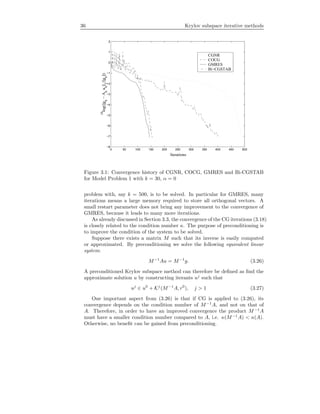
3.1 Convergence history of CGNR, COCG, GMRES and Bi-CGSTAB
for Model Problem 1 with k = 30, α = 0 . . . . . . . . . . . . . . 36
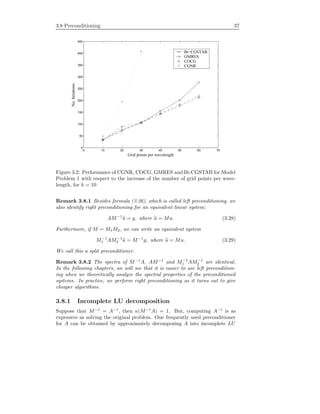
3.2 Performance of CGNR, COCG, GMRES and Bi-CGSTAB for
Model Problem 1 with respect to the increase of the number of
grid points per wavelength, for k = 10 . . . . . . . . . . . . . . . 37
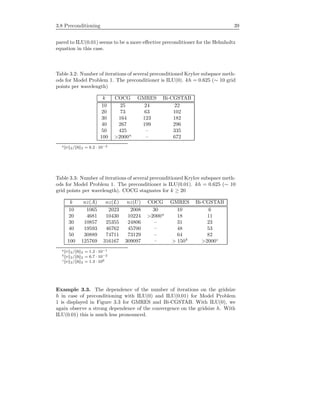
3.3 Performance (in number of iterations) of GMRES (dashed line)
and Bi-CGSTAB (solid line) for Model Problem 1 with respect to
an increasing number of grid points per wavelength. The upper
part is for preconditioning with ILU(0). The lower part is for
ILU(0.01). . . . . . . . . . . . . . . . . . . . . . . . . . . . . . . . 40
vi LIST OF FIGURES
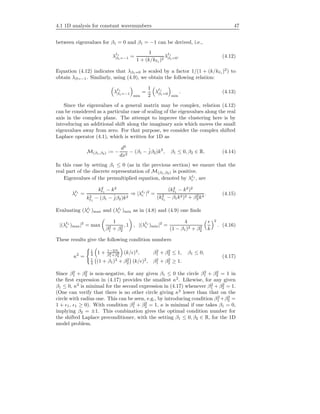
4.1 Condition number κ of M−1
A vs. coefficient β1 for the real
shifted Laplace preconditioner . . . . . . . . . . . . . . . . . . . . 46
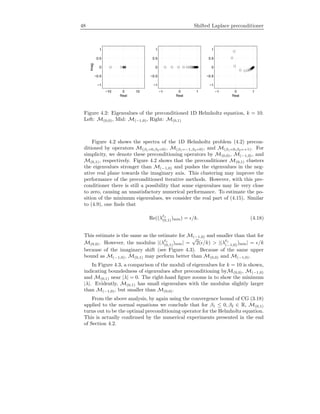
4.2 Eigenvalues of the preconditioned 1D Helmholtz equation, k =
10. Left: M(0,0), Mid: M(−1,0), Right: M(0,1) . . . . . . . . . . 48
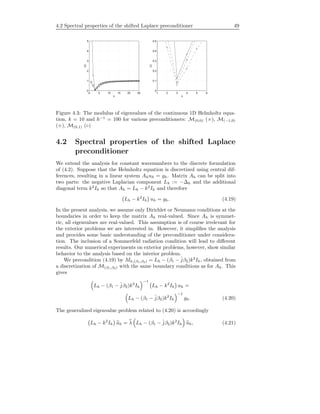
4.3 The modulus of eigenvalues of the continuous 1D Helmholtz equa-
tion, k = 10 and h−1
= 100 for various preconditioners: M(0,0)
(×), M(−1,0) (+), M(0,1) (◦) . . . . . . . . . . . . . . . . . . . . 49
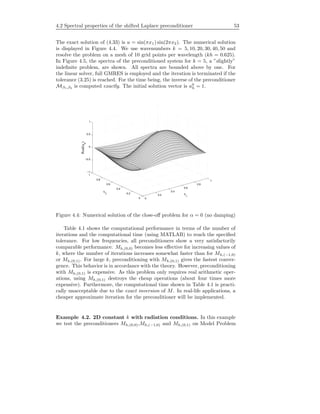
4.4 Numerical solution of the close-off problem for α = 0 (no damping) 53
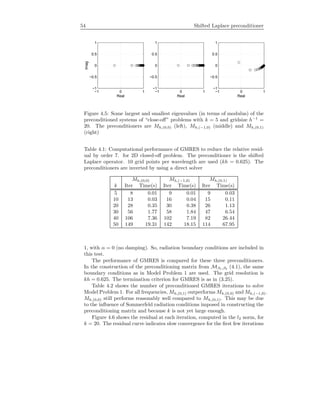
4.5 Some largest and smallest eigenvalues (in terms of modulus) of
the preconditioned systems of “close-off” problems with k = 5
and gridsize h−1
= 20. The preconditioners are Mh,(0,0) (left),
Mh,(−1,0) (middle) and Mh,(0,1) (right) . . . . . . . . . . . . . . . 54
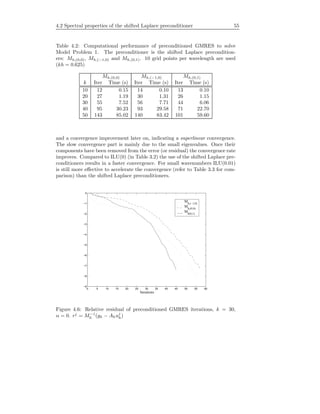
4.6 Relative residual of preconditioned GMRES iterations, k = 30,
α = 0. rj
= M−1
h (gh − Ahuj
h) . . . . . . . . . . . . . . . . . . . . 55
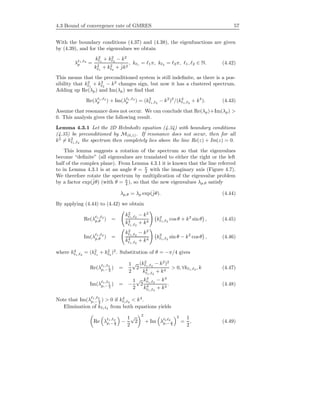
4.7 Rotation of the z-plane. . . . . . . . . . . . . . . . . . . . . . . . 58
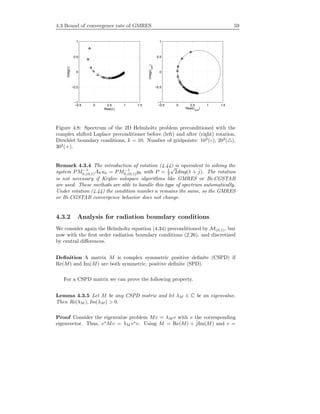
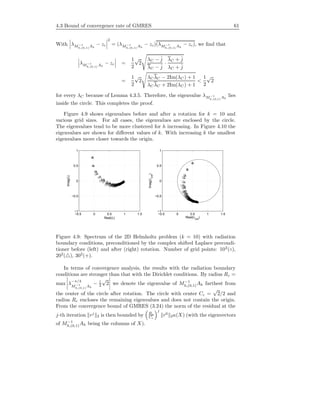
4.8 Spectrum of the 2D Helmholtz problem preconditioned with the
complex shifted Laplace preconditioner before (left) and after
(right) rotation, Dirichlet boundary conditions, k = 10. Num-
ber of gridpoints: 102
(◦), 202
( ), 302
(+). . . . . . . . . . . . . . 59
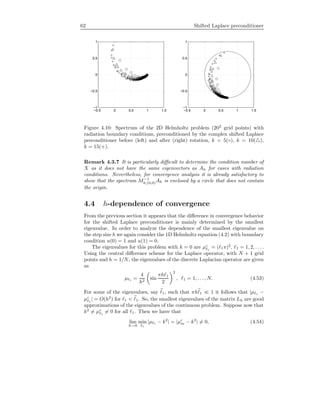
4.9 Spectrum of the 2D Helmholtz problem (k = 10) with radia-
tion boundary conditions, preconditioned by the complex shifted
Laplace preconditioner before (left) and after (right) rotation.
Number of grid points: 102
(◦), 202
( ), 302
(+). . . . . . . . . . . 61
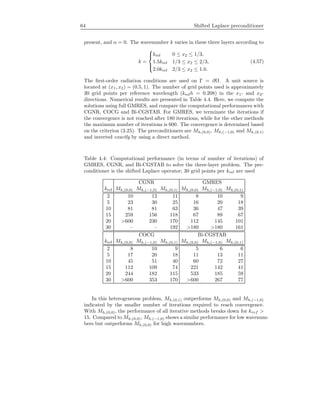
4.10 Spectrum of the 2D Helmholtz problem (202
grid points) with
radiation boundary conditions, preconditioned by the complex
shifted Laplace preconditioner before (left) and after (right) ro-
tation, k = 5(◦), k = 10( ), k = 15(+). . . . . . . . . . . . . . . 62
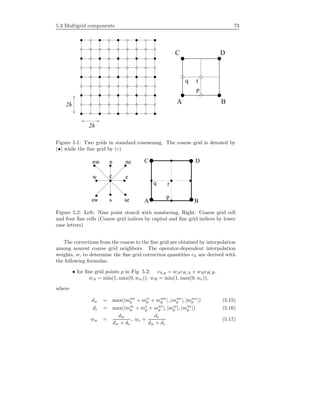
5.1 Two grids in standard coarsening. The coarse grid is denoted by
(•) while the fine grid by (◦) . . . . . . . . . . . . . . . . . . . . 73
5.2 Left: Nine point stencil with numbering, Right: Coarse grid cell
and four fine cells (Coarse grid indices by capital and fine grid
indices by lower case letters) . . . . . . . . . . . . . . . . . . . . . 73
5.3 Two- and multigrid cycle: (i) V-cycle, (ii) F-cycle and (iii) W-cycle 76
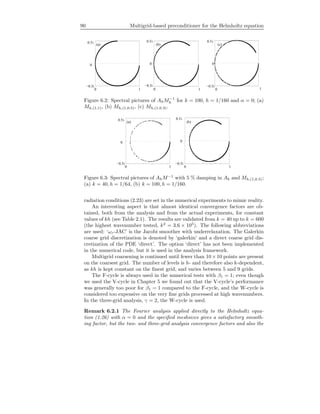
6.1 Spectral pictures of AhM−1
h with α = 0 and different values
of (β1, β2) in (6.1): (a) Mh,(0,0), (b) Mh,(−1,0), (c) Mh,(0,1), (d)
Mh,(1,1), (e) Mh,(1,0.5), (f) Mh,(1,0.3). . . . . . . . . . . . . . . . . 89
6.2 Spectral pictures of AhM−1
h for k = 100, h = 1/160 and α = 0;
(a) Mh,(1,1), (b) Mh,(1,0.5), (c) Mh,(1,0.3). . . . . . . . . . . . . . . 90
6.3 Spectral pictures of AhM−1
with 5 % damping in Ah and Mh,(1,0.5);
(a) k = 40, h = 1/64, (b) k = 100, h = 1/160. . . . . . . . . . . . 90
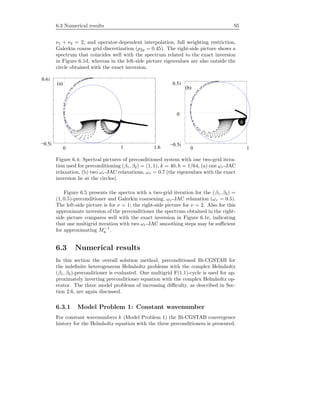
6.4 Spectral pictures of preconditioned system with one two-grid iter-
ation used for preconditioning (β1, β2) = (1, 1), k = 40, h = 1/64,
(a) one ωr-JAC relaxation, (b) two ωr-JAC relaxations, ωr = 0.7
(the eigenvalues with the exact inversion lie at the circles). . . . . 95
LIST OF FIGURES vii
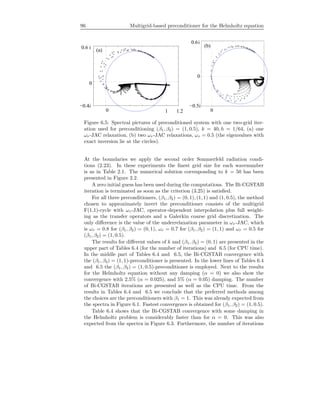
6.5 Spectral pictures of preconditioned system with one two-grid it-
eration used for preconditioning (β1, β2) = (1, 0.5), k = 40, h =
1/64, (a) one ωr-JAC relaxation, (b) two ωr-JAC relaxations,
ωr = 0.5 (the eigenvalues with exact inversion lie at the circles). . 96
6.6 Bi-CGSTAB convergence plot for (β1, β2) = (1, 0.5) for the wedge
problem at different frequencies, α = 0. . . . . . . . . . . . . . . 100
6.7 Domain with absorption layers (Ω2) . . . . . . . . . . . . . . . . 101
7.1 Semicoarsening of three grid levels: standard coarsening in two
directions (x1 and x2), the third (x3) direction is kept uncoarsened105
7.2 The 27-point stencil . . . . . . . . . . . . . . . . . . . . . . . . . 107
7.3 Three-dimensional problems: (a) constant k (b) three layers, k is
varied in the x2-direction. . . . . . . . . . . . . . . . . . . . . . . 109
7.4 Wedge problem: fa(x1, x2, x3) = 0.5x1 +2.5x2 +0.375x3 −1 = 0,
fb(x1, x2, x3) = −1
6 x1 + 5
3 x2 − 1
3 x3 − 1 = 0 . . . . . . . . . . . . . 112
List of Tables
1.1 Some two-dimensional Poisson solvers with arithmetic complexity
[92]. N is the number of unknowns . . . . . . . . . . . . . . . . . 11
2.1 Number of grid points employed, related to the wavenumber, so
that kh = 0.625. . . . . . . . . . . . . . . . . . . . . . . . . . . . 20
3.1 Number of iterations of several Krylov subspace methods to reach
convergence for Model Problem 1. kh = 0.625 (∼ 10 grid points
per wavelength) . . . . . . . . . . . . . . . . . . . . . . . . . . . . 35
3.2 Number of iterations of several preconditioned Krylov subspace
methods for Model Problem 1. The preconditioner is ILU(0).
kh = 0.625 (∼ 10 grid points per wavelength) . . . . . . . . . . . 39
3.3 Number of iterations of several preconditioned Krylov subspace
methods for Model Problem 1. The preconditioner is ILU(0.01).
kh = 0.625 (∼ 10 grid points per wavelength). COCG stagnates
for k ≥ 20 . . . . . . . . . . . . . . . . . . . . . . . . . . . . . . . 39
4.1 Computational performance of GMRES to reduce the relative
residual by order 7. for 2D closed-off problem. The precondi-
tioner is the shifted Laplace operator. 10 grid points per wave-
length are used (kh = 0.625). The preconditioners are inverted
by using a direct solver . . . . . . . . . . . . . . . . . . . . . . . . 54
4.2 Computational performance of preconditioned GMRES to solve
Model Problem 1. The preconditioner is the shifted Laplace pre-
conditioners: Mh,(0,0), Mh,(−1,0) and Mh,(0,1). 10 grid points per
wavelength are used (kh = 0.625) . . . . . . . . . . . . . . . . . . 55
4.3 Computational performance of GMRES (in terms of number of
iterations) to solve the “close-off” problem (see Example 4.1) with
different grid resolutions . . . . . . . . . . . . . . . . . . . . . . . 63
4.4 Computational performance (in terms of number of iterations)
of GMRES, CGNR, and Bi-CGSTAB to solve the three-layer
problem. The preconditioner is the shifted Laplace operator; 30
grid points per kref are used . . . . . . . . . . . . . . . . . . . . . 64
x LIST OF TABLES
5.1 Comparison of asymptotic convergence from Fourier analysis with
numerical multigrid convergence, Mh,(0,1). µ is the smoothing
factor; ρ2g, ρ3g are the two- and three-grid convergence factor
from Fourier analysis; ρh is the numerical multigrid convergence
factor. The smoother is ωr-RB-GS with ωr = 1 . . . . . . . . . . 79
5.2 Comparison of asymptotic convergence from Fourier analysis with
numerical multigrid convergence, Mh,(0,1). µ is the smoothing
factor; ρ2g, ρ3g are the two- and three-grid convergence factor
from Fourier analysis; ρh is the numerical multigrid convergence
factor. The smoother is ωr-JAC with ωr = 0.8 . . . . . . . . . . 79
5.3 Number of multigrid V-cycles to solve the preconditioner Mh,(0,1),
with MD and FW as the transfer operators. The CPU time is
presented for k = 100. The termination criterion is rj
/r0
≤ 10−6
80
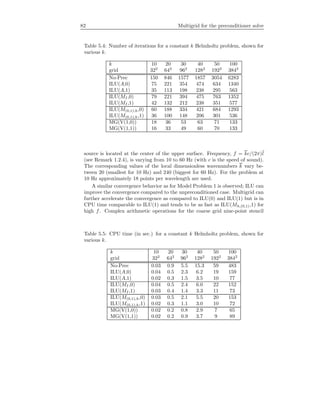
5.4 Number of iterations for a constant k Helmholtz problem, shown
for various k. . . . . . . . . . . . . . . . . . . . . . . . . . . . . . 82
5.5 CPU time (in sec.) for a constant k Helmholtz problem, shown
for various k. . . . . . . . . . . . . . . . . . . . . . . . . . . . . . 82
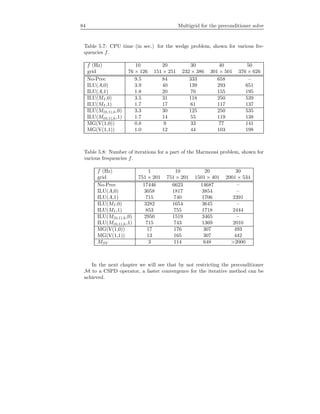
5.6 Number of iterations for the wedge problem, shown for various
frequencies f. . . . . . . . . . . . . . . . . . . . . . . . . . . . . . 83
5.7 CPU time (in sec.) for the wedge problem, shown for various
frequencies f. . . . . . . . . . . . . . . . . . . . . . . . . . . . . . 84
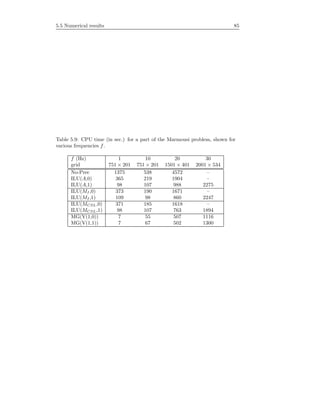
5.8 Number of iterations for a part of the Marmousi problem, shown
for various frequencies f. . . . . . . . . . . . . . . . . . . . . . . . 84
5.9 CPU time (in sec.) for a part of the Marmousi problem, shown
for various frequencies f. . . . . . . . . . . . . . . . . . . . . . . . 85
6.1 Comparison of convergence (β1, β2) = (1, 1), Fourier analysis con-
vergence (γ = 1), ωr-JAC, ωr = 0.7 and F(1,1)-cycle. Coarse grid
discretizations are compared. (The direct discretization has not
been implemented) . . . . . . . . . . . . . . . . . . . . . . . . . . 91
6.2 Fourier analysis convergence factors compared to multigrid con-
vergence (β1, β2) = (1, 0.5). The smoother is ωr-JAC with ωr =
0.5. (The direct discretization has not been implemented) . . . . 91
6.3 Smoothing factors µh for ωr-JAC on different coarse grids and
various (β1, β2)-values. . . . . . . . . . . . . . . . . . . . . . . . . 92
6.4 Number of prec. Bi-CGSTAB iterations to reduce the initial
residual by 7 orders. Damping parameter α is varied in the
Helmholtz problem. . . . . . . . . . . . . . . . . . . . . . . . . . . 97
6.5 CPU time (in seconds) to reduce the initial residual by 7 orders.
Damping parameter α is varied in the Helmholtz problem. . . . . 98
6.6 High wavenumbers, number of Bi-CGSTAB iterations and CPU
time in seconds (in parentheses) to reduce the initial residual by
7 orders with and without damping in the Helmholtz problem. . 98
LIST OF TABLES xi
6.7 Bi-CGSTAB convergence for the wedge problem with and with-
out damping and the three multigrid based (β1, β2)-preconditioners
compared. Number of Bi-CGSTAB iterations and CPU time in
seconds (in parentheses). . . . . . . . . . . . . . . . . . . . . . . . 99
6.8 Bi-CGSTAB convergence for the Marmousi problem with and
without damping and the three multigrid based (β1, β2)-preconditioners.
Number of Bi-CGSTAB iterations and CPU time in seconds (in
parentheses). . . . . . . . . . . . . . . . . . . . . . . . . . . . . . 100
6.9 Bi-CGSTAB convergence for the Marmousi problem with and
without damping. The Helmholtz equation is discretized by us-
ing a 9-point stencil (γ = 4/5). The preconditioner is based on
(β1, β2) = (1, 0.5), discretized with the 5-point stencil. 50 grid-
points are added for absorption layers. . . . . . . . . . . . . . . . 102
7.1 Performance of preconditioned Bi-CGSTAB in terms of the num-
ber of iterations and CPU time (in sec.) to reach convergence
for the Helmholtz equation with constant wavenumber k, α = 0;
kh = 0.625 . . . . . . . . . . . . . . . . . . . . . . . . . . . . . . . 109
7.2 Number of iterations of preconditioned Bi-CGSTAB to reach
convergence for the constant wavenumber Helmholtz equation,
α = 0, solved on a different grid resolution. The “–” means that
the computation is not performed because kh > 0.625 . . . . . . 110
7.3 Bi-CGSTAB iteration to reach convergence for three layers prob-
lems with (x1, x2) semicoarsening, krefh = 0.625 . . . . . . . . . . 111
7.4 Bi-CGSTAB iteration to reach convergence for three layers prob-
lems with (x1, x3) semicoarsening, krefh = 0.625 . . . . . . . . . . 111
7.5 Number of Bi-CGSTAB iterations to reach convergence for a
three layers problem with (x1, x2) semicoarsening. The “–” means
that the computation is not performed because krefh > 0.625 . . 112
7.6 Bi-CGSTAB iteration to reach convergence for a three-dimensional
wedge problem with (x1, x2) semicoarsening, krefh = 0.625 . . . . 113
Chapter 1
Introduction
We are concerned with the numerical solution of wave problems in two and three
dimensions. The wave problems to be considered are modeled by means of the
Helmholtz equation, which represents time-harmonic wave propagation in the
frequency domain.
The Helmholtz equation finds its applications in many fields of science and
technology. For example, the Helmholtz equation has been used to investigate
acoustic phenomena in aeronautics [64] and underwater acoustics [41, 4]. The
Helmholtz equation is also solved in electromagnetic applications, e.g. in pho-
tolithography [96]. Due to recently increased interest in a more efficient solver
for migration in 3D geophysical applications the use of the Helmholtz equation
is also investigated in that field [75, 80].
In this thesis we will focus on the application of the Helmholtz equation in
geophysics. The method which is proposed and explained in this thesis can,
however, be used for any class of problems related to the Helmholtz equation.
1.1 Motivation: seismic applications
In geophysical applications, seismic information on the earth’s subsurface struc-
tures is very important. In the petroleum industry, e.g., accurate seismic in-
formation for such a structure can help in determining possible oil reservoirs
in subsurface layers. This information, or in particular an image of the earth’s
subsurface, is gathered by measuring the times required for a seismic wave to re-
turn to the surface after reflection from the interfaces of layers of different local
physical properties. The seismic wave is usually generated by shots of known
frequencies, placed on the earth’s surface, and the returning wave is recorded
by instruments located along the earth’s surface. Variations in the reflection
times from place to place on the surface usually indicate structural features of
the strata up to 6,000 m below the earth’s surface. One technique, which is
popular nowadays, to postprocess the seismic data and construct the image of
the earth’s subsurface is migration.
2 Introduction
Migration is a technique to focus the seismic waves such that the exact
information of the reflector/secondary sources on the subsurface is correctly
known. A modern migration technique is based on the wave equation, originally
proposed by Claerbout in the early 1970s, which is based on the finite-difference
approach [16].
To keep the computational cost acceptable, the wave equation is usually
replaced by a one-way or paraxial approximation [10, 17, 25, 28, 60]. This
approximation is in most cases valid for not too large velocity contrasts and not
too wide angles of incidence. With the continuing increase in computer power,
it may be worthwhile to develop finite-difference two-way or full wave-equation
migration techniques, without making the approximations needed for ray-based
or one-way migration methods [107].
Nowadays, for the imaging of seismic data, the industry is gradually moving
from 1D models based on ray-based techniques to 2D/3D finite-difference wave-
equation migration. Ray-based methods are difficult to use or may even fail in
complex earth models and in the presence of large velocity contrasts. Wave-
equation migration can better handle these situations.
In two-dimensional space, two-way wave-equation migration can be carried
out efficiently by working in the frequency domain. In that case, the linear
system arising from the discretization of the two-way wave equation is solved
once with a direct solution method for each frequency. The result can be used
for the computation of all the wave fields for all shots and also for the back-
propagated receiver wave fields. The latter correspond to the reverse-time wave
fields in the time domain [72, 75, 80]. This makes the 2D method an order of
magnitude faster than its time-domain counterpart when many shots need to
be processed.
Time-domain reverse-time migration requires the storage of the forward and
time-reversed wave fields at time intervals to avoid aliasing. These wave fields
are correlated to obtain a partial migration image for each shot. Adding over all
shots provides the desired result. In the frequency domain, only one forward and
one back-propagated wave field need to be stored. They are simply multiplied
to obtain a partial migration image. The summation over shots and frequencies
produces the final migration image. In this way, a substantial reduction of
storage requirement is obtained.
Because direct solvers are computationally out of reach in 3D, a suitable iter-
ative method for the two-way wave equation is needed. This iterative method,
however, must be applied for each shot and each back-propagated wave field
computation. Differently, a direct method is employed only once to compute an
LU-decomposition of the linear system. Once this costly step has been carried
out, the computation of wave fields for all shots and receiver wave fields can be
carried at a small computational cost [72]. This attractive feature, that makes
the frequency-domain approach so efficient in 2D is lost when we use an iterative
method.
If we ignore storage requirements and only consider computational time, a
frequency-domain formulation can only compete with the time-domain approach
if the work involved in the iterations times the number of frequencies is signifi-
1.2 The Helmholtz equation 3
cantly less than the work needed for doing all the time steps in the time-domain
method [36]. We will return to this issue in Section 1.5.
From its formulation, the time-harmonic Helmholtz equation looks easy and
straightforward to solve as it can be considered as the Poisson equation with ze-
roth order perturbation. Many efficient numerical methods have been developed
for the Poisson equation. This extra term, however, appears in the Helmholtz
equation with the wrong sign. Therefore, the Helmholtz equation does not in-
herit the same nice properties the Poisson equation has. This perturbation is
actually the source of complications when one tries to numerically solve the
Helmholtz equation.
In the last three decades attempts to iteratively solve the Helmholtz equation
have been made by many authors. The paper of Bayliss, Goldstein and Turkel
[12], that appeared in the early 1980s, can be considered as the first publication
which shows efficient implementation of an iterative method (i.e. conjugate gra-
dients) on the Helmholtz equation. The follow-up paper by Gozani, Nochshon
and Turkel [51] includes multigrid as a preconditioner in the conjugate gradient
algorithm. Because the methods are not of highest efficiency for high wavenum-
ber (or frequency) problems, many contributions have been made since. Work
in [12] and [51], however, gives cause for optimism that a well-designed iterative
method can be used to solve the Helmholtz equation with a greater efficiency
than a traditional direct solver, especially in three-dimensional space.
Ideally, the performance of an iterative method for the Helmholtz equation
should be independent of both the grid size and the wavenumber. As inde-
pendence of the grid size can sometimes be easily achieved, the dependence
on the wavenumber is the difficult part to tackle. Iterative methods typically
suffer from efficiency degradation when the wavenumber is increased. The re-
search in this thesis is geared towards an iterative method whose performance
is independent of grid size and (only mildly) of the wavenumber.
1.2 The Helmholtz equation
In this section we derive the Helmholtz equation, which is used in the frequency-
domain wave equation migration. The discussion is given for fluids and solids,
the media which are present in the earth subsurface. For fluids, the Helmholtz
equation can be obtained from the Euler equations, after applying a lineariza-
tion; see [29, 49]. We, however, show a different approach to derive the Helmholtz
equation, as used in [16]. This approach is unified approach, that can be applied
to fluids and solids. Furthermore, the relationship between the wave equation
for fluids and solids is clearly seen.
The basic equations used for the derivation of the wave equation are the
equation of motion (governed by Newton’s second law) and the Hooke law,
which relates particle velocity in space and pressure in time. We first discuss
the wave equation for fluids.
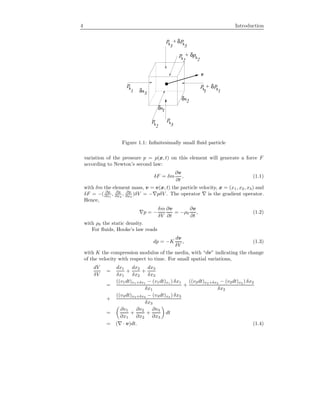
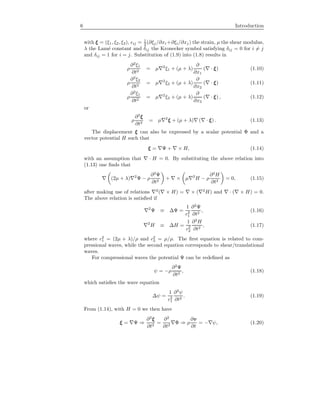
Consider an infinitesimally small fluid element with a volume δV in a domain
Ω = R3
, as depicted in Figure 1.1. By assuming zero viscosity, the spatial
4 Introduction
v
p
ppx x
xδ
p
+
+p
px
px
δ
δ
x x
x
δx
δx
1 1 1
1
2
2
2 2
3
3
p
x3
+ δp
x3
Figure 1.1: Infinitesimally small fluid particle
variation of the pressure p = p(x, t) on this element will generate a force F
according to Newton’s second law:
δF = δm
∂v
∂t
, (1.1)
with δm the element mass, v = v(x, t) the particle velocity, x = (x1, x2, x3) and
δF = −( ∂p
∂x1
, ∂p
∂x2
, ∂p
∂x3
)δV = − pδV . The operator is the gradient operator.
Hence,
p = −
δm
δV
∂v
∂t
= −ρ0
∂v
∂t
, (1.2)
with ρ0 the static density.
For fluids, Hooke’s law reads
dp = −K
dv
δV
, (1.3)
with K the compression modulus of the media, with “dv” indicating the change
of the velocity with respect to time. For small spatial variations,
dV
δV
=
dx1
δx1
+
dx2
δx2
+
dx3
δx3
=
((v1dt)x1+δx1 − (v1dt)x1 ) δx1
δx1
+
((v2dt)x2+δx2 − (v2dt)x2 ) δx2
δx2
+
((v3dt)x3+δx3 − (v3dt)x3 ) δx3
δx3
=
∂v1
∂x1
+
∂v2
∂x2
+
∂v3
∂x3
dt
= ( · v)dt. (1.4)
1.2 The Helmholtz equation 5
1ξ
x2
ξ
2
x1
x1
x2
γ
τ21
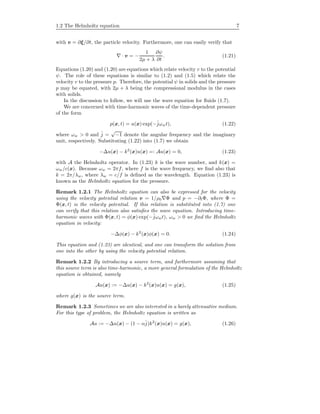
11τ
Figure 1.2: Solid element under stress forces
By using (1.4) and because dp = (∂p/∂t)dt, Hooke’s law for fluids now reads
· v = −
1
K
∂p
∂t
. (1.5)
Applying the gradient operator to (1.2) leads to
· −
1
ρ0
p =
∂
∂t
· v. (1.6)
Substitution of (1.5) into (1.6) and assuming that the gradient of the density ρ0
is infinitesimally small result in
∆p =
1
c2
∂2
p
∂t2
, (1.7)
which is the wave equation for fluids in terms of pressure, with ∆ ≡ 2
the
Laplace operator, and c = K/ρ0 the propagation speed of compressional
waves in fluids.
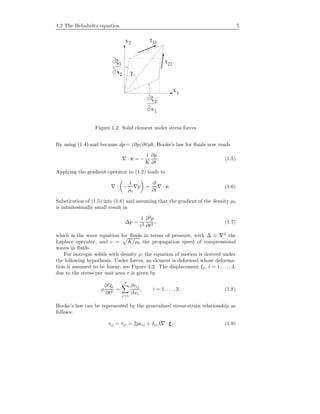
For isotropic solids with density ρ, the equation of motion is derived under
the following hypothesis. Under forces, an element is deformed whose deforma-
tion is assumed to be linear; see Figure 1.2. The displacement ξi, i = 1, . . . , 3,
due to the stress per unit area τ is given by
ρ
∂2
ξi
∂t2
=
3
j=1
∂τij
∂xi
, i = 1, . . . , 3. (1.8)
Hooke’s law can be represented by the generalized stress-strain relationship as
follows:
τij = τji = 2µ ij + δij λ · ξ, (1.9)
6 Introduction
with ξ = (ξ1, ξ2, ξ3), ij = 1
2 (∂ξj/∂xi +∂ξi/∂xj) the strain, µ the shear modulus,
λ the Lam´e constant and δij the Kronecker symbol satisfying δij = 0 for i = j
and δij = 1 for i = j. Substitution of (1.9) into (1.8) results in
ρ
∂2
ξ1
∂t2
= µ 2
ξ1 + (µ + λ)
∂
∂x1
( · ξ) (1.10)
ρ
∂2
ξ2
∂t2
= µ 2
ξ2 + (µ + λ)
∂
∂x2
( · ξ) (1.11)
ρ
∂2
ξ1
∂t2
= µ 2
ξ3 + (µ + λ)
∂
∂x3
( · ξ) , (1.12)
or
ρ
∂2
ξ
∂t2
= µ 2
ξ + (µ + λ) ( · ξ) . (1.13)
The displacement ξ can also be expressed by a scalar potential Φ and a
vector potential H such that
ξ = Ψ + × H, (1.14)
with an assumption that · H = 0. By substituting the above relation into
(1.13) one finds that
(2µ + λ) 2
Ψ − ρ
∂2
Ψ
∂t2
+ × µ 2
H − ρ
∂2
H
∂t2
= 0, (1.15)
after making use of relations 2
( × H) = × ( 2
H) and · ( × H) = 0.
The above relation is satisfied if
2
Ψ ≡ ∆Ψ =
1
c2
1
∂2
Ψ
∂t2
, (1.16)
2
H ≡ ∆H =
1
c2
2
∂2
H
∂t2
, (1.17)
where c2
1 = (2µ + λ)/ρ and c2
2 = µ/ρ. The first equation is related to com-
pressional waves, while the second equation corresponds to shear/translational
waves.
For compressional waves the potential Ψ can be redefined as
ψ = −ρ
∂2
Ψ
∂t2
, (1.18)
which satisfies the wave equation
∆ψ =
1
c2
1
∂2
ψ
∂t2
. (1.19)
From (1.14), with H = 0 we then have
ξ = Ψ ⇒
∂2
ξ
∂t2
=
∂2
∂t2
Φ ⇒ ρ
∂v
∂t
= − ψ, (1.20)
1.2 The Helmholtz equation 7
with v = ∂ξ/∂t, the particle velocity. Furthermore, one can easily verify that
· v = −
1
2µ + λ
∂ψ
∂t
. (1.21)
Equations (1.20) and (1.20) are equations which relate velocity v to the potential
ψ. The role of these equations is similar to (1.2) and (1.5) which relate the
velocity v to the pressure p. Therefore, the potential ψ in solids and the pressure
p may be equated, with 2µ + λ being the compressional modulus in the cases
with solids.
In the discussion to follow, we will use the wave equation for fluids (1.7).
We are concerned with time-harmonic waves of the time-dependent pressure
of the form
p(x, t) = u(x) exp(−ˆjωwt), (1.22)
where ωw > 0 and ˆj =
√
−1 denote the angular frequency and the imaginary
unit, respectively. Substituting (1.22) into (1.7) we obtain
−∆u(x) − k2
(x)u(x) =: Au(x) = 0, (1.23)
with A the Helmholtz operator. In (1.23) k is the wave number, and k(x) =
ωw/c(x). Because ωw = 2πf, where f is the wave frequency, we find also that
k = 2π/λw, where λw = c/f is defined as the wavelength. Equation (1.23) is
known as the Helmholtz equation for the pressure.
Remark 1.2.1 The Helmholtz equation can also be expressed for the velocity
using the velocity potential relation v = 1/ρ0 Φ and p = −∂tΦ, where Φ =
Φ(x, t) is the velocity potential. If this relation is substituted into (1.7) one
can verify that this relation also satisfies the wave equation. Introducing time-
harmonic waves with Φ(x, t) = φ(x) exp(−ˆjωwt), ωw > 0 we find the Helmholtz
equation in velocity:
−∆φ(x) − k2
(x)φ(x) = 0. (1.24)
This equation and (1.23) are identical, and one can transform the solution from
one into the other by using the velocity potential relation.
Remark 1.2.2 By introducing a source term, and furthermore assuming that
this source term is also time-harmonic, a more general formulation of the Helmholtz
equation is obtained, namely
Au(x) := −∆u(x) − k2
(x)u(x) = g(x), (1.25)
where g(x) is the source term.
Remark 1.2.3 Sometimes we are also interested in a barely attenuative medium.
For this type of problem, the Helmholtz equation is written as
Au := −∆u(x) − (1 − αˆj)k2
(x)u(x) = g(x), (1.26)
8 Introduction
with 0 ≤ α 1 indicating the fraction of damping in the medium. In geophysical
applications, that are of our main interest, this damping can be set up to 5%;
(α = 0.05).
The “damped” Helmholtz equation expressed by (1.26) is more general than
(1.23) and (1.25). Therefore, due to its generality we prefer to use the Helmholtz
equation (1.26) throughout the presentation. Whenever necessary, the “stan-
dard” Helmholtz equation can be recovered from (1.26) by setting α = 0.
Remark 1.2.4 Scaling. Assume that the physical domain has a characteristic
length l and consider a nondimensional domain [0, 1]3
. The nondimensional
length is determined as x1 = x1/l, x2 = x2/l and x3 = x3/l. Thus,
∂
∂x1
=
1
l
∂
∂x1
,
∂2
∂x2
1
=
1
l
2
∂2
∂x2
1
, and so on.
Substituting these relations into (1.26) results in
−∆u(x) − (1 − αˆj)k
2
(x)u(x) = g(x), x = (x1, x2, x2), in Ω = (0, 1)3
,
with the wavenumber in the non-dimensional domain, denoted by k, can be re-
lated to the physical quantities in the physical domain by the relation
k = 2πfl/c. (1.27)
In the discussion to follow we will use the notation k for wavenumbers regardless
of the domain we are considering. However, the meaning should be clear from the
context. If we consider a unit domain, the wavenumber should be dimensionless.
1.3 Boundary conditions
For a partial differential equation, of the form (1.23), (1.25) or (1.26), proper
boundary conditions are required. These boundary conditions should be chosen
such that the resulting problem is well-posed. In general, one can identify two
types of boundary conditions. The first type is a boundary condition for waves
propagating to infinite distance. The second type is related to waves scattered
by obstacles in a medium.
A boundary condition at infinity can be derived by considering the phys-
ical situation at infinity [49]. This situation can be viewed directly from the
Helmholtz equation (1.23) if we consider a domain Ω with a homogeneous
medium. Assume spherical symmetric waves propagating from a source or a
scatterer in the domain Ω. In most cases, close to the source/scatterer this
assumption is easily violated; there the waves are arbitrary and more complex
than just spherical. We assume, however, that at infinity these complex waves
are disentangled and become spherical. Under this assumption, the problem
1.3 Boundary conditions 9
can be evaluated in a spherical coordinate system. In the spherical coordinate
system, the Helmholtz equation is transformed into
−(ru) − k2
(ru) = 0,
with a general solution of the form
u(r) = A
cos(kr)
r
+ B
sin(kr)
r
. (1.28)
Combining (1.28) with (1.22) we find that
p(r, t) = A∗ exp(ˆj(kr − ωwt))
r
+ B∗ exp(−ˆj(kr + ωwt))
r
. (1.29)
By considering surfaces of constant phase it is easily deduced that the
first term at the right hand side describes waves propagating away from the
source/scatterer, as ωwt increases with time, while the second term represents
waves propagating inwards from infinity. If a region Ω bounded by a spherical
surface Γ = ∂Ω contains a scatterer, the second term in (1.29) cannot be a so-
lution, as physics only allows waves propagating away from the scatterer. The
solution, therefore, consists only of the first term in (1.29). Since the first term
contains a factor r−1
, the amplitude of the wave must disappear at infinity.
The vanishing criterion ensuring u(r) → 0 as r → ∞ is provided by the
radiation condition. For k > 0, if we differentiate (1.29), after dropping the
second right hand term, the following relation results:
r(u − ˆjku) = −u.
For r → ∞, one finds that u → 0. By this we can reformulate the problem as
lim
r→∞
u − ˆjku ∼ o(r−1
); lim
r→∞
ru ∼ O(1). (1.30)
In the above relations, symbols “o” and “O” are the Landau’s symbols, defined
as
f1(x) ∼ O(f2(x)) =⇒
f1(x)
f2(x)
→ C,
f1(x) ∼ o(f2(x)) =⇒
f1(x)
f2(x)
→ 0,
with C being a constant. The first condition in (1.30) is the Sommerfeld radia-
tion condition, whereas the second condition is the finiteness condition.
Remark 1.3.1 A different terminology is also used for the radiation condition.
For instance it is sometimes called “non-reflecting” or “absorbing” boundary
condition. We will use them interchangeably in this thesis.
10 Introduction
The radiation condition (1.30) is only satisfied at infinity. In a numerical
model, this condition is approximately satisfied, as an infinite domain is always
truncated to a finite region. Therefore, a numerical radiation condition is re-
quired for boundaries at finite distance, which mimics the radiation condition
at infinity. This will be addressed in Chapter 2.
In the scattering situation, additional boundary conditions inside Ω repre-
senting the presence of the obstacles should be added. Consider an impenetrable
obstacle D in Ω with boundary Γs = ∂D. We distinguish two types of bound-
ary conditions commonly used for scattering problems. In the case of sound-soft
obstacles, the velocity of the total wave (i.e. the sum of the incoming wave φi
and the scattered wave φs
) vanishes at Γs, i.e. φ = 0 on Γs. This is known
as the Dirichlet boundary condition. For the case of sound-hard obstacles, the
condition on Γs leads to a Neumann condition: ∂φ/∂n = 0, implying a condition
of a vanishing normal velocity on the scatterer surface.
1.4 Direct methods and iterative methods
Numerical approximations based on finite differences/volumes/elements require
the solution of a sparse, large linear system of equations. There are in general
two classes of methods to solve a linear system: direct methods and iterative
methods.
Direct methods are basically derived from Gaussian elimination. They are
well-known for their robustness for general problems. However, Gaussian elimi-
nation is not favorable for sparse linear systems. During the elimination process,
zero elements in the matrix may be filled by non-zero entries. This is called fill-
in and gives rise to two complications: (i) extra computer storage required to
store the additional non-zero entries, (ii) extra computational work during the
elimination process.
In many problems, a reordering strategy or pre-processing (e.g. nested dis-
section) technique can be used to modify the structure of the matrix such that
Gaussian elimination can be performed more efficiently (see e.g. [48]). Never-
theless, it is also possible that the pre-processing adds some more computational
work.
Iterative methods, on the other hand, rely primarily on matrix-vector multi-
plications. An example of a simple iterative method is the Jacobi iteration. In
the Jacobi iteration, the solution of linear system is iteratively obtained from a
recursion consisting of one matrix-vector multiplication, starting with a given
initial solution. A matrix-vector multiplication is a cheap process, requiring only
O(N) arithmetic operations per iteration with N the number of unknowns. If
the method converges after a finite small number of iterations, the method would
be efficient.
Iterative methods, however, are not always guaranteed to have fast conver-
gence. In fact there are many situations for iterative methods to diverge. In
such cases, iterative methods do not offer any advantage as compared to direct
methods.
1.5 Time-domain vs. frequency-domain solver 11
Table 1.1 compares the typical complexities of different solvers for a banded
linear system obtained from a finite difference discretization of the 2D Poisson
equation. The size of the linear system to solve is N ×N, where N is the number
of unknowns. The iterative methods converge to a tolerance . Conjugate
gradients and multigrid, two advanced iterative methods, are later discussed in
this thesis.
Table 1.1: Some two-dimensional Poisson solvers with arithmetic complexity
[92]. N is the number of unknowns
Method Complexity
Gauss elimination O(N2
)
Jacobi/Gauss-Seidel iteration O(N2
log )
Successive over relaxation (SOR) O(N3/2
log )
Conjugate gradient O(N3/2
log )
Nested dissection [48] O(N3/2
)
Alternating-direction iteration (ADI) [101] O(N log N log )
Multigrid (iterative) O(N log )
Multigrid (FMG) O(N)
For a sparse, large linear system, direct methods become impractical. This is
typical for problems in three-dimensional space. The complexity of the method
becomes O(N3
) and storage requirement can be up to O(N2
) due to fill-in.
Therefore, for three-dimensional problems iterative methods are the method of
choice. In the case of slow convergence or even divergence remedies based on
theory often exist.
The Helmholtz equation is one of the problems for which iterative methods
typically result in an extremely slow convergence. For reasons explained system-
atically in Chapters 2 and 3, the Helmholtz equation is inherently unfavorable
for iterative methods. However, with a proper remedy, e.g. with a good pre-
conditioner (to be discussed in Chapters 4 and 5), an efficient iterative method
can be designed.
Conjugate gradients and conjugate-gradient-like methods have been used in
[12], [51], [47] and [64] to solve the Helmholtz equation. ADI is used in [32].
Multigrid implementations are found in [22], [100], [65], [33] and [63].
1.5 Time-domain vs. frequency-domain solver
As mentioned in Section 1.1, to make a frequency-domain solver competitive
with the time-domain approach for geophysical applications, we require that
the work for the iterations times the number of frequencies is significantly less
than the work needed for doing all the time steps in the time-domain method.
In this section we elaborate on this subject, based on a complexity analysis [36].
12 Introduction
The basis for the performance prediction is the well-known time-domain
approach complexity. With ns the number of shots and nt the number of time
steps, the time-domain complexity is ns nt O(N), with N again the number
of unknowns. Stability requirements usually dictate nt = O(N1/d
), with d =
1, . . . , 3 the dimension. So, the overall complexity of the time-domain method
is ns O(N1+1/d
) for ns shots.
Suppose that there exists in frequency domain an efficient iterative method
for the Helmholtz equation with a complexity of order O(N) per iteration step.
With nf the number of frequencies, the overall complexity of the iterative solver
is ns nf nit O(N), with nit the number of iteration. The choice of the grid spac-
ing is determined by the maximum wavelength that can be accurately repre-
sented by the discretization. This implies that nf = O(N1/d
) if the maximum
frequency in the data is adapted to the grid spacing, whereas nf is indepen-
dent of N as soon as the grid is finer than required to accurately represent the
highest frequency in the data. In practice, one generally operates in the first
regime where nf = O(N1/d
). With these considerations, the complexity of the
iterative frequency-domain solver is ns nit O(N1+1/d
). From this estimate, the
optimal iterative frequency-domain solver would have the same complexity as
the time-domain solver if nit = O(1).
For a comparison between two solvers, however, the actual multiplicative
constants in the cost estimates also play an important role. The complexity of
the time-domain solver is Ct ns N1+1/d
and of the iterative frequency-domain
solver Cf ns nit N1+1/d
, with constants Ct and Cf . If one constant is several
orders of magnitude smaller than the other, a cost comparison of the meth-
ods cannot be based on considerations that involve O(n), O(nf ), etc., only.
This is observed in 2D migration problems presented in [74], where nested
dissection is used in the frequency domain. From complexity analysis, the
time-domain approach shows a better asymptotic behavior than the frequency
domain approach. Actual computations reveal, however, that the frequency-
domain method is about one order of magnitude faster than the time-domain
approach. The multiplicative constant for the frequency-domain direct solver
is apparently far smaller than the one for the time-domain solver. The reason
is that the number of frequencies needed is smaller than the number of time
steps imposed by the stability condition of the time-domain solver [75]. This
result gives an indication that if an iterative method with complexity of O(N)
can be made convergent after an O(1) number of iterations, the method can be
competitive. As in 3D direct methods become out of question, the importance
of an efficient iterative method becomes more obvious.
1.6 Scope of the thesis
This thesis deals with numerical methods for solving the Helmholtz equation in
two and three dimensions, with the following characteristics:
(i) the property of the medium (in terms of the local speed of sound, c) can
vary; i.e, heterogeneity is present in the medium,
1.7 Outline of the thesis 13
(ii) the wavenumber k can be very large, e.g. ∼ 1000 in a unit square domain.
We focus on iterative methods within the classes of Krylov subspace and
multigrid methods. As already mentioned, we aim at a method whose perfor-
mance is independent of grid size and wavenumber. By using a proper precon-
ditioner, the performance of the method can be made grid-independent. The
method presented in this thesis shows linear dependence on the wavenumber,
with only small constant.
Furthermore, we focus on linear systems obtained from finite difference dis-
cretizations. This is, however, not a limitation of the iterative method discussed
here. The method can handle different types of discretizations without losing
its efficiency and robustness.
Numerical results presented in this thesis are based on problems arising from
geophysical applications with extremely high wavenumbers. But, the method
developed in this thesis can also be used in other applications governed by the
Helmholtz equation.
1.7 Outline of the thesis
The outline of the thesis is as follows.
• In Chapter 2, discretization methods for the Helmholtz equation are dis-
cussed. The discussion emphasizes finite differences suitable for geophys-
ical applications.
• In Chapter 3 iterative methods are introduced for solving the resulting
linear systems. These include the basic iterative (Jacobi and Gauss-Seidel)
and Krylov subspace methods, which are the important and principal
methods in our solver. Some preconditioners which are relevant for Krylov
subspace methods are also discussed.
• Chapter 4 is devoted to a novel class of preconditioners for the Helmholtz
equation, called complex shifted Laplace preconditioners, which is an im-
portant ingredient in the method presented in this thesis and introduced
by us in a series of papers [37, 38, 40]. Discussions include the spectral
properties which are helpful to evaluate the convergence of the Krylov
subspace methods.
• In Chapter 5 the multigrid method is introduced. In particular, we discuss
the use of multigrid to approximately invert the complex shifted-Laplace
operator.
• In Chapter 6 a multigrid-based preconditioner especially designed for the
Helmholtz equation is introduced and discussed. Numerical tests for two-
dimensional problems are presented.
• Chapter 7 discusses the extension of the method to three dimensions and
shows results for three-dimensional problems.
14 Introduction
• In Chapter 8 we draw some conclusions and give remarks and suggestions
for future work.
1.8 About numerical implementations
In this thesis computations are performed for a variety of model problems. In
the early stages of the research a not-the-fastest computer was used to produce
the convergence results. As a new, faster computer has replaced the old one, the
numerical results are updated to have more impressing CPU times. Therefore,
one finds that some results here differ with the results that appeared in early
publications, e.g. in [38].
To reproduce the numerical results presented in this thesis, we have used
a LINUX machine with one Intel Pentium 4, 2.40 GHz CPU. This machine is
equipped with 2 GByte of RAM and 512 KByte of cache memory. For small
problems, MATLAB has been used for coding. GNU’s Fortran 77 compiler is
used mainly for large problems.
Chapter 2
Finite differences for the
Helmholtz equation
The standard procedure for obtaining a numerical solution of any partial differ-
ential equation (PDE) is first replacing the equation by its discrete formulation.
For the Helmholtz equation, there are many methods to realize this, including
the boundary element method (BEM) and the finite element method (FEM).
BEM, which typically results in a small but full linear system after discretiza-
tion, will not be discussed here. References [57], [58], [59], [7], [8], [9] and
[31], amongst others, discuss FEM for the Helmholtz equation. We focus on
finite difference methods (FDM). All numerical results presented in this thesis
are obtained from a finite difference approximation of the Helmholtz equation.
Furthermore, structured equidistant grids are employed.
A general discussion on finite difference methods for partial differential equa-
tions can be found, e.g. in [88]. The development of a high order FDM is given,
e.g. in [68], [13], [66] and [90]. There exist different finite difference approx-
imations for the Helmholtz equation (see e.g. [54], [85] and [61]). Here we
consider two of them: the pointwise representation and a high order representa-
tion. The pointwise representation is usually related to the so-called five-point
stencil. Dispersion and anisotropy properties of the two representations are
briefly discussed in Section 2.3.
In geophysical applications finite differences are widely used. One practical
reason is that the domains used in these applications are often simple (e.g. rect-
angular or box shape) and can be well fitted by regular finite difference meshes.
For Helmholtz problems with a complex geometry arising from scattering prob-
lems, finite elements are often the method of choice.
For ease of presentation, we consider the “damped” Helmholtz equation
(1.26) in Ω ⊂ R2
. Extension to three-dimensional space is straightforward.
16 Finite differences for the Helmholtz equation
2.1 Second order finite difference approximation
Let the sufficiently smooth domain Ω be discretized by an equidistant grid with
the grid size h. The discretized domain is denoted by Ωh. We compute approx-
imate solutions of the Helmholtz equation on Ωh. Let us consider the solution
at the grid point x = (x1, x2) = {(i1h, i2h)|i1, i2 = 1, 2, . . .,
√
N} in Ωh, with N
the number of unknowns. We introduce the standard lexicographical numbering
and denote the approximate solution u(x) = u(i1h, i2h) as ui1,i2 and those at
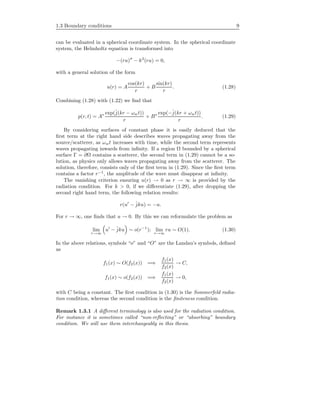
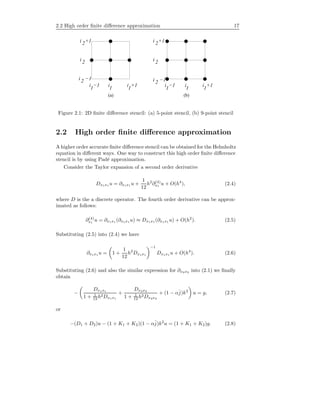
the four neighboring points with ui1−1,i2 , ui1+1,i2 , ui1,i2−1, ui1,i2+1 (see Figure
2.1). By using the approximation
∂2
u
∂x2
1
≈
1
h2
(ui1+1,i2 − 2ui1,i2 + ui1−1,i2 ) and
∂2
u
∂x2
2
≈
1
h2
(ui1,i2+1 − 2ui1,i2 + ui1,i2−1) ,
the Helmholtz equation
Au := −∆u − (1 − αˆj)k2
u = g, in Ω, (2.1)
can now be approximated in Ωh by the equation
−
1
h2
(ui1,i2−1 + ui1−1,i2 − 4ui1,i2 + ui1+1,i2 + ui1,i2+1)
− (1 − αˆj)k2
ui1,i2 = gi1,i2 , for i1, i2 = 1, 2, . . . , n,
which can be written in stencil notation as
Ah,5puh
∧
= −
1
h2


1
1 −4 + (1 − αˆj)k2
h2
1
1

 uh = gh, (2.2)
with h = 1/
√
N, the grid size.
In the above equation we approximate the second order differential term
by the central difference scheme. For smooth solutions in uniform grids, this
approximation is of O(h2
) accuracy which is sufficient for many applications.
One can easily prove that on non-uniform grids, this approximation is only
accurate up to O(h).
Extension to the 3D Helmholtz equation. In 3D, the discretized Helmholtz
operator can be written in stencil notation as
Ah,7p
∧
=
−
1
h2




0
0 1 0
0


i3−1


1
1 −6 + (1 − αˆj)k2
h2
1
1


i3


0
0 1 0
0


i3+1

 .
(2.3)
2.2 High order finite difference approximation 17
i i −1 ii −1 i +1
(a) (b)
i +1
i
1 1 1 1 1 1
2
2
2
i +1
i −1
i +12
i 2
i −12
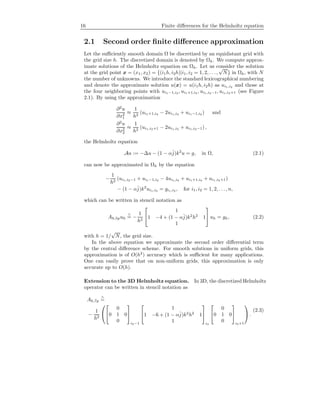
Figure 2.1: 2D finite difference stencil: (a) 5-point stencil, (b) 9-point stencil
2.2 High order finite difference approximation
A higher order accurate finite difference stencil can be obtained for the Helmholtz
equation in different ways. One way to construct this high order finite difference
stencil is by using Pad´e approximation.
Consider the Taylor expansion of a second order derivative
Dx1x1 u = ∂x1x1 u +
1
12
h2
∂(4)
x1
u + O(h4
), (2.4)
where D is the a discrete operator. The fourth order derivative can be approx-
imated as follows:
∂(4)
x1
u = ∂x1x1 (∂x1x1 u) ≈ Dx1x1 (∂x1x1 u) + O(h2
). (2.5)
Substituting (2.5) into (2.4) we have
∂x1x1 u = 1 +
1
12
h2
Dx1x1
−1
Dx1x1 u + O(h4
). (2.6)
Substituting (2.6) and also the similar expression for ∂x2x2 into (2.1) we finally
obtain
−
Dx1x1
1 + 1
12 h2Dx1x1
+
Dx2x2
1 + 1
12 h2Dx2x2
+ (1 − αˆj)k2
u = g, (2.7)
or
−(D1 + D2)u − (1 + K1 + K2)(1 − αˆj)k2
u = (1 + K1 + K2)g. (2.8)
18 Finite differences for the Helmholtz equation
where
D1 = Dx1x1 + Dx2x2 (2.9)
D2 =
h2
6
Dx1x1 Dx2x2 (2.10)
K1 =
h2
12
(Dx1x1 + Dx2x2 ) (2.11)
K2 =
h4
144
Dx1x1 Dx2x2 (2.12)
Equation (2.8) is called the point-wise Pad´e approximation of the Helmholtz
equation. Harari and Turkel [54] (and also Singer and Turkel in [85]) propose
a generalization to this approximation by introducing a free parameter γ ∈ R.
This parameter is tuned such that the dispersion or the anisotropy is minimal.
The following 9-point stencil is due to Harari and Turkel [54], for α = 0:
Ah,9p
∧
= −
1
h2



1
6 + γ (kh)2
144
2
3 + (6−γ)(kh)2
72
1
6 + γ (kh)2
144
2
3 + (6−γ)(kh)2
72 −10
3 + (24+γ)(kh)2
36
2
3 + (6−γ)(kh)2
72
1
6 + γ (kh)2
144
2
3 + (6−γ)(kh)2
72
1
6 + γ (kh)2
144


 . (2.13)
It can be shown that this scheme is consistent for kh → 0 and O(h4
) accurate for
constant wavenumber and uniform grids. The scheme, however, is only O(h3
)
for nonconstant wavenumber and non-uniform grids.
Remark 2.2.1 The Pad´e approximation for the 3D Helmholtz equation is given
in Appendix A.
Remark 2.2.2 A non standard 9-point finite difference approximation is also
proposed by [61]. The approach is based on a splitting of the Laplacian term
into two parts: one in grid line direction and one in cell-diagonal direction,
with some weights. It can be shown that the dispersion and anisotropy can also
be minimized in this case.
2.3 Dispersion and anisotropy
In order to illustrate the dispersion and anisotropy properties of a discretization
scheme, we define two parameters which characterize wave propagations [54]:
cp =
ωw
k
, cg =
∂ωw
∂k
, (2.14)
which are called the phase velocity and the group velocity, respectively. For
homogeneous and isotropic continuous media, cp = cg = c0; i.e. the media is
non-dispersive.
In a discrete formulation the non-dispersive property no longer holds. In-
stead, we have that
ch
p =
ωw
kh
=
k
kh
c0, ch
g =
∂ωw
∂kh
=
∂kh
∂k
−1
c0, (2.15)
2.3 Dispersion and anisotropy 19
where kh
= f(kh), depending on the discretization. For the 5-point stencil, we
have that [54]:
ch
p
c0
=
kh
arccos(1 − (kh)2/2)
, (2.16)
ch
g
c0
= 1 − (kh)2/4. (2.17)
Thus, for the 5-point stencil the phase and group velocity are slower than the
speed of sound c0.
For the 9-point stencil (2.13), the phase and group velocity along the grid
lines are determined respectively as:
ch
p
c0
=
kh
arccos((1 − 5(kh)2/12)/(1 + (kh)2/12))
, (2.18)
ch
g
c0
= 1 − (kh)2/6 (1 + (kh)2
/12). (2.19)
Along the grid line, for a resolution up to a minimum of 4 grid points per
wavelength (i.e. kh < 1.57), the 9-point stencil is less dispersive compared to the
5-point stencil. In fact, the error of the 9-point stencil falls within 7 % compared
to non-dispersion solution. The 5-point stencil, however, is still accurate if more
than 10 grid points per wavelength are used (or, equivalently, if kh < 0.625).
Similarly, one can derive the phase and group velocity of discrete cases for
plane waves oriented at an angle θ with respect to the grid lines. An extreme
case occurs when the wave is in the direction of the cell’s diagonal (θ = π/4).
For the 5-point stencil we then have
ch
p
c0
=
kh
√
2 arccos(1 − (kh)2/4)
, (2.20)
ch
g
c0
= 1 − (kh)2/8, (2.21)
and for the 9-point stencil, the phase and group velocities can be determined
from the relation
kh
h =
√
2 arccos
6 1 + (1 − γ)(kh)4/144 − (4 + (6 − γ)(kh)2
/12)
2 + γ(kh)2/12
. (2.22)
In both cases, the phase and group velocity are slower than the speed of
sound c0. For the 5-point stencil, however, the scheme is less dispersive for waves
oriented in the direction of cell diagonals compared to waves in the direction
of grid lines. The value γ = 2/5 results in a 9-point discretization stencil with
minimal dispersion in the direction of cell diagonals. If γ = 14/5 the difference
between dispersion in the direction of cell diagonals and grid lines is minimal.
Thus, γ = 14/5 leads to a 9-point stencil with minimal anisotropy. We refer the
reader to [54] for a more detailed discussion on this subject.
20 Finite differences for the Helmholtz equation
Remark 2.3.1 For the second order scheme, however, the quantity kh is not
sufficient to determine the accuracy of the numerical solution of the Helmholtz
equation [13]. The quantity k3
h2
is also found important in determining the
accuracy in the L2
norm, especially at high wavenumbers.
Remark 2.3.2 In our numerical tests we often use the five-point finite differ-
ence stencil on the minimum allowable grid resolution kh = 0.625. Table 2.1
displays the number of grid points for kh = 0.625.
Table 2.1: Number of grid points employed, related to the wavenumber, so that
kh = 0.625.
k: 10 20 30 40 50 80 100 150 200 500 600
N(= 1/h): 8 16 32 64 80 128 160 240 320 800 960
2.4 Numerical boundary conditions
In Chapter 1 we have formulated a condition for the radiation boundary. This
condition, however, is only satisfied in an infinite domain. For computational
purposes extending the domain to infinity is not practical due to, e.g., restricted
hardware resources. Therefore, we often truncate the domain in such away
that a physically and computationally acceptable compromise is reached. In
this truncated domain, the non-reflecting boundary condition given in (1.30) is,
however, no longer valid.
In [70] and [67] non-local boundary conditions are proposed to mimic the
radiation condition at infinity. Despite their accuracy for any direction of wave
incidence, the inclusion of this type of boundary condition in the discretization
is not practical because of the non-locality. Enquist et al in [34] proposed local
boundary conditions for a truncated domain; see also [26], [27]. Different types
of local boundary conditions have also been proposed elsewhere; see, e.g., in [56],
[50] and the references therein. In this thesis, we limit ourselves to the local
boundary conditions proposed in [34], either in the first order or the second
order formulation.
In our case we consider a rectangular domain which is typically used in
geophysics. We distinguish on a boundary Γ: faces, edges and corners. For each
part of Γ we have the following boundary conditions (see [26, 34, 55, 11]):
Faces:
B2u|face := ±
∂u
∂xi
− ˆjku −
ˆj
2k
3
j=1,j=i
∂2
u
∂x2
j
= 0, i = 1, . . . , 3. (2.23)
Here xi is the coordinate perpendicular to the face.
2.5 The properties of the linear system 21
Edges:
B2u|edge := −
3
2
k2
u − ˆjk
3
j=1,j=i
±
∂u
∂xj
−
1
2
∂2
u
∂x2
i
= 0, i = 1, . . . , 3, (2.24)
with xi the coordinate parallel to the edge.
Corners:
B2u|corner := −2ˆjku +
3
i=1
±
∂u
∂xi
= 0. (2.25)
In (2.23)–(2.25) the ± sign is determined such that for out going waves the
non-reflecting condition is satisfied.
For the second order derivatives, to retain the same order of accuracy as in
the interior the same discretization is used as for the Helmholtz operator.
In Chapters 4 and 5 we implement the first order boundary condition on the
faces described by [34]
B1u|face :=
∂
∂η
− ˆjk u = 0, (2.26)
with η the outward normal component to the boundary. This boundary con-
dition (2.26) is straightforward to discretize (either with one-sided or central
schemes), but it is not accurate for inclined outgoing waves. In Chapter 6
boundary conditions of the form (2.23)–(2.25) are implemented.
Remark 2.4.1 In practice the use of the second order radiation conditions
sometimes is not sufficient to reduce reflections. In the last decade a new and ac-
curate boundary condition for wave equations, called the perfectly matched layer
(PML) has attracted many researchers. PML is first introduced in Berenger’s
two papers [14] and [15]. Contributions to the well-posedness of PML are given
by Abarbanel et al in [1] (and also [2]). Applications of PML in wave problems
can be found, e.g. in [95] and [93]. In our research, the use of PML is not
investigated in detail.
Instead, we will use in some of numerical tests (in Chapter 6) a classical
method similar to PML, which is dubbed as “sponge” layers (or absorption lay-
ers). These layers are added around the physical domain whose functions is
to damp the out going waves. Therefore, the “damped” Helmholtz equation is
used in this layer. On the boundaries of the absorption layers, the first order
Sommerfeld radiation condition is imposed.
2.5 The properties of the linear system
Discretization of the Helmholtz equation (2.1) and boundary conditions (2.23)–
(2.25) (or (2.26)) leads to a linear system
Ahuh = gh, Ah ∈ CN×N
, uh, gh ∈ CN
. (2.27)
22 Finite differences for the Helmholtz equation
Ah is complex-valued because of the inclusion of radiation boundary conditions.
The matrix Ah is indefinite for sufficiently large wavenumbers k. Here, the term
“indefinite” means that the real part of eigenvalues of Ah has both positive and
negative signs. Ah is also symmetric, but non-Hermitian, i.e. A∗
h = Ah. So, Ah
is not self-adjoint. Furthermore, Ah is extremely ill-conditioned.
The two properties: indefiniteness and ill-conditioning are of highest impor-
tant if we consider an iterative method as a solver for (2.27). Without being
too detailed here, standard iterative methods mentioned in Table 1.1 simply do
not work well for (2.27).
2.6 Model problems
Throughout this thesis we present numerical solutions for different problems
in 2D (and 3D). Some problems are used only for a preliminary evaluation of
the numerical performance of the method, for example the “closed-off” and the
three-layer models used in Chapter 4. Other problems are designed to mimic
2D geophysical applications. We use the latter as our model problems (MP)
which are frequently used throughout this thesis. The model problems (MP)
represent an increasing level of difficulty which is suitable to test the robustness
and efficiency of the iterative methods proposed in this thesis. Problems in
three-dimensional space are introduced separately in Chapter 7.
MP1. 2D constant wave number.
For α ∈ R and k = constant, find u ∈ CN
satisfying:



−∆u − (1 − α)k2
u = g, in Ω = (0, 1)2
g = δ(x1 − 1
2 , x2 − 1
2 ), x1 = (0, 1), x2 = (0, 1)
with the first or second order radiation conditions on Γ ≡ ∂Ω.
(2.28)
Here δ is the Dirac delta function:
δ(x1, x2) =
1, x1 = 0, x2 = 0
0, elsewhere.
(2.29)
A typical real part of numerical solution of MP1 is shown in Figure 2.2, for
k = 50, α = 0, obtained by the 5-point and 9-point stencil (γ = 2/5, minimal
dispersion) with h = 1/80. Here for the 5-point stencil we have used the second
order radiation conditions. In case of 9-point stencil extra damping layers are
used, surrounding the physical domain. Unphysical reflections at the bound-
aries are not present due to the boundary treatment.
2.6 Model problems 23
x−axis
y−axis
0 0.2 0.4 0.6 0.8 1
0
0.2
0.4
0.6
0.8
1
x−axis
y−axis
0 0.2 0.4 0.6 0.8 1
0
0.2
0.4
0.6
0.8
1
Figure 2.2: Numerical solution (real part) at k = 50, α = 0 for the model
problem MP1 with k constant. Left: 5-point stencil with 2nd order radiation
boundary conditions. Right: 9-point stencil (γ = 2/5) and 1st order radiation
boundary conditions imposed on the damping layer
MP2. 2D wedge problem.
This is a problem which mimics three layers with a simple heterogeneity, taken
from [81].
For α ∈ R, find u ∈ CN
satisfying:



−∆u − (1 − α)k2
(x)u = g, in Ω = (0, 600) × (0, 1000) meter2
g = δ(x1 − 300, x2), x1 = (0, 600), x2 = (0, 1000)
with the first or second order radiation conditions on Γ ≡ ∂Ω.
(2.30)
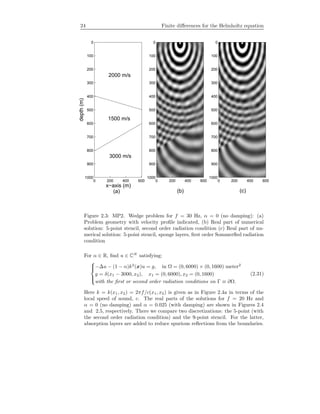
So, k = k(x1, x2) = 2πf/c(x1, x2) is given as in Figure 2.3a in terms of the local
speed of sound, c. The real parts of the solutions for f = 30, h = 2.6 m and with
α = 0 are shown in Figure 2.3b and 2.3c. In Figure 2.3b the 5-point stencil
is used with the second order radiation conditions. In Figure 2.3c the 5-point
stencil is used with sponge layers added. At the boundaries of the sponge layers,
the first order Sommerfeld radiation condition is imposed.
MP3. 2D Marmousi problem.
This problem mimics the earth’s subsurface layer with a complex heterogeneity
[18, 81]. It represents a part of the full Marmousi problem, a relevant and diffi-
cult test in geophysics.
24 Finite differences for the Helmholtz equation
0 200 400 600
0
100
200
300
400
500
600
700
800
900
1000
0 200 400 600
0
100
200
300
400
500
600
700
800
900
1000
0 200 400 600
0
100
200
300
400
500
600
700
800
900
1000
x−axis (m)
depth(m)
2000 m/s
1500 m/s
3000 m/s
(a) (b) (c)
Figure 2.3: MP2. Wedge problem for f = 30 Hz, α = 0 (no damping): (a)
Problem geometry with velocity profile indicated, (b) Real part of numerical
solution: 5-point stencil, second order radiation condition (c) Real part of nu-
merical solution: 5-point stencil, sponge layers, first order Sommerfled radiation
condition
For α ∈ R, find u ∈ CN
satisfying:



−∆u − (1 − α)k2
(x)u = g, in Ω = (0, 6000) × (0, 1600) meter2
g = δ(x1 − 3000, x2), x1 = (0, 6000), x2 = (0, 1600)
with the first or second order radiation conditions on Γ ≡ ∂Ω.
(2.31)
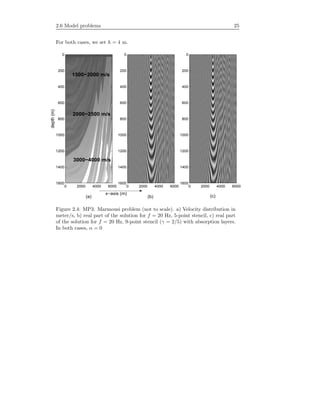
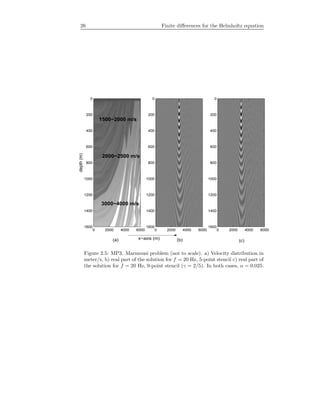
Here k = k(x1, x2) = 2πf/c(x1, x2) is given as in Figure 2.4a in terms of the
local speed of sound, c. The real parts of the solutions for f = 20 Hz and
α = 0 (no damping) and α = 0.025 (with damping) are shown in Figures 2.4
and 2.5, respectively. There we compare two discretizations: the 5-point (with
the second order radiation condition) and the 9-point stencil. For the latter,
absorption layers are added to reduce spurious reflections from the boundaries.
2.6 Model problems 25
For both cases, we set h = 4 m.
0 2000 4000 6000
0
200
400
600
800
1000
1200
1400
1600
0 2000 4000 6000
0
200
400
600
800
1000
1200
1400
1600
depth(m)
0 2000 4000 6000
0
200
400
600
800
1000
1200
1400
1600
(a) (b) (c)
x−axis (m)
1500−2000 m/s
2000−2500 m/s
3000−4000 m/s
Figure 2.4: MP3. Marmousi problem (not to scale). a) Velocity distribution in
meter/s, b) real part of the solution for f = 20 Hz, 5-point stencil, c) real part
of the solution for f = 20 Hz, 9-point stencil (γ = 2/5) with absorption layers.
In both cases, α = 0
26 Finite differences for the Helmholtz equation
depth(m)
0 2000 4000 6000
0
200
400
600
800
1000
1200
1400
1600
0 2000 4000 6000
0
200
400
600
800
1000
1200
1400
1600
0 2000 4000 6000
0
200
400
600
800
1000
1200
1400
1600
(a) (b) (c)
x−axis (m)
1500−2000 m/s
2000−2500 m/s
3000−4000 m/s
Figure 2.5: MP3. Marmousi problem (not to scale). a) Velocity distribution in
meter/s, b) real part of the solution for f = 20 Hz, 5-point stencil c) real part of
the solution for f = 20 Hz, 9-point stencil (γ = 2/5). In both cases, α = 0.025.
Chapter 3
Krylov subspace iterative
methods
In this chapter some iterative methods for solving the linear system
Ahuh = gh. (3.1)
are reviewed. Unless mentioned otherwise, Ah is a square, complex, non-
symmetric matrix.
We begin our discussion by introducing standard iterative methods. Section
3.2 is devoted to Krylov subspace iterative methods. We give some preliminary
numerical results for the Helmholtz equation in Section 3.7 for the so-called
unpreconditioned Krylov subspace methods. To accelerate the convergence pre-
conditioning is presented in Section 3.8.
In this chapter we omit the subscript “h” from matrices and vectors for
convenience.
3.1 Basic iterative methods
Let us consider a splitting
A = F − G, F, G ∈ CN×N
,
where N is the number of unknowns. After substitution into (3.1), we have
(F − G)u = g ⇐⇒ Fu = g + Gu. (3.2)
For uj−1
the approximate solution after the (j − 1)-th iteration, the new ap-
proximation uj
can be computed as
Fuj
= g + Guj−1
=⇒ uj
= F−1
(g + Guj−1
). (3.3)
28 Krylov subspace iterative methods
Thus,
uj
= F−1
g + (I − F−1
A)uj−1
= uj−1
+ F−1
rj−1
, (3.4)
with rj−1
:= g − Auj−1
the residual after the (j − 1)-th iteration, and I the
identity matrix. Equation (3.4) is called the basic iterative method.
The basic iteration is distinguished by the way the splitting is chosen. If
the splitting is defined by A = D − E, where D = diag(A), the Jacobi iteration
results, namely
uj
= uj−1
+ D−1
rj−1
. (3.5)
The Gauss-Seidel iteration is obtained from the splitting A = L − U, where L
and U are lower and upper triangular matrices, respectively. This iteration is
written as
uj
= uj−1
+ L−1
rj−1
. (3.6)
3.2 Krylov subspace methods
The Krylov subspace iteration methods are developed based on a construction
of consecutive iterants in a Krylov subspace, i.e. a subspace of the form
Kj
(A, r0
) = span r0
, Ar0
, A2
r0
, . . . , Aj−1
r0
, (3.7)
where r0
:= g − Au0
is the initial residual, with u0
the initial solution. The
dimension of Kj
is equal to j and increases by one at each step of the approxi-
mation process.
The idea of Krylov subspace methods can be outlined as follows. For an
initial solution u0
, approximations uj
to the solution u are computed every step
by iterants uj
of the form
uj
∈ u0
+ Kj
(A, r0
), j > 1. (3.8)
The Krylov subspace Kj
is constructed by the basis v1
, v2
, . . . , vj
, where
V j
= [v1
, v2
, . . . , vj
] ∈ Kj
. (3.9)
With residual rj
= g − Auj
, (3.7) gives an expression for the residual at the
j-th step
rj
= r0
− AV j
yj
, (3.10)
where yj
∈ CN
and uj
= u0
+ V j
yj
. From (3.10) we observe that Krylov
subspace methods rely on constructing the basis of V j
and the vector yj
. In
general we identify two methods that can be used for constructing the basis of
3.3 Conjugate gradient 29
V j
: Arnoldi’s method and Lanczos’ method. The vector yj
can be constructed
by a residual projection or by a residual norm minimization method.
In the following subsections, we present some Krylov subspace algorithms,
that are used in numerical simulations in this thesis. In particular, we discuss
the Conjugate Gradient (CG) (see e.g. [83]), GMRES [84] and Bi-CGSTAB
[97] algorithms. CG can be used to derive CGNR (which can be used for the
Helmholtz equation) and as a basis for COCG [98], a CG-like method for com-
plex, symmetric matrices.
Some authors, e.g. [47] have also used QMR [46] and its symmetric version
SQMR [44] for the Helmholtz equation.
3.3 Conjugate gradient
Here we assume the matrix A to be symmetric, positive definite (SPD). In CG
one constructs a vector uj
∈ Kj
(A, r0
) such that u − uj
A is minimal, where
u A = (Au, u)
1
2 . For this purpose, the vector uj+1
is expressed as
uj+1
= uj
+ αj
pj
, (3.11)
where pj
is the search direction. The residual vectors satisfy the recurrence
rj+1
= rj
− αj
Apj
. (3.12)
For all rj
’s to be orthogonal, the necessary condition is that (rj+1
, rj
) = 0. Here
(a, b) denotes the standard Hermitian inner product a∗
b, which reduces to the
transposed inner product aT
b if a, b ∈ RN
. Thus,
(rj+1
, rj
) = 0 → (rj
− αj
Apj
, rj
) = 0, (3.13)
which gives
αj
=
(rj
, rj
)
(Apj, rj )
. (3.14)
Since the next search direction pj+1
is a linear combination of rj+1
and pj
, i.e.,
pj+1
= rj+1
+ βj
pj
, (3.15)
the denominator in (3.14) can be written as (Apj
, pj
− βj−1
pj−1
) = (Apj
, pj
),
since (Apj
, pj−1
) = 0. Also because (Apj+1
, pj
) = 0, we find that
βj
=
rj+1
, rj+1
rj , rj
. (3.16)
The CG algorithm is summarized as follows:
30 Krylov subspace iterative methods
Algorithm 3.1. Conjugate gradient, CG
1. Set the initial guess: u0
. Compute r0
= g − Au0
. Set p0
= r0
.
2. Do j = 0, 1, . . .
3. αj
= (rj
, rj
)/(Apj
, pj
).
4. uj+1
= uj
+ αj
pj
. If accurate then quit.
5. rj+1
= rj
− αj
Apj
.
6. βj
= (rj+1
, rj+1
)/(rj
, rj
).
7. pj+1
= rj+1
+ βj
pj
.
8. Enddo
It can be shown that this algorithm minimizes u − uj
A over Kj
(A, r0
).
Algorithm 3.1 has the nice properties that it requires only short recurrences,
one matrix/vector multiplication and a few vector updates. However, for general
matrices the algorithm may not converge, because the orthogonality condition
cannot be satisfied. In case the definiteness of A (like for the Helmholtz equa-
tion) is not guaranteed, the product (V j
)∗
AV j
=: Tj
is possibly singular or
nearly singular. Since xj
= V j
Tj
βe1, for Tj
nearly/possibly singular, xj
is
poorly determined then, see [79].
One simple remedy for the indefiniteness is to apply the CG algorithm to
the normal equations A∗
A. In this case one considers the linear system
A∗
Au = A∗
g. (3.17)
For u = 0, u∗
A∗
Au = (Ax, Ax) > 0. Hence, the product A∗
A is positive
definite. Furthermore, if A ∈ CN×N
, the product A∗
A is Hermitian, because
(A∗
A)∗
= A∗
A. Therefore, Algorithm 3.1 can be applied to the linear system
(3.17).
Direct implication of Algorithm 3.1 applied on (3.17) results in the following
algorithm, called CGNR.
Algorithm 3.2. CGNR
1. Set the initial guess: u0
. Compute r0
= g − Au0
.
2. Compute z0
= A∗
r0
. Set p0
= r0
.
3. Do j = 0, 1, . . .
4. wj
= Apj
.
5. αj
= (zj
, zj
)/(Apj
, Apj
).
6. uj+1
= uj
+ αj
pj
. If accurate then quit.
7. rj+1
= rj
− αj
Apj
.
8. zj+1
= A∗
rj+1
.
9. βj
= (zj+1
, zj+1
)/(zj
, zj
).
10. pj+1
= zj+1
+ βj
pj
.
11. Enddo
In general, Algorithm 3.2. is twice as expensive as Algorithm 3.1. Further-
more, A∗
is sometimes not readily available, meaning one has to compute A∗
each time it is required. In this situation, it is better to have an algorithm for
general matrices where A∗
needs not necessarily be computed explicitly. This
3.4 Conjugate orthogonal-conjugate gradient 31
is one of the two main reasons why Bi-CGSTAB (discussed in Section 3.6) is
more preferable for our problems. The other reason will be explained shortly
when we discuss the convergence of CG iterations.
For algorithms with optimality properties, like CG (and also GMRES), con-
vergence estimates can be derived. This property is essential, especially in
Chapter 4, when we are considering the convergence behavior of Krylov subspace
iterations for the Helmholtz equation. Here, we present one of the convergence
estimates of CG. We refer the reader to, e.g., [83] for more details.
Given κ = λmax/λmin, the l2 condition number of an SPD matrix A, where
λmax and λmin represent the maximum and the minimum eigenvalues of A,
respectively. The error between the exact solution uh and the approximate
solution after the j-th CG iteration can be bounded by the following upper
bound:
u − uj
A ≤ 2
√
κ − 1
√
κ + 1
j
u − u0
A. (3.18)
It is clear that CG converges faster for a matrix A with a smaller condition
number κ.
For the normal equations and A an SPD matrix, κ(A∗
A) = κ2
(A). Thus
one can immediately conclude that CGNR (Algorithm 3.2) is far less efficient
than CG. (This conclusion is generally not true for a non SPD matrix. For A
indefinite, CG may diverge, whereas CGNR will still converge, even though the
convergence is very slow.)
3.4 Conjugate orthogonal-conjugate gradient
The next short recurrence algorithm which requires only one matrix/vector mul-
tiplication can also be derived for a complex, symmetric but non-Hermitian ma-
trix A by replacing the orthogonality condition (3.13) by the so-called conjugate
orthogonality condition [98]:
(rj
, ri
) = 0 if j = i. (3.19)
Since A = AT
we have that (u, Ay) = (A
T
u, y) = (Au, y) = (y, Au). One can
prove that the vectors {r0
, . . . , rj
) form a basis for Kj+1
(A, r0
). Furthermore,
the vectors rj
are conjugate orthogonal.
Based on rj
, the solution uj+1
can be constructed in Kj+1
(A, r0
) that satis-
fies the condition that the residual rj+1
= g − Auj+1
is conjugate orthogonal to
Kj+1
(A, r0
). This results in an algorithm which is similar to CG, but with the
(Hermitian) inner product being replaced by the standard inner product. The
algorithm, called conjugate orthogonal-conjugate gradient (COCG) is coded as
follows:
Algorithm 3.3. Conjugate orthogonal-conjugate gradient (COCG)
1. Set the initial guess: u0
. Compute r0
= g − Au0
. Set p0
= r0
.
2. Do j = 0, 1, . . .
32 Krylov subspace iterative methods
3. αj
= (rj
, rj
)/(Apj, pj
).
4. uj+1
= uj
+ αj
pj
. If accurate then quit.
5. rj+1
= rj
− αj
Apj
.
6. βj
= (rj+1
, rj+1
)/(rj
, rj
).
7. pj+1
= rj+1
+ βj
pj
.
8. Enddo
Algorithm 3.3, however, has several drawbacks. First of all, the algorithm
is no longer optimal. This is because the error u − uj
A at every step is
not minimal. The error, therefore, is not monotonically decreasing. In many
cases, the lack of optimality condition for COCG is characterized by an erratic
convergence behavior. Residual smoothing [110] can be used to obtain a rather
monotonic decreasing convergence.
Secondly, the COCG algorithm may suffer from two kinds of breakdown. The
first breakdown is related to the quasi null-space formed in the algorithm. The
quasi null-space is characterized by the situation that for rj
= 0, (rj
, rj
) = 0.
This breakdown can be overcome by restarting the process or by switching to
another algorithm. The second breakdown is due to the rank deficiency of the
linear system for computing the coefficients yj
. This type of breakdown is,
however, uncured.
Thirdly, the condition A = AT
is often too restrictive for preconditioning.
We postpone the discussion of this issue until Section 3.8, where we introduce
preconditioners to enhance the convergence of Krylov subspace methods.
3.5 Generalized Minimal Residual, GMRES
The GMRES method is an iterative method for nonsymmetric matrices, which
minimizes the residual norm over the Krylov subspace. The GMRES algorithm
is given as follows (see Saad [83] and Saad and Schultz [84]).
Algorithm 3.4. Generalized Minimum Residual, GMRES
1. Choose u0
. Compute r0
= g − Au0
, β := r0
2 and v1
:= r0
/β
2. For j = 1, 2, . . ., m do:
3. Compute wj
:= Avj
4. For i = 1, 2, . . ., m do:
5. hi,j := (wj
, vi
), wj
:= wj
− hi,jvi
6. Enddo
7. hj+1,j = wj
2.
8. vj+1
= wj
/hj+1,j
9. Enddo
10. Compute ym
: the minimizer of βe1 − ¯Hmy 2 and um
= u0
+ V m
ym
Line 2 to 9 represent the Arnoldi algorithm for orthogonalization. In line
10, we define a minimalization process by solving a least squares problem
J(y) = g − Au 2, (3.20)
3.6 Bi-CGSTAB 33
where
u = u0
+ V k
y (3.21)
is any vector in Kk
. Except for line 10, the GMRES algorithm is almost identical
with the Full Orthogonalization Method (FOM) [82]. (In FOM, we compute
ym
= H−1
m (βe1), where e1 is the first unit vector.) Inserting the expression of u
(3.21) to (3.20) and making use of the following property:
AV j
= V j+1 ¯Hj (3.22)
(see Preposition 6.5 in [83]), we arrive at the following result:
J(y) = βe1 − ¯Hmy 2, (3.23)
which is subjected to minimization. In (3.23), β = r0
, and e1 ≡ {1, 0, · · · , 0}T
.
The GMRES algorithm may break down if at iteration step j, hj+1,j = 0 (see
line 8). However, this situation implies that residual vector is zero and therefore,
the algorithm gives the exact solution at this step. Hence, examination of value
hj+1,j in algorithm step 7 becomes important. For the convergence of GMRES,
the following theorem is useful.
Theorem 3.5.1 Convergence of GMRES [84]. Suppose that A is diago-
nalizable so that A = XΛX, where Λ = diag{λ1, . . . , λN } with positive real
parts. Assume that all eigenvalues are enclosed by a circle centered at Cc > 0
and having radius Rc < Cc (so the circle does not enclose the origin). Then the
residual norm at the j-th GMRES iteration satisfies the inequality
rj
2 ≤
Rc
Cc
j
κ(X) r0
2. (3.24)
If iteration number m is large, the GMRES algorithm becomes impractical
because of memory and computational requirements. This is understandable
from the fact that during the Arnoldi steps the number of vectors requiring
storage increases. To remedy this problem, the algorithm can be restarted. The
restarted GMRES follows the idea of the original GMRES except that after the
l-th step, the algorithm is repeated by setting l = 0.
The restarted GMRES algorithm may, however, lead to difficulties if A is
not positive definite [83]. For such a type of matrix, the algorithm can stag-
nate, which is not the case for the non-restarted GMRES algorithm (that is
guaranteed to converge in at most N steps [84]).
3.6 Bi-CGSTAB
For non-symmetric matrices an iterative method can be developed based on the
non-symmetric Lanczos algorithm. The basis of this algorithm is the construc-
tion of two biorthogonal bases for two Krylov subspaces: K(A, r0
) and L(A∗
, r0
).
34 Krylov subspace iterative methods
As shown by Fletcher [42], the resulting algorithm also has short recurrences.
The algorithm, called BiCG, solves not only the original linear system Au = g,
but also the dual system A∗
u = g, which is usually not required. Sonneveld [87]
makes the observation that throughout the BiCG process until convergence,
only {rj
} is exploited. He further notices that the vectors rj
can be constructed
from BiCG polynomials φ(A). They can be recovered during the BiCG process,
by the relation rj
= φ2
j (A)r0
. This results in an algorithm, called CGS, which
does not require multiplication by A∗
. CGS, however, suffers from an irregular
convergence.
A smoothly converging variant of CGS is proposed by van der Vorst [97] by
introducing another polynomial relation for rj
of the form rj
= φj(A)ψj (A)r0
.
The residual polynomial φj is associated with the BiCG iteration while ψj is
another polynomial determined from a simple recurrence in order to stabilize the
convergence behavior. The Bi-CGSTAB algorithm is then written as follows:
Algorithm 3.5. Bi-CGSTAB
1. Compute r0
:= g − Au0
; r arbitrary.
2. p0
:= r0
3. For j = 1, 2, · · · , until convergence do:
4. αj
:= (rj
, r/(Apj
, r)
5. sj
:= rj
− αj
Apj
6. ωj
:= (Asj
, sj
)/(Asj
, Asj
)
7. uj+1
:= uj
+ αj
pj
+ ωj
sj
8. rj+1
:= sj
− ωj
Asj
9. βj
:= (rj+1
, r)/(rj
, r) × αj
/ωj
10. pj+1
:= rj+1
+ βj
(pj
− ωj
Apj
)
11. Enddo
Bi-CGSTAB is an attractive alternative to CGS. However, if parameter ωj
in step 6 gets very close to zero the algorithm may stagnate or break down.
Numerical experiments confirm that this is likely to happen if A is real and
has complex eigenvalues with an imaginary part larger than the real part. In
such a case, one may expect that the situation where ω is very close to zero can
be better handled by the minimum-residual polynomial ψ(A) of higher order.
Improvements to Bi-CGSTAB have been proposed, e.g., by Gutknecht [52] and
Sleijpen and Fokkema [86]. Gutknecht [52] proposed the use of a second order
polynomial for ψ(A) in his BiCGSTAB2 algorithm. However, it becomes clear
from experiments that for the same situation in which BiCGSTAB breaks down,
BiCGSTAB2 stagnates or also breaks down. Sleijpen and Fokkema [86] proposed
a modification by forming a general l-th order polynomial for ψ(A), resulting in
the BiCGSTAB(l) algorithm. For l = 1, the algorithm resembles van der Vorst’s
BiCGSTAB.
Numerical experiments reveal that BiCGSTAB(l) improves BiCGSTAB in
the case of stagnation or breakdown. It is also known that a large l can be
chosen to improve the convergence. In general, BiCGSTAB(l) is superior to
BiCGSTAB or BiCGSTAB2, but it is also more costly.
3.7 Numerical example 35
3.7 Numerical example
Example 3.1. A first numerical result is shown in Table 3.1, which compares
the convergence of several Krylov subspace methods applied directly to Model
Problem 1 (constant k). We set α = 0; so, we consider the undamped Helmholtz
equation. Here we use the first order radiation boundary conditions (2.26) on
Γ. The problem is discretized by the 5-point finite difference stencil.
Starting with the initial guess u0
= 0, the iteration is terminated at the j-th
iteration if the following condition is satisfied:
g − Auj
/ g ≤ 10−7
. (3.25)
(Unless mentioned otherwise, we use (3.25) as the termination criterion in this
thesis). We set kh = 0.625, which is equivalent to choosing ∼10 grid points per
wavelength (see Table 2.1).
From Table 3.1, the performance of all algorithms decreases as k increases,
and COCG seems to be the method of choice (short recurrence and with com-
parable convergence as GMRES). Convergence history for k = 30 is displayed in
Figure 3.1. An erratic convergence behavior is observed for COCG. Superlinear
convergence is clearly seen for GMRES and CGNR. A long, slow converging
part of CGNR convergence is due to many small eigenvalues of A∗
A.
Table 3.1: Number of iterations of several Krylov subspace methods to reach
convergence for Model Problem 1. kh = 0.625 (∼ 10 grid points per wavelength)
k CGNR COCG GMRES Bi-CGSTAB
10 49 33 32 35
20 208 80 79 145
30 492 154 143 402
40 943 255 241 816
Figure 3.2 shows the effect of increasing the number of grid points per wave-
length on the number of iterations for k = 10. For all algorithms, the conver-
gence slows down if more accurate solutions are needed. Among them, CGNR
is the most sensitive algorithm. This is somewhat disappointing; as we tend to
increase the accuracy of the solution, the performance of the iterative methods
without any enhancement degrades.
3.8 Preconditioning
Even though the methods are convergent for the numerical examples given in
Section 3.7, the convergence is too slow. As we only considered very simple
problems (with small k), one may imagine that the methods are inefficient if a
36 Krylov subspace iterative methods
0 50 100 150 200 250 300 350 400 450 500
−8
−7
−6
−5
−4
−3
−2
−1
0
1
2
Iterations
10
log(||gh
−Ah
uh
||2
/||gh
||)
CGNR
COCG
GMRES
Bi−CGSTAB
Figure 3.1: Convergence history of CGNR, COCG, GMRES and Bi-CGSTAB
for Model Problem 1 with k = 30, α = 0
problem with, say k = 500, is to be solved. In particular for GMRES, many
iterations means a large memory required to store all orthogonal vectors. A
small restart parameter does not bring any improvement to the convergence of
GMRES, because it leads to many more iterations.
As already discussed in Section 3.3, the convergence of the CG iterations (3.18)
is closely related to the condition number κ. The purpose of preconditioning is
to improve the condition of the system to be solved.
Suppose there exists a matrix M such that its inverse is easily computed
or approximated. By preconditioning we solve the following equivalent linear
system:
M−1
Au = M−1
g. (3.26)
A preconditioned Krylov subspace method can therefore be defined as find the
approximate solution u by constructing iterants uj
such that
uj
∈ u0
+ Kj
(M−1
A, r0
), j > 1 (3.27)
One important aspect from (3.26) is that if CG is applied to (3.26), its
convergence depends on the condition number of M−1
A, and not on that of
A. Therefore, in order to have an improved convergence the product M−1
A
must have a smaller condition number compared to A, i.e. κ(M−1
A) < κ(A).
Otherwise, no benefit can be gained from preconditioning.
3.8 Preconditioning 37
0 10 20 30 40 50 60 70
0
50
100
150
200
250
300
350
400
450
Grid points per wavelength
No.Iterations
Bi−CGSTAB
GMRES
COCG
CGNR
Figure 3.2: Performance of CGNR, COCG, GMRES and Bi-CGSTAB for Model
Problem 1 with respect to the increase of the number of grid points per wave-
length, for k = 10
Remark 3.8.1 Besides formula (3.26), which is called left preconditioning, we
also identify right preconditioning for an equivalent linear system:
AM−1
u = g, where u = Mu. (3.28)
Furthermore, if M = M1M2, we can write an equivalent system
M−1
1 AM−1
2 u = M−1
g, where u = Mu. (3.29)
We call this a split preconditioner.
Remark 3.8.2 The spectra of M−1
A, AM−1
and M−1
1 AM−1
2 are identical.
In the following chapters, we will see that it is easier to use left precondition-
ing when we theoretically analyze the spectral properties of the preconditioned
systems. In practice, we perform right preconditioning as it turns out to give
cheaper algorithms.
3.8.1 Incomplete LU decomposition
Suppose that M−1
= A−1
, then κ(M−1
A) = 1. But, computing A−1
is as
expensive as solving the original problem. One frequently used preconditioner
for A can be obtained by approximately decomposing A into incomplete LU
38 Krylov subspace iterative methods
factors [83], where L and U are lower and upper triangular matrices, respectively.
This is achieved by applying an incomplete LU factorization to A. The degree
of approximation of LU depends on the number of fill-in elements allowed in
the LU factors. The simplest one is the so-called ILU(0), wherein the same
non-zero structure as A is retained in ILU.
A more accurate approximation can be obtained by increasing the level of
fill-in. Two scenarios exist. The first is more structure-oriented, and is done
by adding more off-diagonals in the LU factors. We denote this as ILU(nlev),
which nlev > 0 is a reasonably small integer, indicating the level of fill-in. This
scenario will result in a structured linear system for L and U. The second
scenario is related to a drop tolerance of fill-in. So, this scenario is more value-
oriented. If during an LU factorization the value of an element falls below a
prescribed tolerance , which is small, this element is set to zero. We denote this
incomplete LU decomposition as ILU( ), with the drop tolerance. An ILU( )
process often leads to unstructured L and U matrices. We refer to [83] for a
more detailed discussion on incomplete LU preconditioners.
The inclusion of a preconditioner in the CGNR, COCG, GMRES and Bi-
CSGTAB algorithms is straightforward.
Example 3.2. Tables 3.2 and 3.3 show convergence results for Model Problem
1 as in Section 3.7 Example 3.1, obtained after the inclusion of a preconditioner
in the COCG, GMRES and Bi-CGSTAB algorithms. (Here we do not com-
pute the solution by CGNR). The preconditioners are ILU(0) and ILU( ) with
= 0.01 (thus, denoted by ILU(0.01)). We take kh = 0.625. Compared to the
unpreconditioned case, the use of ILU(0) and ILU(0.01) as preconditioners ac-
celerates the convergence significantly, with more fill-in, in general, giving faster
convergence for small wavenumber. For large wavenumber, for example k = 100,
all methods show a slow convergence, with ILU(0.01) becoming ineffective as
compared to ILU(0). Since A is not an M-matrix, an ILU factorization applied
to A is not a stable process. This may lead to an inaccurate LU approximation
of A, and, therefore, lead to a bad preconditioner for A.
Different from the case without preconditioners, COCG turns out to con-
verge slower than the other methods, and does not converge (after 10,000 iter-
ations, Table 3.3) for high wavenumbers if ILU(0.01) is used as preconditioner.
This is because ILU(0.01) does not lead to a symmetric preconditioner. Thus,
the preconditioned linear system is not guaranteed to be symmetric. GMRES
and Bi-CGSTAB result in a comparable convergence in terms of the number of
iterations. As Bi-CGSTAB requires two matrix-vector products and two pre-
conditioner solves, the overall performance of Bi-CGSTAB is not better than
GMRES. GMRES may, however, suffer from storage problems if larger problems
(for an increasing k, as indicated by “–” in Table 3.2 for k = 50 and 100) have
to be solved, which tend to require too many iterations to reach convergence.
In Table 3.3 we measure the number of nonzero elements in the L and U
matrices for ILU(0.01). For increasing k, and thus N, the number of nonzero
elements becomes unacceptably large. ILU(0), which results in far less nonzero
elements (similar to the nonzero elements of A) in the L and U matrices com-
3.8 Preconditioning 39
pared to ILU(0.01) seems to be a more effective preconditioner for the Helmholtz
equation in this case.
Table 3.2: Number of iterations of several preconditioned Krylov subspace meth-
ods for Model Problem 1. The preconditioner is ILU(0). kh = 0.625 (∼ 10 grid
points per wavelength)
k COCG GMRES Bi-CGSTAB
10 25 24 22
20 73 63 102
30 164 123 182
40 267 199 296
50 425 – 335
100 >2000a
– 672
a r 2/ b 2 = 6.2 · 10−3
Table 3.3: Number of iterations of several preconditioned Krylov subspace meth-
ods for Model Problem 1. The preconditioner is ILU(0.01). kh = 0.625 (∼ 10
grid points per wavelength). COCG stagnates for k ≥ 20
k nz(A) nz(L) nz(U) COCG GMRES Bi-CGSTAB
10 1065 2023 2008 30 10 6
20 4681 10430 10224 >2000a
18 11
30 10857 25355 24806 – 31 23
40 19593 46762 45700 – 48 53
50 30889 74711 73129 – 64 82
100 125769 316167 309097 – > 150b
>2000c
a r 2/ b 2 = 1.2 · 10−1
b r 2/ b 2 = 6.7 · 10−2
c r 2/ b 2 = 1.3 · 100
Example 3.3. The dependence of the number of iterations on the gridsize
h in case of preconditioning with ILU(0) and ILU(0.01) for Model Problem
1 is displayed in Figure 3.3 for GMRES and Bi-CGSTAB. With ILU(0), we
again observe a strong dependence of the convergence on the gridsize h. With
ILU(0.01) this is much less pronounced.
40 Krylov subspace iterative methods
0 10 20 30 40 50 60 70
0
50
100
150
200
250
Gridpoint per wavelength
No.Iterations
ILU(0)
ILU(0.01)
Figure 3.3: Performance (in number of iterations) of GMRES (dashed line)
and Bi-CGSTAB (solid line) for Model Problem 1 with respect to an increasing
number of grid points per wavelength. The upper part is for preconditioning
with ILU(0). The lower part is for ILU(0.01).
3.8.2 Incomplete factorization-based preconditioner
An ILU factorization may not be stable if A is not an M-matrix, which is the
case for the discrete Helmholtz equation. This is particularly observed from
numerical results in Section 3.8.1 with ILU(0.01) as preconditioner. In the
remainder of this chapter we discuss some preconditioners which are suitable
for the Helmholtz equation. Therefore, A should now be considered as a matrix
which is obtained from a discretization of the Helmholtz equation.
For the indefinite Helmholtz equation, various types of preconditioners have
been proposed. Evaluations of incomplete Cholesky factorization applied to
“less-indefinite” Helmholtz matrices are given in [69]. Reference [47] shows that
a parabolic factorization of the Helmholtz equation on a semi-discrete level can
be used as a preconditioner. Reference [81] proposes a separation-of-variables
technique to approximately factorize the linear system. The factorization is
exact for constant wavenumbers, but becomes somewhat cumbersome in the
presence of heterogeneities, that may even lead to divergence of the iterative
methods.
In [69] a modification of A is proposed such that ILU factorizations can be
constructed safely. For the approximation of A−1
, denoted by M−1
I , a constraint
3.8 Preconditioning 41
is set such that the preconditioned system AM−1
I is definite or “less indefinite”
than the original system. Here the term “indefiniteness” is related to the real
part of spectrum of the given linear system: one demands that Re σ(AM−1
I ) >
0 (or Re σ(AM−1
I ) < 0).
For A ∈ CN×N
, a matrix A can be extracted from A where the real part of
A is a non-singular symmetric M-matrix [101]. In the situation of interest here
(i.e., the Helmholtz equation discretized by the 5-point stencil), if one introduces
a parameter γ ≥ 1 and defines
Re(ai,j ) =
Re(ai,j) if i = j,
Re(ai,j) − γ min{0, Re((Ae)i)} if i = j,
it can be proven that Re(A) is a non-singular symmetric M-matrix [69]. Then,
Re(A) can be considered as a real perturbation of Re(A). Since Re(A) is a
symmetric M-matrix, ILU can be applied safely. For the imaginary part, one
simply sets
Im(aij) = Im(aij ), ∀i, j.
In [69] several possible strategies for this preconditioner are proposed. In
this thesis, we only describe one of them, namely
MI ≡ A = A0 + ˆjIm(A), A0 = Re(A) + Q, (3.30)
with
qii = − min{0, Re((Ae)i)}. (3.31)
We use (3.30)–(3.31) in Chapter 5, in combination with ILU(nlev), nlev = 0, 1.
Reference [69] evaluates the preconditioner for a finite element discretization of
the Helmholtz equation. In principle, one could also use a multigrid method for
approximating M−1
I , but since MI is constructed based on matrix modifications,
the multigrid method should preferably be an algebraic multigrid method (see,
for example, [92]).
3.8.3 Separation-of-variables preconditioner
It is well known that a separation of variables technique can be used to analyt-
ically solve the Laplace equation with special boundary conditions. The zeroth
order term k2
(x1, x2)u prevents the use of this technique in the same way for the
Helmholtz operator. An approximation can, however, be made in the separation
of variables context. This approximation can then be used as a preconditioner
for the Helmholtz equation.
For k2
(x1, x2) an arbitrary twice integrable function, the following decom-
position can be made,
k2
(x1, x2) = k2
x1
(x1) + k2
x2
(y) + ˜k2
(x1, x2), in Ω = [x1a , x1b
] × [x2a , x2b
],(3.32)
42 Krylov subspace iterative methods
satisfying the conditions
x1b
x1a
˜k2
(x1, x2)dx1 = 0, ∀x2,
x2b
x2a
˜k2
(x1, x2)dx2 = 0, ∀x1.
It can be proven that the decomposition (3.32) is unique [81]. Denoting by K,
a matrix representation of the zero-th order term, and L∆, the Laplace term,
matrix A can be written as
A = L∆ − K2
= X1 + X2 − K2
,
where
X1 = Ix2 ⊗ Ax1 , X2 = Ax2 ⊗ Ix1 , and K2
= Ix2 ⊗ K2
x1
+ K2
x2
⊗ Ix1 + K2,
with ⊗ the Kronecker product, Ix1 , Ix2 identity matrices and K2
x1
, K2
x2
, K2 di-
agonal matrices related to (3.32).
It is ˜k in (3.32) which prevents a complete decomposition of A. If we neglect
this term, K2
can be decomposed in the same way as L∆. This results in the
following separated variables formulation
A := X1 + X2 − K2 = Ix2 ⊗ (Ax1 − K2
x1
) + (Ax2 − K2
x2
) ⊗ Ix1 , (3.33)
where A approximates A up to the term K2. If wavenumber k is constant then
decomposition (3.32) is exact. As A can be further decomposed into a block
tridiagonal matrix, it is motivating to use A as a preconditioner for A. We
denote this preconditioner throughout this paper by MSV := A.
The construction of a block tridiagonal decomposition of MSV involves the
singular value decomposition in one direction, e.g. in the x1-direction. We refer
to [81] for more details.
Chapter 4
Shifted Laplace
preconditioner
We have seen in Chapter 3 that standard Krylov subspace methods converge
too slowly for the 2D Helmholtz equation. Furthermore, the convergence was
strongly dependent on the gridsize. Preconditioning based on an incomplete LU
factorization of the discrete Helmholtz equation does not effectively improve the
convergence for general cases. ILU(0.01) requires an unacceptably large storage,
but is still not effective in improving the convergence. ILU(0), on the other hand,
only requires a moderate storage. Its convergence is, however, not impressive
and sensitive to the gridsize.
In the last three decades efficient preconditioners for indefinite linear systems
have attracted attention of many researchers. The linear algebra theory for
indefinite linear systems, however, is not as well-developed as the theory for
definite linear systems.
For definite, elliptic boundary value problems, theoretical guidelines for pre-
conditioning are provided in [71] which justify the usual suggestion of choosing
the leading parts of an elliptic operator as the preconditioner. Reference [5]
analyzes preconditioners for an M-matrix, with the rate of convergence of the
conjugate gradient method given in [6]. For indefinite linear systems, theoretical
analysis of preconditioners can be found in [108]. Implementation of incomplete
factorization and block SSOR as preconditioners for indefinite problems is dis-
cussed in [45].
In [12],[51] and [64] preconditioners based on definite elliptic operators are
used in the context of Krylov subspace methods accelerated by multigrid.
Here we introduce a special class of preconditioners for the Helmholtz equa-
tion [37, 38, 102] to effectively improve the convergence of Krylov subspace
methods. This class of preconditioners is constructed by discretization of the
following operator
M(β1,β2) := −∆ − (β1 − ˆjβ2)k2
, β1, β2 ∈ R, (4.1)
44 Shifted Laplace preconditioner
which is called “shifted Laplace operator”. The preconditioners used in [12] and
[64] also belong to this class of preconditioners. They can be recovered from
(4.1) by setting (β1, β2) = (0, 0) and (β1, β2) = (−1, 0), respectively.
In this chapter we discuss the shifted Laplace preconditioner in detail. To
get insight in this class of preconditioners we first look at a 1D analysis for the
continuous operator with a “real” shift as used in [12] and [64], followed by a
purely “imaginary” shift (introduced in [37, 38]). Then, spectral analysis on
the discrete level is given in Section 4.2 under the restriction that the discrete
formulation of M(β1,β2) (4.1) should result in a (complex) symmetric, positive
definite matrix (CSPD). A convergence analysis which is based on the conver-
gence rate of GMRES is derived in Section 4.3. We then show in Section 4.4 that
the convergence is gridsize-independent. Some preliminary numerical results are
presented in Section 4.5, to show the effectiveness of this class of preconditioners
for a simple heterogeneous Helmholtz problem.
4.1 1D analysis for constant wavenumbers
In this section some analysis which motivates the development of the shifted
Laplace preconditioners is given. For simplicity and clarity we provide the anal-
ysis for the “undamped”, one-dimensional Helmholtz equation in this section.
Thus, α = 0 in (1.26).
4.1.1 Real shift
We consider here a 1D Helmholtz equation in a unit domain Ω = (0, 1):
−
d2
u
dx2
1
− k2
u = 0, (4.2)
with Dirichlet boundary conditions u(0) = u(1) = 0. For simplicity we only
consider problems with constant k over Ω. A non-trivial solution for the related
continuous eigenvalue problem
−
d2
dx2
1
+ k2
u = λu. (4.3)
is a general solution of the form u = sin(ax1). This solution satisfies the condi-
tions at x1 = 0 and x1 = 1. By substituting this solution in (4.3) we arrive at
the following relation:
(k2
1
− k2
) sin(π 1x1) = λ sin(π 1x1) → λ 1
= k2
1
− k2
, (4.4)
where k 1 = π 1, 1 ∈ N/{0}. Thus, for large wavenumbers k the eigenvalues
change sign, indicating the indefiniteness of the problem.
In 1D the preconditioning operator (4.1) reads
Mβ1 := −
d2
dx2
1
− β1k2
, with β ≤ 0. (4.5)
4.1 1D analysis for constant wavenumbers 45
We restrict ourselves to the preconditioning operator with β1 ≤ 0, since in this
case a finite difference discretization of (4.5) leads to a symmetric, positive defi-
nite matrix (SPD). Numerous efficient methods exist for solving such a matrix.
In particular, β1 = 0 and β1 = −1 give preconditioners used by Bayliss et al.
[12] and Laird et al. [64], respectively. In relation with the continuous eigenvalue
problem, the preconditioned (generalized) eigenvalue problem reads
−
d2
dx2
1
− k2
u 1
= λ 1
r −
d2
dx2
1
− β1k2
u 1
. (4.6)
By assuming a solution of the form u = sin(ax1), the eigenvalues are found
to be
λ 1
r =
k2
1
− k2
k2
1
− β1k2
=
1 − (k/k 1 )2
1 − β1(k/k 1 )2
, (4.7)
where k 1 = π 1, 1 ∈ N/{0}. For 1 → ∞, λ 1
r → 1, i.e., the eigenvalues are
bounded above by one. For 1 → 0, the low eigenmodes, we have λ 1
r → 1/β1.
The modulus of this eigenvalue remains bounded unless −1 ≤ β1 ≤ 0. The
maximum eigenvalue can therefore be written as
|(λ 1
r )max| = max
1
β1
, 1 . (4.8)
To estimate the smallest eigenvalue, we use a simple but rough analysis as
follows. It is assumed that the minimum eigenvalue is very close (but not equal)
to zero. This assumption implies a condition k 1 ≈ k as obtained from (4.7). To
be more precise, let k 1 = k + , where is any small number. By substituting
this relation into (4.7), and by neglecting the higher order terms and assuming
that k k2
, we find that
(λ 1
r )min =
2
1 − β1 k
. (4.9)
From (4.9), the minimum eigenvalue can be very close to zero as β1 goes to
infinity. The condition number of the preconditioned Helmholtz operator now
reads
κ =
1
2 (1 − β1)k/ if β1 ≤ −1,
1
2|β1| (1 − β1)k/ if − 1 ≤ β1 ≤ 0.
(4.10)
If β1 ≤ −1, κ is a monotonically increasing function with respect to |β1|.
The best choice is β1 = −1, which gives the minimal κ in this context. If
−1 ≤ β1 ≤ 0, κ is a monotonically increasing function with respect to β1. κ is
minimal in this range if β1 = −1. In the limit we find that
lim
β1↓−1
κ = lim
β2↑−1
κ = k/ , (4.11)
46 Shifted Laplace preconditioner
−6 −5 −4 −3 −2 −1 0
0
0.5
1
1.5
2
2.5
3
3.5
4
β
1
κεk
−1
Figure 4.1: Condition number κ of M−1
A vs. coefficient β1 for the real shifted
Laplace preconditioner
which is the minimum value of κ for β1 ≤ 0 ∈ R (see Figure 4.1).
The relation (4.10) tells us that taking the leading part of the Helmholtz
equation (i.e. the Laplacian term, β1 = 0) is generally advisable for high
wavenumbers, as advocated in [71]. However, this is no longer true for small
wavenumbers, for which the condition number of the preconditioned linear sys-
tem may become very large. From the convergence bound of CG (3.18) the
result (4.10) also gives an indication that setting β1 = −1 in (4.5) leads to a
fast converging preconditioned iterative method for the Helmholtz equation.
4.1.2 Generalization to complex shift
The basic analysis on 1D shifted Laplace preconditioners for β1 ≤ 0 in Sec-
tion 4.1.1 gives β1 = −1 as the optimum case. A nice property of the real
shifted Laplace operator, at least in 1D, is that the eigenvalues have an upper
bound. However, this property does not guarantee that the eigenvalues are fa-
vorably distributed. There is the possibility that one or more eigenvalues lie
very close to zero. For example, setting β1 = −1 gives the minimal condition
number κ but, at the same time, results in λmin which is not better than for
β1 = 0. We can improve the preconditioner by preserving the boundedness and
at the same time shifting the minimum eigenvalue as far as possible from zero.
Consider the minimum eigenvalue λmin obtained from the 1D problem (4.2).
We may shift this eigenvalue away from zero by adding some real value to λ.
In general, this addition will shift all eigenvalues, which is undesirable. An
alternative is to multiply the eigenvalues by a factor. From (4.7) the relation
4.1 1D analysis for constant wavenumbers 47
between eigenvalues for β1 = 0 and β1 = −1 can be derived, i.e.,
λ 1
β1=−1 =
1
1 + (k/k 1 )2
λ 1
β1=0. (4.12)
Equation (4.12) indicates that λβ1=0 is scaled by a factor 1/(1 + (k/k 1 )2
) to
obtain λβ=−1. Similarly, using (4.9), we obtain the following relation:
λ 1
β1=−1
min
=
1
2
λ 1
β1=0
min
. (4.13)
Since the eigenvalues of a general matrix may be complex, relation (4.12)
can be considered as a particular case of scaling of the eigenvalues along the real
axis in the complex plane. The attempt to improve the clustering here is by
introducing an additional shift along the imaginary axis which moves the small
eigenvalues away from zero. For that purpose, we consider the complex shifted
Laplace operator (4.1), which is written for 1D as
M(β1,β2) := −
d2
dx2
− (β1 − ˆjβ2)k2
, β1 ≤ 0, β2 ∈ R. (4.14)
In this case by setting β1 ≤ 0 (as in the previous section) we ensure that the
real part of the discrete representation of M(β1,β2) is positive.
Eigenvalues of the premultiplied equation, denoted by λ 1
c , are
λ 1
c =
k2
1
− k2
k2
1
− (β1 − ˆjβ2)k2
⇒ |λ 1
c |2
=
(k2
1
− k2
)2
(k2
1
− β1k2)2 + β2
2k4
. (4.15)
Evaluating (λ 1
c )max and (λ 1
c )min as in (4.8) and (4.9) one finds
|(λ 1
c )max|2
= max
1
β2
1 + β2
2
, 1 , |(λ 1
c )min|2
=
4
(1 − β1)2 + β2
2 k
2
. (4.16)
These results give the following condition numbers
κ2
=
1
4 1 + 1−2β1
β2
1 +β2
2
(k/ )2
, β2
1 + β2
2 ≤ 1, β1 ≤ 0,
1
4 (1 + β1)2
+ β2
2 (k/ )2
, β2
1 + β2
2 ≥ 1.
(4.17)
Since β2
1 + β2
2 is non-negative, for any given β1 ≤ 0 the circle β2
1 + β2
2 = 1 in
the first expression in (4.17) provides the smallest κ2
. Likewise, for any given
β1 ≤ 0, κ2
is minimal for the second expression in (4.17) whenever β2
1 + β2
2 = 1.
(One can verify that there is no other circle giving κ2
lower than that on the
circle with radius one. This can be seen, e.g., by introducing condition β2
1 +β2
2 =
1 + 1, 1 ≥ 0). With condition β2
1 + β2
2 = 1, κ is minimal if one takes β1 = 0,
implying β2 = ±1. This combination gives the optimal condition number for
the shifted Laplace preconditioner, with the setting β1 ≤ 0, β2 ∈ R, for the 1D
model problem.
48 Shifted Laplace preconditioner
−10 0 10
−1
−0.5
0
0.5
1
Real
Imag −1 0 1
−1
−0.5
0
0.5
1
Real
−1 0 1
−1
−0.5
0
0.5
1
Real
Figure 4.2: Eigenvalues of the preconditioned 1D Helmholtz equation, k = 10.
Left: M(0,0), Mid: M(−1,0), Right: M(0,1)
Figure 4.2 shows the spectra of the 1D Helmholtz problem (4.2) precon-
ditioned by operators M(β1=0,β2=0), M(β1=−1,β2=0), and M(β1=0,β2=+1). For
simplicity, we denote these preconditioning operators by M(0,0), M(−1,0), and
M(0,1), respectively. Figure 4.2 shows that the preconditioner M(0,1) clusters
the eigenvalues stronger than M(−1,0) and pushes the eigenvalues in the neg-
ative real plane towards the imaginary axis. This clustering may improve the
performance of the preconditioned iterative methods. However, with this pre-
conditioner there is still a possibility that some eigenvalues may lie very close
to zero, causing an unsatisfactory numerical performance. To estimate the po-
sition of the minimum eigenvalues, we consider the real part of (4.15). Similar
to (4.9), one finds that
Re((λ 1
(0,1))min) = /k. (4.18)
This estimate is the same as the estimate for M(−1,0) and smaller than that for
M(0,0). However, the modulus |(λ 1
(0,1))min| =
√
2( /k) > |(λ 1
(−1,0))min| = /k
because of the imaginary shift (see Figure 4.3). Because of the same upper
bound as M(−1,0), M(0,1) may perform better than M(0,0) and M(−1,0).
In Figure 4.3, a comparison of the moduli of eigenvalues for k = 10 is shown,
indicating boundedness of eigenvalues after preconditioning byM(0,0), M(−1,0)
and M(0,1) near |λ| = 0. The right-hand figure zooms in to show the minimum
|λ|. Evidently, M(0,1) has small eigenvalues with the modulus slightly larger
than M(−1,0), but smaller than M(0,0).
From the above analysis, by again using the convergence bound of CG (3.18)
applied to the normal equations we conclude that for β1 ≤ 0, β2 ∈ R, M(0,1)
turns out to be the optimal preconditioning operator for the Helmholtz equation.
This is actually confirmed by the numerical experiments presented in the end
of Section 4.2.
4.2 Spectral properties of the shifted Laplace preconditioner 49
0 5 10 15 20 25
0
1
2
3
4
5
n
|λ|
1 2 3 4 5 6
0
0.1
0.2
0.3
0.4
0.5
n
|λ|
Figure 4.3: The modulus of eigenvalues of the continuous 1D Helmholtz equa-
tion, k = 10 and h−1
= 100 for various preconditioners: M(0,0) (×), M(−1,0)
(+), M(0,1) (◦)
4.2 Spectral properties of the shifted Laplace
preconditioner
We extend the analysis for constant wavenumbers to the discrete formulation
of (4.2). Suppose that the Helmholtz equation is discretized using central dif-
ferences, resulting in a linear system Ahuh = gh. Matrix Ah can be split into
two parts: the negative Laplacian component Lh := −∆h and the additional
diagonal term k2
Ih so that Ah = Lh − k2
Ih and therefore
Lh − k2
Ih uh = gh. (4.19)
In the present analysis, we assume only Dirichlet or Neumann conditions at the
boundaries in order to keep the matrix Ah real-valued. Since Ah is symmet-
ric, all eigenvalues are real-valued. This assumption is of course irrelevant for
the exterior problems we are interested in. However, it simplifies the analysis
and provides some basic understanding of the preconditioner under considera-
tion. The inclusion of a Sommerfeld radiation condition will lead to different
results. Our numerical experiments on exterior problems, however, show similar
behavior to the analysis based on the interior problem.
We precondition (4.19) by Mh,(β1,β2) = Lh − (β1 − ˆjβ2)k2
Ih, obtained from
a discretization of M(β1,β2) with the same boundary conditions as for Ah. This
gives
Lh − (β1 − ˆjβ2)k2
Ih
−1
Lh − k2
Ih uh =
Lh − (β1 − ˆjβ2)k2
Ih
−1
gh. (4.20)
The generalized eigenvalue problem related to (4.20) is accordingly
Lh − k2
Ih uh = λ Lh − (β1 − ˆjβ2)k2
Ih uh, (4.21)
50 Shifted Laplace preconditioner
with uh the eigenvector corresponding to the discrete eigenvalue λ.
Both systems (4.19) and (4.20) are indefinite if k2
is larger than the smallest
eigenvalue of Lh. In this case, the convergence properties of (4.20) are difficult
to estimate. Therefore, for analysis purposes the subsequent analysis will be
based on a normal equations formulation of the preconditioned matrix system
(as in [64]).
Denote the ordered eigenvalues of Lh as 0 < µ1 ≤ · · · ≤ µN , and the normal
equations A∗
hAh, (M−1
h,(0,0)Ah)∗
(M−1
h,(0,0)Ah), (M−1
h,(−1,0)Ah)∗
(M−1
h,(−1,0)Ah) and
(M−1
h,(0,1)Ah)∗
(M−1
h,(0,1)Ah) as QA, Q(0,0), Q(−1,0) and Q(0,1), respectively. We
find the eigenvalues in the four following cases as:
λ (QA) = µm − k2 2
, (4.22)
λ Q(0,0) =
µm − k2
µm
2
= 1 −
k2
µm
2
, (4.23)
λ Q(−1,0) =
µm − k2
µm + k2
2
= 1 −
2k2
µm + k2
2
, (4.24)
λ Q(0,1) =
µm − k2
µm + ˆjk2
µm − k2
µm + ˆjk2
= 1 −
2µmk2
µ2
m + k4
. (4.25)
We first consider the case where k is small such that 0 < k2
< µ1, where µ1
the smallest eigenvalue of −Lh. Using (4.22)–(4.25), we find the minimal and
maximal eigenvalues as follows:
λ (QA)min = µ1 − k2 2
, λ (QA)max = µN − k2 2
,
λ Q(0,0) min
= 1 −
k2
µ1
2
, λ Q(0,0) max
= 1 −
k2
µN
2
,
λ Q(−1,0) min
= 1 −
2k2
µ1 + k2
2
, λ Q(−1,0) max
= 1 −
2k2
µN + k2
2
,
λ Q(0,1) min
= 1 −
2µ1k2
µ2
1 + k4
, λ Q(0,1) max
= 1 −
2µN k2
µ2
N + k4
.
Since k2
/µ1 < 1, one easily sees that
λ Q(0,0) min
> λ Q(−1,0) min
.
As m → ∞, one finds also that
lim
µN →∞
λ Q(0,0) max
= lim
µN →∞
λ Q(−1,0) max
= 1.
With respect to the l2-condition number, it becomes evident that for k <
√
µ1,
preconditioning with Mh,(0,0) gives a lower condition number than precondition-
ing with Mh,(−1,0). Hence, for small k, Mh,(0,0) is more effective than Mh,(−1,0).
4.2 Spectral properties of the shifted Laplace preconditioner 51
For Mh,(0,1), one can compute that
λ Q(0,1) min
/λ Q(0,0) min
=
(µ1 + k2
)2
µ2
1 + k4
> 1,
lim
µN →∞
λ Q(0,1) max
= 1.
So, for k <
√
µ1, preconditioning with Mh,(0,0) gives a better condition number
than with Mh,(0,1). For k small, Mh,(0,0) is more effective than Mh,(−1,0) and
Mh,(0,1).
We consider now k large, such that µ1 < k2
< µN . For QA (4.22), one finds
that
λ (QA)min = µm1 − k2 2
, where |µm1 − k2
| ≤ |µm − k2
|, ∀m,
λ (QA)max = µN − k2 2
.
(4.26)
The eigenvalues are unbounded either for large µN or large k.
For the preconditioned system Q(0,0) one finds
λ Q(0,0) min
=
µm2 − k2
µm2
2
, where
µm2 − k2
µm2
≤
µm − k2
µm
, ∀m,
λ Q(0,0) max
= max
µN − k2
µN
2
,
µ1 − k2
µ1
2
.
(4.27)
In this case, there will be boundedness for large µN , i.e., for µN → ∞, λN = 1
as long as k is finite (because limk→∞((µm − k2
)/(µm))2
= ∞). Furthermore,
limµ1→0((µ1 − k2
)/(µ1))2
= ∞. Therefore, λmax can become extremely large,
which makes Mh,(0,0) less favorable for preconditioning.
For the preconditioned system Q(−1,0), one finds that
λ Q(−1,0) min
=
µm3 − k2
µm3 + k2
2
, where
µm3 − k2
µm3 + k2
≤
µm − k2
µm + µm3
, ∀m,
λ Q(−1,0) max
= max
µN − k2
µN + k2
2
,
µ1 − k2
µ1 + k2
2
.
(4.28)
From (4.28), it is found that
lim
µN →∞
µN − k2
µN + k2
2
= 1; lim
µ1→0
µ1 − k2
µ1 + k2
2
= 1; lim
k→∞
µm − k2
µm + k2
2
= 1.
The preconditioned system M−1
h,(−1,0)Ah is always bounded above by one, i.e.
the eigenvalues are always clustered. Moreover, Mh,(−1,0) provides a better
condition number than Mh,(0,0). For large k, Mh,(−1,0) is more effective than
Mh,(0,0).
52 Shifted Laplace preconditioner
Finally, we consider the complex shifted preconditioned system with Mh,(0,1).
One finds that
λ Q(0,1) min
=
(µm4 − k2
)2
µ2
m4
+ k4
where
(µm4 − k2
)2
µ2
m4
+ k4
≤
(µm − k2
)2
µ2
m + k4
, ∀m,
λ Q(0,1) max
= max 1 −
2µ1k2
µ2
1 + k4
, 1 −
2µN k2
µ2
N + k4
.
(4.29)
The following results follow from (4.29):
lim
µN →∞
λ Q(0,1) max
= 1; lim
µ1→0
λ Q(0,1) max
= 1; lim
k→∞
λ Q(0,1) max
= 1.
Hence, the eigenvalues of Q(0,1) are bounded above by one. Typically, precon-
ditioning with Mh,(0,1) gives a better condition number than with Mh,(0,0).
To compare Mh,(0,1) with Mh,(−1,0) we need to estimate the lower bound.
In doing this, we assume that λmin ≈ 0 implying µm = k2
+ , > 0. After
substituting this relation to (4.29), one finds that
λ Q(0,1) min
=
1
2
2
k4
. (4.30)
For Mh,(−1,0) we find that
λ Q(−1,0) min
=
1
4
2
k4
. (4.31)
Therefore,
λ Q(0,1) min
= 2λ Q(−1,0) min
. (4.32)
With respect to the l2−condition number, one finds that
κ Q(0,1) = 2
k4
2
< κ Q(−1,0) = 4
k4
2
.
Considering the above result, we conclude that Mh,(0,1) is more effective as the
preconditioner than Mh,(−1,0) for the problems under consideration.
Remark 4.2.1 For an interior problem where the resulting linear system is
real-valued, the use of the complex shifted Laplace preconditioner Mh,(0,1) re-
quires more operations because of complex arithmetics. In this situation, it is
possible that the gain in the convergence speed-up is overruled by the extra cost
of complex arithmetic operations.
Example 4.1. 2D homogeneous “close-off” problem. We consider a
problem in a 2D rectangular homogeneous medium, α = 0, governed by
Au := −∆ − k2
u = (5π2
− k2
) sin(πx1) sin(2πx2), Ω = (0, 1)2
,
u = 0, at the boundaries.
(4.33)
4.2 Spectral properties of the shifted Laplace preconditioner 53
The exact solution of (4.33) is u = sin(πx1) sin(2πx2). The numerical solution
is displayed in Figure 4.4. We use wavenumbers k = 5, 10, 20, 30, 40, 50 and
resolve the problem on a mesh of 10 grid points per wavelength (kh = 0.625).
In Figure 4.5, the spectra of the preconditioned system for k = 5, a ”slightly”
indefinite problem, are shown. All spectra are bounded above by one. For
the linear solver, full GMRES is employed and the iteration is terminated if the
tolerance (3.25) is reached. For the time being, the inverse of the preconditioner
Mβ1,β2 is computed exactly. The initial solution vector is u0
h = 1.
0
0.2
0.4
0.6
0.8
1
0
0.2
0.4
0.6
0.8
1
−1
−0.5
0
0.5
1
x1
x2
Real(uh
)
Figure 4.4: Numerical solution of the close-off problem for α = 0 (no damping)
Table 4.1 shows the computational performance in terms of the number of
iterations and the computational time (using MATLAB) to reach the specified
tolerance. For low frequencies, all preconditioners show a very satisfactorily
comparable performance. Mh,(0,0) becomes less effective for increasing values of
k, where the number of iterations increases somewhat faster than for Mh,(−1,0)
or Mh,(0,1). For large k, preconditioning with Mh,(0,1) gives the fastest conver-
gence. This behavior is in accordance with the theory. However, preconditioning
with Mh,(0,1) is expensive. As this problem only requires real arithmetic oper-
ations, using Mh,(0,1) destroys the cheap operations (about four times more
expensive). Furthermore, the computational time shown in Table 4.1 is practi-
cally unacceptable due to the exact inversion of M. In real-life applications, a
cheaper approximate iteration for the preconditioner will be implemented.
Example 4.2. 2D constant k with radiation conditions. In this example
we test the preconditioners Mh,(0,0),Mh,(−1,0) and Mh,(0,1) on Model Problem
54 Shifted Laplace preconditioner
−1 0 1
−1
−0.5
0
0.5
1
Real
Imag
−1 0 1
−1
−0.5
0
0.5
1
Real
−1 0 1
−1
−0.5
0
0.5
1
Real
Figure 4.5: Some largest and smallest eigenvalues (in terms of modulus) of the
preconditioned systems of “close-off” problems with k = 5 and gridsize h−1
=
20. The preconditioners are Mh,(0,0) (left), Mh,(−1,0) (middle) and Mh,(0,1)
(right)
Table 4.1: Computational performance of GMRES to reduce the relative resid-
ual by order 7. for 2D closed-off problem. The preconditioner is the shifted
Laplace operator. 10 grid points per wavelength are used (kh = 0.625). The
preconditioners are inverted by using a direct solver
Mh,(0,0) Mh,(−1,0) Mh,(0,1)
k Iter Time(s) Iter Time(s) Iter Time(s)
5 8 0.01 9 0.01 9 0.03
10 13 0.03 16 0.04 15 0.11
20 28 0.35 30 0.38 26 1.13
30 56 1.77 58 1.84 47 6.54
40 106 7.36 102 7.19 82 26.44
50 149 19.31 142 18.15 114 67.95
1, with α = 0 (no damping). So, radiation boundary conditions are included in
this test.
The performance of GMRES is compared for these three preconditioners.
In the construction of the preconditioning matrix from Mβ1,β2 (4.1), the same
boundary conditions as in Model Problem 1 are used. The grid resolution is
kh = 0.625. The termination criterion for GMRES is as in (3.25).
Table 4.2 shows the number of preconditioned GMRES iterations to solve
Model Problem 1. For all frequencies, Mh,(0,1) outperforms Mh,(0,0) and Mh,(−1,0).
Mh,(0,0) still performs reasonably well compared to Mh,(0,1). This may be due
to the influence of Sommerfeld radiation conditions imposed in constructing the
preconditioning matrix and because k is not yet large enough.
Figure 4.6 shows the residual at each iteration, computed in the l2 norm, for
k = 20. The residual curve indicates slow convergence for the first few iterations
4.2 Spectral properties of the shifted Laplace preconditioner 55
Table 4.2: Computational performance of preconditioned GMRES to solve
Model Problem 1. The preconditioner is the shifted Laplace precondition-
ers: Mh,(0,0), Mh,(−1,0) and Mh,(0,1). 10 grid points per wavelength are used
(kh = 0.625)
Mh,(0,0) Mh,(−1,0) Mh,(0,1)
k Iter Time (s) Iter Time (s) Iter Time (s)
10 12 0.15 14 0.10 13 0.10
20 27 1.19 30 1.31 26 1.15
30 55 7.52 56 7.71 44 6.06
40 95 30.23 93 29.58 71 22.70
50 143 85.02 140 83.42 101 59.60
and a convergence improvement later on, indicating a superlinear convergence.
The slow convergence part is mainly due to the small eigenvalues. Once their
components have been removed from the error (or residual) the convergence rate
improves. Compared to ILU(0) (in Table 3.2) the use of the shifted Laplace pre-
conditioners results in a faster convergence. For small wavenumbers ILU(0.01)
is still more effective to accelerate the convergence (refer to Table 3.3 for com-
parison) than the shifted Laplace preconditioners.
0 5 10 15 20 25 30 35 40 45 50 55 60
−9
−8
−7
−6
−5
−4
−3
−2
−1
0
Iterations
M
h,(−1,0)
M
h,(0,0)
M
h(0,1)
Figure 4.6: Relative residual of preconditioned GMRES iterations, k = 30,
α = 0. rj
= M−1
h (gh − Ahuj
h)
56 Shifted Laplace preconditioner
4.3 Bound of convergence rate of GMRES
In this section we apply GMRES convergence analysis for the discrete 2D
Helmholtz equation, preconditioned by the shifted Laplace preconditioner. In
particular, we consider Mh,(0,1) as the preconditioner. We first provide the
spectral properties of a Helmholtz problem with Dirichlet boundary conditions
(which is called “closed-off problem”). In Section 4.3.2, we use the results to ob-
tain a bound for the GMRES convergence rate with radiation conditions (2.26).
Again, for simplicity we set wavenumber k to be constant over Ω, and α = 0
(undamped). We have presented these results in [40].
4.3.1 Closed-off problem
The two-dimensional, “closed-off” Helmholtz problem to be analyzed is defined
as follows:
Au := −
∂2
u
∂x2
1
−
∂2
u
∂x2
2
− k2
u = 0, in Ω = (0, 1)2
, (4.34)
u(0, x2) = u(1, x2) = 0, u(x1, 0) = u(x1, 1) = 0. (4.35)
The eigenvalue problem related to (4.34)–(4.35) reads
−
∂2
∂x2
−
∂2
∂y2
− k2
u 1, 2
= λ 1, 2
u 1, 2
, 1, 2 ∈ N (4.36)
u 1, 2
(0, x2) = u 1, 2
(1, x2) = 0, (4.37)
u 1, 2
(x1, 0) = u 1, 2
(x1, 1) = 0, (4.38)
where u 1, 2
and λ 1 2
are the eigenfunctions and eigenvalues, respectively. The
eigenfunctions
u 1, 2
= sin( 1πx) sin( 2πy), for 1, 2 ∈ N. (4.39)
satisfy (4.36)-(4.38). Substituting these eigenfunctions in (4.36) yields
λ 1, 2
= k2
1
+ k2
2
− k2
, k 1 = 1π, k 2 = 2π. (4.40)
In this case k 1 , k 2 are the natural frequencies. Resonance occurs if the
wavenumber (or reduced frequency), k, is equal to k 1 2 := k2
1
+ k2
2
. It
resembles the condition λ 1, 2
= 0.
Now, the complex shifted Laplace preconditioner M(0,1) in 2D is used to
speed up the convergence. We can write the preconditioned eigenvalue problem
as
−
∂2
∂x2
1
+
∂2
∂x2
2
+ k2
u 1, 2
= λ 1, 2
p −
∂2
∂x2
1
−
∂2
∂x2
2
+ ˆjk2
u 1, 2
. (4.41)
4.3 Bound of convergence rate of GMRES 57
With the boundary conditions (4.37) and (4.38), the eigenfunctions are given
by (4.39), and for the eigenvalues we obtain
λ 1, 2
p =
k2
1
+ k2
2
− k2
k2
1
+ k2
2
+ ˆjk2
, k 1 = 1π, k 2 = 2π, 1, 2 ∈ N. (4.42)
This means that the preconditioned system is still indefinite, as there is a pos-
sibility that k2
1
+ k2
2
− k2
changes sign, but now it has a clustered spectrum.
Adding up Re(λp) and Im(λp) we find that
Re(λ 1, 2
p ) + Im(λ 1, 2
p ) = (k2
1, 2
− k2
)2
/(k4
1, 2
+ k4
). (4.43)
Assume that resonance does not occur. We can conclude that Re(λp)+Im(λp) >
0. This analysis gives the following result.
Lemma 4.3.1 Let the 2D Helmholtz equation (4.34) with boundary conditions
(4.35) be preconditioned by M(0,1). If resonance does not occur, then for all
k2
= k2
1, 2
the spectrum then completely lies above the line Re(z) + Im(z) = 0.
This lemma suggests a rotation of the spectrum so that the eigenvalues
become “definite” (all eigenvalues are translated to either the right or the left
half of the complex plane). From Lemma 4.3.1 it is known that the line referred
to in Lemma 4.3.1 is at an angle θ = π
4 with the imaginary axis (Figure 4.7).
We therefore rotate the spectrum by multiplication of the eigenvalue problem
by a factor exp(ˆjθ) (with θ = π
4 ), so that the new eigenvalues λp,θ satisfy
λp,θ = λp exp(ˆjθ). (4.44)
By applying (4.44) to (4.42) we obtain
Re(λ 1, 2
p,θ ) =
k2
1, 2
− k2
k4
1, 2
+ k4
k2
1, 2
cos θ + k2
sin θ , (4.45)
Im(λ 1, 2
p,θ ) =
k2
1, 2
− k2
k4
1, 2
+ k4
k2
1, 2
sin θ − k2
cos θ , (4.46)
where k4
1, 2
= (k2
1
+ k2
2
)2
. Substitution of θ = −π/4 gives
Re(λ 1, 2
p,− π
4
) =
1
2
√
2
(k2
1, 2
− k2
)2
k4
1, 2
+ k4
> 0, ∀k 1, 2 , k (4.47)
Im(λ 1, 2
p,− π
4
) = −
1
2
√
2
k4
1, 2
− k4
k4
1, 2
+ k4
. (4.48)
Note that Im(λ 1, 2
p,− π
4
) > 0 if k4
1 2
< k4
.
Elimination of k 1 2 from both equations yields
Re λ 1, 2
p,− π
4
−
1
2
√
2
2
+ Im λ 1 2
p,− π
4
2
=
1
2
, (4.49)
58 Shifted Laplace preconditioner
Re
Im
Im
Re
θ
θ
θ
Figure 4.7: Rotation of the z-plane.
or
λ 1, 2
p,− π
4
−
1
2
√
2 =
1
2
√
2, (4.50)
which leads to the following lemma.
Lemma 4.3.2 Let the 2D Helmholtz problem (4.34) with boundary conditions
(4.35) be preconditioned by M(0,1) and assume that resonance does not occur.
Furthermore, let the spectrum be rotated according to (4.44). For θ = −π/4,
the spectrum has the following properties:
(i) All eigenvalues lie on a circle with center zc,−π
4
= 1
2
√
2 and radius r =
1
2
√
2. There are no zero eigenvalues.
(ii) This circle is independent of wavenumber k.
Figure 4.8 illustrates Lemma 4.3.2, for k = 10. The grid size affects the
position of the small eigenvalues, which asymptotically move closer to the origin.
As the circle contains the origin, the classical convergence bound for GMRES
cannot be used to estimate the convergence. Therefore, a closer look at the
eigenvalues in the vicinity of the origin is required, if one wants to estimate the
rate of convergence. On the other hand, the result implies that if an eigenvalue
close to the origin is well approximated by a Ritz value during the GMRES
process, the convergence of GMRES becomes superlinear [99], which is indeed
observed in our numerical experiments in Section 4.2 (see Figure 4.6).
From Lemma 4.3.2, we get the following corollary.
Corollary 4.3.3 Let the 2D Helmholtz problem (4.34) with boundary conditions
(4.35) be preconditioned by operator M(0,1). Then, the spectrum lies on the
circle |z − zc| = 1
2
√
2, with zc = 1
2 (1 + ˆj) the center of circle.
Proof The proof can be obtained by back transformation of the result in
Lemma 4.3.2 by using the rotation matrix (4.44) with θ = π/4.
4.3 Bound of convergence rate of GMRES 59
−0.5 0 0.5 1 1.5
−1
−0.5
0
0.5
1
Real(λ)
Imag(λ)
−0.5 0 0.5 1 1.5
−1
−0.5
0
0.5
1
Real(λ
π/4
)
Imag(λπ/4
)
Figure 4.8: Spectrum of the 2D Helmholtz problem preconditioned with the
complex shifted Laplace preconditioner before (left) and after (right) rotation,
Dirichlet boundary conditions, k = 10. Number of gridpoints: 102
(◦), 202
( ),
302
(+).
Remark 4.3.4 The introduction of rotation (4.44) is equivalent to solving the
system PM−1
h,(0,1)Ahuh = PM−1
h,(0,1)gh with P = 1
2
√
2diag(1 + ˆj). The rotation
is not necessary if Krylov subspace algorithms like GMRES or Bi-CGSTAB
are used. These methods are able to handle this type of spectrum automatically.
Under rotation (4.44) the condition number κ remains the same, so the GMRES
or Bi-CGSTAB convergence behavior does not change.
4.3.2 Analysis for radiation boundary conditions
We consider again the Helmholtz equation (4.34) preconditioned by M(0,1), but
now with the first order radiation boundary conditions (2.26), and discretized
by central differences.
Definition A matrix M is complex symmetric positive definite (CSPD) if
Re(M) and Im(M) are both symmetric, positive definite (SPD).
For a CSPD matrix we can prove the following property.
Lemma 4.3.5 Let M be any CSPD matrix and let λM ∈ C be an eigenvalue.
Then Re(λM ), Im(λM ) > 0.
Proof Consider the eigenvalue problem Mv = λM v with v the corresponding
eigenvector. Thus, v∗
Mv = λM v∗
v. Using M = Re(M) + ˆjIm(M) and v =
60 Shifted Laplace preconditioner
Re(v) + ˆjIm(v) we have
λM v∗
v = Re(v)T
Re(M)Re(v) + Im(v)T
Re(M)Im(v)
+ ˆj Re(v)T
Re(M)Im(v) − Im(v)T
Re(M)Re(v)
+ ˆj Re(v)T
Im(M)Re(v) + Im(v)T
Im(M)Im(v)
+ Im(v)T
Im(M)Re(v) − Re(v)T
Im(M)Im(v).
By using the definition of CSPD, the bilinear form and the definition of an SPD
matrix, we find that
Re(λM ) = (Re(v)T
Re(M)Re(v) + Im(v)T
Re(M)Im(v))/v∗
v > 0,
Im(λM ) = (Re(v)T
Im(M)Re(v) + Im(v)T
Im(M)Im(v))/v∗
v > 0,
which completes the proof.
One can show that the discretization of the negative Laplacian and the boundary
conditions results in a CSPD matrix Lh ∈ CN×N
for all kh > 0. We introduce
the splitting
Ah = Lh − K2
h =⇒ K−1
h LhK−1
h = K−1
h AhK−1
h + Ih, (4.51)
where Kh = kIh, k > 0. For Lh a CSPD matrix we also have that K−1
h LhK−1
h =
(kIh)−1
Lh(kIh)−1
= k−2
Lh, is a CSPD matrix. Denote K−1
h LhK−1
h by Ch.
From Lemma 4.3.5, if λC is an eigenvalue of Ch, then Re(λC ), Im(λC ) > 0.
We now consider a similar splitting: Mh,(0,1) := Lh + ˆjK2
h, with boundary
condition (2.26) included in the discretization. For the preconditioned system
we have
M−1
h,(0,1)Ahv = λM−1
h,(0,1)
Ah
v.
It is easy to show that
λM−1
h,(0,1)
Ah
=
λC − 1
λC + ˆj
. (4.52)
With this result, we obtain the following theorem.
Theorem 4.3.6 Let λM−1
h,(0,1)
Ah
be an eigenvalue of M−1
h,(0,1)Ah with boundary
condition (2.26). Let |z−zc| = 1
2
√
2 with zc = 1
2 (1+ˆj) be the circle corresponding
to all eigenvalues of the “closed-off” problem (as described in Corollary 4).
Then, λM−1
h,(0,1)
Ah
is enclosed by this circle.
Proof By using (4.52) and Corollary 4.3.3 we have that
λM−1
(0,1),h
Ah
− zc =
λC − 1
λC + ˆj
−
1
2
(1 + ˆj)
=
1
2
λC − 1 − ˆj(λC + 1)
λC + ˆj
=
1
2
(λC − 1 − ˆj(λC + 1))(λC − ˆj)
(λC + ˆj)(λC − ˆj)
.
4.3 Bound of convergence rate of GMRES 61
With λM−1
h,(0,1)
Ah
− zc
2
= (λM−1
h,(0,1)
Ah
− zc)(λM−1
h,(0,1)
Ah
− zc), we find that
λM−1
h,(0,1)
Ah
− zc =
1
2
√
2
λC − ˆj
λC − ˆj
·
λC + ˆj
λC + ˆj
=
1
2
√
2
λCλC − 2Im(λC ) + 1
λCλC + 2Im(λC ) + 1
<
1
2
√
2
for every λC because of Lemma 4.3.5. Therefore, the eigenvalue λM−1
h,(0,1)
Ah
lies
inside the circle. This completes the proof.
Figure 4.9 shows eigenvalues before and after a rotation for k = 10 and
various grid sizes. For all cases, the eigenvalues are enclosed by the circle.
The eigenvalues tend to be more clustered for h increasing. In Figure 4.10 the
eigenvalues are shown for different values of k. With increasing k the smallest
eigenvalues move closer towards the origin.
−0.5 0 0.5 1 1.5
−1
−0.5
0
0.5
1
Real(λ)
Imag(λ)
−0.5 0 0.5 1 1.5
−1
−0.5
0
0.5
1
Real(λ
π/4
)
Imag(λπ/4
)
Figure 4.9: Spectrum of the 2D Helmholtz problem (k = 10) with radiation
boundary conditions, preconditioned by the complex shifted Laplace precondi-
tioner before (left) and after (right) rotation. Number of grid points: 102
(◦),
202
( ), 302
(+).
In terms of convergence analysis, the results with the radiation boundary
conditions are stronger than that with the Dirichlet conditions. By radius Rc =
max λ
−π/4
M−1
h,(0,1)
Ah
− 1
2
√
2 we denote the eigenvalue of M−1
h,(0,1)Ah farthest from
the center of the circle after rotation. The circle with center Cc =
√
2/2 and
radius Rc encloses the remaining eigenvalues and does not contain the origin.
From the convergence bound of GMRES (3.24) the norm of the residual at the
j-th iteration rj
2 is then bounded by Rc
Cc
j
r0
2κ(X) (with the eigenvectors
of M−1
h,(0,1)Ah being the columns of X).
62 Shifted Laplace preconditioner
−0.5 0 0.5 1 1.5
−1
−0.5
0
0.5
1
−0.5 0 0.5 1 1.5
−1
−0.5
0
0.5
1
Figure 4.10: Spectrum of the 2D Helmholtz problem (202
grid points) with
radiation boundary conditions, preconditioned by the complex shifted Laplace
preconditioner before (left) and after (right) rotation, k = 5(◦), k = 10( ),
k = 15(+).
Remark 4.3.7 It is particularly difficult to determine the condition number of
X as it does not have the same eigenvectors as Ah for cases with radiation
conditions. Nevertheless, for convergence analysis it is already satisfactory to
show that the spectrum M−1
h,(0,0)Ah is enclosed by a circle that does not contain
the origin.
4.4 h-dependence of convergence
From the previous section it appears that the difference in convergence behavior
for the shifted Laplace preconditioner is mainly determined by the smallest
eigenvalue. In order to analyze the dependence of the smallest eigenvalue on
the step size h we again consider the 1D Helmholtz equation (4.2) with boundary
condition u(0) = 1 and u(1) = 0.
The eigenvalues for this problem with k = 0 are µc
1
= ( 1π)2
, 1 = 1, 2, . . ..
Using the central difference scheme for the Laplace operator, with N + 1 grid
points and h = 1/N, the eigenvalues of the discrete Laplacian operator are given
as
µ 1 =
4
h2
sin
πh 1
2
2
, 1 = 1, . . . , N. (4.53)
For some of the eigenvalues, say 1, such that πh 1 1 it follows that |µ 1 −
µc
1
| = O(h2
) for 1 < 1. So, the smallest eigenvalues of the matrix Lh are good
approximations of the eigenvalues of the continuous problem. Suppose now that
k2
= µc
1
= 0 for all 1. Then we have that
lim
h→0
min
1
|µ 1 − k2
| = |µc
m − k2
| = 0, (4.54)
4.5 Extension to heterogeneous media 63
where |µc
m −k2
| = min 1 |µc
1
−k2
|. Combining this limit with the analysis given
in Section 4.2, for Mh,(0,1) we can show that [102]
lim
h→0
λmin(Q(0,1)) =
|µc
m − k2
|2
2k4
. (4.55)
Since the maximal eigenvalues of Q(0,1) are bounded by 1, we conclude that the
convergence behavior of this preconditioners is independent of h (see also [71]).
Only initially there can be dependence of the smallest eigenvalue on h. In a
similar way, for Mh,(−1,0) we find that
lim
h→0
λmin(Q(1,0)) =
|µc
m − k2
|2
4k4
, (4.56)
which also indicates an h-independent convergence.
Example 4.3. h-independence convergence. To show the convergence be-
havior with respect to the gridsize, h, we consider the problem described in
Example 4.1 and solve it on different gridsizes using GMRES. The convergence
results are shown in Table 4.3 and confirm the h-independent convergence be-
havior. Similar results are obtained for Bi-CGSTAB.
Table 4.3: Computational performance of GMRES (in terms of number of it-
erations) to solve the “close-off” problem (see Example 4.1) with different grid
resolutions
Mh,(0,0) Mh,(−1,0) Mh,(0,1)
h−1
h−1
h−1
k 50 100 150 50 100 150 50 100 150
10 13 14 14 17 17 17 15 15 16
20 26 26 28 29 30 32 25 26 26
30 52 57 57 54 59 60 44 47 49
40 99 96 98 96 96 99 79 78 80
4.5 Extension to heterogeneous media
In the analysis and numerical tests given so far, we only treated problems in
homogeneous media. In real applications we typically encounter problems with
heterogeneous properties of the media. Extension of the method to problems
with heterogeneity is straightforward. The analysis, however, is much harder.
Example 4.4. Three-layer problems. We show numerical results for a 2D
problem in Ω = (0, 1)2
with three layers wherein a simple heterogeneity in k is
64 Shifted Laplace preconditioner
present, and α = 0. The wavenumber k varies in these three layers according to
k =



kref 0 ≤ x2 ≤ 1/3,
1.5kref 1/3 ≤ x2 ≤ 2/3,
2.0kref 2/3 ≤ x2 ≤ 1.0.
(4.57)
The first-order radiation conditions are used on Γ = ∂Ω. A unit source is
located at (x1, x2) = (0.5, 1). The number of grid points used is approximately
30 grid points per reference wavelength (krefh = 0.208) in the x1- and x2-
directions. Numerical results are presented in Table 4.4. Here, we compute the
solutions using full GMRES, and compare the computational performances with
CGNR, COCG and Bi-CGSTAB. For GMRES, we terminate the iterations if
the convergence is not reached after 180 iterations, while for the other methods
the maximum number of iterations is 600. The convergence is determined based
on the criterion (3.25). The preconditioners are Mh,(0,0), Mh,(−1,0) and Mh,(0,1)
and inverted exactly by using a direct method.
Table 4.4: Computational performance (in terms of number of iterations) of
GMRES, CGNR, and Bi-CGSTAB to solve the three-layer problem. The pre-
conditioner is the shifted Laplace operator; 30 grid points per kref are used
CGNR GMRES
kref Mh,(0,0) Mh,(−1,0) Mh,(0,1) Mh,(0,0) Mh,(−1,0) Mh,(0,1)
2 10 12 11 8 10 9
5 23 30 25 16 20 18
10 81 81 63 36 47 39
15 259 156 118 67 89 67
20 >600 230 170 112 145 101
30 – – 192 >180 >180 161
COCG Bi-CGSTAB
kref Mh,(0,0) Mh,(−1,0) Mh,(0,1) Mh,(0,0) Mh,(−1,0) Mh,(0,1)
2 8 10 9 5 6 6
5 17 20 18 11 13 11
10 45 51 40 60 72 27
15 112 109 74 221 142 41
20 244 182 115 533 185 59
30 >600 353 170 >600 267 77
In this heterogeneous problem, Mh,(0,1) outperforms Mh,(0,0) and Mh,(−1,0)
indicated by the smaller number of iterations required to reach convergence.
With Mh,(0,0), the performance of all iterative methods breaks down for kref >
15. Compared to Mh,(0,0), Mh,(−1,0) shows a similar performance for low wavenum-
bers but outperforms Mh,(0,0) for high wavenumbers.
4.5 Extension to heterogeneous media 65
From Table 4.4, we also see that preconditioned Bi-CGSTAB does not per-
form well for Mh,(0,0) and Mh,(−1,0), as already indicated in [64], but per-
forms satisfactorily for Mh,(0,1), with a comparable performance as compared
to COCG (in terms of matrix/vector multiplications). Compared to GMRES,
Bi-CGSTAB and COCG preconditioned by Mh,(0,1) show a better convergence
performance for increasing wavenumbers (despite the fact that Bi-CGSTAB
requires two preconditioning steps per iteration). If Mh,(0,1) is used as the pre-
conditioner, Bi-CGSTAB and COCG can replace full GMRES.
From Table 4.4, one also concludes that CGNR may not be a good iterative
method to solve the Helmholtz problem with the shifted Laplace precondition-
ers. This is due to the squaring of the original eigenvalues in the case of the
normal equations, causing too many small eigenvalues. With such a spectrum,
CG-type methods often exhibit very slow convergence. However, since our anal-
ysis for the preconditioners is based on the normal equations, the results of
CGNR are included and are in accordance with the analysis with respect to
other preconditioners.
66 Shifted Laplace preconditioner
Chapter 5
Multigrid for the
preconditioner solve
In the previous chapter we have shown that for high wavenumbers the shifted
Laplace preconditioners were able to effectively accelerate the convergence of
Krylov subspace methods. Furthermore, we have also shown that the shifted
Laplace preconditioner with an imaginary shift, denoted by Mh,(0,1), leads to
the preferred choice. Therefore, for the time being, we will restrict ourselves to
a purely complex symmetric, positive definite (CSPD) preconditioner. In Chap-
ter 6, we will loosen this requirement. We have also shown that the convergence
of the preconditioned Krylov subspace method (in that case GMRES) is inde-
pendent of gridsize h. In the numerical examples that are given in Chapter 4
we have used, however, a direct solution method to invert the preconditioner in
the Krylov subspace method algorithms. This is too expensive, and even more
expensive than solving the original problem.
There exist methods to efficiently solve a CSPD system. One idea is to solve
the preconditioner by means of other iterative methods. One of the techniques
is by using GMRESR [99], which combines GCR as the outer iteration with
GMRES as the inner iteration. This algorithm is, however, expensive in actual
tests if compared with Bi-CGSTAB. An attractive approach is to approximately
solve the preconditioner by using multigrid [20, 53, 92, 105].
Multigrid is known for its efficiency and robustness when it is applied to a
discrete elliptic operator. A multigrid method exhibits fast convergence inde-
pendent of gridsize, h, and with a complexity of O(N log N). To achieve such a
convergence, however, requires a careful design involving many components in
a multigrid method.
This chapter deals with multigrid for solving the preconditioner in the pre-
conditioned Krylov subspace method. We first discuss the principles of multigrid
methods and the actual implementation of these principles. We then explain in
Section 5.2 why the application of multigrid directly to the Helmholtz equation
leads to convergence difficulties. In Section 5.4 we review Fourier analysis which
68 Multigrid for the preconditioner solve
is, among other existing analysis tools, used to quantitatively evaluate the per-
formance of a multigrid algorithm. We restrict ourselves to geometric multigrid.
Algebraic multigrid is beyond the scope of this thesis. The method explained
here can, however, be extended to algebraic multigrid (alongside a finite ele-
ment discretization). Because the geophysical applications are performed on
rectangular domains, geometric multigrid is fully satisfactory.
In Chapter 6 we will use the concepts discussed in this chapter.
5.1 Principles of multigrid
The efficiency of multigrid methods to solve a linear system arising from an
elliptic partial differential equation comes from two facts. First of all, many
classical iterative methods have a strong smoothing effect on the error of any
approximation. The error is not necessarily small, but smooth. This is called
smoothing, which is the first principle of multigrid. The second principle is the
so-called coarse grid correction (CGC). Any smooth quantity on a fine grid can
be well approximated on a coarse grid by a suitable procedure. In the subsequent
sections we elaborate these two principles of multigrid more.
5.1.1 From two-grid method to multigrid
To be more technical, we consider a two-grid method, with a grid sequence
Ωh, ΩH , where Ωh is the fine grid and ΩH a corresponding coarse grid obtained
by doubling the gridsize, i.e. H = 2h. We say that ΩH is obtained by standard
coarsening of Ωh. To see how the two multigrid principles work on two grid
levels, we consider the Poisson equation: −∆u = g, with Dirichlet boundary
conditions, discretized by the five-point finite difference stencil. This leads to
a linear system Lhuh = gh, with Lh = −∆h, the discrete negative Laplacian.
The domain is the unit square. If uj
h is an approximation of uh after the j-th
iteration, the error between these two quantities can be written as
vj
h := uh − uj
h =
n−1
1, 2=1
α 1, 2 sin(π 1x1) sin(π 2x2). (5.1)
For (x1, x2) = Ωh, the discrete operator ∆h has eigenfunctions
φ 1, 2
h (x1, x2) = sin(π 1x1) sin(π 2x2), 1, 2 = 1, 2, . . . ,
√
N − 1, (5.2)
with N the total unknowns. We consider four eigenfunctions
φ 1, 2
h , φ
√
N− 1,n− 2
h , φ
√
N− 1, 2
h , φ
√
N− 1, 2
h . (5.3)
On the coarse grid ΩH , we observe that
φ 1, 2
H = −φ
√
N− 1, 2
H = −φ −1,
√
N− 2
H = φ
√
N− 1,
√
N− 2
H . (5.4)
5.1 Principles of multigrid 69
This means that the four eigenfunctions (5.3) cannot be distinguished on ΩH .
Since the high frequencies coincide with the low frequencies on ΩH , only low
frequencies are visible on ΩH . An iterative method with good smoothing prop-
erties is one that annihilates the high frequency components quickly.
Now the residual is determined by
rj
h := gh − Lhuj
h, (5.5)
which is equivalent to the defect equation:
Lhvj
h = rj
h. (5.6)
To solve the defect equation, the two-grid method benefits from the smooth
error and uses the approximation of this smooth error on the coarse grid to
solve this defect equation approximately. Thus, instead of solving (5.6), in the
two-grid method one solves
LH vj
H = rj
H . (5.7)
The size of the matrix LH is substantially smaller than the size of the matrix
Lh. Therefore, the solution of the defect equation is cheap to obtain. Since rj
H
and vj
H are functions defined on the coarse grid ΩH , two transfer operators are
required to relate the fine-to-coarse grid functions. The first transfer operator
is used to restrict rj
h to ΩH , such that
rj
H := IH
h rj
h, IH
h : G(Ωh) → G(ΩH ). (5.8)
The second operator is used to interpolate (prolongate) the correction vj
H back
to Ωh:
vj
h := Ih
H vj
H , Ih
H : G(ΩH ) → G(Ωh). (5.9)
Using this correction, the new approximation can then be computed:
uj+1
h = uj
h + vj
h. (5.10)
This is called the coarse grid correction. The coarse grid correction by itself is,
however, not a converging method, as high frequency errors are not annihilated.
A two-grid cycle is a cycle consisting of presmoothing, coarse grid correction
and postsmoothing. In pre- and postsmoothing, a classical iterative method
with a smoothing property is used. In the coarse grid correction, the defect
equation is solved on ΩH . An algorithm of a two-grid cycle is given as follows.
Algorithm 5.1. Two-grid cycle
Given the solution at the j-th iteration uj
h.
1. Presmoothing: compute ¯uj
h by applying ν1 steps of a smoother to uj
h
2. Coarse grid correction (CGC)
70 Multigrid for the preconditioner solve
Compute the defect: ¯rj
h = gh − Lh ¯uj
h
Restrict the defect: ¯rj
H = IH
h ¯rj
h
Solve the defect equation on ΩH : LHvj
H = ¯rj
h
Interpolate the correction: vj
h = Ih
H vj
H
Correct the approximation: uj,CGC
h = ¯uj
h + vj
h
3. Postsmoothing: compute uj+1
h by applying ν2 steps of a smoother to uj,CGC
h .
In multigrid methods we consider more than two grid levels given in a se-
quence of grids Ωh, Ω2h, Ω4h, . . . , Ωh0 , with Ωh0 is the coarsest grid, and recur-
sively apply the same principles as in the two-grid case. Here, the solution of
the defect equation on Ω2h is approximately computed by the two-grid method,
and so on. On Ωh0 exact solution of the problem can take place.
5.2 Multigrid convergence for the Helmholtz equa-
tion
Textbook multigrid methods are typically set up so that a smoothing method
reduces high frequency components of an error between the numerical approx-
imation and the exact discrete solution, and a coarse grid correction handles
the low frequency error components. Whereas such methods are easily defined
for elliptic Poisson-like equations, this is not the case for the Helmholtz equa-
tion (without any damping (α = 0) in case of (1.26)). Consider for generality
the Helmholtz equation for an attenuative medium (1.26)), discretized by the
five-point finite difference stencil.
The eigenvalues of the discrete Helmholtz operator (for problems with ho-
mogeneous Dirichlet boundary conditions) are determined by
λ 1, 2
h = µ 1, 2
h − k2
(1 − αˆj)
≡
2
h2
(2 − cos π 1h − cos π 2h) − k2
(1 − αˆj), 1, 2 = 1, . . . ,
√
N − 1
(5.11)
and are not equal to zero as long as k2
(1 − αˆj) is not equal to any of the
eigenvalues of the corresponding discrete Laplace operator µ 1, 2
h . Otherwise,
the matrix is singular and its null-space is spanned by the eigenfunctions
u 1 2
h = sin(π 1x1) sin(π 2x2), (5.12)
with 1, 2 for which λ 1, 2
h = 0
Depending on the particular value of k2
, this equation gives rise to both
smoothing and coarse grid correction difficulties. The matrix has only eigen-
values in the right half plane as long as k2
is less than the smallest eigenvalue
of the Laplace operator, µ1,1
h . For k2
> µ1,1
h , the matrix does not have only
positive eigenvalues. Point-wise Jacobi iteration with underrelaxation does not
converge in that case, but since its smoothing properties are satisfactory, the
5.3 Multigrid components 71
multigrid convergence will deteriorate only gradually for k2
increasing. By the
time k2
approaches the 6th eigenvalue µ 1, 2
h (k2
≈ 150), standard multigrid
diverges. The Jacobi relaxation now diverges for smooth eigenfrequencies u 1, 2
h
with µ 1, 2
h < k2
. Consequently, multigrid will still converge as long as the
coarsest level used is fine enough to represent these smooth eigenfrequencies
sufficiently. So, the coarsest level chosen limits the convergence. When k2
gets
larger more variables need to be represented on the coarsest level for standard
multigrid convergence. Eventually, this does not result in an O(N log N) itera-
tive method.
In addition to this feature, the Helmholtz equation also brings a multigrid
coarse grid correction difficulty. Eigenvalues close to the origin may undergo a
sign change after discretization on a coarser grid. If a sign change occurs the
coarse grid solution does not give a convergence acceleration to the finer grid
problem, but a severe convergence degradation (or even divergence) instead.
In [33] this phenomenon is analyzed and a remedy for the coarse grid correction
related to these problematic eigenvalues is proposed. The efficient treatment
in [33] is that multigrid is combined with Krylov subspace iteration methods.
GMRES is proposed as a smoother and as a cure for the problematic coarse grid
correction. The convergence results achieved are impressive.
Standard multigrid will also fail for k2
-values very close to eigenvalues. In
that case subspace correction techniques should be employed [23].
An advanced multigrid based solution method for the Helmholtz equation is
the wave-ray multigrid method [22]. The method has been adapted for a first-
order system least-squares version of the Helmholtz equation in [65]. Wave-ray
multigrid has been developed for Helmholtz problems with constant or smoothly
varying wavenumbers. A thorough overview for the numerical solution of the
Helmholtz equation is presented in [94].
5.3 Multigrid components
In this section, we detail the multigrid components that can be specified for
approximately inverting a discrete version of the preconditioning operator M
(4.1). We consider the 5-point discretization and denote the discrete precondi-
tioner as Mh. Furthermore, we consider the right preconditioned system. Thus,
we solve the equivalent system
AhM−1
h wh = gh, Mhuh = wh, (5.13)
with Mhuh = wh solved by one multigrid iteration. Standard multigrid coars-
ening, i.e., doubling the mesh size h in every direction is chosen. Since we are
now applying multigrid to Mh, the discrete operator Lh (and LH ) in Algorithm
4.1 are replaced by Mh (and MH).
72 Multigrid for the preconditioner solve
5.3.1 Smoothers
Classical iteration methods like Jacobi with underrelaxation and Gauss-Seidel
iterations can be used as smoothers. We denote the two smoothers by ωr-
JAC and ωr-GS, respectively. In principle one can choose the underrelaxation
parameter ωr ∈ C, but the Fourier analysis (discussed in Section 5.4) indicates
that there is no real benefit for the problems considered later in this chapter
and in Chapter 6. So, we choose ωr ∈ R.
For the Poisson equation, setting ωr = 1 in Jacobi smoother does not lead
to an iterative method with smoothing properties. For Gauss-Seidel, ωr = 1 al-
ready results in good smoothing in combination with lexicographical ordering.
This smoothing property improves if red-black ordering is used. We denote the
Gauss-Seidel relaxation with red-black ordering by ωr-GS-RB. Fourier smooth-
ing analysis of these two relaxation methods is explained in [92].
5.3.2 Prolongation and restriction operators
For the intergrid transfer of the grid functions two (linear) transfer operators
(5.8) and (5.9) are required. There are several ways to construct the transfer
operators.
A frequently used prolongation operator is based on bilinear interpolation
(denoted by BI) from GH to Gh. This interpolation is defined as (see Figure 5.1)
Ih
H vH (x, y) =



vH (x, y) for A
1
2 [vH (x1, x2 + h) + vH (x1, x2 − h)] for q
1
2 [vH (x1 + h, x2) + vH (x1 − h, x2)] for p
1
4 [vH (x1 + h, x2 + h) + vH (x1 + h, x2 − h)
+vH (x1 − h, x2 + h) + vH (x1 − h, x2 − h) for r
(5.14)
We also consider a prolongation operator which is based on operator-dependent
interpolation (denoted by MD) based on de Zeeuw’s transfer operators [109], for
example, for heterogeneous Helmholtz problems. Originally, this prolongation
was set up for general (possibly unsymmetric) real-valued matrices with a split-
ting of matrix M into a symmetric and an antisymmetric part, see [109]
Mh,s =
1
2
(Mh + MT
h ), Mh,t = Mh − Mh,s.
However, since the discretization here leads to a complex symmetric matrix,
the prolongation is adapted and briefly explained for such matrices with nine
diagonals [35].
The notation in a stencil for the explanation of the prolongation is as in
Figure 5.2 (left side). The right picture in Figure 5.2 shows one coarse and
four fine grid cells with indices for the explanation of the interpolation weights.
Capital letters denote coarse grid, lower case letters fine grid points. Operator
element mw
p , for example, denotes the west element of operator Mh at point p
on the fine grid.
5.3 Multigrid components 73
A B
DC
p
q r
2h
2h
Figure 5.1: Two grids in standard coarsening. The coarse grid is denoted by
(•) while the fine grid by (◦)
sw s se
nennw
e
D
BA
C
cw
p
rq
Figure 5.2: Left: Nine point stencil with numbering, Right: Coarse grid cell
and four fine cells (Coarse grid indices by capital and fine grid indices by lower
case letters)
The corrections from the coarse to the fine grid are obtained by interpolation
among nearest coarse grid neighbors. The operator-dependent interpolation
weights, w, to determine the fine grid correction quantities eh are derived with
the following formulas:
• for fine grid points p in Fig. 5.2: eh,p = wAeH,A + wBeH,B.
wA = min(1, max(0, ww)); wB = min(1, max(0, we)),
where
dw = max(|msw
p + mw
p + mnw
p |, |msw
p |, |mnw
p |) (5.15)
de = max(|mse
p + ms
p + mne
p |, |mse
p |, |mne
p |) (5.16)
ww =
dw
dw + de
, we =
de
dw + de
(5.17)
74 Multigrid for the preconditioner solve
• for fine grid points q in Fig. 5.2: eh,q = wAeH,A + wCeH,C.
wA = min(1, max(0, ws)); wC = min(1, max(0, wn)),
with
dn = max(|mnw
q + mn
q + mne
q |, |mnw
q |, |mne
q |) (5.18)
ds = max(|msw
q + ms
q + mse
q |, |msw
q |, |mse
q |) (5.19)
ws =
ds
ds + dn
, wn =
dn
ds + dn
(5.20)
On the remaining points the prolongation is defined as follows
• On fine grid points that are also coarse points: eh(A) = eH (A)
• On points r: eh(r) is determined so that MhIh
H eH = 0 at r.
The interpolation weights are the same as in [109], but especially tailored
to the symmetric complex Helmholtz equation. |.| denotes the modulus, in
this case. As for symmetric problems with jumping coefficients, the prolon-
gation operator by de Zeeuw [109] is very similar to the original operator-
dependent prolongation in [3] and [62]. In [3], for dw, for example, the lumped
sum of three elements, msw
p + mw
p + mnw
p is chosen. For satisfactory conver-
gence it is, however, important to use the modulus of the operator elements, as
in (5.15), (5.16), (5.18),(5.19) in the definition of the interpolation weights.
For the restriction, the simplest choice is injecting the value on a fine grid
points to the corresponding coarse grid points. This is called injection. A
commonly used restriction operator is called the full weighting (FW) operator,
which can be considered as a nine-point weighted average of a (fine) grid function
on a coarse grid. For full weighting, the restriction operator reads
dH (x1, x2) = IH
h dh(x1, x2)
=
1
16
[4dh(x1, x2) + 2dh(x1 + h, x2) + 2dh(x1 − h, x2)
+ 2dh(x1, x2 + h) + 2dh(x1, x2 − h) + dh(x1 + h, x2 + h)
+ dh(x1 − h, x2 + h) + dh(x1 + h, x2 − h) + dh(x1 − h, x2 − h)],
(5.21)
or, in stencil notation,
IH
h =
1
16


1 2 1
2 4 2
1 2 1


H
h
. (5.22)
In general, we do not choose for the adjoint of the prolongation operator,
which is commonly used but not absolutely necessary (as already stated in [3]
and an example where the restriction is not the adjoint of the prolongation
operator has been given in [30]), unless a combination of bilinear interpolation
and full weighting is evaluated. In this case the adjoint of bilinear interpola-
tion operator equals the full weighting operator. Choosing the combination of a
5.4 Fourier analysis 75
full weighting restriction and the operator-dependent interpolation brings to a
robust convergence for a variety of Helmholtz problems with constant and non-
constant coefficients. For constant coefficients and mildly varying wavenumbers,
bilinear interpolation (in combination with full weighting) also gives very sat-
isfactory convergence results, but for strongly varying coefficients, as in Model
Problem 3: the Marmousi problem, a robust and efficient convergence on differ-
ent grid sizes and for many frequencies is observed for the combination of the
transfer operators chosen.
5.3.3 Coarse grid operator, multigrid cycle
A natural choice for the coarse grid operator is to use a direct discretization of
the partial differential operator on the coarse grid ΩH . A different approach is
found in the so-called Galerkin coarse grid operator, which is defined by
M2h := I2h
h MhIh
2h, M4h := I4h
2h M2hI2h
4h , etc. (5.23)
In the Fourier analysis results in Chapter 6, this discretization is compared to a
direct coarse grid discretization of M. The Galerkin coarse grid discretization
seems a natural choice for heterogeneous problems. Also with boundary con-
ditions containing first and second derivatives it is more convenient to choose
the Galerkin coarse grid discretization, as it defines the appropriate coarse grid
boundary stencils automatically. The transfer operators in building the coarse
grid operators are the same as those used for transferring coarse and fine grid
quantities to fine and coarse grids, respectively.
In a two-grid method, we have only one possibility of how the sequence of
a fine and coarse grid is visited. As the number of grid levels increases, there
are many scenarios to process the grids. One typically distinguishes the V-,
F- and W-cycles, as depicted in Figure 5.3. On every visit a number of pre-
and postsmoothing steps is applied. By using the notation of Algorithm 4.1.
V(ν1,ν2), for example, means a V-cycle multigrid with ν1 steps of presmoothing
and ν2 steps of postsmoothing.
5.4 Fourier analysis
In this section we provide analysis for the multigrid convergence of the dis-
crete preconditioning operator Mh. There are several approaches to analyze the
multigrid convergence. For example, Hackbusch [53] gives analysis of multigrid
based on the approximation and smoothing properties of a multigrid method.
This approach gives, though important, qualitative results. On the other hand,
we are interested in quantitative estimates of the multigrid convergence. The
two-grid Rigorous Fourier Analysis (RFA) [92] is the primary tool in our multi-
grid analysis.
76 Multigrid for the preconditioner solve
Ω
Ω
Ω
Ω
h
2h
4h
8h
(i) (ii) (iii)
Multigrid with four grid levelsTwo−grid
Figure 5.3: Two- and multigrid cycle: (i) V-cycle, (ii) F-cycle and (iii) W-cycle
5.4.1 Two- and three-grid convergence analysis
Fourier smoothing and two-grid analysis, two classical multigrid analysis tools,
have been used for quantitative estimates of the smoothing properties and of the
other multigrid components in a two-grid method [19, 20, 21, 89, 92]. Consider
Mhuh = wh in (5.13), where uh represents the exact discrete solution. The
error vj
h = uj
h − uh after the j-th iteration is transformed by a two-grid cycle as
follows:
vj+1
h = T2h
h vj
h, T2h
h = Sν2
h K2h
h Sν1
h , K2h
h = Ih − Ih
2h(M2h)−1
I2h
h Mh. (5.24)
Mh, M2h correspond to discretizations of M on the h-, 2h-grid, Sh is the smooth-
ing operator on the fine grid, Ih the identity operator. ν1 and ν2 represent re-
spectively the number of pre- and postsmoothing steps, I2h
h and Ih
2h denote the
restriction and prolongation operator, respectively. In the analysis we assume
an equidistant grid with
√
N points in each direction.
The O(h2
) discrete complex Helmholtz operator from M belongs to the class
of symmetric stencils. For these stencils it is possible to apply Fourier analysis
on the basis of discrete sine-eigenfunctions φ 1, 2
h , 1, 2 = 1, . . . ,
√
N − 1 (5.3),
instead of the local Fourier analysis with exponential functions. For problems
with symmetric stencils and homogeneous Dirichlet boundary conditions, this
analysis can predict h-dependent convergence factors. (The definition of the
operator-dependent prolongation and the Galerkin coarse grid stencils in Sec-
tion 5.3.2 also lead to symmetric operators, that can be analyzed within this
framework.) From the discussion of multigrid for the original Helmholtz equa-
tion it seems necessary to gain insight into the h-dependency of the multigrid
methods developed also for the complex Helmholtz operator.
For the point-wise Jacobi smoother, the φ 1 2
h (5.3) are also eigenfunctions of
the smoothing operator. This is not true for Gauss-Seidel smoother and the two-
grid iteration operator T 2h
h . However, the 4-dimensional linearly independent
5.4 Fourier analysis 77
spaces, the harmonics:
E 1, 2
h = φ 1, 2
h , φ
√
N− 1,
√
N− 2
h , −φ
√
N− 1, 2
h , −φ 1,
√
N− 2
h (5.25)
for 1, 2 = 1, . . . ,
√
N
2 are invariant under these operators. One can show [89, 92]
that
Mh : span [φ 1, 2
h ] → span [φ 1, 2
h ], (M2h)−1
: span [φ 1, 2
2h ] → span [φ 1, 2
2h ],
Sh : span [φ 1, 2
h ] → span [φ 1, 2
h ],
I2h
h : E 1, 2
h → span [φ 1, 2
2h ], Ih
2h : span [φ 1, 2
2h ] → E 1, 2
h ,
and T2h
h : E 1, 2
h → E 1, 2
h ( 1, 2 = 1, ...,
√
N
2 ). Therefore, the representation of
T2h
h with respect to E 1, 2
h leads to a block-diagonal matrix, T2h
h ,
T2h
h
∧
= T2h
h ( 1, 2)
1, 2=1,...,
√
N
2
=: T2h
h . (5.26)
Here the blocks T2h
h ( 1, 2) are 4 × 4 matrices if 1, 2 <
√
N
2 , 2 × 2 (1 × 1)
matrices if either 1 =
√
N
2 or 2 =
√
N
2 ( 1 =
√
N
2 and 2 =
√
N
2 ). The two-grid
convergence factor is defined as
ρ2g := max
1≤ 1, 2≤
√
N
2
ρ T2h
h ( 1, 2) . (5.27)
Thus, the spectral radii of at most 4 × 4 matrices T2h
h ( 1, 2) have to be deter-
mined, and their maximum with respect to 1 and 2 has to be found.
The definition of the smoothing factor µ is closely related. The smoothing
factor measures the reduction of high frequency error components by an itera-
tive method. It is based on a coarse grid correction operator that annihilates
the low frequency error components completely and keeps the high frequency
components unchanged. K2h
h is replaced by a projection operator Q2h
h mapping
onto the space of high frequencies, i.e., a block diagonal matrix with Q2h
h at most
4 × 4-diagonal blocks defined by diag(0, 1, 1, 1). So, µ is computed as ρ2g (5.27)
with K2h
h in T2h
h replaced by Q2h
h .
Recently, three-grid Fourier analysis is proposed in [106]. An issue that can
be analyzed in some more detail with a third grid is the coarse grid correction.
If a large difference occurs between the two-grid and the three-grid convergence
factors, ρ2g and ρ3g, this is an indication for a problematic coarse grid correction.
For the complex Helmholtz preconditioner it seems important to analyze the
coarse grid correction carefully. The error transformation by a three-grid cycle
is given by
vj+1
h = T4h
h vj
h with
(5.28)
T4h
h = Sν2
h K4h
h Sν1
h and K4h
h = Ih − Ih
2h(I2h − (T4h
2h )γ
)(M2h)−1
I2h
h Mh.
78 Multigrid for the preconditioner solve
Here T4h
2h , defined by (5.24), reads T 4h
2h = Sν2
2h(I2h − I2h
4h (M4h)−1
I2h
4h )Sν1
2h. The
matrix M4h corresponds to 4h-grid discretization of M, S2h is the smoothing
operator and I2h the identity on the 2h-grid, I4h
2h and I2h
4h are transfer opera-
tors between the different grids. The 2h-equation is solved approximately in a
three-grid cycle (5.28) by performing γ two-grid iterations T 4h
2h with zero initial
approximation, see also [89, 106].
The three-grid analysis is a recursive application of the two-grid analysis.
Not only in the transition from h- to 2h-grid but also in the transition from
the 2h- to the 4h-grid, four frequencies are coupled. Thus the three-grid error
transformation operator couples 16 Fourier frequencies. As a consequence, T 4h
h
is unitarily equivalent to a block diagonal matrix T4h
h with at most 16 × 16
blocks, T4h
h ( 1, 2). The block matrices are composed of the Fourier symbols
from the two-grid analysis, which is due to the recursive application of the
two-grid analysis. One may compute the three-grid factor ρ3g, as the supre-
mum of the spectral radii from the 16 × 16 block matrices, T4h
h ( 1, 2). For
more details about the three-grid analysis, we refer to [106]. Three-grid Fourier
analysis software, based on the exponential functions, is freely available, see
www.mgnet.org/mgnet-codes-wienands.html.
5.4.2 Fourier analysis applied to the preconditioner with
imaginary shift
In this section we focus on the shifted Laplace operator with an imaginary shift:
M(0,1) := −∆ + ˆjk2
, (5.29)
and apply RFA to its discrete version Mh,(0,1).
We first consider multigrid with a V-cycle and ωr-GS-RB relaxation with
ωr = 1, which is a well-known combination for the Poisson equation. We set
k = 100 in (5.29), with kh = 0.625. The coarse grid matrices are constructed by
the Galerkin coarse grid discretization. Table 5.1 shows RFA results for this pre-
conditioning operator. In the table we show the two- and three-grid convergence
factor, ρ2g and ρ3g respectively, and the numerical multigrid convergence, ρh.
In addition, we compute the two-grid operator norm T 2h
h S = ρ(T2h
h (T2h
h )∗)
and the three-grid operator norm T 4h
2h S = ρ(T4h
2h (T4h
2h )∗), to quantify an
upper bound for the error reduction in only one multigrid iteration. This lat-
ter quantity is interesting since the method is used as a preconditioner and
only one multigrid iteration is applied for preconditioner solves in the Krylov
subspace methods. Here we have used the MD-FW transfer operators. The
matrix-dependent prolongation operator may be particularly important if a het-
erogeneity is present in the medium. For constant k the multigrid convergence
with this combination resembles that of the bilinear interpolation prolongation
operator. The V(1,0)-cycle is compared to V(1,1), where in parentheses the
number of pre- and post-smoothing steps are indicated. From RFA, the asymp-
totic two-grid convergence factor for the V(1,1)-cycle is about 0.06, which is in
5.4 Fourier analysis 79
a good agreement with the numerical convergence. Furthermore, the norm of
the two-grid operator is well below 0.2. Multigrid for (5.29) behaves very simi-
larly to the definite real version of the Helmholtz operator (and of the Laplace
operator).
Table 5.1: Comparison of asymptotic convergence from Fourier analysis with
numerical multigrid convergence, Mh,(0,1). µ is the smoothing factor; ρ2g, ρ3g
are the two- and three-grid convergence factor from Fourier analysis; ρh is the
numerical multigrid convergence factor. The smoother is ωr-RB-GS with ωr = 1
µ ρ2g T2h
h S ρ3g T4h
2h S ρh, V-cycle
V(1,0) 0.25 0.25 0.56 0.24 0.56 0.235
V(1,1) 0.06 0.06 0.14 0.06 0.14 0.055
We have also analyzed multigrid with γ = 2 and the ωr-JAC smoother,
applied to (5.29). Notice that for γ = 2 the F-cycle is identical to the W-cycle.
Underrelaxation parameter ωr is set to ωr = 0.8, as this is the optimal choice for
the Laplace operator [92]. Again, the agreement between the smoothing, two-
and three-grid Fourier analysis results with one and two smoothing iterations
and the numerical convergence is excellent, as presented in Table 5.2. The results
obtained are very similar to the convergence factors for the Laplace operator
with ωr-JAC.
Table 5.2: Comparison of asymptotic convergence from Fourier analysis with
numerical multigrid convergence, Mh,(0,1). µ is the smoothing factor; ρ2g, ρ3g
are the two- and three-grid convergence factor from Fourier analysis; ρh is the
numerical multigrid convergence factor. The smoother is ωr-JAC with ωr = 0.8
µ ρ2g T2h
h S ρ3g, γ = 2 T4h
2h S ρh, F-cycle
F(1,0) 0.60 0.60 0.60 0.60 0.60 0.58
F(1,1) 0.36 0.36 0.36 0.36 0.36 0.34
Remark 5.4.1 For the case Mh,(0,1), one can adopt the well-known multigrid
components: direct PDE coarse grid discretization and red-black Gauss-Seidel
relaxation. This gives ρ3g = 0.16 for γ = 1 and ρ3g = 0.08 for γ = 2 with two
smoothing iterations, very similar to the Laplace situation. The cost of red-black
Gauss-Seidel per iteration in CPU time is almost twice as expensive as that of
one Jacobi iteration.
Table 5.3 presents the number of multigrid iterations to solve the precondi-
tioner equation: Mhuh = wh for varying k. The CPU time is only shown for
k = 100. The transfer operators are MD and FW. The results are presented
80 Multigrid for the preconditioner solve
for a V-cycle with different numbers of pre- and post-smoothing. By increasing
the number of pre- and post-smoothing iterations, the number of multigrid it-
erations to converge can be reduced, but, of course, the CPU time for one cycle
typically increases.
Table 5.3: Number of multigrid V-cycles to solve the preconditioner Mh,(0,1),
with MD and FW as the transfer operators. The CPU time is presented for
k = 100. The termination criterion is rj
/r0
≤ 10−6
k time
(ν1, ν2) 20 40 60 80 100 (sec)
(1,0) 9 9 9 9 9 1.01
(1,1) 7 8 6 8 8 1.07
(2,1) 4 6 8 5 6 1.16
(1,2) 4 4 7 4 5 0.97
Since we use multigrid as a method to approximately invert the precondi-
tioner M in the Bi-CGSTAB algorithm, we only consider V(1,0) and V(1,1) in
our numerical experiments in Section 5.
Remark 5.4.2 Starting with the 5-point stencil on the finest grid, the Galerkin
coarse grid discretization based on matrix-dependent (or bilinear) interpolation
and full-weighting restriction results in 9-point coarse grid stencils. The work
on the coarse grids can be substantially reduced if the coarse grid stencil would be
based on a 5-point stencil. A 5-point coarse grid stencil can be recovered if full-
weighting is replaced by half (or full) injection [92]. Using (half) injection, which
leads to efficient multigrid Poisson solvers, however, gives a slower method. For
half injection combined with bilinear interpolation, the method diverges. From
the three-grid analysis half injection results in worse convergence. Extra work
on coarser grid, e.g. by using W(1,1) instead of V(1,1) may help improving the
convergence on the coarse grid. From RFA, we obtain smaller ρ3g with W(1,1)
but this reduction, however, is not so substantial.
One can also obtain a 5-point stencil on the coarse grids by applying a direct
discretization to the operator (5.29). However, it is not trivial how to include
the radiation boundary conditions in the discretization on the coarse grids. In-
accurate representation of the boundary condition may lead to an inefficient
multigrid method.
5.5 Numerical results
Numerical tests are performed on three model problems which mimic geophys-
ical problems; see Section 2.6. We start with a relatively simple problem with
constant k and increase the difficulty of the problem to an irregular heteroge-
neous medium, the so-called Marmousi problem.
5.5 Numerical results 81
Bi-CGSTAB with right preconditioning is implemented. For the precondi-
tioner solves, two scenarios are implemented: incomplete LU factorization and
multigrid. For multigrid, only one multigrid iteration is used to solve the pre-
conditioner. In addition, we compare the convergence with the results using MI
(in Section 3.8.2) and MSV (in Section 3.8.3).
We use the following notation to indicate the different preconditioners im-
plemented.
(1) ILU(Ah,nlev) : nlev level ILU applied to the original matrix Ah,
(2) ILU(MI ,nlev) : nlev level ILU applied to (3.30) and (3.31) (as proposed
in [69]).
(3) ILU(Mh,(0,1),nlev) : nlev level ILU applied to Mh,(0,1),
(4) MG(V,ν1,ν2) : multigrid applied to Mh,(0,1) with V-cycle, ν1 pre-smoothing
and ν2 post-smoothing steps,
(5) MSV : Separation-of-variables preconditioner as defined in (3.33).
In order to compare with the convergence data from [81] we use
gh − Ahuj
h / gh ≤ 10−6
(5.30)
for the termination criterion.
5.5.1 Model Problem 1: Constant wavenumber
Here we consider Model Problem 1. The numerical performance of the different
preconditioners for Bi-CGSTAB is shown in Tables 5.4 (number of iterations)
and 5.5 (CPU time) for increasing k.
All preconditioners accelerate the convergence compared to the unprecondi-
tioned case. Using ILU as the preconditioner based on Ah, MI , and Mh,(0,1)
results in a comparable performance here. Further convergence acceleration
w.r.t. the number of iterations is achieved by multigrid, especially for k increas-
ing. For example, in case of k = 100, the number of iterations is reduced by
factor of 4 compared to ILU(1). MG(V(1,0)) improves the CPU time by factor
of 2 as compared to ILU(0), but not much gain in CPU time is observed in
comparison with ILU(1) (see Table 5.5).
5.5.2 Model Problem 2: The wedge model
A problem of intermediate difficulty, the wedge model, is used to evaluate the be-
havior of the preconditioners for a simple heterogeneous medium with α = 0(see
Model Problem 2 in Section 2.6 and Figure 2.3). The problem is adopted from
[81] so that we can include the numerical results obtained from the Separation-
of-Variables preconditioner. The domain is defined as a rectangle of dimen-
sion 600 × 1000 m2
. The Sommerfeld boundary conditions are set, and a point
82 Multigrid for the preconditioner solve
Table 5.4: Number of iterations for a constant k Helmholtz problem, shown for
various k.
k 10 20 30 40 50 100
grid 322
642
962
1282
1922
3842
No-Prec 150 846 1577 1857 3054 6283
ILU(A,0) 75 221 354 474 634 1340
ILU(A,1) 35 113 198 238 295 563
ILU(MI ,0) 79 221 394 475 763 1352
ILU(MI ,1) 42 132 212 238 351 577
ILU(M(0,1),h,0) 60 188 334 421 684 1293
ILU(M(0,1),h,1) 36 100 148 206 301 536
MG(V(1,0)) 18 36 53 63 71 133
MG(V(1,1)) 16 33 49 60 70 133
source is located at the center of the upper surface. Frequency, f = kc/(2π)¯l
(see Remark 1.2.4), is varying from 10 to 60 Hz (with c is the speed of sound).
The corresponding values of the local dimensionless wavenumbers k vary be-
tween 20 (smallest for 10 Hz) and 240 (biggest for 60 Hz). For the problem at
10 Hz approximately 18 points per wavelength are used.
A similar convergence behavior as for Model Problem 1 is observed; ILU can
improve the convergence compared to the unpreconditioned case. Multigrid can
further accelerate the convergence as compared to ILU(0) and ILU(1) but is in
CPU time comparable to ILU(1) and tends to be as fast as ILU(Mh,(0,1),1) for
high f. Complex arithmetic operations for the coarse grid nine-point stencil
Table 5.5: CPU time (in sec.) for a constant k Helmholtz problem, shown for
various k.
k 10 20 30 40 50 100
grid 322
642
962
1282
1922
3842
No-Prec 0.03 0.9 5.5 15.3 59 483
ILU(A,0) 0.04 0.5 2.3 6.2 19 159
ILU(A,1) 0.02 0.3 1.5 3.5 10 77
ILU(MI ,0) 0.04 0.5 2.4 6.0 22 152
ILU(MI ,1) 0.03 0.4 1.4 3.3 11 73
ILU(M(0,1),h,0) 0.03 0.5 2.1 5.5 20 153
ILU(M(0,1),h,1) 0.02 0.3 1.1 3.0 10 72
MG(V(1,0)) 0.02 0.2 0.8 2.9 7 65
MG(V(1,1)) 0.02 0.2 0.9 3.7 9 89
5.5 Numerical results 83
elements may be the reason for the comparable CPU time of multigrid and
ILU(Mh,(0,1),1).
The use of a V-cycle with only a pre-smoothing step for the preconditioner is
the best option w.r.t. multigrid; The combination Bi-CGSTAB and ILU(1) for
Mh,(0,1) solves the problem fastest among the choices presented. For high fre-
quencies, the complex shifted-Laplace preconditioner Mh,(0,1) does not indicate
any breakdown of the iterations, whereas the SV preconditioner did (CPU time
is not available for SV in [81]). The performance of the complex shifted-Laplace
preconditioner behaves well; the number of iterations increases almost linearly
against f.
Table 5.6: Number of iterations for the wedge problem, shown for various fre-
quencies f.
f (Hz) 10 20 30 40 50
grid 76 × 126 151 × 251 232 × 386 301 × 501 376 × 626
No-Prec 2379 4057 6907 8248 >10000
ILU(A,0) 571 1339 1917 2443 3287
ILU(A,1) 239 563 832 1120 1418
ILU(MI ,0) 529 1066 1718 2173 2959
ILU(MI ,1) 235 531 787 903 1056
ILU(M(0,1),h,0) 485 997 1759 2082 2824
ILU(M(0,1),h,1) 212 426 664 859 1005
MG(V(1,0)) 48 92 132 182 213
MG(V(1,1)) 44 91 128 182 223
MSV 14 45 167 830 >2000
5.5.3 Model Problem 3: The Marmousi problem
The last example is Model Problem 3 (see Section 2.6): a part of the Marmousi
problem which mimics subsurface geology (see also Figure 2.4) with α = 0. The
domain is taken to be rectangular with a dimension of 6000 × 1600 m2
. The
Sommerfeld radiation condition is imposed at the boundary, and a point source
is placed at the center of the upper surface. The minimum number of points per
wavelength equals 17. The frequency is varied between 1 and 30 Hz. The number
of iterations and CPU time are presented in Tables 5.8 and 5.9, respectively, for
frequencies ranging from 1 to 30 Hz, with the termination criterion (5.30).
Whereas the iteration with ILU(0) hardly converges, not even for frequency
f = 1 Hz, the complex shifted-Laplace preconditioner accelerates the iteration
effectively. For low frequencies, the SV preconditioner outperforms the complex
shifted Laplace preconditioner, but the latter is faster as the frequency increases.
Even though multigrid can help reduce the number of iterations, it brings
only about 20% reduction in the CPU-time compared to ILU(1), see Table 5.9.
84 Multigrid for the preconditioner solve
Table 5.7: CPU time (in sec.) for the wedge problem, shown for various fre-
quencies f.
f (Hz) 10 20 30 40 50
grid 76 × 126 151 × 251 232 × 386 301 × 501 376 × 626
No-Prec 9.5 84 333 658 –
ILU(A,0) 3.9 40 139 293 651
ILU(A,1) 1.8 20 70 155 195
ILU(MI ,0) 3.5 31 118 250 539
ILU(MI ,1) 1.7 17 61 117 137
ILU(M(0,1),h,0) 3.3 30 125 250 535
ILU(M(0,1),h,1) 1.7 14 55 119 138
MG(V(1,0)) 0.8 9 33 77 141
MG(V(1,1)) 1.0 12 44 103 198
Table 5.8: Number of iterations for a part of the Marmousi problem, shown for
various frequencies f.
f (Hz) 1 10 20 30
grid 751 × 201 751 × 201 1501 × 401 2001 × 534
No-Prec 17446 6623 14687 –
ILU(A,0) 3058 1817 3854 –
ILU(A,1) 715 740 1706 2391
ILU(MI ,0) 3282 1654 3645 –
ILU(MI ,1) 853 755 1718 2444
ILU(M(0,1),h,0) 2950 1519 3465 –
ILU(M(0,1),h,1) 715 743 1369 2010
MG(V(1,0)) 17 176 307 493
MG(V(1,1)) 13 165 307 442
MSV 3 114 648 >2000
In the next chapter we will see that by not restricting the preconditioner
M to a CSPD operator, a faster convergence for the iterative method can be
achieved.
5.5 Numerical results 85
Table 5.9: CPU time (in sec.) for a part of the Marmousi problem, shown for
various frequencies f.
f (Hz) 1 10 20 30
grid 751 × 201 751 × 201 1501 × 401 2001 × 534
No-Prec 1375 538 4572 –
ILU(A,0) 365 219 1904 –
ILU(A,1) 98 107 988 2275
ILU(MI ,0) 373 190 1671 –
ILU(MI ,1) 109 98 860 2247
ILU(MCSL,0) 371 185 1618 –
ILU(MCSL,1) 98 107 763 1894
MG(V(1,0)) 7 55 507 1116
MG(V(1,1)) 7 67 502 1300
86 Multigrid for the preconditioner solve
Chapter 6
Multigrid-based
preconditioner for the
Helmholtz equation
In Chapter 4 we introduced a preconditioner for high wavenumber Helmholtz
problems in heterogeneous media. The preconditioner was based on the Laplace
operator with a zeroth-order imaginary term. In Chapter 5, in the context of
preconditioned Krylov subspace methods, we have advocated the use of multi-
grid to approximately invert the preconditioner. Numerical results suggested
that one multigrid iteration for the preconditioner solve is sufficient to result in
a fast converging Krylov subspace method. The choice of preconditioner was,
however, restricted by the fact that we only allowed the real part of the pre-
conditioning matrix to be (positive) definite. In this chapter we will be more
flexible in the choice of the parameters in the preconditioner. With more flexi-
bility, we will see that the preconditioned system leads to a favorably clustered
spectrum for a Krylov subspace convergence acceleration.
In this chapter we benefit from Fourier analysis in several ways. First of
all, for idealized (homogeneous boundary conditions, constant coefficients) ver-
sions of the preconditioned system it is possible to visualize its spectrum for
different values of the wavenumber, as Fourier analysis provides all eigenvalues,
Section 6.1. Secondly, for analyzing multigrid algorithms quantitatively Fourier
smoothing, two- and three-grid analysis [20, 21, 89, 92, 106] are the analysis
tools of choice.
In the end of this chapter, convergence results are shown for the set of 2D
model problems described in Section 2.6. These results shows that with more
flexibility in the choice of parameters β1 and β2 in the preconditioning operator,
a significant convergence improvement can be obtained.
88 Multigrid-based preconditioner for the Helmholtz equation
6.1 More on the spectral properties of the shifted
Laplace preconditioner
Our starting point is the shifted Laplace operator (4.14) written for 2D case as
M(β1,β2) := −∆ − (β1 − ˆjβ2)k2
, (6.1)
with (β1, β2) now any arbitrary real value. Boundary conditions are set identical
to those for the original Helmholtz problem. One member of the family is M(0,1),
which was analyzed thoroughly in the previous two chapters. In addition to this
choice, we include in this chapter some more values for (β1, β2).
We perform Fourier analysis to investigate the effect of the choice of (β1, β2)
in the preconditioner on the clustering of the eigenvalues of the preconditioned
system. For this we consider operator (5.13) with homogeneous Dirichlet bound-
ary conditions, wavenumber k constant, a discrete version of Helmholtz opera-
tor (1.26), Ah, and of preconditioner (6.1), Mh. For both Ah and Mh we choose
the 5-point stencil. The components (5.12) are eigenfunctions of these discrete
operators with constant coefficients. With these eigenfunctions AhM−1
h is di-
agonalizable and the eigenvalues are easily determined. In the first tests we
do not include damping in Ah, so α = 0 in (1.26). We consider several possi-
bilities: β = (β1, β2) = {(0, 0), (−1, 0), (0, 1), (1, 1), (1, 0.5), (1, 0.3)}. The first
three pairs are known: β = (0, 0) is from Bayliss [12], β = (−1, 0) from [64],
and β = (0, 1) as in [37, 38, 40] (see Chapters 4 and 5). The pairs with β1 = 1
are new here. So we reduce the imaginary term in such a way that the operator
M(β1,β2) approximates the Helmholtz operator A. Again, we use the notation
Mh,(β1,β2) to indicate the discrete version of M(β1,β2) (6.1).
Figure 6.1 presents the spectra of AhM−1
h for Mh,(0,0), Mh,(−1,0), Mh,(0,1),
Mh,(1,1), Mh,(1,0.5) and Mh,(1,0.3). The results are for k = 40 (k2
= 1600),
h = 1/64. Similar eigenvalue distributions are observed for finer grids.
From the spectra presented with the shifted Laplace preconditioner the lower
pictures of Figure 6.1 are favorable as their real parts vary between 0 and 1.
Preconditioner Mh,(0,0) in Figure 6.1a exhibits large isolated eigenvalues; for
Mh,(−1,0) the eigenvalues in Figure 6.1b are distributed between −1 and 1 on
the real axis. The preconditioners with complex Helmholtz terms give rise to
a curved spectrum. Whereas the real part of the spectrum in Figure 6.1c still
includes a part of the negative real axis, this is not the case for the (β1, β2)-
preconditioners with β1 = 1. The difference between Figures 6.1d, 6.1e and 6.1f
is that with a smaller value of β2 fewer outliers close to the origin are observed.
This is favorable for the convergence of the preconditioned Krylov methods.
The approximate inversion of the preconditioner itself by multigrid, however,
will be shown to be harder for smaller values of β2.
In Figure 6.2 the spectra for k = 100 (k2
= 104
) on a grid with h = 1/160
are presented for β1 = 1 and β2 varying between 1 and 0.3. The spectra are
very similar to those in Figure 6.1. More eigenvalues lie, however, in the vicinity
of the origin, due to the higher wavenumber and the correspondingly finer grid.
6.2 Multigrid for the preconditioner 89
(a) (b) (c)
0 0
0
11−1 0 0−0.20−80
(e)(d)
0
0
1 0 1
0
0 1
0
(f)
i i i
0.5i 0.5i 0.5i
−i −0.4i
−0.5i −0.5i−0.5i
−i
Figure 6.1: Spectral pictures of AhM−1
h with α = 0 and different values of
(β1, β2) in (6.1): (a) Mh,(0,0), (b) Mh,(−1,0), (c) Mh,(0,1), (d) Mh,(1,1), (e)
Mh,(1,0.5), (f) Mh,(1,0.3).
Figure 6.3 then presents the distribution of eigenvalues for the case that 5%s
damping (α = 0.05) is set in A. Parameters in the preconditioner are (β, β2) =
(1, 0.5). Again the 5-point stencil is used for discretization. Figure 6.3a presents
the spectrum for k = 40, h = 1/64, and Figure 6.3b for k = 100, h = 1/160. An
interesting observation is that now the eigenvalues move away from the origin
into the right half plane. This is beneficial for iterative solution methods. From
the spectra in Figure 6.3 it is expected that the Bi-CGSTAB convergence in the
case of damping will be considerably faster than for the undamped case. As
the circles have moved away from the origin it is possible to apply the classical
theory of the GMRES convergence [84, 83], for example. One can place an
ellipse around the spectrum. As it becomes a circle in the case of damping, it is
expected that the resulting bounds for the GMRES convergence will be sharp.
6.2 Multigrid for the preconditioner
6.2.1 Fourier analysis and multigrid results
We first consider here solely the preconditioner M(β1,β2) (6.1) and compare the
numerical multigrid convergence with asymptotic convergence factors µ, ρ2g, ρ3g
from Fourier analysis. (The behavior of the complete solution method will be
considered in the next section.) Wavenumber k is taken constant here and a
square domain with an equidistant grid is used. The second order Sommerfeld
90 Multigrid-based preconditioner for the Helmholtz equation
(a) (b) (c)
0 0
10 0
0
110
−0.5
0.5
−0.5
0.5
−0.5
0.5i ii
iii
Figure 6.2: Spectral pictures of AhM−1
h for k = 100, h = 1/160 and α = 0; (a)
Mh,(1,1), (b) Mh,(1,0.5), (c) Mh,(1,0.3).
(a) (b)
0 0
1010
−0.5
0.5 0.5
−0.5i
i
i
i
Figure 6.3: Spectral pictures of AhM−1
with 5 % damping in Ah and Mh,(1,0.5);
(a) k = 40, h = 1/64, (b) k = 100, h = 1/160.
radiation conditions (2.23) are set in the numerical experiments to mimic reality.
An interesting aspect is that almost identical convergence factors are ob-
tained, both from the analysis and from the actual experiments, for constant
values of kh (see Table 2.1). The results are validated from k = 40 up to k = 600
(the highest wavenumber tested, k2
= 3.6 × 10⁵
). The following abbreviations
are used: ‘ωr-JAC’ is the Jacobi smoother with underrelaxation. The Galerkin
coarse grid discretization is denoted by ‘galerkin’ and a direct coarse grid dis-
cretization of the PDE ‘direct’. The option ‘direct’ has not been implemented
in the numerical code, but it is used in the analysis framework.
Multigrid coarsening is continued until fewer than 10×10 points are present
on the coarsest grid. The number of levels is h- and therefore also k-dependent,
as kh is kept constant on the finest grid, and varies between 5 and 9 grids.
The F-cycle is always used in the numerical tests with β1 = 1; even though
we used the V-cycle in Chapter 5 we found out that the V-cycle’s performance
was generally too poor for β1 = 1 compared to the F-cycle, and the W-cycle is
considered too expensive on the very fine grids processed at high wavenumbers.
In the three-grid analysis, γ = 2, the W-cycle is used.
Remark 6.2.1 The Fourier analysis applied directly to the Helmholtz equa-
tion (1.26) with α = 0 and the specified meshsizes gives a satisfactory smooth-
ing factor, but the two- and three-grid analysis convergence factors and also the
6.2 Multigrid for the preconditioner 91
actual multigrid results show a strong divergence, as expected.
The Case (β1,β2)= (1, 1). The first test is for Mh,(1,1). In this test we em-
ploy ωr-JAC smoothing with ωr = 0.7 in an F(1,1)-cycle (ν1 = ν2 = 1). We
compare the Galerkin discretization with the direct coarse grid PDE discretiza-
tion. Analysis results with two smoothing iterations are shown in Table 6.1 and
they are compared to the numerical F(1,1) multigrid convergence.
Table 6.1: Comparison of convergence (β1, β2) = (1, 1), Fourier analysis conver-
gence (γ = 1), ωr-JAC, ωr = 0.7 and F(1,1)-cycle. Coarse grid discretizations
are compared. (The direct discretization has not been implemented)
coarse discr. µ ρ2g ρ3g, γ = 2 ρh, F(1,1)
galerkin 0.47 0.47 0.47 0.45
direct 0.47 0.47 0.47 -
Convergence factors well below 0.5 are obtained with the F(1,1)-cycle, and
ωr-JAC relaxation with ωr = 0.7. The Fourier analysis results with the Galerkin
coarse grid discretization are very similar to those obtained with a direct coarse
grid PDE discretization. We observe no difference between the results for the
two coarse grid discretizations.
The Case (β1,β2) = (1, 0.5). This is our preconditioner of choice. For this
parameter set it is possible to obtain a converging multigrid iteration by means
of an F(1,1)-cycle, ωr-JAC relaxation with ωr = 0.5, and a Galerkin coarse
grid discretization. The underrelaxation parameter needs to be adapted for
a robust convergence for a variety of heterogeneous Helmholtz problems. For
values β2 < 0.5 it is very difficult to find a satisfactory converging multigrid
F(1,1)-cycle with the components at hand. They are therefore not considered.
Table 6.2 compares the Galerkin with the direct PDE coarse grid discretiza-
tion. Here, the operator-dependent interpolation and full weighting restriction
are chosen and two smoothing iterations are applied.
Table 6.2: Fourier analysis convergence factors compared to multigrid conver-
gence (β1, β2) = (1, 0.5). The smoother is ωr-JAC with ωr = 0.5. (The direct
discretization has not been implemented)
coarse discr. µ ρ2g ρ3g, γ = 2 ρh, F(1,1)
galerkin 0.60 0.60 0.60 0.61
direct 0.60 0.60 0.60 -
The smoothing, two- and three-grid factors are very similar, which is an
indication for the proper choice of coarse grid correction components for the
92 Multigrid-based preconditioner for the Helmholtz equation
problems under investigation. The numerical convergence with the F(1,1)-cycle
is again very similar to the Fourier results.
In the following three remarks we explain the satisfactorily convergence with
standard multigrid for the complex Helmholtz equation and β1 = 1 with some
heuristic arguments.
Remark 6.2.2 Smoothing. The Fourier symbol of ωr-JAC for the complex
Helmholtz equation reads
Sh = 1 −
ωr
4 − (β1 − β2
ˆj)(hk)2
4 − (β1 − β2
ˆj)(hk)2
− 2 cos 1πh − 2 cos 2πh ,
1, 2 = 1, . . . ,
√
N − 1.
We consider the case k = 40, h = 1/64 and take ωr as in the previous ex-
periments. Table 6.3 presents smoothing factors on four consecutive grids for
(β1, β2) = (1, 0) (original Helmholtz equation) and for (β1, β2) = (0, 1), (1, 1)
and (1, 0.5). For simplicity, a direct PDE discretization on the coarse grids has
been used.
Table 6.3: Smoothing factors µh for ωr-JAC on different coarse grids and various
(β1, β2)-values.
(β1, β2) ωr in ωr-JAC h :
1/64 1/32 1/16 1/8
(1, 0) 0.7 0.47 0.75 2.31 0.18
(0, 1) 0.8 0.36 0.32 0.13 0.05
(1, 1) 0.7 0.47 0.56 0.35 0.13
(1, 0.5) 0.5 0.60 0.77 0.81 0.32
From Table 6.3, one finds that for h = 1/16 ωr-JAC diverges for the orig-
inal Helmholtz operator (also found with other relaxation parameters). This
is in accordance with the remarks in [23, 33], that smoothing problems do not
occur on the very fine or the very coarse grids, but on the intermediate grids.
Furthermore, it can be observed that the (β1, β2) = (0, 1)-preconditioner re-
sembles a Laplace-type situation, with excellent smoothing factors on all grids.
The preconditioners with β1 = 1 give smoothing factors less than one on every
grid. The (1, 1)-preconditioner exhibits better smoothing factors than the set
(β1, β2) = (1, 0.5), which represents a limit case for which smoothing factors are
still below one.
Remark 6.2.3 Simplified coarse grid analysis. Some insight into the coarse
grid correction can be gained from the so-called ‘simplified coarse grid analysis’
or first-differential-approximation analysis [21, 23, 92]. As in [33] we apply
this analysis for a 1D Helmholtz operator. Assuming that transfer operators
do not have any effect on the lowest frequencies, the quantity 1 − λ 1
h /λ2 1
2h ( 1
6.2 Multigrid for the preconditioner 93
small) gives some insight into the relation between the discrete fine and coarse
grid operators. This quantity should be close to zero and is an indication of the
suitability of a coarse grid operator in multigrid. For the original 1D Helmholtz
equation and α = 0 (no damping) this quantity reads [33]:
1 − λ 1
h /λ2 1
2h =
sin4
( 1hπ/2)
sin2
( 1hπ/2) cos2 ( 1hπ/2) − (kh/2)2
, 1 = 1, . . . , N.
It may give rise to a problematic coarse grid correction in the range where
sin2
( 1hπ/2) cos2
( 1hπ/2) ≈ (kh/2)2
and 1 is associated with a smooth mode. For a 1D version of the complex
Helmholtz operator, this quantity reads
1 − λ 1
h /λ2 1
2h =
sin4
( 1hπ/2)
sin2
( 1hπ/2) cos2 ( 1hπ/2) − (kh/2)2(β1 − β2
ˆj)
=
sin4
( 1hπ/2) sin2
( 1hπ/2) cos2
( 1hπ/2) − (kh/2)2
(β1 + β2
ˆj)
sin2
( 1hπ/2) cos2 ( 1hπ/2) − (kh/2)2β1
2
+ (kh/2)2β2
2
,
1 = 1, . . . , N.
This expression for the complex Helmholtz operator is close to zero for the
(β1, β2)-sets under consideration: the denominator does not reach zero, and the
numerator contains the term sin4
hπ/2 which is very small for smooth eigen-
modes.
Remark 6.2.4 h-ellipticity. When a Galerkin coarse grid discretization is
used, it is difficult to gain insight into the coarse grid correction, as the coarse
grid stencil elements are constructed with nontrivial formulas. Therefore, we
discuss here for the case (β1, β2) = (1, 0.5) two coarse grid discretizations. With
h = 1/64, k = 40, α = 0 in the five-point stencil, we obtain by direct PDE
discretization similar coarse grid stencils as the fine grid stencil with grid sizes
2h or 4h, respectively. In that case, only the central stencil element contains an
imaginary contribution. When the Galerkin coarse grid operator is employed,
the imaginary part is distributed over all entries. With operator-dependent in-
terpolation and full weighting restriction we find,
A2h
∧
=


−282.9 + 15.3ˆj −665.8 + 80.6ˆj −282.9 + 15.3ˆj
−665.8 + 80.6ˆj 2164.5 + 461.2ˆj −665.8 + 80.6ˆj
−282.9 + 15.3ˆj −665.8 + 80.6ˆj −282.9 + 15.3ˆj

 ,
A4h
∧
=


−129.5 + 43.0ˆj −290.1 + 135.0ˆj −129.5 + 43.0ˆj
−290.1 + 135.0ˆj −101.4 + 483.2ˆj −290.1 + 135.0ˆj
−129.5 + 43.0ˆj −290.1 + 135.0ˆj −129.5 + 43.0ˆj

 .(6.2)
The h-ellipticity measures, indicating the suitability of the stencils for point-
wise smoothing [21, 92], are 0.28 and 0.18. For the direct PDE discretization
94 Multigrid-based preconditioner for the Helmholtz equation
the h-ellipticity measures are 0.13 and 0.45 for the 2h- and 4h-discretization,
respectively. The fact that these qualitative measures are not close to zero means
that point-wise smoothers can be constructed for these stencils. From these com-
plicated coarse grid stencils it is, however, difficult to judge between the different
smoothers, relaxation parameters etc. but the three-grid Fourier analysis helps
to some extent. We obtain very satisfactory multigrid convergence with simple
multigrid components, although the coarse grid discretization (6.2) seems awk-
ward. At least it does not spoil the h-independent multigrid convergence. One
merely needs to choose the underrelaxation parameter in the smoother with some
care.
6.2.2 Multigrid for the preconditioner
One multigrid iteration is taken for approximating the inverse of the opera-
tor in (5.13). After some experimentation it was found that it is sufficient to
employ a multigrid iteration with a convergence factor ρh ≈ 0.6 for the precon-
ditioner. This can also be observed qualitatively from spectral pictures obtained
by Fourier analysis as follows. Let us start with a regular splitting of Mh:
Chuj+1
h = (Ch − Mh)uj
h + wh, or uj+1
h = (Ih − C−1
h Mh)uj
h + C−1
h wh. (6.3)
This splitting is considered to represent a multigrid iteration, with iteration
matrix (Ih − C−1
h Mh) and C−1
h an approximation of M−1
h . T2h
h in (5.24) repre-
sents the two-grid version of a multigrid iteration matrix. Therefore, we equate
T2h
h = Ih − C−1
h Mh. Matrix T2h
h in (5.26) is a block matrix related to T 2h
h :
T2h
h = UhT2h
h U−1
h , where Uh is a unitary matrix with four consecutive rows
defined by the orthogonal eigenvectors related to (5.12). Uh transforms the
two-grid iteration matrix into the block diagonal matrix T2h
h . Clearly,
T2h
h = Ih − UhC−1
h MhU−1
h , and
UhC−1
h MhU−1
h = UhC−1
h U−1
h UhMhU−1
h =: C−1
h Mh
is in block diagonal form. We have C−1
h MhM−1
h = (Ih − T2h
h )M−1
h . So, the
expression for the block diagonal form AhC−1
h (C−1
h the approximation of M−1
h )
from (5.13) reads
AhC−1
h = Ah(Ih − T2h
h )M−1
h (6.4)
As all symbols of the operators in the right-hand side of (6.4) can be formed
easily with Fourier two-grid analysis, the corresponding eigenvalues can be vi-
sualized for various multigrid cycles. These spectra can be compared to those
in Figure 6.1, where operator Mh from (6.1) is inverted exactly. Figure 6.4,
for example, presents the spectrum of the (β1, β2) = (1, 1)-preconditioned sys-
tem where a two-grid iteration is used for preconditioning, for wavenumber
k = 40 (h = 1/64). The left-side picture shows the spectrum with one ωr-JAC
(ωr = 0.7) smoothing iteration for which ρ2g ≈ 0.7, whereas the right-side pic-
ture shows the two-grid spectral picture with two ωr-JAC smoothing iterations,
6.3 Numerical results 95
ν1 + ν2 = 2, and operator-dependent interpolation, full weighting restriction,
Galerkin coarse grid discretization (ρ2g = 0.45). The right-side picture shows a
spectrum that coincides well with the spectrum related to the exact inversion
in Figure 6.1d, whereas in the left-side picture eigenvalues are also outside the
circle obtained with the exact inversion.
(b)
0
10
0.5
−0.5
0 1
0.6
1.6
−0.5i
i
i
i
(a)
Figure 6.4: Spectral pictures of preconditioned system with one two-grid itera-
tion used for preconditioning (β1, β2) = (1, 1), k = 40, h = 1/64, (a) one ωr-JAC
relaxation, (b) two ωr-JAC relaxations, ωr = 0.7 (the eigenvalues with the exact
inversion lie at the circles).
Figure 6.5 presents the spectra with a two-grid iteration for the (β1, β2) =
(1, 0.5)-preconditioner and Galerkin coarsening, ωr-JAC relaxation (ωr = 0.5).
The left-side picture is for ν = 1; the right-side picture for ν = 2. Also for this
approximate inversion of the preconditioner the spectrum obtained in the right-
side picture compares well with the exact inversion in Figure 6.1e, indicating
that one multigrid iteration with two ωr-JAC smoothing steps may be sufficient
for approximating M−1
h .
6.3 Numerical results
In this section the overall solution method, preconditioned Bi-CGSTAB for
the indefinite heterogeneous Helmholtz problems with the complex Helmholtz
(β1, β2)-preconditioner is evaluated. One multigrid F(1,1)-cycle is used for ap-
proximately inverting preconditioner equation with the complex Helmholtz op-
erator. The three model problems of increasing difficulty, as described in Sec-
tion 2.6, are again discussed.
6.3.1 Model Problem 1: Constant wavenumber
For constant wavenumbers k (Model Problem 1) the Bi-CGSTAB convergence
history for the Helmholtz equation with the three preconditioners is presented.
96 Multigrid-based preconditioner for the Helmholtz equation
0
(b)
i−0.5
0
i0.6
1.2
0.6
10
0
i
i−0.4
(a)
Figure 6.5: Spectral pictures of preconditioned system with one two-grid iter-
ation used for preconditioning (β1, β2) = (1, 0.5), k = 40, h = 1/64, (a) one
ωr-JAC relaxation, (b) two ωr-JAC relaxations, ωr = 0.5 (the eigenvalues with
exact inversion lie at the circles).
At the boundaries we apply the second order Sommerfeld radiation condi-
tions (2.23). In these experiments the finest grid size for each wavenumber
is as in Table 2.1. The numerical solution corresponding to k = 50 has been
presented in Figure 2.2.
A zero initial guess has been used during the computations. The Bi-CGSTAB
iteration is terminated as soon as the criterion (3.25) is satisfied.
For all three preconditioners, (β1, β2) = (0, 1), (1, 1) and (1, 0.5), the method
chosen to approximately invert the preconditioner consists of the multigrid
F(1,1)-cycle with ωr-JAC, operator-dependent interpolation plus full weight-
ing as the transfer operators and a Galerkin coarse grid discretization. The
only difference is the value of the underrelaxation parameter in ωr-JAC, which
is ωr = 0.8 for (β1, β2) = (0, 1), ωr = 0.7 for (β1, β2) = (1, 1) and ωr = 0.5 for
(β1, β2) = (1, 0.5).
The results for different values of k and (β1, β2) = (0, 1) are presented in the
upper part of Tables 6.4 (for the number of iterations) and 6.5 (for CPU time).
In the middle part of Tables 6.4 and 6.5, the Bi-CGSTAB convergence with
the (β1, β2) = (1, 1)-preconditioner is presented. In the lower lines of Tables 6.4
and 6.5 the (β1, β2) = (1, 0.5)-preconditioner is employed. Next to the results
for the Helmholtz equation without any damping (α = 0) we also show the
convergence with 2.5% (α = 0.025), and 5% (α = 0.05) damping. The number
of Bi-CGSTAB iterations are presented as well as the CPU time. From the
results in Tables 6.4 and 6.5 we conclude that the preferred methods among
the choices are the preconditioners with β1 = 1. This was already expected from
the spectra in Figure 6.1. Fastest convergence is obtained for (β1, β2) = (1, 0.5).
Table 6.4 shows that the Bi-CGSTAB convergence with some damping in
the Helmholtz problem is considerably faster than for α = 0. This was also
expected from the spectra in Figure 6.3. Furthermore, the number of iterations
6.3 Numerical results 97
Table 6.4: Number of prec. Bi-CGSTAB iterations to reduce the initial residual
by 7 orders. Damping parameter α is varied in the Helmholtz problem.
k :
(β1, β2) α from (1.26) 40 50 80 100 150
α = 0 57 73 112 126 188
(0, 1) 2.5% damping 48 61 84 93 121
5% damping 45 55 69 75 97
α = 0 36 39 54 74 90
(1,1) 2.5% damping 33 37 44 51 61
5% damping 28 30 36 41 49
α = 0 26 31 44 52 73
(1,0.5) 2.5% damping 24 26 33 39 47
5% damping 21 23 28 32 37
in the case of damping grows only slowly for increasing wavenumbers, especially
for the (β1, β2) = (1, 0.5)-preconditioner.
The difference between the two preconditioners with β1 = 1 is more pro-
nounced if we compute higher wavenumbers. The Bi-CGSTAB convergence
and CPU times for the higher wavenumbers, without and with damping in the
Helmholtz problem are presented in Table 6.6.
Also for the higher wavenumbers damping in the Helmholtz problem by
means of α = 0 improves the convergence significantly. Very satisfactory con-
vergence is found for high wavenumbers on fine grids.
6.3.2 Model Problem 2: The wedge model
A problem of intermediate difficulty is Model Problem 2, used to evaluate the
preconditioner’s behavior for a simple heterogeneous medium (see Figure 2.3 for
the velocity variation and the solution for frequency 30 and 50 Hz). Here, the
second order Sommerfeld radiation boundary conditions (2.23) are applied.
In the preconditioner with the complex Helmholtz equation, wavenumber
k(x, y) is chosen as in the original problem. Also the boundary conditions in
the preconditioner are as for the original problem. The number of Bi-CGSTAB
iterations with one multigrid iteration for the preconditioner with (β1, β2) =
(0, 1), (1, 1) and (1, 0.5) are displayed in Table 6.7, for frequencies ranging from
10 to 60 Hz on corresponding grid sizes. Results with and without damping
in the Helmholtz problem are presented. The only difference in the multigrid
methods for the preconditioner is the value of the relaxation parameter: for
(β1, β2) = (0, 1) ωr = 0.8, for (β1, β2) = (1, 1) ωr = 0.7, for (β1, β2) = (1, 0.5)
ωr = 0.5. A zero initial guess has been used as starting approximation.
The convergence results for (β1, β2) = (1, 0.5) are best, also without any
damping in the original problem. The convergence with the (1,0.5)-preconditioner
98 Multigrid-based preconditioner for the Helmholtz equation
Table 6.5: CPU time (in seconds) to reduce the initial residual by 7 orders.
Damping parameter α is varied in the Helmholtz problem.
k :
(β1, β2) α in (1.26) 40 50 80 100 150
α = 0 0.44 0.92 4.3 7.7 28.5
(0, 1) 2.5% damping 0.38 0.77 3.3 5.6 18.5
5% damping 0.35 0.70 2.7 4.7 14.9
α = 0 0.30 0.51 2.2 4.5 13.9
(1,1) 2.5% damping 0.27 0.48 1.8 3.2 9.6
5% damping 0.24 0.39 1.5 2.6 7.5
α = 0 0.21 0.40 1.8 3.3 10.8
(1,0.5) 2.5% damping 0.20 0.35 1.4 2.5 7.3
5% damping 0.18 0.32 1.2 2.1 5.8
Table 6.6: High wavenumbers, number of Bi-CGSTAB iterations and CPU time
in seconds (in parentheses) to reduce the initial residual by 7 orders with and
without damping in the Helmholtz problem.
k :
(β1, β2) α in (1.26) 200 500 600
α = 0 114 (30.8) 291 (515) 352 (890)
(1,1) 2.5 % damping 74 (20.2) 125 (227) 145 (372)
5 % damping 56 (15.5) 95 (174) 80 (205)
α = 0 92 (25.4) 250 (425) 298 (726)
(1,0.5) 2.5 % damping 57 (15.2) 91 (164) 102 (252)
5 % damping 44 (11.9) 64 (115) 66 (165)
is about 1.5 times faster than with the (1,1)-preconditioner and about 3 times
faster than with the (0,1)-preconditioner. The Bi-CGSTAB convergence for the
wedge problem for α = 0 and different frequencies is visualized for (β1, β2) =
(1, 0.5) in Figure 6.6.
6.3.3 Model Problem 3: The Marmousi problem
Finally, we present numerical results for Model Problem 3 with the second
order Sommerfeld conditions imposed at the boundaries (see Figure 2.4a; see
also numerical results in Section 5.5).
Preconditioning consists of one multigrid iteration for the complex Helmholtz
equation with the multigrid components prescribed. The underrelaxation pa-
rameter in ω-JAC is depending on (β1, β2). In the preconditioner again the
wavenumbers k(x1, x2) are as in the original problem. Also the boundary con-
6.3 Numerical results 99
Table 6.7: Bi-CGSTAB convergence for the wedge problem with and with-
out damping and the three multigrid based (β1, β2)-preconditioners compared.
Number of Bi-CGSTAB iterations and CPU time in seconds (in parentheses).
(β1, β2)
f (Hz) Grid damping (0,1) (1,1) (1,0.5)
0.0% 52 (1.2) 30 (0.67) 19 (0.42)
10 75 × 125 2.5% 48 (1.1) 27 (0.62) 17 (0.39)
5.0% 42 (0.91) 25 (0.57) 16 (0.38)
0.0% 91 (8.8) 45 (4.5) 27 (2.8)
20 149 × 249 2.5% 75 (7.2) 39 (4.0) 23 (2.4)
5.0% 65 (6.3) 35 (3.5) 20 (2.1)
0.0% 128 (30.6) 64 (15.8) 37 (9.4)
30 232 × 386 2.5% 94 (22.8) 49 (12.3) 29 (7.5)
5.0% 86 (21.0) 42 (10.7) 25 (6.6)
0.0% 161 (66.1) 80 (33.5) 49 (20.8)
40 301 × 501 2.5% 116 (48.0) 60 (25.4) 35 (15.2)
5.0% 91 (37.9) 46 (19.8) 28 (12.4)
0.0% 205 (134.5) 98 (65.5) 58 (38.7)
50 376 × 626 2.5% 135 (89.0) 67 (45.5) 37 (24.8)
5.0% 99 (66.5) 54 (37.1) 32 (22.0)
0.0% 232 (247.3) 118 (127.6) 66 (71.9)
60 481 × 801 2.5% 147 (159.1) 74 (81.1) 42 (47.1)
5.0% 110 (119.6) 58 (64.5) 32 (36.7)
ditions are as in the original problem. Table 6.8 presents the number of Bi-
CGSTAB iterations to solve the indefinite Helmholtz Marmousi problem with in
parentheses the CPU times required. Results are presented for α = 0, 0.025 and
0.05. A zero initial guess has been used. The (β1, β2) = (1, 0.5)-preconditioner
shows a satisfactory and robust convergence, also for this problem with ir-
regularly varying wavenumbers. For α = 0.05 the number of iterations in-
creases only very slowly for increasing frequencies. With the (β1, β2) = (1, 0.5)-
preconditioner the CPU time is reduced by a factor 3, compared to the perfor-
mance of the (β1, β2) = (0, 1)-preconditioner for the challenging problems. The
difference with the (β1, β2) = (1, 1) is less pronounced, but still significant.
The real parts of the solutions at 20 Hz for α = 0 and α = 0.025 are presented
in Figure 2.4b and 2.4c. The effect of damping of the solution is significant, as
can be deduced from these global pictures. However, in the actual applications,
some damping is present. The right side picture may therefore be a more realistic
solution for the real application.
In comparison with convergence results based on the ILU(1) preconditioner,
presented in Chapter 5, an acceleration by a factor of more than four in terms
of CPU time is obtained by using (β1, β2) = (1, 0.5). Therefore, the method
100 Multigrid-based preconditioner for the Helmholtz equation
0 10 20 30 40 50 60 70
−9
−8
−7
−6
−5
−4
−3
−2
−1
0
Iteration
Relativeresidual
f = 10 Hz
f = 20 Hz
f = 30 Hz
f = 40 Hz
f = 50 Hz
f = 60 Hz
Figure 6.6: Bi-CGSTAB convergence plot for (β1, β2) = (1, 0.5) for the wedge
problem at different frequencies, α = 0.
Table 6.8: Bi-CGSTAB convergence for the Marmousi problem with and without
damping and the three multigrid based (β1, β2)-preconditioners. Number of Bi-
CGSTAB iterations and CPU time in seconds (in parentheses).
(β1, β2)
f (Hz) Grid damping (0,1) (1,1) (1,0.5)
0.0% 91 (36) 55 (22) 39 (16)
1 751 × 201 2.5% 87 (34) 46 (18) 36 (15)
5.0% 78 (31) 47 (19) 32 (14)
0.0% 187 (72) 89 (35) 54 (22)
10 751 × 201 2.5% 123 (48) 59 (23) 34 (15)
5.0% 95 (37) 49 (20) 29 (12)
0.0% 388 (642) 162 (273) 98 (167)
20 1501 × 401 2.5% 202 (411) 86 (147) 54 (94)
5.0% 142 (295) 60 (104) 35 (64)
0.0% 484 (1472) 212 (649) 144 (444)
30 2001 × 534 2.5% 208 (640) 96 (300) 60 (192)
5.0% 121 (380) 63 (200) 37 (122)
shows its effectiveness.
Remark 6.3.1 In Chapter 5, the first order radiation conditions (2.26) are
used, and the termination criterion is one order of magnitude larger than that
6.3 Numerical results 101
we use in this chapter. Our observation reveals that different boundary condi-
tions do not significantly affect the convergence. As long as the same boundary
conditions are used in both the Helmholtz and the preconditioning operator, the
convergence for a given frequency remains practically the same.
An adaptation of the solution method presented to a variant of the Helmholtz
problem in which the damping parameter α is varying locally will be an easy
generalization.
6.3.4 Convergence result for the 9-point stencil
Numerical tests have also been performed by using the 9-point stencil (2.13)
with γ = 4/5. Absorption layers (denoted by Ω2) are added at the physical
boundaries (Ω1) with a thickness of 50 gridpoints (see Figure 6.7). In Ω2 the
damped Helmholtz equation is used with
α = 0.25
(x − xd)2
(xm − xd)2
, (6.5)
where xd is the position of the physical boundary Γ1 and xm is the position
of the boundary of the absorption layer, Γ2. On Γ2 the first order radiation
condition (2.26) is imposed. The addition of absorption layers may further
reduce undesired reflections from the physical boundaries.
Ω2
Ω1
Γ2Physical domain
Γ1
Figure 6.7: Domain with absorption layers (Ω2)
We use (β1, β2) = (1, 0.5) for the preconditioner, which is discretized by the
5-point stencil (this is in contrast with Am which is given by a 9-point stencil).
Numerical results are shown here for Model Problem 3; see Table 6.9. The real
part of the solutions at 20 Hz for α = 0 and α = 0.025 has been presented in
Figure 2.5b and 2.5c.
Compared to the results in Table 6.8, the use of the 9-point stencil does
not influence the convergence negatively, as the convergence is similar to that
102 Multigrid-based preconditioner for the Helmholtz equation
Table 6.9: Bi-CGSTAB convergence for the Marmousi problem with and without
damping. The Helmholtz equation is discretized by using a 9-point stencil (γ =
4/5). The preconditioner is based on (β1, β2) = (1, 0.5), discretized with the
5-point stencil. 50 gridpoints are added for absorption layers.
damping, α
f(Hz) 0.0% 2.5% 5.0%
1 9 (9) 9 (9) 8 (8)
10 47 (37) 33 (27) 24 (20)
20 87 (193) 46 (106) 33 (78)
30 138 (513) 56 (215) 39 (154)
with the 5-point stencil. The CPU time increases somewhat due to the larger
problem size. This is due the inclusion of absorption layers. Furthermore, this
result shows that the preconditioning operator needs not be discretized by the
same discretization for the Helmholtz equation. Similar results are also observed
for cases without absorption layers (not presented).
Chapter 7
Three-dimensional
Helmholtz equation
In the preceding chapters we have show that multigrid applied to the shifted
Laplace preconditioner can effectively enhance the convergence of Krylov sub-
space methods (which, in this case, is Bi-CGSTAB) for the 2D heterogeneous
Helmholtz equation at high wavenumbers. It has been shown, theoretically and
numerically, that the convergence is h-independent and mildly depends on the
wavenumber k for the undamped case (α = 0). For Helmholtz problems with
damping (α ∼ 0.05) the convergence is observed to be also independent of k.
In this chapter we discuss the extension of the method to 3D [39]. The gen-
eral algorithm is similar: multigrid-based preconditioners within Bi-CGSTAB.
For Bi-CGSTAB the algorithm is immediately extendable to 3D. For multigrid,
however, a multigrid algorithm with semicoarsening is employed. By this the
coarsening is not done in all three directions. Rather, one does coarsening in
one or two directions, while the other directions are uncoarsened, in which line
(or plane) smoothing is applied. After introducing the 3D Helmholtz equation
and the 3D preconditioner, a multigrid method with semicoarsening for approx-
imately inverting the preconditioner is discussed in Section 7.2. Applications of
the method to 3D model problems are given in Section 7.3.
7.1 3D Helmholtz equation
We consider the three-dimensional Helmholtz equation in a 3D rectangular do-
main Ω ⊂ R3
:
Au := − ∂x1x1 + ∂x2x2 + ∂x3x3 + (1 − αˆj)k2
u = g, (7.1)
with boundary conditions on Γ ≡ ∂Ω as determined by (2.23)–(2.26). Equation
(7.1) is discretized using the standard 7-point finite difference stencil.
104 Three-dimensional Helmholtz equation
In 3D the preconditioning operator reads
M := − ∂x1x1 + ∂x2x2 + ∂x3x3 + (1 − 0.5ˆj)k2
. (7.2)
In this chapter we simplify the notation for the shifted Laplace preconditioner as
we only consider one particular case with (β1, β2) = (1, 0.5). So, here M always
refers to M(1,0.5). The preconditioner M is then constructed from discretiza-
tion of (7.2) using the 7-point finite difference stencil, with the same boundary
conditions as for (7.1). The right preconditioned linear system to solve is then
given as
AhM−1
h wh = gh, wh = Mhuh, (7.3)
where Mhuh = wh is to be solved approximately using one multigrid iteration.
7.2 Multigrid with semicoarsening for the pre-
conditioner
For a three-dimensional problem, the choice of multigrid components is richer
than in two dimensions. For the 3D Poisson equation, multigrid method with
standard coarsening and point-wise smoothing already results in a good con-
vergence. For anisotropic Poisson problems, however, multigrid with standard
coarsening and point smoother is not sufficient; the convergence rate is not the
typically fast multigrid convergence. For such problems, the use of line (or
plane) smoothers is important. A point smoother can only produce fast multi-
grid convergence if a semicoarsening strategy is incorporated (see [91]). For
more complicated situations, where strong variations exist in an arbitrary way
in the domain, the use of algebraic multigrid is a natural choice (not treated in
this thesis).
The shifted Laplace operator does not seem to require a non-standard multi-
grid method; multigrid method with point smoother seems sufficient. This is an
observation in 2D, even for Helmholtz problems with strong heterogeneities (see
Chapter 6). We, however, prefer to use a multigrid method with semicoarsening
because if coarsening is only done in two directions, all 2D multigrid compo-
nents (which were analyzed in Chapters 5 and 6) can be immediately used in
a 3D setting. For example, the interpolation operator can be built based on
bilinear interpolation or operator-dependent interpolation by de Zeeuw. The
restriction operator can also be determined in the same way as in 2D. In the
third direction, where the grid is kept uncoarsened, line smoothing is employed.
Furthermore, a 2D parallelization strategy can immediately be adopted in 3D.
A discussion on multigrid with semicoarsening can be found, e.g. in [73, 78],
for multiple semicoarsened grids (MSG) method, or in [77] for the so-called
MG-S method, which is also based on multiple semicoarsening. For MG-S, the
behavior of the method can be analyzed based on standard multigrid methods.
Processing the semicoarsened grids in the case of MG-S can be viewed as a
7.2 Multigrid with semicoarsening for the preconditioner 105
smoothing iteration in the standard multigrid sequence. Extension of flexible
MG-S to 3D problems with anisotropy is presented in [104].
The 3D multigrid with (x1, x2) semicoarsening is illustrated in Figure 7.1
for three grid levels. In this case standard coarsening, i.e. doubling the mesh
size, only takes place in x1- and x2-directions, while the x3-direction is kept
uncoarsened. For the shifted Laplace operator (and the Helmholtz operator)
anisotropies do not appear. Therefore, the choice of coarsening is rather ar-
bitrary. We show in the numerical results in Section 7.3 that the choice of
coarsening direction does not have a significant effect to the convergence of the
method.
x
y
z
3,3,3
2,2,3
1,1,3
Figure 7.1: Semicoarsening of three grid levels: standard coarsening in two
directions (x1 and x2), the third (x3) direction is kept uncoarsened
Consider the preconditioning operator (7.2) which is discretized by the 7-
point stencil on a grid Gh = {(i1h, i2h, i3h)|i1, i2, i3 = 1, . . . , 3
√
N − 1}, with
h = 1/ 3
√
N. For a damped x3-line Jacobi relaxation with relaxation factor
0 < ωr ≤ 1 we have the following iteration:
(Mh,x3 + Dh)uj+1
h + (Mh,x1 + Mh,x2 )uj
h = wh, (7.4)
uj+1
h = ωruj+1
h + (1 − ωr)uj
h, (7.5)
with
(Mh,x1 u)i1,i2,i3 := −
1
h2
(ui1+1,i2,i3 + ui1−1,i2,i3 ) , (7.6)
(Mh,x2 u)i1,i2,i3 := −
1
h2
(ui1,i2+1,i3 + ui1,i2−1,i3 ) , (7.7)
(Mh,x3 u)i1,i2,i3 := −
1
h2
(ui1,i2,i3+1 + ui1,i2,i3−1) , (7.8)
(Dhu)i1,i2,i3 :=
1
h2
6 − (1 − 0.5ˆj)k2
h2
ui1,i2,i3 . (7.9)
106 Three-dimensional Helmholtz equation
Equations (7.4)– (7.5) can be rewritten as
1
ωr
(Mh,x3 + Dh)uj+1
h = wh − (Mh,x1 + Mh,x2 )uj
h +
1 − ωr
ωr
(Mh,x3 + Dh)uj
h,
If the error at the j-th iteration is defined by ej
= uj
h − uh, where uh is the
exact solution of Mhuh = wh, we find that
1
ωr
(Mh,x3 + Dh)ej+1
=
1 − ωr
ωr
(Mh,x3 + Dh) − (Mh,x1 + Mh,x2 ) ej
. (7.10)
By using Fourier decomposition of the error function in the form of
ej
= Ej
θ exp ˆj (θ · x) , θ = (θx1 , θx2 , θx3 ), x =
1
h
(x1, x2, x3), (7.11)
the new error after an iteration can be related to the previous error by
1
ωr
Ej+1
θ
6
h2
−
2
h2
cos θx3 − (1 − 0.5ˆj)k2
=
Ej
θ
1 − ωr
ωr
6
h2
−
2
h2
cos θx3 − (1 − 0.5ˆj)k2
) +
2
h2
(cos θx1 + cos θx2 ) .
The convergence factor of the θ component, µ(θ), is determined by
µ(θ) ≡
Ej+1
θ
Ej
θ
=
(1 − ωr) 6 − 2 cos θx3 − (1 − 0.5ˆj)k2
h2
+ 2ωr (cos θx1 + cos θx2 )
6 − 2 cos θx3 − (1 − 0.5ˆj)k2h2
=
(1 − ωr)(2 − 2 cos θx3 ) + (1 − ωr)(4 − (1 − 0.5ˆj)k2
h2
) + 2 cos θx1 + 2 cos θx2
2 − 2 cosθx3 + 4 − (1 − 0.5ˆj)k2h2
≤ max 1 − ωr,
(1 − ωr)(4 − (1 − 0.5ˆj)k2
h2
) + 2 cos θx1 + 2 cos θx2
4 − (1 − 0.5ˆj)k2h2
.
The second term in the above expression is the convergence factor of the 2D
point Jacobi with underrelaxation ωr, denoted by µ(θx1 , θx2 ). Since 1 − ωr ≤ 1
for 0 < ωr ≤ 1 this second term plays an important role in determining a
converging 3D multigrid solver. If µ(θx1 , θx2 ) ≤ 1, a robust 3D iterative solver
can be designed by comprising of the damped x3-line Jacobi and the 2D damped
point Jacobi with (x1, x2) coarsening.
In Chapter 6 we gave an analysis which showed that a point Jacobi smoother
with relaxation ωr = 0.5 results in a robust F(1,1)-multigrid method for the
2D version of the preconditioner (7.2). We have used the following multigrid
components in the 2D multigrid method for the shifted Laplace preconditioner:
7.2 Multigrid with semicoarsening for the preconditioner 107
• Restriction, IH
h : Gh → GH , is full weighting,
• Prolongation, Ih
H : GH → Gh, is bilinear interpolation or de Zeeuw’s
operator-dependent interpolation [109], and
• Galerkin coarse grid discretization AH = IH
h AhIh
H .
In the 3D multigrid method with semicoarsening, the same multigrid compo-
nents as in 2D are used. However, a slight adaptation is needed before one
realizes the same 2D interpolation and restriction operators in 3D semicoarsen-
ing.
Prolongation operator. To determine the 3D interpolation weights, we con-
sider the 27-point stencil matrix (see Figure 7.2), written as follows:
(Mu)i1,i2,i3
=
iz=−1,0,1
(m(iz)1
i1,i2,i3
ui1−1,i2−1,i3+iz +m(iz)2
i1,i2,i3
ui1,i2−1,i3+iz
+m(iz)3
i1,i2,i3
ui1+1,i2−1,i3+iz +m(iz)4
i1,i2,i3
ui1−1,i2,i3+iz
+m(iz)5
i1,i2,i3
ui1,i2,i3+iz +m(iz)6
i1,i2,i3
ui1+1,i2,i3+iz
+m(iz)7
i1,i2,i3
ui1−1,i2+1,i3+iz +m(iz)8
i1,i2,i3
ui1,i2+1,i3+iz
+m(iz)9
i1,i2,i3
ui1+1,i2+1,i3+iz).
(7.12)
1 2 3
4 5 6
7 8 9
iz = −1
iz = 0
iz = 1
x
z
y
Figure 7.2: The 27-point stencil
108 Three-dimensional Helmholtz equation
In case the coarsening is only done in (x1, x2) direction, a lumped 9-point
stencil matrix Mh in an (x1, x2)-plane is defined as:
(Mφ)i1,i2,i3 = m1
i1,i2,i3
ui1−1,i2−1,i3 + m2
i1,i2,i3
ui1,i2−1,i3 + m3
i1,i2,i3
ui1+1,i2−1,i3
+ m4
i1,i2,i3
ui1−1,i2,i3 + m5
i1,i2,i3
ui1,i2,i3 + m6
i1,i2,i3
ui1+1,i2,i3
+ m7
i1,i2,i3
ui1−1,i2+1,i3 + m8
i1,i2,i3
ui1,i2+1,i3 + m9
i1,i2,i3
ui1+1,i2+1,i3 ,
with
mp
i1,i2,i3
= m(−1)p
i1,i2,i3
+ m(0)p
i1,i2,i3
+ m(1)p
i1,i2,i3
, p = 1, 2, . . . , 9.
Based on the lumped 9-point stencil the coarse-to-fine grid interpolation can be
determined in the same way as described in Chapter 5 for bilinear interpolation
(BI) or in [109] for operator-dependent interpolation (MD).
Restriction operator. For the restriction operator we use the full weight-
ing (5.22) instead of the adjoint of the interpolation operator. In the (x1, x2)
semicoarsening setting the implementation of the 2D full weighting operator is
straightforward.
7.3 Numerical results
In this section we present numerical results from several 3D model problems, as
depicted in Figure 7.3 and 7.4. Since the numerical experiments are performed
on a single processor machine, the problem size that can be resolved is limited. A
parallel implementation in 3D becomes inevitable. The examples here, however,
are representative to show that the shifted Laplace preconditioner is robust and
effective to accelerate the Krylov subspace methods applied to the Helmholtz
equation in general dimensions with regular heterogeneities. There is no reason
to believe that the solver will not perform well for irregular heterogeneities.
7.3.1 3D constant wavenumber
We first consider a problem at constant wavenumber and α = 0 (undamped)
in Ω = (0, 1)3
. At the boundaries Γ = ∂Ω the first-order radiation conditions
are prescribed, that are discretized by a one-sided finite difference scheme. A
unit source is situated at x = (1
2 , 1
2 , 1
2 ). Starting with a zero initial guess,
Bi-CGSTAB runs until the residual is reduced by 7 orders of magnitude, as
in (3.25).
The numerical performance is shown in Table 7.1 for various wavenumbers
k, obtained on grids of resolution kh = 0.625 (∼ 10 grid points per wavelength).
Compared to Model Problem 1 in 2D, the 3D convergence results show a similar
performance as their 2D counterparts, or even faster convergence is observed.
In the constant wavenumber case, the use of bilinear or operator-dependent in-
terpolation in multigrid does not lead to a different computational performance.
7.3 Numerical results 109
x
x
x
b
(a) (b)
unit source
1
2
3
ka
k
k
Figure 7.3: Three-dimensional problems: (a) constant k (b) three layers, k is
varied in the x2-direction.
The effect of different grid resolutions on the numerical performance is shown
in Table 7.2 for k = 10, 20 and 30. Except for k = 10, for which the number
of iterations slightly increases on the finer grids, the results indicate an almost
h-independent convergence of the method with multigrid.
However, with the operator-dependent interpolation an increasing number
of iterations is observed for fine grids. For example, for k = 10 on a 963
mesh (∼
60 grid points per wavelength), Bi-CGSTAB does not converge in 30 iterations.
In this case, we find multigrid does not lead to a converging method for the
preconditioner. The h-independent convergence is, however, recovered for high
wavenumbers. As we currently are not able to compute a larger problem, due to
hardware restrictions, further investigation of this fact are needed in the future
(especially in a parallel implementation).
Table 7.1: Performance of preconditioned Bi-CGSTAB in terms of the number
of iterations and CPU time (in sec.) to reach convergence for the Helmholtz
equation with constant wavenumber k, α = 0; kh = 0.625
BI MD
k Iter Time Iter Time
10 9 0.65 9 0.71
20 13 6.89 13 6.64
30 17 25.52 18 27.63
40 21 75.99 21 71.35
50 24 136.31 24 136.33
60 26 251.62 27 276.88
110 Three-dimensional Helmholtz equation
Table 7.2: Number of iterations of preconditioned Bi-CGSTAB to reach con-
vergence for the constant wavenumber Helmholtz equation, α = 0, solved on a
different grid resolution. The “–” means that the computation is not performed
because kh > 0.625
BI MD
Grid: Grid:
k 163
323
483
643
963
163
323
483
643
963
10 9 9 10 11 18 9 10 15 16 >30
20 – 13 13 12 14 – 13 13 13 19
30 – – 17 16 17 – – 17 17 17
7.3.2 3D three-layer problems
The second problem to be considered is a three-layer problem where the wavenum-
ber varies in Ω according to
k =



akref 0 ≤ x2 < 1/3,
kref 1/3 ≤ x2 < 2/3,
bkref 2/3 ≤ x2 ≤ 1.
(7.13)
The problem is sketched in Figure 7.3b. A source is located at x = (1
2 , 1
2 , 0).
With this model problem we investigate the influence of different semicoarsening
directions on the convergence of the preconditioned Bi-CGSTAB in the presence
of a simple heterogeneity. We first look at the case where coarsening is done
in the direction of strong variation in k, i.e. (x1, x2) semicoarsening. We use a
zero initial guess for Bi-CGSTAB and terminate the iterations if criterion (3.25)
is satisfied.
Table 7.3 shows the convergence results for two pairs (a, b), that determine
the physical contrast in the media. For (a, b) used in Table 7.3 we see that there
is a significant effect of an increasing contrast on the numerical performance.
The number of iterations increases linearly with respect to kref. With respect
to the interpolation operator in multigrid, the use of the operator-dependent
interpolation is found to be somewhat more effective than bilinear interpolation.
For small wavenumbers the bilinear interpolation outperforms the operator-
dependent interpolation.
In order to see the effect of different coarsening directions on the conver-
gence, we also perform (x1, x3) semicoarsening. This means that the direction
with variation in k (i.e. x2) is not coarsened. The convergence results are shown
in Table 7.4. Compared to Table 7.3 the results from the two semicoarsening
strategies are almost identical, which implies that the semicoarsening directions
can be chosen independent from the direction of the contrast. Similar conver-
gence results as the (x1, x2)-semicoarsening case are also obtained for different
choices of interpolation operator.
7.3 Numerical results 111
Table 7.3: Bi-CGSTAB iteration to reach convergence for three layers problems
with (x1, x2) semicoarsening, krefh = 0.625
(a, b) = (1.2, 1.5) (a, b) = (1.2, 2.0)
kref Iter Time(s) Iter Time(s)
BI MD BI MD BI MD BI MD
10 9 12 0.71 0.81 14 16 0.98 0.99
20 18 19 8.47 9.02 24 29 12.07 12.89
30 30 29 42.50 41.91 36 43 57.07 53.33
40 36 33 114.44 107.68 49 56 173.50 172.07
50 49 40 261.18 218.40 65 68 382.73 381.49
60 51 48 470.62 449.48 78 75 736.10 713.43
Table 7.4: Bi-CGSTAB iteration to reach convergence for three layers problems
with (x1, x3) semicoarsening, krefh = 0.625
(a, b) = (1.2, 1.5) (1.5, 2.0)
kref BI MD BI MD
10 11 12 13 14
20 18 18 23 25
30 30 28 36 35
40 36 34 50 49
50 49 40 65 62
60 51 49 79 68
The numerical tests related to Tables 7.3 and 7.4 are performed on grids
whose resolution is based on the criterion krefh ≤ 0.625, which is related to the
minimal number of grid points per wavelength for the 7-point stencil. On the
top and bottom layers, however, the grid resolution falls below this criterion.
The safest is to set a grid resolution based on the largest wavenumber in the
medium. For example, in case (a, b) = (1.2, 1.5) for k = 20, kmax = 30. Hence,
instead of using h−1
= 32 we require that h−1
= 48. Table 7.5 displays results
on this finer grids for kref = 10 and 20. In this case we only use the operator-
dependent interpolation. Here we observe a convergence dependence on h only
for kref = 10. This is because the preconditioner is not accurately inverted
by multigrid. This dependence, however, becomes much less significant as the
wavenumber increases. The convergence there is asymptotically independent of
h.
112 Three-dimensional Helmholtz equation
Table 7.5: Number of Bi-CGSTAB iterations to reach convergence for a three
layers problem with (x1, x2) semicoarsening. The “–” means that the computa-
tion is not performed because krefh > 0.625
(a, b) = (1.2, 1.5)
kref 163
323
483
643
803
963
10 12 12 11 14 19 35
20 – 19 16 23 14 16
30 – – 29 23 20 20
7.3.3 The 3D wedge problem
The final 3D example is the so-called 3D wedge problem as depicted in Fig-
ure 7.4. A unit source is located at x = (1
2 , 1
2 , 0). On the boundaries the
first-order radiation conditions (2.26) are imposed. For multigrid iteration, the
bilinear (BI) and operator-dependent interpolation (MD) are used and com-
pared. The restriction is the full weighting (FW) operator. The convergence
results are shown in Table 7.6 for various values of kref.
(0,0.6,0)
f
f
Unit sourcex
x
2
1a
b
k
k
k
1
2
x3
(0,0.25,1)
(0,0.8,1)
(1,0.2,0)
(1,0.7,0)
(0,0.4,0)
Figure 7.4: Wedge problem: fa(x1, x2, x3) = 0.5x1 + 2.5x2 + 0.375x3 − 1 = 0,
fb(x1, x2, x3) = −1
6 x1 + 5
3 x2 − 1
3 x3 − 1 = 0
For this problem, similar convergence results as for the previous problems
are observed. For high wavenumbers the operator-dependent interpolation is
superior to the bilinear interpolation.
7.3 Numerical results 113
Table 7.6: Bi-CGSTAB iteration to reach convergence for a three-dimensional
wedge problem with (x1, x2) semicoarsening, krefh = 0.625
(a, b) = (1.2, 1.5) (a, b) = (1.2, 2.0)
Iter Time(s) Iter Time(s)
kref BI MD BI MD BI MD BI MD
10 11 12 0.80 0.86 14 14 0.96 0.97
20 17 18 8.83 9.06 27 28 13.09 13.76
30 25 23 40.03 37.89 37 36 56.68 55.94
40 31 29 111.27 106.27 53 50 181.05 175.53
50 40 38 258.67 249.64 66 62 413.04 392.29
60 47 43 510.92 474.95 79 76 831.94 808.33
In summary, for these 3D model problems with regular heterogeneities we
find a similar, very satisfactorily numerical convergence as we saw for corre-
sponding 2D model problems.
114 Three-dimensional Helmholtz equation
Chapter 8
Conclusion
8.1 Overview
Due to resolution requirements, finite difference/element discretizations of the
Helmholtz equation at high wavenumbers always lead to a large, sparse linear
system. This linear system is symmetric, but highly indefinite, non-Hermitian
and extremely ill-conditioned. These properties bring complications when one
needs to iteratively solve the linear system. Direct methods are only viable in
2D, while their use in 3D is simply out of reach. When one considers iterative
methods for solving indefinite, non-Hermitian and ill-conditioned linear systems,
one is often faced with the slow convergence of the methods, or even divergence.
Direct applications of standard, existing methods, like preconditioned Krylov
subspace or multigrid methods, do not result in satisfactory convergence. For
preconditioning, the well-known incomplete LU factorization is not effective.
In this thesis we have proposed and discussed an iterative method to solve
the discrete Helmholtz equation in 2D and 3D at very high wavenumbers.
The method is robust and efficient, and can solve problems with strong het-
erogeneities arising, e.g., from geophysical applications. The method can be
viewed as a preconditioned Krylov subspace iteration, with multigrid serving as
the preconditioner. Multigrid, however, is not applied to the discrete Helmholtz
equation at hand. Rather, multigrid is applied to a properly chosen precondi-
tioning operator, which is called in this thesis the shifted Laplace operator. This
operator can be considered as the Laplace operator with a “complex perturba-
tion” of the zeroth order term. Thus, to solve the Helmholtz equation, multigrid
applied to the shifted Laplace operator has to be used in the Krylov subspace
iteration context.
We have theoretically analyzed the preconditioner in continuous and discrete
case, and provided the “optimal” preconditioning operator for convergence ac-
celeration. Some convergence analysis has also been given. The theoretical
results have been confirmed by numerical results.
We have used a finite difference discretization and the numerical results are
116 Conclusion
obtained on regular, finite difference meshes. Therefore, geometric multigrid is
a natural choice in this case. As multigrid is the key element in our method,
satisfactory multigrid convergence for the preconditioner is important. It is not
required that multigrid applied to the preconditioner converges at the same rate
as the multigrid convergence for the Poisson equation, for instance. As the error
due to multigrid iterations is corrected by the Krylov subspace method, what
is important here is that the multigrid iterations must lead to a convergence
acceleration of the Krylov subspace methods. Furthermore, the 5-point and
9-point stencils have been used to discretize the Helmholtz equation. For both
cases, the preconditioner is, however, obtained from discretization based on the
5-point stencil. The convergence for both cases is very similar.
To analyze the performance of multigrid we have used intensively Rigor-
ous Fourier Analysis (RFA). With RFA, we are not only able to quantify the
multigrid performance for two and three grids, but also to study the spectral
properties of the preconditioned linear system. These two benefits of using
RFA make it possible to make a good choice of multigrid components for a
Krylov subspace acceleration. For example, from RFA we found that W(1,1)-
multigrid with point Jacobi smoother with underrelaxation results in a good
multigrid-based preconditioner for Bi-CGSTAB. As one can not distinguish the
significance between bilinear and operator-dependent interpolation in constant
wavenumber Helmholtz problems, the use of operator-dependent interpolation in
cases with strong heterogeneities becomes necessarily important. We also found
that Galerkin coarse grid discretization is better done based on a combination
of an interpolation operator and an explicit restriction operator, and not of an
interpolation operator and its adjoint. In this case, for general Helmholtz prob-
lems, the operator-dependent interpolation of de Zeeuw and the full weighting
operator lead to the better combination among other possibilities. The results of
RFA were numerically confirmed, with the W-cycle was replaced by the F-cycle
to reduce the amount of work.
Extension to 3D is straightforward. In this thesis, we have used a 3D multi-
grid method with semicoarsening. This is in general a robust method for prob-
lems with anisotropies. One advantage of using multigrid with semicoarsening
is that if one applies coarsening only in two directions, a robust 2D multigrid
method with point smoother can be used in the two directions, while in the third
direction a line smoother is applied. Therefore, the behavior of the method can
be foreseen immediately from the 2D multigrid methods.
Numerical experiments in 2D and 3D have been performed and were pre-
sented in this thesis based on problems of varying difficulties. The numerical
results showed the robustness and efficiency of the method. The convergence is
independent of gridsize for constant wavenumber problems, and asymptotically
independent of gridsize for problems with heterogeneities. The convergence de-
pends linearly on the wavenumber, with only a small linear constant. In cases
with damping (i.e. in an attenuative medium), the convergence is wavenumber-
independent.
The 2D Marmousi problem used in this thesis is considered as a difficult
problem to solve. Beside our method, the only method known so far used to
8.2 Remark 117
iteratively solve this problem is Bi-CGSTAB with the separation-of-variables
preconditioner [81]. This method, however, does not converge after 2000 itera-
tions at f = 30 Hz. To our knowledge, our method is the first iterative method
which is able to reach convergence for the Marmousi problem with satisfactory
performance (for f = 30 Hz, 136 iterations).
8.2 Remark
Deflation
From the spectral analysis of the preconditioned system we observed that many
eigenvalues lie very close to zero in the complex plane. This bunch of small eigen-
values is responsible for slow convergence in the first few iterations of Krylov
subspace iterations, before the fast convergence is obtained. This is called su-
perlinear convergence, and observed in our numerical tests.
In [76, 24, 43] so-called deflation is used to project out the smallest eigenval-
ues from the original spectrum. As their components no longer contribute to the
residual (or error), the convergence rate improves. In deflation a deflation sub-
space must be constructed, which is usually based on eigenvectors corresponding
to the removed eigenvalues. For a small number of small eigenvalues, say ∼ 5,
corresponding to a small matrix A, the projection matrix can be easily deter-
mined. A problem arises when a bunch of too many small eigenvalues has to be
projected out from the spectrum. Computing the corresponding eigenvectors is
then too expensive.
As advocated in [43, 103] the projection matrix can be approximately con-
structed based on spectral properties of the problem. Thus, one needs not define
the projection matrix exactly. For our case, if a similar approach can also be
realized, a faster convergence of the method can be expected.
Finite element implementation
Many applications of the Helmholtz equation involve complicated geometries.
For such geometries a finite element discretization is a natural choice. In this
thesis we did not treat finite element methods. The method, however, is easily
extended to finite elements. For finite element matrices, algebraic multigrid is
then the natural choice.
Parallel implementation
In geophysical applications, one usually encounters huge problems that lead to
huge matrices. In 3D, for instance, the number of unknowns to be resolved is of
order of billions, which is too huge to be fitted in one computer. For a realistic
3D problem, and to some extent for 2D, parallel implementation of the method
becomes inevitable.
The method proposed in this thesis is fully parallelizable. Every step in the
Bi-CGSTAB algorithm is parallelizable: the matrix-vector multiplications, the
118 Conclusion
inner products and preconditioner solves. For the latter we have chosen multi-
grid components such that the multigrid algorithm can be fully implemented
in a parallel machine. The Jacobi smoother, for example, not only turns out
to be an efficient smoother for the shifted Laplace operator, but it is also fully
parallelizable.
Currently, a parallel implementation is carried out and preliminary results
from 2D tests indicate a good scalability of the method.
Seismic application: migration
As stated in Chapter 1, the target application of the method is in 2D/3D
frequency-domain migration in seismics. This is done by resolving the Helmholtz
equation for a range of frequencies and recording the solution of each frequency
on some locations of the receiver on the earth’s surface. Once all of these so-
lutions are obtained, time domain solution can be recovered by Fast-Fourier
transforming the frequency-domain solutions.
We currently carry out a migration computation for a synthetic model based
on the full Marmousi problem, and the results will be part of our publication
in [36].
Bibliography
[1] S. Abarbanel and D. Gottlieb, A mathematical analysis of the PML
method, J. Comput. Phys., 134 (1997), pp. 357–363.
[2] , On the construction and analysis of absorbing layers in CEM, Appl.
Numer. Math., 27 (1998), pp. 331–340.
[3] R. E. Alcouffe, A. Brandt, J. E. Dendy Jr, and J. W. Painter,
The multi-grid method for the diffusion equation with strongly discontin-
uous coefficients, SIAM J. Sci. Comput., 2 (1981), pp. 430–454.
[4] A. Arnold and M. Ehrhardt, Discrete transparent boundary condi-
tions for wide angle parabolic equations in underwater acoustics, J. Com-
put. Phys., 145 (1998), pp. 611–638.
[5] O. Axelsson, A survey of preconditioned iterative methods for linear
systems of algebraic equations, BIT, 25 (1985), pp. 166–187.
[6] O. Axelsson and G. Lindskog, On the rate of convergence of the pre-
conditioned conjugate gradient method, Numer. Math., 48 (1986), pp. 499–
523.
[7] I. Babuska, F. Ihlenburg, T. Strouboulis, and S. K. Gangaraj,
Posteriori error estimation for finite element solutions of Helmholtz’s
equation. Part I: The quality of local indicators and estimators, Int. J.
Numer. Methods. Engrg., 40 (1997), pp. 3443–3462.
[8] , Posteriori error estimation for finite element solutions of
Helmholtz’s equation. Part II: Estimation of the pollution error, Int. J.
Numer. Methods. Engrg., 40 (1997), pp. 3883–3900.
[9] I. Babuska and S. Sauter, Is the pollution effect of the FEM avoidable
for the Helmholtz Equation considering high wave numbers?, SIAM J.
Numer. Anal., 27 (1997), pp. 323–352.
[10] A. Bamberger, B. Enquist, L. Halpern, and P. Joly, Parabolic
wave equation approximation in heterogeneous media, SIAM J. Appl.
Math., 48 (1988), pp. 99–128.
120 BIBLIOGRAPHY
[11] A. Bamberger, P. Joly, and J. E. Roberts, Second-order absorb-
ing boundary conditions for the wave equation: A solution for the corner
problem, SIAM J. Numer. Anal., 27 (1990), pp. 323–352.
[12] A. Bayliss, C. I. Goldstein, and E. Turkel, An iterative method for
Helmholtz equation, J. Comput. Phys., 49 (1983), pp. 443–457.
[13] , On accuracy conditions for the numerical computation of waves, J.
Comput. Phys., 59 (1985), pp. 396–404.
[14] J. P. Berenger, A perfectly matched layer for the absorption of electro-
magnetic waves, J. Comput. Phys., 114 (1994), pp. 185–200.
[15] , Three-dimensional perfectly matched layer for the absorption of
electromagnetic waves, J. Comput. Phys., 127 (1996), pp. 363–379.
[16] A. J. Berkhout, Seismic Migration: Imaging of Acoustic Energy by
Wave Field Extrapolation, Elsevier, Amsterdam, 1982.
[17] B. Biondi and G. Palacharla, 3-d prestack migration of common-
azimuth data, Geophysics, 61 (1996), pp. 1822–1832.
[18] A. Bourgeois, M. Bourget, P. Lailly, M. Poulet, P. Ricarte,
and R. Versteeg, Marmousi, model and data, in Marmousi Experience,
1991, pp. 5–16.
[19] K. Brackenridge, Multigrid and cyclic reduction applied to the
Helmholtz equation, in Proc. 6th Copper Mountain Conf. on Multigrid
Methods, N. D. Melson, T. A. Manteuffel, and S. F. McCormick, eds.,
1993, pp. 31–41.
[20] A. Brandt, Multi–level adaptive solutions to boundary–value problems,
Math. Comp., 31 (1977), pp. 333–390.
[21] , Multigrid techniques: 1984 guide with applications to fluid dynam-
ics, Tech. Rep. GMD-Studie 85, GMD Sankt Augustine, Germany, 2002.
[22] A. Brandt and I. Livshits, Wave-ray multigrid methods for standing
wave equations, Electr. Trans. Num. Anal., 6 (1997), pp. 162–181.
[23] A. Brandt and S. Ta’asan, Multigrid method for nearly singular and
slightly indefinite problems, in Proc. EMG’85 Cologne, 1986, pp. 99–121.
[24] A. Chapman and Y. Saad, Deflated and augmented krylov subspace
techniques, Numer. Linear Algebra Appl., 4(1) (1997), pp. 43–66.
[25] J. F. Claerbout, Imaging the Earth’s Interior, Blackwell Scientific Pub-
lications, 1985.
[26] R. Clayton and B. Engquist, Absorbing boundary conditions for
acoustic and elastic wave equations, Bull. Seis. Soc. America, 67(6) (1977),
pp. 1529–1540.
BIBLIOGRAPHY 121
[27] , Absorbing boundary conditions for wave-equation migration, Geo-
physics, 45(5) (1980), pp. 895–904.
[28] F. Collino and P. Joly, Splitting of operators, alternate directions, and
paraxial approximations for the three-dimensional wave equation, SIAM J.
Sci. Comput., 16 (1995), pp. 1019–1048.
[29] D. Colton and R. Kress, Inverse matrix and electromagnetic scattering
theory, Springer Verlag, Berlin-Heidelberg, 1998.
[30] J. Dendy, Jr., Blackbox multigrid for nonsymmetric problems, Appl.
Math. Comput., 13 (1983), pp. 261–283.
[31] A. Deraemaeker, I. Babuska, and P. Bouillard, Dispersion and
pollution of the FEM solution for the Helmholtz equation in one, two, and
three Dimensions, Int. J. Numer. Methods Engrg., 46 (1999), pp. 471–499.
[32] J. Douglas, J. Hensley, and J. E. Roberts, An alternating-direction
iteration method for Helmholtz problems, Appl. Math., 38 (1993), pp. 289–
300.
[33] H. R. Elman, O. G. Ernst, and D. P. O’Leary, A multigrid method
enhanced by Krylov subspace iteration for discrete helmholtz equations,
SIAM J. Sci. Comput., 31 (2001), pp. 1291–1315.
[34] B. Engquist and A. Majda, Absorbing boundary conditions for the
numerical simulation of waves, Math. Comput., 31 (1977), pp. 629–651.
[35] Y. A. Erlangga, C. W. Oosterlee, and C. Vuik, A novel multigrid-
based preconditioner for the heterogeneous helmholtz equation, SIAM J.
Sci. Comput., (to appear).
[36] Y. A. Erlangga, R. E. Plessix, W. A. Mulder, C. vuik, and
C. W. Oosterlee, A new iterative solver for the time-harmonic wave
equation applied to seismic problems, Geophysics, submitted (2005).
[37] Y. A. Erlangga, C. Vuik, and C. W. Oosterlee, On a class of pre-
conditioners for solving the the discrete helmholtz equation, in Mathemat-
ical and Numerical Aspects of Wave Propagation, G. Cohen, E. Heikkola,
P. Joly, and P. Neittaanm akki, eds., Univ. Jyv¨askyl¨a, Finland, 2003,
pp. 788–793.
[38] , On a class of preconditioners for solving the Helmholtz equation,
Appl. Numer. Math., 50 (2004), pp. 409–425.
[39] , Krylov subspace iterative methods accelerated with multigrid for
the 3d heterogeneous helmholtz equation, in Mathematical and Numeri-
cal Aspects of Wave Propagation, Brown University, Rhode Island, 2005,
pp. 418–419.
122 BIBLIOGRAPHY
[40] , Comparison of multigrid and incomplete LU shifted-Laplace precon-
ditioners for the inhomogeneous Helmholtz equation, Appl. Numer. Math.,
(in press).
[41] G. J. Fix and S. P. Marin, Variational methods for underwater acoustic
problems, J. Comput. Phys., 28 (1978), pp. 253–270.
[42] R. Fletcher, Conjugate gradient methods for indefinite systems, in Proc.
the 1974 Dundee Biennial Conf. on Numerical Analysis, G. A. Watson,
ed., 1975, pp. 73–89.
[43] J. Frank and C. Vuik, On the construction of the deflated-based pre-
conditioner, SIAM J. Sci. Comput., 23(2) (2001), pp. 442–462.
[44] R. W. Freund, Conjugate gradient-type methods for linear systems with
complex symmetric coefficient matrices, SIAM J. Sci. Stat. Comput., 13(1)
(1992), pp. 425–448.
[45] , Preconditioning of symmetric but highly indefinite linear systems,
in 15th IMACS World Congress on Scientific Computation Modelling and
Applied Mathematics, Vol. 2 Numerical Mathematics, A. Sydow, ed.,
1997, pp. 551–556.
[46] R. W. Freund and N. M. Nachtigal, QMR: A quasi minimum resid-
ual method for non-Hermitian linear systems, Numer. Math., 60 (1991),
pp. 315–339.
[47] M. J. Gander and F. Nataf, AILU for Helmholtz problems: A new
preconditioner based on the analytic parabolic factorization, J. Comput.
Acoustics, 9 (2001), pp. 1499–1509.
[48] A. George and J. W. Liu, Computer solution of large sparse positive
definite systems, Prentice-Hall Inc., NJ, 1981.
[49] D. N. Ghosh-Roy and L. S. Couchman, Inverse problems and inverse
scattering of plane waves, Academic Press, London, 2002.
[50] D. Givoli and I. Patlashenko, Optimal local non-reflecting boundary
conditions, Appl. Numer. Math., 27 (1998), pp. 367–384.
[51] J. Gozani, A. Nachshon, and E. Turkel, Conjugate gradient coupled
with multigrid for an indefinite problem, in Advances in Comput. Methods
for PDEs V, 1984, pp. 425–427.
[52] M. H. Gutknecht, Variants of BICGSTAB for matrices with complex
spectrum, SIAM J. Sci. Comput., 14(5) (1993), pp. 1022–1033.
[53] W. Hackbusch, Multi-Grid Methods and Applications, Springer-Verlag,
Berlin, 2003.
BIBLIOGRAPHY 123
[54] I. Harari and E. Turkel, Accurate finite difference methods for time-
harmonic wave propagation, J. Comput. Phys., 119 (1995), pp. 252–270.
[55] E. Heikkola, T. Rossi, and J. Toivanen, A parallel fictitious domain
decomposition method for the three-dimensional Helmholtz equation, tech.
rep., Dept. Math. Info. Tech., Univ. J¨yvask¨yla, No. B 9/2000, 2000.
[56] R. L. Higdon, Numerical absorbing boundary conditions for the wave
equation, Math. Comp., 49(179) (1987), pp. 65–90.
[57] F. Ihlenburg and I. Babuska, Dispersion analysis and error estima-
tion of Galerkin finite element methods for the Helmholtz equation, Int. J.
Numer. Methods Engrg., 38 (1995), pp. 3745–3774.
[58] , Finite element solution of the Helmholtz equation with high wave
number. Part I: The h-version of the FEM, Comput. Math. Appl., 30(9)
(1995), pp. 9–37.
[59] , Finite element solution of the Helmholtz equation with high wave
number. Part II: The hp-version of the FEM, SIAM J. Numer. Anal., 34
(1997), pp. 315–358.
[60] S. W. Jin and G. Peng, Prestack depth migration using a hybrid pseudo-
screen propagator, in 68th SEG Annual Mtg., 1998, pp. 1819–1822.
[61] C.-H. Jo, C. Shin, and J. H. Suh, An optimal 9-point, finite difference,
frequency space, 2-D scalar wave extrapolator, Geophysics, 61(2) (1996),
pp. 529–537.
[62] R. Kettler, Analysis and comparison of relaxation schemes in robust
multigrid and preconditioned conjugate gradient methods, in Multigrid
methods. Lecture Notes in Mathematics 960, W. Hackbusch and U. Trot-
tenberg, eds., 1982, pp. 502–534.
[63] S. Kim and S. Kim, Multigrid simulation for high-frequency solutions of
the Helmholtz problem in heterogeneous media, SIAM J. Sci. Comput., 24
(2002), pp. 684–701.
[64] A. L. Laird and M. B. Giles, Preconditioned iterative solution of the
2D Helmholtz equation, Tech. Rep. NA 02-12, Comp. Lab., Oxford Univ.,
2002.
[65] B. Lee, T. A. Manteuffel, S. F. McCormick, and J. Ruge, First-
order system least-squares for the Helmholtz equation, SIAM J. Sci. Com-
put., 21 (2000), pp. 1927–1949.
[66] S. K. Lele, Compact finite difference schemes with spectral-like resolu-
tion, J. Comput. Phys., 103(1) (1992), pp. 16–42.
[67] E. L. Lindman, Free space boundary conditions for time dependent wave
equation, J. Comput. Phys., 18 (1975), pp. 66–78.
124 BIBLIOGRAPHY
[68] R. E. Lynch and J. R. Rice, A high-order difference method for differ-
ential equations, Math. Comp., 34(150) (1980), pp. 333–372.
[69] M. M. M. Made, Incomplete factorization-based preconditionings for
solving the Helmholtz equation, Int. J. Numer. Meth. Engng., 50 (2001),
pp. 1077–1101.
[70] A. Majda and S. Osher, Reflection of singularities at the boundary,
Comm. Pure Appl. Math., 28 (1975), pp. 277–298.
[71] T. A. Manteuffel and S. V. Parter, Preconditioning and boundary
conditions, SIAM J. Numer. Anal., 27(3) (1990), pp. 656–694.
[72] K. J. Marfurt, Accuracy of finite-difference and finite-element modeling
of the scalar and elastic wave equations, Geophysics, 49 (1984), pp. 533–
549.
[73] W. A. Mulder, A new multigrid approach to convection problems, J.
Comput. Phys., 83 (1989), pp. 303–323.
[74] W. A. Mulder and R. E. Plessix, How to choose a subset of frequen-
cies in frequency-domain finite-difference migration, Geophys. J. Int., 158
(2004), pp. 801–812.
[75] , One-way and two-way wave-equation migration, Geophys. J. Int.,
69 (2004), pp. 1491–1504.
[76] R. A. Nicolaides, Deflation of conjugate gradients with applications to
boundary value problems, SIAM J. Numer. Anal., 24(2) (1987), pp. 355–
365.
[77] C. W. Oosterlee, The convergence of parallel multiblock multigrid
methods, Appl. Numer. Math., 19 (1995), pp. 115–128.
[78] C. W. Oosterlee and P. Wesseling, On the robustness of multiple a
semi-coarsened grid method, Z. Angew. Math. Mech., 75 (1995), pp. 251–
257.
[79] C. C. Paige and M. A. Saunders, Solution of sparse indefinite systems
of linear equations, SIAM J. Numer. Anal., 12(4) (1975), pp. 617–629.
[80] R. E. Plessix and W. A. Mulder, Frequency-domain finite-difference
amplitude-preserving migration, Geophys. J. Int., 157 (2004), pp. 975–987.
[81] , Separation-of-variables as a preconditioner for an iterative
helmholtz solver, Appl. Numer. Math., 44 (2004), pp. 385–400.
[82] Y. Saad, Krylov subspace methods for solving large unsymmetric linear
systems, Math. Comp., 37 (1981), pp. 105–126.
BIBLIOGRAPHY 125
[83] , Iterative Methods for Sparse Linear Systems, SIAM, Philadelphia,
2003.
[84] Y. Saad and M. H. Schultz, GMRES: A generalized minimal residual
algorithm for solving nonsymmetric linear systems, SIAM J. Sci. Stat.
Comput., 7(12) (1986), pp. 856–869.
[85] I. Singer and E. Turkel, High-order finite difference methods for the
Helmholtz equation, Comput. Methods Appl. Mech. Engrg., 163 (1998),
pp. 343–358.
[86] G. L. G. Sleijpen and D. R. Fokkema, BICGSTAB(L) for linear
equations involving unsymmetric matrices with complex spectrum, Electr.
Trans. Numer. Anal., 1 (1993), pp. 11–32.
[87] P. Sonneveld, CGS: A fast Lanczos-type solver for nonsymmetric linear
systems, SIAM J. Sci. Stat. Comput., 10 (1989), pp. 36–52.
[88] J. C. Strikwerda, Finite Difference Schemes and Partial Differential
Equations, Wadsworth & Brooks/Cole, Pacific Groove, CA, 1989.
[89] K. St¨uben and U. Trottenberg, Multigrid methods: fundamental al-
gorithms, model problem analysis and applications, in Lecture Notes in
Math. 960, W. Hackbusch and U. Trottenberg, eds., 1982, pp. 1–176.
[90] C. K. W. Tam and J. C. Webb, Dispersion-relation-preserving finite
difference schemes for computational acoustics, J. Comput. Phys., 107(2)
(1993), pp. 262–281.
[91] C. A. Thole and U. Trottenberg, Basic smoothing procedures for
the multigrid treatment of elliptic 3D operators, Appl. Math. Comput., 19
(1986), pp. 333–345.
[92] U. Trottenberg, C. Oosterlee, and A. Sch¨uller, Multigrid, Aca-
demic Press, New York, 2001.
[93] S. Tsynkov and E. Turkel, A cartesian perfectly matched layer for the
Helmholtz equation, in Absrobing Boundaries and Layers, Domain Decom-
position Methods Applications to Large Scale Computation, L. Tourette
and L. Harpern, eds., Springer, Berlin, 2001, pp. 279–309.
[94] E. Turkel, Numerical difficulties solving time harmonic equations, in
Multiscale Computational Methods in Chemistry and Physics, A. Brandt,
ed., IOS Press, Ohmsha, 2001, pp. 319–337.
[95] E. Turkel and A. Yefet, Absorbing PML boundary layers for wave-like
equations, Appl. Numer. Math., 27 (1998), pp. 533–557.
126 BIBLIOGRAPHY
[96] H. P. Urbach and R. T. M. Merkx, Finite element simulation of
electromagnetic plane wave diffraction at gratings for arbitrary angles of
incidence, in Mathematical and Numerical Aspects of Wave Propagation
Phenomena, G. Cohen, L. Halpern, and P. Joly, eds., 1991, pp. –.
[97] H. A. van der Vorst, Bi-CGSTAB: a fast and smoothly converging
variant of BI-CG for the solution of nonsymmetric linear systems, SIAM
J. Sci. Stat. Comput., 13(2) (1992), pp. 631–644.
[98] H. A. van der Vorst and J. B. M. Melissen, A Petrov-Galerkin type
method for solving Ax = b, where A is symmetric complex systems, IEEE
Trans. Magnetics, 26(2) (1990), pp. 706–708.
[99] H. A. van der Vorst and C. Vuik, GMRESR: A family for nested
GMRES methods, Numer. Linear Algebra Appl., 1(4) (1994), pp. 369–
386.
[100] P. Vanek, J. Mandel, and M. Brezina, Two-level algebraic multigrid
for the Helmholtz problem, Contemp. Math., 218 (1998), pp. 349–356.
[101] R. S. Varga, Matrix iterative analysis, Prentice-Hall, Inc., New Jersey,
1962.
[102] C. Vuik, Y. A. Erlangga, and C. W. Oosterlee, Shifted Laplace
preconditioner for the Helmholtz equations, Tech. Rep. Report 03-18,
Dept. Appl. Math. Anal., Delft Univ. Tech., The Netherlands, 2003.
[103] C. Vuik, A. Segal, L. el Yaakoubi, and E. Dufour, A comparison
of various deflation vectors applied to elliptic problems with discontinuous
coefficients, Appl. Numer. Math., 41 (2002), pp. 219–233.
[104] T. Washio and C. W. Oosterlee, Flexible multiple semicoarsening for
three-dimensional singularly perturbed problems, SIAM J. Sci. Comput.,
19(5) (1998), pp. 1646–1666.
[105] P. Wesseling, An Introduction to Multigrid Methods, John Willey and
Sons, London, 1992.
[106] R. Wienands and C. W. Oosterlee, On three-grid fourier analysis of
multigrid, SIAM J. Sci. Comput., 23 (2001), pp. 651–671.
[107] Y. Yoon, K. J. Marfurt, and W. Starr, Challenges in reverse-time
migration, in SEG Expanded Abstracts 23, 2004.
[108] H. Yserentant, Preconditioning indefinite discretization matrices, Nu-
mer. Math., 54 (1988), pp. 719–734.
[109] P. M. d. Zeeuw, Matrix-dependent prolongations and restrictions in a
blackbox multigrid solver, J. Comput. Appl. Math., 33 (1990), pp. 1–27.
[110] L. Zhou and H. F. Walker, Residual smoothing techniques for iterative
methods, SIAM J. Sci. Comput., 15(2) (1994), pp. 297–312.

Erlangga

  • 1.
    A robust andefficient iterative method for the numerical solution of the Helmholtz equation Yogi Ahmad ERLANGGA
  • 2.
    A robust andefficient iterative method for the numerical solution of the Helmholtz equation PROEFSCHRIFT ter verkrijging van de graad van doctor aan de Technische Universiteit Delft, op gezag van de Rector Magnificus prof.dr.ir. J.T. Fokkema, voorzitter van het College voor Promoties, in het openbaar te verdedigen op maandag 22 december 2005 om 10:30 uur door Yogi Ahmad ERLANGGA ingenieur luchtvaart- en ruimtevaarttechniek, Technische Universiteit Delft geboren te Tasikmalaya, Indonesi¨e.
  • 3.
    Contents 1 Introduction 1 1.1Motivation: seismic applications . . . . . . . . . . . . . . . . . . 1 1.2 The Helmholtz equation . . . . . . . . . . . . . . . . . . . . . . . 3 1.3 Boundary conditions . . . . . . . . . . . . . . . . . . . . . . . . . 8 1.4 Direct methods and iterative methods . . . . . . . . . . . . . . . 10 1.5 Time-domain vs. frequency-domain solver . . . . . . . . . . . . . 11 1.6 Scope of the thesis . . . . . . . . . . . . . . . . . . . . . . . . . . 12 1.7 Outline of the thesis . . . . . . . . . . . . . . . . . . . . . . . . . 13 1.8 About numerical implementations . . . . . . . . . . . . . . . . . 14 2 Finite differences for the Helmholtz equation 15 2.1 Second order finite difference approximation . . . . . . . . . . . . 16 2.2 High order finite difference approximation . . . . . . . . . . . . . 17 2.3 Dispersion and anisotropy . . . . . . . . . . . . . . . . . . . . . . 18 2.4 Numerical boundary conditions . . . . . . . . . . . . . . . . . . . 20 2.5 The properties of the linear system . . . . . . . . . . . . . . . . . 21 2.6 Model problems . . . . . . . . . . . . . . . . . . . . . . . . . . . . 22 3 Krylov subspace iterative methods 27 3.1 Basic iterative methods . . . . . . . . . . . . . . . . . . . . . . . 27 3.2 Krylov subspace methods . . . . . . . . . . . . . . . . . . . . . . 28 3.3 Conjugate gradient . . . . . . . . . . . . . . . . . . . . . . . . . . 29 3.4 Conjugate orthogonal-conjugate gradient . . . . . . . . . . . . . . 31 3.5 Generalized Minimal Residual, GMRES . . . . . . . . . . . . . . 32 3.6 Bi-CGSTAB . . . . . . . . . . . . . . . . . . . . . . . . . . . . . . 33 3.7 Numerical example . . . . . . . . . . . . . . . . . . . . . . . . . . 35 3.8 Preconditioning . . . . . . . . . . . . . . . . . . . . . . . . . . . . 35 3.8.1 Incomplete LU decomposition . . . . . . . . . . . . . . . . 37 3.8.2 Incomplete factorization-based preconditioner . . . . . . . 40 3.8.3 Separation-of-variables preconditioner . . . . . . . . . . . 41 4 Shifted Laplace preconditioner 43 4.1 1D analysis for constant wavenumbers . . . . . . . . . . . . . . . 44 4.1.1 Real shift . . . . . . . . . . . . . . . . . . . . . . . . . . . 44
  • 4.
    ii CONTENTS 4.1.2 Generalizationto complex shift . . . . . . . . . . . . . . . 46 4.2 Spectral properties of the shifted Laplace preconditioner . . . . . 49 4.3 Bound of convergence rate of GMRES . . . . . . . . . . . . . . . 56 4.3.1 Closed-off problem . . . . . . . . . . . . . . . . . . . . . . 56 4.3.2 Analysis for radiation boundary conditions . . . . . . . . 59 4.4 h-dependence of convergence . . . . . . . . . . . . . . . . . . . . 62 4.5 Extension to heterogeneous media . . . . . . . . . . . . . . . . . 63 5 Multigrid for the preconditioner solve 67 5.1 Principles of multigrid . . . . . . . . . . . . . . . . . . . . . . . . 68 5.1.1 From two-grid method to multigrid . . . . . . . . . . . . . 68 5.2 Multigrid convergence for the Helmholtz equation . . . . . . . . . 70 5.3 Multigrid components . . . . . . . . . . . . . . . . . . . . . . . . 71 5.3.1 Smoothers . . . . . . . . . . . . . . . . . . . . . . . . . . . 72 5.3.2 Prolongation and restriction operators . . . . . . . . . . . 72 5.3.3 Coarse grid operator, multigrid cycle . . . . . . . . . . . . 75 5.4 Fourier analysis . . . . . . . . . . . . . . . . . . . . . . . . . . . . 75 5.4.1 Two- and three-grid convergence analysis . . . . . . . . . 76 5.4.2 Fourier analysis applied to the preconditioner with imag- inary shift . . . . . . . . . . . . . . . . . . . . . . . . . . . 78 5.5 Numerical results . . . . . . . . . . . . . . . . . . . . . . . . . . . 80 5.5.1 Model Problem 1: Constant wavenumber . . . . . . . . . 81 5.5.2 Model Problem 2: The wedge model . . . . . . . . . . . . 81 5.5.3 Model Problem 3: The Marmousi problem . . . . . . . . . 83 6 Multigrid-based preconditioner for the Helmholtz equation 87 6.1 More on the spectral properties of the shifted Laplace precondi- tioner . . . . . . . . . . . . . . . . . . . . . . . . . . . . . . . . . 88 6.2 Multigrid for the preconditioner . . . . . . . . . . . . . . . . . . . 89 6.2.1 Fourier analysis and multigrid results . . . . . . . . . . . 89 6.2.2 Multigrid for the preconditioner . . . . . . . . . . . . . . 94 6.3 Numerical results . . . . . . . . . . . . . . . . . . . . . . . . . . . 95 6.3.1 Model Problem 1: Constant wavenumber . . . . . . . . . 95 6.3.2 Model Problem 2: The wedge model . . . . . . . . . . . . 97 6.3.3 Model Problem 3: The Marmousi problem . . . . . . . . . 98 6.3.4 Convergence result for the 9-point stencil . . . . . . . . . 101 7 Three-dimensional Helmholtz equation 103 7.1 3D Helmholtz equation . . . . . . . . . . . . . . . . . . . . . . . . 103 7.2 Multigrid with semicoarsening for the preconditioner . . . . . . . 104 7.3 Numerical results . . . . . . . . . . . . . . . . . . . . . . . . . . . 108 7.3.1 3D constant wavenumber . . . . . . . . . . . . . . . . . . 108 7.3.2 3D three-layer problems . . . . . . . . . . . . . . . . . . . 110 7.3.3 The 3D wedge problem . . . . . . . . . . . . . . . . . . . 112
  • 5.
    CONTENTS iii 8 Conclusion115 8.1 Overview . . . . . . . . . . . . . . . . . . . . . . . . . . . . . . . 115 8.2 Remark . . . . . . . . . . . . . . . . . . . . . . . . . . . . . . . . 117
  • 6.
  • 7.
    List of Figures 1.1Infinitesimally small fluid particle . . . . . . . . . . . . . . . . . . 4 1.2 Solid element under stress forces . . . . . . . . . . . . . . . . . . 5 2.1 2D finite difference stencil: (a) 5-point stencil, (b) 9-point stencil 17 2.2 Numerical solution (real part) at k = 50, α = 0 for the model problem MP1 with k constant. Left: 5-point stencil with 2nd order radiation boundary conditions. Right: 9-point stencil (γ = 2/5) and 1st order radiation boundary conditions imposed on the damping layer . . . . . . . . . . . . . . . . . . . . . . . . . . . . . 23 2.3 MP2. Wedge problem for f = 30 Hz, α = 0 (no damping): (a) Problem geometry with velocity profile indicated, (b) Real part of numerical solution: 5-point stencil, second order radiation condition (c) Real part of numerical solution: 5-point stencil, sponge layers, first order Sommerfled radiation condition . . . . . 24 2.4 MP3. Marmousi problem (not to scale). a) Velocity distribution in meter/s, b) real part of the solution for f = 20 Hz, 5-point stencil, c) real part of the solution for f = 20 Hz, 9-point stencil (γ = 2/5) with absorption layers. In both cases, α = 0 . . . . . . 25 2.5 MP3. Marmousi problem (not to scale). a) Velocity distribution in meter/s, b) real part of the solution for f = 20 Hz, 5-point stencil c) real part of the solution for f = 20 Hz, 9-point stencil (γ = 2/5). In both cases, α = 0.025. . . . . . . . . . . . . . . . . 26 3.1 Convergence history of CGNR, COCG, GMRES and Bi-CGSTAB for Model Problem 1 with k = 30, α = 0 . . . . . . . . . . . . . . 36 3.2 Performance of CGNR, COCG, GMRES and Bi-CGSTAB for Model Problem 1 with respect to the increase of the number of grid points per wavelength, for k = 10 . . . . . . . . . . . . . . . 37 3.3 Performance (in number of iterations) of GMRES (dashed line) and Bi-CGSTAB (solid line) for Model Problem 1 with respect to an increasing number of grid points per wavelength. The upper part is for preconditioning with ILU(0). The lower part is for ILU(0.01). . . . . . . . . . . . . . . . . . . . . . . . . . . . . . . . 40
  • 8.
    vi LIST OFFIGURES 4.1 Condition number κ of M−1 A vs. coefficient β1 for the real shifted Laplace preconditioner . . . . . . . . . . . . . . . . . . . . 46 4.2 Eigenvalues of the preconditioned 1D Helmholtz equation, k = 10. Left: M(0,0), Mid: M(−1,0), Right: M(0,1) . . . . . . . . . . 48 4.3 The modulus of eigenvalues of the continuous 1D Helmholtz equa- tion, k = 10 and h−1 = 100 for various preconditioners: M(0,0) (×), M(−1,0) (+), M(0,1) (◦) . . . . . . . . . . . . . . . . . . . . 49 4.4 Numerical solution of the close-off problem for α = 0 (no damping) 53 4.5 Some largest and smallest eigenvalues (in terms of modulus) of the preconditioned systems of “close-off” problems with k = 5 and gridsize h−1 = 20. The preconditioners are Mh,(0,0) (left), Mh,(−1,0) (middle) and Mh,(0,1) (right) . . . . . . . . . . . . . . . 54 4.6 Relative residual of preconditioned GMRES iterations, k = 30, α = 0. rj = M−1 h (gh − Ahuj h) . . . . . . . . . . . . . . . . . . . . 55 4.7 Rotation of the z-plane. . . . . . . . . . . . . . . . . . . . . . . . 58 4.8 Spectrum of the 2D Helmholtz problem preconditioned with the complex shifted Laplace preconditioner before (left) and after (right) rotation, Dirichlet boundary conditions, k = 10. Num- ber of gridpoints: 102 (◦), 202 ( ), 302 (+). . . . . . . . . . . . . . 59 4.9 Spectrum of the 2D Helmholtz problem (k = 10) with radia- tion boundary conditions, preconditioned by the complex shifted Laplace preconditioner before (left) and after (right) rotation. Number of grid points: 102 (◦), 202 ( ), 302 (+). . . . . . . . . . . 61 4.10 Spectrum of the 2D Helmholtz problem (202 grid points) with radiation boundary conditions, preconditioned by the complex shifted Laplace preconditioner before (left) and after (right) ro- tation, k = 5(◦), k = 10( ), k = 15(+). . . . . . . . . . . . . . . 62 5.1 Two grids in standard coarsening. The coarse grid is denoted by (•) while the fine grid by (◦) . . . . . . . . . . . . . . . . . . . . 73 5.2 Left: Nine point stencil with numbering, Right: Coarse grid cell and four fine cells (Coarse grid indices by capital and fine grid indices by lower case letters) . . . . . . . . . . . . . . . . . . . . . 73 5.3 Two- and multigrid cycle: (i) V-cycle, (ii) F-cycle and (iii) W-cycle 76 6.1 Spectral pictures of AhM−1 h with α = 0 and different values of (β1, β2) in (6.1): (a) Mh,(0,0), (b) Mh,(−1,0), (c) Mh,(0,1), (d) Mh,(1,1), (e) Mh,(1,0.5), (f) Mh,(1,0.3). . . . . . . . . . . . . . . . . 89 6.2 Spectral pictures of AhM−1 h for k = 100, h = 1/160 and α = 0; (a) Mh,(1,1), (b) Mh,(1,0.5), (c) Mh,(1,0.3). . . . . . . . . . . . . . . 90 6.3 Spectral pictures of AhM−1 with 5 % damping in Ah and Mh,(1,0.5); (a) k = 40, h = 1/64, (b) k = 100, h = 1/160. . . . . . . . . . . . 90 6.4 Spectral pictures of preconditioned system with one two-grid iter- ation used for preconditioning (β1, β2) = (1, 1), k = 40, h = 1/64, (a) one ωr-JAC relaxation, (b) two ωr-JAC relaxations, ωr = 0.7 (the eigenvalues with the exact inversion lie at the circles). . . . . 95
  • 9.
    LIST OF FIGURESvii 6.5 Spectral pictures of preconditioned system with one two-grid it- eration used for preconditioning (β1, β2) = (1, 0.5), k = 40, h = 1/64, (a) one ωr-JAC relaxation, (b) two ωr-JAC relaxations, ωr = 0.5 (the eigenvalues with exact inversion lie at the circles). . 96 6.6 Bi-CGSTAB convergence plot for (β1, β2) = (1, 0.5) for the wedge problem at different frequencies, α = 0. . . . . . . . . . . . . . . 100 6.7 Domain with absorption layers (Ω2) . . . . . . . . . . . . . . . . 101 7.1 Semicoarsening of three grid levels: standard coarsening in two directions (x1 and x2), the third (x3) direction is kept uncoarsened105 7.2 The 27-point stencil . . . . . . . . . . . . . . . . . . . . . . . . . 107 7.3 Three-dimensional problems: (a) constant k (b) three layers, k is varied in the x2-direction. . . . . . . . . . . . . . . . . . . . . . . 109 7.4 Wedge problem: fa(x1, x2, x3) = 0.5x1 +2.5x2 +0.375x3 −1 = 0, fb(x1, x2, x3) = −1 6 x1 + 5 3 x2 − 1 3 x3 − 1 = 0 . . . . . . . . . . . . . 112
  • 11.
    List of Tables 1.1Some two-dimensional Poisson solvers with arithmetic complexity [92]. N is the number of unknowns . . . . . . . . . . . . . . . . . 11 2.1 Number of grid points employed, related to the wavenumber, so that kh = 0.625. . . . . . . . . . . . . . . . . . . . . . . . . . . . 20 3.1 Number of iterations of several Krylov subspace methods to reach convergence for Model Problem 1. kh = 0.625 (∼ 10 grid points per wavelength) . . . . . . . . . . . . . . . . . . . . . . . . . . . . 35 3.2 Number of iterations of several preconditioned Krylov subspace methods for Model Problem 1. The preconditioner is ILU(0). kh = 0.625 (∼ 10 grid points per wavelength) . . . . . . . . . . . 39 3.3 Number of iterations of several preconditioned Krylov subspace methods for Model Problem 1. The preconditioner is ILU(0.01). kh = 0.625 (∼ 10 grid points per wavelength). COCG stagnates for k ≥ 20 . . . . . . . . . . . . . . . . . . . . . . . . . . . . . . . 39 4.1 Computational performance of GMRES to reduce the relative residual by order 7. for 2D closed-off problem. The precondi- tioner is the shifted Laplace operator. 10 grid points per wave- length are used (kh = 0.625). The preconditioners are inverted by using a direct solver . . . . . . . . . . . . . . . . . . . . . . . . 54 4.2 Computational performance of preconditioned GMRES to solve Model Problem 1. The preconditioner is the shifted Laplace pre- conditioners: Mh,(0,0), Mh,(−1,0) and Mh,(0,1). 10 grid points per wavelength are used (kh = 0.625) . . . . . . . . . . . . . . . . . . 55 4.3 Computational performance of GMRES (in terms of number of iterations) to solve the “close-off” problem (see Example 4.1) with different grid resolutions . . . . . . . . . . . . . . . . . . . . . . . 63 4.4 Computational performance (in terms of number of iterations) of GMRES, CGNR, and Bi-CGSTAB to solve the three-layer problem. The preconditioner is the shifted Laplace operator; 30 grid points per kref are used . . . . . . . . . . . . . . . . . . . . . 64
  • 12.
    x LIST OFTABLES 5.1 Comparison of asymptotic convergence from Fourier analysis with numerical multigrid convergence, Mh,(0,1). µ is the smoothing factor; ρ2g, ρ3g are the two- and three-grid convergence factor from Fourier analysis; ρh is the numerical multigrid convergence factor. The smoother is ωr-RB-GS with ωr = 1 . . . . . . . . . . 79 5.2 Comparison of asymptotic convergence from Fourier analysis with numerical multigrid convergence, Mh,(0,1). µ is the smoothing factor; ρ2g, ρ3g are the two- and three-grid convergence factor from Fourier analysis; ρh is the numerical multigrid convergence factor. The smoother is ωr-JAC with ωr = 0.8 . . . . . . . . . . 79 5.3 Number of multigrid V-cycles to solve the preconditioner Mh,(0,1), with MD and FW as the transfer operators. The CPU time is presented for k = 100. The termination criterion is rj /r0 ≤ 10−6 80 5.4 Number of iterations for a constant k Helmholtz problem, shown for various k. . . . . . . . . . . . . . . . . . . . . . . . . . . . . . 82 5.5 CPU time (in sec.) for a constant k Helmholtz problem, shown for various k. . . . . . . . . . . . . . . . . . . . . . . . . . . . . . 82 5.6 Number of iterations for the wedge problem, shown for various frequencies f. . . . . . . . . . . . . . . . . . . . . . . . . . . . . . 83 5.7 CPU time (in sec.) for the wedge problem, shown for various frequencies f. . . . . . . . . . . . . . . . . . . . . . . . . . . . . . 84 5.8 Number of iterations for a part of the Marmousi problem, shown for various frequencies f. . . . . . . . . . . . . . . . . . . . . . . . 84 5.9 CPU time (in sec.) for a part of the Marmousi problem, shown for various frequencies f. . . . . . . . . . . . . . . . . . . . . . . . 85 6.1 Comparison of convergence (β1, β2) = (1, 1), Fourier analysis con- vergence (γ = 1), ωr-JAC, ωr = 0.7 and F(1,1)-cycle. Coarse grid discretizations are compared. (The direct discretization has not been implemented) . . . . . . . . . . . . . . . . . . . . . . . . . . 91 6.2 Fourier analysis convergence factors compared to multigrid con- vergence (β1, β2) = (1, 0.5). The smoother is ωr-JAC with ωr = 0.5. (The direct discretization has not been implemented) . . . . 91 6.3 Smoothing factors µh for ωr-JAC on different coarse grids and various (β1, β2)-values. . . . . . . . . . . . . . . . . . . . . . . . . 92 6.4 Number of prec. Bi-CGSTAB iterations to reduce the initial residual by 7 orders. Damping parameter α is varied in the Helmholtz problem. . . . . . . . . . . . . . . . . . . . . . . . . . . 97 6.5 CPU time (in seconds) to reduce the initial residual by 7 orders. Damping parameter α is varied in the Helmholtz problem. . . . . 98 6.6 High wavenumbers, number of Bi-CGSTAB iterations and CPU time in seconds (in parentheses) to reduce the initial residual by 7 orders with and without damping in the Helmholtz problem. . 98
  • 13.
    LIST OF TABLESxi 6.7 Bi-CGSTAB convergence for the wedge problem with and with- out damping and the three multigrid based (β1, β2)-preconditioners compared. Number of Bi-CGSTAB iterations and CPU time in seconds (in parentheses). . . . . . . . . . . . . . . . . . . . . . . . 99 6.8 Bi-CGSTAB convergence for the Marmousi problem with and without damping and the three multigrid based (β1, β2)-preconditioners. Number of Bi-CGSTAB iterations and CPU time in seconds (in parentheses). . . . . . . . . . . . . . . . . . . . . . . . . . . . . . 100 6.9 Bi-CGSTAB convergence for the Marmousi problem with and without damping. The Helmholtz equation is discretized by us- ing a 9-point stencil (γ = 4/5). The preconditioner is based on (β1, β2) = (1, 0.5), discretized with the 5-point stencil. 50 grid- points are added for absorption layers. . . . . . . . . . . . . . . . 102 7.1 Performance of preconditioned Bi-CGSTAB in terms of the num- ber of iterations and CPU time (in sec.) to reach convergence for the Helmholtz equation with constant wavenumber k, α = 0; kh = 0.625 . . . . . . . . . . . . . . . . . . . . . . . . . . . . . . . 109 7.2 Number of iterations of preconditioned Bi-CGSTAB to reach convergence for the constant wavenumber Helmholtz equation, α = 0, solved on a different grid resolution. The “–” means that the computation is not performed because kh > 0.625 . . . . . . 110 7.3 Bi-CGSTAB iteration to reach convergence for three layers prob- lems with (x1, x2) semicoarsening, krefh = 0.625 . . . . . . . . . . 111 7.4 Bi-CGSTAB iteration to reach convergence for three layers prob- lems with (x1, x3) semicoarsening, krefh = 0.625 . . . . . . . . . . 111 7.5 Number of Bi-CGSTAB iterations to reach convergence for a three layers problem with (x1, x2) semicoarsening. The “–” means that the computation is not performed because krefh > 0.625 . . 112 7.6 Bi-CGSTAB iteration to reach convergence for a three-dimensional wedge problem with (x1, x2) semicoarsening, krefh = 0.625 . . . . 113
  • 15.
    Chapter 1 Introduction We areconcerned with the numerical solution of wave problems in two and three dimensions. The wave problems to be considered are modeled by means of the Helmholtz equation, which represents time-harmonic wave propagation in the frequency domain. The Helmholtz equation finds its applications in many fields of science and technology. For example, the Helmholtz equation has been used to investigate acoustic phenomena in aeronautics [64] and underwater acoustics [41, 4]. The Helmholtz equation is also solved in electromagnetic applications, e.g. in pho- tolithography [96]. Due to recently increased interest in a more efficient solver for migration in 3D geophysical applications the use of the Helmholtz equation is also investigated in that field [75, 80]. In this thesis we will focus on the application of the Helmholtz equation in geophysics. The method which is proposed and explained in this thesis can, however, be used for any class of problems related to the Helmholtz equation. 1.1 Motivation: seismic applications In geophysical applications, seismic information on the earth’s subsurface struc- tures is very important. In the petroleum industry, e.g., accurate seismic in- formation for such a structure can help in determining possible oil reservoirs in subsurface layers. This information, or in particular an image of the earth’s subsurface, is gathered by measuring the times required for a seismic wave to re- turn to the surface after reflection from the interfaces of layers of different local physical properties. The seismic wave is usually generated by shots of known frequencies, placed on the earth’s surface, and the returning wave is recorded by instruments located along the earth’s surface. Variations in the reflection times from place to place on the surface usually indicate structural features of the strata up to 6,000 m below the earth’s surface. One technique, which is popular nowadays, to postprocess the seismic data and construct the image of the earth’s subsurface is migration.
  • 16.
    2 Introduction Migration isa technique to focus the seismic waves such that the exact information of the reflector/secondary sources on the subsurface is correctly known. A modern migration technique is based on the wave equation, originally proposed by Claerbout in the early 1970s, which is based on the finite-difference approach [16]. To keep the computational cost acceptable, the wave equation is usually replaced by a one-way or paraxial approximation [10, 17, 25, 28, 60]. This approximation is in most cases valid for not too large velocity contrasts and not too wide angles of incidence. With the continuing increase in computer power, it may be worthwhile to develop finite-difference two-way or full wave-equation migration techniques, without making the approximations needed for ray-based or one-way migration methods [107]. Nowadays, for the imaging of seismic data, the industry is gradually moving from 1D models based on ray-based techniques to 2D/3D finite-difference wave- equation migration. Ray-based methods are difficult to use or may even fail in complex earth models and in the presence of large velocity contrasts. Wave- equation migration can better handle these situations. In two-dimensional space, two-way wave-equation migration can be carried out efficiently by working in the frequency domain. In that case, the linear system arising from the discretization of the two-way wave equation is solved once with a direct solution method for each frequency. The result can be used for the computation of all the wave fields for all shots and also for the back- propagated receiver wave fields. The latter correspond to the reverse-time wave fields in the time domain [72, 75, 80]. This makes the 2D method an order of magnitude faster than its time-domain counterpart when many shots need to be processed. Time-domain reverse-time migration requires the storage of the forward and time-reversed wave fields at time intervals to avoid aliasing. These wave fields are correlated to obtain a partial migration image for each shot. Adding over all shots provides the desired result. In the frequency domain, only one forward and one back-propagated wave field need to be stored. They are simply multiplied to obtain a partial migration image. The summation over shots and frequencies produces the final migration image. In this way, a substantial reduction of storage requirement is obtained. Because direct solvers are computationally out of reach in 3D, a suitable iter- ative method for the two-way wave equation is needed. This iterative method, however, must be applied for each shot and each back-propagated wave field computation. Differently, a direct method is employed only once to compute an LU-decomposition of the linear system. Once this costly step has been carried out, the computation of wave fields for all shots and receiver wave fields can be carried at a small computational cost [72]. This attractive feature, that makes the frequency-domain approach so efficient in 2D is lost when we use an iterative method. If we ignore storage requirements and only consider computational time, a frequency-domain formulation can only compete with the time-domain approach if the work involved in the iterations times the number of frequencies is signifi-
  • 17.
    1.2 The Helmholtzequation 3 cantly less than the work needed for doing all the time steps in the time-domain method [36]. We will return to this issue in Section 1.5. From its formulation, the time-harmonic Helmholtz equation looks easy and straightforward to solve as it can be considered as the Poisson equation with ze- roth order perturbation. Many efficient numerical methods have been developed for the Poisson equation. This extra term, however, appears in the Helmholtz equation with the wrong sign. Therefore, the Helmholtz equation does not in- herit the same nice properties the Poisson equation has. This perturbation is actually the source of complications when one tries to numerically solve the Helmholtz equation. In the last three decades attempts to iteratively solve the Helmholtz equation have been made by many authors. The paper of Bayliss, Goldstein and Turkel [12], that appeared in the early 1980s, can be considered as the first publication which shows efficient implementation of an iterative method (i.e. conjugate gra- dients) on the Helmholtz equation. The follow-up paper by Gozani, Nochshon and Turkel [51] includes multigrid as a preconditioner in the conjugate gradient algorithm. Because the methods are not of highest efficiency for high wavenum- ber (or frequency) problems, many contributions have been made since. Work in [12] and [51], however, gives cause for optimism that a well-designed iterative method can be used to solve the Helmholtz equation with a greater efficiency than a traditional direct solver, especially in three-dimensional space. Ideally, the performance of an iterative method for the Helmholtz equation should be independent of both the grid size and the wavenumber. As inde- pendence of the grid size can sometimes be easily achieved, the dependence on the wavenumber is the difficult part to tackle. Iterative methods typically suffer from efficiency degradation when the wavenumber is increased. The re- search in this thesis is geared towards an iterative method whose performance is independent of grid size and (only mildly) of the wavenumber. 1.2 The Helmholtz equation In this section we derive the Helmholtz equation, which is used in the frequency- domain wave equation migration. The discussion is given for fluids and solids, the media which are present in the earth subsurface. For fluids, the Helmholtz equation can be obtained from the Euler equations, after applying a lineariza- tion; see [29, 49]. We, however, show a different approach to derive the Helmholtz equation, as used in [16]. This approach is unified approach, that can be applied to fluids and solids. Furthermore, the relationship between the wave equation for fluids and solids is clearly seen. The basic equations used for the derivation of the wave equation are the equation of motion (governed by Newton’s second law) and the Hooke law, which relates particle velocity in space and pressure in time. We first discuss the wave equation for fluids. Consider an infinitesimally small fluid element with a volume δV in a domain Ω = R3 , as depicted in Figure 1.1. By assuming zero viscosity, the spatial
  • 18.
    4 Introduction v p ppx x xδ p + +p px px δ δ xx x δx δx 1 1 1 1 2 2 2 2 3 3 p x3 + δp x3 Figure 1.1: Infinitesimally small fluid particle variation of the pressure p = p(x, t) on this element will generate a force F according to Newton’s second law: δF = δm ∂v ∂t , (1.1) with δm the element mass, v = v(x, t) the particle velocity, x = (x1, x2, x3) and δF = −( ∂p ∂x1 , ∂p ∂x2 , ∂p ∂x3 )δV = − pδV . The operator is the gradient operator. Hence, p = − δm δV ∂v ∂t = −ρ0 ∂v ∂t , (1.2) with ρ0 the static density. For fluids, Hooke’s law reads dp = −K dv δV , (1.3) with K the compression modulus of the media, with “dv” indicating the change of the velocity with respect to time. For small spatial variations, dV δV = dx1 δx1 + dx2 δx2 + dx3 δx3 = ((v1dt)x1+δx1 − (v1dt)x1 ) δx1 δx1 + ((v2dt)x2+δx2 − (v2dt)x2 ) δx2 δx2 + ((v3dt)x3+δx3 − (v3dt)x3 ) δx3 δx3 = ∂v1 ∂x1 + ∂v2 ∂x2 + ∂v3 ∂x3 dt = ( · v)dt. (1.4)
  • 19.
    1.2 The Helmholtzequation 5 1ξ x2 ξ 2 x1 x1 x2 γ τ21 11τ Figure 1.2: Solid element under stress forces By using (1.4) and because dp = (∂p/∂t)dt, Hooke’s law for fluids now reads · v = − 1 K ∂p ∂t . (1.5) Applying the gradient operator to (1.2) leads to · − 1 ρ0 p = ∂ ∂t · v. (1.6) Substitution of (1.5) into (1.6) and assuming that the gradient of the density ρ0 is infinitesimally small result in ∆p = 1 c2 ∂2 p ∂t2 , (1.7) which is the wave equation for fluids in terms of pressure, with ∆ ≡ 2 the Laplace operator, and c = K/ρ0 the propagation speed of compressional waves in fluids. For isotropic solids with density ρ, the equation of motion is derived under the following hypothesis. Under forces, an element is deformed whose deforma- tion is assumed to be linear; see Figure 1.2. The displacement ξi, i = 1, . . . , 3, due to the stress per unit area τ is given by ρ ∂2 ξi ∂t2 = 3 j=1 ∂τij ∂xi , i = 1, . . . , 3. (1.8) Hooke’s law can be represented by the generalized stress-strain relationship as follows: τij = τji = 2µ ij + δij λ · ξ, (1.9)
  • 20.
    6 Introduction with ξ= (ξ1, ξ2, ξ3), ij = 1 2 (∂ξj/∂xi +∂ξi/∂xj) the strain, µ the shear modulus, λ the Lam´e constant and δij the Kronecker symbol satisfying δij = 0 for i = j and δij = 1 for i = j. Substitution of (1.9) into (1.8) results in ρ ∂2 ξ1 ∂t2 = µ 2 ξ1 + (µ + λ) ∂ ∂x1 ( · ξ) (1.10) ρ ∂2 ξ2 ∂t2 = µ 2 ξ2 + (µ + λ) ∂ ∂x2 ( · ξ) (1.11) ρ ∂2 ξ1 ∂t2 = µ 2 ξ3 + (µ + λ) ∂ ∂x3 ( · ξ) , (1.12) or ρ ∂2 ξ ∂t2 = µ 2 ξ + (µ + λ) ( · ξ) . (1.13) The displacement ξ can also be expressed by a scalar potential Φ and a vector potential H such that ξ = Ψ + × H, (1.14) with an assumption that · H = 0. By substituting the above relation into (1.13) one finds that (2µ + λ) 2 Ψ − ρ ∂2 Ψ ∂t2 + × µ 2 H − ρ ∂2 H ∂t2 = 0, (1.15) after making use of relations 2 ( × H) = × ( 2 H) and · ( × H) = 0. The above relation is satisfied if 2 Ψ ≡ ∆Ψ = 1 c2 1 ∂2 Ψ ∂t2 , (1.16) 2 H ≡ ∆H = 1 c2 2 ∂2 H ∂t2 , (1.17) where c2 1 = (2µ + λ)/ρ and c2 2 = µ/ρ. The first equation is related to com- pressional waves, while the second equation corresponds to shear/translational waves. For compressional waves the potential Ψ can be redefined as ψ = −ρ ∂2 Ψ ∂t2 , (1.18) which satisfies the wave equation ∆ψ = 1 c2 1 ∂2 ψ ∂t2 . (1.19) From (1.14), with H = 0 we then have ξ = Ψ ⇒ ∂2 ξ ∂t2 = ∂2 ∂t2 Φ ⇒ ρ ∂v ∂t = − ψ, (1.20)
  • 21.
    1.2 The Helmholtzequation 7 with v = ∂ξ/∂t, the particle velocity. Furthermore, one can easily verify that · v = − 1 2µ + λ ∂ψ ∂t . (1.21) Equations (1.20) and (1.20) are equations which relate velocity v to the potential ψ. The role of these equations is similar to (1.2) and (1.5) which relate the velocity v to the pressure p. Therefore, the potential ψ in solids and the pressure p may be equated, with 2µ + λ being the compressional modulus in the cases with solids. In the discussion to follow, we will use the wave equation for fluids (1.7). We are concerned with time-harmonic waves of the time-dependent pressure of the form p(x, t) = u(x) exp(−ˆjωwt), (1.22) where ωw > 0 and ˆj = √ −1 denote the angular frequency and the imaginary unit, respectively. Substituting (1.22) into (1.7) we obtain −∆u(x) − k2 (x)u(x) =: Au(x) = 0, (1.23) with A the Helmholtz operator. In (1.23) k is the wave number, and k(x) = ωw/c(x). Because ωw = 2πf, where f is the wave frequency, we find also that k = 2π/λw, where λw = c/f is defined as the wavelength. Equation (1.23) is known as the Helmholtz equation for the pressure. Remark 1.2.1 The Helmholtz equation can also be expressed for the velocity using the velocity potential relation v = 1/ρ0 Φ and p = −∂tΦ, where Φ = Φ(x, t) is the velocity potential. If this relation is substituted into (1.7) one can verify that this relation also satisfies the wave equation. Introducing time- harmonic waves with Φ(x, t) = φ(x) exp(−ˆjωwt), ωw > 0 we find the Helmholtz equation in velocity: −∆φ(x) − k2 (x)φ(x) = 0. (1.24) This equation and (1.23) are identical, and one can transform the solution from one into the other by using the velocity potential relation. Remark 1.2.2 By introducing a source term, and furthermore assuming that this source term is also time-harmonic, a more general formulation of the Helmholtz equation is obtained, namely Au(x) := −∆u(x) − k2 (x)u(x) = g(x), (1.25) where g(x) is the source term. Remark 1.2.3 Sometimes we are also interested in a barely attenuative medium. For this type of problem, the Helmholtz equation is written as Au := −∆u(x) − (1 − αˆj)k2 (x)u(x) = g(x), (1.26)
  • 22.
    8 Introduction with 0≤ α 1 indicating the fraction of damping in the medium. In geophysical applications, that are of our main interest, this damping can be set up to 5%; (α = 0.05). The “damped” Helmholtz equation expressed by (1.26) is more general than (1.23) and (1.25). Therefore, due to its generality we prefer to use the Helmholtz equation (1.26) throughout the presentation. Whenever necessary, the “stan- dard” Helmholtz equation can be recovered from (1.26) by setting α = 0. Remark 1.2.4 Scaling. Assume that the physical domain has a characteristic length l and consider a nondimensional domain [0, 1]3 . The nondimensional length is determined as x1 = x1/l, x2 = x2/l and x3 = x3/l. Thus, ∂ ∂x1 = 1 l ∂ ∂x1 , ∂2 ∂x2 1 = 1 l 2 ∂2 ∂x2 1 , and so on. Substituting these relations into (1.26) results in −∆u(x) − (1 − αˆj)k 2 (x)u(x) = g(x), x = (x1, x2, x2), in Ω = (0, 1)3 , with the wavenumber in the non-dimensional domain, denoted by k, can be re- lated to the physical quantities in the physical domain by the relation k = 2πfl/c. (1.27) In the discussion to follow we will use the notation k for wavenumbers regardless of the domain we are considering. However, the meaning should be clear from the context. If we consider a unit domain, the wavenumber should be dimensionless. 1.3 Boundary conditions For a partial differential equation, of the form (1.23), (1.25) or (1.26), proper boundary conditions are required. These boundary conditions should be chosen such that the resulting problem is well-posed. In general, one can identify two types of boundary conditions. The first type is a boundary condition for waves propagating to infinite distance. The second type is related to waves scattered by obstacles in a medium. A boundary condition at infinity can be derived by considering the phys- ical situation at infinity [49]. This situation can be viewed directly from the Helmholtz equation (1.23) if we consider a domain Ω with a homogeneous medium. Assume spherical symmetric waves propagating from a source or a scatterer in the domain Ω. In most cases, close to the source/scatterer this assumption is easily violated; there the waves are arbitrary and more complex than just spherical. We assume, however, that at infinity these complex waves are disentangled and become spherical. Under this assumption, the problem
  • 23.
    1.3 Boundary conditions9 can be evaluated in a spherical coordinate system. In the spherical coordinate system, the Helmholtz equation is transformed into −(ru) − k2 (ru) = 0, with a general solution of the form u(r) = A cos(kr) r + B sin(kr) r . (1.28) Combining (1.28) with (1.22) we find that p(r, t) = A∗ exp(ˆj(kr − ωwt)) r + B∗ exp(−ˆj(kr + ωwt)) r . (1.29) By considering surfaces of constant phase it is easily deduced that the first term at the right hand side describes waves propagating away from the source/scatterer, as ωwt increases with time, while the second term represents waves propagating inwards from infinity. If a region Ω bounded by a spherical surface Γ = ∂Ω contains a scatterer, the second term in (1.29) cannot be a so- lution, as physics only allows waves propagating away from the scatterer. The solution, therefore, consists only of the first term in (1.29). Since the first term contains a factor r−1 , the amplitude of the wave must disappear at infinity. The vanishing criterion ensuring u(r) → 0 as r → ∞ is provided by the radiation condition. For k > 0, if we differentiate (1.29), after dropping the second right hand term, the following relation results: r(u − ˆjku) = −u. For r → ∞, one finds that u → 0. By this we can reformulate the problem as lim r→∞ u − ˆjku ∼ o(r−1 ); lim r→∞ ru ∼ O(1). (1.30) In the above relations, symbols “o” and “O” are the Landau’s symbols, defined as f1(x) ∼ O(f2(x)) =⇒ f1(x) f2(x) → C, f1(x) ∼ o(f2(x)) =⇒ f1(x) f2(x) → 0, with C being a constant. The first condition in (1.30) is the Sommerfeld radia- tion condition, whereas the second condition is the finiteness condition. Remark 1.3.1 A different terminology is also used for the radiation condition. For instance it is sometimes called “non-reflecting” or “absorbing” boundary condition. We will use them interchangeably in this thesis.
  • 24.
    10 Introduction The radiationcondition (1.30) is only satisfied at infinity. In a numerical model, this condition is approximately satisfied, as an infinite domain is always truncated to a finite region. Therefore, a numerical radiation condition is re- quired for boundaries at finite distance, which mimics the radiation condition at infinity. This will be addressed in Chapter 2. In the scattering situation, additional boundary conditions inside Ω repre- senting the presence of the obstacles should be added. Consider an impenetrable obstacle D in Ω with boundary Γs = ∂D. We distinguish two types of bound- ary conditions commonly used for scattering problems. In the case of sound-soft obstacles, the velocity of the total wave (i.e. the sum of the incoming wave φi and the scattered wave φs ) vanishes at Γs, i.e. φ = 0 on Γs. This is known as the Dirichlet boundary condition. For the case of sound-hard obstacles, the condition on Γs leads to a Neumann condition: ∂φ/∂n = 0, implying a condition of a vanishing normal velocity on the scatterer surface. 1.4 Direct methods and iterative methods Numerical approximations based on finite differences/volumes/elements require the solution of a sparse, large linear system of equations. There are in general two classes of methods to solve a linear system: direct methods and iterative methods. Direct methods are basically derived from Gaussian elimination. They are well-known for their robustness for general problems. However, Gaussian elimi- nation is not favorable for sparse linear systems. During the elimination process, zero elements in the matrix may be filled by non-zero entries. This is called fill- in and gives rise to two complications: (i) extra computer storage required to store the additional non-zero entries, (ii) extra computational work during the elimination process. In many problems, a reordering strategy or pre-processing (e.g. nested dis- section) technique can be used to modify the structure of the matrix such that Gaussian elimination can be performed more efficiently (see e.g. [48]). Never- theless, it is also possible that the pre-processing adds some more computational work. Iterative methods, on the other hand, rely primarily on matrix-vector multi- plications. An example of a simple iterative method is the Jacobi iteration. In the Jacobi iteration, the solution of linear system is iteratively obtained from a recursion consisting of one matrix-vector multiplication, starting with a given initial solution. A matrix-vector multiplication is a cheap process, requiring only O(N) arithmetic operations per iteration with N the number of unknowns. If the method converges after a finite small number of iterations, the method would be efficient. Iterative methods, however, are not always guaranteed to have fast conver- gence. In fact there are many situations for iterative methods to diverge. In such cases, iterative methods do not offer any advantage as compared to direct methods.
  • 25.
    1.5 Time-domain vs.frequency-domain solver 11 Table 1.1 compares the typical complexities of different solvers for a banded linear system obtained from a finite difference discretization of the 2D Poisson equation. The size of the linear system to solve is N ×N, where N is the number of unknowns. The iterative methods converge to a tolerance . Conjugate gradients and multigrid, two advanced iterative methods, are later discussed in this thesis. Table 1.1: Some two-dimensional Poisson solvers with arithmetic complexity [92]. N is the number of unknowns Method Complexity Gauss elimination O(N2 ) Jacobi/Gauss-Seidel iteration O(N2 log ) Successive over relaxation (SOR) O(N3/2 log ) Conjugate gradient O(N3/2 log ) Nested dissection [48] O(N3/2 ) Alternating-direction iteration (ADI) [101] O(N log N log ) Multigrid (iterative) O(N log ) Multigrid (FMG) O(N) For a sparse, large linear system, direct methods become impractical. This is typical for problems in three-dimensional space. The complexity of the method becomes O(N3 ) and storage requirement can be up to O(N2 ) due to fill-in. Therefore, for three-dimensional problems iterative methods are the method of choice. In the case of slow convergence or even divergence remedies based on theory often exist. The Helmholtz equation is one of the problems for which iterative methods typically result in an extremely slow convergence. For reasons explained system- atically in Chapters 2 and 3, the Helmholtz equation is inherently unfavorable for iterative methods. However, with a proper remedy, e.g. with a good pre- conditioner (to be discussed in Chapters 4 and 5), an efficient iterative method can be designed. Conjugate gradients and conjugate-gradient-like methods have been used in [12], [51], [47] and [64] to solve the Helmholtz equation. ADI is used in [32]. Multigrid implementations are found in [22], [100], [65], [33] and [63]. 1.5 Time-domain vs. frequency-domain solver As mentioned in Section 1.1, to make a frequency-domain solver competitive with the time-domain approach for geophysical applications, we require that the work for the iterations times the number of frequencies is significantly less than the work needed for doing all the time steps in the time-domain method. In this section we elaborate on this subject, based on a complexity analysis [36].
  • 26.
    12 Introduction The basisfor the performance prediction is the well-known time-domain approach complexity. With ns the number of shots and nt the number of time steps, the time-domain complexity is ns nt O(N), with N again the number of unknowns. Stability requirements usually dictate nt = O(N1/d ), with d = 1, . . . , 3 the dimension. So, the overall complexity of the time-domain method is ns O(N1+1/d ) for ns shots. Suppose that there exists in frequency domain an efficient iterative method for the Helmholtz equation with a complexity of order O(N) per iteration step. With nf the number of frequencies, the overall complexity of the iterative solver is ns nf nit O(N), with nit the number of iteration. The choice of the grid spac- ing is determined by the maximum wavelength that can be accurately repre- sented by the discretization. This implies that nf = O(N1/d ) if the maximum frequency in the data is adapted to the grid spacing, whereas nf is indepen- dent of N as soon as the grid is finer than required to accurately represent the highest frequency in the data. In practice, one generally operates in the first regime where nf = O(N1/d ). With these considerations, the complexity of the iterative frequency-domain solver is ns nit O(N1+1/d ). From this estimate, the optimal iterative frequency-domain solver would have the same complexity as the time-domain solver if nit = O(1). For a comparison between two solvers, however, the actual multiplicative constants in the cost estimates also play an important role. The complexity of the time-domain solver is Ct ns N1+1/d and of the iterative frequency-domain solver Cf ns nit N1+1/d , with constants Ct and Cf . If one constant is several orders of magnitude smaller than the other, a cost comparison of the meth- ods cannot be based on considerations that involve O(n), O(nf ), etc., only. This is observed in 2D migration problems presented in [74], where nested dissection is used in the frequency domain. From complexity analysis, the time-domain approach shows a better asymptotic behavior than the frequency domain approach. Actual computations reveal, however, that the frequency- domain method is about one order of magnitude faster than the time-domain approach. The multiplicative constant for the frequency-domain direct solver is apparently far smaller than the one for the time-domain solver. The reason is that the number of frequencies needed is smaller than the number of time steps imposed by the stability condition of the time-domain solver [75]. This result gives an indication that if an iterative method with complexity of O(N) can be made convergent after an O(1) number of iterations, the method can be competitive. As in 3D direct methods become out of question, the importance of an efficient iterative method becomes more obvious. 1.6 Scope of the thesis This thesis deals with numerical methods for solving the Helmholtz equation in two and three dimensions, with the following characteristics: (i) the property of the medium (in terms of the local speed of sound, c) can vary; i.e, heterogeneity is present in the medium,
  • 27.
    1.7 Outline ofthe thesis 13 (ii) the wavenumber k can be very large, e.g. ∼ 1000 in a unit square domain. We focus on iterative methods within the classes of Krylov subspace and multigrid methods. As already mentioned, we aim at a method whose perfor- mance is independent of grid size and wavenumber. By using a proper precon- ditioner, the performance of the method can be made grid-independent. The method presented in this thesis shows linear dependence on the wavenumber, with only small constant. Furthermore, we focus on linear systems obtained from finite difference dis- cretizations. This is, however, not a limitation of the iterative method discussed here. The method can handle different types of discretizations without losing its efficiency and robustness. Numerical results presented in this thesis are based on problems arising from geophysical applications with extremely high wavenumbers. But, the method developed in this thesis can also be used in other applications governed by the Helmholtz equation. 1.7 Outline of the thesis The outline of the thesis is as follows. • In Chapter 2, discretization methods for the Helmholtz equation are dis- cussed. The discussion emphasizes finite differences suitable for geophys- ical applications. • In Chapter 3 iterative methods are introduced for solving the resulting linear systems. These include the basic iterative (Jacobi and Gauss-Seidel) and Krylov subspace methods, which are the important and principal methods in our solver. Some preconditioners which are relevant for Krylov subspace methods are also discussed. • Chapter 4 is devoted to a novel class of preconditioners for the Helmholtz equation, called complex shifted Laplace preconditioners, which is an im- portant ingredient in the method presented in this thesis and introduced by us in a series of papers [37, 38, 40]. Discussions include the spectral properties which are helpful to evaluate the convergence of the Krylov subspace methods. • In Chapter 5 the multigrid method is introduced. In particular, we discuss the use of multigrid to approximately invert the complex shifted-Laplace operator. • In Chapter 6 a multigrid-based preconditioner especially designed for the Helmholtz equation is introduced and discussed. Numerical tests for two- dimensional problems are presented. • Chapter 7 discusses the extension of the method to three dimensions and shows results for three-dimensional problems.
  • 28.
    14 Introduction • InChapter 8 we draw some conclusions and give remarks and suggestions for future work. 1.8 About numerical implementations In this thesis computations are performed for a variety of model problems. In the early stages of the research a not-the-fastest computer was used to produce the convergence results. As a new, faster computer has replaced the old one, the numerical results are updated to have more impressing CPU times. Therefore, one finds that some results here differ with the results that appeared in early publications, e.g. in [38]. To reproduce the numerical results presented in this thesis, we have used a LINUX machine with one Intel Pentium 4, 2.40 GHz CPU. This machine is equipped with 2 GByte of RAM and 512 KByte of cache memory. For small problems, MATLAB has been used for coding. GNU’s Fortran 77 compiler is used mainly for large problems.
  • 29.
    Chapter 2 Finite differencesfor the Helmholtz equation The standard procedure for obtaining a numerical solution of any partial differ- ential equation (PDE) is first replacing the equation by its discrete formulation. For the Helmholtz equation, there are many methods to realize this, including the boundary element method (BEM) and the finite element method (FEM). BEM, which typically results in a small but full linear system after discretiza- tion, will not be discussed here. References [57], [58], [59], [7], [8], [9] and [31], amongst others, discuss FEM for the Helmholtz equation. We focus on finite difference methods (FDM). All numerical results presented in this thesis are obtained from a finite difference approximation of the Helmholtz equation. Furthermore, structured equidistant grids are employed. A general discussion on finite difference methods for partial differential equa- tions can be found, e.g. in [88]. The development of a high order FDM is given, e.g. in [68], [13], [66] and [90]. There exist different finite difference approx- imations for the Helmholtz equation (see e.g. [54], [85] and [61]). Here we consider two of them: the pointwise representation and a high order representa- tion. The pointwise representation is usually related to the so-called five-point stencil. Dispersion and anisotropy properties of the two representations are briefly discussed in Section 2.3. In geophysical applications finite differences are widely used. One practical reason is that the domains used in these applications are often simple (e.g. rect- angular or box shape) and can be well fitted by regular finite difference meshes. For Helmholtz problems with a complex geometry arising from scattering prob- lems, finite elements are often the method of choice. For ease of presentation, we consider the “damped” Helmholtz equation (1.26) in Ω ⊂ R2 . Extension to three-dimensional space is straightforward.
  • 30.
    16 Finite differencesfor the Helmholtz equation 2.1 Second order finite difference approximation Let the sufficiently smooth domain Ω be discretized by an equidistant grid with the grid size h. The discretized domain is denoted by Ωh. We compute approx- imate solutions of the Helmholtz equation on Ωh. Let us consider the solution at the grid point x = (x1, x2) = {(i1h, i2h)|i1, i2 = 1, 2, . . ., √ N} in Ωh, with N the number of unknowns. We introduce the standard lexicographical numbering and denote the approximate solution u(x) = u(i1h, i2h) as ui1,i2 and those at the four neighboring points with ui1−1,i2 , ui1+1,i2 , ui1,i2−1, ui1,i2+1 (see Figure 2.1). By using the approximation ∂2 u ∂x2 1 ≈ 1 h2 (ui1+1,i2 − 2ui1,i2 + ui1−1,i2 ) and ∂2 u ∂x2 2 ≈ 1 h2 (ui1,i2+1 − 2ui1,i2 + ui1,i2−1) , the Helmholtz equation Au := −∆u − (1 − αˆj)k2 u = g, in Ω, (2.1) can now be approximated in Ωh by the equation − 1 h2 (ui1,i2−1 + ui1−1,i2 − 4ui1,i2 + ui1+1,i2 + ui1,i2+1) − (1 − αˆj)k2 ui1,i2 = gi1,i2 , for i1, i2 = 1, 2, . . . , n, which can be written in stencil notation as Ah,5puh ∧ = − 1 h2   1 1 −4 + (1 − αˆj)k2 h2 1 1   uh = gh, (2.2) with h = 1/ √ N, the grid size. In the above equation we approximate the second order differential term by the central difference scheme. For smooth solutions in uniform grids, this approximation is of O(h2 ) accuracy which is sufficient for many applications. One can easily prove that on non-uniform grids, this approximation is only accurate up to O(h). Extension to the 3D Helmholtz equation. In 3D, the discretized Helmholtz operator can be written in stencil notation as Ah,7p ∧ = − 1 h2     0 0 1 0 0   i3−1   1 1 −6 + (1 − αˆj)k2 h2 1 1   i3   0 0 1 0 0   i3+1   . (2.3)
  • 31.
    2.2 High orderfinite difference approximation 17 i i −1 ii −1 i +1 (a) (b) i +1 i 1 1 1 1 1 1 2 2 2 i +1 i −1 i +12 i 2 i −12 Figure 2.1: 2D finite difference stencil: (a) 5-point stencil, (b) 9-point stencil 2.2 High order finite difference approximation A higher order accurate finite difference stencil can be obtained for the Helmholtz equation in different ways. One way to construct this high order finite difference stencil is by using Pad´e approximation. Consider the Taylor expansion of a second order derivative Dx1x1 u = ∂x1x1 u + 1 12 h2 ∂(4) x1 u + O(h4 ), (2.4) where D is the a discrete operator. The fourth order derivative can be approx- imated as follows: ∂(4) x1 u = ∂x1x1 (∂x1x1 u) ≈ Dx1x1 (∂x1x1 u) + O(h2 ). (2.5) Substituting (2.5) into (2.4) we have ∂x1x1 u = 1 + 1 12 h2 Dx1x1 −1 Dx1x1 u + O(h4 ). (2.6) Substituting (2.6) and also the similar expression for ∂x2x2 into (2.1) we finally obtain − Dx1x1 1 + 1 12 h2Dx1x1 + Dx2x2 1 + 1 12 h2Dx2x2 + (1 − αˆj)k2 u = g, (2.7) or −(D1 + D2)u − (1 + K1 + K2)(1 − αˆj)k2 u = (1 + K1 + K2)g. (2.8)
  • 32.
    18 Finite differencesfor the Helmholtz equation where D1 = Dx1x1 + Dx2x2 (2.9) D2 = h2 6 Dx1x1 Dx2x2 (2.10) K1 = h2 12 (Dx1x1 + Dx2x2 ) (2.11) K2 = h4 144 Dx1x1 Dx2x2 (2.12) Equation (2.8) is called the point-wise Pad´e approximation of the Helmholtz equation. Harari and Turkel [54] (and also Singer and Turkel in [85]) propose a generalization to this approximation by introducing a free parameter γ ∈ R. This parameter is tuned such that the dispersion or the anisotropy is minimal. The following 9-point stencil is due to Harari and Turkel [54], for α = 0: Ah,9p ∧ = − 1 h2    1 6 + γ (kh)2 144 2 3 + (6−γ)(kh)2 72 1 6 + γ (kh)2 144 2 3 + (6−γ)(kh)2 72 −10 3 + (24+γ)(kh)2 36 2 3 + (6−γ)(kh)2 72 1 6 + γ (kh)2 144 2 3 + (6−γ)(kh)2 72 1 6 + γ (kh)2 144    . (2.13) It can be shown that this scheme is consistent for kh → 0 and O(h4 ) accurate for constant wavenumber and uniform grids. The scheme, however, is only O(h3 ) for nonconstant wavenumber and non-uniform grids. Remark 2.2.1 The Pad´e approximation for the 3D Helmholtz equation is given in Appendix A. Remark 2.2.2 A non standard 9-point finite difference approximation is also proposed by [61]. The approach is based on a splitting of the Laplacian term into two parts: one in grid line direction and one in cell-diagonal direction, with some weights. It can be shown that the dispersion and anisotropy can also be minimized in this case. 2.3 Dispersion and anisotropy In order to illustrate the dispersion and anisotropy properties of a discretization scheme, we define two parameters which characterize wave propagations [54]: cp = ωw k , cg = ∂ωw ∂k , (2.14) which are called the phase velocity and the group velocity, respectively. For homogeneous and isotropic continuous media, cp = cg = c0; i.e. the media is non-dispersive. In a discrete formulation the non-dispersive property no longer holds. In- stead, we have that ch p = ωw kh = k kh c0, ch g = ∂ωw ∂kh = ∂kh ∂k −1 c0, (2.15)
  • 33.
    2.3 Dispersion andanisotropy 19 where kh = f(kh), depending on the discretization. For the 5-point stencil, we have that [54]: ch p c0 = kh arccos(1 − (kh)2/2) , (2.16) ch g c0 = 1 − (kh)2/4. (2.17) Thus, for the 5-point stencil the phase and group velocity are slower than the speed of sound c0. For the 9-point stencil (2.13), the phase and group velocity along the grid lines are determined respectively as: ch p c0 = kh arccos((1 − 5(kh)2/12)/(1 + (kh)2/12)) , (2.18) ch g c0 = 1 − (kh)2/6 (1 + (kh)2 /12). (2.19) Along the grid line, for a resolution up to a minimum of 4 grid points per wavelength (i.e. kh < 1.57), the 9-point stencil is less dispersive compared to the 5-point stencil. In fact, the error of the 9-point stencil falls within 7 % compared to non-dispersion solution. The 5-point stencil, however, is still accurate if more than 10 grid points per wavelength are used (or, equivalently, if kh < 0.625). Similarly, one can derive the phase and group velocity of discrete cases for plane waves oriented at an angle θ with respect to the grid lines. An extreme case occurs when the wave is in the direction of the cell’s diagonal (θ = π/4). For the 5-point stencil we then have ch p c0 = kh √ 2 arccos(1 − (kh)2/4) , (2.20) ch g c0 = 1 − (kh)2/8, (2.21) and for the 9-point stencil, the phase and group velocities can be determined from the relation kh h = √ 2 arccos 6 1 + (1 − γ)(kh)4/144 − (4 + (6 − γ)(kh)2 /12) 2 + γ(kh)2/12 . (2.22) In both cases, the phase and group velocity are slower than the speed of sound c0. For the 5-point stencil, however, the scheme is less dispersive for waves oriented in the direction of cell diagonals compared to waves in the direction of grid lines. The value γ = 2/5 results in a 9-point discretization stencil with minimal dispersion in the direction of cell diagonals. If γ = 14/5 the difference between dispersion in the direction of cell diagonals and grid lines is minimal. Thus, γ = 14/5 leads to a 9-point stencil with minimal anisotropy. We refer the reader to [54] for a more detailed discussion on this subject.
  • 34.
    20 Finite differencesfor the Helmholtz equation Remark 2.3.1 For the second order scheme, however, the quantity kh is not sufficient to determine the accuracy of the numerical solution of the Helmholtz equation [13]. The quantity k3 h2 is also found important in determining the accuracy in the L2 norm, especially at high wavenumbers. Remark 2.3.2 In our numerical tests we often use the five-point finite differ- ence stencil on the minimum allowable grid resolution kh = 0.625. Table 2.1 displays the number of grid points for kh = 0.625. Table 2.1: Number of grid points employed, related to the wavenumber, so that kh = 0.625. k: 10 20 30 40 50 80 100 150 200 500 600 N(= 1/h): 8 16 32 64 80 128 160 240 320 800 960 2.4 Numerical boundary conditions In Chapter 1 we have formulated a condition for the radiation boundary. This condition, however, is only satisfied in an infinite domain. For computational purposes extending the domain to infinity is not practical due to, e.g., restricted hardware resources. Therefore, we often truncate the domain in such away that a physically and computationally acceptable compromise is reached. In this truncated domain, the non-reflecting boundary condition given in (1.30) is, however, no longer valid. In [70] and [67] non-local boundary conditions are proposed to mimic the radiation condition at infinity. Despite their accuracy for any direction of wave incidence, the inclusion of this type of boundary condition in the discretization is not practical because of the non-locality. Enquist et al in [34] proposed local boundary conditions for a truncated domain; see also [26], [27]. Different types of local boundary conditions have also been proposed elsewhere; see, e.g., in [56], [50] and the references therein. In this thesis, we limit ourselves to the local boundary conditions proposed in [34], either in the first order or the second order formulation. In our case we consider a rectangular domain which is typically used in geophysics. We distinguish on a boundary Γ: faces, edges and corners. For each part of Γ we have the following boundary conditions (see [26, 34, 55, 11]): Faces: B2u|face := ± ∂u ∂xi − ˆjku − ˆj 2k 3 j=1,j=i ∂2 u ∂x2 j = 0, i = 1, . . . , 3. (2.23) Here xi is the coordinate perpendicular to the face.
  • 35.
    2.5 The propertiesof the linear system 21 Edges: B2u|edge := − 3 2 k2 u − ˆjk 3 j=1,j=i ± ∂u ∂xj − 1 2 ∂2 u ∂x2 i = 0, i = 1, . . . , 3, (2.24) with xi the coordinate parallel to the edge. Corners: B2u|corner := −2ˆjku + 3 i=1 ± ∂u ∂xi = 0. (2.25) In (2.23)–(2.25) the ± sign is determined such that for out going waves the non-reflecting condition is satisfied. For the second order derivatives, to retain the same order of accuracy as in the interior the same discretization is used as for the Helmholtz operator. In Chapters 4 and 5 we implement the first order boundary condition on the faces described by [34] B1u|face := ∂ ∂η − ˆjk u = 0, (2.26) with η the outward normal component to the boundary. This boundary con- dition (2.26) is straightforward to discretize (either with one-sided or central schemes), but it is not accurate for inclined outgoing waves. In Chapter 6 boundary conditions of the form (2.23)–(2.25) are implemented. Remark 2.4.1 In practice the use of the second order radiation conditions sometimes is not sufficient to reduce reflections. In the last decade a new and ac- curate boundary condition for wave equations, called the perfectly matched layer (PML) has attracted many researchers. PML is first introduced in Berenger’s two papers [14] and [15]. Contributions to the well-posedness of PML are given by Abarbanel et al in [1] (and also [2]). Applications of PML in wave problems can be found, e.g. in [95] and [93]. In our research, the use of PML is not investigated in detail. Instead, we will use in some of numerical tests (in Chapter 6) a classical method similar to PML, which is dubbed as “sponge” layers (or absorption lay- ers). These layers are added around the physical domain whose functions is to damp the out going waves. Therefore, the “damped” Helmholtz equation is used in this layer. On the boundaries of the absorption layers, the first order Sommerfeld radiation condition is imposed. 2.5 The properties of the linear system Discretization of the Helmholtz equation (2.1) and boundary conditions (2.23)– (2.25) (or (2.26)) leads to a linear system Ahuh = gh, Ah ∈ CN×N , uh, gh ∈ CN . (2.27)
  • 36.
    22 Finite differencesfor the Helmholtz equation Ah is complex-valued because of the inclusion of radiation boundary conditions. The matrix Ah is indefinite for sufficiently large wavenumbers k. Here, the term “indefinite” means that the real part of eigenvalues of Ah has both positive and negative signs. Ah is also symmetric, but non-Hermitian, i.e. A∗ h = Ah. So, Ah is not self-adjoint. Furthermore, Ah is extremely ill-conditioned. The two properties: indefiniteness and ill-conditioning are of highest impor- tant if we consider an iterative method as a solver for (2.27). Without being too detailed here, standard iterative methods mentioned in Table 1.1 simply do not work well for (2.27). 2.6 Model problems Throughout this thesis we present numerical solutions for different problems in 2D (and 3D). Some problems are used only for a preliminary evaluation of the numerical performance of the method, for example the “closed-off” and the three-layer models used in Chapter 4. Other problems are designed to mimic 2D geophysical applications. We use the latter as our model problems (MP) which are frequently used throughout this thesis. The model problems (MP) represent an increasing level of difficulty which is suitable to test the robustness and efficiency of the iterative methods proposed in this thesis. Problems in three-dimensional space are introduced separately in Chapter 7. MP1. 2D constant wave number. For α ∈ R and k = constant, find u ∈ CN satisfying:    −∆u − (1 − α)k2 u = g, in Ω = (0, 1)2 g = δ(x1 − 1 2 , x2 − 1 2 ), x1 = (0, 1), x2 = (0, 1) with the first or second order radiation conditions on Γ ≡ ∂Ω. (2.28) Here δ is the Dirac delta function: δ(x1, x2) = 1, x1 = 0, x2 = 0 0, elsewhere. (2.29) A typical real part of numerical solution of MP1 is shown in Figure 2.2, for k = 50, α = 0, obtained by the 5-point and 9-point stencil (γ = 2/5, minimal dispersion) with h = 1/80. Here for the 5-point stencil we have used the second order radiation conditions. In case of 9-point stencil extra damping layers are used, surrounding the physical domain. Unphysical reflections at the bound- aries are not present due to the boundary treatment.
  • 37.
    2.6 Model problems23 x−axis y−axis 0 0.2 0.4 0.6 0.8 1 0 0.2 0.4 0.6 0.8 1 x−axis y−axis 0 0.2 0.4 0.6 0.8 1 0 0.2 0.4 0.6 0.8 1 Figure 2.2: Numerical solution (real part) at k = 50, α = 0 for the model problem MP1 with k constant. Left: 5-point stencil with 2nd order radiation boundary conditions. Right: 9-point stencil (γ = 2/5) and 1st order radiation boundary conditions imposed on the damping layer MP2. 2D wedge problem. This is a problem which mimics three layers with a simple heterogeneity, taken from [81]. For α ∈ R, find u ∈ CN satisfying:    −∆u − (1 − α)k2 (x)u = g, in Ω = (0, 600) × (0, 1000) meter2 g = δ(x1 − 300, x2), x1 = (0, 600), x2 = (0, 1000) with the first or second order radiation conditions on Γ ≡ ∂Ω. (2.30) So, k = k(x1, x2) = 2πf/c(x1, x2) is given as in Figure 2.3a in terms of the local speed of sound, c. The real parts of the solutions for f = 30, h = 2.6 m and with α = 0 are shown in Figure 2.3b and 2.3c. In Figure 2.3b the 5-point stencil is used with the second order radiation conditions. In Figure 2.3c the 5-point stencil is used with sponge layers added. At the boundaries of the sponge layers, the first order Sommerfeld radiation condition is imposed. MP3. 2D Marmousi problem. This problem mimics the earth’s subsurface layer with a complex heterogeneity [18, 81]. It represents a part of the full Marmousi problem, a relevant and diffi- cult test in geophysics.
  • 38.
    24 Finite differencesfor the Helmholtz equation 0 200 400 600 0 100 200 300 400 500 600 700 800 900 1000 0 200 400 600 0 100 200 300 400 500 600 700 800 900 1000 0 200 400 600 0 100 200 300 400 500 600 700 800 900 1000 x−axis (m) depth(m) 2000 m/s 1500 m/s 3000 m/s (a) (b) (c) Figure 2.3: MP2. Wedge problem for f = 30 Hz, α = 0 (no damping): (a) Problem geometry with velocity profile indicated, (b) Real part of numerical solution: 5-point stencil, second order radiation condition (c) Real part of nu- merical solution: 5-point stencil, sponge layers, first order Sommerfled radiation condition For α ∈ R, find u ∈ CN satisfying:    −∆u − (1 − α)k2 (x)u = g, in Ω = (0, 6000) × (0, 1600) meter2 g = δ(x1 − 3000, x2), x1 = (0, 6000), x2 = (0, 1600) with the first or second order radiation conditions on Γ ≡ ∂Ω. (2.31) Here k = k(x1, x2) = 2πf/c(x1, x2) is given as in Figure 2.4a in terms of the local speed of sound, c. The real parts of the solutions for f = 20 Hz and α = 0 (no damping) and α = 0.025 (with damping) are shown in Figures 2.4 and 2.5, respectively. There we compare two discretizations: the 5-point (with the second order radiation condition) and the 9-point stencil. For the latter, absorption layers are added to reduce spurious reflections from the boundaries.
  • 39.
    2.6 Model problems25 For both cases, we set h = 4 m. 0 2000 4000 6000 0 200 400 600 800 1000 1200 1400 1600 0 2000 4000 6000 0 200 400 600 800 1000 1200 1400 1600 depth(m) 0 2000 4000 6000 0 200 400 600 800 1000 1200 1400 1600 (a) (b) (c) x−axis (m) 1500−2000 m/s 2000−2500 m/s 3000−4000 m/s Figure 2.4: MP3. Marmousi problem (not to scale). a) Velocity distribution in meter/s, b) real part of the solution for f = 20 Hz, 5-point stencil, c) real part of the solution for f = 20 Hz, 9-point stencil (γ = 2/5) with absorption layers. In both cases, α = 0
  • 40.
    26 Finite differencesfor the Helmholtz equation depth(m) 0 2000 4000 6000 0 200 400 600 800 1000 1200 1400 1600 0 2000 4000 6000 0 200 400 600 800 1000 1200 1400 1600 0 2000 4000 6000 0 200 400 600 800 1000 1200 1400 1600 (a) (b) (c) x−axis (m) 1500−2000 m/s 2000−2500 m/s 3000−4000 m/s Figure 2.5: MP3. Marmousi problem (not to scale). a) Velocity distribution in meter/s, b) real part of the solution for f = 20 Hz, 5-point stencil c) real part of the solution for f = 20 Hz, 9-point stencil (γ = 2/5). In both cases, α = 0.025.
  • 41.
    Chapter 3 Krylov subspaceiterative methods In this chapter some iterative methods for solving the linear system Ahuh = gh. (3.1) are reviewed. Unless mentioned otherwise, Ah is a square, complex, non- symmetric matrix. We begin our discussion by introducing standard iterative methods. Section 3.2 is devoted to Krylov subspace iterative methods. We give some preliminary numerical results for the Helmholtz equation in Section 3.7 for the so-called unpreconditioned Krylov subspace methods. To accelerate the convergence pre- conditioning is presented in Section 3.8. In this chapter we omit the subscript “h” from matrices and vectors for convenience. 3.1 Basic iterative methods Let us consider a splitting A = F − G, F, G ∈ CN×N , where N is the number of unknowns. After substitution into (3.1), we have (F − G)u = g ⇐⇒ Fu = g + Gu. (3.2) For uj−1 the approximate solution after the (j − 1)-th iteration, the new ap- proximation uj can be computed as Fuj = g + Guj−1 =⇒ uj = F−1 (g + Guj−1 ). (3.3)
  • 42.
    28 Krylov subspaceiterative methods Thus, uj = F−1 g + (I − F−1 A)uj−1 = uj−1 + F−1 rj−1 , (3.4) with rj−1 := g − Auj−1 the residual after the (j − 1)-th iteration, and I the identity matrix. Equation (3.4) is called the basic iterative method. The basic iteration is distinguished by the way the splitting is chosen. If the splitting is defined by A = D − E, where D = diag(A), the Jacobi iteration results, namely uj = uj−1 + D−1 rj−1 . (3.5) The Gauss-Seidel iteration is obtained from the splitting A = L − U, where L and U are lower and upper triangular matrices, respectively. This iteration is written as uj = uj−1 + L−1 rj−1 . (3.6) 3.2 Krylov subspace methods The Krylov subspace iteration methods are developed based on a construction of consecutive iterants in a Krylov subspace, i.e. a subspace of the form Kj (A, r0 ) = span r0 , Ar0 , A2 r0 , . . . , Aj−1 r0 , (3.7) where r0 := g − Au0 is the initial residual, with u0 the initial solution. The dimension of Kj is equal to j and increases by one at each step of the approxi- mation process. The idea of Krylov subspace methods can be outlined as follows. For an initial solution u0 , approximations uj to the solution u are computed every step by iterants uj of the form uj ∈ u0 + Kj (A, r0 ), j > 1. (3.8) The Krylov subspace Kj is constructed by the basis v1 , v2 , . . . , vj , where V j = [v1 , v2 , . . . , vj ] ∈ Kj . (3.9) With residual rj = g − Auj , (3.7) gives an expression for the residual at the j-th step rj = r0 − AV j yj , (3.10) where yj ∈ CN and uj = u0 + V j yj . From (3.10) we observe that Krylov subspace methods rely on constructing the basis of V j and the vector yj . In general we identify two methods that can be used for constructing the basis of
  • 43.
    3.3 Conjugate gradient29 V j : Arnoldi’s method and Lanczos’ method. The vector yj can be constructed by a residual projection or by a residual norm minimization method. In the following subsections, we present some Krylov subspace algorithms, that are used in numerical simulations in this thesis. In particular, we discuss the Conjugate Gradient (CG) (see e.g. [83]), GMRES [84] and Bi-CGSTAB [97] algorithms. CG can be used to derive CGNR (which can be used for the Helmholtz equation) and as a basis for COCG [98], a CG-like method for com- plex, symmetric matrices. Some authors, e.g. [47] have also used QMR [46] and its symmetric version SQMR [44] for the Helmholtz equation. 3.3 Conjugate gradient Here we assume the matrix A to be symmetric, positive definite (SPD). In CG one constructs a vector uj ∈ Kj (A, r0 ) such that u − uj A is minimal, where u A = (Au, u) 1 2 . For this purpose, the vector uj+1 is expressed as uj+1 = uj + αj pj , (3.11) where pj is the search direction. The residual vectors satisfy the recurrence rj+1 = rj − αj Apj . (3.12) For all rj ’s to be orthogonal, the necessary condition is that (rj+1 , rj ) = 0. Here (a, b) denotes the standard Hermitian inner product a∗ b, which reduces to the transposed inner product aT b if a, b ∈ RN . Thus, (rj+1 , rj ) = 0 → (rj − αj Apj , rj ) = 0, (3.13) which gives αj = (rj , rj ) (Apj, rj ) . (3.14) Since the next search direction pj+1 is a linear combination of rj+1 and pj , i.e., pj+1 = rj+1 + βj pj , (3.15) the denominator in (3.14) can be written as (Apj , pj − βj−1 pj−1 ) = (Apj , pj ), since (Apj , pj−1 ) = 0. Also because (Apj+1 , pj ) = 0, we find that βj = rj+1 , rj+1 rj , rj . (3.16) The CG algorithm is summarized as follows:
  • 44.
    30 Krylov subspaceiterative methods Algorithm 3.1. Conjugate gradient, CG 1. Set the initial guess: u0 . Compute r0 = g − Au0 . Set p0 = r0 . 2. Do j = 0, 1, . . . 3. αj = (rj , rj )/(Apj , pj ). 4. uj+1 = uj + αj pj . If accurate then quit. 5. rj+1 = rj − αj Apj . 6. βj = (rj+1 , rj+1 )/(rj , rj ). 7. pj+1 = rj+1 + βj pj . 8. Enddo It can be shown that this algorithm minimizes u − uj A over Kj (A, r0 ). Algorithm 3.1 has the nice properties that it requires only short recurrences, one matrix/vector multiplication and a few vector updates. However, for general matrices the algorithm may not converge, because the orthogonality condition cannot be satisfied. In case the definiteness of A (like for the Helmholtz equa- tion) is not guaranteed, the product (V j )∗ AV j =: Tj is possibly singular or nearly singular. Since xj = V j Tj βe1, for Tj nearly/possibly singular, xj is poorly determined then, see [79]. One simple remedy for the indefiniteness is to apply the CG algorithm to the normal equations A∗ A. In this case one considers the linear system A∗ Au = A∗ g. (3.17) For u = 0, u∗ A∗ Au = (Ax, Ax) > 0. Hence, the product A∗ A is positive definite. Furthermore, if A ∈ CN×N , the product A∗ A is Hermitian, because (A∗ A)∗ = A∗ A. Therefore, Algorithm 3.1 can be applied to the linear system (3.17). Direct implication of Algorithm 3.1 applied on (3.17) results in the following algorithm, called CGNR. Algorithm 3.2. CGNR 1. Set the initial guess: u0 . Compute r0 = g − Au0 . 2. Compute z0 = A∗ r0 . Set p0 = r0 . 3. Do j = 0, 1, . . . 4. wj = Apj . 5. αj = (zj , zj )/(Apj , Apj ). 6. uj+1 = uj + αj pj . If accurate then quit. 7. rj+1 = rj − αj Apj . 8. zj+1 = A∗ rj+1 . 9. βj = (zj+1 , zj+1 )/(zj , zj ). 10. pj+1 = zj+1 + βj pj . 11. Enddo In general, Algorithm 3.2. is twice as expensive as Algorithm 3.1. Further- more, A∗ is sometimes not readily available, meaning one has to compute A∗ each time it is required. In this situation, it is better to have an algorithm for general matrices where A∗ needs not necessarily be computed explicitly. This
  • 45.
    3.4 Conjugate orthogonal-conjugategradient 31 is one of the two main reasons why Bi-CGSTAB (discussed in Section 3.6) is more preferable for our problems. The other reason will be explained shortly when we discuss the convergence of CG iterations. For algorithms with optimality properties, like CG (and also GMRES), con- vergence estimates can be derived. This property is essential, especially in Chapter 4, when we are considering the convergence behavior of Krylov subspace iterations for the Helmholtz equation. Here, we present one of the convergence estimates of CG. We refer the reader to, e.g., [83] for more details. Given κ = λmax/λmin, the l2 condition number of an SPD matrix A, where λmax and λmin represent the maximum and the minimum eigenvalues of A, respectively. The error between the exact solution uh and the approximate solution after the j-th CG iteration can be bounded by the following upper bound: u − uj A ≤ 2 √ κ − 1 √ κ + 1 j u − u0 A. (3.18) It is clear that CG converges faster for a matrix A with a smaller condition number κ. For the normal equations and A an SPD matrix, κ(A∗ A) = κ2 (A). Thus one can immediately conclude that CGNR (Algorithm 3.2) is far less efficient than CG. (This conclusion is generally not true for a non SPD matrix. For A indefinite, CG may diverge, whereas CGNR will still converge, even though the convergence is very slow.) 3.4 Conjugate orthogonal-conjugate gradient The next short recurrence algorithm which requires only one matrix/vector mul- tiplication can also be derived for a complex, symmetric but non-Hermitian ma- trix A by replacing the orthogonality condition (3.13) by the so-called conjugate orthogonality condition [98]: (rj , ri ) = 0 if j = i. (3.19) Since A = AT we have that (u, Ay) = (A T u, y) = (Au, y) = (y, Au). One can prove that the vectors {r0 , . . . , rj ) form a basis for Kj+1 (A, r0 ). Furthermore, the vectors rj are conjugate orthogonal. Based on rj , the solution uj+1 can be constructed in Kj+1 (A, r0 ) that satis- fies the condition that the residual rj+1 = g − Auj+1 is conjugate orthogonal to Kj+1 (A, r0 ). This results in an algorithm which is similar to CG, but with the (Hermitian) inner product being replaced by the standard inner product. The algorithm, called conjugate orthogonal-conjugate gradient (COCG) is coded as follows: Algorithm 3.3. Conjugate orthogonal-conjugate gradient (COCG) 1. Set the initial guess: u0 . Compute r0 = g − Au0 . Set p0 = r0 . 2. Do j = 0, 1, . . .
  • 46.
    32 Krylov subspaceiterative methods 3. αj = (rj , rj )/(Apj, pj ). 4. uj+1 = uj + αj pj . If accurate then quit. 5. rj+1 = rj − αj Apj . 6. βj = (rj+1 , rj+1 )/(rj , rj ). 7. pj+1 = rj+1 + βj pj . 8. Enddo Algorithm 3.3, however, has several drawbacks. First of all, the algorithm is no longer optimal. This is because the error u − uj A at every step is not minimal. The error, therefore, is not monotonically decreasing. In many cases, the lack of optimality condition for COCG is characterized by an erratic convergence behavior. Residual smoothing [110] can be used to obtain a rather monotonic decreasing convergence. Secondly, the COCG algorithm may suffer from two kinds of breakdown. The first breakdown is related to the quasi null-space formed in the algorithm. The quasi null-space is characterized by the situation that for rj = 0, (rj , rj ) = 0. This breakdown can be overcome by restarting the process or by switching to another algorithm. The second breakdown is due to the rank deficiency of the linear system for computing the coefficients yj . This type of breakdown is, however, uncured. Thirdly, the condition A = AT is often too restrictive for preconditioning. We postpone the discussion of this issue until Section 3.8, where we introduce preconditioners to enhance the convergence of Krylov subspace methods. 3.5 Generalized Minimal Residual, GMRES The GMRES method is an iterative method for nonsymmetric matrices, which minimizes the residual norm over the Krylov subspace. The GMRES algorithm is given as follows (see Saad [83] and Saad and Schultz [84]). Algorithm 3.4. Generalized Minimum Residual, GMRES 1. Choose u0 . Compute r0 = g − Au0 , β := r0 2 and v1 := r0 /β 2. For j = 1, 2, . . ., m do: 3. Compute wj := Avj 4. For i = 1, 2, . . ., m do: 5. hi,j := (wj , vi ), wj := wj − hi,jvi 6. Enddo 7. hj+1,j = wj 2. 8. vj+1 = wj /hj+1,j 9. Enddo 10. Compute ym : the minimizer of βe1 − ¯Hmy 2 and um = u0 + V m ym Line 2 to 9 represent the Arnoldi algorithm for orthogonalization. In line 10, we define a minimalization process by solving a least squares problem J(y) = g − Au 2, (3.20)
  • 47.
    3.6 Bi-CGSTAB 33 where u= u0 + V k y (3.21) is any vector in Kk . Except for line 10, the GMRES algorithm is almost identical with the Full Orthogonalization Method (FOM) [82]. (In FOM, we compute ym = H−1 m (βe1), where e1 is the first unit vector.) Inserting the expression of u (3.21) to (3.20) and making use of the following property: AV j = V j+1 ¯Hj (3.22) (see Preposition 6.5 in [83]), we arrive at the following result: J(y) = βe1 − ¯Hmy 2, (3.23) which is subjected to minimization. In (3.23), β = r0 , and e1 ≡ {1, 0, · · · , 0}T . The GMRES algorithm may break down if at iteration step j, hj+1,j = 0 (see line 8). However, this situation implies that residual vector is zero and therefore, the algorithm gives the exact solution at this step. Hence, examination of value hj+1,j in algorithm step 7 becomes important. For the convergence of GMRES, the following theorem is useful. Theorem 3.5.1 Convergence of GMRES [84]. Suppose that A is diago- nalizable so that A = XΛX, where Λ = diag{λ1, . . . , λN } with positive real parts. Assume that all eigenvalues are enclosed by a circle centered at Cc > 0 and having radius Rc < Cc (so the circle does not enclose the origin). Then the residual norm at the j-th GMRES iteration satisfies the inequality rj 2 ≤ Rc Cc j κ(X) r0 2. (3.24) If iteration number m is large, the GMRES algorithm becomes impractical because of memory and computational requirements. This is understandable from the fact that during the Arnoldi steps the number of vectors requiring storage increases. To remedy this problem, the algorithm can be restarted. The restarted GMRES follows the idea of the original GMRES except that after the l-th step, the algorithm is repeated by setting l = 0. The restarted GMRES algorithm may, however, lead to difficulties if A is not positive definite [83]. For such a type of matrix, the algorithm can stag- nate, which is not the case for the non-restarted GMRES algorithm (that is guaranteed to converge in at most N steps [84]). 3.6 Bi-CGSTAB For non-symmetric matrices an iterative method can be developed based on the non-symmetric Lanczos algorithm. The basis of this algorithm is the construc- tion of two biorthogonal bases for two Krylov subspaces: K(A, r0 ) and L(A∗ , r0 ).
  • 48.
    34 Krylov subspaceiterative methods As shown by Fletcher [42], the resulting algorithm also has short recurrences. The algorithm, called BiCG, solves not only the original linear system Au = g, but also the dual system A∗ u = g, which is usually not required. Sonneveld [87] makes the observation that throughout the BiCG process until convergence, only {rj } is exploited. He further notices that the vectors rj can be constructed from BiCG polynomials φ(A). They can be recovered during the BiCG process, by the relation rj = φ2 j (A)r0 . This results in an algorithm, called CGS, which does not require multiplication by A∗ . CGS, however, suffers from an irregular convergence. A smoothly converging variant of CGS is proposed by van der Vorst [97] by introducing another polynomial relation for rj of the form rj = φj(A)ψj (A)r0 . The residual polynomial φj is associated with the BiCG iteration while ψj is another polynomial determined from a simple recurrence in order to stabilize the convergence behavior. The Bi-CGSTAB algorithm is then written as follows: Algorithm 3.5. Bi-CGSTAB 1. Compute r0 := g − Au0 ; r arbitrary. 2. p0 := r0 3. For j = 1, 2, · · · , until convergence do: 4. αj := (rj , r/(Apj , r) 5. sj := rj − αj Apj 6. ωj := (Asj , sj )/(Asj , Asj ) 7. uj+1 := uj + αj pj + ωj sj 8. rj+1 := sj − ωj Asj 9. βj := (rj+1 , r)/(rj , r) × αj /ωj 10. pj+1 := rj+1 + βj (pj − ωj Apj ) 11. Enddo Bi-CGSTAB is an attractive alternative to CGS. However, if parameter ωj in step 6 gets very close to zero the algorithm may stagnate or break down. Numerical experiments confirm that this is likely to happen if A is real and has complex eigenvalues with an imaginary part larger than the real part. In such a case, one may expect that the situation where ω is very close to zero can be better handled by the minimum-residual polynomial ψ(A) of higher order. Improvements to Bi-CGSTAB have been proposed, e.g., by Gutknecht [52] and Sleijpen and Fokkema [86]. Gutknecht [52] proposed the use of a second order polynomial for ψ(A) in his BiCGSTAB2 algorithm. However, it becomes clear from experiments that for the same situation in which BiCGSTAB breaks down, BiCGSTAB2 stagnates or also breaks down. Sleijpen and Fokkema [86] proposed a modification by forming a general l-th order polynomial for ψ(A), resulting in the BiCGSTAB(l) algorithm. For l = 1, the algorithm resembles van der Vorst’s BiCGSTAB. Numerical experiments reveal that BiCGSTAB(l) improves BiCGSTAB in the case of stagnation or breakdown. It is also known that a large l can be chosen to improve the convergence. In general, BiCGSTAB(l) is superior to BiCGSTAB or BiCGSTAB2, but it is also more costly.
  • 49.
    3.7 Numerical example35 3.7 Numerical example Example 3.1. A first numerical result is shown in Table 3.1, which compares the convergence of several Krylov subspace methods applied directly to Model Problem 1 (constant k). We set α = 0; so, we consider the undamped Helmholtz equation. Here we use the first order radiation boundary conditions (2.26) on Γ. The problem is discretized by the 5-point finite difference stencil. Starting with the initial guess u0 = 0, the iteration is terminated at the j-th iteration if the following condition is satisfied: g − Auj / g ≤ 10−7 . (3.25) (Unless mentioned otherwise, we use (3.25) as the termination criterion in this thesis). We set kh = 0.625, which is equivalent to choosing ∼10 grid points per wavelength (see Table 2.1). From Table 3.1, the performance of all algorithms decreases as k increases, and COCG seems to be the method of choice (short recurrence and with com- parable convergence as GMRES). Convergence history for k = 30 is displayed in Figure 3.1. An erratic convergence behavior is observed for COCG. Superlinear convergence is clearly seen for GMRES and CGNR. A long, slow converging part of CGNR convergence is due to many small eigenvalues of A∗ A. Table 3.1: Number of iterations of several Krylov subspace methods to reach convergence for Model Problem 1. kh = 0.625 (∼ 10 grid points per wavelength) k CGNR COCG GMRES Bi-CGSTAB 10 49 33 32 35 20 208 80 79 145 30 492 154 143 402 40 943 255 241 816 Figure 3.2 shows the effect of increasing the number of grid points per wave- length on the number of iterations for k = 10. For all algorithms, the conver- gence slows down if more accurate solutions are needed. Among them, CGNR is the most sensitive algorithm. This is somewhat disappointing; as we tend to increase the accuracy of the solution, the performance of the iterative methods without any enhancement degrades. 3.8 Preconditioning Even though the methods are convergent for the numerical examples given in Section 3.7, the convergence is too slow. As we only considered very simple problems (with small k), one may imagine that the methods are inefficient if a
  • 50.
    36 Krylov subspaceiterative methods 0 50 100 150 200 250 300 350 400 450 500 −8 −7 −6 −5 −4 −3 −2 −1 0 1 2 Iterations 10 log(||gh −Ah uh ||2 /||gh ||) CGNR COCG GMRES Bi−CGSTAB Figure 3.1: Convergence history of CGNR, COCG, GMRES and Bi-CGSTAB for Model Problem 1 with k = 30, α = 0 problem with, say k = 500, is to be solved. In particular for GMRES, many iterations means a large memory required to store all orthogonal vectors. A small restart parameter does not bring any improvement to the convergence of GMRES, because it leads to many more iterations. As already discussed in Section 3.3, the convergence of the CG iterations (3.18) is closely related to the condition number κ. The purpose of preconditioning is to improve the condition of the system to be solved. Suppose there exists a matrix M such that its inverse is easily computed or approximated. By preconditioning we solve the following equivalent linear system: M−1 Au = M−1 g. (3.26) A preconditioned Krylov subspace method can therefore be defined as find the approximate solution u by constructing iterants uj such that uj ∈ u0 + Kj (M−1 A, r0 ), j > 1 (3.27) One important aspect from (3.26) is that if CG is applied to (3.26), its convergence depends on the condition number of M−1 A, and not on that of A. Therefore, in order to have an improved convergence the product M−1 A must have a smaller condition number compared to A, i.e. κ(M−1 A) < κ(A). Otherwise, no benefit can be gained from preconditioning.
  • 51.
    3.8 Preconditioning 37 010 20 30 40 50 60 70 0 50 100 150 200 250 300 350 400 450 Grid points per wavelength No.Iterations Bi−CGSTAB GMRES COCG CGNR Figure 3.2: Performance of CGNR, COCG, GMRES and Bi-CGSTAB for Model Problem 1 with respect to the increase of the number of grid points per wave- length, for k = 10 Remark 3.8.1 Besides formula (3.26), which is called left preconditioning, we also identify right preconditioning for an equivalent linear system: AM−1 u = g, where u = Mu. (3.28) Furthermore, if M = M1M2, we can write an equivalent system M−1 1 AM−1 2 u = M−1 g, where u = Mu. (3.29) We call this a split preconditioner. Remark 3.8.2 The spectra of M−1 A, AM−1 and M−1 1 AM−1 2 are identical. In the following chapters, we will see that it is easier to use left precondition- ing when we theoretically analyze the spectral properties of the preconditioned systems. In practice, we perform right preconditioning as it turns out to give cheaper algorithms. 3.8.1 Incomplete LU decomposition Suppose that M−1 = A−1 , then κ(M−1 A) = 1. But, computing A−1 is as expensive as solving the original problem. One frequently used preconditioner for A can be obtained by approximately decomposing A into incomplete LU
  • 52.
    38 Krylov subspaceiterative methods factors [83], where L and U are lower and upper triangular matrices, respectively. This is achieved by applying an incomplete LU factorization to A. The degree of approximation of LU depends on the number of fill-in elements allowed in the LU factors. The simplest one is the so-called ILU(0), wherein the same non-zero structure as A is retained in ILU. A more accurate approximation can be obtained by increasing the level of fill-in. Two scenarios exist. The first is more structure-oriented, and is done by adding more off-diagonals in the LU factors. We denote this as ILU(nlev), which nlev > 0 is a reasonably small integer, indicating the level of fill-in. This scenario will result in a structured linear system for L and U. The second scenario is related to a drop tolerance of fill-in. So, this scenario is more value- oriented. If during an LU factorization the value of an element falls below a prescribed tolerance , which is small, this element is set to zero. We denote this incomplete LU decomposition as ILU( ), with the drop tolerance. An ILU( ) process often leads to unstructured L and U matrices. We refer to [83] for a more detailed discussion on incomplete LU preconditioners. The inclusion of a preconditioner in the CGNR, COCG, GMRES and Bi- CSGTAB algorithms is straightforward. Example 3.2. Tables 3.2 and 3.3 show convergence results for Model Problem 1 as in Section 3.7 Example 3.1, obtained after the inclusion of a preconditioner in the COCG, GMRES and Bi-CGSTAB algorithms. (Here we do not com- pute the solution by CGNR). The preconditioners are ILU(0) and ILU( ) with = 0.01 (thus, denoted by ILU(0.01)). We take kh = 0.625. Compared to the unpreconditioned case, the use of ILU(0) and ILU(0.01) as preconditioners ac- celerates the convergence significantly, with more fill-in, in general, giving faster convergence for small wavenumber. For large wavenumber, for example k = 100, all methods show a slow convergence, with ILU(0.01) becoming ineffective as compared to ILU(0). Since A is not an M-matrix, an ILU factorization applied to A is not a stable process. This may lead to an inaccurate LU approximation of A, and, therefore, lead to a bad preconditioner for A. Different from the case without preconditioners, COCG turns out to con- verge slower than the other methods, and does not converge (after 10,000 iter- ations, Table 3.3) for high wavenumbers if ILU(0.01) is used as preconditioner. This is because ILU(0.01) does not lead to a symmetric preconditioner. Thus, the preconditioned linear system is not guaranteed to be symmetric. GMRES and Bi-CGSTAB result in a comparable convergence in terms of the number of iterations. As Bi-CGSTAB requires two matrix-vector products and two pre- conditioner solves, the overall performance of Bi-CGSTAB is not better than GMRES. GMRES may, however, suffer from storage problems if larger problems (for an increasing k, as indicated by “–” in Table 3.2 for k = 50 and 100) have to be solved, which tend to require too many iterations to reach convergence. In Table 3.3 we measure the number of nonzero elements in the L and U matrices for ILU(0.01). For increasing k, and thus N, the number of nonzero elements becomes unacceptably large. ILU(0), which results in far less nonzero elements (similar to the nonzero elements of A) in the L and U matrices com-
  • 53.
    3.8 Preconditioning 39 paredto ILU(0.01) seems to be a more effective preconditioner for the Helmholtz equation in this case. Table 3.2: Number of iterations of several preconditioned Krylov subspace meth- ods for Model Problem 1. The preconditioner is ILU(0). kh = 0.625 (∼ 10 grid points per wavelength) k COCG GMRES Bi-CGSTAB 10 25 24 22 20 73 63 102 30 164 123 182 40 267 199 296 50 425 – 335 100 >2000a – 672 a r 2/ b 2 = 6.2 · 10−3 Table 3.3: Number of iterations of several preconditioned Krylov subspace meth- ods for Model Problem 1. The preconditioner is ILU(0.01). kh = 0.625 (∼ 10 grid points per wavelength). COCG stagnates for k ≥ 20 k nz(A) nz(L) nz(U) COCG GMRES Bi-CGSTAB 10 1065 2023 2008 30 10 6 20 4681 10430 10224 >2000a 18 11 30 10857 25355 24806 – 31 23 40 19593 46762 45700 – 48 53 50 30889 74711 73129 – 64 82 100 125769 316167 309097 – > 150b >2000c a r 2/ b 2 = 1.2 · 10−1 b r 2/ b 2 = 6.7 · 10−2 c r 2/ b 2 = 1.3 · 100 Example 3.3. The dependence of the number of iterations on the gridsize h in case of preconditioning with ILU(0) and ILU(0.01) for Model Problem 1 is displayed in Figure 3.3 for GMRES and Bi-CGSTAB. With ILU(0), we again observe a strong dependence of the convergence on the gridsize h. With ILU(0.01) this is much less pronounced.
  • 54.
    40 Krylov subspaceiterative methods 0 10 20 30 40 50 60 70 0 50 100 150 200 250 Gridpoint per wavelength No.Iterations ILU(0) ILU(0.01) Figure 3.3: Performance (in number of iterations) of GMRES (dashed line) and Bi-CGSTAB (solid line) for Model Problem 1 with respect to an increasing number of grid points per wavelength. The upper part is for preconditioning with ILU(0). The lower part is for ILU(0.01). 3.8.2 Incomplete factorization-based preconditioner An ILU factorization may not be stable if A is not an M-matrix, which is the case for the discrete Helmholtz equation. This is particularly observed from numerical results in Section 3.8.1 with ILU(0.01) as preconditioner. In the remainder of this chapter we discuss some preconditioners which are suitable for the Helmholtz equation. Therefore, A should now be considered as a matrix which is obtained from a discretization of the Helmholtz equation. For the indefinite Helmholtz equation, various types of preconditioners have been proposed. Evaluations of incomplete Cholesky factorization applied to “less-indefinite” Helmholtz matrices are given in [69]. Reference [47] shows that a parabolic factorization of the Helmholtz equation on a semi-discrete level can be used as a preconditioner. Reference [81] proposes a separation-of-variables technique to approximately factorize the linear system. The factorization is exact for constant wavenumbers, but becomes somewhat cumbersome in the presence of heterogeneities, that may even lead to divergence of the iterative methods. In [69] a modification of A is proposed such that ILU factorizations can be constructed safely. For the approximation of A−1 , denoted by M−1 I , a constraint
  • 55.
    3.8 Preconditioning 41 isset such that the preconditioned system AM−1 I is definite or “less indefinite” than the original system. Here the term “indefiniteness” is related to the real part of spectrum of the given linear system: one demands that Re σ(AM−1 I ) > 0 (or Re σ(AM−1 I ) < 0). For A ∈ CN×N , a matrix A can be extracted from A where the real part of A is a non-singular symmetric M-matrix [101]. In the situation of interest here (i.e., the Helmholtz equation discretized by the 5-point stencil), if one introduces a parameter γ ≥ 1 and defines Re(ai,j ) = Re(ai,j) if i = j, Re(ai,j) − γ min{0, Re((Ae)i)} if i = j, it can be proven that Re(A) is a non-singular symmetric M-matrix [69]. Then, Re(A) can be considered as a real perturbation of Re(A). Since Re(A) is a symmetric M-matrix, ILU can be applied safely. For the imaginary part, one simply sets Im(aij) = Im(aij ), ∀i, j. In [69] several possible strategies for this preconditioner are proposed. In this thesis, we only describe one of them, namely MI ≡ A = A0 + ˆjIm(A), A0 = Re(A) + Q, (3.30) with qii = − min{0, Re((Ae)i)}. (3.31) We use (3.30)–(3.31) in Chapter 5, in combination with ILU(nlev), nlev = 0, 1. Reference [69] evaluates the preconditioner for a finite element discretization of the Helmholtz equation. In principle, one could also use a multigrid method for approximating M−1 I , but since MI is constructed based on matrix modifications, the multigrid method should preferably be an algebraic multigrid method (see, for example, [92]). 3.8.3 Separation-of-variables preconditioner It is well known that a separation of variables technique can be used to analyt- ically solve the Laplace equation with special boundary conditions. The zeroth order term k2 (x1, x2)u prevents the use of this technique in the same way for the Helmholtz operator. An approximation can, however, be made in the separation of variables context. This approximation can then be used as a preconditioner for the Helmholtz equation. For k2 (x1, x2) an arbitrary twice integrable function, the following decom- position can be made, k2 (x1, x2) = k2 x1 (x1) + k2 x2 (y) + ˜k2 (x1, x2), in Ω = [x1a , x1b ] × [x2a , x2b ],(3.32)
  • 56.
    42 Krylov subspaceiterative methods satisfying the conditions x1b x1a ˜k2 (x1, x2)dx1 = 0, ∀x2, x2b x2a ˜k2 (x1, x2)dx2 = 0, ∀x1. It can be proven that the decomposition (3.32) is unique [81]. Denoting by K, a matrix representation of the zero-th order term, and L∆, the Laplace term, matrix A can be written as A = L∆ − K2 = X1 + X2 − K2 , where X1 = Ix2 ⊗ Ax1 , X2 = Ax2 ⊗ Ix1 , and K2 = Ix2 ⊗ K2 x1 + K2 x2 ⊗ Ix1 + K2, with ⊗ the Kronecker product, Ix1 , Ix2 identity matrices and K2 x1 , K2 x2 , K2 di- agonal matrices related to (3.32). It is ˜k in (3.32) which prevents a complete decomposition of A. If we neglect this term, K2 can be decomposed in the same way as L∆. This results in the following separated variables formulation A := X1 + X2 − K2 = Ix2 ⊗ (Ax1 − K2 x1 ) + (Ax2 − K2 x2 ) ⊗ Ix1 , (3.33) where A approximates A up to the term K2. If wavenumber k is constant then decomposition (3.32) is exact. As A can be further decomposed into a block tridiagonal matrix, it is motivating to use A as a preconditioner for A. We denote this preconditioner throughout this paper by MSV := A. The construction of a block tridiagonal decomposition of MSV involves the singular value decomposition in one direction, e.g. in the x1-direction. We refer to [81] for more details.
  • 57.
    Chapter 4 Shifted Laplace preconditioner Wehave seen in Chapter 3 that standard Krylov subspace methods converge too slowly for the 2D Helmholtz equation. Furthermore, the convergence was strongly dependent on the gridsize. Preconditioning based on an incomplete LU factorization of the discrete Helmholtz equation does not effectively improve the convergence for general cases. ILU(0.01) requires an unacceptably large storage, but is still not effective in improving the convergence. ILU(0), on the other hand, only requires a moderate storage. Its convergence is, however, not impressive and sensitive to the gridsize. In the last three decades efficient preconditioners for indefinite linear systems have attracted attention of many researchers. The linear algebra theory for indefinite linear systems, however, is not as well-developed as the theory for definite linear systems. For definite, elliptic boundary value problems, theoretical guidelines for pre- conditioning are provided in [71] which justify the usual suggestion of choosing the leading parts of an elliptic operator as the preconditioner. Reference [5] analyzes preconditioners for an M-matrix, with the rate of convergence of the conjugate gradient method given in [6]. For indefinite linear systems, theoretical analysis of preconditioners can be found in [108]. Implementation of incomplete factorization and block SSOR as preconditioners for indefinite problems is dis- cussed in [45]. In [12],[51] and [64] preconditioners based on definite elliptic operators are used in the context of Krylov subspace methods accelerated by multigrid. Here we introduce a special class of preconditioners for the Helmholtz equa- tion [37, 38, 102] to effectively improve the convergence of Krylov subspace methods. This class of preconditioners is constructed by discretization of the following operator M(β1,β2) := −∆ − (β1 − ˆjβ2)k2 , β1, β2 ∈ R, (4.1)
  • 58.
    44 Shifted Laplacepreconditioner which is called “shifted Laplace operator”. The preconditioners used in [12] and [64] also belong to this class of preconditioners. They can be recovered from (4.1) by setting (β1, β2) = (0, 0) and (β1, β2) = (−1, 0), respectively. In this chapter we discuss the shifted Laplace preconditioner in detail. To get insight in this class of preconditioners we first look at a 1D analysis for the continuous operator with a “real” shift as used in [12] and [64], followed by a purely “imaginary” shift (introduced in [37, 38]). Then, spectral analysis on the discrete level is given in Section 4.2 under the restriction that the discrete formulation of M(β1,β2) (4.1) should result in a (complex) symmetric, positive definite matrix (CSPD). A convergence analysis which is based on the conver- gence rate of GMRES is derived in Section 4.3. We then show in Section 4.4 that the convergence is gridsize-independent. Some preliminary numerical results are presented in Section 4.5, to show the effectiveness of this class of preconditioners for a simple heterogeneous Helmholtz problem. 4.1 1D analysis for constant wavenumbers In this section some analysis which motivates the development of the shifted Laplace preconditioners is given. For simplicity and clarity we provide the anal- ysis for the “undamped”, one-dimensional Helmholtz equation in this section. Thus, α = 0 in (1.26). 4.1.1 Real shift We consider here a 1D Helmholtz equation in a unit domain Ω = (0, 1): − d2 u dx2 1 − k2 u = 0, (4.2) with Dirichlet boundary conditions u(0) = u(1) = 0. For simplicity we only consider problems with constant k over Ω. A non-trivial solution for the related continuous eigenvalue problem − d2 dx2 1 + k2 u = λu. (4.3) is a general solution of the form u = sin(ax1). This solution satisfies the condi- tions at x1 = 0 and x1 = 1. By substituting this solution in (4.3) we arrive at the following relation: (k2 1 − k2 ) sin(π 1x1) = λ sin(π 1x1) → λ 1 = k2 1 − k2 , (4.4) where k 1 = π 1, 1 ∈ N/{0}. Thus, for large wavenumbers k the eigenvalues change sign, indicating the indefiniteness of the problem. In 1D the preconditioning operator (4.1) reads Mβ1 := − d2 dx2 1 − β1k2 , with β ≤ 0. (4.5)
  • 59.
    4.1 1D analysisfor constant wavenumbers 45 We restrict ourselves to the preconditioning operator with β1 ≤ 0, since in this case a finite difference discretization of (4.5) leads to a symmetric, positive defi- nite matrix (SPD). Numerous efficient methods exist for solving such a matrix. In particular, β1 = 0 and β1 = −1 give preconditioners used by Bayliss et al. [12] and Laird et al. [64], respectively. In relation with the continuous eigenvalue problem, the preconditioned (generalized) eigenvalue problem reads − d2 dx2 1 − k2 u 1 = λ 1 r − d2 dx2 1 − β1k2 u 1 . (4.6) By assuming a solution of the form u = sin(ax1), the eigenvalues are found to be λ 1 r = k2 1 − k2 k2 1 − β1k2 = 1 − (k/k 1 )2 1 − β1(k/k 1 )2 , (4.7) where k 1 = π 1, 1 ∈ N/{0}. For 1 → ∞, λ 1 r → 1, i.e., the eigenvalues are bounded above by one. For 1 → 0, the low eigenmodes, we have λ 1 r → 1/β1. The modulus of this eigenvalue remains bounded unless −1 ≤ β1 ≤ 0. The maximum eigenvalue can therefore be written as |(λ 1 r )max| = max 1 β1 , 1 . (4.8) To estimate the smallest eigenvalue, we use a simple but rough analysis as follows. It is assumed that the minimum eigenvalue is very close (but not equal) to zero. This assumption implies a condition k 1 ≈ k as obtained from (4.7). To be more precise, let k 1 = k + , where is any small number. By substituting this relation into (4.7), and by neglecting the higher order terms and assuming that k k2 , we find that (λ 1 r )min = 2 1 − β1 k . (4.9) From (4.9), the minimum eigenvalue can be very close to zero as β1 goes to infinity. The condition number of the preconditioned Helmholtz operator now reads κ = 1 2 (1 − β1)k/ if β1 ≤ −1, 1 2|β1| (1 − β1)k/ if − 1 ≤ β1 ≤ 0. (4.10) If β1 ≤ −1, κ is a monotonically increasing function with respect to |β1|. The best choice is β1 = −1, which gives the minimal κ in this context. If −1 ≤ β1 ≤ 0, κ is a monotonically increasing function with respect to β1. κ is minimal in this range if β1 = −1. In the limit we find that lim β1↓−1 κ = lim β2↑−1 κ = k/ , (4.11)
  • 60.
    46 Shifted Laplacepreconditioner −6 −5 −4 −3 −2 −1 0 0 0.5 1 1.5 2 2.5 3 3.5 4 β 1 κεk −1 Figure 4.1: Condition number κ of M−1 A vs. coefficient β1 for the real shifted Laplace preconditioner which is the minimum value of κ for β1 ≤ 0 ∈ R (see Figure 4.1). The relation (4.10) tells us that taking the leading part of the Helmholtz equation (i.e. the Laplacian term, β1 = 0) is generally advisable for high wavenumbers, as advocated in [71]. However, this is no longer true for small wavenumbers, for which the condition number of the preconditioned linear sys- tem may become very large. From the convergence bound of CG (3.18) the result (4.10) also gives an indication that setting β1 = −1 in (4.5) leads to a fast converging preconditioned iterative method for the Helmholtz equation. 4.1.2 Generalization to complex shift The basic analysis on 1D shifted Laplace preconditioners for β1 ≤ 0 in Sec- tion 4.1.1 gives β1 = −1 as the optimum case. A nice property of the real shifted Laplace operator, at least in 1D, is that the eigenvalues have an upper bound. However, this property does not guarantee that the eigenvalues are fa- vorably distributed. There is the possibility that one or more eigenvalues lie very close to zero. For example, setting β1 = −1 gives the minimal condition number κ but, at the same time, results in λmin which is not better than for β1 = 0. We can improve the preconditioner by preserving the boundedness and at the same time shifting the minimum eigenvalue as far as possible from zero. Consider the minimum eigenvalue λmin obtained from the 1D problem (4.2). We may shift this eigenvalue away from zero by adding some real value to λ. In general, this addition will shift all eigenvalues, which is undesirable. An alternative is to multiply the eigenvalues by a factor. From (4.7) the relation
  • 61.
    4.1 1D analysisfor constant wavenumbers 47 between eigenvalues for β1 = 0 and β1 = −1 can be derived, i.e., λ 1 β1=−1 = 1 1 + (k/k 1 )2 λ 1 β1=0. (4.12) Equation (4.12) indicates that λβ1=0 is scaled by a factor 1/(1 + (k/k 1 )2 ) to obtain λβ=−1. Similarly, using (4.9), we obtain the following relation: λ 1 β1=−1 min = 1 2 λ 1 β1=0 min . (4.13) Since the eigenvalues of a general matrix may be complex, relation (4.12) can be considered as a particular case of scaling of the eigenvalues along the real axis in the complex plane. The attempt to improve the clustering here is by introducing an additional shift along the imaginary axis which moves the small eigenvalues away from zero. For that purpose, we consider the complex shifted Laplace operator (4.1), which is written for 1D as M(β1,β2) := − d2 dx2 − (β1 − ˆjβ2)k2 , β1 ≤ 0, β2 ∈ R. (4.14) In this case by setting β1 ≤ 0 (as in the previous section) we ensure that the real part of the discrete representation of M(β1,β2) is positive. Eigenvalues of the premultiplied equation, denoted by λ 1 c , are λ 1 c = k2 1 − k2 k2 1 − (β1 − ˆjβ2)k2 ⇒ |λ 1 c |2 = (k2 1 − k2 )2 (k2 1 − β1k2)2 + β2 2k4 . (4.15) Evaluating (λ 1 c )max and (λ 1 c )min as in (4.8) and (4.9) one finds |(λ 1 c )max|2 = max 1 β2 1 + β2 2 , 1 , |(λ 1 c )min|2 = 4 (1 − β1)2 + β2 2 k 2 . (4.16) These results give the following condition numbers κ2 = 1 4 1 + 1−2β1 β2 1 +β2 2 (k/ )2 , β2 1 + β2 2 ≤ 1, β1 ≤ 0, 1 4 (1 + β1)2 + β2 2 (k/ )2 , β2 1 + β2 2 ≥ 1. (4.17) Since β2 1 + β2 2 is non-negative, for any given β1 ≤ 0 the circle β2 1 + β2 2 = 1 in the first expression in (4.17) provides the smallest κ2 . Likewise, for any given β1 ≤ 0, κ2 is minimal for the second expression in (4.17) whenever β2 1 + β2 2 = 1. (One can verify that there is no other circle giving κ2 lower than that on the circle with radius one. This can be seen, e.g., by introducing condition β2 1 +β2 2 = 1 + 1, 1 ≥ 0). With condition β2 1 + β2 2 = 1, κ is minimal if one takes β1 = 0, implying β2 = ±1. This combination gives the optimal condition number for the shifted Laplace preconditioner, with the setting β1 ≤ 0, β2 ∈ R, for the 1D model problem.
  • 62.
    48 Shifted Laplacepreconditioner −10 0 10 −1 −0.5 0 0.5 1 Real Imag −1 0 1 −1 −0.5 0 0.5 1 Real −1 0 1 −1 −0.5 0 0.5 1 Real Figure 4.2: Eigenvalues of the preconditioned 1D Helmholtz equation, k = 10. Left: M(0,0), Mid: M(−1,0), Right: M(0,1) Figure 4.2 shows the spectra of the 1D Helmholtz problem (4.2) precon- ditioned by operators M(β1=0,β2=0), M(β1=−1,β2=0), and M(β1=0,β2=+1). For simplicity, we denote these preconditioning operators by M(0,0), M(−1,0), and M(0,1), respectively. Figure 4.2 shows that the preconditioner M(0,1) clusters the eigenvalues stronger than M(−1,0) and pushes the eigenvalues in the neg- ative real plane towards the imaginary axis. This clustering may improve the performance of the preconditioned iterative methods. However, with this pre- conditioner there is still a possibility that some eigenvalues may lie very close to zero, causing an unsatisfactory numerical performance. To estimate the po- sition of the minimum eigenvalues, we consider the real part of (4.15). Similar to (4.9), one finds that Re((λ 1 (0,1))min) = /k. (4.18) This estimate is the same as the estimate for M(−1,0) and smaller than that for M(0,0). However, the modulus |(λ 1 (0,1))min| = √ 2( /k) > |(λ 1 (−1,0))min| = /k because of the imaginary shift (see Figure 4.3). Because of the same upper bound as M(−1,0), M(0,1) may perform better than M(0,0) and M(−1,0). In Figure 4.3, a comparison of the moduli of eigenvalues for k = 10 is shown, indicating boundedness of eigenvalues after preconditioning byM(0,0), M(−1,0) and M(0,1) near |λ| = 0. The right-hand figure zooms in to show the minimum |λ|. Evidently, M(0,1) has small eigenvalues with the modulus slightly larger than M(−1,0), but smaller than M(0,0). From the above analysis, by again using the convergence bound of CG (3.18) applied to the normal equations we conclude that for β1 ≤ 0, β2 ∈ R, M(0,1) turns out to be the optimal preconditioning operator for the Helmholtz equation. This is actually confirmed by the numerical experiments presented in the end of Section 4.2.
  • 63.
    4.2 Spectral propertiesof the shifted Laplace preconditioner 49 0 5 10 15 20 25 0 1 2 3 4 5 n |λ| 1 2 3 4 5 6 0 0.1 0.2 0.3 0.4 0.5 n |λ| Figure 4.3: The modulus of eigenvalues of the continuous 1D Helmholtz equa- tion, k = 10 and h−1 = 100 for various preconditioners: M(0,0) (×), M(−1,0) (+), M(0,1) (◦) 4.2 Spectral properties of the shifted Laplace preconditioner We extend the analysis for constant wavenumbers to the discrete formulation of (4.2). Suppose that the Helmholtz equation is discretized using central dif- ferences, resulting in a linear system Ahuh = gh. Matrix Ah can be split into two parts: the negative Laplacian component Lh := −∆h and the additional diagonal term k2 Ih so that Ah = Lh − k2 Ih and therefore Lh − k2 Ih uh = gh. (4.19) In the present analysis, we assume only Dirichlet or Neumann conditions at the boundaries in order to keep the matrix Ah real-valued. Since Ah is symmet- ric, all eigenvalues are real-valued. This assumption is of course irrelevant for the exterior problems we are interested in. However, it simplifies the analysis and provides some basic understanding of the preconditioner under considera- tion. The inclusion of a Sommerfeld radiation condition will lead to different results. Our numerical experiments on exterior problems, however, show similar behavior to the analysis based on the interior problem. We precondition (4.19) by Mh,(β1,β2) = Lh − (β1 − ˆjβ2)k2 Ih, obtained from a discretization of M(β1,β2) with the same boundary conditions as for Ah. This gives Lh − (β1 − ˆjβ2)k2 Ih −1 Lh − k2 Ih uh = Lh − (β1 − ˆjβ2)k2 Ih −1 gh. (4.20) The generalized eigenvalue problem related to (4.20) is accordingly Lh − k2 Ih uh = λ Lh − (β1 − ˆjβ2)k2 Ih uh, (4.21)
  • 64.
    50 Shifted Laplacepreconditioner with uh the eigenvector corresponding to the discrete eigenvalue λ. Both systems (4.19) and (4.20) are indefinite if k2 is larger than the smallest eigenvalue of Lh. In this case, the convergence properties of (4.20) are difficult to estimate. Therefore, for analysis purposes the subsequent analysis will be based on a normal equations formulation of the preconditioned matrix system (as in [64]). Denote the ordered eigenvalues of Lh as 0 < µ1 ≤ · · · ≤ µN , and the normal equations A∗ hAh, (M−1 h,(0,0)Ah)∗ (M−1 h,(0,0)Ah), (M−1 h,(−1,0)Ah)∗ (M−1 h,(−1,0)Ah) and (M−1 h,(0,1)Ah)∗ (M−1 h,(0,1)Ah) as QA, Q(0,0), Q(−1,0) and Q(0,1), respectively. We find the eigenvalues in the four following cases as: λ (QA) = µm − k2 2 , (4.22) λ Q(0,0) = µm − k2 µm 2 = 1 − k2 µm 2 , (4.23) λ Q(−1,0) = µm − k2 µm + k2 2 = 1 − 2k2 µm + k2 2 , (4.24) λ Q(0,1) = µm − k2 µm + ˆjk2 µm − k2 µm + ˆjk2 = 1 − 2µmk2 µ2 m + k4 . (4.25) We first consider the case where k is small such that 0 < k2 < µ1, where µ1 the smallest eigenvalue of −Lh. Using (4.22)–(4.25), we find the minimal and maximal eigenvalues as follows: λ (QA)min = µ1 − k2 2 , λ (QA)max = µN − k2 2 , λ Q(0,0) min = 1 − k2 µ1 2 , λ Q(0,0) max = 1 − k2 µN 2 , λ Q(−1,0) min = 1 − 2k2 µ1 + k2 2 , λ Q(−1,0) max = 1 − 2k2 µN + k2 2 , λ Q(0,1) min = 1 − 2µ1k2 µ2 1 + k4 , λ Q(0,1) max = 1 − 2µN k2 µ2 N + k4 . Since k2 /µ1 < 1, one easily sees that λ Q(0,0) min > λ Q(−1,0) min . As m → ∞, one finds also that lim µN →∞ λ Q(0,0) max = lim µN →∞ λ Q(−1,0) max = 1. With respect to the l2-condition number, it becomes evident that for k < √ µ1, preconditioning with Mh,(0,0) gives a lower condition number than precondition- ing with Mh,(−1,0). Hence, for small k, Mh,(0,0) is more effective than Mh,(−1,0).
  • 65.
    4.2 Spectral propertiesof the shifted Laplace preconditioner 51 For Mh,(0,1), one can compute that λ Q(0,1) min /λ Q(0,0) min = (µ1 + k2 )2 µ2 1 + k4 > 1, lim µN →∞ λ Q(0,1) max = 1. So, for k < √ µ1, preconditioning with Mh,(0,0) gives a better condition number than with Mh,(0,1). For k small, Mh,(0,0) is more effective than Mh,(−1,0) and Mh,(0,1). We consider now k large, such that µ1 < k2 < µN . For QA (4.22), one finds that λ (QA)min = µm1 − k2 2 , where |µm1 − k2 | ≤ |µm − k2 |, ∀m, λ (QA)max = µN − k2 2 . (4.26) The eigenvalues are unbounded either for large µN or large k. For the preconditioned system Q(0,0) one finds λ Q(0,0) min = µm2 − k2 µm2 2 , where µm2 − k2 µm2 ≤ µm − k2 µm , ∀m, λ Q(0,0) max = max µN − k2 µN 2 , µ1 − k2 µ1 2 . (4.27) In this case, there will be boundedness for large µN , i.e., for µN → ∞, λN = 1 as long as k is finite (because limk→∞((µm − k2 )/(µm))2 = ∞). Furthermore, limµ1→0((µ1 − k2 )/(µ1))2 = ∞. Therefore, λmax can become extremely large, which makes Mh,(0,0) less favorable for preconditioning. For the preconditioned system Q(−1,0), one finds that λ Q(−1,0) min = µm3 − k2 µm3 + k2 2 , where µm3 − k2 µm3 + k2 ≤ µm − k2 µm + µm3 , ∀m, λ Q(−1,0) max = max µN − k2 µN + k2 2 , µ1 − k2 µ1 + k2 2 . (4.28) From (4.28), it is found that lim µN →∞ µN − k2 µN + k2 2 = 1; lim µ1→0 µ1 − k2 µ1 + k2 2 = 1; lim k→∞ µm − k2 µm + k2 2 = 1. The preconditioned system M−1 h,(−1,0)Ah is always bounded above by one, i.e. the eigenvalues are always clustered. Moreover, Mh,(−1,0) provides a better condition number than Mh,(0,0). For large k, Mh,(−1,0) is more effective than Mh,(0,0).
  • 66.
    52 Shifted Laplacepreconditioner Finally, we consider the complex shifted preconditioned system with Mh,(0,1). One finds that λ Q(0,1) min = (µm4 − k2 )2 µ2 m4 + k4 where (µm4 − k2 )2 µ2 m4 + k4 ≤ (µm − k2 )2 µ2 m + k4 , ∀m, λ Q(0,1) max = max 1 − 2µ1k2 µ2 1 + k4 , 1 − 2µN k2 µ2 N + k4 . (4.29) The following results follow from (4.29): lim µN →∞ λ Q(0,1) max = 1; lim µ1→0 λ Q(0,1) max = 1; lim k→∞ λ Q(0,1) max = 1. Hence, the eigenvalues of Q(0,1) are bounded above by one. Typically, precon- ditioning with Mh,(0,1) gives a better condition number than with Mh,(0,0). To compare Mh,(0,1) with Mh,(−1,0) we need to estimate the lower bound. In doing this, we assume that λmin ≈ 0 implying µm = k2 + , > 0. After substituting this relation to (4.29), one finds that λ Q(0,1) min = 1 2 2 k4 . (4.30) For Mh,(−1,0) we find that λ Q(−1,0) min = 1 4 2 k4 . (4.31) Therefore, λ Q(0,1) min = 2λ Q(−1,0) min . (4.32) With respect to the l2−condition number, one finds that κ Q(0,1) = 2 k4 2 < κ Q(−1,0) = 4 k4 2 . Considering the above result, we conclude that Mh,(0,1) is more effective as the preconditioner than Mh,(−1,0) for the problems under consideration. Remark 4.2.1 For an interior problem where the resulting linear system is real-valued, the use of the complex shifted Laplace preconditioner Mh,(0,1) re- quires more operations because of complex arithmetics. In this situation, it is possible that the gain in the convergence speed-up is overruled by the extra cost of complex arithmetic operations. Example 4.1. 2D homogeneous “close-off” problem. We consider a problem in a 2D rectangular homogeneous medium, α = 0, governed by Au := −∆ − k2 u = (5π2 − k2 ) sin(πx1) sin(2πx2), Ω = (0, 1)2 , u = 0, at the boundaries. (4.33)
  • 67.
    4.2 Spectral propertiesof the shifted Laplace preconditioner 53 The exact solution of (4.33) is u = sin(πx1) sin(2πx2). The numerical solution is displayed in Figure 4.4. We use wavenumbers k = 5, 10, 20, 30, 40, 50 and resolve the problem on a mesh of 10 grid points per wavelength (kh = 0.625). In Figure 4.5, the spectra of the preconditioned system for k = 5, a ”slightly” indefinite problem, are shown. All spectra are bounded above by one. For the linear solver, full GMRES is employed and the iteration is terminated if the tolerance (3.25) is reached. For the time being, the inverse of the preconditioner Mβ1,β2 is computed exactly. The initial solution vector is u0 h = 1. 0 0.2 0.4 0.6 0.8 1 0 0.2 0.4 0.6 0.8 1 −1 −0.5 0 0.5 1 x1 x2 Real(uh ) Figure 4.4: Numerical solution of the close-off problem for α = 0 (no damping) Table 4.1 shows the computational performance in terms of the number of iterations and the computational time (using MATLAB) to reach the specified tolerance. For low frequencies, all preconditioners show a very satisfactorily comparable performance. Mh,(0,0) becomes less effective for increasing values of k, where the number of iterations increases somewhat faster than for Mh,(−1,0) or Mh,(0,1). For large k, preconditioning with Mh,(0,1) gives the fastest conver- gence. This behavior is in accordance with the theory. However, preconditioning with Mh,(0,1) is expensive. As this problem only requires real arithmetic oper- ations, using Mh,(0,1) destroys the cheap operations (about four times more expensive). Furthermore, the computational time shown in Table 4.1 is practi- cally unacceptable due to the exact inversion of M. In real-life applications, a cheaper approximate iteration for the preconditioner will be implemented. Example 4.2. 2D constant k with radiation conditions. In this example we test the preconditioners Mh,(0,0),Mh,(−1,0) and Mh,(0,1) on Model Problem
  • 68.
    54 Shifted Laplacepreconditioner −1 0 1 −1 −0.5 0 0.5 1 Real Imag −1 0 1 −1 −0.5 0 0.5 1 Real −1 0 1 −1 −0.5 0 0.5 1 Real Figure 4.5: Some largest and smallest eigenvalues (in terms of modulus) of the preconditioned systems of “close-off” problems with k = 5 and gridsize h−1 = 20. The preconditioners are Mh,(0,0) (left), Mh,(−1,0) (middle) and Mh,(0,1) (right) Table 4.1: Computational performance of GMRES to reduce the relative resid- ual by order 7. for 2D closed-off problem. The preconditioner is the shifted Laplace operator. 10 grid points per wavelength are used (kh = 0.625). The preconditioners are inverted by using a direct solver Mh,(0,0) Mh,(−1,0) Mh,(0,1) k Iter Time(s) Iter Time(s) Iter Time(s) 5 8 0.01 9 0.01 9 0.03 10 13 0.03 16 0.04 15 0.11 20 28 0.35 30 0.38 26 1.13 30 56 1.77 58 1.84 47 6.54 40 106 7.36 102 7.19 82 26.44 50 149 19.31 142 18.15 114 67.95 1, with α = 0 (no damping). So, radiation boundary conditions are included in this test. The performance of GMRES is compared for these three preconditioners. In the construction of the preconditioning matrix from Mβ1,β2 (4.1), the same boundary conditions as in Model Problem 1 are used. The grid resolution is kh = 0.625. The termination criterion for GMRES is as in (3.25). Table 4.2 shows the number of preconditioned GMRES iterations to solve Model Problem 1. For all frequencies, Mh,(0,1) outperforms Mh,(0,0) and Mh,(−1,0). Mh,(0,0) still performs reasonably well compared to Mh,(0,1). This may be due to the influence of Sommerfeld radiation conditions imposed in constructing the preconditioning matrix and because k is not yet large enough. Figure 4.6 shows the residual at each iteration, computed in the l2 norm, for k = 20. The residual curve indicates slow convergence for the first few iterations
  • 69.
    4.2 Spectral propertiesof the shifted Laplace preconditioner 55 Table 4.2: Computational performance of preconditioned GMRES to solve Model Problem 1. The preconditioner is the shifted Laplace precondition- ers: Mh,(0,0), Mh,(−1,0) and Mh,(0,1). 10 grid points per wavelength are used (kh = 0.625) Mh,(0,0) Mh,(−1,0) Mh,(0,1) k Iter Time (s) Iter Time (s) Iter Time (s) 10 12 0.15 14 0.10 13 0.10 20 27 1.19 30 1.31 26 1.15 30 55 7.52 56 7.71 44 6.06 40 95 30.23 93 29.58 71 22.70 50 143 85.02 140 83.42 101 59.60 and a convergence improvement later on, indicating a superlinear convergence. The slow convergence part is mainly due to the small eigenvalues. Once their components have been removed from the error (or residual) the convergence rate improves. Compared to ILU(0) (in Table 3.2) the use of the shifted Laplace pre- conditioners results in a faster convergence. For small wavenumbers ILU(0.01) is still more effective to accelerate the convergence (refer to Table 3.3 for com- parison) than the shifted Laplace preconditioners. 0 5 10 15 20 25 30 35 40 45 50 55 60 −9 −8 −7 −6 −5 −4 −3 −2 −1 0 Iterations M h,(−1,0) M h,(0,0) M h(0,1) Figure 4.6: Relative residual of preconditioned GMRES iterations, k = 30, α = 0. rj = M−1 h (gh − Ahuj h)
  • 70.
    56 Shifted Laplacepreconditioner 4.3 Bound of convergence rate of GMRES In this section we apply GMRES convergence analysis for the discrete 2D Helmholtz equation, preconditioned by the shifted Laplace preconditioner. In particular, we consider Mh,(0,1) as the preconditioner. We first provide the spectral properties of a Helmholtz problem with Dirichlet boundary conditions (which is called “closed-off problem”). In Section 4.3.2, we use the results to ob- tain a bound for the GMRES convergence rate with radiation conditions (2.26). Again, for simplicity we set wavenumber k to be constant over Ω, and α = 0 (undamped). We have presented these results in [40]. 4.3.1 Closed-off problem The two-dimensional, “closed-off” Helmholtz problem to be analyzed is defined as follows: Au := − ∂2 u ∂x2 1 − ∂2 u ∂x2 2 − k2 u = 0, in Ω = (0, 1)2 , (4.34) u(0, x2) = u(1, x2) = 0, u(x1, 0) = u(x1, 1) = 0. (4.35) The eigenvalue problem related to (4.34)–(4.35) reads − ∂2 ∂x2 − ∂2 ∂y2 − k2 u 1, 2 = λ 1, 2 u 1, 2 , 1, 2 ∈ N (4.36) u 1, 2 (0, x2) = u 1, 2 (1, x2) = 0, (4.37) u 1, 2 (x1, 0) = u 1, 2 (x1, 1) = 0, (4.38) where u 1, 2 and λ 1 2 are the eigenfunctions and eigenvalues, respectively. The eigenfunctions u 1, 2 = sin( 1πx) sin( 2πy), for 1, 2 ∈ N. (4.39) satisfy (4.36)-(4.38). Substituting these eigenfunctions in (4.36) yields λ 1, 2 = k2 1 + k2 2 − k2 , k 1 = 1π, k 2 = 2π. (4.40) In this case k 1 , k 2 are the natural frequencies. Resonance occurs if the wavenumber (or reduced frequency), k, is equal to k 1 2 := k2 1 + k2 2 . It resembles the condition λ 1, 2 = 0. Now, the complex shifted Laplace preconditioner M(0,1) in 2D is used to speed up the convergence. We can write the preconditioned eigenvalue problem as − ∂2 ∂x2 1 + ∂2 ∂x2 2 + k2 u 1, 2 = λ 1, 2 p − ∂2 ∂x2 1 − ∂2 ∂x2 2 + ˆjk2 u 1, 2 . (4.41)
  • 71.
    4.3 Bound ofconvergence rate of GMRES 57 With the boundary conditions (4.37) and (4.38), the eigenfunctions are given by (4.39), and for the eigenvalues we obtain λ 1, 2 p = k2 1 + k2 2 − k2 k2 1 + k2 2 + ˆjk2 , k 1 = 1π, k 2 = 2π, 1, 2 ∈ N. (4.42) This means that the preconditioned system is still indefinite, as there is a pos- sibility that k2 1 + k2 2 − k2 changes sign, but now it has a clustered spectrum. Adding up Re(λp) and Im(λp) we find that Re(λ 1, 2 p ) + Im(λ 1, 2 p ) = (k2 1, 2 − k2 )2 /(k4 1, 2 + k4 ). (4.43) Assume that resonance does not occur. We can conclude that Re(λp)+Im(λp) > 0. This analysis gives the following result. Lemma 4.3.1 Let the 2D Helmholtz equation (4.34) with boundary conditions (4.35) be preconditioned by M(0,1). If resonance does not occur, then for all k2 = k2 1, 2 the spectrum then completely lies above the line Re(z) + Im(z) = 0. This lemma suggests a rotation of the spectrum so that the eigenvalues become “definite” (all eigenvalues are translated to either the right or the left half of the complex plane). From Lemma 4.3.1 it is known that the line referred to in Lemma 4.3.1 is at an angle θ = π 4 with the imaginary axis (Figure 4.7). We therefore rotate the spectrum by multiplication of the eigenvalue problem by a factor exp(ˆjθ) (with θ = π 4 ), so that the new eigenvalues λp,θ satisfy λp,θ = λp exp(ˆjθ). (4.44) By applying (4.44) to (4.42) we obtain Re(λ 1, 2 p,θ ) = k2 1, 2 − k2 k4 1, 2 + k4 k2 1, 2 cos θ + k2 sin θ , (4.45) Im(λ 1, 2 p,θ ) = k2 1, 2 − k2 k4 1, 2 + k4 k2 1, 2 sin θ − k2 cos θ , (4.46) where k4 1, 2 = (k2 1 + k2 2 )2 . Substitution of θ = −π/4 gives Re(λ 1, 2 p,− π 4 ) = 1 2 √ 2 (k2 1, 2 − k2 )2 k4 1, 2 + k4 > 0, ∀k 1, 2 , k (4.47) Im(λ 1, 2 p,− π 4 ) = − 1 2 √ 2 k4 1, 2 − k4 k4 1, 2 + k4 . (4.48) Note that Im(λ 1, 2 p,− π 4 ) > 0 if k4 1 2 < k4 . Elimination of k 1 2 from both equations yields Re λ 1, 2 p,− π 4 − 1 2 √ 2 2 + Im λ 1 2 p,− π 4 2 = 1 2 , (4.49)
  • 72.
    58 Shifted Laplacepreconditioner Re Im Im Re θ θ θ Figure 4.7: Rotation of the z-plane. or λ 1, 2 p,− π 4 − 1 2 √ 2 = 1 2 √ 2, (4.50) which leads to the following lemma. Lemma 4.3.2 Let the 2D Helmholtz problem (4.34) with boundary conditions (4.35) be preconditioned by M(0,1) and assume that resonance does not occur. Furthermore, let the spectrum be rotated according to (4.44). For θ = −π/4, the spectrum has the following properties: (i) All eigenvalues lie on a circle with center zc,−π 4 = 1 2 √ 2 and radius r = 1 2 √ 2. There are no zero eigenvalues. (ii) This circle is independent of wavenumber k. Figure 4.8 illustrates Lemma 4.3.2, for k = 10. The grid size affects the position of the small eigenvalues, which asymptotically move closer to the origin. As the circle contains the origin, the classical convergence bound for GMRES cannot be used to estimate the convergence. Therefore, a closer look at the eigenvalues in the vicinity of the origin is required, if one wants to estimate the rate of convergence. On the other hand, the result implies that if an eigenvalue close to the origin is well approximated by a Ritz value during the GMRES process, the convergence of GMRES becomes superlinear [99], which is indeed observed in our numerical experiments in Section 4.2 (see Figure 4.6). From Lemma 4.3.2, we get the following corollary. Corollary 4.3.3 Let the 2D Helmholtz problem (4.34) with boundary conditions (4.35) be preconditioned by operator M(0,1). Then, the spectrum lies on the circle |z − zc| = 1 2 √ 2, with zc = 1 2 (1 + ˆj) the center of circle. Proof The proof can be obtained by back transformation of the result in Lemma 4.3.2 by using the rotation matrix (4.44) with θ = π/4.
  • 73.
    4.3 Bound ofconvergence rate of GMRES 59 −0.5 0 0.5 1 1.5 −1 −0.5 0 0.5 1 Real(λ) Imag(λ) −0.5 0 0.5 1 1.5 −1 −0.5 0 0.5 1 Real(λ π/4 ) Imag(λπ/4 ) Figure 4.8: Spectrum of the 2D Helmholtz problem preconditioned with the complex shifted Laplace preconditioner before (left) and after (right) rotation, Dirichlet boundary conditions, k = 10. Number of gridpoints: 102 (◦), 202 ( ), 302 (+). Remark 4.3.4 The introduction of rotation (4.44) is equivalent to solving the system PM−1 h,(0,1)Ahuh = PM−1 h,(0,1)gh with P = 1 2 √ 2diag(1 + ˆj). The rotation is not necessary if Krylov subspace algorithms like GMRES or Bi-CGSTAB are used. These methods are able to handle this type of spectrum automatically. Under rotation (4.44) the condition number κ remains the same, so the GMRES or Bi-CGSTAB convergence behavior does not change. 4.3.2 Analysis for radiation boundary conditions We consider again the Helmholtz equation (4.34) preconditioned by M(0,1), but now with the first order radiation boundary conditions (2.26), and discretized by central differences. Definition A matrix M is complex symmetric positive definite (CSPD) if Re(M) and Im(M) are both symmetric, positive definite (SPD). For a CSPD matrix we can prove the following property. Lemma 4.3.5 Let M be any CSPD matrix and let λM ∈ C be an eigenvalue. Then Re(λM ), Im(λM ) > 0. Proof Consider the eigenvalue problem Mv = λM v with v the corresponding eigenvector. Thus, v∗ Mv = λM v∗ v. Using M = Re(M) + ˆjIm(M) and v =
  • 74.
    60 Shifted Laplacepreconditioner Re(v) + ˆjIm(v) we have λM v∗ v = Re(v)T Re(M)Re(v) + Im(v)T Re(M)Im(v) + ˆj Re(v)T Re(M)Im(v) − Im(v)T Re(M)Re(v) + ˆj Re(v)T Im(M)Re(v) + Im(v)T Im(M)Im(v) + Im(v)T Im(M)Re(v) − Re(v)T Im(M)Im(v). By using the definition of CSPD, the bilinear form and the definition of an SPD matrix, we find that Re(λM ) = (Re(v)T Re(M)Re(v) + Im(v)T Re(M)Im(v))/v∗ v > 0, Im(λM ) = (Re(v)T Im(M)Re(v) + Im(v)T Im(M)Im(v))/v∗ v > 0, which completes the proof. One can show that the discretization of the negative Laplacian and the boundary conditions results in a CSPD matrix Lh ∈ CN×N for all kh > 0. We introduce the splitting Ah = Lh − K2 h =⇒ K−1 h LhK−1 h = K−1 h AhK−1 h + Ih, (4.51) where Kh = kIh, k > 0. For Lh a CSPD matrix we also have that K−1 h LhK−1 h = (kIh)−1 Lh(kIh)−1 = k−2 Lh, is a CSPD matrix. Denote K−1 h LhK−1 h by Ch. From Lemma 4.3.5, if λC is an eigenvalue of Ch, then Re(λC ), Im(λC ) > 0. We now consider a similar splitting: Mh,(0,1) := Lh + ˆjK2 h, with boundary condition (2.26) included in the discretization. For the preconditioned system we have M−1 h,(0,1)Ahv = λM−1 h,(0,1) Ah v. It is easy to show that λM−1 h,(0,1) Ah = λC − 1 λC + ˆj . (4.52) With this result, we obtain the following theorem. Theorem 4.3.6 Let λM−1 h,(0,1) Ah be an eigenvalue of M−1 h,(0,1)Ah with boundary condition (2.26). Let |z−zc| = 1 2 √ 2 with zc = 1 2 (1+ˆj) be the circle corresponding to all eigenvalues of the “closed-off” problem (as described in Corollary 4). Then, λM−1 h,(0,1) Ah is enclosed by this circle. Proof By using (4.52) and Corollary 4.3.3 we have that λM−1 (0,1),h Ah − zc = λC − 1 λC + ˆj − 1 2 (1 + ˆj) = 1 2 λC − 1 − ˆj(λC + 1) λC + ˆj = 1 2 (λC − 1 − ˆj(λC + 1))(λC − ˆj) (λC + ˆj)(λC − ˆj) .
  • 75.
    4.3 Bound ofconvergence rate of GMRES 61 With λM−1 h,(0,1) Ah − zc 2 = (λM−1 h,(0,1) Ah − zc)(λM−1 h,(0,1) Ah − zc), we find that λM−1 h,(0,1) Ah − zc = 1 2 √ 2 λC − ˆj λC − ˆj · λC + ˆj λC + ˆj = 1 2 √ 2 λCλC − 2Im(λC ) + 1 λCλC + 2Im(λC ) + 1 < 1 2 √ 2 for every λC because of Lemma 4.3.5. Therefore, the eigenvalue λM−1 h,(0,1) Ah lies inside the circle. This completes the proof. Figure 4.9 shows eigenvalues before and after a rotation for k = 10 and various grid sizes. For all cases, the eigenvalues are enclosed by the circle. The eigenvalues tend to be more clustered for h increasing. In Figure 4.10 the eigenvalues are shown for different values of k. With increasing k the smallest eigenvalues move closer towards the origin. −0.5 0 0.5 1 1.5 −1 −0.5 0 0.5 1 Real(λ) Imag(λ) −0.5 0 0.5 1 1.5 −1 −0.5 0 0.5 1 Real(λ π/4 ) Imag(λπ/4 ) Figure 4.9: Spectrum of the 2D Helmholtz problem (k = 10) with radiation boundary conditions, preconditioned by the complex shifted Laplace precondi- tioner before (left) and after (right) rotation. Number of grid points: 102 (◦), 202 ( ), 302 (+). In terms of convergence analysis, the results with the radiation boundary conditions are stronger than that with the Dirichlet conditions. By radius Rc = max λ −π/4 M−1 h,(0,1) Ah − 1 2 √ 2 we denote the eigenvalue of M−1 h,(0,1)Ah farthest from the center of the circle after rotation. The circle with center Cc = √ 2/2 and radius Rc encloses the remaining eigenvalues and does not contain the origin. From the convergence bound of GMRES (3.24) the norm of the residual at the j-th iteration rj 2 is then bounded by Rc Cc j r0 2κ(X) (with the eigenvectors of M−1 h,(0,1)Ah being the columns of X).
  • 76.
    62 Shifted Laplacepreconditioner −0.5 0 0.5 1 1.5 −1 −0.5 0 0.5 1 −0.5 0 0.5 1 1.5 −1 −0.5 0 0.5 1 Figure 4.10: Spectrum of the 2D Helmholtz problem (202 grid points) with radiation boundary conditions, preconditioned by the complex shifted Laplace preconditioner before (left) and after (right) rotation, k = 5(◦), k = 10( ), k = 15(+). Remark 4.3.7 It is particularly difficult to determine the condition number of X as it does not have the same eigenvectors as Ah for cases with radiation conditions. Nevertheless, for convergence analysis it is already satisfactory to show that the spectrum M−1 h,(0,0)Ah is enclosed by a circle that does not contain the origin. 4.4 h-dependence of convergence From the previous section it appears that the difference in convergence behavior for the shifted Laplace preconditioner is mainly determined by the smallest eigenvalue. In order to analyze the dependence of the smallest eigenvalue on the step size h we again consider the 1D Helmholtz equation (4.2) with boundary condition u(0) = 1 and u(1) = 0. The eigenvalues for this problem with k = 0 are µc 1 = ( 1π)2 , 1 = 1, 2, . . .. Using the central difference scheme for the Laplace operator, with N + 1 grid points and h = 1/N, the eigenvalues of the discrete Laplacian operator are given as µ 1 = 4 h2 sin πh 1 2 2 , 1 = 1, . . . , N. (4.53) For some of the eigenvalues, say 1, such that πh 1 1 it follows that |µ 1 − µc 1 | = O(h2 ) for 1 < 1. So, the smallest eigenvalues of the matrix Lh are good approximations of the eigenvalues of the continuous problem. Suppose now that k2 = µc 1 = 0 for all 1. Then we have that lim h→0 min 1 |µ 1 − k2 | = |µc m − k2 | = 0, (4.54)
  • 77.
    4.5 Extension toheterogeneous media 63 where |µc m −k2 | = min 1 |µc 1 −k2 |. Combining this limit with the analysis given in Section 4.2, for Mh,(0,1) we can show that [102] lim h→0 λmin(Q(0,1)) = |µc m − k2 |2 2k4 . (4.55) Since the maximal eigenvalues of Q(0,1) are bounded by 1, we conclude that the convergence behavior of this preconditioners is independent of h (see also [71]). Only initially there can be dependence of the smallest eigenvalue on h. In a similar way, for Mh,(−1,0) we find that lim h→0 λmin(Q(1,0)) = |µc m − k2 |2 4k4 , (4.56) which also indicates an h-independent convergence. Example 4.3. h-independence convergence. To show the convergence be- havior with respect to the gridsize, h, we consider the problem described in Example 4.1 and solve it on different gridsizes using GMRES. The convergence results are shown in Table 4.3 and confirm the h-independent convergence be- havior. Similar results are obtained for Bi-CGSTAB. Table 4.3: Computational performance of GMRES (in terms of number of it- erations) to solve the “close-off” problem (see Example 4.1) with different grid resolutions Mh,(0,0) Mh,(−1,0) Mh,(0,1) h−1 h−1 h−1 k 50 100 150 50 100 150 50 100 150 10 13 14 14 17 17 17 15 15 16 20 26 26 28 29 30 32 25 26 26 30 52 57 57 54 59 60 44 47 49 40 99 96 98 96 96 99 79 78 80 4.5 Extension to heterogeneous media In the analysis and numerical tests given so far, we only treated problems in homogeneous media. In real applications we typically encounter problems with heterogeneous properties of the media. Extension of the method to problems with heterogeneity is straightforward. The analysis, however, is much harder. Example 4.4. Three-layer problems. We show numerical results for a 2D problem in Ω = (0, 1)2 with three layers wherein a simple heterogeneity in k is
  • 78.
    64 Shifted Laplacepreconditioner present, and α = 0. The wavenumber k varies in these three layers according to k =    kref 0 ≤ x2 ≤ 1/3, 1.5kref 1/3 ≤ x2 ≤ 2/3, 2.0kref 2/3 ≤ x2 ≤ 1.0. (4.57) The first-order radiation conditions are used on Γ = ∂Ω. A unit source is located at (x1, x2) = (0.5, 1). The number of grid points used is approximately 30 grid points per reference wavelength (krefh = 0.208) in the x1- and x2- directions. Numerical results are presented in Table 4.4. Here, we compute the solutions using full GMRES, and compare the computational performances with CGNR, COCG and Bi-CGSTAB. For GMRES, we terminate the iterations if the convergence is not reached after 180 iterations, while for the other methods the maximum number of iterations is 600. The convergence is determined based on the criterion (3.25). The preconditioners are Mh,(0,0), Mh,(−1,0) and Mh,(0,1) and inverted exactly by using a direct method. Table 4.4: Computational performance (in terms of number of iterations) of GMRES, CGNR, and Bi-CGSTAB to solve the three-layer problem. The pre- conditioner is the shifted Laplace operator; 30 grid points per kref are used CGNR GMRES kref Mh,(0,0) Mh,(−1,0) Mh,(0,1) Mh,(0,0) Mh,(−1,0) Mh,(0,1) 2 10 12 11 8 10 9 5 23 30 25 16 20 18 10 81 81 63 36 47 39 15 259 156 118 67 89 67 20 >600 230 170 112 145 101 30 – – 192 >180 >180 161 COCG Bi-CGSTAB kref Mh,(0,0) Mh,(−1,0) Mh,(0,1) Mh,(0,0) Mh,(−1,0) Mh,(0,1) 2 8 10 9 5 6 6 5 17 20 18 11 13 11 10 45 51 40 60 72 27 15 112 109 74 221 142 41 20 244 182 115 533 185 59 30 >600 353 170 >600 267 77 In this heterogeneous problem, Mh,(0,1) outperforms Mh,(0,0) and Mh,(−1,0) indicated by the smaller number of iterations required to reach convergence. With Mh,(0,0), the performance of all iterative methods breaks down for kref > 15. Compared to Mh,(0,0), Mh,(−1,0) shows a similar performance for low wavenum- bers but outperforms Mh,(0,0) for high wavenumbers.
  • 79.
    4.5 Extension toheterogeneous media 65 From Table 4.4, we also see that preconditioned Bi-CGSTAB does not per- form well for Mh,(0,0) and Mh,(−1,0), as already indicated in [64], but per- forms satisfactorily for Mh,(0,1), with a comparable performance as compared to COCG (in terms of matrix/vector multiplications). Compared to GMRES, Bi-CGSTAB and COCG preconditioned by Mh,(0,1) show a better convergence performance for increasing wavenumbers (despite the fact that Bi-CGSTAB requires two preconditioning steps per iteration). If Mh,(0,1) is used as the pre- conditioner, Bi-CGSTAB and COCG can replace full GMRES. From Table 4.4, one also concludes that CGNR may not be a good iterative method to solve the Helmholtz problem with the shifted Laplace precondition- ers. This is due to the squaring of the original eigenvalues in the case of the normal equations, causing too many small eigenvalues. With such a spectrum, CG-type methods often exhibit very slow convergence. However, since our anal- ysis for the preconditioners is based on the normal equations, the results of CGNR are included and are in accordance with the analysis with respect to other preconditioners.
  • 80.
    66 Shifted Laplacepreconditioner
  • 81.
    Chapter 5 Multigrid forthe preconditioner solve In the previous chapter we have shown that for high wavenumbers the shifted Laplace preconditioners were able to effectively accelerate the convergence of Krylov subspace methods. Furthermore, we have also shown that the shifted Laplace preconditioner with an imaginary shift, denoted by Mh,(0,1), leads to the preferred choice. Therefore, for the time being, we will restrict ourselves to a purely complex symmetric, positive definite (CSPD) preconditioner. In Chap- ter 6, we will loosen this requirement. We have also shown that the convergence of the preconditioned Krylov subspace method (in that case GMRES) is inde- pendent of gridsize h. In the numerical examples that are given in Chapter 4 we have used, however, a direct solution method to invert the preconditioner in the Krylov subspace method algorithms. This is too expensive, and even more expensive than solving the original problem. There exist methods to efficiently solve a CSPD system. One idea is to solve the preconditioner by means of other iterative methods. One of the techniques is by using GMRESR [99], which combines GCR as the outer iteration with GMRES as the inner iteration. This algorithm is, however, expensive in actual tests if compared with Bi-CGSTAB. An attractive approach is to approximately solve the preconditioner by using multigrid [20, 53, 92, 105]. Multigrid is known for its efficiency and robustness when it is applied to a discrete elliptic operator. A multigrid method exhibits fast convergence inde- pendent of gridsize, h, and with a complexity of O(N log N). To achieve such a convergence, however, requires a careful design involving many components in a multigrid method. This chapter deals with multigrid for solving the preconditioner in the pre- conditioned Krylov subspace method. We first discuss the principles of multigrid methods and the actual implementation of these principles. We then explain in Section 5.2 why the application of multigrid directly to the Helmholtz equation leads to convergence difficulties. In Section 5.4 we review Fourier analysis which
  • 82.
    68 Multigrid forthe preconditioner solve is, among other existing analysis tools, used to quantitatively evaluate the per- formance of a multigrid algorithm. We restrict ourselves to geometric multigrid. Algebraic multigrid is beyond the scope of this thesis. The method explained here can, however, be extended to algebraic multigrid (alongside a finite ele- ment discretization). Because the geophysical applications are performed on rectangular domains, geometric multigrid is fully satisfactory. In Chapter 6 we will use the concepts discussed in this chapter. 5.1 Principles of multigrid The efficiency of multigrid methods to solve a linear system arising from an elliptic partial differential equation comes from two facts. First of all, many classical iterative methods have a strong smoothing effect on the error of any approximation. The error is not necessarily small, but smooth. This is called smoothing, which is the first principle of multigrid. The second principle is the so-called coarse grid correction (CGC). Any smooth quantity on a fine grid can be well approximated on a coarse grid by a suitable procedure. In the subsequent sections we elaborate these two principles of multigrid more. 5.1.1 From two-grid method to multigrid To be more technical, we consider a two-grid method, with a grid sequence Ωh, ΩH , where Ωh is the fine grid and ΩH a corresponding coarse grid obtained by doubling the gridsize, i.e. H = 2h. We say that ΩH is obtained by standard coarsening of Ωh. To see how the two multigrid principles work on two grid levels, we consider the Poisson equation: −∆u = g, with Dirichlet boundary conditions, discretized by the five-point finite difference stencil. This leads to a linear system Lhuh = gh, with Lh = −∆h, the discrete negative Laplacian. The domain is the unit square. If uj h is an approximation of uh after the j-th iteration, the error between these two quantities can be written as vj h := uh − uj h = n−1 1, 2=1 α 1, 2 sin(π 1x1) sin(π 2x2). (5.1) For (x1, x2) = Ωh, the discrete operator ∆h has eigenfunctions φ 1, 2 h (x1, x2) = sin(π 1x1) sin(π 2x2), 1, 2 = 1, 2, . . . , √ N − 1, (5.2) with N the total unknowns. We consider four eigenfunctions φ 1, 2 h , φ √ N− 1,n− 2 h , φ √ N− 1, 2 h , φ √ N− 1, 2 h . (5.3) On the coarse grid ΩH , we observe that φ 1, 2 H = −φ √ N− 1, 2 H = −φ −1, √ N− 2 H = φ √ N− 1, √ N− 2 H . (5.4)
  • 83.
    5.1 Principles ofmultigrid 69 This means that the four eigenfunctions (5.3) cannot be distinguished on ΩH . Since the high frequencies coincide with the low frequencies on ΩH , only low frequencies are visible on ΩH . An iterative method with good smoothing prop- erties is one that annihilates the high frequency components quickly. Now the residual is determined by rj h := gh − Lhuj h, (5.5) which is equivalent to the defect equation: Lhvj h = rj h. (5.6) To solve the defect equation, the two-grid method benefits from the smooth error and uses the approximation of this smooth error on the coarse grid to solve this defect equation approximately. Thus, instead of solving (5.6), in the two-grid method one solves LH vj H = rj H . (5.7) The size of the matrix LH is substantially smaller than the size of the matrix Lh. Therefore, the solution of the defect equation is cheap to obtain. Since rj H and vj H are functions defined on the coarse grid ΩH , two transfer operators are required to relate the fine-to-coarse grid functions. The first transfer operator is used to restrict rj h to ΩH , such that rj H := IH h rj h, IH h : G(Ωh) → G(ΩH ). (5.8) The second operator is used to interpolate (prolongate) the correction vj H back to Ωh: vj h := Ih H vj H , Ih H : G(ΩH ) → G(Ωh). (5.9) Using this correction, the new approximation can then be computed: uj+1 h = uj h + vj h. (5.10) This is called the coarse grid correction. The coarse grid correction by itself is, however, not a converging method, as high frequency errors are not annihilated. A two-grid cycle is a cycle consisting of presmoothing, coarse grid correction and postsmoothing. In pre- and postsmoothing, a classical iterative method with a smoothing property is used. In the coarse grid correction, the defect equation is solved on ΩH . An algorithm of a two-grid cycle is given as follows. Algorithm 5.1. Two-grid cycle Given the solution at the j-th iteration uj h. 1. Presmoothing: compute ¯uj h by applying ν1 steps of a smoother to uj h 2. Coarse grid correction (CGC)
  • 84.
    70 Multigrid forthe preconditioner solve Compute the defect: ¯rj h = gh − Lh ¯uj h Restrict the defect: ¯rj H = IH h ¯rj h Solve the defect equation on ΩH : LHvj H = ¯rj h Interpolate the correction: vj h = Ih H vj H Correct the approximation: uj,CGC h = ¯uj h + vj h 3. Postsmoothing: compute uj+1 h by applying ν2 steps of a smoother to uj,CGC h . In multigrid methods we consider more than two grid levels given in a se- quence of grids Ωh, Ω2h, Ω4h, . . . , Ωh0 , with Ωh0 is the coarsest grid, and recur- sively apply the same principles as in the two-grid case. Here, the solution of the defect equation on Ω2h is approximately computed by the two-grid method, and so on. On Ωh0 exact solution of the problem can take place. 5.2 Multigrid convergence for the Helmholtz equa- tion Textbook multigrid methods are typically set up so that a smoothing method reduces high frequency components of an error between the numerical approx- imation and the exact discrete solution, and a coarse grid correction handles the low frequency error components. Whereas such methods are easily defined for elliptic Poisson-like equations, this is not the case for the Helmholtz equa- tion (without any damping (α = 0) in case of (1.26)). Consider for generality the Helmholtz equation for an attenuative medium (1.26)), discretized by the five-point finite difference stencil. The eigenvalues of the discrete Helmholtz operator (for problems with ho- mogeneous Dirichlet boundary conditions) are determined by λ 1, 2 h = µ 1, 2 h − k2 (1 − αˆj) ≡ 2 h2 (2 − cos π 1h − cos π 2h) − k2 (1 − αˆj), 1, 2 = 1, . . . , √ N − 1 (5.11) and are not equal to zero as long as k2 (1 − αˆj) is not equal to any of the eigenvalues of the corresponding discrete Laplace operator µ 1, 2 h . Otherwise, the matrix is singular and its null-space is spanned by the eigenfunctions u 1 2 h = sin(π 1x1) sin(π 2x2), (5.12) with 1, 2 for which λ 1, 2 h = 0 Depending on the particular value of k2 , this equation gives rise to both smoothing and coarse grid correction difficulties. The matrix has only eigen- values in the right half plane as long as k2 is less than the smallest eigenvalue of the Laplace operator, µ1,1 h . For k2 > µ1,1 h , the matrix does not have only positive eigenvalues. Point-wise Jacobi iteration with underrelaxation does not converge in that case, but since its smoothing properties are satisfactory, the
  • 85.
    5.3 Multigrid components71 multigrid convergence will deteriorate only gradually for k2 increasing. By the time k2 approaches the 6th eigenvalue µ 1, 2 h (k2 ≈ 150), standard multigrid diverges. The Jacobi relaxation now diverges for smooth eigenfrequencies u 1, 2 h with µ 1, 2 h < k2 . Consequently, multigrid will still converge as long as the coarsest level used is fine enough to represent these smooth eigenfrequencies sufficiently. So, the coarsest level chosen limits the convergence. When k2 gets larger more variables need to be represented on the coarsest level for standard multigrid convergence. Eventually, this does not result in an O(N log N) itera- tive method. In addition to this feature, the Helmholtz equation also brings a multigrid coarse grid correction difficulty. Eigenvalues close to the origin may undergo a sign change after discretization on a coarser grid. If a sign change occurs the coarse grid solution does not give a convergence acceleration to the finer grid problem, but a severe convergence degradation (or even divergence) instead. In [33] this phenomenon is analyzed and a remedy for the coarse grid correction related to these problematic eigenvalues is proposed. The efficient treatment in [33] is that multigrid is combined with Krylov subspace iteration methods. GMRES is proposed as a smoother and as a cure for the problematic coarse grid correction. The convergence results achieved are impressive. Standard multigrid will also fail for k2 -values very close to eigenvalues. In that case subspace correction techniques should be employed [23]. An advanced multigrid based solution method for the Helmholtz equation is the wave-ray multigrid method [22]. The method has been adapted for a first- order system least-squares version of the Helmholtz equation in [65]. Wave-ray multigrid has been developed for Helmholtz problems with constant or smoothly varying wavenumbers. A thorough overview for the numerical solution of the Helmholtz equation is presented in [94]. 5.3 Multigrid components In this section, we detail the multigrid components that can be specified for approximately inverting a discrete version of the preconditioning operator M (4.1). We consider the 5-point discretization and denote the discrete precondi- tioner as Mh. Furthermore, we consider the right preconditioned system. Thus, we solve the equivalent system AhM−1 h wh = gh, Mhuh = wh, (5.13) with Mhuh = wh solved by one multigrid iteration. Standard multigrid coars- ening, i.e., doubling the mesh size h in every direction is chosen. Since we are now applying multigrid to Mh, the discrete operator Lh (and LH ) in Algorithm 4.1 are replaced by Mh (and MH).
  • 86.
    72 Multigrid forthe preconditioner solve 5.3.1 Smoothers Classical iteration methods like Jacobi with underrelaxation and Gauss-Seidel iterations can be used as smoothers. We denote the two smoothers by ωr- JAC and ωr-GS, respectively. In principle one can choose the underrelaxation parameter ωr ∈ C, but the Fourier analysis (discussed in Section 5.4) indicates that there is no real benefit for the problems considered later in this chapter and in Chapter 6. So, we choose ωr ∈ R. For the Poisson equation, setting ωr = 1 in Jacobi smoother does not lead to an iterative method with smoothing properties. For Gauss-Seidel, ωr = 1 al- ready results in good smoothing in combination with lexicographical ordering. This smoothing property improves if red-black ordering is used. We denote the Gauss-Seidel relaxation with red-black ordering by ωr-GS-RB. Fourier smooth- ing analysis of these two relaxation methods is explained in [92]. 5.3.2 Prolongation and restriction operators For the intergrid transfer of the grid functions two (linear) transfer operators (5.8) and (5.9) are required. There are several ways to construct the transfer operators. A frequently used prolongation operator is based on bilinear interpolation (denoted by BI) from GH to Gh. This interpolation is defined as (see Figure 5.1) Ih H vH (x, y) =    vH (x, y) for A 1 2 [vH (x1, x2 + h) + vH (x1, x2 − h)] for q 1 2 [vH (x1 + h, x2) + vH (x1 − h, x2)] for p 1 4 [vH (x1 + h, x2 + h) + vH (x1 + h, x2 − h) +vH (x1 − h, x2 + h) + vH (x1 − h, x2 − h) for r (5.14) We also consider a prolongation operator which is based on operator-dependent interpolation (denoted by MD) based on de Zeeuw’s transfer operators [109], for example, for heterogeneous Helmholtz problems. Originally, this prolongation was set up for general (possibly unsymmetric) real-valued matrices with a split- ting of matrix M into a symmetric and an antisymmetric part, see [109] Mh,s = 1 2 (Mh + MT h ), Mh,t = Mh − Mh,s. However, since the discretization here leads to a complex symmetric matrix, the prolongation is adapted and briefly explained for such matrices with nine diagonals [35]. The notation in a stencil for the explanation of the prolongation is as in Figure 5.2 (left side). The right picture in Figure 5.2 shows one coarse and four fine grid cells with indices for the explanation of the interpolation weights. Capital letters denote coarse grid, lower case letters fine grid points. Operator element mw p , for example, denotes the west element of operator Mh at point p on the fine grid.
  • 87.
    5.3 Multigrid components73 A B DC p q r 2h 2h Figure 5.1: Two grids in standard coarsening. The coarse grid is denoted by (•) while the fine grid by (◦) sw s se nennw e D BA C cw p rq Figure 5.2: Left: Nine point stencil with numbering, Right: Coarse grid cell and four fine cells (Coarse grid indices by capital and fine grid indices by lower case letters) The corrections from the coarse to the fine grid are obtained by interpolation among nearest coarse grid neighbors. The operator-dependent interpolation weights, w, to determine the fine grid correction quantities eh are derived with the following formulas: • for fine grid points p in Fig. 5.2: eh,p = wAeH,A + wBeH,B. wA = min(1, max(0, ww)); wB = min(1, max(0, we)), where dw = max(|msw p + mw p + mnw p |, |msw p |, |mnw p |) (5.15) de = max(|mse p + ms p + mne p |, |mse p |, |mne p |) (5.16) ww = dw dw + de , we = de dw + de (5.17)
  • 88.
    74 Multigrid forthe preconditioner solve • for fine grid points q in Fig. 5.2: eh,q = wAeH,A + wCeH,C. wA = min(1, max(0, ws)); wC = min(1, max(0, wn)), with dn = max(|mnw q + mn q + mne q |, |mnw q |, |mne q |) (5.18) ds = max(|msw q + ms q + mse q |, |msw q |, |mse q |) (5.19) ws = ds ds + dn , wn = dn ds + dn (5.20) On the remaining points the prolongation is defined as follows • On fine grid points that are also coarse points: eh(A) = eH (A) • On points r: eh(r) is determined so that MhIh H eH = 0 at r. The interpolation weights are the same as in [109], but especially tailored to the symmetric complex Helmholtz equation. |.| denotes the modulus, in this case. As for symmetric problems with jumping coefficients, the prolon- gation operator by de Zeeuw [109] is very similar to the original operator- dependent prolongation in [3] and [62]. In [3], for dw, for example, the lumped sum of three elements, msw p + mw p + mnw p is chosen. For satisfactory conver- gence it is, however, important to use the modulus of the operator elements, as in (5.15), (5.16), (5.18),(5.19) in the definition of the interpolation weights. For the restriction, the simplest choice is injecting the value on a fine grid points to the corresponding coarse grid points. This is called injection. A commonly used restriction operator is called the full weighting (FW) operator, which can be considered as a nine-point weighted average of a (fine) grid function on a coarse grid. For full weighting, the restriction operator reads dH (x1, x2) = IH h dh(x1, x2) = 1 16 [4dh(x1, x2) + 2dh(x1 + h, x2) + 2dh(x1 − h, x2) + 2dh(x1, x2 + h) + 2dh(x1, x2 − h) + dh(x1 + h, x2 + h) + dh(x1 − h, x2 + h) + dh(x1 + h, x2 − h) + dh(x1 − h, x2 − h)], (5.21) or, in stencil notation, IH h = 1 16   1 2 1 2 4 2 1 2 1   H h . (5.22) In general, we do not choose for the adjoint of the prolongation operator, which is commonly used but not absolutely necessary (as already stated in [3] and an example where the restriction is not the adjoint of the prolongation operator has been given in [30]), unless a combination of bilinear interpolation and full weighting is evaluated. In this case the adjoint of bilinear interpola- tion operator equals the full weighting operator. Choosing the combination of a
  • 89.
    5.4 Fourier analysis75 full weighting restriction and the operator-dependent interpolation brings to a robust convergence for a variety of Helmholtz problems with constant and non- constant coefficients. For constant coefficients and mildly varying wavenumbers, bilinear interpolation (in combination with full weighting) also gives very sat- isfactory convergence results, but for strongly varying coefficients, as in Model Problem 3: the Marmousi problem, a robust and efficient convergence on differ- ent grid sizes and for many frequencies is observed for the combination of the transfer operators chosen. 5.3.3 Coarse grid operator, multigrid cycle A natural choice for the coarse grid operator is to use a direct discretization of the partial differential operator on the coarse grid ΩH . A different approach is found in the so-called Galerkin coarse grid operator, which is defined by M2h := I2h h MhIh 2h, M4h := I4h 2h M2hI2h 4h , etc. (5.23) In the Fourier analysis results in Chapter 6, this discretization is compared to a direct coarse grid discretization of M. The Galerkin coarse grid discretization seems a natural choice for heterogeneous problems. Also with boundary con- ditions containing first and second derivatives it is more convenient to choose the Galerkin coarse grid discretization, as it defines the appropriate coarse grid boundary stencils automatically. The transfer operators in building the coarse grid operators are the same as those used for transferring coarse and fine grid quantities to fine and coarse grids, respectively. In a two-grid method, we have only one possibility of how the sequence of a fine and coarse grid is visited. As the number of grid levels increases, there are many scenarios to process the grids. One typically distinguishes the V-, F- and W-cycles, as depicted in Figure 5.3. On every visit a number of pre- and postsmoothing steps is applied. By using the notation of Algorithm 4.1. V(ν1,ν2), for example, means a V-cycle multigrid with ν1 steps of presmoothing and ν2 steps of postsmoothing. 5.4 Fourier analysis In this section we provide analysis for the multigrid convergence of the dis- crete preconditioning operator Mh. There are several approaches to analyze the multigrid convergence. For example, Hackbusch [53] gives analysis of multigrid based on the approximation and smoothing properties of a multigrid method. This approach gives, though important, qualitative results. On the other hand, we are interested in quantitative estimates of the multigrid convergence. The two-grid Rigorous Fourier Analysis (RFA) [92] is the primary tool in our multi- grid analysis.
  • 90.
    76 Multigrid forthe preconditioner solve Ω Ω Ω Ω h 2h 4h 8h (i) (ii) (iii) Multigrid with four grid levelsTwo−grid Figure 5.3: Two- and multigrid cycle: (i) V-cycle, (ii) F-cycle and (iii) W-cycle 5.4.1 Two- and three-grid convergence analysis Fourier smoothing and two-grid analysis, two classical multigrid analysis tools, have been used for quantitative estimates of the smoothing properties and of the other multigrid components in a two-grid method [19, 20, 21, 89, 92]. Consider Mhuh = wh in (5.13), where uh represents the exact discrete solution. The error vj h = uj h − uh after the j-th iteration is transformed by a two-grid cycle as follows: vj+1 h = T2h h vj h, T2h h = Sν2 h K2h h Sν1 h , K2h h = Ih − Ih 2h(M2h)−1 I2h h Mh. (5.24) Mh, M2h correspond to discretizations of M on the h-, 2h-grid, Sh is the smooth- ing operator on the fine grid, Ih the identity operator. ν1 and ν2 represent re- spectively the number of pre- and postsmoothing steps, I2h h and Ih 2h denote the restriction and prolongation operator, respectively. In the analysis we assume an equidistant grid with √ N points in each direction. The O(h2 ) discrete complex Helmholtz operator from M belongs to the class of symmetric stencils. For these stencils it is possible to apply Fourier analysis on the basis of discrete sine-eigenfunctions φ 1, 2 h , 1, 2 = 1, . . . , √ N − 1 (5.3), instead of the local Fourier analysis with exponential functions. For problems with symmetric stencils and homogeneous Dirichlet boundary conditions, this analysis can predict h-dependent convergence factors. (The definition of the operator-dependent prolongation and the Galerkin coarse grid stencils in Sec- tion 5.3.2 also lead to symmetric operators, that can be analyzed within this framework.) From the discussion of multigrid for the original Helmholtz equa- tion it seems necessary to gain insight into the h-dependency of the multigrid methods developed also for the complex Helmholtz operator. For the point-wise Jacobi smoother, the φ 1 2 h (5.3) are also eigenfunctions of the smoothing operator. This is not true for Gauss-Seidel smoother and the two- grid iteration operator T 2h h . However, the 4-dimensional linearly independent
  • 91.
    5.4 Fourier analysis77 spaces, the harmonics: E 1, 2 h = φ 1, 2 h , φ √ N− 1, √ N− 2 h , −φ √ N− 1, 2 h , −φ 1, √ N− 2 h (5.25) for 1, 2 = 1, . . . , √ N 2 are invariant under these operators. One can show [89, 92] that Mh : span [φ 1, 2 h ] → span [φ 1, 2 h ], (M2h)−1 : span [φ 1, 2 2h ] → span [φ 1, 2 2h ], Sh : span [φ 1, 2 h ] → span [φ 1, 2 h ], I2h h : E 1, 2 h → span [φ 1, 2 2h ], Ih 2h : span [φ 1, 2 2h ] → E 1, 2 h , and T2h h : E 1, 2 h → E 1, 2 h ( 1, 2 = 1, ..., √ N 2 ). Therefore, the representation of T2h h with respect to E 1, 2 h leads to a block-diagonal matrix, T2h h , T2h h ∧ = T2h h ( 1, 2) 1, 2=1,..., √ N 2 =: T2h h . (5.26) Here the blocks T2h h ( 1, 2) are 4 × 4 matrices if 1, 2 < √ N 2 , 2 × 2 (1 × 1) matrices if either 1 = √ N 2 or 2 = √ N 2 ( 1 = √ N 2 and 2 = √ N 2 ). The two-grid convergence factor is defined as ρ2g := max 1≤ 1, 2≤ √ N 2 ρ T2h h ( 1, 2) . (5.27) Thus, the spectral radii of at most 4 × 4 matrices T2h h ( 1, 2) have to be deter- mined, and their maximum with respect to 1 and 2 has to be found. The definition of the smoothing factor µ is closely related. The smoothing factor measures the reduction of high frequency error components by an itera- tive method. It is based on a coarse grid correction operator that annihilates the low frequency error components completely and keeps the high frequency components unchanged. K2h h is replaced by a projection operator Q2h h mapping onto the space of high frequencies, i.e., a block diagonal matrix with Q2h h at most 4 × 4-diagonal blocks defined by diag(0, 1, 1, 1). So, µ is computed as ρ2g (5.27) with K2h h in T2h h replaced by Q2h h . Recently, three-grid Fourier analysis is proposed in [106]. An issue that can be analyzed in some more detail with a third grid is the coarse grid correction. If a large difference occurs between the two-grid and the three-grid convergence factors, ρ2g and ρ3g, this is an indication for a problematic coarse grid correction. For the complex Helmholtz preconditioner it seems important to analyze the coarse grid correction carefully. The error transformation by a three-grid cycle is given by vj+1 h = T4h h vj h with (5.28) T4h h = Sν2 h K4h h Sν1 h and K4h h = Ih − Ih 2h(I2h − (T4h 2h )γ )(M2h)−1 I2h h Mh.
  • 92.
    78 Multigrid forthe preconditioner solve Here T4h 2h , defined by (5.24), reads T 4h 2h = Sν2 2h(I2h − I2h 4h (M4h)−1 I2h 4h )Sν1 2h. The matrix M4h corresponds to 4h-grid discretization of M, S2h is the smoothing operator and I2h the identity on the 2h-grid, I4h 2h and I2h 4h are transfer opera- tors between the different grids. The 2h-equation is solved approximately in a three-grid cycle (5.28) by performing γ two-grid iterations T 4h 2h with zero initial approximation, see also [89, 106]. The three-grid analysis is a recursive application of the two-grid analysis. Not only in the transition from h- to 2h-grid but also in the transition from the 2h- to the 4h-grid, four frequencies are coupled. Thus the three-grid error transformation operator couples 16 Fourier frequencies. As a consequence, T 4h h is unitarily equivalent to a block diagonal matrix T4h h with at most 16 × 16 blocks, T4h h ( 1, 2). The block matrices are composed of the Fourier symbols from the two-grid analysis, which is due to the recursive application of the two-grid analysis. One may compute the three-grid factor ρ3g, as the supre- mum of the spectral radii from the 16 × 16 block matrices, T4h h ( 1, 2). For more details about the three-grid analysis, we refer to [106]. Three-grid Fourier analysis software, based on the exponential functions, is freely available, see www.mgnet.org/mgnet-codes-wienands.html. 5.4.2 Fourier analysis applied to the preconditioner with imaginary shift In this section we focus on the shifted Laplace operator with an imaginary shift: M(0,1) := −∆ + ˆjk2 , (5.29) and apply RFA to its discrete version Mh,(0,1). We first consider multigrid with a V-cycle and ωr-GS-RB relaxation with ωr = 1, which is a well-known combination for the Poisson equation. We set k = 100 in (5.29), with kh = 0.625. The coarse grid matrices are constructed by the Galerkin coarse grid discretization. Table 5.1 shows RFA results for this pre- conditioning operator. In the table we show the two- and three-grid convergence factor, ρ2g and ρ3g respectively, and the numerical multigrid convergence, ρh. In addition, we compute the two-grid operator norm T 2h h S = ρ(T2h h (T2h h )∗) and the three-grid operator norm T 4h 2h S = ρ(T4h 2h (T4h 2h )∗), to quantify an upper bound for the error reduction in only one multigrid iteration. This lat- ter quantity is interesting since the method is used as a preconditioner and only one multigrid iteration is applied for preconditioner solves in the Krylov subspace methods. Here we have used the MD-FW transfer operators. The matrix-dependent prolongation operator may be particularly important if a het- erogeneity is present in the medium. For constant k the multigrid convergence with this combination resembles that of the bilinear interpolation prolongation operator. The V(1,0)-cycle is compared to V(1,1), where in parentheses the number of pre- and post-smoothing steps are indicated. From RFA, the asymp- totic two-grid convergence factor for the V(1,1)-cycle is about 0.06, which is in
  • 93.
    5.4 Fourier analysis79 a good agreement with the numerical convergence. Furthermore, the norm of the two-grid operator is well below 0.2. Multigrid for (5.29) behaves very simi- larly to the definite real version of the Helmholtz operator (and of the Laplace operator). Table 5.1: Comparison of asymptotic convergence from Fourier analysis with numerical multigrid convergence, Mh,(0,1). µ is the smoothing factor; ρ2g, ρ3g are the two- and three-grid convergence factor from Fourier analysis; ρh is the numerical multigrid convergence factor. The smoother is ωr-RB-GS with ωr = 1 µ ρ2g T2h h S ρ3g T4h 2h S ρh, V-cycle V(1,0) 0.25 0.25 0.56 0.24 0.56 0.235 V(1,1) 0.06 0.06 0.14 0.06 0.14 0.055 We have also analyzed multigrid with γ = 2 and the ωr-JAC smoother, applied to (5.29). Notice that for γ = 2 the F-cycle is identical to the W-cycle. Underrelaxation parameter ωr is set to ωr = 0.8, as this is the optimal choice for the Laplace operator [92]. Again, the agreement between the smoothing, two- and three-grid Fourier analysis results with one and two smoothing iterations and the numerical convergence is excellent, as presented in Table 5.2. The results obtained are very similar to the convergence factors for the Laplace operator with ωr-JAC. Table 5.2: Comparison of asymptotic convergence from Fourier analysis with numerical multigrid convergence, Mh,(0,1). µ is the smoothing factor; ρ2g, ρ3g are the two- and three-grid convergence factor from Fourier analysis; ρh is the numerical multigrid convergence factor. The smoother is ωr-JAC with ωr = 0.8 µ ρ2g T2h h S ρ3g, γ = 2 T4h 2h S ρh, F-cycle F(1,0) 0.60 0.60 0.60 0.60 0.60 0.58 F(1,1) 0.36 0.36 0.36 0.36 0.36 0.34 Remark 5.4.1 For the case Mh,(0,1), one can adopt the well-known multigrid components: direct PDE coarse grid discretization and red-black Gauss-Seidel relaxation. This gives ρ3g = 0.16 for γ = 1 and ρ3g = 0.08 for γ = 2 with two smoothing iterations, very similar to the Laplace situation. The cost of red-black Gauss-Seidel per iteration in CPU time is almost twice as expensive as that of one Jacobi iteration. Table 5.3 presents the number of multigrid iterations to solve the precondi- tioner equation: Mhuh = wh for varying k. The CPU time is only shown for k = 100. The transfer operators are MD and FW. The results are presented
  • 94.
    80 Multigrid forthe preconditioner solve for a V-cycle with different numbers of pre- and post-smoothing. By increasing the number of pre- and post-smoothing iterations, the number of multigrid it- erations to converge can be reduced, but, of course, the CPU time for one cycle typically increases. Table 5.3: Number of multigrid V-cycles to solve the preconditioner Mh,(0,1), with MD and FW as the transfer operators. The CPU time is presented for k = 100. The termination criterion is rj /r0 ≤ 10−6 k time (ν1, ν2) 20 40 60 80 100 (sec) (1,0) 9 9 9 9 9 1.01 (1,1) 7 8 6 8 8 1.07 (2,1) 4 6 8 5 6 1.16 (1,2) 4 4 7 4 5 0.97 Since we use multigrid as a method to approximately invert the precondi- tioner M in the Bi-CGSTAB algorithm, we only consider V(1,0) and V(1,1) in our numerical experiments in Section 5. Remark 5.4.2 Starting with the 5-point stencil on the finest grid, the Galerkin coarse grid discretization based on matrix-dependent (or bilinear) interpolation and full-weighting restriction results in 9-point coarse grid stencils. The work on the coarse grids can be substantially reduced if the coarse grid stencil would be based on a 5-point stencil. A 5-point coarse grid stencil can be recovered if full- weighting is replaced by half (or full) injection [92]. Using (half) injection, which leads to efficient multigrid Poisson solvers, however, gives a slower method. For half injection combined with bilinear interpolation, the method diverges. From the three-grid analysis half injection results in worse convergence. Extra work on coarser grid, e.g. by using W(1,1) instead of V(1,1) may help improving the convergence on the coarse grid. From RFA, we obtain smaller ρ3g with W(1,1) but this reduction, however, is not so substantial. One can also obtain a 5-point stencil on the coarse grids by applying a direct discretization to the operator (5.29). However, it is not trivial how to include the radiation boundary conditions in the discretization on the coarse grids. In- accurate representation of the boundary condition may lead to an inefficient multigrid method. 5.5 Numerical results Numerical tests are performed on three model problems which mimic geophys- ical problems; see Section 2.6. We start with a relatively simple problem with constant k and increase the difficulty of the problem to an irregular heteroge- neous medium, the so-called Marmousi problem.
  • 95.
    5.5 Numerical results81 Bi-CGSTAB with right preconditioning is implemented. For the precondi- tioner solves, two scenarios are implemented: incomplete LU factorization and multigrid. For multigrid, only one multigrid iteration is used to solve the pre- conditioner. In addition, we compare the convergence with the results using MI (in Section 3.8.2) and MSV (in Section 3.8.3). We use the following notation to indicate the different preconditioners im- plemented. (1) ILU(Ah,nlev) : nlev level ILU applied to the original matrix Ah, (2) ILU(MI ,nlev) : nlev level ILU applied to (3.30) and (3.31) (as proposed in [69]). (3) ILU(Mh,(0,1),nlev) : nlev level ILU applied to Mh,(0,1), (4) MG(V,ν1,ν2) : multigrid applied to Mh,(0,1) with V-cycle, ν1 pre-smoothing and ν2 post-smoothing steps, (5) MSV : Separation-of-variables preconditioner as defined in (3.33). In order to compare with the convergence data from [81] we use gh − Ahuj h / gh ≤ 10−6 (5.30) for the termination criterion. 5.5.1 Model Problem 1: Constant wavenumber Here we consider Model Problem 1. The numerical performance of the different preconditioners for Bi-CGSTAB is shown in Tables 5.4 (number of iterations) and 5.5 (CPU time) for increasing k. All preconditioners accelerate the convergence compared to the unprecondi- tioned case. Using ILU as the preconditioner based on Ah, MI , and Mh,(0,1) results in a comparable performance here. Further convergence acceleration w.r.t. the number of iterations is achieved by multigrid, especially for k increas- ing. For example, in case of k = 100, the number of iterations is reduced by factor of 4 compared to ILU(1). MG(V(1,0)) improves the CPU time by factor of 2 as compared to ILU(0), but not much gain in CPU time is observed in comparison with ILU(1) (see Table 5.5). 5.5.2 Model Problem 2: The wedge model A problem of intermediate difficulty, the wedge model, is used to evaluate the be- havior of the preconditioners for a simple heterogeneous medium with α = 0(see Model Problem 2 in Section 2.6 and Figure 2.3). The problem is adopted from [81] so that we can include the numerical results obtained from the Separation- of-Variables preconditioner. The domain is defined as a rectangle of dimen- sion 600 × 1000 m2 . The Sommerfeld boundary conditions are set, and a point
  • 96.
    82 Multigrid forthe preconditioner solve Table 5.4: Number of iterations for a constant k Helmholtz problem, shown for various k. k 10 20 30 40 50 100 grid 322 642 962 1282 1922 3842 No-Prec 150 846 1577 1857 3054 6283 ILU(A,0) 75 221 354 474 634 1340 ILU(A,1) 35 113 198 238 295 563 ILU(MI ,0) 79 221 394 475 763 1352 ILU(MI ,1) 42 132 212 238 351 577 ILU(M(0,1),h,0) 60 188 334 421 684 1293 ILU(M(0,1),h,1) 36 100 148 206 301 536 MG(V(1,0)) 18 36 53 63 71 133 MG(V(1,1)) 16 33 49 60 70 133 source is located at the center of the upper surface. Frequency, f = kc/(2π)¯l (see Remark 1.2.4), is varying from 10 to 60 Hz (with c is the speed of sound). The corresponding values of the local dimensionless wavenumbers k vary be- tween 20 (smallest for 10 Hz) and 240 (biggest for 60 Hz). For the problem at 10 Hz approximately 18 points per wavelength are used. A similar convergence behavior as for Model Problem 1 is observed; ILU can improve the convergence compared to the unpreconditioned case. Multigrid can further accelerate the convergence as compared to ILU(0) and ILU(1) but is in CPU time comparable to ILU(1) and tends to be as fast as ILU(Mh,(0,1),1) for high f. Complex arithmetic operations for the coarse grid nine-point stencil Table 5.5: CPU time (in sec.) for a constant k Helmholtz problem, shown for various k. k 10 20 30 40 50 100 grid 322 642 962 1282 1922 3842 No-Prec 0.03 0.9 5.5 15.3 59 483 ILU(A,0) 0.04 0.5 2.3 6.2 19 159 ILU(A,1) 0.02 0.3 1.5 3.5 10 77 ILU(MI ,0) 0.04 0.5 2.4 6.0 22 152 ILU(MI ,1) 0.03 0.4 1.4 3.3 11 73 ILU(M(0,1),h,0) 0.03 0.5 2.1 5.5 20 153 ILU(M(0,1),h,1) 0.02 0.3 1.1 3.0 10 72 MG(V(1,0)) 0.02 0.2 0.8 2.9 7 65 MG(V(1,1)) 0.02 0.2 0.9 3.7 9 89
  • 97.
    5.5 Numerical results83 elements may be the reason for the comparable CPU time of multigrid and ILU(Mh,(0,1),1). The use of a V-cycle with only a pre-smoothing step for the preconditioner is the best option w.r.t. multigrid; The combination Bi-CGSTAB and ILU(1) for Mh,(0,1) solves the problem fastest among the choices presented. For high fre- quencies, the complex shifted-Laplace preconditioner Mh,(0,1) does not indicate any breakdown of the iterations, whereas the SV preconditioner did (CPU time is not available for SV in [81]). The performance of the complex shifted-Laplace preconditioner behaves well; the number of iterations increases almost linearly against f. Table 5.6: Number of iterations for the wedge problem, shown for various fre- quencies f. f (Hz) 10 20 30 40 50 grid 76 × 126 151 × 251 232 × 386 301 × 501 376 × 626 No-Prec 2379 4057 6907 8248 >10000 ILU(A,0) 571 1339 1917 2443 3287 ILU(A,1) 239 563 832 1120 1418 ILU(MI ,0) 529 1066 1718 2173 2959 ILU(MI ,1) 235 531 787 903 1056 ILU(M(0,1),h,0) 485 997 1759 2082 2824 ILU(M(0,1),h,1) 212 426 664 859 1005 MG(V(1,0)) 48 92 132 182 213 MG(V(1,1)) 44 91 128 182 223 MSV 14 45 167 830 >2000 5.5.3 Model Problem 3: The Marmousi problem The last example is Model Problem 3 (see Section 2.6): a part of the Marmousi problem which mimics subsurface geology (see also Figure 2.4) with α = 0. The domain is taken to be rectangular with a dimension of 6000 × 1600 m2 . The Sommerfeld radiation condition is imposed at the boundary, and a point source is placed at the center of the upper surface. The minimum number of points per wavelength equals 17. The frequency is varied between 1 and 30 Hz. The number of iterations and CPU time are presented in Tables 5.8 and 5.9, respectively, for frequencies ranging from 1 to 30 Hz, with the termination criterion (5.30). Whereas the iteration with ILU(0) hardly converges, not even for frequency f = 1 Hz, the complex shifted-Laplace preconditioner accelerates the iteration effectively. For low frequencies, the SV preconditioner outperforms the complex shifted Laplace preconditioner, but the latter is faster as the frequency increases. Even though multigrid can help reduce the number of iterations, it brings only about 20% reduction in the CPU-time compared to ILU(1), see Table 5.9.
  • 98.
    84 Multigrid forthe preconditioner solve Table 5.7: CPU time (in sec.) for the wedge problem, shown for various fre- quencies f. f (Hz) 10 20 30 40 50 grid 76 × 126 151 × 251 232 × 386 301 × 501 376 × 626 No-Prec 9.5 84 333 658 – ILU(A,0) 3.9 40 139 293 651 ILU(A,1) 1.8 20 70 155 195 ILU(MI ,0) 3.5 31 118 250 539 ILU(MI ,1) 1.7 17 61 117 137 ILU(M(0,1),h,0) 3.3 30 125 250 535 ILU(M(0,1),h,1) 1.7 14 55 119 138 MG(V(1,0)) 0.8 9 33 77 141 MG(V(1,1)) 1.0 12 44 103 198 Table 5.8: Number of iterations for a part of the Marmousi problem, shown for various frequencies f. f (Hz) 1 10 20 30 grid 751 × 201 751 × 201 1501 × 401 2001 × 534 No-Prec 17446 6623 14687 – ILU(A,0) 3058 1817 3854 – ILU(A,1) 715 740 1706 2391 ILU(MI ,0) 3282 1654 3645 – ILU(MI ,1) 853 755 1718 2444 ILU(M(0,1),h,0) 2950 1519 3465 – ILU(M(0,1),h,1) 715 743 1369 2010 MG(V(1,0)) 17 176 307 493 MG(V(1,1)) 13 165 307 442 MSV 3 114 648 >2000 In the next chapter we will see that by not restricting the preconditioner M to a CSPD operator, a faster convergence for the iterative method can be achieved.
  • 99.
    5.5 Numerical results85 Table 5.9: CPU time (in sec.) for a part of the Marmousi problem, shown for various frequencies f. f (Hz) 1 10 20 30 grid 751 × 201 751 × 201 1501 × 401 2001 × 534 No-Prec 1375 538 4572 – ILU(A,0) 365 219 1904 – ILU(A,1) 98 107 988 2275 ILU(MI ,0) 373 190 1671 – ILU(MI ,1) 109 98 860 2247 ILU(MCSL,0) 371 185 1618 – ILU(MCSL,1) 98 107 763 1894 MG(V(1,0)) 7 55 507 1116 MG(V(1,1)) 7 67 502 1300
  • 100.
    86 Multigrid forthe preconditioner solve
  • 101.
    Chapter 6 Multigrid-based preconditioner forthe Helmholtz equation In Chapter 4 we introduced a preconditioner for high wavenumber Helmholtz problems in heterogeneous media. The preconditioner was based on the Laplace operator with a zeroth-order imaginary term. In Chapter 5, in the context of preconditioned Krylov subspace methods, we have advocated the use of multi- grid to approximately invert the preconditioner. Numerical results suggested that one multigrid iteration for the preconditioner solve is sufficient to result in a fast converging Krylov subspace method. The choice of preconditioner was, however, restricted by the fact that we only allowed the real part of the pre- conditioning matrix to be (positive) definite. In this chapter we will be more flexible in the choice of the parameters in the preconditioner. With more flexi- bility, we will see that the preconditioned system leads to a favorably clustered spectrum for a Krylov subspace convergence acceleration. In this chapter we benefit from Fourier analysis in several ways. First of all, for idealized (homogeneous boundary conditions, constant coefficients) ver- sions of the preconditioned system it is possible to visualize its spectrum for different values of the wavenumber, as Fourier analysis provides all eigenvalues, Section 6.1. Secondly, for analyzing multigrid algorithms quantitatively Fourier smoothing, two- and three-grid analysis [20, 21, 89, 92, 106] are the analysis tools of choice. In the end of this chapter, convergence results are shown for the set of 2D model problems described in Section 2.6. These results shows that with more flexibility in the choice of parameters β1 and β2 in the preconditioning operator, a significant convergence improvement can be obtained.
  • 102.
    88 Multigrid-based preconditionerfor the Helmholtz equation 6.1 More on the spectral properties of the shifted Laplace preconditioner Our starting point is the shifted Laplace operator (4.14) written for 2D case as M(β1,β2) := −∆ − (β1 − ˆjβ2)k2 , (6.1) with (β1, β2) now any arbitrary real value. Boundary conditions are set identical to those for the original Helmholtz problem. One member of the family is M(0,1), which was analyzed thoroughly in the previous two chapters. In addition to this choice, we include in this chapter some more values for (β1, β2). We perform Fourier analysis to investigate the effect of the choice of (β1, β2) in the preconditioner on the clustering of the eigenvalues of the preconditioned system. For this we consider operator (5.13) with homogeneous Dirichlet bound- ary conditions, wavenumber k constant, a discrete version of Helmholtz opera- tor (1.26), Ah, and of preconditioner (6.1), Mh. For both Ah and Mh we choose the 5-point stencil. The components (5.12) are eigenfunctions of these discrete operators with constant coefficients. With these eigenfunctions AhM−1 h is di- agonalizable and the eigenvalues are easily determined. In the first tests we do not include damping in Ah, so α = 0 in (1.26). We consider several possi- bilities: β = (β1, β2) = {(0, 0), (−1, 0), (0, 1), (1, 1), (1, 0.5), (1, 0.3)}. The first three pairs are known: β = (0, 0) is from Bayliss [12], β = (−1, 0) from [64], and β = (0, 1) as in [37, 38, 40] (see Chapters 4 and 5). The pairs with β1 = 1 are new here. So we reduce the imaginary term in such a way that the operator M(β1,β2) approximates the Helmholtz operator A. Again, we use the notation Mh,(β1,β2) to indicate the discrete version of M(β1,β2) (6.1). Figure 6.1 presents the spectra of AhM−1 h for Mh,(0,0), Mh,(−1,0), Mh,(0,1), Mh,(1,1), Mh,(1,0.5) and Mh,(1,0.3). The results are for k = 40 (k2 = 1600), h = 1/64. Similar eigenvalue distributions are observed for finer grids. From the spectra presented with the shifted Laplace preconditioner the lower pictures of Figure 6.1 are favorable as their real parts vary between 0 and 1. Preconditioner Mh,(0,0) in Figure 6.1a exhibits large isolated eigenvalues; for Mh,(−1,0) the eigenvalues in Figure 6.1b are distributed between −1 and 1 on the real axis. The preconditioners with complex Helmholtz terms give rise to a curved spectrum. Whereas the real part of the spectrum in Figure 6.1c still includes a part of the negative real axis, this is not the case for the (β1, β2)- preconditioners with β1 = 1. The difference between Figures 6.1d, 6.1e and 6.1f is that with a smaller value of β2 fewer outliers close to the origin are observed. This is favorable for the convergence of the preconditioned Krylov methods. The approximate inversion of the preconditioner itself by multigrid, however, will be shown to be harder for smaller values of β2. In Figure 6.2 the spectra for k = 100 (k2 = 104 ) on a grid with h = 1/160 are presented for β1 = 1 and β2 varying between 1 and 0.3. The spectra are very similar to those in Figure 6.1. More eigenvalues lie, however, in the vicinity of the origin, due to the higher wavenumber and the correspondingly finer grid.
  • 103.
    6.2 Multigrid forthe preconditioner 89 (a) (b) (c) 0 0 0 11−1 0 0−0.20−80 (e)(d) 0 0 1 0 1 0 0 1 0 (f) i i i 0.5i 0.5i 0.5i −i −0.4i −0.5i −0.5i−0.5i −i Figure 6.1: Spectral pictures of AhM−1 h with α = 0 and different values of (β1, β2) in (6.1): (a) Mh,(0,0), (b) Mh,(−1,0), (c) Mh,(0,1), (d) Mh,(1,1), (e) Mh,(1,0.5), (f) Mh,(1,0.3). Figure 6.3 then presents the distribution of eigenvalues for the case that 5%s damping (α = 0.05) is set in A. Parameters in the preconditioner are (β, β2) = (1, 0.5). Again the 5-point stencil is used for discretization. Figure 6.3a presents the spectrum for k = 40, h = 1/64, and Figure 6.3b for k = 100, h = 1/160. An interesting observation is that now the eigenvalues move away from the origin into the right half plane. This is beneficial for iterative solution methods. From the spectra in Figure 6.3 it is expected that the Bi-CGSTAB convergence in the case of damping will be considerably faster than for the undamped case. As the circles have moved away from the origin it is possible to apply the classical theory of the GMRES convergence [84, 83], for example. One can place an ellipse around the spectrum. As it becomes a circle in the case of damping, it is expected that the resulting bounds for the GMRES convergence will be sharp. 6.2 Multigrid for the preconditioner 6.2.1 Fourier analysis and multigrid results We first consider here solely the preconditioner M(β1,β2) (6.1) and compare the numerical multigrid convergence with asymptotic convergence factors µ, ρ2g, ρ3g from Fourier analysis. (The behavior of the complete solution method will be considered in the next section.) Wavenumber k is taken constant here and a square domain with an equidistant grid is used. The second order Sommerfeld
  • 104.
    90 Multigrid-based preconditionerfor the Helmholtz equation (a) (b) (c) 0 0 10 0 0 110 −0.5 0.5 −0.5 0.5 −0.5 0.5i ii iii Figure 6.2: Spectral pictures of AhM−1 h for k = 100, h = 1/160 and α = 0; (a) Mh,(1,1), (b) Mh,(1,0.5), (c) Mh,(1,0.3). (a) (b) 0 0 1010 −0.5 0.5 0.5 −0.5i i i i Figure 6.3: Spectral pictures of AhM−1 with 5 % damping in Ah and Mh,(1,0.5); (a) k = 40, h = 1/64, (b) k = 100, h = 1/160. radiation conditions (2.23) are set in the numerical experiments to mimic reality. An interesting aspect is that almost identical convergence factors are ob- tained, both from the analysis and from the actual experiments, for constant values of kh (see Table 2.1). The results are validated from k = 40 up to k = 600 (the highest wavenumber tested, k2 = 3.6 × 10⁵ ). The following abbreviations are used: ‘ωr-JAC’ is the Jacobi smoother with underrelaxation. The Galerkin coarse grid discretization is denoted by ‘galerkin’ and a direct coarse grid dis- cretization of the PDE ‘direct’. The option ‘direct’ has not been implemented in the numerical code, but it is used in the analysis framework. Multigrid coarsening is continued until fewer than 10×10 points are present on the coarsest grid. The number of levels is h- and therefore also k-dependent, as kh is kept constant on the finest grid, and varies between 5 and 9 grids. The F-cycle is always used in the numerical tests with β1 = 1; even though we used the V-cycle in Chapter 5 we found out that the V-cycle’s performance was generally too poor for β1 = 1 compared to the F-cycle, and the W-cycle is considered too expensive on the very fine grids processed at high wavenumbers. In the three-grid analysis, γ = 2, the W-cycle is used. Remark 6.2.1 The Fourier analysis applied directly to the Helmholtz equa- tion (1.26) with α = 0 and the specified meshsizes gives a satisfactory smooth- ing factor, but the two- and three-grid analysis convergence factors and also the
  • 105.
    6.2 Multigrid forthe preconditioner 91 actual multigrid results show a strong divergence, as expected. The Case (β1,β2)= (1, 1). The first test is for Mh,(1,1). In this test we em- ploy ωr-JAC smoothing with ωr = 0.7 in an F(1,1)-cycle (ν1 = ν2 = 1). We compare the Galerkin discretization with the direct coarse grid PDE discretiza- tion. Analysis results with two smoothing iterations are shown in Table 6.1 and they are compared to the numerical F(1,1) multigrid convergence. Table 6.1: Comparison of convergence (β1, β2) = (1, 1), Fourier analysis conver- gence (γ = 1), ωr-JAC, ωr = 0.7 and F(1,1)-cycle. Coarse grid discretizations are compared. (The direct discretization has not been implemented) coarse discr. µ ρ2g ρ3g, γ = 2 ρh, F(1,1) galerkin 0.47 0.47 0.47 0.45 direct 0.47 0.47 0.47 - Convergence factors well below 0.5 are obtained with the F(1,1)-cycle, and ωr-JAC relaxation with ωr = 0.7. The Fourier analysis results with the Galerkin coarse grid discretization are very similar to those obtained with a direct coarse grid PDE discretization. We observe no difference between the results for the two coarse grid discretizations. The Case (β1,β2) = (1, 0.5). This is our preconditioner of choice. For this parameter set it is possible to obtain a converging multigrid iteration by means of an F(1,1)-cycle, ωr-JAC relaxation with ωr = 0.5, and a Galerkin coarse grid discretization. The underrelaxation parameter needs to be adapted for a robust convergence for a variety of heterogeneous Helmholtz problems. For values β2 < 0.5 it is very difficult to find a satisfactory converging multigrid F(1,1)-cycle with the components at hand. They are therefore not considered. Table 6.2 compares the Galerkin with the direct PDE coarse grid discretiza- tion. Here, the operator-dependent interpolation and full weighting restriction are chosen and two smoothing iterations are applied. Table 6.2: Fourier analysis convergence factors compared to multigrid conver- gence (β1, β2) = (1, 0.5). The smoother is ωr-JAC with ωr = 0.5. (The direct discretization has not been implemented) coarse discr. µ ρ2g ρ3g, γ = 2 ρh, F(1,1) galerkin 0.60 0.60 0.60 0.61 direct 0.60 0.60 0.60 - The smoothing, two- and three-grid factors are very similar, which is an indication for the proper choice of coarse grid correction components for the
  • 106.
    92 Multigrid-based preconditionerfor the Helmholtz equation problems under investigation. The numerical convergence with the F(1,1)-cycle is again very similar to the Fourier results. In the following three remarks we explain the satisfactorily convergence with standard multigrid for the complex Helmholtz equation and β1 = 1 with some heuristic arguments. Remark 6.2.2 Smoothing. The Fourier symbol of ωr-JAC for the complex Helmholtz equation reads Sh = 1 − ωr 4 − (β1 − β2 ˆj)(hk)2 4 − (β1 − β2 ˆj)(hk)2 − 2 cos 1πh − 2 cos 2πh , 1, 2 = 1, . . . , √ N − 1. We consider the case k = 40, h = 1/64 and take ωr as in the previous ex- periments. Table 6.3 presents smoothing factors on four consecutive grids for (β1, β2) = (1, 0) (original Helmholtz equation) and for (β1, β2) = (0, 1), (1, 1) and (1, 0.5). For simplicity, a direct PDE discretization on the coarse grids has been used. Table 6.3: Smoothing factors µh for ωr-JAC on different coarse grids and various (β1, β2)-values. (β1, β2) ωr in ωr-JAC h : 1/64 1/32 1/16 1/8 (1, 0) 0.7 0.47 0.75 2.31 0.18 (0, 1) 0.8 0.36 0.32 0.13 0.05 (1, 1) 0.7 0.47 0.56 0.35 0.13 (1, 0.5) 0.5 0.60 0.77 0.81 0.32 From Table 6.3, one finds that for h = 1/16 ωr-JAC diverges for the orig- inal Helmholtz operator (also found with other relaxation parameters). This is in accordance with the remarks in [23, 33], that smoothing problems do not occur on the very fine or the very coarse grids, but on the intermediate grids. Furthermore, it can be observed that the (β1, β2) = (0, 1)-preconditioner re- sembles a Laplace-type situation, with excellent smoothing factors on all grids. The preconditioners with β1 = 1 give smoothing factors less than one on every grid. The (1, 1)-preconditioner exhibits better smoothing factors than the set (β1, β2) = (1, 0.5), which represents a limit case for which smoothing factors are still below one. Remark 6.2.3 Simplified coarse grid analysis. Some insight into the coarse grid correction can be gained from the so-called ‘simplified coarse grid analysis’ or first-differential-approximation analysis [21, 23, 92]. As in [33] we apply this analysis for a 1D Helmholtz operator. Assuming that transfer operators do not have any effect on the lowest frequencies, the quantity 1 − λ 1 h /λ2 1 2h ( 1
  • 107.
    6.2 Multigrid forthe preconditioner 93 small) gives some insight into the relation between the discrete fine and coarse grid operators. This quantity should be close to zero and is an indication of the suitability of a coarse grid operator in multigrid. For the original 1D Helmholtz equation and α = 0 (no damping) this quantity reads [33]: 1 − λ 1 h /λ2 1 2h = sin4 ( 1hπ/2) sin2 ( 1hπ/2) cos2 ( 1hπ/2) − (kh/2)2 , 1 = 1, . . . , N. It may give rise to a problematic coarse grid correction in the range where sin2 ( 1hπ/2) cos2 ( 1hπ/2) ≈ (kh/2)2 and 1 is associated with a smooth mode. For a 1D version of the complex Helmholtz operator, this quantity reads 1 − λ 1 h /λ2 1 2h = sin4 ( 1hπ/2) sin2 ( 1hπ/2) cos2 ( 1hπ/2) − (kh/2)2(β1 − β2 ˆj) = sin4 ( 1hπ/2) sin2 ( 1hπ/2) cos2 ( 1hπ/2) − (kh/2)2 (β1 + β2 ˆj) sin2 ( 1hπ/2) cos2 ( 1hπ/2) − (kh/2)2β1 2 + (kh/2)2β2 2 , 1 = 1, . . . , N. This expression for the complex Helmholtz operator is close to zero for the (β1, β2)-sets under consideration: the denominator does not reach zero, and the numerator contains the term sin4 hπ/2 which is very small for smooth eigen- modes. Remark 6.2.4 h-ellipticity. When a Galerkin coarse grid discretization is used, it is difficult to gain insight into the coarse grid correction, as the coarse grid stencil elements are constructed with nontrivial formulas. Therefore, we discuss here for the case (β1, β2) = (1, 0.5) two coarse grid discretizations. With h = 1/64, k = 40, α = 0 in the five-point stencil, we obtain by direct PDE discretization similar coarse grid stencils as the fine grid stencil with grid sizes 2h or 4h, respectively. In that case, only the central stencil element contains an imaginary contribution. When the Galerkin coarse grid operator is employed, the imaginary part is distributed over all entries. With operator-dependent in- terpolation and full weighting restriction we find, A2h ∧ =   −282.9 + 15.3ˆj −665.8 + 80.6ˆj −282.9 + 15.3ˆj −665.8 + 80.6ˆj 2164.5 + 461.2ˆj −665.8 + 80.6ˆj −282.9 + 15.3ˆj −665.8 + 80.6ˆj −282.9 + 15.3ˆj   , A4h ∧ =   −129.5 + 43.0ˆj −290.1 + 135.0ˆj −129.5 + 43.0ˆj −290.1 + 135.0ˆj −101.4 + 483.2ˆj −290.1 + 135.0ˆj −129.5 + 43.0ˆj −290.1 + 135.0ˆj −129.5 + 43.0ˆj   .(6.2) The h-ellipticity measures, indicating the suitability of the stencils for point- wise smoothing [21, 92], are 0.28 and 0.18. For the direct PDE discretization
  • 108.
    94 Multigrid-based preconditionerfor the Helmholtz equation the h-ellipticity measures are 0.13 and 0.45 for the 2h- and 4h-discretization, respectively. The fact that these qualitative measures are not close to zero means that point-wise smoothers can be constructed for these stencils. From these com- plicated coarse grid stencils it is, however, difficult to judge between the different smoothers, relaxation parameters etc. but the three-grid Fourier analysis helps to some extent. We obtain very satisfactory multigrid convergence with simple multigrid components, although the coarse grid discretization (6.2) seems awk- ward. At least it does not spoil the h-independent multigrid convergence. One merely needs to choose the underrelaxation parameter in the smoother with some care. 6.2.2 Multigrid for the preconditioner One multigrid iteration is taken for approximating the inverse of the opera- tor in (5.13). After some experimentation it was found that it is sufficient to employ a multigrid iteration with a convergence factor ρh ≈ 0.6 for the precon- ditioner. This can also be observed qualitatively from spectral pictures obtained by Fourier analysis as follows. Let us start with a regular splitting of Mh: Chuj+1 h = (Ch − Mh)uj h + wh, or uj+1 h = (Ih − C−1 h Mh)uj h + C−1 h wh. (6.3) This splitting is considered to represent a multigrid iteration, with iteration matrix (Ih − C−1 h Mh) and C−1 h an approximation of M−1 h . T2h h in (5.24) repre- sents the two-grid version of a multigrid iteration matrix. Therefore, we equate T2h h = Ih − C−1 h Mh. Matrix T2h h in (5.26) is a block matrix related to T 2h h : T2h h = UhT2h h U−1 h , where Uh is a unitary matrix with four consecutive rows defined by the orthogonal eigenvectors related to (5.12). Uh transforms the two-grid iteration matrix into the block diagonal matrix T2h h . Clearly, T2h h = Ih − UhC−1 h MhU−1 h , and UhC−1 h MhU−1 h = UhC−1 h U−1 h UhMhU−1 h =: C−1 h Mh is in block diagonal form. We have C−1 h MhM−1 h = (Ih − T2h h )M−1 h . So, the expression for the block diagonal form AhC−1 h (C−1 h the approximation of M−1 h ) from (5.13) reads AhC−1 h = Ah(Ih − T2h h )M−1 h (6.4) As all symbols of the operators in the right-hand side of (6.4) can be formed easily with Fourier two-grid analysis, the corresponding eigenvalues can be vi- sualized for various multigrid cycles. These spectra can be compared to those in Figure 6.1, where operator Mh from (6.1) is inverted exactly. Figure 6.4, for example, presents the spectrum of the (β1, β2) = (1, 1)-preconditioned sys- tem where a two-grid iteration is used for preconditioning, for wavenumber k = 40 (h = 1/64). The left-side picture shows the spectrum with one ωr-JAC (ωr = 0.7) smoothing iteration for which ρ2g ≈ 0.7, whereas the right-side pic- ture shows the two-grid spectral picture with two ωr-JAC smoothing iterations,
  • 109.
    6.3 Numerical results95 ν1 + ν2 = 2, and operator-dependent interpolation, full weighting restriction, Galerkin coarse grid discretization (ρ2g = 0.45). The right-side picture shows a spectrum that coincides well with the spectrum related to the exact inversion in Figure 6.1d, whereas in the left-side picture eigenvalues are also outside the circle obtained with the exact inversion. (b) 0 10 0.5 −0.5 0 1 0.6 1.6 −0.5i i i i (a) Figure 6.4: Spectral pictures of preconditioned system with one two-grid itera- tion used for preconditioning (β1, β2) = (1, 1), k = 40, h = 1/64, (a) one ωr-JAC relaxation, (b) two ωr-JAC relaxations, ωr = 0.7 (the eigenvalues with the exact inversion lie at the circles). Figure 6.5 presents the spectra with a two-grid iteration for the (β1, β2) = (1, 0.5)-preconditioner and Galerkin coarsening, ωr-JAC relaxation (ωr = 0.5). The left-side picture is for ν = 1; the right-side picture for ν = 2. Also for this approximate inversion of the preconditioner the spectrum obtained in the right- side picture compares well with the exact inversion in Figure 6.1e, indicating that one multigrid iteration with two ωr-JAC smoothing steps may be sufficient for approximating M−1 h . 6.3 Numerical results In this section the overall solution method, preconditioned Bi-CGSTAB for the indefinite heterogeneous Helmholtz problems with the complex Helmholtz (β1, β2)-preconditioner is evaluated. One multigrid F(1,1)-cycle is used for ap- proximately inverting preconditioner equation with the complex Helmholtz op- erator. The three model problems of increasing difficulty, as described in Sec- tion 2.6, are again discussed. 6.3.1 Model Problem 1: Constant wavenumber For constant wavenumbers k (Model Problem 1) the Bi-CGSTAB convergence history for the Helmholtz equation with the three preconditioners is presented.
  • 110.
    96 Multigrid-based preconditionerfor the Helmholtz equation 0 (b) i−0.5 0 i0.6 1.2 0.6 10 0 i i−0.4 (a) Figure 6.5: Spectral pictures of preconditioned system with one two-grid iter- ation used for preconditioning (β1, β2) = (1, 0.5), k = 40, h = 1/64, (a) one ωr-JAC relaxation, (b) two ωr-JAC relaxations, ωr = 0.5 (the eigenvalues with exact inversion lie at the circles). At the boundaries we apply the second order Sommerfeld radiation condi- tions (2.23). In these experiments the finest grid size for each wavenumber is as in Table 2.1. The numerical solution corresponding to k = 50 has been presented in Figure 2.2. A zero initial guess has been used during the computations. The Bi-CGSTAB iteration is terminated as soon as the criterion (3.25) is satisfied. For all three preconditioners, (β1, β2) = (0, 1), (1, 1) and (1, 0.5), the method chosen to approximately invert the preconditioner consists of the multigrid F(1,1)-cycle with ωr-JAC, operator-dependent interpolation plus full weight- ing as the transfer operators and a Galerkin coarse grid discretization. The only difference is the value of the underrelaxation parameter in ωr-JAC, which is ωr = 0.8 for (β1, β2) = (0, 1), ωr = 0.7 for (β1, β2) = (1, 1) and ωr = 0.5 for (β1, β2) = (1, 0.5). The results for different values of k and (β1, β2) = (0, 1) are presented in the upper part of Tables 6.4 (for the number of iterations) and 6.5 (for CPU time). In the middle part of Tables 6.4 and 6.5, the Bi-CGSTAB convergence with the (β1, β2) = (1, 1)-preconditioner is presented. In the lower lines of Tables 6.4 and 6.5 the (β1, β2) = (1, 0.5)-preconditioner is employed. Next to the results for the Helmholtz equation without any damping (α = 0) we also show the convergence with 2.5% (α = 0.025), and 5% (α = 0.05) damping. The number of Bi-CGSTAB iterations are presented as well as the CPU time. From the results in Tables 6.4 and 6.5 we conclude that the preferred methods among the choices are the preconditioners with β1 = 1. This was already expected from the spectra in Figure 6.1. Fastest convergence is obtained for (β1, β2) = (1, 0.5). Table 6.4 shows that the Bi-CGSTAB convergence with some damping in the Helmholtz problem is considerably faster than for α = 0. This was also expected from the spectra in Figure 6.3. Furthermore, the number of iterations
  • 111.
    6.3 Numerical results97 Table 6.4: Number of prec. Bi-CGSTAB iterations to reduce the initial residual by 7 orders. Damping parameter α is varied in the Helmholtz problem. k : (β1, β2) α from (1.26) 40 50 80 100 150 α = 0 57 73 112 126 188 (0, 1) 2.5% damping 48 61 84 93 121 5% damping 45 55 69 75 97 α = 0 36 39 54 74 90 (1,1) 2.5% damping 33 37 44 51 61 5% damping 28 30 36 41 49 α = 0 26 31 44 52 73 (1,0.5) 2.5% damping 24 26 33 39 47 5% damping 21 23 28 32 37 in the case of damping grows only slowly for increasing wavenumbers, especially for the (β1, β2) = (1, 0.5)-preconditioner. The difference between the two preconditioners with β1 = 1 is more pro- nounced if we compute higher wavenumbers. The Bi-CGSTAB convergence and CPU times for the higher wavenumbers, without and with damping in the Helmholtz problem are presented in Table 6.6. Also for the higher wavenumbers damping in the Helmholtz problem by means of α = 0 improves the convergence significantly. Very satisfactory con- vergence is found for high wavenumbers on fine grids. 6.3.2 Model Problem 2: The wedge model A problem of intermediate difficulty is Model Problem 2, used to evaluate the preconditioner’s behavior for a simple heterogeneous medium (see Figure 2.3 for the velocity variation and the solution for frequency 30 and 50 Hz). Here, the second order Sommerfeld radiation boundary conditions (2.23) are applied. In the preconditioner with the complex Helmholtz equation, wavenumber k(x, y) is chosen as in the original problem. Also the boundary conditions in the preconditioner are as for the original problem. The number of Bi-CGSTAB iterations with one multigrid iteration for the preconditioner with (β1, β2) = (0, 1), (1, 1) and (1, 0.5) are displayed in Table 6.7, for frequencies ranging from 10 to 60 Hz on corresponding grid sizes. Results with and without damping in the Helmholtz problem are presented. The only difference in the multigrid methods for the preconditioner is the value of the relaxation parameter: for (β1, β2) = (0, 1) ωr = 0.8, for (β1, β2) = (1, 1) ωr = 0.7, for (β1, β2) = (1, 0.5) ωr = 0.5. A zero initial guess has been used as starting approximation. The convergence results for (β1, β2) = (1, 0.5) are best, also without any damping in the original problem. The convergence with the (1,0.5)-preconditioner
  • 112.
    98 Multigrid-based preconditionerfor the Helmholtz equation Table 6.5: CPU time (in seconds) to reduce the initial residual by 7 orders. Damping parameter α is varied in the Helmholtz problem. k : (β1, β2) α in (1.26) 40 50 80 100 150 α = 0 0.44 0.92 4.3 7.7 28.5 (0, 1) 2.5% damping 0.38 0.77 3.3 5.6 18.5 5% damping 0.35 0.70 2.7 4.7 14.9 α = 0 0.30 0.51 2.2 4.5 13.9 (1,1) 2.5% damping 0.27 0.48 1.8 3.2 9.6 5% damping 0.24 0.39 1.5 2.6 7.5 α = 0 0.21 0.40 1.8 3.3 10.8 (1,0.5) 2.5% damping 0.20 0.35 1.4 2.5 7.3 5% damping 0.18 0.32 1.2 2.1 5.8 Table 6.6: High wavenumbers, number of Bi-CGSTAB iterations and CPU time in seconds (in parentheses) to reduce the initial residual by 7 orders with and without damping in the Helmholtz problem. k : (β1, β2) α in (1.26) 200 500 600 α = 0 114 (30.8) 291 (515) 352 (890) (1,1) 2.5 % damping 74 (20.2) 125 (227) 145 (372) 5 % damping 56 (15.5) 95 (174) 80 (205) α = 0 92 (25.4) 250 (425) 298 (726) (1,0.5) 2.5 % damping 57 (15.2) 91 (164) 102 (252) 5 % damping 44 (11.9) 64 (115) 66 (165) is about 1.5 times faster than with the (1,1)-preconditioner and about 3 times faster than with the (0,1)-preconditioner. The Bi-CGSTAB convergence for the wedge problem for α = 0 and different frequencies is visualized for (β1, β2) = (1, 0.5) in Figure 6.6. 6.3.3 Model Problem 3: The Marmousi problem Finally, we present numerical results for Model Problem 3 with the second order Sommerfeld conditions imposed at the boundaries (see Figure 2.4a; see also numerical results in Section 5.5). Preconditioning consists of one multigrid iteration for the complex Helmholtz equation with the multigrid components prescribed. The underrelaxation pa- rameter in ω-JAC is depending on (β1, β2). In the preconditioner again the wavenumbers k(x1, x2) are as in the original problem. Also the boundary con-
  • 113.
    6.3 Numerical results99 Table 6.7: Bi-CGSTAB convergence for the wedge problem with and with- out damping and the three multigrid based (β1, β2)-preconditioners compared. Number of Bi-CGSTAB iterations and CPU time in seconds (in parentheses). (β1, β2) f (Hz) Grid damping (0,1) (1,1) (1,0.5) 0.0% 52 (1.2) 30 (0.67) 19 (0.42) 10 75 × 125 2.5% 48 (1.1) 27 (0.62) 17 (0.39) 5.0% 42 (0.91) 25 (0.57) 16 (0.38) 0.0% 91 (8.8) 45 (4.5) 27 (2.8) 20 149 × 249 2.5% 75 (7.2) 39 (4.0) 23 (2.4) 5.0% 65 (6.3) 35 (3.5) 20 (2.1) 0.0% 128 (30.6) 64 (15.8) 37 (9.4) 30 232 × 386 2.5% 94 (22.8) 49 (12.3) 29 (7.5) 5.0% 86 (21.0) 42 (10.7) 25 (6.6) 0.0% 161 (66.1) 80 (33.5) 49 (20.8) 40 301 × 501 2.5% 116 (48.0) 60 (25.4) 35 (15.2) 5.0% 91 (37.9) 46 (19.8) 28 (12.4) 0.0% 205 (134.5) 98 (65.5) 58 (38.7) 50 376 × 626 2.5% 135 (89.0) 67 (45.5) 37 (24.8) 5.0% 99 (66.5) 54 (37.1) 32 (22.0) 0.0% 232 (247.3) 118 (127.6) 66 (71.9) 60 481 × 801 2.5% 147 (159.1) 74 (81.1) 42 (47.1) 5.0% 110 (119.6) 58 (64.5) 32 (36.7) ditions are as in the original problem. Table 6.8 presents the number of Bi- CGSTAB iterations to solve the indefinite Helmholtz Marmousi problem with in parentheses the CPU times required. Results are presented for α = 0, 0.025 and 0.05. A zero initial guess has been used. The (β1, β2) = (1, 0.5)-preconditioner shows a satisfactory and robust convergence, also for this problem with ir- regularly varying wavenumbers. For α = 0.05 the number of iterations in- creases only very slowly for increasing frequencies. With the (β1, β2) = (1, 0.5)- preconditioner the CPU time is reduced by a factor 3, compared to the perfor- mance of the (β1, β2) = (0, 1)-preconditioner for the challenging problems. The difference with the (β1, β2) = (1, 1) is less pronounced, but still significant. The real parts of the solutions at 20 Hz for α = 0 and α = 0.025 are presented in Figure 2.4b and 2.4c. The effect of damping of the solution is significant, as can be deduced from these global pictures. However, in the actual applications, some damping is present. The right side picture may therefore be a more realistic solution for the real application. In comparison with convergence results based on the ILU(1) preconditioner, presented in Chapter 5, an acceleration by a factor of more than four in terms of CPU time is obtained by using (β1, β2) = (1, 0.5). Therefore, the method
  • 114.
    100 Multigrid-based preconditionerfor the Helmholtz equation 0 10 20 30 40 50 60 70 −9 −8 −7 −6 −5 −4 −3 −2 −1 0 Iteration Relativeresidual f = 10 Hz f = 20 Hz f = 30 Hz f = 40 Hz f = 50 Hz f = 60 Hz Figure 6.6: Bi-CGSTAB convergence plot for (β1, β2) = (1, 0.5) for the wedge problem at different frequencies, α = 0. Table 6.8: Bi-CGSTAB convergence for the Marmousi problem with and without damping and the three multigrid based (β1, β2)-preconditioners. Number of Bi- CGSTAB iterations and CPU time in seconds (in parentheses). (β1, β2) f (Hz) Grid damping (0,1) (1,1) (1,0.5) 0.0% 91 (36) 55 (22) 39 (16) 1 751 × 201 2.5% 87 (34) 46 (18) 36 (15) 5.0% 78 (31) 47 (19) 32 (14) 0.0% 187 (72) 89 (35) 54 (22) 10 751 × 201 2.5% 123 (48) 59 (23) 34 (15) 5.0% 95 (37) 49 (20) 29 (12) 0.0% 388 (642) 162 (273) 98 (167) 20 1501 × 401 2.5% 202 (411) 86 (147) 54 (94) 5.0% 142 (295) 60 (104) 35 (64) 0.0% 484 (1472) 212 (649) 144 (444) 30 2001 × 534 2.5% 208 (640) 96 (300) 60 (192) 5.0% 121 (380) 63 (200) 37 (122) shows its effectiveness. Remark 6.3.1 In Chapter 5, the first order radiation conditions (2.26) are used, and the termination criterion is one order of magnitude larger than that
  • 115.
    6.3 Numerical results101 we use in this chapter. Our observation reveals that different boundary condi- tions do not significantly affect the convergence. As long as the same boundary conditions are used in both the Helmholtz and the preconditioning operator, the convergence for a given frequency remains practically the same. An adaptation of the solution method presented to a variant of the Helmholtz problem in which the damping parameter α is varying locally will be an easy generalization. 6.3.4 Convergence result for the 9-point stencil Numerical tests have also been performed by using the 9-point stencil (2.13) with γ = 4/5. Absorption layers (denoted by Ω2) are added at the physical boundaries (Ω1) with a thickness of 50 gridpoints (see Figure 6.7). In Ω2 the damped Helmholtz equation is used with α = 0.25 (x − xd)2 (xm − xd)2 , (6.5) where xd is the position of the physical boundary Γ1 and xm is the position of the boundary of the absorption layer, Γ2. On Γ2 the first order radiation condition (2.26) is imposed. The addition of absorption layers may further reduce undesired reflections from the physical boundaries. Ω2 Ω1 Γ2Physical domain Γ1 Figure 6.7: Domain with absorption layers (Ω2) We use (β1, β2) = (1, 0.5) for the preconditioner, which is discretized by the 5-point stencil (this is in contrast with Am which is given by a 9-point stencil). Numerical results are shown here for Model Problem 3; see Table 6.9. The real part of the solutions at 20 Hz for α = 0 and α = 0.025 has been presented in Figure 2.5b and 2.5c. Compared to the results in Table 6.8, the use of the 9-point stencil does not influence the convergence negatively, as the convergence is similar to that
  • 116.
    102 Multigrid-based preconditionerfor the Helmholtz equation Table 6.9: Bi-CGSTAB convergence for the Marmousi problem with and without damping. The Helmholtz equation is discretized by using a 9-point stencil (γ = 4/5). The preconditioner is based on (β1, β2) = (1, 0.5), discretized with the 5-point stencil. 50 gridpoints are added for absorption layers. damping, α f(Hz) 0.0% 2.5% 5.0% 1 9 (9) 9 (9) 8 (8) 10 47 (37) 33 (27) 24 (20) 20 87 (193) 46 (106) 33 (78) 30 138 (513) 56 (215) 39 (154) with the 5-point stencil. The CPU time increases somewhat due to the larger problem size. This is due the inclusion of absorption layers. Furthermore, this result shows that the preconditioning operator needs not be discretized by the same discretization for the Helmholtz equation. Similar results are also observed for cases without absorption layers (not presented).
  • 117.
    Chapter 7 Three-dimensional Helmholtz equation Inthe preceding chapters we have show that multigrid applied to the shifted Laplace preconditioner can effectively enhance the convergence of Krylov sub- space methods (which, in this case, is Bi-CGSTAB) for the 2D heterogeneous Helmholtz equation at high wavenumbers. It has been shown, theoretically and numerically, that the convergence is h-independent and mildly depends on the wavenumber k for the undamped case (α = 0). For Helmholtz problems with damping (α ∼ 0.05) the convergence is observed to be also independent of k. In this chapter we discuss the extension of the method to 3D [39]. The gen- eral algorithm is similar: multigrid-based preconditioners within Bi-CGSTAB. For Bi-CGSTAB the algorithm is immediately extendable to 3D. For multigrid, however, a multigrid algorithm with semicoarsening is employed. By this the coarsening is not done in all three directions. Rather, one does coarsening in one or two directions, while the other directions are uncoarsened, in which line (or plane) smoothing is applied. After introducing the 3D Helmholtz equation and the 3D preconditioner, a multigrid method with semicoarsening for approx- imately inverting the preconditioner is discussed in Section 7.2. Applications of the method to 3D model problems are given in Section 7.3. 7.1 3D Helmholtz equation We consider the three-dimensional Helmholtz equation in a 3D rectangular do- main Ω ⊂ R3 : Au := − ∂x1x1 + ∂x2x2 + ∂x3x3 + (1 − αˆj)k2 u = g, (7.1) with boundary conditions on Γ ≡ ∂Ω as determined by (2.23)–(2.26). Equation (7.1) is discretized using the standard 7-point finite difference stencil.
  • 118.
    104 Three-dimensional Helmholtzequation In 3D the preconditioning operator reads M := − ∂x1x1 + ∂x2x2 + ∂x3x3 + (1 − 0.5ˆj)k2 . (7.2) In this chapter we simplify the notation for the shifted Laplace preconditioner as we only consider one particular case with (β1, β2) = (1, 0.5). So, here M always refers to M(1,0.5). The preconditioner M is then constructed from discretiza- tion of (7.2) using the 7-point finite difference stencil, with the same boundary conditions as for (7.1). The right preconditioned linear system to solve is then given as AhM−1 h wh = gh, wh = Mhuh, (7.3) where Mhuh = wh is to be solved approximately using one multigrid iteration. 7.2 Multigrid with semicoarsening for the pre- conditioner For a three-dimensional problem, the choice of multigrid components is richer than in two dimensions. For the 3D Poisson equation, multigrid method with standard coarsening and point-wise smoothing already results in a good con- vergence. For anisotropic Poisson problems, however, multigrid with standard coarsening and point smoother is not sufficient; the convergence rate is not the typically fast multigrid convergence. For such problems, the use of line (or plane) smoothers is important. A point smoother can only produce fast multi- grid convergence if a semicoarsening strategy is incorporated (see [91]). For more complicated situations, where strong variations exist in an arbitrary way in the domain, the use of algebraic multigrid is a natural choice (not treated in this thesis). The shifted Laplace operator does not seem to require a non-standard multi- grid method; multigrid method with point smoother seems sufficient. This is an observation in 2D, even for Helmholtz problems with strong heterogeneities (see Chapter 6). We, however, prefer to use a multigrid method with semicoarsening because if coarsening is only done in two directions, all 2D multigrid compo- nents (which were analyzed in Chapters 5 and 6) can be immediately used in a 3D setting. For example, the interpolation operator can be built based on bilinear interpolation or operator-dependent interpolation by de Zeeuw. The restriction operator can also be determined in the same way as in 2D. In the third direction, where the grid is kept uncoarsened, line smoothing is employed. Furthermore, a 2D parallelization strategy can immediately be adopted in 3D. A discussion on multigrid with semicoarsening can be found, e.g. in [73, 78], for multiple semicoarsened grids (MSG) method, or in [77] for the so-called MG-S method, which is also based on multiple semicoarsening. For MG-S, the behavior of the method can be analyzed based on standard multigrid methods. Processing the semicoarsened grids in the case of MG-S can be viewed as a
  • 119.
    7.2 Multigrid withsemicoarsening for the preconditioner 105 smoothing iteration in the standard multigrid sequence. Extension of flexible MG-S to 3D problems with anisotropy is presented in [104]. The 3D multigrid with (x1, x2) semicoarsening is illustrated in Figure 7.1 for three grid levels. In this case standard coarsening, i.e. doubling the mesh size, only takes place in x1- and x2-directions, while the x3-direction is kept uncoarsened. For the shifted Laplace operator (and the Helmholtz operator) anisotropies do not appear. Therefore, the choice of coarsening is rather ar- bitrary. We show in the numerical results in Section 7.3 that the choice of coarsening direction does not have a significant effect to the convergence of the method. x y z 3,3,3 2,2,3 1,1,3 Figure 7.1: Semicoarsening of three grid levels: standard coarsening in two directions (x1 and x2), the third (x3) direction is kept uncoarsened Consider the preconditioning operator (7.2) which is discretized by the 7- point stencil on a grid Gh = {(i1h, i2h, i3h)|i1, i2, i3 = 1, . . . , 3 √ N − 1}, with h = 1/ 3 √ N. For a damped x3-line Jacobi relaxation with relaxation factor 0 < ωr ≤ 1 we have the following iteration: (Mh,x3 + Dh)uj+1 h + (Mh,x1 + Mh,x2 )uj h = wh, (7.4) uj+1 h = ωruj+1 h + (1 − ωr)uj h, (7.5) with (Mh,x1 u)i1,i2,i3 := − 1 h2 (ui1+1,i2,i3 + ui1−1,i2,i3 ) , (7.6) (Mh,x2 u)i1,i2,i3 := − 1 h2 (ui1,i2+1,i3 + ui1,i2−1,i3 ) , (7.7) (Mh,x3 u)i1,i2,i3 := − 1 h2 (ui1,i2,i3+1 + ui1,i2,i3−1) , (7.8) (Dhu)i1,i2,i3 := 1 h2 6 − (1 − 0.5ˆj)k2 h2 ui1,i2,i3 . (7.9)
  • 120.
    106 Three-dimensional Helmholtzequation Equations (7.4)– (7.5) can be rewritten as 1 ωr (Mh,x3 + Dh)uj+1 h = wh − (Mh,x1 + Mh,x2 )uj h + 1 − ωr ωr (Mh,x3 + Dh)uj h, If the error at the j-th iteration is defined by ej = uj h − uh, where uh is the exact solution of Mhuh = wh, we find that 1 ωr (Mh,x3 + Dh)ej+1 = 1 − ωr ωr (Mh,x3 + Dh) − (Mh,x1 + Mh,x2 ) ej . (7.10) By using Fourier decomposition of the error function in the form of ej = Ej θ exp ˆj (θ · x) , θ = (θx1 , θx2 , θx3 ), x = 1 h (x1, x2, x3), (7.11) the new error after an iteration can be related to the previous error by 1 ωr Ej+1 θ 6 h2 − 2 h2 cos θx3 − (1 − 0.5ˆj)k2 = Ej θ 1 − ωr ωr 6 h2 − 2 h2 cos θx3 − (1 − 0.5ˆj)k2 ) + 2 h2 (cos θx1 + cos θx2 ) . The convergence factor of the θ component, µ(θ), is determined by µ(θ) ≡ Ej+1 θ Ej θ = (1 − ωr) 6 − 2 cos θx3 − (1 − 0.5ˆj)k2 h2 + 2ωr (cos θx1 + cos θx2 ) 6 − 2 cos θx3 − (1 − 0.5ˆj)k2h2 = (1 − ωr)(2 − 2 cos θx3 ) + (1 − ωr)(4 − (1 − 0.5ˆj)k2 h2 ) + 2 cos θx1 + 2 cos θx2 2 − 2 cosθx3 + 4 − (1 − 0.5ˆj)k2h2 ≤ max 1 − ωr, (1 − ωr)(4 − (1 − 0.5ˆj)k2 h2 ) + 2 cos θx1 + 2 cos θx2 4 − (1 − 0.5ˆj)k2h2 . The second term in the above expression is the convergence factor of the 2D point Jacobi with underrelaxation ωr, denoted by µ(θx1 , θx2 ). Since 1 − ωr ≤ 1 for 0 < ωr ≤ 1 this second term plays an important role in determining a converging 3D multigrid solver. If µ(θx1 , θx2 ) ≤ 1, a robust 3D iterative solver can be designed by comprising of the damped x3-line Jacobi and the 2D damped point Jacobi with (x1, x2) coarsening. In Chapter 6 we gave an analysis which showed that a point Jacobi smoother with relaxation ωr = 0.5 results in a robust F(1,1)-multigrid method for the 2D version of the preconditioner (7.2). We have used the following multigrid components in the 2D multigrid method for the shifted Laplace preconditioner:
  • 121.
    7.2 Multigrid withsemicoarsening for the preconditioner 107 • Restriction, IH h : Gh → GH , is full weighting, • Prolongation, Ih H : GH → Gh, is bilinear interpolation or de Zeeuw’s operator-dependent interpolation [109], and • Galerkin coarse grid discretization AH = IH h AhIh H . In the 3D multigrid method with semicoarsening, the same multigrid compo- nents as in 2D are used. However, a slight adaptation is needed before one realizes the same 2D interpolation and restriction operators in 3D semicoarsen- ing. Prolongation operator. To determine the 3D interpolation weights, we con- sider the 27-point stencil matrix (see Figure 7.2), written as follows: (Mu)i1,i2,i3 = iz=−1,0,1 (m(iz)1 i1,i2,i3 ui1−1,i2−1,i3+iz +m(iz)2 i1,i2,i3 ui1,i2−1,i3+iz +m(iz)3 i1,i2,i3 ui1+1,i2−1,i3+iz +m(iz)4 i1,i2,i3 ui1−1,i2,i3+iz +m(iz)5 i1,i2,i3 ui1,i2,i3+iz +m(iz)6 i1,i2,i3 ui1+1,i2,i3+iz +m(iz)7 i1,i2,i3 ui1−1,i2+1,i3+iz +m(iz)8 i1,i2,i3 ui1,i2+1,i3+iz +m(iz)9 i1,i2,i3 ui1+1,i2+1,i3+iz). (7.12) 1 2 3 4 5 6 7 8 9 iz = −1 iz = 0 iz = 1 x z y Figure 7.2: The 27-point stencil
  • 122.
    108 Three-dimensional Helmholtzequation In case the coarsening is only done in (x1, x2) direction, a lumped 9-point stencil matrix Mh in an (x1, x2)-plane is defined as: (Mφ)i1,i2,i3 = m1 i1,i2,i3 ui1−1,i2−1,i3 + m2 i1,i2,i3 ui1,i2−1,i3 + m3 i1,i2,i3 ui1+1,i2−1,i3 + m4 i1,i2,i3 ui1−1,i2,i3 + m5 i1,i2,i3 ui1,i2,i3 + m6 i1,i2,i3 ui1+1,i2,i3 + m7 i1,i2,i3 ui1−1,i2+1,i3 + m8 i1,i2,i3 ui1,i2+1,i3 + m9 i1,i2,i3 ui1+1,i2+1,i3 , with mp i1,i2,i3 = m(−1)p i1,i2,i3 + m(0)p i1,i2,i3 + m(1)p i1,i2,i3 , p = 1, 2, . . . , 9. Based on the lumped 9-point stencil the coarse-to-fine grid interpolation can be determined in the same way as described in Chapter 5 for bilinear interpolation (BI) or in [109] for operator-dependent interpolation (MD). Restriction operator. For the restriction operator we use the full weight- ing (5.22) instead of the adjoint of the interpolation operator. In the (x1, x2) semicoarsening setting the implementation of the 2D full weighting operator is straightforward. 7.3 Numerical results In this section we present numerical results from several 3D model problems, as depicted in Figure 7.3 and 7.4. Since the numerical experiments are performed on a single processor machine, the problem size that can be resolved is limited. A parallel implementation in 3D becomes inevitable. The examples here, however, are representative to show that the shifted Laplace preconditioner is robust and effective to accelerate the Krylov subspace methods applied to the Helmholtz equation in general dimensions with regular heterogeneities. There is no reason to believe that the solver will not perform well for irregular heterogeneities. 7.3.1 3D constant wavenumber We first consider a problem at constant wavenumber and α = 0 (undamped) in Ω = (0, 1)3 . At the boundaries Γ = ∂Ω the first-order radiation conditions are prescribed, that are discretized by a one-sided finite difference scheme. A unit source is situated at x = (1 2 , 1 2 , 1 2 ). Starting with a zero initial guess, Bi-CGSTAB runs until the residual is reduced by 7 orders of magnitude, as in (3.25). The numerical performance is shown in Table 7.1 for various wavenumbers k, obtained on grids of resolution kh = 0.625 (∼ 10 grid points per wavelength). Compared to Model Problem 1 in 2D, the 3D convergence results show a similar performance as their 2D counterparts, or even faster convergence is observed. In the constant wavenumber case, the use of bilinear or operator-dependent in- terpolation in multigrid does not lead to a different computational performance.
  • 123.
    7.3 Numerical results109 x x x b (a) (b) unit source 1 2 3 ka k k Figure 7.3: Three-dimensional problems: (a) constant k (b) three layers, k is varied in the x2-direction. The effect of different grid resolutions on the numerical performance is shown in Table 7.2 for k = 10, 20 and 30. Except for k = 10, for which the number of iterations slightly increases on the finer grids, the results indicate an almost h-independent convergence of the method with multigrid. However, with the operator-dependent interpolation an increasing number of iterations is observed for fine grids. For example, for k = 10 on a 963 mesh (∼ 60 grid points per wavelength), Bi-CGSTAB does not converge in 30 iterations. In this case, we find multigrid does not lead to a converging method for the preconditioner. The h-independent convergence is, however, recovered for high wavenumbers. As we currently are not able to compute a larger problem, due to hardware restrictions, further investigation of this fact are needed in the future (especially in a parallel implementation). Table 7.1: Performance of preconditioned Bi-CGSTAB in terms of the number of iterations and CPU time (in sec.) to reach convergence for the Helmholtz equation with constant wavenumber k, α = 0; kh = 0.625 BI MD k Iter Time Iter Time 10 9 0.65 9 0.71 20 13 6.89 13 6.64 30 17 25.52 18 27.63 40 21 75.99 21 71.35 50 24 136.31 24 136.33 60 26 251.62 27 276.88
  • 124.
    110 Three-dimensional Helmholtzequation Table 7.2: Number of iterations of preconditioned Bi-CGSTAB to reach con- vergence for the constant wavenumber Helmholtz equation, α = 0, solved on a different grid resolution. The “–” means that the computation is not performed because kh > 0.625 BI MD Grid: Grid: k 163 323 483 643 963 163 323 483 643 963 10 9 9 10 11 18 9 10 15 16 >30 20 – 13 13 12 14 – 13 13 13 19 30 – – 17 16 17 – – 17 17 17 7.3.2 3D three-layer problems The second problem to be considered is a three-layer problem where the wavenum- ber varies in Ω according to k =    akref 0 ≤ x2 < 1/3, kref 1/3 ≤ x2 < 2/3, bkref 2/3 ≤ x2 ≤ 1. (7.13) The problem is sketched in Figure 7.3b. A source is located at x = (1 2 , 1 2 , 0). With this model problem we investigate the influence of different semicoarsening directions on the convergence of the preconditioned Bi-CGSTAB in the presence of a simple heterogeneity. We first look at the case where coarsening is done in the direction of strong variation in k, i.e. (x1, x2) semicoarsening. We use a zero initial guess for Bi-CGSTAB and terminate the iterations if criterion (3.25) is satisfied. Table 7.3 shows the convergence results for two pairs (a, b), that determine the physical contrast in the media. For (a, b) used in Table 7.3 we see that there is a significant effect of an increasing contrast on the numerical performance. The number of iterations increases linearly with respect to kref. With respect to the interpolation operator in multigrid, the use of the operator-dependent interpolation is found to be somewhat more effective than bilinear interpolation. For small wavenumbers the bilinear interpolation outperforms the operator- dependent interpolation. In order to see the effect of different coarsening directions on the conver- gence, we also perform (x1, x3) semicoarsening. This means that the direction with variation in k (i.e. x2) is not coarsened. The convergence results are shown in Table 7.4. Compared to Table 7.3 the results from the two semicoarsening strategies are almost identical, which implies that the semicoarsening directions can be chosen independent from the direction of the contrast. Similar conver- gence results as the (x1, x2)-semicoarsening case are also obtained for different choices of interpolation operator.
  • 125.
    7.3 Numerical results111 Table 7.3: Bi-CGSTAB iteration to reach convergence for three layers problems with (x1, x2) semicoarsening, krefh = 0.625 (a, b) = (1.2, 1.5) (a, b) = (1.2, 2.0) kref Iter Time(s) Iter Time(s) BI MD BI MD BI MD BI MD 10 9 12 0.71 0.81 14 16 0.98 0.99 20 18 19 8.47 9.02 24 29 12.07 12.89 30 30 29 42.50 41.91 36 43 57.07 53.33 40 36 33 114.44 107.68 49 56 173.50 172.07 50 49 40 261.18 218.40 65 68 382.73 381.49 60 51 48 470.62 449.48 78 75 736.10 713.43 Table 7.4: Bi-CGSTAB iteration to reach convergence for three layers problems with (x1, x3) semicoarsening, krefh = 0.625 (a, b) = (1.2, 1.5) (1.5, 2.0) kref BI MD BI MD 10 11 12 13 14 20 18 18 23 25 30 30 28 36 35 40 36 34 50 49 50 49 40 65 62 60 51 49 79 68 The numerical tests related to Tables 7.3 and 7.4 are performed on grids whose resolution is based on the criterion krefh ≤ 0.625, which is related to the minimal number of grid points per wavelength for the 7-point stencil. On the top and bottom layers, however, the grid resolution falls below this criterion. The safest is to set a grid resolution based on the largest wavenumber in the medium. For example, in case (a, b) = (1.2, 1.5) for k = 20, kmax = 30. Hence, instead of using h−1 = 32 we require that h−1 = 48. Table 7.5 displays results on this finer grids for kref = 10 and 20. In this case we only use the operator- dependent interpolation. Here we observe a convergence dependence on h only for kref = 10. This is because the preconditioner is not accurately inverted by multigrid. This dependence, however, becomes much less significant as the wavenumber increases. The convergence there is asymptotically independent of h.
  • 126.
    112 Three-dimensional Helmholtzequation Table 7.5: Number of Bi-CGSTAB iterations to reach convergence for a three layers problem with (x1, x2) semicoarsening. The “–” means that the computa- tion is not performed because krefh > 0.625 (a, b) = (1.2, 1.5) kref 163 323 483 643 803 963 10 12 12 11 14 19 35 20 – 19 16 23 14 16 30 – – 29 23 20 20 7.3.3 The 3D wedge problem The final 3D example is the so-called 3D wedge problem as depicted in Fig- ure 7.4. A unit source is located at x = (1 2 , 1 2 , 0). On the boundaries the first-order radiation conditions (2.26) are imposed. For multigrid iteration, the bilinear (BI) and operator-dependent interpolation (MD) are used and com- pared. The restriction is the full weighting (FW) operator. The convergence results are shown in Table 7.6 for various values of kref. (0,0.6,0) f f Unit sourcex x 2 1a b k k k 1 2 x3 (0,0.25,1) (0,0.8,1) (1,0.2,0) (1,0.7,0) (0,0.4,0) Figure 7.4: Wedge problem: fa(x1, x2, x3) = 0.5x1 + 2.5x2 + 0.375x3 − 1 = 0, fb(x1, x2, x3) = −1 6 x1 + 5 3 x2 − 1 3 x3 − 1 = 0 For this problem, similar convergence results as for the previous problems are observed. For high wavenumbers the operator-dependent interpolation is superior to the bilinear interpolation.
  • 127.
    7.3 Numerical results113 Table 7.6: Bi-CGSTAB iteration to reach convergence for a three-dimensional wedge problem with (x1, x2) semicoarsening, krefh = 0.625 (a, b) = (1.2, 1.5) (a, b) = (1.2, 2.0) Iter Time(s) Iter Time(s) kref BI MD BI MD BI MD BI MD 10 11 12 0.80 0.86 14 14 0.96 0.97 20 17 18 8.83 9.06 27 28 13.09 13.76 30 25 23 40.03 37.89 37 36 56.68 55.94 40 31 29 111.27 106.27 53 50 181.05 175.53 50 40 38 258.67 249.64 66 62 413.04 392.29 60 47 43 510.92 474.95 79 76 831.94 808.33 In summary, for these 3D model problems with regular heterogeneities we find a similar, very satisfactorily numerical convergence as we saw for corre- sponding 2D model problems.
  • 128.
  • 129.
    Chapter 8 Conclusion 8.1 Overview Dueto resolution requirements, finite difference/element discretizations of the Helmholtz equation at high wavenumbers always lead to a large, sparse linear system. This linear system is symmetric, but highly indefinite, non-Hermitian and extremely ill-conditioned. These properties bring complications when one needs to iteratively solve the linear system. Direct methods are only viable in 2D, while their use in 3D is simply out of reach. When one considers iterative methods for solving indefinite, non-Hermitian and ill-conditioned linear systems, one is often faced with the slow convergence of the methods, or even divergence. Direct applications of standard, existing methods, like preconditioned Krylov subspace or multigrid methods, do not result in satisfactory convergence. For preconditioning, the well-known incomplete LU factorization is not effective. In this thesis we have proposed and discussed an iterative method to solve the discrete Helmholtz equation in 2D and 3D at very high wavenumbers. The method is robust and efficient, and can solve problems with strong het- erogeneities arising, e.g., from geophysical applications. The method can be viewed as a preconditioned Krylov subspace iteration, with multigrid serving as the preconditioner. Multigrid, however, is not applied to the discrete Helmholtz equation at hand. Rather, multigrid is applied to a properly chosen precondi- tioning operator, which is called in this thesis the shifted Laplace operator. This operator can be considered as the Laplace operator with a “complex perturba- tion” of the zeroth order term. Thus, to solve the Helmholtz equation, multigrid applied to the shifted Laplace operator has to be used in the Krylov subspace iteration context. We have theoretically analyzed the preconditioner in continuous and discrete case, and provided the “optimal” preconditioning operator for convergence ac- celeration. Some convergence analysis has also been given. The theoretical results have been confirmed by numerical results. We have used a finite difference discretization and the numerical results are
  • 130.
    116 Conclusion obtained onregular, finite difference meshes. Therefore, geometric multigrid is a natural choice in this case. As multigrid is the key element in our method, satisfactory multigrid convergence for the preconditioner is important. It is not required that multigrid applied to the preconditioner converges at the same rate as the multigrid convergence for the Poisson equation, for instance. As the error due to multigrid iterations is corrected by the Krylov subspace method, what is important here is that the multigrid iterations must lead to a convergence acceleration of the Krylov subspace methods. Furthermore, the 5-point and 9-point stencils have been used to discretize the Helmholtz equation. For both cases, the preconditioner is, however, obtained from discretization based on the 5-point stencil. The convergence for both cases is very similar. To analyze the performance of multigrid we have used intensively Rigor- ous Fourier Analysis (RFA). With RFA, we are not only able to quantify the multigrid performance for two and three grids, but also to study the spectral properties of the preconditioned linear system. These two benefits of using RFA make it possible to make a good choice of multigrid components for a Krylov subspace acceleration. For example, from RFA we found that W(1,1)- multigrid with point Jacobi smoother with underrelaxation results in a good multigrid-based preconditioner for Bi-CGSTAB. As one can not distinguish the significance between bilinear and operator-dependent interpolation in constant wavenumber Helmholtz problems, the use of operator-dependent interpolation in cases with strong heterogeneities becomes necessarily important. We also found that Galerkin coarse grid discretization is better done based on a combination of an interpolation operator and an explicit restriction operator, and not of an interpolation operator and its adjoint. In this case, for general Helmholtz prob- lems, the operator-dependent interpolation of de Zeeuw and the full weighting operator lead to the better combination among other possibilities. The results of RFA were numerically confirmed, with the W-cycle was replaced by the F-cycle to reduce the amount of work. Extension to 3D is straightforward. In this thesis, we have used a 3D multi- grid method with semicoarsening. This is in general a robust method for prob- lems with anisotropies. One advantage of using multigrid with semicoarsening is that if one applies coarsening only in two directions, a robust 2D multigrid method with point smoother can be used in the two directions, while in the third direction a line smoother is applied. Therefore, the behavior of the method can be foreseen immediately from the 2D multigrid methods. Numerical experiments in 2D and 3D have been performed and were pre- sented in this thesis based on problems of varying difficulties. The numerical results showed the robustness and efficiency of the method. The convergence is independent of gridsize for constant wavenumber problems, and asymptotically independent of gridsize for problems with heterogeneities. The convergence de- pends linearly on the wavenumber, with only a small linear constant. In cases with damping (i.e. in an attenuative medium), the convergence is wavenumber- independent. The 2D Marmousi problem used in this thesis is considered as a difficult problem to solve. Beside our method, the only method known so far used to
  • 131.
    8.2 Remark 117 iterativelysolve this problem is Bi-CGSTAB with the separation-of-variables preconditioner [81]. This method, however, does not converge after 2000 itera- tions at f = 30 Hz. To our knowledge, our method is the first iterative method which is able to reach convergence for the Marmousi problem with satisfactory performance (for f = 30 Hz, 136 iterations). 8.2 Remark Deflation From the spectral analysis of the preconditioned system we observed that many eigenvalues lie very close to zero in the complex plane. This bunch of small eigen- values is responsible for slow convergence in the first few iterations of Krylov subspace iterations, before the fast convergence is obtained. This is called su- perlinear convergence, and observed in our numerical tests. In [76, 24, 43] so-called deflation is used to project out the smallest eigenval- ues from the original spectrum. As their components no longer contribute to the residual (or error), the convergence rate improves. In deflation a deflation sub- space must be constructed, which is usually based on eigenvectors corresponding to the removed eigenvalues. For a small number of small eigenvalues, say ∼ 5, corresponding to a small matrix A, the projection matrix can be easily deter- mined. A problem arises when a bunch of too many small eigenvalues has to be projected out from the spectrum. Computing the corresponding eigenvectors is then too expensive. As advocated in [43, 103] the projection matrix can be approximately con- structed based on spectral properties of the problem. Thus, one needs not define the projection matrix exactly. For our case, if a similar approach can also be realized, a faster convergence of the method can be expected. Finite element implementation Many applications of the Helmholtz equation involve complicated geometries. For such geometries a finite element discretization is a natural choice. In this thesis we did not treat finite element methods. The method, however, is easily extended to finite elements. For finite element matrices, algebraic multigrid is then the natural choice. Parallel implementation In geophysical applications, one usually encounters huge problems that lead to huge matrices. In 3D, for instance, the number of unknowns to be resolved is of order of billions, which is too huge to be fitted in one computer. For a realistic 3D problem, and to some extent for 2D, parallel implementation of the method becomes inevitable. The method proposed in this thesis is fully parallelizable. Every step in the Bi-CGSTAB algorithm is parallelizable: the matrix-vector multiplications, the
  • 132.
    118 Conclusion inner productsand preconditioner solves. For the latter we have chosen multi- grid components such that the multigrid algorithm can be fully implemented in a parallel machine. The Jacobi smoother, for example, not only turns out to be an efficient smoother for the shifted Laplace operator, but it is also fully parallelizable. Currently, a parallel implementation is carried out and preliminary results from 2D tests indicate a good scalability of the method. Seismic application: migration As stated in Chapter 1, the target application of the method is in 2D/3D frequency-domain migration in seismics. This is done by resolving the Helmholtz equation for a range of frequencies and recording the solution of each frequency on some locations of the receiver on the earth’s surface. Once all of these so- lutions are obtained, time domain solution can be recovered by Fast-Fourier transforming the frequency-domain solutions. We currently carry out a migration computation for a synthetic model based on the full Marmousi problem, and the results will be part of our publication in [36].
  • 133.
    Bibliography [1] S. Abarbaneland D. Gottlieb, A mathematical analysis of the PML method, J. Comput. Phys., 134 (1997), pp. 357–363. [2] , On the construction and analysis of absorbing layers in CEM, Appl. Numer. Math., 27 (1998), pp. 331–340. [3] R. E. Alcouffe, A. Brandt, J. E. Dendy Jr, and J. W. Painter, The multi-grid method for the diffusion equation with strongly discontin- uous coefficients, SIAM J. Sci. Comput., 2 (1981), pp. 430–454. [4] A. Arnold and M. Ehrhardt, Discrete transparent boundary condi- tions for wide angle parabolic equations in underwater acoustics, J. Com- put. Phys., 145 (1998), pp. 611–638. [5] O. Axelsson, A survey of preconditioned iterative methods for linear systems of algebraic equations, BIT, 25 (1985), pp. 166–187. [6] O. Axelsson and G. Lindskog, On the rate of convergence of the pre- conditioned conjugate gradient method, Numer. Math., 48 (1986), pp. 499– 523. [7] I. Babuska, F. Ihlenburg, T. Strouboulis, and S. K. Gangaraj, Posteriori error estimation for finite element solutions of Helmholtz’s equation. Part I: The quality of local indicators and estimators, Int. J. Numer. Methods. Engrg., 40 (1997), pp. 3443–3462. [8] , Posteriori error estimation for finite element solutions of Helmholtz’s equation. Part II: Estimation of the pollution error, Int. J. Numer. Methods. Engrg., 40 (1997), pp. 3883–3900. [9] I. Babuska and S. Sauter, Is the pollution effect of the FEM avoidable for the Helmholtz Equation considering high wave numbers?, SIAM J. Numer. Anal., 27 (1997), pp. 323–352. [10] A. Bamberger, B. Enquist, L. Halpern, and P. Joly, Parabolic wave equation approximation in heterogeneous media, SIAM J. Appl. Math., 48 (1988), pp. 99–128.
  • 134.
    120 BIBLIOGRAPHY [11] A.Bamberger, P. Joly, and J. E. Roberts, Second-order absorb- ing boundary conditions for the wave equation: A solution for the corner problem, SIAM J. Numer. Anal., 27 (1990), pp. 323–352. [12] A. Bayliss, C. I. Goldstein, and E. Turkel, An iterative method for Helmholtz equation, J. Comput. Phys., 49 (1983), pp. 443–457. [13] , On accuracy conditions for the numerical computation of waves, J. Comput. Phys., 59 (1985), pp. 396–404. [14] J. P. Berenger, A perfectly matched layer for the absorption of electro- magnetic waves, J. Comput. Phys., 114 (1994), pp. 185–200. [15] , Three-dimensional perfectly matched layer for the absorption of electromagnetic waves, J. Comput. Phys., 127 (1996), pp. 363–379. [16] A. J. Berkhout, Seismic Migration: Imaging of Acoustic Energy by Wave Field Extrapolation, Elsevier, Amsterdam, 1982. [17] B. Biondi and G. Palacharla, 3-d prestack migration of common- azimuth data, Geophysics, 61 (1996), pp. 1822–1832. [18] A. Bourgeois, M. Bourget, P. Lailly, M. Poulet, P. Ricarte, and R. Versteeg, Marmousi, model and data, in Marmousi Experience, 1991, pp. 5–16. [19] K. Brackenridge, Multigrid and cyclic reduction applied to the Helmholtz equation, in Proc. 6th Copper Mountain Conf. on Multigrid Methods, N. D. Melson, T. A. Manteuffel, and S. F. McCormick, eds., 1993, pp. 31–41. [20] A. Brandt, Multi–level adaptive solutions to boundary–value problems, Math. Comp., 31 (1977), pp. 333–390. [21] , Multigrid techniques: 1984 guide with applications to fluid dynam- ics, Tech. Rep. GMD-Studie 85, GMD Sankt Augustine, Germany, 2002. [22] A. Brandt and I. Livshits, Wave-ray multigrid methods for standing wave equations, Electr. Trans. Num. Anal., 6 (1997), pp. 162–181. [23] A. Brandt and S. Ta’asan, Multigrid method for nearly singular and slightly indefinite problems, in Proc. EMG’85 Cologne, 1986, pp. 99–121. [24] A. Chapman and Y. Saad, Deflated and augmented krylov subspace techniques, Numer. Linear Algebra Appl., 4(1) (1997), pp. 43–66. [25] J. F. Claerbout, Imaging the Earth’s Interior, Blackwell Scientific Pub- lications, 1985. [26] R. Clayton and B. Engquist, Absorbing boundary conditions for acoustic and elastic wave equations, Bull. Seis. Soc. America, 67(6) (1977), pp. 1529–1540.
  • 135.
    BIBLIOGRAPHY 121 [27] ,Absorbing boundary conditions for wave-equation migration, Geo- physics, 45(5) (1980), pp. 895–904. [28] F. Collino and P. Joly, Splitting of operators, alternate directions, and paraxial approximations for the three-dimensional wave equation, SIAM J. Sci. Comput., 16 (1995), pp. 1019–1048. [29] D. Colton and R. Kress, Inverse matrix and electromagnetic scattering theory, Springer Verlag, Berlin-Heidelberg, 1998. [30] J. Dendy, Jr., Blackbox multigrid for nonsymmetric problems, Appl. Math. Comput., 13 (1983), pp. 261–283. [31] A. Deraemaeker, I. Babuska, and P. Bouillard, Dispersion and pollution of the FEM solution for the Helmholtz equation in one, two, and three Dimensions, Int. J. Numer. Methods Engrg., 46 (1999), pp. 471–499. [32] J. Douglas, J. Hensley, and J. E. Roberts, An alternating-direction iteration method for Helmholtz problems, Appl. Math., 38 (1993), pp. 289– 300. [33] H. R. Elman, O. G. Ernst, and D. P. O’Leary, A multigrid method enhanced by Krylov subspace iteration for discrete helmholtz equations, SIAM J. Sci. Comput., 31 (2001), pp. 1291–1315. [34] B. Engquist and A. Majda, Absorbing boundary conditions for the numerical simulation of waves, Math. Comput., 31 (1977), pp. 629–651. [35] Y. A. Erlangga, C. W. Oosterlee, and C. Vuik, A novel multigrid- based preconditioner for the heterogeneous helmholtz equation, SIAM J. Sci. Comput., (to appear). [36] Y. A. Erlangga, R. E. Plessix, W. A. Mulder, C. vuik, and C. W. Oosterlee, A new iterative solver for the time-harmonic wave equation applied to seismic problems, Geophysics, submitted (2005). [37] Y. A. Erlangga, C. Vuik, and C. W. Oosterlee, On a class of pre- conditioners for solving the the discrete helmholtz equation, in Mathemat- ical and Numerical Aspects of Wave Propagation, G. Cohen, E. Heikkola, P. Joly, and P. Neittaanm akki, eds., Univ. Jyv¨askyl¨a, Finland, 2003, pp. 788–793. [38] , On a class of preconditioners for solving the Helmholtz equation, Appl. Numer. Math., 50 (2004), pp. 409–425. [39] , Krylov subspace iterative methods accelerated with multigrid for the 3d heterogeneous helmholtz equation, in Mathematical and Numeri- cal Aspects of Wave Propagation, Brown University, Rhode Island, 2005, pp. 418–419.
  • 136.
    122 BIBLIOGRAPHY [40] ,Comparison of multigrid and incomplete LU shifted-Laplace precon- ditioners for the inhomogeneous Helmholtz equation, Appl. Numer. Math., (in press). [41] G. J. Fix and S. P. Marin, Variational methods for underwater acoustic problems, J. Comput. Phys., 28 (1978), pp. 253–270. [42] R. Fletcher, Conjugate gradient methods for indefinite systems, in Proc. the 1974 Dundee Biennial Conf. on Numerical Analysis, G. A. Watson, ed., 1975, pp. 73–89. [43] J. Frank and C. Vuik, On the construction of the deflated-based pre- conditioner, SIAM J. Sci. Comput., 23(2) (2001), pp. 442–462. [44] R. W. Freund, Conjugate gradient-type methods for linear systems with complex symmetric coefficient matrices, SIAM J. Sci. Stat. Comput., 13(1) (1992), pp. 425–448. [45] , Preconditioning of symmetric but highly indefinite linear systems, in 15th IMACS World Congress on Scientific Computation Modelling and Applied Mathematics, Vol. 2 Numerical Mathematics, A. Sydow, ed., 1997, pp. 551–556. [46] R. W. Freund and N. M. Nachtigal, QMR: A quasi minimum resid- ual method for non-Hermitian linear systems, Numer. Math., 60 (1991), pp. 315–339. [47] M. J. Gander and F. Nataf, AILU for Helmholtz problems: A new preconditioner based on the analytic parabolic factorization, J. Comput. Acoustics, 9 (2001), pp. 1499–1509. [48] A. George and J. W. Liu, Computer solution of large sparse positive definite systems, Prentice-Hall Inc., NJ, 1981. [49] D. N. Ghosh-Roy and L. S. Couchman, Inverse problems and inverse scattering of plane waves, Academic Press, London, 2002. [50] D. Givoli and I. Patlashenko, Optimal local non-reflecting boundary conditions, Appl. Numer. Math., 27 (1998), pp. 367–384. [51] J. Gozani, A. Nachshon, and E. Turkel, Conjugate gradient coupled with multigrid for an indefinite problem, in Advances in Comput. Methods for PDEs V, 1984, pp. 425–427. [52] M. H. Gutknecht, Variants of BICGSTAB for matrices with complex spectrum, SIAM J. Sci. Comput., 14(5) (1993), pp. 1022–1033. [53] W. Hackbusch, Multi-Grid Methods and Applications, Springer-Verlag, Berlin, 2003.
  • 137.
    BIBLIOGRAPHY 123 [54] I.Harari and E. Turkel, Accurate finite difference methods for time- harmonic wave propagation, J. Comput. Phys., 119 (1995), pp. 252–270. [55] E. Heikkola, T. Rossi, and J. Toivanen, A parallel fictitious domain decomposition method for the three-dimensional Helmholtz equation, tech. rep., Dept. Math. Info. Tech., Univ. J¨yvask¨yla, No. B 9/2000, 2000. [56] R. L. Higdon, Numerical absorbing boundary conditions for the wave equation, Math. Comp., 49(179) (1987), pp. 65–90. [57] F. Ihlenburg and I. Babuska, Dispersion analysis and error estima- tion of Galerkin finite element methods for the Helmholtz equation, Int. J. Numer. Methods Engrg., 38 (1995), pp. 3745–3774. [58] , Finite element solution of the Helmholtz equation with high wave number. Part I: The h-version of the FEM, Comput. Math. Appl., 30(9) (1995), pp. 9–37. [59] , Finite element solution of the Helmholtz equation with high wave number. Part II: The hp-version of the FEM, SIAM J. Numer. Anal., 34 (1997), pp. 315–358. [60] S. W. Jin and G. Peng, Prestack depth migration using a hybrid pseudo- screen propagator, in 68th SEG Annual Mtg., 1998, pp. 1819–1822. [61] C.-H. Jo, C. Shin, and J. H. Suh, An optimal 9-point, finite difference, frequency space, 2-D scalar wave extrapolator, Geophysics, 61(2) (1996), pp. 529–537. [62] R. Kettler, Analysis and comparison of relaxation schemes in robust multigrid and preconditioned conjugate gradient methods, in Multigrid methods. Lecture Notes in Mathematics 960, W. Hackbusch and U. Trot- tenberg, eds., 1982, pp. 502–534. [63] S. Kim and S. Kim, Multigrid simulation for high-frequency solutions of the Helmholtz problem in heterogeneous media, SIAM J. Sci. Comput., 24 (2002), pp. 684–701. [64] A. L. Laird and M. B. Giles, Preconditioned iterative solution of the 2D Helmholtz equation, Tech. Rep. NA 02-12, Comp. Lab., Oxford Univ., 2002. [65] B. Lee, T. A. Manteuffel, S. F. McCormick, and J. Ruge, First- order system least-squares for the Helmholtz equation, SIAM J. Sci. Com- put., 21 (2000), pp. 1927–1949. [66] S. K. Lele, Compact finite difference schemes with spectral-like resolu- tion, J. Comput. Phys., 103(1) (1992), pp. 16–42. [67] E. L. Lindman, Free space boundary conditions for time dependent wave equation, J. Comput. Phys., 18 (1975), pp. 66–78.
  • 138.
    124 BIBLIOGRAPHY [68] R.E. Lynch and J. R. Rice, A high-order difference method for differ- ential equations, Math. Comp., 34(150) (1980), pp. 333–372. [69] M. M. M. Made, Incomplete factorization-based preconditionings for solving the Helmholtz equation, Int. J. Numer. Meth. Engng., 50 (2001), pp. 1077–1101. [70] A. Majda and S. Osher, Reflection of singularities at the boundary, Comm. Pure Appl. Math., 28 (1975), pp. 277–298. [71] T. A. Manteuffel and S. V. Parter, Preconditioning and boundary conditions, SIAM J. Numer. Anal., 27(3) (1990), pp. 656–694. [72] K. J. Marfurt, Accuracy of finite-difference and finite-element modeling of the scalar and elastic wave equations, Geophysics, 49 (1984), pp. 533– 549. [73] W. A. Mulder, A new multigrid approach to convection problems, J. Comput. Phys., 83 (1989), pp. 303–323. [74] W. A. Mulder and R. E. Plessix, How to choose a subset of frequen- cies in frequency-domain finite-difference migration, Geophys. J. Int., 158 (2004), pp. 801–812. [75] , One-way and two-way wave-equation migration, Geophys. J. Int., 69 (2004), pp. 1491–1504. [76] R. A. Nicolaides, Deflation of conjugate gradients with applications to boundary value problems, SIAM J. Numer. Anal., 24(2) (1987), pp. 355– 365. [77] C. W. Oosterlee, The convergence of parallel multiblock multigrid methods, Appl. Numer. Math., 19 (1995), pp. 115–128. [78] C. W. Oosterlee and P. Wesseling, On the robustness of multiple a semi-coarsened grid method, Z. Angew. Math. Mech., 75 (1995), pp. 251– 257. [79] C. C. Paige and M. A. Saunders, Solution of sparse indefinite systems of linear equations, SIAM J. Numer. Anal., 12(4) (1975), pp. 617–629. [80] R. E. Plessix and W. A. Mulder, Frequency-domain finite-difference amplitude-preserving migration, Geophys. J. Int., 157 (2004), pp. 975–987. [81] , Separation-of-variables as a preconditioner for an iterative helmholtz solver, Appl. Numer. Math., 44 (2004), pp. 385–400. [82] Y. Saad, Krylov subspace methods for solving large unsymmetric linear systems, Math. Comp., 37 (1981), pp. 105–126.
  • 139.
    BIBLIOGRAPHY 125 [83] ,Iterative Methods for Sparse Linear Systems, SIAM, Philadelphia, 2003. [84] Y. Saad and M. H. Schultz, GMRES: A generalized minimal residual algorithm for solving nonsymmetric linear systems, SIAM J. Sci. Stat. Comput., 7(12) (1986), pp. 856–869. [85] I. Singer and E. Turkel, High-order finite difference methods for the Helmholtz equation, Comput. Methods Appl. Mech. Engrg., 163 (1998), pp. 343–358. [86] G. L. G. Sleijpen and D. R. Fokkema, BICGSTAB(L) for linear equations involving unsymmetric matrices with complex spectrum, Electr. Trans. Numer. Anal., 1 (1993), pp. 11–32. [87] P. Sonneveld, CGS: A fast Lanczos-type solver for nonsymmetric linear systems, SIAM J. Sci. Stat. Comput., 10 (1989), pp. 36–52. [88] J. C. Strikwerda, Finite Difference Schemes and Partial Differential Equations, Wadsworth & Brooks/Cole, Pacific Groove, CA, 1989. [89] K. St¨uben and U. Trottenberg, Multigrid methods: fundamental al- gorithms, model problem analysis and applications, in Lecture Notes in Math. 960, W. Hackbusch and U. Trottenberg, eds., 1982, pp. 1–176. [90] C. K. W. Tam and J. C. Webb, Dispersion-relation-preserving finite difference schemes for computational acoustics, J. Comput. Phys., 107(2) (1993), pp. 262–281. [91] C. A. Thole and U. Trottenberg, Basic smoothing procedures for the multigrid treatment of elliptic 3D operators, Appl. Math. Comput., 19 (1986), pp. 333–345. [92] U. Trottenberg, C. Oosterlee, and A. Sch¨uller, Multigrid, Aca- demic Press, New York, 2001. [93] S. Tsynkov and E. Turkel, A cartesian perfectly matched layer for the Helmholtz equation, in Absrobing Boundaries and Layers, Domain Decom- position Methods Applications to Large Scale Computation, L. Tourette and L. Harpern, eds., Springer, Berlin, 2001, pp. 279–309. [94] E. Turkel, Numerical difficulties solving time harmonic equations, in Multiscale Computational Methods in Chemistry and Physics, A. Brandt, ed., IOS Press, Ohmsha, 2001, pp. 319–337. [95] E. Turkel and A. Yefet, Absorbing PML boundary layers for wave-like equations, Appl. Numer. Math., 27 (1998), pp. 533–557.
  • 140.
    126 BIBLIOGRAPHY [96] H.P. Urbach and R. T. M. Merkx, Finite element simulation of electromagnetic plane wave diffraction at gratings for arbitrary angles of incidence, in Mathematical and Numerical Aspects of Wave Propagation Phenomena, G. Cohen, L. Halpern, and P. Joly, eds., 1991, pp. –. [97] H. A. van der Vorst, Bi-CGSTAB: a fast and smoothly converging variant of BI-CG for the solution of nonsymmetric linear systems, SIAM J. Sci. Stat. Comput., 13(2) (1992), pp. 631–644. [98] H. A. van der Vorst and J. B. M. Melissen, A Petrov-Galerkin type method for solving Ax = b, where A is symmetric complex systems, IEEE Trans. Magnetics, 26(2) (1990), pp. 706–708. [99] H. A. van der Vorst and C. Vuik, GMRESR: A family for nested GMRES methods, Numer. Linear Algebra Appl., 1(4) (1994), pp. 369– 386. [100] P. Vanek, J. Mandel, and M. Brezina, Two-level algebraic multigrid for the Helmholtz problem, Contemp. Math., 218 (1998), pp. 349–356. [101] R. S. Varga, Matrix iterative analysis, Prentice-Hall, Inc., New Jersey, 1962. [102] C. Vuik, Y. A. Erlangga, and C. W. Oosterlee, Shifted Laplace preconditioner for the Helmholtz equations, Tech. Rep. Report 03-18, Dept. Appl. Math. Anal., Delft Univ. Tech., The Netherlands, 2003. [103] C. Vuik, A. Segal, L. el Yaakoubi, and E. Dufour, A comparison of various deflation vectors applied to elliptic problems with discontinuous coefficients, Appl. Numer. Math., 41 (2002), pp. 219–233. [104] T. Washio and C. W. Oosterlee, Flexible multiple semicoarsening for three-dimensional singularly perturbed problems, SIAM J. Sci. Comput., 19(5) (1998), pp. 1646–1666. [105] P. Wesseling, An Introduction to Multigrid Methods, John Willey and Sons, London, 1992. [106] R. Wienands and C. W. Oosterlee, On three-grid fourier analysis of multigrid, SIAM J. Sci. Comput., 23 (2001), pp. 651–671. [107] Y. Yoon, K. J. Marfurt, and W. Starr, Challenges in reverse-time migration, in SEG Expanded Abstracts 23, 2004. [108] H. Yserentant, Preconditioning indefinite discretization matrices, Nu- mer. Math., 54 (1988), pp. 719–734. [109] P. M. d. Zeeuw, Matrix-dependent prolongations and restrictions in a blackbox multigrid solver, J. Comput. Appl. Math., 33 (1990), pp. 1–27. [110] L. Zhou and H. F. Walker, Residual smoothing techniques for iterative methods, SIAM J. Sci. Comput., 15(2) (1994), pp. 297–312.