Electrical Stimulation
For
Erectile Dysfunction
Aditya Johan Romadhon, Sst.Ft, M.Fis
Erectile Dysfunction
“The consistent or recurrent
inability to attain and/or
maintain a penile erection
sufficient for sexual satisfaction”
WHO-ISIR. 1st
International
Consultation on
ED, 1999
How would you
describe yourself?
Always, usually,
sometimes or never
able to get and keep an
erection good enough
for sexual intercourse
The subjects answering
‘always’ were classified
as normal
Those whos answering
“usually, sometimes or
never” were classified
as having mild,
moderate or complete”
Pathologic processes in these regions, such as Parkinson’s disease, stroke, encephalitis, or temporal lobe
epilepsy, are often associated with ED
The MPOA, the paraventricular nucleus, and the hippocampus have been regarded as important
integration centers for sexual drive and penile erection
Because an erection is a neurovascular event, any disease or dysfunction affecting the brain, spinal cord,
cavernous and pudendal nerves can induce dysfunction
Some are based on the cause (diabetic, iatrogenic, traumatic) and some on the neurovascular mechanism of
the erectile process failure to initiate [neurogenic], failure to fill [arterial], and failure to store [venous]
Many classifications have been proposed for ED.
doi: 10.1016/j.ucl.2005.08.007
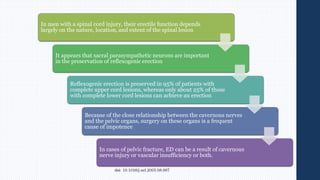
In men with a spinal cord injury, their erectile function depends
largely on the nature, location, and extent of the spinal lesion
It appears that sacral parasympathetic neurons are important
in the preservation of reflexogenic erection
Reflexogenic erection is preserved in 95% of patients with
complete upper cord lesions, whereas only about 25% of those
with complete lower cord lesions can achieve an erection
Because of the close relationship between the cavernous nerves
and the pelvic organs, surgery on these organs is a frequent
cause of impotence
In cases of pelvic fracture, ED can be a result of cavernous
nerve injury or vascular insufficiency or both.
Prevalence of erectile dysfunction and associated factors among
men without concomitant diseases: a population study
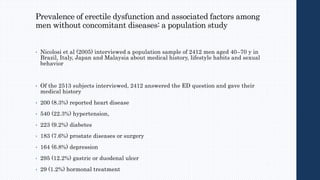
• Nicolosi et al (2005) interviewed a population sample of 2412 men aged 40–70 y in
Brazil, Italy, Japan and Malaysia about medical history, lifestyle habits and sexual
behavior
• Of the 2513 subjects interviewed, 2412 answered the ED question and gave their
medical history
• 200 (8.3%) reported heart disease
• 540 (22.3%) hypertension,
• 223 (9.2%) diabetes
• 183 (7.6%) prostate diseases or surgery
• 164 (6.8%) depression
• 295 (12.2%) gastric or duodenal ulcer
• 29 (1.2%) hormonal treatment
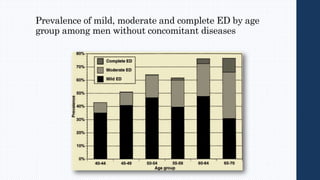
Prevalence of mild, moderate and complete ED by age
group among men without concomitant diseases
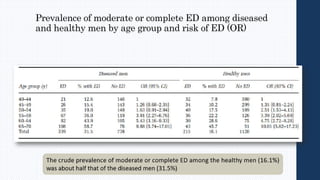
Prevalence of moderate or complete ED among diseased
and healthy men by age group and risk of ED (OR)
Penile Erection
Penile erection is initiated after central
processing and integration of tactile, visual,
olfactory, and imaginative stimuli
Final response is mediated
by coordinated spinal
activity in the autonomic
pathways to the penis and
in the somatic pathways to
the perineal striated
muscles
https://doi.org/10.1111/j.1743-6109.2009.01624.x
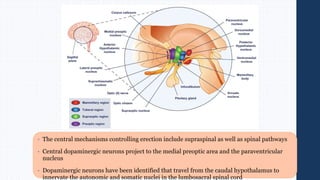
• The central mechanisms controlling erection include supraspinal as well as spinal pathways
• Central dopaminergic neurons project to the medial preoptic area and the paraventricular
nucleus
• Dopaminergic neurons have been identified that travel from the caudal hypothalamus to
innervate the autonomic and somatic nuclei in the lumbosacral spinal cord
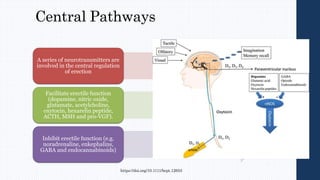
Central Pathways
A series of neurotransmitters are
involved in the central regulation
of erection
Facilitate erectile function
(dopamine, nitric oxide,
glutamate, acetylcholine,
oxytocin, hexarelin peptide,
ACTH, MSH and pro-VGF).
Inhibit erectile function (e.g.
noradrenaline, enkephalins,
GABA and endocannabinoids)
https://doi.org/10.1111/bcpt.12653
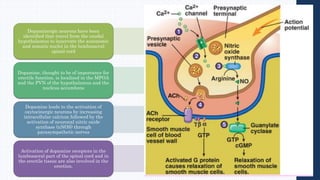
Dopaminergic neurons have been
identified that travel from the caudal
hypothalamus to innervate the autonomic
and somatic nuclei in the lumbosacral
spinal cord
Dopamine, thought to be of importance for
erectile function, is localized in the MPOA
and the PVN of the hypothalamus and the
nucleus accumbens
Dopamine leads to the activation of
oxytocinergic neurons by increasing
intracellular calcium followed by the
activation of neuronal nitric oxide
synthase (nNOS) through
parasympathetic nerves
Activation of dopamine receptors in the
lumbosacral part of the spinal cord and in
the erectile tissue are also involved in the
erection.
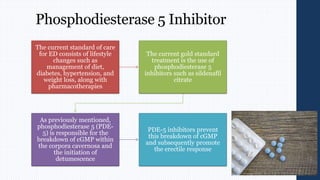
Phosphodiesterase 5 Inhibitor
The current standard of care
for ED consists of lifestyle
changes such as
management of diet,
diabetes, hypertension, and
weight loss, along with
pharmacotherapies
The current gold standard
treatment is the use of
phosphodiesterase 5
inhibitors such as sildenafil
citrate
As previously mentioned,
phosphodiesterase 5 (PDE-
5) is responsible for the
breakdown of cGMP within
the corpora cavernosa and
the initiation of
detumescence
PDE-5 inhibitors prevent
this breakdown of cGMP
and subsequently promote
the erectile response
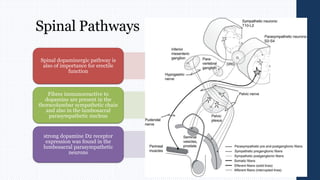
Spinal Pathways
Spinal dopaminergic pathway is
also of importance for erectile
function
Fibres immunoreactive to
dopamine are present in the
thoracolumbar sympathetic chain
and also in the lumbosacral
parasympathetic nucleus
strong dopamine D2 receptor
expression was found in the
lumbosacral parasympathetic
neurons
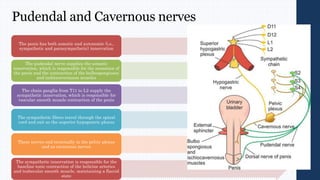
Pudendal and Cavernous nerves
The penis has both somatic and autonomic (i.e.,
sympathetic and parasympathetic) innervation
The pudendal nerve supplies the somatic
innervation, which is responsible for the sensation of
the penis and the contraction of the bulbospongiosus
and ischiocavernosus muscles
The chain ganglia from T11 to L2 supply the
sympathetic innervation, which is responsible for
vascular smooth muscle contraction of the penis
The sympathetic fibers travel through the spinal
cord and exit as the superior hypogastric plexus
These nerves end terminally in the pelvic plexus
and as cavernous nerves
The sympathetic innervation is responsible for the
baseline tonic contraction of the helicine arteries
and trabecular smooth muscle, maintaining a flaccid
state
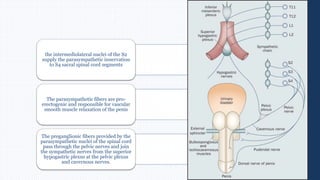
the intermediolateral nuclei of the S2
supply the parasympathetic innervation
to S4 sacral spinal cord segments
The parasympathetic fibers are pro-
erectogenic and responsible for vascular
smooth muscle relaxation of the penis
The preganglionic fibers provided by the
parasympathetic nuclei of the spinal cord
pass through the pelvic nerves and join
the sympathetic nerves from the superior
hypogastric plexus at the pelvic plexus
and cavernous nerves.
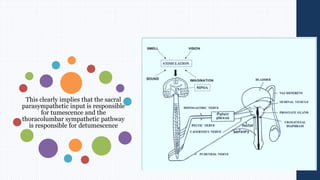
This clearly implies that the sacral
parasympathetic input is responsible
for tumescence and the
thoracolumbar sympathetic pathway
is responsible for detumescence
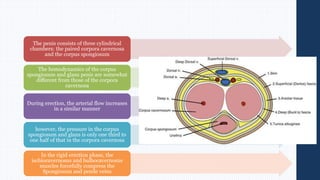
The penis consists of three cylindrical
chambers: the paired corpora cavernosa
and the corpus spongiosum
The hemodynamics of the corpus
spongiosum and glans penis are somewhat
different from those of the corpora
cavernosa
During erection, the arterial flow increases
in a similar manner
however, the pressure in the corpus
spongiosum and glans is only one third to
one half of that in the corpora cavernosa
In the rigid erection phase, the
ischiocavernosus and bulbocavernosus
muscles forcefully compress the
Spongiosum and penile veins
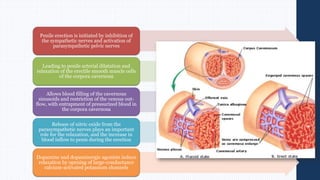
Penile erection is initiated by inhibition of
the sympathetic nerves and activation of
parasympathetic pelvic nerves
Leading to penile arterial dilatation and
relaxation of the erectile smooth muscle cells
of the corpora cavernosa
Allows blood filling of the cavernous
sinusoids and restriction of the venous out-
flow, with entrapment of pressurized blood in
the corpora cavernosa
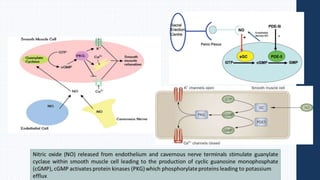
Release of nitric oxide from the
parasympathetic nerves plays an important
role for the relaxation, and the increase in
blood inflow to penis during the erection
Dopamine and dopaminergic agonists induce
relaxation by opening of large-conductance
calcium-activated potassium channels
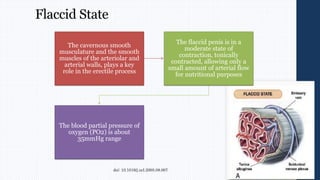
Flaccid State
The cavernous smooth
musculature and the smooth
muscles of the arteriolar and
arterial walls, plays a key
role in the erectile process
The flaccid penis is in a
moderate state of
contraction, tonically
contracted, allowing only a
small amount of arterial flow
for nutritional purposes
The blood partial pressure of
oxygen (PO2) is about
35mmHg range
doi: 10.1016/j.ucl.2005.08.007
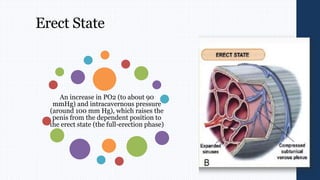
Erect State
An increase in PO2 (to about 90
mmHg) and intracavernous pressure
(around 100 mm Hg), which raises the
penis from the dependent position to
the erect state (the full-erection phase)
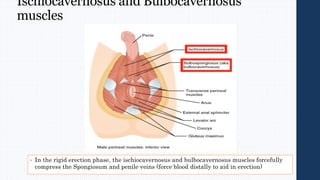
Ischiocavernosus and Bulbocavernosus
muscles
• In the rigid erection phase, the ischiocavernosus and bulbocavernosus muscles forcefully
compress the Spongiosum and penile veins (force blood distally to aid in erection)
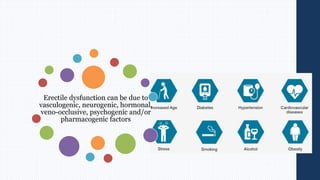
Erectile dysfunction can be due to
vasculogenic, neurogenic, hormonal,
veno-occlusive, psychogenic and/or
pharmacogenic factors
Percutaneous Perineal Electrostimulation Induces
Erection: Clinical Significance in Patients With Spinal Cord
Injury and Erectile Dysfunction
The probe was applied to the perineum in the area between the anal orifice and the bulb of corpus spongiosum
participant lying in the lithotomy position and the scrotum elevated and strapped to the abdomen
PESP was performed by means of the same probe used in rectal electroejaculation
Percutaneous electrostimulation of the perineum (PESP) was performed, and penile erection was evaluated by
recording the intracorporeal pressure
Duration of erectile dysfunction (ED) was 9 to 16 years (mean 11.6 6 2.2 y)
28 healthy volunteers (age 36.3 ± 7.4 y) and 18 patients (age 36.6 ± 6.8 y) with complete neurogenic erectile dysfunction
(NED)
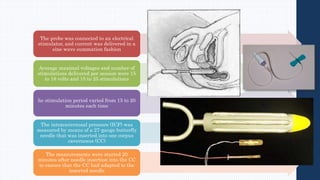
The probe was connected to an electrical
stimulator, and current was delivered in a
sine wave summation fashion
Average maximal voltages and number of
stimulations delivered per session were 15
to 18 volts and 15 to 25 stimulations
he stimulation period varied from 15 to 20
minutes each time
The intracavernosal pressure (ICP) was
measured by means of a 27-gauge butterfly
needle that was inserted into one corpus
cavernosus (CC)
The measurements were started 20
minutes after needle insertion into the CC
to ensure that the CC had adapted to the
inserted needle
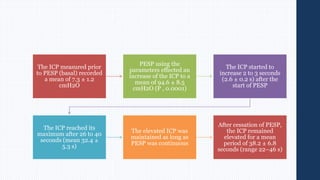
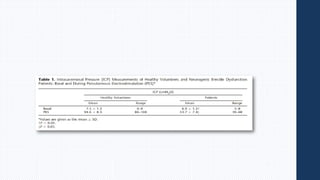
The ICP measured prior
to PESP (basal) recorded
a mean of 7.3 ± 1.2
cmH2O
PESP using the
parameters effected an
increase of the ICP to a
mean of 94.6 ± 8.5
cmH2O (P , 0.0001)
The ICP started to
increase 2 to 3 seconds
(2.6 ± 0.2 s) after the
start of PESP
The ICP reached its
maximum after 26 to 40
seconds (mean 32.4 ±
5.3 s)
The elevated ICP was
maintained as long as
PESP was continuous
After cessation of PESP,
the ICP remained
elevated for a mean
period of 38.2 ± 6.8
seconds (range 22–46 s)
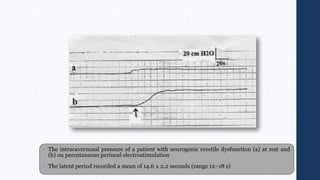
• The intracavernosal pressure of a patient with neurogenic erectile dysfunction (a) at rest and
(b) on percutaneous perineal electrostimulation
• The latent period recorded a mean of 14.6 ± 2.2 seconds (range 12–18 s)
Functional electrical
stimulation (FES)
therapy has shown a
high regenerative
capacity for smooth
muscle cells
FES can be a beneficial
treatment option when
the cause of ED is
related to degeneration
of cavernous smooth
muscle
We randomized 22
patients, aged 40 to 65
years, with known ED
(defined as a score of
less than 22 on the
IIEF-5)
Participants were
randomly assigned to
two groups:
intervention (IG) or
control (CG)
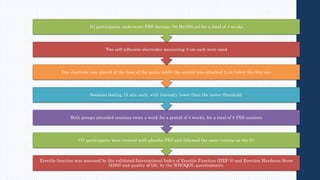
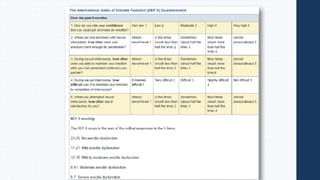
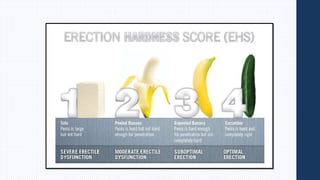
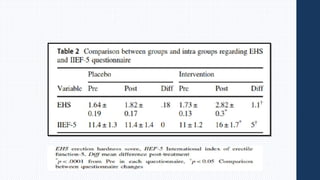
Erectile function was assessed by the validated International Index of Erectile Function (IIEF-5) and Erection Hardness Score
(EHS) and quality of life, by the WHOQOL questionnaire.
CG participants were treated with placebo FES and followed the same routine as the IG
Both groups attended sessions twice a week for a period of 4 weeks, for a total of 8 FES sessions
Sessions lasting 15 min each, with intensity lower than the motor threshold.
One electrode was placed at the base of the penis, while the second was attached 2 cm below the first one
Two self-adhesive electrodes measuring 3 cm each were used
IG participants underwent FES therapy (50 Hz/500 µs) for a total of 4 weeks
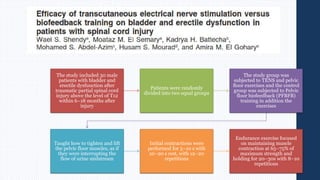
The study included 30 male
patients with bladder and
erectile dysfunction after
traumatic partial spinal cord
injury above the level of T12
within 6–18 months after
injury
Patients were randomly
divided into two equal groups
The study group was
subjected to TENS and pelvic
floor exercises and the control
group was subjected to Pelvic
floor biofeedback (PFBFB)
training in addition the
exercises
Taught how to tighten and lift
the pelvic floor muscles, as if
they were interrupting the
flow of urine midstream
Initial contractions were
performed for 5–10 s with
10–20 s rest, with 12–20
repetitions
Endurance exercise focused
on maintaining muscle
contraction at 65–75% of
maximum strength and
holding for 20–30s with 8–10
repetitions
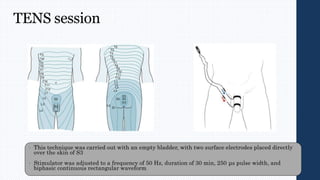
TENS session
• This technique was carried out with an empty bladder, with two surface electrodes placed directly
over the skin of S3
• Stimulator was adjusted to a frequency of 50 Hz, duration of 30 min, 250 μs pulse width, and
biphasic continuous rectangular waveform
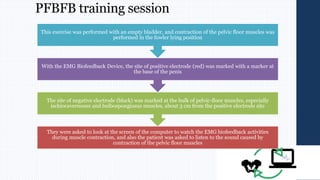
PFBFB training session
They were asked to look at the screen of the computer to watch the EMG biofeedback activities
during muscle contraction, and also the patient was asked to listen to the sound caused by
contraction of the pelvic floor muscles
The site of negative electrode (black) was marked at the bulk of pelvic-floor muscles, especially
ischiocavernosus and bulbospongiosus muscles, about 3 cm from the positive electrode site
With the EMG Biofeedback Device, the site of positive electrode (red) was marked with a marker at
the base of the penis
This exercise was performed with an empty bladder, and contraction of the pelvic floor muscles was
performed in the fowler lying position
THANKS

erectile dysfunction.pptx

  • 1.
  • 2.
    Erectile Dysfunction “The consistentor recurrent inability to attain and/or maintain a penile erection sufficient for sexual satisfaction” WHO-ISIR. 1st International Consultation on ED, 1999
  • 3.
    How would you describeyourself? Always, usually, sometimes or never able to get and keep an erection good enough for sexual intercourse The subjects answering ‘always’ were classified as normal Those whos answering “usually, sometimes or never” were classified as having mild, moderate or complete”
  • 4.
    Pathologic processes inthese regions, such as Parkinson’s disease, stroke, encephalitis, or temporal lobe epilepsy, are often associated with ED The MPOA, the paraventricular nucleus, and the hippocampus have been regarded as important integration centers for sexual drive and penile erection Because an erection is a neurovascular event, any disease or dysfunction affecting the brain, spinal cord, cavernous and pudendal nerves can induce dysfunction Some are based on the cause (diabetic, iatrogenic, traumatic) and some on the neurovascular mechanism of the erectile process failure to initiate [neurogenic], failure to fill [arterial], and failure to store [venous] Many classifications have been proposed for ED. doi: 10.1016/j.ucl.2005.08.007
  • 5.
    In men witha spinal cord injury, their erectile function depends largely on the nature, location, and extent of the spinal lesion It appears that sacral parasympathetic neurons are important in the preservation of reflexogenic erection Reflexogenic erection is preserved in 95% of patients with complete upper cord lesions, whereas only about 25% of those with complete lower cord lesions can achieve an erection Because of the close relationship between the cavernous nerves and the pelvic organs, surgery on these organs is a frequent cause of impotence In cases of pelvic fracture, ED can be a result of cavernous nerve injury or vascular insufficiency or both.
  • 6.
    Prevalence of erectiledysfunction and associated factors among men without concomitant diseases: a population study • Nicolosi et al (2005) interviewed a population sample of 2412 men aged 40–70 y in Brazil, Italy, Japan and Malaysia about medical history, lifestyle habits and sexual behavior • Of the 2513 subjects interviewed, 2412 answered the ED question and gave their medical history • 200 (8.3%) reported heart disease • 540 (22.3%) hypertension, • 223 (9.2%) diabetes • 183 (7.6%) prostate diseases or surgery • 164 (6.8%) depression • 295 (12.2%) gastric or duodenal ulcer • 29 (1.2%) hormonal treatment
  • 7.
    Prevalence of mild,moderate and complete ED by age group among men without concomitant diseases
  • 8.
    Prevalence of moderateor complete ED among diseased and healthy men by age group and risk of ED (OR)
  • 9.
    Penile Erection Penile erectionis initiated after central processing and integration of tactile, visual, olfactory, and imaginative stimuli Final response is mediated by coordinated spinal activity in the autonomic pathways to the penis and in the somatic pathways to the perineal striated muscles https://doi.org/10.1111/j.1743-6109.2009.01624.x
  • 10.
    • The centralmechanisms controlling erection include supraspinal as well as spinal pathways • Central dopaminergic neurons project to the medial preoptic area and the paraventricular nucleus • Dopaminergic neurons have been identified that travel from the caudal hypothalamus to innervate the autonomic and somatic nuclei in the lumbosacral spinal cord
  • 11.
    Central Pathways A seriesof neurotransmitters are involved in the central regulation of erection Facilitate erectile function (dopamine, nitric oxide, glutamate, acetylcholine, oxytocin, hexarelin peptide, ACTH, MSH and pro-VGF). Inhibit erectile function (e.g. noradrenaline, enkephalins, GABA and endocannabinoids) https://doi.org/10.1111/bcpt.12653
  • 12.
    Dopaminergic neurons havebeen identified that travel from the caudal hypothalamus to innervate the autonomic and somatic nuclei in the lumbosacral spinal cord Dopamine, thought to be of importance for erectile function, is localized in the MPOA and the PVN of the hypothalamus and the nucleus accumbens Dopamine leads to the activation of oxytocinergic neurons by increasing intracellular calcium followed by the activation of neuronal nitric oxide synthase (nNOS) through parasympathetic nerves Activation of dopamine receptors in the lumbosacral part of the spinal cord and in the erectile tissue are also involved in the erection.
  • 14.
    Phosphodiesterase 5 Inhibitor Thecurrent standard of care for ED consists of lifestyle changes such as management of diet, diabetes, hypertension, and weight loss, along with pharmacotherapies The current gold standard treatment is the use of phosphodiesterase 5 inhibitors such as sildenafil citrate As previously mentioned, phosphodiesterase 5 (PDE- 5) is responsible for the breakdown of cGMP within the corpora cavernosa and the initiation of detumescence PDE-5 inhibitors prevent this breakdown of cGMP and subsequently promote the erectile response
  • 15.
    Spinal Pathways Spinal dopaminergicpathway is also of importance for erectile function Fibres immunoreactive to dopamine are present in the thoracolumbar sympathetic chain and also in the lumbosacral parasympathetic nucleus strong dopamine D2 receptor expression was found in the lumbosacral parasympathetic neurons
  • 16.
    Pudendal and Cavernousnerves The penis has both somatic and autonomic (i.e., sympathetic and parasympathetic) innervation The pudendal nerve supplies the somatic innervation, which is responsible for the sensation of the penis and the contraction of the bulbospongiosus and ischiocavernosus muscles The chain ganglia from T11 to L2 supply the sympathetic innervation, which is responsible for vascular smooth muscle contraction of the penis The sympathetic fibers travel through the spinal cord and exit as the superior hypogastric plexus These nerves end terminally in the pelvic plexus and as cavernous nerves The sympathetic innervation is responsible for the baseline tonic contraction of the helicine arteries and trabecular smooth muscle, maintaining a flaccid state
  • 17.
    the intermediolateral nucleiof the S2 supply the parasympathetic innervation to S4 sacral spinal cord segments The parasympathetic fibers are pro- erectogenic and responsible for vascular smooth muscle relaxation of the penis The preganglionic fibers provided by the parasympathetic nuclei of the spinal cord pass through the pelvic nerves and join the sympathetic nerves from the superior hypogastric plexus at the pelvic plexus and cavernous nerves.
  • 18.
    This clearly impliesthat the sacral parasympathetic input is responsible for tumescence and the thoracolumbar sympathetic pathway is responsible for detumescence
  • 19.
    The penis consistsof three cylindrical chambers: the paired corpora cavernosa and the corpus spongiosum The hemodynamics of the corpus spongiosum and glans penis are somewhat different from those of the corpora cavernosa During erection, the arterial flow increases in a similar manner however, the pressure in the corpus spongiosum and glans is only one third to one half of that in the corpora cavernosa In the rigid erection phase, the ischiocavernosus and bulbocavernosus muscles forcefully compress the Spongiosum and penile veins
  • 20.
    Penile erection isinitiated by inhibition of the sympathetic nerves and activation of parasympathetic pelvic nerves Leading to penile arterial dilatation and relaxation of the erectile smooth muscle cells of the corpora cavernosa Allows blood filling of the cavernous sinusoids and restriction of the venous out- flow, with entrapment of pressurized blood in the corpora cavernosa Release of nitric oxide from the parasympathetic nerves plays an important role for the relaxation, and the increase in blood inflow to penis during the erection Dopamine and dopaminergic agonists induce relaxation by opening of large-conductance calcium-activated potassium channels
  • 21.
    Flaccid State The cavernoussmooth musculature and the smooth muscles of the arteriolar and arterial walls, plays a key role in the erectile process The flaccid penis is in a moderate state of contraction, tonically contracted, allowing only a small amount of arterial flow for nutritional purposes The blood partial pressure of oxygen (PO2) is about 35mmHg range doi: 10.1016/j.ucl.2005.08.007
  • 22.
    Erect State An increasein PO2 (to about 90 mmHg) and intracavernous pressure (around 100 mm Hg), which raises the penis from the dependent position to the erect state (the full-erection phase)
  • 23.
    Ischiocavernosus and Bulbocavernosus muscles •In the rigid erection phase, the ischiocavernosus and bulbocavernosus muscles forcefully compress the Spongiosum and penile veins (force blood distally to aid in erection)
  • 24.
    Erectile dysfunction canbe due to vasculogenic, neurogenic, hormonal, veno-occlusive, psychogenic and/or pharmacogenic factors
  • 26.
    Percutaneous Perineal ElectrostimulationInduces Erection: Clinical Significance in Patients With Spinal Cord Injury and Erectile Dysfunction The probe was applied to the perineum in the area between the anal orifice and the bulb of corpus spongiosum participant lying in the lithotomy position and the scrotum elevated and strapped to the abdomen PESP was performed by means of the same probe used in rectal electroejaculation Percutaneous electrostimulation of the perineum (PESP) was performed, and penile erection was evaluated by recording the intracorporeal pressure Duration of erectile dysfunction (ED) was 9 to 16 years (mean 11.6 6 2.2 y) 28 healthy volunteers (age 36.3 ± 7.4 y) and 18 patients (age 36.6 ± 6.8 y) with complete neurogenic erectile dysfunction (NED)
  • 27.
    The probe wasconnected to an electrical stimulator, and current was delivered in a sine wave summation fashion Average maximal voltages and number of stimulations delivered per session were 15 to 18 volts and 15 to 25 stimulations he stimulation period varied from 15 to 20 minutes each time The intracavernosal pressure (ICP) was measured by means of a 27-gauge butterfly needle that was inserted into one corpus cavernosus (CC) The measurements were started 20 minutes after needle insertion into the CC to ensure that the CC had adapted to the inserted needle
  • 28.
    The ICP measuredprior to PESP (basal) recorded a mean of 7.3 ± 1.2 cmH2O PESP using the parameters effected an increase of the ICP to a mean of 94.6 ± 8.5 cmH2O (P , 0.0001) The ICP started to increase 2 to 3 seconds (2.6 ± 0.2 s) after the start of PESP The ICP reached its maximum after 26 to 40 seconds (mean 32.4 ± 5.3 s) The elevated ICP was maintained as long as PESP was continuous After cessation of PESP, the ICP remained elevated for a mean period of 38.2 ± 6.8 seconds (range 22–46 s)
  • 29.
    • The intracavernosalpressure of a patient with neurogenic erectile dysfunction (a) at rest and (b) on percutaneous perineal electrostimulation • The latent period recorded a mean of 14.6 ± 2.2 seconds (range 12–18 s)
  • 31.
    Functional electrical stimulation (FES) therapyhas shown a high regenerative capacity for smooth muscle cells FES can be a beneficial treatment option when the cause of ED is related to degeneration of cavernous smooth muscle We randomized 22 patients, aged 40 to 65 years, with known ED (defined as a score of less than 22 on the IIEF-5) Participants were randomly assigned to two groups: intervention (IG) or control (CG)
  • 32.
    Erectile function wasassessed by the validated International Index of Erectile Function (IIEF-5) and Erection Hardness Score (EHS) and quality of life, by the WHOQOL questionnaire. CG participants were treated with placebo FES and followed the same routine as the IG Both groups attended sessions twice a week for a period of 4 weeks, for a total of 8 FES sessions Sessions lasting 15 min each, with intensity lower than the motor threshold. One electrode was placed at the base of the penis, while the second was attached 2 cm below the first one Two self-adhesive electrodes measuring 3 cm each were used IG participants underwent FES therapy (50 Hz/500 µs) for a total of 4 weeks
  • 36.
    The study included30 male patients with bladder and erectile dysfunction after traumatic partial spinal cord injury above the level of T12 within 6–18 months after injury Patients were randomly divided into two equal groups The study group was subjected to TENS and pelvic floor exercises and the control group was subjected to Pelvic floor biofeedback (PFBFB) training in addition the exercises Taught how to tighten and lift the pelvic floor muscles, as if they were interrupting the flow of urine midstream Initial contractions were performed for 5–10 s with 10–20 s rest, with 12–20 repetitions Endurance exercise focused on maintaining muscle contraction at 65–75% of maximum strength and holding for 20–30s with 8–10 repetitions
  • 37.
    TENS session • Thistechnique was carried out with an empty bladder, with two surface electrodes placed directly over the skin of S3 • Stimulator was adjusted to a frequency of 50 Hz, duration of 30 min, 250 μs pulse width, and biphasic continuous rectangular waveform
  • 38.
    PFBFB training session Theywere asked to look at the screen of the computer to watch the EMG biofeedback activities during muscle contraction, and also the patient was asked to listen to the sound caused by contraction of the pelvic floor muscles The site of negative electrode (black) was marked at the bulk of pelvic-floor muscles, especially ischiocavernosus and bulbospongiosus muscles, about 3 cm from the positive electrode site With the EMG Biofeedback Device, the site of positive electrode (red) was marked with a marker at the base of the penis This exercise was performed with an empty bladder, and contraction of the pelvic floor muscles was performed in the fowler lying position
  • 40.