Equivalence Points (EP)
Systematics & Classification
aqion.de
updated 2017-09-28
The set of Equivalence Points
(EP & semi-EP) is the unique barcode
of an acid-base system.
Motivation
- 2 -
An Equivalence Point is a special
equilibrium state at which chemical
equivalent quantities of acids and bases
are mixed:
EP: [acid] = [base]
square brackets indicate
molar concentrations
Common Definition
- 3 -
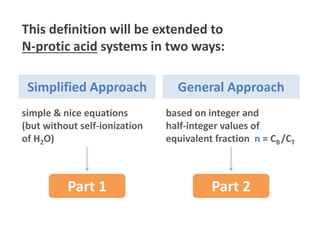
This definition will be extended to
N-protic acid systems in two ways:
Part 1
Simplified Approach General Approach
Part 2
simple & nice equations
(but without self-ionization
of H2O)
based on integer and
half-integer values of
equivalent fraction n = CB /CT
- 4 -
Simplified Approach
(valid for High-Concentrated Acids)
Part 1
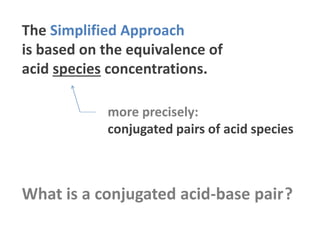
The Simplified Approach
is based on the equivalence of
acid species concentrations.
more precisely:
conjugated pairs of acid species
What is a conjugated acid-base pair?
- 6 -
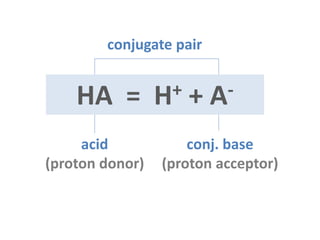
acid
(proton donor)
conj. base
(proton acceptor)
conjugate pair
HA = H+ + A-
- 7 -
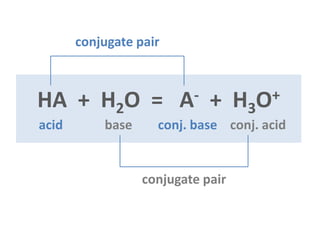
HA + H2O = A- + H3O+
conjugate pair
conjugate pair
acid base conj. base conj. acid
- 8 -
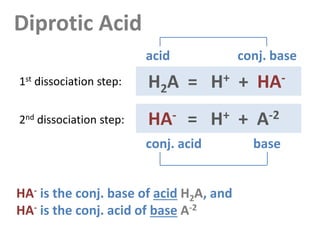
Diprotic Acid
H2A = H+ + HA-
HA- = H+ + A-2
conj. acid base
acid conj. base
1st dissociation step:
2nd dissociation step:
HA- is the conj. base of acid H2A, and
HA- is the conj. acid of base A-2
- 9 -
HA- is the conj. base of acid H2A, and
HA- is the conj. acid of base A-2
EP of HA-: [H2A] = [A-2]
Diprotic Acid
Notation:
The diprotic acid has 3 species: [H2A], [HA-] and [A-2].
They add up to the total amount: CT = [H2A] + [HA-] + [A-2]  [H2A]T
Triprotic Acid (H3A)
EP of H2A-: [H3A] = [HA-2]
EP of HA-2: [HA-2] = [A-3]
In addition, there are much more types of
equivalence points. Let‘s systematize it.
- 11 -
Equivalence &
Semi-Equivalence Points of H3A
Part 1a
Triprotic Acid
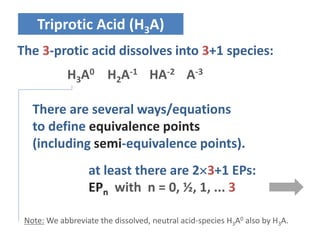
Triprotic Acid (H3A)
The 3-protic acid dissolves into 3+1 species:
H3A0 H2A-1 HA-2 A-3
There are several ways/equations
to define equivalence points
(including semi-equivalence points).
at least there are 23+1 EPs:
EPn with n = 0, ½, 1, ... 3
Note: We abbreviate the dissolved, neutral acid-species H3A0 also by H3A.
Triprotic Acid (H3A)
EP0 [H+] = [H2A-]
EP1/2 [H3A] = [H2A-]
EP1 [H3A] = [HA-2]
EP3/2 [H2A-] = [HA-2]
EP2 [H2A-] = [A-3]
EP5/2 [HA-2] = [A-3]
EP3 [HA-2] = [OH-]
H+ H3A H2A- HA-2 A-3 OH-
EP0 EP2
EP1 EP3
Equivalence Points
H3A H2A- HA-2 A-3
EP1/2 EP5/2
EP3/2
Semi-EPs
Triprotic Acid
1st diss. step: H3A = H+ + H2A- K1 = [H+][H2A-]/[H3A]
2nd diss. step: H2A- = H+ + HA-2 K2 = [H+][HA-2]/[H2A-]
3rd diss. step: HA-2 = H+ + A-3 K3 = [H+][HA-3]/[HA-2]
stepwise equilibrium constants
K1 = K1 = [H+]  pH = pK1
[H2A-] = [H3A]
(semi-EP)
[H+][H2A-]
[H3A]
K1K2 = K1K2 = [H+]2  pH = ½(pK1+pK2)
[HA-2] = [H3A]
(EP)
[H+]2[HA-2]
[H3A]
Each EP (or semi-EP) is characterized by one specific pH value
that relies directly on the acidity constants K: EP  pH  pK
pH = lg [H+]
pK = lg K
EP0 [H+] = [H2A-]
EP1/2 [H3A] = [H2A-]  pH1/2 = pK1
EP1 [H3A] = [HA-2]  pH1 = ½(pK1+pK2)
EP3/2 [H2A-] = [HA-2]  pH3/2 = pK2
EP2 [H2A-] = [A-3]  pH2 = ½(pK2+pK3)
EP5/2 [HA-2] = [A-3]  pH5/2 = pK3
EP3 [HA-2] = [OH-]
Each EP (or semi-EP) is characterized by one pH value
that relies directly on the acidity constants K: EP  pH  pK
The two “external EPs” EP0 and EP3 are non-trivial;
they depend, in addition, on the total amount of acid, CT.
- 16 -
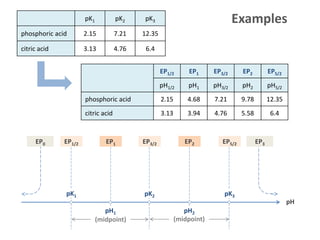
EP1/2 EP1 EP3/2 EP2 EP5/2
pH1/2 pH1 pH3/2 pH2 pH5/2
phosphoric acid 2.15 4.68 7.21 9.78 12.35
citric acid 3.13 3.94 4.76 5.58 6.4
pK1 pK2 pK3
phosphoric acid 2.15 7.21 12.35
citric acid 3.13 4.76 6.4
pK1 pK2
EP1/2 EP1
pK3
pH
EP5/2EP2EP3/2
(midpoint) (midpoint)
pH1 pH2
EP0 EP3
Examples
- 17 -
Equivalence &
Semi-Equivalence Points of HNA
Part 1b
N-protic Acid
(N = 1, 2, 3, ...)
EP0 [H+] = [1]
EP1/2 [0] = [1]  pH1/2 = pK1
EP1 [0] = [2]  pH1 = ½(pK1+pK2)
EP3/2 [1] = [2]  pH3/2 = pK2
EP2 [1] = [3]  pH2 = ½(pK2+pK3)
⁞
EPN-½ [N-1] = [N]  pHN-½ = pKN
EPN [N-1] = [OH-]
An N-protic acid HNA has
internalEPs
two external EPs
and 2N+1 EPs:
N+1 acid-species: [j]  [HN-jA-j] with j = 0,1, ... N
N Acid HNA
EP1/2 EP1 EP3/2 EP2 EP5/2
pH1/2 pH1 pH3/2 pH2 pH5/2
1 acetic acid 4.76
2 (composite) carbonic acid 6.35 8.34 10.33
3 phosphoric acid 2.15 4.68 7.21 9.78 12.35
3 citric acid 3.13 3.94 4.76 5.58 6.4
Acid Type pK1 pK2 pK3
acetic acid HA 4.76
(composite) carbonic acid H2A 6.35 10.33
phosphoric acid H3A 2.15 7.21 12.35
citric acid H3A 3.13 4.76 6.4
Examples for Internal EPs
Unified Notation
for Internal EPs
EPn 
 pHn = ½ (pKn +pKn+1)
 pHn = pKn+1/2
[n-1] = [n+1]
[n-½] = [n+½]
integer n = j
(n = 1,2, ... N-1)
half-integer n = j-½
(n = ½, ³/₂, ... N-½)
semi-EPs:
Note: j is integer and indicates the acid-species [j] and acidity constants Kj;
n is integer and half-integer and labels the EPs and semi-EPs.
the true, chemical meaning of n
becomes clear in Part 2
External EPs
EPN [N-1] = [OH-]  pHN  14
EP0 [H+] = [1]  pH0  0
There is no simple relationship between EP  pH.
pH of EP0 and EPN depend on K1 to KN and on CT (= total
amount of acid).
However,
for CT   the following asymptotic behavior exists:
- 22 -
pH
CT[M]CT[M]
n=0 n=0.5 n=1.5n=1
n=2
n=0
n=0.5
n=1.5n=1 n=2
n=2.5
n=3
H3A (phosphoric acid)
H2A (carbonic acid)
Examples
Internal EPs:
red lines
(independent of CT)
External EPs:
blue & green lines
(CT-dependent)
Curves as dashed (and not solid) lines remind us that the simplified approach is an approximation.
Caution:
The simplified approach fails
for highly diluted acids
This restriction is
removed in the General Approach Part 2
(because self-ionization of H2O is ignored)
General Approach
based on Equivalent Fraction n
Part 2
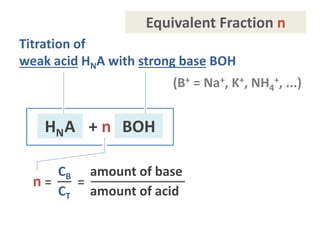
n = CB/CT
(B+ = Na+, K+, NH4
+, ...)
n = =
CB amount of base
CT amount of acid
HNA BOH+ n
Titration of
weak acid HNA with strong base BOH
Equivalent Fraction n
- 26 -
EP1  1 = CB /CT
EP½  ½ = CB /CT
EP1: [acid]T = [base]T
Generalization to other EPs:
EPn  n = CB /CT
⁞
CT CB T = total amount
- 27 -
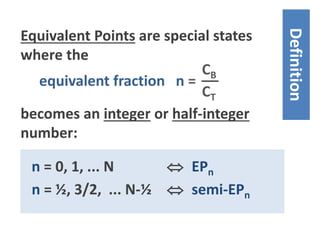
equivalent fraction n =
CB
CT
Equivalent Points are special states
where the
n = 0, 1, ... N  EPn
n = ½, 3/2, ... N-½  semi-EPn
Definition
becomes an integer or half-integer
value:
- 28 -
Basic Equation for HNA
n = Y1(x) +
w(x)
CT
self-ionization H2O
x
x
K
w w

N211 Naa2aY  
0j
j
j a
x
k
a 






1
N
N
2
21
0
x
k
...
x
k
x
k
1a








ionization fractions (j = 0, 1, ... N)
with
cumulative equilibrium constants: k1 = K1, k2 = K1K2, ...
total amount of acid
x  [H+] = 10-pH
Ref: www.aqion.de/file/acid-base-systems.pdf
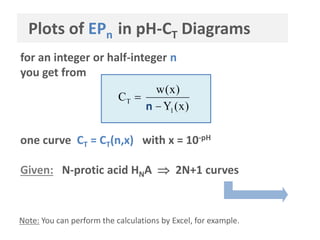
Plots of EPn in pH-CT Diagrams
for an integer or half-integer n
you get from
one curve CT = CT(n,x) with x = 10-pH
)x(Yn
)x(w
C
1
T


n
Given: N-protic acid HNA  2N+1 curves
Note: You can perform the calculations by Excel, for example.
- 30 -
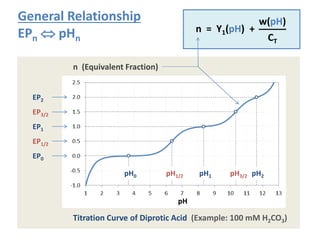
General Relationship
EPn  pHn
pH
n (Equivalent Fraction)
pH1/2 pH3/2pH0 pH1 pH2
EP1/2
EP3/2
EP0
EP1
EP2
Titration Curve of Diprotic Acid (Example: 100 mM H2CO3)
n = Y1(pH) +
w(pH)
CT
n=0 n=0.5 n=1
n=0 n=0.5 n=1 n=1.5
n=2
HA (acetic acid)
H2A (carbonic acid)
CT[M]
n=0
0.5 1.51 2 2.5
n=3
H3A (phosphoric acid)
n=0 0.5 1.51 2 2.5
n=3
H3A (citric acid)
pH
CT[M]
pH
EP & semi-EP
internal EP
external EP0
external EPN
dashed lines refer to the
“pure-acid case” in Part 1
n = Y1(x) +
w(x)
CT
General Approach
n = Y1(x)
Simplified Approach
(Pure-Acid Case)
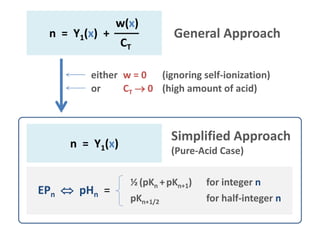
either w = 0 (ignoring self-ionization)
or CT  0 (high amount of acid)
EPn  pHn =
½ (pKn +pKn+1) for integer n
pKn+1/2 for half-integer n
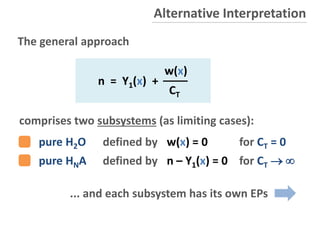
comprises two subsystems (as limiting cases):
pure H2O defined by w(x) = 0 for CT = 0
pure HNA defined by n – Y1(x) = 0 for CT  
n = Y1(x) +
w(x)
CT
The general approach
Alternative Interpretation
... and each subsystem has its own EPs
- 34 -
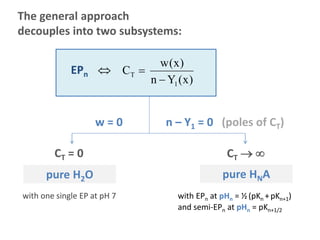
The general approach
decouples into two subsystems:
CT = 0 CT  
pure H2O pure HNA
with one single EP at pH 7 with EPn at pHn = ½(pKn +pKn+1)
and semi-EPn at pHn = pKn+1/2
w = 0 n – Y1 = 0 (poles of CT)
)x(Yn
)x(w
C
1
T

EPn 
- 35 -
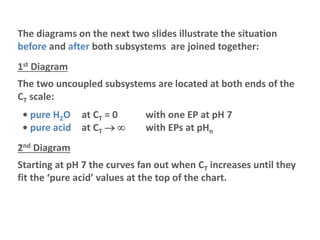
The diagrams on the next two slides illustrate the situation
before and after both subsystems are joined together:
1st Diagram
The two uncoupled subsystems are located at both ends of the
CT scale:
• pure H2O at CT = 0 with one EP at pH 7
• pure acid at CT   with EPs at pHn
2nd Diagram
Starting at pH 7 the curves fan out when CT increases until they
fit the ‘pure acid’ values at the top of the chart.
- 36 -
Example H3PO4
CT[M]
pure acid (H3A)
pure H2O
two uncoupled subsystems
pH
pH=7
EP1/2 EP3/2EP1 EP2 EP5/2EP0 EP3
- 37 -
Example H3PO4
CT[M]
acid + H2O
pH
EP1/2 EP3/2EP1 EP2 EP5/2EP0 EP3
)x(Yn
)x(w
C
1
T


Coupling of two Subsystems
- 38 -
Summary
An N-protic acid has 2N+1 equivalence points:
EPn  n = CB /CT for n = 0, ½, 1, ... N
Equivalence points are special equilibrium states where
the equivalent fraction n = CB/CT becomes an integer or
half-integer value.
The relationship EPn  pHn is given by
where Y1 describes the acid and w the water.
n = Y1(pH) + w(pH)/CT
For high-concentrated acids (CT  ) the relationship
simplifies to: n = Y1(pH)
which yields the direct
link to acidity constants:
½ (pKn +pKn+1)  EP
pKn+1/2  semi-EP
pHn =
For high-concentrated acids (CT  ) there is
an alternative definition of EPs
based on equal species concentrations:
EPn: [n-1] = [n+1]
semi-EPn: [n-½] = [n+½]
Example: In carbonate systems EP1 is often introduced
as state where [H2CO3] = [CO3
-2].
The equivalent fraction n = Y1+ w/CT (titration curve)
describes the buffer capacity. Its pH-derivative is the
buffer intensity β = dn/dpH. EPs are extrema of β:
EPn  minimum buffer intensity
semi-EPn  maximum buffer intensity
Titration & Buffer Intensity
EPn (integer n)  minimum buffer intensity
semi-EPn (half-integer n)  maximum buffer intensity
pH
titration curve n(pH)
(buffer capacity)
buffer intensity β
EP1/2
EP3/2
EP0
EP1
EP2
pH1/2 pH3/2pH0 pH1 pH2
Diprotic Acid (100 mM H2CO3)
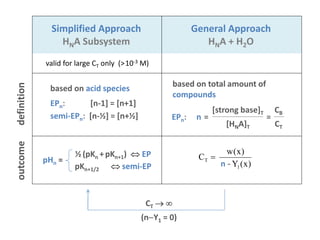
Simplified Approach
HNA Subsystem
General Approach
HNA + H2O
valid for large CT only (>10-3 M)
definition
based on acid species
EPn: [n-1] = [n+1]
semi-EPn: [n-½] = [n+½]
outcome
½ (pKn +pKn+1)  EP
pKn+1/2  semi-EP
pHn =
CT  
(nY1 = 0)
)x(Yn
)x(w
C
1
T


n
based on total amount of
compounds
EPn: n = =
[HNA]T
[strong base]T
CT
CB
- 43 -
Ref
www.aqion.de/file/acid-base-systems.pdf
www.aqion.de/site/68 (EN)
www.aqion.de/site/24 (DE)

Equivalence Points

  • 1.
    Equivalence Points (EP) Systematics& Classification aqion.de updated 2017-09-28
  • 2.
    The set ofEquivalence Points (EP & semi-EP) is the unique barcode of an acid-base system. Motivation - 2 -
  • 3.
    An Equivalence Pointis a special equilibrium state at which chemical equivalent quantities of acids and bases are mixed: EP: [acid] = [base] square brackets indicate molar concentrations Common Definition - 3 -
  • 4.
    This definition willbe extended to N-protic acid systems in two ways: Part 1 Simplified Approach General Approach Part 2 simple & nice equations (but without self-ionization of H2O) based on integer and half-integer values of equivalent fraction n = CB /CT - 4 -
  • 5.
    Simplified Approach (valid forHigh-Concentrated Acids) Part 1
  • 6.
    The Simplified Approach isbased on the equivalence of acid species concentrations. more precisely: conjugated pairs of acid species What is a conjugated acid-base pair? - 6 -
  • 7.
    acid (proton donor) conj. base (protonacceptor) conjugate pair HA = H+ + A- - 7 -
  • 8.
    HA + H2O= A- + H3O+ conjugate pair conjugate pair acid base conj. base conj. acid - 8 -
  • 9.
    Diprotic Acid H2A =H+ + HA- HA- = H+ + A-2 conj. acid base acid conj. base 1st dissociation step: 2nd dissociation step: HA- is the conj. base of acid H2A, and HA- is the conj. acid of base A-2 - 9 -
  • 10.
    HA- is theconj. base of acid H2A, and HA- is the conj. acid of base A-2 EP of HA-: [H2A] = [A-2] Diprotic Acid Notation: The diprotic acid has 3 species: [H2A], [HA-] and [A-2]. They add up to the total amount: CT = [H2A] + [HA-] + [A-2]  [H2A]T
  • 11.
    Triprotic Acid (H3A) EPof H2A-: [H3A] = [HA-2] EP of HA-2: [HA-2] = [A-3] In addition, there are much more types of equivalence points. Let‘s systematize it. - 11 -
  • 12.
    Equivalence & Semi-Equivalence Pointsof H3A Part 1a Triprotic Acid
  • 13.
    Triprotic Acid (H3A) The3-protic acid dissolves into 3+1 species: H3A0 H2A-1 HA-2 A-3 There are several ways/equations to define equivalence points (including semi-equivalence points). at least there are 23+1 EPs: EPn with n = 0, ½, 1, ... 3 Note: We abbreviate the dissolved, neutral acid-species H3A0 also by H3A.
  • 14.
    Triprotic Acid (H3A) EP0[H+] = [H2A-] EP1/2 [H3A] = [H2A-] EP1 [H3A] = [HA-2] EP3/2 [H2A-] = [HA-2] EP2 [H2A-] = [A-3] EP5/2 [HA-2] = [A-3] EP3 [HA-2] = [OH-] H+ H3A H2A- HA-2 A-3 OH- EP0 EP2 EP1 EP3 Equivalence Points H3A H2A- HA-2 A-3 EP1/2 EP5/2 EP3/2 Semi-EPs
  • 15.
    Triprotic Acid 1st diss.step: H3A = H+ + H2A- K1 = [H+][H2A-]/[H3A] 2nd diss. step: H2A- = H+ + HA-2 K2 = [H+][HA-2]/[H2A-] 3rd diss. step: HA-2 = H+ + A-3 K3 = [H+][HA-3]/[HA-2] stepwise equilibrium constants K1 = K1 = [H+]  pH = pK1 [H2A-] = [H3A] (semi-EP) [H+][H2A-] [H3A] K1K2 = K1K2 = [H+]2  pH = ½(pK1+pK2) [HA-2] = [H3A] (EP) [H+]2[HA-2] [H3A] Each EP (or semi-EP) is characterized by one specific pH value that relies directly on the acidity constants K: EP  pH  pK pH = lg [H+] pK = lg K
  • 16.
    EP0 [H+] =[H2A-] EP1/2 [H3A] = [H2A-]  pH1/2 = pK1 EP1 [H3A] = [HA-2]  pH1 = ½(pK1+pK2) EP3/2 [H2A-] = [HA-2]  pH3/2 = pK2 EP2 [H2A-] = [A-3]  pH2 = ½(pK2+pK3) EP5/2 [HA-2] = [A-3]  pH5/2 = pK3 EP3 [HA-2] = [OH-] Each EP (or semi-EP) is characterized by one pH value that relies directly on the acidity constants K: EP  pH  pK The two “external EPs” EP0 and EP3 are non-trivial; they depend, in addition, on the total amount of acid, CT. - 16 -
  • 17.
    EP1/2 EP1 EP3/2EP2 EP5/2 pH1/2 pH1 pH3/2 pH2 pH5/2 phosphoric acid 2.15 4.68 7.21 9.78 12.35 citric acid 3.13 3.94 4.76 5.58 6.4 pK1 pK2 pK3 phosphoric acid 2.15 7.21 12.35 citric acid 3.13 4.76 6.4 pK1 pK2 EP1/2 EP1 pK3 pH EP5/2EP2EP3/2 (midpoint) (midpoint) pH1 pH2 EP0 EP3 Examples - 17 -
  • 18.
    Equivalence & Semi-Equivalence Pointsof HNA Part 1b N-protic Acid (N = 1, 2, 3, ...)
  • 19.
    EP0 [H+] =[1] EP1/2 [0] = [1]  pH1/2 = pK1 EP1 [0] = [2]  pH1 = ½(pK1+pK2) EP3/2 [1] = [2]  pH3/2 = pK2 EP2 [1] = [3]  pH2 = ½(pK2+pK3) ⁞ EPN-½ [N-1] = [N]  pHN-½ = pKN EPN [N-1] = [OH-] An N-protic acid HNA has internalEPs two external EPs and 2N+1 EPs: N+1 acid-species: [j]  [HN-jA-j] with j = 0,1, ... N
  • 20.
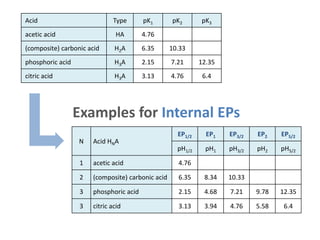
    N Acid HNA EP1/2EP1 EP3/2 EP2 EP5/2 pH1/2 pH1 pH3/2 pH2 pH5/2 1 acetic acid 4.76 2 (composite) carbonic acid 6.35 8.34 10.33 3 phosphoric acid 2.15 4.68 7.21 9.78 12.35 3 citric acid 3.13 3.94 4.76 5.58 6.4 Acid Type pK1 pK2 pK3 acetic acid HA 4.76 (composite) carbonic acid H2A 6.35 10.33 phosphoric acid H3A 2.15 7.21 12.35 citric acid H3A 3.13 4.76 6.4 Examples for Internal EPs
  • 21.
    Unified Notation for InternalEPs EPn   pHn = ½ (pKn +pKn+1)  pHn = pKn+1/2 [n-1] = [n+1] [n-½] = [n+½] integer n = j (n = 1,2, ... N-1) half-integer n = j-½ (n = ½, ³/₂, ... N-½) semi-EPs: Note: j is integer and indicates the acid-species [j] and acidity constants Kj; n is integer and half-integer and labels the EPs and semi-EPs. the true, chemical meaning of n becomes clear in Part 2
  • 22.
    External EPs EPN [N-1]= [OH-]  pHN  14 EP0 [H+] = [1]  pH0  0 There is no simple relationship between EP  pH. pH of EP0 and EPN depend on K1 to KN and on CT (= total amount of acid). However, for CT   the following asymptotic behavior exists: - 22 -
  • 23.
    pH CT[M]CT[M] n=0 n=0.5 n=1.5n=1 n=2 n=0 n=0.5 n=1.5n=1n=2 n=2.5 n=3 H3A (phosphoric acid) H2A (carbonic acid) Examples Internal EPs: red lines (independent of CT) External EPs: blue & green lines (CT-dependent) Curves as dashed (and not solid) lines remind us that the simplified approach is an approximation.
  • 24.
    Caution: The simplified approachfails for highly diluted acids This restriction is removed in the General Approach Part 2 (because self-ionization of H2O is ignored)
  • 25.
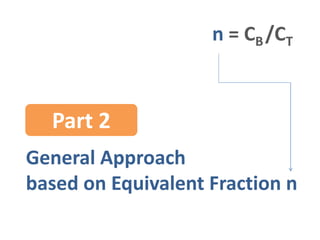
    General Approach based onEquivalent Fraction n Part 2 n = CB/CT
  • 26.
    (B+ = Na+,K+, NH4 +, ...) n = = CB amount of base CT amount of acid HNA BOH+ n Titration of weak acid HNA with strong base BOH Equivalent Fraction n - 26 -
  • 27.
    EP1  1= CB /CT EP½  ½ = CB /CT EP1: [acid]T = [base]T Generalization to other EPs: EPn  n = CB /CT ⁞ CT CB T = total amount - 27 -
  • 28.
    equivalent fraction n= CB CT Equivalent Points are special states where the n = 0, 1, ... N  EPn n = ½, 3/2, ... N-½  semi-EPn Definition becomes an integer or half-integer value: - 28 -
  • 29.
    Basic Equation forHNA n = Y1(x) + w(x) CT self-ionization H2O x x K w w  N211 Naa2aY   0j j j a x k a        1 N N 2 21 0 x k ... x k x k 1a         ionization fractions (j = 0, 1, ... N) with cumulative equilibrium constants: k1 = K1, k2 = K1K2, ... total amount of acid x  [H+] = 10-pH Ref: www.aqion.de/file/acid-base-systems.pdf
  • 30.
    Plots of EPnin pH-CT Diagrams for an integer or half-integer n you get from one curve CT = CT(n,x) with x = 10-pH )x(Yn )x(w C 1 T   n Given: N-protic acid HNA  2N+1 curves Note: You can perform the calculations by Excel, for example. - 30 -
  • 31.
    General Relationship EPn pHn pH n (Equivalent Fraction) pH1/2 pH3/2pH0 pH1 pH2 EP1/2 EP3/2 EP0 EP1 EP2 Titration Curve of Diprotic Acid (Example: 100 mM H2CO3) n = Y1(pH) + w(pH) CT
  • 32.
    n=0 n=0.5 n=1 n=0n=0.5 n=1 n=1.5 n=2 HA (acetic acid) H2A (carbonic acid) CT[M] n=0 0.5 1.51 2 2.5 n=3 H3A (phosphoric acid) n=0 0.5 1.51 2 2.5 n=3 H3A (citric acid) pH CT[M] pH EP & semi-EP internal EP external EP0 external EPN dashed lines refer to the “pure-acid case” in Part 1
  • 33.
    n = Y1(x)+ w(x) CT General Approach n = Y1(x) Simplified Approach (Pure-Acid Case) either w = 0 (ignoring self-ionization) or CT  0 (high amount of acid) EPn  pHn = ½ (pKn +pKn+1) for integer n pKn+1/2 for half-integer n
  • 34.
    comprises two subsystems(as limiting cases): pure H2O defined by w(x) = 0 for CT = 0 pure HNA defined by n – Y1(x) = 0 for CT   n = Y1(x) + w(x) CT The general approach Alternative Interpretation ... and each subsystem has its own EPs - 34 -
  • 35.
    The general approach decouplesinto two subsystems: CT = 0 CT   pure H2O pure HNA with one single EP at pH 7 with EPn at pHn = ½(pKn +pKn+1) and semi-EPn at pHn = pKn+1/2 w = 0 n – Y1 = 0 (poles of CT) )x(Yn )x(w C 1 T  EPn  - 35 -
  • 36.
    The diagrams onthe next two slides illustrate the situation before and after both subsystems are joined together: 1st Diagram The two uncoupled subsystems are located at both ends of the CT scale: • pure H2O at CT = 0 with one EP at pH 7 • pure acid at CT   with EPs at pHn 2nd Diagram Starting at pH 7 the curves fan out when CT increases until they fit the ‘pure acid’ values at the top of the chart. - 36 -
  • 37.
    Example H3PO4 CT[M] pure acid(H3A) pure H2O two uncoupled subsystems pH pH=7 EP1/2 EP3/2EP1 EP2 EP5/2EP0 EP3 - 37 -
  • 38.
    Example H3PO4 CT[M] acid +H2O pH EP1/2 EP3/2EP1 EP2 EP5/2EP0 EP3 )x(Yn )x(w C 1 T   Coupling of two Subsystems - 38 -
  • 39.
  • 40.
    An N-protic acidhas 2N+1 equivalence points: EPn  n = CB /CT for n = 0, ½, 1, ... N Equivalence points are special equilibrium states where the equivalent fraction n = CB/CT becomes an integer or half-integer value. The relationship EPn  pHn is given by where Y1 describes the acid and w the water. n = Y1(pH) + w(pH)/CT For high-concentrated acids (CT  ) the relationship simplifies to: n = Y1(pH) which yields the direct link to acidity constants: ½ (pKn +pKn+1)  EP pKn+1/2  semi-EP pHn =
  • 41.
    For high-concentrated acids(CT  ) there is an alternative definition of EPs based on equal species concentrations: EPn: [n-1] = [n+1] semi-EPn: [n-½] = [n+½] Example: In carbonate systems EP1 is often introduced as state where [H2CO3] = [CO3 -2]. The equivalent fraction n = Y1+ w/CT (titration curve) describes the buffer capacity. Its pH-derivative is the buffer intensity β = dn/dpH. EPs are extrema of β: EPn  minimum buffer intensity semi-EPn  maximum buffer intensity
  • 42.
    Titration & BufferIntensity EPn (integer n)  minimum buffer intensity semi-EPn (half-integer n)  maximum buffer intensity pH titration curve n(pH) (buffer capacity) buffer intensity β EP1/2 EP3/2 EP0 EP1 EP2 pH1/2 pH3/2pH0 pH1 pH2 Diprotic Acid (100 mM H2CO3)
  • 43.
    Simplified Approach HNA Subsystem GeneralApproach HNA + H2O valid for large CT only (>10-3 M) definition based on acid species EPn: [n-1] = [n+1] semi-EPn: [n-½] = [n+½] outcome ½ (pKn +pKn+1)  EP pKn+1/2  semi-EP pHn = CT   (nY1 = 0) )x(Yn )x(w C 1 T   n based on total amount of compounds EPn: n = = [HNA]T [strong base]T CT CB - 43 -
  • 44.