Merrill Lynch does and seeks to do business with companies covered in its research reports. As a result, investors should be aware that the firm may
have a conflict of interest that could affect the objectivity of this report. Investors should consider this report as only a single factor in making their
investment decision.
Refer to important disclosures on page 9. 10588124
Canadian Economic & Financial Weekly
No longer a staple of our
strategy
Downgrading consumer staples to neutral
We have maintained an overweight in the consumer staples sector of the TSX for
several quarters now, attracted to its defensive characteristics and its leverage to
a healthy-looking Canadian consumer. We’re not sure either of those attractions
applies any longer, and with this publication we downgrade the sector to neutral.
Earnings and valuations the staples of our concern
We initially preferred the consumer staples space because of its solid cash flow,
robust balance sheet, low beta and steady earnings stream, qualities which fit our
defense-oriented investment strategy. However, some of those characteristics have
lost their lustre in recent months; for instance, forward earnings estimates have
broadly declined and the sector’s beta has risen. Furthermore, valuation metrics for
the sector seem a bit frothy. On a forward P/E basis, the sector currently trades at
an 18.2x multiple versus the 14.9x commanded by the TSX. This spread itself isn’t
surprising, as the sector has historically traded at a slight premium to the broad
market (after all, investors have traditionally paid up for stable earnings growth). But
what is concerning, in our view, is that the sector’s premium to the TSX has widened
to a 15-month high despite declining earnings estimates and an increasingly
gloomier sector profile. In our view, weaker fundamentals combined with rising
competition from the US (most notably Wal-Mart) suggest that the sector should no
longer command the premium it historically has. On balance, our fundamental
research team concurs with this assessment, as they have buy ratings on only two
out of the eight staples companies they cover. They remain bullish on Shoppers
Drug Mart (YSC, B-1-7, $52.92) and Couche Tard (YATDB, C-1-7, $25.30).
Canadian consumer spending decelerating
The second reason why we were originally attracted to the staples sector was its
leverage to the Canadian consumer. Since 2005, consumer spending growth has
remained robust, averaging about 4.0% over the last seven quarters. However,
that strength has essentially disappeared of late as evidenced in the retail sales
data. Using our 0.8% point estimate for December retail sales (ex-autos), our
tracking suggests that Q4 ex-autos sales (a cleaner metric for the staples sector)
contracted 3.7% q/q saar, the steepest decline on record and the first negative
print in 21 quarters. Moreover, with average hourly earnings of permanent
employees (the BoC’s preferred wage inflation measure) at a 42-month low of
2.0% y/y, consumers don’t seem to be getting pay raises to boost spending either
(though this does help partially explain some of the recent weakness in spending).
Putting it all together, these results imply that retailers can expect a more sluggish
consumer spending environment ahead, and we indeed anticipate a more
lethargic performance from the staples sector.
Note to readers: Due to travel schedules, the next edition of the Canadian
Economic & Financial Weekly will be published Monday, February 26. Data
through that date are discussed in this edition’s Week Ahead section. We
apologize for any inconvenience this may cause.
Investment Strategy
Economics | Canada
16 February 2007
David D. Wolf +1 416 369 8764
Economist & Strategist
Merrill Lynch (Canada)
d_wolf@ml.com
Kevin Cheng +1 416 369-8741
Economist & Strategist
Merrill Lynch (Canada)
kevin_cheng@ml.com
Highlights:
On balance, we see upside risk to next
week’s key data. On the two top-tier data
reports, we see headline CPI increasing
1.1% y/y and CPIX rising 2.1% y/y, in line
with the consensus. Meanwhile, we see
retail sales and ex-auto sales increasing
1.2%/0.8%, respectively. Additionally, we
expect the international securities
transaction data to show a small inflow of
C$3.0bn (vs C$3.4bn consensus).
Upside surprises were seen in this week’s
international trade and manufacturing data.
The December trade surplus was better
than expected at C$5.0bn (vs consensus of
C$4.7bn), while manufacturing shipments
rose 1.7%, doubling the 0.7% gain
expected by consensus (please see Charts
of the Week).
Another strong week for the TSX as it rose
0.8% to a new record of 13,288. Telecom
services (+2.7%), materials (+2.6%) and
industrials (+2.5%) all showed strong
performances, while info tech (-0.3%) and
energy (-0.5%) were the only sectors in
the red.
Canadian Economic & Financial Weekly
16 February 2007
2
Charts of the Week
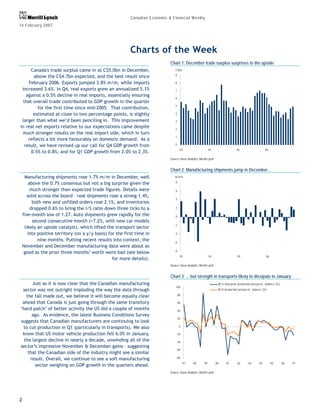
Canada's trade surplus came in at C$5.0bn in December,
above the C$4.7bn expected, and the best result since
February 2006. Exports jumped 3.8% m/m, while imports
increased 3.6%. In Q4, real exports grew an annualized 5.1%
against a 0.5% decline in real imports, essentially ensuring
that overall trade contributed to GDP growth in the quarter
for the first time since mid-2005. That contribution,
estimated at close to two percentage points, is slightly
larger than what we’d been penciling in. This improvement
in real net exports relative to our expectations came despite
much stronger results on the real import side, which in turn
reflects a bit more favourably on domestic demand. As a
result, we have revised up our call for Q4 GDP growth from
0.5% to 0.8%, and for Q1 GDP growth from 2.0% to 2.3%.
Chart 1: December trade surplus surprises to the upside
0
1
2
3
4
5
6
7
8
9
03 04 05 06
C$bn
Source: Haver Analytics, Merrill Lynch
Manufacturing shipments rose 1.7% m/m in December, well
above the 0.7% consensus but not a big surprise given the
much stronger than expected trade figures. Details were
solid across the board – real shipments rose a strong 1.4%,
both new and unfilled orders rose 2.1%, and inventories
dropped 0.6% to bring the I/S ratio down three ticks to a
five-month low of 1.27. Auto shipments grew rapidly for the
second consecutive month (+7.2%, with new car models
likely an upside catalyst), which lifted the transport sector
into positive territory (on a y/y basis) for the first time in
nine months. Putting recent results into context, the
November and December manufacturing data were about as
good as the prior three months’ worth were bad (see below
for more details).
Chart 2: Manufacturing shipments jump in December...
-8
-6
-4
-2
0
2
4
6
8
03 04 05 06
m/m%
Source: Haver Analytics, Merrill Lynch
Just as it is now clear that the Canadian manufacturing
sector was not outright imploding the way the data through
the fall made out, we believe it will become equally clear
ahead that Canada is just going through the same transitory
‘hard patch’ of better activity the US did a couple of months
ago. As evidence, the latest Business Conditions Survey
suggests that Canadian manufacturers are continuing to look
to cut production in Q1 (particularly in transports). We also
know that US motor vehicle production fell 6.0% in January,
the largest decline in nearly a decade, unwinding all of the
sector’s impressive November & December gains – suggesting
that the Canadian side of the industry might see a similar
result. Overall, we continue to see a soft manufacturing
sector weighing on GDP growth in the quarters ahead.
Chart 3: ... but strength in transports likely to dissipate in January
-80
-60
-40
-20
0
20
40
60
80
100
97 98 99 00 01 02 03 04 05 06 07
BCS transports production prospects, balance (%)
BCS production prospects, balance (%)
Source: Haver Analytics, Merrill Lynch
Canadian Economic & Financial Weekly
16 February 2007
3
Week Ahead Preview
The risk on next week’s numbers looks largely to the upside, as Canada looks to
be hitting its own ‘hard patch’ of data to match better recent US results.
The most important report will, in our view, be Tuesday’s CPI for January. The
core CPIX inflation rate fell unexpectedly in each of the past two months, coming
back down to the BoC’s 2.0% target earlier than anticipated. The fall in inflation
was driven largely by softer auto and clothing prices, refuting the notion that
minor recent weakness in the CAD would have an immediate inflationary impact.
Those areas are likely to stabilize in January, but other components can be
expected take over the disinflationary initiative. Specifically, we know that new
house prices (the ‘house’ part of the NHPI) fell last month for the first time in more
than eight years, a result which will slot directly into the January CPI, cooling what
had been the fastest area of services price inflation. As well, measured travel
tour prices commonly fall 8% to 14% this month; we imagine the decline may be
even larger this year, as warm weather in Central Canada surely mitigated
vacation demand. Offsetting these disinflationary influences should be minor
service price increases (particularly those that mark up on January 1), and
unfavourable base effects (CPIX was flat last January). Pulling it all together, we
expect a modest tick up in the CPIX rate to 2.1% y/y, in line with the consensus,
but with the balance of risks tilted modestly to the downside.
On the headline CPI rate, we expect an unchanged monthly result leading the y/y
rate to fall from 1.6% to 1.1%, largely due to the comparison between January’s
5% gas price decline and last January’s similar-sized increase.
The other top-tier release of the week will be Wednesday’s retail sales report for
December. The data have been awful of late. September sales were expected to
be bad, and they were (-1.1%/-0.8% headline/ex-autos). October sales were
expected to be much better, and they weren’t (-0.8%/-0.8%). November sales
were expected to make up for both, and they didn’t for either (+0.2%/+0.1%).
Fourth time’s the charm? The 5.6% jump in auto sales says yes, retail warnings
of very slow-moving winter items say no. We expect a strong holiday result, but
note that an increase even beyond our above-consensus +1.2% estimate would
be necessary just to get the level of sales back up to the cyclical peak (August).
Regardless of the outcome, this number should do little to change the fact that
real consumer spending barely rose in Q4 after four straight 3.5%+ quarters.
The other link in the distributive chain – wholesale trade – has shown a similarly
poor recent sales profile. And as with the retail sector (perhaps even more so), a
solid bounce looks likely in December. Autos are likely to be a particular sector of
strength – we’ve seen the bounces in exports, imports, shipments and the like,
but not yet in wholesales. Our call is for a 1.5% rise, double the consensus call.
As important as the sales result, however, will be the inventories data; the
wholesale I/S ratio rose for the fourth straight month in November to a 38-month
high of 1.29, contributing to our inventory correction concerns.
The leading indicator rounds out the list of activity-related figures this week, and
also looks likely to bounce, with most components improving for the January add-
up (particularly in manufacturing) after the prior month’s weakness. We expect a
0.5% m/m LI rise in January, from 0.3% in December, from 0.5% in November,
from 0.3% in October… that saw-toothed recent pattern usefully reflects the more
general uncertainty over the near-term path of growth in Canada.
Table 1: 2005/2006 BoC Fixed Action Dates
Date
Overnight
Target Rate Change
Tuesday, 24 January 2006 3.50% +25 bps
Tuesday, 7 March 2006 3.75% +25 bps
Tuesday, 25 April 2006 4.00% +25 bps
Wednesday, 24 May 2006 4.25% +25 bps
Tuesday, 11 July 2006 4.25% 0 bps
Wednesday, 6 September 2006 4.25% 0 bps
Tuesday, 17 October 2006 4.25% 0 bps
Tuesday, 5 December 2006 4.25% 0 bps
Tuesday, 16 January 2007 4.25% 0 bps
Tuesday, 6 March 2007
Tuesday, 24 April 2007
Tuesday, 29 May 2007
Tuesday, 10 July 2007
Wednesday, 5 September 2007
Tuesday, 16 October 2007
Tuesday, 4 December 2007
Source: Bank of Canada
Canadian Economic & Financial Weekly
16 February 2007
4
On their face, the November international securities transactions figures were
entirely at odds with our view of an adverse shift in Canadian capital flows.
StatsCan measured C$11.0bn of foreign net buying of Canadian securities in
November, while Canadian net purchases of foreign securities ebbed to C$5.3bn,
leaving Canada with a surplus on portfolio capital transactions after 17 months of
(generally rising) deficits. Heavy bond issuance by Canadian banks in non-CAD
currencies seemed to explain much of this, however (both the strength in inflows
and weakness in outflows); we don’t believe these data signal a shift in investor
attitudes towards Canadian vs foreign opportunities. Still, we will be comforted to
see these data revert to ‘trend’ in Monday’s release for December, expecting a
small inflow to contrast with a large outflow as per most of 2006.
Friday’s little-watched Quarterly Financial Statistics for Enterprises should show a
marked deceleration in Canadian corporate operating profits in Q4, based on
both slower volume growth and narrower margins (the latter driven by lower
commodity prices). The 1.0% q/q profit growth we expect would still leave the y/y
growth rate to fall to 2.5%, lowest since Q2 2002. Where this number goes, the
TSX trailing 12-month EPS growth figure (currently at 23%) generally follows.
BoC Deputy Governor Kennedy will be speaking on “Adjusting to Economic
Change” at the Greater Saskatoon Chamber of Commerce Thursday afternoon.
With the BoC both confused at recently divergent data and content with the
current stance of policy, we expect to hear nothing new on the policy front.
Finally, we hope that the establishment survey of employment due out on Monday
the 26th
will clear up some of the outstanding puzzles in the Canadian labour
market data. The lagging establishment results have thus far generally been
consistent with the stronger headline employment results, with October and
November showing a combined 62K increase in payrolls (not far from the LFS’
76K). It will be important for December’s establishment figure to ratify the further
52K growth in employment shown in the LFS. The wage data in the
establishment survey have, like those in the household (LFS) survey, been
surprisingly soft given apparently strong job growth. Average weekly earnings
growth stood at 2.6% y/y in November, barely half January’s peak (4.9%), though
wage inflation has come off of September’s 1.9% trough.
Table 2: The Week Ahead
Economic Event Period ML Forecast Consensus Previous
Monday, Feb 19
International Securities Transactions Dec C$3.0bn C$3.4bn C$11.0bn
Wholesale Trade Dec 1.5% 0.8% 0.1%
Tuesday, Feb 20
CPI (7:00) Jan 0.0% 0.1% 0.2%
CPI y/y (7:00) Jan 1.1% 1.1% 1.6%
CPIX m/m – BoC definition (7:00) Jan 0.1% 0.1% -0.2%
CPIX y/y – BoC definition (7:00) Jan 2.1% 2.1% 2.0%
Leading Indicator Jan 0.5% 0.4% 0.3%
Wednesday, Feb 21
Retail Sales Dec 1.2% 1.0% 0.2%
Retail Sales Ex-Autos Dec 0.8% 0.6% 0.1%
Thursday, Feb 22
Operating Profits Q4 1.0% - 2.8%
Deputy Governor Sheryl Kennedy speaks (13:35)
Monday, Feb 26
Payroll Employment Dec 25K - 60K
Average Weekly Earnings y/y Dec 2.7% - 2.6%
Source: Bloomberg, Merrill Lynch. Events are 8:30ET unless otherwise noted.
Canadian Economic & Financial Weekly
16 February 2007
5
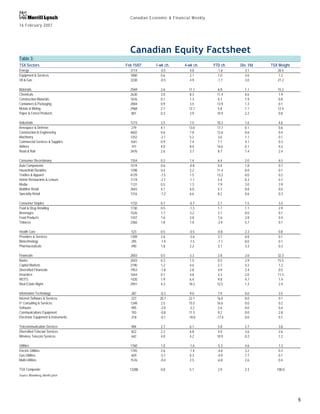
Canadian Equity Factsheet
Table 3:
TSX Sectors Feb 15/07 1-wk ch. 4-wk ch. YTD ch. Div. Yld TSX Weight
Energy 3114 -0.5 4.8 -1.6 3.1 28.4
Equipment & Services 1800 0.6 2.1 1.0 4.6 1.2
Oil & Gas 3238 -0.5 4.9 -1.7 3.0 27.2
Materials 2569 2.6 11.1 6.8 1.1 15.2
Chemicals 2630 3.0 8.3 11.4 0.6 1.9
Construction Materials 1876 0.1 1.3 0.1 1.9 0.0
Containers & Packaging 2004 0.9 3.5 13.9 1.3 0.1
Metals & Mining 2968 2.7 12.1 5.8 1.1 12.4
Paper & Forest Products 801 0.3 3.9 10.9 2.2 0.8
Industrials 1273 2.5 7.5 10.3 1.6 4.6
Aerospace & Defense 279 4.1 13.0 17.7 0.1 0.6
Construction & Engineering 4602 0.6 7.8 12.6 0.6 0.4
Machinery 1252 -2.1 5.2 3.6 1.1 0.1
Commercial Services & Supplies 1641 0.9 7.4 7.1 4.1 0.3
Airlines 741 4.0 8.0 14.6 0.1 0.2
Road & Rail 3476 2.6 3.7 8.7 1.4 2.4
Consumer Discretionary 1354 0.3 1.4 6.4 2.0 6.5
Auto Components 1519 0.6 -0.8 0.4 1.8 0.7
Household Durables 1298 0.4 2.2 11.4 0.0 0.1
Textiles & Apparel 4129 -1.5 1.5 13.2 0.0 0.2
Hotels Restaurants & Leisure 1174 -2.1 -1.1 5.4 0.3 0.7
Media 1131 0.5 1.3 7.9 3.0 3.9
Multiline Retail 2643 4.1 6.0 5.7 0.8 0.5
Specialty Retail 1316 -1.2 6.6 8.2 0.6 0.3
Consumer Staples 1732 0.7 -0.7 2.1 1.5 3.5
Food & Drug Retailing 1730 0.5 -1.5 1.7 1.1 2.9
Beverages 1526 1.7 3.2 3.1 0.0 0.1
Food Products 1437 1.6 3.8 7.6 2.8 0.4
Tobacco 2366 1.8 1.0 -3.4 5.7 0.1
Health Care 523 0.5 -0.5 -0.8 2.3 0.8
Providers & Services 1309 2.6 -3.6 3.7 6.8 0.1
Biotechnology 295 -1.9 -7.5 -7.7 0.0 0.1
Pharmaceuticals 490 1.8 2.2 3.1 3.3 0.3
Financials 2003 0.5 3.3 2.8 2.6 32.3
Banks 2043 0.3 1.5 0.5 2.9 15.5
Capital Markets 2190 1.2 4.6 2.7 4.2 1.2
Diversified Financials 1953 -1.8 2.8 4.9 2.4 0.5
Insurance 1644 0.1 4.8 4.3 2.0 11.3
REITS 1420 1.9 6.4 9.8 4.7 1.4
Real Estate Mgmt 2941 4.3 10.3 12.5 1.3 2.4
Information Technology 287 -0.3 9.0 7.9 0.0 3.5
Internet Software & Services 227 20.7 22.1 16.0 0.0 0.1
IT Consulting & Services 1348 2.5 15.5 16.6 0.0 0.2
Software 995 -2.0 -2.2 2.6 0.0 0.4
Communications Equipment 193 -0.8 11.5 9.2 0.0 2.8
Electronic Equipment & Instruments 218 -0.1 -19.0 -17.4 0.0 0.1
Telecommunication Services 904 2.7 6.1 5.8 2.7 3.8
Diversified Telecom Services 822 2.2 6.8 4.0 3.6 2.6
Wireless Telecom Services 642 4.0 4.2 10.9 0.2 1.2
Utilities 1760 1.0 -1.6 -5.3 4.6 1.3
Electric Utilities 1745 2.6 -1.4 -4.6 3.2 0.3
Gas Utilities 659 -5.1 0.3 -4.9 7.7 0.1
Multi-Utilities 1576 -0.4 2.5 -6.8 2.6 0.4
TSX Composite 13288 0.8 5.1 2.9 2.3 100.0
Source: Bloomberg, Merrill Lynch
Canadian Economic & Financial Weekly
16 February 2007
6
Canadian Fixed Income Factsheet
Chart 4: GoC Yield Curve
(%)
2.25
2.75
3.25
3.75
4.25
4.75
5.25
3-month 2-y r 5-y r 10-y r 30-y r
6-month forw ard
6-months ago
Current
Source: Datastream, Merrill Lynch
Chart 5: Breakeven Inflation Rate
30-year GoC yield minus RRB yield (%)
1.50
1.70
1.90
2.10
2.30
2.50
2.70
2.90
3.10
3.30
Jan/02 Jul/02 Jan/03 Jul/03 Jan/04 Jul/04 Jan/05 Jul/05 Jan/06 Jul/06 Jan/07
Source: Haver Analytics, Merrill Lynch
Chart 6: Canada/U.S. 2-Year Spread
(bp)
-150
-100
-50
0
50
100
150
200
250
Jan/02 Jul/02 Jan/03 Jul/03 Jan/04 Jul/04 Jan/05 Jul/05 Jan/06 Jul/06 Jan/07
Source: Haver Analytics, Merrill Lynch
Chart 7: Canada/U.S. 10-Year Spread
(bp)
-100
-50
0
50
100
150
Jan/02 Jul/02 Jan/03 Jul/03 Jan/04 Jul/04 Jan/05 Jul/05 Jan/06 Jul/06 Jan/07
Source: Haver Analytics, Merrill Lynch
Table 4: Canadian Broad Market Index Total Return by Sector
(% change: as of Feb 15, 2007)
Total Return
ML Ticker 1-month 3-month 6-month Year-to-date
Government Bonds Total G0C0 0.5 0.4 3.4 0.3
1-5 yrs GVC0 0.3 0.7 2.3 0.4
5-10 yrs G6C0 0.5 0.3 3.2 0.3
15+ yrs G8C0 0.6 0.0 4.9 0.2
Corporates Total F0C0 0.6 0.9 3.9 0.6
Provincials and Municipals Total G0CP 0.6 0.5 4.1 0.5
Real Return Bonds G0CI 0.3 -2.8 -1.6 -0.4
Source: Merrill Lynch
Canadian Economic & Financial Weekly
16 February 2007
7
Key Economic & Financial Forecasts
Table 5:
06Q1 06Q2 06Q3 06Q4 07Q1 07Q2 07Q3 07Q4 2005 2006 2007 2008
Economy (q/q% saar)
GDP 3.8 2.0 1.7 0.8 2.3 1.2 2.3 3.6 2.9 2.7 1.8 3.5
Consumption 4.8 3.8 4.2 1.2 3.0 2.9 3.2 3.4 3.9 4.1 3.0 3.3
Government 3.8 4.7 0.6 2.3 3.6 4.0 4.4 4.4 3.2 3.7 3.3 4.2
Housing Investment 14.2 -4.8 -8.2 3.0 -1.0 -2.0 -2.0 -2.0 3.2 2.5 -1.7 -2.0
Business Investment 8.1 5.4 7.0 5.3 6.7 6.0 6.3 7.3 9.4 8.6 6.4 7.4
Exports -3.8 -1.7 3.6 5.0 4.0 0.0 3.0 3.5 2.1 1.5 2.8 4.0
Imports -2.0 8.6 4.1 0.0 5.0 3.0 4.0 6.0 7.1 5.0 3.7 6.2
Inventory (C$bn) 11.5 18.6 15.3 5.5 3.0 0.0 -3.0 -1.0 15.5 12.6 -0.3 5.5
Nominal GDP 3.7 1.6 2.3 0.2 2.3 2.3 3.4 4.9 6.2 4.7 2.2 4.7
Trade (C$bn)
Merchandise Trade Balance 66.5 51.6 49.0 51.9 44.4 40.7 39.0 36.5 64.9 54.7 40.1 30.4
Current Account Balance 42.0 18.7 20.3 23.7 16.7 13.5 12.3 10.4 32.0 26.2 13.2 5.5
(% of GDP) 2.9 1.3 1.4 1.6 1.2 0.9 0.8 0.7 2.3 1.8 0.9 0.4
Inflation (yr/yr% change)
Consumer Price Index 2.4 2.6 1.7 1.3 1.6 1.0 1.4 1.9 2.2 2.0 1.5 1.8
CPI-X** 1.7 1.8 2.1 2.2 2.2 2.1 1.8 1.7 1.6 1.9 2.0 1.7
GDP Deflator 3.7 3.0 1.4 -0.1 -0.1 0.3 0.4 0.9 3.2 2.0 0.4 1.2
Financial (End of period, %)
Overnight Rate 3.75 4.25 4.25 4.25 4.25 4.25 3.75 3.75 3.25 4.25 3.75 4.50
3-mth 3.86 4.30 4.16 4.15 4.25 4.25 3.75 3.75 3.39 4.15 3.75 4.50
2-yr 3.99 4.40 3.91 4.02 3.90 3.75 3.60 3.80 3.85 4.02 3.80 4.60
5-yr 4.15 4.47 3.90 3.99 3.90 3.75 3.75 4.10 3.92 3.99 4.10 4.70
10-yr 4.26 4.58 4.00 4.08 4.00 3.95 4.05 4.20 3.98 4.08 4.20 4.80
30-yr 4.26 4.61 4.09 4.14 4.10 4.05 4.20 4.35 4.05 4.14 4.35 4.90
TSX Composite 11,272 12,908 12,300 13,200
TSX Calendar Oper. Earnings 603 750 705 790
% change 13.3 24.4 -6.0 12.1
C$/US$* 1.17 1.12 1.12 1.17 1.15 1.17 1.20 1.18 1.16 1.17 1.18 1.12
Other Indicators
Employment (q/q ann. % ch.) 1.6 3.1 0.4 2.2 1.3 0.2 1.3 2.4 1.4 1.9 1.2 2.0
Unemployment Rate (%) 6.4 6.2 6.4 6.2 6.5 6.8 6.9 6.8 6.8 6.3 6.8 6.6
Housing Starts (000s) 247.6 229.1 219.6 222.0 220.0 215.0 210.0 205.0 224.3 228.4 212.5 192.5
Source: Merrill Lynch
*ML FX Strategy team, **excludes indirect taxes
Shaded regions represent ML forecasts
Canadian Economic & Financial Weekly
16 February 2007
8
Canadian Economic & Financial Data
Table 6
Jan-07 Dec-06 Nov-06 Oct-06 Sep-06 Aug-06 Jul-06
Financial Indicators
Yields (mth-end, %)
Call Loan Rate 4.25 4.25 4.25 4.25 4.25 4.25 4.25
3-mth T-bill 4.17 4.15 4.17 4.17 4.16 4.11 4.15
2-yr 4.10 4.02 3.87 3.97 3.91 3.99 4.12
5-yr 4.08 3.99 3.81 3.94 3.90 4.01 4.18
10-yr 4.17 4.08 3.90 4.02 4.01 4.11 4.34
30-yr 4.22 4.14 3.99 4.08 4.09 4.19 4.37
Canada/U.S Spreads (month-end, bps)
3-mth -84 -72 -71 -78 -60 -81 -80
2-yr -84 -80 -75 -74 -79 -80 -86
10-yr -66 -63 -56 -58 -63 -62 -65
30-yr -71 -68 -57 -64 -68 -69 -70
Gov't of Canada Securities Outstandings ($ blns)
Treasury Bills 119.0 124.7 127.9 119.7 121.0 117.8 120.5
Bonds 119.0 228.9 237.5 233.2 232.8 234.4 233.7
Canada Savings Bonds 119.0 15.6 15.7 17.0 17.0 17.1 17.1
Other Financial Indicators (month-end)
C$/US$ 1.177 1.165 1.141 1.123 1.118 1.104 1.132
TSE 300 13034 12908 12752 12345 11761 12074 11831
Bank of Canada Commodity Index (mth-avg) 186.7 195.1 195.3 186.1 185.4 204.2 200.9
Economic Indicators
Employment (m/m ch., 000s) 88.9 52.5 23.5 51.5 21.4 -6.3 -3.0
% change, year-ago 2.4 2.1 1.7 1.8 1.9 1.7 2.0
Unemployment Rate (%) 6.2 6.1 6.2 6.1 6.4 6.4 6.4
Retail Sales (m/m % ch.) na na 0.2 -0.8 -1.1 0.7 1.6
% change, year-ago na na 4.7 5.6 7.1 6.9 5.8
Mfg Shipments (m/m % ch.) na 1.7 2.4 -0.2 -3.1 -1.0 0.9
% change, year-ago na -0.8 -1.0 -5.3 -4.0 -0.9 2.8
New Orders (m/m % ch.) na 2.1 3.4 0.2 -2.6 -1.9 1.0
% change, year-ago na 1.6 -0.5 -5.9 -3.7 -3.1 2.0
Mfg Inventory-to-Shipment Ratio na 1.27 1.30 1.33 1.32 1.28 1.26
Merch. Trade Balance ($ blns) na 5.0 4.7 3.3 4.2 3.9 3.6
Housing Starts (000s) 248.5 212.6 229.1 224.9 207.9 214.7 236.0
% change, year-ago 0.7 -9.4 0.7 6.1 -11.4 2.3 -3.2
Real GDP at Basic Prices (m/m % ch.) na na 0.2 0.0 -0.4 0.3 0.2
% change, year-ago na na 1.6 1.7 1.9 2.3 2.5
Hours Worked (m/m % ch.) 0.2 -1.2 1.4 0.3 0.2 -0.3 0.1
% change, year-ago 1.1 1.5 3.0 1.6 1.7 1.0 1.8
Inflation Indicators (y/y % ch.)
Consumer Price Index na 1.6 1.4 0.9 0.7 2.1 2.4
Ex. Food & Energy na 1.5 1.5 1.8 1.6 1.4 1.4
Ex. Eight Most Volatile Components (BoC definition) na 2.0 2.2 2.3 2.2 2.0 2.0
Industrial Price Index na 3.6 2.0 1.2 1.4 3.6 4.6
Ex. Energy na 4.0 2.7 3.0 3.0 2.7 2.8
Raw Material Price Index na 11.7 4.7 2.2 4.0 9.6 19.1
Average hourly earnings for permanent workers 2.0 2.3 2.8 3.1 3.4 4.0 4.0
Monetary and Credit Aggregates (y/y % ch.)
M1++ na 8.9 8.6 7.7 7.9 8.2 7.6
M2 na 9.3 9.0 8.7 7.5 8.0 8.0
M3 na 10.2 9.4 8.7 7.5 7.0 6.7
Business Credit na 5.6 5.5 4.8 5.4 5.8 5.8
Consumer Credit na 7.7 7.9 8.2 8.4 8.0 8.3
Source: Datastream, Haver Analytics, Merrill Lynch
Canadian Economic & Financial Weekly
16 February 2007
9
Important Disclosures
Due to the nature of strategic analysis, the issuers or securities recommended or discussed in this report are not continuously followed. Accordingly, investors
must regard this report as providing stand-alone analysis and should not expect continuing analysis or additional reports relating to such issuers and/or securities.
The analyst(s) responsible for covering the securities in this report receive compensation based upon, among other factors, the overall profitability of Merrill
Lynch, including profits derived from investment banking revenues.
Other Important Disclosures
Information relating to Non-U.S. affiliates of Merrill Lynch, Pierce, Fenner & Smith Incorporated (MLPF&S):
MLPF&S distributes research reports of the following non-US affiliates in the US (short name: legal name): Merrill Lynch (France): Merrill Lynch Capital Markets
(France) SAS; Merrill Lynch (Frankfurt): Merrill Lynch International Bank Ltd, Frankfurt Branch; Merrill Lynch (South Africa): Merrill Lynch South Africa (Pty) Ltd;
Merrill Lynch (Milan): Merrill Lynch International Bank Limited; MLPF&S (UK): Merrill Lynch, Pierce, Fenner & Smith Limited; Merrill Lynch (Australia): Merrill Lynch
Equities (Australia) Limited; Merrill Lynch (Hong Kong): Merrill Lynch (Asia Pacific) Limited; Merrill Lynch (Singapore): Merrill Lynch (Singapore) Pte Ltd; Merrill
Lynch (Canada): Merrill Lynch Canada Inc; Merrill Lynch (Mexico): Merrill Lynch Mexico, SA de CV, Casa de Bolsa; Merrill Lynch (Argentina): Merrill Lynch
Argentina SA; Merrill Lynch (Japan): Merrill Lynch Japan Securities Co, Ltd; Merrill Lynch (Seoul): Merrill Lynch International Incorporated (Seoul Branch); Merrill
Lynch (Taiwan): Merrill Lynch Global (Taiwan) Limited; DSP Merrill Lynch (India): DSP Merrill Lynch Limited; PT Merrill Lynch (Indonesia): PT Merrill Lynch
Indonesia; Merrill Lynch (KL) Sdn. Bhd.: Merrill Lynch (Malaysia); Merrill Lynch (Israel): Merrill Lynch Israel Limited; Merrill Lynch (Russia): Merrill Lynch CIS Limited,
Moscow.
This research report has been prepared and issued by MLPF&S and/or one or more of its non-U.S. affiliates. MLPF&S is the distributor of this research report in
the U.S. and accepts full responsibility for research reports of its non-U.S. affiliates distributed in the U.S. Any U.S. person receiving this research report and wishing
to effect any transaction in any security discussed in the report should do so through MLPF&S and not such foreign affiliates.
This research report has been approved for publication in the United Kingdom by Merrill Lynch, Pierce, Fenner & Smith Limited, which is authorized and
regulated by the Financial Services Authority; has been considered and distributed in Japan by Merrill Lynch Japan Securities Co, Ltd, a registered securities dealer
under the Securities and Exchange Law in Japan; is distributed in Hong Kong by Merrill Lynch (Asia Pacific) Limited, which is regulated by the Hong Kong SFC; is
issued and distributed in Taiwan by Merrill Lynch Global (Taiwan) Ltd or Merrill Lynch, Pierce, Fenner & Smith Limited (Taiwan Branch); is issued and distributed in
Malaysia by Merrill Lynch (KL) Sdn. Bhd., a licensed investment adviser regulated by the Malaysian Securities Commission; and is issued and distributed in
Singapore by Merrill Lynch International Bank Limited (Merchant Bank) and Merrill Lynch (Singapore) Pte Ltd (Company Registration No.’s F 06872E and
198602883D respectively). Merrill Lynch International Bank Limited (Merchant Bank) and Merrill Lynch (Singapore) Pte Ltd. are regulated by the Monetary Authority
of Singapore. Merrill Lynch Equities (Australia) Limited, (ABN 65 006 276 795), AFS License 235132, provides this report in Australia. No approval is required for
publication or distribution of this report in Brazil.
Merrill Lynch (Frankfurt) is regulated by BaFin.
Copyright, User Agreement and other general information related to this report:
Copyright 2007 Merrill Lynch, Pierce, Fenner & Smith Incorporated. All rights reserved. This research report is prepared for the use of Merrill Lynch clients and
may not be redistributed, retransmitted or disclosed, in whole or in part, or in any form or manner, without the express written consent of Merrill Lynch. Merrill Lynch
research reports are distributed simultaneously to internal and client websites eligible to receive such research prior to any public dissemination by Merrill Lynch of
the research report or information or opinion contained therein. Any unauthorized use or disclosure is prohibited. Receipt and review of this research report
constitutes your agreement not to redistribute, retransmit, or disclose to others the contents, opinions, conclusion, or information contained in this report (including
any investment recommendations, estimates or price targets) prior to Merrill Lynch's public disclosure of such information. The information herein (other than
disclosure information relating to Merrill Lynch and its affiliates) was obtained from various sources and we do not guarantee its accuracy. Merrill Lynch makes no
representations or warranties whatsoever as to the data and information provided in any third party referenced website and shall have no liability or responsibility
arising out of or in connection with any such referenced website.
This research report provides general information only. Neither the information nor any opinion expressed constitutes an offer or an invitation to make an offer,
to buy or sell any securities or other investment or any options, futures or derivatives related to such securities or investments. It is not intended to provide personal
investment advice and it does not take into account the specific investment objectives, financial situation and the particular needs of any specific person who may
receive this report. Investors should seek financial advice regarding the appropriateness of investing in any securities, other investment or investment strategies
discussed or recommended in this report and should understand that statements regarding future prospects may not be realized. Investors should note that income
from such securities or other investments, if any, may fluctuate and that price or value of such securities and investments may rise or fall. Accordingly, investors may
receive back less than originally invested. Past performance is not necessarily a guide to future performance. Any information relating to the tax status of financial
instruments discussed herein is not intended to provide tax advice or to be used by anyone to provide tax advice. Investors are urged to seek tax advice based on
their particular circumstances from an independent tax professional.
Foreign currency rates of exchange may adversely affect the value, price or income of any security or related investment mentioned in this report. In addition,
investors in securities such as ADRs, whose values are influenced by the currency of the underlying security, effectively assume currency risk.
Merrill Lynch Research policies relating to conflicts of interest are described at http://www.ml.com/media/43347.pdf.

Equity Strategy - Consumer Staples

  • 1.
    Merrill Lynch doesand seeks to do business with companies covered in its research reports. As a result, investors should be aware that the firm may have a conflict of interest that could affect the objectivity of this report. Investors should consider this report as only a single factor in making their investment decision. Refer to important disclosures on page 9. 10588124 Canadian Economic & Financial Weekly No longer a staple of our strategy Downgrading consumer staples to neutral We have maintained an overweight in the consumer staples sector of the TSX for several quarters now, attracted to its defensive characteristics and its leverage to a healthy-looking Canadian consumer. We’re not sure either of those attractions applies any longer, and with this publication we downgrade the sector to neutral. Earnings and valuations the staples of our concern We initially preferred the consumer staples space because of its solid cash flow, robust balance sheet, low beta and steady earnings stream, qualities which fit our defense-oriented investment strategy. However, some of those characteristics have lost their lustre in recent months; for instance, forward earnings estimates have broadly declined and the sector’s beta has risen. Furthermore, valuation metrics for the sector seem a bit frothy. On a forward P/E basis, the sector currently trades at an 18.2x multiple versus the 14.9x commanded by the TSX. This spread itself isn’t surprising, as the sector has historically traded at a slight premium to the broad market (after all, investors have traditionally paid up for stable earnings growth). But what is concerning, in our view, is that the sector’s premium to the TSX has widened to a 15-month high despite declining earnings estimates and an increasingly gloomier sector profile. In our view, weaker fundamentals combined with rising competition from the US (most notably Wal-Mart) suggest that the sector should no longer command the premium it historically has. On balance, our fundamental research team concurs with this assessment, as they have buy ratings on only two out of the eight staples companies they cover. They remain bullish on Shoppers Drug Mart (YSC, B-1-7, $52.92) and Couche Tard (YATDB, C-1-7, $25.30). Canadian consumer spending decelerating The second reason why we were originally attracted to the staples sector was its leverage to the Canadian consumer. Since 2005, consumer spending growth has remained robust, averaging about 4.0% over the last seven quarters. However, that strength has essentially disappeared of late as evidenced in the retail sales data. Using our 0.8% point estimate for December retail sales (ex-autos), our tracking suggests that Q4 ex-autos sales (a cleaner metric for the staples sector) contracted 3.7% q/q saar, the steepest decline on record and the first negative print in 21 quarters. Moreover, with average hourly earnings of permanent employees (the BoC’s preferred wage inflation measure) at a 42-month low of 2.0% y/y, consumers don’t seem to be getting pay raises to boost spending either (though this does help partially explain some of the recent weakness in spending). Putting it all together, these results imply that retailers can expect a more sluggish consumer spending environment ahead, and we indeed anticipate a more lethargic performance from the staples sector. Note to readers: Due to travel schedules, the next edition of the Canadian Economic & Financial Weekly will be published Monday, February 26. Data through that date are discussed in this edition’s Week Ahead section. We apologize for any inconvenience this may cause. Investment Strategy Economics | Canada 16 February 2007 David D. Wolf +1 416 369 8764 Economist & Strategist Merrill Lynch (Canada) d_wolf@ml.com Kevin Cheng +1 416 369-8741 Economist & Strategist Merrill Lynch (Canada) kevin_cheng@ml.com Highlights: On balance, we see upside risk to next week’s key data. On the two top-tier data reports, we see headline CPI increasing 1.1% y/y and CPIX rising 2.1% y/y, in line with the consensus. Meanwhile, we see retail sales and ex-auto sales increasing 1.2%/0.8%, respectively. Additionally, we expect the international securities transaction data to show a small inflow of C$3.0bn (vs C$3.4bn consensus). Upside surprises were seen in this week’s international trade and manufacturing data. The December trade surplus was better than expected at C$5.0bn (vs consensus of C$4.7bn), while manufacturing shipments rose 1.7%, doubling the 0.7% gain expected by consensus (please see Charts of the Week). Another strong week for the TSX as it rose 0.8% to a new record of 13,288. Telecom services (+2.7%), materials (+2.6%) and industrials (+2.5%) all showed strong performances, while info tech (-0.3%) and energy (-0.5%) were the only sectors in the red.
  • 2.
    Canadian Economic &Financial Weekly 16 February 2007 2 Charts of the Week Canada's trade surplus came in at C$5.0bn in December, above the C$4.7bn expected, and the best result since February 2006. Exports jumped 3.8% m/m, while imports increased 3.6%. In Q4, real exports grew an annualized 5.1% against a 0.5% decline in real imports, essentially ensuring that overall trade contributed to GDP growth in the quarter for the first time since mid-2005. That contribution, estimated at close to two percentage points, is slightly larger than what we’d been penciling in. This improvement in real net exports relative to our expectations came despite much stronger results on the real import side, which in turn reflects a bit more favourably on domestic demand. As a result, we have revised up our call for Q4 GDP growth from 0.5% to 0.8%, and for Q1 GDP growth from 2.0% to 2.3%. Chart 1: December trade surplus surprises to the upside 0 1 2 3 4 5 6 7 8 9 03 04 05 06 C$bn Source: Haver Analytics, Merrill Lynch Manufacturing shipments rose 1.7% m/m in December, well above the 0.7% consensus but not a big surprise given the much stronger than expected trade figures. Details were solid across the board – real shipments rose a strong 1.4%, both new and unfilled orders rose 2.1%, and inventories dropped 0.6% to bring the I/S ratio down three ticks to a five-month low of 1.27. Auto shipments grew rapidly for the second consecutive month (+7.2%, with new car models likely an upside catalyst), which lifted the transport sector into positive territory (on a y/y basis) for the first time in nine months. Putting recent results into context, the November and December manufacturing data were about as good as the prior three months’ worth were bad (see below for more details). Chart 2: Manufacturing shipments jump in December... -8 -6 -4 -2 0 2 4 6 8 03 04 05 06 m/m% Source: Haver Analytics, Merrill Lynch Just as it is now clear that the Canadian manufacturing sector was not outright imploding the way the data through the fall made out, we believe it will become equally clear ahead that Canada is just going through the same transitory ‘hard patch’ of better activity the US did a couple of months ago. As evidence, the latest Business Conditions Survey suggests that Canadian manufacturers are continuing to look to cut production in Q1 (particularly in transports). We also know that US motor vehicle production fell 6.0% in January, the largest decline in nearly a decade, unwinding all of the sector’s impressive November & December gains – suggesting that the Canadian side of the industry might see a similar result. Overall, we continue to see a soft manufacturing sector weighing on GDP growth in the quarters ahead. Chart 3: ... but strength in transports likely to dissipate in January -80 -60 -40 -20 0 20 40 60 80 100 97 98 99 00 01 02 03 04 05 06 07 BCS transports production prospects, balance (%) BCS production prospects, balance (%) Source: Haver Analytics, Merrill Lynch
  • 3.
    Canadian Economic &Financial Weekly 16 February 2007 3 Week Ahead Preview The risk on next week’s numbers looks largely to the upside, as Canada looks to be hitting its own ‘hard patch’ of data to match better recent US results. The most important report will, in our view, be Tuesday’s CPI for January. The core CPIX inflation rate fell unexpectedly in each of the past two months, coming back down to the BoC’s 2.0% target earlier than anticipated. The fall in inflation was driven largely by softer auto and clothing prices, refuting the notion that minor recent weakness in the CAD would have an immediate inflationary impact. Those areas are likely to stabilize in January, but other components can be expected take over the disinflationary initiative. Specifically, we know that new house prices (the ‘house’ part of the NHPI) fell last month for the first time in more than eight years, a result which will slot directly into the January CPI, cooling what had been the fastest area of services price inflation. As well, measured travel tour prices commonly fall 8% to 14% this month; we imagine the decline may be even larger this year, as warm weather in Central Canada surely mitigated vacation demand. Offsetting these disinflationary influences should be minor service price increases (particularly those that mark up on January 1), and unfavourable base effects (CPIX was flat last January). Pulling it all together, we expect a modest tick up in the CPIX rate to 2.1% y/y, in line with the consensus, but with the balance of risks tilted modestly to the downside. On the headline CPI rate, we expect an unchanged monthly result leading the y/y rate to fall from 1.6% to 1.1%, largely due to the comparison between January’s 5% gas price decline and last January’s similar-sized increase. The other top-tier release of the week will be Wednesday’s retail sales report for December. The data have been awful of late. September sales were expected to be bad, and they were (-1.1%/-0.8% headline/ex-autos). October sales were expected to be much better, and they weren’t (-0.8%/-0.8%). November sales were expected to make up for both, and they didn’t for either (+0.2%/+0.1%). Fourth time’s the charm? The 5.6% jump in auto sales says yes, retail warnings of very slow-moving winter items say no. We expect a strong holiday result, but note that an increase even beyond our above-consensus +1.2% estimate would be necessary just to get the level of sales back up to the cyclical peak (August). Regardless of the outcome, this number should do little to change the fact that real consumer spending barely rose in Q4 after four straight 3.5%+ quarters. The other link in the distributive chain – wholesale trade – has shown a similarly poor recent sales profile. And as with the retail sector (perhaps even more so), a solid bounce looks likely in December. Autos are likely to be a particular sector of strength – we’ve seen the bounces in exports, imports, shipments and the like, but not yet in wholesales. Our call is for a 1.5% rise, double the consensus call. As important as the sales result, however, will be the inventories data; the wholesale I/S ratio rose for the fourth straight month in November to a 38-month high of 1.29, contributing to our inventory correction concerns. The leading indicator rounds out the list of activity-related figures this week, and also looks likely to bounce, with most components improving for the January add- up (particularly in manufacturing) after the prior month’s weakness. We expect a 0.5% m/m LI rise in January, from 0.3% in December, from 0.5% in November, from 0.3% in October… that saw-toothed recent pattern usefully reflects the more general uncertainty over the near-term path of growth in Canada. Table 1: 2005/2006 BoC Fixed Action Dates Date Overnight Target Rate Change Tuesday, 24 January 2006 3.50% +25 bps Tuesday, 7 March 2006 3.75% +25 bps Tuesday, 25 April 2006 4.00% +25 bps Wednesday, 24 May 2006 4.25% +25 bps Tuesday, 11 July 2006 4.25% 0 bps Wednesday, 6 September 2006 4.25% 0 bps Tuesday, 17 October 2006 4.25% 0 bps Tuesday, 5 December 2006 4.25% 0 bps Tuesday, 16 January 2007 4.25% 0 bps Tuesday, 6 March 2007 Tuesday, 24 April 2007 Tuesday, 29 May 2007 Tuesday, 10 July 2007 Wednesday, 5 September 2007 Tuesday, 16 October 2007 Tuesday, 4 December 2007 Source: Bank of Canada
  • 4.
    Canadian Economic &Financial Weekly 16 February 2007 4 On their face, the November international securities transactions figures were entirely at odds with our view of an adverse shift in Canadian capital flows. StatsCan measured C$11.0bn of foreign net buying of Canadian securities in November, while Canadian net purchases of foreign securities ebbed to C$5.3bn, leaving Canada with a surplus on portfolio capital transactions after 17 months of (generally rising) deficits. Heavy bond issuance by Canadian banks in non-CAD currencies seemed to explain much of this, however (both the strength in inflows and weakness in outflows); we don’t believe these data signal a shift in investor attitudes towards Canadian vs foreign opportunities. Still, we will be comforted to see these data revert to ‘trend’ in Monday’s release for December, expecting a small inflow to contrast with a large outflow as per most of 2006. Friday’s little-watched Quarterly Financial Statistics for Enterprises should show a marked deceleration in Canadian corporate operating profits in Q4, based on both slower volume growth and narrower margins (the latter driven by lower commodity prices). The 1.0% q/q profit growth we expect would still leave the y/y growth rate to fall to 2.5%, lowest since Q2 2002. Where this number goes, the TSX trailing 12-month EPS growth figure (currently at 23%) generally follows. BoC Deputy Governor Kennedy will be speaking on “Adjusting to Economic Change” at the Greater Saskatoon Chamber of Commerce Thursday afternoon. With the BoC both confused at recently divergent data and content with the current stance of policy, we expect to hear nothing new on the policy front. Finally, we hope that the establishment survey of employment due out on Monday the 26th will clear up some of the outstanding puzzles in the Canadian labour market data. The lagging establishment results have thus far generally been consistent with the stronger headline employment results, with October and November showing a combined 62K increase in payrolls (not far from the LFS’ 76K). It will be important for December’s establishment figure to ratify the further 52K growth in employment shown in the LFS. The wage data in the establishment survey have, like those in the household (LFS) survey, been surprisingly soft given apparently strong job growth. Average weekly earnings growth stood at 2.6% y/y in November, barely half January’s peak (4.9%), though wage inflation has come off of September’s 1.9% trough. Table 2: The Week Ahead Economic Event Period ML Forecast Consensus Previous Monday, Feb 19 International Securities Transactions Dec C$3.0bn C$3.4bn C$11.0bn Wholesale Trade Dec 1.5% 0.8% 0.1% Tuesday, Feb 20 CPI (7:00) Jan 0.0% 0.1% 0.2% CPI y/y (7:00) Jan 1.1% 1.1% 1.6% CPIX m/m – BoC definition (7:00) Jan 0.1% 0.1% -0.2% CPIX y/y – BoC definition (7:00) Jan 2.1% 2.1% 2.0% Leading Indicator Jan 0.5% 0.4% 0.3% Wednesday, Feb 21 Retail Sales Dec 1.2% 1.0% 0.2% Retail Sales Ex-Autos Dec 0.8% 0.6% 0.1% Thursday, Feb 22 Operating Profits Q4 1.0% - 2.8% Deputy Governor Sheryl Kennedy speaks (13:35) Monday, Feb 26 Payroll Employment Dec 25K - 60K Average Weekly Earnings y/y Dec 2.7% - 2.6% Source: Bloomberg, Merrill Lynch. Events are 8:30ET unless otherwise noted.
  • 5.
    Canadian Economic &Financial Weekly 16 February 2007 5 Canadian Equity Factsheet Table 3: TSX Sectors Feb 15/07 1-wk ch. 4-wk ch. YTD ch. Div. Yld TSX Weight Energy 3114 -0.5 4.8 -1.6 3.1 28.4 Equipment & Services 1800 0.6 2.1 1.0 4.6 1.2 Oil & Gas 3238 -0.5 4.9 -1.7 3.0 27.2 Materials 2569 2.6 11.1 6.8 1.1 15.2 Chemicals 2630 3.0 8.3 11.4 0.6 1.9 Construction Materials 1876 0.1 1.3 0.1 1.9 0.0 Containers & Packaging 2004 0.9 3.5 13.9 1.3 0.1 Metals & Mining 2968 2.7 12.1 5.8 1.1 12.4 Paper & Forest Products 801 0.3 3.9 10.9 2.2 0.8 Industrials 1273 2.5 7.5 10.3 1.6 4.6 Aerospace & Defense 279 4.1 13.0 17.7 0.1 0.6 Construction & Engineering 4602 0.6 7.8 12.6 0.6 0.4 Machinery 1252 -2.1 5.2 3.6 1.1 0.1 Commercial Services & Supplies 1641 0.9 7.4 7.1 4.1 0.3 Airlines 741 4.0 8.0 14.6 0.1 0.2 Road & Rail 3476 2.6 3.7 8.7 1.4 2.4 Consumer Discretionary 1354 0.3 1.4 6.4 2.0 6.5 Auto Components 1519 0.6 -0.8 0.4 1.8 0.7 Household Durables 1298 0.4 2.2 11.4 0.0 0.1 Textiles & Apparel 4129 -1.5 1.5 13.2 0.0 0.2 Hotels Restaurants & Leisure 1174 -2.1 -1.1 5.4 0.3 0.7 Media 1131 0.5 1.3 7.9 3.0 3.9 Multiline Retail 2643 4.1 6.0 5.7 0.8 0.5 Specialty Retail 1316 -1.2 6.6 8.2 0.6 0.3 Consumer Staples 1732 0.7 -0.7 2.1 1.5 3.5 Food & Drug Retailing 1730 0.5 -1.5 1.7 1.1 2.9 Beverages 1526 1.7 3.2 3.1 0.0 0.1 Food Products 1437 1.6 3.8 7.6 2.8 0.4 Tobacco 2366 1.8 1.0 -3.4 5.7 0.1 Health Care 523 0.5 -0.5 -0.8 2.3 0.8 Providers & Services 1309 2.6 -3.6 3.7 6.8 0.1 Biotechnology 295 -1.9 -7.5 -7.7 0.0 0.1 Pharmaceuticals 490 1.8 2.2 3.1 3.3 0.3 Financials 2003 0.5 3.3 2.8 2.6 32.3 Banks 2043 0.3 1.5 0.5 2.9 15.5 Capital Markets 2190 1.2 4.6 2.7 4.2 1.2 Diversified Financials 1953 -1.8 2.8 4.9 2.4 0.5 Insurance 1644 0.1 4.8 4.3 2.0 11.3 REITS 1420 1.9 6.4 9.8 4.7 1.4 Real Estate Mgmt 2941 4.3 10.3 12.5 1.3 2.4 Information Technology 287 -0.3 9.0 7.9 0.0 3.5 Internet Software & Services 227 20.7 22.1 16.0 0.0 0.1 IT Consulting & Services 1348 2.5 15.5 16.6 0.0 0.2 Software 995 -2.0 -2.2 2.6 0.0 0.4 Communications Equipment 193 -0.8 11.5 9.2 0.0 2.8 Electronic Equipment & Instruments 218 -0.1 -19.0 -17.4 0.0 0.1 Telecommunication Services 904 2.7 6.1 5.8 2.7 3.8 Diversified Telecom Services 822 2.2 6.8 4.0 3.6 2.6 Wireless Telecom Services 642 4.0 4.2 10.9 0.2 1.2 Utilities 1760 1.0 -1.6 -5.3 4.6 1.3 Electric Utilities 1745 2.6 -1.4 -4.6 3.2 0.3 Gas Utilities 659 -5.1 0.3 -4.9 7.7 0.1 Multi-Utilities 1576 -0.4 2.5 -6.8 2.6 0.4 TSX Composite 13288 0.8 5.1 2.9 2.3 100.0 Source: Bloomberg, Merrill Lynch
  • 6.
    Canadian Economic &Financial Weekly 16 February 2007 6 Canadian Fixed Income Factsheet Chart 4: GoC Yield Curve (%) 2.25 2.75 3.25 3.75 4.25 4.75 5.25 3-month 2-y r 5-y r 10-y r 30-y r 6-month forw ard 6-months ago Current Source: Datastream, Merrill Lynch Chart 5: Breakeven Inflation Rate 30-year GoC yield minus RRB yield (%) 1.50 1.70 1.90 2.10 2.30 2.50 2.70 2.90 3.10 3.30 Jan/02 Jul/02 Jan/03 Jul/03 Jan/04 Jul/04 Jan/05 Jul/05 Jan/06 Jul/06 Jan/07 Source: Haver Analytics, Merrill Lynch Chart 6: Canada/U.S. 2-Year Spread (bp) -150 -100 -50 0 50 100 150 200 250 Jan/02 Jul/02 Jan/03 Jul/03 Jan/04 Jul/04 Jan/05 Jul/05 Jan/06 Jul/06 Jan/07 Source: Haver Analytics, Merrill Lynch Chart 7: Canada/U.S. 10-Year Spread (bp) -100 -50 0 50 100 150 Jan/02 Jul/02 Jan/03 Jul/03 Jan/04 Jul/04 Jan/05 Jul/05 Jan/06 Jul/06 Jan/07 Source: Haver Analytics, Merrill Lynch Table 4: Canadian Broad Market Index Total Return by Sector (% change: as of Feb 15, 2007) Total Return ML Ticker 1-month 3-month 6-month Year-to-date Government Bonds Total G0C0 0.5 0.4 3.4 0.3 1-5 yrs GVC0 0.3 0.7 2.3 0.4 5-10 yrs G6C0 0.5 0.3 3.2 0.3 15+ yrs G8C0 0.6 0.0 4.9 0.2 Corporates Total F0C0 0.6 0.9 3.9 0.6 Provincials and Municipals Total G0CP 0.6 0.5 4.1 0.5 Real Return Bonds G0CI 0.3 -2.8 -1.6 -0.4 Source: Merrill Lynch
  • 7.
    Canadian Economic &Financial Weekly 16 February 2007 7 Key Economic & Financial Forecasts Table 5: 06Q1 06Q2 06Q3 06Q4 07Q1 07Q2 07Q3 07Q4 2005 2006 2007 2008 Economy (q/q% saar) GDP 3.8 2.0 1.7 0.8 2.3 1.2 2.3 3.6 2.9 2.7 1.8 3.5 Consumption 4.8 3.8 4.2 1.2 3.0 2.9 3.2 3.4 3.9 4.1 3.0 3.3 Government 3.8 4.7 0.6 2.3 3.6 4.0 4.4 4.4 3.2 3.7 3.3 4.2 Housing Investment 14.2 -4.8 -8.2 3.0 -1.0 -2.0 -2.0 -2.0 3.2 2.5 -1.7 -2.0 Business Investment 8.1 5.4 7.0 5.3 6.7 6.0 6.3 7.3 9.4 8.6 6.4 7.4 Exports -3.8 -1.7 3.6 5.0 4.0 0.0 3.0 3.5 2.1 1.5 2.8 4.0 Imports -2.0 8.6 4.1 0.0 5.0 3.0 4.0 6.0 7.1 5.0 3.7 6.2 Inventory (C$bn) 11.5 18.6 15.3 5.5 3.0 0.0 -3.0 -1.0 15.5 12.6 -0.3 5.5 Nominal GDP 3.7 1.6 2.3 0.2 2.3 2.3 3.4 4.9 6.2 4.7 2.2 4.7 Trade (C$bn) Merchandise Trade Balance 66.5 51.6 49.0 51.9 44.4 40.7 39.0 36.5 64.9 54.7 40.1 30.4 Current Account Balance 42.0 18.7 20.3 23.7 16.7 13.5 12.3 10.4 32.0 26.2 13.2 5.5 (% of GDP) 2.9 1.3 1.4 1.6 1.2 0.9 0.8 0.7 2.3 1.8 0.9 0.4 Inflation (yr/yr% change) Consumer Price Index 2.4 2.6 1.7 1.3 1.6 1.0 1.4 1.9 2.2 2.0 1.5 1.8 CPI-X** 1.7 1.8 2.1 2.2 2.2 2.1 1.8 1.7 1.6 1.9 2.0 1.7 GDP Deflator 3.7 3.0 1.4 -0.1 -0.1 0.3 0.4 0.9 3.2 2.0 0.4 1.2 Financial (End of period, %) Overnight Rate 3.75 4.25 4.25 4.25 4.25 4.25 3.75 3.75 3.25 4.25 3.75 4.50 3-mth 3.86 4.30 4.16 4.15 4.25 4.25 3.75 3.75 3.39 4.15 3.75 4.50 2-yr 3.99 4.40 3.91 4.02 3.90 3.75 3.60 3.80 3.85 4.02 3.80 4.60 5-yr 4.15 4.47 3.90 3.99 3.90 3.75 3.75 4.10 3.92 3.99 4.10 4.70 10-yr 4.26 4.58 4.00 4.08 4.00 3.95 4.05 4.20 3.98 4.08 4.20 4.80 30-yr 4.26 4.61 4.09 4.14 4.10 4.05 4.20 4.35 4.05 4.14 4.35 4.90 TSX Composite 11,272 12,908 12,300 13,200 TSX Calendar Oper. Earnings 603 750 705 790 % change 13.3 24.4 -6.0 12.1 C$/US$* 1.17 1.12 1.12 1.17 1.15 1.17 1.20 1.18 1.16 1.17 1.18 1.12 Other Indicators Employment (q/q ann. % ch.) 1.6 3.1 0.4 2.2 1.3 0.2 1.3 2.4 1.4 1.9 1.2 2.0 Unemployment Rate (%) 6.4 6.2 6.4 6.2 6.5 6.8 6.9 6.8 6.8 6.3 6.8 6.6 Housing Starts (000s) 247.6 229.1 219.6 222.0 220.0 215.0 210.0 205.0 224.3 228.4 212.5 192.5 Source: Merrill Lynch *ML FX Strategy team, **excludes indirect taxes Shaded regions represent ML forecasts
  • 8.
    Canadian Economic &Financial Weekly 16 February 2007 8 Canadian Economic & Financial Data Table 6 Jan-07 Dec-06 Nov-06 Oct-06 Sep-06 Aug-06 Jul-06 Financial Indicators Yields (mth-end, %) Call Loan Rate 4.25 4.25 4.25 4.25 4.25 4.25 4.25 3-mth T-bill 4.17 4.15 4.17 4.17 4.16 4.11 4.15 2-yr 4.10 4.02 3.87 3.97 3.91 3.99 4.12 5-yr 4.08 3.99 3.81 3.94 3.90 4.01 4.18 10-yr 4.17 4.08 3.90 4.02 4.01 4.11 4.34 30-yr 4.22 4.14 3.99 4.08 4.09 4.19 4.37 Canada/U.S Spreads (month-end, bps) 3-mth -84 -72 -71 -78 -60 -81 -80 2-yr -84 -80 -75 -74 -79 -80 -86 10-yr -66 -63 -56 -58 -63 -62 -65 30-yr -71 -68 -57 -64 -68 -69 -70 Gov't of Canada Securities Outstandings ($ blns) Treasury Bills 119.0 124.7 127.9 119.7 121.0 117.8 120.5 Bonds 119.0 228.9 237.5 233.2 232.8 234.4 233.7 Canada Savings Bonds 119.0 15.6 15.7 17.0 17.0 17.1 17.1 Other Financial Indicators (month-end) C$/US$ 1.177 1.165 1.141 1.123 1.118 1.104 1.132 TSE 300 13034 12908 12752 12345 11761 12074 11831 Bank of Canada Commodity Index (mth-avg) 186.7 195.1 195.3 186.1 185.4 204.2 200.9 Economic Indicators Employment (m/m ch., 000s) 88.9 52.5 23.5 51.5 21.4 -6.3 -3.0 % change, year-ago 2.4 2.1 1.7 1.8 1.9 1.7 2.0 Unemployment Rate (%) 6.2 6.1 6.2 6.1 6.4 6.4 6.4 Retail Sales (m/m % ch.) na na 0.2 -0.8 -1.1 0.7 1.6 % change, year-ago na na 4.7 5.6 7.1 6.9 5.8 Mfg Shipments (m/m % ch.) na 1.7 2.4 -0.2 -3.1 -1.0 0.9 % change, year-ago na -0.8 -1.0 -5.3 -4.0 -0.9 2.8 New Orders (m/m % ch.) na 2.1 3.4 0.2 -2.6 -1.9 1.0 % change, year-ago na 1.6 -0.5 -5.9 -3.7 -3.1 2.0 Mfg Inventory-to-Shipment Ratio na 1.27 1.30 1.33 1.32 1.28 1.26 Merch. Trade Balance ($ blns) na 5.0 4.7 3.3 4.2 3.9 3.6 Housing Starts (000s) 248.5 212.6 229.1 224.9 207.9 214.7 236.0 % change, year-ago 0.7 -9.4 0.7 6.1 -11.4 2.3 -3.2 Real GDP at Basic Prices (m/m % ch.) na na 0.2 0.0 -0.4 0.3 0.2 % change, year-ago na na 1.6 1.7 1.9 2.3 2.5 Hours Worked (m/m % ch.) 0.2 -1.2 1.4 0.3 0.2 -0.3 0.1 % change, year-ago 1.1 1.5 3.0 1.6 1.7 1.0 1.8 Inflation Indicators (y/y % ch.) Consumer Price Index na 1.6 1.4 0.9 0.7 2.1 2.4 Ex. Food & Energy na 1.5 1.5 1.8 1.6 1.4 1.4 Ex. Eight Most Volatile Components (BoC definition) na 2.0 2.2 2.3 2.2 2.0 2.0 Industrial Price Index na 3.6 2.0 1.2 1.4 3.6 4.6 Ex. Energy na 4.0 2.7 3.0 3.0 2.7 2.8 Raw Material Price Index na 11.7 4.7 2.2 4.0 9.6 19.1 Average hourly earnings for permanent workers 2.0 2.3 2.8 3.1 3.4 4.0 4.0 Monetary and Credit Aggregates (y/y % ch.) M1++ na 8.9 8.6 7.7 7.9 8.2 7.6 M2 na 9.3 9.0 8.7 7.5 8.0 8.0 M3 na 10.2 9.4 8.7 7.5 7.0 6.7 Business Credit na 5.6 5.5 4.8 5.4 5.8 5.8 Consumer Credit na 7.7 7.9 8.2 8.4 8.0 8.3 Source: Datastream, Haver Analytics, Merrill Lynch
  • 9.
    Canadian Economic &Financial Weekly 16 February 2007 9 Important Disclosures Due to the nature of strategic analysis, the issuers or securities recommended or discussed in this report are not continuously followed. Accordingly, investors must regard this report as providing stand-alone analysis and should not expect continuing analysis or additional reports relating to such issuers and/or securities. The analyst(s) responsible for covering the securities in this report receive compensation based upon, among other factors, the overall profitability of Merrill Lynch, including profits derived from investment banking revenues. Other Important Disclosures Information relating to Non-U.S. affiliates of Merrill Lynch, Pierce, Fenner & Smith Incorporated (MLPF&S): MLPF&S distributes research reports of the following non-US affiliates in the US (short name: legal name): Merrill Lynch (France): Merrill Lynch Capital Markets (France) SAS; Merrill Lynch (Frankfurt): Merrill Lynch International Bank Ltd, Frankfurt Branch; Merrill Lynch (South Africa): Merrill Lynch South Africa (Pty) Ltd; Merrill Lynch (Milan): Merrill Lynch International Bank Limited; MLPF&S (UK): Merrill Lynch, Pierce, Fenner & Smith Limited; Merrill Lynch (Australia): Merrill Lynch Equities (Australia) Limited; Merrill Lynch (Hong Kong): Merrill Lynch (Asia Pacific) Limited; Merrill Lynch (Singapore): Merrill Lynch (Singapore) Pte Ltd; Merrill Lynch (Canada): Merrill Lynch Canada Inc; Merrill Lynch (Mexico): Merrill Lynch Mexico, SA de CV, Casa de Bolsa; Merrill Lynch (Argentina): Merrill Lynch Argentina SA; Merrill Lynch (Japan): Merrill Lynch Japan Securities Co, Ltd; Merrill Lynch (Seoul): Merrill Lynch International Incorporated (Seoul Branch); Merrill Lynch (Taiwan): Merrill Lynch Global (Taiwan) Limited; DSP Merrill Lynch (India): DSP Merrill Lynch Limited; PT Merrill Lynch (Indonesia): PT Merrill Lynch Indonesia; Merrill Lynch (KL) Sdn. Bhd.: Merrill Lynch (Malaysia); Merrill Lynch (Israel): Merrill Lynch Israel Limited; Merrill Lynch (Russia): Merrill Lynch CIS Limited, Moscow. This research report has been prepared and issued by MLPF&S and/or one or more of its non-U.S. affiliates. MLPF&S is the distributor of this research report in the U.S. and accepts full responsibility for research reports of its non-U.S. affiliates distributed in the U.S. Any U.S. person receiving this research report and wishing to effect any transaction in any security discussed in the report should do so through MLPF&S and not such foreign affiliates. This research report has been approved for publication in the United Kingdom by Merrill Lynch, Pierce, Fenner & Smith Limited, which is authorized and regulated by the Financial Services Authority; has been considered and distributed in Japan by Merrill Lynch Japan Securities Co, Ltd, a registered securities dealer under the Securities and Exchange Law in Japan; is distributed in Hong Kong by Merrill Lynch (Asia Pacific) Limited, which is regulated by the Hong Kong SFC; is issued and distributed in Taiwan by Merrill Lynch Global (Taiwan) Ltd or Merrill Lynch, Pierce, Fenner & Smith Limited (Taiwan Branch); is issued and distributed in Malaysia by Merrill Lynch (KL) Sdn. Bhd., a licensed investment adviser regulated by the Malaysian Securities Commission; and is issued and distributed in Singapore by Merrill Lynch International Bank Limited (Merchant Bank) and Merrill Lynch (Singapore) Pte Ltd (Company Registration No.’s F 06872E and 198602883D respectively). Merrill Lynch International Bank Limited (Merchant Bank) and Merrill Lynch (Singapore) Pte Ltd. are regulated by the Monetary Authority of Singapore. Merrill Lynch Equities (Australia) Limited, (ABN 65 006 276 795), AFS License 235132, provides this report in Australia. No approval is required for publication or distribution of this report in Brazil. Merrill Lynch (Frankfurt) is regulated by BaFin. Copyright, User Agreement and other general information related to this report: Copyright 2007 Merrill Lynch, Pierce, Fenner & Smith Incorporated. All rights reserved. This research report is prepared for the use of Merrill Lynch clients and may not be redistributed, retransmitted or disclosed, in whole or in part, or in any form or manner, without the express written consent of Merrill Lynch. Merrill Lynch research reports are distributed simultaneously to internal and client websites eligible to receive such research prior to any public dissemination by Merrill Lynch of the research report or information or opinion contained therein. Any unauthorized use or disclosure is prohibited. Receipt and review of this research report constitutes your agreement not to redistribute, retransmit, or disclose to others the contents, opinions, conclusion, or information contained in this report (including any investment recommendations, estimates or price targets) prior to Merrill Lynch's public disclosure of such information. The information herein (other than disclosure information relating to Merrill Lynch and its affiliates) was obtained from various sources and we do not guarantee its accuracy. Merrill Lynch makes no representations or warranties whatsoever as to the data and information provided in any third party referenced website and shall have no liability or responsibility arising out of or in connection with any such referenced website. This research report provides general information only. Neither the information nor any opinion expressed constitutes an offer or an invitation to make an offer, to buy or sell any securities or other investment or any options, futures or derivatives related to such securities or investments. It is not intended to provide personal investment advice and it does not take into account the specific investment objectives, financial situation and the particular needs of any specific person who may receive this report. Investors should seek financial advice regarding the appropriateness of investing in any securities, other investment or investment strategies discussed or recommended in this report and should understand that statements regarding future prospects may not be realized. Investors should note that income from such securities or other investments, if any, may fluctuate and that price or value of such securities and investments may rise or fall. Accordingly, investors may receive back less than originally invested. Past performance is not necessarily a guide to future performance. Any information relating to the tax status of financial instruments discussed herein is not intended to provide tax advice or to be used by anyone to provide tax advice. Investors are urged to seek tax advice based on their particular circumstances from an independent tax professional. Foreign currency rates of exchange may adversely affect the value, price or income of any security or related investment mentioned in this report. In addition, investors in securities such as ADRs, whose values are influenced by the currency of the underlying security, effectively assume currency risk. Merrill Lynch Research policies relating to conflicts of interest are described at http://www.ml.com/media/43347.pdf.