Thu
Sep 18
2008
ISI INTERNATIONAL STRATEGY & INVESTMENT
Portfolio Strategy Report
François Trahan 212 446 5634 ftrahan@isigrp.com
Kevin Cheng 212 446 5630 kcheng@isigrp.com
Stephen G. Gregory 212 446 5661 sgregory@isigrp.com
Brian J. Herlihy 212 446 9421 bherlihy@isigrp.com
Michael J. Kantrowitz, CFA 212 446 5632 mkantrowitz@isigrp.com
1 of 5
Trying To Think Through The Chaos
In May we published a lengthy report that reviewed many of the popular bubbles over the last few
hundred years to uncover the typical behavior during boom and bust cycles. Admittedly, the last few
days have put history into perspective and have left many, us included, stunned. The events of the
past few days have made it difficult for market watchers to think clearly. It reminds us of what it felt
like in 1998 (LTCM) when fear gripped the market amidst immeasurable uncertainly. It is important
to understand why this is happening. While there are a lot of moving parts, it is largely a result of the
lagged effects of past monetary tightening. However, when you see the actual effects of tightening it
is usually time to take a step back and think about the consequences of the policy response.
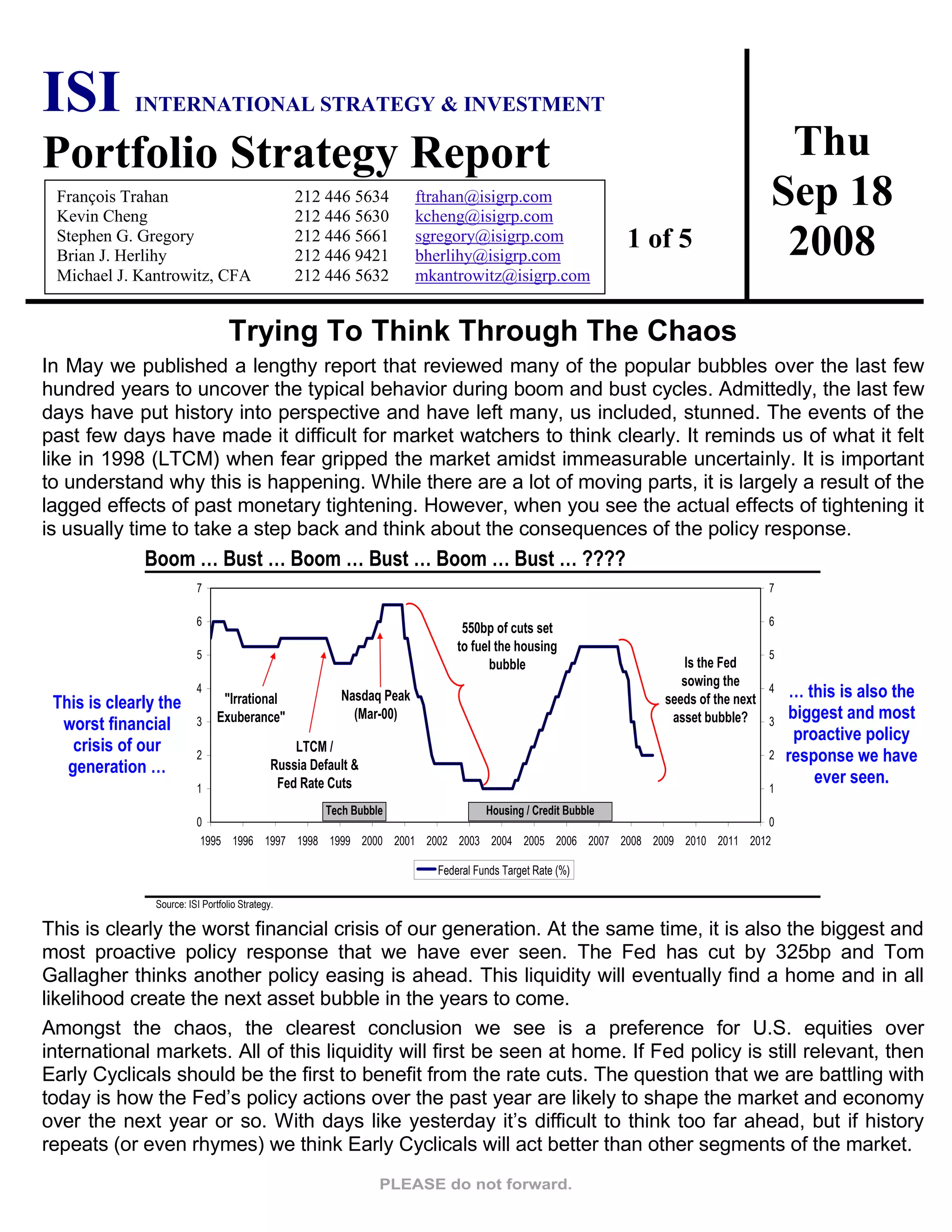
Boom … Bust … Boom … Bust … Boom … Bust … ????
This is clearly the
worst financial
crisis of our
generation …
0
1
2
3
4
5
6
7
1995 1996 1997 1998 1999 2000 2001 2002 2003 2004 2005 2006 2007 2008 2009 2010 2011 2012
0
1
2
3
4
5
6
7
Federal Funds Target Rate (%)
"Irrational
Exuberance"
LTCM /
Russia Default &
Fed Rate Cuts
Nasdaq Peak
(Mar-00)
550bp of cuts set
to fuel the housing
bubble
Housing / Credit Bubble
Is the Fed
sowing the
seeds of the next
asset bubble?
Tech Bubble
… this is also the
biggest and most
proactive policy
response we have
ever seen.
Source: ISI Portfolio Strategy.
This is clearly the worst financial crisis of our generation. At the same time, it is also the biggest and
most proactive policy response that we have ever seen. The Fed has cut by 325bp and Tom
Gallagher thinks another policy easing is ahead. This liquidity will eventually find a home and in all
likelihood create the next asset bubble in the years to come.
Amongst the chaos, the clearest conclusion we see is a preference for U.S. equities over
international markets. All of this liquidity will first be seen at home. If Fed policy is still relevant, then
Early Cyclicals should be the first to benefit from the rate cuts. The question that we are battling with
today is how the Fed’s policy actions over the past year are likely to shape the market and economy
over the next year or so. With days like yesterday it’s difficult to think too far ahead, but if history
repeats (or even rhymes) we think Early Cyclicals will act better than other segments of the market.
Market Strategy
Market Strategy
Market Strategy
Market Strategy

Market Strategy

  • 1.
    Thu Sep 18 2008 ISI INTERNATIONALSTRATEGY & INVESTMENT Portfolio Strategy Report François Trahan 212 446 5634 ftrahan@isigrp.com Kevin Cheng 212 446 5630 kcheng@isigrp.com Stephen G. Gregory 212 446 5661 sgregory@isigrp.com Brian J. Herlihy 212 446 9421 bherlihy@isigrp.com Michael J. Kantrowitz, CFA 212 446 5632 mkantrowitz@isigrp.com 1 of 5 Trying To Think Through The Chaos In May we published a lengthy report that reviewed many of the popular bubbles over the last few hundred years to uncover the typical behavior during boom and bust cycles. Admittedly, the last few days have put history into perspective and have left many, us included, stunned. The events of the past few days have made it difficult for market watchers to think clearly. It reminds us of what it felt like in 1998 (LTCM) when fear gripped the market amidst immeasurable uncertainly. It is important to understand why this is happening. While there are a lot of moving parts, it is largely a result of the lagged effects of past monetary tightening. However, when you see the actual effects of tightening it is usually time to take a step back and think about the consequences of the policy response. Boom … Bust … Boom … Bust … Boom … Bust … ???? This is clearly the worst financial crisis of our generation … 0 1 2 3 4 5 6 7 1995 1996 1997 1998 1999 2000 2001 2002 2003 2004 2005 2006 2007 2008 2009 2010 2011 2012 0 1 2 3 4 5 6 7 Federal Funds Target Rate (%) "Irrational Exuberance" LTCM / Russia Default & Fed Rate Cuts Nasdaq Peak (Mar-00) 550bp of cuts set to fuel the housing bubble Housing / Credit Bubble Is the Fed sowing the seeds of the next asset bubble? Tech Bubble … this is also the biggest and most proactive policy response we have ever seen. Source: ISI Portfolio Strategy. This is clearly the worst financial crisis of our generation. At the same time, it is also the biggest and most proactive policy response that we have ever seen. The Fed has cut by 325bp and Tom Gallagher thinks another policy easing is ahead. This liquidity will eventually find a home and in all likelihood create the next asset bubble in the years to come. Amongst the chaos, the clearest conclusion we see is a preference for U.S. equities over international markets. All of this liquidity will first be seen at home. If Fed policy is still relevant, then Early Cyclicals should be the first to benefit from the rate cuts. The question that we are battling with today is how the Fed’s policy actions over the past year are likely to shape the market and economy over the next year or so. With days like yesterday it’s difficult to think too far ahead, but if history repeats (or even rhymes) we think Early Cyclicals will act better than other segments of the market.