





Options to Attract, Retain and
     Incentivize Talent


                                 1
   The information contained in this outline is
    general in nature and based on authorities that
    are subject to change. It is not intended, and
    should not be construed as, legal or tax advice
    provided to the reader. This material is not
    necessarily applicable to, or suitable for,
    specific circumstances or needs.


                                                      2
   Attract, retain and incentivize individuals
   Offer present and future employees a greater
    stake in the success of the Company
   More clearly align the interests of employees,
    consultants and advisors with those of the
    Company
   Reward those whom the progress, growth and
    profitability of the Company depends


                                                     3
   Equity incentives are typically granted pursuant to the
    terms of an “Option Plan” or “Equity Incentive Plan”
    that’s been approved by board and shareholders
   We typically prepare an option plan when we organize
    a new corporation; usually about 20-30 pages long
   Plan creates an “option pool” – total number of
    shares/units available for grant under the Plan
   The Board (or a Board committee) is in charge of
    administering the Plan and approving equity grants


                                                              4
   Three (3 ) main types of equity incentives that
    can be granted with an Equity Incentive Plan:

       Options
       Restricted Stock
       Stock Appreciation Rights (SARs)


                                                      5
   A word about LLCs:
   Equity incentive plans are common/straight-
    forward when dealing with a corporation
   You can certainly have an equity incentive plan
    with an LLC but just be aware that you will be
    dealing with the world of partnership taxation
   There are a number of tax issues that need to be
    considered, e.g., partners cannot be employees


                                                       6
   Option: contractual right to buy equity in a
    Company for a stated period of time at a pre-
    determined price
   An option enables a person to benefit from
    increases in the Company’s value
   Option holder does not enjoy the rights
    associated with stock ownership (e.g.,
    dividends, voting, etc.) until exercise of option
    and purchase of equity

                                                        7
   Your “Option Plan” or “Equity Incentive Plan”
    will lay out the framework for what kinds of
    options the Company can grant
   Read your plan and if you have questions, go
    over it with your lawyer
   You want to keep your cap table as clean as
    possible and one way you can do that is by
    adhering to the terms of your Option Plan


                                                    8
   Specific terms of a person’s option are usually
    set forth in an Option Award Agreement
   Options should vest over time or upon
    reaching certain goals as the option holder
    continues to work for the Company
   Options typically terminate sometime after the
    holder’s employment terminates with the
    Company


                                                      9
   An ISO is a stock option granted to employees
    only (not available for LLCs)

   If certain requirements in the tax code are met:
     No income tax when ISO is granted to employee
     No income tax when ISO is exercised by employee
     There is income tax if employee sells the stock for a
      gain


                                                              10
   Must be granted to an employee (rather than a
    consultant or non-employee director)
   Exercise price must be at or above market price
    (FMV) at the time the option is granted (must
    be determined in good faith by the Board)
   Option term cannot exceed 10 years
   Cannot be transferred except in case of death
   Plan must be approved by board/shareholders


                                                      11
   Stock acquired with an ISO that appreciates in
    value gets the lower, more favorable long term
    capital gains treatment if it is sold:

   2 years after ISO is granted; and
   1 year after ISO is exercised


                                                     12
   If employee sells the stock acquired with an
    ISO either:

   Less than 2 years after it was granted; or
   Less than 1 year after it was exercised,

   Gains will be taxed at ordinary income rather
    than capital gains rate


                                                    13
   If an option does not meet the requirements for
    ISO status, then it is a non-qualified option
   Tax treatment is simpler, but less favorable to
    the employee or consultant
   Like ISOs there is no income recognition upon
    grant of the option
   Unlike ISOs there is income recognition upon
    exercise


                                                      14
   The income that is recognized upon exercise of
    a non-qualified option is treated as ordinary
    income

   When the stock is sold later, the individual will
    have a capital gain or loss


                                                        15
   In addition to ISOs and non-qualified options,
    Company can also grant restricted stock to
    incentivize employees, consultants and
    advisors

   The term “restricted stock” means the shares
    have been transferred to an individual but
    must be returned if employment/service
    terminates before they “vest”


                                                     16
   There is no income reported for restricted stock
    until the year in which the stock “vests” –
    meaning it is no longer subject to a risk of
    forfeiture
   FMV of stock on vesting date – minus amount
    paid for stock (if any) = ordinary income
   Unless holder has made an 83(b) election


                                                       17
   Individual can file an 83(b) election to
    recognize income in the year the stock is
    granted – prior to vesting – based on the FMV
    on the grant date
   When stock has little or no value on grant date,
    income reported is relatively small amount
   83(b) made so that a large portion of the
    appreciation in the stock’s value is taxed at the
    more favorable long-term capital gains rate

                                                        18
   The risk in making an 83(b) election is an
    individual may report income that’s never
    actually received if the individual leaves the
    Company before the stock vests
   If the stock has little or no value, risk is small
   Election must be made within 30 days of
    transfer
   Must be sent to IRS and filed with individual’s
    return

                                                         19
 SAR: right to receive a cash payment equal to the
 difference in the price of the Company’s stock on the
 date of grant and the FMV of that stock at a future date

 Usually vest over time and/or upon reaching certain
 performance goals; SAR holder is not a stockholder

 SARs are taxed as ordinary income when the holder is
 entitled to exercise the SAR – whether or not the SAR is
 actually exercised


                                                            20
   Finally, companies that may not be ready to grant their
    employees, consultants or advisors equity in the
    Company, may want to consider adopting a cash
    bonus plan
   Certain valued employees can be eligible to receive
    discretionary bonuses that are tied to a set percentage
    of net income
   Employee must remain employed to be eligible; bonus
    payable at Company’s discretion in accordance with
    usual accounting practices


                                                              21
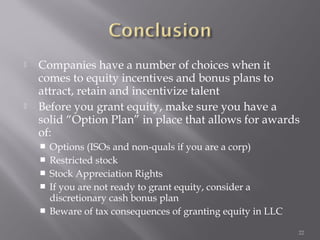
   Companies have a number of choices when it
    comes to equity incentives and bonus plans to
    attract, retain and incentivize talent
   Before you grant equity, make sure you have a
    solid “Option Plan” in place that allows for awards
    of:
       Options (ISOs and non-quals if you are a corp)
       Restricted stock
       Stock Appreciation Rights
       If you are not ready to grant equity, consider a
        discretionary cash bonus plan
       Beware of tax consequences of granting equity in LLC

                                                               22
   Herbert P. Moore, Jr.
   www.SorinRand.com
   hmoore@sorinrand.com
   O: 732-737-7730


                            23

Equity Incentives and Bonus Plans for Employees, Consultants & Advisors

  • 1.
    Options to Attract,Retain and Incentivize Talent 1
  • 2.
    The information contained in this outline is general in nature and based on authorities that are subject to change. It is not intended, and should not be construed as, legal or tax advice provided to the reader. This material is not necessarily applicable to, or suitable for, specific circumstances or needs. 2
  • 3.
    Attract, retain and incentivize individuals  Offer present and future employees a greater stake in the success of the Company  More clearly align the interests of employees, consultants and advisors with those of the Company  Reward those whom the progress, growth and profitability of the Company depends 3
  • 4.
    Equity incentives are typically granted pursuant to the terms of an “Option Plan” or “Equity Incentive Plan” that’s been approved by board and shareholders  We typically prepare an option plan when we organize a new corporation; usually about 20-30 pages long  Plan creates an “option pool” – total number of shares/units available for grant under the Plan  The Board (or a Board committee) is in charge of administering the Plan and approving equity grants 4
  • 5.
    Three (3 ) main types of equity incentives that can be granted with an Equity Incentive Plan:  Options  Restricted Stock  Stock Appreciation Rights (SARs) 5
  • 6.
    A word about LLCs:  Equity incentive plans are common/straight- forward when dealing with a corporation  You can certainly have an equity incentive plan with an LLC but just be aware that you will be dealing with the world of partnership taxation  There are a number of tax issues that need to be considered, e.g., partners cannot be employees 6
  • 7.
    Option: contractual right to buy equity in a Company for a stated period of time at a pre- determined price  An option enables a person to benefit from increases in the Company’s value  Option holder does not enjoy the rights associated with stock ownership (e.g., dividends, voting, etc.) until exercise of option and purchase of equity 7
  • 8.
    Your “Option Plan” or “Equity Incentive Plan” will lay out the framework for what kinds of options the Company can grant  Read your plan and if you have questions, go over it with your lawyer  You want to keep your cap table as clean as possible and one way you can do that is by adhering to the terms of your Option Plan 8
  • 9.
    Specific terms of a person’s option are usually set forth in an Option Award Agreement  Options should vest over time or upon reaching certain goals as the option holder continues to work for the Company  Options typically terminate sometime after the holder’s employment terminates with the Company 9
  • 10.
    An ISO is a stock option granted to employees only (not available for LLCs)  If certain requirements in the tax code are met:  No income tax when ISO is granted to employee  No income tax when ISO is exercised by employee  There is income tax if employee sells the stock for a gain 10
  • 11.
    Must be granted to an employee (rather than a consultant or non-employee director)  Exercise price must be at or above market price (FMV) at the time the option is granted (must be determined in good faith by the Board)  Option term cannot exceed 10 years  Cannot be transferred except in case of death  Plan must be approved by board/shareholders 11
  • 12.
    Stock acquired with an ISO that appreciates in value gets the lower, more favorable long term capital gains treatment if it is sold:  2 years after ISO is granted; and  1 year after ISO is exercised 12
  • 13.
    If employee sells the stock acquired with an ISO either:  Less than 2 years after it was granted; or  Less than 1 year after it was exercised,  Gains will be taxed at ordinary income rather than capital gains rate 13
  • 14.
    If an option does not meet the requirements for ISO status, then it is a non-qualified option  Tax treatment is simpler, but less favorable to the employee or consultant  Like ISOs there is no income recognition upon grant of the option  Unlike ISOs there is income recognition upon exercise 14
  • 15.
    The income that is recognized upon exercise of a non-qualified option is treated as ordinary income  When the stock is sold later, the individual will have a capital gain or loss 15
  • 16.
    In addition to ISOs and non-qualified options, Company can also grant restricted stock to incentivize employees, consultants and advisors  The term “restricted stock” means the shares have been transferred to an individual but must be returned if employment/service terminates before they “vest” 16
  • 17.
    There is no income reported for restricted stock until the year in which the stock “vests” – meaning it is no longer subject to a risk of forfeiture  FMV of stock on vesting date – minus amount paid for stock (if any) = ordinary income  Unless holder has made an 83(b) election 17
  • 18.
    Individual can file an 83(b) election to recognize income in the year the stock is granted – prior to vesting – based on the FMV on the grant date  When stock has little or no value on grant date, income reported is relatively small amount  83(b) made so that a large portion of the appreciation in the stock’s value is taxed at the more favorable long-term capital gains rate 18
  • 19.
    The risk in making an 83(b) election is an individual may report income that’s never actually received if the individual leaves the Company before the stock vests  If the stock has little or no value, risk is small  Election must be made within 30 days of transfer  Must be sent to IRS and filed with individual’s return 19
  • 20.
     SAR: rightto receive a cash payment equal to the difference in the price of the Company’s stock on the date of grant and the FMV of that stock at a future date  Usually vest over time and/or upon reaching certain performance goals; SAR holder is not a stockholder  SARs are taxed as ordinary income when the holder is entitled to exercise the SAR – whether or not the SAR is actually exercised 20
  • 21.
    Finally, companies that may not be ready to grant their employees, consultants or advisors equity in the Company, may want to consider adopting a cash bonus plan  Certain valued employees can be eligible to receive discretionary bonuses that are tied to a set percentage of net income  Employee must remain employed to be eligible; bonus payable at Company’s discretion in accordance with usual accounting practices 21
  • 22.
    Companies have a number of choices when it comes to equity incentives and bonus plans to attract, retain and incentivize talent  Before you grant equity, make sure you have a solid “Option Plan” in place that allows for awards of:  Options (ISOs and non-quals if you are a corp)  Restricted stock  Stock Appreciation Rights  If you are not ready to grant equity, consider a discretionary cash bonus plan  Beware of tax consequences of granting equity in LLC 22
  • 23.
    Herbert P. Moore, Jr.  www.SorinRand.com  hmoore@sorinrand.com  O: 732-737-7730 23