Introduction:
Capital budgeting:
Capital budgeting (or investment appraisal) is the planning process used to determine whether
an organisation's long term investments such as new machinery, replacement machinery, new
plants, new products, and research development projects are worth pursuing. It is budget for
major capital, or investment, expenditures.[1]

Many formal methods are used in capital budgeting, including the techniques such as

   Accounting rate of return
   Net present value
   Profitability index
   Internal rate of return
   Modified internal rate of return
   Equivalent annuity
These methods use the incremental cash flows from each potential investment,
or project Techniques based on accounting earnings and accounting rules are sometimes used -
though economists consider this to be improper - such as the accounting rate of return, and
"return on investment." Simplified and hybrid methods are used as well, such as payback
period and discounted payback period.


Dividend policy:
Once a company makes a profit, they must decide on what to do with those profits. They could
continue to retain the profits within the company, or they could pay out the profits to the
owners of the firm in the form of dividends. Once the company decides on whether to pay
dividends, they may establish a somewhat permanent dividend policy, which may in turn
impact on investors and perceptions of the company in the financial markets. What they decide
depends on the situation of the company now and in the future. It also depends on the
preferences of investors and potential investors.

Factors effecting dividend policy:
. Stability of Earnings. The nature of business has an important bearing on the dividend policy.
Industrial units having stability of earnings may formulate a more consistent dividend policy
than those having an uneven flow of incomes because they can predict easily their savings and
earnings. Usually, enterprises dealing in necessities suffer less from oscillating earnings than
those dealing in luxuries or fancy goods.

2. Age of corporation. Age of the corporation counts much in deciding the dividend policy. A
newly established company may require much of its earnings for expansion and plant
improvement and may adopt a rigid dividend policy while, on the other hand, an older
company can formulate a clear cut and more consistent policy regarding dividend.

3. Liquidity of Funds. Availability of cash and sound financial position is also an important factor
in dividend decisions. A dividend represents a cash outflow, the greater the funds and the
liquidity of the firm the better the ability to pay dividend. The liquidity of a firm depends very
much on the investment and financial decisions of the firm which in turn determines the rate of
expansion and the manner of financing. If cash position is weak, stock dividend will be
distributed and if cash position is good, company can distribute the cash dividend.

4. Extent of share Distribution. Nature of ownership also affects the dividend decisions. A
closely held company is likely to get the assent of the shareholders for the suspension of
dividend or for following a conservative dividend policy. On the other hand, a company having a
good number of shareholders widely distributed and forming low or medium income group,
would face a great difficulty in securing such assent because they will emphasise to distribute
higher dividend.

5. Needs for Additional Capital. Companies retain a part of their profits for strengthening their
financial position. The income may be conserved for meeting the increased requirements of
working capital or of future expansion. Small companies usually find difficulties in raising
finance for their needs of increased working capital for expansion programmes. They having no
other alternative, use their ploughed back profits. Thus, such Companies distribute dividend at
low rates and retain a big part of profits.

6. Trade Cycles. Business cycles also exercise influence upon dividend Policy. Dividend policy is
adjusted according to the business oscillations. During the boom, prudent management creates
food reserves for contingencies which follow the inflationary period. Higher rates of dividend
can be used as a tool for marketing the securities in an otherwise depressed market. The
financial solvency can be proved and maintained by the companies in dull years if the adequate
reserves have been built up.

7. Government Policies. The earnings capacity of the enterprise is widely affected by the change
in fiscal, industrial, labour, control and other government policies. Sometimes government
restricts the distribution of dividend beyond a certain percentage in a particular industry or in
all spheres of business activity as was done in emergency. The dividend policy has to be
modified or formulated accordingly in those enterprises.
8. Taxation Policy. High taxation reduces the earnings of he companies and consequently the
rate of dividend is lowered down. Sometimes government levies dividend-tax of distribution of
dividend beyond a certain limit. It also affects the capital formation. N India, dividends beyond
10 % of paid-up capital are subject to dividend tax at 7.5 %.

9. Legal Requirements. In deciding on the dividend, the directors take the legal requirements
too into consideration. In order to protect the interests of creditors an outsiders, the
companies Act 1956 prescribes certain guidelines in respect of the distribution and payment of
dividend. Moreover, a company is required to provide for depreciation on its fixed and tangible
assets before declaring dividend on shares. It proposes that Dividend should not be distributed
out of capita, in any case. Likewise, contractual obligation should also be fulfilled, for example,
payment of dividend on preference shares in priority over ordinary dividend.

10. Past dividend Rates. While formulating the Dividend Policy, the directors must keep in mind
the dividend paid in past years. The current rate should be around the average past rat. If it has
been abnormally increased the shares will be subjected to speculation. In a new concern, the
company should consider the dividend policy of the rival organisation.

11. Ability to Borrow. Well established and large firms have better access to the capital market
than the new Companies and may borrow funds from the external sources if there arises any
need. Such Companies may have a better dividend pay-out ratio. Whereas smaller firms have to
depend on their internal sources and therefore they will have to built up good reserves by
reducing the dividend pay out ratio for meeting any obligation requiring heavy funds.

12. Policy of Control. Policy of control is another determining factor is so far as dividends are
shareholders and therefore, declare a dividend at low rate. Because by adding new
shareholders they fear dilution of control and diversion of policies and programmes of the
existing management. So they prefer to meet the needs through retained earing. If the
directors do not bother about the control of affairs they will follow a liberal dividend policy.
Thus control is an influencing factor in framing the dividend policy.

13. Repayments of Loan. A company having loan indebtedness are vowed to a high rate of
retention earnings, unless one other arrangements are made for the redemption of debt on
maturity. It will naturally lower down the rate of dividend. Sometimes, the lenders (mostly
institutional lenders) put restrictions on the dividend distribution still such time their loan is
outstanding. Formal loan contracts generally provide a certain standard of liquidity and
solvency to be maintained. Management is bound to hour such restrictions and to limit the rate
of dividend payout.

14. Time for Payment of Dividend. When should the dividend be paid is another consideration.
Payment of dividend means outflow of cash. It is, therefore, desirable to distribute dividend at
a time when is least needed by the company because there are peak times as well as lean
periods of expenditure. Wise management should plan the payment of dividend in such a
manner that there is no cash outflow at a time when the undertaking is already in need of
urgent finances.

15. Regularity and stability in Dividend Payment. Dividends should be paid regularly because
each investor is interested in the regular payment of dividend. The management should, inspite
of regular payment of dividend, consider that the rate of dividend should be all the most
constant. For this purpose sometimes companies maintain dividend equalization Fund.
Background of the company:
Tech Mahindra is part of the US $8.25 billion Mahindra Group, in partnership with British
Telecommunications plc (BT), one of the world’s leading communications service providers. Focused
primarily on the telecommunications industry, Tech Mahindra is a leading global systems integrator and
business transformation consulting organization. Tech Mahindra has recently expanded its IT portfolio
by acquiring the leading global business and information technology services company, Mahindra
Satyam (earlier known as Satyam Computer Services).


Tech Mahindra’s capabilities spread across a broad spectrum, including Business Support Systems (BSS),
Operations Support Systems (OSS), Network Design & Engineering, Next Generation Networks, Mobility
Solutions, Security consulting and Testing. The solutions portfolio includes Consulting, Application
Development & Management, Network Services, Solution Integration, Product Engineering,
Infrastructure Managed Services, Remote Infrastructure Management and BPO. With an array of service
offerings for TSPs, TEMs and ISVs, Tech Mahindra is a chosen transformation partner for several leading
wireline, wireless and broadband operators in Europe, Asia-Pacific and North America.


Tech Mahindra has successfully implemented more than 15 Greenfield Operations globally and has
over 126 active customer engagementsmostly in the Telecom sector. The company has been involved in
about 8 transformation programs of incumbent telecom operators.


In the Telecom sector, Tech Mahindra has niche and proven domain expertise, distinctive IT skills,
research and development, innovative delivery models and approach to off-shoring. Company’s
solutions enable clients to maximize returns on IT investment by achieving faster time to market,
reduced total cost of ownership resulting into high levels of customer satisfaction. Tech Mahindra’s
achievements have been recognized by various industry analysts, forums and clients – winning several
prestigious awards and accolades.


Tech Mahindra has a global footprint through operations in more than 25 countries with 17 sales offices
and 13 delivery centers. Assessed at SEI CMMi Level 5, Tech Mahindra's track record for value delivery is
supported by over 34, 200 professionals who provide a unique blend of culture, domain expertise and in
depth technology skill sets. Its development centers are ISO 9001:2008 & BS7799 certified.
Company history:
History
Tech Mahindra was incorporated as a joint venture between Mahindra & Mahindra and British
Telecom plc in 1986 under the name of ‘Mahindra British Telecom’. Later, the name was
changed to ‘Tech Mahindra’, to reflect the diversification and growth of the client base and the
increased breadth of our service offerings.

Milestones
 1986   Incorporation in India


 1987   Commencement of Business


 1993   Incorporation of MBT International Inc., the first overseas subsidiary


 1994   Awarded the ISO 9001 certification by BVQI


 1995   Established the UK branch office


 2001   Incorporated MBT GmbH, Germany incorporated

        Re-certified to ISO 9001:1994 by BVQI


 2002   Assessed at Level 5 of SEI CMM by KPMG

        Incorporated MBT Software Technologies Pte. Limited, Singapore


 2003   Re-certified to ISO 9001:2000 by RWTUV


 2005   Certified to BS 7799-2:2002 (Information Security Management Framework) by RWTUV now known as TUV Nord

        Acquired Axes Technologies (India) Private Limited, including its US and Singapore subsidiaries

        Assessed at Level 5 of SEI CMMI by KPMG


 2006   Name changed to Tech Mahindra Limited Assessed at Level 5 of SEI People-CMM (P-CMM) by QAI India

        Raised Rs 4.65 billion ($100 million) from a hugely successful IPO to build a new facility in Pune, to house about 9,000
        staff

        Formed a JV with Motorola Inc. under the name CanvasM


 2007   Acquired iPolicy Networks Private Limited

        Launched the Tech Mahindra Foundation to address the needs of the underprivileged in our society, especially
        children
2009   With Satyam acquisition, Tech Mahindra is well positioned to be a leader in the broader IT services space, serving a
       wide array of industry verticals like banking and financial services, manufacturing, energy and utilities in addition to
       telecom


2010   AT&T 2010 Supplier Award for outstanding performance & service to AT& T and its affiliates

       Expands footprint in Latin America
Literature review:
   1. Institutional Holdings and Payout Policy

MICHAELY, RONI

This paper examines the relation between institutional holdings and payout policy in U.S. public
firms. We find that payout policy affects institutional holdings. Institutions avoid firms that do
not pay dividends. However, among dividend-paying firms they prefer firms that pay fewer
dividends. Our evidence indicates that institutions prefer firms that repurchase shares, and
regular repurchasers over nonregular repurchasers. Higher institutional holdings or a
concentration of holdings do not cause firms to increase their dividends, their repurchases, or
their total payout. Our results do not support models that predict that high dividends attract
institutional clientele, or models that predict that institutions cause firms to increase payout.

   2. Corporate Dividend Policy: The Views of British Financial Managers.

Dhanani, Alpa

Using a survey approach, this paper examines the importance and relevance of the various
theories of dividend policy for UK companies. Further, it evaluates the extent to which
corporate characteristics such as size and industry influence managerial responses to the
survey. In general, the results support dividend hypotheses relating to signalling and ownership
structure, in preference to those about capital structure and investment decisions and agency
issues. At a more detailed level, the cross sectional analysis reveals important differences
between managers’ responses, based on company size, industry sector, growth opportunities,
ownership structure and information asymmetry

   3. FOCUS ON PRESENT STATUS AND DETERMINANTS OF DIVIDEND PAYOUT POLICY:
      ATHENS STOCK EXCHANGE IN PERSPECTIVE

            Papadopoulos, Dimitrios L.1
            Charalambidis, Dimitrios P.
In this paper we investigate the present status and determinants of dividend policy of firms
listed in the Athens Stock Exchange. We find that: a) payout policy is subjected to minor
changes through years, b) most firms distribute no special dividends, c) differences between
dividend policy of retail firms and that of industrial firms are minor, d) the variables used
explain only a small proportion of dividend policy's variability and e) cash flow is the main
determinant of dividend policy.
4. Ben Naceur, Samy1 sbennaceur@lycos.com
      Goaied, Mohamed1
      Belanes, Amel

The authors study the dividend policy of 48 firms listed on the Tunisian Stock Exchange during
the period 1996–2002. The study tests whether or not managers of Tunisian listed firms smooth
their dividends. Moreover, the study outlines the main determinants that may drive the
dividend policy of Tunisian quoted firms. To answer the first question, we use Lintner's model in
a dynamic setting. The results clearly demonstrate that Tunisian firms rely on both current
earnings and past dividends to fix their dividend payment. However, the study shows that
dividends tend to be more sensitive to current earnings than prior dividends. To find out the
determinants of dividend policy, dynamic panel regressions have been performed. First,
profitable firms with more stable earnings can afford larger free cash flows and thus pay larger
dividends. Furthermore, they distribute larger dividends whenever they are growing fast.
However, neither the ownership concentration nor the financial leverage seems to have any
impact on dividend policy in Tunisia. Also, the liquidity of stock market and size negatively
impacts the dividend payment. The results are somewhat robust to different specifications

   5. Dividend Policy and Reputation.

          Gillet, Roland1,2
          Lapointe, Marc-André3 marc-andre.lapointe2@USherbrooke.ca
          Raimbourg, Philippe1,4


We examine the role of reputation when firms use dividends to signal their profitability. We
analyze a signaling model in which reputation plays no role in equilibrium. We then show that
taking reputation into account as a link between sequential dividend decisions makes it possible
to endogenize signaling costs and obtain a separating equilibrium. Lastly, we use the
reversibility hypothesis and assume that in each period, managers can reverse their choices in
terms of dividend distribution. We find that in most cases, the signaling equilibrium becomes
unstable, causing any dividend signaling policy to become difficult to implement.
Objectives of study:
     Dividend policy of Tech Mahindra Ltd.

     Why falling DPS?

     Why falling DPR?

     Effects of the recent Satyam deal on the company capital budgeting decisions

     Future of the riskiness of the firm
Research Methodology and tools used:
Data collection is from secondary sources like capitaline, reuters finance, moneycontrol.com etc

Tools that we are using are as follows:

Single factor Regression:

In statistics, regression analysis includes any techniques for modelling and analyzing several
variables, when the focus is on the relationship between a dependent variable and one or
moreindependent variables. More specifically, regression analysis helps us understand how the
typical value of the dependent variable changes when any one of the independent variables is
varied, while the other independent variables are held fixed. Most commonly, regression
analysis estimates the conditional expectation of the dependent variable given the independent
variables — that is, the average value of the dependent variable when the independent
variables are held fixed. Less commonly, the focus is on a quantile, or other location
parameter of the conditional distribution of the dependent variable given the independent
variables. In all cases, the estimation target is a function of the independent variables called
the regression function. In regression analysis, it is also of interest to characterize the variation
of the dependent variable around the regression function, which can be described by
a probability distribution.
Objective one: To study the dividend policy of the company:
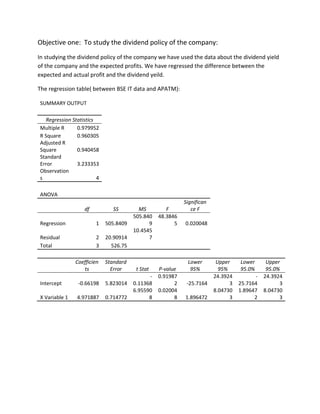
In studying the dividend policy of the company we have used the data about the dividend yield
of the company and the expected profits. We have regressed the difference between the
expected and actual profit and the dividend yeild.

The regression table( between BSE IT data and APATM):

SUMMARY OUTPUT

  Regression Statistics
Multiple R     0.979952
R Square       0.960305
Adjusted R
Square         0.940458
Standard
Error          3.233353
Observation
s                       4

ANOVA
                                                           Significan
                  df           SS        MS         F         ce F
                                       505.840   48.3846
Regression             1    505.8409         9         5   0.020048
                                       10.4545
Residual               2    20.90914         7
Total                  3      526.75

               Coefficien   Standard                        Lower        Upper    Lower      Upper
                  ts          Error     t Stat   P-value     95%          95%     95.0%      95.0%
                                             -   0.91987                24.3924         -   24.3924
Intercept       -0.66198    5.823014   0.11368         2    -25.7164          3   25.7164         3
                                       6.95590   0.02004                8.04730   1.89647   8.04730
X Variable 1   4.971887     0.714772         8         8   1.896472           3         2         3
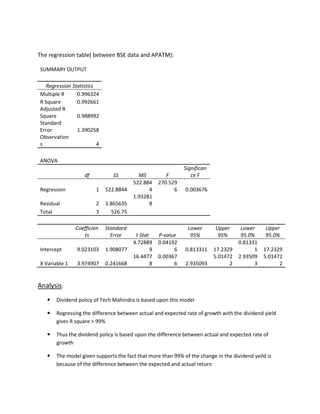
The regression table( between BSE data and APATM):

SUMMARY OUTPUT

  Regression Statistics
Multiple R     0.996324
R Square       0.992661
Adjusted R
Square         0.988992
Standard
Error          1.390258
Observation
s                       4

ANOVA
                                                             Significan
                  df           SS        MS           F         ce F
                                       522.884     270.529
Regression             1    522.8844         4           6   0.003676
                                       1.93281
Residual               2    3.865635         8
Total                  3      526.75

               Coefficien   Standard                          Lower       Upper      Lower     Upper
                  ts          Error     t Stat     P-value     95%         95%       95.0%     95.0%
                                       4.72889     0.04192                          0.81331
Intercept      9.023103     1.908077           9         6   0.813311     17.2329         1   17.2329
                                       16.4477     0.00367                5.01472   2.93509   5.01472
X Variable 1   3.974907     0.241668           8         6   2.935093           2         3         2


Analysis:
      Dividend policy of Tech Mahindra is based upon this model

      Regressing the difference between actual and expected rate of growth with the dividend yield
       gives R square > 99%

      Thus the dividend policy is based upon the difference between actual and expected rate of
       growth

      The model given supports the fact that more than 99% of the change in the dividend yeild is
       because of the difference between the expected and actual return
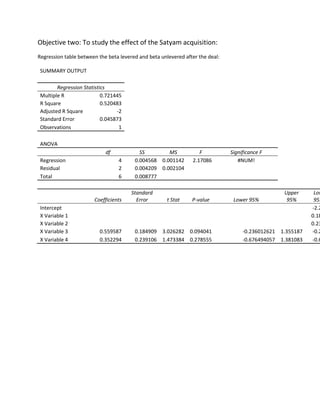
Objective two: To study the effect of the Satyam acquisition:
Regression table between the beta levered and beta unlevered after the deal:

 SUMMARY OUTPUT

        Regression Statistics
 Multiple R                0.721445
 R Square                  0.520483
 Adjusted R Square               -2
 Standard Error            0.045873
 Observations                     1

 ANOVA
                            df            SS        MS             F           Significance F
 Regression                      4      0.004568 0.001142       2.17086           #NUM!
 Residual                        2      0.004209 0.002104
 Total                           6      0.008777

                                       Standard                                                   Upper      Low
                       Coefficients      Error        t Stat    P-value         Lower 95%          95%       95.
 Intercept                                                                                                  -2.2
 X Variable 1                                                                                               0.18
 X Variable 2                                                                                               0.23
 X Variable 3            0.559587       0.184909 3.026282 0.094041                  -0.236012621 1.355187   -0.2
 X Variable 4            0.352294       0.239106 1.473384 0.278555                  -0.676494057 1.381083   -0.6
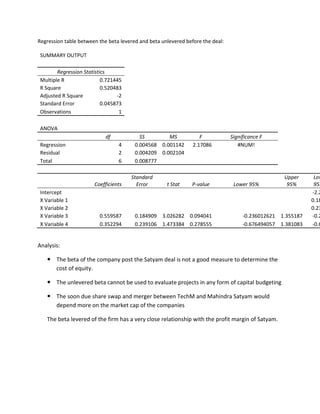
Regression table between the beta levered and beta unlevered before the deal:

 SUMMARY OUTPUT

        Regression Statistics
 Multiple R                0.721445
 R Square                  0.520483
 Adjusted R Square               -2
 Standard Error            0.045873
 Observations                     1

 ANOVA
                            df            SS        MS             F            Significance F
 Regression                      4      0.004568 0.001142       2.17086            #NUM!
 Residual                        2      0.004209 0.002104
 Total                           6      0.008777

                                      Standard                                                     Upper      Low
                       Coefficients     Error        t Stat    P-value           Lower 95%          95%       95.
 Intercept                                                                                                   -2.2
 X Variable 1                                                                                                0.18
 X Variable 2                                                                                                0.23
 X Variable 3            0.559587       0.184909 3.026282 0.094041                   -0.236012621 1.355187   -0.2
 X Variable 4            0.352294       0.239106 1.473384 0.278555                   -0.676494057 1.381083   -0.6


Analysis:

     The beta of the company post the Satyam deal is not a good measure to determine the
      cost of equity.

     The unlevered beta cannot be used to evaluate projects in any form of capital budgeting

     The soon due share swap and merger between TechM and Mahindra Satyam would
      depend more on the market cap of the companies

    The beta levered of the firm has a very close relationship with the profit margin of Satyam.
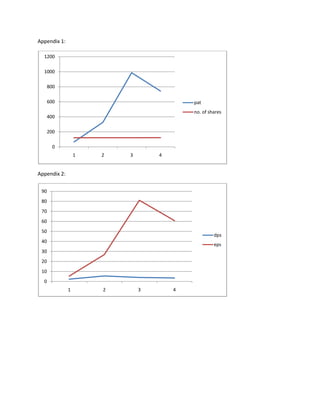
Appendix 1:

  1200

  1000

      800

      600                                 pat
                                          no. of shares
      400

      200

        0
                  1   2   3       4


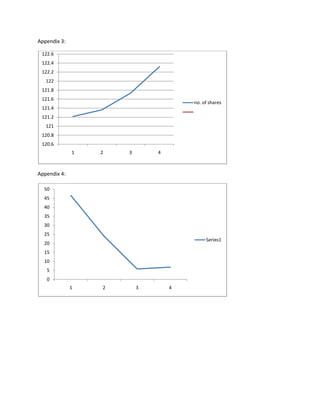
Appendix 2:

 90
 80
 70
 60
 50
                                                   dps
 40
                                                   eps
 30
 20
 10
  0
              1       2       3       4
Appendix 3:

 122.6
 122.4
 122.2
   122
 121.8
 121.6
                                      no. of shares
 121.4
 121.2
   121
 120.8
 120.6
              1   2   3       4


Appendix 4:

  50
  45
  40
  35
  30
  25
                                           Series1
  20
  15
  10
   5
   0
              1   2       3       4
Cf report

Cf report

  • 1.
    Introduction: Capital budgeting: Capital budgeting(or investment appraisal) is the planning process used to determine whether an organisation's long term investments such as new machinery, replacement machinery, new plants, new products, and research development projects are worth pursuing. It is budget for major capital, or investment, expenditures.[1] Many formal methods are used in capital budgeting, including the techniques such as  Accounting rate of return  Net present value  Profitability index  Internal rate of return  Modified internal rate of return  Equivalent annuity These methods use the incremental cash flows from each potential investment, or project Techniques based on accounting earnings and accounting rules are sometimes used - though economists consider this to be improper - such as the accounting rate of return, and "return on investment." Simplified and hybrid methods are used as well, such as payback period and discounted payback period. Dividend policy: Once a company makes a profit, they must decide on what to do with those profits. They could continue to retain the profits within the company, or they could pay out the profits to the owners of the firm in the form of dividends. Once the company decides on whether to pay dividends, they may establish a somewhat permanent dividend policy, which may in turn impact on investors and perceptions of the company in the financial markets. What they decide depends on the situation of the company now and in the future. It also depends on the preferences of investors and potential investors. Factors effecting dividend policy: . Stability of Earnings. The nature of business has an important bearing on the dividend policy. Industrial units having stability of earnings may formulate a more consistent dividend policy
  • 2.
    than those havingan uneven flow of incomes because they can predict easily their savings and earnings. Usually, enterprises dealing in necessities suffer less from oscillating earnings than those dealing in luxuries or fancy goods. 2. Age of corporation. Age of the corporation counts much in deciding the dividend policy. A newly established company may require much of its earnings for expansion and plant improvement and may adopt a rigid dividend policy while, on the other hand, an older company can formulate a clear cut and more consistent policy regarding dividend. 3. Liquidity of Funds. Availability of cash and sound financial position is also an important factor in dividend decisions. A dividend represents a cash outflow, the greater the funds and the liquidity of the firm the better the ability to pay dividend. The liquidity of a firm depends very much on the investment and financial decisions of the firm which in turn determines the rate of expansion and the manner of financing. If cash position is weak, stock dividend will be distributed and if cash position is good, company can distribute the cash dividend. 4. Extent of share Distribution. Nature of ownership also affects the dividend decisions. A closely held company is likely to get the assent of the shareholders for the suspension of dividend or for following a conservative dividend policy. On the other hand, a company having a good number of shareholders widely distributed and forming low or medium income group, would face a great difficulty in securing such assent because they will emphasise to distribute higher dividend. 5. Needs for Additional Capital. Companies retain a part of their profits for strengthening their financial position. The income may be conserved for meeting the increased requirements of working capital or of future expansion. Small companies usually find difficulties in raising finance for their needs of increased working capital for expansion programmes. They having no other alternative, use their ploughed back profits. Thus, such Companies distribute dividend at low rates and retain a big part of profits. 6. Trade Cycles. Business cycles also exercise influence upon dividend Policy. Dividend policy is adjusted according to the business oscillations. During the boom, prudent management creates food reserves for contingencies which follow the inflationary period. Higher rates of dividend can be used as a tool for marketing the securities in an otherwise depressed market. The financial solvency can be proved and maintained by the companies in dull years if the adequate reserves have been built up. 7. Government Policies. The earnings capacity of the enterprise is widely affected by the change in fiscal, industrial, labour, control and other government policies. Sometimes government restricts the distribution of dividend beyond a certain percentage in a particular industry or in all spheres of business activity as was done in emergency. The dividend policy has to be modified or formulated accordingly in those enterprises.
  • 3.
    8. Taxation Policy.High taxation reduces the earnings of he companies and consequently the rate of dividend is lowered down. Sometimes government levies dividend-tax of distribution of dividend beyond a certain limit. It also affects the capital formation. N India, dividends beyond 10 % of paid-up capital are subject to dividend tax at 7.5 %. 9. Legal Requirements. In deciding on the dividend, the directors take the legal requirements too into consideration. In order to protect the interests of creditors an outsiders, the companies Act 1956 prescribes certain guidelines in respect of the distribution and payment of dividend. Moreover, a company is required to provide for depreciation on its fixed and tangible assets before declaring dividend on shares. It proposes that Dividend should not be distributed out of capita, in any case. Likewise, contractual obligation should also be fulfilled, for example, payment of dividend on preference shares in priority over ordinary dividend. 10. Past dividend Rates. While formulating the Dividend Policy, the directors must keep in mind the dividend paid in past years. The current rate should be around the average past rat. If it has been abnormally increased the shares will be subjected to speculation. In a new concern, the company should consider the dividend policy of the rival organisation. 11. Ability to Borrow. Well established and large firms have better access to the capital market than the new Companies and may borrow funds from the external sources if there arises any need. Such Companies may have a better dividend pay-out ratio. Whereas smaller firms have to depend on their internal sources and therefore they will have to built up good reserves by reducing the dividend pay out ratio for meeting any obligation requiring heavy funds. 12. Policy of Control. Policy of control is another determining factor is so far as dividends are shareholders and therefore, declare a dividend at low rate. Because by adding new shareholders they fear dilution of control and diversion of policies and programmes of the existing management. So they prefer to meet the needs through retained earing. If the directors do not bother about the control of affairs they will follow a liberal dividend policy. Thus control is an influencing factor in framing the dividend policy. 13. Repayments of Loan. A company having loan indebtedness are vowed to a high rate of retention earnings, unless one other arrangements are made for the redemption of debt on maturity. It will naturally lower down the rate of dividend. Sometimes, the lenders (mostly institutional lenders) put restrictions on the dividend distribution still such time their loan is outstanding. Formal loan contracts generally provide a certain standard of liquidity and solvency to be maintained. Management is bound to hour such restrictions and to limit the rate of dividend payout. 14. Time for Payment of Dividend. When should the dividend be paid is another consideration. Payment of dividend means outflow of cash. It is, therefore, desirable to distribute dividend at a time when is least needed by the company because there are peak times as well as lean periods of expenditure. Wise management should plan the payment of dividend in such a manner that there is no cash outflow at a time when the undertaking is already in need of
  • 4.
    urgent finances. 15. Regularityand stability in Dividend Payment. Dividends should be paid regularly because each investor is interested in the regular payment of dividend. The management should, inspite of regular payment of dividend, consider that the rate of dividend should be all the most constant. For this purpose sometimes companies maintain dividend equalization Fund.
  • 5.
    Background of thecompany: Tech Mahindra is part of the US $8.25 billion Mahindra Group, in partnership with British Telecommunications plc (BT), one of the world’s leading communications service providers. Focused primarily on the telecommunications industry, Tech Mahindra is a leading global systems integrator and business transformation consulting organization. Tech Mahindra has recently expanded its IT portfolio by acquiring the leading global business and information technology services company, Mahindra Satyam (earlier known as Satyam Computer Services). Tech Mahindra’s capabilities spread across a broad spectrum, including Business Support Systems (BSS), Operations Support Systems (OSS), Network Design & Engineering, Next Generation Networks, Mobility Solutions, Security consulting and Testing. The solutions portfolio includes Consulting, Application Development & Management, Network Services, Solution Integration, Product Engineering, Infrastructure Managed Services, Remote Infrastructure Management and BPO. With an array of service offerings for TSPs, TEMs and ISVs, Tech Mahindra is a chosen transformation partner for several leading wireline, wireless and broadband operators in Europe, Asia-Pacific and North America. Tech Mahindra has successfully implemented more than 15 Greenfield Operations globally and has over 126 active customer engagementsmostly in the Telecom sector. The company has been involved in about 8 transformation programs of incumbent telecom operators. In the Telecom sector, Tech Mahindra has niche and proven domain expertise, distinctive IT skills, research and development, innovative delivery models and approach to off-shoring. Company’s solutions enable clients to maximize returns on IT investment by achieving faster time to market, reduced total cost of ownership resulting into high levels of customer satisfaction. Tech Mahindra’s achievements have been recognized by various industry analysts, forums and clients – winning several prestigious awards and accolades. Tech Mahindra has a global footprint through operations in more than 25 countries with 17 sales offices and 13 delivery centers. Assessed at SEI CMMi Level 5, Tech Mahindra's track record for value delivery is supported by over 34, 200 professionals who provide a unique blend of culture, domain expertise and in depth technology skill sets. Its development centers are ISO 9001:2008 & BS7799 certified.
  • 6.
    Company history: History Tech Mahindrawas incorporated as a joint venture between Mahindra & Mahindra and British Telecom plc in 1986 under the name of ‘Mahindra British Telecom’. Later, the name was changed to ‘Tech Mahindra’, to reflect the diversification and growth of the client base and the increased breadth of our service offerings. Milestones 1986 Incorporation in India 1987 Commencement of Business 1993 Incorporation of MBT International Inc., the first overseas subsidiary 1994 Awarded the ISO 9001 certification by BVQI 1995 Established the UK branch office 2001 Incorporated MBT GmbH, Germany incorporated Re-certified to ISO 9001:1994 by BVQI 2002 Assessed at Level 5 of SEI CMM by KPMG Incorporated MBT Software Technologies Pte. Limited, Singapore 2003 Re-certified to ISO 9001:2000 by RWTUV 2005 Certified to BS 7799-2:2002 (Information Security Management Framework) by RWTUV now known as TUV Nord Acquired Axes Technologies (India) Private Limited, including its US and Singapore subsidiaries Assessed at Level 5 of SEI CMMI by KPMG 2006 Name changed to Tech Mahindra Limited Assessed at Level 5 of SEI People-CMM (P-CMM) by QAI India Raised Rs 4.65 billion ($100 million) from a hugely successful IPO to build a new facility in Pune, to house about 9,000 staff Formed a JV with Motorola Inc. under the name CanvasM 2007 Acquired iPolicy Networks Private Limited Launched the Tech Mahindra Foundation to address the needs of the underprivileged in our society, especially children
  • 7.
    2009 With Satyam acquisition, Tech Mahindra is well positioned to be a leader in the broader IT services space, serving a wide array of industry verticals like banking and financial services, manufacturing, energy and utilities in addition to telecom 2010 AT&T 2010 Supplier Award for outstanding performance & service to AT& T and its affiliates Expands footprint in Latin America
  • 8.
    Literature review: 1. Institutional Holdings and Payout Policy MICHAELY, RONI This paper examines the relation between institutional holdings and payout policy in U.S. public firms. We find that payout policy affects institutional holdings. Institutions avoid firms that do not pay dividends. However, among dividend-paying firms they prefer firms that pay fewer dividends. Our evidence indicates that institutions prefer firms that repurchase shares, and regular repurchasers over nonregular repurchasers. Higher institutional holdings or a concentration of holdings do not cause firms to increase their dividends, their repurchases, or their total payout. Our results do not support models that predict that high dividends attract institutional clientele, or models that predict that institutions cause firms to increase payout. 2. Corporate Dividend Policy: The Views of British Financial Managers. Dhanani, Alpa Using a survey approach, this paper examines the importance and relevance of the various theories of dividend policy for UK companies. Further, it evaluates the extent to which corporate characteristics such as size and industry influence managerial responses to the survey. In general, the results support dividend hypotheses relating to signalling and ownership structure, in preference to those about capital structure and investment decisions and agency issues. At a more detailed level, the cross sectional analysis reveals important differences between managers’ responses, based on company size, industry sector, growth opportunities, ownership structure and information asymmetry 3. FOCUS ON PRESENT STATUS AND DETERMINANTS OF DIVIDEND PAYOUT POLICY: ATHENS STOCK EXCHANGE IN PERSPECTIVE Papadopoulos, Dimitrios L.1 Charalambidis, Dimitrios P. In this paper we investigate the present status and determinants of dividend policy of firms listed in the Athens Stock Exchange. We find that: a) payout policy is subjected to minor changes through years, b) most firms distribute no special dividends, c) differences between dividend policy of retail firms and that of industrial firms are minor, d) the variables used explain only a small proportion of dividend policy's variability and e) cash flow is the main determinant of dividend policy.
  • 9.
    4. Ben Naceur,Samy1 sbennaceur@lycos.com Goaied, Mohamed1 Belanes, Amel The authors study the dividend policy of 48 firms listed on the Tunisian Stock Exchange during the period 1996–2002. The study tests whether or not managers of Tunisian listed firms smooth their dividends. Moreover, the study outlines the main determinants that may drive the dividend policy of Tunisian quoted firms. To answer the first question, we use Lintner's model in a dynamic setting. The results clearly demonstrate that Tunisian firms rely on both current earnings and past dividends to fix their dividend payment. However, the study shows that dividends tend to be more sensitive to current earnings than prior dividends. To find out the determinants of dividend policy, dynamic panel regressions have been performed. First, profitable firms with more stable earnings can afford larger free cash flows and thus pay larger dividends. Furthermore, they distribute larger dividends whenever they are growing fast. However, neither the ownership concentration nor the financial leverage seems to have any impact on dividend policy in Tunisia. Also, the liquidity of stock market and size negatively impacts the dividend payment. The results are somewhat robust to different specifications 5. Dividend Policy and Reputation. Gillet, Roland1,2 Lapointe, Marc-André3 marc-andre.lapointe2@USherbrooke.ca Raimbourg, Philippe1,4 We examine the role of reputation when firms use dividends to signal their profitability. We analyze a signaling model in which reputation plays no role in equilibrium. We then show that taking reputation into account as a link between sequential dividend decisions makes it possible to endogenize signaling costs and obtain a separating equilibrium. Lastly, we use the reversibility hypothesis and assume that in each period, managers can reverse their choices in terms of dividend distribution. We find that in most cases, the signaling equilibrium becomes unstable, causing any dividend signaling policy to become difficult to implement.
  • 10.
    Objectives of study:  Dividend policy of Tech Mahindra Ltd.  Why falling DPS?  Why falling DPR?  Effects of the recent Satyam deal on the company capital budgeting decisions  Future of the riskiness of the firm
  • 11.
    Research Methodology andtools used: Data collection is from secondary sources like capitaline, reuters finance, moneycontrol.com etc Tools that we are using are as follows: Single factor Regression: In statistics, regression analysis includes any techniques for modelling and analyzing several variables, when the focus is on the relationship between a dependent variable and one or moreindependent variables. More specifically, regression analysis helps us understand how the typical value of the dependent variable changes when any one of the independent variables is varied, while the other independent variables are held fixed. Most commonly, regression analysis estimates the conditional expectation of the dependent variable given the independent variables — that is, the average value of the dependent variable when the independent variables are held fixed. Less commonly, the focus is on a quantile, or other location parameter of the conditional distribution of the dependent variable given the independent variables. In all cases, the estimation target is a function of the independent variables called the regression function. In regression analysis, it is also of interest to characterize the variation of the dependent variable around the regression function, which can be described by a probability distribution.
  • 12.
    Objective one: Tostudy the dividend policy of the company: In studying the dividend policy of the company we have used the data about the dividend yield of the company and the expected profits. We have regressed the difference between the expected and actual profit and the dividend yeild. The regression table( between BSE IT data and APATM): SUMMARY OUTPUT Regression Statistics Multiple R 0.979952 R Square 0.960305 Adjusted R Square 0.940458 Standard Error 3.233353 Observation s 4 ANOVA Significan df SS MS F ce F 505.840 48.3846 Regression 1 505.8409 9 5 0.020048 10.4545 Residual 2 20.90914 7 Total 3 526.75 Coefficien Standard Lower Upper Lower Upper ts Error t Stat P-value 95% 95% 95.0% 95.0% - 0.91987 24.3924 - 24.3924 Intercept -0.66198 5.823014 0.11368 2 -25.7164 3 25.7164 3 6.95590 0.02004 8.04730 1.89647 8.04730 X Variable 1 4.971887 0.714772 8 8 1.896472 3 2 3
  • 13.
    The regression table(between BSE data and APATM): SUMMARY OUTPUT Regression Statistics Multiple R 0.996324 R Square 0.992661 Adjusted R Square 0.988992 Standard Error 1.390258 Observation s 4 ANOVA Significan df SS MS F ce F 522.884 270.529 Regression 1 522.8844 4 6 0.003676 1.93281 Residual 2 3.865635 8 Total 3 526.75 Coefficien Standard Lower Upper Lower Upper ts Error t Stat P-value 95% 95% 95.0% 95.0% 4.72889 0.04192 0.81331 Intercept 9.023103 1.908077 9 6 0.813311 17.2329 1 17.2329 16.4477 0.00367 5.01472 2.93509 5.01472 X Variable 1 3.974907 0.241668 8 6 2.935093 2 3 2 Analysis:  Dividend policy of Tech Mahindra is based upon this model  Regressing the difference between actual and expected rate of growth with the dividend yield gives R square > 99%  Thus the dividend policy is based upon the difference between actual and expected rate of growth  The model given supports the fact that more than 99% of the change in the dividend yeild is because of the difference between the expected and actual return
  • 14.
    Objective two: Tostudy the effect of the Satyam acquisition: Regression table between the beta levered and beta unlevered after the deal: SUMMARY OUTPUT Regression Statistics Multiple R 0.721445 R Square 0.520483 Adjusted R Square -2 Standard Error 0.045873 Observations 1 ANOVA df SS MS F Significance F Regression 4 0.004568 0.001142 2.17086 #NUM! Residual 2 0.004209 0.002104 Total 6 0.008777 Standard Upper Low Coefficients Error t Stat P-value Lower 95% 95% 95. Intercept -2.2 X Variable 1 0.18 X Variable 2 0.23 X Variable 3 0.559587 0.184909 3.026282 0.094041 -0.236012621 1.355187 -0.2 X Variable 4 0.352294 0.239106 1.473384 0.278555 -0.676494057 1.381083 -0.6
  • 15.
    Regression table betweenthe beta levered and beta unlevered before the deal: SUMMARY OUTPUT Regression Statistics Multiple R 0.721445 R Square 0.520483 Adjusted R Square -2 Standard Error 0.045873 Observations 1 ANOVA df SS MS F Significance F Regression 4 0.004568 0.001142 2.17086 #NUM! Residual 2 0.004209 0.002104 Total 6 0.008777 Standard Upper Low Coefficients Error t Stat P-value Lower 95% 95% 95. Intercept -2.2 X Variable 1 0.18 X Variable 2 0.23 X Variable 3 0.559587 0.184909 3.026282 0.094041 -0.236012621 1.355187 -0.2 X Variable 4 0.352294 0.239106 1.473384 0.278555 -0.676494057 1.381083 -0.6 Analysis:  The beta of the company post the Satyam deal is not a good measure to determine the cost of equity.  The unlevered beta cannot be used to evaluate projects in any form of capital budgeting  The soon due share swap and merger between TechM and Mahindra Satyam would depend more on the market cap of the companies The beta levered of the firm has a very close relationship with the profit margin of Satyam.
  • 16.
    Appendix 1: 1200 1000 800 600 pat no. of shares 400 200 0 1 2 3 4 Appendix 2: 90 80 70 60 50 dps 40 eps 30 20 10 0 1 2 3 4
  • 17.
    Appendix 3: 122.6 122.4 122.2 122 121.8 121.6 no. of shares 121.4 121.2 121 120.8 120.6 1 2 3 4 Appendix 4: 50 45 40 35 30 25 Series1 20 15 10 5 0 1 2 3 4