1
Awagarh public school
Sustainable
Developmen
t
Introduction
 The term “sustainable development” first came to
prominence in the world Conservation Strategy
(WCS) in 1980.
 It achieved a new status with the publication of two
significant reports by Brundtalnd on: North and
South: a programme for survival and common
crisis (1985) and
 Our Common Future (1983) and has gained even
greater attention since the United Nations
Conference on Environment and Development
(UNCED) held in Rio de Jenerio in June 1992.
definition
 Sustainable development can be defined as an
approach to the economic development of a
country without compromising with the quality of
the environment for future generations.
 In the name of economic development, the price of
environmental damage is paid in the form of land
degradation, soil erosion, air and water pollution,
deforestation, etc.
 This damage may surpass the advantages of
having more quality output of goods and services.
How Sustainability Works
 Sustainability encourages businesses to frame decisions in
terms of environmental, social, and human impact for the
long-term, rather than on short-term gains such as next
quarter's earnings report. It influences them to consider more
factors than simply the immediate profit or loss involved.
Increasingly, companies have issued sustainability goals such
as commitment to zero-waste packaging by a certain year, or
to reduce overall emissions by a certain percentage.
 These companies can achieve their sustainability needs by
cutting emissions, lowering their energy usage, sourcing
products from fair-trade organizations, and ensuring their
physical waste is disposed of properly and with as small a
carbon footprint as possible.
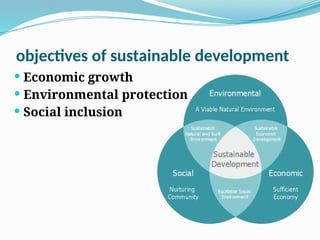
objectives of sustainable development
 Economic growth
 Environmental protection
 Social inclusion
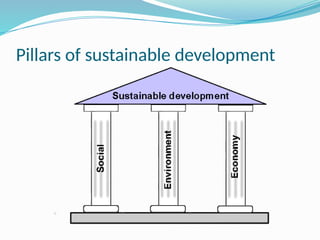
Pillars of sustainable development
Importance of Sustainable Development
1. Provides Essential Human Needs
 The explosion of population means people will
have to scramble for the limited life essentials
like food, shelter, and water. Adequate provision
of these basic needs almost entirely hinges on
infrastructure capable of sustaining them for a
long time.
 If governments insist on utilizing fossil fuel-
based sources of energy instead of renewable
and sustainable options, the cost and
environmental effects of supplying these basic
needs would become a tall order.
Importance of Sustainable Development…..
2. Agricultural Requirement
 A growing population means agriculture must catch up.
Finding ways to feed more than 3 billion people can be
staggering. If the same unsustainable cultivation, planting,
irrigation, spraying, and harvesting techniques are utilized
in the future, they might prove to be financially burdening
considering fossil fuel resources are projected to run out.
 Sustainable development focuses on sustainable
agricultural methods such as effective seeding techniques
and crop rotation to promote high yields while maintaining
the integrity of the soil, which produces food for a large
population.
Importance of Sustainable Development…..
 3. Manage Climate Change
 Climate change can be mitigated by sustainable
development practices. Sustainable development
practices seek to reduce the use of fossil-based
sources of fuel like oil, natural gas, and coal.
Fossil fuel sources of energy are unsustainable
since they will deplete in the future and are
responsible for the emission of greenhouse
gasses.
Importance of Sustainable Development…..
 4. Financial Stability
 Sustainable development practices have the
ability to create more financially sustainable
economies across the globe. Developing
countries that can’t access fossil fuels can
leverage renewable forms of energy to power
their economies.
 From the development of renewable energy
technologies, these countries can create
sustainable jobs as opposed to finite jobs based
on fossil fuel technologies.
Importance of Sustainable Development…..
 5. Sustain Biodiversity
 Unsustainable development and overconsumption
practices greatly impact biodiversity. The life ecosystem
is designed in such a way that species depend on one
another for survival. For instance, plants produce
oxygen that humans need for respiration.
 Humans exhale carbon dioxide that plants need for
growth and production. Unsustainable development
practices like emission of greenhouse gasses in the
atmosphere kill many plant species resulting in the
reduction of atmospheric oxygen.
Examples of Sustainable Development
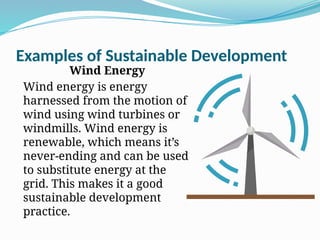
Wind Energy
Wind energy is energy
harnessed from the motion of
wind using wind turbines or
windmills. Wind energy is
renewable, which means it’s
never-ending and can be used
to substitute energy at the
grid. This makes it a good
sustainable development
practice.
Examples of Sustainable Development…..
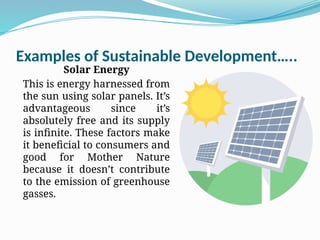
Solar Energy
This is energy harnessed from
the sun using solar panels. It’s
advantageous since it’s
absolutely free and its supply
is infinite. These factors make
it beneficial to consumers and
good for Mother Nature
because it doesn’t contribute
to the emission of greenhouse
gasses.
Examples of Sustainable Development…..
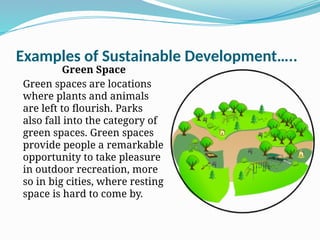
Green Space
Green spaces are locations
where plants and animals
are left to flourish. Parks
also fall into the category of
green spaces. Green spaces
provide people a remarkable
opportunity to take pleasure
in outdoor recreation, more
so in big cities, where resting
space is hard to come by.
Examples of Sustainable Development…..
Crop Rotation
Crop rotation, in contrast, is
defined as “the successive
planting of different crops on
the same land to improve soil
fertility and help control insects
and diseases.” This way of
farming is not a new practice,
but rather a more ancient way
of farming chemical-free, whilst
maximizing the long-term
growth potential of land.
What Prevents Sustainable Development
From Happening?
 The first is that for many aspects of development,
using sustainable methods and materials is
expensive. While the long-term cost of
sustainability does prove to be less expensive than
traditional development, the creation of a
sustainable project may be far more expensive in
the first phase.
 The second major issue is that there is not a
generally accepted need for sustainable
development. This is an education issue that may
take many years to resolve.
Conclusion
 Sustainable development is largely about people, their well-being,
and equity in their relationships with each other, in a context where
nature-society imbalances can threaten economic and social
stability.
 Because climate change, its drivers, its impacts and its policy
responses will interact with economic production and services,
human settlements and human societies, climate change is likely to
be a significant factor in the sustainable development of many
areas (e.g., Downing, 2002).
 Simply stated, climate change has the potential to affect many
aspects of human development, positively or negatively, depending
on the geographic location, the economic sector, and the level of
economic and social development already attained (e.g., regarding
particular vulnerabilities of the poor, see Dow and Wilbanks, 2003
Thanks

587089064-sustainable-development-ppt.pptx

  • 1.
  • 2.
  • 3.
    Introduction  The term“sustainable development” first came to prominence in the world Conservation Strategy (WCS) in 1980.  It achieved a new status with the publication of two significant reports by Brundtalnd on: North and South: a programme for survival and common crisis (1985) and  Our Common Future (1983) and has gained even greater attention since the United Nations Conference on Environment and Development (UNCED) held in Rio de Jenerio in June 1992.
  • 4.
    definition  Sustainable developmentcan be defined as an approach to the economic development of a country without compromising with the quality of the environment for future generations.  In the name of economic development, the price of environmental damage is paid in the form of land degradation, soil erosion, air and water pollution, deforestation, etc.  This damage may surpass the advantages of having more quality output of goods and services.
  • 5.
    How Sustainability Works Sustainability encourages businesses to frame decisions in terms of environmental, social, and human impact for the long-term, rather than on short-term gains such as next quarter's earnings report. It influences them to consider more factors than simply the immediate profit or loss involved. Increasingly, companies have issued sustainability goals such as commitment to zero-waste packaging by a certain year, or to reduce overall emissions by a certain percentage.  These companies can achieve their sustainability needs by cutting emissions, lowering their energy usage, sourcing products from fair-trade organizations, and ensuring their physical waste is disposed of properly and with as small a carbon footprint as possible.
  • 6.
    objectives of sustainabledevelopment  Economic growth  Environmental protection  Social inclusion
  • 7.
  • 9.
    Importance of SustainableDevelopment 1. Provides Essential Human Needs  The explosion of population means people will have to scramble for the limited life essentials like food, shelter, and water. Adequate provision of these basic needs almost entirely hinges on infrastructure capable of sustaining them for a long time.  If governments insist on utilizing fossil fuel- based sources of energy instead of renewable and sustainable options, the cost and environmental effects of supplying these basic needs would become a tall order.
  • 10.
    Importance of SustainableDevelopment….. 2. Agricultural Requirement  A growing population means agriculture must catch up. Finding ways to feed more than 3 billion people can be staggering. If the same unsustainable cultivation, planting, irrigation, spraying, and harvesting techniques are utilized in the future, they might prove to be financially burdening considering fossil fuel resources are projected to run out.  Sustainable development focuses on sustainable agricultural methods such as effective seeding techniques and crop rotation to promote high yields while maintaining the integrity of the soil, which produces food for a large population.
  • 11.
    Importance of SustainableDevelopment…..  3. Manage Climate Change  Climate change can be mitigated by sustainable development practices. Sustainable development practices seek to reduce the use of fossil-based sources of fuel like oil, natural gas, and coal. Fossil fuel sources of energy are unsustainable since they will deplete in the future and are responsible for the emission of greenhouse gasses.
  • 12.
    Importance of SustainableDevelopment…..  4. Financial Stability  Sustainable development practices have the ability to create more financially sustainable economies across the globe. Developing countries that can’t access fossil fuels can leverage renewable forms of energy to power their economies.  From the development of renewable energy technologies, these countries can create sustainable jobs as opposed to finite jobs based on fossil fuel technologies.
  • 13.
    Importance of SustainableDevelopment…..  5. Sustain Biodiversity  Unsustainable development and overconsumption practices greatly impact biodiversity. The life ecosystem is designed in such a way that species depend on one another for survival. For instance, plants produce oxygen that humans need for respiration.  Humans exhale carbon dioxide that plants need for growth and production. Unsustainable development practices like emission of greenhouse gasses in the atmosphere kill many plant species resulting in the reduction of atmospheric oxygen.
  • 14.
    Examples of SustainableDevelopment Wind Energy Wind energy is energy harnessed from the motion of wind using wind turbines or windmills. Wind energy is renewable, which means it’s never-ending and can be used to substitute energy at the grid. This makes it a good sustainable development practice.
  • 15.
    Examples of SustainableDevelopment….. Solar Energy This is energy harnessed from the sun using solar panels. It’s advantageous since it’s absolutely free and its supply is infinite. These factors make it beneficial to consumers and good for Mother Nature because it doesn’t contribute to the emission of greenhouse gasses.
  • 16.
    Examples of SustainableDevelopment….. Green Space Green spaces are locations where plants and animals are left to flourish. Parks also fall into the category of green spaces. Green spaces provide people a remarkable opportunity to take pleasure in outdoor recreation, more so in big cities, where resting space is hard to come by.
  • 17.
    Examples of SustainableDevelopment….. Crop Rotation Crop rotation, in contrast, is defined as “the successive planting of different crops on the same land to improve soil fertility and help control insects and diseases.” This way of farming is not a new practice, but rather a more ancient way of farming chemical-free, whilst maximizing the long-term growth potential of land.
  • 18.
    What Prevents SustainableDevelopment From Happening?  The first is that for many aspects of development, using sustainable methods and materials is expensive. While the long-term cost of sustainability does prove to be less expensive than traditional development, the creation of a sustainable project may be far more expensive in the first phase.  The second major issue is that there is not a generally accepted need for sustainable development. This is an education issue that may take many years to resolve.
  • 19.
    Conclusion  Sustainable developmentis largely about people, their well-being, and equity in their relationships with each other, in a context where nature-society imbalances can threaten economic and social stability.  Because climate change, its drivers, its impacts and its policy responses will interact with economic production and services, human settlements and human societies, climate change is likely to be a significant factor in the sustainable development of many areas (e.g., Downing, 2002).  Simply stated, climate change has the potential to affect many aspects of human development, positively or negatively, depending on the geographic location, the economic sector, and the level of economic and social development already attained (e.g., regarding particular vulnerabilities of the poor, see Dow and Wilbanks, 2003
  • 20.