


Robert Oakley
Commercial Director
Rob Needham
Technical Director
OBJECTIVES
1. Pro-Actively Manage Your Business Equipment
2. Operate Business Equipment Safely
3. Improve the ROI of Business Equipment
4. Reduce Business Risk
5. Provide Ideas for Optimising Equipment Management
5. Additional Information and Resources
AGENDA
1. An Introduction to Equipment Management 15 Minutes
• Why Business Equipment is Critical to your Business
• The 7 Key Problems with Managing Business Equipment
2. The Asset Register 10 Minutes
• Record Keeping – Compliance and a Basis for Effective Management
• What and Where
3. Maintenance and Calibration 5 Minutes
• Keeping Track
• Safety: Staff – Customers – Partners – the Public
4. The High Cost of Failure 5 Minutes
• Regulatory Non-Compliance
• Human and Financial Costs
5. Best Practice 10 Minutes
• Safe Operation.
• Smart Equipment and the Internet of Everything
6. Questions. 15 Minutes
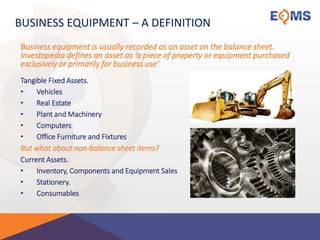
BUSINESS EQUIPMENT – A DEFINITION
Business equipment is usually recorded as an asset on the balance sheet.
Investopedia defines an asset as ‘a piece of property or equipment purchased
exclusively or primarily for business use’
Tangible Fixed Assets.
• Vehicles
• Real Estate
• Plant and Machinery
• Computers
• Office Furniture and Fixtures
But what about non-balance sheet items?
Current Assets.
• Inventory, Components and Equipment Sales
• Stationery.
• Consumables
ASSET MANAGEMENT
ISO 55000 defines Asset management as the "coordinated
activity of an organization to realize value from assets". In turn,
Assets are defined as follows: "An asset is an item, thing or entity
that has potential or actual value to an organization".
The IAM is the professional body for those
involved in acquisition, operation and care of
physical assets – especially critical
infrastructure. The Institute is for
professionals worldwide who are dedicated
to furthering their knowledge and
understanding of Asset Management.
WHY IS BUSINESS EQUIPMENT CRITICAL?
• Key to competing in fast-paced global markets
• Supports faster and smarter working
• Quality and reliability supports ‘just-in-time’ purchase
• Adds to the Regulatory Compliance burden
• A source of competitive advantage
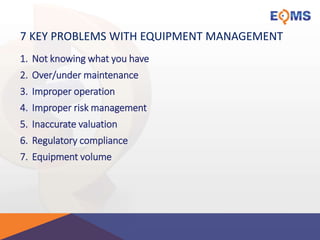
7 KEY PROBLEMS WITH EQUIPMENT MANAGEMENT
1. Not knowing what you have
2. Over/under maintenance
3. Improper operation
4. Improper risk management
5. Inaccurate valuation
6. Regulatory compliance
7. Equipment volume
7 KEY PROBLEMS WITH EQUIPMENT MANAGEMENT
1. Not knowing what you have
7 KEY PROBLEMS WITH EQUIPMENT MANAGEMENT
1. Not knowing what you have
2. Over/under maintenance
7 KEY PROBLEMS WITH EQUIPMENT MANAGEMENT
1. Not knowing what you have
2. Over/under maintenance
3. Improper operation
7 KEY PROBLEMS WITH EQUIPMENT MANAGEMENT
1. Not knowing what you have
2. Over/under maintenance
3. Improper operation
4. Improper risk management
7 KEY PROBLEMS WITH EQUIPMENT MANAGEMENT
1. Not knowing what you have
2. Over/under maintenance
3. Improper operation
4. Improper risk management
5. Inaccurate valuation
7 KEY PROBLEMS WITH EQUIPMENT MANAGEMENT
1. Not knowing what you have
2. Over/under maintenance
3. Improper operation
4. Improper risk management
5. Inaccurate valuation
6. Regulatory compliance
7 KEY PROBLEMS WITH EQUIPMENT MANAGEMENT
1. Not knowing what you have
2. Over/under maintenance
3. Improper operation
4. Improper risk management
5. Inaccurate valuation
6. Regulatory compliance
7. Equipment volume
POLL 1
What is the key problem your organisation faces when
managing equipment?
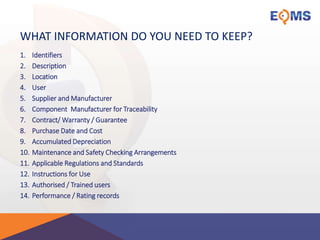
WHAT INFORMATION DO YOU NEED TO KEEP?
1. Identifiers
2. Description
3. Location
4. User
5. Supplier and Manufacturer
6. Component Manufacturer for Traceability
7. Contract/ Warranty / Guarantee
8. Purchase Date and Cost
9. Accumulated Depreciation
10. Maintenance and Safety Checking Arrangements
11. Applicable Regulations and Standards
12. Instructions for Use
13. Authorised / Trained users
14. Performance / Rating records
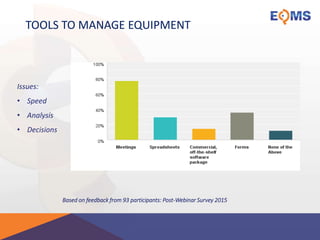
TOOLS TO MANAGE EQUIPMENT
Issues:
• Speed
• Analysis
• Decisions
Based on feedback from 93 participants: Post-Webinar Survey 2015
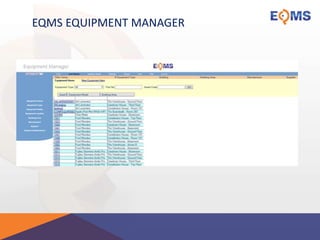
EQMS EQUIPMENT MANAGER
POLL 2
Do you believe your existing Equipment Management
record-keeping satisfies the requirements of applicable
standards and regulation?
POLL 3
Do you believe your existing Equipment Management
processes satisfy the requirements of your business?
MAINTENANCE, CALIBRATION AND SAFETY CHECKS
1. Regulatory Requirements
2. Internal/External Standards
3. Frequency
4. Trained Personnel/ External Expertise
5. Quantify Risk
6. Communicate Internally
REGULATORY NON-COMPLIANCE
Supply of Machinery (Safety) Regulations 2008, as
amended by the Supply of Machinery (Safety)
(Amendment) Regulations 2011.
http://www.hse.gov.uk/prosecutions/breach/breach_list.
asp?PN=6&ST=B&SN=S&SF=IS&SV=5&SO=DHD
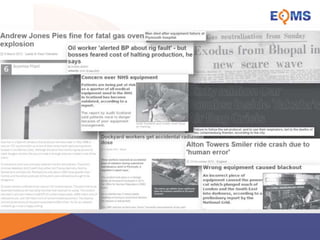
FINANCIAL AND HUMAN COSTS
1. In April 2005 details of 3500 Australian customers from 18
banks, including names and account numbers, lost on a
USB stick by a representative of the Australian High Tech
Crime Centre during transit to an international meeting on
computer crime.
2. Andrew Jones Pies, of Huddersfield, West Yorkshire has
been fined £250,000 for safety offences after a gas
explosion in an industrial bakery oven killed a man and
badly injured another. The company went into
administration and had to pay £124,896 in costs at York
Crown Court. David Cole, 37, was killed in 2009 when the
explosion blew the large oven door off its hinges in April
2009. The judge said the company had "failed dismally".
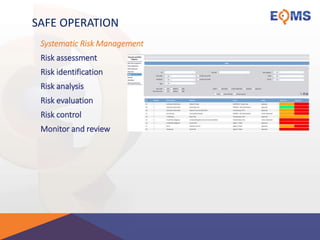
SAFE OPERATION
Systematic Risk Management
Risk assessment
Risk identification
Risk analysis
Risk evaluation
Risk control
Monitor and review
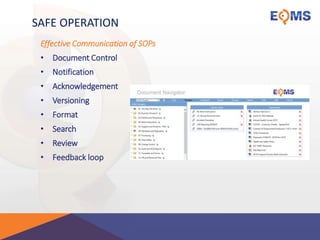
SAFE OPERATION
Effective Communication of SOPs
• Document Control
• Notification
• Acknowledgement
• Versioning
• Format
• Search
• Review
• Feedback loop
SAFE OPERATION
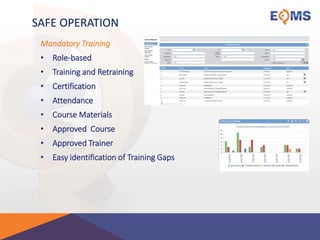
Mandatory Training
• Role-based
• Training and Retraining
• Certification
• Attendance
• Course Materials
• Approved Course
• Approved Trainer
• Easy identification of Training Gaps
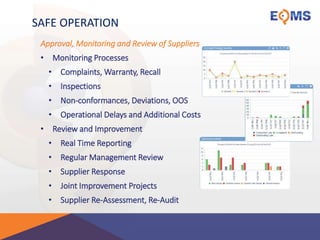
SAFE OPERATION
Approval, Monitoring and Review of Suppliers
• Monitoring Processes
• Complaints, Warranty, Recall
• Inspections
• Non-conformances, Deviations, OOS
• Operational Delays and Additional Costs
• Review and Improvement
• Real Time Reporting
• Regular Management Review
• Supplier Response
• Joint Improvement Projects
• Supplier Re-Assessment, Re-Audit
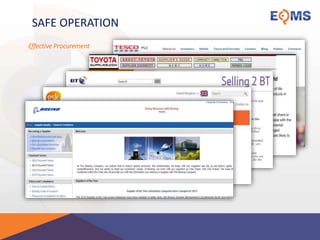
SAFE OPERATION
Effective Procurement
NEW TECHNOLOGIES
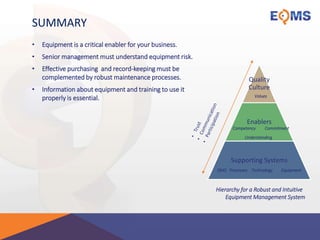
SUMMARY
• Equipment is a critical enabler for your business.
• Senior management must understand equipment risk.
• Effective purchasing and record-keeping must be
complemented by robust maintenance processes.
• Information about equipment and training to use it
properly is essential.
Quality
Culture
Enablers
Supporting Systems
Hierarchy for a Robust and Intuitive
Equipment Management System
QMS Processes Technology Equipment
Competency Commitment
Understanding
Values
QUESTIONS?
FURTHER INFORMATION
• EQMS Datasheets for
• Equipment Manager
• Supplier Manager
• Audit & Inspection Manager
• Issue Manager
• Document Manager
• Risk Manager
• Post Webinar Survey.
• Replay Webinar.
FURTHER HELP & SUPPORT
Qualsys Limited
Aizlewoods Mill,
Nursery Street,
Sheffield,
S3 8GG
emily.hill@qualsys.co.uk
+44 (0)114 282 3338
robert.oakley@qualsys.co.uk
+44 (0)7919 005538

Equipment maintenance management: implementation

  • 1.
    Robert Oakley Commercial Director RobNeedham Technical Director
  • 2.
    OBJECTIVES 1. Pro-Actively ManageYour Business Equipment 2. Operate Business Equipment Safely 3. Improve the ROI of Business Equipment 4. Reduce Business Risk 5. Provide Ideas for Optimising Equipment Management 5. Additional Information and Resources
  • 3.
    AGENDA 1. An Introductionto Equipment Management 15 Minutes • Why Business Equipment is Critical to your Business • The 7 Key Problems with Managing Business Equipment 2. The Asset Register 10 Minutes • Record Keeping – Compliance and a Basis for Effective Management • What and Where 3. Maintenance and Calibration 5 Minutes • Keeping Track • Safety: Staff – Customers – Partners – the Public 4. The High Cost of Failure 5 Minutes • Regulatory Non-Compliance • Human and Financial Costs 5. Best Practice 10 Minutes • Safe Operation. • Smart Equipment and the Internet of Everything 6. Questions. 15 Minutes
  • 5.
    BUSINESS EQUIPMENT –A DEFINITION Business equipment is usually recorded as an asset on the balance sheet. Investopedia defines an asset as ‘a piece of property or equipment purchased exclusively or primarily for business use’ Tangible Fixed Assets. • Vehicles • Real Estate • Plant and Machinery • Computers • Office Furniture and Fixtures But what about non-balance sheet items? Current Assets. • Inventory, Components and Equipment Sales • Stationery. • Consumables
  • 6.
    ASSET MANAGEMENT ISO 55000defines Asset management as the "coordinated activity of an organization to realize value from assets". In turn, Assets are defined as follows: "An asset is an item, thing or entity that has potential or actual value to an organization". The IAM is the professional body for those involved in acquisition, operation and care of physical assets – especially critical infrastructure. The Institute is for professionals worldwide who are dedicated to furthering their knowledge and understanding of Asset Management.
  • 7.
    WHY IS BUSINESSEQUIPMENT CRITICAL? • Key to competing in fast-paced global markets • Supports faster and smarter working • Quality and reliability supports ‘just-in-time’ purchase • Adds to the Regulatory Compliance burden • A source of competitive advantage
  • 9.
    7 KEY PROBLEMSWITH EQUIPMENT MANAGEMENT 1. Not knowing what you have 2. Over/under maintenance 3. Improper operation 4. Improper risk management 5. Inaccurate valuation 6. Regulatory compliance 7. Equipment volume
  • 10.
    7 KEY PROBLEMSWITH EQUIPMENT MANAGEMENT 1. Not knowing what you have
  • 11.
    7 KEY PROBLEMSWITH EQUIPMENT MANAGEMENT 1. Not knowing what you have 2. Over/under maintenance
  • 12.
    7 KEY PROBLEMSWITH EQUIPMENT MANAGEMENT 1. Not knowing what you have 2. Over/under maintenance 3. Improper operation
  • 13.
    7 KEY PROBLEMSWITH EQUIPMENT MANAGEMENT 1. Not knowing what you have 2. Over/under maintenance 3. Improper operation 4. Improper risk management
  • 14.
    7 KEY PROBLEMSWITH EQUIPMENT MANAGEMENT 1. Not knowing what you have 2. Over/under maintenance 3. Improper operation 4. Improper risk management 5. Inaccurate valuation
  • 15.
    7 KEY PROBLEMSWITH EQUIPMENT MANAGEMENT 1. Not knowing what you have 2. Over/under maintenance 3. Improper operation 4. Improper risk management 5. Inaccurate valuation 6. Regulatory compliance
  • 16.
    7 KEY PROBLEMSWITH EQUIPMENT MANAGEMENT 1. Not knowing what you have 2. Over/under maintenance 3. Improper operation 4. Improper risk management 5. Inaccurate valuation 6. Regulatory compliance 7. Equipment volume
  • 18.
    POLL 1 What isthe key problem your organisation faces when managing equipment?
  • 20.
    WHAT INFORMATION DOYOU NEED TO KEEP? 1. Identifiers 2. Description 3. Location 4. User 5. Supplier and Manufacturer 6. Component Manufacturer for Traceability 7. Contract/ Warranty / Guarantee 8. Purchase Date and Cost 9. Accumulated Depreciation 10. Maintenance and Safety Checking Arrangements 11. Applicable Regulations and Standards 12. Instructions for Use 13. Authorised / Trained users 14. Performance / Rating records
  • 21.
    TOOLS TO MANAGEEQUIPMENT Issues: • Speed • Analysis • Decisions Based on feedback from 93 participants: Post-Webinar Survey 2015
  • 22.
  • 23.
    POLL 2 Do youbelieve your existing Equipment Management record-keeping satisfies the requirements of applicable standards and regulation?
  • 24.
    POLL 3 Do youbelieve your existing Equipment Management processes satisfy the requirements of your business?
  • 26.
    MAINTENANCE, CALIBRATION ANDSAFETY CHECKS 1. Regulatory Requirements 2. Internal/External Standards 3. Frequency 4. Trained Personnel/ External Expertise 5. Quantify Risk 6. Communicate Internally
  • 28.
    REGULATORY NON-COMPLIANCE Supply ofMachinery (Safety) Regulations 2008, as amended by the Supply of Machinery (Safety) (Amendment) Regulations 2011. http://www.hse.gov.uk/prosecutions/breach/breach_list. asp?PN=6&ST=B&SN=S&SF=IS&SV=5&SO=DHD
  • 29.
    FINANCIAL AND HUMANCOSTS 1. In April 2005 details of 3500 Australian customers from 18 banks, including names and account numbers, lost on a USB stick by a representative of the Australian High Tech Crime Centre during transit to an international meeting on computer crime. 2. Andrew Jones Pies, of Huddersfield, West Yorkshire has been fined £250,000 for safety offences after a gas explosion in an industrial bakery oven killed a man and badly injured another. The company went into administration and had to pay £124,896 in costs at York Crown Court. David Cole, 37, was killed in 2009 when the explosion blew the large oven door off its hinges in April 2009. The judge said the company had "failed dismally".
  • 31.
    SAFE OPERATION Systematic RiskManagement Risk assessment Risk identification Risk analysis Risk evaluation Risk control Monitor and review
  • 32.
    SAFE OPERATION Effective Communicationof SOPs • Document Control • Notification • Acknowledgement • Versioning • Format • Search • Review • Feedback loop
  • 33.
    SAFE OPERATION Mandatory Training •Role-based • Training and Retraining • Certification • Attendance • Course Materials • Approved Course • Approved Trainer • Easy identification of Training Gaps
  • 34.
    SAFE OPERATION Approval, Monitoringand Review of Suppliers • Monitoring Processes • Complaints, Warranty, Recall • Inspections • Non-conformances, Deviations, OOS • Operational Delays and Additional Costs • Review and Improvement • Real Time Reporting • Regular Management Review • Supplier Response • Joint Improvement Projects • Supplier Re-Assessment, Re-Audit
  • 35.
  • 36.
  • 37.
    SUMMARY • Equipment isa critical enabler for your business. • Senior management must understand equipment risk. • Effective purchasing and record-keeping must be complemented by robust maintenance processes. • Information about equipment and training to use it properly is essential. Quality Culture Enablers Supporting Systems Hierarchy for a Robust and Intuitive Equipment Management System QMS Processes Technology Equipment Competency Commitment Understanding Values
  • 38.
  • 39.
    FURTHER INFORMATION • EQMSDatasheets for • Equipment Manager • Supplier Manager • Audit & Inspection Manager • Issue Manager • Document Manager • Risk Manager • Post Webinar Survey. • Replay Webinar.
  • 40.
    FURTHER HELP &SUPPORT Qualsys Limited Aizlewoods Mill, Nursery Street, Sheffield, S3 8GG emily.hill@qualsys.co.uk +44 (0)114 282 3338 robert.oakley@qualsys.co.uk +44 (0)7919 005538