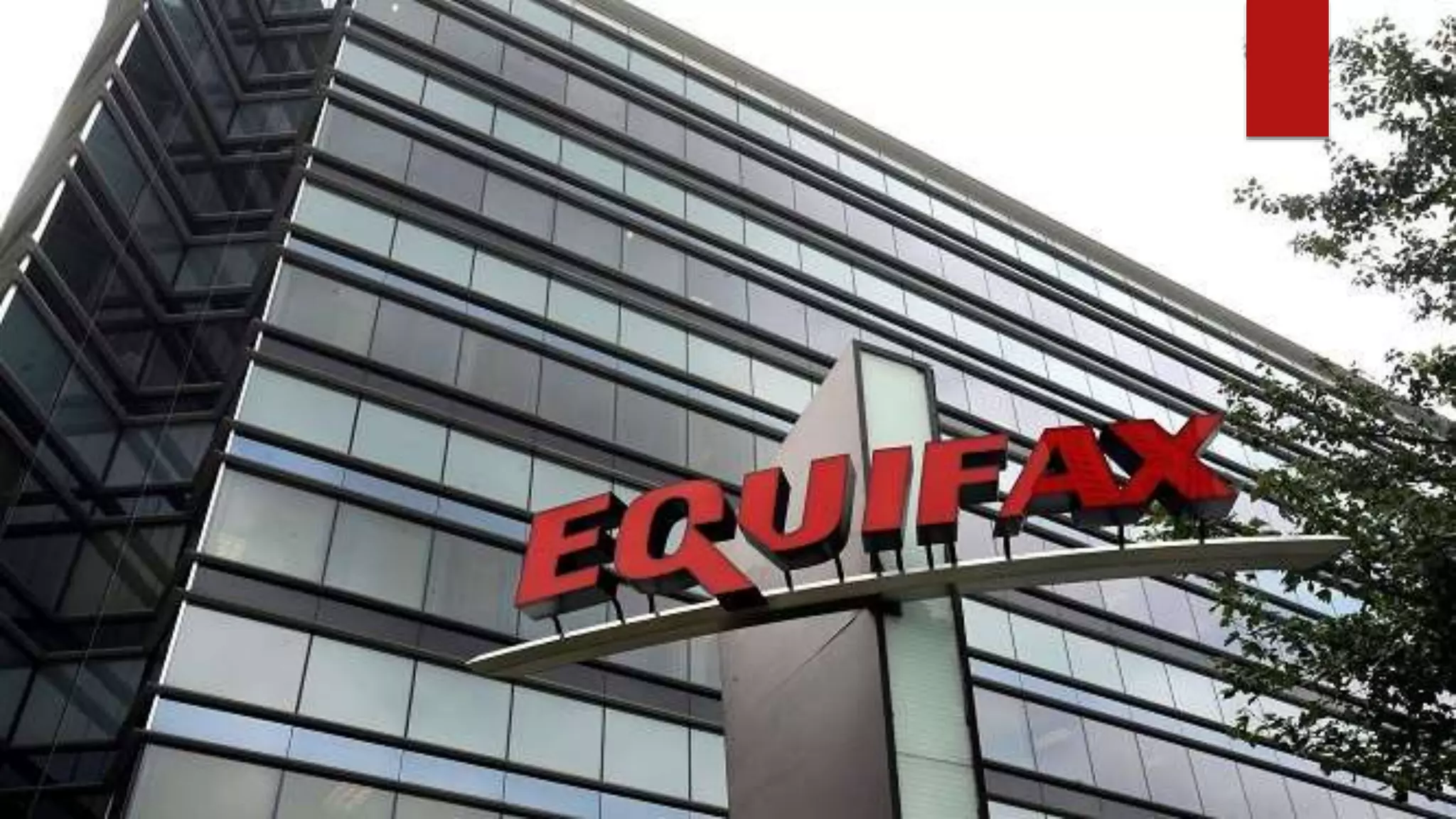
EQUIFAX
DATA BREACH
2
What happened?
3
Equifax announced that on September 7th 2017, 143 million US based users and
unknown number of Canadian users had their
• FULL NAME
• SOCIAL SECURITY NUMBER
• ADDRESS
• DATE OF BIRTH
• DIVER’S LICENSE NUMBER
• CREDIT HISTORY
Source: https://www.govinfosecurity.com
4
Why I bother?
5
• If you cut out the under 18’s you might be looking at percentage of 58%
of adults who are hacked now.
• If you ever help or inquired about a credit card, cell phone account,
security clearance, jobs, electric service, water service, housing rent,
internet service, universities you are most likely affected.
• This isn’t like other hacks where credit card information was out, where
you could cancel a credit card.
• It’s like someone cloned you for the express purpose of that person
opening up credit cards in your name and maxing it out.
6
• 143 million U.S. consumers' personal details, including names, birthdates,
addresses, Social Security numbers and in some cases driver's license
numbers.
• 209,000 U.S. consumers' payment cards.
• 182,000 U.S. consumers' credit dispute documents, containing personal
information.
• 400,000 British consumers' personal details, which Equifax was accidentally
storing on its U.S. servers.
• 100,000 Canadian consumers' personal details.
Breach Report
Source: https://www.govinfosecurity.com
7
How it has been
attacked?
8
• Equifax failed to patch a vulnerability in Apache Struts - a web application
development framework - in a timely manner.
• Equifax has confirmed that attackers entered its system in mid-May 2017, through
the patch available in March.
• The vulnerability was Apache Struts CVE-2017-5638.
• It allows remote attackers to execute arbitrary commands via a #cmd= string in a
crafted Content-Type HTTP header, as exploited in the wild in March 2017.
9
Source: https://nvd.nist.gov/vuln/detail/CVE-2017-5638
What to do now?
10
1. Get a credit report right now!
2. Monitor your credit!
3. Initiate a credit freeze (optional).
If you are part of this affected group :
11
• The breach of Equifax is a shining example of what happens when you do not
prepare for data breach response ahead of time.
• Though Equifax ironically provides identity theft protection services it has
been hacked with most valuable information from it’s server.
Conclusion
12

Equifax data breach

  • 2.
  • 3.
  • 4.
    Equifax announced thaton September 7th 2017, 143 million US based users and unknown number of Canadian users had their • FULL NAME • SOCIAL SECURITY NUMBER • ADDRESS • DATE OF BIRTH • DIVER’S LICENSE NUMBER • CREDIT HISTORY Source: https://www.govinfosecurity.com 4
  • 5.
  • 6.
    • If youcut out the under 18’s you might be looking at percentage of 58% of adults who are hacked now. • If you ever help or inquired about a credit card, cell phone account, security clearance, jobs, electric service, water service, housing rent, internet service, universities you are most likely affected. • This isn’t like other hacks where credit card information was out, where you could cancel a credit card. • It’s like someone cloned you for the express purpose of that person opening up credit cards in your name and maxing it out. 6
  • 7.
    • 143 millionU.S. consumers' personal details, including names, birthdates, addresses, Social Security numbers and in some cases driver's license numbers. • 209,000 U.S. consumers' payment cards. • 182,000 U.S. consumers' credit dispute documents, containing personal information. • 400,000 British consumers' personal details, which Equifax was accidentally storing on its U.S. servers. • 100,000 Canadian consumers' personal details. Breach Report Source: https://www.govinfosecurity.com 7
  • 8.
    How it hasbeen attacked? 8
  • 9.
    • Equifax failedto patch a vulnerability in Apache Struts - a web application development framework - in a timely manner. • Equifax has confirmed that attackers entered its system in mid-May 2017, through the patch available in March. • The vulnerability was Apache Struts CVE-2017-5638. • It allows remote attackers to execute arbitrary commands via a #cmd= string in a crafted Content-Type HTTP header, as exploited in the wild in March 2017. 9 Source: https://nvd.nist.gov/vuln/detail/CVE-2017-5638
  • 10.
    What to donow? 10
  • 11.
    1. Get acredit report right now! 2. Monitor your credit! 3. Initiate a credit freeze (optional). If you are part of this affected group : 11
  • 12.
    • The breachof Equifax is a shining example of what happens when you do not prepare for data breach response ahead of time. • Though Equifax ironically provides identity theft protection services it has been hacked with most valuable information from it’s server. Conclusion 12