EPILEPSY
August 10, 2013 SSG 1
August 10, 2013 SSG 2
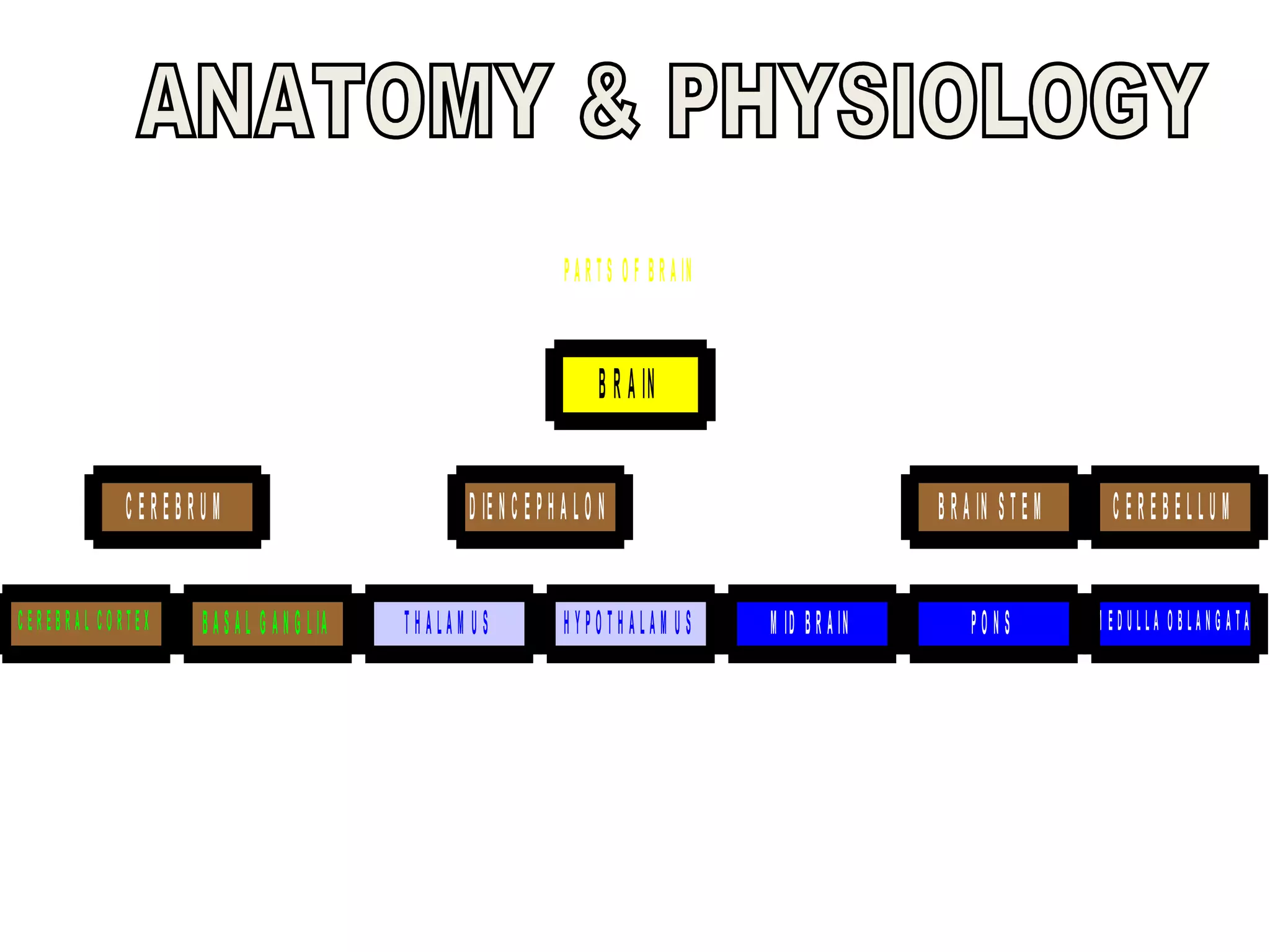
P A R T S O F B R A IN
C E R E B R A L C O R T E X B A S A L G A N G L IA
C E R E B R U M
T H A L A M U S H Y P O T H A L A M U S
D IE N C E P H A L O N
M ID B R A IN P O N S M E D U L L A O B L A N G A T A
B R A IN S T E M C E R E B E L L U M
B R A IN
August 10, 2013 CNE 3
August 10, 2013 CNE 4
@ CEREBRUM (two hemisphere)
 
A. FUNCTION
1. Highest level of functioning.
2. Governs all sensory and motor activity,
thought and learning.
3. Analyzes, associates, integrates and stores
information.
August 10, 2013 SSG 5
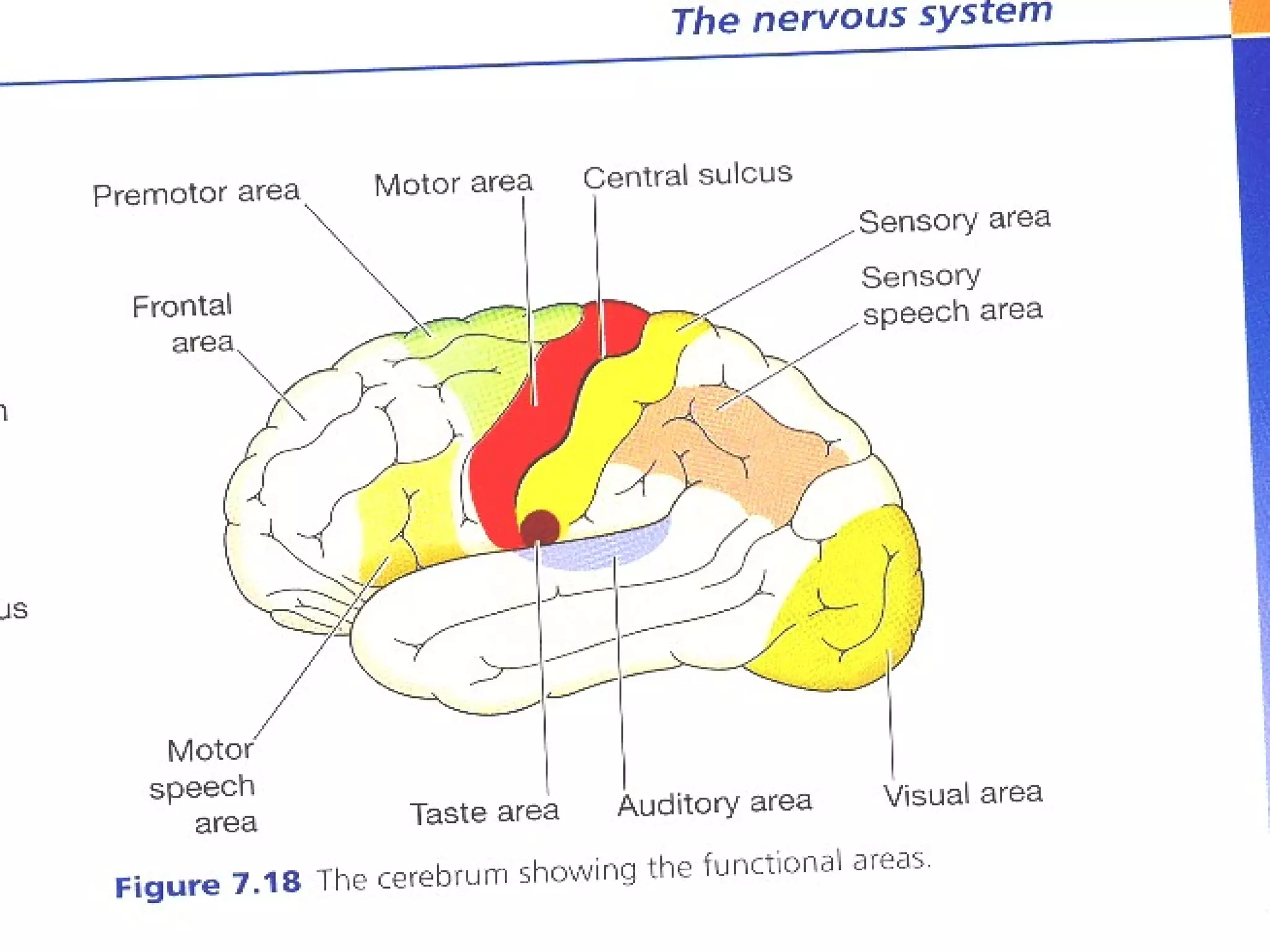
@ Cerebral Cortex (outer gray layer) divided into four
major lobes:
1. FRONTAL
* Precentral gyrus-motor function
* Broca s area –motor speech area
* Prefrontal-controls morals,values and judgments
2.  PARIETAL
* Post central gyrus-integrates general sensation
* Interprets pain,touch,temp. and pressure
* Governs discriminations
3.  TEMPORAL
* Auditory center
* Wernicke”s area-sensory speech center
4.  OCCIPITAL –VISUAL AREA
August 10, 2013 SSG 6
@ BASAL GANGLIA
* Collections of cell bodies in white
matter
* Control motor movement
* Part of extra pyramidal tract
August 10, 2013 SSG 7
@. DIENCEPHALON
A.THALAMUS
1. Screens and relays sensory impulses to
cortex
2. lowest level crude conscious awareness
B.HYPOTHALAMUS-
Regulates autonomic nervous system,stress
response,sleep, appetite, body temp..fld bal.
and emotions.
August 10, 2013 SSG 8
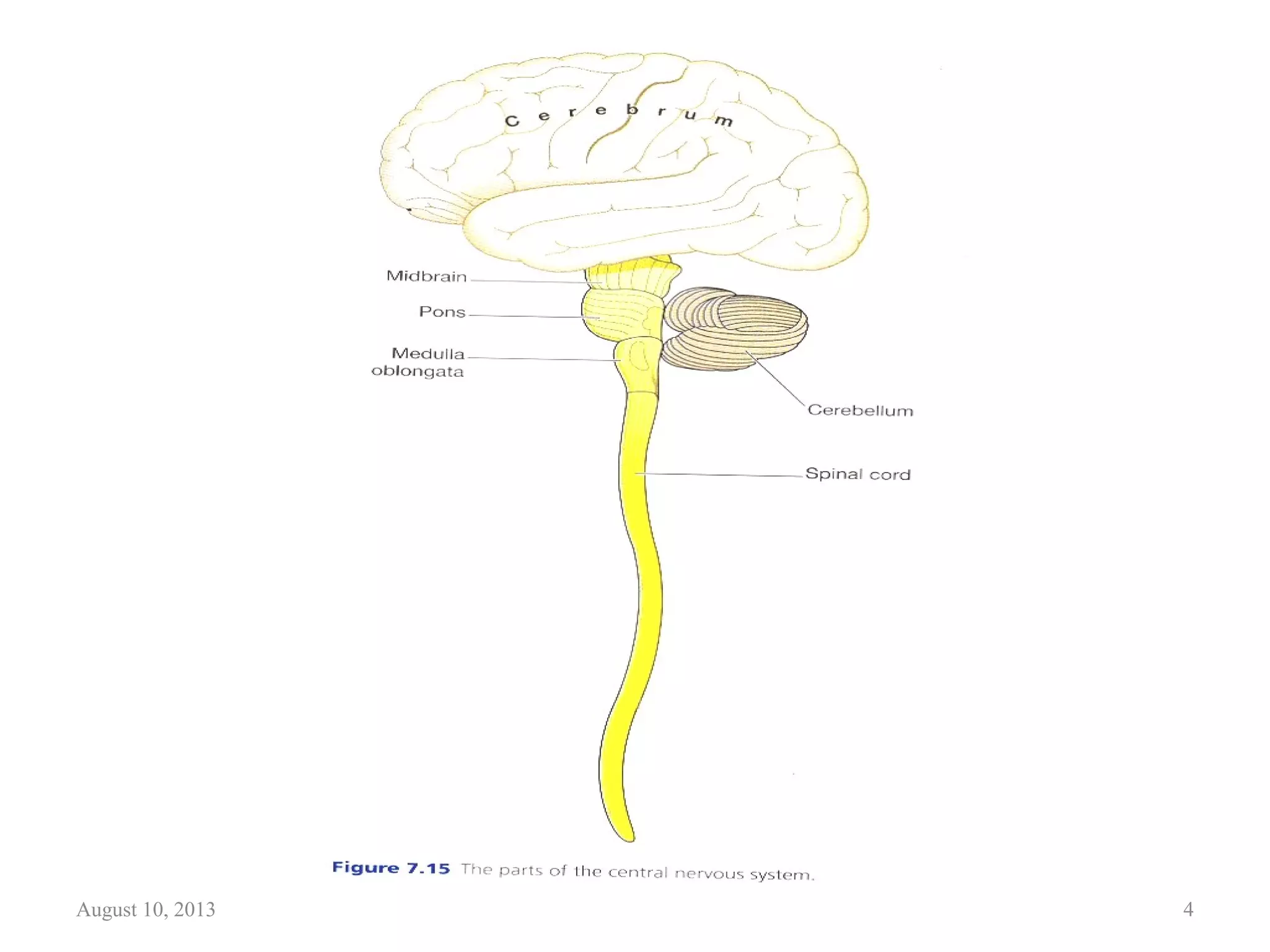
@. BRAIN STEM
A. Midbrain-motor coordination
       B. Pons-involuntary Resp. reflexes
C. Medulla oblongata-vasomotor
center
August 10, 2013 SSG 9
@.CEREBELLUM
Coordinates muscle movement,
posture and muscle tone.
August 10, 2013 SSG 10
August 10, 2013 CNE 11
HOW THE BRAIN WORKS?
1. Brain is made up of billions of cells,including a
networks of cell called NEURONS,this neurons
branch out ,much like branches on a tree.This
neural network enables communication with in the
brain and bet. The brain and the rest of the body.
2. When a neuron “fires” it sends small electrical
impulses along it’s branches toward surrounding
cells. At the end of each branch is a small gap or
synapse,which the impulse must overcome in order
to continue it’s journey.
August 10, 2013 SSG 12
3. When an impulse reaches the end of a
branch, chemicals called NEUROTRANSMITTER
are released to fld. the synapse.
Some are excitatory, stimulating the
neighboring cell to fire ,Others are inhibitory,
making the next cells less likely to fire.
August 10, 2013 CNE 13
EPILEPSY
A paroxysmal disturbance in a
consciousness with autonomic
sensory and or motor dysfunction ;a
manifestation of excessive neuronal
discharges in the brain.
August 10, 2013 SSG 14
CAUSES
It can be structural,chemical or physiological or
combined causes:
1. Genetic factors
2. Trauma-head-brain
3. Brain tumor
4. Circulatory disorder (stroke, arteriovenous
malformation)
5. Metabolic disorder (hypoglycemia,
hypocalcaemia, abnoxia)
6. Toxicity (drugs and alcohol)
7. CNS infection (encephalitis, meningitis,
abscess)August 10, 2013 SSG 15
CLASSIFICATIONS:
1. Symptomatic-secondary to probable
cause.
2. Idiopathic-primary epilepsy without
definite known cause.
August 10, 2013 SSG 16
SEIZURE:
An excessive discharge of electrical activity
within the brain,which leads to a change in
movement, sensation, experience or
consciousness.
The effects they have on the body vary
greatly depending on where in the brain the
seizures starts and where it spreads.
August 10, 2013 SSG 17
PHASES:
1. AURA- An unusual sensation or peculiar feeling
often felt prior to a more widespread seizure.can
also be called a simple partial seizure.
2. ICTUS- The whole seizure including the aura
3. POST ICTUS- Time after seizure;may experience
muscle weakness of deep sleep.
August 10, 2013 SSG 18
SEIZURE CAN CAUSE:
1. A twitching muscle
2. Convulsive movements
3. A tingling sensation
4. Sweating
5. The perception of an unusual smell or
taste
6. Hallucinations
7. Fear or anxiety
8. Changes in awareness
9. Loss of consciousness
10. Other changes
August 10, 2013 SSG 19
TYPES:
1. GENERALIZED SEIZURES:
Affects both hemispheres of the brain
at the same time.abnormal activity is not
focused in one specific area and there
generally is no aura at the start.
August 10, 2013 SSG 20
FORMS:
1. Typical absence seizure (Petit Mal)
-Result in brief episodes of impaired awareness. There
also may be small motor movements, changes in muscle
tone or automatic behaviors. Most common in children.
2. Atonic / Akinetic seizures
-Associated with a sudden loss of muscle tone in a limb
or throughout the entire body.The person having the
seizures will drop things or fall to the ground.
August 10, 2013 SSG 21
3. Myoclonic
-Sudden shock like jolt to one or more muscle
which increases muscle tone and causes
movement. These sudden jerks are like those that
occur in healthy people as fall sleep.
4. Tonic-Clonic (Grand Mal)
-Begin with simultaneous loss of consciousness
and the tonic phase (stiffening of the body) the
person falls to the ground and often emits a loud
cry as the chest muscle stiffing.
Next comes the clonic phase,during which the
muscles rhythmically jerk.
August 10, 2013 SSG 22
2. PARTIAL SEIZURE
- It begin in a part of one brain hemisphere,
generally in the temporal or frontal lobe.
August 10, 2013 SSG 23
TYPES:
1. SIMPLE PARTIAL (aura’s)
* Is focused in a specific area of the brain.
* A person remains alert and afterward is
able to remember what happened.
* An aura or simple partial seizure may
constitute the entire seizure or may
precede a complex partial or generalized
seizure.
August 10, 2013 SSG 24
SYMPTOMS VARY ON THE AREA OF THE BRAIN:
1. Motor seizures cause a change in muscle
activity and may involve jerking or stiffening
of a part of the body.
2. Sensory seizures may cause abnormal
functions in any of the five senses.
3. Autonomic seizures affect involuntary functions
and may cause a rapid heart beat or breathing
rate, sweating or an unpleasant sensation in
the abdomen,chest,throat or head.
4. Psychic seizures may affect perception and
memory or stimulate emotions such as fear
August 10, 2013 SSG 25
2.COMPLEX PARTIAL SEIZURES:
@ Seizure accompanied by impaired
consciousness and recall.
@ May also involve staring,automatic
behavior such as smacking chewing
,picking ,walking, grunting, repetition of
word or phrases or other symptoms
and signs.August 10, 2013 SSG 26
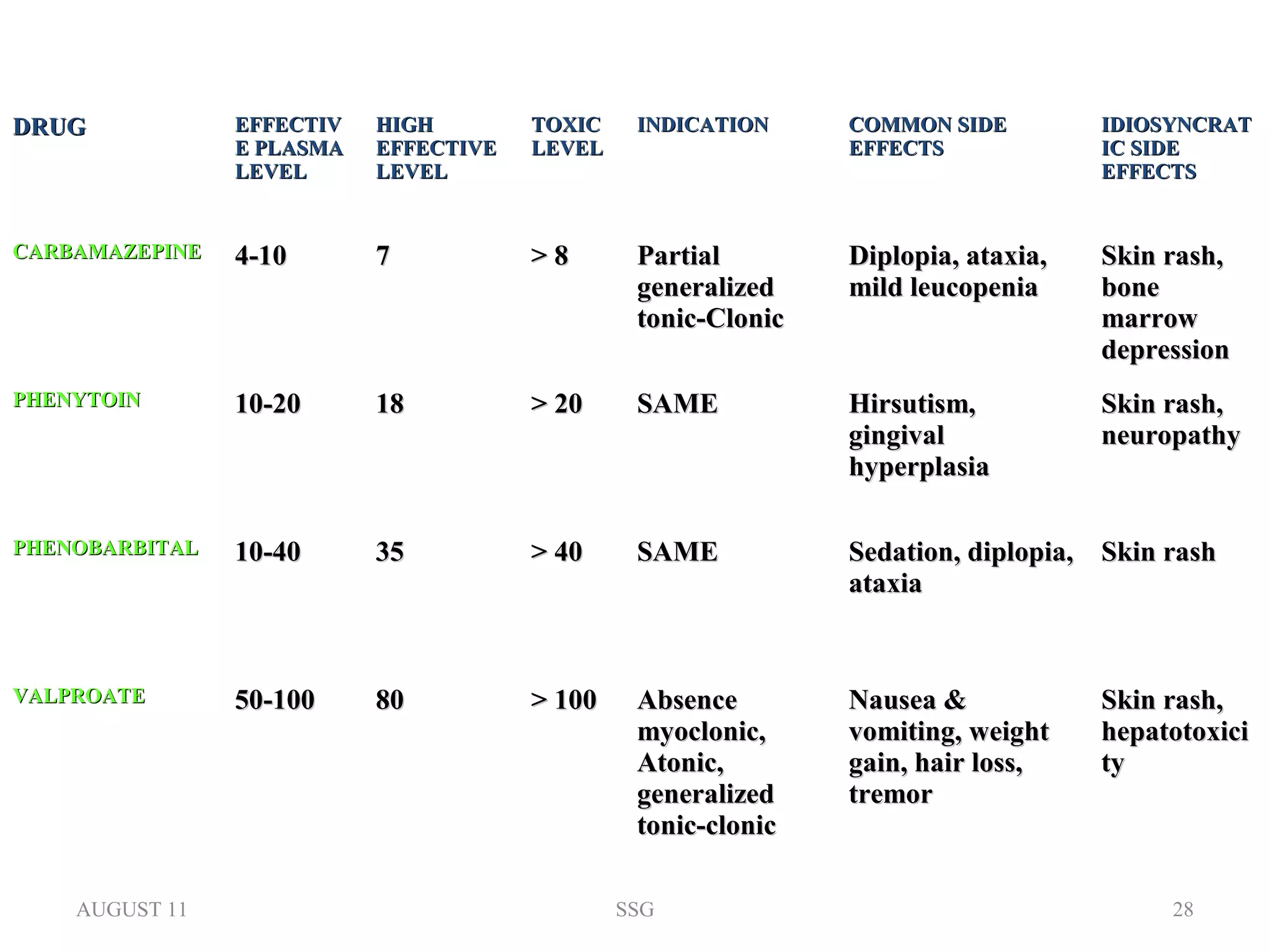
DRUGS COMMONLY USED IN EPILEPSY:
1. CARBAMAZEPINE
2. PHENYTOIN
3. PHENOBARBITAL
4. VALPROATE
August 10, 2013 SSG 27
DRUGDRUG EFFECTIVEFFECTIV
E PLASMAE PLASMA
LEVELLEVEL
HIGHHIGH
EFFECTIVEEFFECTIVE
LEVELLEVEL
TOXICTOXIC
LEVELLEVEL
INDICATIONINDICATION COMMON SIDECOMMON SIDE
EFFECTSEFFECTS
IDIOSYNCRATIDIOSYNCRAT
IC SIDEIC SIDE
EFFECTSEFFECTS
CARBAMAZEPINECARBAMAZEPINE 4-104-10 77 > 8> 8 PartialPartial
generalizedgeneralized
tonic-Clonictonic-Clonic
Diplopia, ataxia,Diplopia, ataxia,
mild leucopeniamild leucopenia
Skin rash,Skin rash,
bonebone
marrowmarrow
depressiondepression
PHENYTOINPHENYTOIN 10-2010-20 1818 > 20> 20 SAMESAME Hirsutism,Hirsutism,
gingivalgingival
hyperplasiahyperplasia
Skin rash,Skin rash,
neuropathyneuropathy
PHENOBARBITALPHENOBARBITAL 10-4010-40 3535 > 40> 40 SAMESAME Sedation, diplopia,Sedation, diplopia,
ataxiaataxia
Skin rashSkin rash
VALPROATEVALPROATE 50-10050-100 8080 > 100> 100 AbsenceAbsence
myoclonic,myoclonic,
Atonic,Atonic,
generalizedgeneralized
tonic-clonictonic-clonic
Nausea &Nausea &
vomiting, weightvomiting, weight
gain, hair loss,gain, hair loss,
tremortremor
Skin rash,Skin rash,
hepatotoxicihepatotoxici
tyty
AUGUST 11 SSG 28
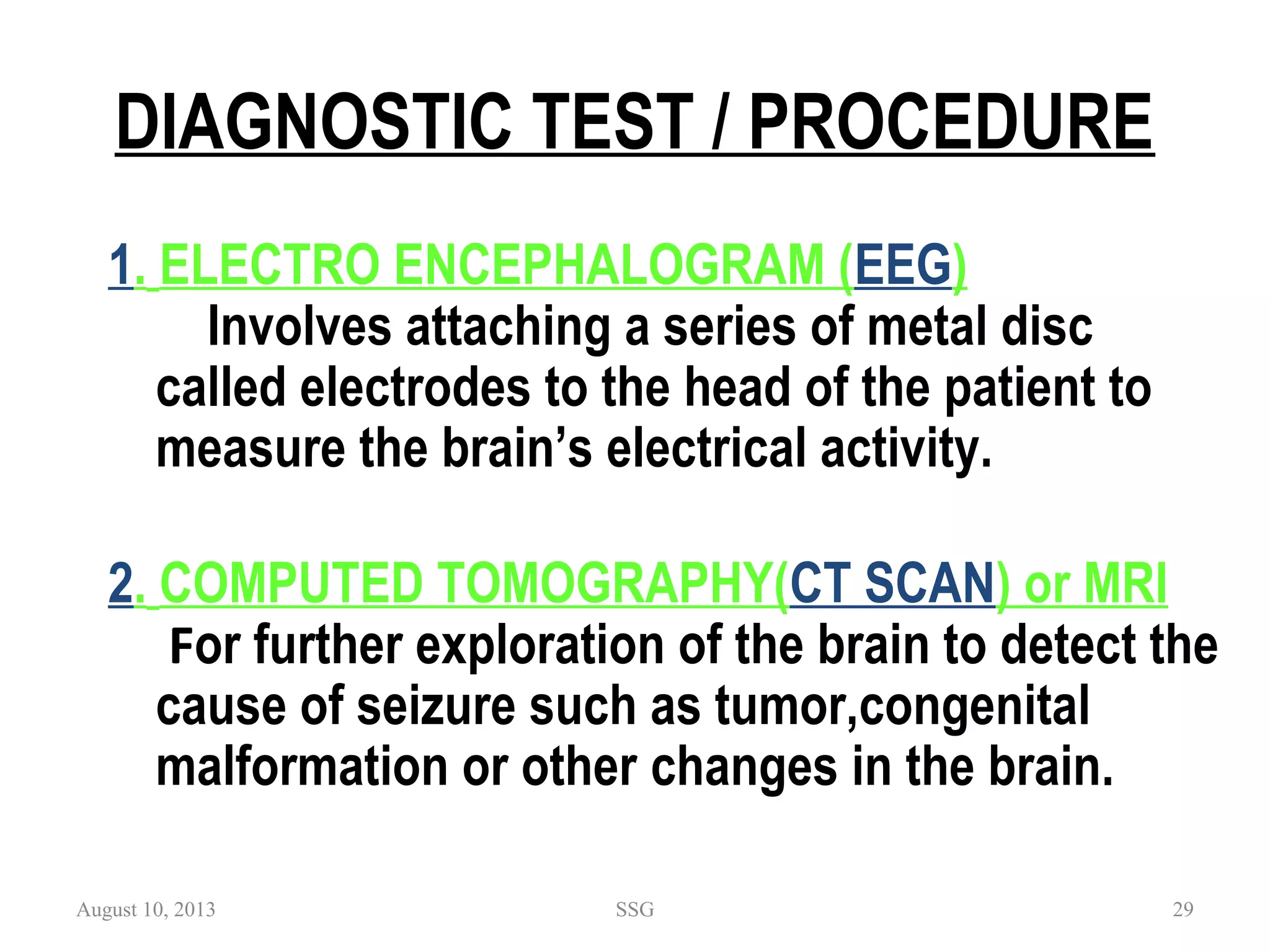
DIAGNOSTIC TEST / PROCEDURE
1. ELECTRO ENCEPHALOGRAM (EEG)
Involves attaching a series of metal disc
called electrodes to the head of the patient to
measure the brain’s electrical activity.
2. COMPUTED TOMOGRAPHY(CT SCAN) or MRI
 For further exploration of the brain to detect the
cause of seizure such as tumor,congenital
malformation or other changes in the brain.
August 10, 2013 SSG 29
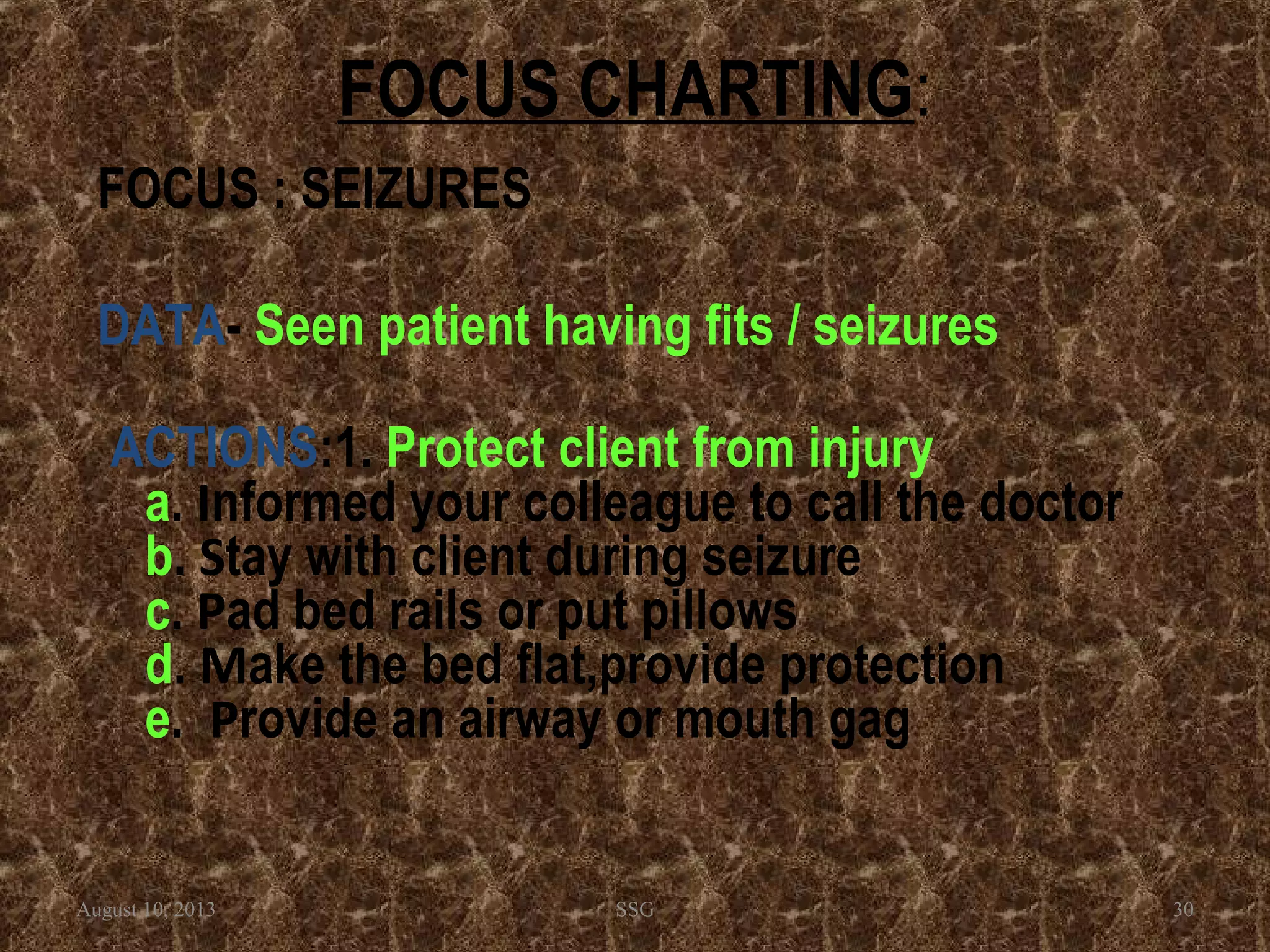
FOCUS CHARTING:
FOCUS : SEIZURES
DATA- Seen patient having fits / seizures
ACTIONS:1. Protect client from injury
a. Informed your colleague to call the doctor
b. Stay with client during seizure
c. Pad bed rails or put pillows
d. Make the bed flat,provide protection
e. Provide an airway or mouth gag
August 10, 2013 SSG 30
*never restraints of if tongue is caught in teeth
do not attempt to open it *
3.  Observe and record seizures pattern
4.  Provide privacy during seizure
5.  Administer and monitor the effects of
medications
RESPONSE- Free from injury and privacy
provided and absence of seizure.
August 10, 2013 SSG 31
CASE HISTORY
PATIENT NAME MR. X
SEX /AGE MALE / 19 Y.O.
NATIONALITY SAUDI
COMPANY ARAMCO-PCUR
MR # 43-71-98
CASE NO. 249877
DATE OF ADMISSION 23/09/03
DATE OF DISCHARGE STILL IN THE HOSPITAL
NAME OF DOCTOR; DR. M.D. MANIKAL
DEPARTMENT NEUROLOGY.
August 10, 2013 SSG 32
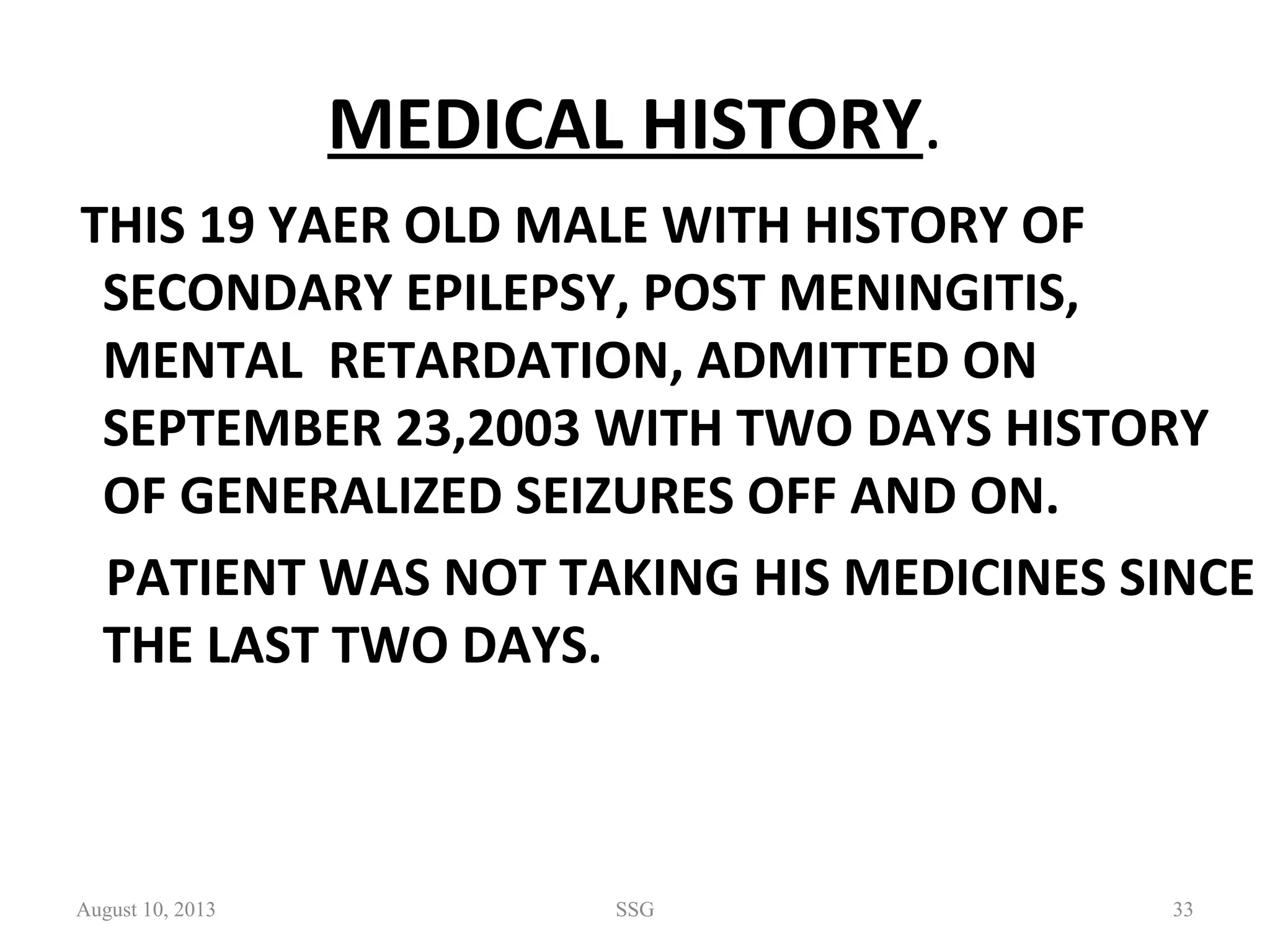
MEDICAL HISTORY.
THIS 19 YAER OLD MALE WITH HISTORY OF 
SECONDARY EPILEPSY, POST MENINGITIS, 
MENTAL  RETARDATION, ADMITTED ON 
SEPTEMBER 23,2003 WITH TWO DAYS HISTORY 
OF GENERALIZED SEIZURES OFF AND ON. 
    PATIENT WAS NOT TAKING HIS MEDICINES SINCE 
THE LAST TWO DAYS.
August 10, 2013 SSG 33
EXAMINATION.
PATIENT IS AWAKE, POST ICTAL STATE AND
IRRITABLE.
PULSE: 105/MIN.
BLD. PRESSURE: 120/80 mmHg, Afebrile, SPO2:
95%.
Other systemic examination unremarkable. A
scar of old brain surgery long time ago on left
side of scalp was noted.
August 10, 2013 SSG 34
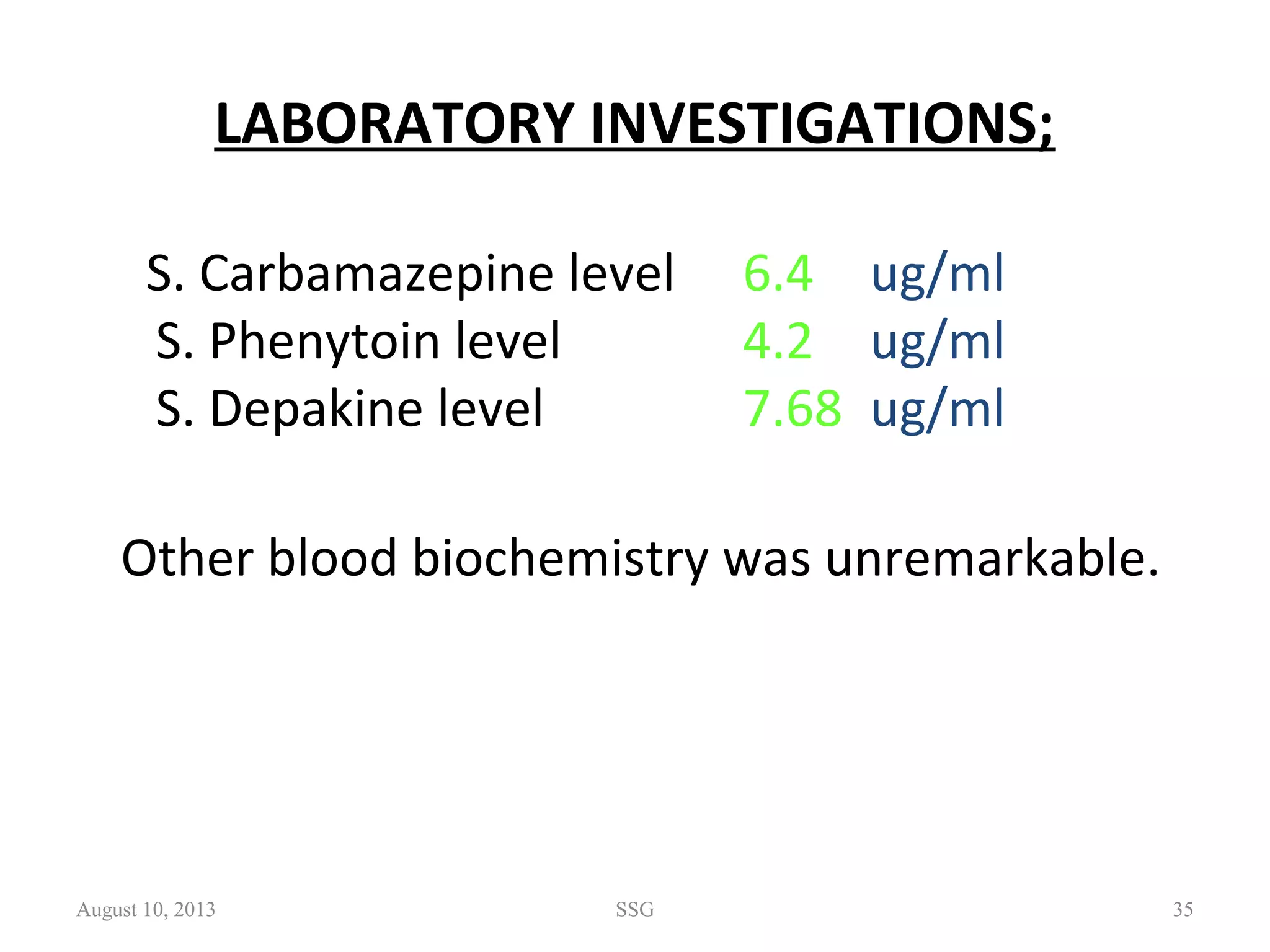
LABORATORY INVESTIGATIONS;
S. Carbamazepine level 6.4 ug/ml
S. Phenytoin level 4.2 ug/ml
S. Depakine level 7.68 ug/ml
Other blood biochemistry was unremarkable.
August 10, 2013 SSG 35
TREATMENT
Patient was admitted in ICU, given Valium 5mg IV 
stat then PRN basis. Started on IV flds, given IV 
Phenytoin 600mg IV stat then Phenytoin 200mg 
IV Tid for 24hrs. then Phenytoin 400mg PO x OD 
started his usual medicines.Tegretol CR 400mg 
PO TID, Lamictal 150mg PO BID, Caltrate 600mg 
PO x OD, One Alpha 0.25 ug PO BID. Patient has 
improved and transferred to floor on Sept. 25, 
2003 in satisfactory condition.
August 10, 2013 SSG 36
This young man needs a constant caregiver 
attention to cater to his daily self care / 
hygiene activities as also to attend to regular 
medications and seizure precautions. Strict 
compliance to anti-epileptic medications is 
needed so that he does not present 
repeatedly  with seizures as emergency to the 
hospital.
He is being discharged and may attend follow 
up as required every month or two to the 
Neurology clinic.
August 10, 2013 SSG 37
His relatives however are reluctant to keep him at 
home on the basis that he has a chronic 
permanent illness. This young man is again 
readmitted with seizure recurrence.
His S.Tegretol level is low , Epanutin level is high. 
Doses are being readjusted. He developed one 
episode of hematemesis and awaiting upper GI 
Endoscopy. He is likely to be a permanent 
neurological invalid due to his mental retardation 
and uncontrolled epilepsy,secondary to childhood 
meningitis.
He should ideally be in Long-term care unit, So LTC 
was recommended and transferred to the ALTC 
ward.
August 10, 2013 SSG 38
August 10, 2013 SSG 39

Epliepsy