Causes and Symptoms
Causes of epilepsy
In over half of epilepsy cases, a cause cannot be found. If
there is an identifiable cause, it usually involves the brain
being affected by a condition.
The brain is a delicate mix of nerve cells, electrical impulses
and chemicals, known as neurotransmitters. Any damage has
the potential to disrupt the workings of the brain and cause
seizures.
CONT,
There are two main categories of epilepsy:
 idiopathic (or primary) epilepsy – where no apparent
cause for epilepsy can be found, but there may be a
family history, suggesting that the condition is inherited
 symptomatic (or secondary) epilepsy – where there is a
known cause for a person’s epilepsy
Idiopathic epilepsy
In many cases, no cause of epilepsy is found. This may be because
medical equipment is not advanced enough to spot some types of
damage, or because the epilepsy has a genetic cause.
Many researchers have suggested that small genetic changes in the
brain could be the cause of epilepsy. Current research is looking
for defects in certain genes that may affect electrical transmission
in the brain.
A number of studies have been carried out; however, no strong
association has so far been found between any particular genes
and the development of epilepsy.
Symptomatic epilepsy
 Causes of symptomatic epilepsy can include:
 Cerebrovascular disease(problems with the blood vessels
that supply the brain) – such as a stroke or subarachnoid
haemorrhage
 Brain tumours
 Severe head injuries
 Drug abuse and alcohol misuse
Symptomatic epilepsy
 Infections that can damage the brain – such as meningitis
 Problems during birth that cause a baby to be deprived of
oxygen – such as the umbilical cord getting twisted or
compressed during labour
 Some parts of the brain not developing properly
 Although some of these problems can cause epilepsy in
childhood, symptomatic epilepsy is generally more
common in older people – particularly those over 60 years
of age.
Seizure triggers
For many people with epilepsy, seizures can occur without any
obvious trigger. However, certain circumstances or the use of
certain substances can sometimes precede a seizure. These
include:
 Stress
 Lack of sleep
 Drinking alcohol
 Some medications and illegal drugs
 In women, monthly periods
 Flashing lights (this is an uncommon trigger that affects only 5%
of people with epilepsy, and is known as photosensitive
epilepsy)
Symptoms of epilepsy
The main symptoms of epilepsy are repeated seizures
(fits). There are many different types of seizure,
depending on the area of the brain affected.
People with epilepsy can experience any type of seizure,
although most people have a consistent pattern of
symptoms.
Seizures can occur when you are awake or asleep.
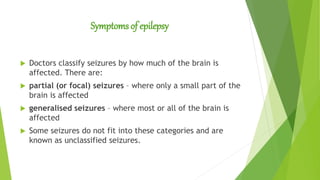
Symptoms of epilepsy
 Doctors classify seizures by how much of the brain is
affected. There are:
 partial (or focal) seizures – where only a small part of the
brain is affected
 generalised seizures – where most or all of the brain is
affected
 Some seizures do not fit into these categories and are
known as unclassified seizures.
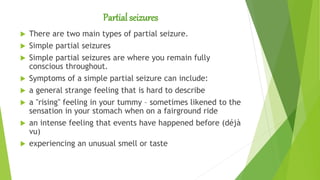
Partial seizures
 There are two main types of partial seizure.
 Simple partial seizures
 Simple partial seizures are where you remain fully
conscious throughout.
 Symptoms of a simple partial seizure can include:
 a general strange feeling that is hard to describe
 a "rising" feeling in your tummy – sometimes likened to the
sensation in your stomach when on a fairground ride
 an intense feeling that events have happened before (déjà
vu)
 experiencing an unusual smell or taste
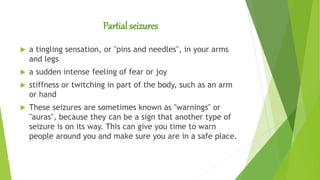
Partial seizures
 a tingling sensation, or "pins and needles", in your arms
and legs
 a sudden intense feeling of fear or joy
 stiffness or twitching in part of the body, such as an arm
or hand
 These seizures are sometimes known as "warnings" or
"auras", because they can be a sign that another type of
seizure is on its way. This can give you time to warn
people around you and make sure you are in a safe place.
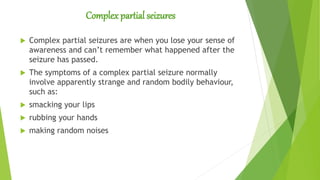
Complex partial seizures
 Complex partial seizures are when you lose your sense of
awareness and can’t remember what happened after the
seizure has passed.
 The symptoms of a complex partial seizure normally
involve apparently strange and random bodily behaviour,
such as:
 smacking your lips
 rubbing your hands
 making random noises
Complex partial seizures
 moving your arms around
 picking at clothes
 fiddling with objects
 adopting an unusual posture
 chewing or swallowing
 During a complex partial seizure, you will not be able to
respond to anyone else, and you will have no memory of
the event.
Generalisedseizures
There are six main types of generalised seizure.
Absences
Absence seizures, which used to be called petit mal, mainly
affect children, but they also occur in adults. They cause the
person to lose awareness of their surroundings, usually for
up to 15 seconds. The person will seem to stare vacantly into
space, although some people will flutter their eyes or smack
their lips. The person will have no memory of the seizure.
Absences can occur several times a day. They may affect a
child's performance at school, and can be dangerous if they
occur at a critical time, such as crossing a busy road.
Myoclonic seizures
These types of seizures cause your arms, legs or upper body
to jerk or twitch, as if you have received an electric shock.
They often only last for a fraction of a second, and you will
normally remain conscious during this time.
Myoclonic jerks often happen in the first few hours after
waking up and can occur in combination with other types of
generalised seizures.
Clonic seizures
These cause the same sort of twitching as myoclonic jerks,
except the symptoms will last longer, normally up to two
minutes. Loss of consciousness may also occur.
Atonic seizures
Atonic seizures cause all your muscles to suddenly relax, so
there is a chance you may fall to the ground and there is a
risk you could injure yourself.
Tonic seizures
Tonic seizures cause all your muscles to suddenly become
stiff, which can mean you lose balance and fall over. Like
atonic seizures, there is a risk of injury.
Tonic-clonic seizures
Tonic-clonic seizures or convulsions, which used to be known
as grand mal, have two stages. Your body will initially
become stiff and then your arms and legs will begin
twitching. You will lose consciousness and some people will
wet themselves. The seizure normally lasts a few minutes,
but can last longer.

Epilepsy Awareness

  • 1.
  • 2.
    Causes of epilepsy Inover half of epilepsy cases, a cause cannot be found. If there is an identifiable cause, it usually involves the brain being affected by a condition. The brain is a delicate mix of nerve cells, electrical impulses and chemicals, known as neurotransmitters. Any damage has the potential to disrupt the workings of the brain and cause seizures.
  • 3.
    CONT, There are twomain categories of epilepsy:  idiopathic (or primary) epilepsy – where no apparent cause for epilepsy can be found, but there may be a family history, suggesting that the condition is inherited  symptomatic (or secondary) epilepsy – where there is a known cause for a person’s epilepsy
  • 4.
    Idiopathic epilepsy In manycases, no cause of epilepsy is found. This may be because medical equipment is not advanced enough to spot some types of damage, or because the epilepsy has a genetic cause. Many researchers have suggested that small genetic changes in the brain could be the cause of epilepsy. Current research is looking for defects in certain genes that may affect electrical transmission in the brain. A number of studies have been carried out; however, no strong association has so far been found between any particular genes and the development of epilepsy.
  • 5.
    Symptomatic epilepsy  Causesof symptomatic epilepsy can include:  Cerebrovascular disease(problems with the blood vessels that supply the brain) – such as a stroke or subarachnoid haemorrhage  Brain tumours  Severe head injuries  Drug abuse and alcohol misuse
  • 6.
    Symptomatic epilepsy  Infectionsthat can damage the brain – such as meningitis  Problems during birth that cause a baby to be deprived of oxygen – such as the umbilical cord getting twisted or compressed during labour  Some parts of the brain not developing properly  Although some of these problems can cause epilepsy in childhood, symptomatic epilepsy is generally more common in older people – particularly those over 60 years of age.
  • 7.
    Seizure triggers For manypeople with epilepsy, seizures can occur without any obvious trigger. However, certain circumstances or the use of certain substances can sometimes precede a seizure. These include:  Stress  Lack of sleep  Drinking alcohol  Some medications and illegal drugs  In women, monthly periods  Flashing lights (this is an uncommon trigger that affects only 5% of people with epilepsy, and is known as photosensitive epilepsy)
  • 8.
    Symptoms of epilepsy Themain symptoms of epilepsy are repeated seizures (fits). There are many different types of seizure, depending on the area of the brain affected. People with epilepsy can experience any type of seizure, although most people have a consistent pattern of symptoms. Seizures can occur when you are awake or asleep.
  • 9.
    Symptoms of epilepsy Doctors classify seizures by how much of the brain is affected. There are:  partial (or focal) seizures – where only a small part of the brain is affected  generalised seizures – where most or all of the brain is affected  Some seizures do not fit into these categories and are known as unclassified seizures.
  • 10.
    Partial seizures  Thereare two main types of partial seizure.  Simple partial seizures  Simple partial seizures are where you remain fully conscious throughout.  Symptoms of a simple partial seizure can include:  a general strange feeling that is hard to describe  a "rising" feeling in your tummy – sometimes likened to the sensation in your stomach when on a fairground ride  an intense feeling that events have happened before (déjà vu)  experiencing an unusual smell or taste
  • 11.
    Partial seizures  atingling sensation, or "pins and needles", in your arms and legs  a sudden intense feeling of fear or joy  stiffness or twitching in part of the body, such as an arm or hand  These seizures are sometimes known as "warnings" or "auras", because they can be a sign that another type of seizure is on its way. This can give you time to warn people around you and make sure you are in a safe place.
  • 12.
    Complex partial seizures Complex partial seizures are when you lose your sense of awareness and can’t remember what happened after the seizure has passed.  The symptoms of a complex partial seizure normally involve apparently strange and random bodily behaviour, such as:  smacking your lips  rubbing your hands  making random noises
  • 13.
    Complex partial seizures moving your arms around  picking at clothes  fiddling with objects  adopting an unusual posture  chewing or swallowing  During a complex partial seizure, you will not be able to respond to anyone else, and you will have no memory of the event.
  • 14.
    Generalisedseizures There are sixmain types of generalised seizure. Absences Absence seizures, which used to be called petit mal, mainly affect children, but they also occur in adults. They cause the person to lose awareness of their surroundings, usually for up to 15 seconds. The person will seem to stare vacantly into space, although some people will flutter their eyes or smack their lips. The person will have no memory of the seizure. Absences can occur several times a day. They may affect a child's performance at school, and can be dangerous if they occur at a critical time, such as crossing a busy road.
  • 15.
    Myoclonic seizures These typesof seizures cause your arms, legs or upper body to jerk or twitch, as if you have received an electric shock. They often only last for a fraction of a second, and you will normally remain conscious during this time. Myoclonic jerks often happen in the first few hours after waking up and can occur in combination with other types of generalised seizures.
  • 16.
    Clonic seizures These causethe same sort of twitching as myoclonic jerks, except the symptoms will last longer, normally up to two minutes. Loss of consciousness may also occur.
  • 17.
    Atonic seizures Atonic seizurescause all your muscles to suddenly relax, so there is a chance you may fall to the ground and there is a risk you could injure yourself.
  • 18.
    Tonic seizures Tonic seizurescause all your muscles to suddenly become stiff, which can mean you lose balance and fall over. Like atonic seizures, there is a risk of injury.
  • 19.
    Tonic-clonic seizures Tonic-clonic seizuresor convulsions, which used to be known as grand mal, have two stages. Your body will initially become stiff and then your arms and legs will begin twitching. You will lose consciousness and some people will wet themselves. The seizure normally lasts a few minutes, but can last longer.