Presented by:
Shaheen Wasil
M.S. Pharm (2nd Sem.)
Pharmacology & Toxicology
National Institute of Pharmaceutical Education & Research (NIPER)
S.A.S. Nagar , Mohali
Flow of Presentation
Introduction
Various epigenetic modifications
Epigenetics in disease
Therapeutic targeting of epigenetic modifications
Conclusion
Introduction
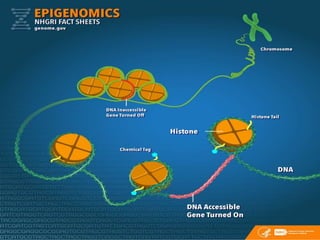
What is epigenome?
What does the epigenome do?
Is the epigenome inherited?
Can the epigenome change?
What makes the epigenome change?
Epigenetic Modifications
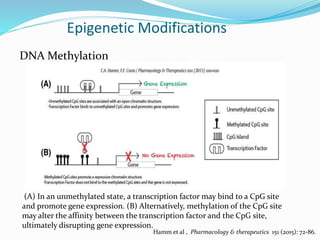
DNA Methylation
(A) In an unmethylated state, a transcription factor may bind to a CpG site
and promote gene expression. (B) Alternatively, methylation of the CpG site
may alter the affinity between the transcription factor and the CpG site,
ultimately disrupting gene expression.
Hamm et al , Pharmacology & therapeutics 151 (2015): 72-86.
Contd…
 DNA methylation is established and maintained by a family of
enzymes known as DNA methyltransferases(DNMTs)
 DNMT1
Most abundant DNMT
Maintainance of DNA methylation
Greater affinity for hemimethylated DNA
 DNMT3A & DNMT3B
De novo methylases, establish DNA methylation
No preference for hemimethylated or unmethylated DNA
 DNA methylation is removed by DNA demethylases(TET proteins).
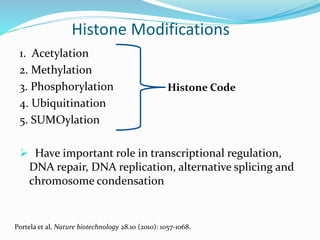
Histone Modifications
1. Acetylation
2. Methylation
3. Phosphorylation
4. Ubiquitination
5. SUMOylation
 Have important role in transcriptional regulation,
DNA repair, DNA replication, alternative splicing and
chromosome condensation
Portela et al, Nature biotechnology 28.10 (2010): 1057-1068.
Histone Code
Acetylation
 Involves acetylation of the lysine residues on the histone tails
mainly of H3 and H4 histones
 Represents active transcription
 Enzymes involved in the acetylation of histones are Histone
Acetyl Transferases (HATs)-GNAT, CBP/P300 etc
 Enzymes involved in removal of these acetylation marks are
Histone Deacetylases- Class I HDAC, Class II HDAC, Class IV
HDAC(zinc dependent metallohydrolases), and Class III HDAC
(NAD+ dependent deacetylases)
Methylation
 Involves methylation of the lysine residues in the histone tails
 Depending upon the position of lysine and number of methyl groups, this
mark can represent both active and repressed transcription
me3/me3 at H3K4, H3K36 and H3K79 represent active transcription
H3K9me2/me3, H3K36me2, H4K20me1 and H3K27me3 represent
repressed transcription
 The enzymes involved in methylation are the histone lysine methyl
transferases- Set1, Set7/9, etc
 The enzymes involved in the removal of these methyl groups are histone
lysine demethylases-LSD1, JMJD2A, etc
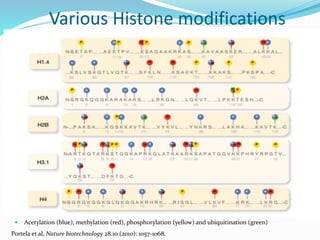
Various Histone modifications
 Acetylation (blue), methylation (red), phosphorylation (yellow) and ubiquitination (green)
Portela et al, Nature biotechnology 28.10 (2010): 1057-1068.
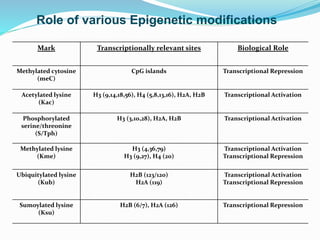
Mark Transcriptionally relevant sites Biological Role
Methylated cytosine
(meC)
CpG islands Transcriptional Repression
Acetylated lysine
(Kac)
H3 (9,14,18,56), H4 (5,8,13,16), H2A, H2B Transcriptional Activation
Phosphorylated
serine/threonine
(S/Tph)
H3 (3,10,28), H2A, H2B Transcriptional Activation
Methylated lysine
(Kme)
H3 (4,36,79)
H3 (9,27), H4 (20)
Transcriptional Activation
Transcriptional Repression
Ubiquitylated lysine
(Kub)
H2B (123/120)
H2A (119)
Transcriptional Activation
Transcriptional Repression
Sumoylated lysine
(Ksu)
H2B (6/7), H2A (126) Transcriptional Repression
Role of various Epigenetic modifications
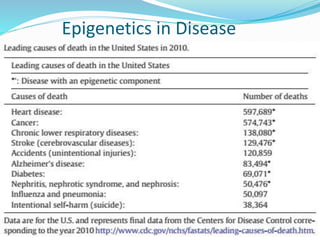
Epigenetics in Disease
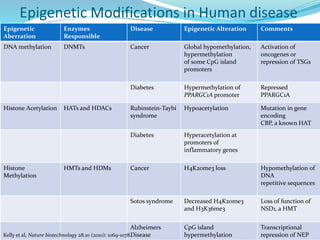
Epigenetic Modifications in Human disease
Epigenetic
Aberration
Enzymes
Responsible
Disease Epigenetic Alteration Comments
DNA methylation DNMTs Cancer Global hypomethylation,
hypermethylation
of some CpG island
promoters
Activation of
oncogenes or
repression of TSGs
Diabetes Hypermethylation of
PPARGC1A promoter
Repressed
PPARGC1A
Histone Acetylation HATs and HDACs Rubinstein-Taybi
syndrome
Hypoacetylation Mutation in gene
encoding
CBP, a known HAT
Diabetes Hyperacetylation at
promoters of
inflammatory genes
Histone
Methylation
HMTs and HDMs Cancer H4K20me3 loss Hypomethylation of
DNA
repetitive sequences
Sotos syndrome Decreased H4K20me3
and H3K36me3
Loss of function of
NSD1, a HMT
Alzheimers
Disease
CpG island
hypermethylation
Transcriptional
repression of NEPKelly et al, Nature biotechnology 28.10 (2010): 1069-1078.
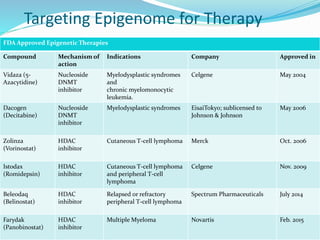
FDA Approved Epigenetic Therapies
Compound Mechanism of
action
Indications Company Approved in
Vidaza (5-
Azacytidine)
Nucleoside
DNMT
inhibitor
Myelodysplastic syndromes
and
chronic myelomonocytic
leukemia.
Celgene May 2004
Dacogen
(Decitabine)
Nucleoside
DNMT
inhibitor
Myelodysplastic syndromes EisaiTokyo; sublicensed to
Johnson & Johnson
May 2006
Zolinza
(Vorinostat)
HDAC
inhibitor
Cutaneous T-cell lymphoma Merck Oct. 2006
Istodax
(Romidepsin)
HDAC
inhibitor
Cutaneous T-cell lymphoma
and peripheral T-cell
lymphoma
Celgene Nov. 2009
Beleodaq
(Belinostat)
HDAC
inhibitor
Relapsed or refractory
peripheral T-cell lymphoma
Spectrum Pharmaceuticals July 2014
Farydak
(Panobinostat)
HDAC
inhibitor
Multiple Myeloma Novartis Feb. 2015
Targeting Epigenome for Therapy
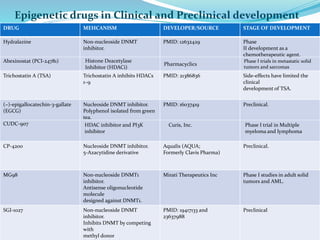
DRUG MEHCANISM DEVELOPER/SOURCE STAGE OF DEVELOPMENT
Hydralazine
Abexinostat (PCI-24781)
Non-nucleoside DNMT
inhibitor.
PMID: 12632429 Phase
II development as a
chemotherapeutic agent.
Trichostatin A (TSA) Trichostatin A inhibits HDACs
1–9
PMID: 21386836 Side-effects have limited the
clinical
development of TSA.
(−)-epigallocatechin-3-gallate
(EGCG)
CUDC-907
Nucleoside DNMT inhibitor.
Polyphenol isolated from green
tea.
PMID: 16037419 Preclinical.
CP-4200 Nucleoside DNMT inhibitor.
5-Azacytidine derivative
Aqualis (AQUA;
Formerly Clavis Pharma)
Preclinical.
MG98 Non-nucleoside DNMT1
inhibitor.
Antisense oligonucleotide
molecule
designed against DNMT1.
Mirati Therapeutics Inc Phase I studies in adult solid
tumors and AML.
SGI-1027 Non-nucleoside DNMT
inhibitor.
Inhibits DNMT by competing
with
methyl donor
PMID: 19417133 and
23637988
Preclinical
Epigenetic drugs in Clinical and Preclinical development
Histone Deacetylase
Inhibitor (HDACi)
Pharmacyclics
Phase I trials in metastatic solid
tumors and sarcomas
HDAC inhibitor and PI3K
inhibitor
Curis, Inc. Phase I trial in Multiple
myeloma and lymphoma
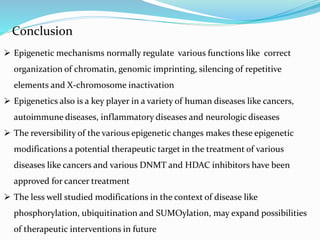
Conclusion
 Epigenetic mechanisms normally regulate various functions like correct
organization of chromatin, genomic imprinting, silencing of repetitive
elements and X-chromosome inactivation
 Epigenetics also is a key player in a variety of human diseases like cancers,
autoimmune diseases, inflammatory diseases and neurologic diseases
 The reversibility of the various epigenetic changes makes these epigenetic
modifications a potential therapeutic target in the treatment of various
diseases like cancers and various DNMT and HDAC inhibitors have been
approved for cancer treatment
 The less well studied modifications in the context of disease like
phosphorylation, ubiquitination and SUMOylation, may expand possibilities
of therapeutic interventions in future
Thank You

Epigenomes as a therapeutic target

  • 1.
    Presented by: Shaheen Wasil M.S.Pharm (2nd Sem.) Pharmacology & Toxicology National Institute of Pharmaceutical Education & Research (NIPER) S.A.S. Nagar , Mohali
  • 2.
    Flow of Presentation Introduction Variousepigenetic modifications Epigenetics in disease Therapeutic targeting of epigenetic modifications Conclusion
  • 3.
    Introduction What is epigenome? Whatdoes the epigenome do? Is the epigenome inherited? Can the epigenome change? What makes the epigenome change?
  • 5.
    Epigenetic Modifications DNA Methylation (A)In an unmethylated state, a transcription factor may bind to a CpG site and promote gene expression. (B) Alternatively, methylation of the CpG site may alter the affinity between the transcription factor and the CpG site, ultimately disrupting gene expression. Hamm et al , Pharmacology & therapeutics 151 (2015): 72-86.
  • 6.
    Contd…  DNA methylationis established and maintained by a family of enzymes known as DNA methyltransferases(DNMTs)  DNMT1 Most abundant DNMT Maintainance of DNA methylation Greater affinity for hemimethylated DNA  DNMT3A & DNMT3B De novo methylases, establish DNA methylation No preference for hemimethylated or unmethylated DNA  DNA methylation is removed by DNA demethylases(TET proteins).
  • 7.
    Histone Modifications 1. Acetylation 2.Methylation 3. Phosphorylation 4. Ubiquitination 5. SUMOylation  Have important role in transcriptional regulation, DNA repair, DNA replication, alternative splicing and chromosome condensation Portela et al, Nature biotechnology 28.10 (2010): 1057-1068. Histone Code
  • 8.
    Acetylation  Involves acetylationof the lysine residues on the histone tails mainly of H3 and H4 histones  Represents active transcription  Enzymes involved in the acetylation of histones are Histone Acetyl Transferases (HATs)-GNAT, CBP/P300 etc  Enzymes involved in removal of these acetylation marks are Histone Deacetylases- Class I HDAC, Class II HDAC, Class IV HDAC(zinc dependent metallohydrolases), and Class III HDAC (NAD+ dependent deacetylases)
  • 9.
    Methylation  Involves methylationof the lysine residues in the histone tails  Depending upon the position of lysine and number of methyl groups, this mark can represent both active and repressed transcription me3/me3 at H3K4, H3K36 and H3K79 represent active transcription H3K9me2/me3, H3K36me2, H4K20me1 and H3K27me3 represent repressed transcription  The enzymes involved in methylation are the histone lysine methyl transferases- Set1, Set7/9, etc  The enzymes involved in the removal of these methyl groups are histone lysine demethylases-LSD1, JMJD2A, etc
  • 10.
    Various Histone modifications Acetylation (blue), methylation (red), phosphorylation (yellow) and ubiquitination (green) Portela et al, Nature biotechnology 28.10 (2010): 1057-1068.
  • 11.
    Mark Transcriptionally relevantsites Biological Role Methylated cytosine (meC) CpG islands Transcriptional Repression Acetylated lysine (Kac) H3 (9,14,18,56), H4 (5,8,13,16), H2A, H2B Transcriptional Activation Phosphorylated serine/threonine (S/Tph) H3 (3,10,28), H2A, H2B Transcriptional Activation Methylated lysine (Kme) H3 (4,36,79) H3 (9,27), H4 (20) Transcriptional Activation Transcriptional Repression Ubiquitylated lysine (Kub) H2B (123/120) H2A (119) Transcriptional Activation Transcriptional Repression Sumoylated lysine (Ksu) H2B (6/7), H2A (126) Transcriptional Repression Role of various Epigenetic modifications
  • 12.
  • 13.
    Epigenetic Modifications inHuman disease Epigenetic Aberration Enzymes Responsible Disease Epigenetic Alteration Comments DNA methylation DNMTs Cancer Global hypomethylation, hypermethylation of some CpG island promoters Activation of oncogenes or repression of TSGs Diabetes Hypermethylation of PPARGC1A promoter Repressed PPARGC1A Histone Acetylation HATs and HDACs Rubinstein-Taybi syndrome Hypoacetylation Mutation in gene encoding CBP, a known HAT Diabetes Hyperacetylation at promoters of inflammatory genes Histone Methylation HMTs and HDMs Cancer H4K20me3 loss Hypomethylation of DNA repetitive sequences Sotos syndrome Decreased H4K20me3 and H3K36me3 Loss of function of NSD1, a HMT Alzheimers Disease CpG island hypermethylation Transcriptional repression of NEPKelly et al, Nature biotechnology 28.10 (2010): 1069-1078.
  • 14.
    FDA Approved EpigeneticTherapies Compound Mechanism of action Indications Company Approved in Vidaza (5- Azacytidine) Nucleoside DNMT inhibitor Myelodysplastic syndromes and chronic myelomonocytic leukemia. Celgene May 2004 Dacogen (Decitabine) Nucleoside DNMT inhibitor Myelodysplastic syndromes EisaiTokyo; sublicensed to Johnson & Johnson May 2006 Zolinza (Vorinostat) HDAC inhibitor Cutaneous T-cell lymphoma Merck Oct. 2006 Istodax (Romidepsin) HDAC inhibitor Cutaneous T-cell lymphoma and peripheral T-cell lymphoma Celgene Nov. 2009 Beleodaq (Belinostat) HDAC inhibitor Relapsed or refractory peripheral T-cell lymphoma Spectrum Pharmaceuticals July 2014 Farydak (Panobinostat) HDAC inhibitor Multiple Myeloma Novartis Feb. 2015 Targeting Epigenome for Therapy
  • 15.
    DRUG MEHCANISM DEVELOPER/SOURCESTAGE OF DEVELOPMENT Hydralazine Abexinostat (PCI-24781) Non-nucleoside DNMT inhibitor. PMID: 12632429 Phase II development as a chemotherapeutic agent. Trichostatin A (TSA) Trichostatin A inhibits HDACs 1–9 PMID: 21386836 Side-effects have limited the clinical development of TSA. (−)-epigallocatechin-3-gallate (EGCG) CUDC-907 Nucleoside DNMT inhibitor. Polyphenol isolated from green tea. PMID: 16037419 Preclinical. CP-4200 Nucleoside DNMT inhibitor. 5-Azacytidine derivative Aqualis (AQUA; Formerly Clavis Pharma) Preclinical. MG98 Non-nucleoside DNMT1 inhibitor. Antisense oligonucleotide molecule designed against DNMT1. Mirati Therapeutics Inc Phase I studies in adult solid tumors and AML. SGI-1027 Non-nucleoside DNMT inhibitor. Inhibits DNMT by competing with methyl donor PMID: 19417133 and 23637988 Preclinical Epigenetic drugs in Clinical and Preclinical development Histone Deacetylase Inhibitor (HDACi) Pharmacyclics Phase I trials in metastatic solid tumors and sarcomas HDAC inhibitor and PI3K inhibitor Curis, Inc. Phase I trial in Multiple myeloma and lymphoma
  • 16.
    Conclusion  Epigenetic mechanismsnormally regulate various functions like correct organization of chromatin, genomic imprinting, silencing of repetitive elements and X-chromosome inactivation  Epigenetics also is a key player in a variety of human diseases like cancers, autoimmune diseases, inflammatory diseases and neurologic diseases  The reversibility of the various epigenetic changes makes these epigenetic modifications a potential therapeutic target in the treatment of various diseases like cancers and various DNMT and HDAC inhibitors have been approved for cancer treatment  The less well studied modifications in the context of disease like phosphorylation, ubiquitination and SUMOylation, may expand possibilities of therapeutic interventions in future
  • 17.