

Epigenetics
The Microbiome
and
The Environment
Dr. Fathi Neana, MD
Chief of Orthopaedics
Dr. Fakhry & Dr. A. Al-Garzaie Hospital
October , 19 - 2020
The epigenome is a multitude of chemical compounds that can tell the genome what
to do. The human genome is the complete assembly of DNA (deoxyribonucleic acid)-
about 3 billion base pairs - that makes each individual unique.
DNA holds the instructions for building the proteins that carry out a variety of
functions in a cell.
The epigenome is made up of chemical compounds and proteins that can attach to
DNA and direct such actions as turning genes on or off, controlling the production of
proteins in particular cells.
When epigenomic compounds attach to DNA and modify its function, they are said to
have "marked" the genome. These marks do not change the sequence of the DNA.
Rather, they change the way cells use the DNA's instructions.
The marks are sometimes passed on from cell to cell as cells divide. They also can be
passed down from one generation to the next.
Epigenomics Fact Sheet
What is an epigenome
We are in the era of biochemistry and molecular
biology with better understanding of our genome
and DNA sequencing (the sequence of adenine,
guanine, cytosine, and thymine)
An epigenome consists of a record of the chemical
changes to the DNA and histone proteins of an
organism
These changes can be passed down to an
organism's offspring via transgenerational
epigenetic inheritance.
Wikipedia
What is an epigenome
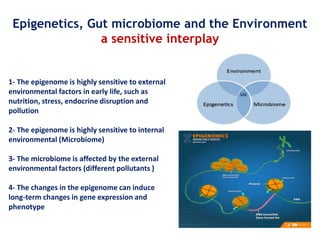
1- The epigenome is highly sensitive to external
environmental factors in early life, such as
nutrition, stress, endocrine disruption and
pollution
2- The epigenome is highly sensitive to internal
environmental (Microbiome)
3- The microbiome is affected by the external
environmental factors (different pollutants )
4- The changes in the epigenome can induce
long-term changes in gene expression and
phenotype
Epigenetics, Gut microbiome and the Environment
a sensitive interplay
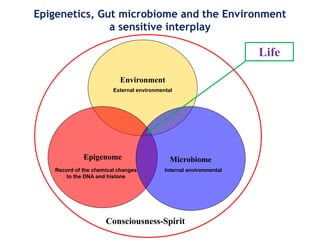
Environment
Epigenome Microbiome
Life
Consciousness-Spirit
Internal environmental
External environmental
Record of the chemical changes
to the DNA and histone
Epigenetics, Gut microbiome and the Environment
a sensitive interplay
How epigenetics, our gut microbiome
and the environment interact to change our lives
Ben Locwin | Genetic Literacy Project | October 17, 2016
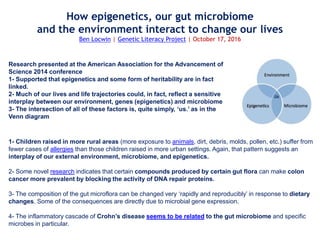
Research presented at the American Association for the Advancement of
Science 2014 conference
1- Supported that epigenetics and some form of heritability are in fact
linked.
2- Much of our lives and life trajectories could, in fact, reflect a sensitive
interplay between our environment, genes (epigenetics) and microbiome
3- The intersection of all of these factors is, quite simply, ‘us.’ as in the
Venn diagram
1- Children raised in more rural areas (more exposure to animals, dirt, debris, molds, pollen, etc.) suffer from
fewer cases of allergies than those children raised in more urban settings. Again, that pattern suggests an
interplay of our external environment, microbiome, and epigenetics.
2- Some novel research indicates that certain compounds produced by certain gut flora can make colon
cancer more prevalent by blocking the activity of DNA repair proteins.
3- The composition of the gut microflora can be changed very ‘rapidly and reproducibly’ in response to dietary
changes. Some of the consequences are directly due to microbial gene expression.
4- The inflammatory cascade of Crohn’s disease seems to be related to the gut microbiome and specific
microbes in particular.
Epigenetics and lifestyle
Jorge Alejandro Alegría-Torres,1 Andrea Baccarelli,2 and Valentina Bollati3,*
Epigenomics. Author manuscript; available in PMC 2013 Aug 26.
Published in final edited form as: Epigenomics. 2011 Jun; 3(3): 267–277.
doi: 10.2217/epi.11.22 PMCID: PMC3752894 NIHMSID: NIHMS498542 PMID: 22122337
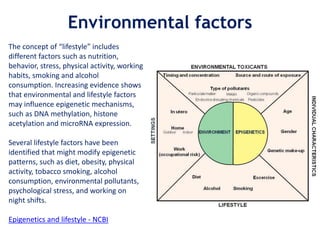
The concept of “lifestyle” includes different factors such as nutrition, behavior, stress,
physical activity, working habits, smoking and alcohol consumption.
Increasing evidence shows that environmental and lifestyle factors may influence
epigenetic mechanisms, such as DNA methylation, histone acetylation and microRNA
expression.
Several lifestyle factors have been identified that might modify epigenetic patterns, such
as diet, obesity, physical activity, tobacco smoking, alcohol consumption, environmental
pollutants, psychological stress, and working on night shifts.
Most studies conducted so far have been centered on DNA methylation, whereas only a
few investigations have studied lifestyle factors in relation to histone modifications and
miRNAs.
Current evidence indicating that lifestyle factors might affect human health via
epigenetic mechanisms.
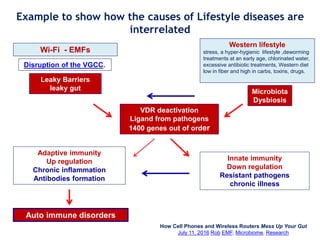
Wi-Fi - EMFs
Disruption of the VGCC.
Leaky Barriers
leaky gut
How Cell Phones and Wireless Routers Mess Up Your Gut
July 11, 2016 Rob EMF, Microbiome, Research
Microbiota
Dysbiosis
VDR deactivation
Ligand from pathogens
1400 genes out of order
Innate immunity
Down regulation
Resistant pathogens
chronic illness
Adaptive immunity
Up regulation
Chronic inflammation
Antibodies formation
Auto immune disorders
Example to show how the causes of Lifestyle diseases are
interrelated
Western lifestyle
stress, a hyper-hygienic lifestyle ,deworming
treatments at an early age, chlorinated water,
excessive antibiotic treatments, Western diet
low in fiber and high in carbs, toxins, drugs.
Environmental factors
The concept of “lifestyle” includes
different factors such as nutrition,
behavior, stress, physical activity, working
habits, smoking and alcohol
consumption. Increasing evidence shows
that environmental and lifestyle factors
may influence epigenetic mechanisms,
such as DNA methylation, histone
acetylation and microRNA expression.
Several lifestyle factors have been
identified that might modify epigenetic
patterns, such as diet, obesity, physical
activity, tobacco smoking, alcohol
consumption, environmental pollutants,
psychological stress, and working on
night shifts.
Epigenetics and lifestyle - NCBI
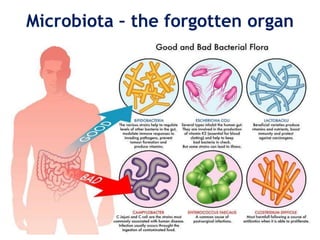
Microbiota – the forgotten organ
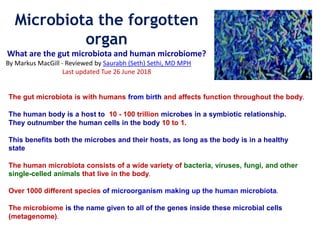
The gut microbiota is with humans from birth and affects function throughout the body.
The human body is a host to 10 - 100 trillion microbes in a symbiotic relationship.
They outnumber the human cells in the body 10 to 1.
This benefits both the microbes and their hosts, as long as the body is in a healthy
state
The human microbiota consists of a wide variety of bacteria, viruses, fungi, and other
single-celled animals that live in the body.
Over 1000 different species of microorganism making up the human microbiota.
The microbiome is the name given to all of the genes inside these microbial cells
(metagenome).
Microbiota the forgotten
organ
What are the gut microbiota and human microbiome?
By Markus MacGill - Reviewed by Saurabh (Seth) Sethi, MD MPH
Last updated Tue 26 June 2018
The microorganisms living inside the gastrointestinal tract amount to around
4 pounds of biomass. Every individual has a unique mix of species.
The microbiota is important for nutrition, immunity, and effects on the brain
and behavior.
It is implicated in a number of diseases that cause a disturbance in the normal
balance of microbes.
The biggest populations of microbes reside
in the gut. Other popular habitats include
the skin and genitals.
The microbial cells and their genetic material,
the microbiome, live with humans from birth.
This relationship is vital to normal health.
Microbiota – the forgotten organ
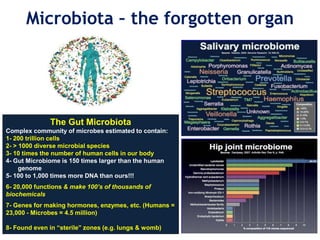
The Gut Microbiota
Complex community of microbes estimated to contain:
1- 200 trillion cells
2- > 1000 diverse microbial species
3- 10 times the number of human cells in our body
4- Gut Microbiome is 150 times larger than the human
genome
5- 100 to 1,000 times more DNA than ours!!!
6- 20,000 functions & make 100’s of thousands of
biochemicals
7- Genes for making hormones, enzymes, etc. (Humans =
23,000 - Microbes = 4.5 million)
8- Found even in “sterile” zones (e.g. lungs & womb)
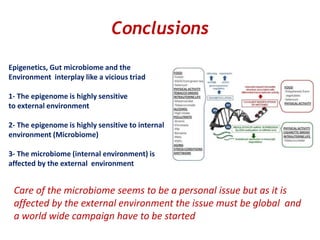
Epigenetics, Gut microbiome and the
Environment interplay like a vicious triad
1- The epigenome is highly sensitive
to external environment
2- The epigenome is highly sensitive to internal
environment (Microbiome)
3- The microbiome (internal environment) is
affected by the external environment
Conclusions
Care of the microbiome seems to be a personal issue but as it is
affected by the external environment the issue must be global and
a world wide campaign have to be started
Epigenetics, the microbiome and the environment

Epigenetics, the microbiome and the environment

  • 1.
    Epigenetics The Microbiome and The Environment Dr.Fathi Neana, MD Chief of Orthopaedics Dr. Fakhry & Dr. A. Al-Garzaie Hospital October , 19 - 2020
  • 3.
    The epigenome isa multitude of chemical compounds that can tell the genome what to do. The human genome is the complete assembly of DNA (deoxyribonucleic acid)- about 3 billion base pairs - that makes each individual unique. DNA holds the instructions for building the proteins that carry out a variety of functions in a cell. The epigenome is made up of chemical compounds and proteins that can attach to DNA and direct such actions as turning genes on or off, controlling the production of proteins in particular cells. When epigenomic compounds attach to DNA and modify its function, they are said to have "marked" the genome. These marks do not change the sequence of the DNA. Rather, they change the way cells use the DNA's instructions. The marks are sometimes passed on from cell to cell as cells divide. They also can be passed down from one generation to the next. Epigenomics Fact Sheet What is an epigenome
  • 4.
    We are inthe era of biochemistry and molecular biology with better understanding of our genome and DNA sequencing (the sequence of adenine, guanine, cytosine, and thymine) An epigenome consists of a record of the chemical changes to the DNA and histone proteins of an organism These changes can be passed down to an organism's offspring via transgenerational epigenetic inheritance. Wikipedia What is an epigenome
  • 5.
    1- The epigenomeis highly sensitive to external environmental factors in early life, such as nutrition, stress, endocrine disruption and pollution 2- The epigenome is highly sensitive to internal environmental (Microbiome) 3- The microbiome is affected by the external environmental factors (different pollutants ) 4- The changes in the epigenome can induce long-term changes in gene expression and phenotype Epigenetics, Gut microbiome and the Environment a sensitive interplay
  • 6.
    Environment Epigenome Microbiome Life Consciousness-Spirit Internal environmental Externalenvironmental Record of the chemical changes to the DNA and histone Epigenetics, Gut microbiome and the Environment a sensitive interplay
  • 7.
    How epigenetics, ourgut microbiome and the environment interact to change our lives Ben Locwin | Genetic Literacy Project | October 17, 2016 Research presented at the American Association for the Advancement of Science 2014 conference 1- Supported that epigenetics and some form of heritability are in fact linked. 2- Much of our lives and life trajectories could, in fact, reflect a sensitive interplay between our environment, genes (epigenetics) and microbiome 3- The intersection of all of these factors is, quite simply, ‘us.’ as in the Venn diagram 1- Children raised in more rural areas (more exposure to animals, dirt, debris, molds, pollen, etc.) suffer from fewer cases of allergies than those children raised in more urban settings. Again, that pattern suggests an interplay of our external environment, microbiome, and epigenetics. 2- Some novel research indicates that certain compounds produced by certain gut flora can make colon cancer more prevalent by blocking the activity of DNA repair proteins. 3- The composition of the gut microflora can be changed very ‘rapidly and reproducibly’ in response to dietary changes. Some of the consequences are directly due to microbial gene expression. 4- The inflammatory cascade of Crohn’s disease seems to be related to the gut microbiome and specific microbes in particular.
  • 8.
    Epigenetics and lifestyle JorgeAlejandro Alegría-Torres,1 Andrea Baccarelli,2 and Valentina Bollati3,* Epigenomics. Author manuscript; available in PMC 2013 Aug 26. Published in final edited form as: Epigenomics. 2011 Jun; 3(3): 267–277. doi: 10.2217/epi.11.22 PMCID: PMC3752894 NIHMSID: NIHMS498542 PMID: 22122337 The concept of “lifestyle” includes different factors such as nutrition, behavior, stress, physical activity, working habits, smoking and alcohol consumption. Increasing evidence shows that environmental and lifestyle factors may influence epigenetic mechanisms, such as DNA methylation, histone acetylation and microRNA expression. Several lifestyle factors have been identified that might modify epigenetic patterns, such as diet, obesity, physical activity, tobacco smoking, alcohol consumption, environmental pollutants, psychological stress, and working on night shifts. Most studies conducted so far have been centered on DNA methylation, whereas only a few investigations have studied lifestyle factors in relation to histone modifications and miRNAs. Current evidence indicating that lifestyle factors might affect human health via epigenetic mechanisms.
  • 9.
    Wi-Fi - EMFs Disruptionof the VGCC. Leaky Barriers leaky gut How Cell Phones and Wireless Routers Mess Up Your Gut July 11, 2016 Rob EMF, Microbiome, Research Microbiota Dysbiosis VDR deactivation Ligand from pathogens 1400 genes out of order Innate immunity Down regulation Resistant pathogens chronic illness Adaptive immunity Up regulation Chronic inflammation Antibodies formation Auto immune disorders Example to show how the causes of Lifestyle diseases are interrelated Western lifestyle stress, a hyper-hygienic lifestyle ,deworming treatments at an early age, chlorinated water, excessive antibiotic treatments, Western diet low in fiber and high in carbs, toxins, drugs.
  • 10.
    Environmental factors The conceptof “lifestyle” includes different factors such as nutrition, behavior, stress, physical activity, working habits, smoking and alcohol consumption. Increasing evidence shows that environmental and lifestyle factors may influence epigenetic mechanisms, such as DNA methylation, histone acetylation and microRNA expression. Several lifestyle factors have been identified that might modify epigenetic patterns, such as diet, obesity, physical activity, tobacco smoking, alcohol consumption, environmental pollutants, psychological stress, and working on night shifts. Epigenetics and lifestyle - NCBI
  • 11.
    Microbiota – theforgotten organ
  • 12.
    The gut microbiotais with humans from birth and affects function throughout the body. The human body is a host to 10 - 100 trillion microbes in a symbiotic relationship. They outnumber the human cells in the body 10 to 1. This benefits both the microbes and their hosts, as long as the body is in a healthy state The human microbiota consists of a wide variety of bacteria, viruses, fungi, and other single-celled animals that live in the body. Over 1000 different species of microorganism making up the human microbiota. The microbiome is the name given to all of the genes inside these microbial cells (metagenome). Microbiota the forgotten organ What are the gut microbiota and human microbiome? By Markus MacGill - Reviewed by Saurabh (Seth) Sethi, MD MPH Last updated Tue 26 June 2018
  • 13.
    The microorganisms livinginside the gastrointestinal tract amount to around 4 pounds of biomass. Every individual has a unique mix of species. The microbiota is important for nutrition, immunity, and effects on the brain and behavior. It is implicated in a number of diseases that cause a disturbance in the normal balance of microbes. The biggest populations of microbes reside in the gut. Other popular habitats include the skin and genitals. The microbial cells and their genetic material, the microbiome, live with humans from birth. This relationship is vital to normal health.
  • 14.
    Microbiota – theforgotten organ The Gut Microbiota Complex community of microbes estimated to contain: 1- 200 trillion cells 2- > 1000 diverse microbial species 3- 10 times the number of human cells in our body 4- Gut Microbiome is 150 times larger than the human genome 5- 100 to 1,000 times more DNA than ours!!! 6- 20,000 functions & make 100’s of thousands of biochemicals 7- Genes for making hormones, enzymes, etc. (Humans = 23,000 - Microbes = 4.5 million) 8- Found even in “sterile” zones (e.g. lungs & womb)
  • 15.
    Epigenetics, Gut microbiomeand the Environment interplay like a vicious triad 1- The epigenome is highly sensitive to external environment 2- The epigenome is highly sensitive to internal environment (Microbiome) 3- The microbiome (internal environment) is affected by the external environment Conclusions Care of the microbiome seems to be a personal issue but as it is affected by the external environment the issue must be global and a world wide campaign have to be started