EPIDEMIOLOGICAL TRIAD
INTRODUCTION
EVENTS IN NATURAL HISTORY OF DISEASE
FACTORS OF EPIDEMIOLOGICAL TRAID
AGENT FACTOR
HOST FACTOR (INTRINSIC)
ENVIROMENTAL FACTOR (EXTRINSIC)
CONCLUSION
REFERENCES
CONTENT
EPIDEMIOLOGICAL TRIAD
 DEFENITION
• The occurrence and manifestation of any disease either
communicable or non communicable are determined by the
agent, the host and the environment. This together constitute
epidemiological triad.
FACTORS OF EPIDEMIOLOGICAL
TRIAD
Agent Host
Environment
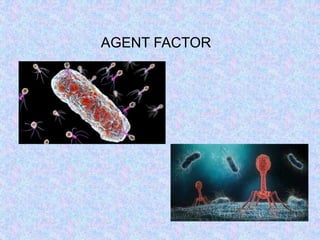
AGENT FACTOR
AGENT FACTOR
 First link in the chain of disease.
 In the development of disease, agent is the foremost factor, it can
be living or non-living.
AGENT FACTOR
 These disease agents classified into 6 broad groups:
i. Biological agent e.g. Bacteria, Virus.
ii. Nutritional agent e.g. Carbohydrate, Fats and Vitamins.
iii. Chemical agent e.g. Allergen, Metal, Serum bilirubin.
iv. Mechanical agent e.g. Tearing, Sprains, Dislocation.
v. Physical agent e.g. Electricity, Sound, Radiation.
vi. Social agent e.g. Smoking, Abuse of drug, Alcohol
HOST FACTOR
• Host factor is the human body where the disease agent
stay, grow and multiply to produce illness.
• In epidemiology terminology the human host is referred
to as soil and the disease agent as seed.
The host factor may be classified as –
i. Demographic e.g.- age, sex, ethnicity
ii. Biological e.g.- genetic factor
iii. Social and economic e.g.- education, occupation
iv. Life style factors e.g.- personality traits, living habits
ENVIRONMENTAL
FACTORS
ENVIRONMENTAL FACTORS
• Study of disease is a study of man and his environment.
It has been proved that environment is responsible for
many diseases.
Environment factors are classified into three groups:-
• Physical environment
• Biological environment
• Physiological environment
CONCLUSION
In conclusion, epidemiology is a vital discipline that
provides critical insights into disease patterns, risk factors,
and public health interventions. By studying the
distribution and determinants of diseases, epidemiologists
contribute to the development of effective strategies to
prevent, control, and manage diseases, ultimately
improving the health and well-being of populations
around the world.
1. K. Park. Park's Textbook of Preventive and Social
Medicine. 26th Edition, Madhya Pradesh: M/s
Banarsidas Bhanot Publishers; 2021.
2. Soben Peter. Essential of Public Health Dentistry
(Community Dentistry). 7th Edition, New Delhi: Arya
Medi Publishing House PVT. Ltd.; 2022
REFERENCE
THANK
YOU

Epidemiological Traid.pptx

  • 1.
  • 2.
    INTRODUCTION EVENTS IN NATURALHISTORY OF DISEASE FACTORS OF EPIDEMIOLOGICAL TRAID AGENT FACTOR HOST FACTOR (INTRINSIC) ENVIROMENTAL FACTOR (EXTRINSIC) CONCLUSION REFERENCES CONTENT
  • 3.
    EPIDEMIOLOGICAL TRIAD  DEFENITION •The occurrence and manifestation of any disease either communicable or non communicable are determined by the agent, the host and the environment. This together constitute epidemiological triad.
  • 4.
  • 5.
  • 6.
    AGENT FACTOR  Firstlink in the chain of disease.  In the development of disease, agent is the foremost factor, it can be living or non-living.
  • 7.
    AGENT FACTOR  Thesedisease agents classified into 6 broad groups: i. Biological agent e.g. Bacteria, Virus. ii. Nutritional agent e.g. Carbohydrate, Fats and Vitamins. iii. Chemical agent e.g. Allergen, Metal, Serum bilirubin. iv. Mechanical agent e.g. Tearing, Sprains, Dislocation. v. Physical agent e.g. Electricity, Sound, Radiation. vi. Social agent e.g. Smoking, Abuse of drug, Alcohol
  • 8.
    HOST FACTOR • Hostfactor is the human body where the disease agent stay, grow and multiply to produce illness. • In epidemiology terminology the human host is referred to as soil and the disease agent as seed. The host factor may be classified as – i. Demographic e.g.- age, sex, ethnicity ii. Biological e.g.- genetic factor iii. Social and economic e.g.- education, occupation iv. Life style factors e.g.- personality traits, living habits
  • 9.
  • 10.
    ENVIRONMENTAL FACTORS • Studyof disease is a study of man and his environment. It has been proved that environment is responsible for many diseases. Environment factors are classified into three groups:- • Physical environment • Biological environment • Physiological environment
  • 11.
    CONCLUSION In conclusion, epidemiologyis a vital discipline that provides critical insights into disease patterns, risk factors, and public health interventions. By studying the distribution and determinants of diseases, epidemiologists contribute to the development of effective strategies to prevent, control, and manage diseases, ultimately improving the health and well-being of populations around the world.
  • 12.
    1. K. Park.Park's Textbook of Preventive and Social Medicine. 26th Edition, Madhya Pradesh: M/s Banarsidas Bhanot Publishers; 2021. 2. Soben Peter. Essential of Public Health Dentistry (Community Dentistry). 7th Edition, New Delhi: Arya Medi Publishing House PVT. Ltd.; 2022 REFERENCE
  • 13.