EPA Registration
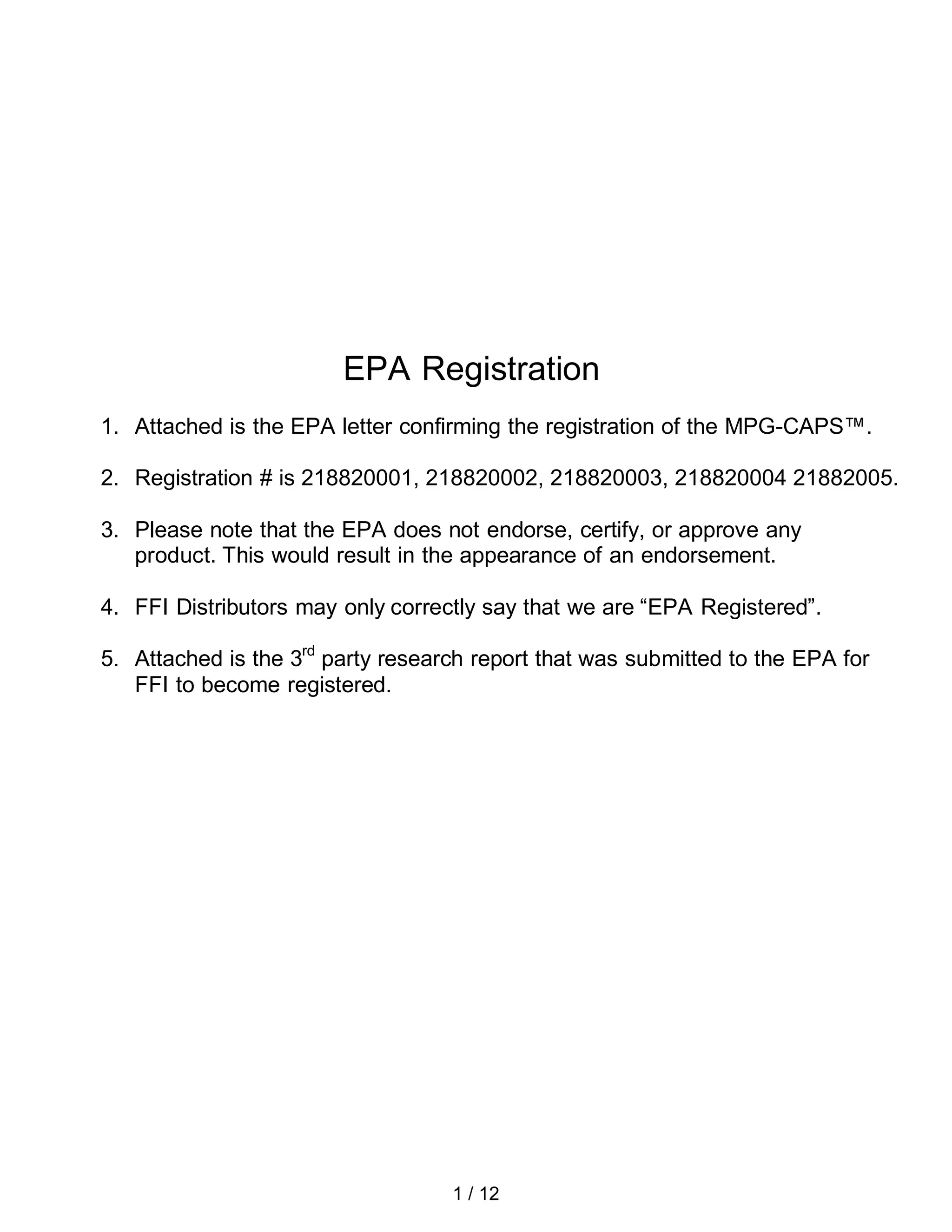
1. Attached is the EPA letter confirming the registration of the MPG-CAPS™.

2. Registration # is 218820001, 218820002, 218820003, 218820004 21882005.

3. Please note that the EPA does not endorse, certify, or approve any
   product. This would result in the appearance of an endorsement.

4. FFI Distributors may only correctly say that we are “EPA Registered”.

5. Attached is the 3rd party research report that was submitted to the EPA for
   FFI to become registered.

 . NOTE: FFI Distributors have been specifically asked by the EPA not to
   contact the EPA for confirmation or discussion of any matters relating to
   te EPA Registration.


                                   1 / 12
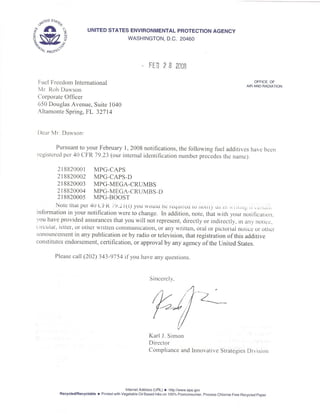
Advanced Fuel Technologies
                                  Field Test Report #710A
                New Gasoline and Diesel Valve Recession Control Technology combines:

                                      Environmental acceptability
                                      Direct octane increase
                                      Combustion chamber deposit control with unique
                                      ability to stop existing valve recession


Fuel Freedom International, LLC.• 650 Douglas Ave., Suite 1040 • Altamonte Springs, FL 32714 • (407) 682-0060
                                                                                                 Page 1 of 10


                                                       3 / 12
Executive Summary

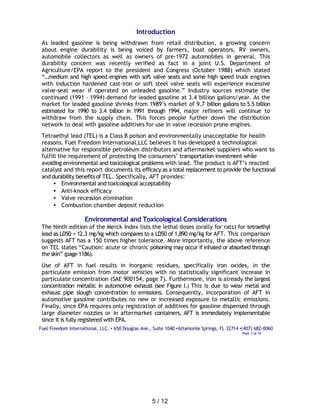
   Fuel Freedom International, LLC is pleased to introduce new gasoline additive technology
   based on its AFT catalyst.                              This report provides technical
   documentation for this product as a lead replacement in gasoline for use in engines susceptible to
   valve seat recession. The U.S. Environmental Protection Agency has been requiring the removal of lead
   from gasoline since 1973. This program has effectively removed an environmental contaminant but is
   causing justified concern about equipment durability and performance for consumers who
   have pre-1973 vehicles, off-road equipment such as farm tractors and boats.

   Currently available anti-valve wear products provide limited efficacy and may
   cause combustion chamber deposits. Fuel Freedom’s AFT has been demonstrated in both
   laboratory and on road studies to:
       • Increase octane
       • Prevent valve recession from starting
       • Stop valve recession which has already begun
       • Reduce combustion chamber deposits
       • Improve emission performance

   All of these benefits are achieved through the use of AFT at only 15 ppm in gasoline, a
   level which has been shown to contribute no significant increase in iron emission from
   vehicles tested. AFT is the answer for customers when they must switch from leaded
   gasoline due to environmental and availability constraints.


Fuel Freedom International, LLC. • 650 Douglas Ave., Suite 1040 •Altamonte Springs, FL 32714 •(407) 682-0060
                                                                                               Page 2 of 10


                                                      4 / 12
Introduction
 As leaded gasoline is being withdrawn from retail distribution, a growing concern
 about engine durability is being voiced by farmers, boat operators, RV owners,
 automobile collectors as well as owners of pre-1972 automobiles in general. This
 durability concern was recently verified as fact in a joint U.S. Department of
 Agriculture/EPA report to the president and Congress (October 1988) which stated
 “…medium and high speed engines with soft valve seats and some high speed truck engines
 with induction hardened cast-iron or soft steel valve seats will experience excessive
 valve-seat wear if operated on unleaded gasoline.” Industry sources estimate the
 continued (1991 – 1994) demand for leaded gasoline at 3.4 billion gallons/year. As the
 market for leaded gasoline shrinks from 1989’s market of 9.7 billion gallons to 5.5 billion
 estimated for 1990 to 3.4 billion in 1991 through 1994, major refiners will continue to
 withdraw from the supply chain. This forces people further down the distribution
 network to deal with gasoline additives for use in valve recession prone engines.
 Tetraethyl lead (TEL) is a Class B poison and environmentally unacceptable for health
 reasons. Fuel Freedom International,LLC believes it has developed a technological
 alternative for responsible petroleum distributors and aftermarket suppliers who want to
 fulfill the requirement of protecting the consumers’ transportation investment while
 avoiding environmental and toxicological problems with lead. The product is AFT’s reacted
 catalyst and this report documents its efficacy as a total replacement to provide the functional
 and durability benefits of TEL. Specifically, AFT provides:
      • Environmental and toxicological acceptability
      • Anti-knock efficacy
      • Valve recession elimination
      • Combustion chamber deposit reduction

                     Environmental and Toxicological Considerations
 The Ninth edition of the Merck Index lists the lethal doses (orally for rats) for tetraethyl
 lead as LD50 = 12.3 mg/kg which compares to a LD50 of 1,890 mg/kg for AFT. This comparison
 suggests AFT has a 150 times higher tolerance. More importantly, the above reference
 on TEL states “Caution: acute or chronic poisoning may occur if inhaled or absorbed through
 the skin” (page 1186).
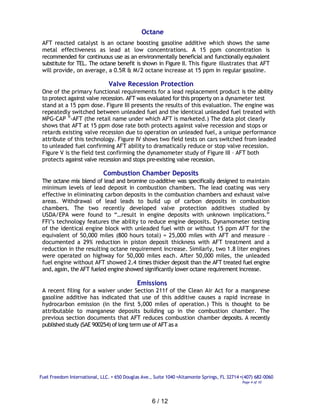
 Use of AFT in fuel results in inorganic residues, specifically iron oxides, in the
 particulate emission from motor vehicles with no statistically significant increase in
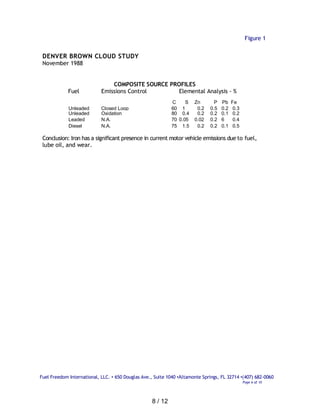
 particulate concentration (SAE 900154, page 7). Furthermore, iron is already the largest
 concentration metallic in automotive exhaust (see Figure I.) This is due to wear metal and
 exhaust pipe slough concentration to emissions. Consequently, incorporation of AFT in
 automotive gasoline contributes no new or increased exposure to metallic emissions.
 Finally, since EPA requires only registration of additives for gasoline dispensed through
 large diameter nozzles or in aftermarket containers, AFT is immediately implementable
 since it is fully registered with EPA.
Fuel Freedom International, LLC. • 650 Douglas Ave., Suite 1040 •Altamonte Springs, FL 32714 •(407) 682-0060
                                                                                             Page 3 of 10


                                                    5 / 12
Octane
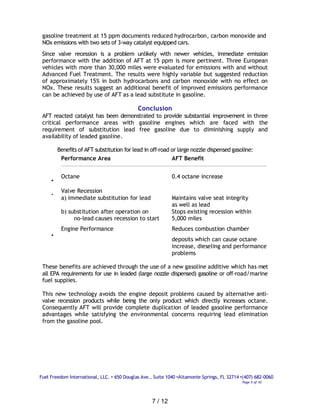
 AFT reacted catalyst is an octane boosting gasoline additive which shows the same
 metal effectiveness as lead at low concentrations. A 15 ppm concentration is
 recommended for continuous use as an environmentally beneficial and functionally equivalent
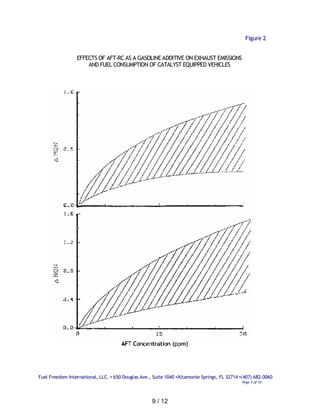
 substitute for TEL. The octane benefit is shown in Figure II. This figure illustrates that AFT
 will provide, on average, a 0.5R & M/2 octane increase at 15 ppm in regular gasoline.

                               Valve Recession Protection
 One of the primary functional requirements for a lead replacement product is the ability
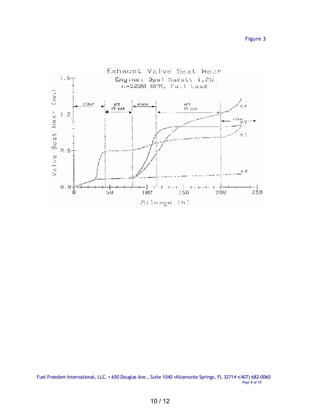
 to protect against valve recession. AFT was evaluated for this property on a dynameter test
 stand at a 15 ppm dose. Figure III presents the results of this evaluation. The engine was
 repeatedly switched between unleaded fuel and the identical unleaded fuel treated with
 MPG-CAP ®-AFT (the retail name under which AFT is marketed.) The data plot clearly
 shows that AFT at 15 ppm dose rate both protects against valve recession and stops or
 retards existing valve recession due to operation on unleaded fuel, a unique performance
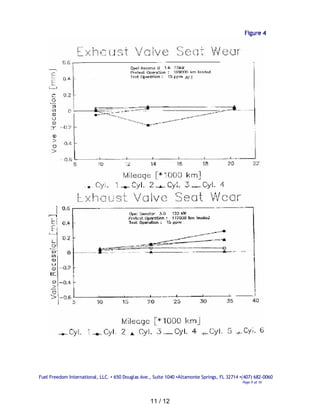
 attribute of this technology. Figure IV shows two field tests on cars switched from leaded
 to unleaded fuel confirming AFT ability to dramatically reduce or stop valve recession.
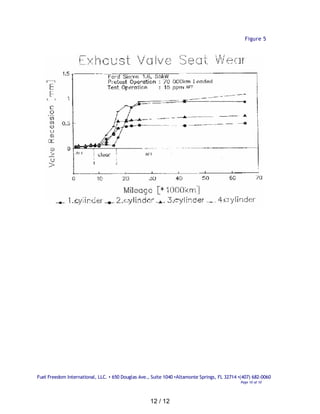
 Figure V is the field test confirming the dynamometer study of Figure III – AFT both
 protects against valve recession and stops pre-existing valve recession.

                             Combustion Chamber Deposits
 The octane mix blend of lead and bromine co-additive was specifically designed to maintain
 minimum levels of lead deposit in combustion chambers. The lead coating was very
 effective in eliminating carbon deposits in the combustion chambers and exhaust valve
 areas. Withdrawal of lead leads to build up of carbon deposits in combustion
 chambers. The two recently developed valve protection additives studied by
 USDA/EPA were found to “…result in engine deposits with unknown implications.”
 FFI’s technology features the ability to reduce engine deposits. Dynamometer testing
 of the identical engine block with unleaded fuel with or without 15 ppm AFT for the
 equivalent of 50,000 miles (800 hours total) = 25,000 miles with AFT and measure –
 documented a 29% reduction in piston deposit thickness with AFT treatment and a
 reduction in the resulting octane requirement increase. Similarly, two 1.8 liter engines
 were operated on highway for 50,000 miles each. After 50,000 miles, the unleaded
 fuel engine without AFT showed 2.4 times thicker deposit than the AFT treated fuel engine
 and, again, the AFT fueled engine showed significantly lower octane requirement increase.

                                             Emissions
 A recent filing for a waiver under Section 211f of the Clean Air Act for a manganese
 gasoline additive has indicated that use of this additive causes a rapid increase in
 hydrocarbon emission (in the first 5,000 miles of operation.) This is thought to be
 attributable to manganese deposits building up in the combustion chamber. The
 previous section documents that AFT reduces combustion chamber deposits. A recently
 published study (SAE 900254) of long term use of AFT as a


Fuel Freedom International, LLC. • 650 Douglas Ave., Suite 1040 •Altamonte Springs, FL 32714 •(407) 682-0060
                                                                                             Page 4 of 10


                                                    6 / 12
gasoline treatment at 15 ppm documents reduced hydrocarbon, carbon monoxide and
 NOx emissions with two sets of 3-way catalyst equipped cars.
 Since valve recession is a problem unlikely with newer vehicles, immediate emission
 performance with the addition of AFT at 15 ppm is more pertinent. Three European
 vehicles with more than 30,000 miles were evaluated for emissions with and without
 Advanced Fuel Treatment. The results were highly variable but suggested reduction
 of approximately 15% in both hydrocarbons and carbon monoxide with no effect on
 NOx. These results suggest an additional benefit of improved emissions performance
 can be achieved by use of AFT as a lead substitute in gasoline.

                                             Conclusion
 AFT reacted catalyst has been demonstrated to provide substantial improvement in three
 critical performance areas with gasoline engines which are faced with the
 requirement of substitution lead free gasoline due to diminishing supply and
 availability of leaded gasoline.

         Benefits of AFT substitution for lead in off-road or large nozzle dispensed gasoline:
          Performance Area                                 AFT Benefit


          Octane                                             0.4 octane increase
     •
          Valve Recession
     •
          a) immediate substitution for lead                 Maintains valve seat integrity
                                                             as well as lead
          b) substitution after operation on                 Stops existing recession within
               no-lead causes recession to start             5,000 miles
          Engine Performance                                 Reduces combustion chamber
     •
                                                             deposits which can cause octane
                                                             increase, dieseling and performance
                                                             problems

 These benefits are achieved through the use of a new gasoline additive which has met
 all EPA requirements for use in leaded (large nozzle dispensed) gasoline or off-road/marine
 fuel supplies.

 This new technology avoids the engine deposit problems caused by alternative anti-
 valve recession products while being the only product which directly increases octane.
 Consequently AFT will provide complete duplication of leaded gasoline performance
 advantages while satisfying the environmental concerns requiring lead elimination
 from the gasoline pool.


Fuel Freedom International, LLC. • 650 Douglas Ave., Suite 1040 •Altamonte Springs, FL 32714 •(407) 682-0060
                                                                                             Page 5 of 10


                                                    7 / 12
Figure 1


 DENVER BROWN CLOUD STUDY
 November 1988


                                COMPOSITE SOURCE PROFILES
             Fuel           Emissions Control       Elemental Analysis - %
                                                            C     S    Zn       P   Pb    Fe
             Unleaded       Closed Loop                     60 1        0.2   0.5   0.2    0.3
             Unleaded       Oxidation                       80 0.4      0.2   0.2   0.1    0.2
             Leaded         N.A.                            70 0.05    0.02   0.2   6      0.4
             Diesel         N.A.                            75 1.5      0.2   0.2   0.1    0.5

 Conclusion: Iron has a significant presence in current motor vehicle emissions due to fuel,
 lube oil, and wear.


Fuel Freedom International, LLC. • 650 Douglas Ave., Suite 1040 •Altamonte Springs, FL 32714 •(407) 682-0060
                                                                                                 Page 6 of 10


                                                   8 / 12
Figure 2


                 EFFECTS OF AFT-RC AS A GASOLINE ADDITIVE ON EXHAUST EMISSIONS
                     AND FUEL CONSUMPTION OF CATALYST EQUIPPED VEHICLES


Fuel Freedom International, LLC. • 650 Douglas Ave., Suite 1040 •Altamonte Springs, FL 32714 •(407) 682-0060
                                                                                              Page 7 of 10


                                                    9 / 12
Figure 3


Fuel Freedom International, LLC. • 650 Douglas Ave., Suite 1040 •Altamonte Springs, FL 32714 •(407) 682-0060
                                                                                              Page 8 of 10


                                                    10 / 12
Fuel Freedom International, LLC. • 650 Douglas Ave., Suite 1040 •Altamonte Springs, FL 32714 •(407) 682-0060
                                                                                              Page 9 of 10


                                                   11 / 12
Figure 5


Fuel Freedom International, LLC. • 650 Douglas Ave., Suite 1040 •Altamonte Springs, FL 32714 •(407) 682-0060
                                                                                              Page 10 of 10


                                                    12 / 12

Epa Registration Info Pkge

  • 1.
    EPA Registration 1. Attachedis the EPA letter confirming the registration of the MPG-CAPS™. 2. Registration # is 218820001, 218820002, 218820003, 218820004 21882005. 3. Please note that the EPA does not endorse, certify, or approve any product. This would result in the appearance of an endorsement. 4. FFI Distributors may only correctly say that we are “EPA Registered”. 5. Attached is the 3rd party research report that was submitted to the EPA for FFI to become registered. . NOTE: FFI Distributors have been specifically asked by the EPA not to contact the EPA for confirmation or discussion of any matters relating to te EPA Registration. 1 / 12
  • 3.
    Advanced Fuel Technologies Field Test Report #710A New Gasoline and Diesel Valve Recession Control Technology combines: Environmental acceptability Direct octane increase Combustion chamber deposit control with unique ability to stop existing valve recession Fuel Freedom International, LLC.• 650 Douglas Ave., Suite 1040 • Altamonte Springs, FL 32714 • (407) 682-0060 Page 1 of 10 3 / 12
  • 4.
    Executive Summary Fuel Freedom International, LLC is pleased to introduce new gasoline additive technology based on its AFT catalyst. This report provides technical documentation for this product as a lead replacement in gasoline for use in engines susceptible to valve seat recession. The U.S. Environmental Protection Agency has been requiring the removal of lead from gasoline since 1973. This program has effectively removed an environmental contaminant but is causing justified concern about equipment durability and performance for consumers who have pre-1973 vehicles, off-road equipment such as farm tractors and boats. Currently available anti-valve wear products provide limited efficacy and may cause combustion chamber deposits. Fuel Freedom’s AFT has been demonstrated in both laboratory and on road studies to: • Increase octane • Prevent valve recession from starting • Stop valve recession which has already begun • Reduce combustion chamber deposits • Improve emission performance All of these benefits are achieved through the use of AFT at only 15 ppm in gasoline, a level which has been shown to contribute no significant increase in iron emission from vehicles tested. AFT is the answer for customers when they must switch from leaded gasoline due to environmental and availability constraints. Fuel Freedom International, LLC. • 650 Douglas Ave., Suite 1040 •Altamonte Springs, FL 32714 •(407) 682-0060 Page 2 of 10 4 / 12
  • 5.
    Introduction As leadedgasoline is being withdrawn from retail distribution, a growing concern about engine durability is being voiced by farmers, boat operators, RV owners, automobile collectors as well as owners of pre-1972 automobiles in general. This durability concern was recently verified as fact in a joint U.S. Department of Agriculture/EPA report to the president and Congress (October 1988) which stated “…medium and high speed engines with soft valve seats and some high speed truck engines with induction hardened cast-iron or soft steel valve seats will experience excessive valve-seat wear if operated on unleaded gasoline.” Industry sources estimate the continued (1991 – 1994) demand for leaded gasoline at 3.4 billion gallons/year. As the market for leaded gasoline shrinks from 1989’s market of 9.7 billion gallons to 5.5 billion estimated for 1990 to 3.4 billion in 1991 through 1994, major refiners will continue to withdraw from the supply chain. This forces people further down the distribution network to deal with gasoline additives for use in valve recession prone engines. Tetraethyl lead (TEL) is a Class B poison and environmentally unacceptable for health reasons. Fuel Freedom International,LLC believes it has developed a technological alternative for responsible petroleum distributors and aftermarket suppliers who want to fulfill the requirement of protecting the consumers’ transportation investment while avoiding environmental and toxicological problems with lead. The product is AFT’s reacted catalyst and this report documents its efficacy as a total replacement to provide the functional and durability benefits of TEL. Specifically, AFT provides: • Environmental and toxicological acceptability • Anti-knock efficacy • Valve recession elimination • Combustion chamber deposit reduction Environmental and Toxicological Considerations The Ninth edition of the Merck Index lists the lethal doses (orally for rats) for tetraethyl lead as LD50 = 12.3 mg/kg which compares to a LD50 of 1,890 mg/kg for AFT. This comparison suggests AFT has a 150 times higher tolerance. More importantly, the above reference on TEL states “Caution: acute or chronic poisoning may occur if inhaled or absorbed through the skin” (page 1186). Use of AFT in fuel results in inorganic residues, specifically iron oxides, in the particulate emission from motor vehicles with no statistically significant increase in particulate concentration (SAE 900154, page 7). Furthermore, iron is already the largest concentration metallic in automotive exhaust (see Figure I.) This is due to wear metal and exhaust pipe slough concentration to emissions. Consequently, incorporation of AFT in automotive gasoline contributes no new or increased exposure to metallic emissions. Finally, since EPA requires only registration of additives for gasoline dispensed through large diameter nozzles or in aftermarket containers, AFT is immediately implementable since it is fully registered with EPA. Fuel Freedom International, LLC. • 650 Douglas Ave., Suite 1040 •Altamonte Springs, FL 32714 •(407) 682-0060 Page 3 of 10 5 / 12
  • 6.
    Octane AFT reactedcatalyst is an octane boosting gasoline additive which shows the same metal effectiveness as lead at low concentrations. A 15 ppm concentration is recommended for continuous use as an environmentally beneficial and functionally equivalent substitute for TEL. The octane benefit is shown in Figure II. This figure illustrates that AFT will provide, on average, a 0.5R & M/2 octane increase at 15 ppm in regular gasoline. Valve Recession Protection One of the primary functional requirements for a lead replacement product is the ability to protect against valve recession. AFT was evaluated for this property on a dynameter test stand at a 15 ppm dose. Figure III presents the results of this evaluation. The engine was repeatedly switched between unleaded fuel and the identical unleaded fuel treated with MPG-CAP ®-AFT (the retail name under which AFT is marketed.) The data plot clearly shows that AFT at 15 ppm dose rate both protects against valve recession and stops or retards existing valve recession due to operation on unleaded fuel, a unique performance attribute of this technology. Figure IV shows two field tests on cars switched from leaded to unleaded fuel confirming AFT ability to dramatically reduce or stop valve recession. Figure V is the field test confirming the dynamometer study of Figure III – AFT both protects against valve recession and stops pre-existing valve recession. Combustion Chamber Deposits The octane mix blend of lead and bromine co-additive was specifically designed to maintain minimum levels of lead deposit in combustion chambers. The lead coating was very effective in eliminating carbon deposits in the combustion chambers and exhaust valve areas. Withdrawal of lead leads to build up of carbon deposits in combustion chambers. The two recently developed valve protection additives studied by USDA/EPA were found to “…result in engine deposits with unknown implications.” FFI’s technology features the ability to reduce engine deposits. Dynamometer testing of the identical engine block with unleaded fuel with or without 15 ppm AFT for the equivalent of 50,000 miles (800 hours total) = 25,000 miles with AFT and measure – documented a 29% reduction in piston deposit thickness with AFT treatment and a reduction in the resulting octane requirement increase. Similarly, two 1.8 liter engines were operated on highway for 50,000 miles each. After 50,000 miles, the unleaded fuel engine without AFT showed 2.4 times thicker deposit than the AFT treated fuel engine and, again, the AFT fueled engine showed significantly lower octane requirement increase. Emissions A recent filing for a waiver under Section 211f of the Clean Air Act for a manganese gasoline additive has indicated that use of this additive causes a rapid increase in hydrocarbon emission (in the first 5,000 miles of operation.) This is thought to be attributable to manganese deposits building up in the combustion chamber. The previous section documents that AFT reduces combustion chamber deposits. A recently published study (SAE 900254) of long term use of AFT as a Fuel Freedom International, LLC. • 650 Douglas Ave., Suite 1040 •Altamonte Springs, FL 32714 •(407) 682-0060 Page 4 of 10 6 / 12
  • 7.
    gasoline treatment at15 ppm documents reduced hydrocarbon, carbon monoxide and NOx emissions with two sets of 3-way catalyst equipped cars. Since valve recession is a problem unlikely with newer vehicles, immediate emission performance with the addition of AFT at 15 ppm is more pertinent. Three European vehicles with more than 30,000 miles were evaluated for emissions with and without Advanced Fuel Treatment. The results were highly variable but suggested reduction of approximately 15% in both hydrocarbons and carbon monoxide with no effect on NOx. These results suggest an additional benefit of improved emissions performance can be achieved by use of AFT as a lead substitute in gasoline. Conclusion AFT reacted catalyst has been demonstrated to provide substantial improvement in three critical performance areas with gasoline engines which are faced with the requirement of substitution lead free gasoline due to diminishing supply and availability of leaded gasoline. Benefits of AFT substitution for lead in off-road or large nozzle dispensed gasoline: Performance Area AFT Benefit Octane 0.4 octane increase • Valve Recession • a) immediate substitution for lead Maintains valve seat integrity as well as lead b) substitution after operation on Stops existing recession within no-lead causes recession to start 5,000 miles Engine Performance Reduces combustion chamber • deposits which can cause octane increase, dieseling and performance problems These benefits are achieved through the use of a new gasoline additive which has met all EPA requirements for use in leaded (large nozzle dispensed) gasoline or off-road/marine fuel supplies. This new technology avoids the engine deposit problems caused by alternative anti- valve recession products while being the only product which directly increases octane. Consequently AFT will provide complete duplication of leaded gasoline performance advantages while satisfying the environmental concerns requiring lead elimination from the gasoline pool. Fuel Freedom International, LLC. • 650 Douglas Ave., Suite 1040 •Altamonte Springs, FL 32714 •(407) 682-0060 Page 5 of 10 7 / 12
  • 8.
    Figure 1 DENVERBROWN CLOUD STUDY November 1988 COMPOSITE SOURCE PROFILES Fuel Emissions Control Elemental Analysis - % C S Zn P Pb Fe Unleaded Closed Loop 60 1 0.2 0.5 0.2 0.3 Unleaded Oxidation 80 0.4 0.2 0.2 0.1 0.2 Leaded N.A. 70 0.05 0.02 0.2 6 0.4 Diesel N.A. 75 1.5 0.2 0.2 0.1 0.5 Conclusion: Iron has a significant presence in current motor vehicle emissions due to fuel, lube oil, and wear. Fuel Freedom International, LLC. • 650 Douglas Ave., Suite 1040 •Altamonte Springs, FL 32714 •(407) 682-0060 Page 6 of 10 8 / 12
  • 9.
    Figure 2 EFFECTS OF AFT-RC AS A GASOLINE ADDITIVE ON EXHAUST EMISSIONS AND FUEL CONSUMPTION OF CATALYST EQUIPPED VEHICLES Fuel Freedom International, LLC. • 650 Douglas Ave., Suite 1040 •Altamonte Springs, FL 32714 •(407) 682-0060 Page 7 of 10 9 / 12
  • 10.
    Figure 3 Fuel FreedomInternational, LLC. • 650 Douglas Ave., Suite 1040 •Altamonte Springs, FL 32714 •(407) 682-0060 Page 8 of 10 10 / 12
  • 11.
    Fuel Freedom International,LLC. • 650 Douglas Ave., Suite 1040 •Altamonte Springs, FL 32714 •(407) 682-0060 Page 9 of 10 11 / 12
  • 12.
    Figure 5 Fuel FreedomInternational, LLC. • 650 Douglas Ave., Suite 1040 •Altamonte Springs, FL 32714 •(407) 682-0060 Page 10 of 10 12 / 12