The changes that occur in human beings
between conception and death are referred to
                   as:

         maturation
         cognitive development
         growth
         development
Which of the following is FALSE regarding a
     general principle of development ?


 Development is rapid and dramatic.
 Development occurs at different rates.
 Development takes place gradually.
 Development takes place in an orderly sequence.
What is a major issue pertaining to the
          nature-nurture controversy?
 Young children demonstrate patterns of behavior or thinking,
 called schemes, which older children and adults also use in
 dealing with objects in the world.
 Development occurs in a smooth progression as skills develop
 and parents and the environment provide experiences.
 Is development predetermined at birth, by hereditary factors,
 or does experience and other environmental factors affect it?
 All children are believed to acquire skills in the same sequence,
 although rates of progress differ from child to child.
Did you remember to do your
         homework?


                              5
What part of the brain is associated
     with higher mental functions?
The cortex is a crumpled sheet of neurons that serves three
major functions: receiving signals from sense organs,
controlling voluntary movement and forming associations.
The part of the cortex that controls physical motor movement
develops or matures first, then the areas that control complex
senses such as vision and hearing, and last the frontal lobe,
which controls the higher-order thinking processes.


                                                             7
What is lateralization and
         why is it important?
Lateralization is the specialization of the two sides, or
hemispheres, of the brain. The brain begins to lateralize soon
after birth. For most people, the left hemisphere is prominent
in spatial and visual processing.
Even though certain functions are associated with certain
parts of the brain, the various parts and systems of the brain
work together to learn and perform complex activities such as
reading and to construct understanding.


                                                            8
Piaget’s Theory
 (1986 – 1980)
 Piaget studied his children’s intellectual
  development from infancy.
 While studying his children, Piaget developed
  theories concerning how children learn.
 His theory of Cognitive Development consists
  of four stages of intellectual development.
Stage 1 - Sensorimotor
 During this stage, the child begins to develop:
 Reflexes
 Habits
 Hand-eye coordination
 Object Permanence (knowing something exists,
  even though it can’t be seen)
 Experimentation and creativity.
 Trial and error experiments
Piaget Stage 1 Sensorimotor, Object Permenence
Stage 2 - Preoperational

During this stage, the child begins to develop:
   Ability to represent objects with images and words
   Language skills
   Imagination

Children learn through imitation and play during this stage.
 They begin to use reasoning, however it is mainly intuitive,
 instead of logical.
Piaget Stage 2 Preoperational Lack of Conservation
Stage 3 - Concrete Operational

During this stage, the child begins to develop:
  The fundamentals of logic
  Ability to sort objects
  Ability to classify objects
  Understanding of conservation (physical
   quantities do not change based on the
   arrangement and/or appearance of the object)
Piaget Stage 3 Concrete Reversibility
Stage 4 - Formal Operational

During this stage, the child begins to develop:
 Ability to hypothesize, test and reevaluate
  hypotheses

Children begin thinking in a formal systematic way
Piaget Stage 4 Formal. Deductive Reasoning
Egocentrism
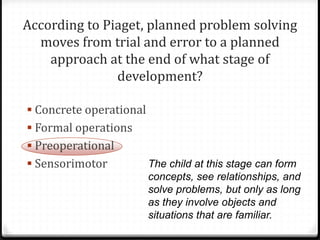
According to Piaget, planned problem solving
  moves from trial and error to a planned
    approach at the end of what stage of
               development?

 Concrete operational
 Formal operations
 Preoperational
 Sensorimotor           The child at this stage can form
                         concepts, see relationships, and
                         solve problems, but only as long
                         as they involve objects and
                         situations that are familiar.
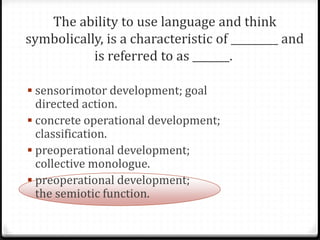
 sensorimotor development; goal
  directed action.
 concrete operational development;
  classification.
 preoperational development;
  collective monologue.
 preoperational development;
  the semiotic function.
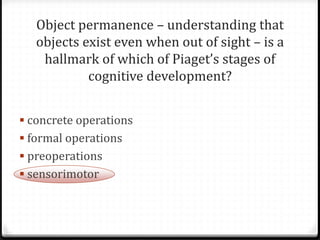
Object permanence – understanding that
   objects exist even when out of sight – is a
    hallmark of which of Piaget’s stages of
            cognitive development?


 concrete operations
 formal operations
 preoperations
 sensorimotor
Understanding that the volume remains the
same, even if it is transferred from a tall, thin
container to a short, wide one requires which
     of the following cognitive abilities?


   conservation and decentration
   hypothetical and scientific thought
   transitivity and reversibility
   private speech and scaffolding
 Piaget’s theories have had a major impact on the
  theory and practice of education.
 First, the theories focused attention on the idea of
  developmentally appropriate education—an
  education with environments, curriculum, materials,
  and instruction that are suitable for students in terms
  of their physical and cognitive abilities and their social
  and emotional needs.
 In addition, several major approaches to curriculum
  and instruction are explicitly based on Piagetian
  theory, and this theory has been influential in
  constructivist models of learning.
 Berk (2001) summarizes the main teaching
  implications drawn from Piaget as follows:
1. A focus on the process of children’s thinking,
   not just its products.
   In addition to checking the correctness of
   children’s answers, teachers must understand the
   processes children use to get to the answer.
   Appropriate learning experiences build on
   children’s current level of cognitive functioning,
   and only when teachers appreciate children’s
   methods of arriving at particular conclusions are
   they in a position to provide such experiences.
2. Recognition of the crucial role of children’s self-
   initiated, active involvement in learning
   activities.
   In a Piagetian classroom the presentation of ready-
   made knowledge is deemphasized, and children
   are encouraged to discover for themselves through
   spontaneous interaction with the environment.
   Therefore, instead of teaching didactically, teachers
   provide a rich variety of activities that permit
   children to act directly on the physical world.
3. A deemphasis on practices aimed at making children
  adultlike in their thinking.
  Piaget referred to the question “How can we speed up
  development?” as “the American question.” Among the many
  countries he visited, psychologists and educators in the
  United States seemed most interested in what techniques
  could be used to accelerate children’s progress through the
  stages. Piagetian-based educational programs accept his firm
  belief that premature teaching could be worse than no
  teaching at all, because it leads to superficial acceptance of
  adult formulas rather than true cognitive understanding.
4. Acceptance of individual differences in developmental
  progress.
  Piaget’s theory assumes that all children go through the same
  developmental sequence but that they do so at different rates.
  Therefore, teachers must make a special effort to arrange
  classroom activities for individuals and small groups of
  children rather than for the total class group. In addition,
  because individual differences are expected, assessment of
  children’s educational progress should be made in terms of
  each child’s own previous course of development, not in
  terms of normative standards provided by the performances
  of same-age peers.
5. Piaget emphasized the role of two types of
  relationships: constraint and cooperation in moral
  development.
  Relationships of constraint involve unilateral respect and
  the imposition of views from authority. In contrast,
  relationships of cooperation are best suited for the
  development of knowledge because they involve mutual
  respect, and each person is obliged to listen to the other
  and to fully explain themselves. This situation is most
  likely to lead to mutual understanding, which is essential
  in the development of all forms of knowledge.
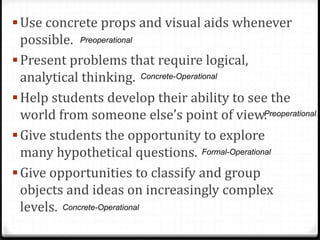
 Use concrete props and visual aids whenever
  possible. Preoperational
 Present problems that require logical,
  analytical thinking. Concrete-Operational
 Help students develop their ability to see the
  world from someone else’s point of view.     Preoperational

 Give students the opportunity to explore
  many hypothetical questions. Formal-Operational
 Give opportunities to classify and group
  objects and ideas on increasingly complex
  levels. Concrete-Operational
Limitations on Piaget’s
             Theory
 Although Piaget’s influence on Developmental and
  Educational Psychology has been enormous, recent
  research do not support all of his ideas.
 Almost all psychologists agree with his descriptions
  on the way children think, but many of them disagree
  with his explanations on why thinking develops the
  way it does.
Problems With Research
             Methods
Much of the criticism of Piaget's work is in regards to
his research methods. A major source of inspiration for
the theory was Piaget's observations of his own three
children. In addition to this, the other children in
Piaget's small research sample were all from well-
educated professionals of high socio-economic status.
Because of this unrepresentative sample, it is difficult to
generalize his findings to a larger population.
Problems With Formal
            Operations
Research has disputed Piaget's argument that all
children will automatically move to the next stage of
development as they mature. Some data suggests that
environmental factors may play a role in the
development of formal operations.
Underestimates Children's
               Abilities
Most researchers agree that children posses many of the
abilities at an earlier age than Piaget suspected. Recent
research on theory of mind has found that children of 4- or 5-
years old have a rather sophisticated understanding of their
own mental processes as well as those of other people. For
example, children of this age have some ability to take the
perspective of another person, meaning they are far less
egocentric than Piaget believed.
The model underestimates young children's abilities and
overestimates older children's abilities.
In Piaget's model, children have limitations in logical thinking
until the age of seven due to "perceptual centration,"
"irreversibility" and "egocentrism." However, critics say many
children are able to overcome these limitations at the age of five
or six. So this generalization may not fit all children. Again
critics say there are many children who are not able to think
abstractly and hypothetically during the period of 11-15.
Particularly, the age of 11 is too early to start complex mental
operations.
The model overemphasizes biological influence on
cognitive development.
According to the model, every child goes through similar
stages of cognitive development and environment and
education have little influence on these stages. An important
implication of this assumption is that education's contribution
is not so powerful on cognitive development.
Piaget's model implicates that the teaching process should
be student-centered, that is, the student should be main
source of information in the educational process.
The major task of the teacher is to design an environment that is
conducive to active involvement and learning, but not
transmitting knowledge to the student directly. The teacher is a
facilitator only. The child will actively explore the outside world
and try to make sense based on his/her cognitive level of
operation. An imposition on him/her will confuse the child
especially if that impositions is not parallel to his level. This
position brings out an implication about the role of schools and
teachers in child's learning a passive one. This implication is
criticized by many educators since it underestimates children's
learning abilities and the influence of schooling on child's
cognitive development.
What would you do?
The District’s program demands a unit about poetry that includes a
lesson about symbolism. You are worried that many of your fifth grade
students are not ready to understand this concept so abstract, so you
decide to question some of them about what is a symbol.
“They are big metal plates that sound when you clap them” – says
Estela as she waves her hands like a big drum.
“Yes, -adds Juan-. My sister plays them in her highschool band.”
You realize that they are in the wrong road, so you try again. “I’m not
talking about the cymbals, but about symbols, like rings are the symbol
for marriage, or a heart is the symbol for love, or…”
You feel all the astonished looks. Pedro tries: “You mean like the
Olympic torch.”
“And what is what it represents, Pedro?”, you ask.
“I already told you, the torch”, he answers wondering how somebody
could be so obtuse.
Answer these questions:
1.   What do these reactions tell you about the children
     thinking?
2.   How would you approach this unit?
3.   What else could you do to “listen” to the thoughts of your
     students and adapt what you are teaching to their level
     of thought?
4.   What would you do for your students to acquire the
     concrete experience about symbolism?
5.   How would you decide if the development of the
     students is not enough for this material?
Compare and Contrast
 Share with a partner the answers you gave to the 5
  questions. Are they similar? Are they very different?
 Talk with your partner. Discuss options of examples.
  Write guidelines for the class.

Ep 2012 week4-piaget

  • 2.
    The changes thatoccur in human beings between conception and death are referred to as:  maturation  cognitive development  growth  development
  • 3.
    Which of thefollowing is FALSE regarding a general principle of development ?  Development is rapid and dramatic.  Development occurs at different rates.  Development takes place gradually.  Development takes place in an orderly sequence.
  • 4.
    What is amajor issue pertaining to the nature-nurture controversy?  Young children demonstrate patterns of behavior or thinking, called schemes, which older children and adults also use in dealing with objects in the world.  Development occurs in a smooth progression as skills develop and parents and the environment provide experiences.  Is development predetermined at birth, by hereditary factors, or does experience and other environmental factors affect it?  All children are believed to acquire skills in the same sequence, although rates of progress differ from child to child.
  • 5.
    Did you rememberto do your homework? 5
  • 7.
    What part ofthe brain is associated with higher mental functions? The cortex is a crumpled sheet of neurons that serves three major functions: receiving signals from sense organs, controlling voluntary movement and forming associations. The part of the cortex that controls physical motor movement develops or matures first, then the areas that control complex senses such as vision and hearing, and last the frontal lobe, which controls the higher-order thinking processes. 7
  • 8.
    What is lateralizationand why is it important? Lateralization is the specialization of the two sides, or hemispheres, of the brain. The brain begins to lateralize soon after birth. For most people, the left hemisphere is prominent in spatial and visual processing. Even though certain functions are associated with certain parts of the brain, the various parts and systems of the brain work together to learn and perform complex activities such as reading and to construct understanding. 8
  • 10.
    Piaget’s Theory  (1986– 1980)  Piaget studied his children’s intellectual development from infancy.  While studying his children, Piaget developed theories concerning how children learn.  His theory of Cognitive Development consists of four stages of intellectual development.
  • 12.
    Stage 1 -Sensorimotor  During this stage, the child begins to develop:  Reflexes  Habits  Hand-eye coordination  Object Permanence (knowing something exists, even though it can’t be seen)  Experimentation and creativity.  Trial and error experiments
  • 13.
    Piaget Stage 1Sensorimotor, Object Permenence
  • 14.
    Stage 2 -Preoperational During this stage, the child begins to develop:  Ability to represent objects with images and words  Language skills  Imagination Children learn through imitation and play during this stage. They begin to use reasoning, however it is mainly intuitive, instead of logical.
  • 15.
    Piaget Stage 2Preoperational Lack of Conservation
  • 16.
    Stage 3 -Concrete Operational During this stage, the child begins to develop:  The fundamentals of logic  Ability to sort objects  Ability to classify objects  Understanding of conservation (physical quantities do not change based on the arrangement and/or appearance of the object)
  • 17.
    Piaget Stage 3Concrete Reversibility
  • 18.
    Stage 4 -Formal Operational During this stage, the child begins to develop:  Ability to hypothesize, test and reevaluate hypotheses Children begin thinking in a formal systematic way
  • 19.
    Piaget Stage 4Formal. Deductive Reasoning
  • 20.
  • 22.
    According to Piaget,planned problem solving moves from trial and error to a planned approach at the end of what stage of development?  Concrete operational  Formal operations  Preoperational  Sensorimotor The child at this stage can form concepts, see relationships, and solve problems, but only as long as they involve objects and situations that are familiar.
  • 23.
     sensorimotor development;goal directed action.  concrete operational development; classification.  preoperational development; collective monologue.  preoperational development; the semiotic function.
  • 24.
    Object permanence –understanding that objects exist even when out of sight – is a hallmark of which of Piaget’s stages of cognitive development?  concrete operations  formal operations  preoperations  sensorimotor
  • 25.
    Understanding that thevolume remains the same, even if it is transferred from a tall, thin container to a short, wide one requires which of the following cognitive abilities?  conservation and decentration  hypothetical and scientific thought  transitivity and reversibility  private speech and scaffolding
  • 27.
     Piaget’s theorieshave had a major impact on the theory and practice of education.  First, the theories focused attention on the idea of developmentally appropriate education—an education with environments, curriculum, materials, and instruction that are suitable for students in terms of their physical and cognitive abilities and their social and emotional needs.
  • 28.
     In addition,several major approaches to curriculum and instruction are explicitly based on Piagetian theory, and this theory has been influential in constructivist models of learning.  Berk (2001) summarizes the main teaching implications drawn from Piaget as follows:
  • 29.
    1. A focuson the process of children’s thinking, not just its products. In addition to checking the correctness of children’s answers, teachers must understand the processes children use to get to the answer. Appropriate learning experiences build on children’s current level of cognitive functioning, and only when teachers appreciate children’s methods of arriving at particular conclusions are they in a position to provide such experiences.
  • 30.
    2. Recognition ofthe crucial role of children’s self- initiated, active involvement in learning activities. In a Piagetian classroom the presentation of ready- made knowledge is deemphasized, and children are encouraged to discover for themselves through spontaneous interaction with the environment. Therefore, instead of teaching didactically, teachers provide a rich variety of activities that permit children to act directly on the physical world.
  • 31.
    3. A deemphasison practices aimed at making children adultlike in their thinking. Piaget referred to the question “How can we speed up development?” as “the American question.” Among the many countries he visited, psychologists and educators in the United States seemed most interested in what techniques could be used to accelerate children’s progress through the stages. Piagetian-based educational programs accept his firm belief that premature teaching could be worse than no teaching at all, because it leads to superficial acceptance of adult formulas rather than true cognitive understanding.
  • 32.
    4. Acceptance ofindividual differences in developmental progress. Piaget’s theory assumes that all children go through the same developmental sequence but that they do so at different rates. Therefore, teachers must make a special effort to arrange classroom activities for individuals and small groups of children rather than for the total class group. In addition, because individual differences are expected, assessment of children’s educational progress should be made in terms of each child’s own previous course of development, not in terms of normative standards provided by the performances of same-age peers.
  • 33.
    5. Piaget emphasizedthe role of two types of relationships: constraint and cooperation in moral development. Relationships of constraint involve unilateral respect and the imposition of views from authority. In contrast, relationships of cooperation are best suited for the development of knowledge because they involve mutual respect, and each person is obliged to listen to the other and to fully explain themselves. This situation is most likely to lead to mutual understanding, which is essential in the development of all forms of knowledge.
  • 35.
     Use concreteprops and visual aids whenever possible. Preoperational  Present problems that require logical, analytical thinking. Concrete-Operational  Help students develop their ability to see the world from someone else’s point of view. Preoperational  Give students the opportunity to explore many hypothetical questions. Formal-Operational  Give opportunities to classify and group objects and ideas on increasingly complex levels. Concrete-Operational
  • 37.
    Limitations on Piaget’s Theory  Although Piaget’s influence on Developmental and Educational Psychology has been enormous, recent research do not support all of his ideas.  Almost all psychologists agree with his descriptions on the way children think, but many of them disagree with his explanations on why thinking develops the way it does.
  • 38.
    Problems With Research Methods Much of the criticism of Piaget's work is in regards to his research methods. A major source of inspiration for the theory was Piaget's observations of his own three children. In addition to this, the other children in Piaget's small research sample were all from well- educated professionals of high socio-economic status. Because of this unrepresentative sample, it is difficult to generalize his findings to a larger population.
  • 39.
    Problems With Formal Operations Research has disputed Piaget's argument that all children will automatically move to the next stage of development as they mature. Some data suggests that environmental factors may play a role in the development of formal operations.
  • 40.
    Underestimates Children's Abilities Most researchers agree that children posses many of the abilities at an earlier age than Piaget suspected. Recent research on theory of mind has found that children of 4- or 5- years old have a rather sophisticated understanding of their own mental processes as well as those of other people. For example, children of this age have some ability to take the perspective of another person, meaning they are far less egocentric than Piaget believed.
  • 42.
    The model underestimatesyoung children's abilities and overestimates older children's abilities. In Piaget's model, children have limitations in logical thinking until the age of seven due to "perceptual centration," "irreversibility" and "egocentrism." However, critics say many children are able to overcome these limitations at the age of five or six. So this generalization may not fit all children. Again critics say there are many children who are not able to think abstractly and hypothetically during the period of 11-15. Particularly, the age of 11 is too early to start complex mental operations.
  • 43.
    The model overemphasizesbiological influence on cognitive development. According to the model, every child goes through similar stages of cognitive development and environment and education have little influence on these stages. An important implication of this assumption is that education's contribution is not so powerful on cognitive development.
  • 44.
    Piaget's model implicatesthat the teaching process should be student-centered, that is, the student should be main source of information in the educational process. The major task of the teacher is to design an environment that is conducive to active involvement and learning, but not transmitting knowledge to the student directly. The teacher is a facilitator only. The child will actively explore the outside world and try to make sense based on his/her cognitive level of operation. An imposition on him/her will confuse the child especially if that impositions is not parallel to his level. This position brings out an implication about the role of schools and teachers in child's learning a passive one. This implication is criticized by many educators since it underestimates children's learning abilities and the influence of schooling on child's cognitive development.
  • 46.
    What would youdo? The District’s program demands a unit about poetry that includes a lesson about symbolism. You are worried that many of your fifth grade students are not ready to understand this concept so abstract, so you decide to question some of them about what is a symbol. “They are big metal plates that sound when you clap them” – says Estela as she waves her hands like a big drum. “Yes, -adds Juan-. My sister plays them in her highschool band.” You realize that they are in the wrong road, so you try again. “I’m not talking about the cymbals, but about symbols, like rings are the symbol for marriage, or a heart is the symbol for love, or…” You feel all the astonished looks. Pedro tries: “You mean like the Olympic torch.” “And what is what it represents, Pedro?”, you ask. “I already told you, the torch”, he answers wondering how somebody could be so obtuse.
  • 47.
    Answer these questions: 1. What do these reactions tell you about the children thinking? 2. How would you approach this unit? 3. What else could you do to “listen” to the thoughts of your students and adapt what you are teaching to their level of thought? 4. What would you do for your students to acquire the concrete experience about symbolism? 5. How would you decide if the development of the students is not enough for this material?
  • 48.
    Compare and Contrast Share with a partner the answers you gave to the 5 questions. Are they similar? Are they very different?  Talk with your partner. Discuss options of examples. Write guidelines for the class.