MORAL DEVELOPMENT
&
SELF-INETEREST
LIFESKILL
Submitted By :BRYAN TYSON JOHN
Class :S4,AE&IE
Date :3/2/18
 Moral Development
 Kohlberg’s Theory
 Gilligan’s Theory
 Consensus and Controversy
 Models of Professional Roles
 Self-Interest
o Engineering as Experimentation
o Engineers as Responsible Experimenters
 MORAL DEVELOPMENT
 Moral Development is the progressive change in the moral
sense of human beings across life span.
 The gradual development of an individual’s concept of:
• Right or Wrong
• Conscience
• Religious Values
• Social Attitudes and
• Certain Behaviour
 Process by which children learn their moral beliefs and
develop moral reasoning by making decisions regarding
what is wright or wrong.
Theories of Moral Development
 Piaget’s Theory
 Kohlberg’s Theory
 Gilligan’s Theory
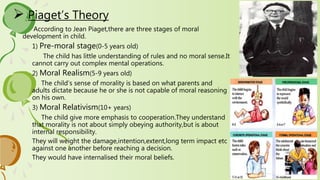
 Piaget’s Theory
According to Jean Piaget,there are three stages of moral
development in child.
1) Pre-moral stage(0-5 years old)
The child has little understanding of rules and no moral sense.It
cannot carry out complex mental operations.
2) Moral Realism(5-9 years old)
The child’s sense of morality is based on what parents and
adults dictate because he or she is not capable of moral reasoning
on his own.
3) Moral Relativism(10+ years)
The child give more emphasis to cooperation.They understand
that morality is not about simply obeying authority,but is about
internal responsibility.
They will weight the damage,intention,extent,long term impact etc
against one another before reaching a decision.
They would have internalised their moral beliefs.
 KOHLBERG’S THEORY
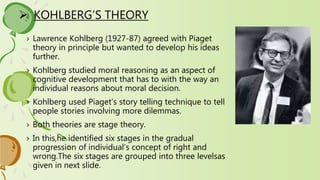
› Lawrence Kohlberg (1927-87) agreed with Piaget
theory in principle but wanted to develop his ideas
further.
› Kohlberg studied moral reasoning as an aspect of
cognitive development that has to with the way an
individual reasons about moral decision.
› Kohlberg used Piaget’s story telling technique to tell
people stories involving more dilemmas.
› Both theories are stage theory.
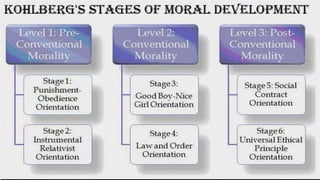
› In this,he identified six stages in the gradual
progression of individual’s concept of right and
wrong.The six stages are grouped into three levelsas
given in next slide.
Level 1:Pre-conventional Morality
› Judgement based solely on a person’s own needs and perceptions.
› Moral reasoning is based on external rewards and punishments.
› Typically children under the age of 10.
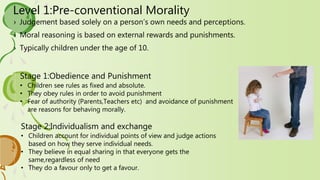
Stage 1:Obedience and Punishment
• Children see rules as fixed and absolute.
• They obey rules in order to avoid punishment
• Fear of authority (Parents,Teachers etc) and avoidance of punishment
are reasons for behaving morally.
Stage 2:Individualism and exchange
• Children account for individual points of view and judge actions
based on how they serve individual needs.
• They believe in equal sharing in that everyone gets the
same,regardless of need
• They do a favour only to get a favour.
Level 2:Conventional Moral Reasoning
› Primary concern is to fit in and play the role of a good citizen
› People have a strong desire to follow the rules and laws.
› Typical of most adults.
Stage3:Good boy-Good girl orientation
• People attempt to live up to the social roles and expectations of family and
community.
• Good behaviour means having good motives and interpersonal feelings such as
love,empathy,trust and concern for others.
• They expect themselves and others to live up to the expectations associated with their
roles.
Stage4:Law and Social order orientation
• People begin to consider society as a whole when making judgements.
• The focus is to maintain social order by:
-Resisting personal pressures -following the rules -doing one’s duty
-Obeying laws -and respecting authority without question.
• A duty to uphold laws and rules for their own sake justifies moral conformity
Level 3:Post-Conventional Morality
› Reasoning based on personal moral standards
› Characterised by references to universal ethical principles that represent
protecting the right of all people.
› Most adults donot reach this level.
Stage5:Social Contract Orientation
• People acknowledge the importance of maintaining the social order but not at the expense
of individual rights
• People at this stage hold that a good society should function on a social contract of
members trying to maximize the welfare of all
• They regard rights prior to particular laws.
Stage6:Universal Ethical Principles
• This is highest stage of moral reasoning according to Kohlberg.
• Moral reasoning is based on conscience,abstract reasoning and an evolved sense of
justice that go beyond rules and laws.
• “Satyagraha” by Mahatama Gandhi and Civil Disobedience by Martin Luther King are
acts performed out of a sense of higher justice and principled conscience
Heinz’s dilemma
› In Europe,a woman was near death from a special kind of cancer.
› There was one drug that the doctors thought might save her.
› It was a form of radium that a druggist in the same town had
recently discovered.
› The drug was expensive to make,but the druggist was charging ten
times what the drug cost him to make.
› He paid $4000 for the radium and charged $4000 for a small dose
of drug.
› The sick woman’s husband ,Heinz went to everyone he knew to
borrow the money and tried every legal means,but he could only
get $2000 which is half of what it cost.
› He told the druggist that his wife was dying,and asked him to sell it
cheaper or let him pay later.
› But the druggist said,”No,I discovered the drug and I’m going to
make money from it.”
› So,having tried every legal means,Heinz gets desperate and
considers breaking into the man’s store to steal the drug for his
wife.
› Heinz’s Dilemma was used by Kohlberg to interview children of different age
groups.He was not interested in answers as such.He was interested in their
reasoning.
› Children at stage1:
• They sat that the actof stealing is wrong.
• The right thing is to obey authority because authority can inflict punishment.
› Children at Stage2:
• They said Heinz can steal the drug because it serves his self interest.
• Children at this stage believe in exchanging favours.
› Children at Stage 3:
• They said “He must steal it.Anyone would do that.”
• His act is morally right because it is out of love for his wife.The druggist must be punished.
› Children at Stage 4:
• Here children sympathise with Heinz,but donot condone the theft.
• If everyone who is in need starts stealing,what will happen to law and order?,how society
function?.
• They acknowledge good motives of Heinz.
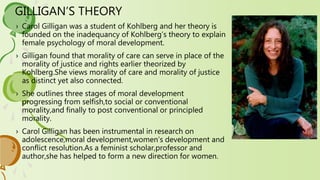
GILLIGAN’S THEORY
› Carol Gilligan was a student of Kohlberg and her theory is
founded on the inadequancy of Kohlberg’s theory to explain
female psychology of moral development.
› Gilligan found that morality of care can serve in place of the
morality of justice and rights earlier theorized by
Kohlberg.She views morality of care and morality of justice
as distinct yet also connected.
› She outlines three stages of moral development
progressing from selfish,to social or conventional
morality,and finally to post conventional or principled
morality.
› Carol Gilligan has been instrumental in research on
adolescence,moral development,women’s development and
conflict resolution.As a feminist scholar,professor and
author,she has helped to form a new direction for women.
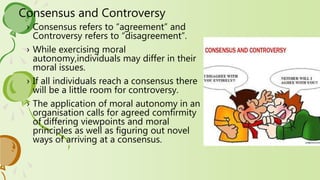
Consensus and Controversy
› Consensus refers to “agreement” and
Controversy refers to “disagreement”.
› While exercising moral
autonomy,individuals may differ in their
moral issues.
› If all individuals reach a consensus there
will be a little room for controversy.
› The application of moral autonomy in an
organisation calls for agreed comfirmity
of differing viewpoints and moral
principles as well as figuring out novel
ways of arriving at a consensus.
MODELS OF PROFESSIONAL ROLES
› Promotion of public good is the primary concern of the professional
engineers.
› There are several role models to whom the engineers are attracted.These
models provoke their thinking,attitudes and actions.
› Engineers often identify themselves with some of the roles given below
(1) Saviour
The engineer as a saviour, save the society from
poverty,illetracy,wastage inefficiency,,ill health,human(labour) dignity and
lead it to prosperity,through technological development and social
planning.
(2) Guardian
He guards the interests of the poor and general public.As one who is
conversant with technology development,is given the authority benefitting
his expertise to determine what is bestsuited to the society
(3) Bureaucratic Servant
He serves the organization and the employers. The management of an enterprise fixes its goals and assigns the
job of problem solving to the engineer, who accepts the challenge and shapes them into concrete
achievements. For example, Jamshedji Tata.
(4) Social Servant
It is one who exhibits social responsibility. The engineer translates the interest and aspirations of the society
into a reality, remembering that his true master is the society at large. For example, Sir M.Viswesvarayya.
(5) Social Enabler and Catalyst
One who changes the society through technology. The engineer must assist the management and the society
to understand their needs and make informed decisions on the desirable technological development and
minimize the negative effects of technology on people and their living environment. Thus, he shines as a social
enabler and a catalyst for further growth. For example, Sri Sundarlal Bahuguna.
(6) Game Player
He is neither a servant nor master. An engineer is an assertive player, not a passive player who may carry out
his master‘s voice. He plays a unique role successfully within the organization, enjoying the excitement of the
profession and having the satisfaction of surging ahead in a competitive world. For example, Narayanamurthy,
Infosys and Dr. Kasthurirangan, ISRO.
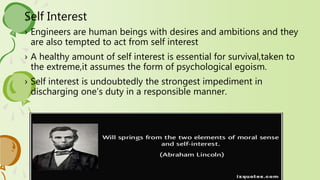
Self Interest
› Engineers are human beings with desires and ambitions and they
are also tempted to act from self interest
› A healthy amount of self interest is essential for survival,taken to
the extreme,it assumes the form of psychological egoism.
› Self interest is undoubtedly the strongest impediment in
discharging one’s duty in a responsible manner.
Engineering as Social Experimentation
› Today the mark of human progress is advancement in
Engineering and Technology.In past,the measure of progress of
a society used to be excellence in arts,literature and the extent
of awareness of its people.
› Experimentation in Engineering in the usual sense refers to
testing of materials for strength and other relevant
properties,trying out various processes,studying the effects by
making prototypes etc.
› Engineering as social experimentation is totally different.Here
each engineering project as a whole is viewed as an experiment
that is conducted on a large scale involving human subjects.
Engineers as Social Experimenters
› The onus is upon the engineers to be comscious and identify
the risks,to constantly monitor and share information with
people for enabling them to make informed decisions.This is a
great responsibility.
› Essential characteristics of an engineer as a responsible social
experimenter:
1) Conscientiousness
It is about being careful ,thoughtful and vigilant with
commitment to values and sensitivity to moral problems.
2) Comprehensive perspective
It’s getting the big picture and fully understanding the moral
context of one’s work.Today’s specialists fail to see the forest for
the trees.i.e, it is better to have all the information that one can
get,analyze all aspects rather than going for remedies at later
stage.
3) Moral Autonomy
It is the capacity to reflect and self impose the moral law
rather than passively adopting social,religious and
professional conventions.If an engineer goes by his
company’s moral views even if his conscience is against
them, he is forfeiting his moral autonomy.
4) Accountability
It’s the moral obligation of the engineer to account for his
actions ,accept responsibility for them and the disposition for
being willing to submit his actions to moral scrutinity in a
completely transparent manner.
Moral Development

Moral Development

  • 1.
    MORAL DEVELOPMENT & SELF-INETEREST LIFESKILL Submitted By:BRYAN TYSON JOHN Class :S4,AE&IE Date :3/2/18
  • 2.
     Moral Development Kohlberg’s Theory  Gilligan’s Theory  Consensus and Controversy  Models of Professional Roles  Self-Interest o Engineering as Experimentation o Engineers as Responsible Experimenters
  • 3.
     MORAL DEVELOPMENT Moral Development is the progressive change in the moral sense of human beings across life span.  The gradual development of an individual’s concept of: • Right or Wrong • Conscience • Religious Values • Social Attitudes and • Certain Behaviour  Process by which children learn their moral beliefs and develop moral reasoning by making decisions regarding what is wright or wrong. Theories of Moral Development  Piaget’s Theory  Kohlberg’s Theory  Gilligan’s Theory
  • 4.
     Piaget’s Theory Accordingto Jean Piaget,there are three stages of moral development in child. 1) Pre-moral stage(0-5 years old) The child has little understanding of rules and no moral sense.It cannot carry out complex mental operations. 2) Moral Realism(5-9 years old) The child’s sense of morality is based on what parents and adults dictate because he or she is not capable of moral reasoning on his own. 3) Moral Relativism(10+ years) The child give more emphasis to cooperation.They understand that morality is not about simply obeying authority,but is about internal responsibility. They will weight the damage,intention,extent,long term impact etc against one another before reaching a decision. They would have internalised their moral beliefs.
  • 5.
     KOHLBERG’S THEORY ›Lawrence Kohlberg (1927-87) agreed with Piaget theory in principle but wanted to develop his ideas further. › Kohlberg studied moral reasoning as an aspect of cognitive development that has to with the way an individual reasons about moral decision. › Kohlberg used Piaget’s story telling technique to tell people stories involving more dilemmas. › Both theories are stage theory. › In this,he identified six stages in the gradual progression of individual’s concept of right and wrong.The six stages are grouped into three levelsas given in next slide.
  • 7.
    Level 1:Pre-conventional Morality ›Judgement based solely on a person’s own needs and perceptions. › Moral reasoning is based on external rewards and punishments. › Typically children under the age of 10. Stage 1:Obedience and Punishment • Children see rules as fixed and absolute. • They obey rules in order to avoid punishment • Fear of authority (Parents,Teachers etc) and avoidance of punishment are reasons for behaving morally. Stage 2:Individualism and exchange • Children account for individual points of view and judge actions based on how they serve individual needs. • They believe in equal sharing in that everyone gets the same,regardless of need • They do a favour only to get a favour.
  • 8.
    Level 2:Conventional MoralReasoning › Primary concern is to fit in and play the role of a good citizen › People have a strong desire to follow the rules and laws. › Typical of most adults. Stage3:Good boy-Good girl orientation • People attempt to live up to the social roles and expectations of family and community. • Good behaviour means having good motives and interpersonal feelings such as love,empathy,trust and concern for others. • They expect themselves and others to live up to the expectations associated with their roles. Stage4:Law and Social order orientation • People begin to consider society as a whole when making judgements. • The focus is to maintain social order by: -Resisting personal pressures -following the rules -doing one’s duty -Obeying laws -and respecting authority without question. • A duty to uphold laws and rules for their own sake justifies moral conformity
  • 9.
    Level 3:Post-Conventional Morality ›Reasoning based on personal moral standards › Characterised by references to universal ethical principles that represent protecting the right of all people. › Most adults donot reach this level. Stage5:Social Contract Orientation • People acknowledge the importance of maintaining the social order but not at the expense of individual rights • People at this stage hold that a good society should function on a social contract of members trying to maximize the welfare of all • They regard rights prior to particular laws. Stage6:Universal Ethical Principles • This is highest stage of moral reasoning according to Kohlberg. • Moral reasoning is based on conscience,abstract reasoning and an evolved sense of justice that go beyond rules and laws. • “Satyagraha” by Mahatama Gandhi and Civil Disobedience by Martin Luther King are acts performed out of a sense of higher justice and principled conscience
  • 10.
    Heinz’s dilemma › InEurope,a woman was near death from a special kind of cancer. › There was one drug that the doctors thought might save her. › It was a form of radium that a druggist in the same town had recently discovered. › The drug was expensive to make,but the druggist was charging ten times what the drug cost him to make. › He paid $4000 for the radium and charged $4000 for a small dose of drug. › The sick woman’s husband ,Heinz went to everyone he knew to borrow the money and tried every legal means,but he could only get $2000 which is half of what it cost. › He told the druggist that his wife was dying,and asked him to sell it cheaper or let him pay later. › But the druggist said,”No,I discovered the drug and I’m going to make money from it.” › So,having tried every legal means,Heinz gets desperate and considers breaking into the man’s store to steal the drug for his wife.
  • 12.
    › Heinz’s Dilemmawas used by Kohlberg to interview children of different age groups.He was not interested in answers as such.He was interested in their reasoning. › Children at stage1: • They sat that the actof stealing is wrong. • The right thing is to obey authority because authority can inflict punishment. › Children at Stage2: • They said Heinz can steal the drug because it serves his self interest. • Children at this stage believe in exchanging favours. › Children at Stage 3: • They said “He must steal it.Anyone would do that.” • His act is morally right because it is out of love for his wife.The druggist must be punished. › Children at Stage 4: • Here children sympathise with Heinz,but donot condone the theft. • If everyone who is in need starts stealing,what will happen to law and order?,how society function?. • They acknowledge good motives of Heinz.
  • 13.
    GILLIGAN’S THEORY › CarolGilligan was a student of Kohlberg and her theory is founded on the inadequancy of Kohlberg’s theory to explain female psychology of moral development. › Gilligan found that morality of care can serve in place of the morality of justice and rights earlier theorized by Kohlberg.She views morality of care and morality of justice as distinct yet also connected. › She outlines three stages of moral development progressing from selfish,to social or conventional morality,and finally to post conventional or principled morality. › Carol Gilligan has been instrumental in research on adolescence,moral development,women’s development and conflict resolution.As a feminist scholar,professor and author,she has helped to form a new direction for women.
  • 14.
    Consensus and Controversy ›Consensus refers to “agreement” and Controversy refers to “disagreement”. › While exercising moral autonomy,individuals may differ in their moral issues. › If all individuals reach a consensus there will be a little room for controversy. › The application of moral autonomy in an organisation calls for agreed comfirmity of differing viewpoints and moral principles as well as figuring out novel ways of arriving at a consensus.
  • 15.
    MODELS OF PROFESSIONALROLES › Promotion of public good is the primary concern of the professional engineers. › There are several role models to whom the engineers are attracted.These models provoke their thinking,attitudes and actions. › Engineers often identify themselves with some of the roles given below (1) Saviour The engineer as a saviour, save the society from poverty,illetracy,wastage inefficiency,,ill health,human(labour) dignity and lead it to prosperity,through technological development and social planning. (2) Guardian He guards the interests of the poor and general public.As one who is conversant with technology development,is given the authority benefitting his expertise to determine what is bestsuited to the society
  • 16.
    (3) Bureaucratic Servant Heserves the organization and the employers. The management of an enterprise fixes its goals and assigns the job of problem solving to the engineer, who accepts the challenge and shapes them into concrete achievements. For example, Jamshedji Tata. (4) Social Servant It is one who exhibits social responsibility. The engineer translates the interest and aspirations of the society into a reality, remembering that his true master is the society at large. For example, Sir M.Viswesvarayya. (5) Social Enabler and Catalyst One who changes the society through technology. The engineer must assist the management and the society to understand their needs and make informed decisions on the desirable technological development and minimize the negative effects of technology on people and their living environment. Thus, he shines as a social enabler and a catalyst for further growth. For example, Sri Sundarlal Bahuguna. (6) Game Player He is neither a servant nor master. An engineer is an assertive player, not a passive player who may carry out his master‘s voice. He plays a unique role successfully within the organization, enjoying the excitement of the profession and having the satisfaction of surging ahead in a competitive world. For example, Narayanamurthy, Infosys and Dr. Kasthurirangan, ISRO.
  • 17.
    Self Interest › Engineersare human beings with desires and ambitions and they are also tempted to act from self interest › A healthy amount of self interest is essential for survival,taken to the extreme,it assumes the form of psychological egoism. › Self interest is undoubtedly the strongest impediment in discharging one’s duty in a responsible manner.
  • 18.
    Engineering as SocialExperimentation › Today the mark of human progress is advancement in Engineering and Technology.In past,the measure of progress of a society used to be excellence in arts,literature and the extent of awareness of its people. › Experimentation in Engineering in the usual sense refers to testing of materials for strength and other relevant properties,trying out various processes,studying the effects by making prototypes etc. › Engineering as social experimentation is totally different.Here each engineering project as a whole is viewed as an experiment that is conducted on a large scale involving human subjects.
  • 19.
    Engineers as SocialExperimenters › The onus is upon the engineers to be comscious and identify the risks,to constantly monitor and share information with people for enabling them to make informed decisions.This is a great responsibility. › Essential characteristics of an engineer as a responsible social experimenter: 1) Conscientiousness It is about being careful ,thoughtful and vigilant with commitment to values and sensitivity to moral problems. 2) Comprehensive perspective It’s getting the big picture and fully understanding the moral context of one’s work.Today’s specialists fail to see the forest for the trees.i.e, it is better to have all the information that one can get,analyze all aspects rather than going for remedies at later stage.
  • 20.
    3) Moral Autonomy Itis the capacity to reflect and self impose the moral law rather than passively adopting social,religious and professional conventions.If an engineer goes by his company’s moral views even if his conscience is against them, he is forfeiting his moral autonomy. 4) Accountability It’s the moral obligation of the engineer to account for his actions ,accept responsibility for them and the disposition for being willing to submit his actions to moral scrutinity in a completely transparent manner.