Enzyme Biotechnology- Methods of enzyme immobilization and
applications.
• Enzyme technology is the technology associated with the use of
enzymes as tools in industry, pharmaceuticals, agriculture or
medicine.
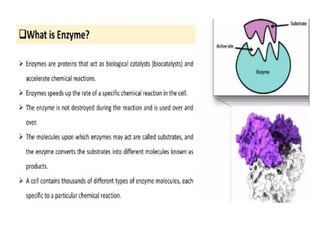
• Enzymes are soluble, amorphous colloidal, proteineous,
bioactive organic catalyst produced by living cells. They are
proteins. composed of one polypeptide (amino acid chain) or
more associated polypeptide chains.
• The catalytic activity of enzymes depend on the L-a-amino acid
sequence and peptide bonds constituting the protein molecule.
Primary, secondary, tertiary and quaternary structures of
enzyme proteins are necessary for their catalytic activity.
• Enzymes are called holoenzyme composed of protein (apoenzyme), non-
protein (coenzyme) and metal.
• Protein part of enzyme is attached to non-protein part by covalent or non-
covalent bond. When coenzyme is attached to apoenzyme tightly and
permanently then it is called as prosthetic group. Enzymes have molecular
weights ranging from about 12,000 to over one million.
• Enzymes are mainly classified as extracellular enzymes (exoenzyme) and
intracellular enzymes (endoenzyme). Exoenzymes are secreted outside the
cell such as cellulose, polyglucturonase, pectinmethylesterase etc.
• Endoenzymes are secreted within the cell such as invertase, uric oxidase,
asparaginase etc. Endoenzymes are isolated by breaking the cells by means
of a homogenizer or a bead mill and extracting them through the
biochemical processes.
• Enzyme biotechnology encompasses the use of enzymes in various
industrial and biomedical applications to enhance processes and
create new products. Enzymes act as biocatalysts, speeding up
biochemical reactions and enabling efficient, sustainable, and often
more precise outcomes. Their applications span food and beverage
production, biofuel generation, textile and leather processing,
diagnostics, and therapeutics.
Key Applications:
• Food and Beverage Industry:
Enzymes like amylases, proteases, and lipases are crucial in bread
making, brewing, and dairy production. Amylases break down starch,
proteases modify proteins, and lipases break down fats, all
contributing to texture, flavor, and shelf life.
• Biofuel Production:
Enzymes like cellulases and hemicellulases are essential for breaking down
plant biomass into fermentable sugars, which are then used to produce
ethanol.
• Textile and Leather Industries:
like cellulases are used in bio-polishing of fabrics, removing excess fibers
and improving fabric quality. Proteases are used in leather processing to
remove hair and other impurities.
• Diagnostics and Therapeutics:
Enzymes play a vital role in medical diagnostics, such as detecting glucose
levels in blood using glucose oxidase. Immobilized enzymes are also used
in drug delivery systems and as therapeutic agents.
• Environmental Applications:
Enzymes are used in bioremediation, breaking down pollutants in
wastewater and soil. They are also used in waste management and for
developing eco-friendly industrial processes.
Advanced Applications and Future Trends:
Protein Engineering:
• This field focuses on modifying enzymes to enhance their activity, stability, or substrate
specificity, leading to improved industrial processes.
Recombinant DNA Technology:
• This technology allows for the large-scale production of specific enzymes using genetically
modified microorganisms.
Nanotechnology:
• Nanomaterials are being explored to improve enzyme immobilization and delivery, enhancing
their stability and activity.
High-throughput Screening:
• This method allows for the rapid screening of large libraries of enzymes to identify those with
desired properties.
• Enzyme biotechnology is a rapidly evolving field with significant potential to improve existing
processes and develop new, sustainable solutions across various sectors. The continuous
development of new enzymes and the refinement of existing technologies will drive further
advancements in this field.
Methods of enzyme immobilization
• Enzyme immobilization is a process in which 'enzymes are physically
confined, or Tized in a certain defined region of space with retention of
their catalytic activities' and can be used repeatedly and continuously. It
is the process wherein an enzyme or cell makes use of safe carrier
phase for stealth and safe homing.
• The use of enzymes in industrial cations is limited because most of the
enzymes are relatively unstable and high cost of Mon, purification and
recovery of active enzymes from the reaction mixtures after the letion
of catalytic process.
• Hence, enzymes must be immobilized on the surface of solid support or
it can convert a continuous flow of substrate to product without being
• The first commercial application of immobilized enzyme technology was
realised in 1969 an with the use of Aspergillus oryzae amino acylase for
the industrial production of L-acids. The advantage of immobilized
enzymes are as follows.
• The immobilization process can lead to increased activity and stability of
the enzyme molecules.
• They are physically confined during a continuous catalytic process.
• Immobilized enzymes are easily recovered from the reaction mixture and
reused.
• Hence, process is more economic.
• They can be operated continuously and can be readily controlled.
• Enzyme immobilization process avoids the contamination in products and
increases enzyme: substrate ratio.
• The products can be easily separated.
Methods of enzyme immobilization
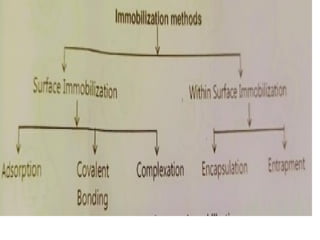
• Enzyme immobilization methods are classified as surface
immobilization and within surface immobilization These methods
depend upon physical relationship of the catalyst to the matrix
(carrier)
• The major components of an immobilized enzyme are the enzyme,
the matrix and the mode of interaction of the enzyme with the
carrier.
• The selected matrix must enhance the operational stability of the
immobilized enzyme purification.
• The carriers used for enzyme immobilization are porous or
nonporous materials with organic (natural or synthetic) or inorganic
nature.
• An ideal carrier matrix should be inert, cost effective, stable, high
regidity, regenerability, large surface area, more permeability,
suitable shape and highly resistance to microbial attack.
Adsorption
• Adsorption is the most economical and simple method to immobilize
enzymes by adsorbing them on to charged or neutral surfaces of inert
substrate.
• Various kinds of supports are used for adsorption such as aluminium
oxide, charcoal, starch, modified sepharose, cellulose derivatives, glass
and ion exchange resins.
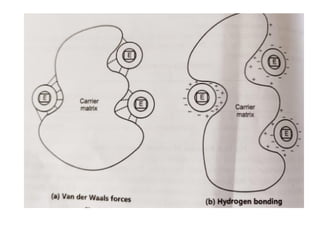
• The adsorption of an enzyme is dependent on the experimental variables
such as pH, ionic strength, temperature, nature of solvent and
concentration of enzyme and adsorbent. The surface of the support
involves weak binding forces between protein and adsorbent such as
hydrogen bonds, van der Waals forces and ionic or hydrophobic
interactions .
• The process of adsorption of an enzyme is performed by mixing the
enzyme and polymer support in a stirred reactor or by percolating the
enzyme through a packed bed, tube or membrane.
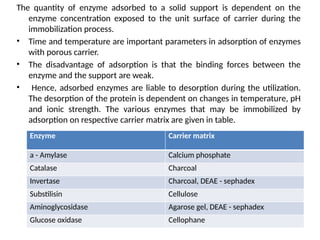
The quantity of enzyme adsorbed to a solid support is dependent on the
enzyme concentration exposed to the unit surface of carrier during the
immobilization process.
• Time and temperature are important parameters in adsorption of enzymes
with porous carrier.
• The disadvantage of adsorption is that the binding forces between the
enzyme and the support are weak.
• Hence, adsorbed enzymes are liable to desorption during the utilization.
The desorption of the protein is dependent on changes in temperature, pH
and ionic strength. The various enzymes that may be immobilized by
adsorption on respective carrier matrix are given in table.
Enzyme Carrier matrix
a - Amylase Calcium phosphate
Catalase Charcoal
Invertase Charcoal, DEAE - sephadex
Substilisin Cellulose
Aminoglycosidase Agarose gel, DEAE - sephadex
Glucose oxidase Cellophane
Covalent bonding
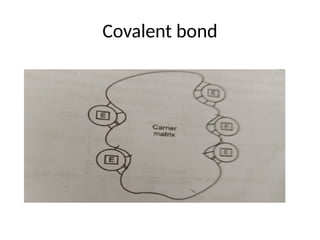
• Covalent bond is formed between the chemical groups of enzyme
• and chemical groups on surface of carrier.
• Covalent bonding has an advantage of an attachment not reversed by pH,
ionic strength or substrate.
• The active site of an enzyme may be blocked through the chemical
reaction and the enzyme rendered inactive. Adsorption of enzymes to the
carrier matrices is quite easy and convenient by covalent bonding.
• The formation of covalent bond usually takes place particularly with the
side chains of amino acids present in the enzyme.
• The various groups are sulphide, sulphahydril, oxide, amino, carboxyl,
hydroxyl, ammonium, imino, amide, methylthiol, guanidyl, imidazole and
phenol ring.
Covalent bond
Different methods of covalent bonding are classified as follows.
1) Diazotation
2)Formation of peptide bond
3)Group activation
4)polyfunctional reagents
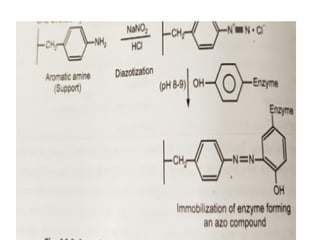
1) Diazotation
• This reaction involves bonding between the amino group of the support
• e.g. aminobenzyl cellulose, amino derivatives of polystyrene,
aminosilanised porous glass and a tyrosyl or histidyl group of the
enzyme.
• The amino functional moiety containing support material is converted to
the corresponding diazonium chloride salt by treating with a mixture of
sodium nitrate and diluted hydrochloric acid.
2) Formation of peptide bond
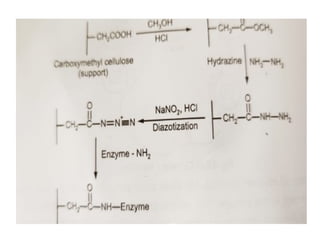
• The reaction occurs between the amino or carboxyl groups of the support
and the carboxyl or amino groups of the enzymes.
• Acyl azide derivatives react with the enzyme protein involving
predominantly the primary amino groups of enzyme to form the peptide
bond.
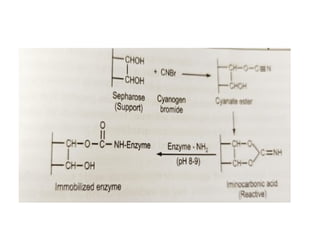
Group activation
In this method, cyanogen bromide is applied to support
containing glycol groups
e.g. cellulose, sephadex, sepharose etc.
biotech lecture  immobilizer enzyme 2.pptx

biotech lecture immobilizer enzyme 2.pptx

  • 1.
    Enzyme Biotechnology- Methodsof enzyme immobilization and applications.
  • 4.
    • Enzyme technologyis the technology associated with the use of enzymes as tools in industry, pharmaceuticals, agriculture or medicine. • Enzymes are soluble, amorphous colloidal, proteineous, bioactive organic catalyst produced by living cells. They are proteins. composed of one polypeptide (amino acid chain) or more associated polypeptide chains. • The catalytic activity of enzymes depend on the L-a-amino acid sequence and peptide bonds constituting the protein molecule. Primary, secondary, tertiary and quaternary structures of enzyme proteins are necessary for their catalytic activity.
  • 5.
    • Enzymes arecalled holoenzyme composed of protein (apoenzyme), non- protein (coenzyme) and metal. • Protein part of enzyme is attached to non-protein part by covalent or non- covalent bond. When coenzyme is attached to apoenzyme tightly and permanently then it is called as prosthetic group. Enzymes have molecular weights ranging from about 12,000 to over one million. • Enzymes are mainly classified as extracellular enzymes (exoenzyme) and intracellular enzymes (endoenzyme). Exoenzymes are secreted outside the cell such as cellulose, polyglucturonase, pectinmethylesterase etc. • Endoenzymes are secreted within the cell such as invertase, uric oxidase, asparaginase etc. Endoenzymes are isolated by breaking the cells by means of a homogenizer or a bead mill and extracting them through the biochemical processes.
  • 6.
    • Enzyme biotechnologyencompasses the use of enzymes in various industrial and biomedical applications to enhance processes and create new products. Enzymes act as biocatalysts, speeding up biochemical reactions and enabling efficient, sustainable, and often more precise outcomes. Their applications span food and beverage production, biofuel generation, textile and leather processing, diagnostics, and therapeutics. Key Applications: • Food and Beverage Industry: Enzymes like amylases, proteases, and lipases are crucial in bread making, brewing, and dairy production. Amylases break down starch, proteases modify proteins, and lipases break down fats, all contributing to texture, flavor, and shelf life.
  • 7.
    • Biofuel Production: Enzymeslike cellulases and hemicellulases are essential for breaking down plant biomass into fermentable sugars, which are then used to produce ethanol. • Textile and Leather Industries: like cellulases are used in bio-polishing of fabrics, removing excess fibers and improving fabric quality. Proteases are used in leather processing to remove hair and other impurities. • Diagnostics and Therapeutics: Enzymes play a vital role in medical diagnostics, such as detecting glucose levels in blood using glucose oxidase. Immobilized enzymes are also used in drug delivery systems and as therapeutic agents. • Environmental Applications: Enzymes are used in bioremediation, breaking down pollutants in wastewater and soil. They are also used in waste management and for developing eco-friendly industrial processes.
  • 8.
    Advanced Applications andFuture Trends: Protein Engineering: • This field focuses on modifying enzymes to enhance their activity, stability, or substrate specificity, leading to improved industrial processes. Recombinant DNA Technology: • This technology allows for the large-scale production of specific enzymes using genetically modified microorganisms. Nanotechnology: • Nanomaterials are being explored to improve enzyme immobilization and delivery, enhancing their stability and activity. High-throughput Screening: • This method allows for the rapid screening of large libraries of enzymes to identify those with desired properties. • Enzyme biotechnology is a rapidly evolving field with significant potential to improve existing processes and develop new, sustainable solutions across various sectors. The continuous development of new enzymes and the refinement of existing technologies will drive further advancements in this field.
  • 9.
    Methods of enzymeimmobilization • Enzyme immobilization is a process in which 'enzymes are physically confined, or Tized in a certain defined region of space with retention of their catalytic activities' and can be used repeatedly and continuously. It is the process wherein an enzyme or cell makes use of safe carrier phase for stealth and safe homing. • The use of enzymes in industrial cations is limited because most of the enzymes are relatively unstable and high cost of Mon, purification and recovery of active enzymes from the reaction mixtures after the letion of catalytic process. • Hence, enzymes must be immobilized on the surface of solid support or it can convert a continuous flow of substrate to product without being • The first commercial application of immobilized enzyme technology was realised in 1969 an with the use of Aspergillus oryzae amino acylase for the industrial production of L-acids. The advantage of immobilized enzymes are as follows.
  • 10.
    • The immobilizationprocess can lead to increased activity and stability of the enzyme molecules. • They are physically confined during a continuous catalytic process. • Immobilized enzymes are easily recovered from the reaction mixture and reused. • Hence, process is more economic. • They can be operated continuously and can be readily controlled. • Enzyme immobilization process avoids the contamination in products and increases enzyme: substrate ratio. • The products can be easily separated.
  • 11.
    Methods of enzymeimmobilization • Enzyme immobilization methods are classified as surface immobilization and within surface immobilization These methods depend upon physical relationship of the catalyst to the matrix (carrier) • The major components of an immobilized enzyme are the enzyme, the matrix and the mode of interaction of the enzyme with the carrier. • The selected matrix must enhance the operational stability of the immobilized enzyme purification. • The carriers used for enzyme immobilization are porous or nonporous materials with organic (natural or synthetic) or inorganic nature. • An ideal carrier matrix should be inert, cost effective, stable, high regidity, regenerability, large surface area, more permeability, suitable shape and highly resistance to microbial attack.
  • 13.
    Adsorption • Adsorption isthe most economical and simple method to immobilize enzymes by adsorbing them on to charged or neutral surfaces of inert substrate. • Various kinds of supports are used for adsorption such as aluminium oxide, charcoal, starch, modified sepharose, cellulose derivatives, glass and ion exchange resins. • The adsorption of an enzyme is dependent on the experimental variables such as pH, ionic strength, temperature, nature of solvent and concentration of enzyme and adsorbent. The surface of the support involves weak binding forces between protein and adsorbent such as hydrogen bonds, van der Waals forces and ionic or hydrophobic interactions . • The process of adsorption of an enzyme is performed by mixing the enzyme and polymer support in a stirred reactor or by percolating the enzyme through a packed bed, tube or membrane.
  • 15.
    The quantity ofenzyme adsorbed to a solid support is dependent on the enzyme concentration exposed to the unit surface of carrier during the immobilization process. • Time and temperature are important parameters in adsorption of enzymes with porous carrier. • The disadvantage of adsorption is that the binding forces between the enzyme and the support are weak. • Hence, adsorbed enzymes are liable to desorption during the utilization. The desorption of the protein is dependent on changes in temperature, pH and ionic strength. The various enzymes that may be immobilized by adsorption on respective carrier matrix are given in table. Enzyme Carrier matrix a - Amylase Calcium phosphate Catalase Charcoal Invertase Charcoal, DEAE - sephadex Substilisin Cellulose Aminoglycosidase Agarose gel, DEAE - sephadex Glucose oxidase Cellophane
  • 16.
    Covalent bonding • Covalentbond is formed between the chemical groups of enzyme • and chemical groups on surface of carrier. • Covalent bonding has an advantage of an attachment not reversed by pH, ionic strength or substrate. • The active site of an enzyme may be blocked through the chemical reaction and the enzyme rendered inactive. Adsorption of enzymes to the carrier matrices is quite easy and convenient by covalent bonding. • The formation of covalent bond usually takes place particularly with the side chains of amino acids present in the enzyme. • The various groups are sulphide, sulphahydril, oxide, amino, carboxyl, hydroxyl, ammonium, imino, amide, methylthiol, guanidyl, imidazole and phenol ring.
  • 17.
  • 18.
    Different methods ofcovalent bonding are classified as follows. 1) Diazotation 2)Formation of peptide bond 3)Group activation 4)polyfunctional reagents
  • 19.
    1) Diazotation • Thisreaction involves bonding between the amino group of the support • e.g. aminobenzyl cellulose, amino derivatives of polystyrene, aminosilanised porous glass and a tyrosyl or histidyl group of the enzyme. • The amino functional moiety containing support material is converted to the corresponding diazonium chloride salt by treating with a mixture of sodium nitrate and diluted hydrochloric acid.
  • 21.
    2) Formation ofpeptide bond • The reaction occurs between the amino or carboxyl groups of the support and the carboxyl or amino groups of the enzymes. • Acyl azide derivatives react with the enzyme protein involving predominantly the primary amino groups of enzyme to form the peptide bond.
  • 23.
    Group activation In thismethod, cyanogen bromide is applied to support containing glycol groups e.g. cellulose, sephadex, sepharose etc.