TOPIC
"Existing facilities and future opportunities for
developing renewable energy sources in India”
GUIDED BY
Mr.Padmalochan Prusty
Asst. Prof. Department of Mechanical Engineering,
GIET ,Khordha
Represented by
Suneli Kumar Jena
B.Tech,Mechanical (3rd
Year)
Reg no:-2201326434
What is Renewable Energy?
• Energy from a source that is not depleted when
used, such as wind or solar power.
• Any energy resource that is naturally
regenerated over a short time scale and derived
directly from the sun (such as thermal,
photochemical, and photoelectric), indirectly
from the sun (such as
wind, hydropower, and photosynthetic
stored in biomass), or from other
energy
natural
movements and mechanisms of the environment
(such as geothermal and tidal energy).
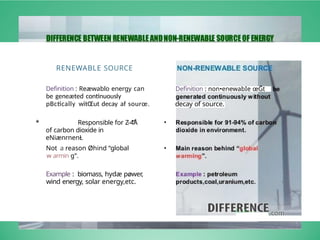
RENEWABLE SOURCE
Definition : Reæwablo energy can
be geneæted continuously
pBctically witŒut decay af sourœ.
Definition : non•enewabIe œĞt
* Responsible for Z-4”
Å
of carbon dioxide in
eNiænrnenŁ
•
Not a reason Øhind “global
w armin g”.
•
Example : biomass, hydæ pøwer,
wind energy, solar energy,etc.
decay of source.
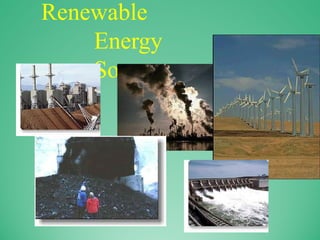
Renewable
Energy
Sources
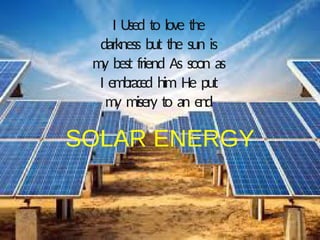
I Used to love the
darkness but the sun is
m
y best friend As soon as
I embr
aced him He put
m
y misery to an end
SOLAR ENERGY
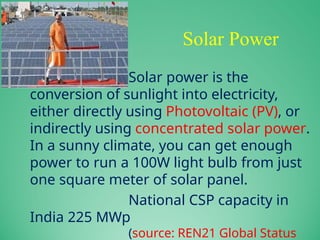
Solar Power
Solar power is the
conversion of sunlight into electricity,
either directly using Photovoltaic (PV), or
indirectly using concentrated solar power.
In a sunny climate, you can get enough
power to run a 100W light bulb from just
one square meter of solar panel.
National CSP capacity in
India 225 MWp
(source: REN21 Global Status
Growth of Solar Power in India
(in MW)
• Rajasthan – 1294.60
• Tamilnadu – 1267.41
• Gujrat - 1123.36
{as on 31st July 2016}
(Source: “State wise installed solar power capacity report”
Ministry of New and Renewable Energy Govt. of India)
And 66% growth in Solar Roof Top Market.
Recently India added 240 MW of Rooftop Solar
Capacity against 145MW in Nov.2014 to Oct. 2015
Existing Solar Plants in India
• Kamuthi Solar Power Plant 360MW Tamil Nadu
• Titan Energy plant 3 MW, kolar district Karnatka
• Titan Energy, 2 MW plant ,Jamuria, West Bengal
• Moser Baer ,Thin Film 1 MW ,Maharashtra
• Lanco , 5 MW ,Gujarat.
• North Delhi Power Ltd (Tata Power) 1 MW , Delhi.
• Reliance ,1 MW ,Thyagaraj stadium Plant,Delhi
• Azure Power 2 MW Awan, Punjab India.
Power Your Home With
Solar Energy
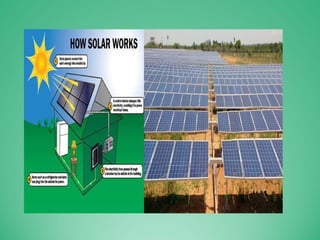
• The system needed isn't that complex
when you examine the devices needed.
Simply add solar panels to collect sunlight
and convert it into electricity. DC power
(direct current) is then sent to an inverter,
which converts DC power into Ac power,
which now runs your home. Through the
use of transfer switches and other safety
devices
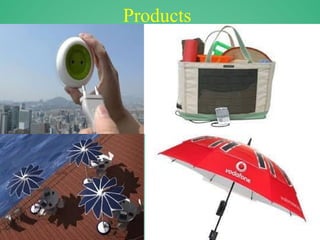
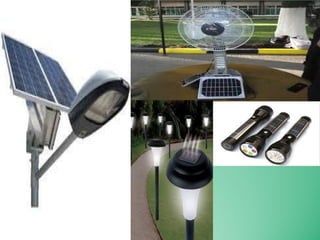
Other Uses Of Solar Energy
• Indoor Lighting
• Outdoor Lighting
• Battery Charging
• Power Pumps With Solar Energy
• Solar Energy Can Heat Our
Home
• Mobile charging
Products
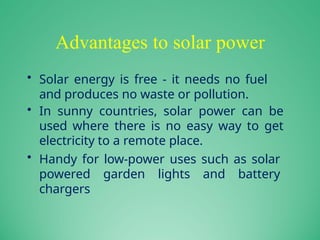
Advantages to solar power
• Solar energy is free - it needs no fuel
and produces no waste or pollution.
• In sunny countries, solar power can be
used where there is no easy way to get
electricity to a remote place.
• Handy for low-power uses such as solar
powered garden lights and battery
chargers
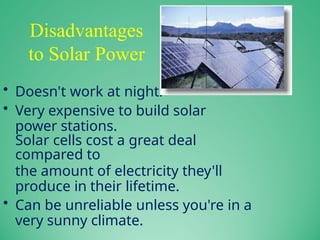
Disadvantages
to Solar Power
• Doesn't work at night.
• Very expensive to build solar
power stations.
Solar cells cost a great deal
compared to
the amount of electricity they'll
produce in their lifetime.
• Can be unreliable unless you're in a
very sunny climate.
WIND ENERGY
Wind power
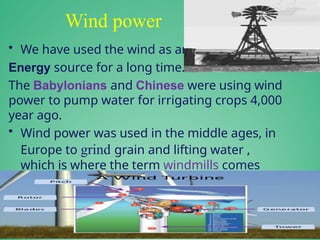
• We have used the wind as an
Energy source for a long time.
The Babylonians and Chinese were using wind
power to pump water for irrigating crops 4,000
year ago.
• Wind power was used in the middle ages, in
Europe to grind grain and lifting water ,
which is where the term windmills comes
from.
How Wind Power
Works
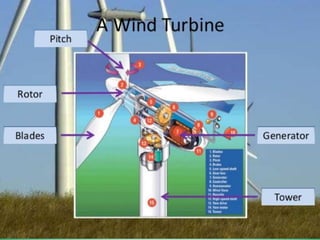
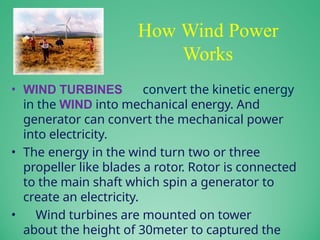
• WIND TURBINES convert the kinetic energy
in the WIND into mechanical energy. And
generator can convert the mechanical power
into electricity.
• The energy in the wind turn two or three
propeller like blades a rotor. Rotor is connected
to the main shaft which spin a generator to
create an electricity.
• Wind turbines are mounted on tower
about the height of 30meter to captured the
Advantages of Wind power
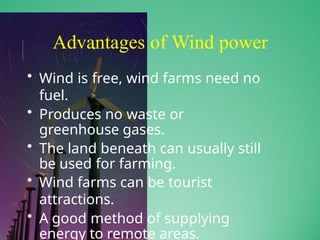
• Wind is free, wind farms need no
fuel.
• Produces no waste or
greenhouse gases.
• The land beneath can usually still
be used for farming.
• Wind farms can be tourist
attractions.
• A good method of supplying
energy to remote areas.
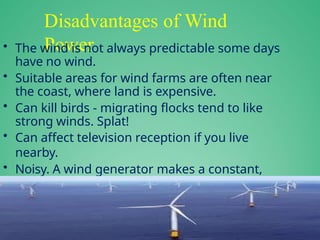
Disadvantages of Wind
Power
• The wind is not always predictable some days
have no wind.
• Suitable areas for wind farms are often near
the coast, where land is expensive.
• Can kill birds - migrating flocks tend to like
strong winds. Splat!
• Can affect television reception if you live
nearby.
• Noisy. A wind generator makes a constant,
low, "swooshing" noise day and night.
Growth factor for wind
• Technology development and a strong domestic
manufacturing base.
• Conducive policy frame for investment.
• Quality assurance:
National institute for wind energy
chennai
• RLMM committee:
Revise list of manufacturers & model
committee
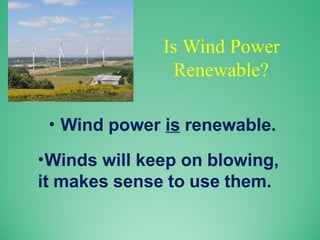
Is Wind Power
Renewable?
• Wind power is renewable.
•Winds will keep on blowing,
it makes sense to use them.
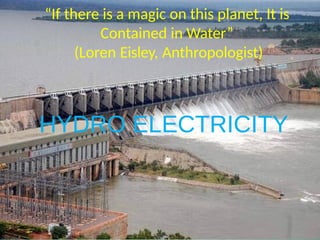
“If there is a magic on this planet, It is
Contained in Water”
(Loren Eisley, Anthropologist)
HYDRO ELECTRICITY
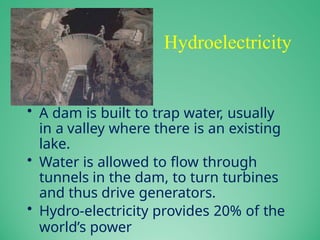
Hydroelectricity
• A dam is built to trap water, usually
in a valley where there is an existing
lake.
• Water is allowed to flow through
tunnels in the dam, to turn turbines
and thus drive generators.
• Hydro-electricity provides 20% of the
world’s power
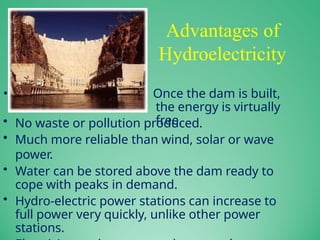
Advantages of
Hydroelectricity
• Once the dam is built,
the energy is virtually
free.
• No waste or pollution produced.
• Much more reliable than wind, solar or wave
power.
• Water can be stored above the dam ready to
cope with peaks in demand.
• Hydro-electric power stations can increase to
full power very quickly, unlike other power
stations.
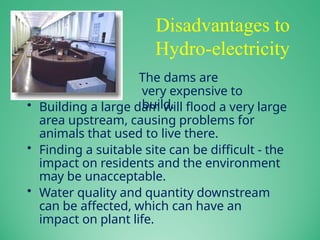
Disadvantages to
Hydro-electricity
• The dams are
very expensive to
build.
• Building a large dam will flood a very large
area upstream, causing problems for
animals that used to live there.
• Finding a suitable site can be difficult - the
impact on residents and the environment
may be unacceptable.
• Water quality and quantity downstream
can be affected, which can have an
impact on plant life.
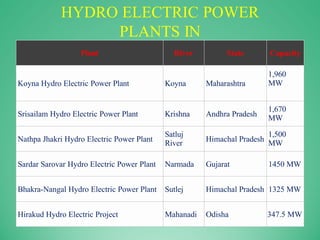
HYDRO ELECTRIC POWER
PLANTS IN
INDIA
Plant River State Capacity
Koyna Hydro Electric Power Plant Koyna Maharashtra
1,960
MW
Srisailam Hydro Electric Power Plant Krishna Andhra Pradesh
1,670
MW
Nathpa Jhakri Hydro Electric Power Plant
Satluj
River
Himachal Pradesh
1,500
MW
Sardar Sarovar Hydro Electric Power Plant Narmada Gujarat 1450 MW
Bhakra-Nangal Hydro Electric Power Plant Sutlej Himachal Pradesh 1325 MW
Hirakud Hydro Electric Project Mahanadi Odisha 347.5 MW
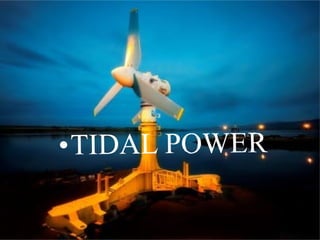
Tidal Power
• Tidal power works rather like a hydro-
electric scheme, except that the dam is
much bigger.
• A huge dam (called a "barrage") is built across a
river estuary. When the tide goes in and out, the
water flows through tunnels in the dam.
• The ebb and flow of the tides can be used to turn
a turbine, or it can be used to push air through a
pipe, which then turns a turbine. Large lock
gates, like the ones used on canals, allow ships to
pass.
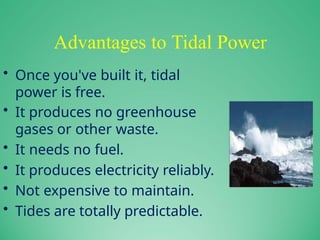
Advantages to Tidal Power
• Once you've built it, tidal
power is free.
• It produces no greenhouse
gases or other waste.
• It needs no fuel.
• It produces electricity reliably.
• Not expensive to maintain.
• Tides are totally predictable.
Disadvantages to
Tidal Power
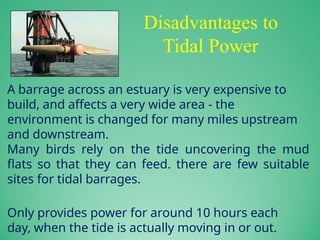
A barrage across an estuary is very expensive to
build, and affects a very wide area - the
environment is changed for many miles upstream
and downstream.
Many birds rely on the tide uncovering the mud
flats so that they can feed. there are few suitable
sites for tidal barrages.
Only provides power for around 10 hours each
day, when the tide is actually moving in or out.
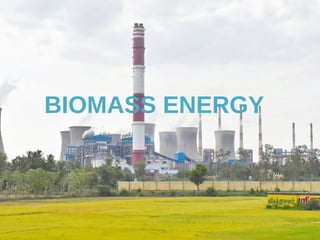
BIOMASS ENERGY
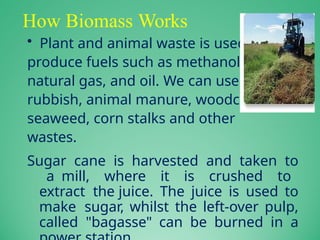
Biomass Energy
• Biomass is fuel that
is organic materials,
a
developed from
renewable
and
sustainable source of energy used to create
electricity or other forms of power.
1. Scrap lumber
2. Forest debris
3. Certain crops
4. Manure
5. Some types of waste residues.
How Biomass Works
• Plant and animal waste is used to
produce fuels such as methanol,
natural gas, and oil. We can use
rubbish, animal manure, woodchips,
seaweed, corn stalks and other
wastes.
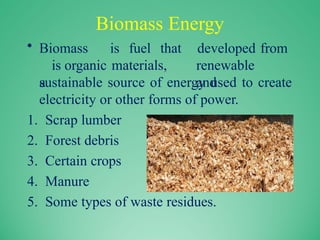
Sugar cane is harvested and taken to
a mill, where it is crushed to
extract the juice. The juice is used to
make sugar, whilst the left-over pulp,
called "bagasse" can be burned in a
Cont.
Other solid wastes, can be burned to
provide heat, or used to make steam
for a power station.
Burn fuel > heat water to
make steam>steam turns turbine
> turbine turns generator>electrical
power sent around the country
Advantages to
Biomass
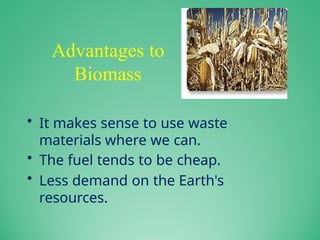
• It makes sense to use waste
materials where we can.
• The fuel tends to be cheap.
• Less demand on the Earth's
resources.
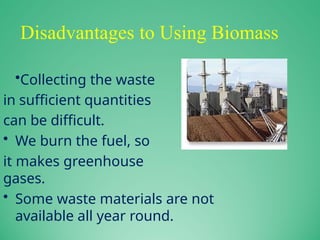
Disadvantages to Using Biomass
•Collecting the waste
in sufficient quantities
can be difficult.
• We burn the fuel, so
it makes greenhouse
gases.
• Some waste materials are not
available all year round.
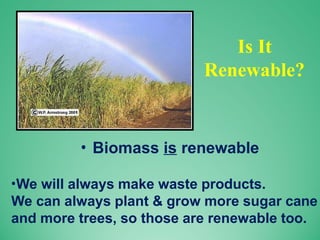
Is It
Renewable?
• Biomass is renewable
•We will always make waste products.
We can always plant & grow more sugar cane
and more trees, so those are renewable too.
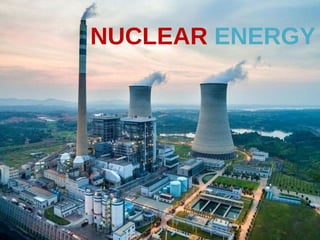
NUCLEAR ENERGY
Nuclear Energy
Nuclear Fission
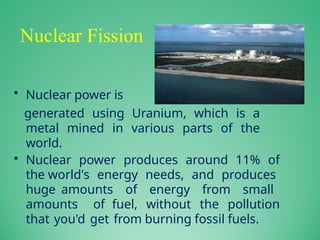
• Nuclear power is
generated using Uranium, which is a
metal mined in various parts of the
world.
• Nuclear power produces around 11% of
the world's energy needs, and produces
huge amounts of energy from small
amounts of fuel, without the pollution
that you'd get from burning fossil fuels.
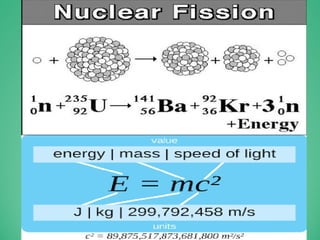
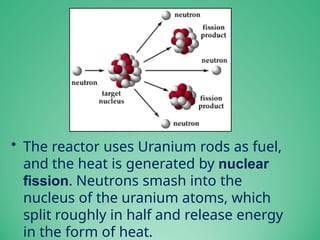
• The reactor uses Uranium rods as fuel,
and the heat is generated by nuclear
fission. Neutrons smash into the
nucleus of the uranium atoms, which
split roughly in half and release energy
in the form of heat.
How Nuclear Power Works
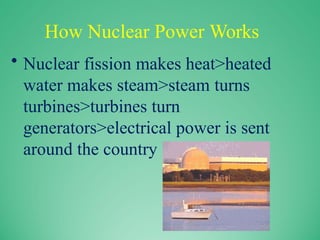
• Nuclear fission makes heat>heated
water makes steam>steam turns
turbines>turbines turn
generators>electrical power is sent
around the country
Nuclear Fusion
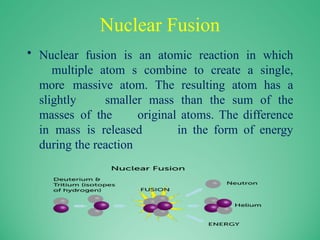
• Nuclear fusion is an atomic reaction in which
multiple atom s combine to create a single,
more massive atom. The resulting atom has a
slightly smaller mass than the sum of the
masses of the original atoms. The difference
in mass is released in the form of energy
during the reaction
What Are The
Challenges ?
• For fusion to occur, reactor temperatures would have
to be on the order of 200 million degrees Celsius
• No material on earth can withstand 200
million degrees without melting
• Two basic strategies:
1)Magnetic Confinement: Confine the
plasma with magnetic fields so that the
plasma will not touch the containment walls
2)Inertial Confinement: Supply large
amounts of energy very quickly (i.e. shoot
with lasers) so that the fuel is burned before
it has time to expand and touch the walls
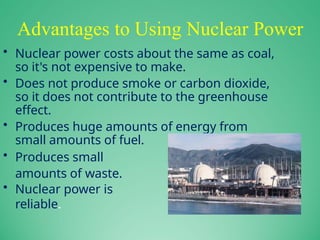
Advantages to Using Nuclear Power
• Nuclear power costs about the same as coal,
so it's not expensive to make.
• Does not produce smoke or carbon dioxide,
so it does not contribute to the greenhouse
effect.
• Produces huge amounts of energy from
small amounts of fuel.
• Produces small
amounts of waste.
• Nuclear power is
reliable.
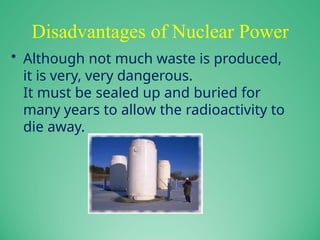
Disadvantages of Nuclear Power
• Although not much waste is produced,
it is very, very dangerous.
It must be sealed up and buried for
many years to allow the radioactivity to
die away.
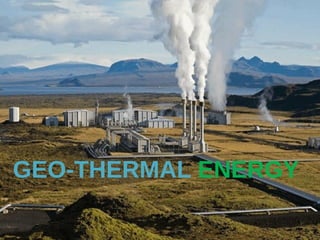
GEO-THERMAL ENERGY
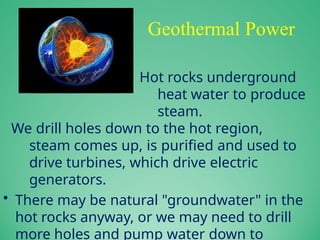
Geothermal Power
– Hot rocks underground
heat water to produce
steam.
We drill holes down to the hot region,
steam comes up, is purified and used to
drive turbines, which drive electric
generators.
• There may be natural "groundwater" in the
hot rocks anyway, or we may need to drill
more holes and pump water down to
Direct Uses Of Geothermal Energy
• space heating
• air conditioning
• industrial processes
• drying
• Greenhouses
• Aquaculture
• hot water
• resorts and pools
• melting snow
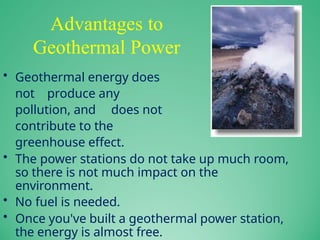
Advantages to
Geothermal Power
• Geothermal energy does
not produce any
pollution, and does not
contribute to the
greenhouse effect.
• The power stations do not take up much room,
so there is not much impact on the
environment.
• No fuel is needed.
• Once you've built a geothermal power station,
the energy is almost free.
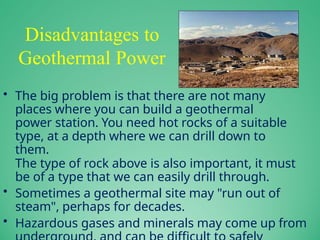
Disadvantages to
Geothermal Power
• The big problem is that there are not many
places where you can build a geothermal
power station. You need hot rocks of a suitable
type, at a depth where we can drill down to
them.
The type of rock above is also important, it must
be of a type that we can easily drill through.
• Sometimes a geothermal site may "run out of
steam", perhaps for decades.
• Hazardous gases and minerals may come up from
Is it Renewable?
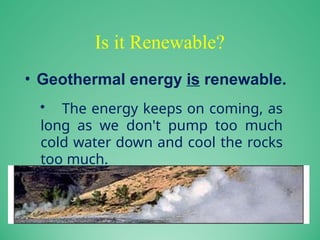
• Geothermal energy is renewable.
• The energy keeps on coming, as
long as we don't pump too much
cold water down and cool the rocks
too much.
.
THANK YOU

Topic Renewable energy Existing facilities in india

  • 1.
    TOPIC "Existing facilities andfuture opportunities for developing renewable energy sources in India” GUIDED BY Mr.Padmalochan Prusty Asst. Prof. Department of Mechanical Engineering, GIET ,Khordha Represented by Suneli Kumar Jena B.Tech,Mechanical (3rd Year) Reg no:-2201326434
  • 2.
    What is RenewableEnergy? • Energy from a source that is not depleted when used, such as wind or solar power. • Any energy resource that is naturally regenerated over a short time scale and derived directly from the sun (such as thermal, photochemical, and photoelectric), indirectly from the sun (such as wind, hydropower, and photosynthetic stored in biomass), or from other energy natural movements and mechanisms of the environment (such as geothermal and tidal energy).
  • 3.
    RENEWABLE SOURCE Definition :Reæwablo energy can be geneæted continuously pBctically witŒut decay af sourœ. Definition : non•enewabIe œĞt * Responsible for Z-4” Å of carbon dioxide in eNiænrnenŁ • Not a reason Øhind “global w armin g”. • Example : biomass, hydæ pøwer, wind energy, solar energy,etc. decay of source.
  • 4.
  • 5.
    I Used tolove the darkness but the sun is m y best friend As soon as I embr aced him He put m y misery to an end SOLAR ENERGY
  • 6.
    Solar Power Solar poweris the conversion of sunlight into electricity, either directly using Photovoltaic (PV), or indirectly using concentrated solar power. In a sunny climate, you can get enough power to run a 100W light bulb from just one square meter of solar panel. National CSP capacity in India 225 MWp (source: REN21 Global Status
  • 7.
    Growth of SolarPower in India (in MW) • Rajasthan – 1294.60 • Tamilnadu – 1267.41 • Gujrat - 1123.36 {as on 31st July 2016} (Source: “State wise installed solar power capacity report” Ministry of New and Renewable Energy Govt. of India) And 66% growth in Solar Roof Top Market. Recently India added 240 MW of Rooftop Solar Capacity against 145MW in Nov.2014 to Oct. 2015
  • 8.
    Existing Solar Plantsin India • Kamuthi Solar Power Plant 360MW Tamil Nadu • Titan Energy plant 3 MW, kolar district Karnatka • Titan Energy, 2 MW plant ,Jamuria, West Bengal • Moser Baer ,Thin Film 1 MW ,Maharashtra • Lanco , 5 MW ,Gujarat. • North Delhi Power Ltd (Tata Power) 1 MW , Delhi. • Reliance ,1 MW ,Thyagaraj stadium Plant,Delhi • Azure Power 2 MW Awan, Punjab India.
  • 9.
    Power Your HomeWith Solar Energy • The system needed isn't that complex when you examine the devices needed. Simply add solar panels to collect sunlight and convert it into electricity. DC power (direct current) is then sent to an inverter, which converts DC power into Ac power, which now runs your home. Through the use of transfer switches and other safety devices
  • 11.
    Other Uses OfSolar Energy • Indoor Lighting • Outdoor Lighting • Battery Charging • Power Pumps With Solar Energy • Solar Energy Can Heat Our Home • Mobile charging
  • 12.
  • 14.
    Advantages to solarpower • Solar energy is free - it needs no fuel and produces no waste or pollution. • In sunny countries, solar power can be used where there is no easy way to get electricity to a remote place. • Handy for low-power uses such as solar powered garden lights and battery chargers
  • 15.
    Disadvantages to Solar Power •Doesn't work at night. • Very expensive to build solar power stations. Solar cells cost a great deal compared to the amount of electricity they'll produce in their lifetime. • Can be unreliable unless you're in a very sunny climate.
  • 16.
  • 17.
    Wind power • Wehave used the wind as an Energy source for a long time. The Babylonians and Chinese were using wind power to pump water for irrigating crops 4,000 year ago. • Wind power was used in the middle ages, in Europe to grind grain and lifting water , which is where the term windmills comes from.
  • 19.
    How Wind Power Works •WIND TURBINES convert the kinetic energy in the WIND into mechanical energy. And generator can convert the mechanical power into electricity. • The energy in the wind turn two or three propeller like blades a rotor. Rotor is connected to the main shaft which spin a generator to create an electricity. • Wind turbines are mounted on tower about the height of 30meter to captured the
  • 20.
    Advantages of Windpower • Wind is free, wind farms need no fuel. • Produces no waste or greenhouse gases. • The land beneath can usually still be used for farming. • Wind farms can be tourist attractions. • A good method of supplying energy to remote areas.
  • 21.
    Disadvantages of Wind Power •The wind is not always predictable some days have no wind. • Suitable areas for wind farms are often near the coast, where land is expensive. • Can kill birds - migrating flocks tend to like strong winds. Splat! • Can affect television reception if you live nearby. • Noisy. A wind generator makes a constant, low, "swooshing" noise day and night.
  • 23.
    Growth factor forwind • Technology development and a strong domestic manufacturing base. • Conducive policy frame for investment. • Quality assurance: National institute for wind energy chennai • RLMM committee: Revise list of manufacturers & model committee
  • 24.
    Is Wind Power Renewable? •Wind power is renewable. •Winds will keep on blowing, it makes sense to use them.
  • 25.
    “If there isa magic on this planet, It is Contained in Water” (Loren Eisley, Anthropologist) HYDRO ELECTRICITY
  • 26.
    Hydroelectricity • A damis built to trap water, usually in a valley where there is an existing lake. • Water is allowed to flow through tunnels in the dam, to turn turbines and thus drive generators. • Hydro-electricity provides 20% of the world’s power
  • 27.
    Advantages of Hydroelectricity • Oncethe dam is built, the energy is virtually free. • No waste or pollution produced. • Much more reliable than wind, solar or wave power. • Water can be stored above the dam ready to cope with peaks in demand. • Hydro-electric power stations can increase to full power very quickly, unlike other power stations.
  • 28.
    Disadvantages to Hydro-electricity • Thedams are very expensive to build. • Building a large dam will flood a very large area upstream, causing problems for animals that used to live there. • Finding a suitable site can be difficult - the impact on residents and the environment may be unacceptable. • Water quality and quantity downstream can be affected, which can have an impact on plant life.
  • 29.
    HYDRO ELECTRIC POWER PLANTSIN INDIA Plant River State Capacity Koyna Hydro Electric Power Plant Koyna Maharashtra 1,960 MW Srisailam Hydro Electric Power Plant Krishna Andhra Pradesh 1,670 MW Nathpa Jhakri Hydro Electric Power Plant Satluj River Himachal Pradesh 1,500 MW Sardar Sarovar Hydro Electric Power Plant Narmada Gujarat 1450 MW Bhakra-Nangal Hydro Electric Power Plant Sutlej Himachal Pradesh 1325 MW Hirakud Hydro Electric Project Mahanadi Odisha 347.5 MW
  • 31.
    Tidal Power • Tidalpower works rather like a hydro- electric scheme, except that the dam is much bigger. • A huge dam (called a "barrage") is built across a river estuary. When the tide goes in and out, the water flows through tunnels in the dam. • The ebb and flow of the tides can be used to turn a turbine, or it can be used to push air through a pipe, which then turns a turbine. Large lock gates, like the ones used on canals, allow ships to pass.
  • 32.
    Advantages to TidalPower • Once you've built it, tidal power is free. • It produces no greenhouse gases or other waste. • It needs no fuel. • It produces electricity reliably. • Not expensive to maintain. • Tides are totally predictable.
  • 33.
    Disadvantages to Tidal Power Abarrage across an estuary is very expensive to build, and affects a very wide area - the environment is changed for many miles upstream and downstream. Many birds rely on the tide uncovering the mud flats so that they can feed. there are few suitable sites for tidal barrages. Only provides power for around 10 hours each day, when the tide is actually moving in or out.
  • 34.
  • 35.
    Biomass Energy • Biomassis fuel that is organic materials, a developed from renewable and sustainable source of energy used to create electricity or other forms of power. 1. Scrap lumber 2. Forest debris 3. Certain crops 4. Manure 5. Some types of waste residues.
  • 36.
    How Biomass Works •Plant and animal waste is used to produce fuels such as methanol, natural gas, and oil. We can use rubbish, animal manure, woodchips, seaweed, corn stalks and other wastes. Sugar cane is harvested and taken to a mill, where it is crushed to extract the juice. The juice is used to make sugar, whilst the left-over pulp, called "bagasse" can be burned in a
  • 37.
    Cont. Other solid wastes,can be burned to provide heat, or used to make steam for a power station. Burn fuel > heat water to make steam>steam turns turbine > turbine turns generator>electrical power sent around the country
  • 38.
    Advantages to Biomass • Itmakes sense to use waste materials where we can. • The fuel tends to be cheap. • Less demand on the Earth's resources.
  • 39.
    Disadvantages to UsingBiomass •Collecting the waste in sufficient quantities can be difficult. • We burn the fuel, so it makes greenhouse gases. • Some waste materials are not available all year round.
  • 40.
    Is It Renewable? • Biomassis renewable •We will always make waste products. We can always plant & grow more sugar cane and more trees, so those are renewable too.
  • 41.
  • 42.
  • 43.
    Nuclear Fission • Nuclearpower is generated using Uranium, which is a metal mined in various parts of the world. • Nuclear power produces around 11% of the world's energy needs, and produces huge amounts of energy from small amounts of fuel, without the pollution that you'd get from burning fossil fuels.
  • 45.
    • The reactoruses Uranium rods as fuel, and the heat is generated by nuclear fission. Neutrons smash into the nucleus of the uranium atoms, which split roughly in half and release energy in the form of heat.
  • 46.
    How Nuclear PowerWorks • Nuclear fission makes heat>heated water makes steam>steam turns turbines>turbines turn generators>electrical power is sent around the country
  • 47.
    Nuclear Fusion • Nuclearfusion is an atomic reaction in which multiple atom s combine to create a single, more massive atom. The resulting atom has a slightly smaller mass than the sum of the masses of the original atoms. The difference in mass is released in the form of energy during the reaction
  • 48.
    What Are The Challenges? • For fusion to occur, reactor temperatures would have to be on the order of 200 million degrees Celsius • No material on earth can withstand 200 million degrees without melting • Two basic strategies: 1)Magnetic Confinement: Confine the plasma with magnetic fields so that the plasma will not touch the containment walls 2)Inertial Confinement: Supply large amounts of energy very quickly (i.e. shoot with lasers) so that the fuel is burned before it has time to expand and touch the walls
  • 49.
    Advantages to UsingNuclear Power • Nuclear power costs about the same as coal, so it's not expensive to make. • Does not produce smoke or carbon dioxide, so it does not contribute to the greenhouse effect. • Produces huge amounts of energy from small amounts of fuel. • Produces small amounts of waste. • Nuclear power is reliable.
  • 50.
    Disadvantages of NuclearPower • Although not much waste is produced, it is very, very dangerous. It must be sealed up and buried for many years to allow the radioactivity to die away.
  • 51.
  • 52.
    Geothermal Power – Hotrocks underground heat water to produce steam. We drill holes down to the hot region, steam comes up, is purified and used to drive turbines, which drive electric generators. • There may be natural "groundwater" in the hot rocks anyway, or we may need to drill more holes and pump water down to
  • 54.
    Direct Uses OfGeothermal Energy • space heating • air conditioning • industrial processes • drying • Greenhouses • Aquaculture • hot water • resorts and pools • melting snow
  • 55.
    Advantages to Geothermal Power •Geothermal energy does not produce any pollution, and does not contribute to the greenhouse effect. • The power stations do not take up much room, so there is not much impact on the environment. • No fuel is needed. • Once you've built a geothermal power station, the energy is almost free.
  • 56.
    Disadvantages to Geothermal Power •The big problem is that there are not many places where you can build a geothermal power station. You need hot rocks of a suitable type, at a depth where we can drill down to them. The type of rock above is also important, it must be of a type that we can easily drill through. • Sometimes a geothermal site may "run out of steam", perhaps for decades. • Hazardous gases and minerals may come up from
  • 57.
    Is it Renewable? •Geothermal energy is renewable. • The energy keeps on coming, as long as we don't pump too much cold water down and cool the rocks too much.
  • 58.