RELIABILITY
                                                                       ENGINEERING

Environmental Stress Screening (ESS)

Purpose           ESS is a test or series of tests specifically designed to disclose weak parts and
                  workmanship defects requiring correction. It may be applied to components,
                  subassemblies, assemblies, or equipment (as appropriate and cost-effective). The
                  intent is to remove defects which would otherwise cause failure during later testing
                  or field service. By moving early failures from the field into the factory, effective
                  ESS programs have demonstrated two important payoffs. First, ESS has helped
                  fielded systems achieve their inherent Reliability and Maintainability (R&M), which
                  translates directly into improved operational performance over time. ESS has
                  significant potential return on investment during both development, production and
                  usage.

                  The Adaptive ESS process is dynamic. That is the starting ESS parameters (Stress
                  Levels, Time) are based on a similar equipment and changed depending on the
                  effectiveness of the screening process (See Figure 1). The ESS failure distribution
                  should be analyzed using the Chance Defective Exponential Model (CDE) described
                  in MIL-HDBK-344A to obtain the best screening parameters that will give the
                  highest outgoing reliability at minimum cost.


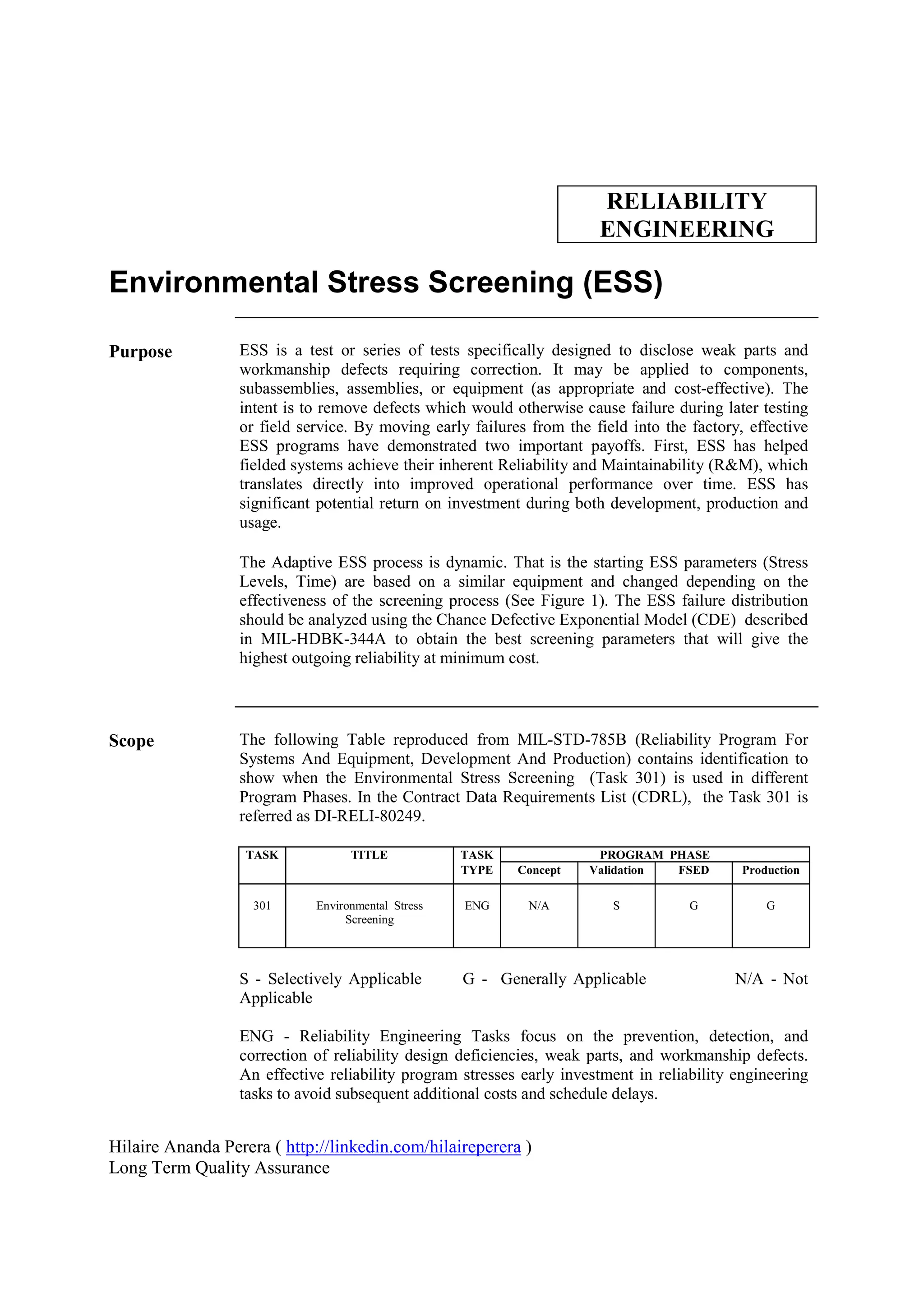
Scope             The following Table reproduced from MIL-STD-785B (Reliability Program For
                  Systems And Equipment, Development And Production) contains identification to
                  show when the Environmental Stress Screening (Task 301) is used in different
                  Program Phases. In the Contract Data Requirements List (CDRL), the Task 301 is
                  referred as DI-RELI-80249.

                   TASK            TITLE            TASK               PROGRAM PHASE
                                                    TYPE   Concept    Validation FSED        Production

                    301      Environmental Stress   ENG      N/A         S           G           G
                                  Screening


                  S - Selectively Applicable        G - Generally Applicable                N/A - Not
                  Applicable

                  ENG - Reliability Engineering Tasks focus on the prevention, detection, and
                  correction of reliability design deficiencies, weak parts, and workmanship defects.
                  An effective reliability program stresses early investment in reliability engineering
                  tasks to avoid subsequent additional costs and schedule delays.


Hilaire Ananda Perera ( http://linkedin.com/hilaireperera )
Long Term Quality Assurance
The Adaptive ESS Process

                                     OTHER                      DEVELOP        ACQUIRE OR
                INDUSTRY
                                    PROGRAM                     FACILITIES     MODIFY TEST
               EXPERIENCE
                                   EXPERIENCE                 SPECIFICATIONS    FACILITIES


    IDENTIFY          DEVELOP                                    PHASE 2       SPECIAL TESTS
                                           ASSESS
   SCREENING         SCREENING                                                 FOR FACILITIES
                                           IMPACT
      GOALS            PLANS                                                     OR TOOLS
                                                                    DEVELOP
                                                                   DETAILED
                                                       No
                                                                  PROCEDURES
                                          FAVOURABLE
  PHASE 1                                   IMPACT?
                                                        Yes                    INCORPORATE
                                                                                  IN ATPs

                                   SUMMARY TO PROGRAM
                                        MANAGER                DEFINE DATA
                                                              REQUIREMENTS
                                   SUMMARY TO QUALITY /
                                   RELIABILITY MANAGERS


                       No                                     ORGANIZE DATA
                                                               COLLECTION
                                                               RESOURCES
  CONTINUE
                       SCREENING            EFFECTIVENESS
  OR REDUCE
                       GOAL MET?                REVIEW
  SCREENING
               Yes


                             SUMMARY TO OTHER SCREENING
                                     PROGRAMS                 COLLECT DATA
                                                                   FOR          IMPLEMENT
                              SUMMARY TO OTHER PROGRAM        EFFECTIVENESS       SCREEN
    PHASE 3                           MANAGERS                    REVIEW


                                                Figure 1


Hilaire Ananda Perera ( http://linkedin.com/hilaireperera )
Long Term Quality Assurance
RELIABILITY
                                                                          ENGINEERING


Environmental Stress Screening (ESS), Continued

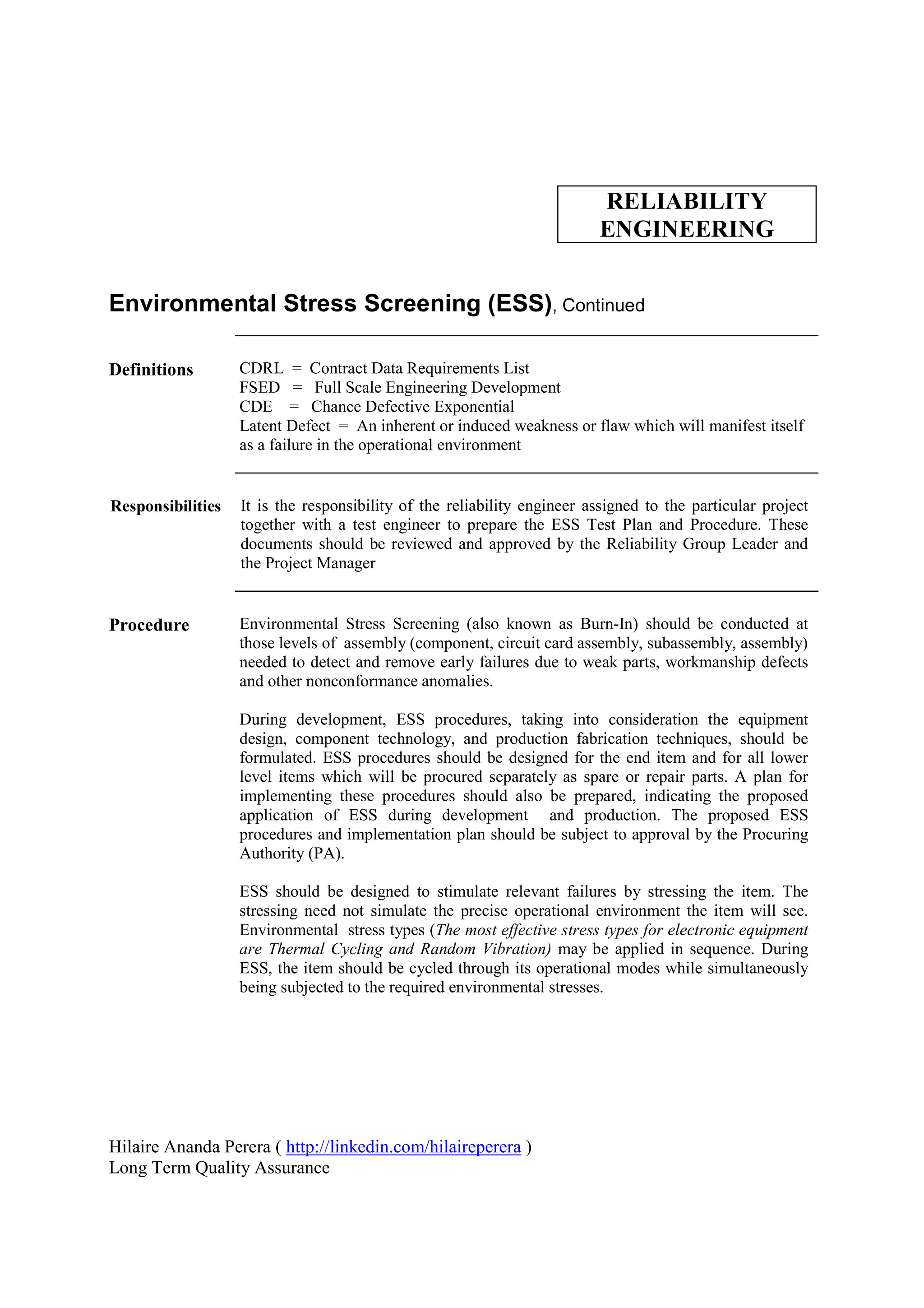
Definitions        CDRL = Contract Data Requirements List
                   FSED = Full Scale Engineering Development
                   CDE = Chance Defective Exponential
                   Latent Defect = An inherent or induced weakness or flaw which will manifest itself
                   as a failure in the operational environment


Responsibilities   It is the responsibility of the reliability engineer assigned to the particular project
                   together with a test engineer to prepare the ESS Test Plan and Procedure. These
                   documents should be reviewed and approved by the Reliability Group Leader and
                   the Project Manager


Procedure          Environmental Stress Screening (also known as Burn-In) should be conducted at
                   those levels of assembly (component, circuit card assembly, subassembly, assembly)
                   needed to detect and remove early failures due to weak parts, workmanship defects
                   and other nonconformance anomalies.

                   During development, ESS procedures, taking into consideration the equipment
                   design, component technology, and production fabrication techniques, should be
                   formulated. ESS procedures should be designed for the end item and for all lower
                   level items which will be procured separately as spare or repair parts. A plan for
                   implementing these procedures should also be prepared, indicating the proposed
                   application of ESS during development and production. The proposed ESS
                   procedures and implementation plan should be subject to approval by the Procuring
                   Authority (PA).

                   ESS should be designed to stimulate relevant failures by stressing the item. The
                   stressing need not simulate the precise operational environment the item will see.
                   Environmental stress types (The most effective stress types for electronic equipment
                   are Thermal Cycling and Random Vibration) may be applied in sequence. During
                   ESS, the item should be cycled through its operational modes while simultaneously
                   being subjected to the required environmental stresses.


Hilaire Ananda Perera ( http://linkedin.com/hilaireperera )
Long Term Quality Assurance
RELIABILITY
                                                                         ENGINEERING

Environmental Stress Screening (ESS), Continued

 Procedure        Upon approval of the proposed ESS procedures and implementation plan, a detailed
(Continued)       environmental stress screening process plan should be prepared and included as part
                  of the reliability test plan. The ESS detailed process plan should include the
                  following, subject to PA approval prior to initiation of ESS:

                  • Description of environmental stress types, levels, profiles, and exposure times to
                    be applied.

                  • Identification of level (part/component, board, subassembly, assembly) at which
                    ESS will be accomplished

                  • Identification of item performance and stress parameters to be monitored during
                    ESS.

                  • Proposed ESS durations (best ESS exposure, failure-free interval and allowable
                    cumulative ESS time per item) based on CDE Model application are:


                    • Let frD be the average failure rate of a defect under a given set of stress
                      conditions. (frD is determined from the ESS curve)

                    • Acceleration Factor is defined as the ratio of the Constant Failure Rate of the
                      ESS Curve to the Predicted Failure Rate or Field Failure Rate. Let Acceleration
                      Factor = A

                    • Best ESS Exposure [Time to remove 99.999% of the Latent Defects] =
                      (-1/frD)*ln(0.00001)

                    • Failure-Free Time (FFT) for 99.99% ESS Yield @ 90% Lower Confidence
                      Level = 7/frD [ This is for A=60 or more ]

                    • If 5% of Operational Life (OL) should not be consumed during ESS when
                      multiple failures and repairs are encountered, Allowable Cumulative ESS time =
                      OL*0.05/A


                  • Method of incorporating ESS results into FRACAS to attain the needed
                    operational reliability (MIL-STD-785B Task 104 )


Hilaire Ananda Perera ( http://linkedin.com/hilaireperera )
Long Term Quality Assurance
RELIABILITY
                                                                ENGINEERING

Environmental Stress Screening (ESS), Continued

Associated        MIL-STD-785: Reliability Program For Systems And Equipment,
Documents         Development And Production

                  MIL-STD-721: Definitions Of Terms For Reliability And Maintainability

                  MIL-HDBK- 344A: Environmental Stress Screening (ESS) Of Electronic
                  Equipment

                  Customer provided Statement Of Work and the Reliability Program Plan

                  ISO 9001 Level II Document: Design Control - The Product Assurance
                  Process


Hilaire Ananda Perera ( http://linkedin.com/hilaireperera )
Long Term Quality Assurance

Environmental stress screening

  • 1.
    RELIABILITY ENGINEERING Environmental Stress Screening (ESS) Purpose ESS is a test or series of tests specifically designed to disclose weak parts and workmanship defects requiring correction. It may be applied to components, subassemblies, assemblies, or equipment (as appropriate and cost-effective). The intent is to remove defects which would otherwise cause failure during later testing or field service. By moving early failures from the field into the factory, effective ESS programs have demonstrated two important payoffs. First, ESS has helped fielded systems achieve their inherent Reliability and Maintainability (R&M), which translates directly into improved operational performance over time. ESS has significant potential return on investment during both development, production and usage. The Adaptive ESS process is dynamic. That is the starting ESS parameters (Stress Levels, Time) are based on a similar equipment and changed depending on the effectiveness of the screening process (See Figure 1). The ESS failure distribution should be analyzed using the Chance Defective Exponential Model (CDE) described in MIL-HDBK-344A to obtain the best screening parameters that will give the highest outgoing reliability at minimum cost. Scope The following Table reproduced from MIL-STD-785B (Reliability Program For Systems And Equipment, Development And Production) contains identification to show when the Environmental Stress Screening (Task 301) is used in different Program Phases. In the Contract Data Requirements List (CDRL), the Task 301 is referred as DI-RELI-80249. TASK TITLE TASK PROGRAM PHASE TYPE Concept Validation FSED Production 301 Environmental Stress ENG N/A S G G Screening S - Selectively Applicable G - Generally Applicable N/A - Not Applicable ENG - Reliability Engineering Tasks focus on the prevention, detection, and correction of reliability design deficiencies, weak parts, and workmanship defects. An effective reliability program stresses early investment in reliability engineering tasks to avoid subsequent additional costs and schedule delays. Hilaire Ananda Perera ( http://linkedin.com/hilaireperera ) Long Term Quality Assurance
  • 2.
    The Adaptive ESSProcess OTHER DEVELOP ACQUIRE OR INDUSTRY PROGRAM FACILITIES MODIFY TEST EXPERIENCE EXPERIENCE SPECIFICATIONS FACILITIES IDENTIFY DEVELOP PHASE 2 SPECIAL TESTS ASSESS SCREENING SCREENING FOR FACILITIES IMPACT GOALS PLANS OR TOOLS DEVELOP DETAILED No PROCEDURES FAVOURABLE PHASE 1 IMPACT? Yes INCORPORATE IN ATPs SUMMARY TO PROGRAM MANAGER DEFINE DATA REQUIREMENTS SUMMARY TO QUALITY / RELIABILITY MANAGERS No ORGANIZE DATA COLLECTION RESOURCES CONTINUE SCREENING EFFECTIVENESS OR REDUCE GOAL MET? REVIEW SCREENING Yes SUMMARY TO OTHER SCREENING PROGRAMS COLLECT DATA FOR IMPLEMENT SUMMARY TO OTHER PROGRAM EFFECTIVENESS SCREEN PHASE 3 MANAGERS REVIEW Figure 1 Hilaire Ananda Perera ( http://linkedin.com/hilaireperera ) Long Term Quality Assurance
  • 3.
    RELIABILITY ENGINEERING Environmental Stress Screening (ESS), Continued Definitions CDRL = Contract Data Requirements List FSED = Full Scale Engineering Development CDE = Chance Defective Exponential Latent Defect = An inherent or induced weakness or flaw which will manifest itself as a failure in the operational environment Responsibilities It is the responsibility of the reliability engineer assigned to the particular project together with a test engineer to prepare the ESS Test Plan and Procedure. These documents should be reviewed and approved by the Reliability Group Leader and the Project Manager Procedure Environmental Stress Screening (also known as Burn-In) should be conducted at those levels of assembly (component, circuit card assembly, subassembly, assembly) needed to detect and remove early failures due to weak parts, workmanship defects and other nonconformance anomalies. During development, ESS procedures, taking into consideration the equipment design, component technology, and production fabrication techniques, should be formulated. ESS procedures should be designed for the end item and for all lower level items which will be procured separately as spare or repair parts. A plan for implementing these procedures should also be prepared, indicating the proposed application of ESS during development and production. The proposed ESS procedures and implementation plan should be subject to approval by the Procuring Authority (PA). ESS should be designed to stimulate relevant failures by stressing the item. The stressing need not simulate the precise operational environment the item will see. Environmental stress types (The most effective stress types for electronic equipment are Thermal Cycling and Random Vibration) may be applied in sequence. During ESS, the item should be cycled through its operational modes while simultaneously being subjected to the required environmental stresses. Hilaire Ananda Perera ( http://linkedin.com/hilaireperera ) Long Term Quality Assurance
  • 4.
    RELIABILITY ENGINEERING Environmental Stress Screening (ESS), Continued Procedure Upon approval of the proposed ESS procedures and implementation plan, a detailed (Continued) environmental stress screening process plan should be prepared and included as part of the reliability test plan. The ESS detailed process plan should include the following, subject to PA approval prior to initiation of ESS: • Description of environmental stress types, levels, profiles, and exposure times to be applied. • Identification of level (part/component, board, subassembly, assembly) at which ESS will be accomplished • Identification of item performance and stress parameters to be monitored during ESS. • Proposed ESS durations (best ESS exposure, failure-free interval and allowable cumulative ESS time per item) based on CDE Model application are: • Let frD be the average failure rate of a defect under a given set of stress conditions. (frD is determined from the ESS curve) • Acceleration Factor is defined as the ratio of the Constant Failure Rate of the ESS Curve to the Predicted Failure Rate or Field Failure Rate. Let Acceleration Factor = A • Best ESS Exposure [Time to remove 99.999% of the Latent Defects] = (-1/frD)*ln(0.00001) • Failure-Free Time (FFT) for 99.99% ESS Yield @ 90% Lower Confidence Level = 7/frD [ This is for A=60 or more ] • If 5% of Operational Life (OL) should not be consumed during ESS when multiple failures and repairs are encountered, Allowable Cumulative ESS time = OL*0.05/A • Method of incorporating ESS results into FRACAS to attain the needed operational reliability (MIL-STD-785B Task 104 ) Hilaire Ananda Perera ( http://linkedin.com/hilaireperera ) Long Term Quality Assurance
  • 5.
    RELIABILITY ENGINEERING Environmental Stress Screening (ESS), Continued Associated MIL-STD-785: Reliability Program For Systems And Equipment, Documents Development And Production MIL-STD-721: Definitions Of Terms For Reliability And Maintainability MIL-HDBK- 344A: Environmental Stress Screening (ESS) Of Electronic Equipment Customer provided Statement Of Work and the Reliability Program Plan ISO 9001 Level II Document: Design Control - The Product Assurance Process Hilaire Ananda Perera ( http://linkedin.com/hilaireperera ) Long Term Quality Assurance