Developing Young Engineers to be Design
              Engineers


         Gary Dittemore, NASA JSC
          Omar Torres, NASA LaRC
          Sam Miller, NASA LaRC
         Theo Muench, NASA GSFC
                                     Used with Permission
MLAS Task, Approach, and Success Criteria

   • Task:
         – Develop an alternate LAS design as risk mitigation for the Orion
           LAS. Demonstrate the alternate concept with a pad abort flight
           test.

   • Approach:
         – Strive to identify the simplest design that will satisfy launch abort
           requirements while maximizing nominal ascent performance
         – Implement flight test by using off-the-shelf parts wherever
           possible to minimize cost and shorten schedule

   • Success Criteria:
         – Obtain sufficient flight test data to assess performance, validate
           models/tools, and support an MLAS Objective System design


Max Launch Abort System                                             Page           2
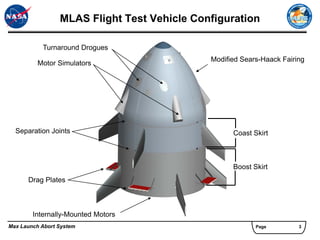
MLAS Flight Test Vehicle Configuration

           Turnaround Drogues
                                             Modified Sears-Haack Fairing
          Motor Simulators


  Separation Joints                                Coast Skirt


                                                   Boost Skirt
      Drag Plates


        Internally-Mounted Motors
Max Launch Abort System                                   Page         3
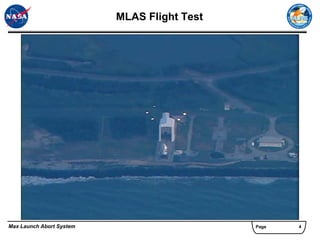
MLAS Flight Test


Max Launch Abort System                      Page   4
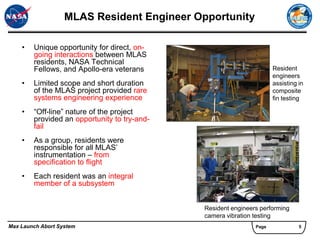
MLAS Resident Engineer Opportunity

    •   Unique opportunity for direct, on-
        going interactions between MLAS
        residents, NASA Technical
        Fellows, and Apollo-era veterans                              Resident
                                                                      engineers
    •   Limited scope and short duration                              assisting in
        of the MLAS project provided rare                             composite
        systems engineering experience                                fin testing

    •   “Off-line” nature of the project
        provided an opportunity to try-and-
        fail
    •   As a group, residents were
        responsible for all MLAS’
        instrumentation – from
        specification to flight
    •   Each resident was an integral
        member of a subsystem


                                              Resident engineers performing
                                              camera vibration testing
Max Launch Abort System                                        Page             5
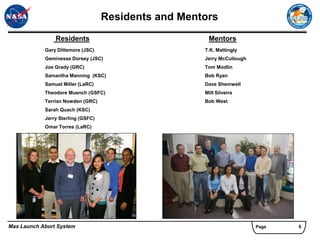
Residents and Mentors
                Residents                              Mentors
            Gary Dittemore (JSC)                      T.K. Mattingly
            Geminesse Dorsey (JSC)                    Jerry McCullough
            Joe Grady (GRC)                           Tom Modlin
            Samantha Manning (KSC)                    Bob Ryan
            Samuel Miller (LaRC)                      Dave Shemwell
            Theodore Muench (GSFC)                    Milt Silveira
            Terrian Nowden (GRC)                      Bob West
            Sarah Quach (KSC)
            Jerry Sterling (GSFC)
            Omar Torres (LaRC)


Max Launch Abort System                                                  Page   6
Skill Development


   •   Best training is hands on experience
         – Requirement development
         – Hardware selection and procurement
         – Procedure writing: test/launch/recycle
         – Vehicle test/check out
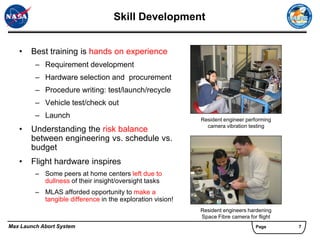
         – Launch                                           Resident engineer performing
                                                              camera vibration testing
   •   Understanding the risk balance
       between engineering vs. schedule vs.
       budget
   •   Flight hardware inspires
         – Some peers at home centers left due to
           dullness of their insight/oversight tasks
         – MLAS afforded opportunity to make a
           tangible difference in the exploration vision!
                                                            Resident engineers hardening
                                                            Space Fibre camera for flight
Max Launch Abort System                                                           Page      7
Experience That Can’t Be Taught


       • Strain gauge amplifier issue
            – Hardware didn’t meet vendor spec
            – Worked constant modifications and adjustments
            – Eventually replaced amplifiers

       • Retrospect illuminates the problem’s value...
            – “You earned your scars; wear them well”
            – Required delivery date plays a large part in corrective action
            – Small team prioritizes itself


Max Launch Abort System                                           Page         8
Improved Thought Process and Approach to
                            Problems

       • Unable to rely on well parameterized problems
            – Ex. Shuttle program has well defined specs and procedures
            – “Needed a push at the beginning to take ownership…”

       • Understanding the design process
            – Aware of the limitations and decisions involved
            – “Models are only as good as the assumptions that went into
              them”

       • Also learned how NOT to think
            – Need to have the goal in mind at all times
            – The project is bigger than the subsystem!


Max Launch Abort System                                         Page       9
Effective Leadership


       • Risk trades during progress of the project
            – Management of critical path: Manifolded Motors

       • Decisions based on past experience
            – Connector issues
            – Air data boom

       • Methods of motivating group
            – Shared personal experiences
            – Tailored approaches to different personalities
            – Communicated openly with all levels of workforce


Max Launch Abort System                                          Page   10
Theo Muench - Background


    • Mechanical engineer
    • GSFC Cryogenics - Research & Development - 4 years
    • Solar Dynamics Observatory – I&T of propulsion
      subsystem – 1 year
    • Landsat Data Continuity Mission – TIRS cryogenic
      subsystem


Max Launch Abort System                              Page   11
Personal Motivation


      • MLAS/resident engineer program provided access to
        project managers in a quasi-peer/mentorship role
           – Big picture perspective provides inspiration for performing
             seemingly simple or mundane tasks
           – Observing effective project management teaches leadership
             skills/process
           – In-depth exposure to role models allows for long-term career
             goal realism
           – Short term efficiency loss through exposing residents to high
             level decision making process is traded for big picture
             inspiration and teaching opportunities


Max Launch Abort System                                          Page        12
Networking


       • MLAS was a multi-center staffed program
            – Direct exposure to other NASA center’s facilities and
              personnel
            – Career building relationships garnered
            – Provides global view of the NASA mission
            – Experience of unity within the agency
            – Understanding of why differences exist between centers


Max Launch Abort System                                          Page   13
Technical Story - Motor Pressure Transducers

       • Expected to see 1200 psi +/- 100 psi for ~6 second
         duration
       • Post-flight review found that sensor pin-outs on vendor
         specification sheet and calibration sheet differed
             – Signal ground recorded instead of signal (0V read during flight)
       • Pre-flight testing
             – Individual sensors bench tested at multiple data points
             – System end-to-end testing only performed at atmospheric
               pressure
             – No comparison of bench test and flight wiring harnesses
             – End to end testing of pressure sensors occurred day before
               shipment to pad
             – Non-trivial to safely get high pressure source into proximity of
               integrated pressure transducers

Max Launch Abort System                                               Page        14
Learning - Engineering Responsibility
                               (Ownership)

       • Personal Background
             – Minimal systems engineering responsibility
             – Highest level of experience (ownership) = repair/maint. of POV
             – My testing philosophy –based on personal experience
       • I knew GSFC “testing philosophy” for robotic missions
             – Risk management through responsibility division, & extensive
               documentation
             – Personally viewed as excessive and tedious
             – Performed tests as instructed
       • Learned the difference between “knowing the path” and
         “walking the path”
             – Gained a personal rational for system testing vs. an institutional
               explanation
             – Importance of communication/documentation

Max Launch Abort System                                               Page          15
Sam Miller - Background


       • Electrical engineer
       • LaRC earth science applications – 2 years
       • Virtual reality research and development – 1 year
       • Robotics R&D – 3 years
       • Never worked on a flight project (!)


Max Launch Abort System                               Page   16
Requirements and Complexity

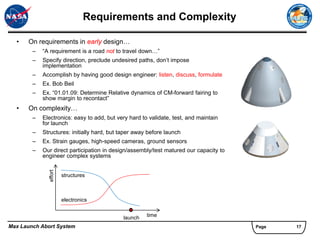
  •   On requirements in early design…
        –   “A requirement is a road not to travel down…”
        –   Specify direction, preclude undesired paths, don’t impose
            implementation
        –   Accomplish by having good design engineer: listen, discuss, formulate
        –   Ex. Bob Beil
        –   Ex. “01.01.09: Determine Relative dynamics of CM-forward fairing to
            show margin to recontact”
  •   On complexity…
        –   Electronics: easy to add, but very hard to validate, test, and maintain
            for launch
        –   Structures: initially hard, but taper away before launch
        –   Ex. Strain gauges, high-speed cameras, ground sensors
        –   Our direct participation in design/assembly/test matured our capacity to
            engineer complex systems
              effort


                       structures


                       electronics


                                            launch    time

Max Launch Abort System                                                                Page   17
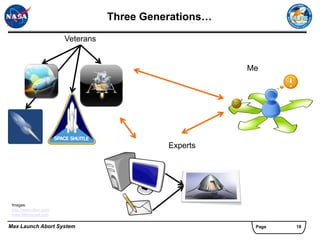
Three Generations…
                         Veterans


                                                         Me


                                              Experts


 Images:
 http://www.clker.com/
 www.fallingpixel.com


Max Launch Abort System                                   Page   18
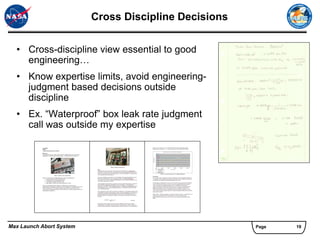
Cross Discipline Decisions


  • Cross-discipline view essential to good
    engineering…
  • Know expertise limits, avoid engineering-
    judgment based decisions outside
    discipline
  • Ex. “Waterproof” box leak rate judgment
    call was outside my expertise


Max Launch Abort System                                Page   19
Gary Dittemore - Background


       • Mechanical Engineer
       • OMS/RCS Mission Operations/JSC – 5 years
       • MLAS/NESC – 2 years


Max Launch Abort System                                 Page   20
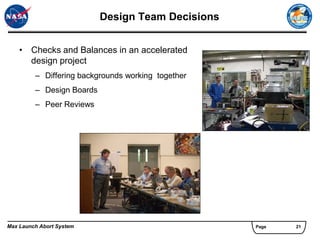
Design Team Decisions


    • Checks and Balances in an accelerated
      design project
         – Differing backgrounds working together
         – Design Boards
         – Peer Reviews


Max Launch Abort System                             Page   21
Differing Background Experiences


       •   Operations Center
            – Learning design process
       •   Research Center
            – Learning operations processes
       •   Flight Test Center
            – Learning to work with a larger program


Max Launch Abort System                                 Page   22
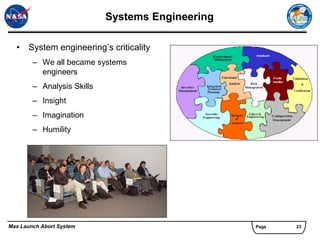
Systems Engineering

  • System engineering’s criticality
        – We all became systems
          engineers
        – Analysis Skills
        – Insight
        – Imagination
        – Humility


Max Launch Abort System                           Page   23
Smart Buyers


     • “Smart buyers”
           – Learned skills to become “smart buyers”
           – Seeing, speaking, understanding


Max Launch Abort System                                Page   24
Omar Torres - Background


       • Electrical Engineer
       • Navy aviation electronics technician
       • Army Research Lab at White Sands Missile Range
       • 2 NASA summer internships
       • 1 Graduate Student Researcher Program (GSRP)
       • NASA Langley Research Center – 5 years


Max Launch Abort System                                   Page   25
Omar’s Takeaways


       • Participation with multidisciplinary team
            – Exposed to effects of one subsystem’s actions to another’s workload

       • MLAS was a challenge in many aspects
            – Participated with avionics, aerodynamics, and GNC teams
            – Had to adjust to a fast pace environment
            – Seeing things from a systems perspective
            – Took responsibilities on actions the team needed help with
       • Opportunity to rise to a new level as an engineer
       • One of a kind experience


Max Launch Abort System                                                     Page    26
What We Learned


       • We learned
            – The relationship of all components of large engineering
              endeavor (from leadership to procedures)
            – To embrace responsibility
            – Agency-wide participation engenders mutual respect
            – To understand and value design, testing, and ops cultures
            – An excellent method for developing young engineers

       • We and our peers are ready for more!!


Max Launch Abort System                                         Page      27
Project Management Suggestions and
                               Benefits

       •   “Napkin to flight” made us better, more versatile engineers, cognizant of
           system-level issues, risks, and trades
       •   Fast pace gives system perspective: the decisional trajectory is held in
           the brains of all
       •   Real hardware responsibility forced us to “walk” paths we only “knew”
           (at best)
       •   Real responsibility, with the capacity for unchecked failure, transforms
           number crunchers to leaders
       •   Gathering top talent from multiple centers to work on a test project,
           allows skill transfer back to multiple centers/organizations
       •   Developing young engineers through prototype work provides a new
           generation of “smart buyers” for the Agency
       •   All engineers should have this type of experience…


Max Launch Abort System                                                  Page          28
Questions?

Dittemore.gary

  • 1.
    Developing Young Engineersto be Design Engineers Gary Dittemore, NASA JSC Omar Torres, NASA LaRC Sam Miller, NASA LaRC Theo Muench, NASA GSFC Used with Permission
  • 2.
    MLAS Task, Approach,and Success Criteria • Task: – Develop an alternate LAS design as risk mitigation for the Orion LAS. Demonstrate the alternate concept with a pad abort flight test. • Approach: – Strive to identify the simplest design that will satisfy launch abort requirements while maximizing nominal ascent performance – Implement flight test by using off-the-shelf parts wherever possible to minimize cost and shorten schedule • Success Criteria: – Obtain sufficient flight test data to assess performance, validate models/tools, and support an MLAS Objective System design Max Launch Abort System Page 2
  • 3.
    MLAS Flight TestVehicle Configuration Turnaround Drogues Modified Sears-Haack Fairing Motor Simulators Separation Joints Coast Skirt Boost Skirt Drag Plates Internally-Mounted Motors Max Launch Abort System Page 3
  • 4.
    MLAS Flight Test MaxLaunch Abort System Page 4
  • 5.
    MLAS Resident EngineerOpportunity • Unique opportunity for direct, on- going interactions between MLAS residents, NASA Technical Fellows, and Apollo-era veterans Resident engineers • Limited scope and short duration assisting in of the MLAS project provided rare composite systems engineering experience fin testing • “Off-line” nature of the project provided an opportunity to try-and- fail • As a group, residents were responsible for all MLAS’ instrumentation – from specification to flight • Each resident was an integral member of a subsystem Resident engineers performing camera vibration testing Max Launch Abort System Page 5
  • 6.
    Residents and Mentors Residents Mentors Gary Dittemore (JSC) T.K. Mattingly Geminesse Dorsey (JSC) Jerry McCullough Joe Grady (GRC) Tom Modlin Samantha Manning (KSC) Bob Ryan Samuel Miller (LaRC) Dave Shemwell Theodore Muench (GSFC) Milt Silveira Terrian Nowden (GRC) Bob West Sarah Quach (KSC) Jerry Sterling (GSFC) Omar Torres (LaRC) Max Launch Abort System Page 6
  • 7.
    Skill Development • Best training is hands on experience – Requirement development – Hardware selection and procurement – Procedure writing: test/launch/recycle – Vehicle test/check out – Launch Resident engineer performing camera vibration testing • Understanding the risk balance between engineering vs. schedule vs. budget • Flight hardware inspires – Some peers at home centers left due to dullness of their insight/oversight tasks – MLAS afforded opportunity to make a tangible difference in the exploration vision! Resident engineers hardening Space Fibre camera for flight Max Launch Abort System Page 7
  • 8.
    Experience That Can’tBe Taught • Strain gauge amplifier issue – Hardware didn’t meet vendor spec – Worked constant modifications and adjustments – Eventually replaced amplifiers • Retrospect illuminates the problem’s value... – “You earned your scars; wear them well” – Required delivery date plays a large part in corrective action – Small team prioritizes itself Max Launch Abort System Page 8
  • 9.
    Improved Thought Processand Approach to Problems • Unable to rely on well parameterized problems – Ex. Shuttle program has well defined specs and procedures – “Needed a push at the beginning to take ownership…” • Understanding the design process – Aware of the limitations and decisions involved – “Models are only as good as the assumptions that went into them” • Also learned how NOT to think – Need to have the goal in mind at all times – The project is bigger than the subsystem! Max Launch Abort System Page 9
  • 10.
    Effective Leadership • Risk trades during progress of the project – Management of critical path: Manifolded Motors • Decisions based on past experience – Connector issues – Air data boom • Methods of motivating group – Shared personal experiences – Tailored approaches to different personalities – Communicated openly with all levels of workforce Max Launch Abort System Page 10
  • 11.
    Theo Muench -Background • Mechanical engineer • GSFC Cryogenics - Research & Development - 4 years • Solar Dynamics Observatory – I&T of propulsion subsystem – 1 year • Landsat Data Continuity Mission – TIRS cryogenic subsystem Max Launch Abort System Page 11
  • 12.
    Personal Motivation • MLAS/resident engineer program provided access to project managers in a quasi-peer/mentorship role – Big picture perspective provides inspiration for performing seemingly simple or mundane tasks – Observing effective project management teaches leadership skills/process – In-depth exposure to role models allows for long-term career goal realism – Short term efficiency loss through exposing residents to high level decision making process is traded for big picture inspiration and teaching opportunities Max Launch Abort System Page 12
  • 13.
    Networking • MLAS was a multi-center staffed program – Direct exposure to other NASA center’s facilities and personnel – Career building relationships garnered – Provides global view of the NASA mission – Experience of unity within the agency – Understanding of why differences exist between centers Max Launch Abort System Page 13
  • 14.
    Technical Story -Motor Pressure Transducers • Expected to see 1200 psi +/- 100 psi for ~6 second duration • Post-flight review found that sensor pin-outs on vendor specification sheet and calibration sheet differed – Signal ground recorded instead of signal (0V read during flight) • Pre-flight testing – Individual sensors bench tested at multiple data points – System end-to-end testing only performed at atmospheric pressure – No comparison of bench test and flight wiring harnesses – End to end testing of pressure sensors occurred day before shipment to pad – Non-trivial to safely get high pressure source into proximity of integrated pressure transducers Max Launch Abort System Page 14
  • 15.
    Learning - EngineeringResponsibility (Ownership) • Personal Background – Minimal systems engineering responsibility – Highest level of experience (ownership) = repair/maint. of POV – My testing philosophy –based on personal experience • I knew GSFC “testing philosophy” for robotic missions – Risk management through responsibility division, & extensive documentation – Personally viewed as excessive and tedious – Performed tests as instructed • Learned the difference between “knowing the path” and “walking the path” – Gained a personal rational for system testing vs. an institutional explanation – Importance of communication/documentation Max Launch Abort System Page 15
  • 16.
    Sam Miller -Background • Electrical engineer • LaRC earth science applications – 2 years • Virtual reality research and development – 1 year • Robotics R&D – 3 years • Never worked on a flight project (!) Max Launch Abort System Page 16
  • 17.
    Requirements and Complexity • On requirements in early design… – “A requirement is a road not to travel down…” – Specify direction, preclude undesired paths, don’t impose implementation – Accomplish by having good design engineer: listen, discuss, formulate – Ex. Bob Beil – Ex. “01.01.09: Determine Relative dynamics of CM-forward fairing to show margin to recontact” • On complexity… – Electronics: easy to add, but very hard to validate, test, and maintain for launch – Structures: initially hard, but taper away before launch – Ex. Strain gauges, high-speed cameras, ground sensors – Our direct participation in design/assembly/test matured our capacity to engineer complex systems effort structures electronics launch time Max Launch Abort System Page 17
  • 18.
    Three Generations… Veterans Me Experts Images: http://www.clker.com/ www.fallingpixel.com Max Launch Abort System Page 18
  • 19.
    Cross Discipline Decisions • Cross-discipline view essential to good engineering… • Know expertise limits, avoid engineering- judgment based decisions outside discipline • Ex. “Waterproof” box leak rate judgment call was outside my expertise Max Launch Abort System Page 19
  • 20.
    Gary Dittemore -Background • Mechanical Engineer • OMS/RCS Mission Operations/JSC – 5 years • MLAS/NESC – 2 years Max Launch Abort System Page 20
  • 21.
    Design Team Decisions • Checks and Balances in an accelerated design project – Differing backgrounds working together – Design Boards – Peer Reviews Max Launch Abort System Page 21
  • 22.
    Differing Background Experiences • Operations Center – Learning design process • Research Center – Learning operations processes • Flight Test Center – Learning to work with a larger program Max Launch Abort System Page 22
  • 23.
    Systems Engineering • System engineering’s criticality – We all became systems engineers – Analysis Skills – Insight – Imagination – Humility Max Launch Abort System Page 23
  • 24.
    Smart Buyers • “Smart buyers” – Learned skills to become “smart buyers” – Seeing, speaking, understanding Max Launch Abort System Page 24
  • 25.
    Omar Torres -Background • Electrical Engineer • Navy aviation electronics technician • Army Research Lab at White Sands Missile Range • 2 NASA summer internships • 1 Graduate Student Researcher Program (GSRP) • NASA Langley Research Center – 5 years Max Launch Abort System Page 25
  • 26.
    Omar’s Takeaways • Participation with multidisciplinary team – Exposed to effects of one subsystem’s actions to another’s workload • MLAS was a challenge in many aspects – Participated with avionics, aerodynamics, and GNC teams – Had to adjust to a fast pace environment – Seeing things from a systems perspective – Took responsibilities on actions the team needed help with • Opportunity to rise to a new level as an engineer • One of a kind experience Max Launch Abort System Page 26
  • 27.
    What We Learned • We learned – The relationship of all components of large engineering endeavor (from leadership to procedures) – To embrace responsibility – Agency-wide participation engenders mutual respect – To understand and value design, testing, and ops cultures – An excellent method for developing young engineers • We and our peers are ready for more!! Max Launch Abort System Page 27
  • 28.
    Project Management Suggestionsand Benefits • “Napkin to flight” made us better, more versatile engineers, cognizant of system-level issues, risks, and trades • Fast pace gives system perspective: the decisional trajectory is held in the brains of all • Real hardware responsibility forced us to “walk” paths we only “knew” (at best) • Real responsibility, with the capacity for unchecked failure, transforms number crunchers to leaders • Gathering top talent from multiple centers to work on a test project, allows skill transfer back to multiple centers/organizations • Developing young engineers through prototype work provides a new generation of “smart buyers” for the Agency • All engineers should have this type of experience… Max Launch Abort System Page 28
  • 29.