International Research Journal of Engineering and Technology (IRJET) e-ISSN: 2395-0056
Volume: 09 Issue: 05 | May 2022 www.irjet.net p-ISSN: 2395-0072
© 2022, IRJET | Impact Factor value: 7.529 | ISO 9001:2008 Certified Journal | Page 283
ENVIRONMENTAL QUALITY PREDICTION AND ITS DEPLOYMENT
Dr.S.Sridevi1, Rakesh Jampala2, B.Yaswanth3
1Associate Professor, Department of ECE, Vel Tech Rangarajan Dr.Sagunthala R&D Institute Of Science And
Technology, Chennai, India
2,3Student, Department of ECE, Vel Tech Rangarajan Dr.Sagunthala R&D Institute Of Science And Technology,
Chennai, India
---------------------------------------------------------------------***---------------------------------------------------------------------
Abstract - The environment is the source of survival for the
human. In the modern days, the degradation of the
environment has been increased significantly, when we
compared to the last few centuries. Examining and protecting
environmental quality has become one of the essentialaspects
for the government in recent days. The meteorological and
traffic factors, burning of fossil fuels, deforestation, industrial
parameters, and mass development of civilization played a
significant role in environmental quality. With a significant
rise in environmental pollution, we need models which will
record information about the environment and its pollutants.
The deposition of harmful gases in the air, mass deforestation,
and industrial factors are affecting the qualityofpeople’slives
around the world. Many researchers began to use the big data
analytics approach as there environmental sensing networks
and sensor data available. In this project, we implement
ma chine learning models to detect and predict
environmental quality. Models in time series will be employed
for the better prediction of environmental quality
Key Words: Environmental quality, Machine learning,
Pollutants, Time series models.
1. INTRODUCTION
With economic development and population rise in cities
lead to environmental pollution problems involving air
pollution, water pollution, noise and the shortage of land
resources have attracted increasing attention. Amongthese,
air pollution is significant problem, as it impact the human
health. People exposure to pollutants has resultedinserious
health problems. Both developing and developed countries
are trying to figure out methodstoamelioratethepresentair
pollution situations. Airpollutionisusuallycausedbyenergy
production from power plants, industries, residential
heating, fuel burning vehicles, natural disasters etc. Human
health concern is one among the important consequences of
air pollution especially in urban areas. Artificial intelligence
and machine learning in recent years has been one of the
phenomenal advancement of technology Instead of just
writing commands as standard works, the philosophy of
artificial intelligence, in which the system makes its own
choices gradually impacts all aspects of our society.Machine
learning is an area where an artificial intelligence system
gathers data from sensors and learns to behave in an
environment. The ability of machine learning (ML)
algorithms to adapt was one of the reasons we chose
machine learning to predict the air quality index. The
machine learning algorithms in such as naive Bayes
classifier, logistic regression and decision tree classifier are
implemented in this approach.
1.1 Aim of the project
The primary objective of this project is to analyze and
predict the optimum quality of air using the machine
learning algorithm. In addition, develop a machine learning
model for higher efficacy and lower error rate for better
prediction. And top of that to help the society with the
optimum model of machine learning for a better tomorrow.
1.2 Project Domain
The project was designed to detect air quality, which is
significant factor in contemporary society, as it impact
individuals health. Therefore, We utilized Machine learning
algorithms to predict the air quality.Wedesignedtheproject
using Supervised learning algorithms of Machine Learning
algorithms such as Decision Tree, Support Vector Machine,
and Naive Bayes.
1.3 Scope of the Project
As the quality of the air is degrading around the world
there is a need for efficient machines for the monitoring air
around the world. Inhaling the air with toxics will leads to
several disease. With the help of the air quality we can
impose the restrictions for saving the environment and can
save humanity from many disasters.
1.4 Methodology
Classification is to determine the class to which each data
sample of the methods belongs, which methods are used
when the outputs of input data are qualitative. The purpose
is to divide the whole problem space into a certain number
of classes. A wide range of classification methods are
present. There are diverse classification methods have been
constructed for different data, since there is no particular
International Research Journal of Engineering and Technology (IRJET) e-ISSN: 2395-0056
Volume: 09 Issue: 05 | May 2022 www.irjet.net p-ISSN: 2395-0072
© 2022, IRJET | Impact Factor value: 7.529 | ISO 9001:2008 Certified Journal | Page 284
method that works on every data set. the aim of
classification is to assign the new samplestoclassesbyusing
the pre-labeled samples. The most commonly used
classification methods are described below
 Logistic Regression
 Naive Bayes
 Decision Tree
 Random Forest
 K-Nearest Neighbor
 Support Vector Machine
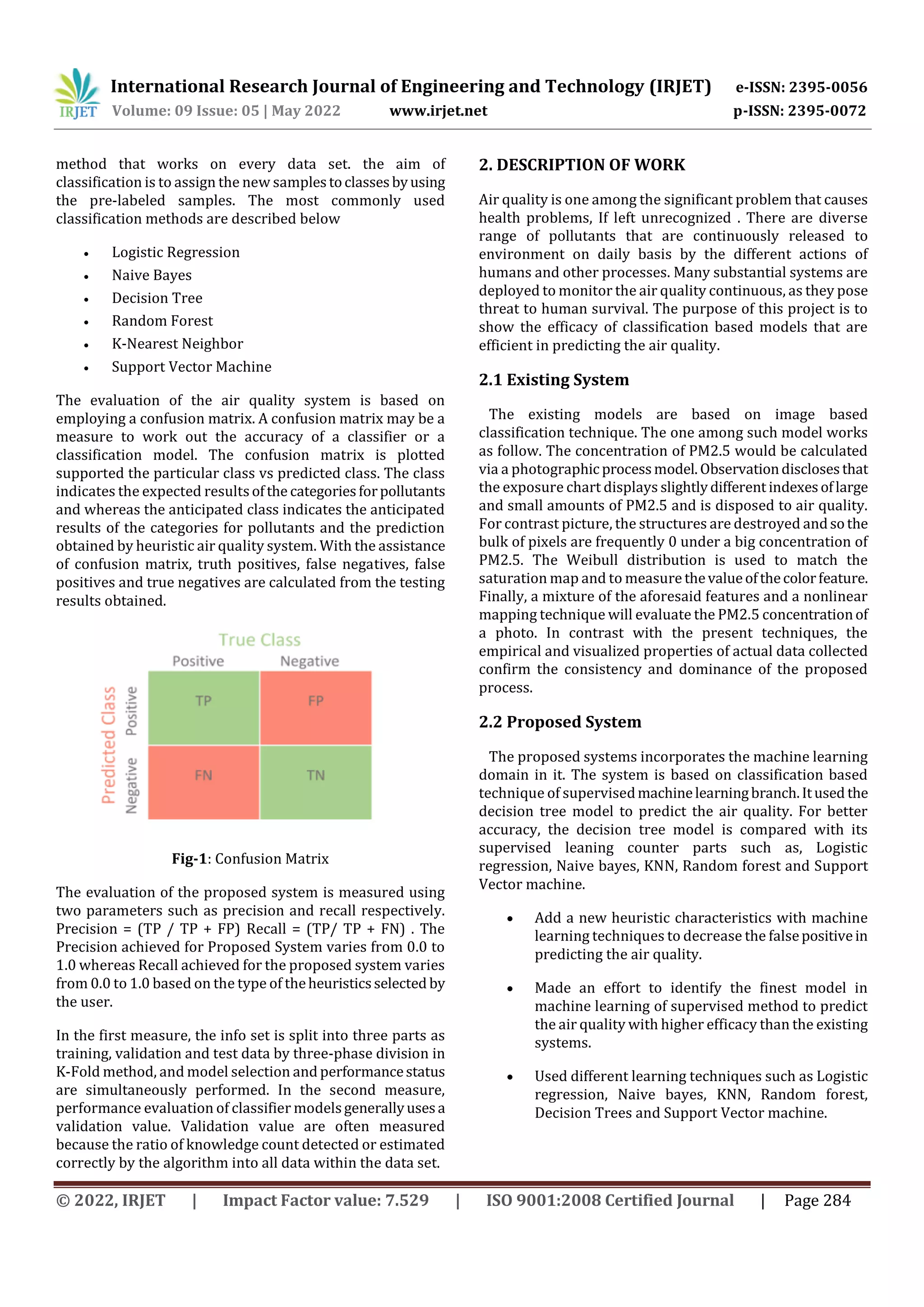
The evaluation of the air quality system is based on
employing a confusion matrix. A confusion matrix may be a
measure to work out the accuracy of a classifier or a
classification model. The confusion matrix is plotted
supported the particular class vs predicted class. The class
indicates the expected resultsofthe categoriesforpollutants
and whereas the anticipated class indicates the anticipated
results of the categories for pollutants and the prediction
obtained by heuristic air quality system. With the assistance
of confusion matrix, truth positives, false negatives, false
positives and true negatives are calculated from the testing
results obtained.
Fig-1: Confusion Matrix
The evaluation of the proposed system is measured using
two parameters such as precision and recall respectively.
Precision = (TP / TP + FP) Recall = (TP/ TP + FN) . The
Precision achieved for Proposed System varies from 0.0 to
1.0 whereas Recall achieved for the proposed system varies
from 0.0 to 1.0 based on the type of theheuristicsselected by
the user.
In the first measure, the info set is split into three parts as
training, validation and test data by three-phase division in
K-Fold method, and model selection and performancestatus
are simultaneously performed. In the second measure,
performance evaluation of classifier modelsgenerallyusesa
validation value. Validation value are often measured
because the ratio of knowledge count detected or estimated
correctly by the algorithm into all data within the data set.
2. DESCRIPTION OF WORK
Air quality is one among the significant problem that causes
health problems, If left unrecognized . There are diverse
range of pollutants that are continuously released to
environment on daily basis by the different actions of
humans and other processes. Many substantial systems are
deployed to monitor the air quality continuous, as they pose
threat to human survival. The purpose of this project is to
show the efficacy of classification based models that are
efficient in predicting the air quality.
2.1 Existing System
The existing models are based on image based
classification technique. The one among such model works
as follow. The concentration of PM2.5 would be calculated
via a photographic processmodel.Observationdisclosesthat
the exposure chart displays slightlydifferent indexesoflarge
and small amounts of PM2.5 and is disposed to air quality.
For contrast picture, the structures are destroyed andsothe
bulk of pixels are frequently 0 under a big concentration of
PM2.5. The Weibull distribution is used to match the
saturation map and to measure thevalueofthecolorfeature.
Finally, a mixture of the aforesaid features and a nonlinear
mapping technique will evaluate the PM2.5 concentrationof
a photo. In contrast with the present techniques, the
empirical and visualized properties of actual data collected
confirm the consistency and dominance of the proposed
process.
2.2 Proposed System
The proposed systems incorporates the machine learning
domain in it. The system is based on classification based
technique of supervisedmachinelearningbranch.Itused the
decision tree model to predict the air quality. For better
accuracy, the decision tree model is compared with its
supervised leaning counter parts such as, Logistic
regression, Naive bayes, KNN, Random forest and Support
Vector machine.
 Add a new heuristic characteristics with machine
learning techniques to decrease the falsepositivein
predicting the air quality.
 Made an effort to identify the finest model in
machine learning of supervised method to predict
the air quality with higher efficacy than the existing
systems.
 Used different learning techniques such as Logistic
regression, Naive bayes, KNN, Random forest,
Decision Trees and Support Vector machine.
International Research Journal of Engineering and Technology (IRJET) e-ISSN: 2395-0056
Volume: 09 Issue: 05 | May 2022 www.irjet.net p-ISSN: 2395-0072
© 2022, IRJET | Impact Factor value: 7.529 | ISO 9001:2008 Certified Journal | Page 285
2.3 Feasibility Study
The feasibility of the project is analyzed in this part and
puts forward a very general project plan and some
commercial recommendations for price estimation. In the
process of system analysis, the feasibility study of the
proposed system was carried out. It is usually ensured that
the planned system will not burden the company. For
feasibility studies, it is important to understand the key
requirements of the system.
3. MODULE DESCRIPTION
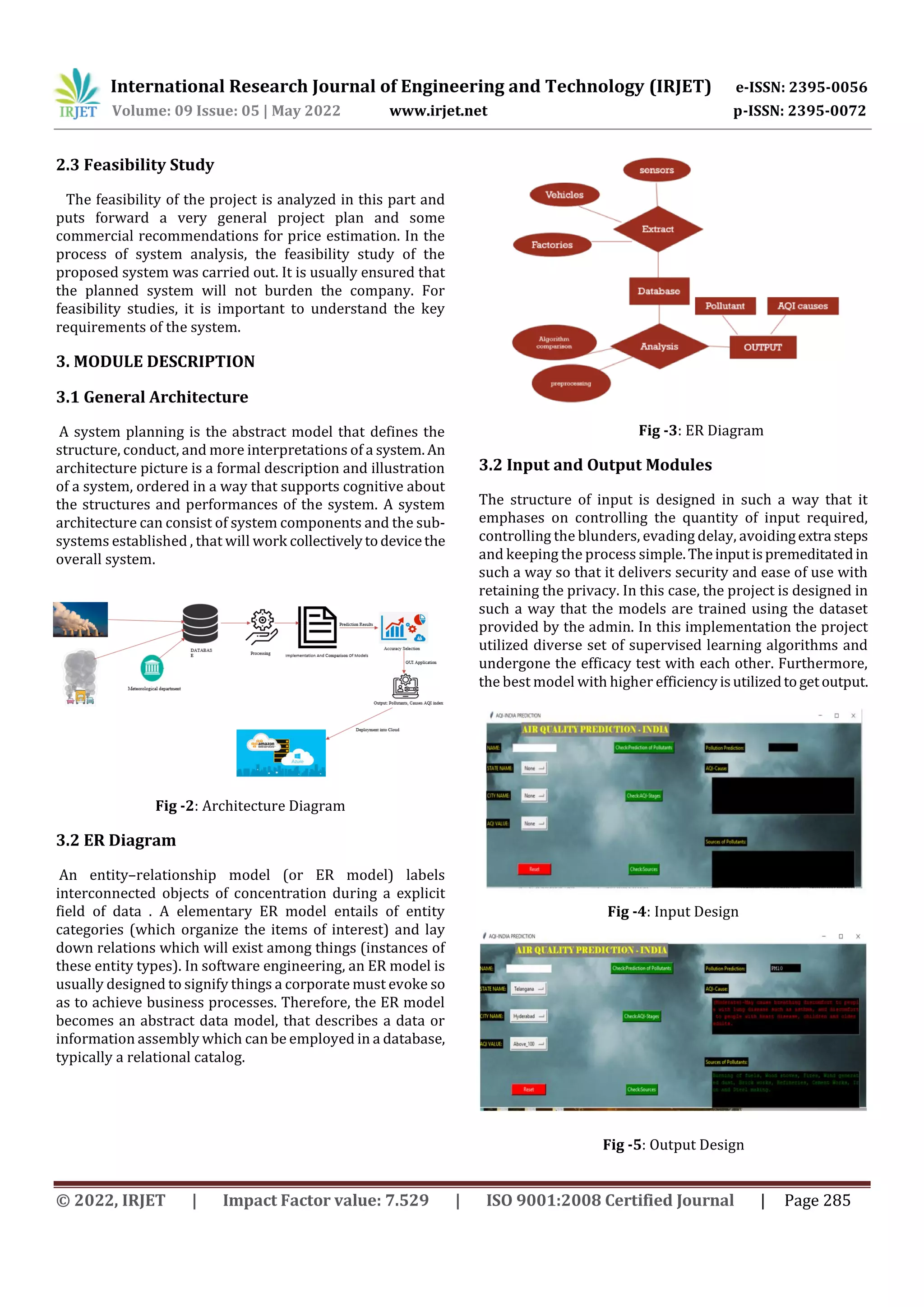
3.1 General Architecture
A system planning is the abstract model that defines the
structure, conduct, and more interpretations of a system. An
architecture picture is a formal description and illustration
of a system, ordered in a way that supports cognitive about
the structures and performances of the system. A system
architecture can consist of system components and the sub-
systems established , that will work collectivelytodevicethe
overall system.
Fig -2: Architecture Diagram
3.2 ER Diagram
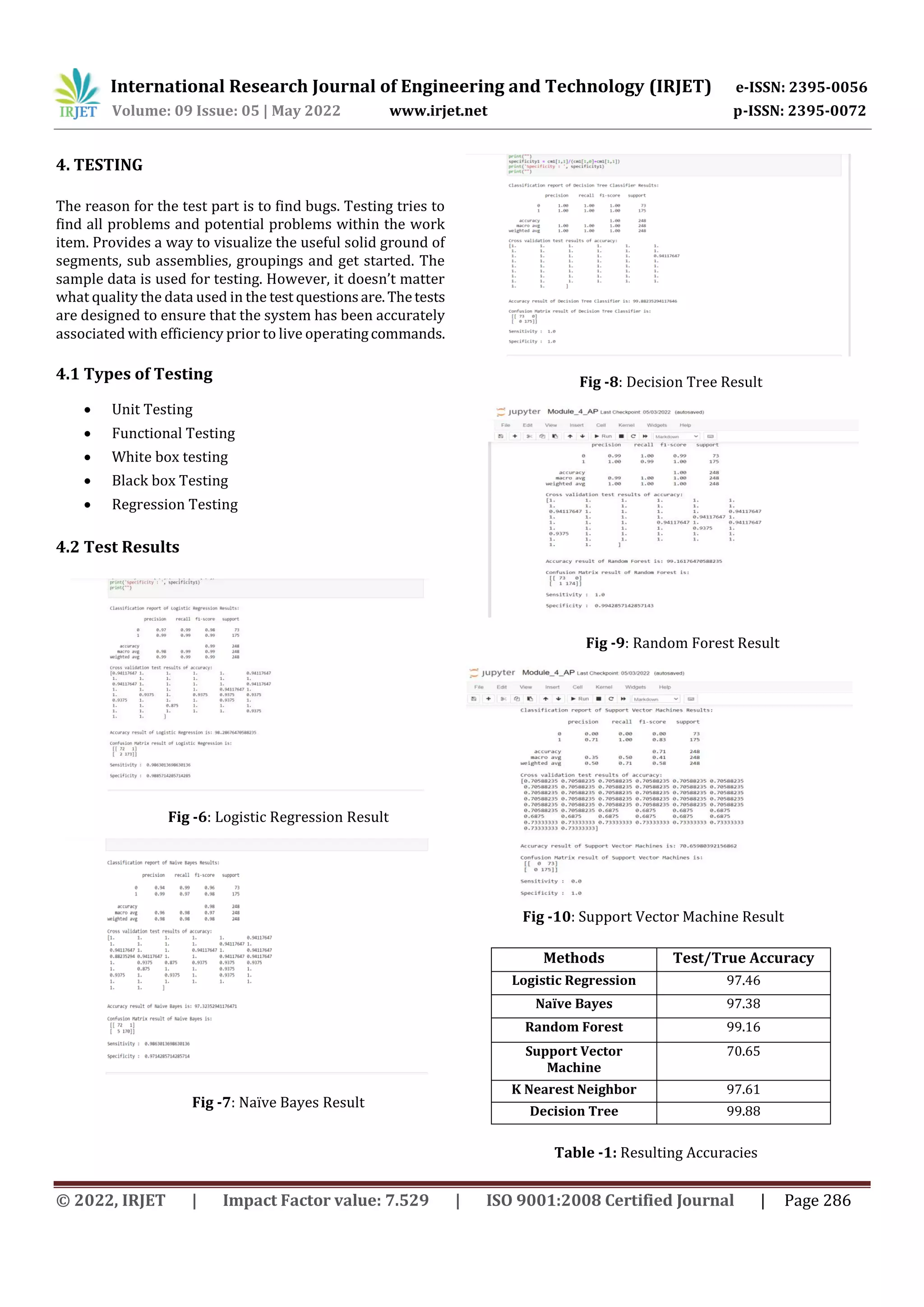
An entity–relationship model (or ER model) labels
interconnected objects of concentration during a explicit
field of data . A elementary ER model entails of entity
categories (which organize the items of interest) and lay
down relations which will exist among things (instances of
these entity types). In software engineering, an ER model is
usually designed to signify things a corporate must evoke so
as to achieve business processes. Therefore, the ER model
becomes an abstract data model, that describes a data or
information assembly which can be employed in a database,
typically a relational catalog.
Fig -3: ER Diagram
3.2 Input and Output Modules
The structure of input is designed in such a way that it
emphases on controlling the quantity of input required,
controlling the blunders, evading delay, avoidingextra steps
and keeping the process simple.Theinputispremeditatedin
such a way so that it delivers security and ease of use with
retaining the privacy. In this case, the project is designed in
such a way that the models are trained using the dataset
provided by the admin. In this implementation the project
utilized diverse set of supervised learning algorithms and
undergone the efficacy test with each other. Furthermore,
the best model with higher efficiencyisutilizedtogetoutput.
Fig -4: Input Design
Fig -5: Output Design
International Research Journal of Engineering and Technology (IRJET) e-ISSN: 2395-0056
Volume: 09 Issue: 05 | May 2022 www.irjet.net p-ISSN: 2395-0072
© 2022, IRJET | Impact Factor value: 7.529 | ISO 9001:2008 Certified Journal | Page 286
4.1 Types of Testing
 Unit Testing
 Functional Testing
 White box testing
 Black box Testing
 Regression Testing
Fig -6: Logistic Regression Result
Fig -7: Naïve Bayes Result
Fig -8: Decision Tree Result
Fig -9: Random Forest Result
Fig -10: Support Vector Machine Result
Methods Test/True Accuracy
Logistic Regression 97.46
Naïve Bayes 97.38
Random Forest 99.16
Support Vector
Machine
70.65
K Nearest Neighbor 97.61
Decision Tree 99.88
Table -1: Resulting Accuracies
4. TESTING
The reason for the test part is to find bugs. Testing tries to
find all problems and potential problems within the work
item. Provides a way to visualize the useful solid ground of
segments, sub assemblies, groupings and get started. The
sample data is used for testing. However, it doesn’t matter
what quality the data used in the test questionsare.Thetests
are designed to ensure that the system has been accurately
associated with efficiency prior to live operatingcommands.
4.2 Test Results
International Research Journal of Engineering and Technology (IRJET) e-ISSN: 2395-0056
Volume: 09 Issue: 05 | May 2022 www.irjet.net p-ISSN: 2395-0072
© 2022, IRJET | Impact Factor value: 7.529 | ISO 9001:2008 Certified Journal | Page 287
5. RESULTS AND DISCUSSIONS
The development of this novel system is to provide the
higher efficacy in detecting the air quality. By means of this
new system, an individual can have an opportunity toassess
the air quality to gain the knowledge of the air quality in the
location. The designed new system uses the classification
based algorithm for the prediction of air quality. For the
efficacy terms, it is compared with five diverse sets of
classification based algorithms of machine learning such as
Logistic regression, Naive bayes, KNN, Random Forest and
Support Vector Machine. The performance of the proposed
system is at a pinnacle than the rest of thecomparedmodels.
The developed model uses the decision tree to classify the
data, which provide the output of the air quality data by
taking input data. There are different classification
techniques are evolved, since differentalgorithmshave been
developed to work with different sets of data, as there is no
exact method that works on all data set. As stated in
literature works, the goal of classification is to allocate the
new samples to classes by using the pre-labeled samples.
6. CONCLUSION AND FUTURE ENHANCEMENTS
Prevention of air pollution is the need of the hour, so a
influential machinelearning systemwasestablishedwith the
help of prediction model. Prediction of pollution events has
become most important issue in major cities in India due to
the increased expansion ofthepopulationandtheassociated
impact of traffic capacities. Data from a variety of
heterogeneous capitals were used and involved collection
and cleansing for use in machine learning algorithms. The
number of model parameters and optimized outputs were
reduced with help of structure regularization which in turn,
alleviated model complexity. The Decision Tree Algorithm
gave the best results among all the algorithms, with an
overall accuracy of 99.8.
REFERENCES
[1] Acharjya, Debi Prasanna, and Kauser Ahmed (2019), ”A
survey on big data analytics: challenges, open research
issues and tools.” International Journal of Advanced
Computer Science and Applications, vol.7,no.2, pp.511-
518.
[2] A. Gnana Soundari, J. Gnana Jeslin, Akshaya A.C
(2019),”Indian Air Quality Prediction And Analysis
Using Machine Learning”, International Journal of
Computer Applications Technology and Research
,Volume 8,Issue 09, 367-370.
[3] Abed Al Ahad M, Sullivan F, Demsar U, Melhem M, Kulu
H(2020),” The Effect Of Air-pollution And Weather
Exposure On Mortality And Hospital Admission And
Implications For Further Research: A Systematic
Scoping Review”. PLoS ONE 15(10): e0241415.
[4] D. Qin, J. Yu, G. Zou, R. Yong, Q. Zhao and B. Zhang
(2019), ”A Novel Combined PredictionSchemeBasedon
CNN and LSTM for Urban PM2.5 Concentration,”inIEEE
Access, vol.7, pp.20050-20059.
[5] G. Yue, K. Gu and J. Qiao (2019), ”Effective and Efficient
Photo-Based PM2.5 Concentration Estimation,” in IEEE
Transactions on Instrumentation and Measurement,
vol.68, no.10, pp. 3962-3971.
[6] T. Zhang and R. P. Dick (2020), ”Estimation of Multiple
Atmospheric Pollutants Through Image Analysis,” IEEE
International Conference on Image Processing (ICIP),
Taipei, Taiwan, pp. 2060-2064,
doi:10.1109/ICIP.2019.8803130.
[7] S. Y. Muhammad, M. Makhtar, A. Rozaimee,A.Abdul,and
A. A. Jamal (2019), “Classification model for air quality
using machine learning techniques,” International
Journal of Software EngineeringandItsApplications,pp.
45-52.
Many efforts from both local and state administrations are
done in order to understand and predict air quality index
aiming to improve community health. With the progression
of IoT substructures, big data knowledges, and machine
learning techniques, real-time air quality monitor and
evaluation is desirable for upcoming smart cities. In futurea
close working between authorities and also applying them
with MLT background, which may provide boosting in
prediction. This can be achieved by building operational
models that adapt automatically to changes in environment.
Also, more data can be included to increase data seasonality.

ENVIRONMENTAL QUALITY PREDICTION AND ITS DEPLOYMENT

  • 1.
    International Research Journalof Engineering and Technology (IRJET) e-ISSN: 2395-0056 Volume: 09 Issue: 05 | May 2022 www.irjet.net p-ISSN: 2395-0072 © 2022, IRJET | Impact Factor value: 7.529 | ISO 9001:2008 Certified Journal | Page 283 ENVIRONMENTAL QUALITY PREDICTION AND ITS DEPLOYMENT Dr.S.Sridevi1, Rakesh Jampala2, B.Yaswanth3 1Associate Professor, Department of ECE, Vel Tech Rangarajan Dr.Sagunthala R&D Institute Of Science And Technology, Chennai, India 2,3Student, Department of ECE, Vel Tech Rangarajan Dr.Sagunthala R&D Institute Of Science And Technology, Chennai, India ---------------------------------------------------------------------***--------------------------------------------------------------------- Abstract - The environment is the source of survival for the human. In the modern days, the degradation of the environment has been increased significantly, when we compared to the last few centuries. Examining and protecting environmental quality has become one of the essentialaspects for the government in recent days. The meteorological and traffic factors, burning of fossil fuels, deforestation, industrial parameters, and mass development of civilization played a significant role in environmental quality. With a significant rise in environmental pollution, we need models which will record information about the environment and its pollutants. The deposition of harmful gases in the air, mass deforestation, and industrial factors are affecting the qualityofpeople’slives around the world. Many researchers began to use the big data analytics approach as there environmental sensing networks and sensor data available. In this project, we implement ma chine learning models to detect and predict environmental quality. Models in time series will be employed for the better prediction of environmental quality Key Words: Environmental quality, Machine learning, Pollutants, Time series models. 1. INTRODUCTION With economic development and population rise in cities lead to environmental pollution problems involving air pollution, water pollution, noise and the shortage of land resources have attracted increasing attention. Amongthese, air pollution is significant problem, as it impact the human health. People exposure to pollutants has resultedinserious health problems. Both developing and developed countries are trying to figure out methodstoamelioratethepresentair pollution situations. Airpollutionisusuallycausedbyenergy production from power plants, industries, residential heating, fuel burning vehicles, natural disasters etc. Human health concern is one among the important consequences of air pollution especially in urban areas. Artificial intelligence and machine learning in recent years has been one of the phenomenal advancement of technology Instead of just writing commands as standard works, the philosophy of artificial intelligence, in which the system makes its own choices gradually impacts all aspects of our society.Machine learning is an area where an artificial intelligence system gathers data from sensors and learns to behave in an environment. The ability of machine learning (ML) algorithms to adapt was one of the reasons we chose machine learning to predict the air quality index. The machine learning algorithms in such as naive Bayes classifier, logistic regression and decision tree classifier are implemented in this approach. 1.1 Aim of the project The primary objective of this project is to analyze and predict the optimum quality of air using the machine learning algorithm. In addition, develop a machine learning model for higher efficacy and lower error rate for better prediction. And top of that to help the society with the optimum model of machine learning for a better tomorrow. 1.2 Project Domain The project was designed to detect air quality, which is significant factor in contemporary society, as it impact individuals health. Therefore, We utilized Machine learning algorithms to predict the air quality.Wedesignedtheproject using Supervised learning algorithms of Machine Learning algorithms such as Decision Tree, Support Vector Machine, and Naive Bayes. 1.3 Scope of the Project As the quality of the air is degrading around the world there is a need for efficient machines for the monitoring air around the world. Inhaling the air with toxics will leads to several disease. With the help of the air quality we can impose the restrictions for saving the environment and can save humanity from many disasters. 1.4 Methodology Classification is to determine the class to which each data sample of the methods belongs, which methods are used when the outputs of input data are qualitative. The purpose is to divide the whole problem space into a certain number of classes. A wide range of classification methods are present. There are diverse classification methods have been constructed for different data, since there is no particular
  • 2.
    International Research Journalof Engineering and Technology (IRJET) e-ISSN: 2395-0056 Volume: 09 Issue: 05 | May 2022 www.irjet.net p-ISSN: 2395-0072 © 2022, IRJET | Impact Factor value: 7.529 | ISO 9001:2008 Certified Journal | Page 284 method that works on every data set. the aim of classification is to assign the new samplestoclassesbyusing the pre-labeled samples. The most commonly used classification methods are described below  Logistic Regression  Naive Bayes  Decision Tree  Random Forest  K-Nearest Neighbor  Support Vector Machine The evaluation of the air quality system is based on employing a confusion matrix. A confusion matrix may be a measure to work out the accuracy of a classifier or a classification model. The confusion matrix is plotted supported the particular class vs predicted class. The class indicates the expected resultsofthe categoriesforpollutants and whereas the anticipated class indicates the anticipated results of the categories for pollutants and the prediction obtained by heuristic air quality system. With the assistance of confusion matrix, truth positives, false negatives, false positives and true negatives are calculated from the testing results obtained. Fig-1: Confusion Matrix The evaluation of the proposed system is measured using two parameters such as precision and recall respectively. Precision = (TP / TP + FP) Recall = (TP/ TP + FN) . The Precision achieved for Proposed System varies from 0.0 to 1.0 whereas Recall achieved for the proposed system varies from 0.0 to 1.0 based on the type of theheuristicsselected by the user. In the first measure, the info set is split into three parts as training, validation and test data by three-phase division in K-Fold method, and model selection and performancestatus are simultaneously performed. In the second measure, performance evaluation of classifier modelsgenerallyusesa validation value. Validation value are often measured because the ratio of knowledge count detected or estimated correctly by the algorithm into all data within the data set. 2. DESCRIPTION OF WORK Air quality is one among the significant problem that causes health problems, If left unrecognized . There are diverse range of pollutants that are continuously released to environment on daily basis by the different actions of humans and other processes. Many substantial systems are deployed to monitor the air quality continuous, as they pose threat to human survival. The purpose of this project is to show the efficacy of classification based models that are efficient in predicting the air quality. 2.1 Existing System The existing models are based on image based classification technique. The one among such model works as follow. The concentration of PM2.5 would be calculated via a photographic processmodel.Observationdisclosesthat the exposure chart displays slightlydifferent indexesoflarge and small amounts of PM2.5 and is disposed to air quality. For contrast picture, the structures are destroyed andsothe bulk of pixels are frequently 0 under a big concentration of PM2.5. The Weibull distribution is used to match the saturation map and to measure thevalueofthecolorfeature. Finally, a mixture of the aforesaid features and a nonlinear mapping technique will evaluate the PM2.5 concentrationof a photo. In contrast with the present techniques, the empirical and visualized properties of actual data collected confirm the consistency and dominance of the proposed process. 2.2 Proposed System The proposed systems incorporates the machine learning domain in it. The system is based on classification based technique of supervisedmachinelearningbranch.Itused the decision tree model to predict the air quality. For better accuracy, the decision tree model is compared with its supervised leaning counter parts such as, Logistic regression, Naive bayes, KNN, Random forest and Support Vector machine.  Add a new heuristic characteristics with machine learning techniques to decrease the falsepositivein predicting the air quality.  Made an effort to identify the finest model in machine learning of supervised method to predict the air quality with higher efficacy than the existing systems.  Used different learning techniques such as Logistic regression, Naive bayes, KNN, Random forest, Decision Trees and Support Vector machine.
  • 3.
    International Research Journalof Engineering and Technology (IRJET) e-ISSN: 2395-0056 Volume: 09 Issue: 05 | May 2022 www.irjet.net p-ISSN: 2395-0072 © 2022, IRJET | Impact Factor value: 7.529 | ISO 9001:2008 Certified Journal | Page 285 2.3 Feasibility Study The feasibility of the project is analyzed in this part and puts forward a very general project plan and some commercial recommendations for price estimation. In the process of system analysis, the feasibility study of the proposed system was carried out. It is usually ensured that the planned system will not burden the company. For feasibility studies, it is important to understand the key requirements of the system. 3. MODULE DESCRIPTION 3.1 General Architecture A system planning is the abstract model that defines the structure, conduct, and more interpretations of a system. An architecture picture is a formal description and illustration of a system, ordered in a way that supports cognitive about the structures and performances of the system. A system architecture can consist of system components and the sub- systems established , that will work collectivelytodevicethe overall system. Fig -2: Architecture Diagram 3.2 ER Diagram An entity–relationship model (or ER model) labels interconnected objects of concentration during a explicit field of data . A elementary ER model entails of entity categories (which organize the items of interest) and lay down relations which will exist among things (instances of these entity types). In software engineering, an ER model is usually designed to signify things a corporate must evoke so as to achieve business processes. Therefore, the ER model becomes an abstract data model, that describes a data or information assembly which can be employed in a database, typically a relational catalog. Fig -3: ER Diagram 3.2 Input and Output Modules The structure of input is designed in such a way that it emphases on controlling the quantity of input required, controlling the blunders, evading delay, avoidingextra steps and keeping the process simple.Theinputispremeditatedin such a way so that it delivers security and ease of use with retaining the privacy. In this case, the project is designed in such a way that the models are trained using the dataset provided by the admin. In this implementation the project utilized diverse set of supervised learning algorithms and undergone the efficacy test with each other. Furthermore, the best model with higher efficiencyisutilizedtogetoutput. Fig -4: Input Design Fig -5: Output Design
  • 4.
    International Research Journalof Engineering and Technology (IRJET) e-ISSN: 2395-0056 Volume: 09 Issue: 05 | May 2022 www.irjet.net p-ISSN: 2395-0072 © 2022, IRJET | Impact Factor value: 7.529 | ISO 9001:2008 Certified Journal | Page 286 4.1 Types of Testing  Unit Testing  Functional Testing  White box testing  Black box Testing  Regression Testing Fig -6: Logistic Regression Result Fig -7: Naïve Bayes Result Fig -8: Decision Tree Result Fig -9: Random Forest Result Fig -10: Support Vector Machine Result Methods Test/True Accuracy Logistic Regression 97.46 Naïve Bayes 97.38 Random Forest 99.16 Support Vector Machine 70.65 K Nearest Neighbor 97.61 Decision Tree 99.88 Table -1: Resulting Accuracies 4. TESTING The reason for the test part is to find bugs. Testing tries to find all problems and potential problems within the work item. Provides a way to visualize the useful solid ground of segments, sub assemblies, groupings and get started. The sample data is used for testing. However, it doesn’t matter what quality the data used in the test questionsare.Thetests are designed to ensure that the system has been accurately associated with efficiency prior to live operatingcommands. 4.2 Test Results
  • 5.
    International Research Journalof Engineering and Technology (IRJET) e-ISSN: 2395-0056 Volume: 09 Issue: 05 | May 2022 www.irjet.net p-ISSN: 2395-0072 © 2022, IRJET | Impact Factor value: 7.529 | ISO 9001:2008 Certified Journal | Page 287 5. RESULTS AND DISCUSSIONS The development of this novel system is to provide the higher efficacy in detecting the air quality. By means of this new system, an individual can have an opportunity toassess the air quality to gain the knowledge of the air quality in the location. The designed new system uses the classification based algorithm for the prediction of air quality. For the efficacy terms, it is compared with five diverse sets of classification based algorithms of machine learning such as Logistic regression, Naive bayes, KNN, Random Forest and Support Vector Machine. The performance of the proposed system is at a pinnacle than the rest of thecomparedmodels. The developed model uses the decision tree to classify the data, which provide the output of the air quality data by taking input data. There are different classification techniques are evolved, since differentalgorithmshave been developed to work with different sets of data, as there is no exact method that works on all data set. As stated in literature works, the goal of classification is to allocate the new samples to classes by using the pre-labeled samples. 6. CONCLUSION AND FUTURE ENHANCEMENTS Prevention of air pollution is the need of the hour, so a influential machinelearning systemwasestablishedwith the help of prediction model. Prediction of pollution events has become most important issue in major cities in India due to the increased expansion ofthepopulationandtheassociated impact of traffic capacities. Data from a variety of heterogeneous capitals were used and involved collection and cleansing for use in machine learning algorithms. The number of model parameters and optimized outputs were reduced with help of structure regularization which in turn, alleviated model complexity. The Decision Tree Algorithm gave the best results among all the algorithms, with an overall accuracy of 99.8. REFERENCES [1] Acharjya, Debi Prasanna, and Kauser Ahmed (2019), ”A survey on big data analytics: challenges, open research issues and tools.” International Journal of Advanced Computer Science and Applications, vol.7,no.2, pp.511- 518. [2] A. Gnana Soundari, J. Gnana Jeslin, Akshaya A.C (2019),”Indian Air Quality Prediction And Analysis Using Machine Learning”, International Journal of Computer Applications Technology and Research ,Volume 8,Issue 09, 367-370. [3] Abed Al Ahad M, Sullivan F, Demsar U, Melhem M, Kulu H(2020),” The Effect Of Air-pollution And Weather Exposure On Mortality And Hospital Admission And Implications For Further Research: A Systematic Scoping Review”. PLoS ONE 15(10): e0241415. [4] D. Qin, J. Yu, G. Zou, R. Yong, Q. Zhao and B. Zhang (2019), ”A Novel Combined PredictionSchemeBasedon CNN and LSTM for Urban PM2.5 Concentration,”inIEEE Access, vol.7, pp.20050-20059. [5] G. Yue, K. Gu and J. Qiao (2019), ”Effective and Efficient Photo-Based PM2.5 Concentration Estimation,” in IEEE Transactions on Instrumentation and Measurement, vol.68, no.10, pp. 3962-3971. [6] T. Zhang and R. P. Dick (2020), ”Estimation of Multiple Atmospheric Pollutants Through Image Analysis,” IEEE International Conference on Image Processing (ICIP), Taipei, Taiwan, pp. 2060-2064, doi:10.1109/ICIP.2019.8803130. [7] S. Y. Muhammad, M. Makhtar, A. Rozaimee,A.Abdul,and A. A. Jamal (2019), “Classification model for air quality using machine learning techniques,” International Journal of Software EngineeringandItsApplications,pp. 45-52. Many efforts from both local and state administrations are done in order to understand and predict air quality index aiming to improve community health. With the progression of IoT substructures, big data knowledges, and machine learning techniques, real-time air quality monitor and evaluation is desirable for upcoming smart cities. In futurea close working between authorities and also applying them with MLT background, which may provide boosting in prediction. This can be achieved by building operational models that adapt automatically to changes in environment. Also, more data can be included to increase data seasonality.