Volume 5, Issue 5, May – 2020 International Journal of Innovative Science and Research Technology
ISSN No: -2456-2165 https://doi.org/10.38124/ijisrt/IJISRT20MAY999
IJISRT20MAY999 www.ijisrt.com 2011
Air Quality Prediction in Urban
Environment Using IoT Sensor Data
Nikhil Sanjay Suryawanshi
California, USA.
Abstract:- The increasing concern for environmental
health has led to a heightened need for accurate air quality
monitoring and prediction. This study presents a
framework for predicting the Air Quality Index (AQI)
using existing datasets rather than relying on real-time
data from IoT sensors. The proposed system incorporates
various machine learning algorithms, including Linear
Regression, Neural Networks, and XGBoost, to analyze the
relationships between air pollution indicators and AQI
values. The methodology encompasses essential steps such
as data preprocessing, normalization, and dividing the
dataset into training and testing sets. Although the system
has not yet been implemented, preliminary analyses
indicate that the use of these models has the potential to
yield reliable AQI predictions, which can significantly
assist policymakers and public health officials in
implementing effective air quality management strategies.
Keywords:- IoT Sensors, Air Quality Index (AQI), Machine
Learning, Deep Learning, Random Forest, Linear
Regression, Neural Networks, XGBoost, Logistic Regression,
Voting Classifier, AQI Values, Min-Max Scaling.
I. INTRODUCTION
Air quality has become a critical concern in urban
environments due to increasing levels of pollution caused by
rapid industrialization, vehicular emissions, and urbanization.
Poor air quality directly impacts human health, leading to
respiratory illnesses, cardiovascular diseases, and even
premature deaths. According to the World Health Organization
(WHO), air pollution contributes to over 4 million deaths
annually, with a significant proportion occurring in urban areas.
Hence prediction of air quality is essential to mitigate these
health risks, inform policy decisions, and enable early warnings
for vulnerable populations [1].
Urban air pollution is a major global problem caused by
rapid city growth, rising population, and increased industrial
activity. Recently, more people have become aware of how
population growth and human activities impact the
environment [2]. The United Nations estimates that the world
has about 7.6 billion people and around 4.2 billion (or 55%) of
them live in cities. By 2050, the number of people living in
cities is expected to double. As cities grow quickly, industries
are expanding to keep up with the needs of more people [3].
Effective urban development planning requires
collaboration from different fields, such as politics,
environmental engineering, and spatial planning. People's
happiness is influenced by how well policymakers do their
jobs, living conditions, access to education, and a healthy
environment [4]. At first, the metallurgical industry was the
biggest cause of pollution, but heating with fossil fuels has
become a more important source over time [5].
Even though using solid fuels for heating is completely
banned, it is still the main cause of pollution during the winter
[6,7]. Air pollution from outside the city is moving into the city,
especially during the colder months [8]. Krakow’s position,
surrounded by small hills and the Carpathian Mountains to the
south [9], makes this worse. As a UNESCO World Heritage
site, Krakow deals with issues that impact both locals and
visitors. The COVID-19 pandemic caused a drop in tourism,
which led to initiatives aimed at rebuilding the tourism industry
in a more sustainable way [10].
The advent of Internet of Things (IoT) technology has
opened new possibilities for high-resolution air quality
monitoring. Low-cost sensors can now be deployed at a scale,
providing real-time data on various pollutants across urban
areas [11]. This wealth of data, combined with advances in
machine learning (ML) techniques, presents an opportunity to
develop more accurate and localized air quality prediction
models. Recent advancements in air quality prediction systems
have increasingly focused on the integration of Internet of
Things (IoT) sensor data with machine learning (ML)
techniques. A variety of models, including time-series
approaches like SARIMA and LSTM, are being used to
improve accuracy in forecasting Air Quality Index (AQI)
levels. One notable approach is the Bayesian optimization of
hybrid time-series models, which has been shown to
outperform traditional methods in urban environments [12].
Machine learning algorithms like XGBoost, and Random
Forest, and deep learning models such as LSTM are
particularly effective in handling the non-linear and complex
nature of air pollution data. These models are also frequently
evaluated using error metrics like RMSE and MAE to ensure
robust predictions [13].
This paper explores the integration of IoT sensor data with
machine learning algorithms to predict air quality in urban
environments. By leveraging the spatial and temporal
resolution of IoT sensor networks and the predictive power of
ML models, we aim to develop a system that can provide
accurate, real-time air quality forecasts at a neighborhood level.
Such a system has the potential to inform public health policies,
guide urban planning decisions, and empower citizens to make
informed choices about their daily activities [14].
Volume 5, Issue 5, May – 2020 International Journal of Innovative Science and Research Technology
ISSN No: -2456-2165 https://doi.org/10.38124/ijisrt/IJISRT20MAY999
IJISRT20MAY999 www.ijisrt.com 2012
 Our Research Addresses Several Key Challenges in this
Domain, Including:
 The integration and preprocessing of heterogeneous data
from IoT sensor networks.
 The selection and optimization of appropriate machine
learning algorithms for air quality prediction.
 The incorporation of contextual factors such as weather
conditions, traffic patterns, and urban morphology into the
predictive models.
 The validation and interpretation of model outputs in the
context of existing air quality standards and health
guidelines.
By addressing these challenges, we aim to contribute to
the growing body of work on smart city technologies and
environmental informatics, while providing practical tools for
improving air quality management in urban areas.
II. LITERATURE REVIEW
Feng et al. [15] proposed an ensemble learning approach
that combined multiple ML algorithms, including gradient
boosting and neural networks. Their hybrid model
demonstrated improved performance in predicting air quality
index (AQI) values compared to individual models.
Xu et al. [16] developed an edge computing-based air
quality prediction system that utilized IoT sensors and deep
learning models. Their approach reduced data transmission
latency and improved the real-time prediction capabilities of
the system. As scientific and technological advancements
accelerate, predictive technologies have permeated numerous
domains. These range from everyday applications like
forecasting individual movement patterns, traffic conditions,
and air quality, to more specialized fields. The reach of
predictive techniques extends beyond simple forecasting,
finding utility in complex optimization challenges [17, 18],
anticipating service quality levels [19], and enhancing user
recommendation systems [20, 21]. This widespread adoption
underscores the versatility and growing importance of
predictive technologies across diverse sectors.
Genc et al. [22] used a multiple linear regression model to
predict Ankara’s air pollution index. Moisan et al. [23]
proposed a method based on dynamic multivariate linear
equations to predict PM2.5 pollution concentrations at different
monitoring stations. The abovementioned studies are all based
on linear model prediction methods. However, the relationships
between air quality and its related factors are mostly nonlinear.
The linear models mentioned above do not represent their
complex interrelationships well.
Ge et al. [24] emphasized the importance of considering
both temporal and non-temporal factors in forecasting air
quality. They recognized that a comprehensive approach,
considering time-dependent patterns as well as static
influences, could lead to more accurate predictions. In a related
effort to improve prediction accuracy, Qi et al. [25] developed
an innovative hybrid model called GC-LSTM. This model
cleverly combined two distinct neural network architectures:
graph convolutional networks (GCN) and Long Short-Term
Memory (LSTM) networks. The GCN component was
employed to analyze and leverage the spatial relationships
between different monitoring locations, while the LSTM
network was utilized to identify and model the temporal
patterns in the air quality data across various time points.
Nahar et al. [26] developed a model that applies machine
learning classifiers to forecast the Air Quality Index (AQI). The
authors examined data provided by the Jordanian Ministry of
Environment, covering a span of 28 months, and observed
pollutant levels. Their model successfully identified the regions
with the highest pollution levels. Castelli et al. [27] conducted
a study aimed at forecasting air quality in California, USA, by
estimating pollutant concentrations using the support vector
regressor (SVR) algorithm. The authors introduced a novel
method to predict atmospheric pollution levels on an hourly
timescale. Soundari et al. [28] developed a neural network
model for forecasting the Indian Air Quality Index (AQI). Their
research demonstrated that, with access to relevant data on air
pollutant concentrations, it is possible to accurately predict the
AQI for the entire nation or specific regions using their
proposed model.
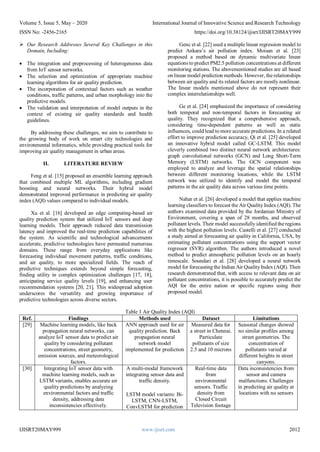
Table 1 Air Quality Index (AQI)
Ref. Findings Methods used Dataset Limitations
[29] Machine learning models, like back
propagation neural networks, can
analyze IoT sensor data to predict air
quality by considering pollutant
concentrations, street geometry,
emission sources, and meteorological
factors.
ANN approach used for air
quality prediction. Back
propagation neural
network model
implemented for prediction
Measured data for
a street in Chennai.
Particulate
pollutants of size
2.5 and 10 microns
Seasonal changes showed
no similar profiles among
street geometries. The
concentration of
pollutants varied at
different heights in street
canyons.
[30] Integrating IoT sensor data with
machine learning models, such as
LSTM variants, enables accurate air
quality predictions by analyzing
environmental factors and traffic
density, addressing data
inconsistencies effectively.
A multi-modal framework
integrating sensor data and
traffic density.
LSTM model variants: Bi-
LSTM, CNN-LSTM,
ConvLSTM for prediction
Real-time data
from
environmental
sensors. Traffic
density from
Closed Circuit
Television footage
Data inconsistencies from
sensor and camera
malfunctions. Challenges
in predicting air quality at
locations with no sensors
Volume 5, Issue 5, May – 2020 International Journal of Innovative Science and Research Technology
ISSN No: -2456-2165 https://doi.org/10.38124/ijisrt/IJISRT20MAY999
IJISRT20MAY999 www.ijisrt.com 2013
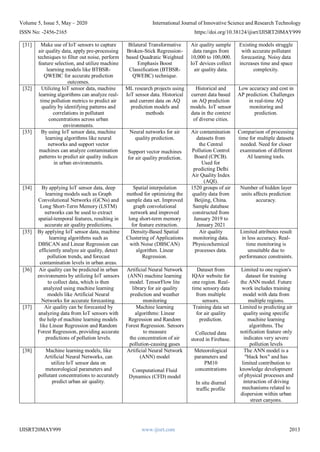
[31] Make use of IoT sensors to capture
air quality data, apply pre-processing
techniques to filter out noise, perform
feature selection, and utilize machine
learning models like BTBSR-
QWEBC for accurate prediction
outcomes.
Bilateral Transformative
Broken-Stick Regression-
based Quadratic Weighted
Emphasis Boost
Classification (BTBSR-
QWEBC) technique.
Air quality sample
data ranges from
10,000 to 100,000.
IoT devices collect
air quality data.
Existing models struggle
with accurate pollutant
forecasting. Noisy data
increases time and space
complexity.
[32] Utilizing IoT sensor data, machine
learning algorithms can analyze real-
time pollution metrics to predict air
quality by identifying patterns and
correlations in pollutant
concentrations across urban
environments.
ML research projects using
IoT sensor data. Historical
and current data on AQ
prediction models and
methods
Historical and
current data based
on AQ prediction
models. IoT sensor
data in the context
of diverse cities.
Low accuracy and cost in
AP prediction. Challenges
in real-time AQ
monitoring and
prediction.
[33] By using IoT sensor data, machine
learning algorithms like neural
networks and support vector
machines can analyze contamination
patterns to predict air quality indices
in urban environments.
Neural networks for air
quality prediction.
Support vector machines
for air quality prediction.
Air contamination
datasets from
the Central
Pollution Control
Board (CPCB).
Used for
predicting Delhi
Air Quality Index
(AQI).
Comparison of processing
time for multiple datasets
needed. Need for closer
examination of different
AI learning tools.
[34] By applying IoT sensor data, deep
learning models such as Graph
Convolutional Networks (GCNs) and
Long Short-Term Memory (LSTM)
networks can be used to extract
spatial-temporal features, resulting in
accurate air quality predictions.
Spatial interpolation
method for optimizing the
sample data set. Improved
graph convolutional
network and improved
long short-term memory
for feature extraction.
1520 groups of air
quality data from
Beijing, China.
Sample database
constructed from
January 2019 to
January 2021
Number of hidden layer
units affects prediction
accuracy.
[35] By applying IoT sensor data, machine
learning algorithms such as
DBSCAN and Linear Regression can
efficiently analyze air quality, detect
pollution trends, and forecast
contamination levels in urban areas.
Density-Based Spatial
Clustering of Applications
with Noise (DBSCAN)
algorithm. Linear
Regression.
Air quality
monitoring data.
Physicochemical
processes data.
Limited attributes result
in less accuracy. Real-
time monitoring is
unsuitable due to
performance constraints.
[36] Air quality can be predicted in urban
environments by utilizing IoT sensors
to collect data, which is then
analyzed using machine learning
models like Artificial Neural
Networks for accurate forecasting.
Artificial Neural Network
(ANN) machine learning
model. TensorFlow lite
library for air quality
prediction and weather
monitoring
Dataset from
IQAir website for
one region. Real-
time sensory data
from multiple
sensors.
Limited to one region's
dataset for training
the ANN model. Future
work includes training
model with data from
multiple regions.
[37] Air quality can be forecasted by
analyzing data from IoT sensors with
the help of machine learning models
like Linear Regression and Random
Forest Regression, providing accurate
predictions of pollution levels.
Machine learning
algorithms: Linear
Regression and Random
Forest Regression. Sensors
to measure
the concentration of air
pollution-causing gases
Training data set
for air quality
prediction.
Collected data
stored in Firebase.
Limited to predicting air
quality using specific
machine learning
algorithms. The
notification feature only
indicates very severe
pollution levels
[38] Machine learning models, like
Artificial Neural Networks, can
utilize IoT sensor data on
meteorological parameters and
pollutant concentrations to accurately
predict urban air quality.
Artificial Neural Network
(ANN) model
Computational Fluid
Dynamics (CFD) model
Meteorological
parameters and
PM10
concentrations
In situ diurnal
traffic profile
The ANN model is a
"black box" and has
limited contribution to
knowledge development
of physical processes and
interaction of driving
mechanisms related to
dispersion within urban
street canyons.
Volume 5, Issue 5, May – 2020 International Journal of Innovative Science and Research Technology
ISSN No: -2456-2165 https://doi.org/10.38124/ijisrt/IJISRT20MAY999
IJISRT20MAY999 www.ijisrt.com 2014
[39] Air quality in urban environments
can be predicted using IoT sensor
data by applying machine learning
algorithms like Random Forest,
which analyzes pollutant levels and
meteorological data for accurate
forecasting.
Machine learning
techniques for pollution
forecasting.
Comparative study to
determine the best model
Pollutant data: CO,
SO2, O3 for 74
Chinese cities.
Meteorological
data: Temp, Wind,
and Humidity for
74 cities.
Linear Regression over-
simplifies real-world
issues.
Decision Trees are
complex and do not
generalize well.
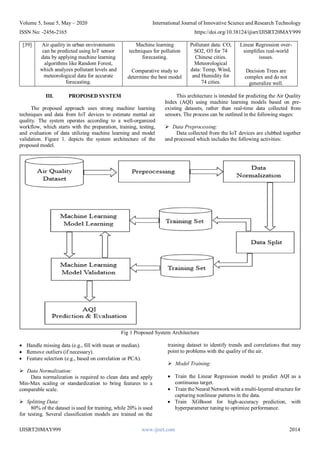
III. PROPOSED SYSTEM
The proposed approach uses strong machine learning
techniques and data from IoT devices to estimate mental air
quality. The system operates according to a well-organized
workflow, which starts with the preparation, training, testing,
and evaluation of data utilizing machine learning and model
validation. Figure 1. depicts the system architecture of the
proposed model.
This architecture is intended for predicting the Air Quality
Index (AQI) using machine learning models based on pre-
existing datasets, rather than real-time data collected from
sensors. The process can be outlined in the following stages:
 Data Preprocessing:
Data collected from the IoT devices are clubbed together
and processed which includes the following activities:
Fig 1 Proposed System Architecture
 Handle missing data (e.g., fill with mean or median).
 Remove outliers (if necessary).
 Feature selection (e.g., based on correlation or PCA).
 Data Normalization:
Data normalization is required to clean data and apply
Min-Max scaling or standardization to bring features to a
comparable scale.
 Splitting Data:
80% of the dataset is used for training, while 20% is used
for testing. Several classification models are trained on the
training dataset to identify trends and correlations that may
point to problems with the quality of the air.
 Model Training:
 Train the Linear Regression model to predict AQI as a
continuous target.
 Train the Neural Network with a multi-layered structure for
capturing nonlinear patterns in the data.
 Train XGBoost for high-accuracy prediction, with
hyperparameter tuning to optimize performance.
Volume 5, Issue 5, May – 2020 International Journal of Innovative Science and Research Technology
ISSN No: -2456-2165 https://doi.org/10.38124/ijisrt/IJISRT20MAY999
IJISRT20MAY999 www.ijisrt.com 2015
 Model Validation:
 Validate each model using the testing set.
 Calculate performance metrics: MAE, RMSE, R-squared.
 AQI Prediction:
 Use the trained models to predict AQI for new data points.
 Evaluate the results and compare model performances.
This system architecture provides a streamlined and
efficient approach to predicting air quality using machine
learning models on pre-existing datasets.
IV. EXPECTED RESULTS
The proposed system for predicting air quality in urban
environments using pre-existing IoT sensor data aims to
achieve high accuracy in Air Quality Index (AQI) predictions.
By employing machine learning models such as Linear
Regression (LR), Neural Networks (NN), and XGBoost, we
expect to obtain reliable predictions. The integration of these
models will facilitate a comprehensive analysis, with neural
networks effectively capturing complex non-linear
relationships among pollutants, while XGBoost excels in
handling large datasets and enhancing prediction accuracy. We
anticipate that XGBoost will demonstrate superior
performance compared to the other models, particularly due to
its robust mechanisms for managing overfitting and effectively
processing intricate data patterns. Although Linear Regression
offers a straightforward approach, its performance is expected
to be reasonable, especially for datasets exhibiting strong linear
correlations between pollutant levels and AQI.
In terms of model evaluation metrics, we aim to achieve
low Mean Absolute Error (MAE) and Root Mean Square Error
(RMSE), along with a high R-squared value, ideally exceeding
0.85. This will indicate the models' effectiveness in explaining
the variance in AQI data. Additionally, we expect the models
to generalize well when applied to unseen datasets,
demonstrating reliable performance with minimal overfitting.
The computational efficiency of each model will also be
analyzed; while XGBoost is anticipated to provide high
accuracy, Linear Regression may be favored for its simplicity
and lower computational demands. Neural Networks, while
potentially requiring more resources, will be evaluated for their
capability to identify complex patterns within the data. This
analysis will offer valuable insights into the trade-offs between
accuracy, complexity, and efficiency across the different
modeling approaches.
V. CONCLUSION & FUTURE SCOPE
This research outlines a systematic approach for
predicting the Air Quality Index using machine learning
techniques and pre-existing datasets. By employing multiple
algorithms, including Linear Regression, Neural Networks, and
XGBoost, the proposed framework demonstrates the capability
to provide accurate AQI forecasts. While the implementation is
still pending, the expected results suggest that these models
could effectively generalize to unseen data, contributing
valuable insights for air quality management. The findings
highlight the importance of utilizing existing datasets to
enhance environmental health, ultimately aiding in the
development of actionable policies for improving air quality.
Future research can build upon this work by integrating
more diverse datasets that include additional environmental
factors and pollutant indicators, thereby improving the
accuracy of AQI predictions. Additionally, exploring advanced
machine learning techniques, such as ensemble learning and
deep learning approaches, could provide deeper insights into
the complex relationships among air quality variables.
Furthermore, once the system is implemented, real-time data
collection from IoT sensors could facilitate dynamic AQI
monitoring and prediction, allowing for timely responses to air
quality fluctuations. Ultimately, the integration of these
methodologies will significantly contribute to advancing air
quality management and promoting public health initiatives.
REFERENCES
[1]. World Health Organization. "Health aspects of air
pollution: results from the WHO project" Systematic
review of health aspects of air pollution in Europe"."
(2004).
[2]. Rybarczyk, Yves, and Rasa Zalakeviciute. "Machine
learning approaches for outdoor air quality modelling:
A systematic review." Applied Sciences 8.12 (2018):
2570.
[3]. Van Bavel, Jan. "The world population explosion:
causes, backgrounds and projections for the future."
Facts, views & vision in ObGyn 5.4 (2013): 281.
[4]. Chang, Daniel Lage, et al. "Knowledge-based, smart
and sustainable cities: A provocation for a conceptual
framework." Journal of Open Innovation: Technology,
Market, and Complexity 4.1 (2018): 1-17.
[5]. Bokwa, A. Environmental impacts of long-term air
pollution changes in Krakow, Poland. Pol. J. Environ.
Stud. 2008, 17, 673–686.
[6]. Podstawczyńska, A., & Chambers, S. D. (2019).
Improved method for characterising temporal
variability in urban air quality part I: Traffic emissions
in central Poland. Atmospheric Environment, 219,
117038.
[7]. Rajagopalan, Sanjay, Sadeer G. Al-Kindi, and Robert
D. Brook. "Air pollution and cardiovascular disease:
JACC state-of-the-art review." Journal of the American
College of Cardiology 72.17 (2018): 2054-2070.
[8]. Li, Rui, et al. "Air pollution characteristics in China
during 2015–2016: Spatiotemporal variations and key
meteorological factors." Science of the total
environment 648 (2019): 902-915.
[9]. Pasierb, Bernadetta, Michał Grodecki, and Rafał
Gwóźdź. "Geophysical and geotechnical approach to a
landslide stability assessment: a case study." Acta
Geophysica 67.6 (2019): 1823-1834.
[10]. Kapera, I. (2018). Sustainable tourism development
efforts by local governments in Poland. Sustainable
cities and society, 40, 581-588.
Volume 5, Issue 5, May – 2020 International Journal of Innovative Science and Research Technology
ISSN No: -2456-2165 https://doi.org/10.38124/ijisrt/IJISRT20MAY999
IJISRT20MAY999 www.ijisrt.com 2016
[11]. Lidia Morawska, Phong K. Thai et al., Applications of
low-cost sensing technologies for air quality
monitoring and exposure assessment: How far have
they gone?,Environment International,Volume 116,
2018, Pages 286-299, ISSN 0160-4120,
https://doi.org/10.1016/j.envint.2018.04.018.
[12]. Islam, Md Shaedul. "An intelligent system on
environment quality remote monitoring and cloud data
logging using Internet of Things (IoT)." 2018
International Conference on Computer,
Communication, Chemical, Material and Electronic
Engineering (IC4ME2). IEEE, 2018.
[13]. Kodali, Ravi Kishore, and Sasweth C. Rajanarayanan.
"IoT based indoor air quality monitoring system." 2019
International Conference on Wireless Communications
Signal Processing and Networking (WiSPNET). IEEE,
2019.
[14]. Zheng, Yu, Furui Liu, and Hsun-Ping Hsieh. "U-air:
When urban air quality inference meets big data."
Proceedings of the 19th ACM SIGKDD international
conference on Knowledge discovery and data mining.
2013.
[15]. Rui Feng, Hui-jun Zheng et al.,” Recurrent Neural
Network and random forest for analysis and accurate
forecast of atmospheric pollutants: A case study in
Hangzhou, China, Journal of Cleaner Production,
Volume 231, 2019, Pages 1005-1015, ISSN 0959-
6526, https://doi.org/10.1016/j.jclepro.2019.05.319.
[16]. Li, Xiang, et al. "Deep learning architecture for air
quality predictions." Environmental Science and
Pollution Research 23 (2016): 22408-22417.
[17]. Wang, Xiufeng, et al. "Eldp: Extended link duration
prediction model for vehicular networks." International
Journal of Distributed Sensor Networks 12.4 (2016):
5767569.
[18]. Na, Woongsoo, et al. "Frequency resource allocation
and interference management in mobile edge
computing for an Internet of Things system." IEEE
Internet of Things Journal 6.3 (2018): 4910-4920.
[19]. Wang, Shangguang, et al. "Multi-dimensional QoS
prediction for service recommendations." IEEE
Transactions on Services Computing 12.1 (2016): 47-
57..
[20]. Ghezzi, Carlo, et al. "Mining behavior models from
user-intensive web applications." Proceedings of the
36th international conference on software engineering.
2014.
[21]. Yang X., Zhou S., and Cao M., An approach to
alleviate the sparsity problem of hybrid collaborative
filtering-based recommendations: the product-attribute
perspective from user reviews, Mobile Networks and
Applications. (2019) 25, 1–15.
[22]. Genc D. D., Yesilyurt C., and Tuncel G., Air pollution
forecasting in Ankara, Turkey using air pollution index
and its relation to assimilative capacity of the
atmosphere, Environmental Monitoring and
Assessment. (2010) 166, no. 1–4, 11–27,
https://doi.org/10.1007/s10661-009-0981-y, 2-s2.0-
77954144269.
[23]. Moisan S., Herrera R., and Clements A., A dynamic
multiple equation approach for forecasting PM2.5
pollution in Santiago, Chile, International Journal of
Forecasting. (2018) 34, no. 4, 566–581,
https://doi.org/10.1016/j.ijforecast.2018.03.007, 2-
s2.0-85048258541.
[24]. Ge L., Zhou A., Li H. et al., Spatially fine-grained air
quality prediction based on DBU-LSTM, Proceedings
of the 16th ACM International Conference on
Computing Frontiers, 2019, Ischia, Italy, 202–205.
[25]. Qi Y., Li Q., Karimian H., and Liu D., A hybrid model
for spatiotemporal forecasting of PM2.5 based on
graph convolutional neural network and long short-
term memory, Science of the Total Environment.
(2019) 664, 1–10,
https://doi.org/10.1016/j.scitotenv.2019.01.333, 2-
s2.0-85061200096.
[26]. Kumar, Anikender, and P. Goyal. "Forecasting of daily
air quality index in Delhi." Science of the Total
Environment 409.24 (2011): 5517-5523.
[27]. Wei, Wenjuan, et al. "Machine learning and statistical
models for predicting indoor air quality." Indoor Air
29.5 (2019): 704-726.
[28]. Soundari A. Gnana, Jeslin J. Gnana, Akshaya
A.C.,”Indian air quality prediction and analysis using
machine learning”, Int J Appl Eng Res, 14 (11) (2019),
pp. 181-186
[29]. Li, Xiang, et al. "Deep learning architecture for air
quality predictions." Environmental Science and
Pollution Research 23 (2016): 22408-22417.
[30]. Zhang, Chuang, et al. "Weather visibility prediction
based on multimodal fusion." IEEE Access 7 (2019):
74776-74786.
[31]. Huang, Chiou-Jye, and Ping-Huan Kuo. "A deep CNN-
LSTM model for particulate matter (PM2. 5)
forecasting in smart cities." Sensors 18.7 (2018): 2220.
[32]. Perera, Charith, et al. "A survey on internet of things
from industrial market perspective." IEEE Access 2
(2014): 1660-1679.
[33]. Kang, Gaganjot Kaur, et al. "Air quality prediction: Big
data and machine learning approaches." Int. J. Environ.
Sci. Dev 9.1 (2018): 8-16
[34]. Du, Shengdong, et al. "Deep air quality forecasting
using hybrid deep learning framework." IEEE
Transactions on Knowledge and Data Engineering 33.6
(2019): 2412-2424.
[35]. Wei, Wenjuan, et al. "Machine learning and statistical
models for predicting indoor air quality." Indoor Air
29.5 (2019): 704-726.
[36]. Shaban, Khaled Bashir, Abdullah Kadri, and Eman
Rezk. "Urban air pollution monitoring system with
forecasting models." IEEE Sensors Journal 16.8
(2016): 2598-2606.
[37]. Kennedy Okokpujie, Etinosa Noma-Osaghae et al., “A
SMART AIR POLLUTION MONITORING
SYSTEM”, International Journal of Civil Engineering
and Technology (IJCIET) Volume 9, Issue 9,
September 2018, pp. 799–809, Article ID:
IJCIET_09_09_077
Volume 5, Issue 5, May – 2020 International Journal of Innovative Science and Research Technology
ISSN No: -2456-2165 https://doi.org/10.38124/ijisrt/IJISRT20MAY999
IJISRT20MAY999 www.ijisrt.com 2017
[38]. Zhao, Junhan, et al. "Deep CNN-based methods to
evaluate neighborhood-scale urban valuation through
street scenes perception." 2018 ieee third international
conference on data science in cyberspace (dsc). IEEE,
2018
[39]. S. Ameer et al., "Comparative Analysis of Machine
Learning Techniques for Predicting Air Quality in
Smart Cities," in IEEE Access, vol. 7, pp. 128325-
128338, 2019, doi: 10.1109/ACCESS.2019.2925082.