"Machine Learning-Driven Model for Pollution
Forecasting and Ecosystem Surveillance"
Presented
By
Praveen Kumar B
Registration ID- 062023CFR012983
Visvesvaraya Technological University
The World Health Organization (WHO) estimates that air, water, and soil pollution contribute to millions of premature
deaths annually, while habitat destruction and biodiversity loss threaten the stability of ecosystems worldwide. Addressing
these issues requires robust tools for predicting pollution and monitoring ecological changes.
Recent advancements in machine learning have opened new avenues for addressing these limitations. ML algorithms excel
at identifying patterns in complex datasets, enabling accurate predictions and facilitating proactive decision-making.
This research proposal aims to develop a machine learning-driven model for pollution forecasting and ecosystem
surveillance. The proposed framework will focus on integrating multi-source environmental data to predict pollution
trends, evaluate ecosystem resilience, and support sustainable management practices. By advancing the application of ML
in this critical domain, this study seeks to contribute to more effective environmental stewardship and informed
policymaking.
Introduction
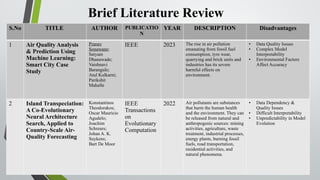
Brief Literature Review
S.No TITLE AUTHOR PUBLICATIO
N
YEAR DESCRIPTION Disadvantages
1 Air Quality Analysis
& Prediction Using
Machine Learning:
Smart City Case
Study
Pranav
Sonawane;
Satyam
Dhanawade;
Vaishnavi
Barangule;
Atul Kulkarni;
Parikshit
Mahalle
IEEE 2023 The rise in air pollution
emanating from fossil fuel
consumption, tyre wear,
quarrying and brick units and
industries has its severe
harmful effects on
environment.
• Data Quality Issues
• Complex Model
Interpretability
• Environmental Factors
Affect Accuracy
2 Island Transpeciation:
A Co-Evolutionary
Neural Architecture
Search, Applied to
Country-Scale Air-
Quality Forecasting
Konstantinos
Theodorakos;
Oscar Mauricio
Agudelo;
Joachim
Schreurs;
Johan A. K.
Suykens;
Bart De Moor
IEEE
Transactions
on
Evolutionary
Computation
2022 Air pollutants are substances
that harm the human health
and the environment. They can
be released from natural and
anthropogenic sources: mining
activities, agriculture, waste
treatment, industrial processes,
energy plants, burning fossil
fuels, road transportation,
residential activities, and
natural phenomena.
• Data Dependency &
Quality Issues
• Difficult Interpretability
• Unpredictability in Model
Evolution
Objectives
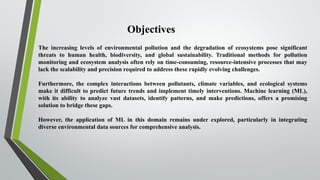
The increasing levels of environmental pollution and the degradation of ecosystems pose significant
threats to human health, biodiversity, and global sustainability. Traditional methods for pollution
monitoring and ecosystem analysis often rely on time-consuming, resource-intensive processes that may
lack the scalability and precision required to address these rapidly evolving challenges.
Furthermore, the complex interactions between pollutants, climate variables, and ecological systems
make it difficult to predict future trends and implement timely interventions. Machine learning (ML),
with its ability to analyze vast datasets, identify patterns, and make predictions, offers a promising
solution to bridge these gaps.
However, the application of ML in this domain remains under explored, particularly in integrating
diverse environmental data sources for comprehensive analysis.
Proposed System Methodology
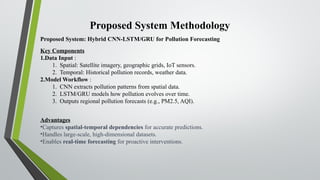
Proposed System: Hybrid CNN-LSTM/GRU for Pollution Forecasting
Key Components
1.Data Input :
1. Spatial: Satellite imagery, geographic grids, IoT sensors.
2. Temporal: Historical pollution records, weather data.
2.Model Workflow :
1. CNN extracts pollution patterns from spatial data.
2. LSTM/GRU models how pollution evolves over time.
3. Outputs regional pollution forecasts (e.g., PM2.5, AQI).
Advantages
•Captures spatial-temporal dependencies for accurate predictions.
•Handles large-scale, high-dimensional datasets.
•Enables real-time forecasting for proactive interventions.
Reference
[1] M. D. Adams and P. S. Kanaroglou, "Mapping real-time air pollution health risk for environmental management: Combining mobile and stationary air
pollution monitoring with neural network models", J. Environ. Manage., vol. 168, pp. 133-141, Mar. 2016.
CrossRef Google Scholar
[2] S. De Vito et al., "On field calibration of an electronic nose for benzene estimation in an urban pollution monitoring scenario", Sensors Actuators B
Chem., vol. 129, no. 2, pp. 750-757, Feb. 2008.
CrossRef Google Scholar
[3] Road Transport YearBook, [online] Available: https://morth.nic.in/print/road-transport-year-books.
Google Scholar
[4] National Air Quality Index, [online] Available: https://app.cpcbccr.com/AQI_India/.
Google Scholar
[5] De Vito, G. Fattoruso, M. Pardo, F. Tortorella and G. Di Francia, "Semi-Supervised Learning Techniques in Artificial Olfaction: A Novel Approach to
Classification Problems and Drift Counteraction", IEEE Sensors Journal, vol. 12, no. 11, pp. 3215-3224, Nov. 2012.
[6] S. Upgupta and P. K. Singh, "Impacts of coal mining: a review of methods and parameters used in India", Current World Environment, vol. 12, no. 1,
pp. 142, 2017.
CrossRef Google Scholar
Thank You….