ENVIRONMENTAL ETHICS
Role Of Religion And Culture
By Benito
CONTENTS
• Introduction
• Environment and Christianity
• Environment and Islam
• Environment and Hinduism
• Environment and Jainism
• Environment and culture
• Conclusion
INTRODUCTION
INTRODUCTION
All religions and cultures have something to offer to
conservation and environmental protection
From each religion several injunctions can be
brought forth to code for environmental sustainable
development
This is simply and extensively demonstrated in the
code of various religions
ENVIRONMENT
AND
CHRISTIANITY
ENVIRONMENT AND CHRISTIANITY
Christianity say that harmonic relationship exist between the divine
and humanity, among human being and nature, and failure to
maintain the harmony may alienate humanity from its creator and
from nature
As the Lord said ‘ I am the alpha and omega , the first and the last ,
the beginning and the end’ consequently every part of creation has
his divine hand in it and no has absolute right to destroy it
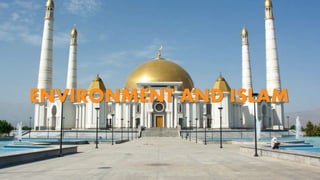
ENVIRONMENT AND ISLAM
In Islam the holy Quran and divinely inspired words of prophet
Mohamed from the foundation of and roles for the conservation of
nature
The Quran message is unity , harmony, balance and order. It
stresses that nature law must be observed and that defined limit
should not be exceeded
The holy Quran declares that everything is created from water
.Allah is considered to be the owner of land and mankind is
guardian whereas other living creatures are considered to be the
beneficiaries
ENVIRONMENT AND
HINDUISM
ENVIRONMENTAL AND HINDUISM
The life on this planet and elsewhere is clearly ingrained in the
Hinduism. The supreme power God has absolute sovereignty over
all creatures including human
According to Hindu scriptures all lives have the same right to
existence. Human have no dominion over other creatures
Human being are forbidden to exploit nature, instead they are
advised to seek peace and live in harmony with nature
The Hindu religion demands veneration, respect and obedience to
maintain and protect the unity of God and nature
ENVIRONMENT AND JAINISM
Jainism places great emphases on the principle that one should
reprise from avoidance act that are harmful to oneself or others
Non violence is the fundamental unit of Jains way of life
For the Jains environmental harmony though spirituality should be
pursued by all. This can be done by adhering to three precepts
which are the right beliefs, the right knowledge, and the right
conductions
Every one should be benevolent towards all living organisms
compassionate for the weak, tolerant for the insolent and joyful at
the virtuous. This is way of bringing environmental harmony
ENVIRONMENT AND
CULTURE
ENVIRONMENT AND INDIAN CULTURE
The cultural heritage of India show a deep concern for
protection and preservation of the environment
Indian tradition considered the earth as mother. Indians
have articulated the need to sustain and promote the
ecological balance of nature though cultural beliefs
CONCLUSION
There is a great role played by religion and culture in environmental
protection and conservation, so we should protect our environment
for future use.
Environmental ethics

Environmental ethics

  • 1.
    ENVIRONMENTAL ETHICS Role OfReligion And Culture By Benito
  • 2.
    CONTENTS • Introduction • Environmentand Christianity • Environment and Islam • Environment and Hinduism • Environment and Jainism • Environment and culture • Conclusion
  • 3.
  • 4.
    INTRODUCTION All religions andcultures have something to offer to conservation and environmental protection From each religion several injunctions can be brought forth to code for environmental sustainable development This is simply and extensively demonstrated in the code of various religions
  • 5.
  • 6.
    ENVIRONMENT AND CHRISTIANITY Christianitysay that harmonic relationship exist between the divine and humanity, among human being and nature, and failure to maintain the harmony may alienate humanity from its creator and from nature As the Lord said ‘ I am the alpha and omega , the first and the last , the beginning and the end’ consequently every part of creation has his divine hand in it and no has absolute right to destroy it
  • 7.
  • 8.
    ENVIRONMENT AND ISLAM InIslam the holy Quran and divinely inspired words of prophet Mohamed from the foundation of and roles for the conservation of nature The Quran message is unity , harmony, balance and order. It stresses that nature law must be observed and that defined limit should not be exceeded The holy Quran declares that everything is created from water .Allah is considered to be the owner of land and mankind is guardian whereas other living creatures are considered to be the beneficiaries
  • 9.
  • 10.
    ENVIRONMENTAL AND HINDUISM Thelife on this planet and elsewhere is clearly ingrained in the Hinduism. The supreme power God has absolute sovereignty over all creatures including human According to Hindu scriptures all lives have the same right to existence. Human have no dominion over other creatures Human being are forbidden to exploit nature, instead they are advised to seek peace and live in harmony with nature The Hindu religion demands veneration, respect and obedience to maintain and protect the unity of God and nature
  • 11.
  • 12.
    ENVIRONMENT AND JAINISM Jainismplaces great emphases on the principle that one should reprise from avoidance act that are harmful to oneself or others Non violence is the fundamental unit of Jains way of life For the Jains environmental harmony though spirituality should be pursued by all. This can be done by adhering to three precepts which are the right beliefs, the right knowledge, and the right conductions Every one should be benevolent towards all living organisms compassionate for the weak, tolerant for the insolent and joyful at the virtuous. This is way of bringing environmental harmony
  • 13.
  • 14.
    ENVIRONMENT AND INDIANCULTURE The cultural heritage of India show a deep concern for protection and preservation of the environment Indian tradition considered the earth as mother. Indians have articulated the need to sustain and promote the ecological balance of nature though cultural beliefs
  • 15.
    CONCLUSION There is agreat role played by religion and culture in environmental protection and conservation, so we should protect our environment for future use.