ENVIRONMENTAL QUALITY
(INDSTRIAL EFFLUENT)
REGULATIONS 2009
)
REGULATION 1 :
CITATION
 These regulations may be cited as Environmental Quality (Industrial Effluent)
Regulations 2009.
REGULATION 2 :
INTERPRETATION
 Best management practice - methods to prevent or reduce the discharge of
industrial effluent that containing contaminants.
 Industrial effluent - any waste in the form of liquid or wastewater generated
from manufacturing process including the treatment of water for water
supply.
 Mixed effluent - any waste contain both industrial effluent and sewage in the
form of liquid or wastewater.
 Licence - a licence referred to in regulation 15 pursuant to subsection 25(1) of
the Act.
 Sludge - any deposit of particulate matter settled from any liquid, including
deposit resulting from physical, chemical and biological.
 Professional engineer - has the same meaning assigned to it in the
Registration of Engineers Act 1967 [Act 138].
 Sewage - any liquid waste or wastewater discharge containing human, animal,
domestic and includes liquids containing chemicals in solution either in the
raw, treated or partially treated form.
 Parameter - chemical oxygen demand or any of the factors shown in the first
column of the Fifth Schedule or in the Ninth Schedule.
 Authorized officer - any officer appointed under section 3 of the Act or any
other officer to whom the Director General has delegated his power under
section 49 of the Act; “batch discharge” means any controlled discharge of a
discrete volume of industrial effluent or mixed effluent.
 Licensed premises - premises occupied by a person who is the holder of a
licence issued in respect of the premises.
 Industrial effluent treatment system - any facility including the effluent
collection system, designed and constructed for the purpose of reducing the
potential of the industrial effluent to cause pollution.
REGULATION 3 :
APPLICATION
 Apply to any premises which discharge or release industrial effluent onto any
soil or into inland water or Malaysian water, other than premises as specified
in the first schedule.
REGULATION 4 :
OBLIGATION TO NOTIFY THE
DIRECTOR GENERAL
1. Person should notify the director general whenever they want to :
a) Carry out any work on any premises that may result in a new sources of
discharge of industrial effluent
b) Construct on any land, building or facility used that may cause the land or
building to result in a new source of discharge of industrial effluent
c) Any changes to the plant, machine or equipment used or installed at the
premises that cause a material change in the quality or quantity of the
release from an existing sources.
d) Carry out upgrading work of an existing industrial effluent treatment system
that may result in a material change in the quantity or quality of the release.
2. The written notification to carry any work should be referred to in sub-
regulation and shall be submitted to Director General withing thirty days
before the work or construction or upgrading commences.
REGULATION 5 :
DESIGN AND CONSTRUCTION OF
INDUSTRIAL EFFLUENT
TREATMENT SYSTEM
1. An owner shall conduct design and construction of the industrial effluent
treatment system withing the premises in strict compliance with the
specifications as specified in the Guidance Document on the Design and
Operation of Industrial Effluent Treatment System issued by the Department
of Environment.
2. An owner shall appoint a professional engineer to undertake the design and
supervision of construction that meets the satisfaction of Director General.
3. An owner of the premises and the professional engineer shall provide a
written declaration that is specified in the Third Schedule, certifying that the
design and construction of the industrial effluent treatment have meet the
specifications of subregulation 1.
4. As-built drawings that show placement of any works or structure shall be
submitted to the Director General not later than thirty days from the date
premises commence operation.
5. As-built drawings means any engineering drawing that shows the placement
of facilities after a work is completed.
REGULATION 6 :
COMPLIANCES WITH
SPECIFICATIONS OF INDUSTRIAL
EFFLUENT TREATMENT SYSTEM
1. No person shall operate any industrial effluent treatment system unless it
complies with the specifications as specified in subregulation 5(1).
2. Director General may issue a directive to the owner of premises who does
not comply with subregulation (1) requiring him to repair, alter, replace or
install any additional equipment or to conduct performance monitoring of
industrial effluent treatment system at his own expenses.
REGULATION 7 :
MONITORING OF DISCHARGE OF
INDUSTRIAL EFFLUENT
TREATMENT SYSTEM
1. An owner of a premises that discharges industrial effluent or mixed effluent
onto or into any soil, or into any inland waters or Malaysian waters shall, at
his own expense—
o monitor the concentration of chemical oxygen demand (COD) and any parameter as
specified in the Fifth Schedule
o install flow-meters, sampling, monitoring and recording equipment.
2. An owner shall maintain a record of industrial effluent or mixed effluent
discharge monitoring data in the form as specified in the Tenth Schedule.
3. The owner shall submit the first record of industrial effluent or mixed
effluent discharge monitoring data to the Director General within thirty days
after the date of coming into operation of these Regulations and the
subsequent records shall be submitted within thirty days after the end of the
calendar month for the report of the previous month.
4. The record of industrial effluent or mixed effluent discharge shall also be
made available for inspection by any authorized officer.
REGULATION 8 :
PROPER OPERATION OF
INDUSTRIAL EFFLUENT
TREATMENT SYSTEM.
1. An owner shall operate and maintain industrial effluent treatment system in
accordance with sound engineering practice for the treatment of the
industrial effluent or mixed effluent and ensure that all components of the
industrial effluent treatment system are in good working condition.
Sound engineering practice - effluent treatment system is operated where the
operational characteristics are maintained within the normal range of values
commonly used for the treatment of industrial effluent or mixed effluent.
REGULATION 9 :
PERFORMANCE MONITORING
EFFLUENT TREATMENT SYSTEM.
1. An owner shall conduct performance monitoring of the components of the
effluent treatment system in the manner as specified in the Guidance
Document on Performance Monitoring of Industrial Effluent Treatment
Systems issued by Department of Environment.
2. An owner shall equip himself or itself with facilities, relevant equipment or
instruments for the purpose of conducting performance monitoring.
REGULATION 10:
COMPETENT PERSON
1. The operation of an industrial effluent treatment system shall be supervised
by a competent person.
2. A competent person shall be any person who has been certified by the
Director General that he is duly qualified to supervise the operation of an
industrial effluent treatment system is in operation.
3. An owner or occupier of a premise shall ensure that a competent person is on
futy at any time the industrial effluent treatment is in operation.
REGULATION 11:
ACCEPTABLE CONDITIONS FOR
THE DISCHARGE OF INDUSTRIAL
EFFLUENT OTHER THAN
PARAMETER OF CHEMICAL
OXYGEN DEMAND (COD)
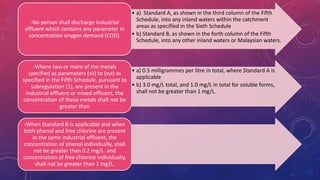
• a) Standard A, as shown in the third column of the Fifth
Schedule, into any inland waters within the catchment
areas as specified in the Sixth Schedule
• b) Standard B, as shown in the forth column of the Fifth
Schedule, into any other inland waters or Malaysian waters.
-No person shall discharge industrial
effluent which contains any parameter in
concentration onygen demand (COD).
• a) 0.5 milligrammes per litre in total, where Standard A is
applicable
• b) 3.0 mg/L total, and 1.0 mg/L in total for soluble forms,
shall not be greater than 1 mg/L.
-Where two or more of the metals
specified as parameters (xii) to (xvi) as
specified in the Fifth Schedule, pursuant to
subregulation (1), are present in the
industrial effluent or mixed effluent, the
concentration of these metals shall not be
greater than
-When Standard B is applicable and when
both phenol and free chlorine are present
in the same industrial effluent, the
concentration of phenol individually, shall
not be greater than 0.2 mg/L. and
concentration of free chlorine individually,
shall not be greater than 1 mg/L.
REGULATIONS 12:
ACCEPTABLE CONDITIONS
FOE THE DISCHARGE OF
INDUSTRIAL EFFLUENT FOR
PARAMETER OF CHEMICAL
OXYGEN DEMAND (COD)
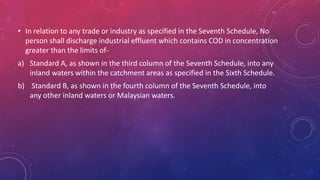
• In relation to any trade or industry as specified in the Seventh Schedule, No
person shall discharge industrial effluent which contains COD in concentration
greater than the limits of-
a) Standard A, as shown in the third column of the Seventh Schedule, into any
inland waters within the catchment areas as specified in the Sixth Schedule.
b) Standard B, as shown in the fourth column of the Seventh Schedule, into
any other inland waters or Malaysian waters.
REGULATION 27 :
MAINTENANCE OF RECORD
 Premises are required to maintain records of manufacturing processes,
operation, maintenance and performance monitoring of the IETS.
 In order to maintain records of manufacturing processes, the flow chart of
manufacturing process which show clearly the points of effluent stream
generation must be updated.
 DOE requires premises to keep the relevant record for a minimum of three
years.
*DOE = Department of Environment
The Regulation 27
(1)
• An owner or occupier of a premises equipped with the industrial effluent
treatment system shall maintain records of the manufacturing processes,
operation, maintenance and performance monitoring of the industrial effluent
treatment system.
(2)
• The records under subregulation (1) shall be made available for
inspection by the authorized officer.
REGULATION 28 :
PERSONNEL TRAINING
 A premise is required to send relevant staff for training and retraining in IETS
operations and on other DOE’s requirements.
 All industry personnel who are involved in the operation of IETS must have
the required knowledge and skills to enable them to perform their duties
satisfactory.
 Record of staff training must be maintained for inspection, especially if
training is provided by training provider (in future).
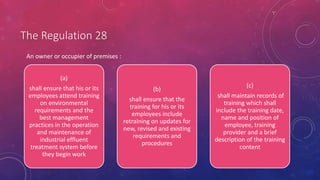
The Regulation 28
(a)
shall ensure that his or its
employees attend training
on environmental
requirements and the
best management
practices in the operation
and maintenance of
industrial effluent
treatment system before
they begin work
(b)
shall ensure that the
training for his or its
employees include
retraining on updates for
new, revised and existing
requirements and
procedures
(c)
shall maintain records of
training which shall
include the training date,
name and position of
employee, training
provider and a brief
description of the training
content
An owner or occupier of premises :
REGULATION 32 :
PENALTY
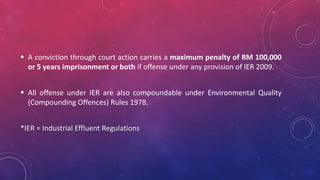
 A conviction through court action carries a maximum penalty of RM 100,000
or 5 years imprisonment or both if offense under any provision of IER 2009.
 All offense under IER are also compoundable under Environmental Quality
(Compounding Offences) Rules 1978.
*IER = Industrial Effluent Regulations
The Regulation 32
Any person who contravenes regulations 4, 5, 6, 7, 8, 9, 10, 11, 12, 13, 14, 16,
17, 18, 19, 20, 21, 22, 23, 24, 27, 28, 29 and 30 shall be guilty of an offence
and shall, on conviction, be liable to a fine not exceeding one hundred
thousand ringgit or to a term of imprisonment for a period not exceeding five
years or to both and to a further fine not exceeding one thousand ringgit a day
for every day that the offence is continued after the notice by the Director
General requiring him to cease the act as specified in the notice has been
served upon him.
THANK YOU!
SOMEONE@EXAMPLE.COM

Environmental regulations 2009

  • 1.
  • 2.
  • 3.
     These regulationsmay be cited as Environmental Quality (Industrial Effluent) Regulations 2009.
  • 4.
  • 5.
     Best managementpractice - methods to prevent or reduce the discharge of industrial effluent that containing contaminants.  Industrial effluent - any waste in the form of liquid or wastewater generated from manufacturing process including the treatment of water for water supply.  Mixed effluent - any waste contain both industrial effluent and sewage in the form of liquid or wastewater.  Licence - a licence referred to in regulation 15 pursuant to subsection 25(1) of the Act.
  • 6.
     Sludge -any deposit of particulate matter settled from any liquid, including deposit resulting from physical, chemical and biological.  Professional engineer - has the same meaning assigned to it in the Registration of Engineers Act 1967 [Act 138].  Sewage - any liquid waste or wastewater discharge containing human, animal, domestic and includes liquids containing chemicals in solution either in the raw, treated or partially treated form.  Parameter - chemical oxygen demand or any of the factors shown in the first column of the Fifth Schedule or in the Ninth Schedule.
  • 7.
     Authorized officer- any officer appointed under section 3 of the Act or any other officer to whom the Director General has delegated his power under section 49 of the Act; “batch discharge” means any controlled discharge of a discrete volume of industrial effluent or mixed effluent.  Licensed premises - premises occupied by a person who is the holder of a licence issued in respect of the premises.  Industrial effluent treatment system - any facility including the effluent collection system, designed and constructed for the purpose of reducing the potential of the industrial effluent to cause pollution.
  • 8.
  • 9.
     Apply toany premises which discharge or release industrial effluent onto any soil or into inland water or Malaysian water, other than premises as specified in the first schedule.
  • 10.
    REGULATION 4 : OBLIGATIONTO NOTIFY THE DIRECTOR GENERAL
  • 11.
    1. Person shouldnotify the director general whenever they want to : a) Carry out any work on any premises that may result in a new sources of discharge of industrial effluent b) Construct on any land, building or facility used that may cause the land or building to result in a new source of discharge of industrial effluent c) Any changes to the plant, machine or equipment used or installed at the premises that cause a material change in the quality or quantity of the release from an existing sources. d) Carry out upgrading work of an existing industrial effluent treatment system that may result in a material change in the quantity or quality of the release. 2. The written notification to carry any work should be referred to in sub- regulation and shall be submitted to Director General withing thirty days before the work or construction or upgrading commences.
  • 12.
    REGULATION 5 : DESIGNAND CONSTRUCTION OF INDUSTRIAL EFFLUENT TREATMENT SYSTEM
  • 13.
    1. An ownershall conduct design and construction of the industrial effluent treatment system withing the premises in strict compliance with the specifications as specified in the Guidance Document on the Design and Operation of Industrial Effluent Treatment System issued by the Department of Environment. 2. An owner shall appoint a professional engineer to undertake the design and supervision of construction that meets the satisfaction of Director General. 3. An owner of the premises and the professional engineer shall provide a written declaration that is specified in the Third Schedule, certifying that the design and construction of the industrial effluent treatment have meet the specifications of subregulation 1. 4. As-built drawings that show placement of any works or structure shall be submitted to the Director General not later than thirty days from the date premises commence operation. 5. As-built drawings means any engineering drawing that shows the placement of facilities after a work is completed.
  • 14.
    REGULATION 6 : COMPLIANCESWITH SPECIFICATIONS OF INDUSTRIAL EFFLUENT TREATMENT SYSTEM
  • 15.
    1. No personshall operate any industrial effluent treatment system unless it complies with the specifications as specified in subregulation 5(1). 2. Director General may issue a directive to the owner of premises who does not comply with subregulation (1) requiring him to repair, alter, replace or install any additional equipment or to conduct performance monitoring of industrial effluent treatment system at his own expenses.
  • 16.
    REGULATION 7 : MONITORINGOF DISCHARGE OF INDUSTRIAL EFFLUENT TREATMENT SYSTEM
  • 17.
    1. An ownerof a premises that discharges industrial effluent or mixed effluent onto or into any soil, or into any inland waters or Malaysian waters shall, at his own expense— o monitor the concentration of chemical oxygen demand (COD) and any parameter as specified in the Fifth Schedule o install flow-meters, sampling, monitoring and recording equipment. 2. An owner shall maintain a record of industrial effluent or mixed effluent discharge monitoring data in the form as specified in the Tenth Schedule. 3. The owner shall submit the first record of industrial effluent or mixed effluent discharge monitoring data to the Director General within thirty days after the date of coming into operation of these Regulations and the subsequent records shall be submitted within thirty days after the end of the calendar month for the report of the previous month. 4. The record of industrial effluent or mixed effluent discharge shall also be made available for inspection by any authorized officer.
  • 18.
    REGULATION 8 : PROPEROPERATION OF INDUSTRIAL EFFLUENT TREATMENT SYSTEM.
  • 19.
    1. An ownershall operate and maintain industrial effluent treatment system in accordance with sound engineering practice for the treatment of the industrial effluent or mixed effluent and ensure that all components of the industrial effluent treatment system are in good working condition. Sound engineering practice - effluent treatment system is operated where the operational characteristics are maintained within the normal range of values commonly used for the treatment of industrial effluent or mixed effluent.
  • 20.
    REGULATION 9 : PERFORMANCEMONITORING EFFLUENT TREATMENT SYSTEM.
  • 21.
    1. An ownershall conduct performance monitoring of the components of the effluent treatment system in the manner as specified in the Guidance Document on Performance Monitoring of Industrial Effluent Treatment Systems issued by Department of Environment. 2. An owner shall equip himself or itself with facilities, relevant equipment or instruments for the purpose of conducting performance monitoring.
  • 22.
  • 23.
    1. The operationof an industrial effluent treatment system shall be supervised by a competent person. 2. A competent person shall be any person who has been certified by the Director General that he is duly qualified to supervise the operation of an industrial effluent treatment system is in operation. 3. An owner or occupier of a premise shall ensure that a competent person is on futy at any time the industrial effluent treatment is in operation.
  • 24.
    REGULATION 11: ACCEPTABLE CONDITIONSFOR THE DISCHARGE OF INDUSTRIAL EFFLUENT OTHER THAN PARAMETER OF CHEMICAL OXYGEN DEMAND (COD)
  • 25.
    • a) StandardA, as shown in the third column of the Fifth Schedule, into any inland waters within the catchment areas as specified in the Sixth Schedule • b) Standard B, as shown in the forth column of the Fifth Schedule, into any other inland waters or Malaysian waters. -No person shall discharge industrial effluent which contains any parameter in concentration onygen demand (COD). • a) 0.5 milligrammes per litre in total, where Standard A is applicable • b) 3.0 mg/L total, and 1.0 mg/L in total for soluble forms, shall not be greater than 1 mg/L. -Where two or more of the metals specified as parameters (xii) to (xvi) as specified in the Fifth Schedule, pursuant to subregulation (1), are present in the industrial effluent or mixed effluent, the concentration of these metals shall not be greater than -When Standard B is applicable and when both phenol and free chlorine are present in the same industrial effluent, the concentration of phenol individually, shall not be greater than 0.2 mg/L. and concentration of free chlorine individually, shall not be greater than 1 mg/L.
  • 26.
    REGULATIONS 12: ACCEPTABLE CONDITIONS FOETHE DISCHARGE OF INDUSTRIAL EFFLUENT FOR PARAMETER OF CHEMICAL OXYGEN DEMAND (COD)
  • 27.
    • In relationto any trade or industry as specified in the Seventh Schedule, No person shall discharge industrial effluent which contains COD in concentration greater than the limits of- a) Standard A, as shown in the third column of the Seventh Schedule, into any inland waters within the catchment areas as specified in the Sixth Schedule. b) Standard B, as shown in the fourth column of the Seventh Schedule, into any other inland waters or Malaysian waters.
  • 28.
  • 29.
     Premises arerequired to maintain records of manufacturing processes, operation, maintenance and performance monitoring of the IETS.  In order to maintain records of manufacturing processes, the flow chart of manufacturing process which show clearly the points of effluent stream generation must be updated.  DOE requires premises to keep the relevant record for a minimum of three years. *DOE = Department of Environment
  • 30.
    The Regulation 27 (1) •An owner or occupier of a premises equipped with the industrial effluent treatment system shall maintain records of the manufacturing processes, operation, maintenance and performance monitoring of the industrial effluent treatment system. (2) • The records under subregulation (1) shall be made available for inspection by the authorized officer.
  • 31.
  • 32.
     A premiseis required to send relevant staff for training and retraining in IETS operations and on other DOE’s requirements.  All industry personnel who are involved in the operation of IETS must have the required knowledge and skills to enable them to perform their duties satisfactory.  Record of staff training must be maintained for inspection, especially if training is provided by training provider (in future).
  • 33.
    The Regulation 28 (a) shallensure that his or its employees attend training on environmental requirements and the best management practices in the operation and maintenance of industrial effluent treatment system before they begin work (b) shall ensure that the training for his or its employees include retraining on updates for new, revised and existing requirements and procedures (c) shall maintain records of training which shall include the training date, name and position of employee, training provider and a brief description of the training content An owner or occupier of premises :
  • 34.
  • 35.
     A convictionthrough court action carries a maximum penalty of RM 100,000 or 5 years imprisonment or both if offense under any provision of IER 2009.  All offense under IER are also compoundable under Environmental Quality (Compounding Offences) Rules 1978. *IER = Industrial Effluent Regulations
  • 36.
    The Regulation 32 Anyperson who contravenes regulations 4, 5, 6, 7, 8, 9, 10, 11, 12, 13, 14, 16, 17, 18, 19, 20, 21, 22, 23, 24, 27, 28, 29 and 30 shall be guilty of an offence and shall, on conviction, be liable to a fine not exceeding one hundred thousand ringgit or to a term of imprisonment for a period not exceeding five years or to both and to a further fine not exceeding one thousand ringgit a day for every day that the offence is continued after the notice by the Director General requiring him to cease the act as specified in the notice has been served upon him.
  • 37.