Pollution
Environment & Ecologyby Dr. Shivin Chaudhary Click Here to Learn More
● System of Air Quality and Weather Forecasting and Research
(SAFAR)
● It is a national initiative introduced by the Ministry of Earth Sciences
(MoES) (not MoEFCC).
● It is an integral part of India’s first Air Quality Early Warning System
operational in Delhi.
● SAFAR will measure the air quality of a metropolitan city.
● It also monitors all weather parameters like temperature, rainfall, humidity,
wind speed, and wind direction, UV radiation, and solar radiation.
● The network has multiple air quality monitoring stations in each city,
equipped with real-time, continuous monitors for various pollutants)
3.
Pollution
Environment & Ecologyby Dr. Shivin Chaudhary Click Here to Learn More
● The system is indigenously developed by the Indian Institute of Tropical
Meteorology (IITM), Pune and is operationalised by the India
Meteorological Department (IMD).
● It has a giant colour LED display that gives out real-time air quality index
on a 24x7 basis with colour-coding (along with 72 hours advance forecast).
● The ultimate objective of the project is to increase awareness among the
public regarding the air quality in their city.
4.
Pollution
Environment & Ecologyby Dr. Shivin Chaudhary Click Here to Learn More
● Pollutants monitored under
SAFAR System include:
1. PM2.5,
2. PM10,
3. Ozone,
4. Carbon Monoxide (CO),
5. Nitrogen Oxides (NOx),
6. Sulphur Dioxide (SO2),
7. Mercury
8. Benzene
9. Toluene (methylbenzene —
used in paint thinners & as octane
booster in gasoline engines),
10. Xylene (dimethylbenzene —
used as a solvent in printing,
rubber, and leather industry), and
Pollution
Environment & Ecologyby Dr. Shivin Chaudhary Click Here to Learn More
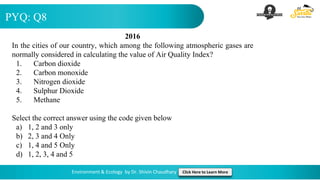
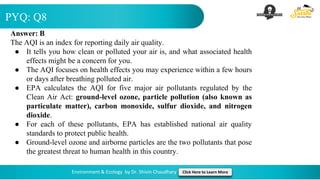
● National Air Quality Index (AQI)
● AQI was launched by MoEFCC in April 2015 under ‘Swachh Bharat’.
● It helps the citizens to judge the air quality within her vicinity.
● There are six AQI categories, namely Good, Satisfactory, Moderately
polluted, Poor, Very Poor, and Severe.
● The AQI will consider eight pollutants
● PM10 and PM2.5
● NO2, SO2,
● Carbon monoxide (CO), Ozone (O3)
● Ammonia (NH3) and Lead (Pb)
7.
Pollution
Environment & Ecologyby Dr. Shivin Chaudhary Click Here to Learn More
● National Air Quality Resource Framework of India (NARFI)
● NARFI is an information mechanism to help decision-makers in
government, municipalities, start-ups and in private sectors to address air
pollution issues in different climatic zones of India.
● Developed by: National Institute of Advanced Studies (NIAS),
Bengaluru with support from Office of Principal Scientific Adviser.
● Will provide an all-inclusive guide to collecting air quality data, studying its
impact and implementing science based solutions.
● Will have 5 modules including Emission Inventory, Air Shed, and
Mitigation; Impacts on Human Health and Agriculture etc.
8.
Pollution
Environment & Ecologyby Dr. Shivin Chaudhary Click Here to Learn More
● Norms for thermal power plants (TPPs)
● Context: Ministry of Environment, Forest and Climate
Change (MoEFCC) gave two year extension to thermal
power plants (TPPs) on SO2 norms.
● About TPP Norms
● In 2015, MoEFCC notified environmental norms for
particulate matter (PM), sulphur dioxides (SO2),
nitrogen oxides and mercury and water use for coal
based TPPs.
● Initially deadline for implementation- 2017 was
extended to 2022.
9.
Pollution
Environment & Ecologyby Dr. Shivin Chaudhary Click Here to Learn More
● Deadline for SO2 further extended for all three categories of TPPs.
● However, deadline remains same for meeting PM and NOx standards.
● Compliance with norms requires retrofitting existing TPPs with auxiliaries
to control emissions such as Flue Gas Desulphurisation (FGD), Selective
Catalytic Reduction etc.
● FGD: A set of technologies used to remove SO2 from sources of emissions,
e.g., exhaust flue gases of fossil-fuel power plants.
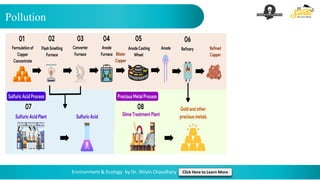
● Thermal power plants are the biggest users of water among all industries.
Pollution
Environment & Ecologyby Dr. Shivin Chaudhary Click Here to Learn More
● Electrostatic Precipitators (ESP)
● Electrostatic precipitation can remove over 99 per cent of particulate
matter present in the exhaust.
● They are used in boilers and furnaces, thermal power plants, cement
factories, steel plants, etc.
● In electrostatic precipitation, emanating dust is charged with ions, and the
ionised particulate matter is collected at an oppositely charged surface.
12.
Pollution
Environment & Ecologyby Dr. Shivin Chaudhary Click Here to Learn More
● Working
● An electrostatic precipitator has electrode wires that are maintained at
several thousand volts, which produce a corona that releases electrons.
● These electrons attach to dust particles giving them a net negative charge.
● The collecting plates are grounded (relatively positive charge) and attract
the charged dust particles.
● The air velocity between the plates must be low enough to allow the dust to
fall.
● The particles are removed from the collection surface by occasional
shaking or rapping.
Pollution
Environment & Ecologyby Dr. Shivin Chaudhary Click Here to Learn More
● Scrubbers
● Scrubbers are wet collectors. They remove aerosols from a stream of gas either
by collecting wet particles on a surface, or the particles are wetted by a
scrubbing liquid.
● The particles get trapped as they travel from the supporting gaseous medium
across the interface to the liquid scrubbing medium (this is similar to mucus in
trachea trapping dust).
● A scrubber can remove gases like sulphur dioxide.
● Inertial Collectors
● Inertia of Suspended Particulate Matter in gas is higher than its solvent. As
inertia is a function of the mass of the particulate matter, the device collects
heavier particles more efficiently (centrifugation is the technique).
● ‘Cyclone’ is a common inertial collector used in gas cleaning plants.
15.
Pollution
Environment & Ecologyby Dr. Shivin Chaudhary Click Here to Learn More
● Catalytic Converter
● Catalytic converters, having expensive metals, platinum-palladium and
rhodium as the catalysts, are fitted into automobiles for reducing the
emission of poisonous gases.
● Motor vehicles equipped with catalytic converters should use unleaded
petrol because the lead in the petrol inactivates the catalyst.
● Working
● As the exhaust passes through the catalytic converter, unburnt
hydrocarbons are converted into carbon dioxide and water, and carbon
monoxide and nitric oxide are changed to carbon dioxide and nitrogen gas,
respectively.
Pollution
Environment & Ecologyby Dr. Shivin Chaudhary Click Here to Learn More
● Flue-Gas Desulfurization (FGD) systems
● FGD systems may involve wet scrubbing or dry scrubbing to remove acidic
gases, particularly sulphur dioxide (SO2) and HCl, from flue gases (gases
flowing out of vertical exhaust pipes). Lime is used in both.
● Wet FGD
○ Flue gases are brought in contact with a liquid or solid slurry
absorbent.
○ The sulphur dioxide dissolves in or reacts with the absorbent & becomes
trapped in as wet calcium sulphite.
○ The sulphite can be converted to gypsum (used in cement production).
● In dry FGD scrubbing, lime is injected directly into flue gas to remove SO2 and
HCl from low-sulphur fuels.
Pollution
Environment & Ecologyby Dr. Shivin Chaudhary Click Here to Learn More
● Fly ash
● Fly ash is a by-product of coal based power generation.
● It is a fine powder with substantial amounts of oxides of silica, aluminium
and calcium.
● It also contains traces of Arsenic, Boron, Chromium, Lead etc. which
leads to air and water pollution if disposed on land.
● With low grade of Indian coal, its ash content is as high as 30-45% in
comparison to imported coal with 10-15%.
● With nearly 55% of our total power production through coal and lignite
based Thermal Power Plants (TPP), the fly ash generation in India is very
high.
● About 83% of Fly Ash is utilized.
20.
Pollution
Environment & Ecologyby Dr. Shivin Chaudhary Click Here to Learn More
● Recent news
● The Ministry of Environment, Forests and Climate Change (MoEFCC) has
extended fly ash utilization deadline for thermal power plants with the
introduction of penalties for noncompliance.
● Shorter Fly-ash utilization cycle: Existing provisions allow TPPs to fully
utilize fly ash in a four-year cycle in a staggered manner. The new policy
will follow a three-year cycle for 100% utilization of Fly-ash with a grace
period of a year if the percentage of ash utilization is between 60-80% and
two years if it is below 60%.
● Introduction of Polluter Pays Principle: A fine of Rs 1,000 per tonne of
unutilized ash has been introduced if the plant does not achieve at least 80%
ash utilization annually or in three years.
Pollution
Environment & Ecologyby Dr. Shivin Chaudhary Click Here to Learn More
● Acid Rain
● Acid rain refers to any precipitation (rain, fog, mist, snow) more acidic than
usual (pH < 5.6; pH < 7 is acidic).
● The pH scale
● The pH scale measures how acidic or basic (alkaline) a solution is. It ranges
from 0 to 14.
● A pH of 7 is neutral. A pH less than 7 is acidic, and a pH greater than 7 is basic.
● A solution with pH 4 is ten times more acidic than pH 5, and a hundred times
more acidic than pH 6.
● pH is based on hydrogen ion concentration in an aqueous solution. pH values
decrease as hydrogen ion levels increase. Whilst the pH range is usually 0 to 14,
lower and higher values are theoretically possible.
23.
Pollution
Environment & Ecologyby Dr. Shivin Chaudhary Click Here to Learn More
Gas Source
SOx (Sulphur
Oxides)
Fossil fuel burning, thermal power plants, smelting of
metal sulphide ores, industrial sources, industrial
production of sulfuric acid in metallurgical, chemical and
fertiliser industries, volcanoes, seas and oceans,
decomposition of organic matter, etc.
NOx (Nitrogen
Oxides – NO, NO2
and N2O)
Fossil fuel burning, lightning, biomass burning, forest
fires, oceans, and power plants
24.
Pollution
Environment & Ecologyby Dr. Shivin Chaudhary Click Here to Learn More
● Nitrogen will only react with oxygen at high temperatures and pressures
in lightning bolts and combustion reactions in power plants or internal
combustion engines. Nitric oxide (NO) and nitrogen dioxide (NO2) are
formed under these conditions. Eventually, nitrogen dioxide may react with
water in the rain to form nitric acid, HNO3.
● The nitrates thus formed may be utilised by plants as a nutrient (so, the soil
gets nitrogen from acid rain).”
25.
Pollution
Environment & Ecologyby Dr. Shivin Chaudhary Click Here to Learn More
Chemistry of Acid Rain
Basic steps involved in the formation of acid rain:
1. The atmosphere receives oxides of sulphur and nitrogen from
natural and human-made sources.
2. Some of these oxides fall back directly to the ground as dry
deposition.
3. Sunlight stimulates the formation of photo oxidants (such as ozone) in
the atmosphere.
4. These photo oxidants interact with the oxides of sulphur & nitrogen
and other gases (like NH3) to produce H2SO4 (sulphuric acid) and
HNO3 (nitric acid) by oxidation.
5. Acid rain containing ions of sulphate, nitrate, ammonium and
hydrogen falls as wet deposition.
Pollution
Environment & Ecologyby Dr. Shivin Chaudhary Click Here to Learn More
Wet Deposition Dry Deposition
If the acids in the air are blown into
areas where the weather is wet, they
can fall to the ground as rain, snow,
fog, or mist, settling on vegetation as
acid depositions.
In areas where the weather is dry,
the acid chemicals may become
incorporated into dust or smoke and
fall to the ground through dry
deposition, sticking to the ground,
buildings, vegetation, cars, etc.
About half of the acidity in the
atmosphere falls back to earth
through dry deposition.
28.
Pollution
Environment & Ecologyby Dr. Shivin Chaudhary Click Here to Learn More
Harmful Effects of Acid Rain
● Effects on soil
● The exchange between hydrogen ions and the nutrient cations like potassium &
magnesium in the soil cause leaching of the nutrients, making the soil infertile.
● An increase in ammonia in the soil due to a decrease in other nutrients
decreases the decomposition rate, and the nitrate level of the soil is also found
to decrease
● Effects on humans
● Bad smell, reduced visibility, and irritation of the skin, eyes and the respiratory
tract. Some direct effects include chronic bronchitis, pulmonary emphysema and
cancer.
29.
Pollution
Environment & Ecologyby Dr. Shivin Chaudhary Click Here to Learn More
● Effects on aquatic life: Eggs or sperms of fish, frogs and other aquatic
organisms are sensitive to pH changes. Acid rain kills their gametes
affecting the life cycles (ecosystem imbalances).
● Effect on terrestrial life: Acid rain damages the cuticle of plant leaves and
reduces photosynthesis.
● Effects on microorganisms: The optimum pH of most bacteria and
protozoa is near neutrality. Most fungi prefer an acidic environment. Blue-
green bacteria prefer an alkaline environment.
● So, microbial species in the soil and water shift from bacteria-bound to
fungi-bound> delay in the decomposition of soil organic material
● Effect on buildings, monuments and materials: Limestone and marble are
destroyed by acid rain. Ex- Taj Mahal (Marble cancer)
30.
Pollution
Environment & Ecologyby Dr. Shivin Chaudhary Click Here to Learn More
● Acid Rain Areas
● They are concentrated in the industrialised belt of the northern hemisphere-
Scandinavia, Canada, Japan, the Northeast United States and North-western
Europe.
● In India, the first acid rain occurred in Bombay in 1974. Instances of acid rain
are being reported in many metropolitan cities. Low soil pH is reported from
north-eastern India, coastal Karnataka and Kerala, parts of Orissa, West Bengal
and Bihar.
● Acid Rain Control Measures
● Using low sulphur fuel or washed coal (chemical washing of pulverised coal)
in thermal plants.
● Buffering: adding a neutralising agent to the acidified water to increase the pH.
Usually, lime in the form of calcium oxide & calcium carbonate is used.
31.
Pollution
Environment & Ecologyby Dr. Shivin Chaudhary Click Here to Learn More
● Plastic Waste Data by Central Pollution Control Board (CPCB)
● Maharashtra, Tamil Nadu, Gujarat among top Indian Plastic waste
producers
● India ranks 5th in generation of plastic waste with an annual discharge of
3.5 million tonne in 2020.
● Almost 83% of this comes from just 10 states/ UTs.
● On a per capita basis, India’s plastic waste generation has almost doubled
over FY2016-20; however, remains lower than most of the developed
economies.
32.
Pollution
Environment & Ecologyby Dr. Shivin Chaudhary Click Here to Learn More
● Plastic Waste Management Rules, 2016
● Government of India has notified the 2016 rules in place of earlier Plastic
Waste (Management and Handling) Rules, 2011 (notified under
Environment Protection Act, 1986)
● It extended the rules to all villages, which were earlier admissible up to
municipal areas.
● The 2016 rules increased the minimum thickness of plastic carry bags from
40 to 50 microns & stipulated minimum thickness of 50 microns for plastic
sheets.
● Sachets made of plastic material used for storing, packing, or selling gutkha,
tobacco or pan masala are prohibited.
33.
Pollution
Environment & Ecologyby Dr. Shivin Chaudhary Click Here to Learn More
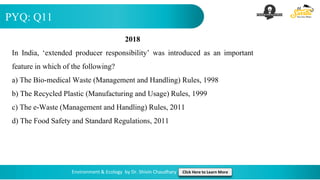
● Extended Producer’s Responsibility (EPR)
● EPR pins responsibility on producers, generators & brand owners in waste
management and collect back systems.
● Plastic waste management fee collection through pre-registration of the
producers, importers of plastic carry bags/multilayered packaging and
vendors selling the same for establishing the waste management system.
● Responsibility
● The local bodies shall be responsible for setting up, operationalisation &
coordination of the waste management system & for performing associated
functions.
● Retailers or street vendors shall not sell, or provide commodities in plastic
sheet or multilayered packaging, or they are liable to pay such fines.
34.
Pollution
Environment & Ecologyby Dr. Shivin Chaudhary Click Here to Learn More
● Reuse of plastic waste
● Exploring options for the reuse of plastic in various applications, namely, road
construction, waste-to-oil, and waste-to-energy, which will enhance plastic
recycling.
● Phasing out non-recyclable multilayered plastic.
● 2018 Amendment
● The amended rules lay down that the phasing out of Multilayered Plastic
(MLP) is now applicable only to MLPs which are “non-recyclable, or non-
energy recoverable, or with no alternate use”.
● The amended Rules also prescribed an automated central registration system
to be evolved by the CPCB for the registration of the producer/importer/brand
owner.
● It omitted Rule 15 i.e. explicit pricing of carry bags mentioned in the 2016 rule.
35.
Pollution
Environment & Ecologyby Dr. Shivin Chaudhary Click Here to Learn More
● Plastic Waste Management (PWM) Amendment Rules, 2021
● Context:
● Ministry of Environment, Forest, and Climate Change (MoEF&CC) has
notified the Plastic Waste Management Amendment Rules, 2021, which
prohibits identified single use plastic items which have low utility and high
littering potential by 2022.
● India has defined SUP as “a plastic commodity intended to be used once for
the same purpose before being disposed of or recycled” in its PWM
Amendment Rules, 2021.
● These include plastic bags, straws, coffee stirrers, soda and water bottles etc
36.
Pollution
Environment & Ecologyby Dr. Shivin Chaudhary Click Here to Learn More
● The assessment of SUP was conducted by comparing two pillars — the
utility index of a particular type of SUP and the environmental impact of
the same.
● The product that scores low on utility and high on environmental impact
should be considered for immediate phase out.
● Key Provisions
● Prohibition on Manufacture, import, stocking, distribution, sale and use of
single-use plastic, including polystyrene and expanded polystyrene,
commodities with effect from 1st July 2022.
● The ban will not apply to commodities made of compostable plastic.
37.
Pollution
Environment & Ecologyby Dr. Shivin Chaudhary Click Here to Learn More
● Thickness of plastic carry bags increased from 50 microns to 75 microns
with effect from 30th September 2021 and to 120 microns with effect from
the 31st December, 2022 [ The thickness has been increased so that bags
becomes expensive as well as can be reused]
● Extended Producer Responsibility (EPR): Plastic packaging waste not
covered under present notification shall be collected and managed in an
environmentally sustainable way through EPR of the producer, importer and
brand owner (PIBO) as per PWM Rules, 2016.
● EPR Guidelines have been given legal force through PWM Amendment
Rules, 2021.
38.
Pollution
Environment & Ecologyby Dr. Shivin Chaudhary Click Here to Learn More
● Implementing agency: Along with state pollution bodies, Central
Pollution Control Board (CPCB) will monitor the ban, identify violations,
and impose penalties already prescribed under the Environmental Protection
Act, 1986.
● Task Force: States and UTs had constituted the special task force for
elimination of SUP and effective implementation of the PWM Rules, 2016.
● Environment Ministry has also set up a national level task force for
making coordinated efforts in this direction.
● State /UT Governments and concerned Central Ministries/Departments have
also been requested to develop a comprehensive action plan for
elimination of SUP and its implementation in a time bound manner.
Pollution
Environment & Ecologyby Dr. Shivin Chaudhary Click Here to Learn More
Microplastics
● Microplastics are shreds of plastic less than 5 mm in length but
larger than 1 micrometre.
● Microplastics are used in cosmetics, personal care products,
industrial scrubbers, microfibers in textiles and virgin resin pellets
used in plastic manufacturing processes.
● Several studies have established the presence of microplastics in
groundwater. A study estimated that the average human ends up
consuming at least 50,000 microplastics in food every year. Their
impact on tiny marine organisms is even significant since their
injection leaves them starved and affects the marine food web.
42.
Pollution
Environment & Ecologyby Dr. Shivin Chaudhary Click Here to Learn More
● According to a study, we may inhale substantial quantities of
microplastics with every breath. And these plastics will eventually
flow into our blood and accumulate in our organs.
● Scientists have been discussing the possibility that microplastic mists
and clouds exist in the atmosphere but this is the first study to quantify
the magnitude of the problem.
● Read here: https://www.downtoearth.org.in/video/pollution/74-
tonnes-of-microplastics-fell-from-the-air-on-auckland-in-2020-86600
43.
Pollution
Environment & Ecologyby Dr. Shivin Chaudhary Click Here to Learn More
Microbeads
● Microbeads (>0.1 µm and < 5 mm) are very tiny pieces of plastic
that are added to health and beauty products, such as in some
cleansers and toothpaste (cooling crystals).
● However, one of the main contributors to microbeads pollution
is not manufactured microbeads, but regular plastic waste, 90% of
which are not recycled.
44.
Pollution
Environment & Ecologyby Dr. Shivin Chaudhary Click Here to Learn More
Polyethylene Terephthalate (PET Plastic)
● PET (polyethylene terephthalate), the chemical name for
polyester. It is a clear, strong, lightweight plastic widely used for
packaging foods and beverages, especially convenience-sized soft
drinks, juices, water, cooking oils, etc.
● PET is entirely recyclable. They can easily be identified by the #1
in the triangular "chasing arrows" code, which is usually moulded
into the bottom or side of the container. No other plastic carries the
#1 code.
45.
Pollution
Environment & Ecologyby Dr. Shivin Chaudhary Click Here to Learn More
● Status of e-waste in India
● 3rd largest Electronic waste producer in the world after China and United
States.
● Produces about 4 mMT (million Metric Tonnes) of e-waste.
● This is expected to increase 40-fold by 2050.
● Computer devices accounts for nearly 70% of annual e-waste production,
followed by telecom sector, medical equipment and electric equipment.
● Only 1.5% of electronic waste generated is recycled through institutional
processes.
● Uttar Pradesh, Uttarakhand, Tamil Nadu, and Haryana are among the States
that have a bigger capacity to dismantle and recycle e-waste.
46.
Pollution
Environment & Ecologyby Dr. Shivin Chaudhary Click Here to Learn More
● E-waste (Management) Rules 2022
● Context: Ministry of Environment, Forest and Climate Change
(MoEF&CC) has notified E-waste (management) Rules 2022, in the
exercise of the powers conferred by the Environment (Protection) Act,
1986. [Recall our discussion that EPA is an “umbrella” legislation]
● Key Provisions:
● 'E-waste' Definition: Electrical and electronic equipment, whole or in part
discarded as waste, and rejects from manufacturing, refurbishment and
repair processes
47.
Pollution
Environment & Ecologyby Dr. Shivin Chaudhary Click Here to Learn More
● Coverage: Every manufacturer, producer, refurbisher, dismantler, and
recycler involved processing of e-waste with certain exceptions
● Compulsory Registration of manufacturer, producer, refurbisher, or
recycler of the e-products with Central Pollution Control Board (CPCB).
● Introduction of Extended Producer Responsibility (EPR) Certificates to
incentivize registered electronic waste recyclers by introducing (not part of
2016 Rules).
● CPCB to conduct random sampling of electrical and electronic equipment
placed on the market to monitor and verify the compliance of reduction of
hazardous substances provisions.
48.
Pollution
Environment & Ecologyby Dr. Shivin Chaudhary Click Here to Learn More
● The Right To Repair Movement
● Right to Repair electronic products is a reference to the need for
government legislation that is intended to allow consumers the ability to
repair and modify their own electronic devices.
● The movement traces its roots back to 1950s.
● The concept originated from USA from the automotive industry.
● In July 2022, the United States passed the Fair Repair Act, 2022, on the
right to repair.
● The United Kingdom and European Union passed legislation such as Right
to Repair Regulations and Right to Repair regarding this right.
● Recently, in India, the Department of Consumer Affairs announced the
formation of a committee under the chairmanship of Nidhi Khare to
develop a comprehensive framework for the right to repair.
49.
Pollution
Environment & Ecologyby Dr. Shivin Chaudhary Click Here to Learn More
● Solid Waste Management Rules (2016)
● These replace the Municipal Solid Wastes (Management and Handling) Rules,
2000. (notified under Environment Protection Act, 1986)
● These Rules are now applicable beyond Municipal areas and extend to urban
agglomerations, notified industrial townships, areas under the control of Indian
Railways, airports, etc., defence establishments, places of pilgrims, etc.
● Responsibilities of Generators have been introduced to segregate waste into 3
streams before handing it over to the collector:
1) Wet (Biodegradable)
2) Dry (Plastic, Paper, metal, wood, etc.)
3) Domestic hazardous wastes (diapers, napkins, containers of cleaning
agents, mosquito repellents, etc.)
50.
Pollution
Environment & Ecologyby Dr. Shivin Chaudhary Click Here to Learn More
● Segregation at Source
● Source segregation of waste has been mandated to channel waste to wealth
by recovery, reuse and recycling
● Hotels and restaurants will also be required to segregate biodegradable
waste & set up a system of collection to ensure that such food waste is
utilised for composting/biomethanation.
● All resident welfare and market associations and gated communities with an
area of above 5,000 sq m will have to segregate waste at the source. They
have to hand over recyclable material to authorised pickers and recyclers or
the urban local body.
51.
Pollution
Environment & Ecologyby Dr. Shivin Chaudhary Click Here to Learn More
● Collect Back scheme for packaging waste
● Brand owners who sell or market their products in non-biodegradable
packaging materials should have a system to collect back the packaging
waste generated due to their production.
● User Fees for Collection
● Municipal authorities will levy user fees for collection, disposal and
processing from bulk generators.
● As per the rules, the generator will have to pay a “User Fee” to the waste
collector & a “Spot Fine” for littering & non-segregation, the quantum of
which will be decided by the local bodies.
52.
Pollution
Environment & Ecologyby Dr. Shivin Chaudhary Click Here to Learn More
● Waste Processing & Treatment
● Bio-degradable waste should be processed and disposed of through
composting/biomethanation.
● Rules have mandated bioremediation or capping of old and abandoned dump
sites within 5 years. Waste processing facilities will have to be set up by local
bodies within the stipulated time frame.
● Promotion of Waste to Energy
● All industrial units within 100 km of a solid waste-based Refuse-Derived Fuel
(RDF) Plant must make arrangements to replace at least 5 per cent of their fuel
requirement with RDF so produced.
● Ministry of New and Renewable Energy should facilitate infrastructure creation
for Waste to Energy plants and provide appropriate subsidies or incentives for
such Waste-to-Energy plants.
53.
Pollution
Environment & Ecologyby Dr. Shivin Chaudhary Click Here to Learn More
● Revision of Parameters
● Landfill site shall be 100 meters away from a river, 200 meters from a pond,
500 meters away from highways, habitations, public parks and water supply
wells and 20 km away from airports/airbases.
● Emission standards are completely amended for dioxins, furans,
particulate matter, etc.
● The compost standards have been amended to align with Fertilizer Control
Order.
● Constitution of Central Monitoring Committee
● Central Monitoring Committee under the chairmanship of the Secretary,
MoEFCC, to monitor the implementation of the rules.
54.
Pollution
Environment & Ecologyby Dr. Shivin Chaudhary Click Here to Learn More
● Treatment of solid waste
● As per 12th schedule and 74th Amendment act, ULB (urban local
bodies) are responsible for keeping cities clean.
● Incineration plants
● The process of burning waste in large furnaces at high temperatures is
known as incineration.
● In these plants, the recyclable material is segregated, and the rest is burnt.
● Burning garbage is not a clean process, as it produces tons of toxic ash and
pollutes the air and water.
● At present, incineration is kept as a last resort and is used mainly for
treating infectious waste.
55.
Pollution
Environment & Ecologyby Dr. Shivin Chaudhary Click Here to Learn More
● Pyrolysis
● Pyrolysis is a process of combustion (burning) of material in the absence
of oxygen, or under a controlled atmosphere of oxygen.
● It is an alternative to incineration.
● Pyrolysis of carbonaceous wastes like firewood, coconut, palm waste, corn
combs, cashew shells, rice husk paddy straw and sawdust, yields charcoal
and products like tar, methyl alcohol, acetic acid, acetone and fuel gas.
56.
Pollution
Environment & Ecologyby Dr. Shivin Chaudhary Click Here to Learn More
● Plasma gasification
● Plasma gasification is an extreme thermal process (uses a combination of
electricity and high temperatures) using plasma (without combustion)
which converts organic matter into a syngas (synthesis gas - made up of
hydrogen and carbon monoxide).
● The inorganic wastes are converted into slag, a solid waste.
● Plasma gasification is a cleaner alternative to landfills, reducing or
eliminating toxicity while avoiding the landfilling of huge amounts of
garbage
57.
Pollution
Environment & Ecologyby Dr. Shivin Chaudhary Click Here to Learn More
● Bio-Medical Waste (Management and Handling) Rules, 2016
● Bio-Medical Waste Management Rules 2016 is an improvement to the 1998
rules. (notified under Environment Protection Act, 1986)
● Biomedical waste comprises human & animal anatomical waste and
treatment apparatus like needles used in health care facilities (HCF –
hospitals, laboratories, immunisation programmes, etc.)
● Salient features:
● Phase out chlorinated plastic bags, gloves and blood bags within two
years.
● Pre-treatment of the laboratory waste, microbiological waste, and blood
samples through sterilisation onsite.
58.
Pollution
Environment & Ecologyby Dr. Shivin Chaudhary Click Here to Learn More
● Establish a bar-code system for bags or containers containing bio-medical
waste for disposal.
● Bio-medical waste has been classified into 4 categories instead earlier ten
to improve segregation at source.
● State Government to provide land for common bio-medical waste
treatment and disposal facilities.
● No occupier shall establish an on-site treatment and disposal facility if a
service of it is available at a distance of seventy-five kilometers
● Operator of a common bio-medical waste treatment and disposal facility to
ensure the timely collection of bio-medical waste from the HCFs.
● Vaccination camps, blood donation camps, etc., will come under the ambit
of these rules.
59.
Pollution
Environment & Ecologyby Dr. Shivin Chaudhary Click Here to Learn More
● Procedure to be followed
● The hospitals must put in place the mechanisms for effective disposal either
directly or through common biomedical waste treatment and disposal
facilities.
● The hospitals servicing 1000 patients or more per month must obtain
authorisation and segregate biomedical waste into categories as specified by
the rules.
● For example, syringes, needles and blood-soiled bandages should be all
disposed of in a red-coloured bag or bin, where they will later be incinerated
(destroy by burning).
● If body fluids are present, the material needs to be incinerated.
Pollution
Environment & Ecologyby Dr. Shivin Chaudhary Click Here to Learn More
● Hazardous Wastes (Management and Handling) Rules, 2016
● It has been notified under Environment Protection Act, 1986.
● For the first time, Rules have been made to distinguish between hazardous
Waste & other wastes.
● Other wastes include waste tyres, paper waste, metal scrap, used electronic
items, etc. and are recognised as a resource for recycling and reuse.
● Salient Features
● The ambit of the Rules has been expanded by including ‘Other Waste’.
● Waste Management hierarchy in the sequence of priority of prevention,
minimisation, reuse, recycling, recovery, co-processing; and safe disposal
has been incorporated
62.
Pollution
Environment & Ecologyby Dr. Shivin Chaudhary Click Here to Learn More
● The rules encourage the reduction of hazardous waste generation and
encourage its recycling and reusing
● They specify strict guidelines related to the import/export or even storage
and transportation of hazardous wastes.
● Import & Export of Hazardous Waste
● No country can export hazardous waste to India for final disposal. This
means that India only imports hazardous wastes to recycle, reuse or for
other utilisation.
● The rules specify the procedure for importing and exporting hazardous
waste to and from India.
63.
Pollution
Environment & Ecologyby Dr. Shivin Chaudhary Click Here to Learn More
● Treatment, Storage and Disposal Facility for Hazardous Wastes
● 2016 rules give a clear direction of how the facility for treatment, storage &
disposal is to be established.
● Permission from the SPCB is required for the layout in this regard.
● Packaging, Labelling and Transport of Hazardous and Other Wastes
● CPCB provides extensive guidelines for packaging and labelling. If the
waste is to be transported to a facility in a different state for its final
disposal, a ‘No Objection Certificate’ is required on the sender’s part from
the SPCBs of both states.
64.
Pollution
Environment & Ecologyby Dr. Shivin Chaudhary Click Here to Learn More
● 2019 Amendment
● Amendment has been made considering the “Ease of Doing Business” &
boosting the “Make in India” initiative by simplifying the procedures
under the Rules, while simultaneously upholding the principles of
sustainable development & ensuring minimal impact on the environment.
● Salient Features
● Solid plastic waste has been prohibited from being imported into the
country, including in Special Economic Zones (SEZ) and by Export
Oriented Units (EOU).
● Exporters of silk waste have now been given an exemption from requiring
permission from MoEFCC.
65.
Pollution
Environment & Ecologyby Dr. Shivin Chaudhary Click Here to Learn More
● Electrical and electronic assemblies and components manufactured in and
exported from India, if found defective, can now be imported back into the
country without obtaining permission from MoEFCC.
● Industries that do not require consent under the Water (Prevention and
Control of Pollution) Act 1974 and the Air (Prevention and Control of
Pollution) Act 1981, are now exempted from requiring authorization also
under the Hazardous and Other Wastes Rules, 2016.
66.
Pollution
Environment & Ecologyby Dr. Shivin Chaudhary Click Here to Learn More
Measuring Pollution Load in Water Dissolved Oxygen (DO)
● Optimum DO content in water is important for the survival of aquatic
organisms.
● The presence of organic and inorganic wastes decreases the DO content
due to the high decomposition rate and O2 consumption.
● Several factors, such as surface turbulence, photosynthetic activity, O2
consumption by organisms and decomposition of organic matter,
determine the amount of DO in water.
● Water having DO content below 8.0 mg/L may be considered
contaminated, and below 4.0 mg/L is considered to be highly polluted.
67.
Pollution
Environment & Ecologyby Dr. Shivin Chaudhary Click Here to Learn More
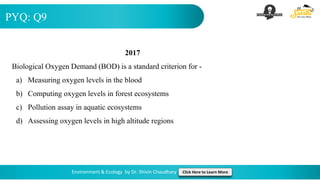
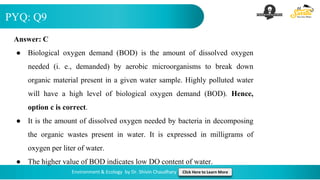
Biological Oxygen Demand (BOD)
● Water pollution by organic wastes is measured in terms of Biochemical
Oxygen Demand (BOD).
● BOD is the amount of dissolved oxygen needed by bacteria to
decompose the organic wastes present in water. It is expressed in
milligrams of oxygen per litre of water.
● The higher value of BOD indicates high pollution due to biodegradable
organic wastes and low DO content of water. Since BOD is limited to
biodegradable materials, it is not a reliable method of measuring water
pollution.
Pollution
Environment & Ecologyby Dr. Shivin Chaudhary Click Here to Learn More
Chemical Oxygen Demand (COD)
● Chemical oxygen demand (COD) is a slightly better mode used to
measure pollution load in the water.
● It measures the amount of oxygen in parts per million required to
oxidise organic (biodegradable and non-biodegradable) and oxidisable
inorganic compounds in the water sample.
70.
Pollution
Environment & Ecologyby Dr. Shivin Chaudhary Click Here to Learn More
Eutrophication and Ageing of Lakes
● The nutrient enrichment of the lakes promotes the growth of algae,
aquatic plants, and various fauna. This process is known as natural
eutrophication.
● Human activities cause similar nutrient enrichment of lakes at an
accelerated rate, and the consequent ageing phenomenon is known as
cultural eutrophication.
● Based on their nutrient content, lakes are categorised as Oligotrophic
(very low in nutrients), Mesotrophic (moderate nutrients) and
Eutrophic (highly nutrient-rich). Most lakes in India are either
eutrophic or mesotrophic because of the nutrients derived from their
surroundings or the organic wastes entering them.
Pollution
Environment & Ecologyby Dr. Shivin Chaudhary Click Here to Learn More
● Eutrophication effects :
● Collapse of food chains
● New Species Invasion
● Loss of freshwater lakes
● Loss of coral reefs
73.
Pollution
Environment & Ecologyby Dr. Shivin Chaudhary Click Here to Learn More
Eutrophication and Algal Blooms
● Eutrophication is the response to the addition of nutrients such as
nitrates and phosphates naturally or artificially, fertilising the
aquatic ecosystem.
● Phytoplankton thrives on the excess nutrients, and their population
explosion covers almost the entire surface layer, restricting the
penetration of sunlight. This condition is known as an algal bloom.
● It results in the death of aquatic plants and hence restricts the
replenishment of oxygen.
74.
Pollution
Environment & Ecologyby Dr. Shivin Chaudhary Click Here to Learn More
Mechanism
● Phytoplankton are photosynthetic during the daytime, adding
oxygen to the aquatic ecosystem. But during the night, they
consume far more oxygen as they respire aggressively. Therefore,
algal blooms accentuate the rate of oxygen depletion as the population
of phytoplankton is exceedingly high.
● The primary consumers like zooplankton & small fish are killed due to
oxygen deprivation caused by algal blooms, adversely affecting the food
chain.
● Further, more oxygen is taken up by microorganisms during the
decomposition process of dead algae, plants, and fishes. The new
anaerobic conditions (absence of oxygen) created promote the growth of
bacteria such as Clostridium botulinum which produces toxins deadly
to aquatic organisms, birds, and mammals.
75.
Pollution
Environment & Ecologyby Dr. Shivin Chaudhary Click Here to Learn More
Harmful Algal Blooms
● Most algal blooms are not harmful, but some produce toxins (neuro
and hepatotoxins), which can kill aquatic organisms (E.g., Shellfish
poisoning) and pose a threat to humans and are known as Harmful Algal
Blooms (HABs).
● They adversely affect commercial and recreational fishing, tourism,
and valued habitats.
76.
Pollution
Environment & Ecologyby Dr. Shivin Chaudhary Click Here to Learn More
Dead zones
● Dead zones (biological deserts or hypoxic zones) are areas in the ocean
with very low oxygen concentrations (hypoxic conditions). They
emerge when the influx of excess chemical nutrients spurs algae
growth (algal blooms). These zones usually occur 200-800 meters (in
the saltwater layer) below the surface.
● Hypoxic zones can occur naturally (due to the upwelling of excess
nutrients). They can be created or enhanced by human activity to form
dead zones. Dead zones are detrimental to animal life. Most of the
animal life either dies or migrates from the zone.
77.
Pollution
Environment & Ecologyby Dr. Shivin Chaudhary Click Here to Learn More
● Dead zones are increasing in the coastal delta and estuarine regions. One
of the largest dead zones forms in the Gulf of Mexico every spring
(farmers fertilise their crops, and rain washes fertiliser off the land into
rivers). There’s a dead zone in the Gulf of Oman, and it’s growing.
Pollution
Environment & Ecologyby Dr. Shivin Chaudhary Click Here to Learn More
Ocean Acidification
● Oceans are an important reservoir of CO2 : they absorb a significant
quanity.
● Ocean acidification is the change in ocean chemistry - lowering of ocean
pH (i.e. increase in concentration of hydrogen ions) driven by the
uptake of carbon compounds by the ocean from the atmosphere
● As the uptake of atmospheric carbon dioxide by the ocean increases, the
concentration of hydrogen ions in the ocean increases, the concentration of
carbonate ions decreases, the pH of the oceans decreases and the oceans
become less alkaline – this process is known as ocean acidification.
Pollution
Environment & Ecologyby Dr. Shivin Chaudhary Click Here to Learn More
Mechanism of Ocean Acidification
● An estimated 30-40% of the carbon dioxide from human activity
released into the atmosphere dissolves into oceans, rivers, and lakes.
To achieve chemical equilibrium, a part of it reacts with water to form
carbonic acid.
● Some carbonic acid molecules react with a water molecule to give a
bicarbonate ion and a hydronium ion (H+), thus increasing ocean
acidity (H+ ion concentration).
● The pH of the ocean surface waters has decreased by about 0.1 pH
unit (i.e. 26% increase in ocean hydrogen ion concentration) since the
beginning of the industrial revolution.
82.
Pollution
Environment & Ecologyby Dr. Shivin Chaudhary Click Here to Learn More
Effects of Ocean Acidification
● Reduced Buffering Capacity: Oceans are an essential reservoir of
CO2, absorbing a significant quantity of it (one-third) produced by
anthropogenic activities and effectively buffering climate change. The
uptake of atmospheric carbon dioxide is occurring at a rate exceeding
the natural buffering capacity of the oceans. Increasing acidity
depresses metabolic rates and immune responses in some organisms.
83.
Pollution
Environment & Ecologyby Dr. Shivin Chaudhary Click Here to Learn More
Effects on Marine Calcifying Organisms:
● Seawater absorbs CO2 to produce carbonic acid, bicarbonate and
carbonate ions. However, the increase in atmospheric CO2 levels
leads to a decrease in pH level and an increase in the concentration of
carbonic acid and bicarbonate ions, causing a decrease in the
concentration of carbonate ions.
● The decreased amount of carbonate ions makes it more difficult for
marine calcifying organisms, such as coral (calcareous corals) and
some plankton (calcareous plankton), to form biogenic calcium
carbonate.
● This accentuates coral bleaching, and commercial fisheries are also
threatened as the calcifying organisms form the base of the aquatic
food webs.
84.
Pollution
Environment & Ecologyby Dr. Shivin Chaudhary Click Here to Learn More
Findings:
● Ocean acidification prompted some species to grow faster and others slower,
it also changed the natural competition between species.
● It inhibits shell growth in marine animals and is suspected as a cause of
reproductive disorders in some fish.
Read:
https://www.downtoearth.org.in/news/climate-change/increasing-ocean-acidity-will-hit-the-
marine-food-chain-says-study-50602
85.
Pollution
Environment & Ecologyby Dr. Shivin Chaudhary Click Here to Learn More
Polluting Industries
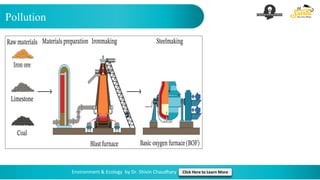
Iron and Steel Industry
● Processes involved
○ Unwanted impurities are removed by smelting iron ore in a blast
furnace.
○ Major impurities include sulphur (which forms iron sulphide, which
dramatically reduces the strength of steel), lead (improves the
machinability of the steel when present in small quantities), oxygen
(oxides make iron and steel weak), etc.
86.
Pollution
Environment & Ecologyby Dr. Shivin Chaudhary Click Here to Learn More
● In a blast furnace, fuel (coke — has far fewer impurities than coal), iron
ore, and flux (limestone — removes sulphur and other impurities into
slag) are continuously supplied.
● The byproducts obtained are liquid slag, liquid iron (pig iron — an
intermediate product of smelting iron ore; has oxides) and gases.
● Oxygen in the iron oxides is reduced by a series of chemical reactions that
produce CO and CO2.
● [Pig iron to steel> Liquid (pig) iron> Cast iron (cooled liquid iron; brittle;
carbon content greater than 2%; wrought iron (weak) = liquid iron + slag)
> Steel (carbon content is up to 2.1%; it does corrode)> Stainless steel
(steel + 10.5% chromium + Nickel, manganese, molybdenum, etc.; it does
not corrode).]
Pollution
Environment & Ecologyby Dr. Shivin Chaudhary Click Here to Learn More
● Steel Slag
● Slag full of impurities such as calcium sulphide (CaS) and oxides of
silica, alumina, magnesia, calcium (CaO), etc., that entered with the iron
ore or coke.
● Only a small percentage of slag goes into landfills.
● Cement made with blast furnace slag has lower permeability and is more
durable than Portland (regular) cement. It is used as an aggregate in
concrete, cement clinker, asphalt concrete, asphalt and road bases.
● Soil improvement: dissolution of slag generates alkalinity that can be
used to precipitate out metals, sulfates, and excess nutrients (like nitrogen,
phosphorus, potassium) in wastewater treatment.
● Soil conditioner: ferrous slags have been used to rebalance soil pH and as
fertilisers (as sources of calcium and magnesium).
89.
Pollution
Environment & Ecologyby Dr. Shivin Chaudhary Click Here to Learn More
● Air Pollution
● The industry burns a lot of coal (thermal power; coke in the blast furnace),
causing air pollution in the form of PM2.5 and PM10, Carbon Dioxide,
Sulphur Oxides (sulphur is eliminated as SO2 in the blast furnace),
● Nitrogen Oxides, Carbon Monoxide, Hydrogen Sulphide, Non-Methane
Volatile Organic Compounds (NMVOC), etc.
● Coke ovens emit naphthalene which is highly toxic and can cause cancer
(carcinogenic).
90.
Pollution
Environment & Ecologyby Dr. Shivin Chaudhary Click Here to Learn More
● Magnetite Pollution
● Magnetite pollution refers to the presence of a magnetic mineral called
Magnetite (Fe3O4) in the environment, as a result of human activities
such as mining, steel production and industrial processes.
● Magnetic particles can interfere with the migratory patterns of birds and
the operation of electronic equipment, such as compasses and navigation
systems.
91.
Pollution
Environment & Ecologyby Dr. Shivin Chaudhary Click Here to Learn More
● Copper Smelting Industry
● Processes Involved
● Mining of raw chalcopyrite ore (CuFeS2 — copper iron sulfide; most
abundant copper ore mineral; <1% Cu).
● Improving chalcopyrite ore concentration (34.5% Cu, 30.5% Fe, and
35.0% S) by crushing, grinding, and flotation purification (oils are used
as certain metals have an affinity to oils) at the mine site.
● Roasting of improved ore concentrate is performed in copper smelters
(mostly near ports) to reduce impurities, including sulfur, antimony,
arsenic, lead, etc.
○ It eliminates 20-50% sulfur as highly concentrated sulfur dioxide
(SO2). It is converted to concentrated sulfuric acid and transported
to fertilisers, pharmaceuticals, paper bleaching, petroleum refineries
and other industries.
92.
Pollution
Environment & Ecologyby Dr. Shivin Chaudhary Click Here to Learn More
● Smelting of roasted ore concentrate produces matte (65% Cu), a molten
mixture of copper sulfide (Cu2S), iron sulfide (FeS), and slag consisting
of iron oxide and heavy metals.
● Converting the matter in a converter furnace yields high-grade blister
copper (~99% Cu).
● Blister copper is refined in an anode furnace, cast into anodes to remove
oxygen (99.5% Cu).
● Electrolytic refining: Copper from the anode plates is electrolytically
deposited on the stainless steel cathode plate, resulting in copper with a
grade of 99.99%.
● Slime generated in electrolytic refining contains precious metals such as
gold, silver, selenium, tellurium etc.
○ These metals are recovered in a slime treatment plant.
Pollution
Environment & Ecologyby Dr. Shivin Chaudhary Click Here to Learn More
● Copper slag
● Copper slag is mainly used for abrasive surface blast-cleaning (used to
shape the surface of the metal, stone, concrete, etc.). It can be used in
road construction and the production of cement, mortar, and concrete as
raw materials for clinker, coarse and fine aggregates.
● Pollution
● Leaching of impurities from copper ore concentrate and slag: radon
(emitted from the natural radioactive decay of uranium, and copper ores),
iron, arsenic, antimony, mercury, lead, cadmium, selenium, magnesium,
aluminium, cobalt, tin, nickel, manganese, nitrates, fluorides, etc.
● As most copper ores are sulphur-based, the smelting process releases
Sulphur Dioxide. When the concentration of sulphur dioxide is too high,
the industries convert it into sulphuric acid, an irritant and water
contaminant.
95.
Pollution
Environment & Ecologyby Dr. Shivin Chaudhary Click Here to Learn More
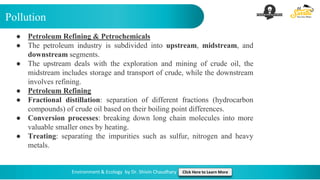
● Petroleum Refining & Petrochemicals
● The petroleum industry is subdivided into upstream, midstream, and
downstream segments.
● The upstream deals with the exploration and mining of crude oil, the
midstream includes storage and transport of crude, while the downstream
involves refining.
● Petroleum Refining
● Fractional distillation: separation of different fractions (hydrocarbon
compounds) of crude oil based on their boiling point differences.
● Conversion processes: breaking down long chain molecules into more
valuable smaller ones by heating.
● Treating: separating the impurities such as sulfur, nitrogen and heavy
metals.
96.
Pollution
Environment & Ecologyby Dr. Shivin Chaudhary Click Here to Learn More
● Pollution
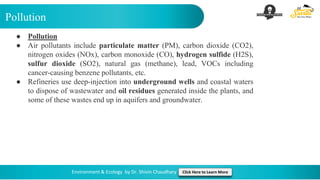
● Air pollutants include particulate matter (PM), carbon dioxide (CO2),
nitrogen oxides (NOx), carbon monoxide (CO), hydrogen sulfide (H2S),
sulfur dioxide (SO2), natural gas (methane), lead, VOCs including
cancer-causing benzene pollutants, etc.
● Refineries use deep-injection into underground wells and coastal waters
to dispose of wastewater and oil residues generated inside the plants, and
some of these wastes end up in aquifers and groundwater.
97.
Pollution
Environment & Ecologyby Dr. Shivin Chaudhary Click Here to Learn More
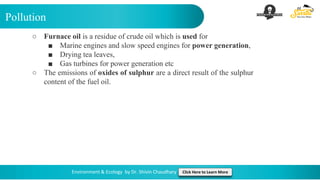
○ Furnace oil is a residue of crude oil which is used for
■ Marine engines and slow speed engines for power generation,
■ Drying tea leaves,
■ Gas turbines for power generation etc
○ The emissions of oxides of sulphur are a direct result of the sulphur
content of the fuel oil.
Pollution
Environment & Ecologyby Dr. Shivin Chaudhary Click Here to Learn More
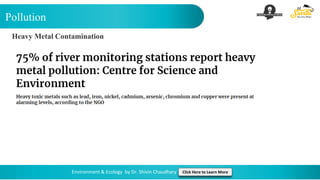
Heavy Metals
● Thay are naturally occurring elements, with high atomic weight and
density at least 5 times greater than that of water.
Examples: Lead, iron, nickel, cadmium, arsenic, chromium and copper.
● Effects of heavy metals exposure:
○ Health: Slowly progressing physical, muscular, and neurological
degenerative processes that mimic Alzheimer’s, Parkinson’s disease
etc.
○ Environment: Affect biodegradability of organic pollutants, making
them less degradable.
○ Plants: Influences soil fertility, disturbs photosynthesis etc.
Pollution
Environment & Ecologyby Dr. Shivin Chaudhary Click Here to Learn More
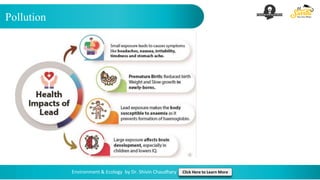
Lead Poisoning
● A report about lead poisoning was prepared jointly by government
think tank Niti Aayog and Council of Scientific & Industrial
Research. It says India bears world’s highest health, economic burden
due to lead poisoning.
Sources of lead:
● Naturally found in the Earth’s crust.
● Mining, smelting and refining industries and their waste.
● Household Products such as Cosmetic Products, Ayurveda medicines
etc.
● Present in printed circuit boards and batteries due to unscientific
recycling
● Potteries (e.g. utensils and glazed ceramic wares), water bodies etc.
Pollution
Environment & Ecologyby Dr. Shivin Chaudhary Click Here to Learn More
Per And Polyfluoroalkyl Substances (PFAs)
● Chemicals with partially or completely fluorinated carbon
chains of varied lengths. They are referred as “forever
chemicals” as do not degrade easily in the environment
due to strong carbon-fluorine bonds.
● PFAS like perfluorooctane sulfonic acid (PFOS) and
perfluorooctanoic acid (PFOA) listed under Stockholm
Convention on Persistent Organic Pollutants (their
production and use are restricted or eliminated in the
Parties.)
Pollution
Environment & Ecologyby Dr. Shivin Chaudhary Click Here to Learn More
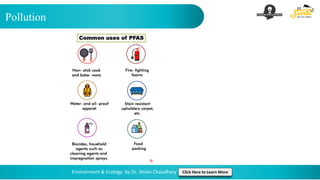
Concerns associated with use of PFAS:
● Found in the blood of people and animals.
● High exposure associated with health risks like decreased fertility,
developmental effects in children, interference with body hormones,
increased cholesterol levels, liver damage, kidney and testicular cancer
etc.
● Difficult to capture and destroy.
Measures to reduce PFAS contamination:
● Safe disposal of PFAS using methods like filtration through activated
carbon tanks, incineration etc.;
● phasing out PFASs listed under the Stockholm Convention and replace
them with safer alternatives;
● Avoid PFAS-based non-stick pans and kitchen utensils; etc.
106.
Pollution
Environment & Ecologyby Dr. Shivin Chaudhary Click Here to Learn More
Nonylphenol (NP)
● Nonylphenol is commonly used in the production of Nonylphenol
Ethoxylates (NPEs).
● NPEs used as surfactants and in day-to-day consumer products such as
detergents, wetting agents and dispersants.
● A study revealed the presence of high levels of toxic chemical NP in
drinking water across India.
● Impacts in Human: Endocrine disruptor associated with adverse effects
like birth defects, skin and eye irritation etc.
● United Nations Environment Programme (UNEP) has designated NP
as a chemical of global concern. No standards exclusively for NP in
drinking and surface waters in India.
107.
Pollution
Environment & Ecologyby Dr. Shivin Chaudhary Click Here to Learn More
Bioremediation
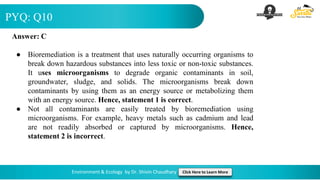
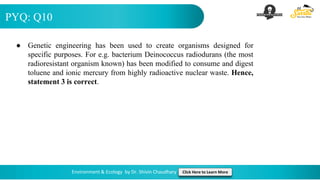
● Bioremediation uses microorganisms (bacteria and fungi) to degrade
environmental contaminants into less toxic forms.
● Microorganisms can be specifically designed for bioremediation using
genetic engineering techniques. Can you recall?
● The process of bioremediation can be monitored indirectly by measuring
the Oxidation Reduction Potential or redox in soil and groundwater,
together with pH, temperature, oxygen content, electron
acceptor/donor concentrations, and concentration of breakdown
products (e.g. carbon dioxide).
108.
Pollution
Environment & Ecologyby Dr. Shivin Chaudhary Click Here to Learn More
● Researchers have reported the presence of naturally occurring
chloropyrifos- resistant bacteria (E.Coli and Pseudomonas fluorescens) in
the environments of Kashmir Valley.
○ Chloropyrifos is an organophosphorous insecticide widely used in
the region.
● The finding, according to the researchers, could lead to the use of microbial
systems for removal of pollutants from contaminated.
109.
Pollution
Environment & Ecologyby Dr. Shivin Chaudhary Click Here to Learn More
In-situ (at the site) bioremediation
● Bioventing: Supply of nutrients through wells to contaminated soil to
stimulate the growth of bacteria. It is used for simple hydrocarbons and
can be used where the contamination is deep under the surface.
● Biosparging: Injection of air under pressure below the water table to
increase groundwater oxygen concentrations and enhance the rate of
biological degradation of contaminants by bacteria.
● Bioaugmentation: Microorganisms are imported to a contaminated site to
enhance the degradation process.
110.
Pollution
Environment & Ecologyby Dr. Shivin Chaudhary Click Here to Learn More
Ex-situ bioremediation
● Landfarming: contaminated soil is excavated and spread over a prepared
bed and periodically tilled until pollutants are degraded. The goal is to
stimulate indigenous biodegradative microorganisms and facilitate their
aerobic degradation of contaminants.
● Bioreactors: involve the processing of contaminated solid material (soil,
sediment, sludge) or water through an engineered containment system.
● Biopiles: It is a hybrid of landfarming and composting. Essentially,
engineered cells are constructed as aerated compost piles. Typically used
for treatment of surface contamination with petroleum hydrocarbons.
● Composting: Composting is nature's recycling of decomposed organic
materials into a rich soil known as compost.
111.
Pollution
Environment & Ecologyby Dr. Shivin Chaudhary Click Here to Learn More
Advantages of bioremediation
● Destroys a wide variety of contaminants.
● The destruction of target pollutants is possible.
● Less expensive and environment-friendly.
Disadvantages of bioremediation
● Bioremediation is limited to biodegradable compounds.
● Not all compounds are susceptible to biodegradation.
● It often takes a longer than other treatment processes
112.
Pollution
Environment & Ecologyby Dr. Shivin Chaudhary Click Here to Learn More
Phytoremediation
● Phytoremediation is the use of plants to remove contaminants from soil
and water. Mangroves, estuarine vegetation and other wetland vegetation
carry out natural phytoremediation.
Types:
● Phytoextraction/phytoaccumulation: It is the accumulation of
contaminants into the roots and aboveground shoots or leaves of
plants. E.g. Water hyacinth (an aquatic weed, invasive species) can
purify water by taking some toxic materials and several heavy metals from
water. Planting eucalyptus trees all along sewage ponds is suggested.
These trees absorb all surplus wastewater rapidly and release pure water
vapour into the atmosphere.
113.
Pollution
Environment & Ecologyby Dr. Shivin Chaudhary Click Here to Learn More
● Phytotransformation or phytodegradation: It refers to the
uptake of organic contaminants from soil, sediments, or water and
their transformation to more stable, less toxic, less mobile form.
● Phytostabilization: It is a technique in which plants reduce the
mobility and migration of contaminated soil. Leachable
constituents are adsorbed and bound into the plant structure so that
they form unstable mass of plant from which the contaminants will
not re-enter the environment.
114.
Pollution
Environment & Ecologyby Dr. Shivin Chaudhary Click Here to Learn More
● Mycoremediation: It is a form of bioremediation in which fungi
are used to decontaminate the area.
● Mycofiltration: It is a similar process, using fungal mycelia to
filter toxic waste and microorganisms from water in soil.
115.
Pollution
Environment & Ecologyby Dr. Shivin Chaudhary Click Here to Learn More
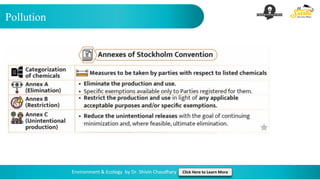
Stockholm Convention on POPs (UNEP convention)
● Stockholm Convention on Persistent Organic Pollutants (POPs) is an
international treaty enacted in 2004 to eliminate or restrict the production
and use of POPs.
● Membership: 186 parties (185 states and the European Union).
○ India ratified in 2006.
○ The Ministry of Environment notified the 'Regulation of POP Rules'
in 2018, under the Environment (Protection) Act, 1986.
○ The chemicals targeted are listed in the annexes of the convention
text.
● Notable non-ratifying states: the United States, (no surprises there)
Israel, and Malaysia.
116.
Pollution
Environment & Ecologyby Dr. Shivin Chaudhary Click Here to Learn More
Persistent Organic Pollutants (POPs)
● POPs are defined as “chemical substances that persist in the
environment, bioaccumulate through the food web, & pose a risk of
causing adverse effects to human health & the environment”.
● The most commonly encountered POPs are organochlorine pesticides.
Why POPs are so harmful?
● They remain intact for exceptionally long periods of time (many years).
● They become widely distributed throughout the environment as a result of
natural processes involving soil, water and, most notably, air, long range
environment transport (LRET).
117.
Pollution
Environment & Ecologyby Dr. Shivin Chaudhary Click Here to Learn More
● They accumulate in the fatty tissue of living organisms including
humans, and are found at higher concentrations at higher levels in the
food chain;
● They are toxic to both humans and wildlife.
● Exposure to POPs can lead to cancer, damage to central & peripheral
nervous systems, diseases of Endos immune system, reproductive
disorders and interference with normal infant and child development.
● In addition, POPs concentrate in living organisms through another process
called bioaccumulation. (upto 70000 times)
118.
Pollution
Environment & Ecologyby Dr. Shivin Chaudhary Click Here to Learn More
Included Listed PoPs Use
Aldrin insecticide.
Endrin agricultural insecticide
Heptachlor termiticide
Hexachlorobenzene chemical intermediate and a solvent for
pesticides.
DDT chlorine-containing pesticides
Pollution
Environment & Ecologyby Dr. Shivin Chaudhary Click Here to Learn More
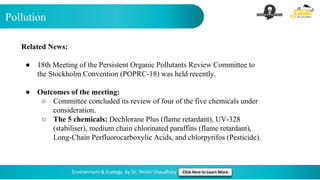
Related News:
● 18th Meeting of the Persistent Organic Pollutants Review Committee to
the Stockholm Convention (POPRC-18) was held recently.
● Outcomes of the meeting:
○ Committee concluded its review of four of the five chemicals under
consideration.
○ The 5 chemicals: Dechlorane Plus (flame retardant), UV-328
(stabiliser), medium chain chlorinated paraffins (flame retardant),
Long-Chain Perfluorocarboxylic Acids, and chlorpyrifos (Pesticide).
121.
Pollution
Environment & Ecologyby Dr. Shivin Chaudhary Click Here to Learn More
Endosulfan
● An organochlorine biocide used for controlling pests and mites by
generating neurotoxic effects. It is prayed on cotton, cashew, fruits, tea,
paddy, and tobacco etc.
● Banned in 2011 by SC and under Stockholm Convention on Persistent
Organic Pollutants.
● Complete ban w.e.f of December 2020 was also put on Alachlor,
Dichlovos, Trichlorfon, Phosphamidon, methyl parathion, phorate
and triazophos.
● Supreme Court (SC) directed Kerala to pay ₹5 lakh compensation each
victim of toxic Endosulfan pesticide. : Kasargod Tragedy
122.
Pollution
Environment & Ecologyby Dr. Shivin Chaudhary Click Here to Learn More
Nanoplastics
● Context: Researchers have developed a new, metallic fingerprint-based
method to detect and measure amount of nanoplastics in organisms.
● Researchers exposed lettuce plants to nanoplastics from commonly found
plastic waste in environment — polystyrene (PS) and polyvinyl chloride
(PVC) nanoplastics.
● Nanoplastics are smaller than 1,000 nanometre (1 nm is equal to one
billionth of a metre).
● It can lead to cell damage and inflammation in humans; growth
impairments, larval deformities and other toxic effects in marine
organisms.
123.
Pollution
Environment & Ecologyby Dr. Shivin Chaudhary Click Here to Learn More
Basel Convention on the Control of Transboundary Movement of
hazardous wastes (UNEP)
● The Basel Convention on the Control of Transboundary Movements
of Hazardous Wastes and their Disposal was adopted on 22 March
1989 by the Conference of Plenipotentiaries in Basel, Switzerland, in
response to a public outcry following the discovery, in the 1980s, in
Africa and other parts of the developing world of deposits of toxic wastes
imported from abroad.
● It entered into force in 1992.
● As of 2018, 190 members are parties to the Convention. The United
States has signed the Convention but has not ratified it.
● India is a member of the Basel Convention. It ratified the convention in
June 1992 and brought it into force on 22nd September
124.
Pollution
Environment & Ecologyby Dr. Shivin Chaudhary Click Here to Learn More
Basel Convention was designed to:
● Reduce the movement of hazardous waste between nations.
● Prevent the transfer of hazardous waste from developed to less developed
countries (LDCs).
● Minimize the amount and toxicity of wastes generated.
● Assist LDCs in environmentally sound management of the hazardous and
other wastes they generate.
125.
Pollution
Environment & Ecologyby Dr. Shivin Chaudhary Click Here to Learn More
● Annexes:
○ Annex I of the Convention: as further clarified in Annexes VIII and
IX, lists those wastes that are classified as hazardous and subject to
the control procedures under the Convention.
○ Annex II of the Convention identifies those wastes that require
special consideration (known as "other wastes", and which primarily
refer to household wastes).
● Examples of Waste Included: Biomedical and healthcare wastes, Used
oils, Used lead acid batteries, Polychlorinated Biphenyls (PCBs).
126.
Pollution
Environment & Ecologyby Dr. Shivin Chaudhary Click Here to Learn More
Rotterdam Convention (UNEP)
● It was adopted in 1998 by a Conference of Plenipotentiaries in Rotterdam,
the Netherlands and entered into force on 24 February 2004.
● The Convention creates legally binding obligations for the implementation
of the Prior Informed Consent (PIC) procedure.
● It built on the voluntary PIC procedure, initiated by UNEP and FAO in
1989 and ceased on 24 February 2006.
127.
Pollution
Environment & Ecologyby Dr. Shivin Chaudhary Click Here to Learn More
● The Convention covers pesticides and industrial chemicals that have been
banned or severely restricted for health or environmental reasons by Parties
and which have been notified by Parties for inclusion in the PIC procedure.
Prior Informed Consent
● A mechanism under Rotterdam Convention for formally obtaining and
disseminating the decisions of importing parties on their willingness to
receive future shipments of hazardous chemicals listed in Annex III of the
Convention and for ensuring compliance with these decisions by exporting
Parties.
128.
Pollution
Environment & Ecologyby Dr. Shivin Chaudhary Click Here to Learn More
Objectives:
● to promote shared responsibility and cooperative efforts among Parties in
the international trade of certain hazardous chemicals in order to protect
human health and the environment from potential harm;
● to contribute to the environmentally sound use of those hazardous
chemicals, by facilitating information exchange about their characteristics,
by providing for a national decision-making process on their import and
export and by disseminating these decisions to Parties.
129.
Pollution
Environment & Ecologyby Dr. Shivin Chaudhary Click Here to Learn More
Other key information:
● Covers pesticides and industrial chemicals that have been banned or
severely restricted for health or environmental reasons by Parties.
● Creates legally binding obligations for the implementation of the PIC
procedure. Information Exchange is facilitated among Parties for a
very broad range of potentially hazardous chemicals.
● A subsidiary body Chemical Review Committee (CRC) was established
to review chemicals and pesticide formulations according to criteria set out
by Convention.
130.
Pollution
Environment & Ecologyby Dr. Shivin Chaudhary Click Here to Learn More
Annex III Chemicals
● The chemicals listed in Annex III include pesticides and industrial
chemicals that have been banned or severely restricted for health or
environmental reasons by two or more Parties and which the Conference of
the Parties has decided to subject to the PIC procedure.
● There are a total of 43 chemicals listed in Annex III, 32 are pesticides
(including 4 severely hazardous pesticide formulations) and 11 industrial
chemicals.
131.
Pollution
Environment & Ecologyby Dr. Shivin Chaudhary Click Here to Learn More
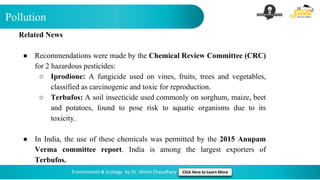
Related News
● Recommendations were made by the Chemical Review Committee (CRC)
for 2 hazardous pesticides:
○ Iprodione: A fungicide used on vines, fruits, trees and vegetables,
classified as carcinogenic and toxic for reproduction.
○ Terbufos: A soil insecticide used commonly on sorghum, maize, beet
and potatoes, found to pose risk to aquatic organisms due to its
toxicity.
● In India, the use of these chemicals was permitted by the 2015 Anupam
Verma committee report. India is among the largest exporters of
Terbufos.
132.
Pollution
Environment & Ecologyby Dr. Shivin Chaudhary Click Here to Learn More
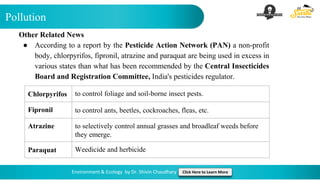
Other Related News
● According to a report by the Pesticide Action Network (PAN) a non-profit
body, chlorpyrifos, fipronil, atrazine and paraquat are being used in excess in
various states than what has been recommended by the Central Insecticides
Board and Registration Committee, India's pesticides regulator.
Chlorpyrifos to control foliage and soil-borne insect pests.
Fipronil to control ants, beetles, cockroaches, fleas, etc.
Atrazine to selectively control annual grasses and broadleaf weeds before
they emerge.
Paraquat Weedicide and herbicide
133.
Pollution
Environment & Ecologyby Dr. Shivin Chaudhary Click Here to Learn More
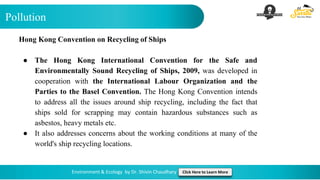
Hong Kong Convention on Recycling of Ships
● The Hong Kong International Convention for the Safe and
Environmentally Sound Recycling of Ships, 2009, was developed in
cooperation with the International Labour Organization and the
Parties to the Basel Convention. The Hong Kong Convention intends
to address all the issues around ship recycling, including the fact that
ships sold for scrapping may contain hazardous substances such as
asbestos, heavy metals etc.
● It also addresses concerns about the working conditions at many of the
world's ship recycling locations.
134.
Pollution
Environment & Ecologyby Dr. Shivin Chaudhary Click Here to Learn More
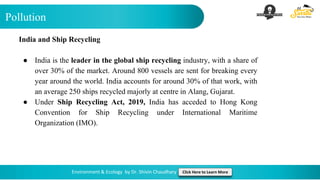
India and Ship Recycling
● India is the leader in the global ship recycling industry, with a share of
over 30% of the market. Around 800 vessels are sent for breaking every
year around the world. India accounts for around 30% of that work, with
an average 250 ships recycled majorly at centre in Alang, Gujarat.
● Under Ship Recycling Act, 2019, India has acceded to Hong Kong
Convention for Ship Recycling under International Maritime
Organization (IMO).
135.
Pollution
Environment & Ecologyby Dr. Shivin Chaudhary Click Here to Learn More
International Convention for the Prevention of Pollution from Ships
(MARPOL)
● The International Convention for the Prevention of Pollution from Ships
(MARPOL) is the main international convention covering prevention
of pollution of the marine environment by ships from operational or
accidental causes.
● The MARPOL Convention was adopted on 2 November 1973 at IMO.
● The Convention includes regulations aimed at preventing and
minimizing pollution from ships - both accidental pollution and that from
routine operations - and currently includes six technical Annexes.
136.
Pollution
Environment & Ecologyby Dr. Shivin Chaudhary Click Here to Learn More
IMO's International Code for Ships Operating in Polar Waters (Polar
Code)
● The Polar Code covers the full range of design, construction,
equipment, operational, training, search and rescue and
environmental protection matters relevant to ships operating in the
inhospitable waters surrounding the two poles. The Polar Code entered
into force on 1 January 2017.
● The Polar Code includes mandatory measures covering safety part (part
I-A) and pollution prevention (part II-A) and recommendatory provisions
for both (parts I-B and II-B).
137.
Pollution
Environment & Ecologyby Dr. Shivin Chaudhary Click Here to Learn More
● The Code requires ships intending to operating in the defined waters in
Poles to apply for a Polar Ship Certificate, which classify the vessel as:
○ Category A ship - ships designed for operation in polar waters at
least in medium first-year ice, which may include old ice inclusions;
○ Category B ship - a ship not included in category A, designed for
operation in polar waters in at least thin first-year ice, which may
include old ice inclusions; or
○ Category C ship - a ship designed to operate in open water or in ice
conditions less severe than those included in Categories A and B.
● The issuance of a certificate would require an assessment, taking into
account the anticipated range of operating conditions and hazards the ship
may encounter in the polar waters.
138.
Pollution
Environment & Ecologyby Dr. Shivin Chaudhary Click Here to Learn More
London Convention (Convention on Dumping of Wastes at Sea)
● An inter-governmental conference on the Convention on the Dumping of
Wastes at Sea met in London in 1972 to adopt this instrument, the
London Convention. The Convention has a global character and is
aimed at international control and putting an end to marine
pollution.
● The definition of dumping under the Convention relates to the deliberate
disposal at sea of wastes or other materials from vessels, aircraft,
platforms & other man-made structures.
139.
Pollution
Environment & Ecologyby Dr. Shivin Chaudhary Click Here to Learn More
● ‘Dumping’ here does not cover wastes derived from the exploration &
exploitation of sea-bed minerals.
● The 1978 amendment to the convention banned the incineration of
wastes at sea.
● It phased out the dumping of industrial wastes by 1995.
140.
Pollution
Environment & Ecologyby Dr. Shivin Chaudhary Click Here to Learn More
Under2 Coalition
● The Under2 Coalition is a coalition of subnational governments that
aims to achieve greenhouse gases emissions mitigation.
● The Under2 MOU was conceived through a partnership between the
governments of California and Baden-Wurttemberg. The
memorandum was developed just before the Paris Agreement.
● It was signed by twelve founding jurisdictions on May 19, 2015 in
Sacramento, California.
● Originally called the Under2 MOU, it became known as the Under2
Coalition in 2017.
● As of October 2022, the list of signatories had grown to 270
governments.
141.
Pollution
Environment & Ecologyby Dr. Shivin Chaudhary Click Here to Learn More
● The Climate Group acting as secretariat.
● Purpose: The intent of the memorandum signatories is for each to
achieve Greenhouse gas emission reductions consistent with a trajectory
of 80 to 95 percent below 1990 levels by 2050 and/or achieving a per
capita annual emission goal of less than 2 metric tons by 2050.
● The Under2 MoU allows subnational governments such as cities,
counties and states to highlight their work to reduce greenhouse gas
emissions.
142.
Blue Flag Certification
Environment& Ecology by Dr. Shivin Chaudhary Click Here to Learn More
● This Certification is accorded by an international agency “Foundation for Environment
Education, Denmark” based on 33 stringent criteria in four major heads i.e
○ Environmental Education and Information,
○ Bathing Water Quality,
○ Environment Management and Conservation and
○ Safety and Services on the beaches.
● It started in France in 1985 and has been implemented in Europe since 1987, and in
areas outside Europe since 2001 when South Africa joined.
● Spain tops the list with 566 such beaches; Greece and France follow with 515 and 395,
respectively.
Mangroves
Environment & Ecologyby Dr. Shivin Chaudhary Click Here to Learn More
● Mangroves are salt-tolerant (halophytes)
evergreen shrubs or small trees (vary in height
from 8 to 20 m) that represent a characteristic
littoral (near the seashore) forest ecosystem.
● They grow below the highwater level of spring
tides.
● The best locations are where abundant silt is
brought down by rivers or on the backshore of
accreting sandy beaches.
● Such locations include brackish waters of
sheltered low-lying coasts, estuaries, mudflats,
tidal creeks, backwaters (coastal waters held back
on land), marshes and lagoons of tropical and
subtropical regions.
145.
Adaptive Mechanism ofMangroves
Environment & Ecology by Dr. Shivin Chaudhary Click Here to Learn More
● Succulent leaves (thick leaves adapted to store
water and reduce evapotranspiration),
● Sunken stomata (to protect from drying winds),
● Leaves with salt-secreting glands (to flush out
the excess salt)
● Aerial breathing roots called pneumatophores,
● Vivipary (seeds or embryos begin to develop
before they detach from the parent),
● Stilt and prop roots (they are fibrous
(adventitious) support roots)
● Buttresses (large, wide support roots on all sides
of a shallowly rooted (mangrove) tree).
146.
Adaptive Mechanism ofMangroves
Environment & Ecology by Dr. Shivin Chaudhary Click Here to Learn More
● The adventitious roots (prop and stilt roots), which emerge from the main trunk above
ground level, act as support roots. The complex root system helps mangroves overcome
the strong wave action and diurnal tidal inundation.
● The pneumatophores (blind roots), prop roots and stilt roots help mangroves overcome
the respiration problem in anaerobic (low oxygen — anoxic) soil conditions (a classic
example of adaptation).
● Mangroves exhibit a viviparity mode of reproduction, i.e., seeds germinate in the tree
itself (before falling to the ground). This is an adaptive mechanism to overcome the
problem of germination in saline water.
147.
Why are mangrovesnot found beyond
subtropics?
Environment & Ecology by Dr. Shivin Chaudhary Click Here to Learn More
● Mangroves are confined to the tropics and subtropics, occurring mainly in
the intertidal regions between latitudes 24° N and 38° S.
● This is because the mangrove vegetation contains a complex salt
filtration system that facilitates high water loss at the root level itself
to cope with the brackish conditions.
● These adaptive mechanisms are energy-intensive and require high solar
radiation.
148.
Mangrove Cover inIndia
Environment & Ecology by Dr. Shivin Chaudhary Click Here to Learn More
149.
Mangrove Cover inIndia
Environment & Ecology by Dr. Shivin Chaudhary Click Here to Learn More
● The mangroves of Sundarbans are the
largest single block of tidal halophytic
mangroves of the world. (Sundari tree)
This mangrove forest is famous for the
Royal Bengal Tiger and crocodiles.
● Bhitarkanika (Orissa): Second largest
in the Indian sub-continent
● Mangrove swamps also occur in
profusion in the intertidal mudflats on
both side of the creeks in the Godavari-
Krishna deltaic regions of Andhra
Pradesh.
150.
Mangrove Cover inIndia
Environment & Ecology by Dr. Shivin Chaudhary Click Here to Learn More
● On the west coast of India, mangroves,
mostly scrubby and degraded occur
along the intertidal region of estuaries
and creeks in Maharashtra, Goa and
Karnataka.
● The mangrove vegetation in the coastal
zone of Kerala is very sparse and thin.
● In Gujarat (north-west coast) mangroves
Avicennia marine, Avicennia officinalis
and Rhizophora mucronata are found
mainly in Gulf of Kutch and the Kori
creek.
151.
State of MangrovesReport 2022
Environment & Ecology by Dr. Shivin Chaudhary Click Here to Learn More
Released by: Global Mangrove Alliance
(annual report).
Key findings
● Global Mangrove extent is of 147,359
km2 (2020). It is higher than previous
estimates of 136,000 km2 (for 2016)
largely due to improved maps rather
than real gains.
● The rates of loss have greatly
diminished, with averaged losses over
the last decade of just 66 km2 of all
mangroves per year (327 km2 between
1996 and 2010).
152.
State of MangrovesReport 2022
Environment & Ecology by Dr. Shivin Chaudhary Click Here to Learn More
153.
Initiatives for Mangrove
Environment& Ecology by Dr. Shivin Chaudhary Click Here to Learn More
● Mangrove Alliance for Climate (MAC) (Launched by The United Arab
Emirates (UAE) and Indonesia.
● Other members include Sri Lanka, Australia, Japan, India and Spain.
● Launched during COP27
● Building with Nature in Indonesia (launched by Indonesia)
● Aims to naturally regenerate mangroves and protect Indonesia’s coast
against flooding.
● Recognised under World Restoration Flagships (UN Decade on
Ecosystem Restoration declared to the best examples of large-scale and
● long-term ecosystem restoration in world)
154.
Initiatives for Mangrove
Environment& Ecology by Dr. Shivin Chaudhary Click Here to Learn More
● MISHTI scheme (Mangrove Initiative for Shoreline Habitats & Tangible
Incomesa): Launched under Budget 2023-24
● Take up mangrove plantation along the coastline and on salt pan lands, wherever
feasible, through convergence between MGNREGS, CAMPA Fund and other
sources.
● Sustainable Aquaculture in Mangrove Ecosystem (SAIME) Initiative
● It is new initiative of sustainable shrimp cultivation provides hope for mangrove
restoration in Sundarbans.
● It is a community-based pilot project in West Bengal under which farmers are
planting mangrove trees around shrimp ponds.
● Generally, mangrove forests are cleared to cultivate shrimps in the areas. o It is
being conceived by Nature Environment and Wildlife Society (NEWS), Global
Nature Fund and others.
155.
Importance of Mangrove
Environment& Ecology by Dr. Shivin Chaudhary Click Here to Learn More
● Highly productive ecosystems with rich biodiversity.
● Very efficient in dissipating the sea wave energy, thus protecting the
coastal areas from tsunamis, storm surges (produced by cyclones) and
soil erosion.
● Slow down water flow and act as a zone of land accretion by enhancing
sediment deposition.
● Act as a riparian buffer and trap pollutants, including heavy metal
contaminants. They enhance the natural recycling of nutrients.
● Essential carbon sink.
● Act as an essential source of livelihood for the coastal communities
dependent on the collection of honey, tannins, wax, firewood, medicinal
plants, edible plants, and fishing
156.
Threats to Mangroves
Environment& Ecology by Dr. Shivin Chaudhary Click Here to Learn More
Natural threats:
● Cyclones, typhoons and strong wave actions.
● Trampling and overgrazing by wildlife and livestock close to mangrove
regions.
● Damage by crabs, oysters and pests to the young seedlings of mangroves.
Anthropological threats:
● Agriculture: Many thousands of acres of mangrove forest have been
destroyed to make way for rice paddies, rubber trees, palm oil plantations,
and other forms of agriculture.
● Coastal Development
● Shrimp Farming: By far the greatest threat to the world’s mangrove
forests is the rapidly expanding shrimp aquaculture industry.
157.
PYQ: Q1
Environment &Ecology by Dr. Shivin Chaudhary Click Here to Learn More
2013
Which of the following can be found as pollutants in the drinking water in
some parts of India?
1. Arsenic
2. Sorbitol
3. Fluoride
4. Formaldehyde
5. Uranium
Select the correct answer using the codes given below.
a) 1 and 3 only
b) 2, 4 and 5 only
c) 1, 3 and 5 only
d) 1, 2, 3, 4 and 5
158.
PYQ: Q1
Environment &Ecology by Dr. Shivin Chaudhary Click Here to Learn More
Answer: C
● Water pollutants include contamination due to domestic wastes,
insecticides and herbicides, food processing waste, pollutants from
livestock operations, volatile organic compounds (VOCs), heavy metals,
chemical waste, and others.
● Uranium in groundwater is indeed a problem in Punjab and leading to
the birth of mentally retarded children.
● Arsenic and Fluoride are well-known water pollutants.
159.
PYQs: Q2
Environment &Ecology by Dr. Shivin Chaudhary Click Here to Learn More
2019
In the context of which one of the following are the terms ‘pyrolysis
and plasma gasification’ mentioned?
a) Extraction of rare earth elements
b) Natural gas extraction technologies
c) Hydrogen fuel-based automobiles
d) Waste-to-energy technologies
160.
PYQs: Q2
Environment &Ecology by Dr. Shivin Chaudhary Click Here to Learn More
Answer: D
Explanation:
● Pyrolysis is the process of heating organic material at high
temperatures in the absence of oxygen.
● Plasma gasification is an extreme thermal process using plasma that
converts organic matter into syngas (synthesis gas) which is
primarily made up of hydrogen and carbon monoxide. Hence,
option d is correct.
161.
PYQ: Q3
Environment &Ecology by Dr. Shivin Chaudhary Click Here to Learn More
2013
Acid rain is caused by the pollution of the environment by -
a) Carbon dioxide and nitrogen
b) Carbon monoxide and carbon dioxide
c) Ozone and carbon dioxide
d) Nitrous oxide and sulphur dioxide
162.
PYQ: Q3
Environment &Ecology by Dr. Shivin Chaudhary Click Here to Learn More
Answer: D
● When oxides of nitrogen and sulphur mix with water in the atmosphere
and come down in the form of rain, it is termed as acid rain.
● Acid rain is caused by a chemical reaction that begins when compounds
like sulphur dioxide and nitrogen oxides are released into the air. These
substances can rise very high into the atmosphere, where they mix and
react with water, oxygen, and other chemicals to form more acidic
pollutants, known as acid rain.
163.
PYQ: Q4
Environment &Ecology by Dr. Shivin Chaudhary Click Here to Learn More
2013
Photochemical smog is a resultant of the reaction among -
a) NO2, 03 and peroxyacetyl nitrate in the presence of sunlight
b) CO, 02 and peroxyacetyl nitrate in the presence of sunlight
c) CO, CO2, and N02 at low-temperature
d) High concentration of N02, O3, and CO in the evening
164.
PYQ: Q4
Environment &Ecology by Dr. Shivin Chaudhary Click Here to Learn More
Answer: A
● Smog is a secondary pollutant, which is made up of Smoke and Fog. It is
caused by a mixture of smoke and sulfur dioxide. The major chemical
pollutants in Photochemical smog are NO, NO2, volatile organic
compounds, ozone, and PAN Perooxyacetly Nitrate. Hence, option a is
correct.
165.
PYQ: Q5
Environment &Ecology by Dr. Shivin Chaudhary Click Here to Learn More
2013
Due to improper/indiscriminate disposal of old and used computers or their
parts, which of the following are released into the environment as e-waste?
1. Beryllium
2. Cadmium
3. Chromium
4. Heptachlor
5. Mercury
6. Lead
7. Plutonium
Select the correct answer using the codes given below.
a) 1, 3, 4, 6 and 7 only
b) 1, 2, 3, 5 and 6 only
c) 2, 4, 5 and 7 only
d) 1, 2, 3, 4, 5, 6 and 7
166.
PYQ: Q5
Environment &Ecology by Dr. Shivin Chaudhary Click Here to Learn More
Answer: B
● The disposed of electrical or electronic devices are termed electronic
waste or e-waste. The elements of e-waste are lead, mercury, cadmium,
chromium, beryllium, Polyvinyl chloride, Sulphur, Perfluorooctanoic, and
Brominated Flame Retardant.
167.
PYQ: Q6
Environment &Ecology by Dr. Shivin Chaudhary Click Here to Learn More
2013
Which one among the following industries is the maximum consumer of water
in India?
a) Engineering
b) Paper and pulp
c) Textiles
d) Thermal power
168.
PYQ: Q6
Environment &Ecology by Dr. Shivin Chaudhary Click Here to Learn More
Answer: D
● Of the total water use by the industry, thermal power plants are the
biggest users of water and account for 88% of the total industrial water
use. They are followed by engineering (5.05%), pulp & paper (2.26%),
and textiles (2.07%) industries.
169.
PYQ: Q7
Environment &Ecology by Dr. Shivin Chaudhary Click Here to Learn More
2014
Which of the following are some important pollutants released by the steel
industry in India?
1. Oxides of sulphur
2. Oxides of nitrogen
3. Carbon monoxide
4. Carbon dioxide
Select the correct answer using the code given below.
a) 1, 3 and 4 only
b) 2 and 3 only
c) 1 and 4 only
d) 1, 2, 3 and 4
170.
PYQ: Q7
Environment &Ecology by Dr. Shivin Chaudhary Click Here to Learn More
Answer: D
● In a steel furnace, coke reacts with iron ore, releasing iron and generating
CO and CO2 gases. Due to the use of coal, pollutants such as SOx and
NOx are released, therefore all are correct options.
171.
PYQ: Q8
Environment &Ecology by Dr. Shivin Chaudhary Click Here to Learn More
2016
In the cities of our country, which among the following atmospheric gases are
normally considered in calculating the value of Air Quality Index?
1. Carbon dioxide
2. Carbon monoxide
3. Nitrogen dioxide
4. Sulphur Dioxide
5. Methane
Select the correct answer using the code given below
a) 1, 2 and 3 only
b) 2, 3 and 4 Only
c) 1, 4 and 5 Only
d) 1, 2, 3, 4 and 5
172.
PYQ: Q8
Environment &Ecology by Dr. Shivin Chaudhary Click Here to Learn More
Answer: B
The AQI is an index for reporting daily air quality.
● It tells you how clean or polluted your air is, and what associated health
effects might be a concern for you.
● The AQI focuses on health effects you may experience within a few hours
or days after breathing polluted air.
● EPA calculates the AQI for five major air pollutants regulated by the
Clean Air Act: ground-level ozone, particle pollution (also known as
particulate matter), carbon monoxide, sulfur dioxide, and nitrogen
dioxide.
● For each of these pollutants, EPA has established national air quality
standards to protect public health.
● Ground-level ozone and airborne particles are the two pollutants that pose
the greatest threat to human health in this country.
173.
PYQ: Q9
Environment &Ecology by Dr. Shivin Chaudhary Click Here to Learn More
2017
Biological Oxygen Demand (BOD) is a standard criterion for -
a) Measuring oxygen levels in the blood
b) Computing oxygen levels in forest ecosystems
c) Pollution assay in aquatic ecosystems
d) Assessing oxygen levels in high altitude regions
174.
PYQ: Q9
Environment &Ecology by Dr. Shivin Chaudhary Click Here to Learn More
Answer: C
● Biological oxygen demand (BOD) is the amount of dissolved oxygen
needed (i. e., demanded) by aerobic microorganisms to break down
organic material present in a given water sample. Highly polluted water
will have a high level of biological oxygen demand (BOD). Hence,
option c is correct.
● It is the amount of dissolved oxygen needed by bacteria in decomposing
the organic wastes present in water. It is expressed in milligrams of
oxygen per liter of water.
● The higher value of BOD indicates low DO content of water.
175.
PYQ: Q10
Environment &Ecology by Dr. Shivin Chaudhary Click Here to Learn More
2017
In the context of solving pollution problems, what is/are the
advantage/advantages of the bioremediation technique?
1. It is a technique for cleaning up pollution by enhancing the same
biodegradation process that occurs in nature.
2. Any contaminant with heavy metals such as cadmium and lead can be
readily and completely treated by bioremediation using microorganisms.
3. Genetic engineering can be used to create microorganisms specifically
designed for bioremediation.
Select the correct answer using the code given below:
a) 1 only
b) 2 and 3 only
c) 1 and 3 only
d) 1, 2 and 3
176.
PYQ: Q10
Environment &Ecology by Dr. Shivin Chaudhary Click Here to Learn More
Answer: C
● Bioremediation is a treatment that uses naturally occurring organisms to
break down hazardous substances into less toxic or non-toxic substances.
It uses microorganisms to degrade organic contaminants in soil,
groundwater, sludge, and solids. The microorganisms break down
contaminants by using them as an energy source or metabolizing them
with an energy source. Hence, statement 1 is correct.
● Not all contaminants are easily treated by bioremediation using
microorganisms. For example, heavy metals such as cadmium and lead
are not readily absorbed or captured by microorganisms. Hence,
statement 2 is incorrect.
177.
PYQ: Q10
Environment &Ecology by Dr. Shivin Chaudhary Click Here to Learn More
● Genetic engineering has been used to create organisms designed for
specific purposes. For e.g. bacterium Deinococcus radiodurans (the most
radioresistant organism known) has been modified to consume and digest
toluene and ionic mercury from highly radioactive nuclear waste. Hence,
statement 3 is correct.
178.
PYQ: Q11
Environment &Ecology by Dr. Shivin Chaudhary Click Here to Learn More
2018
In India, ‘extended producer responsibility’ was introduced as an important
feature in which of the following?
a) The Bio-medical Waste (Management and Handling) Rules, 1998
b) The Recycled Plastic (Manufacturing and Usage) Rules, 1999
c) The e-Waste (Management and Handling) Rules, 2011
d) The Food Safety and Standard Regulations, 2011
179.
PYQ: Q11
Environment &Ecology by Dr. Shivin Chaudhary Click Here to Learn More
Answer: C
E-Waste (Management and Handling) Rules, 2011
● Extended producer’s responsibility (EPR) is the main feature of the E-
waste (Management and Handling) Rules, 2011, wherein the producer of
electrical and electronic equipment has the responsibility of managing
such equipment after its ‘end of life’, thus the producer is responsible for
their products once the consumer discards them. Hence, option c is
correct.
180.
PYQ: Q12
Environment &Ecology by Dr. Shivin Chaudhary Click Here to Learn More
2019
As per the Solid Waste Management Rules, 2016 in India, which one of the
following statements is correct?
a) Waste generator has to segregate waste into five categories.
b) The Rules are applicable to notified urban local bodies, notified towns, and
all industrial townships only.
c) The Rules provide exact and elaborate criteria for the identification of sites
for landfills and waste processing facilities.
d) It is mandatory on the part of the waste generator that the waste generated in
one district cannot be moved to another district.
181.
PYQ: Q12
Environment &Ecology by Dr. Shivin Chaudhary Click Here to Learn More
Answer: C
● The SWM Rules 2016 provide detailed criteria for setting ‐up solid waste
processing and treatment facility, solid waste management in hilly areas,
for waste to energy process, Sanitary Landfills, site selection,
development of facilities at the sanitary landfills, specifications for
landfilling operations and closure on completion of landfilling, pollution
prevention, Closure and Rehabilitation of Old Dumps, etc. Hence, option
c is correct.
182.
PYQ: Q13
Environment &Ecology by Dr. Shivin Chaudhary Click Here to Learn More
2019
Why is there a great concern about the ‘microbeads’ that are released into the
environment?
a) They are considered harmful to marine ecosystems.
b) They are considered to cause skin cancer in children.
c) They are small enough to be absorbed by crop plants in irrigated fields.
d) They are often found to be used as food adulterants.
183.
PYQ: Q13
Environment &Ecology by Dr. Shivin Chaudhary Click Here to Learn More
Answer: A
● Microbeads are manufactured solid plastic particles of less than one
millimeter in their largest dimension
● They are most frequently made of polyethylene but can be of other
petrochemical plastics such as polypropylene and polystyrene.
● Microbeads, small pellets of plastic, extensively used in personal care
products such as shampoo, baby lotion, and face cream and considered
toxic to marine life, are being banned internationally. Hence, option a is
correct.
184.
PYQ: Q14
Environment &Ecology by Dr. Shivin Chaudhary Click Here to Learn More
2019
Consider the following:
1. Carbon monoxide
2. Methane
3. Ozone
4. Sulphur dioxide
Which of the above are released into the atmosphere due to the burning of
crop/biomass residue?
a) 1 and 2 only
b) 2, 3 and 4 only
c) 1 and 4 only
d) 1, 2, 3 and 4
185.
PYQ: Q14
Environment &Ecology by Dr. Shivin Chaudhary Click Here to Learn More
Answer: D
● Agricultural crop residue burning contributes towards the emission of
greenhouse gases (CO2, N2O, CH4), air pollutants
● (CO, NH3, NOx, SO2, NMHC, volatile organic compounds), particulate
matter and smoke thereby posing a threat to human health. Hence, option
d is correct.
186.
PYQ: Q15
Environment &Ecology by Dr. Shivin Chaudhary Click Here to Learn More
2020
Which of the following are the reasons/factors for exposure to benzene
pollution?
1. Automobile exhaust
2. Tobacco smoke
3. Wood burning
4. Using varnished wooden furniture
5. Using products made of polyurethane
Select the correct answer using the code is given below:
a) 1, 2 and 3 only
b) 2 and 4 only
c) 1, 3 and 4 only
d) 1, 2, 3, 4 and 5
187.
PYQ: Q15
Environment &Ecology by Dr. Shivin Chaudhary Click Here to Learn More
Answer: A
● Sources of exposure to benzene Human exposure to benzene has been
associated with a range of acute and long-term adverse health effects and
diseases, including cancer and aplastic anemia. Active and passive
exposure to tobacco smoke is also a significant source of exposure.
Benzene is highly volatile, and most exposure is through inhalation.
Natural sources of benzene include volcanoes and forest fires. Benzene is
also a natural part of crude oil, gasoline, and cigarette smoke.
● Industrial processes As benzene occurs naturally in crude petroleum at
levels up to 4 g/l, human activities using petroleum lead to exposure.
These activities include processing petroleum products, coking of coal,
production of toluene, xylene, and other aromatic compounds, and use in
industrial and consumer products, as a chemical intermediate and as a
component of petrol (gasoline) and heating oils.
188.
PYQ: Q15
Environment &Ecology by Dr. Shivin Chaudhary Click Here to Learn More
● The presence of benzene in petrol and as a widely used industrial solvent
can result in a significant occupational exposure and widespread
emissions to the environment. Automobile exhaust accounts for the
largest source of benzene in the general environment. Wood finishes can
contain and emit various chemicals. For example, paints and some wood
treatments can contain formaldehyde, acetone, toluene, or butanol. Wood
dyes can contain nonane, decane, undecane, dimethyloctane,
dimethylnonane, trimethylnonane, trimethylbenzene. Carbon monoxide is
the most common, but smoke also contains benzene, toluene, nitrogen
oxides, and hydrogen cyanide.
189.
PYQ: Q16
Environment &Ecology by Dr. Shivin Chaudhary Click Here to Learn More
2020
Consider the following statements:
1. Coal ash contains arsenic, lead, and mercury.
2. Coal-fired power plants release Sulphur dioxide and oxides of nitrogen
into the environment.
3. High ash content is observed in Indian coal.
Which of the statements given above is/are correct?
a) 1 only
b) 2 and 3 only
c) 3 only
d) 1, 2 and 3
190.
PYQ: Q16
Environment &Ecology by Dr. Shivin Chaudhary Click Here to Learn More
Answer: D
● Statement 1 is correct: Coal itself isn't a particularly toxic material. But
after it's burned, what remains in the ash includes lead, mercury,
cadmium, chromium, arsenic, and selenium, all at levels that may threaten
human health.
● Statement 2 is correct: Thermal power plants produce large amounts of
nitrogen oxides and sulfur dioxide—the pollutants that cause acid rain—
when they burn fossil fuels, especially coal, to produce energy.
● Statement 3 is correct: India's domestic coal reserves have a high ash
content—up to 40 to 45 percent.
191.
PYQ: Q17
Environment &Ecology by Dr. Shivin Chaudhary Click Here to Learn More
2021
Magnetite particles, suspected to cause neurodegenerative problems, are
generated as environmental pollutants from which of the following?
1. Brakes of motor vehicles
2. Engines of motor vehicles
3. Microwave stoves within homes
4. Power plants
5. Telephone lines
Select the correct answer using the code given below.
a) 1, 2, 3 and 5 only
b) 1, 2 and 4 only
c) 3, 4 and 5 only
d) 1, 2, 3, 4 and 5 only
192.
PYQ: Q17
Environment &Ecology by Dr. Shivin Chaudhary Click Here to Learn More
Answer: B
● Magnetite particles can act as pollutants and lead to neurodegenerative
problems. Magnetic particles can penetrate and damage the blood-brain
barrier and lead to the early development of Alzheimer’s disease.
● Whenever any magnetic component is used in appliances, they generate
magnetic flux which produces magnetic particles.
● Option 1 is correct. The automotive industry uses ceramic or ferrite
magnets to make vehicles safer. One of the most impressive uses is in the
Anti-lock Braking System (ABS) of vehicles. This use of magnets in
motor vehicles can generate magnetic particles.
● Option 2 is correct. Engines of motor vehicles can generate magnetic
particles as they use high-powered magnets which generate magnetic flux.
193.
PYQ: Q17
Environment &Ecology by Dr. Shivin Chaudhary Click Here to Learn More
● Option 4 is correct. Power Plants release metal content along with ash.
The use of coal in power plants is a major source of combustion-
associated magnetite fine particles.
194.
PYQ: Q18
Environment &Ecology by Dr. Shivin Chaudhary Click Here to Learn More
2021
Why is there a concern about copper smelting plants?
1. They may release lethal quantities of carbon monoxide into the
environment.
2. The copper slag can cause the leaching of some heavy metals into the
environment.
3. They may release sulphur dioxide as a pollutant.
Select the correct answer using the code given below.
a) 1 and 2 only
b) 2 and 3 only
c) 1 and 3 only
d) 1, 2 and 3
195.
PYQ: Q18
Environment &Ecology by Dr. Shivin Chaudhary Click Here to Learn More
Answer: B
● Statement 1 is incorrect. In the copper smelting process, first, the carbon
(C) combusts with oxygen (O2) in the air to produce carbon
monoxide (CO). Second, the carbon monoxide reacts with the ore and
removes one of its oxygen atoms, releasing carbon dioxide. Hence, it does
not release a lethal quantity of CO into the environment.
● Statement 2 is correct. Copper smelters emit staggering amounts of toxic
pollution i.e., lead, arsenic and selenium. These heavy metals and
particulate matter from copper smelters contaminate the environment
downwind and downstream.
● Statement 3 is correct. Copper smelters are the largest source of sulphur
oxides (SOx) and trace elements. Suspended particles have a pollution
scope of 2-3 km, while Sulphur dioxide has a range of as much as 15 km.
196.
PYQ: Q19
Environment &Ecology by Dr. Shivin Chaudhary Click Here to Learn More
2022
Consider the following
1. Carbon monoxide
2. Nitrogen oxide
3. Ozone
4. Sulphur dioxide
Excess of which of the above in the environment is/are the cause(s) of acid
rain?
a) 1, 2 and 3
b) 2 and 4 only
c) 4 only
d) 1, 3 and 4
197.
PYQ: Q19
Environment &Ecology by Dr. Shivin Chaudhary Click Here to Learn More
Answer: B (2 and 4 only)
● Photo oxidants like O3 catalyse acid rain formation, they are not the
primary causative agents.
198.
PYQs: Q20
Environment &Ecology by Dr. Shivin Chaudhary Click Here to Learn More
2022
In the context of WHO Air Quality Guidelines, consider
the following statements:
1. The 24-hr mean of PM2.5 should not exceed 15 μg/m3
& annual mean of PM2.5 should not exceed 5μg/m3.
2. In a year, the highest levels of ozone pollution occur
during the periods of inclement weather.
3. PM10 can penetrate the lung barrier and enter the
bloodstream.
4. Excessive ozone in the air can trigger asthma.
Which of the statements given above are correct?
a) 1, 3 and 4
b) 1 and 4 only
c) 2, 3 and 4
d) 1 and 2 only.
199.
PYQs: Q20
Environment &Ecology by Dr. Shivin Chaudhary Click Here to Learn More
Answer: b) 1 and 4 only
● According to WHO Air Quality Guidelines, the annual average concentrations of PM2.5
should not exceed 5 µg/m3, while 24-hour average exposures should not exceed 15 µg/m3
more than 3 - 4 days per year. So, statement 1 is correct.
● Afternoon thunderstorm clouds block sunlight, causing ozone production to slow down for
the day, while moisture from the storm destroys the ozone that has formed. So, statement
2 is not correct.
● Studies have shown that PM with a diameter of 10 μm (PM10) can enter the lungs but not
the bloodstreams. So, statement 3 is not correct
● Excessive ozone can trigger asthma because it is very irritating to the lungs and airways.
So, statement 4 is correct.
200.
PYQs: Q21
Environment &Ecology by Dr. Shivin Chaudhary Click Here to Learn More
2020
Steel slag can be the material for which of the following?
1. Construction of base road
2. Improvement of agricultural soil
3. Production of cement
Select the correct answer using the code given below:
a)1 and 2 only
b)2 and 3 only
c)1 and 3 only
d)1, 2 and 3
201.
PYQs: Q21
Environment &Ecology by Dr. Shivin Chaudhary Click Here to Learn More
Answer- D)
● Steel slag, a by-product of steel making, is produced during the separation of the molten
steel from impurities in steel-making furnaces. The slag occurs as a molten liquid melt and
is a complex solution of silicates and oxides that solidifies upon cooling. It is used in
various activities such as in road construction, these are the preferred aggregates as they
harden well, enabling a thinner layer of pavement than what can be achieved with crushed
stone aggregates. Slag is also very hardy, resistant to both weather and wear. So, statement
1 is correct.
● Benefits of using steel slag for crops: Slag application favors the increase of pH and the
availability of nutrients such as Ca, Mg, and Si in the soil, which leads to the increase in
the absorption of these elements by the plant, favoring the growth and yield of the crops.
So, statement 2 is correct.
● Steel-slag can be used to produce energy-saving cement by co-grinding with OPC clinker
and blast furnace slag. It can replace Portland cement in various applications and is
especially suitable for projects where a low heat of hydration is required. So, statement 3
is correct.
202.
PYQs: Q22
Environment &Ecology by Dr. Shivin Chaudhary Click Here to Learn More
2022
With reference to polyethylene terephthalate, the use of which is so widespread
in our daily lives, consider the following statements:
1. Its fibres can be blended with wool and cotton fibres to reinforce their
properties.
2. Containers made of it can be used to store any alcoholic beverage.
3. Bottles made of it can be recycled into other products.
4. Articles made of it can be easily disposed of by incineration without causing
greenhouse gas emissions.
Which of the statements given above are correct?
a) 1 and 3
b) 2 and 4
c) 1 and. 4
d) 2 and 3
203.
PYQs: Q22
Environment &Ecology by Dr. Shivin Chaudhary Click Here to Learn More
Answer: A (1 and 3 only)
● Explanation:
○ Glass bottles are the safest when it comes to storing most liquids.
Plastics have certain chemical substances (ethylene glycol and
terephthalic acid), which tend to leach if alcohol is stored for a more
extended period.
204.
PYQs: Q22
Environment &Ecology by Dr. Shivin Chaudhary Click Here to Learn More
2022
Which one of the following statements best describes the ‘Polar Code’?
a) It is the international code of safety for ships operating in polar waters.
b) It is the agreement of the countries around the North Pole regarding the
demarcation of their territories in the polar region.
c) It is a set of norms to be followed by the countries whose scientists
undertake research studies In the North Pole and South Pole.
d) It is a trade and security agreement of the member countries of the Arctic
Council.
205.
PYQs: Q22
Environment &Ecology by Dr. Shivin Chaudhary Click Here to Learn More
Answer: A
● The International Code for Ships Operating in Polar Waters (the Polar
Code) is a new code adopted by the IMO. The Code acknowledges that
polar waters may impose additional demands on ships beyond those
normally encountered. It provides a mandatory framework for ships
operating in polar waters.
● It is mandatory under both the International Convention for the Safety of
Life at Sea (SOLAS) and the International Convention for the Prevention
of Pollution from Ships (MARPOL). The Polar Code covers the full range
of design, construction, equipment, operational, training, search and rescue
and environmental protection matters relevant to ships operating in the
inhospitable waters surrounding the two poles. The Polar Code entered into
force on 1 January 2017.
206.
PYQs: Q23
Environment &Ecology by Dr. Shivin Chaudhary Click Here to Learn More
2022
Consider the following statements:
1. “The Climate Group” is an international non-profit organization that drives climate
action by building large networks and runs them.
2. The International Energy Agency in partnership with the Climate Group launched
a global initiative “EP100”.
3. EP100 brings together leading companies committed to driving innovation in
energy efficiency and increasing competitiveness while delivering on emission
reduction goals.
4. Some Indian companies are members of EP100.
5. The International Energy Agency is the Secretariat to the “Under2 Coalition”.
Which of the statements given above are correct?
a) 1, 2, 4 and 5
b) 1, 3 and 4 only
c) 2, 3 and 5 only
d) 1, 2, 3, 4 and 5
207.
PYQs: Q23
Environment &Ecology by Dr. Shivin Chaudhary Click Here to Learn More
Answer: B
● Statement 1 is correct: Climate group is an international non-profit founded in
2003, with offices in London, New York, New Delhi, Amsterdam and Beijing.
It has grown its network to include over 500 multinational businesses in 175
markets worldwide.
● Statement 2 is incorrect: EP100 is a global initiative led by The Climate
Group and the Alliance to Save Energy.( and not by International Energy
Agency)
● Statement 3 is correct: The Climate Group’s global EP100 initiative brings
together a growing group of energy-smart companies committed to improving
their energy productivity and doing more with less greenhouse gas emission. By
integrating ambitious energy targets into business strategy, leading companies
are driving innovation in energy efficiency and increasing competitiveness
while delivering on emissions reduction goals.
208.
PYQs: Q23
Environment &Ecology by Dr. Shivin Chaudhary Click Here to Learn More
● Statement 4 is correct: EP100 has a global reach, with member companies
operating in more than 130 markets around the world. India’s own
Mahindra group is one of the leaders in the ongoing battle to cut energy
consumption and carbon dioxide emissions by increasingly switching to
renewable energy.
● Statement 5 is incorrect: Climate Group is the Secretariat to the Under2
Coalition and not the International Energy Agency and works with
governments to accelerate climate action through four work streams:
○ Pathways
○ Policy action
○ Transparency
○ Diplomacy
209.
PYQs: Q24
Environment &Ecology by Dr. Shivin Chaudhary Click Here to Learn More
2021
With reference to furnace oil, consider the following statements:
1) It is a product of oil refineries.
2) Some industries use it to generate power.
3) Its use causes sulphur emissions into Environment.
Which of the statements given above are correct?
a) 1 & 2 Only
b) 2 & 3 Only
c) 1 & 3 Only
d) 1, 2 & 3
210.
PYQs: Q24
Environment &Ecology by Dr. Shivin Chaudhary Click Here to Learn More
Answer: D) 1,2 & 3
Furnace oil or fuel oil is a dark viscous residual product of crude-oil distillation.
It is used as a fuel in different types of combustion equipment. The emissions of
oxides of sulphur are a direct result of the sulphur content of the fuel oil. Hence,
statements 1 and 3 are correct.
Applications of Furnace oil:
● Marine engines and slow speed engines for power generation,
● Drying tea leaves,
● Gas turbines for power generation,
● Feedstock for fertiliser manufacturing,
● Thermic fluid heaters and hot air generators.
Hence, statement 2 is correct.
211.
PYQs: Q25
Environment &Ecology by Dr. Shivin Chaudhary Click Here to Learn More
2020
In rural road construction, the use of which of the following is preferred for
ensuring environmental sustainability or to reduce carbon footprint?
1. Copper slag
2. Cold mix asphalt technology
3. Geotextiles
4. Hot mix asphalt technology
5. Portland cement
Select the correct answer using the code given below:
(a) 1, 2 and 3 only
(b) 2, 3 and 4 only
(c) 4 and 5 only
(d) 1 and 5 only
212.
PYQs: Q25
Environment &Ecology by Dr. Shivin Chaudhary Click Here to Learn More
Answer: A) 1,2 & 3 only
The usage of Copper slag reduces the usage of primary materials as well as
reduces the construction depth which in turn reduces energy demand in building.
So, (1) is correct.
Cold asphalt mix is produced by mixing unheated mineral aggregate with either
emulsified bitumen or foamed bitumen. Unlike hot mix asphalt (HMA), cold
asphalt mix does not require any heating of aggregate which makes it
economical and relatively pollution-free (no objectionable fumes or odours). So,
(2) is correct and (4) is not correct.
Geotextiles reinforces the soil by adding tensile strength to i. It is used as a rapid
de watering layer in the roadbed. So, (3) is correct.
Portland cement production needs energy and can impact the environment. So,
(5) is not correct.
213.
PYQs: Q25
Environment &Ecology by Dr. Shivin Chaudhary Click Here to Learn More
2011-12
The acidification of oceans is increasing. Why is this phenomenon a cause of
concern?
1) The growth and survival of calcareous phytoplankton will be adversely affected.
2) The growth and survival of coral reefs will be adversely affected.
3) The survival of some animals that have phytoplanktonic larvae will be adversely
affected.
4) The cloud seeding and formation of clouds will be adversely affected.
Which of the statement(s) given above is/are correct?
a) 1, 2 and 3 only
b) 2 only
c) 1 and 3 only
d) 1, 2, 3 and 4
214.
PYQs: Q25
Environment &Ecology by Dr. Shivin Chaudhary Click Here to Learn More
Answer: D (1, 2, 3 and 4)
● Explanation: Ocean acidification decreases the calcifying ability of corals,
calcareous plankton, crustaceans etc., and adversely affects the aquatic food
webs. It also adversely affects cloud formation and cloud seeding.
215.
A MESSAGE FORYOU!
Environment & Ecology by Dr. Shivin Chaudhary Click Here to Learn More
The way forward for you
216.
A MESSAGE FORYOU!
Environment & Ecology by Dr. Shivin Chaudhary Click Here to Learn More
How this course gets created
217.
A MESSAGE FORYOU!
Environment & Ecology by Dr. Shivin Chaudhary Click Here to Learn More
My story from April last year!
218.
A MESSAGE FORYOU!
Environment & Ecology by Dr. Shivin Chaudhary Click Here to Learn More
SURPRISE (As promised!)
219.
A MESSAGE FORYOU!
Environment & Ecology by Dr. Shivin Chaudhary Click Here to Learn More
Regardless of the results,
I’m PROUD of you.
220.
A MESSAGE FORYOU!
Environment & Ecology by Dr. Shivin Chaudhary Click Here to Learn More
THANK YOU
❤️
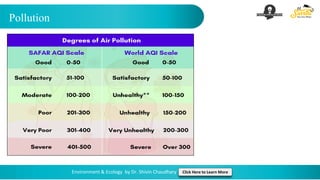
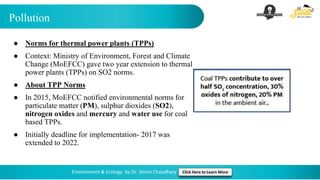
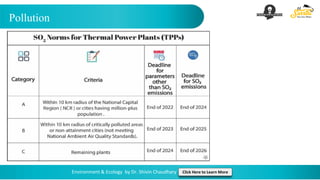
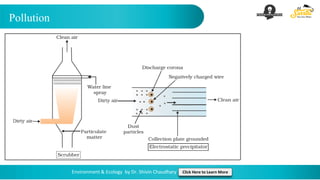
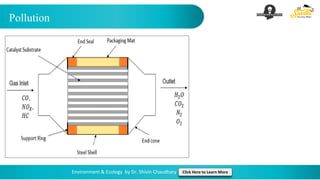
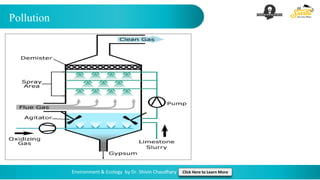
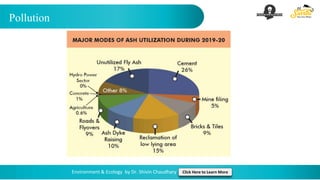
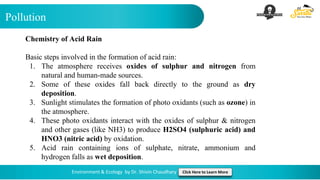
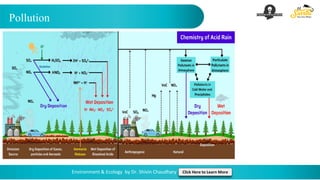
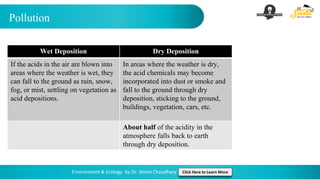
![Pollution
Environment & Ecology by Dr. Shivin Chaudhary Click Here to Learn More
● Thickness of plastic carry bags increased from 50 microns to 75 microns
with effect from 30th September 2021 and to 120 microns with effect from
the 31st December, 2022 [ The thickness has been increased so that bags
becomes expensive as well as can be reused]
● Extended Producer Responsibility (EPR): Plastic packaging waste not
covered under present notification shall be collected and managed in an
environmentally sustainable way through EPR of the producer, importer and
brand owner (PIBO) as per PWM Rules, 2016.
● EPR Guidelines have been given legal force through PWM Amendment
Rules, 2021.](https://image.slidesharecdn.com/lecture15-pollutionpart2-250528013310-d412bfce/85/Lecture-15-Pollution-Part-2-pdffffffffffffffffffffffffffff-37-320.jpg)
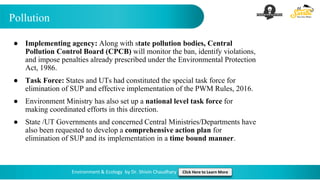
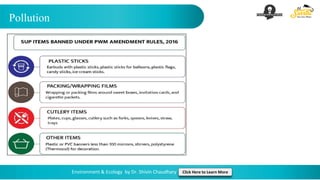
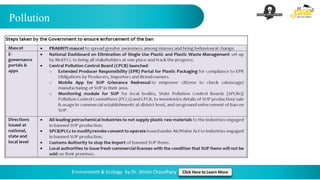
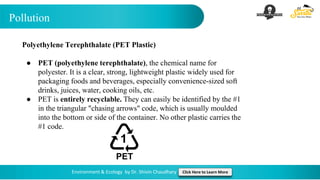
![Pollution
Environment & Ecology by Dr. Shivin Chaudhary Click Here to Learn More
● E-waste (Management) Rules 2022
● Context: Ministry of Environment, Forest and Climate Change
(MoEF&CC) has notified E-waste (management) Rules 2022, in the
exercise of the powers conferred by the Environment (Protection) Act,
1986. [Recall our discussion that EPA is an “umbrella” legislation]
● Key Provisions:
● 'E-waste' Definition: Electrical and electronic equipment, whole or in part
discarded as waste, and rejects from manufacturing, refurbishment and
repair processes](https://image.slidesharecdn.com/lecture15-pollutionpart2-250528013310-d412bfce/85/Lecture-15-Pollution-Part-2-pdffffffffffffffffffffffffffff-46-320.jpg)
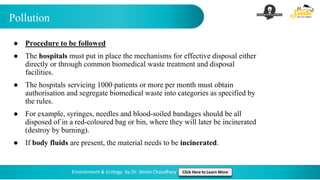
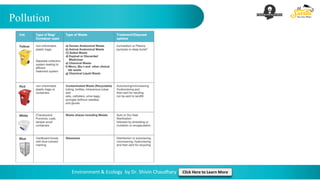
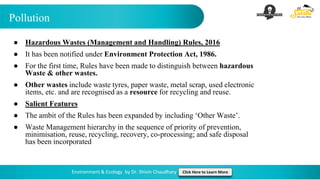
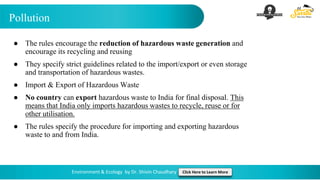
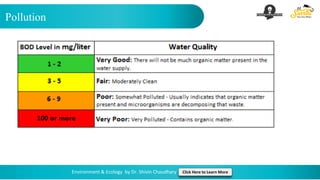
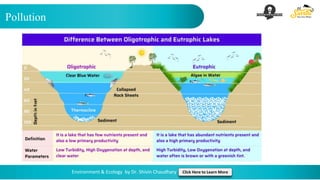
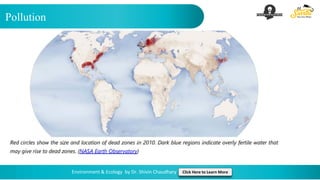
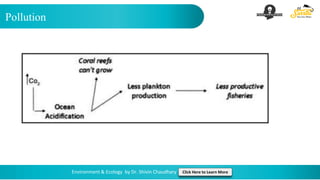
![Pollution
Environment & Ecology by Dr. Shivin Chaudhary Click Here to Learn More
● In a blast furnace, fuel (coke — has far fewer impurities than coal), iron
ore, and flux (limestone — removes sulphur and other impurities into
slag) are continuously supplied.
● The byproducts obtained are liquid slag, liquid iron (pig iron — an
intermediate product of smelting iron ore; has oxides) and gases.
● Oxygen in the iron oxides is reduced by a series of chemical reactions that
produce CO and CO2.
● [Pig iron to steel> Liquid (pig) iron> Cast iron (cooled liquid iron; brittle;
carbon content greater than 2%; wrought iron (weak) = liquid iron + slag)
> Steel (carbon content is up to 2.1%; it does corrode)> Stainless steel
(steel + 10.5% chromium + Nickel, manganese, molybdenum, etc.; it does
not corrode).]](https://image.slidesharecdn.com/lecture15-pollutionpart2-250528013310-d412bfce/85/Lecture-15-Pollution-Part-2-pdffffffffffffffffffffffffffff-86-320.jpg)