Environment &
      Food Safety,
                  overview


                Ankara, 19 April 2010
                         Dario Dongo
 CIAA, Food Safety Management / Hygiene Task Force, v.chairman
Global Food Safety Initiative Tech. Committee, CIAA representative
  ISO TC34 SC17 (Food Safety Management), CIAA representative
         Federalimentare, Regulative Policies, responsible
EU food law
     ...

in a nutshell
Scope


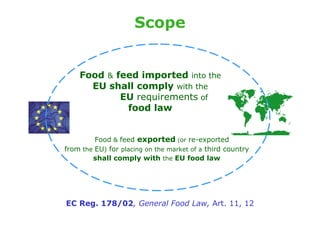
    Food & feed imported into the
      EU shall comply with the
            EU requirements of
             food law


         Food & feed exported (or re-exported
from the EU) for placing on the market of a third country
        shall comply with the EU food law


EC Reg. 178/02, General Food Law, Art. 11, 12
Food Safety


• Unsafe food can’t be placed on the Market
 as:

1)harmful (in the short-mid-long term /
 cumulative effects / sensitivities of specific
 categories of consumers)

2)unfit
      to human consumption (ie. physical
 contamination, deterioration, putrefaction,
 deacay)
          EC Reg. 178/02, General Food Law, Art. 14
“Farm        to Fork” policy

• All those who participate to the food/feed
  chain are responsible for
  the hygiene of their process and
  the safety of their output

• No exemption or limitation of responsabilities

• The safety assurance must be continuos,
  from primary production (animal or vegetal) to final
  distribution (including catering)

          EC Reg. 178/02, General Food Law, Art. 17
Traceability

    All operators must
•   be able to identify their suppliers – who
    supplied what (food & feed, food contact materials)
• be able to identify the business operators to
    whom they have delivered their products - who
    has received which product

• inform the competent authorities on what
  above, whenever requested

           EC Reg. 178/02, General Food Law, Art. 18
Environment & Food Safety

                Heavy        Allergens
                Metals                      Process
                                         contaminants
   Pesticides
     MRL’s                                          Food
                         Micotoxins
                                                   Contact
                             …
                                                   Materials
Dioxins
 PCB’s


 Water


     [GMO’s]
FROM THE FARM …


                        Land

  Food and feed crops may uptake soil contaminants.
 This may affect the quality of products and, in due course, the
                   human and animal health


EC proposal for a Soil Framework Directive (COM(2006) 232)
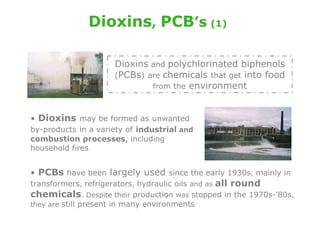
Dioxins, PCB’s (1)

                     Dioxins and polychlorinated biphenols
                     (PCBs) are chemicals that get into food
                             from the environment


• Dioxins may be formed as unwanted
by-products in a variety of industrial and
combustion processes, including
household fires


• PCBs have been largely used since the early 1930s, mainly in
transformers, refrigerators, hydraulic oils and as all round
chemicals. Despite their production was stopped in the 1970s-’80s,
they are still present in many environments
Dioxins, PCB’s (2)
 About 95% of the average person’s exposure to dioxins occurs
    through consumption of food, especially food containing
                         animal fats

 Dioxins from the environment can be present
 in vegetables and other foods [ie. Indian guar
 gum, ’08. Swiss-made thickening agent Unipektin,
 ’07]

 High levels of dioxin can be found in food of
 animal origin (ie. eggs, milk, meat), when feed
 with dioxin had been used [ie. Irish pork, ’08. NL
 milk, ’06 … Belgian feed scandal, ‘99]

EC Reg. 1881/06 sets maximum levels for specific contaminants in
foodstuffs
EC Reg. 1883/2006, sampling and analysis methods for determining the
levels of dioxins and dioxin-like PCBs in specific foodstuffs
Water (1)
 Ground water may be contaminated by a variety of
 biological and chemical hazards, which include:
 • bacteria and viruses
 •   domestic waste
 •   nitrate nitrogen
 • synthetic organic    chemicals
 •   heavy metals
 •   petroleum residues
 •   combustion products (ie. from roadways)
Water Framework Directive, 2000/60/EC
Urban waste water treatment Directive, 91/271/EEC (amended by Dir.
98/15/EEC)

Drinking water Directive, 98/83/EC
IPPC Directive, 2008/1/EC (Integrated Pollution Prevention and Control),
under review, concerning industrial emissions. Integrated permits system covering
52,000 industrial and agricultural installations in the EU
Water (2)
Sewage sludge - rich in nitrogen,
phosphorus and organic matter - can be a
useful fertilizer or soil improver


                   However, it concentrates heavy metals,
                      dioxins, antibiotics and resistant
                                    bacteria

Its treatment and use in agriculture is therefore strictly
regulated. Never in feed production, nor to be left to
grazing animals [’98-’99 food crisis in F, NL: knackeries,
gelatine factories]

Directive 86/278/EEC on use of sewage sludge in agriculture
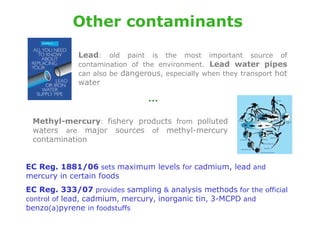
Other contaminants

             Lead:    old paint is the most important source of
             contamination of the environment. Lead water pipes
             can also be dangerous, especially when they transport hot
             water

                                …
 Methyl-mercury: fishery products from polluted
 waters are major sources of methyl-mercury
 contamination


EC Reg. 1881/06 sets maximum levels for cadmium, lead and
mercury in certain foods
EC Reg. 333/07 provides sampling & analysis methods for the official
control of lead, cadmium, mercury, inorganic tin, 3-MCPD and
benzo(a)pyrene in foodstuffs
… INTO THE SUPPLY CHAIN …


             Crops

     agriculture raw materials
Pesticides (1)
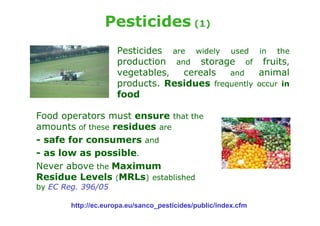
                     Pesticides are widely used in the
                     production and storage of fruits,
                     vegetables,   cereals  and    animal
                     products. Residues frequently occur in
                     food

Food operators must ensure that the
amounts of these residues are
- safe for consumers and
- as low as possible.
Never above the Maximum
Residue Levels (MRLs) established
by EC Reg. 396/05

        http://ec.europa.eu/sanco_pesticides/public/index.cfm
Pesticides (2)
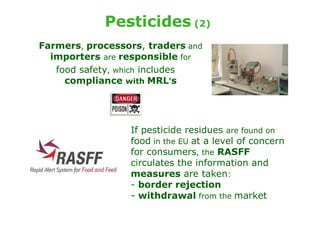
Farmers, processors, traders and
  importers are responsible for
   food safety, which includes
     compliance with MRL’s


                 If pesticide residues are found on
                 food in the EU at a level of concern
                 for consumers, the RASFF
                 circulates the information and
                 measures are taken:
                 - border rejection
                 - withdrawal from the market
Mycotoxins: aflatoxins (1)
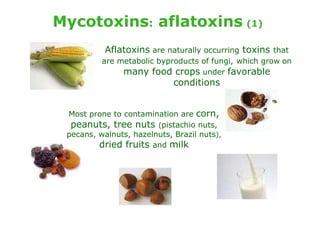
           Aflatoxins are naturally occurring toxins that
          are metabolic byproducts of fungi, which grow on
               many food crops under favorable
                             conditions


 Most prone to contamination are corn,
  peanuts, tree nuts (pistachio nuts,
 pecans, walnuts, hazelnuts, Brazil nuts),
         dried fruits and milk
Aflatoxins (2)
EC Reg. 1881/06 – amended by EU Reg. 165/10 - sets maximum
levels of aflatoxins (B1, B2, G1, G2, M1)

EC Reg. 401/06 – amended by EU Reg. 168/10 - provides sampling
& analysis methods for the official control of mycotoxins, including
aflatoxins
EC Reg. 1152/09, imposing special conditions governing the
import of certain foodstuffs from certain third countries due to
contamination risk by aflatoxins:

-> from Turkey:
•   dried figs
•   hazelnuts (in shell or shelled)
•   pistachios
•   mixtures of nuts or dried fruits (containing figs, hazelnuts or pistachios)
•   fig paste, pistachio paste and hazelnut paste
Ochratoxins
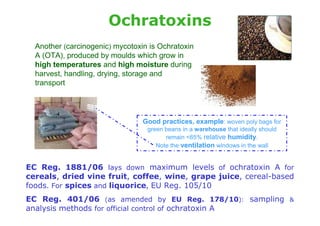
  Another (carcinogenic) mycotoxin is Ochratoxin
  A (OTA), produced by moulds which grow in
  high temperatures and high moisture during
  harvest, handling, drying, storage and
  transport


                                 Good practices, example: woven poly bags for
                                  green beans in a warehouse that ideally should
                                        remain <65% relative humidity.
                                     Note the ventilation windows in the wall


EC Reg. 1881/06 lays down maximum levels of ochratoxin A for
cereals, dried vine fruit, coffee, wine, grape juice, cereal-based
foods. For spices and liquorice, EU Reg. 105/10
EC Reg. 401/06 (as amended by EU Reg. 178/10): sampling                            &
analysis methods for official control of ochratoxin A
Other mycotoxins

Fusaria toxins. Fusaria moulds which produce wrinkling of plant
parts produce also fusaria toxins. Currently, no official limit for
fumosins in food [however, the EU has proposed a limit of 500
microgrammes per kg]

         DON     (deoxynivalenol), one of the most     important of these
         toxins, occurs in grains such as wheat, barley, oats, rye, and
         maize, rice, sorghum. It may coexist with Zeralenone

         -> cereals, baby-food issues, ’03 onwards
         Codex regulatory limit for DON is 1mg/kg food

Patulin is a toxic chemical produced from a number of moulds. Apples
tend to be the major source, yet any mouldy or rotten fruit could
contain this toxin -> fruit juices
Codex Alimentarius is considering reducing the maximum level to 25ppb
from 50ppb (because of high intake of apple juice by young children)
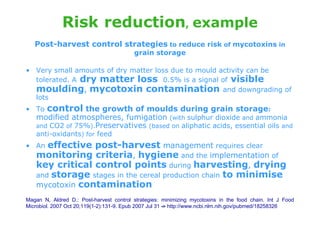
Risk reduction, example
   Post-harvest control strategies to reduce risk of mycotoxins in
                                         grain storage

• Very small amounts of dry matter loss due to mould activity can be
  tolerated. A dry matter loss 0.5% is a signal of visible
  moulding, mycotoxin contamination and downgrading of
  lots
• To    control the growth of moulds during grain storage:
   modified atmospheres, fumigation (with sulphur dioxide and ammonia
   and CO2 of 75%).Preservatives (based on aliphatic acids, essential oils and
   anti-oxidants) for feed
• An  effective post-harvest management requires clear
   monitoring criteria, hygiene and the implementation of
   key critical control points during harvesting, drying
   and storage stages in the cereal production chain to minimise
   mycotoxin contamination
Magan N, Aldred D.: Post-harvest control strategies: minimizing mycotoxins in the food chain. Int J Food
Microbiol. 2007 Oct 20;119(1-2):131-9. Epub 2007 Jul 31 -> http://www.ncbi.nlm.nih.gov/pubmed/18258326
GMO’s
                  Strictly speaking, GMO’s are not a food
                  safety issue, since the European Food
                  Safety Authority is deemed to check the
                  absence of risk prior to their authorization

Yet, having considered the various political stances on this
argument, the European legislator has provided comprehensive
rules on GMO’s authorization, their use in food and feed,
consumer information, traceability

Worth of notice: some GMO’s traits are made to prevent harmful
contaminations of the crops [ie. the genotoxic pyralid]

EC Reg. 1829/03, regarding GMO’s on foods and consumer info
EC Reg. 1830/03, on GMO’s traceability
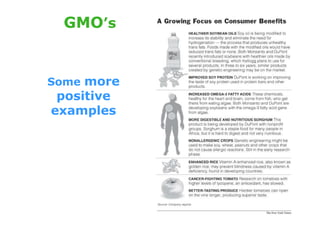
GMO’s


Some more
 positive
examples
… UP TO THE PROCESS …


     Factory Environment

           • SUPPLY
           • PROCESS
           • PACKAGING
Allergens

         Food labels must indicate
  the presence - even if just in traces - of
      allergenic substances, and/or
        materials derived thereof
      [except those mentioned in Dir. 2007/68/EC]


                     X-contamination risk


 Food containing allergenic substances not
    mentioned on their labels are unsafe
-> They must be withdrawn and/or recalled
Fraudulent supplies

Sudan dyes: synthetic azo dyes, hystorically used to
colour products (as shoe polish, automotive paints and petroleum
derivatives).
-> ’03, chili powder and related products contaminated with Sudan
I-IV crisis (over 1,000 products withdrawn from the EU market)


                    Melamine: an industrial chemical found
                    in plastics was found to have been fraudulently
                    added to wheat gluten and rice protein from
                    China
                    -> ‘07, USA, pet foods crisis
                    -> ‘08, worldwide, infant milk powder and other
                    protein sources (milk, soy, gluten, rice) crisis

Adulterated oils: mineral or industrial-use oils mixed with,
and sold as, oils for human consumption
-> ‘09, EU-Ukraine, sunflower-mineral oil mix import
-> ‘94, the “Spanish toxic oil syndrome” (adulterated rapeseed oil)
Process contaminants                                           (1)


Acrylamide: is formed in food by traditional cooking methods such as
baking, frying and roasting at high temperatures (>120° C)

•   Potato products (crisps, chips)
•   Coffee
•   Savoury snacks (e.g. crackers)
•   Toasted cereal products
•   Bread and bakery products

CIAA “Acrylamide Toolbox”, best practices for monitoring and reduction


                  PAHs: Polycyclic aromatic hydrocarbons occurr in oil,
                  coal, tar deposits (byproducts of fossil fuel and biomass burning).
                  Foods - ie. cereals, oils and fats (smaller intakes come from
                  vegetables and cooked meats) - may become contaminated
                  through
                  - direct environmental exposure
                  - migration from packaging material, or
                  - thermal processing of food (baking, grilling, frying, smoking)
                  -> Benzo(a)pyrene
Process contaminants                                    (2)


                 3-MCPD        (3-monochloropropanediol) is formed
                 in a variety of industrially and domestically produced
                 foods. The main area of concern is its occurrence in
                 hydrolysed vegetable proteins, widely used
                 ingredients and a major factor in soy sauce
                 production (itself an ingredient in many products)


Furans: highly volatile cyclic ethers that can be
formed unintentionally in foods during traditional
heat-treatments, such as cooking, bottling,
and canning


          Ethyl carbamate          (also known as EC or urethane) is a
          well known, potent carcinogen, found in fermented foods in
          low concentration as a naturally occurring by-product of the
          fermentation process
Food contact materials                                   (1)


• Food contact materials shall be safe. They shall not
  transfer their components into the food in
  quantities that could endanger human
  health, change the composition of the food
  in an unacceptable way or deteriorate the taste
  and odour of foodstuffs


          If an article is intended for food contact it shall be labelled for
          food contact or bear the symbol with a glass and fork [except
          in cases where the intention for food contact is obvious by the
          nature of the article e.g. knife, fork, wine glass] ..


  Framework Regulation EC 1935/04
Food contact materials                                       (2)


• Traceability is applied also to FCM. Safety
  problems concerning FCM are reported into the
  RASFF. In these cases, the European Commission
  and MS shall take appropriate measures:
  - border rejections
  - withdrawal from the market

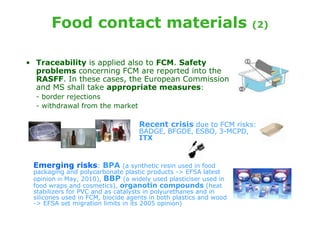
                                   Recent crisis due to FCM risks:
                                   BADGE, BFGDE, ESBO, 3-MCPD,
                                   ITX


 Emerging risks: BPA           (a synthetic resin used in food
 packaging and polycarbonate plastic products -> EFSA latest
 opinion in May, 2010), BBP (a widely used plasticiser used in
 food wraps and cosmetics), organotin compounds (heat
 stabilizers for PVC and as catalysts in polyurethanes and in
 silicones used in FCM, biocide agents in both plastics and wood
 -> EFSA set migration limits in its 2005 opinion)
FROM THE FARM TO THE FORK …


           Solutions ?

          0 Risk is never given,
    Risk analysis always needed !
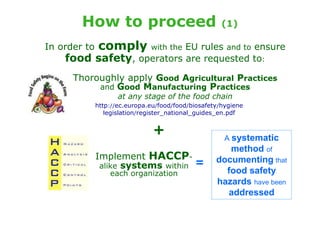
How to proceed                                (1)

In order to   comply           with the EU rules and to ensure
    food safety, operators are requested to:
      Thoroughly apply Good Agricultural Practices
           and Good Manufacturing Practices
                     at any stage of the food chain
              http://ec.europa.eu/food/food/biosafety/hygiene
                 legislation/register_national_guides_en.pdf


                                +                      A systematic
                                                       method of
              Implement HACCP-                      documenting that
               alike systems within =
                  each organization                   food safety
                                                    hazards have been
                                                      addressed
How to proceed         (2)

In order to   addressthe international
markets expectacions and qualify as a
          reliable supplier:

                ISO 22000
                    +
              Applicable GMP’s
              (Pre-Requisites)
               certification

Environment & Food Safety

  • 1.
    Environment & Food Safety, overview Ankara, 19 April 2010 Dario Dongo CIAA, Food Safety Management / Hygiene Task Force, v.chairman Global Food Safety Initiative Tech. Committee, CIAA representative ISO TC34 SC17 (Food Safety Management), CIAA representative Federalimentare, Regulative Policies, responsible
  • 2.
    EU food law ... in a nutshell
  • 3.
    Scope Food & feed imported into the EU shall comply with the EU requirements of food law Food & feed exported (or re-exported from the EU) for placing on the market of a third country shall comply with the EU food law EC Reg. 178/02, General Food Law, Art. 11, 12
  • 4.
    Food Safety • Unsafefood can’t be placed on the Market as: 1)harmful (in the short-mid-long term / cumulative effects / sensitivities of specific categories of consumers) 2)unfit to human consumption (ie. physical contamination, deterioration, putrefaction, deacay) EC Reg. 178/02, General Food Law, Art. 14
  • 5.
    “Farm to Fork” policy • All those who participate to the food/feed chain are responsible for the hygiene of their process and the safety of their output • No exemption or limitation of responsabilities • The safety assurance must be continuos, from primary production (animal or vegetal) to final distribution (including catering) EC Reg. 178/02, General Food Law, Art. 17
  • 6.
    Traceability All operators must • be able to identify their suppliers – who supplied what (food & feed, food contact materials) • be able to identify the business operators to whom they have delivered their products - who has received which product • inform the competent authorities on what above, whenever requested EC Reg. 178/02, General Food Law, Art. 18
  • 7.
    Environment & FoodSafety Heavy Allergens Metals Process contaminants Pesticides MRL’s Food Micotoxins Contact … Materials Dioxins PCB’s Water [GMO’s]
  • 8.
    FROM THE FARM… Land Food and feed crops may uptake soil contaminants. This may affect the quality of products and, in due course, the human and animal health EC proposal for a Soil Framework Directive (COM(2006) 232)
  • 9.
    Dioxins, PCB’s (1) Dioxins and polychlorinated biphenols (PCBs) are chemicals that get into food from the environment • Dioxins may be formed as unwanted by-products in a variety of industrial and combustion processes, including household fires • PCBs have been largely used since the early 1930s, mainly in transformers, refrigerators, hydraulic oils and as all round chemicals. Despite their production was stopped in the 1970s-’80s, they are still present in many environments
  • 10.
    Dioxins, PCB’s (2) About 95% of the average person’s exposure to dioxins occurs through consumption of food, especially food containing animal fats Dioxins from the environment can be present in vegetables and other foods [ie. Indian guar gum, ’08. Swiss-made thickening agent Unipektin, ’07] High levels of dioxin can be found in food of animal origin (ie. eggs, milk, meat), when feed with dioxin had been used [ie. Irish pork, ’08. NL milk, ’06 … Belgian feed scandal, ‘99] EC Reg. 1881/06 sets maximum levels for specific contaminants in foodstuffs EC Reg. 1883/2006, sampling and analysis methods for determining the levels of dioxins and dioxin-like PCBs in specific foodstuffs
  • 11.
    Water (1) Groundwater may be contaminated by a variety of biological and chemical hazards, which include: • bacteria and viruses • domestic waste • nitrate nitrogen • synthetic organic chemicals • heavy metals • petroleum residues • combustion products (ie. from roadways) Water Framework Directive, 2000/60/EC Urban waste water treatment Directive, 91/271/EEC (amended by Dir. 98/15/EEC) Drinking water Directive, 98/83/EC IPPC Directive, 2008/1/EC (Integrated Pollution Prevention and Control), under review, concerning industrial emissions. Integrated permits system covering 52,000 industrial and agricultural installations in the EU
  • 12.
    Water (2) Sewage sludge- rich in nitrogen, phosphorus and organic matter - can be a useful fertilizer or soil improver However, it concentrates heavy metals, dioxins, antibiotics and resistant bacteria Its treatment and use in agriculture is therefore strictly regulated. Never in feed production, nor to be left to grazing animals [’98-’99 food crisis in F, NL: knackeries, gelatine factories] Directive 86/278/EEC on use of sewage sludge in agriculture
  • 13.
    Other contaminants Lead: old paint is the most important source of contamination of the environment. Lead water pipes can also be dangerous, especially when they transport hot water … Methyl-mercury: fishery products from polluted waters are major sources of methyl-mercury contamination EC Reg. 1881/06 sets maximum levels for cadmium, lead and mercury in certain foods EC Reg. 333/07 provides sampling & analysis methods for the official control of lead, cadmium, mercury, inorganic tin, 3-MCPD and benzo(a)pyrene in foodstuffs
  • 14.
    … INTO THESUPPLY CHAIN … Crops agriculture raw materials
  • 15.
    Pesticides (1) Pesticides are widely used in the production and storage of fruits, vegetables, cereals and animal products. Residues frequently occur in food Food operators must ensure that the amounts of these residues are - safe for consumers and - as low as possible. Never above the Maximum Residue Levels (MRLs) established by EC Reg. 396/05 http://ec.europa.eu/sanco_pesticides/public/index.cfm
  • 16.
    Pesticides (2) Farmers, processors,traders and importers are responsible for food safety, which includes compliance with MRL’s If pesticide residues are found on food in the EU at a level of concern for consumers, the RASFF circulates the information and measures are taken: - border rejection - withdrawal from the market
  • 17.
    Mycotoxins: aflatoxins (1) Aflatoxins are naturally occurring toxins that are metabolic byproducts of fungi, which grow on many food crops under favorable conditions Most prone to contamination are corn, peanuts, tree nuts (pistachio nuts, pecans, walnuts, hazelnuts, Brazil nuts), dried fruits and milk
  • 18.
    Aflatoxins (2) EC Reg.1881/06 – amended by EU Reg. 165/10 - sets maximum levels of aflatoxins (B1, B2, G1, G2, M1) EC Reg. 401/06 – amended by EU Reg. 168/10 - provides sampling & analysis methods for the official control of mycotoxins, including aflatoxins EC Reg. 1152/09, imposing special conditions governing the import of certain foodstuffs from certain third countries due to contamination risk by aflatoxins: -> from Turkey: • dried figs • hazelnuts (in shell or shelled) • pistachios • mixtures of nuts or dried fruits (containing figs, hazelnuts or pistachios) • fig paste, pistachio paste and hazelnut paste
  • 19.
    Ochratoxins Another(carcinogenic) mycotoxin is Ochratoxin A (OTA), produced by moulds which grow in high temperatures and high moisture during harvest, handling, drying, storage and transport Good practices, example: woven poly bags for green beans in a warehouse that ideally should remain <65% relative humidity. Note the ventilation windows in the wall EC Reg. 1881/06 lays down maximum levels of ochratoxin A for cereals, dried vine fruit, coffee, wine, grape juice, cereal-based foods. For spices and liquorice, EU Reg. 105/10 EC Reg. 401/06 (as amended by EU Reg. 178/10): sampling & analysis methods for official control of ochratoxin A
  • 20.
    Other mycotoxins Fusaria toxins.Fusaria moulds which produce wrinkling of plant parts produce also fusaria toxins. Currently, no official limit for fumosins in food [however, the EU has proposed a limit of 500 microgrammes per kg] DON (deoxynivalenol), one of the most important of these toxins, occurs in grains such as wheat, barley, oats, rye, and maize, rice, sorghum. It may coexist with Zeralenone -> cereals, baby-food issues, ’03 onwards Codex regulatory limit for DON is 1mg/kg food Patulin is a toxic chemical produced from a number of moulds. Apples tend to be the major source, yet any mouldy or rotten fruit could contain this toxin -> fruit juices Codex Alimentarius is considering reducing the maximum level to 25ppb from 50ppb (because of high intake of apple juice by young children)
  • 21.
    Risk reduction, example Post-harvest control strategies to reduce risk of mycotoxins in grain storage • Very small amounts of dry matter loss due to mould activity can be tolerated. A dry matter loss 0.5% is a signal of visible moulding, mycotoxin contamination and downgrading of lots • To control the growth of moulds during grain storage: modified atmospheres, fumigation (with sulphur dioxide and ammonia and CO2 of 75%).Preservatives (based on aliphatic acids, essential oils and anti-oxidants) for feed • An effective post-harvest management requires clear monitoring criteria, hygiene and the implementation of key critical control points during harvesting, drying and storage stages in the cereal production chain to minimise mycotoxin contamination Magan N, Aldred D.: Post-harvest control strategies: minimizing mycotoxins in the food chain. Int J Food Microbiol. 2007 Oct 20;119(1-2):131-9. Epub 2007 Jul 31 -> http://www.ncbi.nlm.nih.gov/pubmed/18258326
  • 22.
    GMO’s Strictly speaking, GMO’s are not a food safety issue, since the European Food Safety Authority is deemed to check the absence of risk prior to their authorization Yet, having considered the various political stances on this argument, the European legislator has provided comprehensive rules on GMO’s authorization, their use in food and feed, consumer information, traceability Worth of notice: some GMO’s traits are made to prevent harmful contaminations of the crops [ie. the genotoxic pyralid] EC Reg. 1829/03, regarding GMO’s on foods and consumer info EC Reg. 1830/03, on GMO’s traceability
  • 23.
  • 24.
    … UP TOTHE PROCESS … Factory Environment • SUPPLY • PROCESS • PACKAGING
  • 25.
    Allergens Food labels must indicate the presence - even if just in traces - of allergenic substances, and/or materials derived thereof [except those mentioned in Dir. 2007/68/EC] X-contamination risk Food containing allergenic substances not mentioned on their labels are unsafe -> They must be withdrawn and/or recalled
  • 26.
    Fraudulent supplies Sudan dyes:synthetic azo dyes, hystorically used to colour products (as shoe polish, automotive paints and petroleum derivatives). -> ’03, chili powder and related products contaminated with Sudan I-IV crisis (over 1,000 products withdrawn from the EU market) Melamine: an industrial chemical found in plastics was found to have been fraudulently added to wheat gluten and rice protein from China -> ‘07, USA, pet foods crisis -> ‘08, worldwide, infant milk powder and other protein sources (milk, soy, gluten, rice) crisis Adulterated oils: mineral or industrial-use oils mixed with, and sold as, oils for human consumption -> ‘09, EU-Ukraine, sunflower-mineral oil mix import -> ‘94, the “Spanish toxic oil syndrome” (adulterated rapeseed oil)
  • 27.
    Process contaminants (1) Acrylamide: is formed in food by traditional cooking methods such as baking, frying and roasting at high temperatures (>120° C) • Potato products (crisps, chips) • Coffee • Savoury snacks (e.g. crackers) • Toasted cereal products • Bread and bakery products CIAA “Acrylamide Toolbox”, best practices for monitoring and reduction PAHs: Polycyclic aromatic hydrocarbons occurr in oil, coal, tar deposits (byproducts of fossil fuel and biomass burning). Foods - ie. cereals, oils and fats (smaller intakes come from vegetables and cooked meats) - may become contaminated through - direct environmental exposure - migration from packaging material, or - thermal processing of food (baking, grilling, frying, smoking) -> Benzo(a)pyrene
  • 28.
    Process contaminants (2) 3-MCPD (3-monochloropropanediol) is formed in a variety of industrially and domestically produced foods. The main area of concern is its occurrence in hydrolysed vegetable proteins, widely used ingredients and a major factor in soy sauce production (itself an ingredient in many products) Furans: highly volatile cyclic ethers that can be formed unintentionally in foods during traditional heat-treatments, such as cooking, bottling, and canning Ethyl carbamate (also known as EC or urethane) is a well known, potent carcinogen, found in fermented foods in low concentration as a naturally occurring by-product of the fermentation process
  • 29.
    Food contact materials (1) • Food contact materials shall be safe. They shall not transfer their components into the food in quantities that could endanger human health, change the composition of the food in an unacceptable way or deteriorate the taste and odour of foodstuffs If an article is intended for food contact it shall be labelled for food contact or bear the symbol with a glass and fork [except in cases where the intention for food contact is obvious by the nature of the article e.g. knife, fork, wine glass] .. Framework Regulation EC 1935/04
  • 30.
    Food contact materials (2) • Traceability is applied also to FCM. Safety problems concerning FCM are reported into the RASFF. In these cases, the European Commission and MS shall take appropriate measures: - border rejections - withdrawal from the market Recent crisis due to FCM risks: BADGE, BFGDE, ESBO, 3-MCPD, ITX Emerging risks: BPA (a synthetic resin used in food packaging and polycarbonate plastic products -> EFSA latest opinion in May, 2010), BBP (a widely used plasticiser used in food wraps and cosmetics), organotin compounds (heat stabilizers for PVC and as catalysts in polyurethanes and in silicones used in FCM, biocide agents in both plastics and wood -> EFSA set migration limits in its 2005 opinion)
  • 31.
    FROM THE FARMTO THE FORK … Solutions ? 0 Risk is never given, Risk analysis always needed !
  • 32.
    How to proceed (1) In order to comply with the EU rules and to ensure food safety, operators are requested to: Thoroughly apply Good Agricultural Practices and Good Manufacturing Practices at any stage of the food chain http://ec.europa.eu/food/food/biosafety/hygiene legislation/register_national_guides_en.pdf + A systematic method of Implement HACCP- documenting that alike systems within = each organization food safety hazards have been addressed
  • 33.
    How to proceed (2) In order to addressthe international markets expectacions and qualify as a reliable supplier: ISO 22000 + Applicable GMP’s (Pre-Requisites) certification