15th International Conference on Information Quality, 2010
ENTERPRISE MASTER DATA ARCHITECTURE:ENTERPRISE MASTER DATA ARCHITECTURE:
DESIGN DECISIONS AND OPTIONS
Boris Otto
University of St. Gallen
Alexander Schmidt
University of St. Gallen
Institute of Information Management
boris.otto@unisg.ch
Executive Summary/Abstract: The enterprise wide management of master data is a
Institute of Information Management
alexander.schmidt@unisg.ch
Executive Summary/Abstract: The enterprise-wide management of master data is a
prerequisite for companies to meet strategic business requirements such as compliance to
regulatory requirements, integrated customer management, and global business process
integration. Among others, this demands systematic design of the enterprise master data
architecture. The current state-of-the-art, however, does not provide sufficient guidance for
practitioners as it does not specify concrete design decisions they have to make and to the
design options of which they can choose with regard to the master data architecture. This paper
aims at contributing to this gap It reports on the findings of three case studies and usesaims at contributing to this gap. It reports on the findings of three case studies and uses
morphological analysis to structure design decisions and options for the management of an
enterprise master data architecture.
15th International Conference on Information Quality, 2010
Agendag
• Motivation
• Research Question
• Related Work
• Case Studies
• Design Decisions and Options
• Conclusion and Outlook
15th International Conference on Information Quality, 2010
Motivation
• Enterprise master data is key for strategic business requirements
– Compliance to regulations
– 360 degree view on customers
– Enterprise-wide spend analysis
• Active management of enterprise master data requires enterprise
master data architecture (EMDA) managementmaster data architecture (EMDA) management
• A gap exists in both research and practice regarding the related
design decisions and optionsdesign decisions and options
15th International Conference on Information Quality, 2010
Research Question and Approach
• Research Question:
– What are design decisions companies have to make in the design of
enterprise master data architectures and which design options exist?
R h A h• Research Approach:
– Exploratory case study
Multiple cases analyzed at DB Netz Deutsche Telekom and SBB Cargo– Multiple cases analyzed at DB Netz, Deutsche Telekom, and SBB Cargo
– Data collection followed the BECS principles, i.e. the method for
Business Engineering Case Study researchg g y
– Morphological analysis is applied after step-wise case studies
15th International Conference on Information Quality, 2010
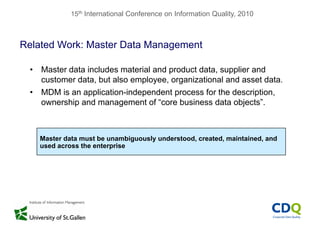
Related Work: Master Data Managementg
• Master data includes material and product data, supplier and
customer data, but also employee, organizational and asset data.
• MDM is an application-independent process for the description,
hi d t f “ b i d t bj t ”ownership and management of “core business data objects”.
Master data must be unambiguously understood, created, maintained, and
used across the enterprise
15th International Conference on Information Quality, 2010
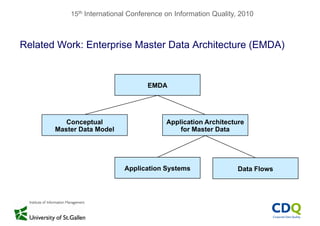
Related Work: Enterprise Master Data Architecture (EMDA)( )
EMDA
Conceptual Application Architecturep
Master Data Model
pp
for Master Data
Application Systems Data Flows
15th International Conference on Information Quality, 2010
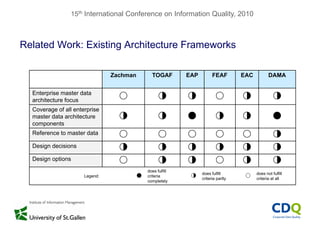
Related Work: Existing Architecture Frameworksg
Zachman TOGAF EAP FEAF EAC DAMAZachman TOGAF EAP FEAF EAC DAMA
Enterprise master data
architecture focusarchitecture focus
Coverage of all enterprise
master data architecture
componentscomponents
Reference to master data
Design decisions
Design options
Legend:
does fulfill
criteria
does fulfill does not fulfill
Legend: criteria
completely
criteria partly criteria at all
15th International Conference on Information Quality, 2010
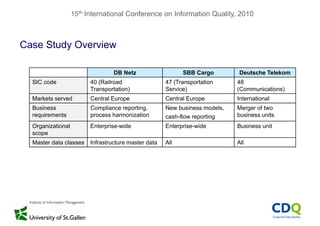
Case Study Overviewy
DB Netz SBB Cargo Deutsche Telekomg
SIC code 40 (Railroad
Transportation)
47 (Transportation
Service)
48
(Communications)
Markets served Central Europe Central Europe InternationalMarkets served Central Europe Central Europe International
Business
requirements
Compliance reporting,
process harmonization
New business models,
cash-flow reporting
Merger of two
business units
Organizational Enterprise wide Enterprise wide Business unitOrganizational
scope
Enterprise-wide Enterprise-wide Business unit
Master data classes Infrastructure master data All All
15th International Conference on Information Quality, 2010
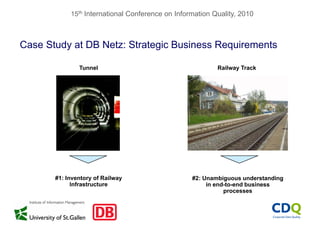
Case Study at DB Netz: Strategic Business Requirementsy g
Tunnel Railway Track
#1: Inventory of Railway
Infrastructure
#2: Unambiguous understanding
in end-to-end business
processes
15th International Conference on Information Quality, 2010
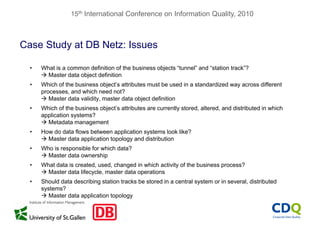
Case Study at DB Netz: Issuesy
• What is a common definition of the business objects “tunnel” and “station track”?
 Master data object definition Master data object definition
• Which of the business object’s attributes must be used in a standardized way across different
processes, and which need not?
 Master data validity, master data object definition Master data validity, master data object definition
• Which of the business object’s attributes are currently stored, altered, and distributed in which
application systems?
 Metadata management
• How do data flows between application systems look like?
 Master data application topology and distribution
• Who is responsible for which data?p
 Master data ownership
• What data is created, used, changed in which activity of the business process?
 Master data lifecycle, master data operations
• Should data describing station tracks be stored in a central system or in several, distributed
systems?
 Master data application topology
15th International Conference on Information Quality, 2010
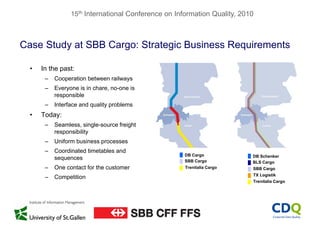
Case Study at SBB Cargo: Strategic Business Requirementsy g g
• In the past:
– Cooperation between railways
– Everyone is in chare, no-one is
responsible
– Interface and quality problems
• Today:
– Seamless single-source freightSeamless, single-source freight
responsibility
– Uniform business processes
Coordinated timetables and– Coordinated timetables and
sequences
– One contact for the customer
C titi
DB Cargo
SBB Cargo
Trenitalia Cargo
DB Schenker
BLS Cargo
SBB Cargo
TX Logistik
– Competition TX Logistik
Trenitalia Cargo
15th International Conference on Information Quality, 2010
Case Study at SBB Cargo: Fields of Actiony g
• Determine common uniform definitions and structures for the company’s master data objects
 Master data object definition conceptual master data model Master data object definition, conceptual master data model
• Create unique identifiers for each master data class for unambiguous identification
 Master data validity
• Establish a central organizational unit responsible for carrying out changes on master data objects• Establish a central organizational unit responsible for carrying out changes on master data objects
 Master data operations, master data ownership
• Determine the “leading system” for each master data class and optimize architecture of
applications administrating master dataapplications administrating master data
 Master data application topology
• Create a Master Data Map depicting assignment of master data objects to applications and the
data flows between them
 Master data application topology and distribution
• Design and implement tool-supported MDM processes
 Master data lifecycle, master data operations
15th International Conference on Information Quality, 2010
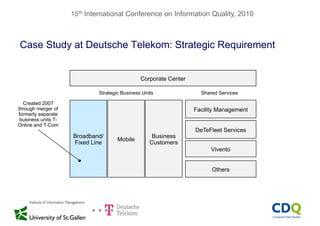
Case Study at Deutsche Telekom: Strategic Requirementy g
Corporate Center
Strategic Business Units Shared Services
Facility Management
Created 2007
through merger of
formerly separate
business units T-
Online and T-Com
Broadband/
Fixed Line
Mobile
Business
Customers
DeTeFleet Services
Vivento
Online and T-Com
Vivento
Others
15th International Conference on Information Quality, 2010
Case Study at Deutsche Telekom: Lacking Transparencyy g y
• Origin and distribution of master data objects on its current application architecture
 Master data application topology and distribution Master data application topology and distribution
• Semantics of master data objects leading to ambiguous understandings and inconsistent usage
 Master data definitions, metadata management
• Business requirements on enterprise wide data quality of certain master data objects• Business requirements on enterprise-wide data quality of certain master data objects
 Master data validity
15th International Conference on Information Quality, 2010
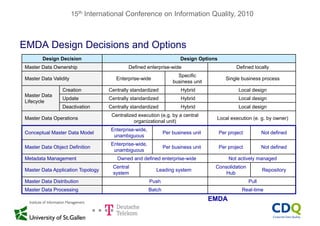
EMDA Design Decisions and Optionsg
Design Decision Design Options
Master Data Ownership Defined enterprise-wide Defined locally
Specific
Master Data Validity Enterprise-wide
Specific
business unit
Single business process
Master Data
Lif l
Creation Centrally standardized Hybrid Local design
Update Centrally standardized Hybrid Local design
Lifecycle
p y y g
Deactivation Centrally standardized Hybrid Local design
Master Data Operations
Centralized execution (e.g. by a central
organizational unit)
Local execution (e. g. by owner)
Conceptual Master Data Model
Enterprise-wide,
unambiguous
Per business unit Per project Not defined
Master Data Object Definition
Enterprise-wide,
unambiguous
Per business unit Per project Not defined
unambiguous
Metadata Management Owned and defined enterprise-wide Not actively managed
Master Data Application Topology
Central
system
Leading system
Consolidation
Hub
Repository
y
Master Data Distribution Push Pull
Master Data Processing Batch Real-time
EMDAEMDA
15th International Conference on Information Quality, 2010
Conclusion and Outlook
• Paper contribution:
– Investigation of an area in which little research is available
– Guidance to practitioners in designing EMDA
• Limitations:
– Validity and generalizability restricted due to low number of cases
investigatedinvestigated
• Future research directions:
Investigate an extended sample to validate findings– Investigate an extended sample to validate findings
– Identification of “architecture patterns”
– Relationship between EMDA design and data quality on one hand asRelationship between EMDA design and data quality on one hand as
well as cost and cycle time of business processes on the other
15th International Conference on Information Quality, 2010
Thank you for your attention.y y

Enterprise Master Data Architecture: Design Decisions and Options

  • 1.
    15th International Conferenceon Information Quality, 2010 ENTERPRISE MASTER DATA ARCHITECTURE:ENTERPRISE MASTER DATA ARCHITECTURE: DESIGN DECISIONS AND OPTIONS Boris Otto University of St. Gallen Alexander Schmidt University of St. Gallen Institute of Information Management boris.otto@unisg.ch Executive Summary/Abstract: The enterprise wide management of master data is a Institute of Information Management alexander.schmidt@unisg.ch Executive Summary/Abstract: The enterprise-wide management of master data is a prerequisite for companies to meet strategic business requirements such as compliance to regulatory requirements, integrated customer management, and global business process integration. Among others, this demands systematic design of the enterprise master data architecture. The current state-of-the-art, however, does not provide sufficient guidance for practitioners as it does not specify concrete design decisions they have to make and to the design options of which they can choose with regard to the master data architecture. This paper aims at contributing to this gap It reports on the findings of three case studies and usesaims at contributing to this gap. It reports on the findings of three case studies and uses morphological analysis to structure design decisions and options for the management of an enterprise master data architecture.
  • 2.
    15th International Conferenceon Information Quality, 2010 Agendag • Motivation • Research Question • Related Work • Case Studies • Design Decisions and Options • Conclusion and Outlook
  • 3.
    15th International Conferenceon Information Quality, 2010 Motivation • Enterprise master data is key for strategic business requirements – Compliance to regulations – 360 degree view on customers – Enterprise-wide spend analysis • Active management of enterprise master data requires enterprise master data architecture (EMDA) managementmaster data architecture (EMDA) management • A gap exists in both research and practice regarding the related design decisions and optionsdesign decisions and options
  • 4.
    15th International Conferenceon Information Quality, 2010 Research Question and Approach • Research Question: – What are design decisions companies have to make in the design of enterprise master data architectures and which design options exist? R h A h• Research Approach: – Exploratory case study Multiple cases analyzed at DB Netz Deutsche Telekom and SBB Cargo– Multiple cases analyzed at DB Netz, Deutsche Telekom, and SBB Cargo – Data collection followed the BECS principles, i.e. the method for Business Engineering Case Study researchg g y – Morphological analysis is applied after step-wise case studies
  • 5.
    15th International Conferenceon Information Quality, 2010 Related Work: Master Data Managementg • Master data includes material and product data, supplier and customer data, but also employee, organizational and asset data. • MDM is an application-independent process for the description, hi d t f “ b i d t bj t ”ownership and management of “core business data objects”. Master data must be unambiguously understood, created, maintained, and used across the enterprise
  • 6.
    15th International Conferenceon Information Quality, 2010 Related Work: Enterprise Master Data Architecture (EMDA)( ) EMDA Conceptual Application Architecturep Master Data Model pp for Master Data Application Systems Data Flows
  • 7.
    15th International Conferenceon Information Quality, 2010 Related Work: Existing Architecture Frameworksg Zachman TOGAF EAP FEAF EAC DAMAZachman TOGAF EAP FEAF EAC DAMA Enterprise master data architecture focusarchitecture focus Coverage of all enterprise master data architecture componentscomponents Reference to master data Design decisions Design options Legend: does fulfill criteria does fulfill does not fulfill Legend: criteria completely criteria partly criteria at all
  • 8.
    15th International Conferenceon Information Quality, 2010 Case Study Overviewy DB Netz SBB Cargo Deutsche Telekomg SIC code 40 (Railroad Transportation) 47 (Transportation Service) 48 (Communications) Markets served Central Europe Central Europe InternationalMarkets served Central Europe Central Europe International Business requirements Compliance reporting, process harmonization New business models, cash-flow reporting Merger of two business units Organizational Enterprise wide Enterprise wide Business unitOrganizational scope Enterprise-wide Enterprise-wide Business unit Master data classes Infrastructure master data All All
  • 9.
    15th International Conferenceon Information Quality, 2010 Case Study at DB Netz: Strategic Business Requirementsy g Tunnel Railway Track #1: Inventory of Railway Infrastructure #2: Unambiguous understanding in end-to-end business processes
  • 10.
    15th International Conferenceon Information Quality, 2010 Case Study at DB Netz: Issuesy • What is a common definition of the business objects “tunnel” and “station track”?  Master data object definition Master data object definition • Which of the business object’s attributes must be used in a standardized way across different processes, and which need not?  Master data validity, master data object definition Master data validity, master data object definition • Which of the business object’s attributes are currently stored, altered, and distributed in which application systems?  Metadata management • How do data flows between application systems look like?  Master data application topology and distribution • Who is responsible for which data?p  Master data ownership • What data is created, used, changed in which activity of the business process?  Master data lifecycle, master data operations • Should data describing station tracks be stored in a central system or in several, distributed systems?  Master data application topology
  • 11.
    15th International Conferenceon Information Quality, 2010 Case Study at SBB Cargo: Strategic Business Requirementsy g g • In the past: – Cooperation between railways – Everyone is in chare, no-one is responsible – Interface and quality problems • Today: – Seamless single-source freightSeamless, single-source freight responsibility – Uniform business processes Coordinated timetables and– Coordinated timetables and sequences – One contact for the customer C titi DB Cargo SBB Cargo Trenitalia Cargo DB Schenker BLS Cargo SBB Cargo TX Logistik – Competition TX Logistik Trenitalia Cargo
  • 12.
    15th International Conferenceon Information Quality, 2010 Case Study at SBB Cargo: Fields of Actiony g • Determine common uniform definitions and structures for the company’s master data objects  Master data object definition conceptual master data model Master data object definition, conceptual master data model • Create unique identifiers for each master data class for unambiguous identification  Master data validity • Establish a central organizational unit responsible for carrying out changes on master data objects• Establish a central organizational unit responsible for carrying out changes on master data objects  Master data operations, master data ownership • Determine the “leading system” for each master data class and optimize architecture of applications administrating master dataapplications administrating master data  Master data application topology • Create a Master Data Map depicting assignment of master data objects to applications and the data flows between them  Master data application topology and distribution • Design and implement tool-supported MDM processes  Master data lifecycle, master data operations
  • 13.
    15th International Conferenceon Information Quality, 2010 Case Study at Deutsche Telekom: Strategic Requirementy g Corporate Center Strategic Business Units Shared Services Facility Management Created 2007 through merger of formerly separate business units T- Online and T-Com Broadband/ Fixed Line Mobile Business Customers DeTeFleet Services Vivento Online and T-Com Vivento Others
  • 14.
    15th International Conferenceon Information Quality, 2010 Case Study at Deutsche Telekom: Lacking Transparencyy g y • Origin and distribution of master data objects on its current application architecture  Master data application topology and distribution Master data application topology and distribution • Semantics of master data objects leading to ambiguous understandings and inconsistent usage  Master data definitions, metadata management • Business requirements on enterprise wide data quality of certain master data objects• Business requirements on enterprise-wide data quality of certain master data objects  Master data validity
  • 15.
    15th International Conferenceon Information Quality, 2010 EMDA Design Decisions and Optionsg Design Decision Design Options Master Data Ownership Defined enterprise-wide Defined locally Specific Master Data Validity Enterprise-wide Specific business unit Single business process Master Data Lif l Creation Centrally standardized Hybrid Local design Update Centrally standardized Hybrid Local design Lifecycle p y y g Deactivation Centrally standardized Hybrid Local design Master Data Operations Centralized execution (e.g. by a central organizational unit) Local execution (e. g. by owner) Conceptual Master Data Model Enterprise-wide, unambiguous Per business unit Per project Not defined Master Data Object Definition Enterprise-wide, unambiguous Per business unit Per project Not defined unambiguous Metadata Management Owned and defined enterprise-wide Not actively managed Master Data Application Topology Central system Leading system Consolidation Hub Repository y Master Data Distribution Push Pull Master Data Processing Batch Real-time EMDAEMDA
  • 16.
    15th International Conferenceon Information Quality, 2010 Conclusion and Outlook • Paper contribution: – Investigation of an area in which little research is available – Guidance to practitioners in designing EMDA • Limitations: – Validity and generalizability restricted due to low number of cases investigatedinvestigated • Future research directions: Investigate an extended sample to validate findings– Investigate an extended sample to validate findings – Identification of “architecture patterns” – Relationship between EMDA design and data quality on one hand asRelationship between EMDA design and data quality on one hand as well as cost and cycle time of business processes on the other
  • 17.
    15th International Conferenceon Information Quality, 2010 Thank you for your attention.y y