Enterprise
Content
Management
Sindi Chen
&
Afsoun Owji
6/16/10 1
INF2177 Summer 2010
1. Business, Organization, and
User Perspectives
1.1 What Is It?
1.2 What Needs Does It Serve?
1.3 Benefits
1.4 Stakeholders and Business Process Changes
1.5 Challenges
6/16/10 2
1.1 What Is It?
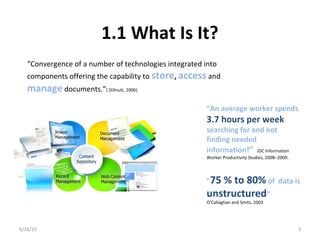
“Convergence of a number of technologies integrated into
components offering the capability to store, access and
manage documents.”( Dillnutt, 2006)
6/16/10 3
“An average worker spends
3.7 hours per week
searching for and not
finding needed
information!” IDC Information
Worker Productivity Studies, 2008–2009.
“75 % to 80% of data is
unstructured”
O’Callaghan and Smits, 2003
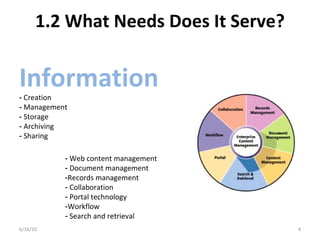
1.2 What Needs Does It Serve?
6/16/10 4
Information- Creation
- Management
- Storage
- Archiving
- Sharing
- Web content management
- Document management
-Records management
- Collaboration
- Portal technology
-Workflow
- Search and retrieval
1.3 Benefits
- Compliance
-Traceability “organizational memory”
- Sarbanes-Oxley legislation 2002
-Bill 198 2002
6/16/10 5
-Efficiency
- Availability
- Consistency
- Customer service
- Consolidation
- Continuity
- Risk mitigation
1.4 Stakeholders and Business
Process Changes
Stakeholder
Employees of the Organization
- Receptionists and administrators
- Sales / IT Representatives
- Managers
- CEO
External
- Customers/Clients
-Interested parties
- Lawyers
-Auditors
-Government
6/16/10 6
Change
- Obliterate and automate
unnecessary procedure
- Processing critical activities faster
1.5 Challenges
6/16/10 7
- Downsizing
- Strict control and regulation vs. autonomy and flexibility
- Focus on information rather than people
- One -size does not fit-all
“The more content and knowledge organizations capture in their ECM system,
the more organizations can controlhow, when, where, and by whom
content is generated, and the more they can pinpoint opportunities for
increased regulationsand automation” (Andersson, 2008)
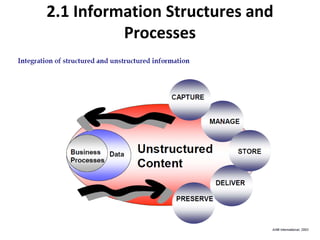
2.1 Information Structures and
Processes
6/16/10 8
2. Information Content and
Processing
2.1 Information Structures and Processes
6/16/10 9
2.1 Information Structures and
Processes
6/16/10 10
- Support both structure and unstructured
information
- Support traditional archive, document
management
- Support process management – Workflow
- Support search and retrieval
3. Technology System
Characteristics
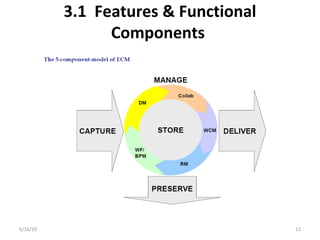
3.1 Features & Functional Components
3.2 Architectural Configurations
3.3 Open Source Solutions
6/16/10 11
3.1 Features & Functional
Components
6/16/10 12
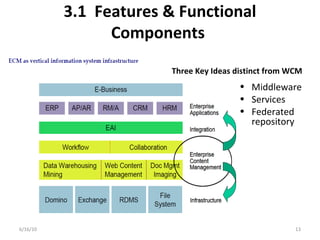
3.1 Features & Functional
Components
6/16/10 13
Three Key Ideas distinct from WCM
• Middleware
• Services
• Federated
repository
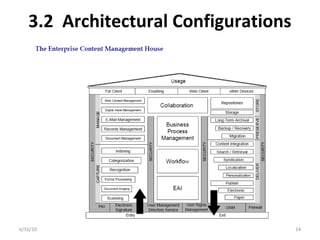
3.2 Architectural Configurations
6/16/10 14
3.3 Open source Solutions
6/16/10 15
http://www.socialtext.com/
http://drupal.orghttp://plone.org/
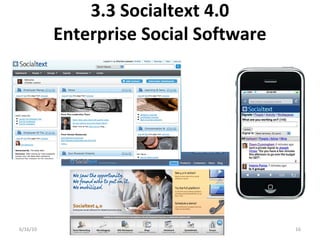
3.3 Socialtext 4.0
Enterprise Social Software
6/16/10 16
4. Requirements & Design
4.1 Requirement Analysis
4.2 Non-functional Requirements
6/16/10 17
4.1 Requirement Analysis
6/16/10 18
- Develop and approve business case (ROI, Scope, Goals linked to
firm’s strategy)
- Inter-disciplinary team formed along with Top Management
- Research firms that have ECM along with work flow processes
- Develop – Use case diagrams, scenarios, work flow, interface,
data conversion
- Determine non-functional requirements
- Gap analysis and requirement documentation
- Evaluate and select ECM (Benefits, functionality checklist)
4.2 Non-functional Requirements
6/16/10 19
-Easy of use
-Backup and Restore
-Availability Requirements
-Error Handling
-Transaction and Data Integrity
-Performance and Configuration
-Security
5. Processes & Methodologies
5.1 ECM Development
5.2 Required knowledge and Skills
6/16/10 20
5.1 ECM Development
6/16/10 21
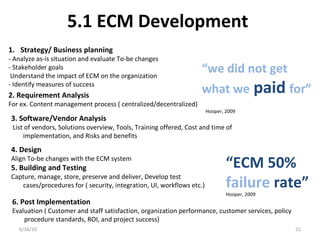
1. Strategy/ Business planning
- Analyze as-is situation and evaluate To-be changes
- Stakeholder goals
Understand the impact of ECM on the organization
- Identify measures of success
“we did not get
what we paid for”
Hooper, 2009
“ECM 50%
failure rate”
Hooper, 2009
2. Requirement Analysis
For ex. Content management process ( centralized/decentralized)
3. Software/Vendor Analysis
List of vendors, Solutions overview, Tools, Training offered, Cost and time of
implementation, and Risks and benefits
6. Post Implementation
Evaluation ( Customer and staff satisfaction, organization performance, customer services, policy
procedure standards, ROI, and project success)
4. Design
Align To-be changes with the ECM system
5. Building and Testing
Capture, manage, store, preserve and deliver, Develop test
cases/procedures for ( security, integration, UI, workflows etc.)
5.2 Required Knowledge and Skills
6/16/10 22
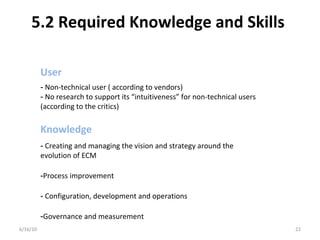
- Creating and managing the vision and strategy around the
evolution of ECM
-Process improvement
- Configuration, development and operations
-Governance and measurement
- Non-technical user ( according to vendors)
- No research to support its “intuitiveness” for non-technical users
(according to the critics)
User
Knowledge
6. Standards and Guidelines
6.1 Industry Guideline and Research
6/16/10 23
6.1 Industry Guidelines and
Research
6/16/10 24
iECM
http://iecm.editme.com/
AIIM
http://www.aiim.org/
KMWorld
- 50,000 subscribers
http://www.kmworld.com/WhitePapers/Default.aspx
Gartner
http://www.gartner.com/technology/home.jsp
“The KMWorld Best Practice White Papers
have become a key component in the creation
of the "shopping lists" for today's information
managers.” KMWorld
“Leading technology publications primarily
read by business leaders and
technologists, do not even know that
technical communication scholarship
exists.”
(Anderson, 2008)
Discussion
6/16/10 25
1. Are ECM technologies liberating workers’ creativity1
or closing it down2
? (creativity vs. control)
2. Who gains and looses the most from the
implementation and consequences of ECM?
Customer? Worker? Vendor? CEO?
3. How to judge if a company needs ECM
implementation?
4. How will ECM solutions enhance if vendors and
mainstream publications consult and apply scholarly
research to their product development?
Bibliography
6/16/10 26
Anand Subramaniam.ECM System – implementation roadmap, risk & Lessons from trenches, retrieved from
http://www.slideshare.net/anandsubramaniam/enterprise-content-management-ecm-system-1812772. 2010
R. Andersen: "The Rhetoric of Enterprise Content Management (ECM): Confronting the Assumptions Driving
ECM Adoption and Transforming Technical Communication", Technical Communication Quarterly, Vol. 17,
2008, pp. 61-87.
R. Dilnutt: "Surviving the Information Explosion", Engineering Management Journal, Vol. 16, 2006, pp. 39- 41.
Hooper, Dan. ECM: Definition Please!, in Infonomics, July/August 2009.
Ulrich Kampffmeyer. ECM Enterprise Content Management, 2006, Hamburg. (English, French, German)
R. O'Callaghan, and M. Smits: "A Strategy Development Process for Enterprise Content Management", in:
Proceedings of the 13th European Conference on Information Systems (ECIS'05), Regensburg, Germany, 2005,
pp. 1271-1282.
Ulrich Kampffmeyer. ECM Enterprise Content Management, 2006, Hamburg. (English, French, German)

Enterprise Content Management

  • 1.
  • 2.
    1. Business, Organization,and User Perspectives 1.1 What Is It? 1.2 What Needs Does It Serve? 1.3 Benefits 1.4 Stakeholders and Business Process Changes 1.5 Challenges 6/16/10 2
  • 3.
    1.1 What IsIt? “Convergence of a number of technologies integrated into components offering the capability to store, access and manage documents.”( Dillnutt, 2006) 6/16/10 3 “An average worker spends 3.7 hours per week searching for and not finding needed information!” IDC Information Worker Productivity Studies, 2008–2009. “75 % to 80% of data is unstructured” O’Callaghan and Smits, 2003
  • 4.
    1.2 What NeedsDoes It Serve? 6/16/10 4 Information- Creation - Management - Storage - Archiving - Sharing - Web content management - Document management -Records management - Collaboration - Portal technology -Workflow - Search and retrieval
  • 5.
    1.3 Benefits - Compliance -Traceability“organizational memory” - Sarbanes-Oxley legislation 2002 -Bill 198 2002 6/16/10 5 -Efficiency - Availability - Consistency - Customer service - Consolidation - Continuity - Risk mitigation
  • 6.
    1.4 Stakeholders andBusiness Process Changes Stakeholder Employees of the Organization - Receptionists and administrators - Sales / IT Representatives - Managers - CEO External - Customers/Clients -Interested parties - Lawyers -Auditors -Government 6/16/10 6 Change - Obliterate and automate unnecessary procedure - Processing critical activities faster
  • 7.
    1.5 Challenges 6/16/10 7 -Downsizing - Strict control and regulation vs. autonomy and flexibility - Focus on information rather than people - One -size does not fit-all “The more content and knowledge organizations capture in their ECM system, the more organizations can controlhow, when, where, and by whom content is generated, and the more they can pinpoint opportunities for increased regulationsand automation” (Andersson, 2008)
  • 8.
    2.1 Information Structuresand Processes 6/16/10 8
  • 9.
    2. Information Contentand Processing 2.1 Information Structures and Processes 6/16/10 9
  • 10.
    2.1 Information Structuresand Processes 6/16/10 10 - Support both structure and unstructured information - Support traditional archive, document management - Support process management – Workflow - Support search and retrieval
  • 11.
    3. Technology System Characteristics 3.1Features & Functional Components 3.2 Architectural Configurations 3.3 Open Source Solutions 6/16/10 11
  • 12.
    3.1 Features &Functional Components 6/16/10 12
  • 13.
    3.1 Features &Functional Components 6/16/10 13 Three Key Ideas distinct from WCM • Middleware • Services • Federated repository
  • 14.
  • 15.
    3.3 Open sourceSolutions 6/16/10 15 http://www.socialtext.com/ http://drupal.orghttp://plone.org/
  • 16.
    3.3 Socialtext 4.0 EnterpriseSocial Software 6/16/10 16
  • 17.
    4. Requirements &Design 4.1 Requirement Analysis 4.2 Non-functional Requirements 6/16/10 17
  • 18.
    4.1 Requirement Analysis 6/16/1018 - Develop and approve business case (ROI, Scope, Goals linked to firm’s strategy) - Inter-disciplinary team formed along with Top Management - Research firms that have ECM along with work flow processes - Develop – Use case diagrams, scenarios, work flow, interface, data conversion - Determine non-functional requirements - Gap analysis and requirement documentation - Evaluate and select ECM (Benefits, functionality checklist)
  • 19.
    4.2 Non-functional Requirements 6/16/1019 -Easy of use -Backup and Restore -Availability Requirements -Error Handling -Transaction and Data Integrity -Performance and Configuration -Security
  • 20.
    5. Processes &Methodologies 5.1 ECM Development 5.2 Required knowledge and Skills 6/16/10 20
  • 21.
    5.1 ECM Development 6/16/1021 1. Strategy/ Business planning - Analyze as-is situation and evaluate To-be changes - Stakeholder goals Understand the impact of ECM on the organization - Identify measures of success “we did not get what we paid for” Hooper, 2009 “ECM 50% failure rate” Hooper, 2009 2. Requirement Analysis For ex. Content management process ( centralized/decentralized) 3. Software/Vendor Analysis List of vendors, Solutions overview, Tools, Training offered, Cost and time of implementation, and Risks and benefits 6. Post Implementation Evaluation ( Customer and staff satisfaction, organization performance, customer services, policy procedure standards, ROI, and project success) 4. Design Align To-be changes with the ECM system 5. Building and Testing Capture, manage, store, preserve and deliver, Develop test cases/procedures for ( security, integration, UI, workflows etc.)
  • 22.
    5.2 Required Knowledgeand Skills 6/16/10 22 - Creating and managing the vision and strategy around the evolution of ECM -Process improvement - Configuration, development and operations -Governance and measurement - Non-technical user ( according to vendors) - No research to support its “intuitiveness” for non-technical users (according to the critics) User Knowledge
  • 23.
    6. Standards andGuidelines 6.1 Industry Guideline and Research 6/16/10 23
  • 24.
    6.1 Industry Guidelinesand Research 6/16/10 24 iECM http://iecm.editme.com/ AIIM http://www.aiim.org/ KMWorld - 50,000 subscribers http://www.kmworld.com/WhitePapers/Default.aspx Gartner http://www.gartner.com/technology/home.jsp “The KMWorld Best Practice White Papers have become a key component in the creation of the "shopping lists" for today's information managers.” KMWorld “Leading technology publications primarily read by business leaders and technologists, do not even know that technical communication scholarship exists.” (Anderson, 2008)
  • 25.
    Discussion 6/16/10 25 1. AreECM technologies liberating workers’ creativity1 or closing it down2 ? (creativity vs. control) 2. Who gains and looses the most from the implementation and consequences of ECM? Customer? Worker? Vendor? CEO? 3. How to judge if a company needs ECM implementation? 4. How will ECM solutions enhance if vendors and mainstream publications consult and apply scholarly research to their product development?
  • 26.
    Bibliography 6/16/10 26 Anand Subramaniam.ECMSystem – implementation roadmap, risk & Lessons from trenches, retrieved from http://www.slideshare.net/anandsubramaniam/enterprise-content-management-ecm-system-1812772. 2010 R. Andersen: "The Rhetoric of Enterprise Content Management (ECM): Confronting the Assumptions Driving ECM Adoption and Transforming Technical Communication", Technical Communication Quarterly, Vol. 17, 2008, pp. 61-87. R. Dilnutt: "Surviving the Information Explosion", Engineering Management Journal, Vol. 16, 2006, pp. 39- 41. Hooper, Dan. ECM: Definition Please!, in Infonomics, July/August 2009. Ulrich Kampffmeyer. ECM Enterprise Content Management, 2006, Hamburg. (English, French, German) R. O'Callaghan, and M. Smits: "A Strategy Development Process for Enterprise Content Management", in: Proceedings of the 13th European Conference on Information Systems (ECIS'05), Regensburg, Germany, 2005, pp. 1271-1282. Ulrich Kampffmeyer. ECM Enterprise Content Management, 2006, Hamburg. (English, French, German)

Editor's Notes

  • #4 Have you worked in an organization that has unstructured data? How did that reduce productivity, customer service and employee satisfaction?
  • #6 Why does compliance matters so much? Source: (Dillnutt, 2006) and (AIIM, 2010) More information about the Sarbanes-Oxley: www.soxlaw.com
  • #7 Any other stakeholders?
  • #8 Do you agree with the scholars? Do you think that ECM solutions will increase managerial control and reduce worker’s autonomy?
  • #15 In 2005 AIIM brought out a new poster, presenting ECM as a large building, with information entry and exit on the ground floor and business process management as the elevator connecting all the floors. This new model incorporates a number of additional components such as E-mail management, digital asset management, content integration and others.
  • #16 Drupal is a free software package that allows an individual, a community of users, or an enterprise to easily publish, manage and organize a wide variety of content on a website. Hundreds of thousands of people and organizations are using Drupal to power an endless variety of web sites, including Community web portals, Discussion sites ,Corporate web sites, Intranet applications, Personal web sites or blogs,Aficionado sites , E-commerce applications Resource directories, Social Networking sites Plone is a free and open source content management system built on top of the Zope application server. Plone can be used for in principle any kind of website, including blogs, internet sites, webshops and internal websites. It is also well positioned to be used as a document publishing system and groupware collaboration tool. The strengths of Plone are its flexible and adaptable workflow, very good security, extensibility, high usability and flexibility.
  • #17 With Socialtext Mobile, the Socialtext platform is available to you anytime, anywhere. You can stay involved in microblogging conversations, stay apprised of what’s going on via activity streams, get to the workspace content you need, access co-worker profiles, and more. Socialtext Mobile automatically detects when you log in from a mobile phone and serves up an optimized mobile interface. It lets you continue to work in Socialtext all the powerful ways you do while in the office: Participate in private and secure microblogging conversations via Socialtext Signals. Stay up-to-date on what others are working on and sharing via activity streams. Click to look up a colleague’s profile, and click to communicate with him or her. Collaborate on content that is automatically shared with others via workspace pages. Socialtext Mobile is platform independent, providing support for a variety of mobile devices. It currently supports Blackberry, iPhone and Android devices. Socialtext Mobile comes free as part of Socialtext.
  • #20 Source: http://mike2.openmethodology.org/wiki/Strategic_Non-Functional_Requirements
  • #22 Based on Anand Subramaniam.ECM System – implementation roadmap, risk & Lessons from trenches, retrieved from http://www.slideshare.net/anandsubramaniam/enterprise-content-management-ecm-system-1812772. 2010
  • #23 User Source: (Anderson, 2008) Knowledge Source: http://www.aiim.org/infonomics/4-skills-needed-for-an-ecm-career.aspx
  • #25 Who should organizations/business leaders turn to for advice when purchasing ECM solutions? White papers or publications written/supported by vendors’ CEOs or scholarly research?
  • #26 1 Creativity: Innovative and appropriate ideas, process and services 2 (Anderson, 2008)