
ENHANCING ACADEMIC
PRODUCTIVITY USING
GENERATIVE AI
24th JUL 2023
Tips and Strategies
www.upm.edu.my
Assoc. Prof. Ts. Dr. Nurfadhlina Mohd Sharef
Faculty of Computer Science and Information Technology,
Universiti Putra Malaysia
nurfadhlina@upm.edu.my
Assoc. Prof. Ts. Dr.
Nurfadhlina Mohd Sharef
Intelligent Computing Research Group, Faculty of Computer Science and Information
Technology, Universiti Putra Malaysia.
nurfadhlina@upm.edu.my, 0126672504, https://sites.google.com/view/nurfadhlina
Affiliation:
1. Associate Professor, Department of Computer
Science, Faculty of Computer Science and
Information Technology, Universiti Putra
Malaysia.
2. Chairperson, Young Scientist Network-Academy
of Sciences Malaysia (YSN-ASM)
3. Task Force Member, National Artificial
Intelligence Roadmap Implementation 2021-
2025, MOSTI
4. Interim Research Associate, Malaysia Institute
for Ageing Research (MyAGEING), Universiti
Putra Malaysia.
5. Research Associate, Institute for Mathematical
Research (INSPEM), Universiti Putra Malaysia.
Data Analytics
1. Digitalisation and IoT for Precision
Biodiversity
2.COVID19 Vaccination Distribution Planning
and Tracking
3. BSH- LHDNM Analytics Dashboard for
Program Bantuan Kerajaan
4. National Integrated Cybersecurity Threat
Factor Profiling
5. Learning Analytics and Chatbot for
Personalized Learning
Machine Learning
1. Deep Recurrent Q-Network Approach for
Multi Objective Recommendation System
2. Interactive Machine Learning based on Deep
Reinforcement Learning and Generative
Adversarial Network Hybrid for Digital Twin
Research Interests
● Artificial Intelligence
● Data Science and Data Analytics
● Text Mining and Question Answering
● Recommender Systems
● eLearning
Text Mining
1.Online Reputation Meter
2.Evolving Multi-Granular Temporal
Abstraction Method to Improve Clinical
Data Analysis
3.Multi-Tasking based Deep Learning for
Tweets Analytics
4.Deep Attention Model For Review-
based Multi-Criteria Recommendation
System
5.Sequence-to-Sequence Based Natural
Answer Generation Models
1. Introduction to generative AI
2. Example 1 on generative AI usage in TnL
3. Example 2 on generative AI usage in TnL
4. Example 3 on generative AI usage in TnL
5. Examples on generative AI for research purposes
6. Conclusion
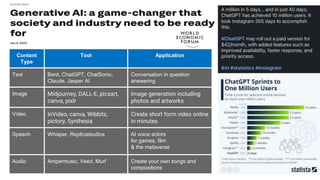
Content
Type
Tool Application
Text Bard, ChatGPT, ChatSonic,
Claude, Jasper AI
Conversation in question
answering
Image Midjourney, DALL-E, picsart,
canva, pixlr
Image generation including
photos and artworks
Video InVideo, canva, Wibbitz,
pictory, Synthesia
Create short form video online
in minutes
Speech Whisper, Replicastudios AI voice actors
for games, film
& the metaverse
Audio Ampermusic, Veed, Murf Create your own songs and
compositions
Source: https://mazlanabbas.com/2023/05/05/transform-your-social-media-
content-with-the-power-of-midjourney-prompts/
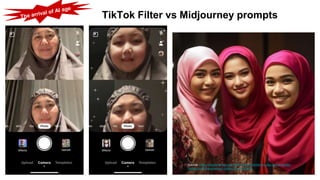
TikTok Filter vs Midjourney prompts
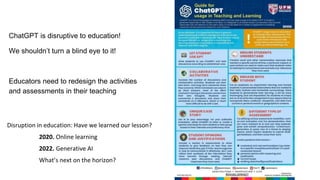
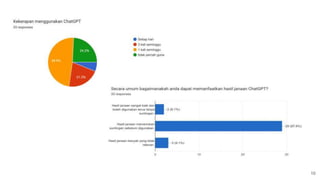
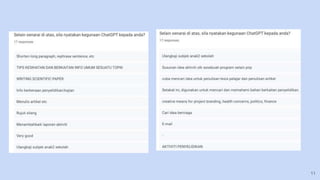
ChatGPT is disruptive to education!
We shouldn’t turn a blind eye to it!
Educators need to redesign the activities
and assessments in their teaching
Disruption in education: Have we learned our lesson?
2020. Online learning
2022. Generative AI
What’s next on the horizon?
9
Issues
1. False and misleading content? Disinformation typhoon by generating
toxic and biased output, and internet will be flooded with artwork that is
indistinguishable from its original
2. Disruption of labour market. Large parts of the creative workforce,
including commercial artists working in entertainment, video games,
advertising, and publishing, could lose their jobs because of generative AI
models. Advertising has the means not only to fund creators but also help
those of differing backgrounds find their careers in the industry. If we (or
even our clients without or input) look to robots to create their work, what
does that mean for them?
3. Ethical concerns. The datasets behind generative AI models are generally
scraped from the internet without seeking consent from living artists or work
still under copyright. Should the artists who created the image used to train
the AI get paid for this?
4. Authenticity and ownership. Would the art pieces generated by AI be
regarded authentic?How about writing that is composed with the assistance
of generative AI? Authors of a publication or an innovation is usually
considered accountable for their writing. Since AI is not an individual,
therefore the product should not be regarded as a valid contribution?
5. Reliability of intelligence. Generative AI systems are only as good as
their training data and may perpetuate biases or even generate and spread
misinformation. Evaluation metrics: Sensibleness and Specificity Average
(SSA), perplexity
10
11
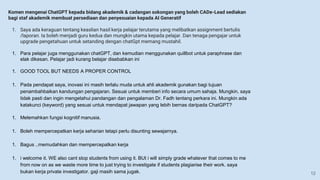
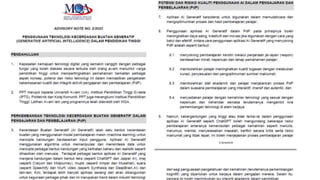
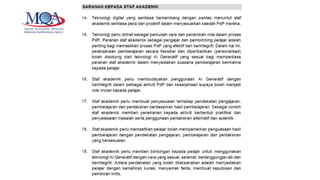
Komen mengenai ChatGPT kepada bidang akademik & cadangan sokongan yang boleh CADe-Lead sediakan
bagi staf akademik membuat persediaan dan penyesuaian kepada AI Generatif
1. Saya ada keraguan tentang keaslian hasil kerja pelajar terutama yang melibatkan assignment bertulis
/laporan. Ia boleh menjadi guru kedua dan mungkin utama kepada pelajar. Dan tenaga pengajar untuk
upgrade pengetahuan untuk setanding dengan chatGpt memang mustahil.
1. Para pelajar juga menggunakan chatGPT, dan kemudian menggunakan quillbot untuk paraphrase dan
elak dikesan. Pelajar jadi kurang belajar disebabkan ini
1. GOOD TOOL BUT NEEDS A PROPER CONTROL
1. Pada pendapat saya, inovasi ini masih terlalu muda untuk ahli akademik gunakan bagi tujuan
penambahbaikan kandungan pengajaran. Sesuai untuk memberi info secara umum sahaja. Mungkin, saya
tidak pasti dan ingin mengetahui pandangan dan pengalaman Dr. Fadh tentang perkara ini. Mungkin ada
katakunci (keyword) yang sesuai untuk mendapat jawapan yang lebih bernas daripada ChatGPT?
1. Melemahkan fungsi kognitif manusia.
1. Boleh mempercepatkan kerja seharian tetapi perlu disunting sewajarnya.
1. Bagus ..memudahkan dan mempercepatkan kerja
1. i welcome it. WE also cant stop students from using it. BUt i will simply grade whatever that comes to me
from now on as we waste more time to just trying to investigate if students plagiarise their work. saya
bukan kerja private investigator. gaji masih sama jugak. 12
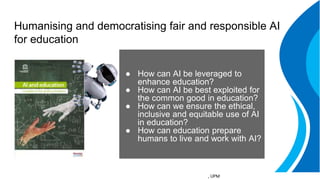
Humanising and democratising fair and responsible AI
for education
● How can AI be leveraged to
enhance education?
● How can AI be best exploited for
the common good in education?
● How can we ensure the ethical,
inclusive and equitable use of AI
in education?
● How can education prepare
humans to live and work with AI?
, UPM
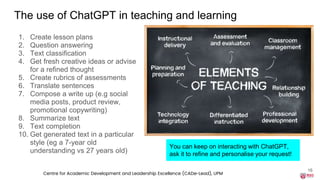
The use of ChatGPT in teaching and learning
1. Create lesson plans
2. Question answering
3. Text classification
4. Get fresh creative ideas or advise
for a refined thought
5. Create rubrics of assessments
6. Translate sentences
7. Compose a write up (e.g social
media posts, product review,
promotional copywriting)
8. Summarize text
9. Text completion
10. Get generated text in a particular
style (eg a 7-year old
understanding vs 27 years old)
16
You can keep on interacting with ChatGPT,
ask it to refine and personalise your request!
Centre for Academic Development and Leadership Excellence (CADe-Lead), UPM
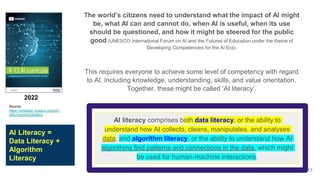
The world’s citizens need to understand what the impact of AI might
be, what AI can and cannot do, when AI is useful, when its use
should be questioned, and how it might be steered for the public
good (UNESCO International Forum on AI and the Futures of Education under the theme of
Developing Competencies for the AI Era).
This requires everyone to achieve some level of competency with regard
to AI, including knowledge, understanding, skills, and value orientation.
Together, these might be called ‘AI literacy’.
Source:
https://unesdoc.unesco.org/ark:/
48223/pf0000380602
2022
AI literacy comprises both data literacy, or the ability to
understand how AI collects, cleans, manipulates, and analyses
data; and algorithm literacy, or the ability to understand how AI
algorithms find patterns and connections in the data, which might
be used for human-machine interactions.
AI Literacy =
Data Literacy +
Algorithm
Literacy
17
26th June 2023
13th Feb 2023
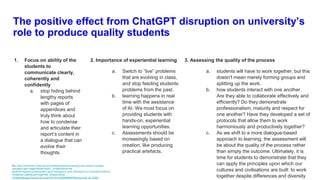
The positive effect from ChatGPT disruption on university’s
role to produce quality students
1. Focus on ability of the
students to
communicate clearly,
coherently and
confidently
a. stop hiding behind
lengthy reports
with pages of
appendices and
truly think about
how to condense
and articulate their
report’s content in
a dialogue that can
evolve their
thoughts.
2. Importance of experiential learning
a. Switch to “live” problems
that are evolving in class,
and stop feeding students
problems from the past.
b. learning happens in real
time with the assistance
of AI. We must focus on
providing students with
hands-on, experiential
learning opportunities.
c. Assessments should be
increasingly based on
creation, like producing
practical artefacts.
3. Assessing the quality of the process
a. students will have to work together, but this
doesn't mean merely forming groups and
splitting up the work.
b. how students interact with one another.
Are they able to collaborate effectively and
efficiently? Do they demonstrate
professionalism, maturity and respect for
one another? Have they developed a set of
protocols that allow them to work
harmoniously and productively together?
c. As we shift to a more dialogue-based
approach to learning, the assessment will
be about the quality of the process rather
than simply the outcome. Ultimately, it is
time for students to demonstrate that they
can apply the principles upon which our
cultures and civilisations are built: to work
together despite differences and diversity
Src: https://newsroom.unsw.edu.au/news/business-law/charting-new-course-university-
education-age-chatgpt?fbclid=IwAR1_bVk5BlUWo4Fr69-
5w3wHnTeqexbuJ5oxRu0m0SLLMjnc7b2ecgIrqVc_aem_ARIuRjvCTjuC1PnjOdExO3nNFIvy
3LneMCkk-icBjW9cowCFjegFWiE_X0weKw36Qb-
GUo8fUg4lCgyw70n3cdLULJrccwVVtP7d1mtZf5MM0BSFRwICpJYukl_nb_Vbf20
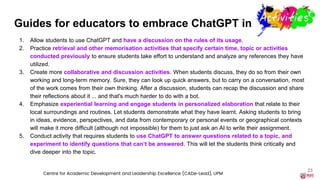
Guides for educators to embrace ChatGPT in activities
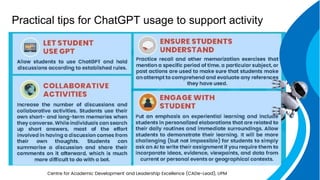
1. Allow students to use ChatGPT and have a discussion on the rules of its usage.
2. Practice retrieval and other memorisation activities that specify certain time, topic or activities
conducted previously to ensure students take effort to understand and analyze any references they have
utilized.
3. Create more collaborative and discussion activities. When students discuss, they do so from their own
working and long-term memory. Sure, they can look up quick answers, but to carry on a conversation, most
of the work comes from their own thinking. After a discussion, students can recap the discussion and share
their reflections about it ... and that's much harder to do with a bot.
4. Emphasize experiential learning and engage students in personalized elaboration that relate to their
local surroundings and routines. Let students demonstrate what they have learnt. Asking students to bring
in ideas, evidence, perspectives, and data from contemporary or personal events or geographical contexts
will make it more difficult (although not impossible) for them to just ask an AI to write their assignment.
5. Conduct activity that requires students to use ChatGPT to answer questions related to a topic, and
experiment to identify questions that can’t be answered. This will let the students think critically and
dive deeper into the topic.
23
Centre for Academic Development and Leadership Excellence (CADe-Lead), UPM
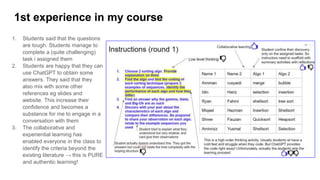
1st experience in my course
1. Students said that the questions
are tough. Students manage to
complete a (quite challenging)
task i assigned them
2. Students are happy that they can
use ChatGPT to obtain some
answers. They said that they
also mix with some other
references eg slides and
website. This increase their
confidence and becomes a
substance for me to engage in a
conversation with them
3. The collaborative and
experiential learning has
enabled everyone in the class to
identify the criteria beyond the
existing literature → this is PURE
and authentic learning!
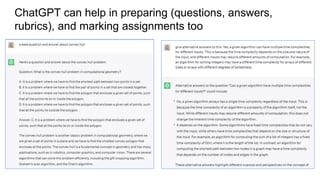
ChatGPT can help in preparing (questions, answers,
rubrics), and marking assignments too
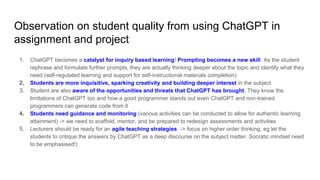
Observation on student quality from using ChatGPT in
assignment and project
1. ChatGPT becomes a catalyst for inquiry based learning! Prompting becomes a new skill. As the student
rephrase and formulate further prompts, they are actually thinking deeper about the topic and identify what they
need (self-regulated learning and support for self-instructional materials completion)
2. Students are more inquisitive, sparking creativity and building deeper interest in the subject
3. Student are also aware of the opportunities and threats that ChatGPT has brought. They know the
limitations of ChatGPT too and how a good programmer stands out even ChatGPT and non-trained
programmers can generate code from it
4. Students need guidance and monitoring (various activities can be conducted to allow for authentic learning
attainment) -> we need to scaffold, mentor, and be prepared to redesign assessments and activities
5. Lecturers should be ready for an agile teaching strategies -> focus on higher order thinking, eg let the
students to critique the answers by ChatGPT as a deep discourse on the subject matter. Socratic mindset need
to be emphasised!)
27
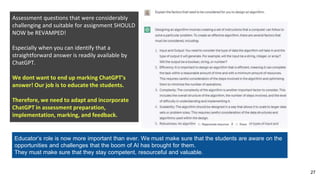
Assessment questions that were considerably
challenging and suitable for assignment SHOULD
NOW be REVAMPED!
Especially when you can identify that a
straightforward answer is readily available by
ChatGPT.
We dont want to end up marking ChatGPT’s
answer! Our job is to educate the students.
Therefore, we need to adapt and incorporate
ChatGPT in assessment preparation,
implementation, marking, and feedback.
Educator’s role is now more important than ever. We must make sure that the students are aware on the
opportunities and challenges that the boom of AI has brought for them.
They must make sure that they stay competent, resourceful and valuable.
28
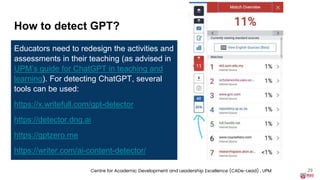
How to detect GPT?
Educators need to redesign the activities and
assessments in their teaching (as advised in
UPM’s guide for ChatGPT in teaching and
learning). For detecting ChatGPT, several
tools can be used:
https://x.writefull.com/gpt-detector
https://detector.dng.ai
https://gptzero.me
https://writer.com/ai-content-detector/
29
Centre for Academic Development and Leadership Excellence (CADe-Lead) , UPM
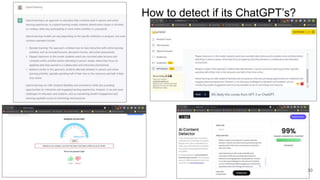
How to detect if its ChatGPT’s?
30
Example prompts to refine the quality of your interaction with ChatGPT
1. Revise this piece of text to be more [clear, shorter, elaborated, concise, simple, complex, humorous]
2. Edit this paragraph for grammar
3. Generate some write up on the [topic] that meets the following criteria [paste criteria].
4. Rewrite this text in the style of [style name]
5. Summarize the [topic] in 50 words or less.
6. Write step-by-step directions for [topic]
7. I need further details than the above.
8. Give me more explanation. Focus on [specific]
9. Based on the following [criteria], give me 5 specific facts for [info]
10. Rewrite this email so it is more [ADJECTIVE] [PASTE EMAIL DRAFT]
11. Write a thank you email to a family member who [WAY THEY HELPED]
12. Describe [TOPIC] in detail
13. Write 10 discussion questions to talk about [TOPIC]
14. Write a model essay on [TOPIC] that includes [FEATURES]
15. Write a song in the style of [ARTIST/GENRE] that teaches students about [TOPIC]
16. Explain the process of [TASK] in [NUMBER] steps
17. Condense this into just [NUMBER] steps [PASTE TEXT]
18. Create a survey to see what [GRADE LEVEL] students would be most interested in learning about [TOPIC]
19. Provide some examples of open-ended questions to include in a student survey about [TOPIC]
20. Can you suggest some interactive games or activities that can help reinforce learning in [TOPIC]?
31
You can keep on interacting with
ChatGPT, ask it to refine and
personalise your request!
Practical tips for ChatGPT usage to support activity
Centre for Academic Development and Leadership Excellence (CADe-Lead), UPM
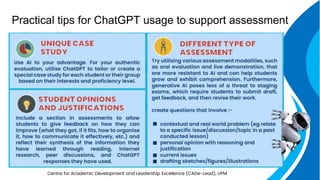
Practical tips for ChatGPT usage to support assessment
Centre for Academic Development and Leadership Excellence (CADe-Lead), UPM
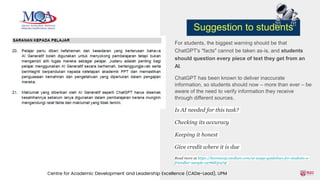
For students, the biggest warning should be that
ChatGPT's "facts" cannot be taken as-is, and students
should question every piece of text they get from an
AI.
ChatGPT has been known to deliver inaccurate
information, so students should now – more than ever – be
aware of the need to verify information they receive
through different sources.
Is AI needed for this task?
Checking its accuracy
Keeping it honest
Give credit where it is due
Read more at https://keemanxp.medium.com/ai-usage-guidelines-for-students-a-
friendlier-sample-c978d831972f
Centre for Academic Development and Leadership Excellence (CADe-Lead), UPM
Suggestion to students
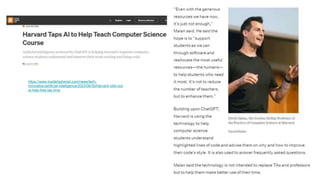
https://www.insidehighered.com/news/tech-
innovation/artificial-intelligence/2023/06/30/harvard-rolls-out-
ai-help-free-tas-time
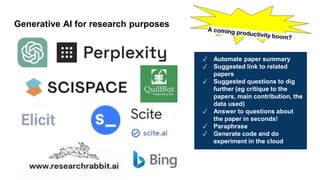
Generative AI for research purposes
✓ Automate paper summary
✓ Suggested link to related
papers
✓ Suggested questions to dig
further (eg critique to the
papers, main contribution, the
data used)
✓ Answer to questions about
the paper in seconds!
✓ Paraphrase
✓ Generate code and do
experiment in the cloud
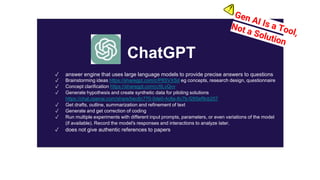
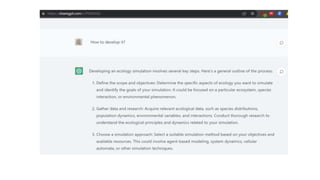
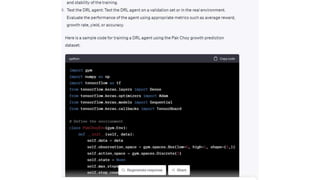
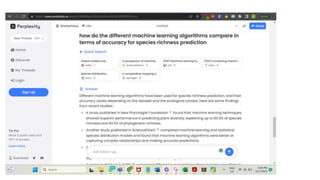
✓ answer engine that uses large language models to provide precise answers to questions
✓ Brainstorming ideas https://sharegpt.com/c/P8SVXSd eg concepts, research design, questionnaire
✓ Concept clarification https://sharegpt.com/c/tILvQvv
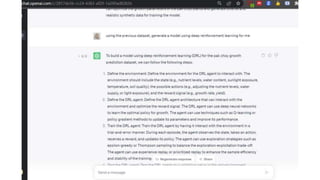
✓ Generate hypothesis and create synthetic data for piloting solutions
https://chat.openai.com/share/bec6c770-0de0-4c8a-8c7b-f265ef9cb257
✓ Get drafts, outline, summarization and refinement of text
✓ Generate and get correction of coding
✓ Run multiple experiments with different input prompts, parameters, or even variations of the model
(if available). Record the model's responses and interactions to analyze later.
✓ does not give authentic references to papers
ChatGPT
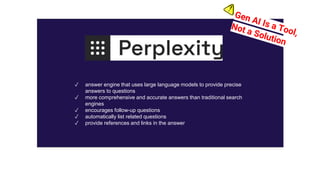
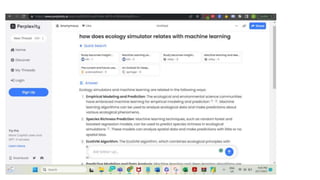
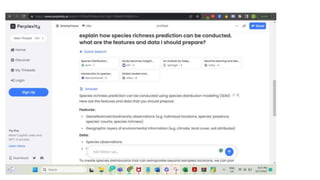
✓ answer engine that uses large language models to provide precise
answers to questions
✓ more comprehensive and accurate answers than traditional search
engines
✓ encourages follow-up questions
✓ automatically list related questions
✓ provide references and links in the answer
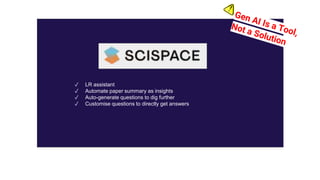
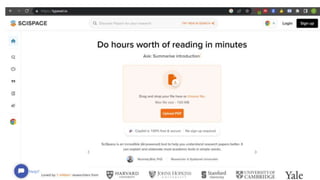
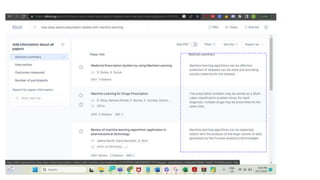
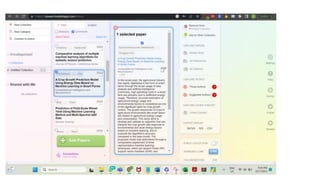
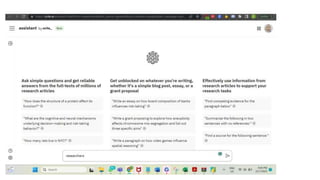
✓ LR assistant
✓ Automate paper summary as insights
✓ Auto-generate questions to dig further
✓ Customise questions to directly get answers
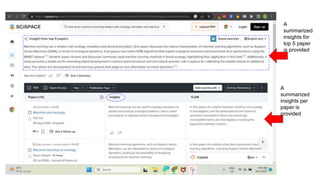
A
summarized
insights for
top 5 paper
is provided
A
summarized
insights per
paper is
provided
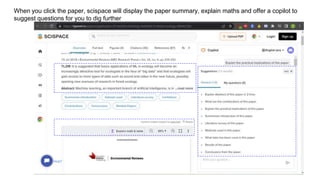
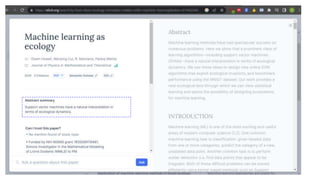
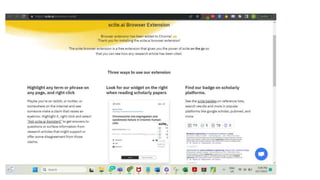
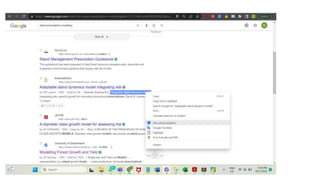
When you click the paper, scispace will display the paper summary, explain maths and offer a copilot to
suggest questions for you to dig further
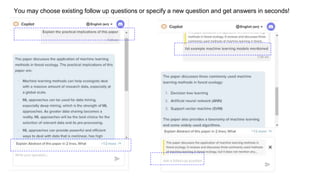
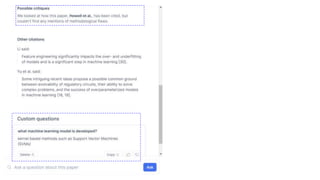
You may choose existing follow up questions or specify a new question and get answers in seconds!
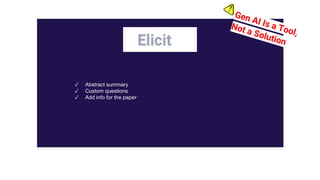
✓ Abstract summary
✓ Custom questions
✓ Add info for the paper
✓ literature mapping tool
✓ suggest links of relevant papers
✓ optimise your time searching for references
✓ citation analysis
✓ ChatGPT of science
✓ extract text
In
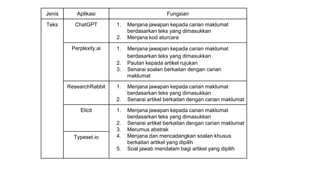
Jenis Aplikasi Fungsian
Teks ChatGPT 1. Menjana jawapan kepada carian maklumat
berdasarkan teks yang dimasukkan
2. Menjana kod aturcara
Perplexity.ai 1. Menjana jawapan kepada carian maklumat
berdasarkan teks yang dimasukkan
2. Pautan kepada artikel rujukan
3. Senarai soalan berkaitan dengan carian
maklumat
ResearchRabbit 1. Menjana jawapan kepada carian maklumat
berdasarkan teks yang dimasukkan
2. Senarai artikel berkaitan dengan carian maklumat
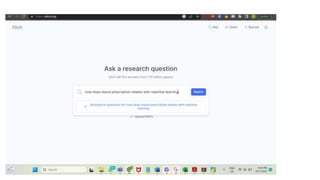
Elicit 1. Menjana jawapan kepada carian maklumat
berdasarkan teks yang dimasukkan
2. Senarai artikel berkaitan dengan carian maklumat
3. Merumus abstrak
4. Menjana dan mencadangkan soalan khusus
berkaitan artikel yang dipilih
5. Soal jawab mendalam bagi artikel yang dipilih
Typeset.io
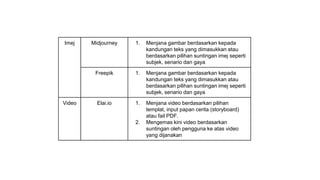
Imej Midjourney 1. Menjana gambar berdasarkan kepada
kandungan teks yang dimasukkan atau
berdasarkan pilihan suntingan imej seperti
subjek, senario dan gaya
Freepik 1. Menjana gambar berdasarkan kepada
kandungan teks yang dimasukkan atau
berdasarkan pilihan suntingan imej seperti
subjek, senario dan gaya
Video Elai.io 1. Menjana video berdasarkan pilihan
templat, input papan cerita (storyboard)
atau fail PDF.
2. Mengemas kini video berdasarkan
suntingan oleh pengguna ke atas video
yang dijanakan
My reflection based on usage of ChatGPT for 1 sem
1. ChatGPT provides personalized support to students (24/7 available tutor)
2. Users still need to have good foundation in the area that he/she search using ChatGPT, so inaccurate
data can be detected
3. Students need to be taught on how to be responsible learners. We need to be a role model to them!
(instead of us assuming they have learnt since they come out with long answers, while actually they only
copy-paste from ChatGPT). Listen to their reflection, and motivate them by interacting further allow us to
have a deep understanding and build connections with them
4. Lecturers need to unlearn and relearn (ChatGPT sometimes are better instructors. We need to leverage
this tech to make ourselves better)
5. Effort still counts for BIG TIME! Students who use ChatGPT as a tool for quality productive learning
struggle gain multiple times benefit. They become stronger thinker, acquire more knowledge, more
confident
Takeaway message
1. By automating tasks that are time-consuming and repetitive, generative AI allows
research professionals to focus on what they do best — creating new knowledge and
exploring new ideas.
2. Because of the capabilities of artificial intelligence, schools will need to rethink how
they evaluate student learning; “in a more dynamic way, as opposed to static
summative assessments or submission of essays
3. Emerging competencies are on resourcefulness and how to leverage tools to be
more productive.
4. Educator’s role is even more important now.. To ensure the students are prepared for
their unforeseen future. They need to be resilient. Focus on critical thinking,
communication, creativity, collaboration, and citizenship
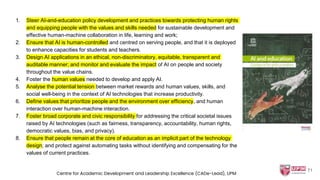
1. Steer AI-and-education policy development and practices towards protecting human rights
and equipping people with the values and skills needed for sustainable development and
effective human-machine collaboration in life, learning and work;
2. Ensure that AI is human-controlled and centred on serving people, and that it is deployed
to enhance capacities for students and teachers.
3. Design AI applications in an ethical, non-discriminatory, equitable, transparent and
auditable manner; and monitor and evaluate the impact of AI on people and society
throughout the value chains.
4. Foster the human values needed to develop and apply AI.
5. Analyse the potential tension between market rewards and human values, skills, and
social well-being in the context of AI technologies that increase productivity.
6. Define values that prioritize people and the environment over efficiency, and human
interaction over human-machine interaction.
7. Foster broad corporate and civic responsibility for addressing the critical societal issues
raised by AI technologies (such as fairness, transparency, accountability, human rights,
democratic values, bias, and privacy).
8. Ensure that people remain at the core of education as an implicit part of the technology
design; and protect against automating tasks without identifying and compensating for the
values of current practices.
71
Centre for Academic Development and Leadership Excellence (CADe-Lead), UPM
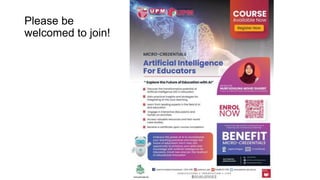
Please be
welcomed to join!
THANKS!
www.upm.edu.my
Nurfadhlina Mohd Sharef
nurfadhlina@upm.edu.my

Enhancing academic productivity using Gen AI

  • 1.
    ENHANCING ACADEMIC PRODUCTIVITY USING GENERATIVEAI 24th JUL 2023 Tips and Strategies www.upm.edu.my Assoc. Prof. Ts. Dr. Nurfadhlina Mohd Sharef Faculty of Computer Science and Information Technology, Universiti Putra Malaysia nurfadhlina@upm.edu.my
  • 2.
    Assoc. Prof. Ts.Dr. Nurfadhlina Mohd Sharef Intelligent Computing Research Group, Faculty of Computer Science and Information Technology, Universiti Putra Malaysia. nurfadhlina@upm.edu.my, 0126672504, https://sites.google.com/view/nurfadhlina Affiliation: 1. Associate Professor, Department of Computer Science, Faculty of Computer Science and Information Technology, Universiti Putra Malaysia. 2. Chairperson, Young Scientist Network-Academy of Sciences Malaysia (YSN-ASM) 3. Task Force Member, National Artificial Intelligence Roadmap Implementation 2021- 2025, MOSTI 4. Interim Research Associate, Malaysia Institute for Ageing Research (MyAGEING), Universiti Putra Malaysia. 5. Research Associate, Institute for Mathematical Research (INSPEM), Universiti Putra Malaysia. Data Analytics 1. Digitalisation and IoT for Precision Biodiversity 2.COVID19 Vaccination Distribution Planning and Tracking 3. BSH- LHDNM Analytics Dashboard for Program Bantuan Kerajaan 4. National Integrated Cybersecurity Threat Factor Profiling 5. Learning Analytics and Chatbot for Personalized Learning Machine Learning 1. Deep Recurrent Q-Network Approach for Multi Objective Recommendation System 2. Interactive Machine Learning based on Deep Reinforcement Learning and Generative Adversarial Network Hybrid for Digital Twin Research Interests ● Artificial Intelligence ● Data Science and Data Analytics ● Text Mining and Question Answering ● Recommender Systems ● eLearning Text Mining 1.Online Reputation Meter 2.Evolving Multi-Granular Temporal Abstraction Method to Improve Clinical Data Analysis 3.Multi-Tasking based Deep Learning for Tweets Analytics 4.Deep Attention Model For Review- based Multi-Criteria Recommendation System 5.Sequence-to-Sequence Based Natural Answer Generation Models
  • 3.
    1. Introduction togenerative AI 2. Example 1 on generative AI usage in TnL 3. Example 2 on generative AI usage in TnL 4. Example 3 on generative AI usage in TnL 5. Examples on generative AI for research purposes 6. Conclusion
  • 4.
    Content Type Tool Application Text Bard,ChatGPT, ChatSonic, Claude, Jasper AI Conversation in question answering Image Midjourney, DALL-E, picsart, canva, pixlr Image generation including photos and artworks Video InVideo, canva, Wibbitz, pictory, Synthesia Create short form video online in minutes Speech Whisper, Replicastudios AI voice actors for games, film & the metaverse Audio Ampermusic, Veed, Murf Create your own songs and compositions
  • 5.
  • 7.
    ChatGPT is disruptiveto education! We shouldn’t turn a blind eye to it! Educators need to redesign the activities and assessments in their teaching Disruption in education: Have we learned our lesson? 2020. Online learning 2022. Generative AI What’s next on the horizon?
  • 8.
    9 Issues 1. False andmisleading content? Disinformation typhoon by generating toxic and biased output, and internet will be flooded with artwork that is indistinguishable from its original 2. Disruption of labour market. Large parts of the creative workforce, including commercial artists working in entertainment, video games, advertising, and publishing, could lose their jobs because of generative AI models. Advertising has the means not only to fund creators but also help those of differing backgrounds find their careers in the industry. If we (or even our clients without or input) look to robots to create their work, what does that mean for them? 3. Ethical concerns. The datasets behind generative AI models are generally scraped from the internet without seeking consent from living artists or work still under copyright. Should the artists who created the image used to train the AI get paid for this? 4. Authenticity and ownership. Would the art pieces generated by AI be regarded authentic?How about writing that is composed with the assistance of generative AI? Authors of a publication or an innovation is usually considered accountable for their writing. Since AI is not an individual, therefore the product should not be regarded as a valid contribution? 5. Reliability of intelligence. Generative AI systems are only as good as their training data and may perpetuate biases or even generate and spread misinformation. Evaluation metrics: Sensibleness and Specificity Average (SSA), perplexity
  • 9.
  • 10.
  • 11.
    Komen mengenai ChatGPTkepada bidang akademik & cadangan sokongan yang boleh CADe-Lead sediakan bagi staf akademik membuat persediaan dan penyesuaian kepada AI Generatif 1. Saya ada keraguan tentang keaslian hasil kerja pelajar terutama yang melibatkan assignment bertulis /laporan. Ia boleh menjadi guru kedua dan mungkin utama kepada pelajar. Dan tenaga pengajar untuk upgrade pengetahuan untuk setanding dengan chatGpt memang mustahil. 1. Para pelajar juga menggunakan chatGPT, dan kemudian menggunakan quillbot untuk paraphrase dan elak dikesan. Pelajar jadi kurang belajar disebabkan ini 1. GOOD TOOL BUT NEEDS A PROPER CONTROL 1. Pada pendapat saya, inovasi ini masih terlalu muda untuk ahli akademik gunakan bagi tujuan penambahbaikan kandungan pengajaran. Sesuai untuk memberi info secara umum sahaja. Mungkin, saya tidak pasti dan ingin mengetahui pandangan dan pengalaman Dr. Fadh tentang perkara ini. Mungkin ada katakunci (keyword) yang sesuai untuk mendapat jawapan yang lebih bernas daripada ChatGPT? 1. Melemahkan fungsi kognitif manusia. 1. Boleh mempercepatkan kerja seharian tetapi perlu disunting sewajarnya. 1. Bagus ..memudahkan dan mempercepatkan kerja 1. i welcome it. WE also cant stop students from using it. BUt i will simply grade whatever that comes to me from now on as we waste more time to just trying to investigate if students plagiarise their work. saya bukan kerja private investigator. gaji masih sama jugak. 12
  • 12.
    Humanising and democratisingfair and responsible AI for education ● How can AI be leveraged to enhance education? ● How can AI be best exploited for the common good in education? ● How can we ensure the ethical, inclusive and equitable use of AI in education? ● How can education prepare humans to live and work with AI? , UPM
  • 15.
    The use ofChatGPT in teaching and learning 1. Create lesson plans 2. Question answering 3. Text classification 4. Get fresh creative ideas or advise for a refined thought 5. Create rubrics of assessments 6. Translate sentences 7. Compose a write up (e.g social media posts, product review, promotional copywriting) 8. Summarize text 9. Text completion 10. Get generated text in a particular style (eg a 7-year old understanding vs 27 years old) 16 You can keep on interacting with ChatGPT, ask it to refine and personalise your request! Centre for Academic Development and Leadership Excellence (CADe-Lead), UPM
  • 16.
    The world’s citizensneed to understand what the impact of AI might be, what AI can and cannot do, when AI is useful, when its use should be questioned, and how it might be steered for the public good (UNESCO International Forum on AI and the Futures of Education under the theme of Developing Competencies for the AI Era). This requires everyone to achieve some level of competency with regard to AI, including knowledge, understanding, skills, and value orientation. Together, these might be called ‘AI literacy’. Source: https://unesdoc.unesco.org/ark:/ 48223/pf0000380602 2022 AI literacy comprises both data literacy, or the ability to understand how AI collects, cleans, manipulates, and analyses data; and algorithm literacy, or the ability to understand how AI algorithms find patterns and connections in the data, which might be used for human-machine interactions. AI Literacy = Data Literacy + Algorithm Literacy 17
  • 17.
  • 18.
    The positive effectfrom ChatGPT disruption on university’s role to produce quality students 1. Focus on ability of the students to communicate clearly, coherently and confidently a. stop hiding behind lengthy reports with pages of appendices and truly think about how to condense and articulate their report’s content in a dialogue that can evolve their thoughts. 2. Importance of experiential learning a. Switch to “live” problems that are evolving in class, and stop feeding students problems from the past. b. learning happens in real time with the assistance of AI. We must focus on providing students with hands-on, experiential learning opportunities. c. Assessments should be increasingly based on creation, like producing practical artefacts. 3. Assessing the quality of the process a. students will have to work together, but this doesn't mean merely forming groups and splitting up the work. b. how students interact with one another. Are they able to collaborate effectively and efficiently? Do they demonstrate professionalism, maturity and respect for one another? Have they developed a set of protocols that allow them to work harmoniously and productively together? c. As we shift to a more dialogue-based approach to learning, the assessment will be about the quality of the process rather than simply the outcome. Ultimately, it is time for students to demonstrate that they can apply the principles upon which our cultures and civilisations are built: to work together despite differences and diversity Src: https://newsroom.unsw.edu.au/news/business-law/charting-new-course-university- education-age-chatgpt?fbclid=IwAR1_bVk5BlUWo4Fr69- 5w3wHnTeqexbuJ5oxRu0m0SLLMjnc7b2ecgIrqVc_aem_ARIuRjvCTjuC1PnjOdExO3nNFIvy 3LneMCkk-icBjW9cowCFjegFWiE_X0weKw36Qb- GUo8fUg4lCgyw70n3cdLULJrccwVVtP7d1mtZf5MM0BSFRwICpJYukl_nb_Vbf20
  • 22.
    Guides for educatorsto embrace ChatGPT in activities 1. Allow students to use ChatGPT and have a discussion on the rules of its usage. 2. Practice retrieval and other memorisation activities that specify certain time, topic or activities conducted previously to ensure students take effort to understand and analyze any references they have utilized. 3. Create more collaborative and discussion activities. When students discuss, they do so from their own working and long-term memory. Sure, they can look up quick answers, but to carry on a conversation, most of the work comes from their own thinking. After a discussion, students can recap the discussion and share their reflections about it ... and that's much harder to do with a bot. 4. Emphasize experiential learning and engage students in personalized elaboration that relate to their local surroundings and routines. Let students demonstrate what they have learnt. Asking students to bring in ideas, evidence, perspectives, and data from contemporary or personal events or geographical contexts will make it more difficult (although not impossible) for them to just ask an AI to write their assignment. 5. Conduct activity that requires students to use ChatGPT to answer questions related to a topic, and experiment to identify questions that can’t be answered. This will let the students think critically and dive deeper into the topic. 23 Centre for Academic Development and Leadership Excellence (CADe-Lead), UPM
  • 23.
    1st experience inmy course 1. Students said that the questions are tough. Students manage to complete a (quite challenging) task i assigned them 2. Students are happy that they can use ChatGPT to obtain some answers. They said that they also mix with some other references eg slides and website. This increase their confidence and becomes a substance for me to engage in a conversation with them 3. The collaborative and experiential learning has enabled everyone in the class to identify the criteria beyond the existing literature → this is PURE and authentic learning!
  • 24.
    ChatGPT can helpin preparing (questions, answers, rubrics), and marking assignments too
  • 25.
    Observation on studentquality from using ChatGPT in assignment and project 1. ChatGPT becomes a catalyst for inquiry based learning! Prompting becomes a new skill. As the student rephrase and formulate further prompts, they are actually thinking deeper about the topic and identify what they need (self-regulated learning and support for self-instructional materials completion) 2. Students are more inquisitive, sparking creativity and building deeper interest in the subject 3. Student are also aware of the opportunities and threats that ChatGPT has brought. They know the limitations of ChatGPT too and how a good programmer stands out even ChatGPT and non-trained programmers can generate code from it 4. Students need guidance and monitoring (various activities can be conducted to allow for authentic learning attainment) -> we need to scaffold, mentor, and be prepared to redesign assessments and activities 5. Lecturers should be ready for an agile teaching strategies -> focus on higher order thinking, eg let the students to critique the answers by ChatGPT as a deep discourse on the subject matter. Socratic mindset need to be emphasised!)
  • 26.
    27 Assessment questions thatwere considerably challenging and suitable for assignment SHOULD NOW be REVAMPED! Especially when you can identify that a straightforward answer is readily available by ChatGPT. We dont want to end up marking ChatGPT’s answer! Our job is to educate the students. Therefore, we need to adapt and incorporate ChatGPT in assessment preparation, implementation, marking, and feedback. Educator’s role is now more important than ever. We must make sure that the students are aware on the opportunities and challenges that the boom of AI has brought for them. They must make sure that they stay competent, resourceful and valuable.
  • 27.
  • 28.
    How to detectGPT? Educators need to redesign the activities and assessments in their teaching (as advised in UPM’s guide for ChatGPT in teaching and learning). For detecting ChatGPT, several tools can be used: https://x.writefull.com/gpt-detector https://detector.dng.ai https://gptzero.me https://writer.com/ai-content-detector/ 29 Centre for Academic Development and Leadership Excellence (CADe-Lead) , UPM
  • 29.
    How to detectif its ChatGPT’s? 30
  • 30.
    Example prompts torefine the quality of your interaction with ChatGPT 1. Revise this piece of text to be more [clear, shorter, elaborated, concise, simple, complex, humorous] 2. Edit this paragraph for grammar 3. Generate some write up on the [topic] that meets the following criteria [paste criteria]. 4. Rewrite this text in the style of [style name] 5. Summarize the [topic] in 50 words or less. 6. Write step-by-step directions for [topic] 7. I need further details than the above. 8. Give me more explanation. Focus on [specific] 9. Based on the following [criteria], give me 5 specific facts for [info] 10. Rewrite this email so it is more [ADJECTIVE] [PASTE EMAIL DRAFT] 11. Write a thank you email to a family member who [WAY THEY HELPED] 12. Describe [TOPIC] in detail 13. Write 10 discussion questions to talk about [TOPIC] 14. Write a model essay on [TOPIC] that includes [FEATURES] 15. Write a song in the style of [ARTIST/GENRE] that teaches students about [TOPIC] 16. Explain the process of [TASK] in [NUMBER] steps 17. Condense this into just [NUMBER] steps [PASTE TEXT] 18. Create a survey to see what [GRADE LEVEL] students would be most interested in learning about [TOPIC] 19. Provide some examples of open-ended questions to include in a student survey about [TOPIC] 20. Can you suggest some interactive games or activities that can help reinforce learning in [TOPIC]? 31 You can keep on interacting with ChatGPT, ask it to refine and personalise your request!
  • 31.
    Practical tips forChatGPT usage to support activity Centre for Academic Development and Leadership Excellence (CADe-Lead), UPM
  • 32.
    Practical tips forChatGPT usage to support assessment Centre for Academic Development and Leadership Excellence (CADe-Lead), UPM
  • 33.
    For students, thebiggest warning should be that ChatGPT's "facts" cannot be taken as-is, and students should question every piece of text they get from an AI. ChatGPT has been known to deliver inaccurate information, so students should now – more than ever – be aware of the need to verify information they receive through different sources. Is AI needed for this task? Checking its accuracy Keeping it honest Give credit where it is due Read more at https://keemanxp.medium.com/ai-usage-guidelines-for-students-a- friendlier-sample-c978d831972f Centre for Academic Development and Leadership Excellence (CADe-Lead), UPM Suggestion to students
  • 35.
  • 39.
    Generative AI forresearch purposes ✓ Automate paper summary ✓ Suggested link to related papers ✓ Suggested questions to dig further (eg critique to the papers, main contribution, the data used) ✓ Answer to questions about the paper in seconds! ✓ Paraphrase ✓ Generate code and do experiment in the cloud
  • 40.
    ✓ answer enginethat uses large language models to provide precise answers to questions ✓ Brainstorming ideas https://sharegpt.com/c/P8SVXSd eg concepts, research design, questionnaire ✓ Concept clarification https://sharegpt.com/c/tILvQvv ✓ Generate hypothesis and create synthetic data for piloting solutions https://chat.openai.com/share/bec6c770-0de0-4c8a-8c7b-f265ef9cb257 ✓ Get drafts, outline, summarization and refinement of text ✓ Generate and get correction of coding ✓ Run multiple experiments with different input prompts, parameters, or even variations of the model (if available). Record the model's responses and interactions to analyze later. ✓ does not give authentic references to papers ChatGPT
  • 44.
    ✓ answer enginethat uses large language models to provide precise answers to questions ✓ more comprehensive and accurate answers than traditional search engines ✓ encourages follow-up questions ✓ automatically list related questions ✓ provide references and links in the answer
  • 48.
    ✓ LR assistant ✓Automate paper summary as insights ✓ Auto-generate questions to dig further ✓ Customise questions to directly get answers
  • 50.
    A summarized insights for top 5paper is provided A summarized insights per paper is provided
  • 51.
    When you clickthe paper, scispace will display the paper summary, explain maths and offer a copilot to suggest questions for you to dig further
  • 52.
    You may chooseexisting follow up questions or specify a new question and get answers in seconds!
  • 53.
    ✓ Abstract summary ✓Custom questions ✓ Add info for the paper
  • 58.
    ✓ literature mappingtool ✓ suggest links of relevant papers ✓ optimise your time searching for references
  • 60.
    ✓ citation analysis ✓ChatGPT of science ✓ extract text
  • 65.
  • 66.
    Jenis Aplikasi Fungsian TeksChatGPT 1. Menjana jawapan kepada carian maklumat berdasarkan teks yang dimasukkan 2. Menjana kod aturcara Perplexity.ai 1. Menjana jawapan kepada carian maklumat berdasarkan teks yang dimasukkan 2. Pautan kepada artikel rujukan 3. Senarai soalan berkaitan dengan carian maklumat ResearchRabbit 1. Menjana jawapan kepada carian maklumat berdasarkan teks yang dimasukkan 2. Senarai artikel berkaitan dengan carian maklumat Elicit 1. Menjana jawapan kepada carian maklumat berdasarkan teks yang dimasukkan 2. Senarai artikel berkaitan dengan carian maklumat 3. Merumus abstrak 4. Menjana dan mencadangkan soalan khusus berkaitan artikel yang dipilih 5. Soal jawab mendalam bagi artikel yang dipilih Typeset.io
  • 67.
    Imej Midjourney 1.Menjana gambar berdasarkan kepada kandungan teks yang dimasukkan atau berdasarkan pilihan suntingan imej seperti subjek, senario dan gaya Freepik 1. Menjana gambar berdasarkan kepada kandungan teks yang dimasukkan atau berdasarkan pilihan suntingan imej seperti subjek, senario dan gaya Video Elai.io 1. Menjana video berdasarkan pilihan templat, input papan cerita (storyboard) atau fail PDF. 2. Mengemas kini video berdasarkan suntingan oleh pengguna ke atas video yang dijanakan
  • 68.
    My reflection basedon usage of ChatGPT for 1 sem 1. ChatGPT provides personalized support to students (24/7 available tutor) 2. Users still need to have good foundation in the area that he/she search using ChatGPT, so inaccurate data can be detected 3. Students need to be taught on how to be responsible learners. We need to be a role model to them! (instead of us assuming they have learnt since they come out with long answers, while actually they only copy-paste from ChatGPT). Listen to their reflection, and motivate them by interacting further allow us to have a deep understanding and build connections with them 4. Lecturers need to unlearn and relearn (ChatGPT sometimes are better instructors. We need to leverage this tech to make ourselves better) 5. Effort still counts for BIG TIME! Students who use ChatGPT as a tool for quality productive learning struggle gain multiple times benefit. They become stronger thinker, acquire more knowledge, more confident
  • 69.
    Takeaway message 1. Byautomating tasks that are time-consuming and repetitive, generative AI allows research professionals to focus on what they do best — creating new knowledge and exploring new ideas. 2. Because of the capabilities of artificial intelligence, schools will need to rethink how they evaluate student learning; “in a more dynamic way, as opposed to static summative assessments or submission of essays 3. Emerging competencies are on resourcefulness and how to leverage tools to be more productive. 4. Educator’s role is even more important now.. To ensure the students are prepared for their unforeseen future. They need to be resilient. Focus on critical thinking, communication, creativity, collaboration, and citizenship
  • 70.
    1. Steer AI-and-educationpolicy development and practices towards protecting human rights and equipping people with the values and skills needed for sustainable development and effective human-machine collaboration in life, learning and work; 2. Ensure that AI is human-controlled and centred on serving people, and that it is deployed to enhance capacities for students and teachers. 3. Design AI applications in an ethical, non-discriminatory, equitable, transparent and auditable manner; and monitor and evaluate the impact of AI on people and society throughout the value chains. 4. Foster the human values needed to develop and apply AI. 5. Analyse the potential tension between market rewards and human values, skills, and social well-being in the context of AI technologies that increase productivity. 6. Define values that prioritize people and the environment over efficiency, and human interaction over human-machine interaction. 7. Foster broad corporate and civic responsibility for addressing the critical societal issues raised by AI technologies (such as fairness, transparency, accountability, human rights, democratic values, bias, and privacy). 8. Ensure that people remain at the core of education as an implicit part of the technology design; and protect against automating tasks without identifying and compensating for the values of current practices. 71 Centre for Academic Development and Leadership Excellence (CADe-Lead), UPM
  • 71.
  • 72.