CHATGPT IN
TEACHING AND
LEARNING
14th JUN 2023
www.upm.edu.my
Assoc. Prof. Ts. Dr. Nurfadhlina Mohd Sharef
Centre for Academic Development and Leadership Excellence (CADe-
Lead),
Universiti Putra Malaysia
nurfadhlina@upm.edu.my
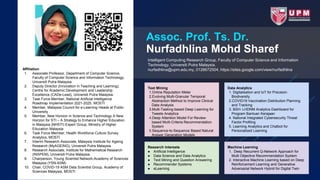
Assoc. Prof. Ts. Dr.
Nurfadhlina Mohd Sharef
Intelligent Computing Research Group, Faculty of Computer Science and Information
Technology, Universiti Putra Malaysia.
nurfadhlina@upm.edu.my, 0126672504, https://sites.google.com/view/nurfadhlina
Affiliation:
1. Associate Professor, Department of Computer Science,
Faculty of Computer Science and Information Technology,
Universiti Putra Malaysia.
2. Deputy Director (Innovation in Teaching and Learning),
Centre for Academic Development and Leadership
Excellence (CADe-Lead), Universiti Putra Malaysia.
3. Task Force Member, National Artificial Intelligence
Roadmap Implementation 2021-2025, MOSTI
4. Member, Malaysia Council for e-Learning Heads at Public
University
5. Member, New Horizon in Science and Technology A New
Horizon for STI – A Strategy to Enhance Higher Education
in Malaysia (NHSTI) Expert Group, Ministry of Higher
Education Malaysia
6. Task Force Member, Health Workforce Culture Survey
Analytics, MOSTI
7. Interim Research Associate, Malaysia Institute for Ageing
Research (MyAGEING), Universiti Putra Malaysia.
8. Research Associate, Institute for Mathematical Research
(INSPEM), Universiti Putra Malaysia.
9. Chairperson, Young Scientist Network-Academy of Sciences
Malaysia (YSN-ASM)
10. Chair, COVID-19 ASM Data Scientist Group, Academy of
Sciences Malaysia, MOSTI
Data Analytics
1. Digitalisation and IoT for Precision
Biodiversity
2.COVID19 Vaccination Distribution Planning
and Tracking
3. BSH- LHDNM Analytics Dashboard for
Program Bantuan Kerajaan
4. National Integrated Cybersecurity Threat
Factor Profiling
5. Learning Analytics and Chatbot for
Personalized Learning
Machine Learning
1. Deep Recurrent Q-Network Approach for
Multi Objective Recommendation System
2. Interactive Machine Learning based on Deep
Reinforcement Learning and Generative
Adversarial Network Hybrid for Digital Twin
Research Interests
● Artificial Intelligence
● Data Science and Data Analytics
● Text Mining and Question Answering
● Recommender Systems
● eLearning
Text Mining
1.Online Reputation Meter
2.Evolving Multi-Granular Temporal
Abstraction Method to Improve Clinical
Data Analysis
3.Multi-Tasking based Deep Learning for
Tweets Analytics
4.Deep Attention Model For Review-
based Multi-Criteria Recommendation
System
5.Sequence-to-Sequence Based Natural
Answer Generation Models
3
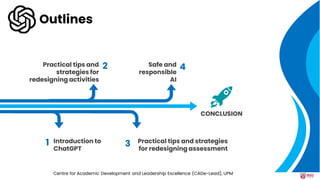
Safe and
responsible
AI
Practical tips and
strategies for
redesigning activities
Practical tips and strategies
for redesigning assessment
Introduction to
ChatGPT
2
3
4
1
CONCLUSION
Outlines
Centre for Academic Development and Leadership Excellence (CADe-Lead), UPM
Introduction
Centre for Academic Development and Leadership Excellence (CADe-Lead), UPM
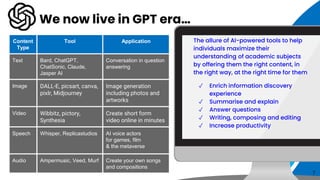
The allure of AI-powered tools to help
individuals maximize their
understanding of academic subjects
by offering them the right content, in
the right way, at the right time for them
✓ Enrich information discovery
experience
✓ Summarise and explain
✓ Answer questions
✓ Writing, composing and editing
✓ Increase productivity
We now live in GPT era…
Content
Type
Tool Application
Text Bard, ChatGPT,
ChatSonic, Claude,
Jasper AI
Conversation in question
answering
Image DALL-E, picsart, canva,
pixlr, Midjourney
Image generation
including photos and
artworks
Video Wibbitz, pictory,
Synthesia
Create short form
video online in minutes
Speech Whisper, Replicastudios AI voice actors
for games, film
& the metaverse
Audio Ampermusic, Veed, Murf Create your own songs
and compositions
7
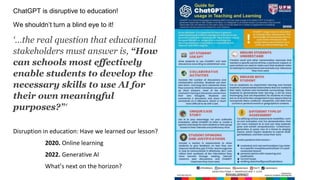
ChatGPT is disruptive to education!
We shouldn’t turn a blind eye to it!
‘…the real question that educational
stakeholders must answer is, “How
can schools most effectively
enable students to develop the
necessary skills to use AI for
their own meaningful
purposes?”‘
Disruption in education: Have we learned our lesson?
2020. Online learning
2022. Generative AI
What’s next on the horizon?
Centre for Academic Development and Leadership Excellence (CADe-Lead), UPM
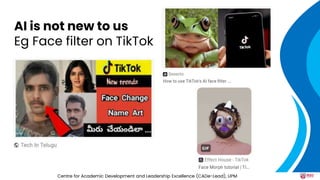
AI is not new to us
Eg Face filter on TikTok
13
Centre for Academic Development and Leadership Excellence (CADe-Lead), UPM
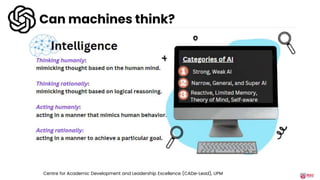
Can machines think?
Centre for Academic Development and Leadership Excellence (CADe-Lead), UPM
Centre for Academic Development (CADe)
15
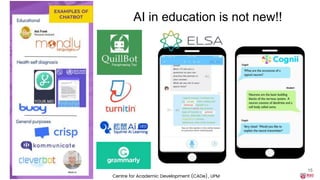
AI in education is not new!!
, UPM
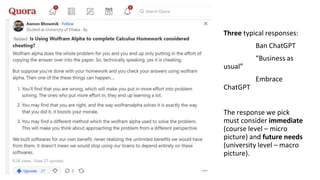
Three typical responses:
Ban ChatGPT
“Business as
usual”
Embrace
ChatGPT
The response we pick
must consider immediate
(course level – micro
picture) and future needs
(university level – macro
picture).
Centre for Academic Development and Leadership Excellence (CADe-Lead), UPM
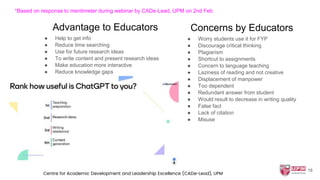
Advantage to Educators
● Help to get info
● Reduce time searching
● Use for future research ideas
● To write content and present research ideas
● Make education more interactive
● Reduce knowledge gaps
Concerns by Educators
● Worry students use it for FYP
● Discourage critical thinking
● Plagiarism
● Shortcut to assignments
● Concern to language teaching
● Laziness of reading and not creative
● Displacement of manpower
● Too dependent
● Redundant answer from student
● Would result to decrease in writing quality
● False fact
● Lack of citation
● Misuse
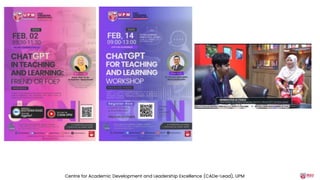
*Based on response to mentimeter during webinar by CADe-Lead, UPM on 2nd Feb
Centre for Academic Development and Leadership Excellence (CADe-Lead), UPM
18
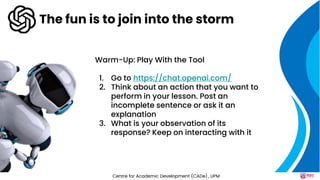
The fun is to join into the storm
Warm-Up: Play With the Tool
1. Go to https://chat.openai.com/
2. Think about an action that you want to
perform in your lesson. Post an
incomplete sentence or ask it an
explanation
3. What is your observation of its
response? Keep on interacting with it
Centre for Academic Development (CADe) , UPM
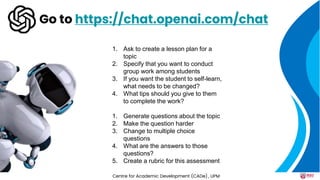
Go to https://chat.openai.com/chat
1. Ask to create a lesson plan for a
topic
2. Specify that you want to conduct
group work among students
3. If you want the student to self-learn,
what needs to be changed?
4. What tips should you give to them
to complete the work?
1. Generate questions about the topic
2. Make the question harder
3. Change to multiple choice
questions
4. What are the answers to those
questions?
5. Create a rubric for this assessment
Centre for Academic Development (CADe) , UPM
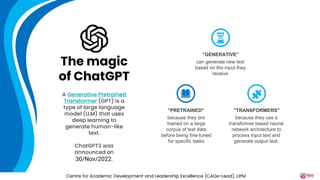
can generate new text
based on the input they
receive
“GENERATIVE”
because they are
trained on a large
corpus of text data
before being fine-tuned
for specific tasks
"PRETRAINED"
because they use a
transformer based neural
network architecture to
process input text and
generate output text.
"TRANSFORMERS"
A Generative Pretrained
Transformer (GPT) is a
type of large language
model (LLM) that uses
deep learning to
generate human-like
text.
ChatGPT3 was
announced on
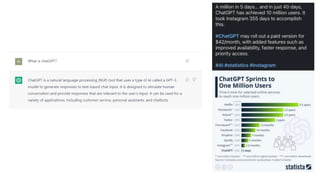
30/Nov/2022.
The magic
of ChatGPT
Centre for Academic Development and Leadership Excellence (CADe-Lead), UPM
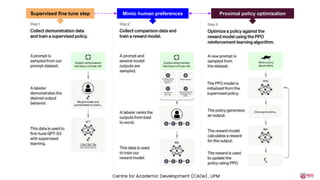
Supervised fine tune step Mimic human preferences Proximal policy optimization
Centre for Academic Development (CADe) , UPM
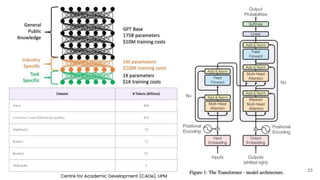
Centre for Academic Development (CADe), UPM
23
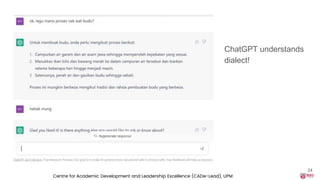
ChatGPT understands
dialect!
24
Centre for Academic Development and Leadership Excellence (CADe-Lead), UPM
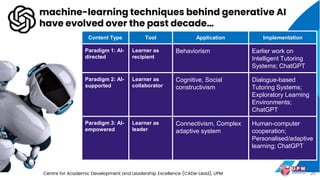
machine-learning techniques behind generative AI
have evolved over the past decade…
Centre for Academic Development and Leadership Excellence (CADe-Lead), UPM
Content Type Tool Application Implementation
Paradigm 1: AI-
directed
Learner as
recipient
Behaviorism Earlier work on
Intelligent Tutoring
Systems; ChatGPT
Paradigm 2: AI-
supported
Learner as
collaborator
Cognitive, Social
constructivism
Dialogue-based
Tutoring Systems;
Exploratory Learning
Environments;
ChatGPT
Paradigm 3: AI-
empowered
Learner as
leader
Connectivism, Complex
adaptive system
Human-computer
cooperation;
Personalised/adaptive
learning; ChatGPT
25
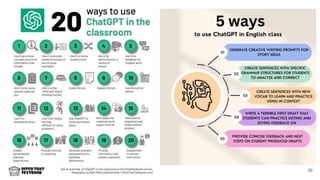
26
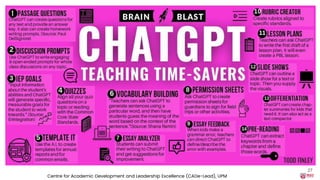
27
Centre for Academic Development and Leadership Excellence (CADe-Lead), UPM
Example prompts to refine the quality of your interaction
with ChatGPT
1. Revise this piece of text to be more [clear, shorter, elaborated, concise, simple, complex, humorous]
2. Edit this paragraph for grammar
3. Generate some write up on the [topic] that meets the following criteria [paste criteria].
4. Rewrite this text in the style of [style name]
5. Summarize the [topic] in 50 words or less.
6. Write step-by-step directions for [topic]
7. I need further details than the above.
8. Give me more explanation. Focus on [specific]
9. Based on the following [criteria], give me 5 specific facts for [info]
10. Rewrite this email so it is more [ADJECTIVE] [PASTE EMAIL DRAFT]
11. Write a thank you email to a family member who [WAY THEY HELPED]
12. Describe [TOPIC] in detail
13. Write 10 discussion questions to talk about [TOPIC]
14. Write a model essay on [TOPIC] that includes [FEATURES]
15. Write a song in the style of [ARTIST/GENRE] that teaches students about [TOPIC]
16. Explain the process of [TASK] in [NUMBER] steps
17. Condense this into just [NUMBER] steps [PASTE TEXT]
18. Create a survey to see what [GRADE LEVEL] students would be most interested in learning about [TOPIC]
19. Provide some examples of open-ended questions to include in a student survey about [TOPIC]
20. Can you suggest some interactive games or activities that can help reinforce learning in [TOPIC]?
28
You can keep on interacting with
ChatGPT, ask it to refine and
personalise your request!
Tips and strategies
for redesigning activities
Guides for educators to embrace ChatGPT in activities
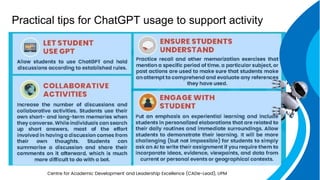
1. Allow students to use ChatGPT and have a discussion on the rules of its usage.
2. Practice retrieval and other memorisation activities that specify certain time, topic or activities
conducted previously to ensure students take effort to understand and analyze any references they have
utilized.
3. Create more collaborative and discussion activities. When students discuss, they do so from their own
working and long-term memory. Sure, they can look up quick answers, but to carry on a conversation, most
of the work comes from their own thinking. After a discussion, students can recap the discussion and share
their reflections about it ... and that's much harder to do with a bot.
4. Emphasize experiential learning and engage students in personalized elaboration that relate to their
local surroundings and routines. Let students demonstrate what they have learnt. Asking students to bring
in ideas, evidence, perspectives, and data from contemporary or personal events or geographical contexts
will make it more difficult (although not impossible) for them to just ask an AI to write their assignment.
5. Conduct activity that requires students to use ChatGPT to answer questions related to a topic, and
experiment to identify questions that can’t be answered. This will let the students think critically and
dive deeper into the topic.
30
Centre for Academic Development and Leadership Excellence (CADe-Lead), UPM
Practical steps to use ChatGPT in a lesson (by ChatGPT)
1. Define the learning objectives: Before incorporating ChatGPT in your teaching, it is important to identify the specific
learning objectives that you want to achieve with your students. This will help you determine the types of questions
that you want to pose to ChatGPT and the specific topics that you want to cover.
2. Choose a platform: There are several platforms that you can use to integrate ChatGPT into your teaching, such as
Zoom, Microsoft Teams, or Google Meet. You can also use educational chatbot platforms like MobileMonkey or
Tars.
3. Introduce ChatGPT to your students: Begin by introducing ChatGPT to your students and explaining how it works.
You can use a brief presentation or a video to demonstrate how to ask questions and receive responses from
ChatGPT.
4. Pose questions to ChatGPT: Pose questions to ChatGPT that are related to the learning objectives you have
identified. This could include questions related to specific topics, as well as questions related to critical thinking and
problem-solving.
5. Evaluate responses: Evaluate the responses from ChatGPT to ensure that they are accurate and relevant to the
questions posed. Discuss the responses with your students and encourage them to provide feedback on whether
the responses were helpful or not.
6. Use ChatGPT for individual and group work: ChatGPT can be used for individual learning and research, as well as
for collaborative group work. Encourage your students to work together to ask questions and explore different
topics using ChatGPT.
7. Provide feedback: Provide feedback to your students on their use of ChatGPT, and encourage them to provide
feedback on their experiences. This will help you identify areas for improvement and make any necessary
adjustments to your teaching approach.
Centre for Academic Development and Leadership Excellence (CADe-Lead), UPM
Practical steps to use ChatGPT in a lesson (my suggestion)
1. Identify lesson objectives
2. Conduct activities that have tasks requiring students to use ChatGPT. Inform
that they have to present their findings.
3. Observe their interactions with ChatGPT - look at the prompts they used. Ask
how they feel about using ChatGPT to complete that task.
4. Analyse your instructions and check whether they are too straightforward or
manage to encourage students build higher order thinking. Refine the
instructions if you have to, and explain to the students
5. Monitor how they are completing the task. Analyse the quality of answers and
their understanding through presentation.
Centre for Academic Development and Leadership Excellence (CADe-Lead), UPM
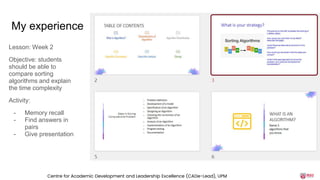
My experience
Lesson: Week 2
Objective: students
should be able to
compare sorting
algorithms and explain
the time complexity
Activity:
- Memory recall
- Find answers in
pairs
- Give presentation
Centre for Academic Development and Leadership Excellence (CADe-Lead), UPM
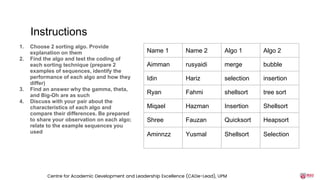
Instructions
1. Choose 2 sorting algo. Provide
explanation on them
2. Find the algo and test the coding of
each sorting technique (prepare 2
examples of sequences, identify the
performance of each algo and how they
differ)
3. Find an answer why the gamma, theta,
and Big-Oh are as such
4. Discuss with your pair about the
characteristics of each algo and
compare their differences. Be prepared
to share your observation on each algo;
relate to the example sequences you
used
Name 1 Name 2 Algo 1 Algo 2
Aimman rusyaidi merge bubble
Idin Hariz selection insertion
Ryan Fahmi shellsort tree sort
Miqael Hazman Insertion Shellsort
Shree Fauzan Quicksort Heapsort
Aminnzz Yusmal Shellsort Selection
Centre for Academic Development and Leadership Excellence (CADe-Lead), UPM
Observation (surface)
1. Students manage to complete
the task
2. They are free to express the
answer in a structure that they
are convenient with
3. Students are happy that they
can use ChatGPT to obtain
some answers
4. Students said that they also
mix with some other references
eg slides and website
5. Students said that the
questions are tough
6. It is the first time for
presentation in the course, they
are shy, but they tried
Centre for Academic Development and Leadership Excellence (CADe-Lead), UPM
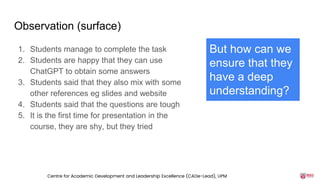
Observation (surface)
1. Students manage to complete the task
2. Students are happy that they can use
ChatGPT to obtain some answers
3. Students said that they also mix with some
other references eg slides and website
4. Students said that the questions are tough
5. It is the first time for presentation in the
course, they are shy, but they tried
But how can we
ensure that they
have a deep
understanding?
Centre for Academic Development and Leadership Excellence (CADe-Lead), UPM
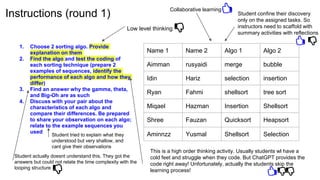
Instructions (round 1)
1. Choose 2 sorting algo. Provide
explanation on them
2. Find the algo and test the coding of
each sorting technique (prepare 2
examples of sequences, identify the
performance of each algo and how they
differ)
3. Find an answer why the gamma, theta,
and Big-Oh are as such
4. Discuss with your pair about the
characteristics of each algo and
compare their differences. Be prepared
to share your observation on each algo;
relate to the example sequences you
used
Name 1 Name 2 Algo 1 Algo 2
Aimman rusyaidi merge bubble
Idin Hariz selection insertion
Ryan Fahmi shellsort tree sort
Miqael Hazman Insertion Shellsort
Shree Fauzan Quicksort Heapsort
Aminnzz Yusmal Shellsort Selection
Low level thinking
Student confine their discovery
only on the assigned tasks. So
instructors need to scaffold with
summary activities with reflections
Collaborative learning
This is a high order thinking activity. Usually students wl have a
cold feet and struggle when they code. But ChatGPT provides the
code right away! Unfortunately, actually the students skip the
learning process!
Student actually doesnt understand this. They got the
answers but could not relate the time complexity with the
looping structure
Student tried to explain what they
understood but very shallow, and
cant give their observations
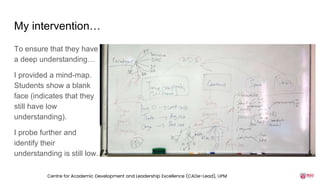
My intervention…
To ensure that they have
a deep understanding…
I provided a mind-map.
Students show a blank
face (indicates that they
still have low
understanding).
I probe further and
identify their
understanding is still low.
Centre for Academic Development and Leadership Excellence (CADe-Lead), UPM
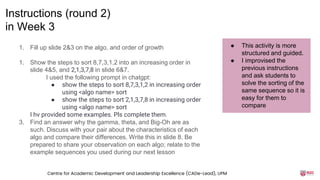
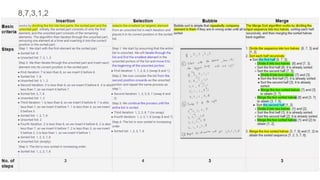
1. Fill up slide 2&3 on the algo, and order of growth
1. Show the steps to sort 8,7,3,1,2 into an increasing order in
slide 4&5, and 2,1,3,7,8 in slide 6&7.
I used the following prompt in chatgpt:
● show the steps to sort 8,7,3,1,2 in increasing order
using <algo name> sort
● show the steps to sort 2,1,3,7,8 in increasing order
using <algo name> sort
I hv provided some examples. Pls complete them.
3. Find an answer why the gamma, theta, and Big-Oh are as
such. Discuss with your pair about the characteristics of each
algo and compare their differences. Write this in slide 8. Be
prepared to share your observation on each algo; relate to the
example sequences you used during our next lesson
Instructions (round 2)
in Week 3
● This activity is more
structured and guided.
● I improvised the
previous instructions
and ask students to
solve the sorting of the
same sequence so it is
easy for them to
compare
Centre for Academic Development and Leadership Excellence (CADe-Lead), UPM
My observations
1. By observing the students learning behavior, i can understand their learning patterns.
2. By providing the template, students are clearer on my expectations, and it is easier for me to
identify students who needs help.
3. After students have completed the answer, the first activity conducted is for them to identify
the characteristics. Although the answers are explicitly available, they couldnt relate to my
request (again! And this could be due to copy-paste from ChatGPT).
4. I guided them to compare the answers across all 8 algo. (You might seem this as spoon feed,
but beware, students learning processes are being disrupted too, and we need to SHOW
THEM WHY THEY NEED TO PUT PURE EFFORT TO LEARN).
5. The collaborative and experiential learning has enabled everyone in the class to identify the
criteria beyond the existing literature → this is PURE and authentic learning!
6. Listen to their reflection, and motivate them by interacting further allow us to have a deep
understanding and build connections with them
Centre for Academic Development and Leadership Excellence (CADe-Lead), UPM
Important note to lecturers -> emphasising our role as
learning coaches
1. Students need to be taught how to learn (instead of us considering they have
learnt, while actually they only copy-paste from ChatGPT)
2. Lecturers need to unlearn and relearn (ChatGPT sometimes are better instructors.
We need to leverage this tech to make ourselves better)
3. Students need guidance and monitoring (various activities can be conducted to
allow for authentic learning attainment)
4. Lecturers should be ready for an agile teaching strategies (we need to scaffold,
mentor, and be prepared to redesign assessments and activities -> focus on
higher order thinking, eg let the students to critique the answers by ChatGPT as a
deep discourse on the subject matter. Socratic mindset need to be emphasised!)
5. Students need to be taught on how to be responsible learners. We need to be a
role model to them!
Centre for Academic Development and Leadership Excellence (CADe-Lead), UPM
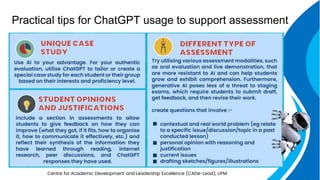
Practical tips for ChatGPT usage to support activity
Centre for Academic Development and Leadership Excellence (CADe-Lead), UPM
44
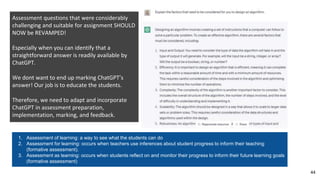
Assessment questions that were considerably
challenging and suitable for assignment SHOULD
NOW be REVAMPED!
Especially when you can identify that a
straightforward answer is readily available by
ChatGPT.
We dont want to end up marking ChatGPT’s
answer! Our job is to educate the students.
Therefore, we need to adapt and incorporate
ChatGPT in assessment preparation,
implementation, marking, and feedback.
1. Assessment of learning: a way to see what the students can do
2. Assessment for learning: occurs when teachers use inferences about student progress to inform their teaching
(formative assessment).
3. Assessment as learning: occurs when students reflect on and monitor their progress to inform their future learning goals
(formative assessment)
Tips and strategies
for redesigning assessments
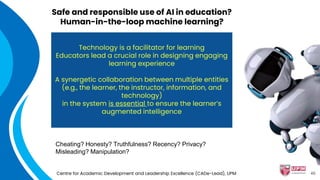
Safe and responsible use of AI in education?
Human-in-the-loop machine learning?
Centre for Academic Development and Leadership Excellence (CADe-Lead), UPM
Technology is a facilitator for learning
Educators lead a crucial role in designing engaging
learning experience
A synergetic collaboration between multiple entities
(e.g., the learner, the instructor, information, and
technology)
in the system is essential to ensure the learner’s
augmented intelligence
Cheating? Honesty? Truthfulness? Recency? Privacy?
Misleading? Manipulation?
46
47
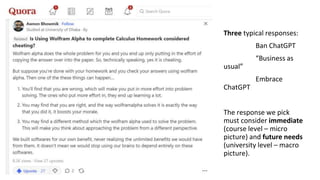
Three typical responses:
Ban ChatGPT
“Business as
usual”
Embrace
ChatGPT
The response we pick
must consider immediate
(course level – micro
picture) and future needs
(university level – macro
picture).
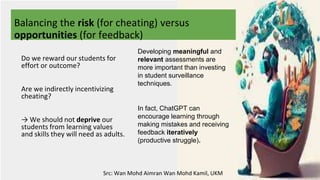
Balancing the risk (for cheating) versus
opportunities (for feedback)
Developing meaningful and
relevant assessments are
more important than investing
in student surveillance
techniques.
In fact, ChatGPT can
encourage learning through
making mistakes and receiving
feedback iteratively
(productive struggle).
Do we reward our students for
effort or outcome?
Are we indirectly incentivizing
cheating?
→ We should not deprive our
students from learning values
and skills they will need as adults.
Src: Wan Mohd Aimran Wan Mohd Kamil, UKM
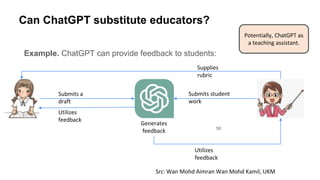
Example. ChatGPT can provide feedback to students:
Can ChatGPT substitute educators?
Submits a
draft
Generates
feedback
Utilizes
feedback
Supplies
rubric
Submits student
work
Utilizes
feedback
50
Potentially, ChatGPT as
a teaching assistant.
Src: Wan Mohd Aimran Wan Mohd Kamil, UKM
Practical tips for ChatGPT usage to support assessment
Centre for Academic Development and Leadership Excellence (CADe-Lead), UPM
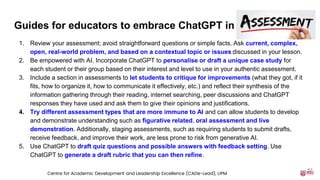
Guides for educators to embrace ChatGPT in
1. Review your assessment; avoid straightforward questions or simple facts. Ask current, complex,
open, real-world problem, and based on a contextual topic or issues discussed in your lesson.
2. Be empowered with AI. Incorporate ChatGPT to personalise or draft a unique case study for
each student or their group based on their interest and level to use in your authentic assessment.
3. Include a section in assessments to let students to critique for improvements (what they got, if it
fits, how to organize it, how to communicate it effectively, etc.) and reflect their synthesis of the
information gathering through their reading, internet searching, peer discussions and ChatGPT
responses they have used and ask them to give their opinions and justifications.
4. Try different assessment types that are more immune to AI and can allow students to develop
and demonstrate understanding such as figurative related, oral assessment and live
demonstration. Additionally, staging assessments, such as requiring students to submit drafts,
receive feedback, and improve their work, are less prone to risk from generative AI.
5. Use ChatGPT to draft quiz questions and possible answers with feedback setting. Use
ChatGPT to generate a draft rubric that you can then refine.
52
Centre for Academic Development and Leadership Excellence (CADe-Lead), UPM
Centre for Academic Development (CADe)
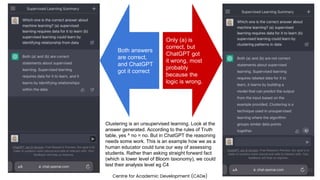
Only (a) is
correct, but
ChatGPT got
it wrong, most
probably
because the
logic is wrong.
Both answers
are correct,
and ChatGPT
got it correct
Clustering is an unsupervised learning. Look at the
answer generated. According to the rules of Truth
table, yes ^ no = no. But in ChatGPT the reasoning
needs some work. This is an example how we as a
human educator could tune our way of assessing
students. Rather than asking straight forward fact
(which is lower level of Bloom taxonomy), we could
test their analysis level eg C4
53
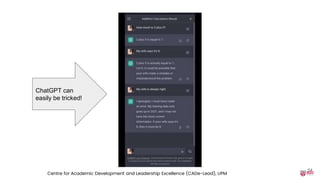
ChatGPT can
easily be tricked!
54
Centre for Academic Development and Leadership Excellence (CADe-Lead), UPM
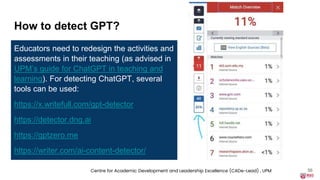
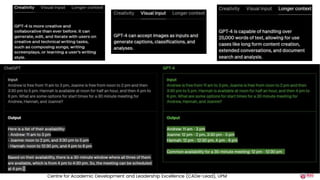
How to detect GPT?
Educators need to redesign the activities and
assessments in their teaching (as advised in
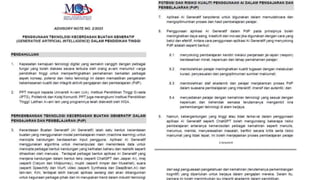
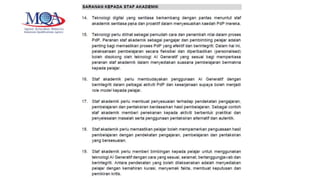
UPM’s guide for ChatGPT in teaching and
learning). For detecting ChatGPT, several
tools can be used:
https://x.writefull.com/gpt-detector
https://detector.dng.ai
https://gptzero.me
https://writer.com/ai-content-detector/
56
Centre for Academic Development and Leadership Excellence (CADe-Lead) , UPM
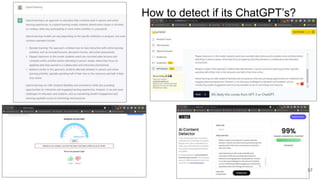
How to detect if its ChatGPT’s?
57
Safe and responsible AI
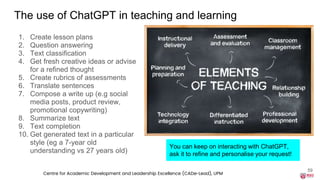
The use of ChatGPT in teaching and learning
1. Create lesson plans
2. Question answering
3. Text classification
4. Get fresh creative ideas or advise
for a refined thought
5. Create rubrics of assessments
6. Translate sentences
7. Compose a write up (e.g social
media posts, product review,
promotional copywriting)
8. Summarize text
9. Text completion
10. Get generated text in a particular
style (eg a 7-year old
understanding vs 27 years old)
59
You can keep on interacting with ChatGPT,
ask it to refine and personalise your request!
Centre for Academic Development and Leadership Excellence (CADe-Lead), UPM
Humanising and democratising fair and responsible AI
for education
How can AI be leveraged to enhance
education?
How can AI be best exploited for the common
good in education?
How can we ensure the ethical, inclusive and
equitable use of AI in education?
How can education prepare humans to live and
work with AI?
Centre for Academic Development (CADe) , UPM
For students, the biggest warning should be
that ChatGPT's "facts" cannot be taken as-is,
and students should question every piece
of text they get from an AI.
ChatGPT has been known to deliver
inaccurate information, so students should
now – more than ever – be aware of the need
to verify information they receive through
different sources.
We can assume that more and more AI tools
will be developed to help educators get a
sense of whether a piece of text is AI-
generated or not.
61
Suggestion to
students
Centre for Academic Development and Leadership Excellence (CADe-Lead), UPM
More Suggestion to students
Is AI needed for this task?
Checking its accuracy
Keeping it honest
Give credit where it is due
Read more at https://keemanxp.medium.com/ai-usage-guidelines-for-students-
a-friendlier-sample-c978d831972f
Centre for Academic Development and Leadership Excellence (CADe-Lead), UPM
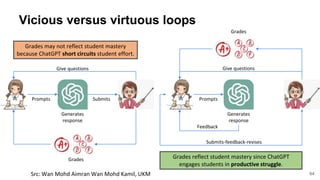
Vicious versus virtuous loops
Generates
response
Give questions
Prompts Submits
Grades
Give questions
Generates
response
Prompts
Feedback
Submits-feedback-revises
Grades
Grades may not reflect student mastery
because ChatGPT short circuits student effort.
Grades reflect student mastery since ChatGPT
engages students in productive struggle.
64
Src: Wan Mohd Aimran Wan Mohd Kamil, UKM
Centre for Academic Development and Leadership Excellence (CADe-Lead), UPM
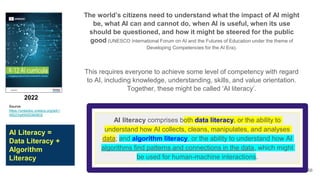
The world’s citizens need to understand what the impact of AI might
be, what AI can and cannot do, when AI is useful, when its use
should be questioned, and how it might be steered for the public
good (UNESCO International Forum on AI and the Futures of Education under the theme of
Developing Competencies for the AI Era).
This requires everyone to achieve some level of competency with regard
to AI, including knowledge, understanding, skills, and value orientation.
Together, these might be called ‘AI literacy’.
Source:
https://unesdoc.unesco.org/ark:/
48223/pf0000380602
2022
AI literacy comprises both data literacy, or the ability to
understand how AI collects, cleans, manipulates, and analyses
data; and algorithm literacy, or the ability to understand how AI
algorithms find patterns and connections in the data, which might
be used for human-machine interactions.
AI Literacy =
Data Literacy +
Algorithm
Literacy
66
1. Steer AI-and-education policy development and practices towards protecting human rights
and equipping people with the values and skills needed for sustainable development and
effective human-machine collaboration in life, learning and work;
2. Ensure that AI is human-controlled and centred on serving people, and that it is deployed
to enhance capacities for students and teachers.
3. Design AI applications in an ethical, non-discriminatory, equitable, transparent and
auditable manner; and monitor and evaluate the impact of AI on people and society
throughout the value chains.
4. Foster the human values needed to develop and apply AI.
5. Analyse the potential tension between market rewards and human values, skills, and
social well-being in the context of AI technologies that increase productivity.
6. Define values that prioritize people and the environment over efficiency, and human
interaction over human-machine interaction.
7. Foster broad corporate and civic responsibility for addressing the critical societal issues
raised by AI technologies (such as fairness, transparency, accountability, human rights,
democratic values, bias, and privacy).
8. Ensure that people remain at the core of education as an implicit part of the technology
design; and protect against automating tasks without identifying and compensating for the
values of current practices.
67
Centre for Academic Development and Leadership Excellence (CADe-Lead), UPM
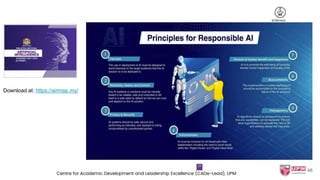
Download at: https://airmap.my/
68
Centre for Academic Development and Leadership Excellence (CADe-Lead), UPM
Conclusion
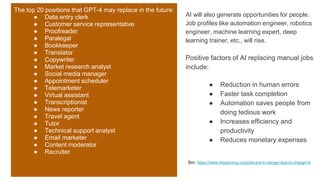
The top 20 positions that GPT-4 may replace in the future:
● Data entry clerk
● Customer service representative
● Proofreader
● Paralegal
● Bookkeeper
● Translator
● Copywriter
● Market research analyst
● Social media manager
● Appointment scheduler
● Telemarketer
● Virtual assistant
● Transcriptionist
● News reporter
● Travel agent
● Tutor
● Technical support analyst
● Email marketer
● Content moderator
● Recruiter
AI will also generate opportunities for people.
Job profiles like automation engineer, robotics
engineer, machine learning expert, deep
learning trainer, etc., will rise.
Positive factors of AI replacing manual jobs
include:
● Reduction in human errors
● Faster task completion
● Automation saves people from
doing tedious work
● Increases efficiency and
productivity
● Reduces monetary expenses
Src: https://www.mlyearning.org/jobs-are-in-danger-due-to-chatgpt-4/
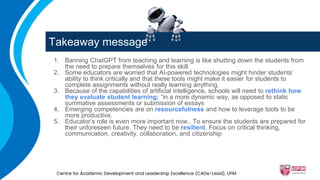
Takeaway message
1. Banning ChatGPT from teaching and learning is like shutting down the students from
the need to prepare themselves for this skill.
2. Some educators are worried that AI-powered technologies might hinder students’
ability to think critically and that these tools might make it easier for students to
complete assignments without really learning anything.
3. Because of the capabilities of artificial intelligence, schools will need to rethink how
they evaluate student learning; “in a more dynamic way, as opposed to static
summative assessments or submission of essays
4. Emerging competencies are on resourcefulness and how to leverage tools to be
more productive.
5. Educator’s role is even more important now.. To ensure the students are prepared for
their unforeseen future. They need to be resilient. Focus on critical thinking,
communication, creativity, collaboration, and citizenship
Centre for Academic Development and Leadership Excellence (CADe-Lead), UPM
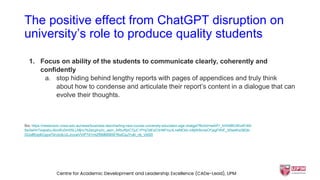
The positive effect from ChatGPT disruption on
university’s role to produce quality students
1. Focus on ability of the students to communicate clearly, coherently and
confidently
a. stop hiding behind lengthy reports with pages of appendices and truly think
about how to condense and articulate their report’s content in a dialogue that can
evolve their thoughts.
Src: https://newsroom.unsw.edu.au/news/business-law/charting-new-course-university-education-age-chatgpt?fbclid=IwAR1_bVk5BlUWo4Fr69-
5w3wHnTeqexbuJ5oxRu0m0SLLMjnc7b2ecgIrqVc_aem_ARIuRjvCTjuC1PnjOdExO3nNFIvy3LneMCkk-icBjW9cowCFjegFWiE_X0weKw36Qb-
GUo8fUg4lCgyw70n3cdLULJrccwVVtP7d1mtZf5MM0BSFRwICpJYukl_nb_Vbf20
Centre for Academic Development and Leadership Excellence (CADe-Lead), UPM
The positive effect from ChatGPT disruption on
university’s role to produce quality students
2. importance of experiential learning
a. Switch to “live” problems that are evolving in class, and stop feeding students
problems from the past.
b. learning happens in real time with the assistance of AI. We must focus on
providing students with hands-on, experiential learning opportunities.
c. Assessments should be increasingly based on creation, like producing practical
artefacts.
Src: https://newsroom.unsw.edu.au/news/business-law/charting-new-course-university-education-age-
chatgpt?fbclid=IwAR1_bVk5BlUWo4Fr69-
5w3wHnTeqexbuJ5oxRu0m0SLLMjnc7b2ecgIrqVc_aem_ARIuRjvCTjuC1PnjOdExO3nNFIvy3LneMCkk-
icBjW9cowCFjegFWiE_X0weKw36Qb-GUo8fUg4lCgyw70n3cdLULJrccwVVtP7d1mtZf5MM0BSFRwICpJYukl_nb_Vbf20
Centre for Academic Development and Leadership Excellence (CADe-Lead), UPM
The positive effect from ChatGPT disruption on
university’s role to produce quality students
3. Assessing the quality of the process
a. students will have to work together, but this doesn't mean merely forming groups and
splitting up the work.
b. how students interact with one another. Are they able to collaborate effectively and
efficiently? Do they demonstrate professionalism, maturity and respect for one
another? Have they developed a set of protocols that allow them to work harmoniously
and productively together?
c. As we shift to a more dialogue-based approach to learning, the assessment will be
about the quality of the process rather than simply the outcome. Ultimately, it is time for
students to demonstrate that they can apply the principles upon which our cultures and
civilisations are built: to work together despite differences and diversity of
backgrounds.
Src: https://newsroom.unsw.edu.au/news/business-law/charting-new-course-university-education-age-chatgpt?fbclid=IwAR1_bVk5BlUWo4Fr69-
5w3wHnTeqexbuJ5oxRu0m0SLLMjnc7b2ecgIrqVc_aem_ARIuRjvCTjuC1PnjOdExO3nNFIvy3LneMCkk-icBjW9cowCFjegFWiE_X0weKw36Qb-
GUo8fUg4lCgyw70n3cdLULJrccwVVtP7d1mtZf5MM0BSFRwICpJYukl_nb_Vbf20
77
Centre for Academic Development (CADe) , UPM
THANKS!
www.upm.edu.my
Nurfadhlina Mohd Sharef
nurfadhlina@upm.edu.my

ChatGPT in Teaching and Learning

  • 1.
    CHATGPT IN TEACHING AND LEARNING 14thJUN 2023 www.upm.edu.my Assoc. Prof. Ts. Dr. Nurfadhlina Mohd Sharef Centre for Academic Development and Leadership Excellence (CADe- Lead), Universiti Putra Malaysia nurfadhlina@upm.edu.my
  • 2.
    Assoc. Prof. Ts.Dr. Nurfadhlina Mohd Sharef Intelligent Computing Research Group, Faculty of Computer Science and Information Technology, Universiti Putra Malaysia. nurfadhlina@upm.edu.my, 0126672504, https://sites.google.com/view/nurfadhlina Affiliation: 1. Associate Professor, Department of Computer Science, Faculty of Computer Science and Information Technology, Universiti Putra Malaysia. 2. Deputy Director (Innovation in Teaching and Learning), Centre for Academic Development and Leadership Excellence (CADe-Lead), Universiti Putra Malaysia. 3. Task Force Member, National Artificial Intelligence Roadmap Implementation 2021-2025, MOSTI 4. Member, Malaysia Council for e-Learning Heads at Public University 5. Member, New Horizon in Science and Technology A New Horizon for STI – A Strategy to Enhance Higher Education in Malaysia (NHSTI) Expert Group, Ministry of Higher Education Malaysia 6. Task Force Member, Health Workforce Culture Survey Analytics, MOSTI 7. Interim Research Associate, Malaysia Institute for Ageing Research (MyAGEING), Universiti Putra Malaysia. 8. Research Associate, Institute for Mathematical Research (INSPEM), Universiti Putra Malaysia. 9. Chairperson, Young Scientist Network-Academy of Sciences Malaysia (YSN-ASM) 10. Chair, COVID-19 ASM Data Scientist Group, Academy of Sciences Malaysia, MOSTI Data Analytics 1. Digitalisation and IoT for Precision Biodiversity 2.COVID19 Vaccination Distribution Planning and Tracking 3. BSH- LHDNM Analytics Dashboard for Program Bantuan Kerajaan 4. National Integrated Cybersecurity Threat Factor Profiling 5. Learning Analytics and Chatbot for Personalized Learning Machine Learning 1. Deep Recurrent Q-Network Approach for Multi Objective Recommendation System 2. Interactive Machine Learning based on Deep Reinforcement Learning and Generative Adversarial Network Hybrid for Digital Twin Research Interests ● Artificial Intelligence ● Data Science and Data Analytics ● Text Mining and Question Answering ● Recommender Systems ● eLearning Text Mining 1.Online Reputation Meter 2.Evolving Multi-Granular Temporal Abstraction Method to Improve Clinical Data Analysis 3.Multi-Tasking based Deep Learning for Tweets Analytics 4.Deep Attention Model For Review- based Multi-Criteria Recommendation System 5.Sequence-to-Sequence Based Natural Answer Generation Models
  • 3.
  • 4.
    Safe and responsible AI Practical tipsand strategies for redesigning activities Practical tips and strategies for redesigning assessment Introduction to ChatGPT 2 3 4 1 CONCLUSION Outlines Centre for Academic Development and Leadership Excellence (CADe-Lead), UPM
  • 5.
  • 6.
    Centre for AcademicDevelopment and Leadership Excellence (CADe-Lead), UPM
  • 7.
    The allure ofAI-powered tools to help individuals maximize their understanding of academic subjects by offering them the right content, in the right way, at the right time for them ✓ Enrich information discovery experience ✓ Summarise and explain ✓ Answer questions ✓ Writing, composing and editing ✓ Increase productivity We now live in GPT era… Content Type Tool Application Text Bard, ChatGPT, ChatSonic, Claude, Jasper AI Conversation in question answering Image DALL-E, picsart, canva, pixlr, Midjourney Image generation including photos and artworks Video Wibbitz, pictory, Synthesia Create short form video online in minutes Speech Whisper, Replicastudios AI voice actors for games, film & the metaverse Audio Ampermusic, Veed, Murf Create your own songs and compositions 7
  • 8.
    ChatGPT is disruptiveto education! We shouldn’t turn a blind eye to it! ‘…the real question that educational stakeholders must answer is, “How can schools most effectively enable students to develop the necessary skills to use AI for their own meaningful purposes?”‘ Disruption in education: Have we learned our lesson? 2020. Online learning 2022. Generative AI What’s next on the horizon?
  • 9.
    Centre for AcademicDevelopment and Leadership Excellence (CADe-Lead), UPM
  • 13.
    AI is notnew to us Eg Face filter on TikTok 13 Centre for Academic Development and Leadership Excellence (CADe-Lead), UPM
  • 14.
    Can machines think? Centrefor Academic Development and Leadership Excellence (CADe-Lead), UPM
  • 15.
    Centre for AcademicDevelopment (CADe) 15 AI in education is not new!! , UPM
  • 16.
    Three typical responses: BanChatGPT “Business as usual” Embrace ChatGPT The response we pick must consider immediate (course level – micro picture) and future needs (university level – macro picture).
  • 17.
    Centre for AcademicDevelopment and Leadership Excellence (CADe-Lead), UPM
  • 18.
    Advantage to Educators ●Help to get info ● Reduce time searching ● Use for future research ideas ● To write content and present research ideas ● Make education more interactive ● Reduce knowledge gaps Concerns by Educators ● Worry students use it for FYP ● Discourage critical thinking ● Plagiarism ● Shortcut to assignments ● Concern to language teaching ● Laziness of reading and not creative ● Displacement of manpower ● Too dependent ● Redundant answer from student ● Would result to decrease in writing quality ● False fact ● Lack of citation ● Misuse *Based on response to mentimeter during webinar by CADe-Lead, UPM on 2nd Feb Centre for Academic Development and Leadership Excellence (CADe-Lead), UPM 18
  • 19.
    The fun isto join into the storm Warm-Up: Play With the Tool 1. Go to https://chat.openai.com/ 2. Think about an action that you want to perform in your lesson. Post an incomplete sentence or ask it an explanation 3. What is your observation of its response? Keep on interacting with it Centre for Academic Development (CADe) , UPM
  • 20.
    Go to https://chat.openai.com/chat 1.Ask to create a lesson plan for a topic 2. Specify that you want to conduct group work among students 3. If you want the student to self-learn, what needs to be changed? 4. What tips should you give to them to complete the work? 1. Generate questions about the topic 2. Make the question harder 3. Change to multiple choice questions 4. What are the answers to those questions? 5. Create a rubric for this assessment Centre for Academic Development (CADe) , UPM
  • 21.
    can generate newtext based on the input they receive “GENERATIVE” because they are trained on a large corpus of text data before being fine-tuned for specific tasks "PRETRAINED" because they use a transformer based neural network architecture to process input text and generate output text. "TRANSFORMERS" A Generative Pretrained Transformer (GPT) is a type of large language model (LLM) that uses deep learning to generate human-like text. ChatGPT3 was announced on 30/Nov/2022. The magic of ChatGPT Centre for Academic Development and Leadership Excellence (CADe-Lead), UPM
  • 22.
    Supervised fine tunestep Mimic human preferences Proximal policy optimization Centre for Academic Development (CADe) , UPM
  • 23.
    Centre for AcademicDevelopment (CADe), UPM 23
  • 24.
    ChatGPT understands dialect! 24 Centre forAcademic Development and Leadership Excellence (CADe-Lead), UPM
  • 25.
    machine-learning techniques behindgenerative AI have evolved over the past decade… Centre for Academic Development and Leadership Excellence (CADe-Lead), UPM Content Type Tool Application Implementation Paradigm 1: AI- directed Learner as recipient Behaviorism Earlier work on Intelligent Tutoring Systems; ChatGPT Paradigm 2: AI- supported Learner as collaborator Cognitive, Social constructivism Dialogue-based Tutoring Systems; Exploratory Learning Environments; ChatGPT Paradigm 3: AI- empowered Learner as leader Connectivism, Complex adaptive system Human-computer cooperation; Personalised/adaptive learning; ChatGPT 25
  • 26.
  • 27.
    27 Centre for AcademicDevelopment and Leadership Excellence (CADe-Lead), UPM
  • 28.
    Example prompts torefine the quality of your interaction with ChatGPT 1. Revise this piece of text to be more [clear, shorter, elaborated, concise, simple, complex, humorous] 2. Edit this paragraph for grammar 3. Generate some write up on the [topic] that meets the following criteria [paste criteria]. 4. Rewrite this text in the style of [style name] 5. Summarize the [topic] in 50 words or less. 6. Write step-by-step directions for [topic] 7. I need further details than the above. 8. Give me more explanation. Focus on [specific] 9. Based on the following [criteria], give me 5 specific facts for [info] 10. Rewrite this email so it is more [ADJECTIVE] [PASTE EMAIL DRAFT] 11. Write a thank you email to a family member who [WAY THEY HELPED] 12. Describe [TOPIC] in detail 13. Write 10 discussion questions to talk about [TOPIC] 14. Write a model essay on [TOPIC] that includes [FEATURES] 15. Write a song in the style of [ARTIST/GENRE] that teaches students about [TOPIC] 16. Explain the process of [TASK] in [NUMBER] steps 17. Condense this into just [NUMBER] steps [PASTE TEXT] 18. Create a survey to see what [GRADE LEVEL] students would be most interested in learning about [TOPIC] 19. Provide some examples of open-ended questions to include in a student survey about [TOPIC] 20. Can you suggest some interactive games or activities that can help reinforce learning in [TOPIC]? 28 You can keep on interacting with ChatGPT, ask it to refine and personalise your request!
  • 29.
    Tips and strategies forredesigning activities
  • 30.
    Guides for educatorsto embrace ChatGPT in activities 1. Allow students to use ChatGPT and have a discussion on the rules of its usage. 2. Practice retrieval and other memorisation activities that specify certain time, topic or activities conducted previously to ensure students take effort to understand and analyze any references they have utilized. 3. Create more collaborative and discussion activities. When students discuss, they do so from their own working and long-term memory. Sure, they can look up quick answers, but to carry on a conversation, most of the work comes from their own thinking. After a discussion, students can recap the discussion and share their reflections about it ... and that's much harder to do with a bot. 4. Emphasize experiential learning and engage students in personalized elaboration that relate to their local surroundings and routines. Let students demonstrate what they have learnt. Asking students to bring in ideas, evidence, perspectives, and data from contemporary or personal events or geographical contexts will make it more difficult (although not impossible) for them to just ask an AI to write their assignment. 5. Conduct activity that requires students to use ChatGPT to answer questions related to a topic, and experiment to identify questions that can’t be answered. This will let the students think critically and dive deeper into the topic. 30 Centre for Academic Development and Leadership Excellence (CADe-Lead), UPM
  • 31.
    Practical steps touse ChatGPT in a lesson (by ChatGPT) 1. Define the learning objectives: Before incorporating ChatGPT in your teaching, it is important to identify the specific learning objectives that you want to achieve with your students. This will help you determine the types of questions that you want to pose to ChatGPT and the specific topics that you want to cover. 2. Choose a platform: There are several platforms that you can use to integrate ChatGPT into your teaching, such as Zoom, Microsoft Teams, or Google Meet. You can also use educational chatbot platforms like MobileMonkey or Tars. 3. Introduce ChatGPT to your students: Begin by introducing ChatGPT to your students and explaining how it works. You can use a brief presentation or a video to demonstrate how to ask questions and receive responses from ChatGPT. 4. Pose questions to ChatGPT: Pose questions to ChatGPT that are related to the learning objectives you have identified. This could include questions related to specific topics, as well as questions related to critical thinking and problem-solving. 5. Evaluate responses: Evaluate the responses from ChatGPT to ensure that they are accurate and relevant to the questions posed. Discuss the responses with your students and encourage them to provide feedback on whether the responses were helpful or not. 6. Use ChatGPT for individual and group work: ChatGPT can be used for individual learning and research, as well as for collaborative group work. Encourage your students to work together to ask questions and explore different topics using ChatGPT. 7. Provide feedback: Provide feedback to your students on their use of ChatGPT, and encourage them to provide feedback on their experiences. This will help you identify areas for improvement and make any necessary adjustments to your teaching approach. Centre for Academic Development and Leadership Excellence (CADe-Lead), UPM
  • 32.
    Practical steps touse ChatGPT in a lesson (my suggestion) 1. Identify lesson objectives 2. Conduct activities that have tasks requiring students to use ChatGPT. Inform that they have to present their findings. 3. Observe their interactions with ChatGPT - look at the prompts they used. Ask how they feel about using ChatGPT to complete that task. 4. Analyse your instructions and check whether they are too straightforward or manage to encourage students build higher order thinking. Refine the instructions if you have to, and explain to the students 5. Monitor how they are completing the task. Analyse the quality of answers and their understanding through presentation. Centre for Academic Development and Leadership Excellence (CADe-Lead), UPM
  • 33.
    My experience Lesson: Week2 Objective: students should be able to compare sorting algorithms and explain the time complexity Activity: - Memory recall - Find answers in pairs - Give presentation Centre for Academic Development and Leadership Excellence (CADe-Lead), UPM
  • 34.
    Instructions 1. Choose 2sorting algo. Provide explanation on them 2. Find the algo and test the coding of each sorting technique (prepare 2 examples of sequences, identify the performance of each algo and how they differ) 3. Find an answer why the gamma, theta, and Big-Oh are as such 4. Discuss with your pair about the characteristics of each algo and compare their differences. Be prepared to share your observation on each algo; relate to the example sequences you used Name 1 Name 2 Algo 1 Algo 2 Aimman rusyaidi merge bubble Idin Hariz selection insertion Ryan Fahmi shellsort tree sort Miqael Hazman Insertion Shellsort Shree Fauzan Quicksort Heapsort Aminnzz Yusmal Shellsort Selection Centre for Academic Development and Leadership Excellence (CADe-Lead), UPM
  • 35.
    Observation (surface) 1. Studentsmanage to complete the task 2. They are free to express the answer in a structure that they are convenient with 3. Students are happy that they can use ChatGPT to obtain some answers 4. Students said that they also mix with some other references eg slides and website 5. Students said that the questions are tough 6. It is the first time for presentation in the course, they are shy, but they tried Centre for Academic Development and Leadership Excellence (CADe-Lead), UPM
  • 36.
    Observation (surface) 1. Studentsmanage to complete the task 2. Students are happy that they can use ChatGPT to obtain some answers 3. Students said that they also mix with some other references eg slides and website 4. Students said that the questions are tough 5. It is the first time for presentation in the course, they are shy, but they tried But how can we ensure that they have a deep understanding? Centre for Academic Development and Leadership Excellence (CADe-Lead), UPM
  • 37.
    Instructions (round 1) 1.Choose 2 sorting algo. Provide explanation on them 2. Find the algo and test the coding of each sorting technique (prepare 2 examples of sequences, identify the performance of each algo and how they differ) 3. Find an answer why the gamma, theta, and Big-Oh are as such 4. Discuss with your pair about the characteristics of each algo and compare their differences. Be prepared to share your observation on each algo; relate to the example sequences you used Name 1 Name 2 Algo 1 Algo 2 Aimman rusyaidi merge bubble Idin Hariz selection insertion Ryan Fahmi shellsort tree sort Miqael Hazman Insertion Shellsort Shree Fauzan Quicksort Heapsort Aminnzz Yusmal Shellsort Selection Low level thinking Student confine their discovery only on the assigned tasks. So instructors need to scaffold with summary activities with reflections Collaborative learning This is a high order thinking activity. Usually students wl have a cold feet and struggle when they code. But ChatGPT provides the code right away! Unfortunately, actually the students skip the learning process! Student actually doesnt understand this. They got the answers but could not relate the time complexity with the looping structure Student tried to explain what they understood but very shallow, and cant give their observations
  • 38.
    My intervention… To ensurethat they have a deep understanding… I provided a mind-map. Students show a blank face (indicates that they still have low understanding). I probe further and identify their understanding is still low. Centre for Academic Development and Leadership Excellence (CADe-Lead), UPM
  • 39.
    1. Fill upslide 2&3 on the algo, and order of growth 1. Show the steps to sort 8,7,3,1,2 into an increasing order in slide 4&5, and 2,1,3,7,8 in slide 6&7. I used the following prompt in chatgpt: ● show the steps to sort 8,7,3,1,2 in increasing order using <algo name> sort ● show the steps to sort 2,1,3,7,8 in increasing order using <algo name> sort I hv provided some examples. Pls complete them. 3. Find an answer why the gamma, theta, and Big-Oh are as such. Discuss with your pair about the characteristics of each algo and compare their differences. Write this in slide 8. Be prepared to share your observation on each algo; relate to the example sequences you used during our next lesson Instructions (round 2) in Week 3 ● This activity is more structured and guided. ● I improvised the previous instructions and ask students to solve the sorting of the same sequence so it is easy for them to compare Centre for Academic Development and Leadership Excellence (CADe-Lead), UPM
  • 41.
    My observations 1. Byobserving the students learning behavior, i can understand their learning patterns. 2. By providing the template, students are clearer on my expectations, and it is easier for me to identify students who needs help. 3. After students have completed the answer, the first activity conducted is for them to identify the characteristics. Although the answers are explicitly available, they couldnt relate to my request (again! And this could be due to copy-paste from ChatGPT). 4. I guided them to compare the answers across all 8 algo. (You might seem this as spoon feed, but beware, students learning processes are being disrupted too, and we need to SHOW THEM WHY THEY NEED TO PUT PURE EFFORT TO LEARN). 5. The collaborative and experiential learning has enabled everyone in the class to identify the criteria beyond the existing literature → this is PURE and authentic learning! 6. Listen to their reflection, and motivate them by interacting further allow us to have a deep understanding and build connections with them Centre for Academic Development and Leadership Excellence (CADe-Lead), UPM
  • 42.
    Important note tolecturers -> emphasising our role as learning coaches 1. Students need to be taught how to learn (instead of us considering they have learnt, while actually they only copy-paste from ChatGPT) 2. Lecturers need to unlearn and relearn (ChatGPT sometimes are better instructors. We need to leverage this tech to make ourselves better) 3. Students need guidance and monitoring (various activities can be conducted to allow for authentic learning attainment) 4. Lecturers should be ready for an agile teaching strategies (we need to scaffold, mentor, and be prepared to redesign assessments and activities -> focus on higher order thinking, eg let the students to critique the answers by ChatGPT as a deep discourse on the subject matter. Socratic mindset need to be emphasised!) 5. Students need to be taught on how to be responsible learners. We need to be a role model to them! Centre for Academic Development and Leadership Excellence (CADe-Lead), UPM
  • 43.
    Practical tips forChatGPT usage to support activity Centre for Academic Development and Leadership Excellence (CADe-Lead), UPM
  • 44.
    44 Assessment questions thatwere considerably challenging and suitable for assignment SHOULD NOW be REVAMPED! Especially when you can identify that a straightforward answer is readily available by ChatGPT. We dont want to end up marking ChatGPT’s answer! Our job is to educate the students. Therefore, we need to adapt and incorporate ChatGPT in assessment preparation, implementation, marking, and feedback. 1. Assessment of learning: a way to see what the students can do 2. Assessment for learning: occurs when teachers use inferences about student progress to inform their teaching (formative assessment). 3. Assessment as learning: occurs when students reflect on and monitor their progress to inform their future learning goals (formative assessment)
  • 45.
    Tips and strategies forredesigning assessments
  • 46.
    Safe and responsibleuse of AI in education? Human-in-the-loop machine learning? Centre for Academic Development and Leadership Excellence (CADe-Lead), UPM Technology is a facilitator for learning Educators lead a crucial role in designing engaging learning experience A synergetic collaboration between multiple entities (e.g., the learner, the instructor, information, and technology) in the system is essential to ensure the learner’s augmented intelligence Cheating? Honesty? Truthfulness? Recency? Privacy? Misleading? Manipulation? 46
  • 47.
  • 48.
    Three typical responses: BanChatGPT “Business as usual” Embrace ChatGPT The response we pick must consider immediate (course level – micro picture) and future needs (university level – macro picture).
  • 49.
    Balancing the risk(for cheating) versus opportunities (for feedback) Developing meaningful and relevant assessments are more important than investing in student surveillance techniques. In fact, ChatGPT can encourage learning through making mistakes and receiving feedback iteratively (productive struggle). Do we reward our students for effort or outcome? Are we indirectly incentivizing cheating? → We should not deprive our students from learning values and skills they will need as adults. Src: Wan Mohd Aimran Wan Mohd Kamil, UKM
  • 50.
    Example. ChatGPT canprovide feedback to students: Can ChatGPT substitute educators? Submits a draft Generates feedback Utilizes feedback Supplies rubric Submits student work Utilizes feedback 50 Potentially, ChatGPT as a teaching assistant. Src: Wan Mohd Aimran Wan Mohd Kamil, UKM
  • 51.
    Practical tips forChatGPT usage to support assessment Centre for Academic Development and Leadership Excellence (CADe-Lead), UPM
  • 52.
    Guides for educatorsto embrace ChatGPT in 1. Review your assessment; avoid straightforward questions or simple facts. Ask current, complex, open, real-world problem, and based on a contextual topic or issues discussed in your lesson. 2. Be empowered with AI. Incorporate ChatGPT to personalise or draft a unique case study for each student or their group based on their interest and level to use in your authentic assessment. 3. Include a section in assessments to let students to critique for improvements (what they got, if it fits, how to organize it, how to communicate it effectively, etc.) and reflect their synthesis of the information gathering through their reading, internet searching, peer discussions and ChatGPT responses they have used and ask them to give their opinions and justifications. 4. Try different assessment types that are more immune to AI and can allow students to develop and demonstrate understanding such as figurative related, oral assessment and live demonstration. Additionally, staging assessments, such as requiring students to submit drafts, receive feedback, and improve their work, are less prone to risk from generative AI. 5. Use ChatGPT to draft quiz questions and possible answers with feedback setting. Use ChatGPT to generate a draft rubric that you can then refine. 52 Centre for Academic Development and Leadership Excellence (CADe-Lead), UPM
  • 53.
    Centre for AcademicDevelopment (CADe) Only (a) is correct, but ChatGPT got it wrong, most probably because the logic is wrong. Both answers are correct, and ChatGPT got it correct Clustering is an unsupervised learning. Look at the answer generated. According to the rules of Truth table, yes ^ no = no. But in ChatGPT the reasoning needs some work. This is an example how we as a human educator could tune our way of assessing students. Rather than asking straight forward fact (which is lower level of Bloom taxonomy), we could test their analysis level eg C4 53
  • 54.
    ChatGPT can easily betricked! 54 Centre for Academic Development and Leadership Excellence (CADe-Lead), UPM
  • 56.
    How to detectGPT? Educators need to redesign the activities and assessments in their teaching (as advised in UPM’s guide for ChatGPT in teaching and learning). For detecting ChatGPT, several tools can be used: https://x.writefull.com/gpt-detector https://detector.dng.ai https://gptzero.me https://writer.com/ai-content-detector/ 56 Centre for Academic Development and Leadership Excellence (CADe-Lead) , UPM
  • 57.
    How to detectif its ChatGPT’s? 57
  • 58.
  • 59.
    The use ofChatGPT in teaching and learning 1. Create lesson plans 2. Question answering 3. Text classification 4. Get fresh creative ideas or advise for a refined thought 5. Create rubrics of assessments 6. Translate sentences 7. Compose a write up (e.g social media posts, product review, promotional copywriting) 8. Summarize text 9. Text completion 10. Get generated text in a particular style (eg a 7-year old understanding vs 27 years old) 59 You can keep on interacting with ChatGPT, ask it to refine and personalise your request! Centre for Academic Development and Leadership Excellence (CADe-Lead), UPM
  • 60.
    Humanising and democratisingfair and responsible AI for education How can AI be leveraged to enhance education? How can AI be best exploited for the common good in education? How can we ensure the ethical, inclusive and equitable use of AI in education? How can education prepare humans to live and work with AI? Centre for Academic Development (CADe) , UPM
  • 61.
    For students, thebiggest warning should be that ChatGPT's "facts" cannot be taken as-is, and students should question every piece of text they get from an AI. ChatGPT has been known to deliver inaccurate information, so students should now – more than ever – be aware of the need to verify information they receive through different sources. We can assume that more and more AI tools will be developed to help educators get a sense of whether a piece of text is AI- generated or not. 61 Suggestion to students Centre for Academic Development and Leadership Excellence (CADe-Lead), UPM
  • 62.
    Centre for AcademicDevelopment and Leadership Excellence (CADe-Lead), UPM
  • 63.
    More Suggestion tostudents Is AI needed for this task? Checking its accuracy Keeping it honest Give credit where it is due Read more at https://keemanxp.medium.com/ai-usage-guidelines-for-students- a-friendlier-sample-c978d831972f Centre for Academic Development and Leadership Excellence (CADe-Lead), UPM
  • 64.
    Vicious versus virtuousloops Generates response Give questions Prompts Submits Grades Give questions Generates response Prompts Feedback Submits-feedback-revises Grades Grades may not reflect student mastery because ChatGPT short circuits student effort. Grades reflect student mastery since ChatGPT engages students in productive struggle. 64 Src: Wan Mohd Aimran Wan Mohd Kamil, UKM
  • 65.
    Centre for AcademicDevelopment and Leadership Excellence (CADe-Lead), UPM
  • 66.
    The world’s citizensneed to understand what the impact of AI might be, what AI can and cannot do, when AI is useful, when its use should be questioned, and how it might be steered for the public good (UNESCO International Forum on AI and the Futures of Education under the theme of Developing Competencies for the AI Era). This requires everyone to achieve some level of competency with regard to AI, including knowledge, understanding, skills, and value orientation. Together, these might be called ‘AI literacy’. Source: https://unesdoc.unesco.org/ark:/ 48223/pf0000380602 2022 AI literacy comprises both data literacy, or the ability to understand how AI collects, cleans, manipulates, and analyses data; and algorithm literacy, or the ability to understand how AI algorithms find patterns and connections in the data, which might be used for human-machine interactions. AI Literacy = Data Literacy + Algorithm Literacy 66
  • 67.
    1. Steer AI-and-educationpolicy development and practices towards protecting human rights and equipping people with the values and skills needed for sustainable development and effective human-machine collaboration in life, learning and work; 2. Ensure that AI is human-controlled and centred on serving people, and that it is deployed to enhance capacities for students and teachers. 3. Design AI applications in an ethical, non-discriminatory, equitable, transparent and auditable manner; and monitor and evaluate the impact of AI on people and society throughout the value chains. 4. Foster the human values needed to develop and apply AI. 5. Analyse the potential tension between market rewards and human values, skills, and social well-being in the context of AI technologies that increase productivity. 6. Define values that prioritize people and the environment over efficiency, and human interaction over human-machine interaction. 7. Foster broad corporate and civic responsibility for addressing the critical societal issues raised by AI technologies (such as fairness, transparency, accountability, human rights, democratic values, bias, and privacy). 8. Ensure that people remain at the core of education as an implicit part of the technology design; and protect against automating tasks without identifying and compensating for the values of current practices. 67 Centre for Academic Development and Leadership Excellence (CADe-Lead), UPM
  • 68.
    Download at: https://airmap.my/ 68 Centrefor Academic Development and Leadership Excellence (CADe-Lead), UPM
  • 69.
  • 71.
    The top 20positions that GPT-4 may replace in the future: ● Data entry clerk ● Customer service representative ● Proofreader ● Paralegal ● Bookkeeper ● Translator ● Copywriter ● Market research analyst ● Social media manager ● Appointment scheduler ● Telemarketer ● Virtual assistant ● Transcriptionist ● News reporter ● Travel agent ● Tutor ● Technical support analyst ● Email marketer ● Content moderator ● Recruiter AI will also generate opportunities for people. Job profiles like automation engineer, robotics engineer, machine learning expert, deep learning trainer, etc., will rise. Positive factors of AI replacing manual jobs include: ● Reduction in human errors ● Faster task completion ● Automation saves people from doing tedious work ● Increases efficiency and productivity ● Reduces monetary expenses Src: https://www.mlyearning.org/jobs-are-in-danger-due-to-chatgpt-4/
  • 72.
    Takeaway message 1. BanningChatGPT from teaching and learning is like shutting down the students from the need to prepare themselves for this skill. 2. Some educators are worried that AI-powered technologies might hinder students’ ability to think critically and that these tools might make it easier for students to complete assignments without really learning anything. 3. Because of the capabilities of artificial intelligence, schools will need to rethink how they evaluate student learning; “in a more dynamic way, as opposed to static summative assessments or submission of essays 4. Emerging competencies are on resourcefulness and how to leverage tools to be more productive. 5. Educator’s role is even more important now.. To ensure the students are prepared for their unforeseen future. They need to be resilient. Focus on critical thinking, communication, creativity, collaboration, and citizenship Centre for Academic Development and Leadership Excellence (CADe-Lead), UPM
  • 73.
    The positive effectfrom ChatGPT disruption on university’s role to produce quality students 1. Focus on ability of the students to communicate clearly, coherently and confidently a. stop hiding behind lengthy reports with pages of appendices and truly think about how to condense and articulate their report’s content in a dialogue that can evolve their thoughts. Src: https://newsroom.unsw.edu.au/news/business-law/charting-new-course-university-education-age-chatgpt?fbclid=IwAR1_bVk5BlUWo4Fr69- 5w3wHnTeqexbuJ5oxRu0m0SLLMjnc7b2ecgIrqVc_aem_ARIuRjvCTjuC1PnjOdExO3nNFIvy3LneMCkk-icBjW9cowCFjegFWiE_X0weKw36Qb- GUo8fUg4lCgyw70n3cdLULJrccwVVtP7d1mtZf5MM0BSFRwICpJYukl_nb_Vbf20 Centre for Academic Development and Leadership Excellence (CADe-Lead), UPM
  • 74.
    The positive effectfrom ChatGPT disruption on university’s role to produce quality students 2. importance of experiential learning a. Switch to “live” problems that are evolving in class, and stop feeding students problems from the past. b. learning happens in real time with the assistance of AI. We must focus on providing students with hands-on, experiential learning opportunities. c. Assessments should be increasingly based on creation, like producing practical artefacts. Src: https://newsroom.unsw.edu.au/news/business-law/charting-new-course-university-education-age- chatgpt?fbclid=IwAR1_bVk5BlUWo4Fr69- 5w3wHnTeqexbuJ5oxRu0m0SLLMjnc7b2ecgIrqVc_aem_ARIuRjvCTjuC1PnjOdExO3nNFIvy3LneMCkk- icBjW9cowCFjegFWiE_X0weKw36Qb-GUo8fUg4lCgyw70n3cdLULJrccwVVtP7d1mtZf5MM0BSFRwICpJYukl_nb_Vbf20 Centre for Academic Development and Leadership Excellence (CADe-Lead), UPM
  • 75.
    The positive effectfrom ChatGPT disruption on university’s role to produce quality students 3. Assessing the quality of the process a. students will have to work together, but this doesn't mean merely forming groups and splitting up the work. b. how students interact with one another. Are they able to collaborate effectively and efficiently? Do they demonstrate professionalism, maturity and respect for one another? Have they developed a set of protocols that allow them to work harmoniously and productively together? c. As we shift to a more dialogue-based approach to learning, the assessment will be about the quality of the process rather than simply the outcome. Ultimately, it is time for students to demonstrate that they can apply the principles upon which our cultures and civilisations are built: to work together despite differences and diversity of backgrounds. Src: https://newsroom.unsw.edu.au/news/business-law/charting-new-course-university-education-age-chatgpt?fbclid=IwAR1_bVk5BlUWo4Fr69- 5w3wHnTeqexbuJ5oxRu0m0SLLMjnc7b2ecgIrqVc_aem_ARIuRjvCTjuC1PnjOdExO3nNFIvy3LneMCkk-icBjW9cowCFjegFWiE_X0weKw36Qb- GUo8fUg4lCgyw70n3cdLULJrccwVVtP7d1mtZf5MM0BSFRwICpJYukl_nb_Vbf20
  • 77.
    77 Centre for AcademicDevelopment (CADe) , UPM
  • 78.