
i
10
English
Learner’s Material
Department of Education
Republic of the Philippines
Celebrating Diversity through
World Literature
This book was collaboratively developed and reviewed by
educators from public and private schools, colleges, and/or universities.
We encourage teachers and other education stakeholders to email
their feedback, comments, and recommendations to the Department of
Education at action@deped.gov.ph.
We value your feedback and recommendations.
ii
Celebrating Diversity through World Literature – Grade 10
English - Learner’s Material
First Edition 2015
ISBN:
Published by the Department of Education
Secretary: Br. Armin A. Luistro FSC
Undersecretary: Dina S. Ocampo, PhD
Development Team of the Learner’s Material
Consultants: Dr. Edizon A. Fermin and Prof. Marla C. Papango
Authors: Liza R. Almonte, Lerma L. Flandez, Angelina Lourdes A. Hermosa, Nedia
Lagustan, Liberty A. Mangaluz, Elenita R. Miranda, Paul Anthony B. Mendoza,
Lito A. Palomar, Grace B. Annette Barradas-Soriano, and Karen B. Villanueva
Reviewers:	 Ruth Alido, Mara Angelie Banares, Jonalyn T. De la Cruz, Benjamin Hanson
S. Juan, Jennifer E. Lopez, Carlo Erba Manalo – Pacinos, Dr. Sterling Plata,
Jeanette M. Romblon, Leilani T. Señires, and Dr. Roderick Tadeo
Language Editor: Dr. Ma. Antoinette Montealegre
Production Team: Dir. Jocelyn DR. Andaya, Dr. Melinda P. Rivera, Mr. Ricardo G. Ador
Dionisio, and Ms. Anna Marie B. San Diego
Illustrators: Angielyn G. Bariñan, Eric S. De Guia, and Jayson M. Gaduena
Layout Artists: Matthew Leysa, Camille Francesca Mondejar, and Jerby Mariano
Printed in the Philippines by REX Book Store, Inc.
Department of Education-Instructional Materials Council Secretariat (DepEd-IMCS)
Office Address:	5th Floor Mabini Bldg., DepEd Complex 						
		Meralco Avenue, Pasig City							
		Philippines 1600
Telefax:		 (02) 634-1054 or 634-1072
E-mail Address:	imcsetd@yahoo.com
Republic Act 8293, section 176 states that: No copyright shall subsist in any work
of the Government of the Philippines. However, prior approval of the government agency
or office wherein the work is created shall be necessary for exploitation of such work for
profit. Such agency or office may, among other things, impose as a condition the payment
of royalties.
Borrowed materials (i.e., songs, stories, poems, pictures, photos, brand names,
trade-marks, etc.) included in this book are owned by their respective copyright holders.
DepEd is represented by the Filipinas Copyright Licensing Society (FILCOLS), Inc. in
seeking permission to use these materials from their respective copyright owners. All
means have been exhausted in seeking permission to use these materials. The publisher
and authors do not represent nor claim ownership over them.
Only institutions and companies which have entered an agreement with FILCOLS
and only within the agreed framework may copy from this Learner’s Material. Those who
have not entered in an agreement with FILCOLS must, if they wish to copy, contact the
publishers and authors directly.
Authors and publishers may email or contact FILCOLS at filcols@gmail.com or
(02) 439-2204, respectively.
vii																	


MODULE 2: Establishing Solidarity
	 Lesson 1: Finding Common Ground
		YOUR JOURNEY
	 	 YOUR OBJECTIVES
		 YOUR INITIAL TASKS
			Task 1: What You See Is What You Get 		 117
Task 2: Predict and Expect 			 117
Task 3: Read Me 					 119
Task 4: FYI						 121
		YOUR TEXT
Inferno – Canto III – The Vestibule of Hell – The
Opportunists by Dante Alighieri
			Task 5: Think Through			 	 123
			Task 6: Read and Imagine 		 	 123
			 Task 7: Sense Chart 			 129
			 Task 8: Applying What You Read		 129
			 Task 9: Making Definitions 			 130
TABLE OF CONTENTS
YOUR DISCOVERY TASKS
Task 10: Read to Write 131
Task 11: Identify and Classify 134
Task 12: Have Your Say 134
YOUR FINAL TASK
Task 13: Express Yourself 136
Task 14: News Writing and Reporting 139
MY TREASURE
Lesson 2: Building Ties
YOUR JOURNEY
YOUR OBJECTIVES
YOUR INITIAL TASKS
Task 1: What Do You Perceive 145
Task 2: Listen and Imagine 145
Task 3: Read to Lead 147
Task 4: I Want Pizza 151
YOUR TEXT
The Song of Roland
Task 5: Read Roland 152
Task 6: Understanding the Song of Roland 156
Task 7: Understanding Theme 157
YOUR DISCOVERY TASK
viii																													
			
																																														
	 Task 8: Give Your Stand 				 159
YOUR FINAL TASK
	 Task 9: Say Your Piece				 159
MY TREASURE
Lesson 3: Being Sensitive to Others
		YOUR JOURNEY
		YOUR OBJECTIVES
		 YOUR INITIAL TASKS
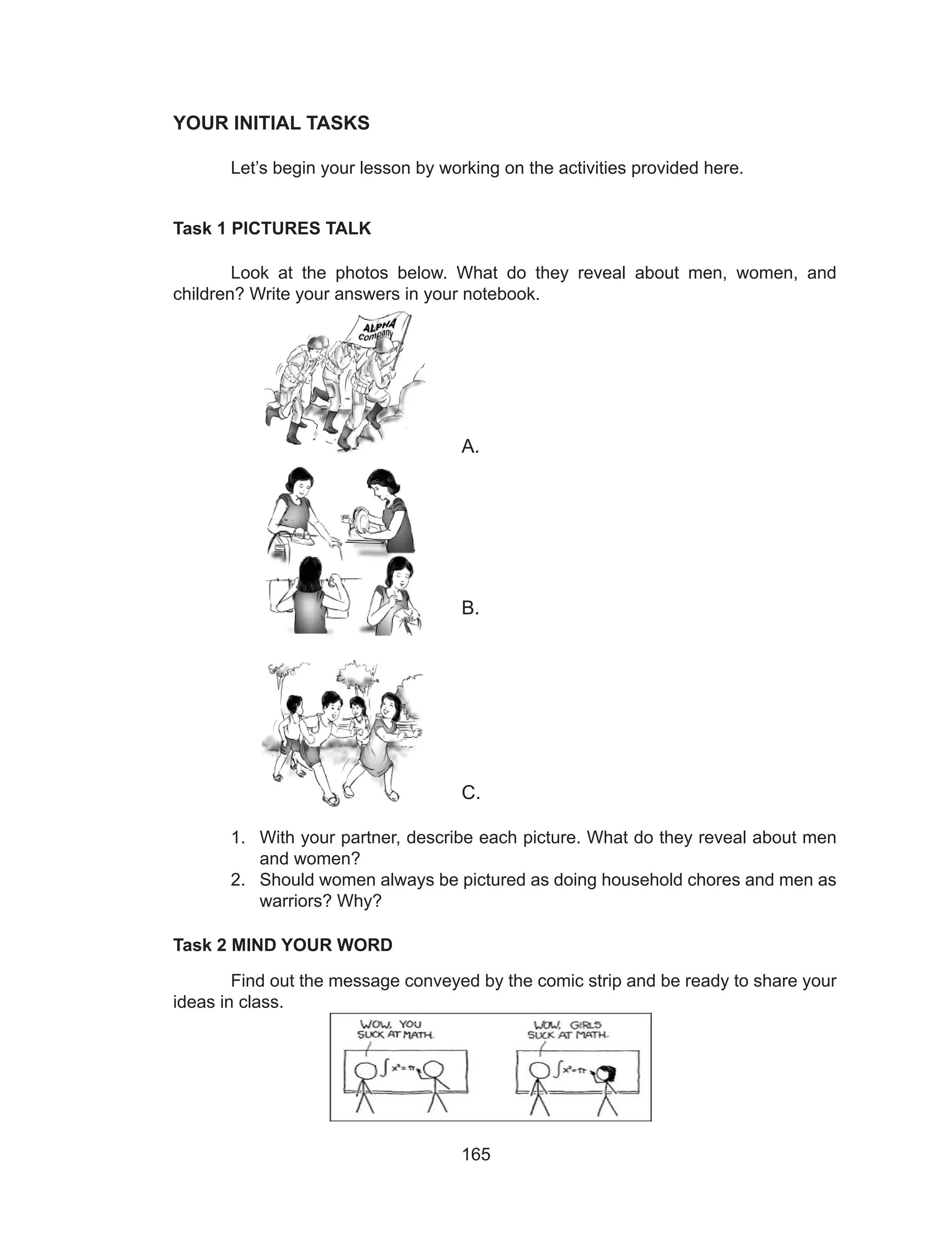
			Task 1: Pictures Talk				 165
			 Task 2: Mind Your World				 165
			 Task 3: Watch That Label				 166
			 Task 4: Bias Detectives				 167
		YOUR TEXT	
		 From Francisco Petrarch’s, The Canzoniere Featured 		
		 Sonnets: Laura, The White Doe and Spring
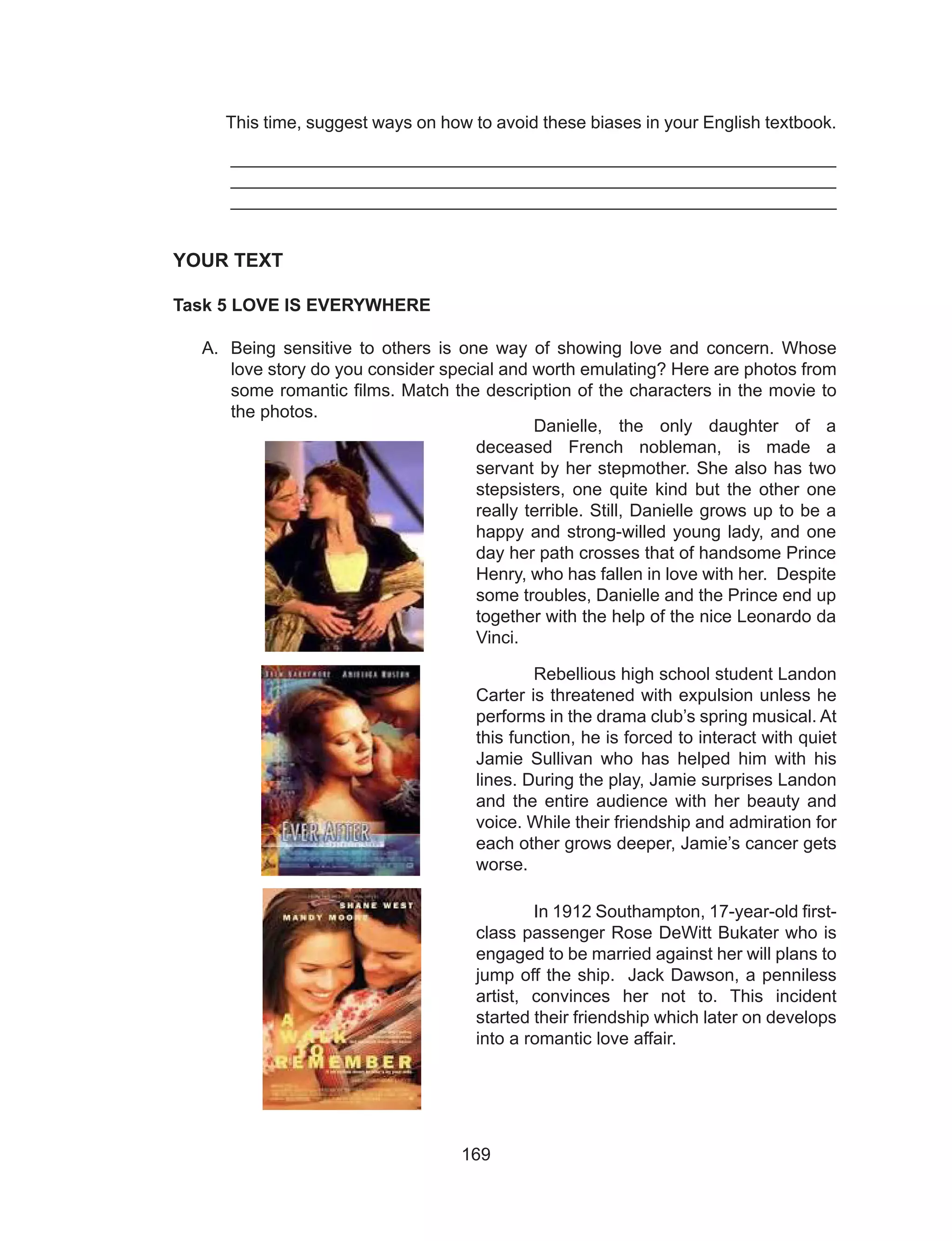
		 Task 5: Love Is Everywhere			 169
		 Task 6: Think about the Poems			 173
		 Task 7: Figure the Meaning			 173
		 Task 8: Sound the Sonnet				 174
		 Task 9: Distinct Sonnets				 177
Task 10: Tick Your Fancy 177
YOUR DISCOVERY TASKS
Task 11: Listen to a Point 178
Task 12: Agree or Disagree 178
Task 13: Read for Info 178
Task 14: Define Those Words 180
Task 15: Bring in the Source 182
Task 16: Write Your Bibliography 188
YOUR FINAL TASKS
Task 17: Try Your Passion 189
Task 18: Speak for Keeps 189
MY TREASURE
ix																																																		
	
Lesson 4: Empathizing with Others
		YOUR JOURNEY
		YOUR OBJECTIVES
		 YOUR INITIAL TASKS
			Task 1: Great Names to Name			 196
			 Task 2: Bias Detectives 2				 197
			 Task 3: Read for Bias				 198
			 Task 4: Think to Solve 				 199
		YOUR TEXT	
		 The Decameron’s Federigo’s Falcon
by Giovanni Boccaccio
		 Task 5: Background Check				 200
		 Task 6: Think Tank					 207
		 Task 7: TMT (Tone, Mood, Theme)		 208
		 Task 8: Like the Others				 208
	 YOUR DISCOVERY TASKS
		 Task 9: Know Your Heart 				 210
		 Task 10: Purpose Galore 				 215
		 Task 11: To Affirm or to Negate			 217
		 Task 12: Affirm or Negate for the Country	 218
		 Task 13: Watch for Conventions			 221
	 YOUR FINAL TASKS
		 Task 14: Speak for Keeps 				 222
	 MY TREASURE
Lesson 5: Accepting Individual Differences
		YOUR JOURNEY
		YOUR OBJECTIVES
YOUR INITIAL TASKS
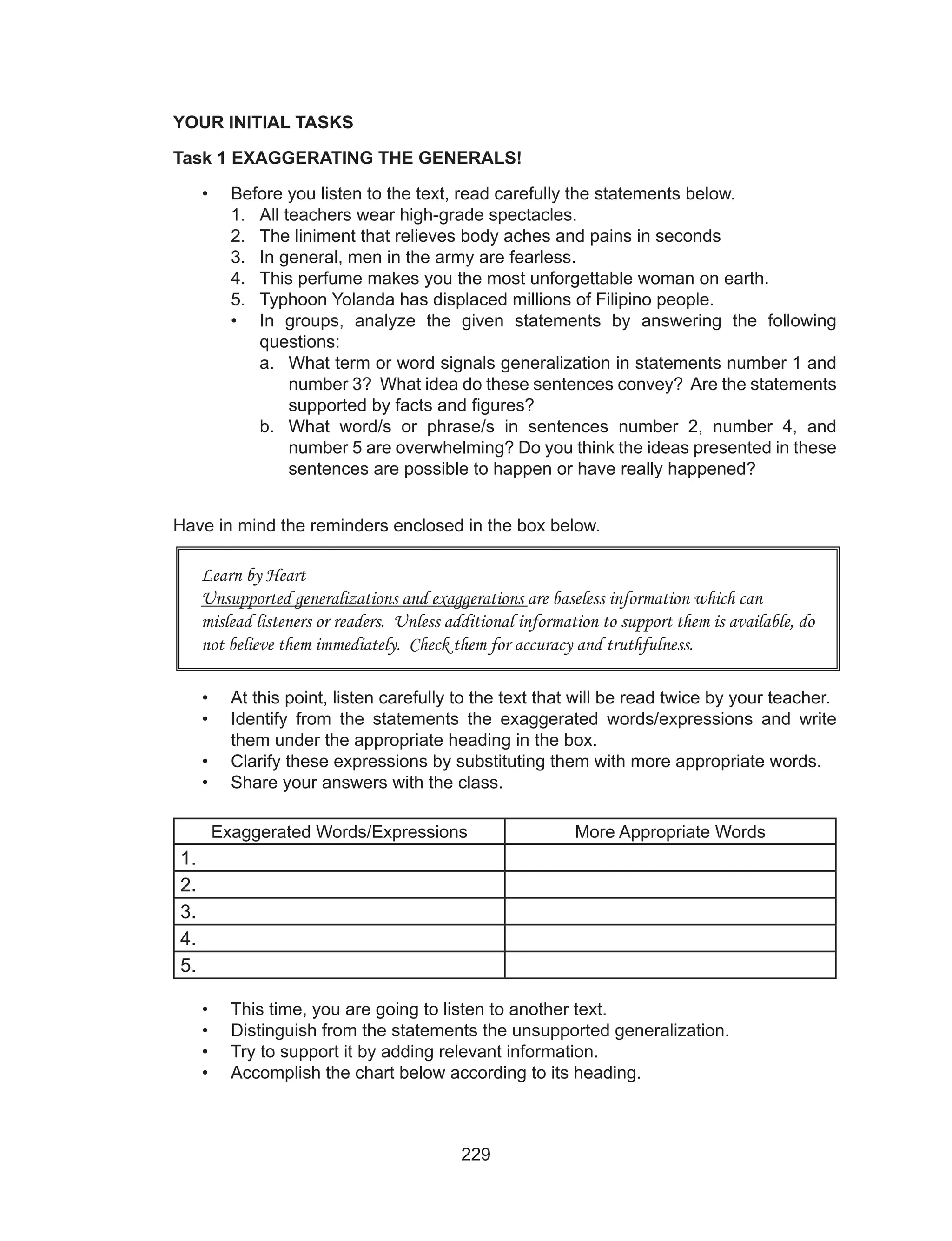
		 	 Task 1: Exaggerating the Generals!		 229
		 	 Task 2: People Are People				 230
		 	 Task 3: I Am What I Am 				 231
Task 4: Essential Essence 231
YOUR TEXT
The Hunchback of Notre Dame by Victor Hugo
Task 5: The Oper-Tech System 232
Task 6: Dare to Answer! 234
Task 7: From the Story, We Differ 235
Task 8: Lookout for the Outlook! 236
Task 9: I Agree…She Doesn’t 236
Task 10: My Motion 237
x


	 Task 11: The Explicits and Otherwise 		 238
		
	 Task 12: The Legal Cite				 239
		
YOUR DISCOVERY TASKS
		
	 Task 13: Varying Groups				 242
		YOUR FINAL TASKS
		
	 Task 14: The Battle of Wits				 243
	
MY TREASURE
Lesson 6: Embodying Solidarity
		YOUR JOURNEY
		YOUR OBJECTIVES
		
YOUR INITIAL TASKS
	
		 Task 1: Overdoing the Generals!			 248
		
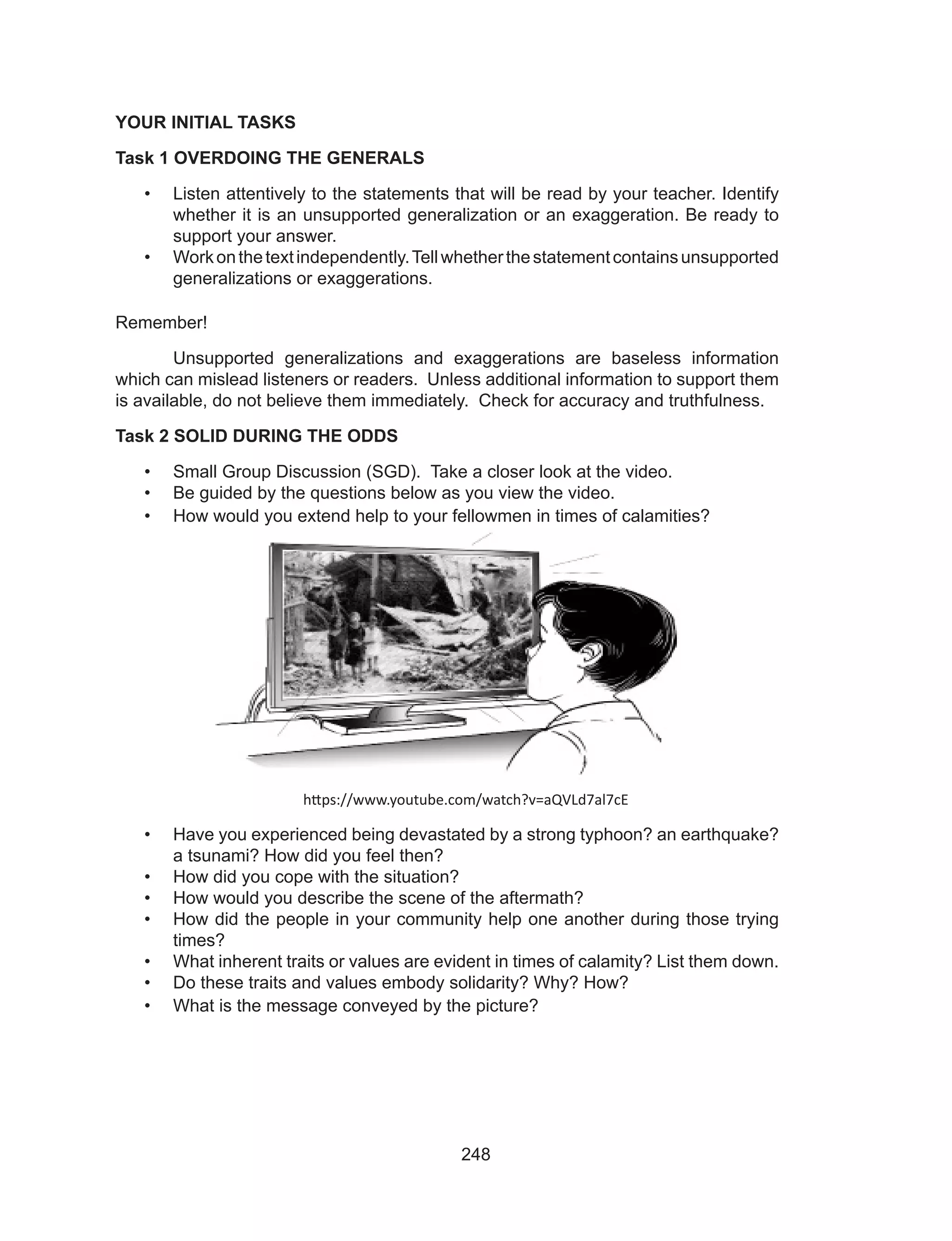
	 Task 2: Solid during the Odds			 248
		
	 Task 3: Making E-Sense				 248
		YOUR TEXT
	 	
The Three Musketeers by Alexander Dumas
		
	 Task 4: I Mean					 249
		
	 Task 5: From Cover to Cover			 249
		
	 Task 6: Time for a Check-up!			 253
		
	 Task 7: Literary Value 				 253
		 	 Task 8: Whip It!					 254
		
	 Task 9: Agree or Disagree 				 257
		YOUR DISCOVERY TASKS
		
	 Task 10: The Team in Theme			 257
		YOUR FINAL TASKS
		
	 Task 11: Weigh In!					 258
		MY TREASURE
109
Establishing Solidarity
110
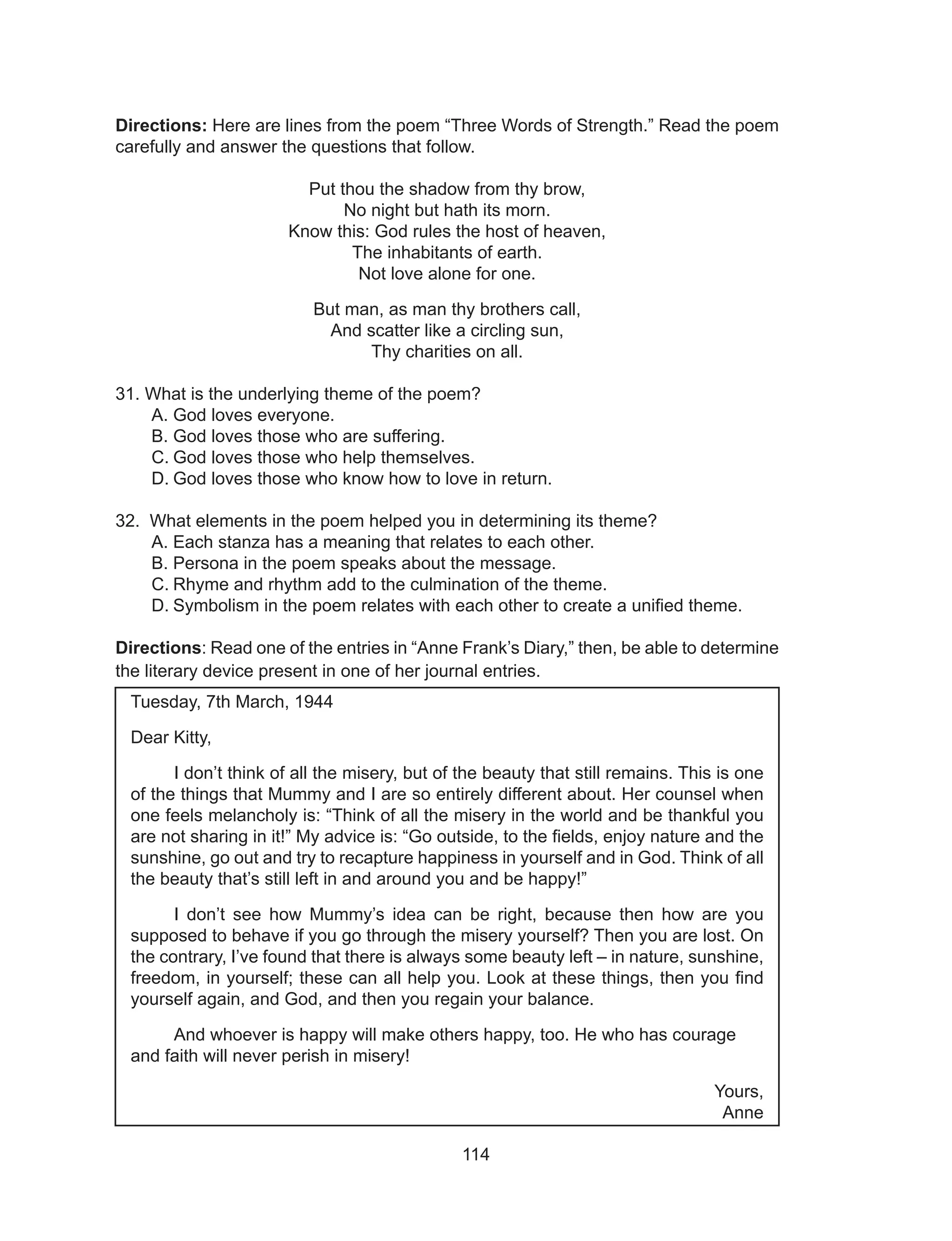
PRE-TEST
MODULE 2
Generel Directions: Read carefully each item and follow directions as indicated. Write
the letter of the most appropriate answer on your answer sheet.
1-2. dentify from the statements the best examples of unsupported generalization and
exaggeration.
A. Differences in principles foretell chaotic relationship.
B. She cried a bucketful of tears when her pet dog passed away.
C. The sun rises in the East and sets in the West.
D. A family is an entity where no one should be left behind.
3-4. What are the two sides in the Oxford-Oregon debate?
A. Rebuttal
B. Affirmative
C. Proposition
D. Negative
5-6. Identify the two aims of a debate program.
A. To enhance the students’ intellectual abilities
B. To enhance the students’ social/communicative skills
C. To enhance students’ locational skills
D. To enhance students’ writing skills
7-11. Identify five affirmative expressions from the statements below.
A. No doubt about
B. Pardon me, but…
C. You have a good point, however…
D. I have nothing against it
E. Definitely
F. That is indeed great
G. Certainly
12-13. From the choices given above, identify two special expressions in negation.
	
14. This type of citation uses the author’s last name and the year of publication
A. parenthetical citation
B. LMA citation
C. in-text citation
D. paragraph-number citation
15. This type of citation uses the author’s last name, the year of publication, and the 	
page number
A. parenthetical citation
B. LMA citation
C. in-text citation
D. paragraph-number citation
111
16. This type of speech persuades others through logical reasoning and analysis.
A. impromptu speech
B. roast speech
C. extemporaneous speech
D. argumentative speech
	
17. The text implicitly stated that President Ramon Magsaysay was ________.
A. a man of disguise
B. a man of principle
C. a man of values
D. a man of action
18. The statement, “Then you will have the artesian well here right away” as directly 	
stated in the text is a/an
A. explicit information
B. implicit information
C. general information
D. firsthand information	
19. The purpose of the author in writing the text is to _____.
A. inform
B. entertain
C. persuade
D. expose
	
20. At the beginning of the passage, the mood is ______.
A. eerie
B. energetic
C. quiet
D. romantic
	 “Then you will have the artesian well here right away,” he said. He
ordered the area commander to get pipes and pumps from the armed forces
supply depot, and demanded they should be brought to the spot immediately.
He asked the army to bring in bulldozer, troops, and trainees for labor and
also organize the civilians.
	 With a deep sigh, Dulce drifted towards the window. In the fading light she
could barely see the figure riding up the path. As soon as he sprang from his horse
and strode to the front door, Dulce knew it was Lance. Quickly she thrust the letter
she had been reading into her dress pocket. The door to the drawing room swung
open.
	 “What have you done with our son?” Lance bellowed, his face distorted with
rage.
	 “He is in a safe place,” Dulce replied, and with a sudden movement, she
yanked at the bell cord to summon the servant.
112
21. At the end of the passage, the mood is ______.
A. tense
B. humorous
C. mysterious
D. calm
22. From the passage, it could be implied that
A. Dulce and Lance are having disagreement over their son.
B. Dulce favors her son’s action.
C. Lance doesn’t approve of his wife’s decision.
D. All of the above
23. The author of the passage wants us to think that ______.
A. a mother knows what is best for her son
B. a conflict normally occurs at home
C. people vary in disposition
D. Lance is very protective of his son
24. The author’s purpose in writing the passage is to ______.
A. tell a story about husband and wife
B. make people realize about the importance of communication
C. describe the setting within the family
D. none of the above
	 The lines below were taken from the narrative poem, “The Walam Olum” by
Delaware Indian. Choose the graphical representation that best explains the text.
113
He made them all to move evenly,
Then the wind blew violently, and it cleared, and the water flowed
off far and strong.
And groups of islands grew newly, and there remained
25.
26.
27.
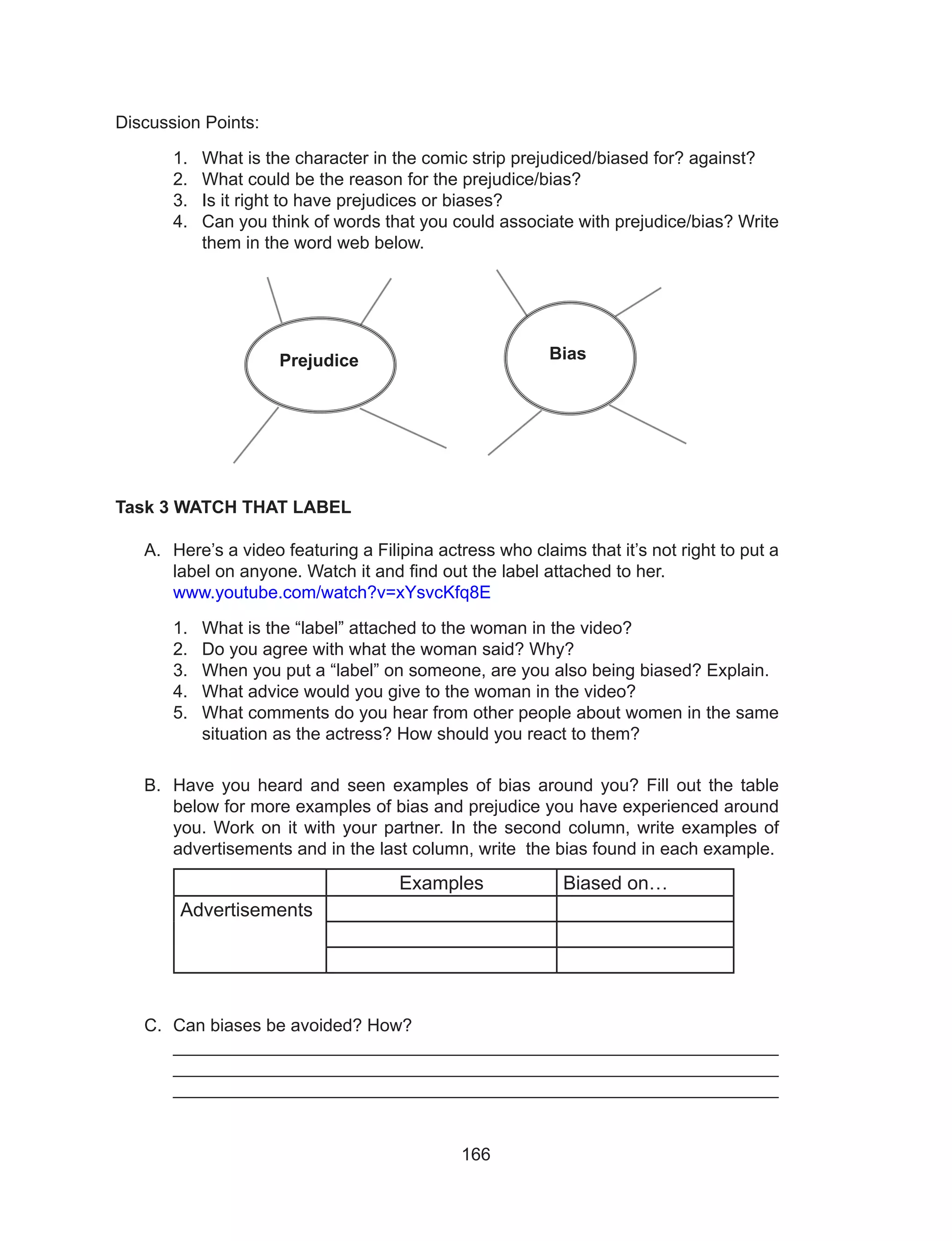
Here is a comic strip. Be able to determine the bias reflected in it. Then, answer
the questions that follow.
28. To whom is the bias directed in this comic strip?
A. boys
B. girls
C. both boys and girls
D. adult girls
29. What is the meaning reflected in this comic strip?
A. It assumes that all the girls have difficulty with Math
B. It assumes that some girls have difficulty with Math
C. It assumes that only girls who are studying have difficulty with Math
D. It assumes that boys and girls have difficulty with Math
30. When you are asked to define the weight of an object in terms of the number
that appears when that object is placed on a weighing scale, you are actually 	
defining the term _______
A. Operationally
B. Technically
C. Lexically
D. Contextually
“At first, in that place, at all times, above the earth,”
On the earth, [was] an extended fog, and there the great Manito
was.
At first, forever, lost in space, everywhere, the great Manito was.
He made the extended land and the sky.
He made the sun, the moon, and the stars.
114
Directions: Here are lines from the poem “Three Words of Strength.” Read the poem
carefully and answer the questions that follow.
Put thou the shadow from thy brow,
No night but hath its morn.
Know this: God rules the host of heaven,
The inhabitants of earth.
Not love alone for one.
But man, as man thy brothers call,
And scatter like a circling sun,
Thy charities on all.
31. What is the underlying theme of the poem?
A.	God loves everyone.
B.	God loves those who are suffering.
C.	God loves those who help themselves.
D.	God loves those who know how to love in return.
32. What elements in the poem helped you in determining its theme?	
A.	Each stanza has a meaning that relates to each other.
B.	Persona in the poem speaks about the message.
C.	Rhyme and rhythm add to the culmination of the theme.
D.	Symbolism in the poem relates with each other to create a unified theme.
Directions: Read one of the entries in “Anne Frank’s Diary,” then, be able to determine
the literary device present in one of her journal entries.
Tuesday, 7th March, 1944
Dear Kitty,
	 I don’t think of all the misery, but of the beauty that still remains. This is one
of the things that Mummy and I are so entirely different about. Her counsel when
one feels melancholy is: “Think of all the misery in the world and be thankful you
are not sharing in it!” My advice is: “Go outside, to the fields, enjoy nature and the
sunshine, go out and try to recapture happiness in yourself and in God. Think of all
the beauty that’s still left in and around you and be happy!”
	 I don’t see how Mummy’s idea can be right, because then how are you
supposed to behave if you go through the misery yourself? Then you are lost. On
the contrary, I’ve found that there is always some beauty left – in nature, sunshine,
freedom, in yourself; these can all help you. Look at these things, then you find
yourself again, and God, and then you regain your balance.
	 And whoever is happy will make others happy, too. He who has courage
and faith will never perish in misery!
Yours,
Anne
115
33. After reading the diary entry, what feeling or mood is conveyed by the author?
A. Optimism
B. Bitterness
C. Pessimism
D. Determination
34. How does the author send the message to her readers?
A. By citing philosophical context in presenting her ideas
B. By sharing her personal belief and comparing it with another
C. By giving examples of other people’s experiences
D. By opposing the views of other people				
	
35. Given this information about the author and based on the author’s diary entry, what
do you think is the author’s purpose in writing her diary?
A. To strengthen her faith in God and to unify her family
B. To communicate her thoughts with friends, family, and the government
C. To keep her occupied during the times that she and her family were hiding
D. To share her thoughts and feelings about the strength of the human spirit 		
and God’s goodness
36. “Animals have emotions and personalities.” How would you show politeness even
though you disagree on the issue?
A. ”You’re wrong!”
B. “I respect you for that, but I do not agree with you.”
C. “You talk nonsense.”
D. “That is outrageous!”
37. Do not compare yourself to others for there will always be lesser and greater
persons than you are - Desiderata. Take your stand and affirm with the statement.
A. “That’s absolutely correct!”
B. “I respect you for that, but…”
C. “No doubt about it”
D. Both A and C
38-41. Arrange the steps on how we plan and draft a speech.
A. Identify your audience.
B. Consider how to grab your listeners’ attention.
C. Find support for your position.
D. Clarify your position.
E. Decide how to present your arguments.
Directions: (42-50) Compose an argumentative essay employing different techniques
(e.g., analogy, comparison and contrast, definition and analysis)
The author, Anne Frank, was a 13-year-old Jewish girl who chronicled
her experiences in a secret attic during the Second World War. She’s a Jew who
was among those hunted by the Nazi during the Holocaust – systematic killing
of about six million Jews. The diary was found by friends and given to her father
after her death in a concentration camp.
116
Module 2
LESSON 1
______________________________________________________________
Finding Common Grounds
YOUR JOURNEY
	 Have you had conflicts with others? How did you feel about it? What did you
do?
	 There must have been times when you jump into a solution without knowing
and analyzing the cause of misunderstanding we have with others. Searching for
signals which may be subtle is a way of recognizing the root of the conflicts and
disagreements.
“I think in most relationships that have problems, there’s fault on both sides.
And in order for it to work, there has to be some common ground that’s shared. And
it’s not just one person making amends.”
									- Steve Carell
YOUR OBJECTIVES
For you to follow the path of your journey, you have to:
•	 assess the effectiveness of the ideas presented in the material
viewed, taking into account its purpose
•	 switch from one listening strategy to another to extract meaning from
the listening text
•	 transcode information from linear to non-linear texts and vice versa
•	 explain illustrations from linear to non-linear texts and vice versa
•	 give technical and operational definitions
•	 express appreciation for sensory images used
•	 observe correct grammar in making definitions
•	 employ appropriate pitch, stress, juncture, intonation, in oral delivery
•	 identify parts and features of argumentative essays
•	 formulate claims of fact, policy, and value
Be reminded that at the end of the module, you are expected
to deliver an argumentative speech emphasizing how to resolve
conflicts among individuals or groups. Your final output in this lesson
is to present a news report.
117
YOUR INITIAL TASKS
Task 1 WHAT YOU SEE IS WHAT YOU GET!
Observe the picture below and identify details that symbolize the things to consider
in resolving conflicts. Do you think the persons in the picture are trying to make
amends to resolve a conflict? Discuss with a partner.
Task 2 PREDICT AND EXPECT
A.	 You will listen to a song entitled “Common Ground” by Kodaline.
Predict words or phrases that you expect to hear from the song through
its title. Write your answer in the box. Do this in your notebook.
118
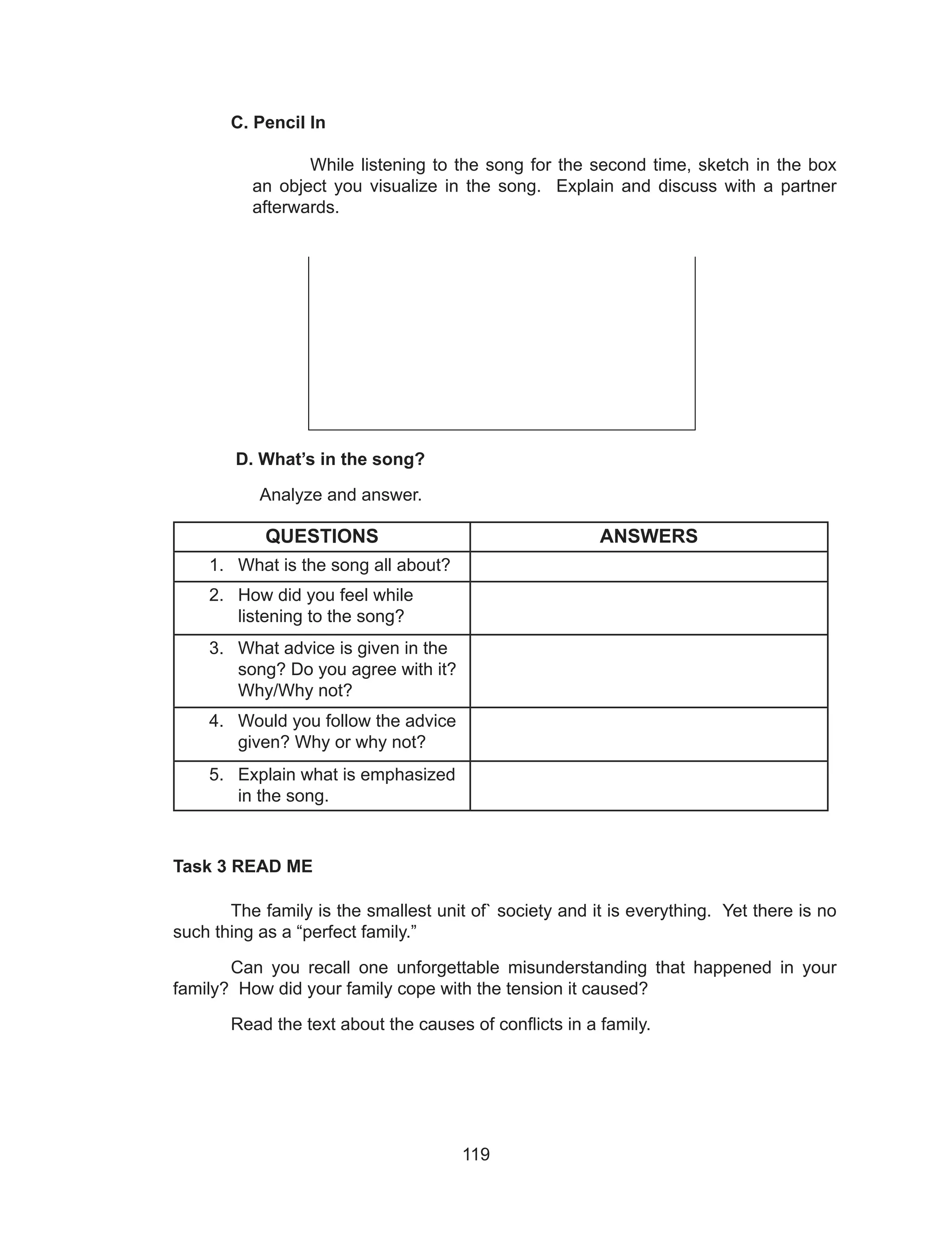
B.	 Listen to the song, then check the words or phrases you listed.
It's easy to win,
It's harder to lose
To admit that you're wrong
When you've got something to prove.
You said it was easy
I tell you they are wrong.
So get busy learning,
are you already gone?
People will tell you
What you want to hear
But the people who know you well
Can make it all clear.
Life isn’t easy,
You got to be strong.
So get busy learning,
Are you already gone?
And all will be forgotten
And we all fall apart,
Yeah all will be forgotten
But the common ground,
It’s a good place to start.
Sure all will be forgotten,
Yeah we will all be forgotten, fall apart.
We will all be forgotten,
But common ground,
Is a good place to start.
Common ground is a good place to start.
COMMON GROUND
by Kodaline
119
C. Pencil In
While listening to the song for the second time, sketch in the box
an object you visualize in the song. Explain and discuss with a partner
afterwards.
D. What’s in the song?
Analyze and answer.
QUESTIONS ANSWERS
1.	 What is the song all about?
2.	 How did you feel while
listening to the song?
3.	 What advice is given in the
song? Do you agree with it?
Why/Why not?
4.	 Would you follow the advice
given? Why or why not?
5.	 Explain what is emphasized
in the song.
Task 3 READ ME
	 The family is the smallest unit of` society and it is everything. Yet there is no
such thing as a “perfect family.”
	 Can you recall one unforgettable misunderstanding that happened in your
family? How did your family cope with the tension it caused?
	 Read the text about the causes of conflicts in a family.
120
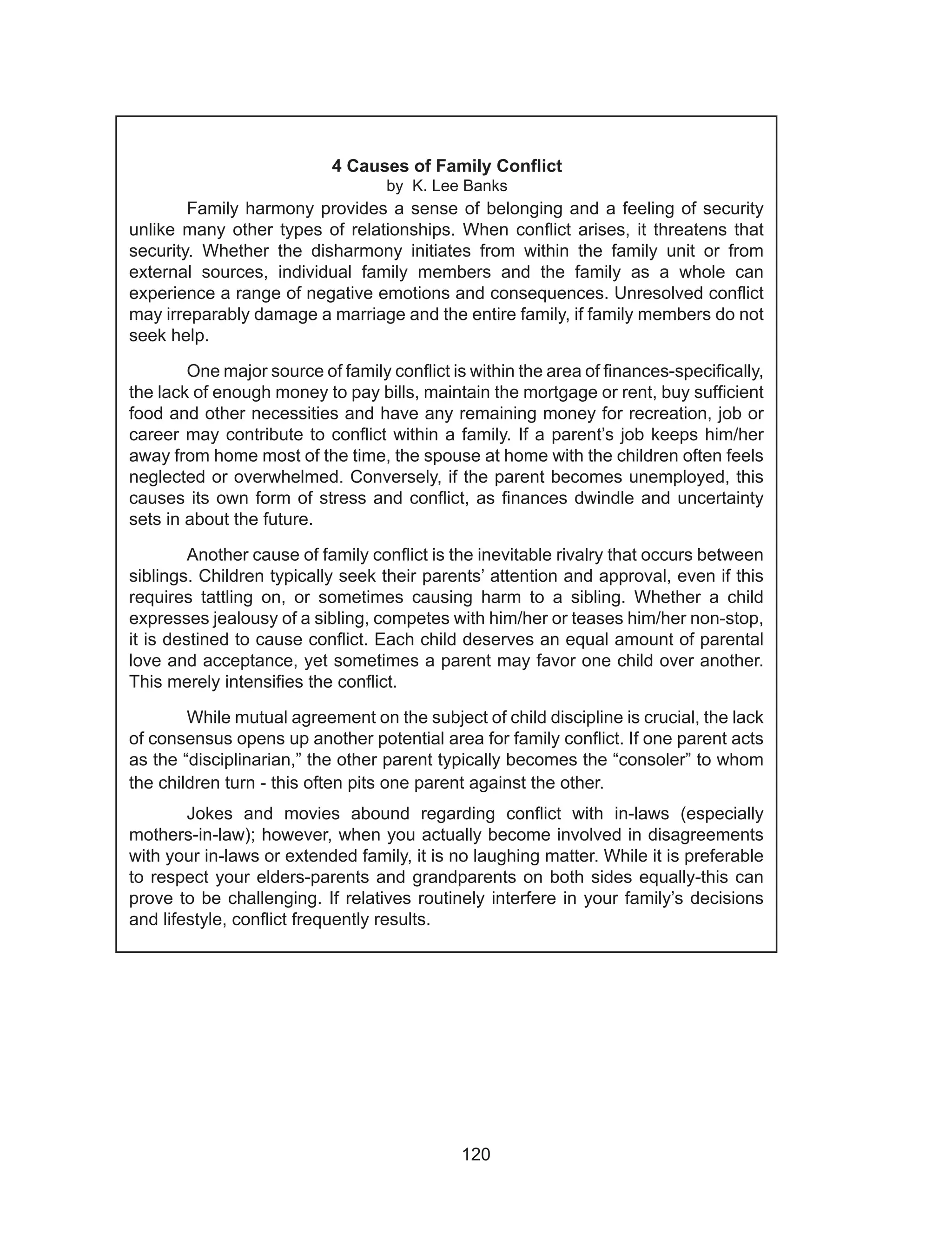
4 Causes of Family Conflict
by K. Lee Banks
	
	 Family harmony provides a sense of belonging and a feeling of security
unlike many other types of relationships. When conflict arises, it threatens that
security. Whether the disharmony initiates from within the family unit or from
external sources, individual family members and the family as a whole can
experience a range of negative emotions and consequences. Unresolved conflict
may irreparably damage a marriage and the entire family, if family members do not
seek help.
	 One major source of family conflict is within the area of finances-specifically,
the lack of enough money to pay bills, maintain the mortgage or rent, buy sufficient
food and other necessities and have any remaining money for recreation, job or
career may contribute to conflict within a family. If a parent’s job keeps him/her
away from home most of the time, the spouse at home with the children often feels
neglected or overwhelmed. Conversely, if the parent becomes unemployed, this
causes its own form of stress and conflict, as finances dwindle and uncertainty
sets in about the future.
	 Another cause of family conflict is the inevitable rivalry that occurs between
siblings. Children typically seek their parents’ attention and approval, even if this
requires tattling on, or sometimes causing harm to a sibling. Whether a child
expresses jealousy of a sibling, competes with him/her or teases him/her non-stop,
it is destined to cause conflict. Each child deserves an equal amount of parental
love and acceptance, yet sometimes a parent may favor one child over another.
This merely intensifies the conflict.
	 While mutual agreement on the subject of child discipline is crucial, the lack
of consensus opens up another potential area for family conflict. If one parent acts
as the “disciplinarian,” the other parent typically becomes the “consoler” to whom
the children turn - this often pits one parent against the other.
	 Jokes and movies abound regarding conflict with in-laws (especially
mothers-in-law); however, when you actually become involved in disagreements
with your in-laws or extended family, it is no laughing matter. While it is preferable
to respect your elders-parents and grandparents on both sides equally-this can
prove to be challenging. If relatives routinely interfere in your family’s decisions
and lifestyle, conflict frequently results.
121
Transcode Me
	 Fill in the diagram with causes of family conflicts. Write a short description of 	
	 each conflict.
	
	
Answer the questions below.
1.	 From the given conflicts, which of these have you experienced with your
family? Why?
______________________________________________________
______________________________________________________
______________________________________________________
2.	 What did you do to resolve the said conflict in your family?
______________________________________________________
______________________________________________________
______________________________________________________
Task 4 FYI
A. Survey to Convey
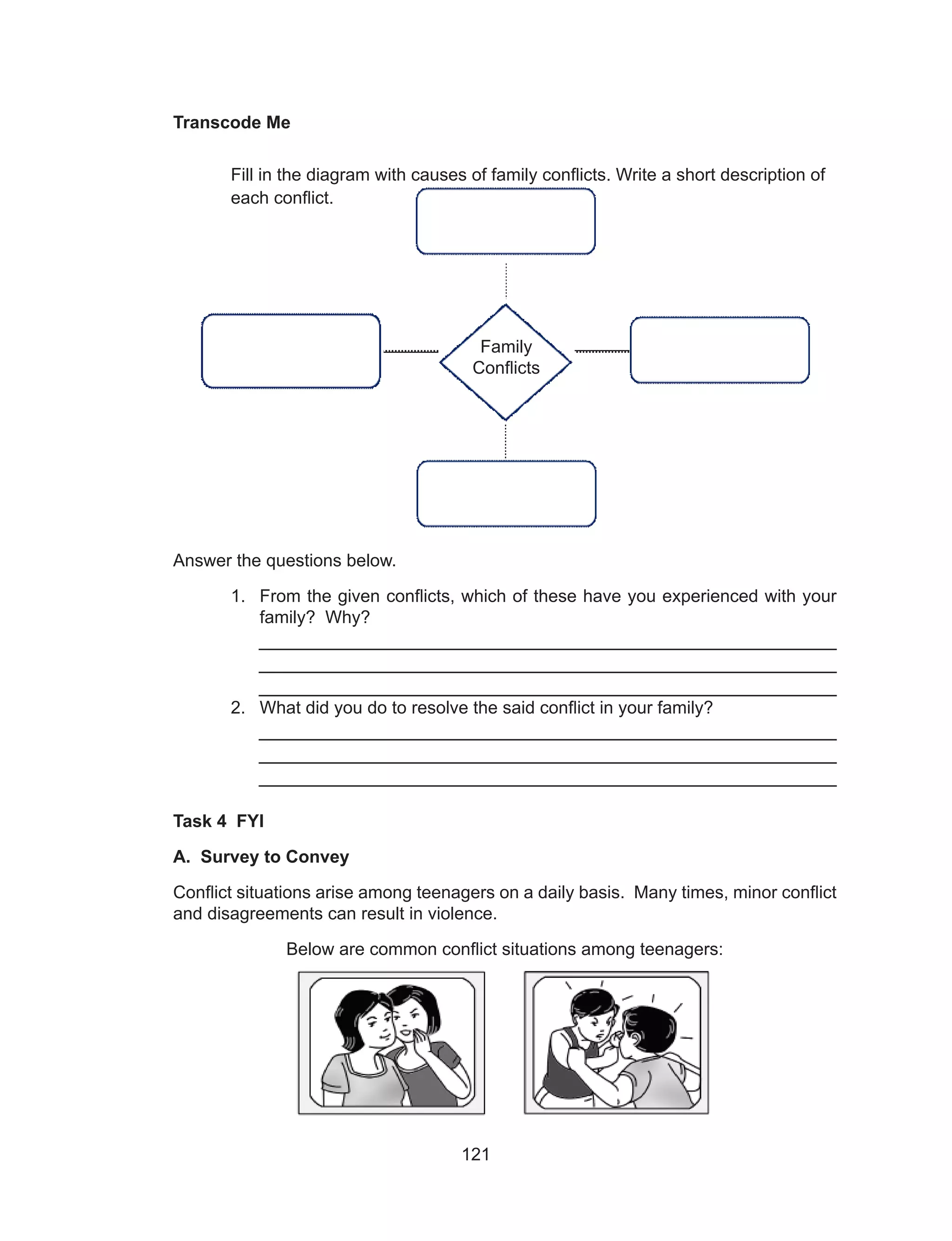
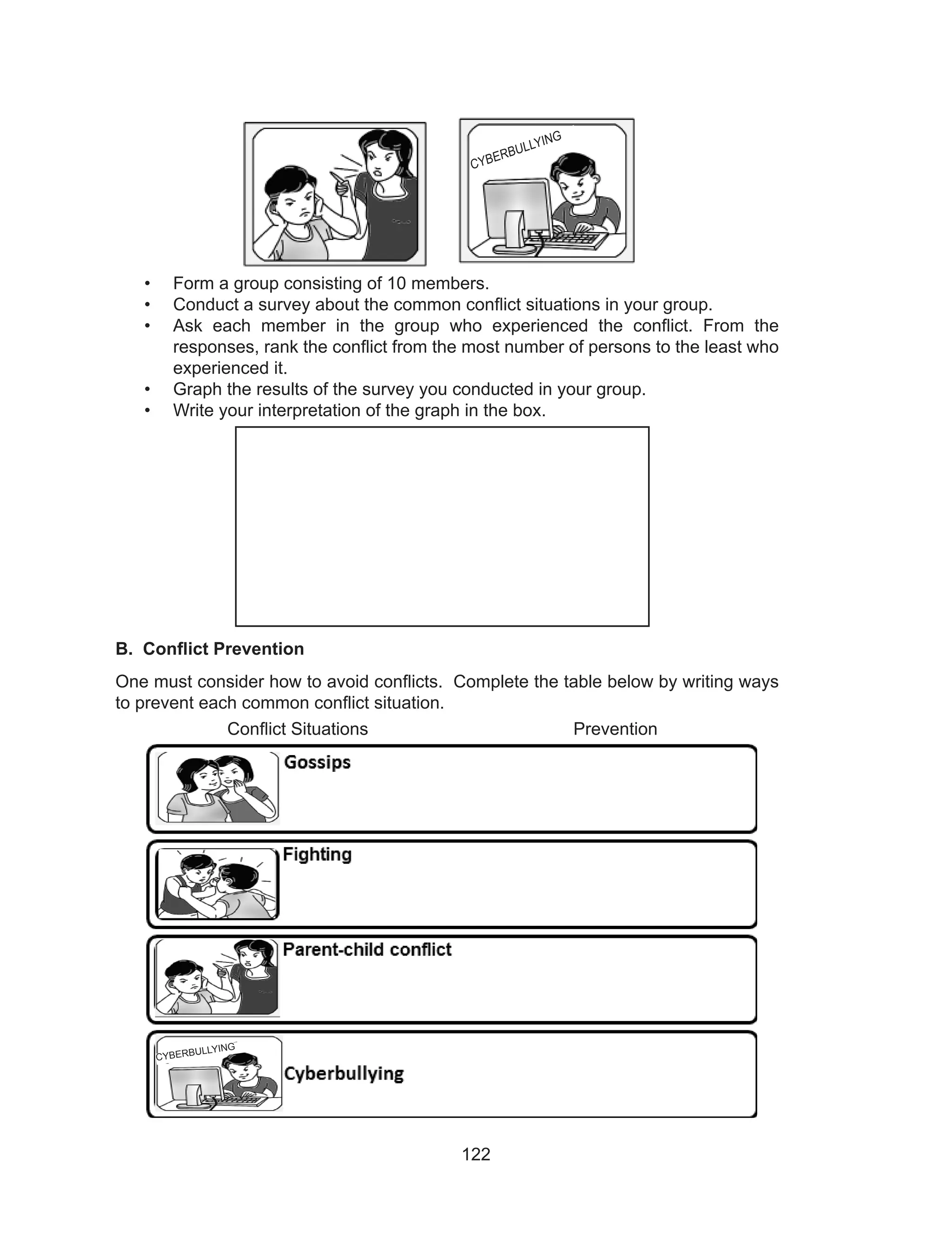
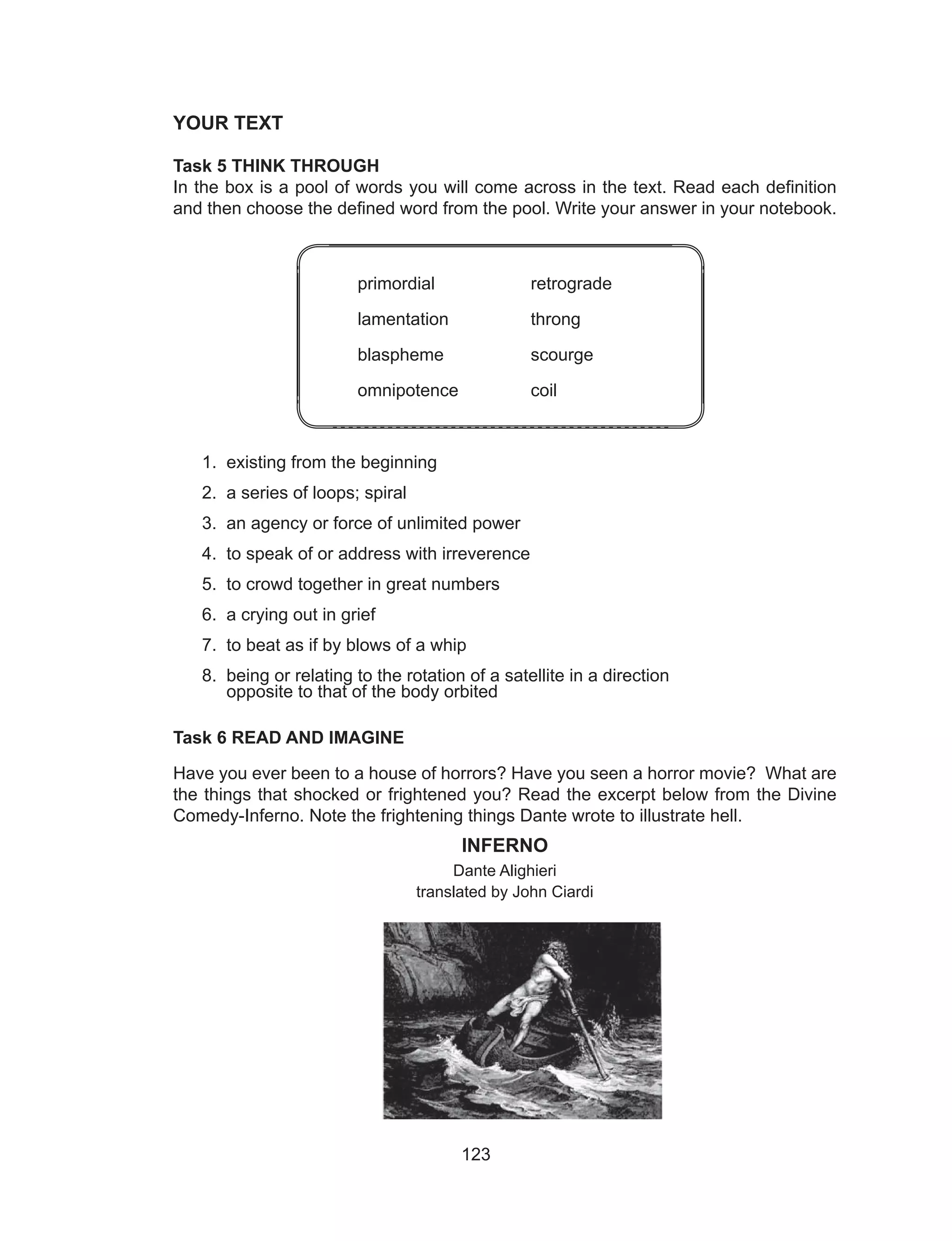
Conflict situations arise among teenagers on a daily basis. Many times, minor conflict
and disagreements can result in violence.
Below are common conflict situations among teenagers:
Family
Conflicts
122
•	 Form a group consisting of 10 members.
•	 Conduct a survey about the common conflict situations in your group.
•	 Ask each member in the group who experienced the conflict. From the
responses, rank the conflict from the most number of persons to the least who
experienced it.
•	 Graph the results of the survey you conducted in your group.
•	 Write your interpretation of the graph in the box.
B. Conflict Prevention
One must consider how to avoid conflicts. Complete the table below by writing ways
to prevent each common conflict situation.
Conflict Situations				 Prevention
CYBERBULLYING
CYBERBULLYING
123
YOUR TEXT
Task 5 THINK THROUGH
In the box is a pool of words you will come across in the text. Read each definition
and then choose the defined word from the pool. Write your answer in your notebook.
	
primordial			retrograde
			lamentation			throng
			blaspheme			scourge
		
omnipotence			coil
1. existing from the beginning
2. a series of loops; spiral
3. an agency or force of unlimited power
4. to speak of or address with irreverence
5. to crowd together in great numbers
6. a crying out in grief
7. to beat as if by blows of a whip
8. being or relating to the rotation of a satellite in a direction
opposite to that of the body orbited
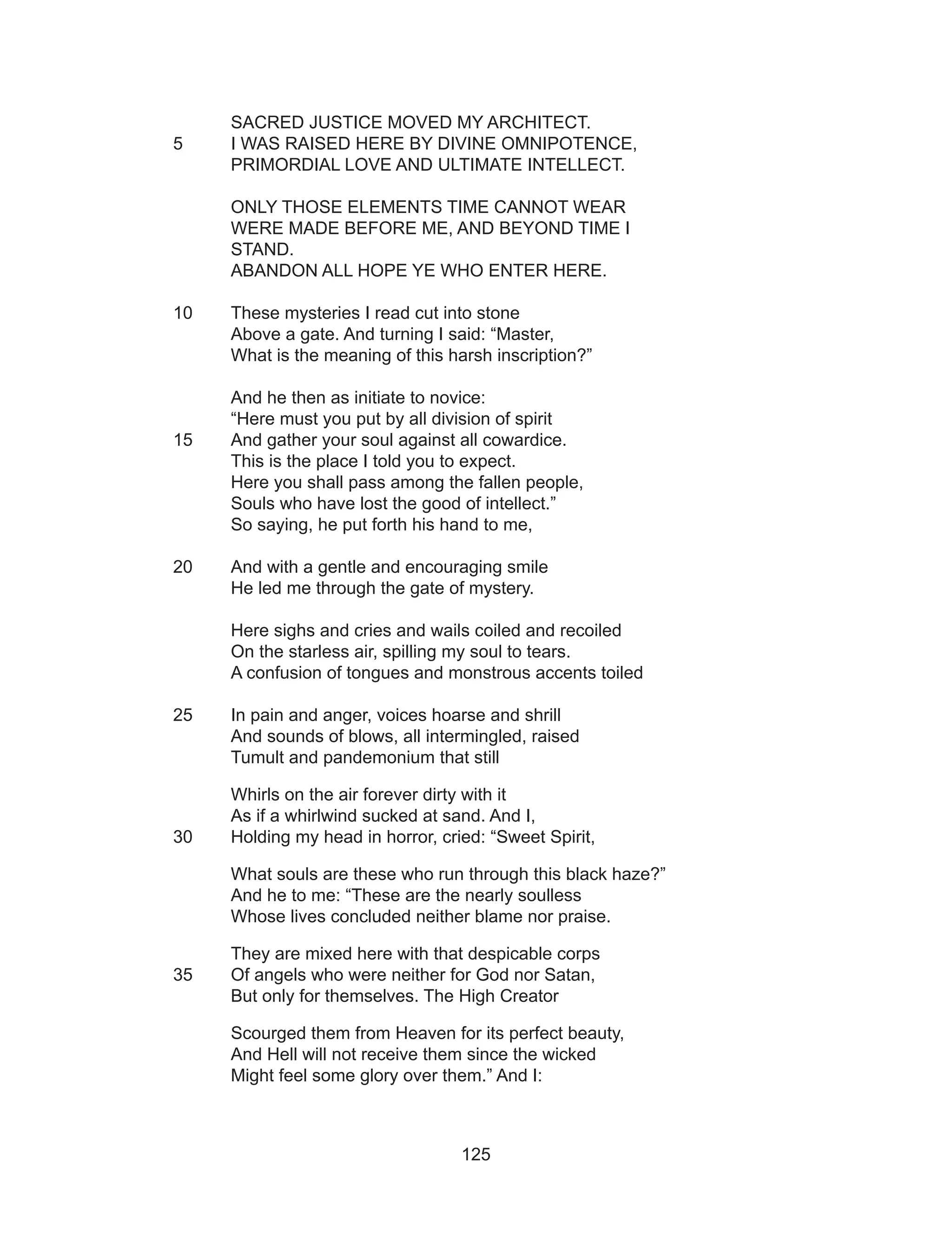
Task 6 READ AND IMAGINE
Have you ever been to a house of horrors? Have you seen a horror movie? What are
the things that shocked or frightened you? Read the excerpt below from the Divine
Comedy-Inferno. Note the frightening things Dante wrote to illustrate hell.
INFERNO
Dante Alighieri
translated by John Ciardi
	primordial		retrograde
	lamentation		throng
	blaspheme		scourge
	omnipotence		coil
124
CANTO III
The Vestibule of Hell
The Opportunists
The Poets pass the Gate of Hell and are immediately
assailed by cries of anguish. Dante sees the first
of the souls in torment. They are THE OPPORTUNISTS,
those souls who in life were neither for
good nor evil but only for themselves. Mixed with
them are those outcasts who took no sides in the Rebellion
of the Angels.They are neither in Hell nor
out of it. Eternally unclassified, they race round and
round pursuing a wavering banner that runs forever
before them through the dirty air; and as they run
they are pursued, by swarms of wasps and hornets,
who sting them and produce a constant flow of blood
and putrid matter which trickles down the bodies of
the sinners and is feasted upon by loathsome worms
and maggots who coat the ground.
The law of Dante’s Hell is the law of symbolic
retribution. As they sinned so are they punished. They
took no sides, therefore they are given no place. As
they pursued the ever-shifting illusion of their own
advantage, changing their courses with every changing
wind, so they pursue eternally an elusive, evershifting
banner. As their sin was a darkness, so they
move in darkness. As their own guilty conscience
pursued them, so they are pursued by swarms of wasps
and hornets. And as their actions were a moral filth,
so they run eternally through the filth of worms and
maggots which they themselves feed.
Dante recognizes several, among them POPE
CELESTINE V, but without delaying to speak to
any of these souls, the Poets move on to ACHERON,
the first of the rivers of Hell. Here the newly arrived
souls of the damned gather and wait for monstrous
CHARON to ferry them over to punishment.
Charon recognizes Dante as a living man and angrily
refuses him passage. Virgil forces Charon to
serve them, but Dante swoons with terror, and does
not reawaken until he is on the other side.
I AM THE WAY INTO THE CITY OF WOE.
I AM THE WAY TO A FORSAKEN PEOPLE.
I AM THE WAY INTO ETERNAL SORROW.
125
SACRED JUSTICE MOVED MY ARCHITECT.
5 	 I WAS RAISED HERE BY DIVINE OMNIPOTENCE,
PRIMORDIAL LOVE AND ULTIMATE INTELLECT.
ONLY THOSE ELEMENTS TIME CANNOT WEAR
WERE MADE BEFORE ME, AND BEYOND TIME I
STAND.
ABANDON ALL HOPE YE WHO ENTER HERE.
10	 These mysteries I read cut into stone
Above a gate. And turning I said: “Master,
What is the meaning of this harsh inscription?”
And he then as initiate to novice:
“Here must you put by all division of spirit
15 	 And gather your soul against all cowardice.
This is the place I told you to expect.
Here you shall pass among the fallen people,
Souls who have lost the good of intellect.”
So saying, he put forth his hand to me,
20 	 And with a gentle and encouraging smile
He led me through the gate of mystery.
Here sighs and cries and wails coiled and recoiled
On the starless air, spilling my soul to tears.
A confusion of tongues and monstrous accents toiled
25	 In pain and anger, voices hoarse and shrill
And sounds of blows, all intermingled, raised
Tumult and pandemonium that still
Whirls on the air forever dirty with it
As if a whirlwind sucked at sand. And I,
30 	 Holding my head in horror, cried: “Sweet Spirit,
What souls are these who run through this black haze?”
And he to me: “These are the nearly soulless
Whose lives concluded neither blame nor praise.
They are mixed here with that despicable corps
35 	 Of angels who were neither for God nor Satan,
But only for themselves. The High Creator
Scourged them from Heaven for its perfect beauty,
And Hell will not receive them since the wicked
Might feel some glory over them.” And I:
126
40 	 “Master, what gnaws at them so hideously
their lamentation stuns the very air?”
“They have no hope of death,” he answered me,
“and in their blind and unattaining state
Their miserable lives have sunk so low
45	 That they must envy every other fate.
No word of them survives their living season.
Mercy and Justice deny them even a name.
Let us not speak of them: look, and pass on.”
50 	 I saw a banner there upon the mist,
Circling and circling, it seemed to scorn all pause.
So it ran on, and still behind it pressed
A never-ending rout of souls in pain.
I had not thought death had undone so many
As passed before me in that mournful train.
55	 And some I knew among them; last of all
I recognized the shadow of that soul
Who, in his cowardice, made the Great Denial.
At once I understood for certain: these
Were of that retrograde and faithless crew
60 	 Hateful to God and to His enemies.
These wretches never born and never dead
Ran naked in a swarm of wasps and hornets
That goaded them the more the more they fled,
And made their faces stream with bloody gouts
65	 Of pus and tears that dribbled to their feet
To be swallowed there by loathsome worms and maggots.
Then looking onward I made out a throng
Assembled on the beach of a wide river,
Whereupon I turned to him: “Master, I long
70 	 To know what souls these are, and what strange
Usage makes them as eager to cross as they seem to be
In this infected light.” At which the Sage:
127
“All this shall be made known to you when we stand
On the joyless beach of Acheron.” And I
75 	 Cast down my eyes, sensing a reprimand
In what he said, and so walked at his side
In silence and ashamed until we came
Through the dead cavern to that sunless tide.
There, steering toward us in an ancient ferry
80 	 Came an old man with white bush of hair,
Bellowing: “Woe to you depraved souls! Bury
Here and forever all hope of Paradise:
I come to lead you to the other shore,
Into eternal dark, into fire and ice.
85	 And you who are living yet, I say begone
From these who are dead.” But when he saw me stand
Against his violence he began again:
“By other windings and by other steerage
Shall you cross to that other shore. Not here! Not here!
90	 A lighter craft than mine must give you passage.”
And my Guide to him: “Charon, bite back your spleen:
This has been willed where what is willed must be,
And is not yours to ask what it may mean.”
The steersman of that marsh of ruined souls,
95 	 Who wore a wheel of flame around each eye,
Stifled the rage that shook his woolly jowls.
But those unmanned and naked spirits there
Turned pale with fear and their teeth began to chatter
At sound of his crude bellow. In despair
100 	 They blasphemed God, their parents, their time on earth,
The race of Adam, and the day and the hour
And the place and the seed and the womb that gave them birth.
128
But all together they drew to that grim shore
Where all must come who lose the fear of God.
105 	 Weeping and cursing they come for evermore,
And demon Charon with eyes like burning coals
Herds them in, and with a whistling oar
Flails on the stragglers to his wake of souls.
As leaves in autumn loosen and stream down
110	 Until the branch stands bare above its tatters
Spread on the rustling ground, so one by one
The evil seed of Adam in its Fall
Cast themselves, at his signal, from the shore
And streamed away like birds who hear their call.
115	 So they are gone over that shadowy water,
And always before they reach the other shore
A new noise stirs on this, and new throngs gather.
“My son,” the courteous Master said to me,
“all who die in the shadow of God’s wrath
120	 Converge to this from every clime and country.
And all pass over eagerly, for here
Divine Justice transforms and spurs them so
Their dread turns wish: they yearn for what they fear.
No soul in Grace comes ever to this crossing;
125	 Therefore if Charon rages at your presence
You will understand the reason for his cursing.”
When he had spoken, all the twilight country
Shook so violently, the terror of it
Bathes me with sweat even in memory:
The tear-soaked ground gave out a sigh of wind
130	 That spewed itself in flame on a red sky,
And all my shattered senses left me. Blind,
Like one whom sleep comes over in a swoon,
I stumbled into darkness and went down.
129
Thinking about the Text
1.	 What is Virgil’s advice to Dante as spoken at the Gate of Hell?
2.	 Who are the souls tortured in this Canto?
3.	 What is Charon’s reaction to Dante’s attempt to cross the river of Acharon?
4.	 How does Virgil silence Charon?
Task 7
A SENSE CHART
	 In Canto III, Dante begins his description of Hell, which becomes an assault
on the senses of the readers. As we read his harrowing descriptions of the sounds,
sights, and even smells of Hell, we come to share in Dante’s repugnance of the horrible
experience the poet encounters.
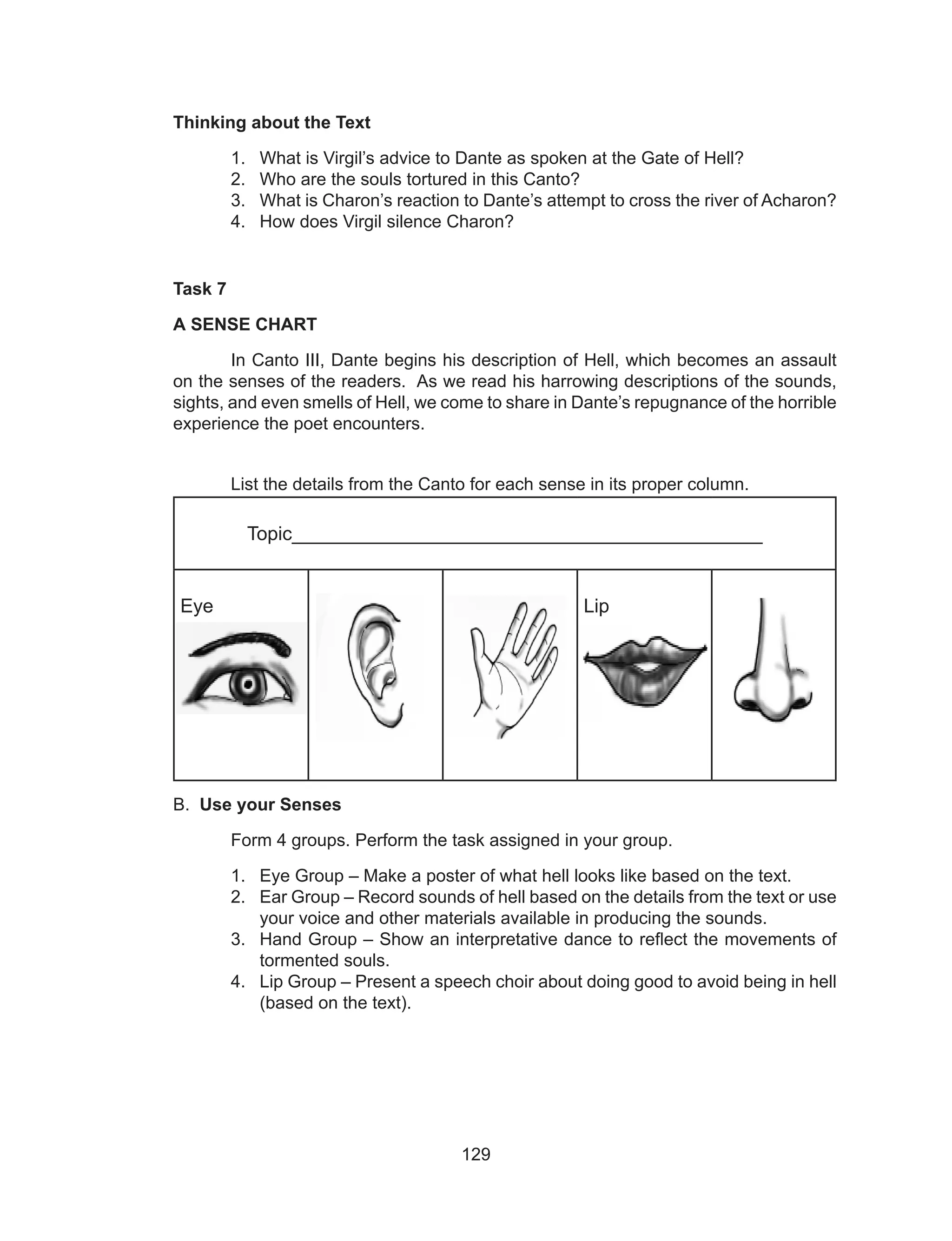
List the details from the Canto for each sense in its proper column.
Topic____________________________________________
Eye Ear Hand Lip Nose
B. Use your Senses
	 Form 4 groups. Perform the task assigned in your group.
1.	 Eye Group – Make a poster of what hell looks like based on the text.
2.	 Ear Group – Record sounds of hell based on the details from the text or use
your voice and other materials available in producing the sounds.
3.	 Hand Group – Show an interpretative dance to reflect the movements of
tormented souls.
4.	 Lip Group – Present a speech choir about doing good to avoid being in hell
(based on the text).
130
Task 8 APPLYING WHAT YOU READ
In “Canto III” of “Inferno” by Dante, Charon tells the souls to “Bury here and forever all
hope of Paradise.”
Explain your answer.
___________________________________________________________________
___________________________________________________________________
___________________________________________________________________
Task 9 MAKING DEFINITIONS
Definitions are a core part of any dictionary. Writing basic definitions requires skill,
practice, and sometimes help.
Read the basic guidelines to follow when writing a definition:
Is hope necessary
in resolving conflicts?
1.	 Just the (dictionary) facts
•	 A definition should contain the information about the word and what
the word refers to. Do not include usage notes in a definition. Get to
the point. Clarity, brevity, and conciseness are better when writing
definitions.
2.	 Avoid complicated terms
•	 Avoid terms that are more complicated or more technical than the
term being defined. The purpose of a definition is to clarify meaning.
3.	 Avoid specific terms
•	 Use conventional English words in explanations whenever possible.
The more widespread a term is, the more users will benefit.
•	 Stay away from jargon. Highly technical terms will most likely require
a user to look up many terms in the definition just to understand what
it says. Although there are cases which involve the use of a technical
term in a specialized field, it should be minimal.
4.	 Avoid circularity
•	 It is not good to define a word with that same word in the definition.
Use different terms.
•	 Avoid defining a term solely using etymologically or morphologically
related terms. Adverbs are especially prone to being defined by the
adjective from which they derive.
131
5.	 Make it simple
•	 Write with simple grammatical structures rather than complex ones.
Place key terms and short explanations near the start of the definition.
http://en.wiktionary.org/wiki/Help:Writing_definitions
	
Define Me
•	 Alphabetize the words.
•	 With your group, go over the other unfamiliar words in your main text.
•	 Make definitions of these unfamiliar words by following the guidelines.
Word Definition
YOUR DISCOVERY TASK
Task 10 READ TO WRITE!


Read an example of an argumentative essay below.
	 Have you ever taken a ride in a public transportation with an aggressive driver?
How did you feel? What did you do? Did you argue with the driver?
Aggressive Driving Should Be Avoided
	
	 Aggressive driving is a phenomenon, which has only recently got the public
worried. The National Highway Traffic Safety Council (NHTSC) defines aggressive
driving as the “operation of a motor vehicle in a manner that endangers or is likely to
endanger persons or property.” Actions such as running red lights, improper passing,
overtaking on the left, improper lane change, failing to yield, improper turns, running
stop signs, tailgaiting, careless driving, and speeding are examples of aggressive
driving. Such actions are dangerous to other road users. Aggressive driving should
be avoided because it causes crashes, injuries and fatalities.
132
	 The first reason why aggressive driving should be avoided is it causes crashes.
According to NHTSC, between 78 percent (excessive speed) and 100 percent (improper
passing) of the cases of aggressive driving resulted in traffic crashes and 96 percent
of the drivers cited for “following too closely” or tailgaiting caused crashes as a result
of their aggressive driving. Moreover, “running red light,” “improper passing,” and
“overtaking on the left” topped other categories of aggressive driving in contributing to
traffic crashes.
	 Another reason why aggressive driving should be avoided is it causes injuries.
NHTSC states that the percentages of the injuries caused by aggressive driving are,
in almost all categories of aggressive driving, above 100 percent.
	 Aggressive driving also causes fatalities. “Overtaking on the left” appears to
be the most important contributing factor in traffic fatalities as it relates to aggressive
driving. “Improper lane change,” “running stop sign,” and “running red light” rank
second through four in terms of their contribution to traffic fatalities.
	 The above evidence shows that aggressive driving causes crash injuries and
fatalities. Hence, aggressive driving should be avoided. Since the opening on the
North-South Highway, the number of kilometers of roads in the country has increased
by one percent while the number of vehicle miles driven has increased by 35 percent.
More cars and more drivers are also on the road leading to more aggressive drivers.
http://learnenglishessay.blogspot.com/2011/12/argumentative-essay.html	
A. Reason Out!
Inside the box provided below, give three reasons why aggressive driving should be
avoided. Write your explanation opposite the box.
	
• __________________________________
__________________________________
_________________________________________________
• __________________________________
__________________________________
_________________________________________________
• __________________________________
__________________________________
_________________________________________________
133
B. I Saw the Sign!
With your group, create a friendly reminder / signage on motorists’ safety while
driving. Write it in the box.
	
Present the signage to the rest of the class.
	 What you just read is an example of an argumentative essay. To know more
about it, read the following details.
	An argumentative essay tries to change the reader’s mind by convincing the
reader to agree with the writer’s point of view.
Characteristics of an Argumentative Essay
An argumentative essay attempts to be highly persuasive and logical. It
usually assumes that the reader disagrees with the writer, but it should be noted
that the reader is no less intelligent than the writer. Hence, an argumentative essay
should be written objectively and logically.
	 An argumentative essay has the following characteristics:
•	 presents and explains the issue or case
•	 gives reasons and supports these reasons to prove its point
•	 refutes (proves wrong) opposing arguments.
Parts
1.	 Introduction
	 First is the introductory paragraph. It introduces the problem
and gives the background information needed for the argument and the
thesis statement.
2.	 Body
	 The body of the essay contains the reasons. Each paragraph
talks about one reason. The reason is included in the topic sentence
and is supported by details or materials. These supporting materials
can be examples, statistics, personal experiences, or quotations.
3.	 Conclusion
	 The conclusion restates the main claim and gives one or two
general statements which exactly summarize the arguments and
support the main premise.
134
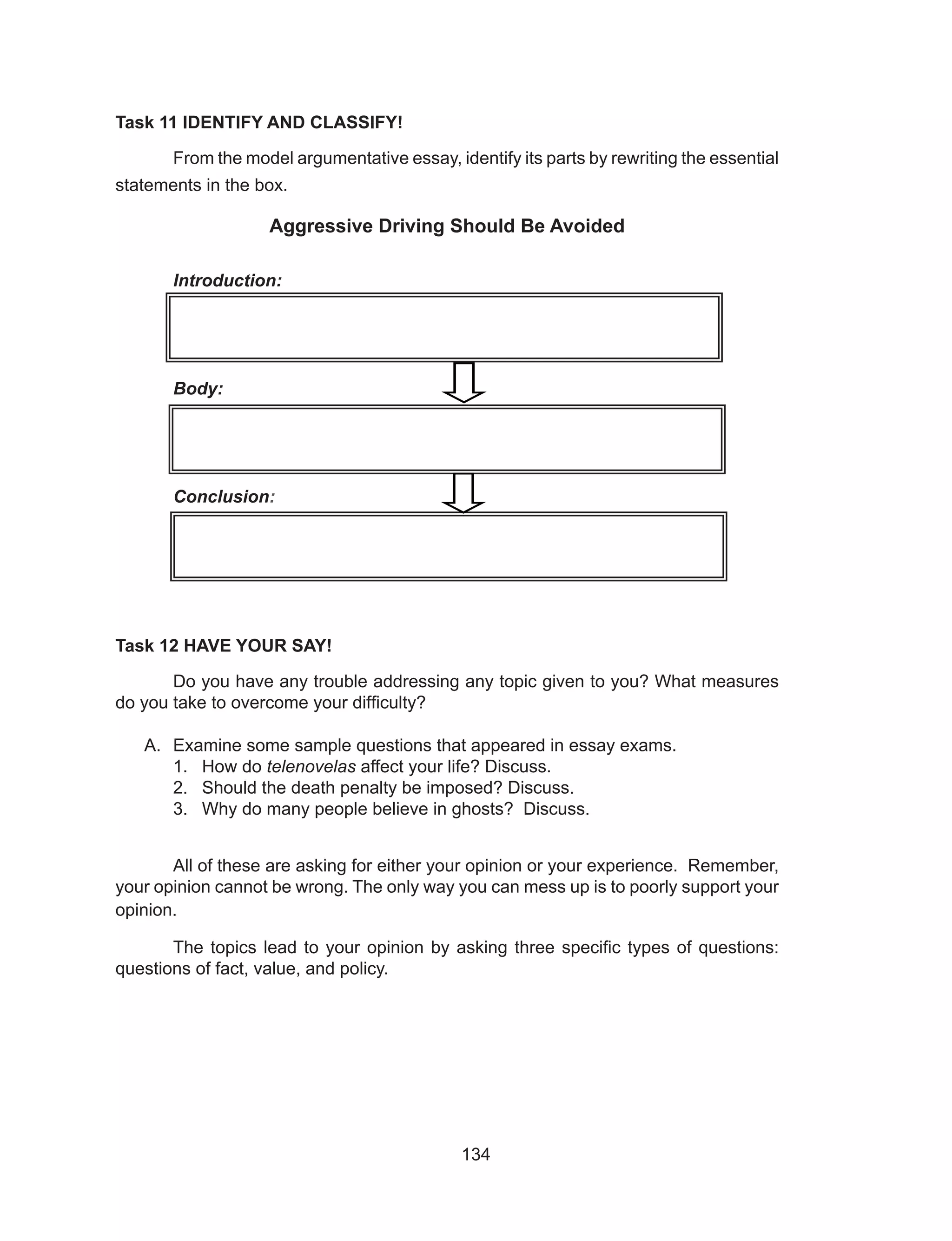
Task 11 IDENTIFY AND CLASSIFY!
	 From the model argumentative essay, identify its parts by rewriting the essential
statements in the box.
Aggressive Driving Should Be Avoided
Introduction:
Body:
Conclusion:
	
Task 12 HAVE YOUR SAY!
	 Do you have any trouble addressing any topic given to you? What measures
do you take to overcome your difficulty?
A.	 Examine some sample questions that appeared in essay exams.
1.	 How do telenovelas affect your life? Discuss.
2.	 Should the death penalty be imposed? Discuss.
3.	 Why do many people believe in ghosts? Discuss.
	 All of these are asking for either your opinion or your experience. Remember,
your opinion cannot be wrong. The only way you can mess up is to poorly support your
opinion.
	 The topics lead to your opinion by asking three specific types of questions:
questions of fact, value, and policy.
135
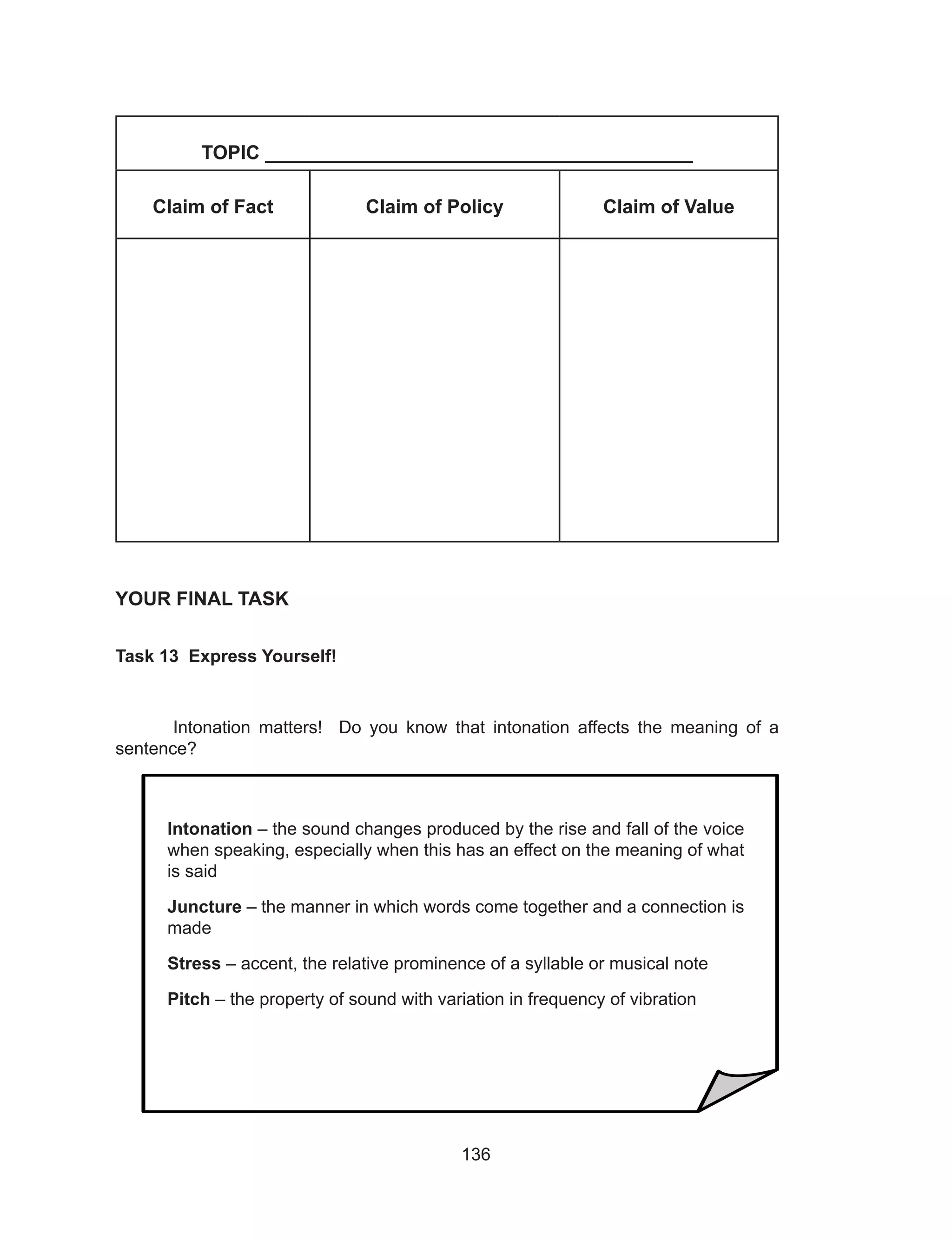
B.	 Formulate your own!
	 Form five groups then formulate your own claims of fact, policy, and
value based on your chosen topic from the list provided. Use the organizer
below to present your claims.
	 	 	
1.	 Resolving Conflicts
2.	 Unity in Diversity
3.	 Harmonizing Relationship with Others
4.	 Recognizing Interpersonal Convergence
5.	 Bridging the Gap
Questions of Fact are those which ask you to answer whether or not something
is. These questions are always answered with either “Yes” or “No” and then you
must construct paragraphs to support the facts.
Example: Is the wall blue? (Yes or No, and then your evidence)
Questions of Value address the relative merit (goodness or badness) of
something. Here you are usually asked to choose between things, ideas, beliefs,
or actions and explain why you did so.
Example: Which is more valuable, love or money? (Which and then why?)
Questions of Policy ask the writer to explain what they would do. The key word
in these topics is usually “should” as in “what should we do...?” The question
asks the writer to make a plan of action to solve some sort of problem. The
answer is a breakdown of the plan and a justification that it fixes the problem.
Example: What should be done to combat the drug problem? (Plan and
justify.)
http://www.keithmurphy.info/1102/question.htm
List of Topics
1.	 Resolving Conflicts
2.	 Unity in Diversity
3.	 Harmonizing Relationship with Others
4.	 Recognizing Interpersonal Convergence
5.	 Bridging the Gap
136
TOPIC ________________________________________
Claim of Fact Claim of Policy Claim of Value
YOUR FINAL TASK
Task 13 Express Yourself!
	 Intonation matters! Do you know that intonation affects the meaning of a
sentence?
	
Intonation – the sound changes produced by the rise and fall of the voice
when speaking, especially when this has an effect on the meaning of what
is said
Juncture – the manner in which words come together and a connection is
made
Stress – accent, the relative prominence of a syllable or musical note
Pitch – the property of sound with variation in frequency of vibration
137
Below are the commonly used expressions. These are necessary words to be
respected and accepted.
A.	 Form a group and perform the intonation activities for oral fluency.
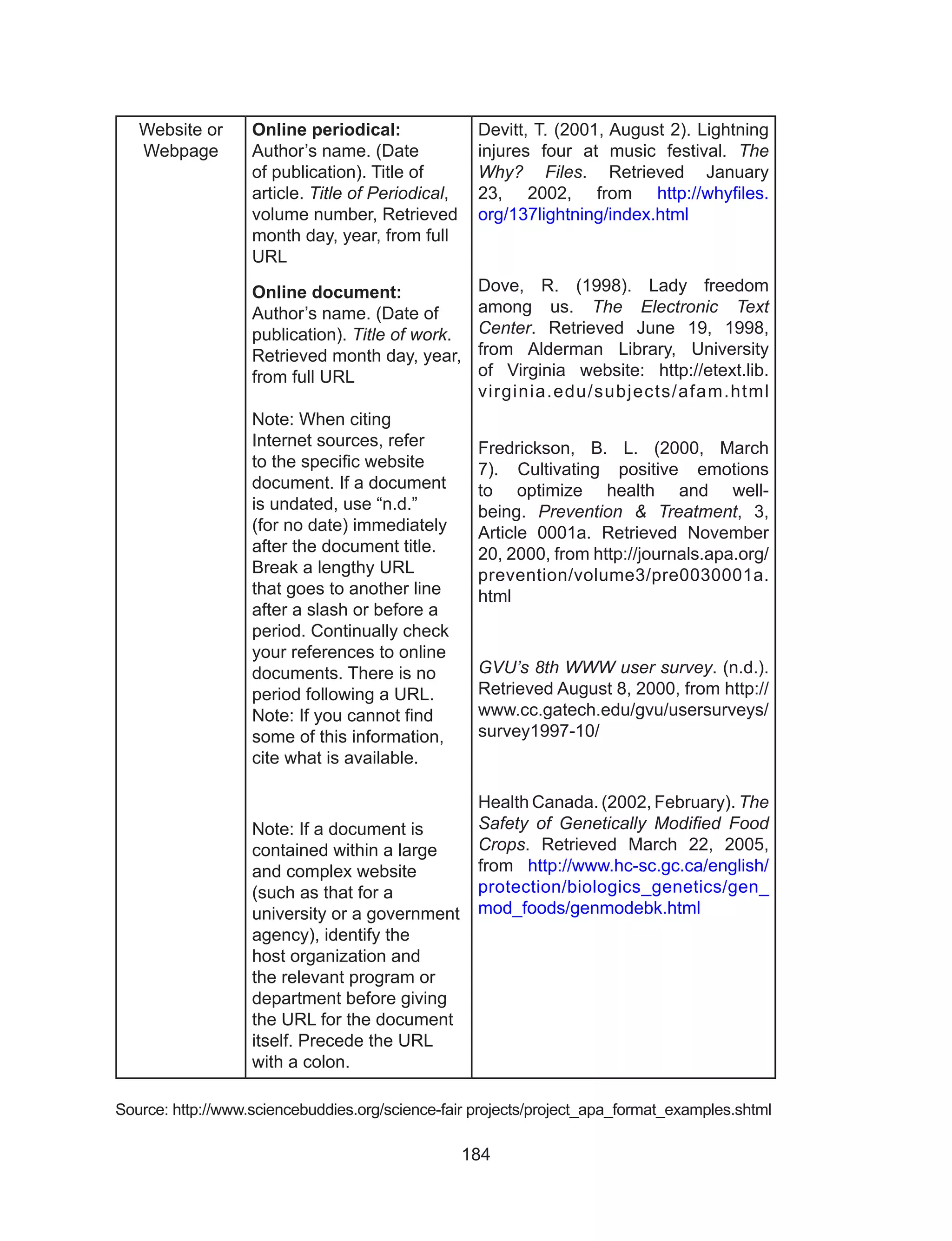
Group 1	
		 Say “Hello” in the following situations:
•	 to a friend
•	 to a friend you haven’t seen for a year
•	 to your teacher
•	 to a six-month old baby
•	 to someone you found doing something they shouldn’t
•	 to someone you’re not sure is still on the other end of the phone
Group 2
		 Say “How are you?” in the following situations:
•	 to someone you meet for the first time
•	 to someone you haven’t seen for 3 years
•	 to someone who just recovered from sickness
•	 to someone who has recently lost a member of the family
Group 3
		 Say “Thank you” to the following people:
•	 someone who helped you carry your bag
•	 someone who gave you a present
•	 someone who opened the door for you
•	 your boss for allowing you to take a leave
Group 4
		Say “Please” in the following situations:
•	 when you’re requesting for something
•	 when you make an order
•	 when you are offering something
•	 when you give a command
Group 5
		Say “Excuse me” in the following situations:
•	 when you want to interrupt in a conversation
•	 when you want to clarify something
•	 when you are correcting someone
•	 when you want to get a person’s name
•	 when you’re asking for directions
138
Performance Rubric
Excellent
(5 points)
Good
(4 points)
Fair
(3 points)
Poor
(2 points)
Unacceptable
(1 point)
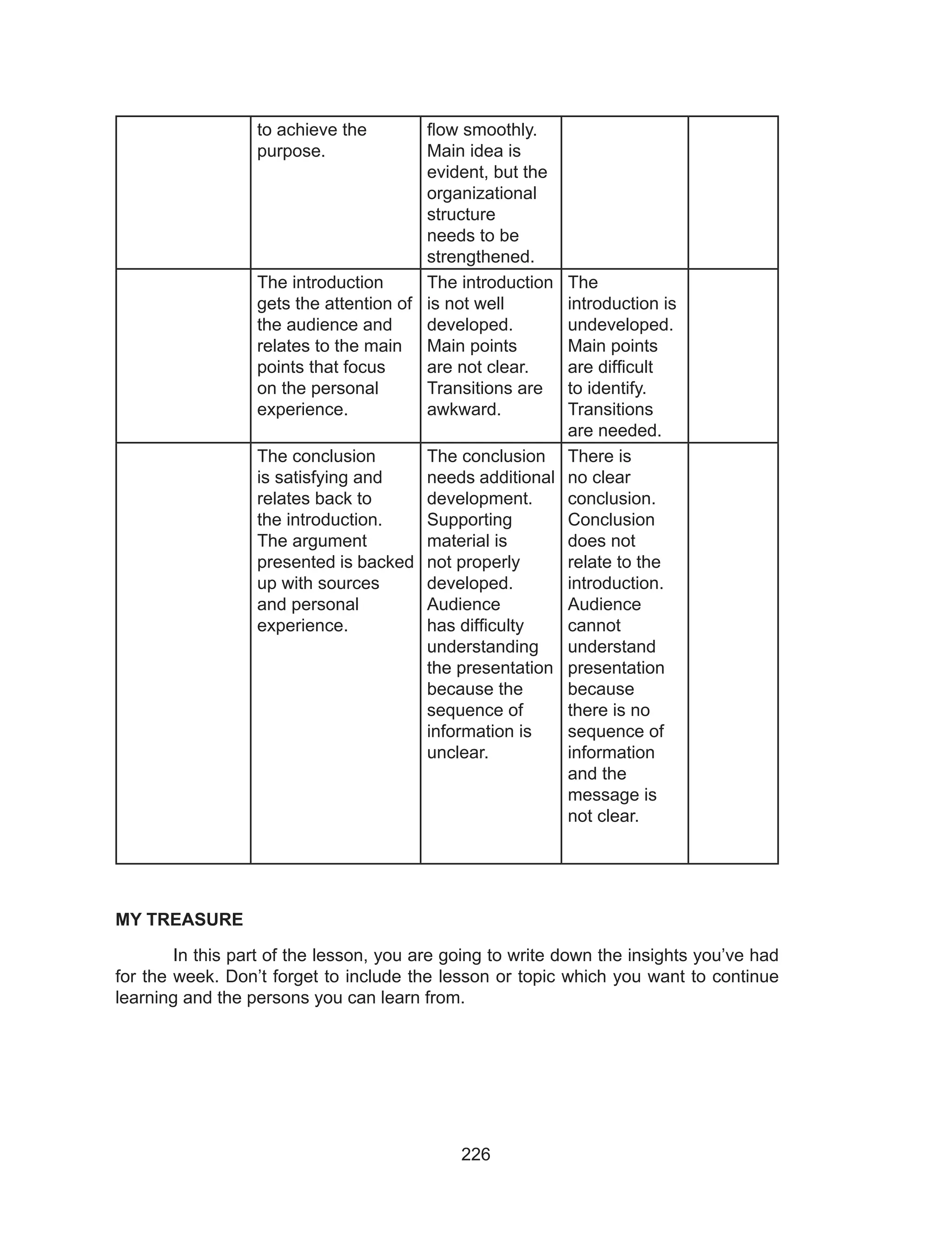
A perfect
center of
pitch, stress,
juncture, and
intonation are
maintained
ALL of the
time in
different
situations.
No tendency
towards
sharping or
flatting note.
A
perfect
center
of

pitch, stress,
juncture, and
intonation
are

maintained

MOST
of

the time
in different
situations.

Students

tend
to

sharp
or

flat
in

extreme

registers
or

vocal

“breaks.”

A
perfect

center
of

pitch, stress,
juncture, and
intonation
are

maintained

SOMETIMES
in different
situations.

Student

tends
to

sharp
or

flat

throughout

their
vocal

range
at

times.


A
perfect

center
of

pitch, stress,
juncture, and
intonation are

maintained

OCCASIONALLY
in different
situations.

Students
sharp
or

flat

consistently
with
some

moments
of
perfect

pitch.


A
perfect
center
of

pitch, stress,
and juncture
does
NOT

occur in
different
situations.
Students

have
little
sense
of

intonation.

It’s your turn!
This time say the following statements correctly and determine if you are going to use
a rising or a falling intonation.
1.	 It’s unbelievable!
2.	 That’s great!
3.	 Oh, sure I will.
4.	 You must be kidding!
5.	 Really? That’s good!
6.	 Don’t worry, I understand.
7.	 You shouldn’t have.
8.	 I think I will.
9.	 Keep it up!
10.	It’s okay.
139
Task 14 NEWS WRITING AND REPORTING
	 NEWS
	 What makes a good news story?
Brainstorm the characteristics of a good news story with a
partner (3 minutes).
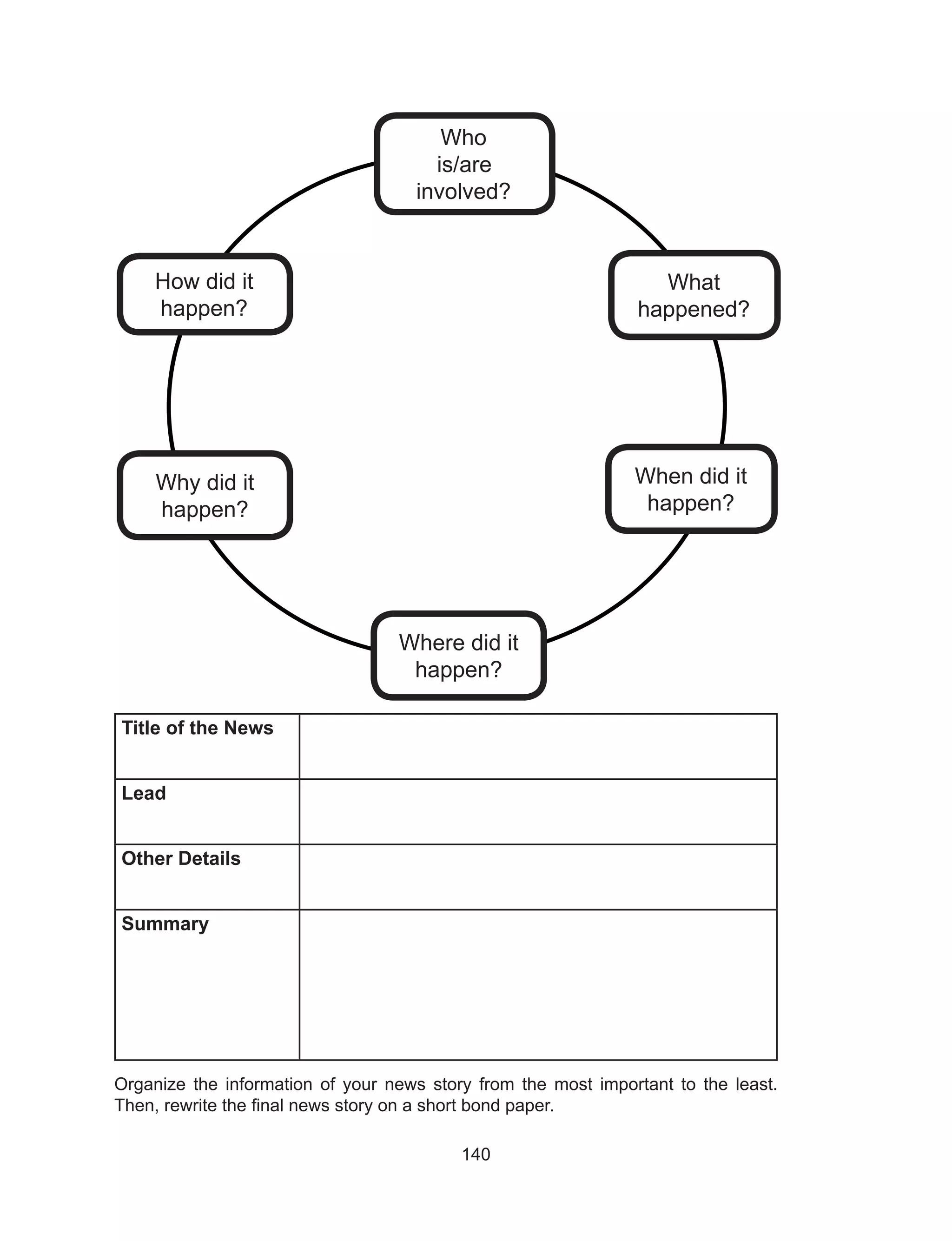
Key Components of a Good News Story
•	 Attention-getting headline
•	 A strong lead containing 5 Ws and H (who, what, when, where, why, and how)
•	 Use of quotes
•	 Real facts (truth and accuracy matter)
•	 A strong summary
•	 Organization of the news (presenting information from most to least important)
What makes a story newsworthy?
	 Some key elements when considering “newsworthiness” are:
•	 Timing:  If it happened today, it’s news, if it happened last week, it’s not; with
24-hour news access, “breaking” news is important.
•	 Significance: How many people are affected?
•	 Proximity:  The closer a story hits home, the more newsworthy it is.
•	 Prominence: When famous people are affected, the story matters (i.e., car
accident involving your family vs. a car accident involving the President).
•	 Human Interest: Because these stories are based on emotional appeal, they
are meant to be amusing or to generate empathy or other emotions. They often
appear in special sections of the newspaper or at the end of the newscast as a
“feel good” story or to draw attention to something particularly amusing, quirky,
or off-beat.
http://www.pbs.org/now/classroom/lessonplan-05.html
A.	 News.. News… News…
Bring a newspaper. With your partner, evaluate one article from the
newspaper if it contains the key components of a good story.
	 Is the article a good news story? Explain.
B.	 Write a News
With a partner, write a news story on resolving conflicts that happened
in your school or community. Fill up the chart to help in writing the first
paragraph or the lead.
140
Title of the News
Lead
Other Details
Summary
Organize the information of your news story from the most important to the least.
Then, rewrite the final news story on a short bond paper.
Who
is/are
involved?
What
happened?
When did it
happen?
Where did it
happen?
Why did it
happen?
How did it
happen?
141
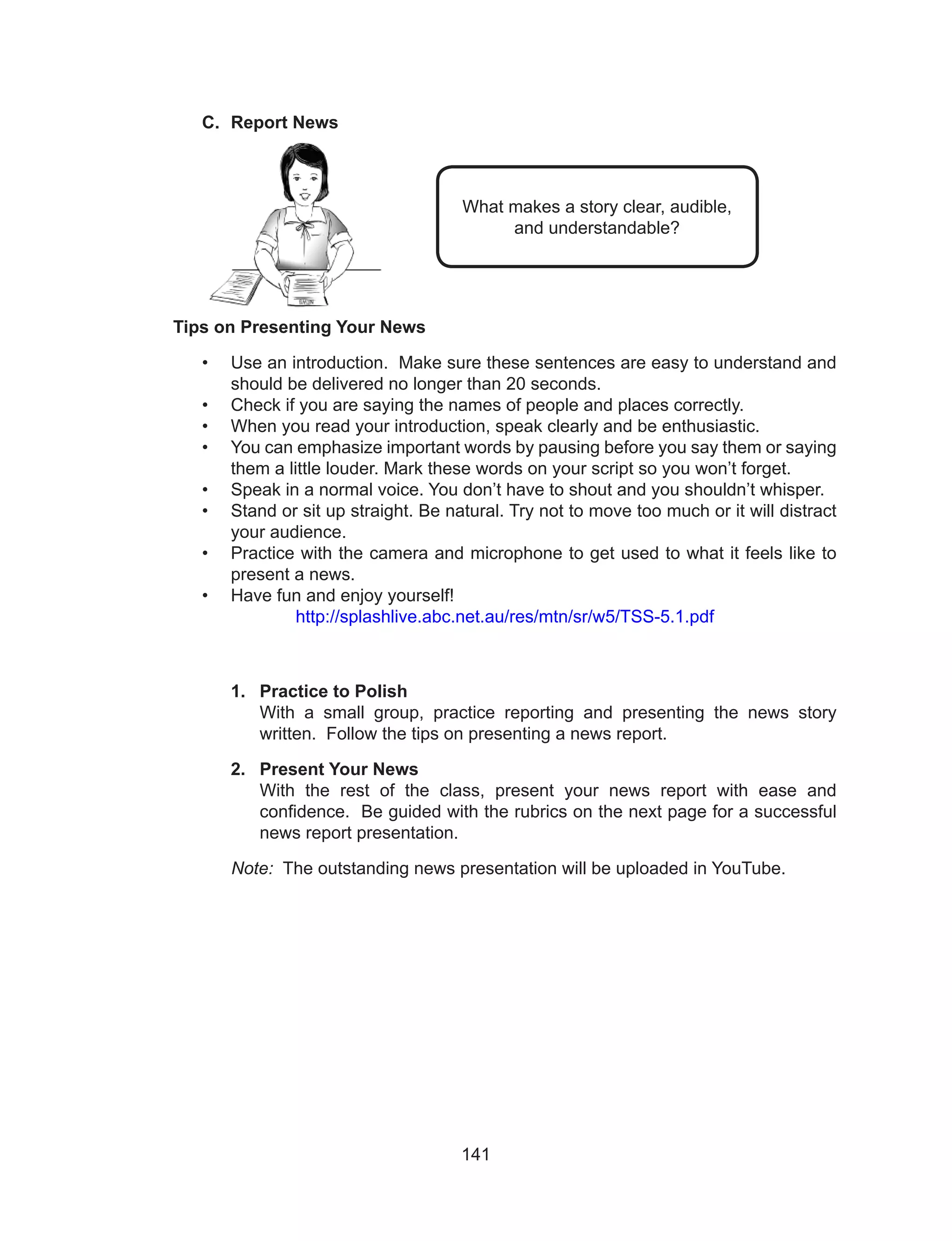
C.	 Report News
	
Tips on Presenting Your News
•	 Use an introduction. Make sure these sentences are easy to understand and
should be delivered no longer than 20 seconds.
•	 Check if you are saying the names of people and places correctly.
•	 When you read your introduction, speak clearly and be enthusiastic.
•	 You can emphasize important words by pausing before you say them or saying
them a little louder. Mark these words on your script so you won’t forget.
•	 Speak in a normal voice. You don’t have to shout and you shouldn’t whisper.
•	 Stand or sit up straight. Be natural. Try not to move too much or it will distract
your audience.
•	 Practice with the camera and microphone to get used to what it feels like to
present a news.
•	 Have fun and enjoy yourself!
http://splashlive.abc.net.au/res/mtn/sr/w5/TSS-5.1.pdf
1.	 Practice to Polish
With a small group, practice reporting and presenting the news story
written. Follow the tips on presenting a news report.
2.	 Present Your News
With the rest of the class, present your news report with ease and
confidence. Be guided with the rubrics on the next page for a successful
news report presentation.
Note: The outstanding news presentation will be uploaded in YouTube.
What makes a story clear, audible,
and understandable?
142
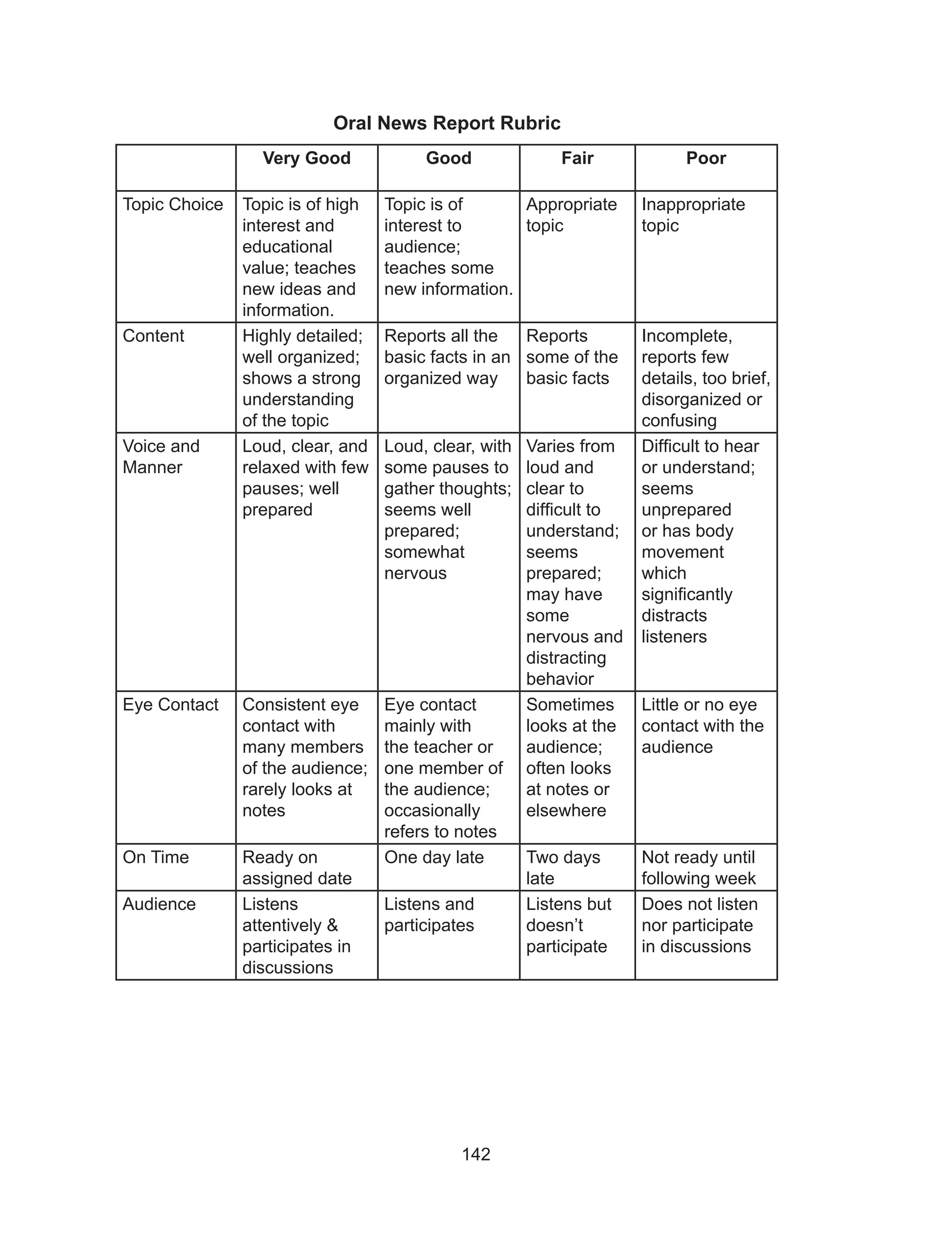
Oral News Report Rubric
	
	
Very Good Good Fair Poor
Topic Choice Topic is of high
interest and
educational
value; teaches
new ideas and
information.
Topic is of
interest to
audience;
teaches some
new information.
Appropriate
topic
Inappropriate
topic
Content Highly detailed;
well organized;
shows a strong
understanding
of the topic
Reports all the
basic facts in an
organized way
Reports
some of the
basic facts
Incomplete,
reports few
details, too brief,
disorganized or
confusing
Voice and
Manner
Loud, clear, and
relaxed with few
pauses; well
prepared
Loud, clear, with
some pauses to
gather thoughts;
seems well
prepared;
somewhat
nervous
Varies from
loud and
clear to
difficult to
understand;
seems
prepared;
may have
some
nervous and
distracting
behavior
Difficult to hear
or understand;
seems
unprepared
or has body
movement
which
significantly
distracts
listeners
Eye Contact Consistent eye
contact with
many members
of the audience;
rarely looks at
notes
Eye contact
mainly with
the teacher or
one member of
the audience;
occasionally
refers to notes
Sometimes
looks at the
audience;
often looks
at notes or
elsewhere
Little or no eye
contact with the
audience
On Time Ready on
assigned date
One day late Two days
late
Not ready until
following week
Audience Listens
attentively &
participates in
discussions
Listens and
participates
Listens but
doesn’t
participate
Does not listen
nor participate
in discussions
143
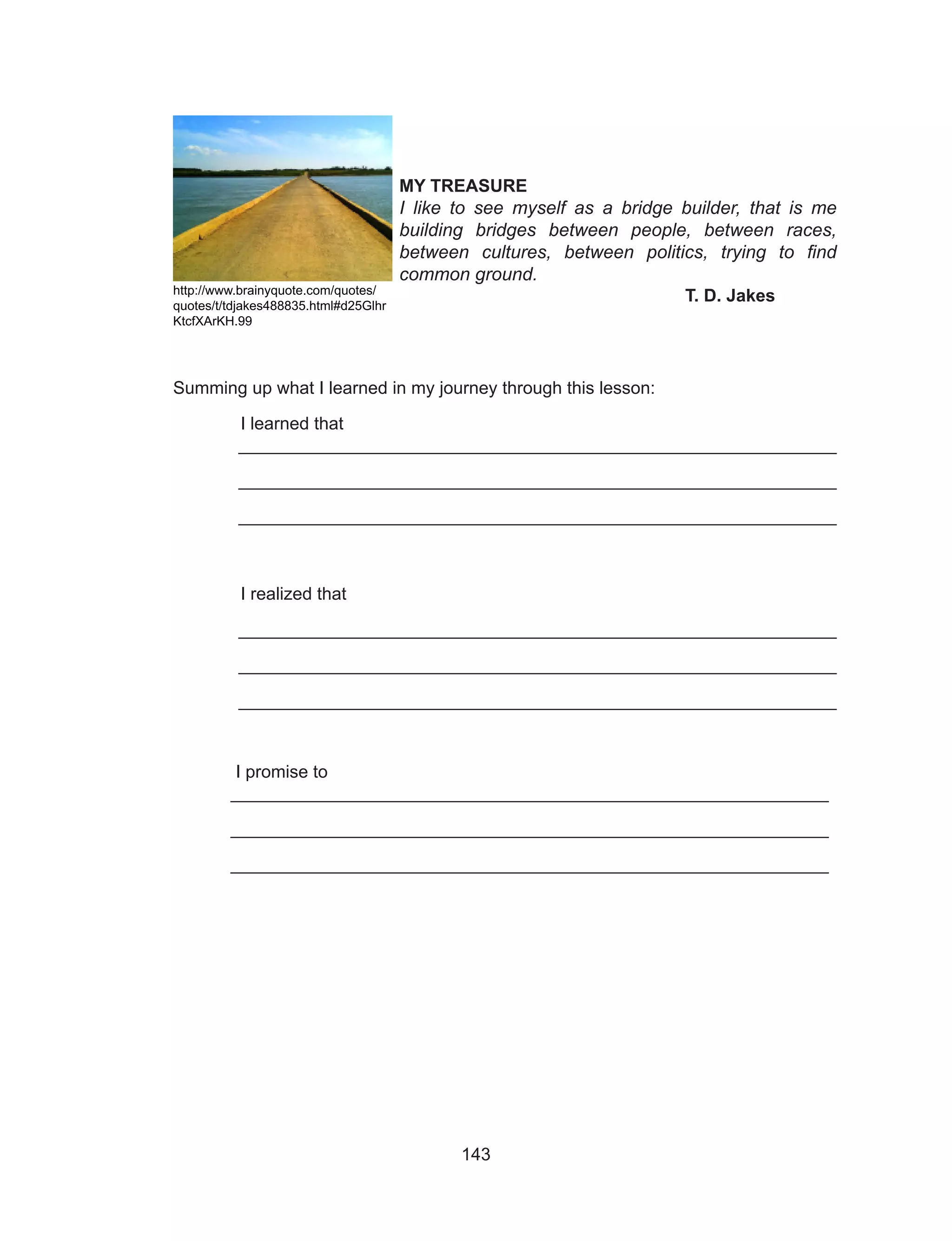
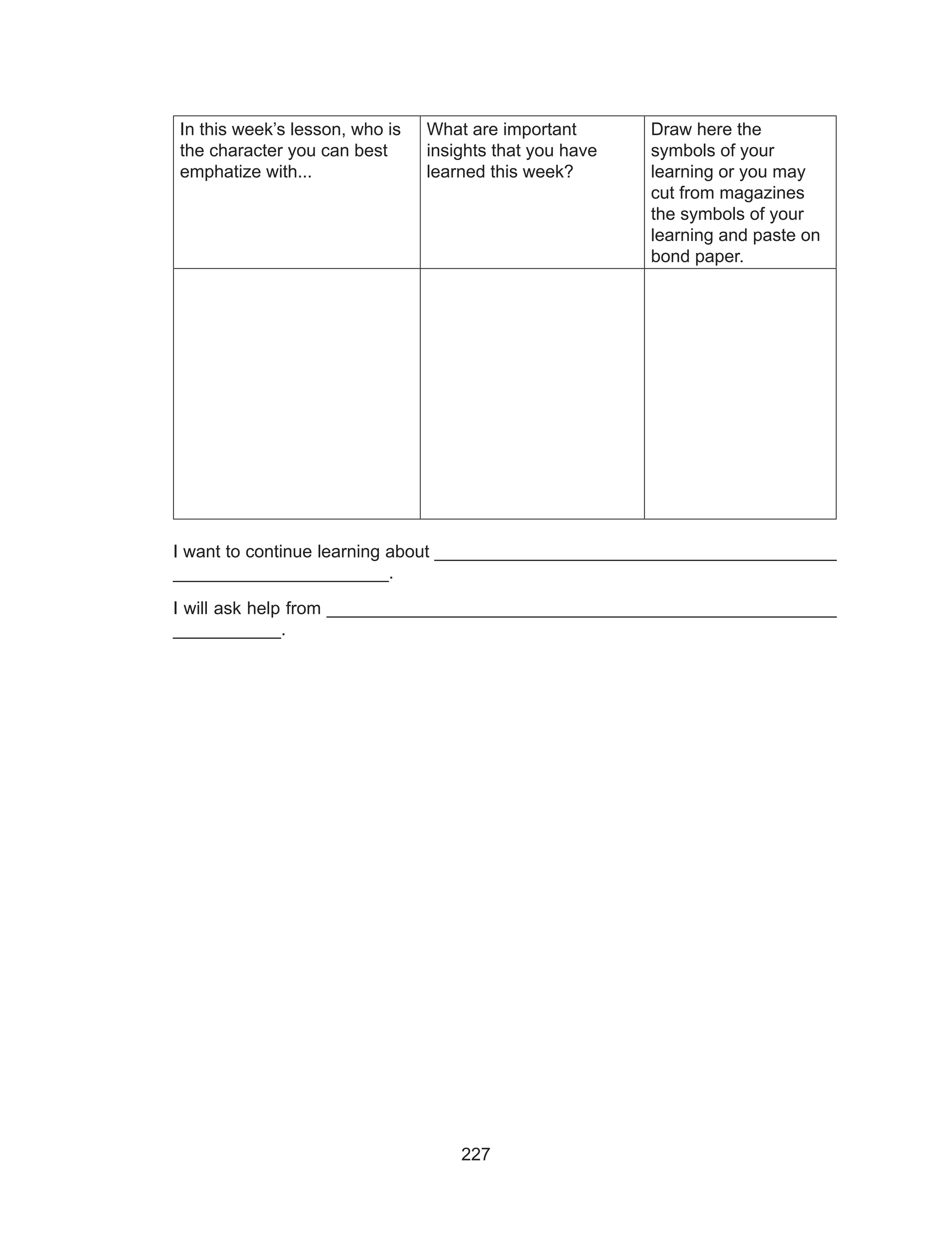
MY TREASURE
I like to see myself as a bridge builder, that is me
building bridges between people, between races,
between cultures, between politics, trying to find
common ground.
T. D. Jakes
Summing up what I learned in my journey through this lesson:
I learned that
_____________________________________________________________
_____________________________________________________________
_____________________________________________________________
I realized that
_____________________________________________________________
	_____________________________________________________________
	_____________________________________________________________
I promise to
	_____________________________________________________________
	_____________________________________________________________
	_____________________________________________________________
http://www.brainyquote.com/quotes/
quotes/t/tdjakes488835.html#d25Glhr
KtcfXArKH.99
144
Module 2
LESSON 2
______________________________________________________________
Building Ties
YOUR JOURNEY
	 Conflicts happen everywhere. It happens in the family, among friends, in the
classroom, or around the corporate conference table. The good news is that it doesn’t
have to damage family relationships, friendships, or business deals. Knowing how
to resolve conflict, wherever it happens, creates confidence and eases pressure and
stress.
	 Building ties is one of the best ways in resolving conflicts. There must be a
connection between and among people even in this diverse world. Remember that we
do not find the meaning of life by ourselves alone - we find it with other people.
	 “We cannot live only for ourselves. A thousand fibers connect us with our fellow
men; and among those fibers, as sympathetic threads, our actions run as causes, and
they come back to us as effects.”	 							
							- Herman Melville
YOUR OBJECTIVES
For you to follow the trail of your valuable journey, you have to:
•	 present information using tables, graphs, and maps
•	 assess whether the speaker’s purpose is achieved or not
•	 assess the effectiveness of the ideas presented in the material viewed taking
into account its purpose
•	 explain how the elements specific to a selection build its theme
•	 explain how the elements specific to a genre help in developing the theme of
the selections
•	 use the correct sound of English when delivering impromptu and
extemporaneous speeches
•	 observe correct grammar in making definitions
•	 use patterns and techniques of developing an argumentative claim
	
	
Be reminded that at the end of this lesson, you are expected to
deliver an extemporaneous speech.
145
YOUR INITIAL TASKS
Task 1 WHAT DO YOU PERCEIVE?
	 		 Observe this picture by paying attention
to its details. What is the person trying to do? Do
you think he’s doing the right thing? Discuss with
a partner.
	 		 If you were the person in the picture,
would you do the same thing? Explain your answer.
Task 2 LISTEN AND IMAGINE
Are you a dreamer? Do you keep your dreams only to yourself? Or do you share
your dreams with others?
A.	 Before you listen to the song “Imagine” by John Lennon, complete its lyrics by
filling-out the lines with the correct word using the pictures below as clues.
146
Imagine
by: John Lennon
Imagine there’s no heaven 
It’s easy if you try
No hell below us 
Above us only 1.) ________
Imagine all the people 
Living for today
Imagine there’s no countries 
It isn’t hard to do 
Nothing to kill or die for 
And no religion too 
Imagine all the people 
Living life in 2.) ________
You may say I’m a 3.) ________
But I’m not the only 4.) ________
I hope someday you’ll join us 
And the 5.) ________ will be as 6.) _________
Imagine no possessions 
I wonder if you can 
No need for greed or 7.) ________
A 8.) ________ of man 
Imagine all the people 
Sharing all the 9.) ________
You may say I’m a 10.) ________
But I’m not the only 11.) ________
I hope someday you’ll join us 
And the 12.) ________ will live as 13.) ________
B.	 Check your answers with a partner while you listen to the song.
C.	 Listen to the song for the second time and try to understand its message. Go
over the words with the whole class.
D.	 Analyze the questions provided then answer them.
Imagine
by John Lennon
Imagine there’s no heaven 
It’s easy if you try
No hell below us 
Above us only 1.) ________
Imagine all the people 
Living for today
Imagine there’s no countries 
It isn’t hard to do 
Nothing to kill or die for 
And no religion too 
Imagine all the people 
Living life in 2.) ________
You may say I’m a 3.) ________
But I’m not the only 4.) ________
I hope someday you’ll join us 
And the 5.) ________ will be as 6.) _________
Imagine no possessions 
I wonder if you can 
No need for greed or 7.) ________
A 8.) ________ of man 
Imagine all the people 
Sharing all the 9.) ________
You may say I’m a 10.) ________
But I’m not the only 11.) ________
I hope someday you’ll join us 
And the 12.) ________ will live as 13.) ________
147
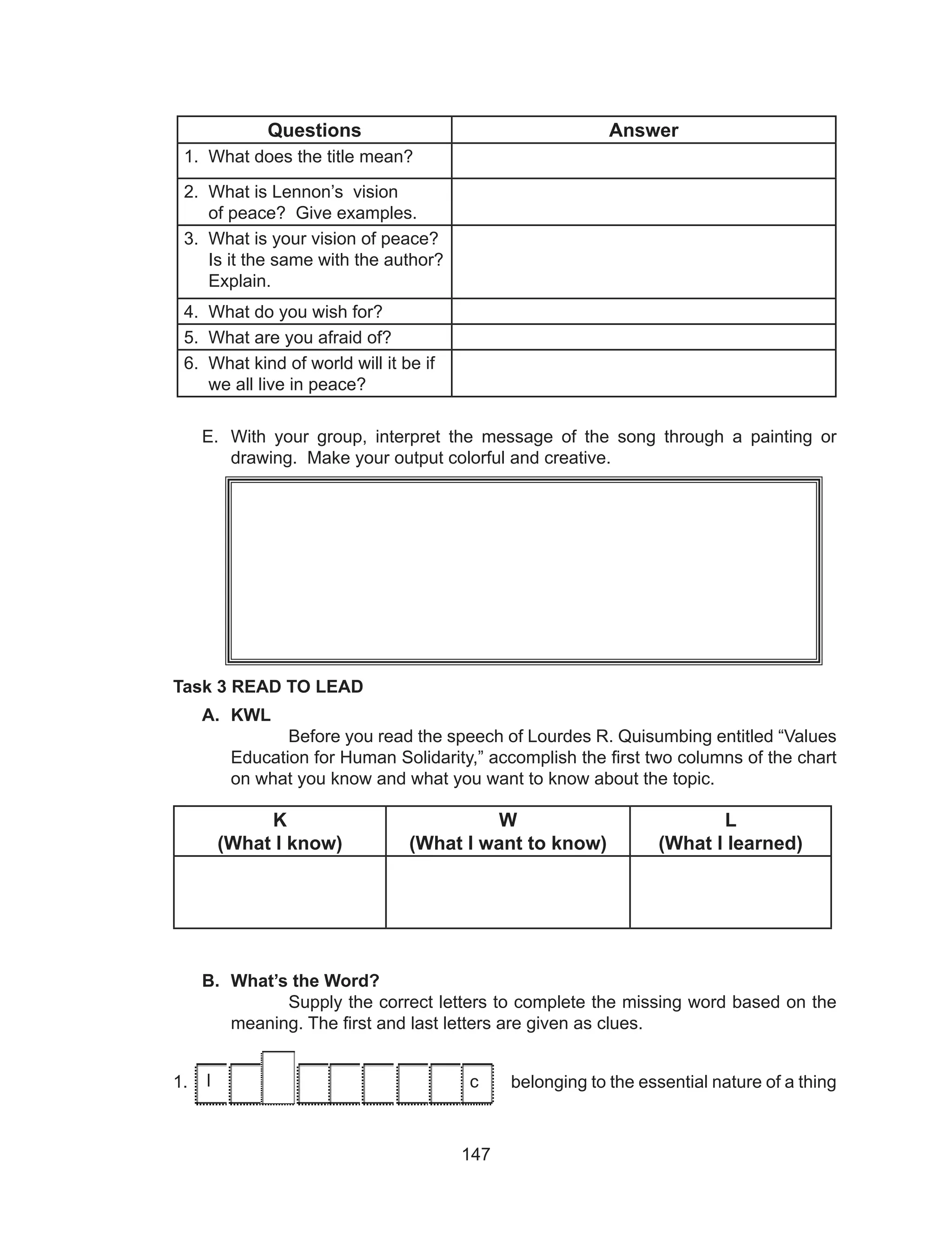
Questions Answer
1. What does the title mean?
2. What is Lennon’s vision
of peace? Give examples.
3. What is your vision of peace?
Is it the same with the author?
Explain.
4. What do you wish for?
5. What are you afraid of?
6. What kind of world will it be if
we all live in peace?
E.	 With your group, interpret the message of the song through a painting or
drawing. Make your output colorful and creative.
Task 3 READ TO LEAD
A.	 KWL
Before you read the speech of Lourdes R. Quisumbing entitled “Values
Education for Human Solidarity,” accomplish the first two columns of the chart
on what you know and what you want to know about the topic.
K
(What I know)
W
(What I want to know)
L
(What I learned)
B.	 What’s the Word?
Supply the correct letters to complete the missing word based on the
meaning. The first and last letters are given as clues.
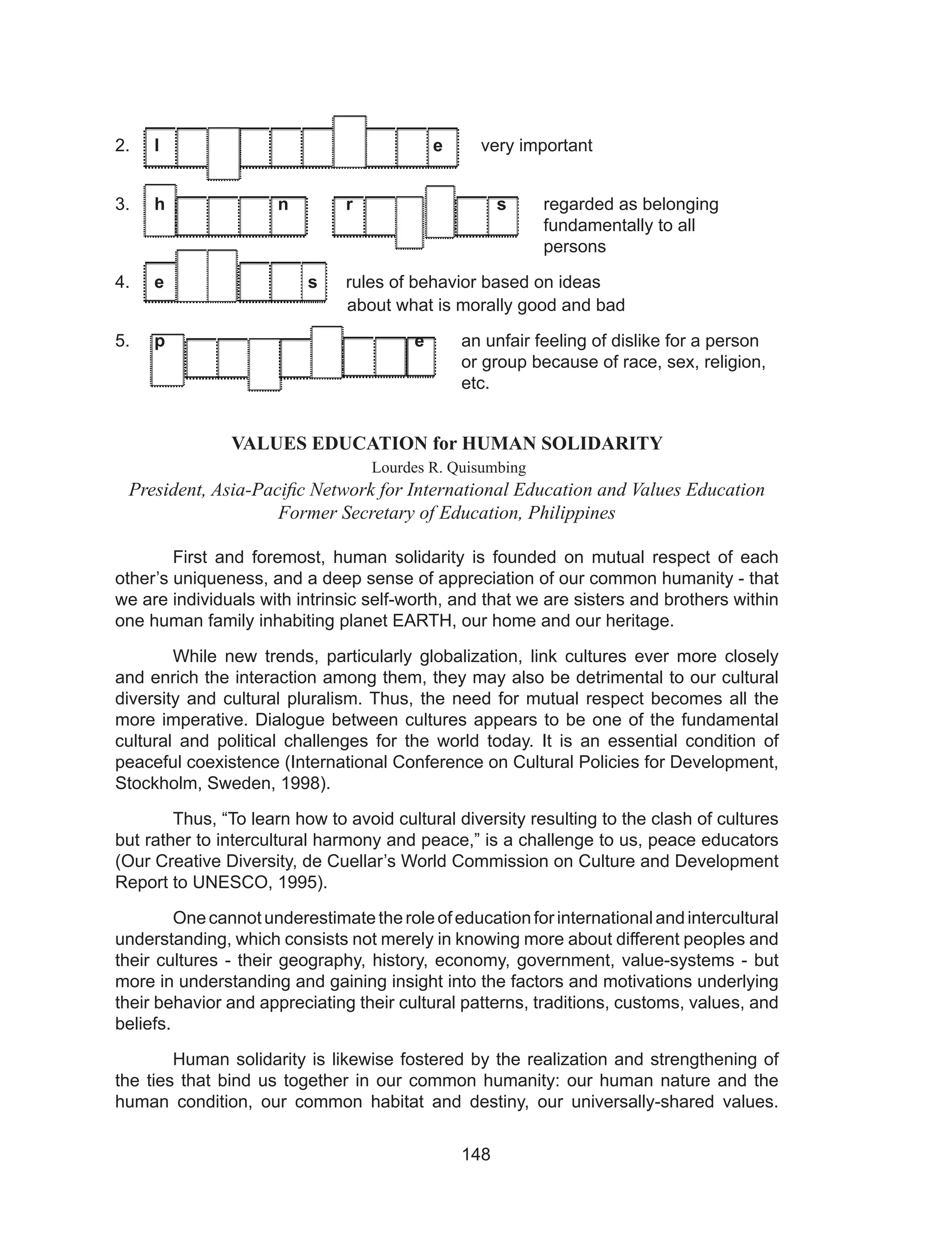
1. I 		 		 c belonging to the essential nature of a thingl c
148
2. I					 e	 very important
3. h n	 r	 s	 regarded as belonging		
							 fundamentally to all		
							 persons
4. e			 s	 rules of behavior based on ideas				
			 about what is morally good and bad
5. p				 e	 an unfair feeling of dislike for a person 	
						 or group because of race, sex, religion, 	
						etc.
VALUES EDUCATION for HUMAN SOLIDARITY
Lourdes R. Quisumbing
President, Asia-Pacific Network for International Education and Values Education
Former Secretary of Education, Philippines
	 First and foremost, human solidarity is founded on mutual respect of each
other’s uniqueness, and a deep sense of appreciation of our common humanity - that
we are individuals with intrinsic self-worth, and that we are sisters and brothers within
one human family inhabiting planet EARTH, our home and our heritage.
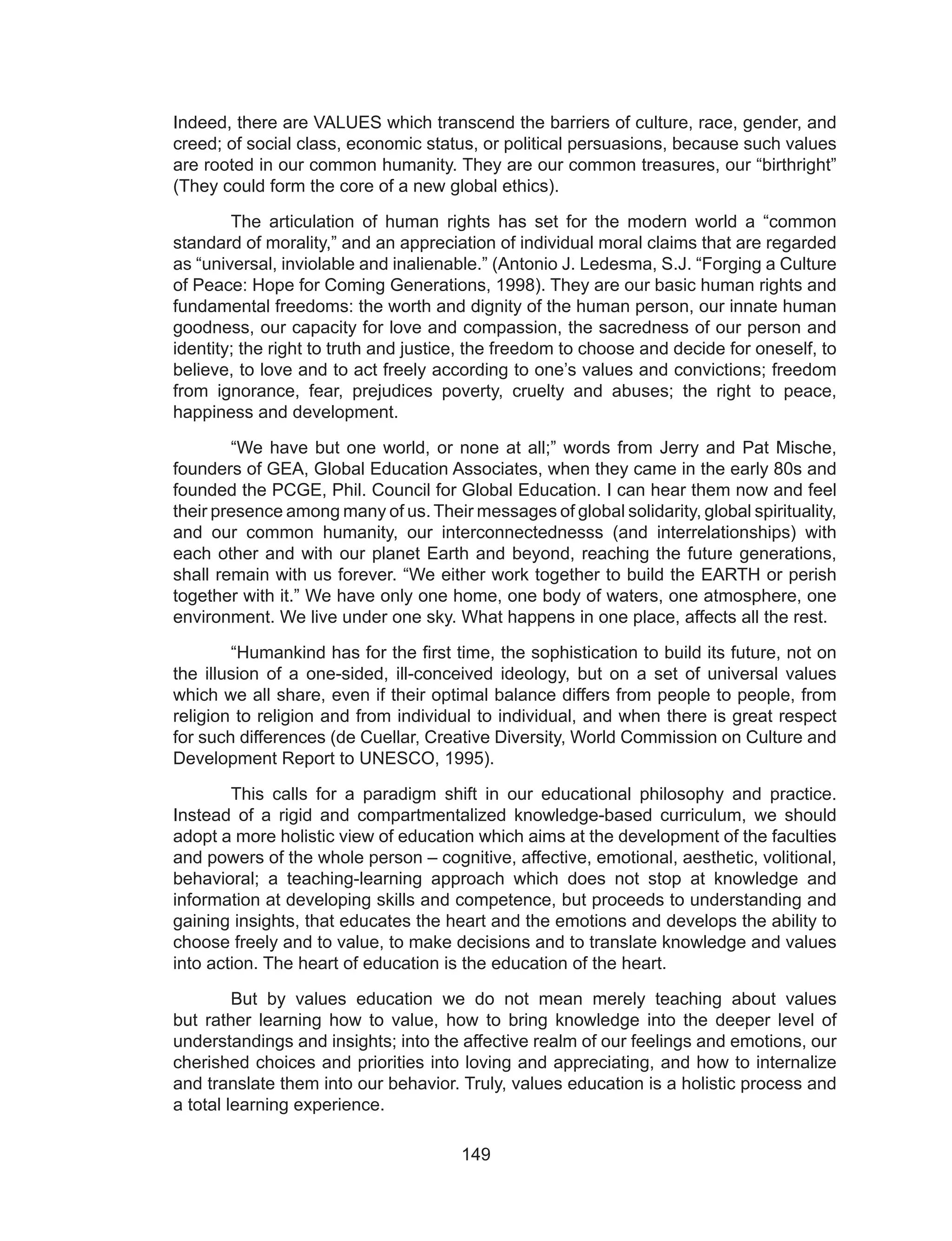
	 While new trends, particularly globalization, link cultures ever more closely
and enrich the interaction among them, they may also be detrimental to our cultural
diversity and cultural pluralism. Thus, the need for mutual respect becomes all the
more imperative. Dialogue between cultures appears to be one of the fundamental
cultural and political challenges for the world today. It is an essential condition of
peaceful coexistence (International Conference on Cultural Policies for Development,
Stockholm, Sweden, 1998).
	 Thus, “To learn how to avoid cultural diversity resulting to the clash of cultures
but rather to intercultural harmony and peace,” is a challenge to us, peace educators
(Our Creative Diversity, de Cuellar’s World Commission on Culture and Development
Report to UNESCO, 1995).
	 Onecannotunderestimatetheroleofeducationforinternationalandintercultural
understanding, which consists not merely in knowing more about different peoples and
their cultures - their geography, history, economy, government, value-systems - but
more in understanding and gaining insight into the factors and motivations underlying
their behavior and appreciating their cultural patterns, traditions, customs, values, and
beliefs.
	 Human solidarity is likewise fostered by the realization and strengthening of
the ties that bind us together in our common humanity: our human nature and the
human condition, our common habitat and destiny, our universally-shared values.
149
Indeed, there are VALUES which transcend the barriers of culture, race, gender, and
creed; of social class, economic status, or political persuasions, because such values
are rooted in our common humanity. They are our common treasures, our “birthright”
(They could form the core of a new global ethics).
	 The articulation of human rights has set for the modern world a “common
standard of morality,” and an appreciation of individual moral claims that are regarded
as “universal, inviolable and inalienable.” (Antonio J. Ledesma, S.J. “Forging a Culture
of Peace: Hope for Coming Generations, 1998). They are our basic human rights and
fundamental freedoms: the worth and dignity of the human person, our innate human
goodness, our capacity for love and compassion, the sacredness of our person and
identity; the right to truth and justice, the freedom to choose and decide for oneself, to
believe, to love and to act freely according to one’s values and convictions; freedom
from ignorance, fear, prejudices poverty, cruelty and abuses; the right to peace,
happiness and development.
	 “We have but one world, or none at all;” words from Jerry and Pat Mische,
founders of GEA, Global Education Associates, when they came in the early 80s and
founded the PCGE, Phil. Council for Global Education. I can hear them now and feel
their presence among many of us. Their messages of global solidarity, global spirituality,
and our common humanity, our interconnectednesss (and interrelationships) with
each other and with our planet Earth and beyond, reaching the future generations,
shall remain with us forever. “We either work together to build the EARTH or perish
together with it.” We have only one home, one body of waters, one atmosphere, one
environment. We live under one sky. What happens in one place, affects all the rest.
	 “Humankind has for the first time, the sophistication to build its future, not on
the illusion of a one-sided, ill-conceived ideology, but on a set of universal values
which we all share, even if their optimal balance differs from people to people, from
religion to religion and from individual to individual, and when there is great respect
for such differences (de Cuellar, Creative Diversity, World Commission on Culture and
Development Report to UNESCO, 1995).
	 This calls for a paradigm shift in our educational philosophy and practice.
Instead of a rigid and compartmentalized knowledge-based curriculum, we should
adopt a more holistic view of education which aims at the development of the faculties
and powers of the whole person – cognitive, affective, emotional, aesthetic, volitional,
behavioral; a teaching-learning approach which does not stop at knowledge and
information at developing skills and competence, but proceeds to understanding and
gaining insights, that educates the heart and the emotions and develops the ability to
choose freely and to value, to make decisions and to translate knowledge and values
into action. The heart of education is the education of the heart.
	 But by values education we do not mean merely teaching about values
but rather learning how to value, how to bring knowledge into the deeper level of
understandings and insights; into the affective realm of our feelings and emotions, our
cherished choices and priorities into loving and appreciating, and how to internalize
and translate them into our behavior. Truly, values education is a holistic process and
a total learning experience.
150
	 In closing, I wish to quote Jacques Delors speaking at the UN Conference on
Environment, Rio de Janeiro, 1992:
	 “The world is our village: if one house catches fire, the roofs over all our heads
are immediately at risk. If anyone of us tries to start rebuilding, his efforts will be purely
symbolic. Solidarity has to be the order of the day: each of us must bear his own share
of the general responsibility.” He continues to say: “We need a global ethics to guide us
in solving global issues, in strengthening our global interdependence and solidarity.”
	 The issues have been raised and the challenges presented in many a forum,
but our answers and our plans have yet to galvanize into a determined and collective
action. In the last analysis, it is not in knowing alone, but in valuing and caring deeply;
not in merely planning but in willing strongly TOGETHER that we can make things
happen.
http://www.humiliationstudies.org/documents/QuisumbingSolidarity.pdf
Accomplish the last column in the KWL chart. What did you learn after reading the
speech?
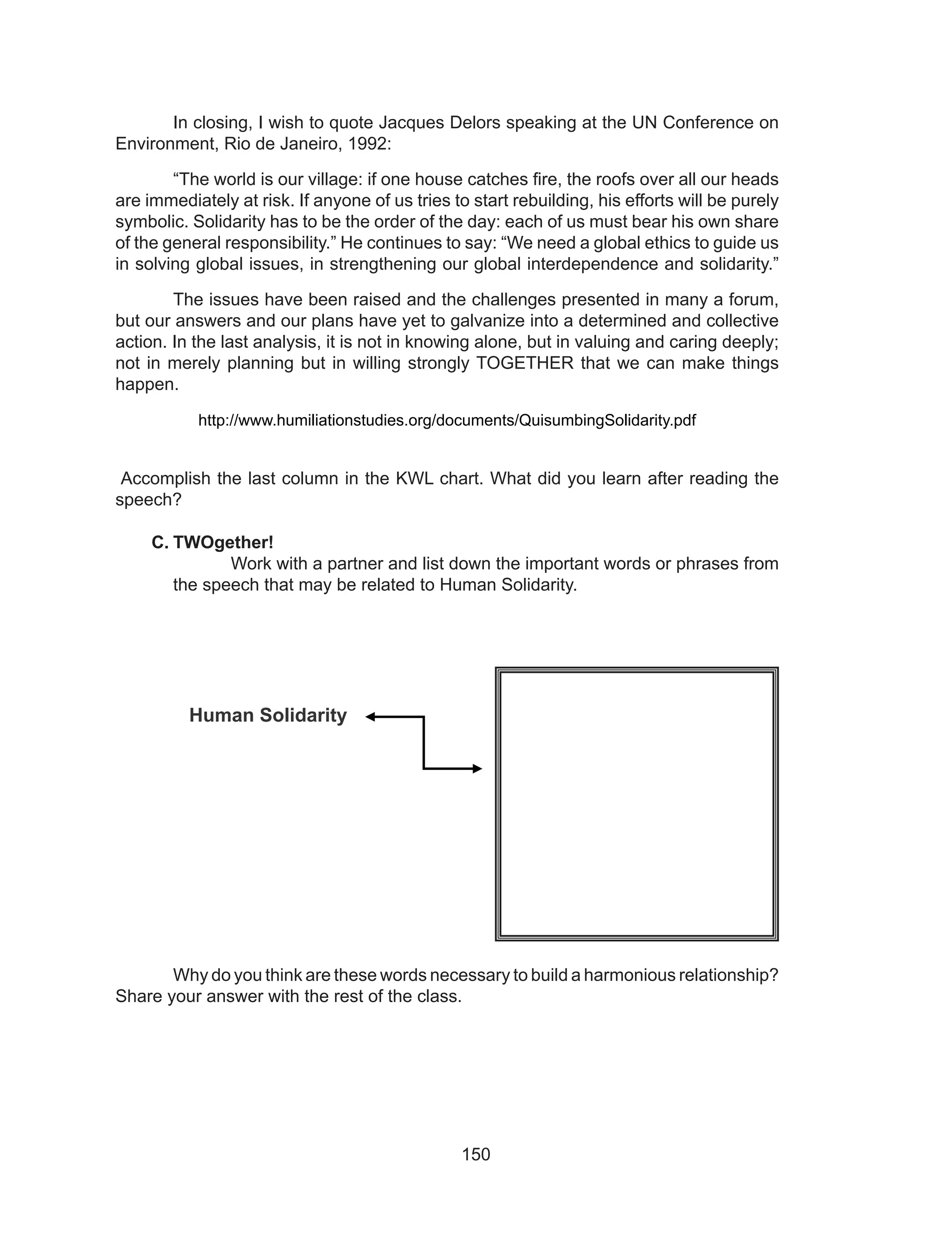
C.	TWOgether!
Work with a partner and list down the important words or phrases from
the speech that may be related to Human Solidarity.
	
	
	 Human Solidarity
	
	 Why do you think are these words necessary to build a harmonious relationship?
Share your answer with the rest of the class.
151
D.	 My Point of View
With your group, brainstorm and discuss about the important statements
included in the speech. Develop your chosen lines into a five-sentence
paragraph expressing your belief and disbelief of the statement. Deliver the
five-sentence paragraph by group with conviction.
Task 4 I WANT A PIZZA!
	 What values and qualities must people possess to attain harmony and
solidarity? Discuss with a partner and write these values on the slices of the pizza.
Explain to the rest of the class why you came up with such values.
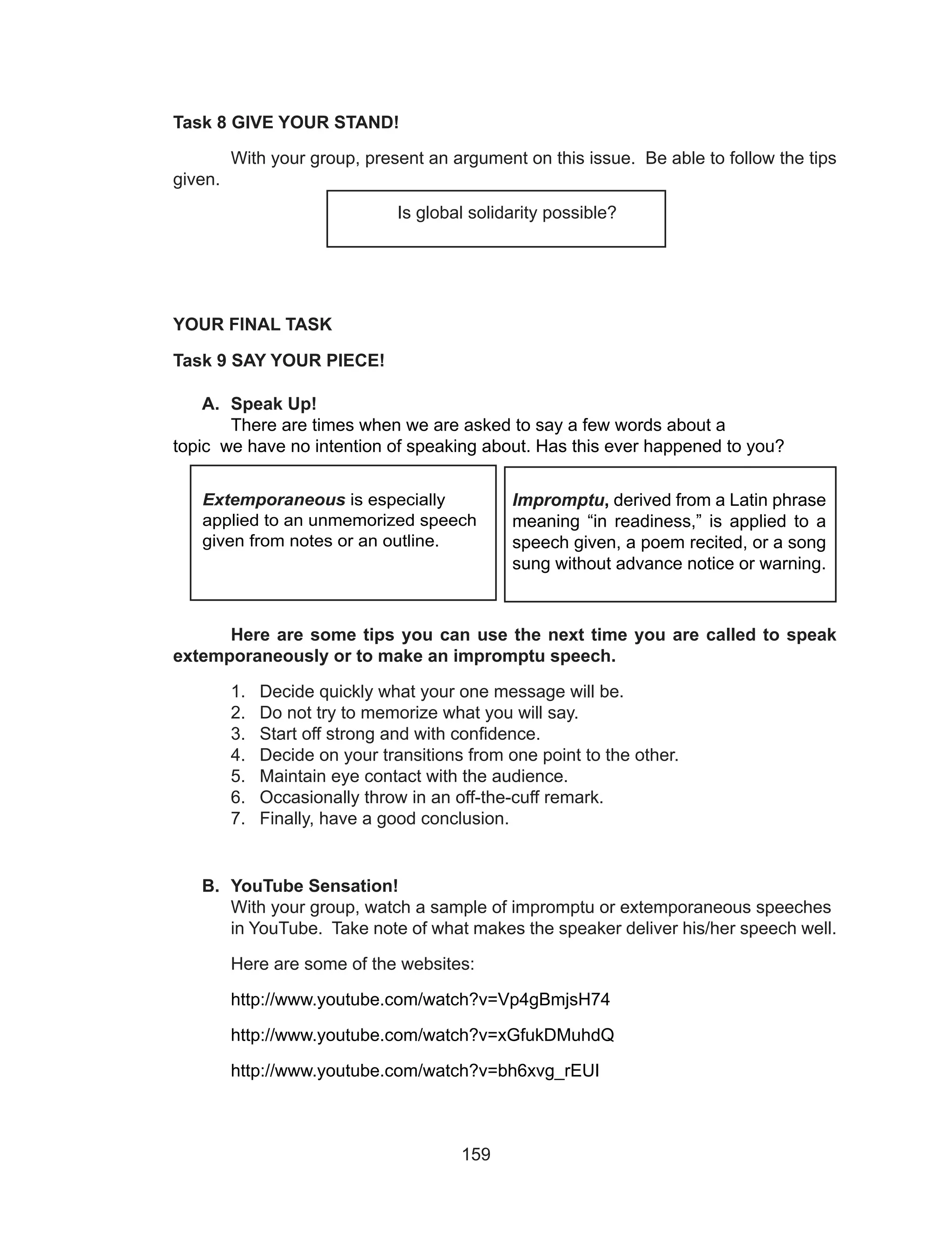
The world is our village.
TOGETHER we can
make things happen.
We have but one world
or none at all.
The heart of
education is the
education of the
heart.
152
YOUR TEXT
Task 5. R2 Read Roland
“The Song of Roland” is an epic poem and, as such, deals with the heroic deeds of
great men. It was written in the Medieval Period A. D. 450-1300
The Emperor Charlemagne, so the
900-year old French epic poem,
The Song of Roland, relates, has
driven the Saracens from Spain. It is
only in Saragosa that King Marsilion
still rules. He sends a message to
Charlemagne, falsely promising
that he will become a Christian if
only the Emperor will leave Spain.
But Charlemagne does not trust him
and decides an envoy must go to
the king. His valiant nephew Roland
offers to go, so does Roland’s friend
Oliver. Charlemagne refuses, so
Roland suggests his step-father,
Count Ganelon, who becomes
engaged and accuses Roland of
trying to bring out his death. But he
accepts the Emperor’s command
and prepares to go.
Ganelon decided that, as he had to go,
he would start at once. After he had
been given a letter by Charlemagne,
he girded on his sword, and mounted
his horse. His knights had been
saddened by his rage at the Court, for
they honoured him, and offered to go
with him. But he waved them away.
Count Ganelon rode furiously to
catch up with King Marsilion’s
messenger, Blancadrin, who had
left Charlemagne’s court before him.
When he found him, the two rode
along talking carefully to test out
each other’s loyalty.
“Your Emperor now has a vast
Empire. Why does he want
Spain as well?” asked Blancardin
when the two men are resting.
“Is he never satisfied?” “Never,”
answered Count Ganelon. “He is
ill-advised by the French, then?”
said Blancadrin cunningly, for
there was more of a question
than a statement in the manner
he spoke. There was silence for
a moment, then Ganelon replied.
“It is the Emperor’s nephew
Roland who gives him
advice,” said Ganelon bitterly.
“I remember a day when
Charlemagne was resting and
Roland arrived hot and dusty
from battle. Roland plucked an
apple and said to the Emperor:
“Take it, Sire. I give it you as I
give you all the crowns I have
taken from kings all over the
earth.”
153
As a result of their conversation,
the two men plotted how they
might be rid of Roland, for
Ganelon had convinced his
companion that if Roland were
dead, the French would desert
Charlemagne, who was now old
and feeble.
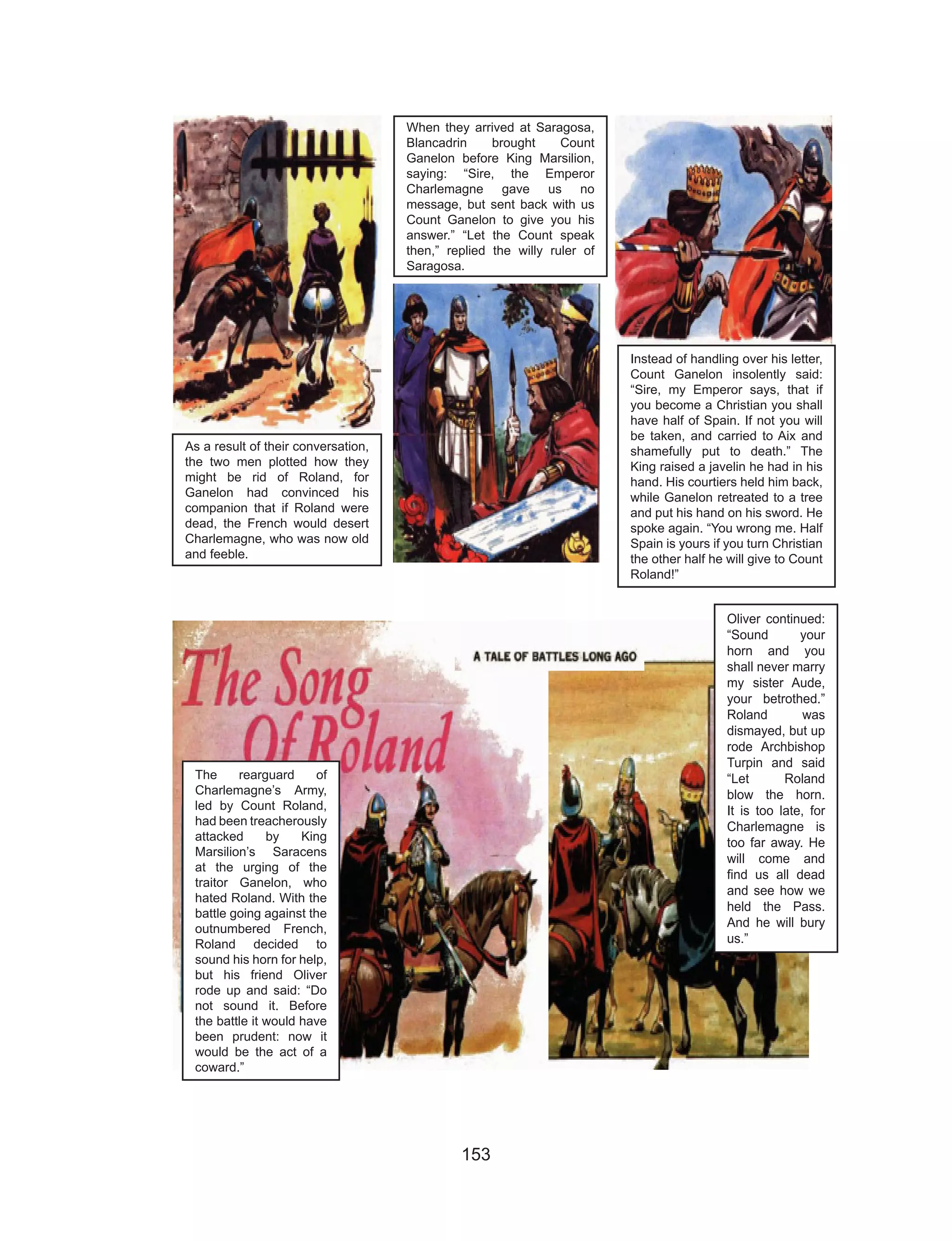
When they arrived at Saragosa,
Blancadrin brought Count
Ganelon before King Marsilion,
saying: “Sire, the Emperor
Charlemagne gave us no
message, but sent back with us
Count Ganelon to give you his
answer.” “Let the Count speak
then,” replied the willy ruler of
Saragosa.
Instead of handling over his letter,
Count Ganelon insolently said:
“Sire, my Emperor says, that if
you become a Christian you shall
have half of Spain. If not you will
be taken, and carried to Aix and
shamefully put to death.” The
King raised a javelin he had in his
hand. His courtiers held him back,
while Ganelon retreated to a tree
and put his hand on his sword. He
spoke again. “You wrong me. Half
Spain is yours if you turn Christian
the other half he will give to Count
Roland!”
The rearguard of
Charlemagne’s Army,
led by Count Roland,
had been treacherously
attacked by King
Marsilion’s Saracens
at the urging of the
traitor Ganelon, who
hated Roland. With the
battle going against the
outnumbered French,
Roland decided to
sound his horn for help,
but his friend Oliver
rode up and said: “Do
not sound it. Before
the battle it would have
been prudent: now it
would be the act of a
coward.”
Oliver continued:
“Sound your
horn and you
shall never marry
my sister Aude,
your betrothed.”
Roland was
dismayed, but up
rode Archbishop
Turpin and said
“Let Roland
blow the horn.
It is too late, for
Charlemagne is
too far away. He
will come and
find us all dead
and see how we
held the Pass.
And he will bury
us.”
154
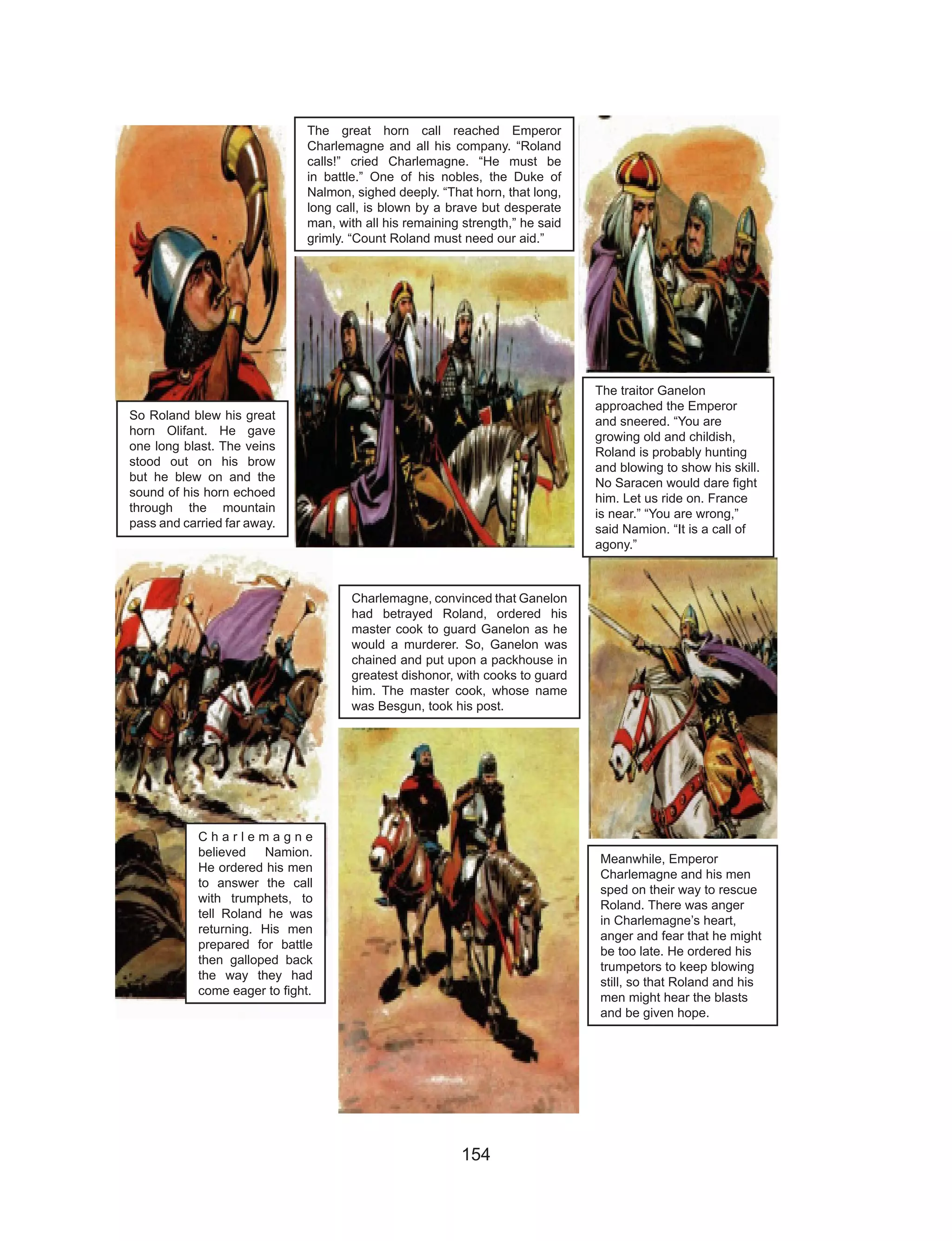
So Roland blew his great
horn Olifant. He gave
one long blast. The veins
stood out on his brow
but he blew on and the
sound of his horn echoed
through the mountain
pass and carried far away.
The great horn call reached Emperor
Charlemagne and all his company. “Roland
calls!” cried Charlemagne. “He must be
in battle.” One of his nobles, the Duke of
Nalmon, sighed deeply. “That horn, that long,
long call, is blown by a brave but desperate
man, with all his remaining strength,” he said
grimly. “Count Roland must need our aid.”
The traitor Ganelon
approached the Emperor
and sneered. “You are
growing old and childish,
Roland is probably hunting
and blowing to show his skill.
No Saracen would dare fight
him. Let us ride on. France
is near.” “You are wrong,”
said Namion. “It is a call of
agony.”
C h a r l e m a g n e
believed Namion.
He ordered his men
to answer the call
with trumphets, to
tell Roland he was
returning. His men
prepared for battle
then galloped back
the way they had
come eager to fight.
Charlemagne, convinced that Ganelon
had betrayed Roland, ordered his
master cook to guard Ganelon as he
would a murderer. So, Ganelon was
chained and put upon a packhouse in
greatest dishonor, with cooks to guard
him. The master cook, whose name
was Besgun, took his post.
Meanwhile, Emperor
Charlemagne and his men
sped on their way to rescue
Roland. There was anger
in Charlemagne’s heart,
anger and fear that he might
be too late. He ordered his
trumpetors to keep blowing
still, so that Roland and his
men might hear the blasts
and be given hope.
155
Count Roland was the last man
left alive of all the valiant French
who had held the pass against
the Saracens. Soon the Emperor
Charlemagne and the rest of the
army would return, summoned by
a mighty blast on Roland’s horn,
but it would be too late. All they
could do would be to bury the dead
and mourn them and see that the
traitor Ganelon was punished, for it
was he who had betrayed Roland
and his men to King Marsilion and
his Saracen hosts.
Roland had thought himself alone
on the battlefield, but suddenly some
Saracens rushed by, and one he
thought dead, rose up and tried to
steal his sword. He felled him with his
horn, smashing the rim.
Now Roland’s strength was at
an end. He tried to shatter his
great sword on a rock so that
no-one else should use it, but
failed. Falling down, he raised
his battle glove to heaven and
prayed. Then he fell back dead.
Too late the Emperor
arrives on the
battlefield. The
Saracens had fled, but
not one Frenchman
was left alive. While
Charlemagne stood in
proud grief, his fighting
men gathered around
him, eager to avenge
Roland.
“Look, my Lord,” cried Duke
Damion, one of his nobles.
“Beyond, there is a cloud of dust
where the Saracens are flying. Let
us ride them down, showing them
no mercy.” Charlemagne rode on.
156
http://bearalley.blogspot.com/2011/03/song-of-roland-part-3.html
Task 6 UNDERSTANDING THE SONG OF ROLAND
A.	 Describe the following characters in the epic.
		Roland		 Charlemagne		Ganelon
B.	 Answer the following questions and discuss with a partner.
1.	 What are the characteristics of the ideal knight according to “The Song of
Roland”?
2.	 Why was Ganelon very angry at Roland?
3.	 How do you feel about King Charlemagne? Is he a wise king? Explain.
	
Back in his palace,
Marsilion lay dying, with
his weeping queen beside
him. Behind her were
some of those warriors
who had attacked the
French, but failed to
vanquish them. Outside
were the broken Saracen
survivors.
Charlemagne arrived in triumph, but treated
Marsilion’s widow with great courtesy. Then
he returned to France where Ganelon
was tried. By law, if Ganelon could find a
champion who could defeat any challenger
in single combat, he would be spared. One
Pinabel agreed to help the traitor.
Count Thierry, a friend of
Roland’s, challenged Pinabel
and felled him with his lance.
So Ganelon paid the penalty for
his crimes. Then Charlemagne
set off for the wars again,
but without Roland, who now
belonged to legend and song.
157
4.	 How do you feel about Roland? Why does he not sound the Olifant to call
King Charlemagne’s army for help at the very beginning?Why do you think
so?
5.	 What causes the death of Roland?
C.	 Reader’s Response
	
	 Think of a time when you, like Roland, were reluctant to ask for help
as he was during the attack. What part did pride play in your hesitancy? Did
you now regret not turning to someone for help?
	 Share this experience with your group.
Task 7 Understanding the Theme
The theme of a work of literature is the insight it gives into life. “The Song of
Roland” may be considered an epic which deals with the theme of betrayal. Within
the confines of medieval society, betrayal of one’s lord or vassal was considered
the greatest violation of the feudal code.
With your group, think of a situation when betrayal happens in our society.
Then discuss with your group the best solution for this, emphasizing how to build ties.
Present this through a short dramatization.
				Rubrics
Message------------------ 40%
Acting --------------------- 30%
Dialogue ----------------- 20%
Teamwork --------------- 10%
				_______
				 	 100%
YOUR DISCOVERY TASK
	 Have you experienced presenting an argument? Was it successful?
	 Here are some techniques on how to develop your argument.
Developing an Argument
	 When you develop your argument, you are confirming your own position and
building your case. Use empirical evidence, such as facts and statistics to support
your claims. Appeal to your audience’s rational and logical thinking. Argue using your
evidence and research.
	 Your list of strengths and weaknesses can help you develop your argument.
158
Techniques on Appealing to Your Readers
	 The success of your argument depends on your skill in convincing your reader
through sound reasoning, persuasion, and evidence. There are three fundamental
types of appeal in presenting an argument: reason, ethics, and emotion.
Write Your Conclusion
	 Your conclusion should state your conviction strongly. Review your main points
and tell your audience what action you would like them to take; address and resolve
the main points in your introduction.
Basic Components of an Argument
•	 The claim (typically answers the question: “What do I think?”)
•	 The reasons (typically answer the question: “Why do I think so?”)
•	 The evidence (typically answers the question: “How do I know this is the
case?”)
Suggested Organization for a Classic Argument
1.	 Introduction: Give the context and background of your issue. Establish
the style, tone, and significance of your issue.
2.	 State Your Case: Clarify your issue here. Give any necessary
background for understanding the issues. Define important terms or
conditions here.
3.	 Proposition: State your central proposition. Be sure that your hook
presents an issue that is open to debate. Present the subtopics or
supportive points to forecast your argument for your reader.
4.	 Refutation: Analyze the opposition’s argument and summarize it; refute
or address the points; point out faulty reasoning and inappropriate
appeals.
5.	 Substantiation and Proof: Present and develop your own case.
Carefully plan your disclosure; avoid logical fallacies. Rely primarily
on reasoning for your appeal and use emotional appeals carefully; use
examples, facts, experts, and statistics. Develop your argument using
the appropriate prose strategy, e.g., causal analysis, comparison,
analogies, or definitions.
6.	 Conclusion: Conclude with conviction. Review your main points and
state your claims strongly. Make a strong plea for action, or invite your
readers to refute your argument.
http://www.umuc.edu/writingcenter/onlineguide/chapter8-09.cfm
159
Task 8 GIVE YOUR STAND!
	 With your group, present an argument on this issue. Be able to follow the tips
given.
YOUR FINAL TASK
Task 9 SAY YOUR PIECE!
A.	 Speak Up!
	 There are times when we are asked to say a few words about a 		
topic we have no intention of speaking about. Has this ever happened to you?
	
							
	 Here are some tips you can use the next time you are called to speak
extemporaneously or to make an impromptu speech.
1.	 Decide quickly what your one message will be.
2.	 Do not try to memorize what you will say.
3.	 Start off strong and with confidence. 
4.	 Decide on your transitions from one point to the other. 
5.	 Maintain eye contact with the audience.
6.	 Occasionally throw in an off-the-cuff remark. 
7.	 Finally, have a good conclusion.
B.	 YouTube Sensation!
	 With your group, watch a sample of impromptu or extemporaneous speeches 	
	 in YouTube. Take note of what makes the speaker deliver his/her speech well.
	 Here are some of the websites:
	 http://www.youtube.com/watch?v=Vp4gBmjsH74
	 http://www.youtube.com/watch?v=xGfukDMuhdQ
	 http://www.youtube.com/watch?v=bh6xvg_rEUI
				
Impromptu, derived from a Latin phrase
meaning “in readiness,” is applied to a
speech given, a poem recited, or a song
sung without advance notice or warning.
Extemporaneous is especially
applied to an unmemorized speech
given from notes or an outline.
Is global solidarity possible?
160
Below is a checklist for a well-delivered speech. Check YES if you observed it in the
video and NO if not.
OBSERVATION YES NO
1. The speaker showed confidence.
2. The speaker maintained good posture and eye contact.
3. The speaker conveyed his/her ideas well.
4. The speaker gave an interesting introduction.
5. The speaker gave a good conclusion.
6. The speaker used facial expressions and proper gestures.
7. The speaker had good pronunciation and maintained a well-
modulated voice.
C. Stand and Deliver!
Choose one quote given by famous authors and deliver a five-minute extemporaneous
speech. Follow the tips given to deliver your speech successfully.
“Let’s create an integrated global
community where we have shared
benefits and responsibilities and we
don’t fight because of our differences.”
- Bill Clinton
“When we have inner peace, we can be
at peace with those around us. When our
community is in a state of peace, it can share
that peace with neighboring communities.” 
- The Dalai Lama
“We have all known the long loneliness and
we have learned that the only solution is
love and that love comes with community.” 
- Dorothy Day
161
“With all my heart I believe that the world’s
present system of sovereign nations can
only lead to barbarism, war and inhumanity,
and that only world law can assure progress
towards a civilized peaceful community.” 
- Albert Einstein
http://www.betterworld.net/quotes/community-quotes.htm
Extemporaneous Evaluation Rubrics
Fair
(1 point)
Good
(2 points)
Very Good
(3 points)
Excellent
(4 points)
Points
Topic Topic is too
challenging
or too easy
for speaker’s
age and skill
level.
Topic could
be more
challenging
for speaker’s
age and skill
level.
Topic is
appropriate for
speaker’s age
and skill level.
Topic is
challenging
for speaker’s
age and skill
level.
Subject
Knowledge
and
Coverage
Not enough
information
is presented
to judge
speaker’s
knowledge.
Adequate
knowledge
of subject is
demonstrated.
In-depth
knowledge
of subject is
demonstrated.
.
Full subject
knowledge
(more than
required).
Organization Speech is
unorganized.
Speech
follows
a logical
progression.
Speech shows
skill and
creativity in
organization.
Speech
shows
a strong
structure and
structure
enhances
effect of
speech.
162
Voice Volume,
pronunciation,
or vocal
variation
needs
improvement.
Voice and
language are
adequate for
the delivery of
the speech.
Voice and
language are
skillful and
effective.
Volume,
tone, timing,
inflection,
and
language
are used
to enhance
speech.
Manner and
Appearance
Appearance,
body
language,
or gestures
need
improvement.
Appearance
and
mannerisms
are
appropriate.
Appearance
and
mannerisms
are presented
with business
like conduct
and style.
Appearance
and
mannerisms
are
presented
with a
professional
demeanor
and personal
style.
Closing Closing is
missing or
unclear.
Closing is
clear and
organized.
Closing is
well-organized
and effective.
Closing is
creative and
contributes
to a unified
and cohesive
presentation.
Effectiveness More practice
is needed
to maintain
audience
interest.
Audience
interest is
maintained.
Effort is shown
to enhance
audience
interest and
involvement.
Multiple
techniques
are used to
artfully and
successfully
create
audience
interest.
https://www.google.com.ph/webhp?source=search_app&gfe_
rd=cr&ei=v6W6U768O8zLkAXRhIDACQ&gws_rd=ssl#q=impromptu+evaluation+rubric
Comments: ___________________________
_____________________________________
_____________________________________
_____________________________________
_____________________________________
_____________________________________
Scoring: Total Points:_______
18-28 Points – Gold
11-17 Points – Blue
Below 10 Points - Red
18 points minimum to advance to
next level / competition
163
MY TREASURE
				Underneath We’re All the Same
He prayed--it wasn’t my religion.
He ate--it wasn’t what I ate.
He spoke--it wasn’t my language.
He dressed--it wasn’t what I wore.
He took my hand--it wasn’t the color of mine.
But when he laughed--it was how I laughed, and 	
				 When he cried--it was how I cried.
	 					 	 Amy Maddox, I6 years old		
							 Franklin Community H.S. 		
						 Spring. 1995
We can learn to see each other and see ourselves in each other and
recognize that human beings are more alike than we are unalike. 		
								– Maya Angelou
Make a pledge by completing the statement below.
My Resolution
In the past, I have been intolerant of other people’s						
___________________________________________________________________
___________________________________________________________________
___________________________________________________________________
___________________________________________________________________
___________________________________________________________________
Now that I have learned the value of tolerance, I will become				
___________________________________________________________________
___________________________________________________________________
___________________________________________________________________
___________________________________________________________________
___________________________________________________________________
164
Module 2
LESSON 3
______________________________________________________________
YOUR JOURNEY
“We cannot be more sensitive to pleasure without being more sensitive to pain.”		
								– Alan Watts
	 Being sensitive to others means
understanding their joy, their pain, their situation,
and where they are coming from. The test of our
sensitivity then is when we understand other people
without bias or prejudice. Let the activities here help
you develop a caring attitude for others.
	 This week’s lesson tells about one man’s
undying devotion to his muse and other historical
trivia during the age of rebirth – the Renaissance.
Our featured literary piece is a poem rich in poetic
elements. You will also get the chance to understand more about bias that thrives in
our society. Using correct grammar in making definitions and acknowledging citations
in preparing a bibliography will help you effectively deliver an impromptu speech at the
end of the lesson.
YOUR OBJECTIVES
	 For this lesson, here are the objectives to help you as you go through the
different activities.
•	 scan for needed information
•	 evaluate listening texts in terms of accuracy, validity, adequacy, and relevance
•	 detect bias and prejudice in the material viewed
•	 give technical and operational definitions
•	 explain how the elements specific to a genre contribute to the theme of a
particular literary selection
•	 explain the literary devices used
•	 use the correct sound of English when delivering impromptu speech
•	 use words and expressions that affirm or negate
•	 acknowledge citations by preparing a bibliography
Being Sensitive to Others
165
YOUR INITIAL TASKS
	 Let’s begin your lesson by working on the activities provided here.
Task 1 PICTURES TALK
	 Look at the photos below. What do they reveal about men, women, and
children? Write your answers in your notebook.
						
				A.


					B.


					C.
1.	 With your partner, describe each picture. What do they reveal about men
and women?
2.	 Should women always be pictured as doing household chores and men as
warriors? Why?
Task 2 MIND YOUR WORD
	 Find out the message conveyed by the comic strip and be ready to share your
ideas in class.
166
Discussion Points:
1.	 What is the character in the comic strip prejudiced/biased for? against?
2.	 What could be the reason for the prejudice/bias?
3.	 Is it right to have prejudices or biases?
4.	 Can you think of words that you could associate with prejudice/bias? Write
them in the word web below.
Task 3 WATCH THAT LABEL
A.	 Here’s a video featuring a Filipina actress who claims that it’s not right to put a
label on anyone. Watch it and find out the label attached to her.
	 www.youtube.com/watch?v=xYsvcKfq8E
1.	 What is the “label” attached to the woman in the video?
2.	 Do you agree with what the woman said? Why?
3.	 When you put a “label” on someone, are you also being biased? Explain.
4.	 What advice would you give to the woman in the video?
5.	 What comments do you hear from other people about women in the same
situation as the actress? How should you react to them?
B.	 Have you heard and seen examples of bias around you? Fill out the table
below for more examples of bias and prejudice you have experienced around
you. Work on it with your partner. In the second column, write examples of
advertisements and in the last column, write the bias found in each example.
Examples Biased on…
Advertisements
C.	 Can biases be avoided? How?							
_____________________________________________________________
_____________________________________________________________
_____________________________________________________________
Prejudice Bias
167
Task 4 BIAS DETECTIVES
	Source: http://www.sadker.org/curricularbias.html
According to a group of researchers there are Seven Forms of Bias in Instructional
Materials.They are as follows:
1. Invisibility: What You Don’t See Makes a Lasting Impression
	
	 The most fundamental and oldest form of bias in instructional materials is the
complete or relative exclusion of a group. With an attempt for inclusion after 1960,
many of today’s textbooks are improved, but far from perfect. Women, those with
disabilities, gays, and homosexuals continue to be missing from many of today’s texts.
2. Stereotyping: Shortcuts to Bigotry
	 Perhaps the most familiar form of bias is the stereotype, which assigns a rigid
set of characteristics to all members of a group, at the cost of individual attributes and
differences. While stereotypes can be positive, they are more often negative. Some
typical stereotypes include: Men portrayed as assertive and successful in their jobs,
but rarely discussed as husbands or fathers. Women as caregivers.
3. Imbalance and Selectivity: A Tale Half Told
	 Curriculum may perpetuate bias by presenting only one interpretation of an
issue, situation, or group of people. Such accounts simplify and distort complex issues
by omitting different perspectives.
	 A text reports that women were “given” the vote, but does not discuss the work,
sacrifices, and even physical abuse suffered by the leaders of the suffrage movement
that “won” the vote. Literature is drawn primarily from western, male authors. Math and
Science courses typically reference European discoveries and formulas.
4. Unreality: Rose Colored Glasses
	
	 Many researchers have noted the tendency of instructional materials to gloss
over unpleasant facts and events in our history. Another example is the notion that
technology will resolve persistent social problems.
5. Fragmentation and Isolation: The Parts Are Less than the Whole
	 Fragmentation emerges when a group is physically or visually isolated in the
text. Often, racial and ethnic group members are depicted as interacting only with
persons like themselves, isolated from other cultural communities. While this form of
bias may be less damaging than omission or stereotypes, fragmentation and isolation
present non-dominant groups as peripheral members of society.
168
6. Linguistic Bias: Words Count
	 Language can be a powerful conveyor of bias, in both blatant and subtle forms.
Linguistic bias can impact race/ethnicity, gender, accents, age, (dis)ability, and sexual
orientation. Such words as forefathers, mankind, and businessman serve to deny the
contributions (even the existence) of females.
7. Cosmetic Bias: “Shiny” covers
	 The relatively new cosmetic bias suggests that a text is bias free, but beyond the
attractive covers, photos, or posters, bias persists. An example is a science textbook
that features a glossy pullout of female scientists but includes precious little narrative
of the scientific contributions of women.
	 Pretend that you are a group of detectives. Using the seven forms of bias
discussed here, review your school’s English reference books/textbooks and identify
if it has any of those forms of biases. Write the title of the book and put a check mark
on the form of bias you have discovered in the book(s).
Title
of the
Book
Invisibility
Stereo-
typing
Selectivity Unreality Fragmentation
Linguistic
Bias
Cosmetic
Bias
169
This time, suggest ways on how to avoid these biases in your English textbook.
_____________________________________________________________
_____________________________________________________________
____________________________________________________________
YOUR TEXT
Task 5 LOVE IS EVERYWHERE
A.	 Being sensitive to others is one way of showing love and concern. Whose
love story do you consider special and worth emulating? Here are photos from
some romantic films. Match the description of the characters in the movie to
the photos.
	
	 Danielle, the only daughter of a
deceased French nobleman, is made a
servant by her stepmother. She also has two
stepsisters, one quite kind but the other one
really terrible. Still, Danielle grows up to be a
happy and strong-willed young lady, and one
day her path crosses that of handsome Prince
Henry, who has fallen in love with her. Despite
some troubles, Danielle and the Prince end up
together with the help of the nice Leonardo da
Vinci.
	 Rebellious high school student Landon
Carter is threatened with expulsion unless he
performs in the drama club’s spring musical. At
this function, he is forced to interact with quiet
Jamie Sullivan who has helped him with his
lines. During the play, Jamie surprises Landon
and the entire audience with her beauty and
voice. While their friendship and admiration for
each other grows deeper, Jamie’s cancer gets
worse.
	 In 1912 Southampton, 17-year-old first-
class passenger Rose DeWitt Bukater who is
engaged to be married against her will plans to
jump off the ship. Jack Dawson, a penniless
artist, convinces her not to. This incident
started their friendship which later on develops
into a romantic love affair.
170


B. Can you name other movies that speak of great love?
Girls, in the future when a man courts you, how would you want him to do it?
Boys, how do you plan to win the heart of your ladylove someday?
•	 List down what you dream of in a courtship.
_____________________________________________________________
_____________________________________________________________
_____________________________________________________________
•	 Read about the courtship during the middle-ages. Compare it with your “ideal”
courtship.
Chivalry and Romantic Ideals (Middle Ages, 1100-1500)
	 The knights and troubadours (traveling poets and musicians) of medieval times
opened doors, pulled out chairs, and let their ladyloves order first. These men knew
their ladies wants and desires, it always came first and foremost in love; winning ladies’
hearts was their ultimate goal.
	 Wealthy knights won women’s hands through brave deeds, while the poets won
them over through their use of words and songs. These ideas were inspired by “courtly
love,” which was a highly idealized and extravagant forbidden affair (mostly among
the noble class) whose core beliefs were the superiority of the lady, the instability of
desire, and the ennobling power of love.
See more at: http://www.match.com/magazine/article/12357/#sthash.GSRJcl6o.dpuf
•	 When one is in love, one has the tendency to be biased. Name an incident
when you did something in the name of love.
_____________________________________________________________
_____________________________________________________________
		 Love has been around us from the very beginning. During the 14th century,
an Italian poet named Francesco Petrarch celebrated his love for his forever muse-
Laura through a collection of poems called “Canzoniere.” The English called him the
greatest Italian poet of the 14th century by setting a pattern for lyric poetry.
	 This was also the time when people were starting to reconnect their
relationship with God and other men and women brought about by the rediscovery
of the classics. This period is called the Rebirth or the Renaissance.
171
•	 Here are poems from Petrarch’s Canzoniere. Read enjoy the rhyme and
rhythm, and discover the message of each poem.
•	 Before you start reading, think about this: How would you describe someone
you are passionately in love with?
LAURA
Translated by Morris Bishop
She used to let her golden hair fly free
For the wind to toy and tangle and molest;
Her eyes were brighter than the radiant west.
(Seldom they shine so now.) I used to see
Pity look out of those deep eyes on me.
(“It was false pity,” you would now protest)
I had love’s tinder heaped within my breast;
What wonder that the flame burned furiously?
She did not walk in any mortal way,
But with angelic progress; when she spoke,
Unearthly voices sang in unison.
She seemed divine among the dreary folk
Of earth. You say she is not so today?
Well, though the bow’s unbent, the wound bleeds on.
The White Doe
Translated by Anna Maria Armi
			 A pure-white doe in an emerald glade
			 Appeared to me, with two antlers of gold,
			 Between two streams, under a laurel’s shade,
172
			 At sunrise, in the season’s bitter cold.
			 Her sight was so suavely merciless
			 That I left work to follow her at leisure,
			 Like the miser who looking for his treasure
			 Sweetens with that delight his bitterness.
			 Around her lovely neck “Do not touch me,”
			Was written with topaz and diamond stone,
			 “My Caesar’s will has been to make me free.”
			 Already toward noon had climbed the sun,
			 My weary eyes were not sated to see,
			 When I fell in the stream and she was gone.
Spring
Translated by Morris Bishop
			Zephyr returns, and scatters everywhere
			 New flowers and grass, and company does bring,
			Procne and Philomel, in sweet despair,
			 And all the tender colors of the Spring.
			 Never were fields so glad, nor skies so fair,
			And Jove exults in Venus prospering.
			 Love is in all the water, earth and air,
			 And love possesses every living thing.
173
			 But to me only heavy sighs return
			 For her who carried in her little hand
			 My heart’s key to her heavenly sojourn,
			 The birds sing loud above the flowering land;
			 Ladies are gracious now – Where deserts burn
			 The beasts still prowl on the ungreening sand.
Task 6 THINK ABOUT THE POEMS
	 In your group, answer the questions about the three poems.
Laura
1.	 In the poem “Laura,” how was Laura described by the speaker?
2.	 In Laura’s “present and past,” what are the common details the speaker
remembers about Laura?
3.	 How does Laura seem to have changed?
4.	 Though years passed,what aspects in the poem “Laura” remain
unchanged?
The White Doe
1.	 What details in the “The White Doe” tell about time and season?
2.	 What is a doe?
3.	 How is the doe described in the poem?
4.	 To whom is the “white doe” compared in the poem?
5.	 What emotion does the last stanza evoke in you?
Spring
1.	 “Spring” is written after Laura’s death. What does the speaker emphasize
about the spring?
2.	 What makes the speaker describe differently the springtime scene?
3.	 What does the ending of the poem reveal about the speaker?
4.	 Who is referred to in the three poems?
5.	 Petrarch was a fourteenth-century writer. In his poems, what are the
situations or feelings that you could relate to? On the other hand, in
what ways are the situations or feelings in the poem outdated?
174
Task 7 FIGURE OUT THE MEANING
	 Understand the poem better by analyzing the language of poetry. Think about
the answers to the following questions first. Then, with a partner, discuss your answers
before sharing it with the whole group.
1.	 What image/s did Petrarch use to compare Laura?
2.	 How did Petrarch describe his feelings when Laura died?
3.	 What kind of language is used by poets and writers in describing persons
or their feelings dramatically?
4.	 What is the meaning and effect of the following lines found in the poems:
“sweet despair” (Spring) and “suavely merciless” (The White Doe). In
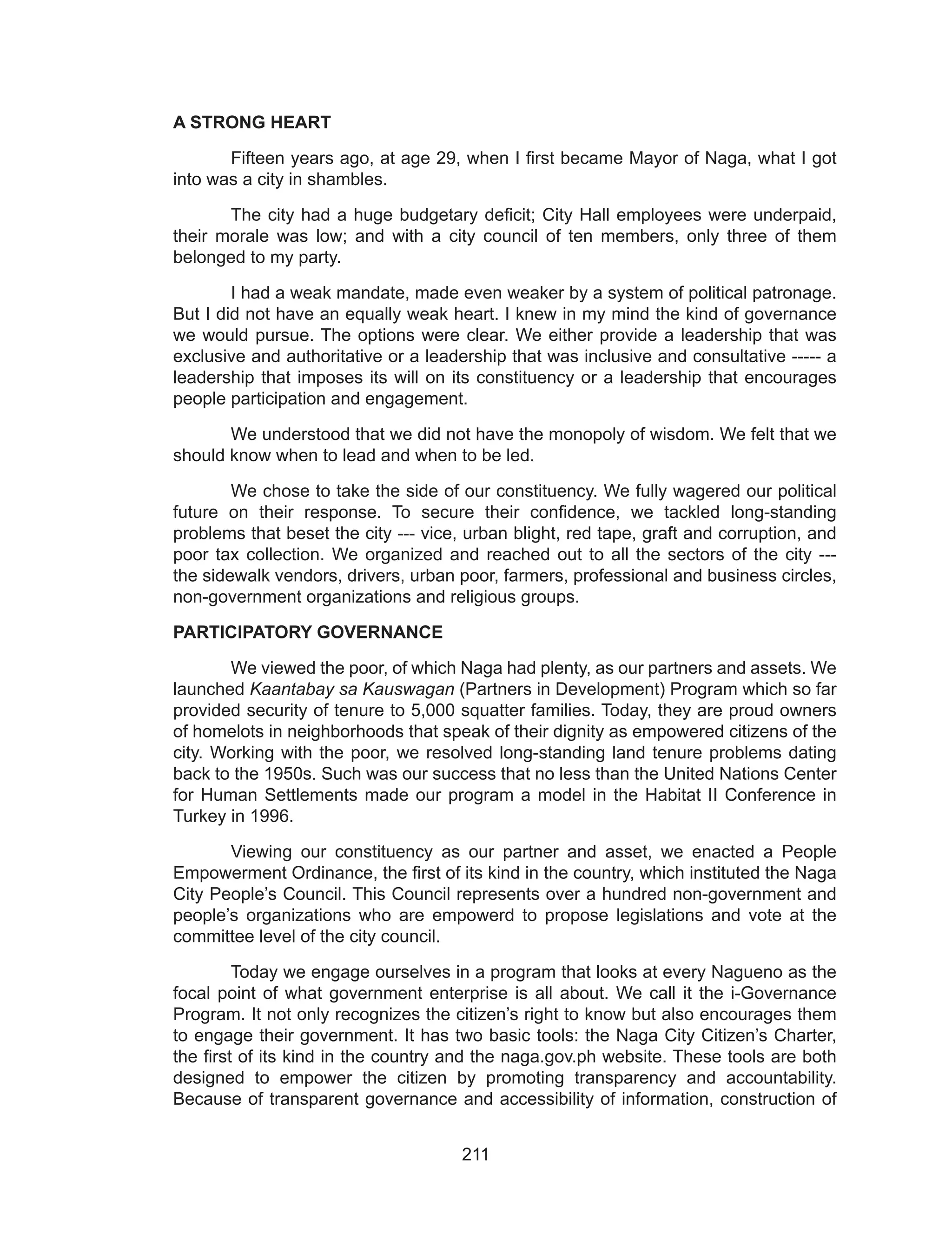
addition, how does the meaning of “suavely merciless” connect with lines 7
to 8 of the poem “The White Doe”?
5.	 What kind of language is used by poets and writers in forming contradiction
that often expresses conflicting feelings?
6.	 What kind of poem are the Petrarch’s three poems?
Task 8 SOUND THE SONNET
A.	 Go through the poem “The White Doe” again. This time focus on the structure
of the poem. Poems are said to have rhyme and rhythm. Let’s find out the
rhyme scheme of this poem.
The White Doe
Translated by Anna Maria Armi
A pure-white doe in an emerald glade
Appeared to me, with two antlers of gold,
Between two streams, under a laurel’s shade,
At sunrise, in the season’s bitter cold.
Her sight was so suavely merciless
That I left work to follow her at leisure,
Like the miser who looking for his treasure
Sweetens with that delight his bitterness.
a
b
a
b
c
d
d
c
175
1.	 How many lines are there in the poem?
2.	 How many lines are there in the first two stanzas?
3.	 How about in the third and fourth stanzas, how many lines are there?
4.	 Study the rhyme scheme. What is the basis of the rhyme scheme?
5.	 How does rhyme and rhythm contribute to the message of the poem?
B.	 Here are sonnets by Petrarch and Shakespeare, respectively. Identify the rhyme
schemes of each sonnet and compare and contrast them with each other.
	
Around her lovely neck “Do not touch me”
Was written with topaz and diamond stone,
“My Caesar’s will has been to make me free.”
Already toward noon had climbed the sun,
My weary eyes were not sated to see,
When I fell in the stream and she was gone.
e
f
e
f
e
f
Spring
Translated by Morris Bishop
Zephyr returns, and scatters everywhere
New flowers and grass, and company does
bring,
Procne and Philomel, in sweet despair,
And all the tender colors of the Spring.
Never were fields so glad, nor skies so fair,
And Jove exults in Venus prospering.
Love is in all the water, earth and air,
And love possesses every living thing.
But to me only heavy sighs return
For her who carried in her little hand
My heart’s key to her heavenly sojourn,
176
The birds sing loud above the flowering
land;
Ladies are gracious now – where deserts
burn
The beasts still prowl on the ungreening
sand.
Sonnet XVIII
William Shakespeare
Shall I compare thee to a summer’s day?
Thou art more lovely and more temperate:
Rough winds do shake the darling buds of
May,
And summer’s lease hath all too short a
date:
Sometime too hot the eye of heaven shines,
And often is his gold complexion dimmed,
And every fair from fair sometime declines,
By chance, or nature’s changing course
untrimmed:
But thy eternal summer shall not fade,
Nor lose possession of that fair thou ow’st,
Nor shall death brag thou wander’st in his
shade,
When in eternal lines to time thou grow’st,
So long as men can breathe, or eyes can
see,
So long lives this, and this gives life to thee.
177
Task 9 DISTINCT SONNETS
	 You have read examples of one type of lyric poem-the sonnet. After reading the
two poems, what similarities and differences did you notice?
Petrarchan
Shakespearean
Discussion Points:
1.	 HowdoestherhymeschemeinPetrarch’ssonnetdifferfromShakespeare’s?
2.	 What does the rhyme scheme do in the sonnet?
3.	 Do the words that rhyme in the sonnet relate to the theme of the poem?
How?
4.	 Aside from sonnets, where else can we use the “rhyme scheme”?
Task 10 TICKLE YOUR FANCY
	 Imagine how Petrarch’s Laura was like. In your group, work on the task that will
be assigned by your teacher.
Group 1 - Based on Petrarch’s description of Laura, draw her image on 		
short bond paper with a dedication addressed to Petrarch.
Group 2 - Choose a song that best describes the love Petrarch has for 		
	 Laura.
Group 3 - Prepare and perform a “rap” intended for courtship.
Group 4 - Pretend you are Petrarch with undying love for Laura and 		
	 write a love letter to her.
Group 5 - Deliver a short speech addressed to your beloved who has died 	
	 without saying farewell to you.
178
YOUR DISCOVERY TASKS
Task 11 LISTEN TO A POINT
	 Listen as your teacher reads a report from http://www.rappler.com/move-
ph/42214-ph-male-female-inequalities accessed on July 2014 about male and female
equalities in the country. Take note of information that will help you decide whether the
news report is valid, accurate, relevant, and with adequate information.
Let’s talk about the news article you just listened to.
1.	 What is the news article about?
2.	 What is the source of the news? Is it a valid source?
3.	 What data about male and female equality in health and survival, education,
economic participation, and politics were mentioned?
4.	 Will you consider this news accurate? Why?
5.	 How important is this news to your life?
6.	 Does the article have all the necessary details that you would need to be
well informed on the issue? What other data do you need?
Task 12 AGREE OR DISAGREE
	 Listen to news articles that will be read by your teacher. On the space provided,
write your response to the article. Write the word agree if you think the article is valid,
accurate, reliable, and with adequate information, and disagree if you think otherwise.
1.	 __________
2.	 __________
3.	 __________
										
	 What made you decide on your answers? How do you define: valid, reliable,
accurate, and adequate?
	________________________________________________________
	________________________________________________________
	________________________________________________________
Task 13 READ FOR INFO
	 Scan the given texts and advertisement. Based on your working definition,
decide whether or not the content of the article or advertisement is valid, accurate,
relevant and with adequate information. Copy the column in your notebook and put
a check mark under the column heading that corresponds to your answer. Support
your answer with proof from the given articles/advertisement.
179
ARTICLES Valid Accurate Relevant
With
Adequate
Information
2013 Manila Social Good
Summit
The Social Good Summit
is an annual, global event
that brings together movers
and shakers to discuss how
technology and social media
can be used for social good.
For 2013, the summit focused
on how to use social media to
help prepare for, respond to,
and minimize the impact of
disasters. Listed below are key
content from the summit:
http://www.rappler.com/move-
ph/42214-ph-male-female-
inequalities
ARTICLES Valid Accurate Relevant
With
Adequate
Information
The 2008 National
Demographic and Health
Survey (NDHS) revealed that
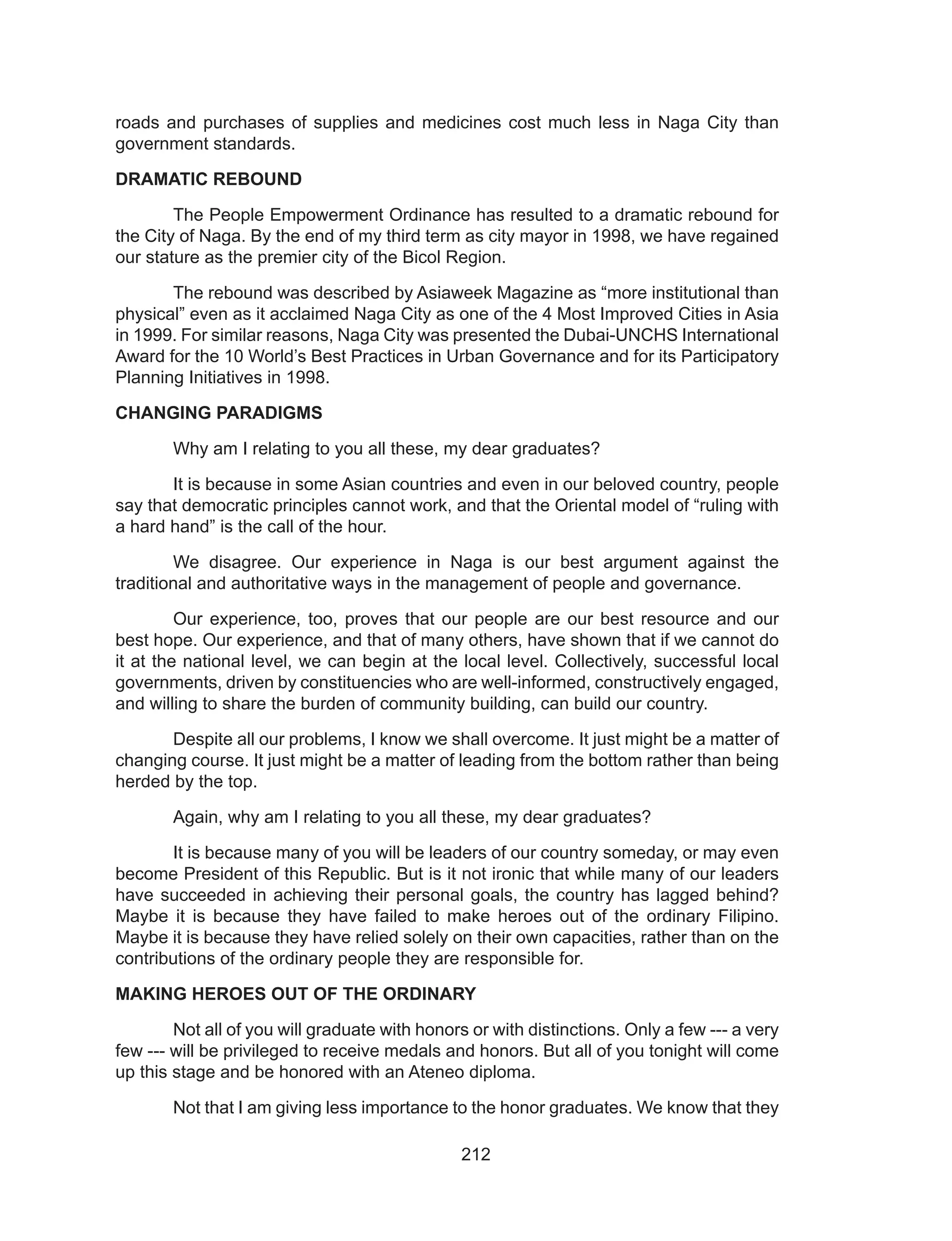
one in five women aged 15-
49 has experienced physical
violence since age 15; 14.4
percent of married women
have experienced physical
abuse from their husbands; and
more than one-third (37%) of
separated or widowed women
have experienced physical
violence, implying that domestic
violence could be the reason for
separation or annulment.
http://pcw.gov.ph/statistics/201405/
statistics-violence-against-filipino-
women
		 									
Explain your answer.
180
Valid Accurate Relevant Adequate
Discussion Points:
1.	 What information did you get from the given articles and advertisement?
2.	 Do they give enough information on the topic?
3.	 What makes an article or an advertisement adequate, valid, accurate, and
reliable?
Task 14 DEFINE THOSE WORDS!
A.	 You were able to give reasons for deciding whether an article has valid,
accurate, reliable, and adequate information. Based on your answers to the
previous tasks, how do you define those terms? With a partner, be able to
define them by completing the sentences below:
1.	 An article is valid when it _______________________________________
___________________________________________________________
___________________________________________________________
2.	 Reliability of the article’s content means ___________________________
___________________________________________________________
___________________________________________________________
3.	 We can say that what we read is accurate when______________________
___________________________________________________________
___________________________________________________________
4.	 Adequate information calls for __________________________________
___________________________________________________________
___________________________________________________________
Explain your answer.
181
B.	 You did well in defining terms like valid, accurate, reliable, and adequate. What
helped you in defining them? Let’s try looking at these examples and find out
how else we can write sentences that define.
1.	 The government has passed Republic Act 9710 (Magna Carta for Women)
to affirm the role of women in nation building and to ensure the substantive
equality of women and men.
What is defined in this sentence? How is it defined?
2.	 “Discrimination Against Women” refers to any gender-based distinction,
exclusion, or restriction which has the effect or purpose of impairing or
nullifying the recognition, enjoyment, or exercise by women, irrespective
of their marital status, on a basis of equality of men and women, of human
rights and fundamental freedoms in the political, economic, social, cultural,
civil, or any other field.
	 http://www.chanrobles.com/republicacts/republicactno9710.php
How is discrimination against women defined? What is the purpose
for including the website address?
3.	 As defined in Republic Act 7610, Child Abuse refers to the maltreatment,
whether habitual or not, of the child which includes any of the following:
(1) Psychological and physical Abuse, neglect, cruelty, sexual abuse, and
emotional maltreatment;
(2) Any act by deeds or words which debases, degrades, or demeans the
intrinsic worth and dignity of a child as a human being;
(3) Unreasonable deprivation of his basic needs for survival, such as food
and shelter; or
(4) Failure to immediately give medical treatment to an injured child
resulting in serious impairment of his growth and development or in his
permanent incapacity or death.
http://www.lawphil.net/statutes/repacts/ra1992/ra_7610_1992.html
What is defined in this item? How is it defined?
Discussion Points:
1.	 What are the ways to define a term within a sentence?
2.	 What are helpful tips in making definitions?
3.	 How can your skill in making definitions help you in preparing a technical
paper or when preparing for an oral argument?
182
C.	 This time, give either the operation or technical definition of each of the following
terms and concepts. You may use the Internet or your books for the definitions.
Be sure to include your source.
Words to Be Defined Operational
Definition
Technical Definition Source
Love
Population
Global Warming
Government
Revenues
Task 15 BRING IN THE SOURCE
A.	 Whether in speaking or in writing, you need to cite your source when stating
facts. At the end of the quarter, you will present an argumentative speech
and it’s important that you build your argument with facts and support all your
claims with accurate, reliable, valid, and adequate facts. But how do you make
attributions and recognize your source on paper? Work on the exercises that
follow to know more about citing your sources.
1.	 Go over Task 11. Copy the Internet website found in the two items defined.
Before the Internet website address or the URL, write first the topic and
after the URL, write the date when the material was accessed.
		 ________________,_________________________, ___________
			 Title of the topic website address or URL date
2.	 Why is it important to acknowledge the source in your speech or in your
paper?
B.	 Here are some more reminders in constructing simple bibliography for different
types of materials.
•	 Each entry should end with a period.
•	 Italics may be substituted by underlining.
•	 The final document should be double spaced and in alphabetical order by
the first word of the entry.
•	 There are several formats for a paper particularly for the bibliography.
Formats differ depending on the purpose. Go over the sample types of
bibliography and be able to distinguish one from the other.
183
1.	 Belowarestandardformatsandexamplesforbasicbibliographicinformation
recommended by the American Psychological Association (APA). For
more information on the APA format, see http://www.apastyle.org.		
		
Format
Examples
Format Examples
Books Author’s last name,
first initial. (Publication
date). Book title. Additional
information. City of
publication: Publishing
company.
Allen, T. (1974).  Vanishing Wildlife
of North America. Washington, D.C.:
National Geographic Society.
Boorstin, D. (1992).  The creators:
A History of the Heroes of the
Imagination. New York: Random
House.
Encyclopedia
& Dictionary
Author’s last name,
first initial. (Date).
Title of Article. Title of
Encyclopedia (Volume,
pages). City of publication:
Publishing company.
Bergmann, P. G. (1993). Relativity.
In  The New Encyclopedia
Britannica  (Vol. 26, pp. 501-508).
Chicago: Encyclopedia Britannica.
Merriam-Webster’s Collegiate
Dictionary  (10th ed.). (1993).
Springfield, MA: Merriam-Webster.
Pettingill, O. S., Jr. (1980). Falcon and
Falconry.  World Book Encyclopedia.
(pp. 150-155). Chicago: World Book.
Magazine &
N e w s p a p e r
Articles
Author’s last name, first
initial. (Publication date).
Article title. Periodical title,
volume number (issue
number if available),
inclusive pages. 
Note: Do not enclose the
title in quotation marks. Put
a period after the title. If a
periodical includes a volume
number, italicize it and then
give the page range (in
regular type) without “pp.”.
If the periodical does not
use volume numbers, as in
newspapers, use p. or pp.
for page numbers. 
Note: Unlike other
periodicals, p. or pp.
precedes page numbers for
a newspaper reference in
APA style.
Harlow, H. F. (1983). Fundamentals
for preparing psychology journal
articles. Journal of Comparative and
Physiological Psychology, 55, 893-
896.
Henry,W.A.,III.(1990,April9).Making
the grade in today’s schools. Time,
135, 28-31.
Kalette, D. (1986, July 21). California
town counts town to big quake. USA
Today, 9, p. A1.
184
Website or
Webpage
Online periodical:
Author’s name. (Date
of publication). Title of
article. Title of Periodical,
volume number, Retrieved
month day, year, from full
URL
Online document:
Author’s name. (Date of
publication). Title of work.
Retrieved month day, year,
from full URL 
Note: When citing
Internet sources, refer
to the specific website
document. If a document
is undated, use “n.d.”
(for no date) immediately
after the document title.
Break a lengthy URL
that goes to another line
after a slash or before a
period. Continually check
your references to online
documents. There is no
period following a URL. 
Note: If you cannot find
some of this information,
cite what is available.
Note: If a document is
contained within a large
and complex website
(such as that for a
university or a government
agency), identify the
host organization and
the relevant program or
department before giving
the URL for the document
itself. Precede the URL
with a colon.
Devitt, T. (2001, August 2). Lightning
injures four at music festival. The
Why? Files. Retrieved January
23, 2002, from http://whyfiles.
org/137lightning/index.html
Dove, R. (1998). Lady freedom
among us. The Electronic Text
Center. Retrieved June 19, 1998,
from Alderman Library, University
of Virginia website: http://etext.lib.
virginia.edu/subjects/afam.html 
Fredrickson, B. L. (2000, March
7). Cultivating positive emotions
to optimize health and well-
being.  Prevention & Treatment, 3,
Article 0001a. Retrieved November
20, 2000, from http://journals.apa.org/
prevention/volume3/pre0030001a.
html
GVU’s 8th WWW user survey. (n.d.).
Retrieved August 8, 2000, from http://
www.cc.gatech.edu/gvu/usersurveys/
survey1997-10/
Health Canada. (2002, February). The
Safety of Genetically Modified Food
Crops. Retrieved March 22, 2005,
from http://www.hc-sc.gc.ca/english/
protection/biologics_genetics/gen_
mod_foods/genmodebk.html
Source: http://www.sciencebuddies.org/science-fair projects/project_apa_format_examples.shtml
185
2.	 Another style in writing bibliography is the Modern Language Association
(MLA) style. According to Purdue Online Writing Lab, it is most commonly
used to write papers and cite sources within the liberal arts and humanities.
Purdue OWL has an update to reflect the  MLA Handbook for Writers
of Research Papers  (7th  ed.) and the  MLA Style Manual and Guide to
Scholarly Publishing (3rd 
ed.), which offers examples for the general format
of MLA research papers, in-text citations, endnotes/footnotes, and the
Works Cited page.
Here are some examples:
1.	 “Blueprint Lays Out Clear Path for Climate Action.” Environmental Defense
Fund, 8 May 2007. Web. 24 May 2009.
2.	 Clinton, Bill. Interview by Andrew C. Revkin. “Clinton on Climate
Change.” New York Times, May 2007. Web. 25 May 2009.
3.	 Dean, Cornelia. “Executive on a Mission: Saving the Planet.” New York
Times, 22 May 2007. Web. 25 May 2009.
4.	 Ebert, Roger. “An Inconvenient Truth.” Rev. of An Inconvenient Truth, Dir.
Davis Guggenheim.  rogerebert.com. Sun-Times News Group, 2 June
2006. Web. 24 May 2009.
5.	 GlobalWarming.org. Cooler Heads Coalition, 2007. Web. 24 May
2009.	
6.	 Gowdy,John.“AvoidingSelf-organizedExtinction:TowardaCo-evolutionary
Economics of Sustainability.”  International Journal of Sustainable
Development and World Ecology 14.1 (2007): 27-36. Print.
7.	 An Inconvenient Truth. Dir. Davis Guggenheim. Perf. Al Gore, Billy West.
Paramount, 2006. DVD.
8.	 Leroux, Marcel.  Global Warming: Myth or Reality?: The Erring Ways of
Climatology. New York: Springer, 2005. Print.
9.	 Milken, Michael, Gary Becker, Myron Scholes, and Daniel Kahneman.
“On Global Warming and Financial Imbalances.”  New Perspectives
Quarterly 23.4 (2006): 63. Print.
10.	Nordhaus, William D. “After Kyoto: Alternative Mechanisms to Control
Global Warming.” American Economic Review 96.2 (2006): 31-34. Print.
Discussion Points:
1.	 What is APA? MLA?
2.	 How are bibliographies written?
3.	 How is APA different from MLA?
4.	 Which style is predominantly used in the field of research?
186
C.	 With your partner, go through the bibliography page of your English LM. List
down at least one work cited/bibliography from a book, Internet, magazine, or
encyclopedia. Copy in your notebook and identify whether the entries are in
APA or MLA format. Share your answers to the class.
___________________________________
___________________________________
___________________________________
___________________________________
D.	 When you research and get notes from your source, you are annotating. An
annotation is a comment, explanation attached to a text, image, or other data.
Often, annotations refer to a specific part of the original data.
Annotation format differs depending on the styles: APA, MLA, or Chicago that an
author may opt to use.
Sample APA Annotation
Ehrenreich, B. (2001). Nickel and dime: On (not) getting by in America. New York:
Henry Holt and Company.
	 In this book of nonfiction based on the journalist’s experiential research,
Ehrenreich attempts to ascertain whether it is currently possible for an individual to live
on a minimum-wage inAmerica. Taking jobs as a waitress, a maid in a cleaning service,
and a Walmart sales employee, the author summarizes and reflects on her work, her
relationships with fellow workers, and her financial struggles in each situation.
	 An experienced journalist, Ehrenreich is aware of the limitations of her
experiment and the ethical implications of her experiential research tactics and
reflects on these issues in the text. The author is forthcoming about her methods and
supplements her experiences with scholarly research on her places of employment,
the economy, and the rising cost of living in America. Ehrenreich’s project is timely,
descriptive, and well-researched.
	 The APA annotation summarizes and assesses the book in the citation. The
first paragraph provides a brief summary of the author’s project in the book, covering
the main points of the work. The second paragraph points out the project’s strengths
and evaluates its methods and presentation. This particular annotation does not reflect
on the source’s potential importance or usefulness for this person’s own research.
For information on formatting APA citations, see APA Formatting and Style Guide.
187
Sample MLA Annotation
Lamott, Anne. Bird by Bird: Some Instructions on Writing and Life. New York: Anchor
Books, 1995. Print.
	 Lamott’s book offers honest advice on the nature of a writing life, complete
with its insecurities and failures. Taking a humorous approach to the realities of being
a writer, the chapters in Lamott’s book are wry and anecdotal and offer advice on
everything from plot development to jealousy, from perfectionism to struggling with
one’s own internal critic. In the process, Lamott includes writing exercises designed to
be both productive and fun.
	 Lamott offers sane advice for those struggling with the anxieties of writing,
but her main project seems to be offering the reader a reality check regarding writing,
publishing, and struggling with one’s own imperfect humanity in the process. Rather
than a practical handbook to producing and/or publishing, this text is indispensable
because of its honest perspective, its down-to-earth humor, and its encouraging
approach.
	 Chapters in this text could easily be included in the curriculum for a writing
class. Several of the chapters in Part 1 address the writing process and would serve
to generate discussion on students’ own drafting and revising processes. Some of the
writing exercises would also be appropriate for generating classroom writing exercises.
Students should find Lamott’s style both engaging and enjoyable.
	 In the sample annotation above, the writer includes three paragraphs: a
summary, an evaluation of the text, and a reflection on its applicability to his/her own
research, respectively.
For information on formatting MLA citations, see MLA 2009 Formatting and Style
Guide.
Sample Chicago Manual Style Annotation
Davidson, Hilda Ellis. Roles of the Northern Goddess. London: Routledge, 1998.
	 Davidson’s book provides a thorough examination of the major roles filled by
the numerous pagan goddesses of Northern Europe in everyday life, including their
roles in hunting, agriculture, domestic arts like weaving, the household, and death.
The author discusses relevant archaeological evidence, patterns of symbol and ritual,
and previous research. The book includes a number of black and white photographs
of relevant artifacts.
	 This annotation includes only one paragraph, a summary of the book. It provides
a concise description of the project and the book’s project and its major features.
Discussion Points:
1.	 What have you noticed in the three styles of annotating a source?
2.	 In what way are they similar? different?
3.	 Which style would you want to use? Why?
4.	 How can this help in gathering your references or notes?
5.	 How can your skill in research help you prepare for your speech?
188
Task 16 WRITE YOUR BIBLIOGRAPHY
	 Almost anything you deal with in everyday life has aspects that are debatable.
As with school issues, any topic that calls for change is worth researching. Gather the
facts now and don’t forget to acknowledge your source.
Do the following:
•	 Brainstorm on a topic that you feel strongly about.
Here are some examples:
- Why violence and sex on TV shows is okay (or not); why free Internet is
a good idea (or bad);
- Why the work week should be shorter (or longer);
- Why all students should participate in extra curricular activities (or not);
- Why actors/actresses should be elected for public office (or not);
- Why death penalty should be revived (or not) or other topics that are
important to you.
•	 Now that you have chosen your main topic, give it a good title.
•	 Make an outline of subtopics that you would be needing to argue your point.
•	 Research on those topics using the books you have brought (about your topic)
and by searching on the Internet.
•	 Using ¼ index cards, write down your annotations to support your topic or
argument and on top of it, write the bibliography. Each subtopic should have at
least two paragraph annotations that support it.
	
	 Remember that you are now gathering important, relevant, valid, adequate,
and accurate facts to help you in presenting your impromptu speech at the end of this
lesson.
•	 Take note that depending on the purpose of your bibliography,
some annotations may summarize, some may assess or evaluate
a source, and some may reflect on the source’s possible uses for
the project at hand. Some annotations may address all three of
these steps. Consider the purpose of your annotated bibliography
and/or your teacher’s directions when deciding how much
information to include in your annotations.
•	 Please keep in mind that all your text, including the write-up
beneath the citation, must be indented so that the author's last
name is the only text that is flush left. For more examples, visit
this website: https://owl.english.purdue.edu/owl/resource/614/03/
189
YOUR FINAL TASK
Task 17 TRY YOUR PASSION
A.	 From the list of topics given to you to research on, which one are you most
passionate about? Try talking about your “passion” in your group. Remember
to do the following:
a.	 Decide on who will speak first.
b.	 Give each speaker a minute to share his/her idea.
c.	 While one is speaking, the rest of the group has to listen.
d.	 Observe how each one shares his/her idea.
e.	 Write down your observations in your notebook following what is asked
in the column provided here.
Speakers
Is the idea shared
appropriate? Why?
Is the voice or manner of
speaking clear? Why?
Discussion Points:
1.	 Did you enjoy your on the spot idea-sharing? Why?
2.	 What motivated you to listen to your classmates’ speeches?
3.	 What suggestions can you give to improve one’s delivery of a speech?
	
www.youtube.com/watch?v=GefKPy5YYHI
Task 18 SPEAK FOR KEEPS
	 This time, watch another video which presents an example of an impromptu
speech. As you view it, listen attentively to the language, words, and expressions used
by the speaker in delivering his/her impromptu speech.
http://www.youtube.com/watch?v=Vp4gBmjsH74 July 13, 2014
A. Let’s answer the questions about the video you have seen.
1.	 What words or expressions in the speech made an impact on you? Explain.
2.	 Is it important to have the right diction and correct usage in delivering a
Get to know more about delivering lines/speeches by watching this “Toastmasters”
video taken from a video sharing site. Be able to list tips in delivering on the spot or
impromptu speeches.
190
speech? Why?
3.	 How does the speaker use the English language in getting her message
across?
4.	 What do you like about the way the speaker delivered her speech?
5.	 What improvements would you suggest in delivering the same speech?
B. YOUR SPEECH...TAKE ONE!
	 Here is a situation that will serve as the basis of your speech. For this activity,
you will be given five (5) minutes to prepare your speech. When preparing, you may
use the PREP strategy (State your Point, Give Reasons, Cite Examples, and Go back
to the Point) to gather your thoughts.
	
	 As soon as you are ready, deliver your speech in front of your groupmates. Be
ready to gather comments from them and don’t forget to give your written output to
your teacher.
Discussion Points:
1.	 Do you think you will get accepted for the job? Why?
2.	 What do you suggest/plan to do to improve your speaking skills?
C. SHOWCASE YOUR SPEECH!
	 This time, deliver your impromptu speech following the instructions given here.
1.	 Work in your group.
2.	 Ask your teacher for the scenario/situation your group will use for your
speech.
3.	 Let your teacher read to you the scenario/situation.
4.	 Draw lots on who will be the first to speak.
5.	 The speaker will talk about the given situation for three (3) minutes. The
second speaker will begin his/her speech based on the last sentence of
the first speaker. The third speaker will do the same and so on. This will
continue until the last speaker has delivered his/her speech.
6.	 Once all of you have delivered your speeches, your teacher will give his/
her synthesis.
7.	 The presentation will be done one group at a time.
After Junior High School, you have decided to apply for work. The company,
“Just Human,” a local travel agency, is looking for a Front Desk Officer who
will take charge of accommodating guests and answering calls and queries from
customers. To get accepted, you need to introduce yourself, share your skills, and
explain why you are the right person for the job. Your diction and use of the English
language will make you get the job.
Write in your notebook some more tips on delivering an impromptu
speech.
191
You will be graded using this rubric adapted from www.marquette.edu/library/services/
oral.doc.
Speech and Presentation Grading Rubric
Public Speaking and Oral Presentation Component
Emerging
(0-12 points)
Developing
(13-16 points)
Advanced
(17-20 points)
Score
1. Organization
(20 points)
Ideas may not
be focused or
developed; the
main purpose
is not clear. The
introduction is
undeveloped.
Main points are
difficult to identify.
Transitions may
be needed.
There is no
conclusion or
may not be clear
the presentation
has concluded.
Conclusion does
not tie back to
the introduction.
Audience cannot
understand
presentation
because there is
no sequence of
information.
Main idea is
evident, but the
organizational
structure may
need to be
strengthened;
ideas may not be
clearly developed
or always flow
smoothly and the
purpose is not
clearly stated.
The introduction
may not be well
developed. Main
points are not
clear. Transitions
may be awkward.
Supporting
material may lack
in development.
The conclusion
may need
additional
development.
Audience
has difficulty
understanding
the presentation
because the
sequence of
information is
unclear.
Ideas are clearly
organized,
developed,
and supported
to achieve a
purpose; the
purpose is clear.
The introduction
gets the attention
of the audience
and clearly states
the specific
purpose of the
speech. Main
points are clear
and organized
effectively. The
conclusion is
satisfying and
relates back to
introduction. (If
the purpose of
the presentation
is to persuade,
there is a clear
action step
identified and
an overt call to
action.)
192
2. Topic
Knowledge
(20 points)
Student does
not have grasp
of information;
student cannot
answer questions
about the subject.
Few, if any,
sources are
cited. Citations
are attributed
incorrectly.
Inaccurate,
generalized, or
inappropriate
supporting
material may
be used. Over
dependence on
notes may be
observed.
Student has a
partial grasp of
the information.
Supporting
material may
lack originality.
Citations are
generally
introduced
and attributed
appropriately.
Student is at ease
with expected
answers to all
questions but
fails to elaborate.
Over dependence
on notes may be
observed.
Student has
a clear grasp
of information.
Citations are
introduced
and attributed
appropriately
and accurately.
Supporting
material is
original, logical,
and relevant.
Student
demonstrates full
knowledge (more
than required)
by answering all
class questions
with explanations
and elaboration.
Speaking outline
or note cards
are used for
reference only.
3. Audience
Adaptation
(20 points)
The presenter is
not able to keep
the audience
engaged.
The verbal
or nonverbal
feedback from
the audience
may suggest a
lack of interest
or confusion.
Topic selection
does not relate to
audience needs
and interests.
The presenter
is able to keep
the audience
engaged most
of the time.
When feedback
indicates a
need for idea
clarification, the
speaker makes
an attempt to
clarify or restate
ideas. Generally,
the speaker
The presenter
is able to
effectively keep
the audience
engaged.
Material is
modified or
clarified as
needed given
audience verbal
and nonverbal
feedback.
Nonverbal
behaviors are
193
demonstrates
audience
awareness
through
nonverbal and
verbal behaviors.
Topic selection
and examples
are somewhat
appropriate for
the audience,
occasion, or
setting. Some
effort to make the
material relevant
to audience
needs and
interests.
used to keep
the audience
engaged.
Delivery style
is modified as
needed. Topic
selection and
examples are
interesting and
relevant for the
audience and
occasion.
4. Language
Use
(Verbal
Effective-
ness)
(20 points)
Language
choices may be
limited, peppered
with slang or
jargon, too
complex, or too
dull. Language
is questionable
or inappropriate
for a particular
audience,
occasion, or
setting. Some
biased or unclear
language may be
used.
Language used is
mostly respectful
or inoffensive.
Language is
appropriate, but
word choices are
not particularly
vivid or precise.
Language
is familiar to
the audience,
appropriate for
the setting, and
free of bias; the
presenter may
“code-switch”
(use a different
language
form) when
appropriate.
Language
choices are vivid
and precise.
5. Delivery
(Nonverbal
Effectiveness)
(20 points)
The delivery
detracts from the
message; eye
contact may be
very limited; the
presenter may
tend to look at
the floor, mumble,
speak inaudibly,
The delivery
generally seems
effective --
however, effective
use of volume,
eye contact, vocal
control, etc. may
not be observed.
Vocal tone, facial
The delivery is
extemporaneous
-- natural,
confident, and
enhances the
message --
posture, eye
contact, smooth
gestures, facial
194
fidget, or read
most of the
speech; gestures
and movements
may be jerky
or excessive.
The delivery
may appear
inconsistent with
the message.
Nonfluencies
(“ums”) are used
excessively.
Articulation and
pronounciation
tend to be
sloppy. Poise of
composure is
lost during any
distractions.
Audience
members have
difficulty hearing
the presentation.
expressions,
clothing and
other nonverbal
expressions
do not detract
significantly from
the message. The
delivery style,
tone of voice, and
clothing choices
do not seem
out-of-place or
disrespectful to
the audience
or occasion.
Some use of
nonfluencies
are observed.
Generally,
articulation and
pronounciation
are clear.
Most audience
members
can hear the
presentation.
expressions,
volume, pace,
etc. indicate
confidence, a
commitment to
the topic, and
willingness to
communicate.
The vocal tone,
delivery style,
and clothing
choices suffest
an awareness
of expectations
and norms.
Limited use of
nonfluencies
is ovserved.
Articulation and
pronounciation
are clear.
All audience
members
can hear the
presentation.
2005. Adapted with permission from Northwest Regional Educational Laboratory (1998)
MY TREASURE
Share Your Life’s Lessons
A.	 It takes practice and genuine concern for others to develop a sensitive heart
towards others. As a young adult, list down ways by which you can develop
sensitivity towards others and the benefits you could get from it.
Tips to develop a sensitive attitude Benefits from being sensitive towards
others
	
Illustrate your learning or write down lyrics of the song that reflect your most important
learning for the week.
195
Module 2
LESSON 4
___________________________________________________________________ 	
	 Empathizing with Others
YOUR JOURNEY
“Too often we underestimate the power of a touch, a smile, a kind word, a listening
ear, an honest compliment, or the smallest act of caring, all of which have the
potential to turn a life around.” 
– Leo Buscaglia
	 In this lesson, you will work on
exercises to hone your skills in analyzing
problems and finding solutions based on
factual information and data.
	 You will also get to read a literary
piece which talks about love that is willing to
endure everything even without assurance of
fulfillment. This week, get the chance to be
inspired by famous persons and their ideals
that helped shape society.
	 All of these will culminate in the sharing of ideas through a personal testimony.
	 Finally, the encompassing theme of concern for one another and a deep sense
of empathy towards each other is highlighted throughout the lesson.
YOUR OBJECTIVES
	 Here are the objectives which will guide you in going through the different
tasks in this lesson. This is also intended for your self-assessment to discover which
competencies you need to develop more.
•	 employ analytical listening in problem solving
•	 detect bias and prejudice in the material viewed
•	 read closely to get author’s purpose
•	 give technical and operational definitions
•	 explain how the elements specific to a genre contribute to the theme of a
particular literary selection
•	 determine tone, mood, technique, and purpose of the author
•	 use words or expressions that affirm or negate
•	 use writing conventions to indicate acknowledgment of resources
•	 observe correct stance and proper stage behavior as deemed necessary e.g.,
in a personal testimony
•	 establish eye contact e.g., when delivering a personal testimony
196
	 Take note that at the end of this module, you will deliver an argumentative
speech and in preparation for that you will convey a personal testimony as a final task
of this lesson.
YOUR INITIAL TASKS
Task 1 GREAT NAMES TO NAME
	 Let’s begin this week with a quiz on naming the world famous personalities and
how they have touched the lives of many people.
	 Read about these personalities and be ready to name each one. Write the
name of the personality on the space provided.
	 To help you in identifying these personalities, their photos are provided here.
a.	 This person devoted herself to working among the poorest of the poor in
the slums of Calcutta. Although without funds, she depended on Divine
Providence and started an open-air school for slum children. Later on,
she founded the order “Missionaries of Charity” to help the poor, the
needy, and the sick.								
_______________________________________________________
_______________________________________________________
b.	 He fought against racial discrimination (apartheid) in South Africa.
He was imprisoned for 27 years for his radical but peaceful move to
abolish apartheid, poverty, and inequality in South Africa. He was also
the country’s first black chief executive. 					
_______________________________________________________
_______________________________________________________
c.	 A very good author, this person was well-travelled and outspoken in her
convictions. She campaigned for women’s right to vote, labor rights,
socialism, and other causes. Her being blind, deaf, and mute did not
stop her from helping people and pursuing her cause.
________________________________________________________
________________________________________________________
d.	 She is known as the first woman elected as President in her country
and in Asia. Her administration led to the promulgation of the 1987
Constitution which limited the powers of the Presidency and re-
established the bicameral congress. Her leadership focused on concern
197
for civil liberties, human rights, and peace talks to end political unrest
in the country.
		_______________________________________________________	
		_______________________________________________________
Task 2 BIAS DETECTIVES 2
	 Here are signs found in different places in the world. Read each one carefully
and find out its message. In your group, answer the questions that follow.
Source: http://en.wikipedia.org/wiki/Nelson_Mandela
In your group, answer the questions about the signage that will be assigned to you.
Discussion Points:
1.	 What helped you in the task?
2.	 Do you also have biases? What are they?
3.	 Have you experienced fighting for something or defending yourself against
other people’s biases? How did you react to it?
4.	 Do you think it is right to have biases? Why?
198
Task 3 READ FOR BIAS
	 Read the following articles and rate the level of bias in each of them. Use the
rating scale that follows each article. Cite examples of bias to support your answer. Do
this activity with a partner.
	 I think that calling this summer hot would be an incredible understatement. It
has, in fact, been quite unbearable with the heat driving everyone indoors and some
even collapsing (and a few dying) from the sweltering and dizzying temperatures. It
truly comes as a welcome relief for many that the rains have begun to quench our
parched population. As everyone knows, water is the most important commodity in life.
Our own bodies are made up of 80% water. We can all live without so many things —
electricity, Internet, and even food for a few days, but we won’t last without water.
http://www.philstar.com/opinion/2014/06/18/1336011/rain-rain-dont-go-away
High Moderate Low None
Exaggerated language
Unbalanced information
Prejudice (for or against)
Product sales
My emotional response
	 Culture change is what this country badly needs. We want to be rid of corrupt
politicians but we are not aware of the role we play in breeding one. For instance,
in our neighborhood where one of the local officials resides, our folks would always
expect that the local official would give financial help every time one of the neighbors
dies. When another gets sick or gives birth, financial help is immediately sought from
that local official. During weddings, baptisms, birthdays, and all sorts of celebration,
the same is expected from him/her.
	 Considering that meager allowance is received by local officials, isn’t it a
wonder where they get the “fund” they give to satisfy the needs of their constituents?
It’s about time that we be aware of the real job description of our officials. Let’s help
them concentrate in doing their job by not asking too much financial help from them.
We can do a lot in helping our country. Let’s begin with ourselves.
High Moderate Low None
Exaggerated language
Unbalanced information
Prejudice (for or against)
Product sales
My emotional response
199
	 In Indonesia, where earthquakes and tsunami are common, how can Panasonic
deliver a solution even when disaster strikes? Panasonic is committed to creating a
better life and a better world, continuously contributing to the evolution of society and
to the happiness of people around the globe. Through its wide range of business
solutions, Panasonic is looking to create a “new Panasonic” which can truly achieve
“A Better Life A Better World.”
http://news.panasonic.net/stories/2014/0421_26946.html
High Moderate Low None
Exaggerated language
Unbalanced information
Prejudice (for or against)
Product sales
My emotional response
Task 4 THINK TO SOLVE
A.	 Listen to the news broadcast and analyze the content. Then with your partner,
answer what is asked for in the table below.
	
News in Two Minutes
	 http://www.youtube.com/watch?v=usxKWu4D31Y
What is the news about? When did it happen? What issue(s) was/were
presented?
B.	 Brainstorm with your group and discuss the following points:
What are issues presented
in the news?
What possible solution
can you offer?
Is the issue presented also
happening in our country?
Give an example.
200
C.	 You have offered a possible solution to the issue presented in the news report.
How were you able to come up with a solution to the problem? What strategy
did you use?
_____________________________________________________________
_____________________________________________________________
YOUR TEXT
Task 5 BACKGROUND CHECK
	 The story you are about to read will also present an issue. Find out what
solution you could give to the characters in the story. But before you do that, read first
the background information about the story.
Source:https://www.google.com.ph/search?q=pictures+of+decameron&tbm=isch&tbo=u&source=univ&
sa=X&ei=R6u-U6WDKYjHkAXWooFo&ved=0CBkQsAQ&biw=1024&bih=499
Source:https://www.google.com.ph/search?q=pictures+of+decameron&tbm=isch&tbo=u&source=univ&sa=X&ei
=R6u-U6WDKYjHkAXWooFo&ved=0CBkQsAQ&biw=1024&bih=499
The Decameron was written by Giovanni
Boccaccio (1313-1375), an Italian poet and
Renaissance Humanist.
It is comprised of 100 novellas told by
ten men and women over a ten-day
journey away from plague-infested
Florence. The Decameron is said to be
a portrayal of everyday life, including
wit, and mockery following a framed
structure. The title comes from the two
Greek words déka (meaning “ten”)
and hēméra, or “day.”
This map of Europe shows the countries
affected by plague. Around 80% of Europe
was hit by the plague.
This setting was used by the author in
creating a band of youthful boys and girls
who shared different stories to forget the
horrors of the plague even for a while.
201
	 G.H. McWilliam, known translator of the Decameron, writes that the women
probably represent the four cardinal virtues (Prudence, Justice, Temperance, and
Fortitude) and the three theological virtues (Faith, Hope, and Love). The three men
could represent the tripartite division of the soul into Reason, Anger, and Lust.
	 The author Boccaccio writes in the Introduction that he has withheld the
true names of the members of the brigata, because he doesn’t want them to “feel
embarrassed, at any time in the future, on account of the ensuing stories, all of which
they either listened to or narrated themselves. The translations of the Italian names of
the members of the Brigata, with their possible allegorical roles, is as follows:
Pampinea - full of vigor (Prudence)
Fiammetta - little flame (Temperance)
Filomena - the beloved, or lover of song (Fortitude)
Emilia - she who allures (Faith)
Elissa - an Italian variant of Dido (Hope)
Neifile - newly enamored, possibly a reference to the dolce stil novo and 	
	 Dante (Love)
Lauretta - a diminutive of Petrach’s Laura (Justice)
Panfilo - all-loving (Reason)
Filostrato - defeated by love (Anger)
Dioneo - an italianized version of Dionysus (Lust)
What image does this background create in your mind? What issue is presented here?
What does the background reveal about the Renaissance?
As you read this story, think of a similar story in Philippine Literature.
Our featured text from the Decameron is told by
Filomena on the last day of their 10-day journey
away from plague-stricken Florence.
202
Federigo’s Falcon
from The Decameron
Giovanni Boccaccio
translated by G. H.
McWilliam
	 Once Filomena had finished, the queen, finding that there was no one left to
speak apart from herself (Dioneo being excluded from the reckoning because of his
privilege) smiled cheerfully and said:
	 It is now my own turn to address you and I shall gladly do so, dearest ladies,
with a story similar in some respects to the one we have just heard. This I have chosen,
not only to acquaint you with the power of your beauty over men of noble spirit, but
so that you may learn to choose for yourselves, whenever necessary, the person on
whom to bestow your largesse, instead of always leaving these matters to be decided
for you by Fortune, who, as it happens, nearly always scatters her gifts with more
abundance than discretion.
What is Filomena’s purpose in telling this story?
What is meant by largesse?
	 You are to know, then, that Coppo di Borghese Domenichi, who once used to
live in our city and possibly lives there still, one of the most highly respected men of our
century, a person worthy of eternal fame, who achieved his position of pre-eminence
by dint of his character and abilities rather than by his noble lineage, frequently took
pleasure during his declining years in discussing incidents from the past with his
neighbors and other folk.
	 In this past time he excelled all others, for he was more coherent, possessed
a superior memory, and spoke with greater eloquence. He had a fine repertoire,
including a tale he frequently told concerning a young Florentine called Federigo, the
son of Messer Filippo Alberighi, who for his deeds of chivalry and courtly manners
was more highly spoken of than any other squire in Tuscany. In the manner of most
young men of gentle breeding, Federigo lost his heart to a noble lady, whose name
was Monna Giovanna, and who in her time was considered one of the loveliest and
most adorable women to be found in Florence. And with the object of winning her love,
he rode at the ring, tilted, gave sumptuous banquets, and distributed a large number
of gifts, spending money without any restraint whatsoever. But since she was no less
chaste than she was fair, the lady took no notice, either of the things that were done in
her honor, or of the person who did them.
From whom did the queen learn this story?
Who are the main personalities in this story? How are they related?
	 In this way, spending far more than he could afford and deriving no profit in
return, Federigo lost his entire fortune (as can easily happen) and reduced himself to
203
poverty, being left with nothing other than a tiny little farm, which produced an income
just sufficient for him to live very frugally, and one falcon of the finest breed in the
whole world. Since he was as deeply in love as ever, and felt unable to go on living
the sort of life in Florence to which he aspired, he moved out to Campi, where his little
farm happened to be situated. Having settled in the country, he went hunting as often
as possible with his falcon, and, without seeking assistance from anyone, he patiently
resigned himself to a life of poverty.
What happened to Federigo?
	 Now one day, while Federigo was living in these straitened circumstances, the
husband of Monna Giovanna happened to fall ill, and, realizing that he was about to
die, he drew up his will. He was a very rich man, and in his will he left everything to
his son, who was just growing up, further stipulating that, if his son should die without
legitimate issue, his estate should go to Monna Giovanna, to whom he had always
been deeply devoted.
	 Shortly afterward he died, leaving Monna Giovanna a widow, and every
summer, in accordance with Florentine custom; she went away with her son to a
country estate of theirs, which was very near Federigo’s farm. Consequently, this lad
of hers happened to become friendly with Federigo, acquiring a passion for birds and
dogs; and, having often seen Federigo’s falcon in flight, he became fascinated by it
and longed to own it, but since he could see that Federigo was deeply attached to the
bird, he never ventured to ask him for it.
	 And there the matter rested, when, to the consternation of his mother, the boy
happened to be taken ill. Being her only child, he was the apple of his mother’s eye,
and she sat beside his bed the whole day long, never ceasing to comfort him. Every
so often she asked him whether there was anything he wanted, imploring him to tell
her what it was, because if it were possible to acquire it, she would move heaven and
earth to obtain it for him.
	 After hearing this offer repeated for the umpteenth time, the boy said: “Mother,
if you could arrange for me to have Federigo’s falcon, I believe I should soon get
better.”
	 On hearing this request, the lady was somewhat taken aback, and began to
consider what she could do about it. Knowing that Federigo had been in love with her
for a long time, and that she had never deigned to cast so much as a single glance
in his direction, she said to herself: “How can I possibly go to him, or even send
anyone, to ask him for this falcon, which to judge from all I have heard is the finest that
ever flew, as well as being the only thing that keeps him alive? And how can I be so
heartless as to deprive so noble a man of his one remaining pleasure?”
What befell Monna’s husband and son?
What was the son’s request to his mother?
204
	 Her mind filled with reflections of this sort, she remained silent, not knowing
what answer to make to her son’s request, and even though she was quite certain that
the falcon was hers for the asking.
	 At length, however, her maternal instincts gained the upper hand, and she
resolved, come what may, to satisfy the child by going in person to Federigo to collect
the bird, and bring it back to him. And so she replied:
	 “Bear up, my son, and see whether you can start feeling any better. I give you
my word that I shall go and fetch it for you first thing tomorrow morning.”
	 Next morning, taking another lady with her for company, his mother left the
house as though intending to go for a walk, made her way to Federigo’s little cottage,
and asked to see him. For several days, the weather had been unsuitable for hawking,
so Federigo was attending to one or two little jobs in his garden, and when he heard,
to his utter astonishment, that Monna Giovanna was at the front door and wished to
speak to him, he happily rushed there to greet her.
	 When she saw him coming, she advanced with womanly grace to meet him.
Federigo received her with a deep bow, whereupon she said:
	 “Greetings, Federigo!” Then she continued: “I have come to make amends for
the harm you have suffered on my account, by loving me more than you ought to have
done. As a token of my esteem, I should like to take breakfast with you this morning,
together with my companion here, but you must not put yourself to any trouble.”
	 “My lady,” replied Federigo in all humility, “I cannot recall ever having suffered
any harm on your account. On the contrary, I have gained so much that if ever attained
any kind of excellence, it was entirely because of your own great worth and the love
I bore you. Moreover, I can assure you that this visit which you have been generous
enough to pay me is worth more to me than all the money I ever possessed, though I
fear that my hospitality will not amount to very much.”
	 So saying, he led her unassumingly into the house and thence into his garden,
where, since there was no one else he could call upon to chaperon her, he said:
	 “My lady, as there is nobody else available, this good woman, who is the wife
of the farmer here will keep you company whilst I go and see about setting the table.”
	 Though his poverty was acute, the extent to which he had squandered his
wealth had not yet been fully borne home to Federigo; but on this particular morning,
finding that he had nothing to set before the lady whose love he had entertained so
lavishly in the past, his eyes were well and truly opened to the fact. Distressed beyond
all measure, he silently cursed his bad luck and rushed all over the house like one
possessed, but could find no trace of either money or valuables. By now the morning
was well advanced, he was still determined to entertain the gentlewoman to some
sort of meal, and, not wishing to beg assistance from his own farmer (or from anyone
else, for that matter), his gaze alighted on his precious falcon, which was sitting on
its perch in the little room where it was kept. And having discovered, on picking it
up, that it was nice and plump, he decided that since he had nowhere else to turn, it
205
would make a worthy dish for such a lady as this. So without thinking twice about it he
wrung the bird’s neck and promptly handed it over to his housekeeper to be plucked,
dressed, and roasted carefully on a spit. Then he covered the table with spotless linen,
of which he still had a certain amount in his possession, and returned in high spirits to
the garden, where he announced to his lady that the meal, such as had been able to
prepare, was now ready.
Where did Monna go one morning?
How was she received by Federigo?
	 The lady and her companion rose from where they were sitting and made their
way to the table. And together with Federigo, who waited on them with the utmost
deference, they made a meal of the prized falcon without knowing what they were
eating.
	 On leaving the table they engaged their host in pleasant conversation for a
while, and when the lady thought it time to broach the subject she had gone there to
discuss, she turned to Federigo and addressed him affably as follows:
	 “I do not doubt for a moment, Federigo, that you will be astonished at my
impertinence when you discover my principal reason for coming here, especially when
you recall your former mode of living and my virtue, which you possibly mistook for
harshness and cruelty. But if you had ever had any children to make you appreciate
the power of parental love, I should think it certain that you would to some extent
forgive me.
	 “However, the fact that you have no children of your own does not exempt
me, a mother, from the laws common to all other mothers. And being bound to obey
those laws, I am forced, contrary to my own wishes and to all the rules of decorum
and propriety, to ask you for something to which I know you are very deeply attached-
-which is only natural, seeing that it is the only consolation, the only pleasure, the only
recreation remaining to you in your present extremity of fortune.
	 The gift I am seeking is your falcon, to which my son has taken so powerful a
liking, that if I fail to take it to him I fear that he will succumb to the illness from which he
is suffering, and consequently I shall lose him. In imploring you to give me this falcon,
I appeal, not to your love, for you are under no obligation to me on that account, but
rather to your noble heart, whereby you have proved yourself superior to all others in
the practice of courtesy. Do me this favor, then, so that I may claim that through your
generosity I have saved my son’s life, thus placing him forever in your debt.”
	 When he heard what it was that she wanted, and realized that he could not
oblige her because he had given her the falcon to eat, Federigo burst into tears in her
presence before being able to utter a single word in reply. At first the lady thought his
tears stemmed more from his grief at having to part with his fine falcon than from any
other motive, and was on the point of telling him that she would prefer not to have it.
But on second thoughts she said nothing, and waited for Federigo to stop crying and
give her his answer, which eventually he did.
206
What was the purpose of Monna’s visit to Federigo?
How did Federigo feel after knowing Monna’s purpose for the visit?
	 “My lady,” he said, “ever since God decreed that you should become the object
of my love, I have repeatedly had cause to complain of Fortune’s hostility towards me.
But all her previous blows were slight by comparison with the one she has dealt me
now. Nor shall I ever be able to forgive her, when I reflect that you have come to my
poor dwelling, which you never deigned to visit when it was rich, and that you desire
from me a trifling favor which she has made it impossible for me to concede. The
reason is simple, and I shall explain it in few words.
	 “When you did me the kindness of telling me that you wished to breakfast with
me, I considered it right and proper, having regard to your excellence and merit, to
do everything within my power to prepare a more sumptuous dish than those I would
offer to my ordinary guests. My thoughts therefore turned to the falcon you have asked
me for and knowing its quality, I reputed it a worthy dish to set before you. So, I had it
roasted and served to you on the trencher this morning, and I could not have wished
for a better way of disposing of it. But now that I discover that you wanted it in a
different form, I am so distressed by my inability to grant your request that I shall never
forgive myself for as long as I live.”
	 In confirmation of his words, Federigo caused the feathers, talons, and beak
to be cast on the table before her. On seeing and hearing all this, the lady reproached
him at first for killing so fine a falcon, and serving it up for a woman to eat; but then she
became lost in admiration for his magnanimity of spirit, which no amount of poverty
had managed to diminish, nor ever would.
How did Monna and Federigo feel about the incident?
	 But now that her hopes of obtaining the falcon had vanished she began to
feel seriously concerned for the health of her son, and after thanking Federigo for his
hospitality and good intentions, she took her leave of him, looking all despondent, and
returned to the child. And to his mother’s indescribable sorrow within the space of a
few days, whether through his disappointment in not being able to have the falcon, or
because he was in any case suffering from a mortal illness, the child passed from this
life.
	 After a period of bitter mourning and continued weeping, the lady was repeatedly
urged by her brothers to remarry, since not only had she been left with a vast fortune
but she was still a young woman. And though she would have preferred to remain a
widow, they gave her so little peace in the end, recalling Federigo’s high merits and his
latest act of generosity, namely to have killed such a fine falcon in her honor, she said
to her brothers:
207
	 “If only it were pleasing you, I should willingly remain as I am; but since you are
so eager for me to take a husband, you may be certain that I shall never marry any
other man except Federigo degli Alberighi.”
	 Her brothers made fun of her, saying:
	 “Silly girl, don’t talk such nonsense! How can you marry a man who hasn’t a
penny with which to bless himself?”
	 “My brothers,” she replied, “I am well aware of that. But I would sooner have a
gentleman without riches, than riches without a gentleman.”
	 Seeing that her mind was made up, and knowing Federigo to be a gentleman
of great merit even though he was poor, her brothers fell in with her wishes and handed
her over to him, along with her immense fortune. Thenceforth, finding himself married
to this great lady with whom he was so deeply in love, and very rich into the bargain,
Federigo managed his affairs more prudently, and lived with her in happiness to the
end of his days.
What happened to Monna’s son?
What had become of Monna? Of Federigo?
Task 6 THINK TANK
	 In your group, discuss your answers to the following questions about the story.
Write your answers on a separate sheet of paper.
Group 1 - What is the difference between saying that Monna “took no 		
	 notice” of Federifo’s love and saying that she did not notice it?
Is it important to explain this distinction? Why?
Group 2 - Federigo decided to kill his falcon. Is it in a way similar to 		
	 Monna’s decision to ask him for it?
Describe the sacrifice both of them had to make.
Group 3 - What social and moral problems came up when Monna 		
	 Giovanna’s son asked her to obtain Federigo’s falcon?
	 In the end, what characteristic of a mother and a woman does 	
	 Monna reveal?
Group 4 - Can we say that the two characters were models of behavior? 	
	 In what way?
	 What faults if there were, did they have?
	 How did you feel when Monna decided to marry Federigo in 	
	 the end?
Group 5 - What is the theme of the story?
208
		 What was Federigo’s attitude toward the falcon?
		 How does the falcon symbolize the central values of the story?
Task 7 TMT (Tone, Mood, Theme) Alert
	 Federigo’s falcon builds on a theme. Theme of the story refers to the central
topic of a text. Its tone and mood are also felt all over the story. Tone refers to the
attitude of the author towards a subject while mood is the atmosphere of the story.
It’s the feeling you get while reading the story. Fill in the graphic organizer with the
appropriate information about the story.
Task 8 LIKE THE OTHERS
	 It has been said that the theme of Boccaccio’s tales has become a source of
inspiration for different authors. Go through the synopsis or excerpts of the stories
listed below. Then, compare and contrast them with Decameron. Work on this with
your group.
	 At the Tabard Inn, a tavern in Southwark, near London, the narrator joins
a company of twenty-nine pilgrims. The pilgrims, like the narrator, are travelling to
the shrine of the martyr Saint Thomas Becket in Canterbury. The narrator gives a
Federigo’s Falcon
Main Theme
Tone Mood Sub-Theme
209
descriptive account of twenty-seven of these pilgrims, including a Knight, Squire,
Yeoman, Prioress, Monk, Friar, Merchant, Clerk, Man of Law, Franklin, Haberdasher,
Carpenter, Weaver, Dyer, Tapestry-Weaver, Cook, Shipman, Physician, Wife, Parson,
Plowman, Miller, Manciple, Reeve, Summoner, Pardoner, and Host. (He does not
describe the Second Nun or Nun’s Priest, although both characters appear later in the
book).
	 The Host, whose name we find out in the Prologue to the Cook’s Tale is Harry
Bailey, suggests that the group ride together and entertain one another with stories.
He decides that each pilgrim will tell two stories on the way to Canterbury and two on
the way back. Whomever he judges to be the best storyteller will receive a meal at
Bailey’s.
Source: www.m.sparknotes.com/lit/canterbury/summary.html
Similarities Differences
Canterbury Tales of
Geoffrey Chaucer and the
Decameron
	 Ibong Adarna is a mythical story, formed in narrative song and poetry called
corrido and considered a big part of Philippine literature.
	 This amazing folklore is about love, sacrifice, and fantasy. Ibong Adarna literally
means Adarna bird. The story centers about catching the mythical bird that possesses
magical powers. The Adarna bird is so beautiful and could change in a lot of stunning
forms. It is very much hard to catch. It knows a total of seven songs which could either
enchant anyone to sleep, turn into stone or heal a deadly sickness. Which is why the
almost dying King Fernando of Berbania tasked his three sons to catch the magical
bird. That’s where the story begins.
Source: http://twentyfive.hubpages.com/hub/Ibong-Adarna-Summary-English-and-Tagalog-
Versions
210
Similarities Differences
Ibong Adarna and
Decameron
YOUR DISCOVERY TASKS
Task 9 KNOW YOUR HEART!
	 Giovanni Boccaccio said that when he wrote Decameron, he wanted to
document life during his time through various tales of love and lessons in life.
	 Authors have purposes when they write articles. Find out the purpose of the
speech you are about to read. It is the Commencement Address of the late Mayor and
DILG Secretary, Jesse Robredo, to the Ateneo De Manila University Class of 2003.
FOLLOW YOUR HEART; PURSUE YOUR DREAM
by Jesse M. Robredo
City Mayor, Naga City
 (Greetings) 
	 I am deeply honored to be your Commencement Speaker today.
	 I must confess I do not consider myself prominent enough to merit the invitation.
I must also confess that I come from that other equally distinguished school along Taft
Avenue. Nevertheless, like I always do when called upon, I will give it my best shot.
	 Humbly I stand before you today. Humbly I relish at the thought that perhaps
one of the reasons why you have chosen me as your Commencement Speaker is that
you want me to share with you the good things that we have accomplished in Naga
City.
	 You, my dear graduates, might wonder why after six years in the private sector
with a lucrative job, I finally decided to involve myself in local governance, which is
otherwise known as the complex world of politics.
	 It is not common that we find young men and women, at their early stage,
stake their future in politics. The old fashion way is for older or more seasoned men,
especially those who have been successful in their profession and have nothing more
to prove, to indulge in politics as a rewarding refuge. In my case, I simply wanted to go
home and see what I can share to the city of my birth.
211
A STRONG HEART
	 Fifteen years ago, at age 29, when I first became Mayor of Naga, what I got
into was a city in shambles.
	 The city had a huge budgetary deficit; City Hall employees were underpaid,
their morale was low; and with a city council of ten members, only three of them
belonged to my party.
	 I had a weak mandate, made even weaker by a system of political patronage.
But I did not have an equally weak heart. I knew in my mind the kind of governance
we would pursue. The options were clear. We either provide a leadership that was
exclusive and authoritative or a leadership that was inclusive and consultative ----- a
leadership that imposes its will on its constituency or a leadership that encourages
people participation and engagement.
	 We understood that we did not have the monopoly of wisdom. We felt that we
should know when to lead and when to be led.
	 We chose to take the side of our constituency. We fully wagered our political
future on their response. To secure their confidence, we tackled long-standing
problems that beset the city --- vice, urban blight, red tape, graft and corruption, and
poor tax collection. We organized and reached out to all the sectors of the city ---
the sidewalk vendors, drivers, urban poor, farmers, professional and business circles,
non-government organizations and religious groups.
PARTICIPATORY GOVERNANCE
	 We viewed the poor, of which Naga had plenty, as our partners and assets. We
launched Kaantabay sa Kauswagan (Partners in Development) Program which so far
provided security of tenure to 5,000 squatter families. Today, they are proud owners
of homelots in neighborhoods that speak of their dignity as empowered citizens of the
city. Working with the poor, we resolved long-standing land tenure problems dating
back to the 1950s. Such was our success that no less than the United Nations Center
for Human Settlements made our program a model in the Habitat II Conference in
Turkey in 1996.
	 Viewing our constituency as our partner and asset, we enacted a People
Empowerment Ordinance, the first of its kind in the country, which instituted the Naga
City People’s Council. This Council represents over a hundred non-government and
people’s organizations who are empowerd to propose legislations and vote at the
committee level of the city council.
	 Today we engage ourselves in a program that looks at every Nagueno as the
focal point of what government enterprise is all about. We call it the i-Governance
Program. It not only recognizes the citizen’s right to know but also encourages them
to engage their government. It has two basic tools: the Naga City Citizen’s Charter,
the first of its kind in the country and the naga.gov.ph website. These tools are both
designed to empower the citizen by promoting transparency and accountability.
Because of transparent governance and accessibility of information, construction of
212
roads and purchases of supplies and medicines cost much less in Naga City than
government standards.
DRAMATIC REBOUND
	 The People Empowerment Ordinance has resulted to a dramatic rebound for
the City of Naga. By the end of my third term as city mayor in 1998, we have regained
our stature as the premier city of the Bicol Region.
	 The rebound was described by Asiaweek Magazine as “more institutional than
physical” even as it acclaimed Naga City as one of the 4 Most Improved Cities in Asia
in 1999. For similar reasons, Naga City was presented the Dubai-UNCHS International
Award for the 10 World’s Best Practices in Urban Governance and for its Participatory
Planning Initiatives in 1998.
CHANGING PARADIGMS
	 Why am I relating to you all these, my dear graduates?
	 It is because in some Asian countries and even in our beloved country, people
say that democratic principles cannot work, and that the Oriental model of “ruling with
a hard hand” is the call of the hour.
	 We disagree. Our experience in Naga is our best argument against the
traditional and authoritative ways in the management of people and governance.
	 Our experience, too, proves that our people are our best resource and our
best hope. Our experience, and that of many others, have shown that if we cannot do
it at the national level, we can begin at the local level. Collectively, successful local
governments, driven by constituencies who are well-informed, constructively engaged,
and willing to share the burden of community building, can build our country.
	 Despite all our problems, I know we shall overcome. It just might be a matter of
changing course. It just might be a matter of leading from the bottom rather than being
herded by the top.
	 Again, why am I relating to you all these, my dear graduates?
	 It is because many of you will be leaders of our country someday, or may even
become President of this Republic. But is it not ironic that while many of our leaders
have succeeded in achieving their personal goals, the country has lagged behind?
Maybe it is because they have failed to make heroes out of the ordinary Filipino.
Maybe it is because they have relied solely on their own capacities, rather than on the
contributions of the ordinary people they are responsible for.
MAKING HEROES OUT OF THE ORDINARY
	 Not all of you will graduate with honors or with distinctions. Only a few --- a very
few --- will be privileged to receive medals and honors. But all of you tonight will come
up this stage and be honored with an Ateneo diploma.
	 Not that I am giving less importance to the honor graduates. We know that they
213
have significant roles to play. But that I would like to focus more on the majority of the
graduates this year. I was just like one of you when I graduated from college in 1980.
To you, I address my experience in Naga City --- for it is our kind, the ordinary, regular
kid on the block, who made the City of Naga rise over its difficulties.
	 Our political history has shown that we have put the burden of running this
country to our “best” people for too long. And yet the gap between the rich and the poor
has grown wider. For this country to succeed, we need to make heroes of the ordinary
people. We need to make heroes of ourselves.
	 I must say that the ordinary employees and constituency have made the
success of Naga possible. In Naga City, we have a woman street sweeper, who held
on to her broom for twenty years. Literally, she had swept every square inch of the
city’s business district. But through sheer determination, she was able to finish her
secondary studies in a night school and graduated, at 54, with a bachelor’s degree,
some 8 years after her own daughters had theirs. To her the City of Naga conferred
the Mayoral Award for becoming an inspiration to ordinary citizens, one who despite
overwhelming odds, has risen above them. Today her broom has become a diploma.
The woman was not an honor graduate --- but an ordinary citizen, struggling to make
life better for her family.
	 Why am I relating this to you, my dear graduates, and my dear ladies and
gentlemen?
	 It is because the world today lacks the values that used to mould the disposition
and the character of the ordinary citizen.
	 The world today, despite the advances in science and technology, has yet to
learn about how to live, what to do, and how to be. As one tired and retired government
employee remarked, “One learns many things when one gets to be my age. But one
has to unlearn many more things that one has gathered with age.”
	 In pre-school, as bestseller writer Robert Fulghum observed, we used to be
taught these: “Share everything. Play fair. Do not cheat. Don’t hit people. Put things
back where you find them. Clean up your own mess. Don’t take things that aren’t yours
… When you go out into the world, hold hands and stick together.”
	 How sad --- after ten years in basic education and four years in higher education
-- we seem to have forgotten the basic tenets learned in pre-school.
	 When graduates go out into the world of business or politics or entertainment
or government service, will they still “share everything,” “play fair,” “put things back
where they find them,” and “clean their own mess?”
	 Our experience in governance in Naga City is nothing but our personal
encounter with the necessity of returning to the basic governance --- a return to the
essential meaning of service --- a return to what is simple and practical --- a return to
the values that our forefathers taught us: the value of honesty, hard work, of fairness
and most all the holy fear of a just God.
214
SMALL FISH IN A BIG POND
	 This Address will not be complete without venturing to answer the question as
to where will you go from here.
	 Should you choose to be a big fish in a small pond, or a small fish in a big pond?
Whatever your doubts are, follow your heart. When I left San Miguel Corporation, in
1986, I knew that serving home was where my heart was. I must say that desire and
commitment far outweigh knowledge and skill. The latter can be learned. Without the
former, your life’s work will be a profession and not a vocation. Find your own niche.
Change careers if you must. But make sure you succeeed.
	 You must always remember that you cannot give what you do not have.
Measure success in terms of how pleased you are with what you have done and not
as to how people define it, with its attendant perks.
	 Later on in life, you will realize that it is neither your successes nor your
conquests that will give you satisfaction. It is your contribution that really matters –
paying back what you owe the community that nurtured you.
THE CHILD IN US
	 Let me end by narrating to you the conversations I had with Grade 6 pupils of a
public school in Panicuason, a mountain barangay in Naga City, some four years ago.
	 Some of these children had to walk 3 to 4 kilometers just to attend school. I
asked them what their ambitions in life were?
	 A boy said he wanted to be a doctor because there was no doctor in the
barangay. A girl said he wanted to be a teacher so that she would make sure that all
the children in her barangay would go to school. Another boy said he wanted to be an
engineer so he could improve the roads and provide irrigation systems for the farmers.
	 Like all of us, they too wanted to be somebody someday. But despite the
deprivations and difficulties, they were all for a noble purpose – to be of service to
others. Not one of them said that it was for fame, money or power. They were so
young, yet they know what was good for their community and for others.
	 As you leave your beloved Alma Mater and pursue your own dreams, do not
forget the child in you. Keep in your hearts always the Ateneo idealism of being men
and women for others. Hold on to it. I am certain you will do no wrong if you keep that
idealism as your guiding light.
Congratulations.
Source: https://www.facebook.com/notes/gma-news/mayor-jesse-robredos-commencement-
address-to-the-ateneo-de-manila-university-cla/10150977631067693
215
Discussion Points:
	 Answer the questions to find out the author’s purpose in writing the text you
just read. Think about your own answers first. Then, pair with your classmates to
validate your answers. Be ready to share them to the whole class as soon as you have
come up with an agreement.
1.	 What kind of text is the material you just read?
2.	 Does the text provide a lot of facts and information?
3.	 List down some of the facts and information provided in the text.
4.	 What is the mood of the article? What emotion of the author is reflected in
it? Explain.
5.	 Tone refers to a writer’s or speaker’s attitude toward a subject. Writers
create tone through their choice of words and details. What is the tone
of the speech? What words reveal the author’s attitude towards following
one’s heart?
6.	 Is the author trying to convince you to do something? What is that?
7.	 What then is the author’s purpose in writing this text?
8.	 Are you convinced by the author’s manner of writing the text? Why?
9.	 Can you recall other texts you have read with the same purpose as this
one? Name one.
Task 10 PURPOSE GALORE!
Read the descriptions of each item and determine the author’s purpose (to entertain,
persuade, or inform). Then, in a sentence or two, explain your answer.
1.	 A pamphlet calling on people not to eat animals or use products made
from animals because the author thinks that it is cruel and unnecessary	
											
Author’s Purpose: 								
__________________________________________________________
Explain Your Answer:
Write a sentence or two.
2.	 An arts craft book containing procedures for making scrapbook, origami,
and other do-it-yourself arts novelty items
												
	 Author’s Purpose: 								
	 ___________________________________________________________
Explain Your Answer:
Write a sentence or two.
216
3.	 A book of over 1,000 believe-it-or-not stories
												
	 Author’s Purpose:									
	 ___________________________________________________________
Explain Your Answer:
Write a sentence or two.
4.	 A politician’s speech about how children in far flung towns should be
provided with quality education and medical help
												
	 Author’s Purpose:
__________________________________________________________
Explain Your Answer:
Write a sentence or two.
5.	 An article which appears in the medical journal about the wonder drug that
could treat dengue
												
	 Author’s Purpose:								
__________________________________________________________
Explain Your Answer:
Write a sentence or two.
6.	 An article comparing and contrasting Vietnamese and Philippine economic
policies
											
		 Author’s Purpose:						
__________________________________________________________
Explain Your Answer:
Write a sentence or two.
217
7.	 The Shakespearean tragedy “Romeo and Juliet,” where two young lovers
are forbidden from seeing one another due to centuries-old blood feud
between their two families
												
	 Author’s Purpose:								
__________________________________________________________
Explain Your Answer:
Write a sentence or two.
8.	 A website describing a local dog leash ordinance, detailing its history and
the penalties for walking around with one’s dog unleashed
												
	 Author’s Purpose:									
	 ___________________________________________________________
Explain Your Answer:
Write a sentence or two.
Task 11 TO AFFIRM OR TO NEGATE
	 Below are lines taken from former Secretary Jesse Robredo’s speech. In your
group, take turns sharing your agreement or disagreement to the ideas presented.
Assign one member of the group to take note of expressions of agreement and
disagreement used by the members of the group.
	 In pre-school, as bestseller writer Robert Fulghum observed, we used to be
taught these: “Share everything. Play fair. Do not cheat. Don’t hit people. Put things
back where you find them. Clean up your own mess. Don’t take things that aren’t yours
… When you go out into the world, hold hands and stick together.”
	 How sad --- after ten years in basic education and four years in higher education
-- we seem to have forgotten the basic tenets learned in pre-school.
 	 When graduates go out into the world of business or politics or entertainment
or government service, will they still “share everything,” “play fair,” “put things back
where they find them,” and “clean their own mess?”
Think about this:
What did you notice about the exchange of ideas in the group?
How did your classmates give affirmative and negative comments?
What should you do when affirming or negating an idea or a situation?
218
Task 12 AFFIRM OR NEGATE FOR THE COUNTRY
	 Read the summary of the book “12 Little Things Every Filipino Can Do to Help
Our Country” by Atty. Alexander Lacson. Comment on each of the following items. Use
expressions that affirm or negate.
The 12 Little Things We Can Do For Our Country
Are Small Acts of Patriotism
Atty. Alexander Lacson
1st: Follow traffic rules. Follow the law.
•	 Traffic rules are the most basic of our country’s laws. If we learn to follow them,
it could be the lowest form of national discipline we can develop as a people. A
culture of discipline is crucial to our destiny as a nation.
•	 Whenever we follow traffic rules, we show our love for our neighbor, our love
for the Filipino.
Your comment: _______________________________________________________
___________________________________________________________________
___________________________________________________________________
2nd : Always ask for an official receipt or OR.
•	 Asking for ORs leads to higher tax collections, which means more funds for
our government, which could strengthen our economy and lead us to progress.
•	 Whenever we help our government in helping our people, we show our love
for our neighbor.
Frequently Used Adverbs of Affirmation and Negation
Adverb of Affirmation:
	 It is an adverb which is used in a sentence to affirm it as true. Generally
these adverbs are used to answer the questions raised by others.
	 They are absolutely, affirmatively, all right (also adj), alright (also adj),
assertedly, avowedly, aye (informal), certainly (also interjection), clearly, definitely,
doubtlessly, exactly, obviously, positively, really (also interjection), surely, truly,
undoubtedly.
Adverb of Negation:
	
	 It is an adverb which is used in a sentence to deny it as true. Generally
these adverbs are used to answer the questions raised by others like almost,
contradictorily, invalidly, never, no (also an adj.), not, rarely.
219
Your comment: _______________________________________________________
___________________________________________________________________
___________________________________________________________________
3rd: Don’t buy smuggled goods. Buy local. Buy Filipino.
•	 Our money should support our economy, not the economy of other countries.
Buying Filipino means supporting the Filipino.
•	 Whenever we support one another as Filipinos, we show our love for our
neighbors.
Your comment: _______________________________________________________
___________________________________________________________________
___________________________________________________________________
4th: Speak positively about us and our country.
•	 Every Filipino is an ambassador of our country. Each one of us, wherever we
maybe, is a salesman of our country.
•	 Whenever we speak positively of our people, we show our love for our
neighbors.
Your comment: _______________________________________________________
___________________________________________________________________
___________________________________________________________________
5th: Respect your traffic officer, policeman & other public servants.
•	 Respect honors and dignifies a man. It compels him to do his job right.
•	 There is love of neighbor whenever we respect those in authority.
Your comment: ______________________________________________________
___________________________________________________________________
___________________________________________________________________
6th: Throw your garbage properly. Segregate. Recycle. Conserve.
•	 The Philippines is the country given to us as a people. It is the birthplace of our
race. It is our home. We should keep it beautiful.
•	 When we keep our environment and our country clean, we show our love for
our people.
Your comment: ______________________________________________________
___________________________________________________________________
___________________________________________________________________
220
7th: Support your church.
•	 When we help our church, we help our Creator in His works on earth.
•	 Whenever we help our church, we show love for our neighbor.
Your comment: ______________________________________________________
___________________________________________________________________
___________________________________________________________________
8th: During elections, do your solemn duty.
•	 When we fight for our votes, we fight for our right to make our own destiny, as
a people and as a nation.
•	 There is love of neighbor when we elect good leaders for our country and
people.
Your comment: ______________________________________________________
___________________________________________________________________
___________________________________________________________________
9th: Pay your employees well.
•	 Acompany must bring prosperity not only to its owners, but also to its employees.
Blessings must be shared. It builds families. It builds our nation.
•	 There is love of neighbor when we value and pay our employees appropriately.
Your comment: ______________________________________________________
___________________________________________________________________
___________________________________________________________________
10th: Pay your taxes.
•	 Taxes are the lifeblood of our government. It is what builds our public schools,
hospitals, and roads. It is what pays our teachers, soldiers, and other public
servants.
•	 There is love of neighbor whenever we pay our taxes properly so our government
can help more people.
Your comment: ______________________________________________________
___________________________________________________________________
___________________________________________________________________
11th: Adopt a scholar or a poor child.
•	 Investing on our youth is investing on our country’s future. Every family who
can afford, should adopt one poor child as a scholar.
•	 There is love of neighbor whenever we help a child get an education.
Your comment: ______________________________________________________
___________________________________________________________________
___________________________________________________________________
221
12th: Be a good parent. Teach your kids to love our country.
•	 If we start planting seeds of patriotism in the hearts and minds of our youth
today, they would become giant patriots of our country someday.
•	 There is love of neighbor whenever we teach and raise our children as patriots,
by loving our country through loving our people.
Your comment: ______________________________________________________
___________________________________________________________________
___________________________________________________________________
Task 13 WATCH FOR CONVENTIONS
	 You may want to cite the two articles: “Follow Your Heart; Pursue Your Dream”
and “12 Little Things Every Filipino Can Do to Help Our Country” in your reference list
as in this example:
Lacson, A. (2005). 12 Little Things Every Filipino Can Do to Help Our Country. Manila:
Alay Pinoy Publishing House
Robredo, Jesse M. (March 29, 2003). Follow Your Heart; Pursue Your Dream.
August 14, 2014. https://www.facebook.com/notes/gma-news/mayor-jesse-
robredos-commencement-address-to-the-ateneo-de-manila-university-
cla/10150977631067693
Discussion Points:
1.	 What type of bibliography is used in the given examples?
2.	 What punctuation marks are used in the reference list?
3.	 How does each punctuation mark function in the bibliographic entry?
4.	 Are these punctuation marks important? Why or why not?
A.	 Try working on this activity. Use correct punctuation marks following the APA
format in the given information.
1.	 Topic: Using Words to Create Tone
	 Title of book: Elements of Literature
Authors: Holt, Rinehart and Winston, Inc.
	 Harcourt Brace Jovanovich, Inc
	 Printed in USA
Published by Holt, Rinehart and Winston, Inc.
Published on 1993, 1989
222
2.	 Author: Patricia Evangelista
	 Published: May 25, 2013
Title of Article: The Binay Republic
Date accessed: Dec. 04, 2014
Url: http://www.rappler.com/thought-leaders/29939-binay-republic
3.	 Author: Harlow, H. F.
	 Published in 1983
	 Title of Article: Fundamentals for preparing psychology journal articles
	 Title of Magazine: Journal of Comparative and Physiological Psychology
	 Page Numbers: 55, 893-896.
B.	 In your group, research about proper stage behavior in delivering a speech.
Write the bibliography to cite your sources. Use the APA style.
YOUR FINAL TASK
Task 14 SPEAK FOR KEEPS
A. This time, watch a video which showcases the speech of a notable speaker. As you
view it, take note of how he presents his ideas and how he acts when delivering his
speech.
	 How to believe in yourself: Jim Cathcart at TEDx Delray Beach
http://www.youtube.com/watch?v=-ki9-oaPwHs Published on Oct 17, 2013
Let’s answer the questions about the video you have seen.
1.	 What is the technique or strategy used by the speaker when delivering his
speech?
2.	 What is the message the speaker wants to impart to his audience? Is he
successful? Why?
3.	 What gestures and facial expressions were evident in the speaker?
4.	 Did the speaker establish eye contact with his audience? Is it important?
About the Speaker:
	 Jim Cathcart thought he would never make a difference.An average student
from a working class family with no athletic or special skills, he expected an
unremarkable existence. But one radio message in 1972 changed the direction of
his life and altered his belief in his potential. Today, he’s a Hall of Fame Speaker,
and has authored 16 books. While changing himself, Jim also discovered how to
help others believe in themselves, too. 
223
Why? Why not?
5.	 What do you like about the way he has delivered his speech?
6.	 What improvements would you do in delivering the same speech?
B. Try It Out
	 Based on the situation given here, prepare your speech. Remember the PREP
strategy you have learned in your previous lesson.


	 You have to choose an issue that you have personally experienced. You may
also discuss another issue not included in the list if you feel passionate about it. Write
it following the PREP pattern. Remember to keep it short and simple by writing a
maximum of 10 sentences only.
State your point about the topic.
______________________________________________________________
______________________________________________________________
Give your reasons for your point or stand on an issue. Back it up with your source.
______________________________________________________________
______________________________________________________________
Write here some more tips on stage behavior you will remember when you
deliver your speech:
	 You are a member of “Everybody Happy” Club. You have attended a meeting
with your fellow members to talk about the different school-related issues. You
feel strongly about this advocacy since you want your school to be a safe and
happy place for all the students.
Among the school issues up for discussion are the following:
•	 Bullying
•	 No-collection policy
•	 No assignment on Fridays
•	 Internet access for all students
•	 Community-based projects
•	 No uniform policy (casual attire among students)
•	 Extra-curricular activities
•	 Class schedule
224
Provide examples or personal experiences to support your point or stand on an issue.
______________________________________________________________
______________________________________________________________
Go back to the point or your stand on an issue.
______________________________________________________________
______________________________________________________________
C. Speak Your Heart Out!
	 Following the speech you have written, be ready to share it in class. Keep in
mind the message you want to convey to your audience and don’t forget to observe
proper stage behavior when delivering your speech.
	 You will be graded using this rubric adapted from www.marquette.edu/library/
services/oral.doc.
Criteria Highly Observed (5) Moderately
Observed (3)
Poorly
Observed (1)
Score
1. Delivery
40%
(10% for each
indicator)
The delivery is
extemporaneous
-- natural, confident,
and enhances the
message.
The delivery
generally seems
effective but is
not consistent.
The delivery
is distracting-
superficial
and lacks
confidence.
Posture, eye
contact, smooth
gestures, facial
expressions,
volume, and pace
indicate confidence.
Effective use
of volume,
eye contact,
gestures,
volume is not
consistent.
Some hesitancy
may be
observed.
Eye contact
is limited (the
presenter
tends to look
at the floor,
mumble,
speak
inaudibly,
fidget, or
read most of
the speech).
Gestures and
movements
may be jerky
or excessive.
The vocal tone,
delivery style are
consistent with the
message.
The delivery
style, tone of
voice seem to
be a little out-of-
place with the
message.
The delivery
and vocal
tone are
inconsistent
with the
message.
225
Articulation and
pronunciation are
clear. All audience
members can hear
the presentation.
Generally,
articulation and
pronunciation
are clear.
Most audience
members
can hear the
presentation.
Articulation
and
pronunciation
tend to be
sloppy.
Audience
members
have difficulty
hearing the
presentation.
2. Language
Use/Verbal
Effectiveness
30%
(10% for each
indicator)
Language is familiar
to the audience,
easy to understand
and appropriate for
the setting.
Language
used is mostly
respectful or
inoffensive and
appropriate.
Language is
inappropriate
for a particular
audience,
occasion,
or setting.
Some unclear
language is
used.
Only the English
language is used.
Other language
or “code
switching” is
used every now
and then.
There is code
switching
most of the
time. Other
language is
used often.
Language choices
are vivid, precise,
and free from
grammar mistakes.
Word choices
are not
particularly vivid
or precise with
some grammar
mistakes.
Language/
word choices
is limited,
peppered
with slang
or jargon,
too complex,
or too dull
with many
grammar
mistakes.
3. Message
and
Organization
30%
(10% each
indicator)
The purpose is
clear. Ideas are
clearly organized,
developed, and
supported
Ideas are
not clearly
developed or
does not always
Ideas are not
focused or
developed;
the main
purpose is not
clear.
226
to achieve the
purpose.
flow smoothly.
Main idea is
evident, but the
organizational
structure
needs to be
strengthened.
The introduction
gets the attention of
the audience and
relates to the main
points that focus
on the personal
experience.
The introduction
is not well
developed.
Main points
are not clear.
Transitions are
awkward.
The
introduction is
undeveloped.
Main points
are difficult
to identify.
Transitions
are needed.
The conclusion
is satisfying and
relates back to
the introduction.
The argument
presented is backed
up with sources
and personal
experience.
The conclusion
needs additional
development.
Supporting
material is
not properly
developed.
Audience
has difficulty
understanding
the presentation
because the
sequence of
information is
unclear.
There is
no clear
conclusion.
Conclusion
does not
relate to the
introduction.
Audience
cannot
understand
presentation
because
there is no
sequence of
information
and the
message is
not clear.
MY TREASURE
	 In this part of the lesson, you are going to write down the insights you’ve had
for the week. Don’t forget to include the lesson or topic which you want to continue
learning and the persons you can learn from.
227
In this week’s lesson, who is
the character you can best
emphatize with...
What are important
insights that you have
learned this week?
Draw here the
symbols of your
learning or you may
cut from magazines
the symbols of your
learning and paste on
bond paper.
I want to continue learning about _________________________________________
______________________.
I will ask help from ____________________________________________________
___________.
228
Module 2
LESSON 5 											
______________________________________________________________
						 Accepting Individual Differences
YOUR JOURNEY
	 Have you ever reflected on why people differ from one another? Was there a
time in your life when you regarded someone unworthy of attention and appreciation
because he/she is different? Or have you been regarded differently by others?
	 Your recognition and acceptance of the uniqueness in every person will enable
you to lead a full and happy life.
	 In the story, “The Hunchback of Notre Dame,” you will be brought back a time
and place wherein differences in looks, physical appearance, and dispositions were a
great deal.
	 This lesson enables you to appreciate the goodness in every man and woman
and in other aspects of humanity as a whole. It will likewise help you to be appreciative
of the nature of every human being. More so, this will help you realize that accepting
individual differences is the initial step to hurdle conflict and discord.
YOUR OBJECTIVES
	 The following objectives will help you answer the foregoing questions.
•	 identify and clarify unsupported generalizations and exaggerations
•	 use previous experiences as scaffold to the message conveyed by a material
viewed
•	 read closely to get explicitly and implicitly stated information
•	 give technical and operational definitions of a term
•	 explain how a selection maybe influenced by culture, history, environment, and
other factors
•	 use words and expressions that affirm or negate use in-text citations
•	 demonstrate confidence and ease in delivering a speech
Be reminded that at the end of the lesson, you are expected
to hold a debate.
229
YOUR INITIAL TASKS
Task 1 EXAGGERATING THE GENERALS!
•	 Before you listen to the text, read carefully the statements below.
1.	 All teachers wear high-grade spectacles.
2.	 The liniment that relieves body aches and pains in seconds
3.	 In general, men in the army are fearless.
4.	 This perfume makes you the most unforgettable woman on earth.
5.	 Typhoon Yolanda has displaced millions of Filipino people.
•	 In groups, analyze the given statements by answering the following
questions:
a.	 What term or word signals generalization in statements number 1 and
number 3? What idea do these sentences convey? Are the statements
supported by facts and figures?
b.	 What word/s or phrase/s in sentences number 2, number 4, and
number 5 are overwhelming? Do you think the ideas presented in these
sentences are possible to happen or have really happened?
Have in mind the reminders enclosed in the box below.
•	 At this point, listen carefully to the text that will be read twice by your teacher.
•	 Identify from the statements the exaggerated words/expressions and write
them under the appropriate heading in the box.
•	 Clarify these expressions by substituting them with more appropriate words.
•	 Share your answers with the class.
Exaggerated Words/Expressions More Appropriate Words
1.
2.
3.
4.
5.
•	 This time, you are going to listen to another text.
•	 Distinguish from the statements the unsupported generalization.
•	 Try to support it by adding relevant information.
•	 Accomplish the chart below according to its heading.
Learn by Heart
Unsupported generalizations and exaggerations are baseless information which can
mislead listeners or readers. Unless additional information to support them is available, do
not believe them immediately. Check them for accuracy and truthfulness.
230
Unsupported Generalization My Supporting Statement
Tip:
	 All, none, most, many, always, often, everyone, never, sometimes, some,
usually, seldom, few, generally, overall, as a general rule --- are words that signal
generalization statements.
Task 2 PEOPLE OR PEOPLE
Pair Work. Look intently at the drawings of people engaged in different activities.
•	 With a partner, talk about the people in the pictures.
•	 Based on the activities that people do in the pictures, what can you say about
each of them?
•	 What kind of people would you like to be around with and why? Pick out at least
three. Talk to a partner then share your responses with the class.
•	 Complete the line: The picture tells us that ___________________________	
_____________________________________________________________
_______________________________________________________
______________________________________________________
231
Task 3 I AM WHAT I AM
•	 Go over the pictures again and note the qualities and traits the person/s in
each picture possibly possesses.
•	 If you were to classify your friends, who has the similar traits and qualities as
those shown in the picture?
•	 How do you deal with the differences in personalities between and among your
set of friends?
•	 How does variation in people’s ways makes life more meaningful? Explain.
•	 Tell what message conveyed by the picture.
Task 4 ESSENTIAL ESSENCE
•	 Test your understanding of, “Accepting Individual Differences.” What do you
expect to gain or learn? Give your answer in five remarkable words. 		
				
				a. ____________________
				b. ____________________
				c. ____________________
				d. ____________________
				e. ____________________
•	 Using the five remarkable words that you listed, write down what you aspire to
gain from this lesson. Write your expectations inside the scroll.
I expect that through this lesson...
___________________________________________
___________________________________________
___________________________________________
___________________________________________
___________________________________________
232
YOUR TEXT
Task 5 THE OPER-TECH SYSTEM
From the past lessons you have learned how to define terms operationally
and technically. Below are five words/terms in the text, “The Hunchback of Notre
Dame.” Use your skill in defining terms in two ways. Accomplish the chart below.
Terms Technical Definition Operational Definition
1. Cathedral
2. Hunchback
3. King
4. Sanctuary
5. Parliament
6. Recluse
7. Vagabonds
•	 With your seatmate as your partner, compare your answers.
•	 Check your seatmate’s answers with the help of your teacher as she explains
how to define terms operationally and technically.
At this point you are now ready to read the text silently.
“We as human beings will never, never survive unless we recognize and celebrate our
differences as well as our similarities.”
									 - Joseph Bruchac
What does it mean to live in a world of variety? This question further leads you to ask
questions like these:
•	 How do you deal with differences?
•	 What common bonds should you find to hurdle differences?
	
	 http://mousejunkies.com/wp-content/uploads/2012/03/hunchback.jpg
	 Date Retrieved: July 6, 2014 4:58am
233
THE HUNCHBACK OF NOTRE DAME
Victor Hugo
During the 1482 Festival of Fools in Paris, Quasimodo, the hunchback of
Notre Dame, is elected the Pope of Fools for being the ugliest person in Paris. He is
hoisted on a throne and paraded around Paris by the jeering mob. Pierre Gringoire,
a struggling poet and philosopher, tries unsuccessfully to get the crowd to watch his
play instead of the parade. Archdeacon Claude Frollo appears and stops the parade
and orders Quasimodo back to Notre Dame with him. Looking for something to eat,
Gringoire admires the graceful beauty of La Esmeralda, a gypsy street dancer, and
decides to follow her home. After rounding a corner, she is suddenly attacked by
Frollo Gringoire and Quasimodo rushes to help her but is knocked out by Frollo as
Frollo runs away. The King’s Archers, led by Phoebus de Chateaupers arrive just in
time and capture the hunchback. Later that night, a group of beggars and thieves are
about to hang Quasimodo when La Esmerelda comes forward and offers to save his
life by “marrying” him for four years only.
The next day, Quasimodo is put on trial and sentenced to two hours of torture
in the Place de Greve. He suffers both the pain of being stretched and pulled apart
as well as being publicly humiliated by the crowd of people, who hate him for his
ugliness. He begs for water, but no one answers his pleas until La Esmeralda comes
forth and brings him something to drink. Nearby, a recluse called Sister Gudule,
screams at La Esmeralda for being a “gypsy child-thief” and blames her for her
daughter’s  kidnapping  fifteen years earlier. A few months later, La Esmeralda is
dancing in front of  Notre Dame and Phoebus calls her over to him. She has  fallen
in love with him and blushes when he asks her to meet him later that night. Frollo
watches them from the top of Notre Dame and becomes insanely jealous of Phoebus.
His obsessive lust for La Esmeralda has made him renounce God and study alchemy
and black magic. In his secret cell at Notre Dame, he plans to trap La Esmeralda like
a spider catching a fly with its web. Later that night he follows Phoebus to his tryst
with La Esmeralda and stabs Phoebus repeatedly. He escapes and La Esmeralda is
captured by the King’s guard.
After being tortured at her trial, La Esmeralda falsely confesses to killing
Phoebus and being a witch. She is sentenced to hang in the Place de Grève. Frollo
visits her in jail and declares his love. He begs her to love him and show him some
pity but she calls him a “goblin-monk” and a murderer, refusing to have anything to
do with him. Before her execution, La Esmeralda is publicly humiliated in front of
Notre Dame. Looking across the square, she suddenly sees Phoebus and calls out
his name. He actually survived the murder attempt but doesn’t want anyone to know
that he was injured. He turns away from La Esmeralda and enters the house of his
bride-to-be. Just then, Quasimodo swings down on a rope from Notre Dame and
carries her back to the cathedral, crying out “Sanctuary!” He had fallen in love with
her when she brought him water and had been planning her escape all along.
	 La Esmeralda is safe from execution just as long as she stays inside the
Cathedral. At first, she finds it hard to even look at Quasimodo, but they form an
uneasy friendship. Even though he is deaf, he enjoys being around her when she
sings.
234
	 Meanwhile, a group of vagabonds resolves to save La Esmeralda after
hearing that Parliament has ordered that she be removed from Notre Dame. But
when Quasimodo sees them attack the Cathedral, he thinks they have come to kill La
Esmeralda and he fends them off as best as he can, killing a large number of them.
Frollo has used the attack as a diversion to sneak La Esmeralda out of the Cathedral.
He offers her two choices: she can either say
she loves him or be hanged. She demands
to be executed and he leaves her with Sister
Gudule. To their astonishment, they discover
that they are mother and daughter. Gudule
tries to protect La Esmeralda, but it is too late.
	 Back at Notre Dame, Quasimodo goes to
the top of the north tower to find her. Gazing
off into the distance, he sees the figure of La Esmeralda in a white dress hanging from
the scaffold. He bellows out in despair and grabs Frollo by the neck. Holding him up in
the air, Quasimodo sighs with grief and then throws Frollo down to his death. Looking
at La Esmeralda hanging off in the distance and Frollo’s wrangled corpse down below,
Quasimodo cries out: “There is everything I ever loved!” Quasimodo is never seen
again. Years later when a gravedigger stumbles across La Esmeralda’s remains, he
finds the skeleton of a hunchback curled around her.
Task 6 DARE TO ANSWER (ROUNDTABLE DISCUSSION)
•	 Check your understanding on the following points by answering the questions
below.
1.	 How do you think history, culture, environment, and other factors influence
the author to express the major themes of the story? Explain your answer
by filling out the web below.
	
Title of the Story
History Culture
Themes
Environment & Other Factors
235
2.	 What is the significance of the structure of Notre Dame Cathedral in the
setting of the story?
3.	 In what ways do you think this story would have been different if the setting
were changed to Contemporary America?
4.	 The author, Victor Hugo, was profoundly concerned by the class differences
as depicted in the story. Name the social strife that can be found in the
story. What would you suggest to resolve the issue?
5.	 Explain how a character’s experience taught you about the value of
accepting differences in people.
Task 7 FROM THE STORY, WE DIFFER
Group Activity
•	 Do the activities that follow to check your understanding of the question.
•	 Form groups with ten students and discuss within the group the task below.
•	 Share your responses with the class.
Group 1. The characters in the story, “The Hunchback of Notre Dame,” face 	
	 problems when others opposed or strived against them. Explain how		
a particular character suffered the effects of discrimination. Then, 		
suggest how the character could overcome this prejudice.
Group 2. Choose two characters from the story who made hasty judgments about 	
	 other people. What would each of these characters have to learn in order 	
	 to be more understanding?
Group 3. Which characters face challenges bravely? Name two 				
characters for their bravery in difficult situations and justify your answer.
Group 4. Using what you know about the culture during the Middle Ages, describe 	
	 its similarities to the plot of the story. Then try to relate its significance		
	 to the story.
Group 5. How does history influence the development of the plot of the 			
	 story? Present your answer in a timeline.
236
Task 8 LOOKOUT FOR THE OUTLOOK
	 You are entitled to your own opinion. In your interaction with others, you affirm
or negate to ideas expressed for a certain motion or issue.
	 Bear in mind the reminders in the boxes below.
	 Expressions that affirm:
Expressions that negate.
Task 9 I AGREE...SHE DOESN’T (DYAD WORK)
	 With a partner talk about the following ideas from the story, “The Hunchback of
Notre Dame.”
	 One will negate and the other will affirm the statement. Use the expressions
above 	in stating your opinion.
1. Notre Dame de Paris was the geographical and moral center of Hugo’s fictional
novel.
I respect you for that, but….
Pardon me, but…
I have nothing against your point; however…
Maybe you’re right, but…
I know what you are trying to imply, but…
You have a great point. However…
I’m sorry, but…
I understand that. However…
That’s right.		 That is absolutely right. That is indeed great.
No doubt about it.	 I have nothing against it. Definitely.
Certainly.		 Yes, you’re right!	 That’s absolutely correct.
I agree
_________________________
I disagree
___________________________
237
2. The story was primarily concerned with the themes of social strife and 	prejudice.
3. The action of the story unfolded not only inside or around the Cathedral, but also on
the top of its towers where Quasimodo can spy virtually on anyone in the entire city.
4. In the story, Frollo believed that all actions were predetermined and that nothing
can stop him from tempting La Esmeralda.
5. The Hunchback of Notre Dame uses the history of the Middle Ages and the
structure of the Notre Dame to express its major themes.
Task 10 MY MOTION
•	 Study and reflect on the issues inside the boxes
•	 Choose one topic then decide
	 whether you affirm or negate the idea.
•	 Be guided by the special expressions on
	 negation and affirmation.
•	 You will be allotted 3 to 5 minutes to organize
	 your ideas.
•	 You must assign a member of the group to be
	 the speaker. He or she must be able to state 					
	 clearly his/her assumptions underlying his/her 					
	arguments.
•	 The speaker must speak about the chosen topic 					
for two minutes.					
Male gender is the
strongest.
Assertive people make
excellent leaders.
Differences in individuality
are something to celebrate.
Accepting differences
in people leads to
harmonious relationship.
Variation in every person
should be regarded
positively.
I agree
_________________________
I disagree
___________________________
I agree
_________________________
I disagree
___________________________
I agree
_________________________
I disagree
___________________________
I agree
_________________________
I disagree
___________________________
238
Task 11 THE EXPLICITS AND OTHERWISE
Read and analyze the text below.
“Then you will have the artesian well here right away,” he said. He ordered the
area commander to get pipes and pump from the armed forces supply depot, and
demanded they should be brought to the spot immediately. He asked the army to
bring in bulldozer, troops and trainees for labor and also organize the civilians.
Excerpt from: “Pres. Ramon Magsaysay, A Man of Action”
•	 The underlined sentences are explicit ideas that point out what President
Ramon Magsaysay did to accomplish things during his presidency.
•	 These explicit ideas lead you to the implicit information that Ramon Magsaysay
was indeed a “man of action.”
Read the selection below to answer the question.
	
•	 The text contains implicit and explicit information.
•	 Bear in mind the difference between an explicit and an implicit information as
discussed briefly in the box.
Explicit information is clearly and directly stated in the text.
Implicit information is not expressly stated. It must be inferred or concluded based
on available details.
	 When John Kemp was born, his arms did not extend past his elbows and his
legs were not fully formed. These physical challenges have inspired Kemp to think
deeply about such questions as “How do we deal with differences?”
	 Medical advice like artificial limbs helped John to get around. However,
what helped even more was the attitude his parents instilled in him. He says,“I
think confidence is instilled at an early age. Confidence involved being truthful with
yourself about your own abilities…the sooner I figure out I can’t do something or
can’t do it well, the better off I am.”
	 Kemp’s positive attitude brought him through school and enabled him to set
up his own legal practice. In addition to doing legal work on the environment, Kemp
acted as a consultant on disability-related legal issues at the start of his career. He
became the executive director of the United Cerebral Palsy Association in 1990. He
is one of the few executives in his field who are physically challenged.
239
•	 From the text of “John Kemp,” identify information which is explicitly and
implicitly stated. Write your answers in your notebook.
		Explicit Information				 Implicit Information
	 __________________________		 ________________________
	 __________________________	 ________________________
Task 12 THE LEGAL CITE
	 In some forms of written communication, there is a need for you to acknowledge
the source of information. Within the text of your paper, include an in-text citation
when you refer to summarize, paraphrase, or quote from another source. For every
in-text citation in your paper, there must be a corresponding entry in your reference list.
	 Be guided by the pointers on in-text citations below (APA style) for they would
be of great help in citing sources as you write your argumentative essay.
	 The American Psychological Association (APA) in-text citation style uses the
author’s last name and the year of publication, for example: (Field, 2005).
	 For direct quotations, include the page number as well, for example: (Field,
2005, p.14).
	 For sources such as websites and e-books that have no page numbers, use a
paragraph number.
Using the Author/Date System
Author’s Name Example of Usage
1.	 The author’s name is
part of the narrative.
Gass and Varonis (1984) found that the most important
element in comprehending non-native speech is
familiarity with the topic.
2.	 The author’s name is
cited in parenthesis
One study found that the most important in
comprehending non-native speech is familiarity with
the topic (Gass and Varonis, 1984).
3.	 Multiple works
(separate each work
with semicolons)
Research shows that listening to a particular accent
improves comprehension of accented speech in
general (Gass and Varonis, 1984; Krech Thomas,
2004).
4.	 In direct quotation, the
author’s name is a part
of the narrative.
Gass and Varonis (1984) found that “the listeners’
familiarity with the topic of discourse greatly facilitates
the interpretation of the entire message” (p.84).
5.	 In direct quote, the
author’s name is in
parenthesis.
One study found that “the listeners’ familiarity with the
topic of discourse greatly facilitates the interpretation
of the entire message” (Gass and Varonis, 1984, p.85).
240
Citing Works by Multiple Authors in Text
Type of
Citation
First Citation Subsequent
citations
First citation,
parenthetical
format
Subsequent
citations,
parenthetical
format
One author Field (2005) Field (2005) (Field, 2005) (Field, 2005)
Two authors Gass & Varonis
(1984)
Gass &
Varonis
(1984)
(Gass &
Varonis, 1984)
(Gass &
Varonis,
1984)
Three authors Munro,
Derwing, & Sato
(2006)
Munro, et al.
(2006)
(Munro,
Derwing, &
Sato, 2006)
(Munro, et al.,
2006)
Four authors Tremblay,
Richer,
Lachance, &
Cote (2010)
Tremblay,
et al. (2010)
(Tremblay,
Richer,
Lachance, &
Cote, 2010)
(Tremblay, et
al., 2010)
Five authors Hay, Elias,
Fileding,
Barnsley,
Homel, &
Frieberg (2007)
Hay, et al.
(2007)
(Hay, Elias,
Fielding,
Barnsley,
Homel, &
Freiberg, 2007)
(Hay, et al.,
2007)
Six or more
authors
Norris-Shortle,
et al. (2006)
Norris-
Shortle, et
al. (2006)
(Norris-Shortle
et al., 2006)
(Norris-
Shortle et al.,
2006)
Read the sample paragraph with in-text citations below
	 A few researches in the linguistic fields have developed training programs
designed to improve native speakers’ ability to understand accented speech (Derwing,
Rossiter, & Munro, 2002; Krech Thomas, 2004). Their training techniques are based on
the research described above indicating that comprehension improves with exposure
to non-native speech. Derwing et al. (2002) conducted their training with students
preparing to be social workers, but note that other professionals who work with non-
native speakers could benefit from a similar program.
References:
1. Derwing, T.M., Rossiter, M.J. (2002). Teaching native speakers to listen to foreign accented
speech, Journal of Multilingual and Multicultural Development, 23 (4), 245-259.
2. Krech Thomas, H. (2004). Training strategies for improving listeners’ comprehension
of foreign-accented speech (Doctoral Dissertation). University of Colorado, Boulder.
241
APA In-Text Citation Guide
	 	 www.libraries.psu.edu
Date retrieved: July 1, 2014, 	
							 11:42pm
•	 Examine the example below.
http://waldenwritingcenter.blogspot.com/2013/10/in-text-vs-parenthetical-apa-citations.html
Date Retrieved: July 6, 2014 2:57am
•	 Take note of the difference between an in-text citation and a parenthetical
citation.
•	 When do you use the in-text citation? the parenthetical citation?
	Write a parenthetical citation for each of the following cited work.
Observe the guidelines specified above.
	 1. Doane, Gilbert H. and James B. Bell. Searching for Your Ancestors. 	 	
	 Minneapolis U of Minnesota P 1980. ( _________________ )
	 2. Heimberg, Marilyn Markham. Discover Your Roots. San Diego: 	 	
	 Communication Creativity 1997. ( ________________ )
	 3. Litchman, Allan J. Your Family History. New York Vintage Books 		
	 1978. ( ___________________ )
	 4. Gatto, Joseph et al. Exploring Visual Design. 2nd
ed. Worcester: Davis, 	
	 1987. (________________ )
	 5. Webster, Charles. From Paracelsus to Newton: Magic and the Making 	
	 of Modern Science. Cambridge: Cambridge UP, 1983. ( _______)
242
YOUR DISCOVERY TASKS
Task 13 VARYING GROUPS
Group A. The Survey
•	 Conduct a school survey. Ask your respondents the question: “How do you
deal with differences?” You can categorize the respondent’s answers by
their relationships with peers, teachers, and parents. You may consider other
categories. Collate their responses, compile the results, and present your
findings. Assign a member to present the output of the group. Speak clearly
about the findings of the group and their stand about it.
Group B. The Net
•	 Gather pictures/photographs showing different people. Talk about variations
in living conditions, culture, norms, and traditions that account for some of
the differences among the world’s population. You may show your output in a
PowerPoint presentation. Assign a member to speak about the stand of the
group.
Group C. The Search
•	 Search for a person who has fostered understanding among different groups of
people. Ask him/her what helps him/her sustain his/her advocacy.
•	 Present your research in class. Assign a member to talk about the findings of
the group.
Group D. The Display
•	 Organize a mini classroom exhibit with the theme, “Accepting Individual
Differences.” Make use of charts, maps, graphs, and photographs to show the
differences and similarities of the students in the class. Invite visitors to see
your display. Assign a member of the group to talk about the variety of talents
of the students to enable the visitors to understand the uniqueness of every
student.
Group E. The Song
•	 Compose a song about “How to deal with differences…” Give a catchy
introduction. Then sing the song accompanied by a beat box or any instrument.
YOUR FINAL TASKS
	 Remember that you are expected to deliver an argumentative speech at the
end of this module. Be guided by the next tasks to enable you to meet the expectations.
243
Task 14 THE BATTLE OF WITS
	 The debate program aims to enhance the students’ intellectual abilities and
social/communicative skills.
 	 Specifically, the program intends to accomplish the following goals:
1.	 Provide them with the opportunity to think critically, improve their 	
communication abilities, solve problems creatively, and increase their self-	
confidence as debate affords training in rhetoric, persuasion, organized 	
communication, and argument.
2.	 Engage them in writing (e.g., speeches), information analysis, and in-depth
library and Internet research, thereby developing their academic research 	
skills.
3.	 Enable them to express their views effectively and to respond cogently to 	
arguments with which they disagree.
4.	 Encourage them to take part in a truly scholarly examination of the issues
confronting the society, thereby molding them to become well-read and
well-informed about current issues.
5.	 Encourage them to value truth and the process of seeking truth.
6.	 Teach them to accept responsibility to articulate a position using to the best
of their ability the available evidence and the rules of reason, logic, and 	
relevance.
7.	 Train them to listen open-mindedly, recognizing always that new information
may alter one’s position.
8.	 Teach them to welcome evaluation and accept, and even encourage, 	
disagreement and criticism.
9.	 Teach them to refuse to reduce disagreement to personal attacks or attacks
on groups or classes of individuals.
10.	Teach students to value civility, even in disagreement.
	
	 http://ourhappyschool.com/debate/debate-tournament-framework-mechanics-
guidelines-etc
	
Here are some other helpful hints to help you participate competently in a debate:
1.	 Avoid repetition. Don't just repeat your constructive arguments. Beat the
other team's arguments and tell the judge why your arguments are better.
2.	 Avoid passing ships. Don't avoid what the other team said. You must clash
directly with their responses.
3.	 Avoid reading evidence only. You must be explaining and telling the judge
why these issues win the debate.
4.	 Avoid rereading evidence that has already been read in constructives. You
can make reference to it by referring to it, but don't re-read it.
5.	 Avoid “lumping and dumping.” Don't try to go for everything. You can't
make 12 responses to each argument in a few minutes.
6.	 Be organized. Don’t jump from issue to issue at random. Be specific and
logical about winning issues.
7.	 Don’t be a blabbering motormouth. Speak quickly but not beyond your
ability. If you speak too fast, you will stumble and not get through as much.
244
	 http://ourhappyschool.com/debate/debate-tournament-framework-mechanics-guidelines-etc
	The foregoing pointers and tips hopefully enabled you to participate in
a class debate.
	Organize yourselves in two big groups. Select three speakers for
your group.
	Your class is going to conduct a debate in the traditional cross-
examination format or the Oxford-Oregon Debate Format.
Study the diagram:
Motion: Class sectioning in the secondary schools should be in alphabetical order
8.	 Don’t whine to the judge about fairness or what the other team might have
done that you think is unethical. Make responses and beat them.
9.	 Don’t make new arguments. You can read new evidence but you can’t run
new disadvantages or topicality responses. You are limiting to extending
the positions laid out in the constructive speeches.
10.	Use signposting. Make sure the judge knows where you are on the
flowsheet. This is not the time to lose the judge on the flow.
11.	Use issue packages. Organize your arguments into issue packages.
Choose arguments which you want to win. Don’t go for everything. Extend
those arguments that you need to win.
12.	Cross-apply arguments. If you dropped an argument in a prior speech
that you think was important, don’t act like you’re losing. Cross-apply
arguments you made somewhere else in the debate to answer it.
The Oxford-Oregon Debate Format
•	 There are two sides in this format: the affirmative and the
negative.
•	 The affirmative proves the validity of the issue or topic called
the proposition while the negative disproves it.
•	 Each team has two speakers and one scribe.
•	 A debate moderator enforces the rules to ensure the debate’s
smooth conduct.
245
Rebuttal 		
	 Constructive 		
	Speech	
Affirmative					 Negative
	
	A moderator and a board of judges should be assigned by your
teacher.
	Each group will be given five to ten minutes to prepare for the topic.
	Each speaker must establish his/her stance (stand), whether he/she
affirms or negates the topic.
	Use the expressions of negation and affirmation.
	Each speaker will be given three minutes to talk about his/her stance
(stand). He/She must show confidence and ease of delivery.
	The judges, based on their discretion, shall have the authority to
determine who will be the best speaker and the best debater. The
winning team shall be determined by the majority decision of the
board of judges.
	http://ourhappyschool.com/debate/debate-tournament-framework-mechanics
guidelines-etc 	
First Speaker	
(Questioning)		
Constructive Speech
Second Speaker		
	Rebuttal 			
	 (Questioning)
Second Speaker		
	Rebuttal 			
	 (Questioning)
Scribe, 		
	 rebuttal,		
	 Summarize		
	 (Questioning)
Scribe, 		
	 rebuttal,		
	 Summarize		
	 (Questioning)
246
MY TREASURE
	 Looking back to the activities presented in this lesson, reflect on the following
questions:
•	 What did I learn about myself and others?
•	 Was there a point of comparison between myself and other people?
•	 How much have I learned from accepting my uniqueness and that of others?
•	 How much have I shown to appreciate others’ strengths and weaknesses?
Answers to these questions must be written in your journal.
247
Module 2
LESSON 6	
______________________________________________________________
		 		 	 Embodying Solidarity
YOUR JOURNEY
	 How do we embody solidarity in a world of diversity? In what ways can we
overcome the walls of differences and rise above disparities to achieve oneness with
our fellowmen?
	 Solidarity is a bond that unites us with other people, with the country, with
the world, and with nature. Being in harmony with all of them makes life meaningful
and blissful. In the face of struggles and conflicts, people reach out to their fellows
in search of resolution. In the process, we learn to value friendship near and far; we
learn to appreciate what nature offers; and we learn to preserve the treasures of the
world.
	 The literature presented in this lesson hopefully will enable you to face
challenges and conflicts as a part of life and deal with them triumphantly.
YOUR OBJECTIVES
This lesson is designed to help you achieve the following objectives:
•	 identify unsupported generalizations and exaggerations
•	 use previous experiences as a scaffold to the message conveyed by a material
viewed
•	 give technical and operational definitions
•	 evaluate text content, elements, features, and properties using a set of criteria
•	 evaluate literature as a vehicle of expressing and resolving conflicts between
and among individuals or groups
•	 use words or expressions that affirm or negate
•	 write an argumentative essay
•	 deliver an argumentative speech emphasizing how to resolve conflicts among
individuals or groups
	
Beremindedthatattheendofthemodule,youareexpected
to deliver effectively an argumentative speech emphasizing how
to resolve conflicts among and between individuals or group.
248
YOUR INITIAL TASKS
Task 1 OVERDOING THE GENERALS
•	 Listen attentively to the statements that will be read by your teacher. Identify
whether it is an unsupported generalization or an exaggeration. Be ready to
support your answer.
•	 Workonthetextindependently.Tellwhetherthestatementcontainsunsupported
generalizations or exaggerations.
Remember!
	 Unsupported generalizations and exaggerations are baseless information
which can mislead listeners or readers. Unless additional information to support them
is available, do not believe them immediately. Check for accuracy and truthfulness.
Task 2 SOLID DURING THE ODDS
•	 Small Group Discussion (SGD). Take a closer look at the video.
•	 Be guided by the questions below as you view the video.
•	 How would you extend help to your fellowmen in times of calamities?
https://www.youtube.com/watch?v=aQVLd7al7cE
•	 Have you experienced being devastated by a strong typhoon? an earthquake?
a tsunami? How did you feel then?
•	 How did you cope with the situation?
•	 How would you describe the scene of the aftermath?
•	 How did the people in your community help one another during those trying
times?
•	 What inherent traits or values are evident in times of calamity? List them down.
•	 Do these traits and values embody solidarity? Why? How?
•	 What is the message conveyed by the picture?
249
Task 3 MAKING E-SENSE
•	 Gauge your understanding of “Embodying Solidarity.” What do you hope to
achieve from this lesson?
•	 List down at least five words that you associate with solidarity.
		1. _____________________________
		 2. _____________________________
		 3. _____________________________
		 4. _____________________________
		 5. _____________________________
•	 Expound on these ideas by writing your expectations of the lesson.
•	 I expect that this lesson will…							
_____________________________________________________________
_____________________________________________________________
•	 At this point, you may proceed to the next phase of the lesson.
	
YOUR TEXT
Task 4 I MEAN...
	 The following terms are used in the text. To better understand the selection,
define these terms operationally and technically.
Terms Operational Definition Technical Definition
Musketeers
Noble
Spies
Cardinal
Duke
Task 5 FROM COVER TO COVER
How would you embody harmony in times of struggles and conflicts?
	 The friendship featured in “The Three Musketeers” is among four young
gentlemen devoted to the King. Their friendship allows them to combine forces and
defeat evil powers that might otherwise prevail. Friendship is thus portrayed in an
immensely positive light in the story—they are always there to share and support each
other.
250
THE THREE MUSKETEERS
Alexander Dumas
	 D’Artagnan (dar-TAN-yan), a poor but noble young man from Gascony, leaves
his home to make his fortune in Paris; he is carrying a letter of introduction to his
father’s friend, Monsieur de Treville, captain of the King’s Musketeers. On the way to
Paris, D’Artagnan’s impulsive nature gets him into trouble; he is beaten and the letter
of introduction is taken from him.
	 In Paris, he nevertheless is granted an interview with Monsieur de Treville,
and is promised acceptance in the Royal Academy free of charge, where he can learn
fencing, riding, and good manners; later, with experience, D’Artagnan, can expect to
become a musketeer.
	 While Treville, is writing a new letter of introduction, D’Artagnan glances out
the window and, by accident, sees the person who robbed him. He runs after him,
and while pursuing him, he offends three musketeers: first, he collides with Athos,
reinjuring Athos’s wounded shoulder; then he jostles Porthos and reveals a partly
counterfeit golden shoulder belt that he is wearing; and finally, he offends Aramis
by ungallantly and unintentionally bringing attention to a lady’s handkerchief. He is
challenged to a duel by each of the musketeers. After he meets the musketeers and
begins dueling with Athos, they are all threatened with arrest by the dreaded cardinal’s
guards because of a law against dueling. D’Artagnan joins forces with the musketeers
and helps drive the cardinal’s men away. Thus, almost immediately after his arrival in
Paris, D’Artagnan becomes an intimate friend of the three musketeers.
	 One day, D’Artagnan’s elderly landlord, Bonacieux, comes to ask him for
help; the landlord’s young wife, Constance, has been kidnapped — probably by the
cardinal’s men because she is the queen’s linen maid and knows many of the queen’s
secrets, secrets which the cardinal desperately wants revealed so that he can discredit
the queen, who earlier rejected his romantic advances. D’Artagnan is able to rescue
Madame Bonacieux from her abductors and, while doing so, falls in love with her. Later,
when he inadvertently sees her cross a bridge with a strange man, he stops them and
discovers that the man is an English nobleman, the Duke of Buckingham, the queen’s
secret lover; being an Englishman, the man is also an enemy of France. That night,
the queen gives the duke an elegant gift of twelve diamond tags in a rosewood box.
	 When the cardinal, through his extended and vast network of spies (one of
whom is among the queen’s ladies-in-waiting) discovers that the queen has given
Buckingham the diamond tags, he asks the king to give a fabulous ball and demand
that the queen wear the king’s gift to her: the twelve diamond tags.
	 The queen is terrified when she learns about the ball and hears her husband
order her to wear the diamond tags. She knows very well that they are in London, in
the possession of the duke of Buckingham. Meanwhile, the cardinal sends one of his
spies — the elegant and beautiful Milady — to London; he instructs her to dance with
the duke, snip off at least two of the diamond tags, and return them to the cardinal so
that he can use them in a blackmail scheme.
251
	 Ready to help the queen regain the diamond tags, whatever the cost,
Constance Bonacieux pleads with D’Artagnan to undertake the dangerous trip to
London in order to retrieve the diamond tags from the duke before the ball and thereby
save the queen’s reputation. D’Artagnan readily accepts Constance’s request, and
accompanied by the three musketeers, he begins the hazardous trip to London. On
the way, they are continually ambushed by the cardinal’s spies, and one by one, the
musketeers are foiled from accompanying D’Artagnan to London.
	 When D’Artagnan reaches London, he reports the situation to Buckingham,
who discovers in horror that two of the tags are missing. Immediately, he calls in his
personal jeweler and instructs him to work furiously in order to make exact copies.
He gives the copies to D’Artagnan, along with the remaining ten tags, and a superb,
prearranged series of horses that will take D’Artagnan from London to Paris in twelve
hours. Thus, the queen is able to appear in what seems to be all twelve of the diamond
tags — to the utter astonishment of the cardinal. For D’Artagnan’s heroic efforts, the
queen secretly presents him with a large, magnificent diamond ring.
	 After agreeing to a rendezvous with Constance (which never takes place
because she is again abducted by the cardinal’s men), D’Artagnan is told that it is
dangerous to remain in Paris: the cardinal knows everything that happens in Paris; it
will not be long, before he learns about D’Artagnan’s role in the diamond tag escapade.
D’Artagnan therefore decides that this would be a good time to discover what happened
to his musketeer friends.
	 He returns to each of the places where he left them, and finding them all safe,
they return to Paris — only to discover that they must buy equipment for the king’s next
military maneuver: the siege of La Rochelle. Each of the musketeers must find some
way of getting money — something they are always short of.
	 While pondering how to get some cash, D’Artagnan sees Milady by accident
and is overwhelmed by her beauty; he follows her and tries to protect her from a
bothersome man who turns out to be her brother-in-law. The brother-in-law challenges
D’Artagnan to a duel and they fight. D’Artagnan overpowers him, but spares his life. In
appreciation for his life, the brother-in-law — Lord de Winter — introduces D’Artagnan
to Milady, Lady de Winter. Meanwhile, Milady’s maid sees D’Artagnan and falls in love
with him, and later she tells him that Milady is madly in love with Count de Wardes,
the man whom D’Artagnan wounded just before sailing to London. She also gives
D’Artagnan a love note which Milady has written to de Wardes. D’Artagnan is so
furious that he forges de Wardes’ signature on a return letter to Milady, arranging a
dark, nighttime rendezvous with Milady.
	 The plan works, and afterward Milady is so satisfied that she gives D’Artagnan
an elegant sapphire ring surrounded with diamonds, promising to have “that stupid
D’Artagnan” killed for having wounded de Wardes.
	 Later, D’Artagnan is furious, and, in order to get revenge against her, he
answers another love note of hers to de Wardes, signing de Wardes’ name under
a flippant reminder that Milady has to “wait her turn.” 	 Milady rears up and tries
to kill D’Artagnan and as they scuffle, her nightgown is torn and D’Artagnan sees the
mark of a convict branded on one of her shoulders. The discovery of this secret is so
252
terrible that Milady vows that D’Artagnan will die. By a stroke of good fortune, however,
and some help from Kitty, D’Artagnan escapes.
	 Relating the adventure to Athos later, the two men discover that Milady is
Athos’s wife, a woman whom he thought he hanged after he discovered that she
was a branded criminal. Athos and D’Artagnan decide to sell Milady’s “tainted” ring
— which originally belonged to Athos’s family — and now they are both able to buy
their equipment for the siege of La Rochelle. Meantime, Porthos has obtained his
equipment from his aging, miserly mistress, and Aramis has obtained his equipment
from his beloved friend, Madame de Chevreuse.
	 Before D’Artagnan and the musketeers leave in their separate regiments for
the siege, the king becomes ill, and D’Artagnan’s group moves out first, leaving the
musketeers behind for the time being to await the king. D’Artagnan is lonesome for his
friends and, one day, he wanders off alone — not a wise decision, because he is fired at
by two of Milady’s hired assassins. Later, during a dangerous mission that D’Artagnan
is leading, the same two assassins again try to kill him. When this attempt fails, Milady
decides to have some poisoned wine delivered to D’Artagnan - compliments of “the
three musketeers.” D’Artagnan does not realize that the wine is poisoned, and he is so
busy talking that he fails to drink the wine immediately. Instead, another soldier drinks
the wine — and falls dead.
	 Meanwhile, the three musketeers are enjoying their leisure time, drinking and
joking, and, by chance, they meet the cardinal, who is going to a meeting with Milady,
who is staying at the inn which the musketeers just left. The musketeers accompany
the cardinal and listen through a broken stovepipe to the conversation.
	 Milady, they learn, is going to London to make sure that the duke of Buckingham
is killed; in return, the cardinal will take revenge against D’Artagnan. The musketeers
immediately decide on a plan to warn D’Artagnan and Buckingham. Thus, when Milady
arrives in England, she is taken prisoner by her brother-in-law, de Winter. However, she
cleverly corrupts her jailer, convinces him (a religious puritan fanatic) that Buckingham
deserves to be put to death, and he obeys her.
	 She then escapes to France, where she is determined to complete her revenge
against D’Artagnan. She goes to the convent where the queen has placed Constance
Bonacieux, D’Artagnan’s beloved, for protection, and there Milady wins the young
girl’s confidence. Precisely when D’Artagnan and the musketeers arrive to rescue
Constance, Milady poisons her and escapes.
	 D’Artagnan and the musketeers track her down, accuse her of her many
crimes — and execute her. When the entire story is revealed later to the cardinal, he
is horrified at the extent of Milady’s evil web of death, and he is extremely impressed
with D’Artagnan’s laudable actions. Consequently, he writes out a commission
for D’Artagnan to become a lieutenant in the King’s Musketeers. After offering the
commission to Athos, Porthos, and Aramis and being refused by all three, D’Artagnan
accepts the prestigious commission at the early age of twenty-one.
			 www.cliffnotes.com/literature/t/the-three-musketeers/book-summary
253
Task 6 TIME FOR A CHECKUP!
Small Group Discussion
	 Form groups of five. Answer the questions below then share your responses
with the class.
1.	 The three musketeers proclaim their motto as “All for one, one for all.”
What does this motto mean?
2.	 How would you describe society during the late-medieval France based
from the setting of the story?
3.	 How do the protagonists assert conflicts and resolutions in the hierarchical
state of affairs of the country?
4.	 What principle do D’Artagnan and the three musketeers uphold? Do you
agree with their principles? Why? Why not?
5.	 What personal code of ethics (principles) do the protagonists abide with?
Why do you think so?
6.	 What conflict did the following characters have in the story and how did
they resolve it? Accomplish the chart in their appropriate heading.
Character Conflict Resolution
D’Artagnan
Athos, Porthos, and Aramis
Cardinal
Queen
Milady
7.	 How did the world Dumas portrayed in “The Three Musketeers” resemble
the modern corporate world? (business in today’s worth)?
Task 7 LITERARY VALUE
	 Here are some characteristics of great literature. Analyze whether the story,
“The Three Musketeers”, met the following criteria.
1.	 Explores great themes in human nature and human experience that
many people can identify with—such as growing up, family life, love, the
courageous individual’s struggle against oppression and war.
2.	 Expresses universal meaning—such as truth or hope—that people from
many different backgrounds and cultures can appreciate.		
3.	 Conveys a timeless message that remains true for many generations of
readers.
4.	 Creates vivid impressions of characters and settings that many generations
of readers can treasure.
254
	Some literary work may not meet the criteria but you can apply other
standards of evaluation when you are making judgments about a work.
					
					 Source: Heath, English 10, USA @ 2000
Task 8 WHIP IT!
	 Read the selection below.
THE PLAGUE
by Albert Camus
	 In the town of Oran, thousands of rats, initially unnoticed by the populace, begin
to die in the streets. A hysteria develops soon afterward, causing the local newspapers
to report the incident. Authorities responding to public pressure order the collection
and cremation of the rats, unaware that the collection itself was the catalyst for the
spread of the bubonic plague.
	 The main character, Dr. Bernard Rieux, lives comfortably in an apartment
building when strangely the building’s concierge, M. Michel, a confidante, dies from a
fever. Dr. Rieux consults his colleague, Castel, about the illness until they come to the
conclusion that a plague is sweeping the town. They both approach fellow doctors and
town authorities about their theory, but are eventually dismissed on the basis of one
death. However, as more and more deaths quickly ensue, it becomes apparent that
there is an epidemic.
	 Authorities, including the Prefect, are slow to accept that the situation is
serious and quibble over the appropriate action to take. Official notices enacting
control measures are posted, but the language used is optimistic and downplays the
seriousness of the situation. A “special ward” is opened at the hospital, but its 80 beds
are filled within three days. As the death toll begins to rise, more desperate measures
are taken. Homes are quarantined; corpses and burials are strictly supervised. A
supply of plague serum finally arrives, but there is only enough to treat existing cases
and the country’s emergency reserves are depleted. When the daily number of deaths
jumps to 30, the town is sealed and an outbreak of plague is officially declared.
	 The town is sealed off. The town gates are shut, rail travel is prohibited, and
all mail service is suspended. The use of telephone lines is restricted only to “urgent”
calls, leaving short telegrams as the only means of communicating with friends or
family outside the town. The separation affects daily activity and depresses the spirit
of the townspeople, who begin to feel isolated and introverted, and the plague begins
255
to affect various characters.
	 One character, Raymond Rambert, devises a plan to escape the city to join
his lover in Paris after city officials refused his request to leave. He befriends some
underground criminals so that they may smuggle him out of the city. Another character,
Father Paneloux, uses the plague as an opportunity to advance his stature in the town
by suggesting that the plague was an act of God punishing the citizens’ sinful nature.
His diatribe falls on the ears of many citizens of the town, who turned to religion in
droves but would not have done so under normal circumstances. Cottard, a criminal
remorseful enough to attempt suicide yet fearful of being arrested, becomes wealthy
as a major smuggler. Meanwhile, Dr. Rieux, a vacationer Jean Tarrou, and a civil
servant Joseph Grand exhaustively treat patients in their homes and in the hospital.
	 Rambert informs Tarrou of his escape plan, but when Tarrou tells him that
others in the city, including Dr. Rieux, also have loved ones outside the city whom they
are not allowed to see, Rambert becomes sympathetic and changes his mind. He then
decides to join Tarrou and Dr. Rieux to help fight the epidemic.
	 In mid-August, the situation continues to worsen. People try to escape the
town, but some are shot by armed sentries. Violence and looting break out on a small
scale, and the authorities respond by declaring martial law and imposing a curfew.
Funerals are conducted with more and more speed, no ceremony, and little concern
for the feelings of the families of the deceased. The inhabitants passively endure their
increasing feelings of exile and separation; despondent, they waste away emotionally
as well as physically.
	 In September and October, the town remains at the mercy of the plague. Rieux
hears from the sanatorium that his wife’s condition is worsening. He also hardens his
heart regarding the plague victims so that he can continue to do his work. Cottard,
on the other hand, seems to flourish during the plague, because it gives him a sense
of being connected to others, since everybody faces the same danger. Cottard and
Tarrou attend a performance of Gluck’s opera Orpheus and Eurydice, but the actor
portraying Orpheus collapses with plague symptoms during the performance.
	 Rambert finally has a chance to escape, but he decides to stay, saying that he
would feel ashamed of himself if he left.
	 Towards the end of October, Castel’s new anti-plague serum is tried for the first
time, but it cannot save the life of Othon’s young son, who suffers greatly, as Paneloux,
Rieux, and Tarrou look on in horror.
	 Paneloux, who has joined the group of volunteers fighting the plague, gives a
second sermon. He addresses the problem of an innocent child’s suffering and says it
is a test of a Christian’s faith, since it requires him either to deny everything or believe
everything. He urges the congregation not to give up the struggle but to do everything
possible to fight the plague.
	 Afew days after the sermon, Paneloux is taken ill. His symptoms do not conform
to those of the plague, but the disease still proves fatal.
256
	 Tarrou and Rambert visit one of the isolation camps, where they meet Othon.
When Othon’s period of quarantine ends, he elects to stay in the camp as a volunteer
because this will make him feel less separated from his dead son. Tarrou tells Rieux
the story of his life, and the two men go swimming together in the sea. Grand catches
the plague and instructs Rieux to burn all his papers. But Grand makes an unexpected
recovery, and deaths from the plague start to decline.
	 By late January, the plague is in full retreat, and the townspeople begin to
celebrate the imminent opening of the town gates. Othon, however, does not escape
death from the disease. Cottard is distressed by the ending of the epidemic, from
which he has profited by shady dealings. Two government employees approach him,
and he flees. Despite the epidemic’s ending, Tarrou contracts the plague and dies after
a heroic struggle. Rieux’s wife also dies.
	 In February, the town gates open and people are reunited with their loved ones
from other cities. Rambert is reunited with his wife. Rieux reveals that he is the narrator
of the chronicle and that he tried to present an objective view of the events.
	 Cottard goes mad and shoots at people from his home. He is arrested. Grand
begins working on his sentence again. Rieux reflects on the epidemic and reaches the
conclusion that there is more to admire than to despise in humans.
						From Wikipedia, the free encyclopedia
•	 Evaluate the selection by answering the questions below:	
	How original and inventive is the work?
	How effectively does the writing achieve the purpose?
	How vividly and believably are the characters, settings, dialogues,
actions, and feelings portrayed?
	How strongly did I react to the work? Did I identify with the character,
situation, or feeling? Did the work stir my memories and emotions?
	Does the message of the work have meaning for me? Will I
remember it a year from now?
•	 Write an evaluation of “The Three Musketeers” by applying the above criteria 	
for great literature and by answering the questions for Evaluating Literature.
257
Task 9 AGREE OR DISAGREE?
	 Affirm or negate some statements taken from the selection, “The Plague.” Use
the appropriate expressions.
1.	 Father Paneloux uses the plague as an opportunity to advance his stature
in the town by suggesting that the plague was an act of God punishing the
citizens’ sinful nature.
	 __________________________________________________________
	 __________________________________________________________
2.	 Funerals are conducted with no ceremony and little concerns for the 	
feelings of the families of the deceased.
	 __________________________________________________________
	 __________________________________________________________
3.	 The authorities respond to the worsening situation by declaring martial law
and imposing curfew.
	 __________________________________________________________
	 __________________________________________________________
4.	 Paneloux addresses the problem of an innocent child’s suffering and says
it is a test of a Christian’s faith.
	 __________________________________________________________
	 __________________________________________________________
5.	 Rieux reflects on the epidemic and reaches the conclusion that there is
more to admire than to despise in humans.
	 __________________________________________________________
	 __________________________________________________________
YOUR DISCOVERY TASK
Task 10 THE TEAM IN THEME!
Group Work.
	How will your group help maintain the peace and order situation in your class.
Shareyourplanofactionwiththerestoftheclass. Assignamembertodiscuss
your plan in a manner of giving a speech revolving on the theme of solidarity.
	Fictional characters or real people resolve conflict by finding a solution
to the problem that confronts them; for others, it means living with the
consequences. Makealistofsomeconflictsportrayedinthestory,“TheThree
Musketeers,” and the ways in which they are or not resolved. Then, make a
258
list of conflicts that happened in the lives of the members of the group and
the ways in which they are or not resolved. Then compare the lists. Share
your comparison lists with the class. Assign a member of the group to talk
about how the group members effectively resolved conflicts in their lives.
	 Discuss with your classmates the best way to handle conflicts that could
arise in a relationship. Assign a member of the group to talk about handling
conflicts in a relationship.
	Think of some issues a person your age might want to speak about but could
findhardtoaddress. Discusstheadvantagesanddisadvantagesofspeaking
out about each issue. Then decide which of these issues you feel particularly
strong about. Prepare notes for a short speech to deliver to the class.
YOUR FINAL TASK
Task 11 WEIGH IN!
	 A. Evaluate the argument in this editorial excerpt from the Philippine Daily
Inquirer featured last May 21, 2002.
LANGUAGE ADVANTAGE
	 In the not so distant past, Filipinos were envied in Asia for their proficiency
in the English Language. Filipinos were invariably chosen presiding officers or
rapporteurs at international conferences in Asia. Filipinos were considered as No.1
on the recruitment list for overseas jobs that require good knowledge of English.
	 Soon, this may no longer be true. Our Asian neighbors have realized the value
of English as an international language in business, science and technology, and
communication, and are working double time to gain proficiency in it. Thousands are
enrolling in English language schools in Shanghai, Hong Kong, Singapore, Bangkok,
and Tokyo—all eager to learn the language in the shortest possible time.
	 And now, we stand to lose our language advantage—our superiority in the use
of English. One factor that has been blamed for the deterioration of English usage
for Filipinos is what has been called the “schizophrenic” bilingual education policy of
the school system. Some subjects are taught in Filipino and some in English. Almost
equal emphasis is given to the teaching of Filipino and English, or if there is bias, that
bias is in favor of Filipino.
	 Studies have shown that the content of school subject is understood more
quickly, assimilated more easily and retained much longer when it is taught in the native
language than when it is taught in the foreign language. But there maybe courses like
Science and Mathematics or Information Technology that are better taught in English.
And the use of Filipino as the medium of instruction in most subjects should not be
promoted at the expense of teaching English as a second language.
	 Up to the ‘50s and ‘60s, English was taught well in the public and private
schools.
259
	 Every day, there were grammar quizzes. Students were made to read, read,
and read some more. Teachers devoted a lot of time or composition in English, and
students were made to rewrite their “themes” until they were almost letter perfect.
Thus, most students became proficient in grammatical Standard English (perhaps
something like this old teaching regimen should be adopted in today’s schools).
	 Now, this is no longer the case. Even the English of some graduates of the
University of the Philippines leaves a lot to be desired, and if many teachers in public
schools cannot write or speak correct English, what are they passing on to their
students?
	 A native language expresses best the thoughts, aspirations, and the soul of
a people. But like the other people on earth, we have to wake up to the reality that
English has become the global lingua franca. It has become the leading medium for
the transmission of information and knowledge, and for the conduct of business and
communication. It is now the language of socio-economic mobility and educational
and professional advancement. This being the case, we have to be proficient in it to
stay in touch with the rest of the world, and to be globally competitive. We cannot
afford to lose our language advantage.
Processing Questions:
	 1. How does the title reveal about the topic of the essay?
	 2. How is the argument introduced?
	 3. What pattern or technique is employed in this writing?
	 4. What examples are used to illustrate the point?
	 5. Does the conclusion resonate with the introduction?
	 6. Generally, what is the challenge posed by the editorial?
Remember!
To persuade the readers through logical reasoning and analysis, use the techniques
suggested in the box on the next page.
An argumentative piece of writing is sometimes called persuasive writing
because it aims to convince the reader about a certain stand on a debatable issue.
Argumentative essays convey opinions that are proposed as true and
justifiable. It is for this reason that an editorial is the most outstanding
example of argumentative writing, although persuasion is also really
identified in campaign speeches or even written advertisements.
A controversial issue always lies at the heart of an argumentative essay.
The argument maybe in favor of (pro) or against (con) the said issue.
260
With the aforegoing activities, you are now ready to compose an argumentative
essay. Your essay should emphasize resolution of conflicts among individuals or
groups.	
Keep in mind the process of writing that you have learned.
B. 1. Follow this process to come up with your argumentative essay. You may choose
from the suggested topics below.
a. Janet Napoles and the Judiciary System of the Philippines
b. The Philippines and Its Diplomatic Relationship with China
c. The Role of the United Nations in the War between Nations
d. (A topic of your own choice)
Now that you have accomplished your argumentative essay, it’s time for you to
start preparing to deliver your speech. Here’s how you can prepare. Be guided by
the process.
Techniques in Argumentation
1.	Analogy. There is an assumption that two things similar in one aspect
are alike in another aspect. 							
Example: bread : butter; teacher : student
2.	Comparison-Contrast. This technique presents the similarities and/or
differences of two major concerns.
Example: Beauty versus Brawn.
Beauty ensures permanent and remarkable success, Brawn
ensures temporary success.
3.	 Definition. This technique gives a meaning or several meanings to a
concept that forms the argument.
Example: Feminism
Feminism is not about hating men. It is about celebrating the
power of women side by side with men.
4.	Analysis. It’s a technique that takes a part from the whole and scrutinizes
it to prove the point.
Example: Career Choice
One’s personal interest determines her choice of a career
because it is her natural response to life in general (personal
interest apart from skills, resources, etc.)
Source: Romero, J.P. & Delos Reyes A.D., Exploring Life through English and American
Literature, 2004
261
C. SPECIAL DELIVERY!
1.	 Planning and Drafting Your Speech
•	 Make a list of things you feel strongly about. (In case you plan to
choose your own topic)
•	 Brainstorm with friends about issues that you often debate on,
then follow the steps in the box.
			
	 Think about how you are going to present your speech. Will it be straightforward,
scholarly approach, or would humor be more effective?
	 2. Practicing and Delivering Your Speech
	 The best way to practice your speech is to present it aloud—again and again.
Try speaking in front of a mirror so you can evaluate and improve your posture,
gestures, eye contact, and use of visual aids. You might tape-record a practice session
so you can critique your voice quality and effectiveness.
	 Or, set up an event with your classmates and take turn, delivering your
speeches. Better yet, deliver your speech to your family.
Steps in Delivering a Speech Effectively
1.	 Use your voice effectively. Speak loud enough to be heard, but vary your
pitch and tone to avoid boring your audience.
2.	 Maintain eye contact. Look directly at a member of the audience while you
speak, moving your eyes from person to person.
3.	 Incorporate gestures and facial expressions. Let your emotions show in
your face—particularly in your eyes and mouth.
Steps in Planning and Drafting Your Speech
1.	 Clarify your position. How do you feel about the issue and why?
2.	 Find support for your position. What research will you have to do
to back up your case? Where can you find that information? Which
evidence will help you make your point most effectively?
3.	 Identify your audience. What do your listeners already know
about the issue? What is their stand on it?
4.	 Consider how to captivate your listeners’ attention. What
startling statistics, amusing anecdote, or intriguing question can you
use to hook your audience at the beginning of your speech?
5.	 Decide how to present your arguments. How can you organize
your arguments so they have the greatest impact? Do you want
to begin with the argument your audience will probably agree with
and move to more controversial points? Would starting with your
strongest argument—or ending with it—work better?
262
Follow these steps for your delivering your speech.
	 3. Revising Your Speech
	Respond to audience feedback.
	Ask your peer reviewer the following questions:
•	 What argument was most convincing?
•	 Which points do you agree with and why?
•	 What aspects of my delivery were most effective?
•	 What aspects of my delivery do I need to improve?
	 4. Polishing Your Speech
	Reflect on the reviews from your peer.
	Practice, practice, practice.
	
	 5. Delivering Your Speech
	Confidently deliver your speech
MY TREASURE 						
From the standpoint of daily life, however, there is one thing we do know:
that man is here for the sake of other men—above all, for those upon whose
smile and well-being our own happiness depends, and also for the countless
unknown souls with whose fate we are connected by a bond of sympathy.
									 -- Albert Einstein
Parts of the module that I find most helpful are						
___________________________________________________________________
___________________________________________________________________
Because they enabled me to become 							
___________________________________________________________________
___________________________________________________________________
And they made me realize that								
___________________________________________________________________
___________________________________________________________________
Hence, I committed myself to									
___________________________________________________________________
__________________________________________________________________
4. Use visual aids. Organize your information into charts, graphs, or drawings
that will reinforce your message. Make sure your materials are large and clear
enough so that everyone in the audience can read them.

Englishgrade10 learning material unit 2

  • 1.
    i 10 English Learner’s Material Department ofEducation Republic of the Philippines Celebrating Diversity through World Literature This book was collaboratively developed and reviewed by educators from public and private schools, colleges, and/or universities. We encourage teachers and other education stakeholders to email their feedback, comments, and recommendations to the Department of Education at action@deped.gov.ph. We value your feedback and recommendations.
  • 2.
    ii Celebrating Diversity throughWorld Literature – Grade 10 English - Learner’s Material First Edition 2015 ISBN: Published by the Department of Education Secretary: Br. Armin A. Luistro FSC Undersecretary: Dina S. Ocampo, PhD Development Team of the Learner’s Material Consultants: Dr. Edizon A. Fermin and Prof. Marla C. Papango Authors: Liza R. Almonte, Lerma L. Flandez, Angelina Lourdes A. Hermosa, Nedia Lagustan, Liberty A. Mangaluz, Elenita R. Miranda, Paul Anthony B. Mendoza, Lito A. Palomar, Grace B. Annette Barradas-Soriano, and Karen B. Villanueva Reviewers: Ruth Alido, Mara Angelie Banares, Jonalyn T. De la Cruz, Benjamin Hanson S. Juan, Jennifer E. Lopez, Carlo Erba Manalo – Pacinos, Dr. Sterling Plata, Jeanette M. Romblon, Leilani T. Señires, and Dr. Roderick Tadeo Language Editor: Dr. Ma. Antoinette Montealegre Production Team: Dir. Jocelyn DR. Andaya, Dr. Melinda P. Rivera, Mr. Ricardo G. Ador Dionisio, and Ms. Anna Marie B. San Diego Illustrators: Angielyn G. Bariñan, Eric S. De Guia, and Jayson M. Gaduena Layout Artists: Matthew Leysa, Camille Francesca Mondejar, and Jerby Mariano Printed in the Philippines by REX Book Store, Inc. Department of Education-Instructional Materials Council Secretariat (DepEd-IMCS) Office Address: 5th Floor Mabini Bldg., DepEd Complex Meralco Avenue, Pasig City Philippines 1600 Telefax: (02) 634-1054 or 634-1072 E-mail Address: imcsetd@yahoo.com Republic Act 8293, section 176 states that: No copyright shall subsist in any work of the Government of the Philippines. However, prior approval of the government agency or office wherein the work is created shall be necessary for exploitation of such work for profit. Such agency or office may, among other things, impose as a condition the payment of royalties. Borrowed materials (i.e., songs, stories, poems, pictures, photos, brand names, trade-marks, etc.) included in this book are owned by their respective copyright holders. DepEd is represented by the Filipinas Copyright Licensing Society (FILCOLS), Inc. in seeking permission to use these materials from their respective copyright owners. All means have been exhausted in seeking permission to use these materials. The publisher and authors do not represent nor claim ownership over them. Only institutions and companies which have entered an agreement with FILCOLS and only within the agreed framework may copy from this Learner’s Material. Those who have not entered in an agreement with FILCOLS must, if they wish to copy, contact the publishers and authors directly. Authors and publishers may email or contact FILCOLS at filcols@gmail.com or (02) 439-2204, respectively.
  • 3.
    vii MODULE 2: EstablishingSolidarity Lesson 1: Finding Common Ground YOUR JOURNEY YOUR OBJECTIVES YOUR INITIAL TASKS Task 1: What You See Is What You Get 117 Task 2: Predict and Expect 117 Task 3: Read Me 119 Task 4: FYI 121 YOUR TEXT Inferno – Canto III – The Vestibule of Hell – The Opportunists by Dante Alighieri Task 5: Think Through 123 Task 6: Read and Imagine 123 Task 7: Sense Chart 129 Task 8: Applying What You Read 129 Task 9: Making Definitions 130 TABLE OF CONTENTS YOUR DISCOVERY TASKS Task 10: Read to Write 131 Task 11: Identify and Classify 134 Task 12: Have Your Say 134 YOUR FINAL TASK Task 13: Express Yourself 136 Task 14: News Writing and Reporting 139 MY TREASURE Lesson 2: Building Ties YOUR JOURNEY YOUR OBJECTIVES YOUR INITIAL TASKS Task 1: What Do You Perceive 145 Task 2: Listen and Imagine 145 Task 3: Read to Lead 147 Task 4: I Want Pizza 151 YOUR TEXT The Song of Roland Task 5: Read Roland 152 Task 6: Understanding the Song of Roland 156 Task 7: Understanding Theme 157 YOUR DISCOVERY TASK
  • 4.
    viii Task 8:Give Your Stand 159 YOUR FINAL TASK Task 9: Say Your Piece 159 MY TREASURE Lesson 3: Being Sensitive to Others YOUR JOURNEY YOUR OBJECTIVES YOUR INITIAL TASKS Task 1: Pictures Talk 165 Task 2: Mind Your World 165 Task 3: Watch That Label 166 Task 4: Bias Detectives 167 YOUR TEXT From Francisco Petrarch’s, The Canzoniere Featured Sonnets: Laura, The White Doe and Spring Task 5: Love Is Everywhere 169 Task 6: Think about the Poems 173 Task 7: Figure the Meaning 173 Task 8: Sound the Sonnet 174 Task 9: Distinct Sonnets 177 Task 10: Tick Your Fancy 177 YOUR DISCOVERY TASKS Task 11: Listen to a Point 178 Task 12: Agree or Disagree 178 Task 13: Read for Info 178 Task 14: Define Those Words 180 Task 15: Bring in the Source 182 Task 16: Write Your Bibliography 188 YOUR FINAL TASKS Task 17: Try Your Passion 189 Task 18: Speak for Keeps 189 MY TREASURE
  • 5.
    ix Lesson 4: Empathizingwith Others YOUR JOURNEY YOUR OBJECTIVES YOUR INITIAL TASKS Task 1: Great Names to Name 196 Task 2: Bias Detectives 2 197 Task 3: Read for Bias 198 Task 4: Think to Solve 199 YOUR TEXT The Decameron’s Federigo’s Falcon by Giovanni Boccaccio Task 5: Background Check 200 Task 6: Think Tank 207 Task 7: TMT (Tone, Mood, Theme) 208 Task 8: Like the Others 208 YOUR DISCOVERY TASKS Task 9: Know Your Heart 210 Task 10: Purpose Galore 215 Task 11: To Affirm or to Negate 217 Task 12: Affirm or Negate for the Country 218 Task 13: Watch for Conventions 221 YOUR FINAL TASKS Task 14: Speak for Keeps 222 MY TREASURE Lesson 5: Accepting Individual Differences YOUR JOURNEY YOUR OBJECTIVES YOUR INITIAL TASKS Task 1: Exaggerating the Generals! 229 Task 2: People Are People 230 Task 3: I Am What I Am 231 Task 4: Essential Essence 231 YOUR TEXT The Hunchback of Notre Dame by Victor Hugo Task 5: The Oper-Tech System 232 Task 6: Dare to Answer! 234 Task 7: From the Story, We Differ 235 Task 8: Lookout for the Outlook! 236 Task 9: I Agree…She Doesn’t 236 Task 10: My Motion 237
  • 6.
    x Task 11:The Explicits and Otherwise 238 Task 12: The Legal Cite 239 YOUR DISCOVERY TASKS Task 13: Varying Groups 242 YOUR FINAL TASKS Task 14: The Battle of Wits 243 MY TREASURE Lesson 6: Embodying Solidarity YOUR JOURNEY YOUR OBJECTIVES YOUR INITIAL TASKS Task 1: Overdoing the Generals! 248 Task 2: Solid during the Odds 248 Task 3: Making E-Sense 248 YOUR TEXT The Three Musketeers by Alexander Dumas Task 4: I Mean 249 Task 5: From Cover to Cover 249 Task 6: Time for a Check-up! 253 Task 7: Literary Value 253 Task 8: Whip It! 254 Task 9: Agree or Disagree 257 YOUR DISCOVERY TASKS Task 10: The Team in Theme 257 YOUR FINAL TASKS Task 11: Weigh In! 258 MY TREASURE
  • 7.
  • 8.
    110 PRE-TEST MODULE 2 Generel Directions:Read carefully each item and follow directions as indicated. Write the letter of the most appropriate answer on your answer sheet. 1-2. dentify from the statements the best examples of unsupported generalization and exaggeration. A. Differences in principles foretell chaotic relationship. B. She cried a bucketful of tears when her pet dog passed away. C. The sun rises in the East and sets in the West. D. A family is an entity where no one should be left behind. 3-4. What are the two sides in the Oxford-Oregon debate? A. Rebuttal B. Affirmative C. Proposition D. Negative 5-6. Identify the two aims of a debate program. A. To enhance the students’ intellectual abilities B. To enhance the students’ social/communicative skills C. To enhance students’ locational skills D. To enhance students’ writing skills 7-11. Identify five affirmative expressions from the statements below. A. No doubt about B. Pardon me, but… C. You have a good point, however… D. I have nothing against it E. Definitely F. That is indeed great G. Certainly 12-13. From the choices given above, identify two special expressions in negation. 14. This type of citation uses the author’s last name and the year of publication A. parenthetical citation B. LMA citation C. in-text citation D. paragraph-number citation 15. This type of citation uses the author’s last name, the year of publication, and the page number A. parenthetical citation B. LMA citation C. in-text citation D. paragraph-number citation
  • 9.
    111 16. This typeof speech persuades others through logical reasoning and analysis. A. impromptu speech B. roast speech C. extemporaneous speech D. argumentative speech 17. The text implicitly stated that President Ramon Magsaysay was ________. A. a man of disguise B. a man of principle C. a man of values D. a man of action 18. The statement, “Then you will have the artesian well here right away” as directly stated in the text is a/an A. explicit information B. implicit information C. general information D. firsthand information 19. The purpose of the author in writing the text is to _____. A. inform B. entertain C. persuade D. expose 20. At the beginning of the passage, the mood is ______. A. eerie B. energetic C. quiet D. romantic “Then you will have the artesian well here right away,” he said. He ordered the area commander to get pipes and pumps from the armed forces supply depot, and demanded they should be brought to the spot immediately. He asked the army to bring in bulldozer, troops, and trainees for labor and also organize the civilians. With a deep sigh, Dulce drifted towards the window. In the fading light she could barely see the figure riding up the path. As soon as he sprang from his horse and strode to the front door, Dulce knew it was Lance. Quickly she thrust the letter she had been reading into her dress pocket. The door to the drawing room swung open. “What have you done with our son?” Lance bellowed, his face distorted with rage. “He is in a safe place,” Dulce replied, and with a sudden movement, she yanked at the bell cord to summon the servant.
  • 10.
    112 21. At theend of the passage, the mood is ______. A. tense B. humorous C. mysterious D. calm 22. From the passage, it could be implied that A. Dulce and Lance are having disagreement over their son. B. Dulce favors her son’s action. C. Lance doesn’t approve of his wife’s decision. D. All of the above 23. The author of the passage wants us to think that ______. A. a mother knows what is best for her son B. a conflict normally occurs at home C. people vary in disposition D. Lance is very protective of his son 24. The author’s purpose in writing the passage is to ______. A. tell a story about husband and wife B. make people realize about the importance of communication C. describe the setting within the family D. none of the above The lines below were taken from the narrative poem, “The Walam Olum” by Delaware Indian. Choose the graphical representation that best explains the text.
  • 11.
    113 He made themall to move evenly, Then the wind blew violently, and it cleared, and the water flowed off far and strong. And groups of islands grew newly, and there remained 25. 26. 27. Here is a comic strip. Be able to determine the bias reflected in it. Then, answer the questions that follow. 28. To whom is the bias directed in this comic strip? A. boys B. girls C. both boys and girls D. adult girls 29. What is the meaning reflected in this comic strip? A. It assumes that all the girls have difficulty with Math B. It assumes that some girls have difficulty with Math C. It assumes that only girls who are studying have difficulty with Math D. It assumes that boys and girls have difficulty with Math 30. When you are asked to define the weight of an object in terms of the number that appears when that object is placed on a weighing scale, you are actually defining the term _______ A. Operationally B. Technically C. Lexically D. Contextually “At first, in that place, at all times, above the earth,” On the earth, [was] an extended fog, and there the great Manito was. At first, forever, lost in space, everywhere, the great Manito was. He made the extended land and the sky. He made the sun, the moon, and the stars.
  • 12.
    114 Directions: Here arelines from the poem “Three Words of Strength.” Read the poem carefully and answer the questions that follow. Put thou the shadow from thy brow, No night but hath its morn. Know this: God rules the host of heaven, The inhabitants of earth. Not love alone for one. But man, as man thy brothers call, And scatter like a circling sun, Thy charities on all. 31. What is the underlying theme of the poem? A. God loves everyone. B. God loves those who are suffering. C. God loves those who help themselves. D. God loves those who know how to love in return. 32. What elements in the poem helped you in determining its theme? A. Each stanza has a meaning that relates to each other. B. Persona in the poem speaks about the message. C. Rhyme and rhythm add to the culmination of the theme. D. Symbolism in the poem relates with each other to create a unified theme. Directions: Read one of the entries in “Anne Frank’s Diary,” then, be able to determine the literary device present in one of her journal entries. Tuesday, 7th March, 1944 Dear Kitty, I don’t think of all the misery, but of the beauty that still remains. This is one of the things that Mummy and I are so entirely different about. Her counsel when one feels melancholy is: “Think of all the misery in the world and be thankful you are not sharing in it!” My advice is: “Go outside, to the fields, enjoy nature and the sunshine, go out and try to recapture happiness in yourself and in God. Think of all the beauty that’s still left in and around you and be happy!” I don’t see how Mummy’s idea can be right, because then how are you supposed to behave if you go through the misery yourself? Then you are lost. On the contrary, I’ve found that there is always some beauty left – in nature, sunshine, freedom, in yourself; these can all help you. Look at these things, then you find yourself again, and God, and then you regain your balance. And whoever is happy will make others happy, too. He who has courage and faith will never perish in misery! Yours, Anne
  • 13.
    115 33. After readingthe diary entry, what feeling or mood is conveyed by the author? A. Optimism B. Bitterness C. Pessimism D. Determination 34. How does the author send the message to her readers? A. By citing philosophical context in presenting her ideas B. By sharing her personal belief and comparing it with another C. By giving examples of other people’s experiences D. By opposing the views of other people 35. Given this information about the author and based on the author’s diary entry, what do you think is the author’s purpose in writing her diary? A. To strengthen her faith in God and to unify her family B. To communicate her thoughts with friends, family, and the government C. To keep her occupied during the times that she and her family were hiding D. To share her thoughts and feelings about the strength of the human spirit and God’s goodness 36. “Animals have emotions and personalities.” How would you show politeness even though you disagree on the issue? A. ”You’re wrong!” B. “I respect you for that, but I do not agree with you.” C. “You talk nonsense.” D. “That is outrageous!” 37. Do not compare yourself to others for there will always be lesser and greater persons than you are - Desiderata. Take your stand and affirm with the statement. A. “That’s absolutely correct!” B. “I respect you for that, but…” C. “No doubt about it” D. Both A and C 38-41. Arrange the steps on how we plan and draft a speech. A. Identify your audience. B. Consider how to grab your listeners’ attention. C. Find support for your position. D. Clarify your position. E. Decide how to present your arguments. Directions: (42-50) Compose an argumentative essay employing different techniques (e.g., analogy, comparison and contrast, definition and analysis) The author, Anne Frank, was a 13-year-old Jewish girl who chronicled her experiences in a secret attic during the Second World War. She’s a Jew who was among those hunted by the Nazi during the Holocaust – systematic killing of about six million Jews. The diary was found by friends and given to her father after her death in a concentration camp.
  • 14.
    116 Module 2 LESSON 1 ______________________________________________________________ FindingCommon Grounds YOUR JOURNEY Have you had conflicts with others? How did you feel about it? What did you do? There must have been times when you jump into a solution without knowing and analyzing the cause of misunderstanding we have with others. Searching for signals which may be subtle is a way of recognizing the root of the conflicts and disagreements. “I think in most relationships that have problems, there’s fault on both sides. And in order for it to work, there has to be some common ground that’s shared. And it’s not just one person making amends.” - Steve Carell YOUR OBJECTIVES For you to follow the path of your journey, you have to: • assess the effectiveness of the ideas presented in the material viewed, taking into account its purpose • switch from one listening strategy to another to extract meaning from the listening text • transcode information from linear to non-linear texts and vice versa • explain illustrations from linear to non-linear texts and vice versa • give technical and operational definitions • express appreciation for sensory images used • observe correct grammar in making definitions • employ appropriate pitch, stress, juncture, intonation, in oral delivery • identify parts and features of argumentative essays • formulate claims of fact, policy, and value Be reminded that at the end of the module, you are expected to deliver an argumentative speech emphasizing how to resolve conflicts among individuals or groups. Your final output in this lesson is to present a news report.
  • 15.
    117 YOUR INITIAL TASKS Task1 WHAT YOU SEE IS WHAT YOU GET! Observe the picture below and identify details that symbolize the things to consider in resolving conflicts. Do you think the persons in the picture are trying to make amends to resolve a conflict? Discuss with a partner. Task 2 PREDICT AND EXPECT A. You will listen to a song entitled “Common Ground” by Kodaline. Predict words or phrases that you expect to hear from the song through its title. Write your answer in the box. Do this in your notebook.
  • 16.
    118 B. Listen tothe song, then check the words or phrases you listed. It's easy to win, It's harder to lose To admit that you're wrong When you've got something to prove. You said it was easy I tell you they are wrong. So get busy learning, are you already gone? People will tell you What you want to hear But the people who know you well Can make it all clear. Life isn’t easy, You got to be strong. So get busy learning, Are you already gone? And all will be forgotten And we all fall apart, Yeah all will be forgotten But the common ground, It’s a good place to start. Sure all will be forgotten, Yeah we will all be forgotten, fall apart. We will all be forgotten, But common ground, Is a good place to start. Common ground is a good place to start. COMMON GROUND by Kodaline
  • 17.
    119 C. Pencil In Whilelistening to the song for the second time, sketch in the box an object you visualize in the song. Explain and discuss with a partner afterwards. D. What’s in the song? Analyze and answer. QUESTIONS ANSWERS 1. What is the song all about? 2. How did you feel while listening to the song? 3. What advice is given in the song? Do you agree with it? Why/Why not? 4. Would you follow the advice given? Why or why not? 5. Explain what is emphasized in the song. Task 3 READ ME The family is the smallest unit of` society and it is everything. Yet there is no such thing as a “perfect family.” Can you recall one unforgettable misunderstanding that happened in your family? How did your family cope with the tension it caused? Read the text about the causes of conflicts in a family.
  • 18.
    120 4 Causes ofFamily Conflict by K. Lee Banks Family harmony provides a sense of belonging and a feeling of security unlike many other types of relationships. When conflict arises, it threatens that security. Whether the disharmony initiates from within the family unit or from external sources, individual family members and the family as a whole can experience a range of negative emotions and consequences. Unresolved conflict may irreparably damage a marriage and the entire family, if family members do not seek help. One major source of family conflict is within the area of finances-specifically, the lack of enough money to pay bills, maintain the mortgage or rent, buy sufficient food and other necessities and have any remaining money for recreation, job or career may contribute to conflict within a family. If a parent’s job keeps him/her away from home most of the time, the spouse at home with the children often feels neglected or overwhelmed. Conversely, if the parent becomes unemployed, this causes its own form of stress and conflict, as finances dwindle and uncertainty sets in about the future. Another cause of family conflict is the inevitable rivalry that occurs between siblings. Children typically seek their parents’ attention and approval, even if this requires tattling on, or sometimes causing harm to a sibling. Whether a child expresses jealousy of a sibling, competes with him/her or teases him/her non-stop, it is destined to cause conflict. Each child deserves an equal amount of parental love and acceptance, yet sometimes a parent may favor one child over another. This merely intensifies the conflict. While mutual agreement on the subject of child discipline is crucial, the lack of consensus opens up another potential area for family conflict. If one parent acts as the “disciplinarian,” the other parent typically becomes the “consoler” to whom the children turn - this often pits one parent against the other. Jokes and movies abound regarding conflict with in-laws (especially mothers-in-law); however, when you actually become involved in disagreements with your in-laws or extended family, it is no laughing matter. While it is preferable to respect your elders-parents and grandparents on both sides equally-this can prove to be challenging. If relatives routinely interfere in your family’s decisions and lifestyle, conflict frequently results.
  • 19.
    121 Transcode Me Fillin the diagram with causes of family conflicts. Write a short description of each conflict. Answer the questions below. 1. From the given conflicts, which of these have you experienced with your family? Why? ______________________________________________________ ______________________________________________________ ______________________________________________________ 2. What did you do to resolve the said conflict in your family? ______________________________________________________ ______________________________________________________ ______________________________________________________ Task 4 FYI A. Survey to Convey Conflict situations arise among teenagers on a daily basis. Many times, minor conflict and disagreements can result in violence. Below are common conflict situations among teenagers: Family Conflicts
  • 20.
    122 • Form agroup consisting of 10 members. • Conduct a survey about the common conflict situations in your group. • Ask each member in the group who experienced the conflict. From the responses, rank the conflict from the most number of persons to the least who experienced it. • Graph the results of the survey you conducted in your group. • Write your interpretation of the graph in the box. B. Conflict Prevention One must consider how to avoid conflicts. Complete the table below by writing ways to prevent each common conflict situation. Conflict Situations Prevention CYBERBULLYING CYBERBULLYING
  • 21.
    123 YOUR TEXT Task 5THINK THROUGH In the box is a pool of words you will come across in the text. Read each definition and then choose the defined word from the pool. Write your answer in your notebook. primordial retrograde lamentation throng blaspheme scourge omnipotence coil 1. existing from the beginning 2. a series of loops; spiral 3. an agency or force of unlimited power 4. to speak of or address with irreverence 5. to crowd together in great numbers 6. a crying out in grief 7. to beat as if by blows of a whip 8. being or relating to the rotation of a satellite in a direction opposite to that of the body orbited Task 6 READ AND IMAGINE Have you ever been to a house of horrors? Have you seen a horror movie? What are the things that shocked or frightened you? Read the excerpt below from the Divine Comedy-Inferno. Note the frightening things Dante wrote to illustrate hell. INFERNO Dante Alighieri translated by John Ciardi primordial retrograde lamentation throng blaspheme scourge omnipotence coil
  • 22.
    124 CANTO III The Vestibuleof Hell The Opportunists The Poets pass the Gate of Hell and are immediately assailed by cries of anguish. Dante sees the first of the souls in torment. They are THE OPPORTUNISTS, those souls who in life were neither for good nor evil but only for themselves. Mixed with them are those outcasts who took no sides in the Rebellion of the Angels.They are neither in Hell nor out of it. Eternally unclassified, they race round and round pursuing a wavering banner that runs forever before them through the dirty air; and as they run they are pursued, by swarms of wasps and hornets, who sting them and produce a constant flow of blood and putrid matter which trickles down the bodies of the sinners and is feasted upon by loathsome worms and maggots who coat the ground. The law of Dante’s Hell is the law of symbolic retribution. As they sinned so are they punished. They took no sides, therefore they are given no place. As they pursued the ever-shifting illusion of their own advantage, changing their courses with every changing wind, so they pursue eternally an elusive, evershifting banner. As their sin was a darkness, so they move in darkness. As their own guilty conscience pursued them, so they are pursued by swarms of wasps and hornets. And as their actions were a moral filth, so they run eternally through the filth of worms and maggots which they themselves feed. Dante recognizes several, among them POPE CELESTINE V, but without delaying to speak to any of these souls, the Poets move on to ACHERON, the first of the rivers of Hell. Here the newly arrived souls of the damned gather and wait for monstrous CHARON to ferry them over to punishment. Charon recognizes Dante as a living man and angrily refuses him passage. Virgil forces Charon to serve them, but Dante swoons with terror, and does not reawaken until he is on the other side. I AM THE WAY INTO THE CITY OF WOE. I AM THE WAY TO A FORSAKEN PEOPLE. I AM THE WAY INTO ETERNAL SORROW.
  • 23.
    125 SACRED JUSTICE MOVEDMY ARCHITECT. 5 I WAS RAISED HERE BY DIVINE OMNIPOTENCE, PRIMORDIAL LOVE AND ULTIMATE INTELLECT. ONLY THOSE ELEMENTS TIME CANNOT WEAR WERE MADE BEFORE ME, AND BEYOND TIME I STAND. ABANDON ALL HOPE YE WHO ENTER HERE. 10 These mysteries I read cut into stone Above a gate. And turning I said: “Master, What is the meaning of this harsh inscription?” And he then as initiate to novice: “Here must you put by all division of spirit 15 And gather your soul against all cowardice. This is the place I told you to expect. Here you shall pass among the fallen people, Souls who have lost the good of intellect.” So saying, he put forth his hand to me, 20 And with a gentle and encouraging smile He led me through the gate of mystery. Here sighs and cries and wails coiled and recoiled On the starless air, spilling my soul to tears. A confusion of tongues and monstrous accents toiled 25 In pain and anger, voices hoarse and shrill And sounds of blows, all intermingled, raised Tumult and pandemonium that still Whirls on the air forever dirty with it As if a whirlwind sucked at sand. And I, 30 Holding my head in horror, cried: “Sweet Spirit, What souls are these who run through this black haze?” And he to me: “These are the nearly soulless Whose lives concluded neither blame nor praise. They are mixed here with that despicable corps 35 Of angels who were neither for God nor Satan, But only for themselves. The High Creator Scourged them from Heaven for its perfect beauty, And Hell will not receive them since the wicked Might feel some glory over them.” And I:
  • 24.
    126 40 “Master,what gnaws at them so hideously their lamentation stuns the very air?” “They have no hope of death,” he answered me, “and in their blind and unattaining state Their miserable lives have sunk so low 45 That they must envy every other fate. No word of them survives their living season. Mercy and Justice deny them even a name. Let us not speak of them: look, and pass on.” 50 I saw a banner there upon the mist, Circling and circling, it seemed to scorn all pause. So it ran on, and still behind it pressed A never-ending rout of souls in pain. I had not thought death had undone so many As passed before me in that mournful train. 55 And some I knew among them; last of all I recognized the shadow of that soul Who, in his cowardice, made the Great Denial. At once I understood for certain: these Were of that retrograde and faithless crew 60 Hateful to God and to His enemies. These wretches never born and never dead Ran naked in a swarm of wasps and hornets That goaded them the more the more they fled, And made their faces stream with bloody gouts 65 Of pus and tears that dribbled to their feet To be swallowed there by loathsome worms and maggots. Then looking onward I made out a throng Assembled on the beach of a wide river, Whereupon I turned to him: “Master, I long 70 To know what souls these are, and what strange Usage makes them as eager to cross as they seem to be In this infected light.” At which the Sage:
  • 25.
    127 “All this shallbe made known to you when we stand On the joyless beach of Acheron.” And I 75 Cast down my eyes, sensing a reprimand In what he said, and so walked at his side In silence and ashamed until we came Through the dead cavern to that sunless tide. There, steering toward us in an ancient ferry 80 Came an old man with white bush of hair, Bellowing: “Woe to you depraved souls! Bury Here and forever all hope of Paradise: I come to lead you to the other shore, Into eternal dark, into fire and ice. 85 And you who are living yet, I say begone From these who are dead.” But when he saw me stand Against his violence he began again: “By other windings and by other steerage Shall you cross to that other shore. Not here! Not here! 90 A lighter craft than mine must give you passage.” And my Guide to him: “Charon, bite back your spleen: This has been willed where what is willed must be, And is not yours to ask what it may mean.” The steersman of that marsh of ruined souls, 95 Who wore a wheel of flame around each eye, Stifled the rage that shook his woolly jowls. But those unmanned and naked spirits there Turned pale with fear and their teeth began to chatter At sound of his crude bellow. In despair 100 They blasphemed God, their parents, their time on earth, The race of Adam, and the day and the hour And the place and the seed and the womb that gave them birth.
  • 26.
    128 But all togetherthey drew to that grim shore Where all must come who lose the fear of God. 105 Weeping and cursing they come for evermore, And demon Charon with eyes like burning coals Herds them in, and with a whistling oar Flails on the stragglers to his wake of souls. As leaves in autumn loosen and stream down 110 Until the branch stands bare above its tatters Spread on the rustling ground, so one by one The evil seed of Adam in its Fall Cast themselves, at his signal, from the shore And streamed away like birds who hear their call. 115 So they are gone over that shadowy water, And always before they reach the other shore A new noise stirs on this, and new throngs gather. “My son,” the courteous Master said to me, “all who die in the shadow of God’s wrath 120 Converge to this from every clime and country. And all pass over eagerly, for here Divine Justice transforms and spurs them so Their dread turns wish: they yearn for what they fear. No soul in Grace comes ever to this crossing; 125 Therefore if Charon rages at your presence You will understand the reason for his cursing.” When he had spoken, all the twilight country Shook so violently, the terror of it Bathes me with sweat even in memory: The tear-soaked ground gave out a sigh of wind 130 That spewed itself in flame on a red sky, And all my shattered senses left me. Blind, Like one whom sleep comes over in a swoon, I stumbled into darkness and went down.
  • 27.
    129 Thinking about theText 1. What is Virgil’s advice to Dante as spoken at the Gate of Hell? 2. Who are the souls tortured in this Canto? 3. What is Charon’s reaction to Dante’s attempt to cross the river of Acharon? 4. How does Virgil silence Charon? Task 7 A SENSE CHART In Canto III, Dante begins his description of Hell, which becomes an assault on the senses of the readers. As we read his harrowing descriptions of the sounds, sights, and even smells of Hell, we come to share in Dante’s repugnance of the horrible experience the poet encounters. List the details from the Canto for each sense in its proper column. Topic____________________________________________ Eye Ear Hand Lip Nose B. Use your Senses Form 4 groups. Perform the task assigned in your group. 1. Eye Group – Make a poster of what hell looks like based on the text. 2. Ear Group – Record sounds of hell based on the details from the text or use your voice and other materials available in producing the sounds. 3. Hand Group – Show an interpretative dance to reflect the movements of tormented souls. 4. Lip Group – Present a speech choir about doing good to avoid being in hell (based on the text).
  • 28.
    130 Task 8 APPLYINGWHAT YOU READ In “Canto III” of “Inferno” by Dante, Charon tells the souls to “Bury here and forever all hope of Paradise.” Explain your answer. ___________________________________________________________________ ___________________________________________________________________ ___________________________________________________________________ Task 9 MAKING DEFINITIONS Definitions are a core part of any dictionary. Writing basic definitions requires skill, practice, and sometimes help. Read the basic guidelines to follow when writing a definition: Is hope necessary in resolving conflicts? 1. Just the (dictionary) facts • A definition should contain the information about the word and what the word refers to. Do not include usage notes in a definition. Get to the point. Clarity, brevity, and conciseness are better when writing definitions. 2. Avoid complicated terms • Avoid terms that are more complicated or more technical than the term being defined. The purpose of a definition is to clarify meaning. 3. Avoid specific terms • Use conventional English words in explanations whenever possible. The more widespread a term is, the more users will benefit. • Stay away from jargon. Highly technical terms will most likely require a user to look up many terms in the definition just to understand what it says. Although there are cases which involve the use of a technical term in a specialized field, it should be minimal. 4. Avoid circularity • It is not good to define a word with that same word in the definition. Use different terms. • Avoid defining a term solely using etymologically or morphologically related terms. Adverbs are especially prone to being defined by the adjective from which they derive.
  • 29.
    131 5. Make itsimple • Write with simple grammatical structures rather than complex ones. Place key terms and short explanations near the start of the definition. http://en.wiktionary.org/wiki/Help:Writing_definitions Define Me • Alphabetize the words. • With your group, go over the other unfamiliar words in your main text. • Make definitions of these unfamiliar words by following the guidelines. Word Definition YOUR DISCOVERY TASK Task 10 READ TO WRITE! Read an example of an argumentative essay below. Have you ever taken a ride in a public transportation with an aggressive driver? How did you feel? What did you do? Did you argue with the driver? Aggressive Driving Should Be Avoided Aggressive driving is a phenomenon, which has only recently got the public worried. The National Highway Traffic Safety Council (NHTSC) defines aggressive driving as the “operation of a motor vehicle in a manner that endangers or is likely to endanger persons or property.” Actions such as running red lights, improper passing, overtaking on the left, improper lane change, failing to yield, improper turns, running stop signs, tailgaiting, careless driving, and speeding are examples of aggressive driving. Such actions are dangerous to other road users. Aggressive driving should be avoided because it causes crashes, injuries and fatalities.
  • 30.
    132 The firstreason why aggressive driving should be avoided is it causes crashes. According to NHTSC, between 78 percent (excessive speed) and 100 percent (improper passing) of the cases of aggressive driving resulted in traffic crashes and 96 percent of the drivers cited for “following too closely” or tailgaiting caused crashes as a result of their aggressive driving. Moreover, “running red light,” “improper passing,” and “overtaking on the left” topped other categories of aggressive driving in contributing to traffic crashes. Another reason why aggressive driving should be avoided is it causes injuries. NHTSC states that the percentages of the injuries caused by aggressive driving are, in almost all categories of aggressive driving, above 100 percent. Aggressive driving also causes fatalities. “Overtaking on the left” appears to be the most important contributing factor in traffic fatalities as it relates to aggressive driving. “Improper lane change,” “running stop sign,” and “running red light” rank second through four in terms of their contribution to traffic fatalities. The above evidence shows that aggressive driving causes crash injuries and fatalities. Hence, aggressive driving should be avoided. Since the opening on the North-South Highway, the number of kilometers of roads in the country has increased by one percent while the number of vehicle miles driven has increased by 35 percent. More cars and more drivers are also on the road leading to more aggressive drivers. http://learnenglishessay.blogspot.com/2011/12/argumentative-essay.html A. Reason Out! Inside the box provided below, give three reasons why aggressive driving should be avoided. Write your explanation opposite the box. • __________________________________ __________________________________ _________________________________________________ • __________________________________ __________________________________ _________________________________________________ • __________________________________ __________________________________ _________________________________________________
  • 31.
    133 B. I Sawthe Sign! With your group, create a friendly reminder / signage on motorists’ safety while driving. Write it in the box. Present the signage to the rest of the class. What you just read is an example of an argumentative essay. To know more about it, read the following details. An argumentative essay tries to change the reader’s mind by convincing the reader to agree with the writer’s point of view. Characteristics of an Argumentative Essay An argumentative essay attempts to be highly persuasive and logical. It usually assumes that the reader disagrees with the writer, but it should be noted that the reader is no less intelligent than the writer. Hence, an argumentative essay should be written objectively and logically. An argumentative essay has the following characteristics: • presents and explains the issue or case • gives reasons and supports these reasons to prove its point • refutes (proves wrong) opposing arguments. Parts 1. Introduction First is the introductory paragraph. It introduces the problem and gives the background information needed for the argument and the thesis statement. 2. Body The body of the essay contains the reasons. Each paragraph talks about one reason. The reason is included in the topic sentence and is supported by details or materials. These supporting materials can be examples, statistics, personal experiences, or quotations. 3. Conclusion The conclusion restates the main claim and gives one or two general statements which exactly summarize the arguments and support the main premise.
  • 32.
    134 Task 11 IDENTIFYAND CLASSIFY! From the model argumentative essay, identify its parts by rewriting the essential statements in the box. Aggressive Driving Should Be Avoided Introduction: Body: Conclusion: Task 12 HAVE YOUR SAY! Do you have any trouble addressing any topic given to you? What measures do you take to overcome your difficulty? A. Examine some sample questions that appeared in essay exams. 1. How do telenovelas affect your life? Discuss. 2. Should the death penalty be imposed? Discuss. 3. Why do many people believe in ghosts? Discuss. All of these are asking for either your opinion or your experience. Remember, your opinion cannot be wrong. The only way you can mess up is to poorly support your opinion. The topics lead to your opinion by asking three specific types of questions: questions of fact, value, and policy.
  • 33.
    135 B. Formulate yourown! Form five groups then formulate your own claims of fact, policy, and value based on your chosen topic from the list provided. Use the organizer below to present your claims. 1. Resolving Conflicts 2. Unity in Diversity 3. Harmonizing Relationship with Others 4. Recognizing Interpersonal Convergence 5. Bridging the Gap Questions of Fact are those which ask you to answer whether or not something is. These questions are always answered with either “Yes” or “No” and then you must construct paragraphs to support the facts. Example: Is the wall blue? (Yes or No, and then your evidence) Questions of Value address the relative merit (goodness or badness) of something. Here you are usually asked to choose between things, ideas, beliefs, or actions and explain why you did so. Example: Which is more valuable, love or money? (Which and then why?) Questions of Policy ask the writer to explain what they would do. The key word in these topics is usually “should” as in “what should we do...?” The question asks the writer to make a plan of action to solve some sort of problem. The answer is a breakdown of the plan and a justification that it fixes the problem. Example: What should be done to combat the drug problem? (Plan and justify.) http://www.keithmurphy.info/1102/question.htm List of Topics 1. Resolving Conflicts 2. Unity in Diversity 3. Harmonizing Relationship with Others 4. Recognizing Interpersonal Convergence 5. Bridging the Gap
  • 34.
    136 TOPIC ________________________________________ Claim ofFact Claim of Policy Claim of Value YOUR FINAL TASK Task 13 Express Yourself! Intonation matters! Do you know that intonation affects the meaning of a sentence? Intonation – the sound changes produced by the rise and fall of the voice when speaking, especially when this has an effect on the meaning of what is said Juncture – the manner in which words come together and a connection is made Stress – accent, the relative prominence of a syllable or musical note Pitch – the property of sound with variation in frequency of vibration
  • 35.
    137 Below are thecommonly used expressions. These are necessary words to be respected and accepted. A. Form a group and perform the intonation activities for oral fluency. Group 1 Say “Hello” in the following situations: • to a friend • to a friend you haven’t seen for a year • to your teacher • to a six-month old baby • to someone you found doing something they shouldn’t • to someone you’re not sure is still on the other end of the phone Group 2 Say “How are you?” in the following situations: • to someone you meet for the first time • to someone you haven’t seen for 3 years • to someone who just recovered from sickness • to someone who has recently lost a member of the family Group 3 Say “Thank you” to the following people: • someone who helped you carry your bag • someone who gave you a present • someone who opened the door for you • your boss for allowing you to take a leave Group 4 Say “Please” in the following situations: • when you’re requesting for something • when you make an order • when you are offering something • when you give a command Group 5 Say “Excuse me” in the following situations: • when you want to interrupt in a conversation • when you want to clarify something • when you are correcting someone • when you want to get a person’s name • when you’re asking for directions
  • 36.
    138 Performance Rubric Excellent (5 points) Good (4points) Fair (3 points) Poor (2 points) Unacceptable (1 point) A perfect center of pitch, stress, juncture, and intonation are maintained ALL of the time in different situations. No tendency towards sharping or flatting note. A
perfect center
of
 pitch, stress, juncture, and intonation are
 maintained
 MOST
of
 the time in different situations.
 Students
 tend
to
 sharp
or
 flat
in
 extreme
 registers
or
 vocal
 “breaks.”
 A
perfect
 center
of
 pitch, stress, juncture, and intonation are
 maintained
 SOMETIMES in different situations.
 Student
 tends
to
 sharp
or
 flat
 throughout
 their
vocal
 range
at
 times.

 
 A
perfect
 center
of
 pitch, stress, juncture, and intonation are
 maintained
 OCCASIONALLY in different situations.
 Students sharp
or
 flat
 consistently with some
 moments
of perfect
 pitch.

 A
perfect center
of
 pitch, stress, and juncture does
NOT
 occur in different situations. Students
 have little
sense
of
 intonation.
 It’s your turn! This time say the following statements correctly and determine if you are going to use a rising or a falling intonation. 1. It’s unbelievable! 2. That’s great! 3. Oh, sure I will. 4. You must be kidding! 5. Really? That’s good! 6. Don’t worry, I understand. 7. You shouldn’t have. 8. I think I will. 9. Keep it up! 10. It’s okay.
  • 37.
    139 Task 14 NEWSWRITING AND REPORTING NEWS What makes a good news story? Brainstorm the characteristics of a good news story with a partner (3 minutes). Key Components of a Good News Story • Attention-getting headline • A strong lead containing 5 Ws and H (who, what, when, where, why, and how) • Use of quotes • Real facts (truth and accuracy matter) • A strong summary • Organization of the news (presenting information from most to least important) What makes a story newsworthy? Some key elements when considering “newsworthiness” are: • Timing:  If it happened today, it’s news, if it happened last week, it’s not; with 24-hour news access, “breaking” news is important. • Significance: How many people are affected? • Proximity:  The closer a story hits home, the more newsworthy it is. • Prominence: When famous people are affected, the story matters (i.e., car accident involving your family vs. a car accident involving the President). • Human Interest: Because these stories are based on emotional appeal, they are meant to be amusing or to generate empathy or other emotions. They often appear in special sections of the newspaper or at the end of the newscast as a “feel good” story or to draw attention to something particularly amusing, quirky, or off-beat. http://www.pbs.org/now/classroom/lessonplan-05.html A. News.. News… News… Bring a newspaper. With your partner, evaluate one article from the newspaper if it contains the key components of a good story. Is the article a good news story? Explain. B. Write a News With a partner, write a news story on resolving conflicts that happened in your school or community. Fill up the chart to help in writing the first paragraph or the lead.
  • 38.
    140 Title of theNews Lead Other Details Summary Organize the information of your news story from the most important to the least. Then, rewrite the final news story on a short bond paper. Who is/are involved? What happened? When did it happen? Where did it happen? Why did it happen? How did it happen?
  • 39.
    141 C. Report News Tipson Presenting Your News • Use an introduction. Make sure these sentences are easy to understand and should be delivered no longer than 20 seconds. • Check if you are saying the names of people and places correctly. • When you read your introduction, speak clearly and be enthusiastic. • You can emphasize important words by pausing before you say them or saying them a little louder. Mark these words on your script so you won’t forget. • Speak in a normal voice. You don’t have to shout and you shouldn’t whisper. • Stand or sit up straight. Be natural. Try not to move too much or it will distract your audience. • Practice with the camera and microphone to get used to what it feels like to present a news. • Have fun and enjoy yourself! http://splashlive.abc.net.au/res/mtn/sr/w5/TSS-5.1.pdf 1. Practice to Polish With a small group, practice reporting and presenting the news story written. Follow the tips on presenting a news report. 2. Present Your News With the rest of the class, present your news report with ease and confidence. Be guided with the rubrics on the next page for a successful news report presentation. Note: The outstanding news presentation will be uploaded in YouTube. What makes a story clear, audible, and understandable?
  • 40.
    142 Oral News ReportRubric Very Good Good Fair Poor Topic Choice Topic is of high interest and educational value; teaches new ideas and information. Topic is of interest to audience; teaches some new information. Appropriate topic Inappropriate topic Content Highly detailed; well organized; shows a strong understanding of the topic Reports all the basic facts in an organized way Reports some of the basic facts Incomplete, reports few details, too brief, disorganized or confusing Voice and Manner Loud, clear, and relaxed with few pauses; well prepared Loud, clear, with some pauses to gather thoughts; seems well prepared; somewhat nervous Varies from loud and clear to difficult to understand; seems prepared; may have some nervous and distracting behavior Difficult to hear or understand; seems unprepared or has body movement which significantly distracts listeners Eye Contact Consistent eye contact with many members of the audience; rarely looks at notes Eye contact mainly with the teacher or one member of the audience; occasionally refers to notes Sometimes looks at the audience; often looks at notes or elsewhere Little or no eye contact with the audience On Time Ready on assigned date One day late Two days late Not ready until following week Audience Listens attentively & participates in discussions Listens and participates Listens but doesn’t participate Does not listen nor participate in discussions
  • 41.
    143 MY TREASURE I liketo see myself as a bridge builder, that is me building bridges between people, between races, between cultures, between politics, trying to find common ground. T. D. Jakes Summing up what I learned in my journey through this lesson: I learned that _____________________________________________________________ _____________________________________________________________ _____________________________________________________________ I realized that _____________________________________________________________ _____________________________________________________________ _____________________________________________________________ I promise to _____________________________________________________________ _____________________________________________________________ _____________________________________________________________ http://www.brainyquote.com/quotes/ quotes/t/tdjakes488835.html#d25Glhr KtcfXArKH.99
  • 42.
    144 Module 2 LESSON 2 ______________________________________________________________ BuildingTies YOUR JOURNEY Conflicts happen everywhere. It happens in the family, among friends, in the classroom, or around the corporate conference table. The good news is that it doesn’t have to damage family relationships, friendships, or business deals. Knowing how to resolve conflict, wherever it happens, creates confidence and eases pressure and stress. Building ties is one of the best ways in resolving conflicts. There must be a connection between and among people even in this diverse world. Remember that we do not find the meaning of life by ourselves alone - we find it with other people. “We cannot live only for ourselves. A thousand fibers connect us with our fellow men; and among those fibers, as sympathetic threads, our actions run as causes, and they come back to us as effects.” - Herman Melville YOUR OBJECTIVES For you to follow the trail of your valuable journey, you have to: • present information using tables, graphs, and maps • assess whether the speaker’s purpose is achieved or not • assess the effectiveness of the ideas presented in the material viewed taking into account its purpose • explain how the elements specific to a selection build its theme • explain how the elements specific to a genre help in developing the theme of the selections • use the correct sound of English when delivering impromptu and extemporaneous speeches • observe correct grammar in making definitions • use patterns and techniques of developing an argumentative claim Be reminded that at the end of this lesson, you are expected to deliver an extemporaneous speech.
  • 43.
    145 YOUR INITIAL TASKS Task1 WHAT DO YOU PERCEIVE? Observe this picture by paying attention to its details. What is the person trying to do? Do you think he’s doing the right thing? Discuss with a partner. If you were the person in the picture, would you do the same thing? Explain your answer. Task 2 LISTEN AND IMAGINE Are you a dreamer? Do you keep your dreams only to yourself? Or do you share your dreams with others? A. Before you listen to the song “Imagine” by John Lennon, complete its lyrics by filling-out the lines with the correct word using the pictures below as clues.
  • 44.
    146 Imagine by: John Lennon Imaginethere’s no heaven  It’s easy if you try No hell below us  Above us only 1.) ________ Imagine all the people  Living for today Imagine there’s no countries  It isn’t hard to do  Nothing to kill or die for  And no religion too  Imagine all the people  Living life in 2.) ________ You may say I’m a 3.) ________ But I’m not the only 4.) ________ I hope someday you’ll join us  And the 5.) ________ will be as 6.) _________ Imagine no possessions  I wonder if you can  No need for greed or 7.) ________ A 8.) ________ of man  Imagine all the people  Sharing all the 9.) ________ You may say I’m a 10.) ________ But I’m not the only 11.) ________ I hope someday you’ll join us  And the 12.) ________ will live as 13.) ________ B. Check your answers with a partner while you listen to the song. C. Listen to the song for the second time and try to understand its message. Go over the words with the whole class. D. Analyze the questions provided then answer them. Imagine by John Lennon Imagine there’s no heaven  It’s easy if you try No hell below us  Above us only 1.) ________ Imagine all the people  Living for today Imagine there’s no countries  It isn’t hard to do  Nothing to kill or die for  And no religion too  Imagine all the people  Living life in 2.) ________ You may say I’m a 3.) ________ But I’m not the only 4.) ________ I hope someday you’ll join us  And the 5.) ________ will be as 6.) _________ Imagine no possessions  I wonder if you can  No need for greed or 7.) ________ A 8.) ________ of man  Imagine all the people  Sharing all the 9.) ________ You may say I’m a 10.) ________ But I’m not the only 11.) ________ I hope someday you’ll join us  And the 12.) ________ will live as 13.) ________
  • 45.
    147 Questions Answer 1. Whatdoes the title mean? 2. What is Lennon’s vision of peace? Give examples. 3. What is your vision of peace? Is it the same with the author? Explain. 4. What do you wish for? 5. What are you afraid of? 6. What kind of world will it be if we all live in peace? E. With your group, interpret the message of the song through a painting or drawing. Make your output colorful and creative. Task 3 READ TO LEAD A. KWL Before you read the speech of Lourdes R. Quisumbing entitled “Values Education for Human Solidarity,” accomplish the first two columns of the chart on what you know and what you want to know about the topic. K (What I know) W (What I want to know) L (What I learned) B. What’s the Word? Supply the correct letters to complete the missing word based on the meaning. The first and last letters are given as clues. 1. I c belonging to the essential nature of a thingl c
  • 46.
    148 2. I e very important 3. h n r s regarded as belonging fundamentally to all persons 4. e s rules of behavior based on ideas about what is morally good and bad 5. p e an unfair feeling of dislike for a person or group because of race, sex, religion, etc. VALUES EDUCATION for HUMAN SOLIDARITY Lourdes R. Quisumbing President, Asia-Pacific Network for International Education and Values Education Former Secretary of Education, Philippines First and foremost, human solidarity is founded on mutual respect of each other’s uniqueness, and a deep sense of appreciation of our common humanity - that we are individuals with intrinsic self-worth, and that we are sisters and brothers within one human family inhabiting planet EARTH, our home and our heritage. While new trends, particularly globalization, link cultures ever more closely and enrich the interaction among them, they may also be detrimental to our cultural diversity and cultural pluralism. Thus, the need for mutual respect becomes all the more imperative. Dialogue between cultures appears to be one of the fundamental cultural and political challenges for the world today. It is an essential condition of peaceful coexistence (International Conference on Cultural Policies for Development, Stockholm, Sweden, 1998). Thus, “To learn how to avoid cultural diversity resulting to the clash of cultures but rather to intercultural harmony and peace,” is a challenge to us, peace educators (Our Creative Diversity, de Cuellar’s World Commission on Culture and Development Report to UNESCO, 1995). Onecannotunderestimatetheroleofeducationforinternationalandintercultural understanding, which consists not merely in knowing more about different peoples and their cultures - their geography, history, economy, government, value-systems - but more in understanding and gaining insight into the factors and motivations underlying their behavior and appreciating their cultural patterns, traditions, customs, values, and beliefs. Human solidarity is likewise fostered by the realization and strengthening of the ties that bind us together in our common humanity: our human nature and the human condition, our common habitat and destiny, our universally-shared values.
  • 47.
    149 Indeed, there areVALUES which transcend the barriers of culture, race, gender, and creed; of social class, economic status, or political persuasions, because such values are rooted in our common humanity. They are our common treasures, our “birthright” (They could form the core of a new global ethics). The articulation of human rights has set for the modern world a “common standard of morality,” and an appreciation of individual moral claims that are regarded as “universal, inviolable and inalienable.” (Antonio J. Ledesma, S.J. “Forging a Culture of Peace: Hope for Coming Generations, 1998). They are our basic human rights and fundamental freedoms: the worth and dignity of the human person, our innate human goodness, our capacity for love and compassion, the sacredness of our person and identity; the right to truth and justice, the freedom to choose and decide for oneself, to believe, to love and to act freely according to one’s values and convictions; freedom from ignorance, fear, prejudices poverty, cruelty and abuses; the right to peace, happiness and development. “We have but one world, or none at all;” words from Jerry and Pat Mische, founders of GEA, Global Education Associates, when they came in the early 80s and founded the PCGE, Phil. Council for Global Education. I can hear them now and feel their presence among many of us. Their messages of global solidarity, global spirituality, and our common humanity, our interconnectednesss (and interrelationships) with each other and with our planet Earth and beyond, reaching the future generations, shall remain with us forever. “We either work together to build the EARTH or perish together with it.” We have only one home, one body of waters, one atmosphere, one environment. We live under one sky. What happens in one place, affects all the rest. “Humankind has for the first time, the sophistication to build its future, not on the illusion of a one-sided, ill-conceived ideology, but on a set of universal values which we all share, even if their optimal balance differs from people to people, from religion to religion and from individual to individual, and when there is great respect for such differences (de Cuellar, Creative Diversity, World Commission on Culture and Development Report to UNESCO, 1995). This calls for a paradigm shift in our educational philosophy and practice. Instead of a rigid and compartmentalized knowledge-based curriculum, we should adopt a more holistic view of education which aims at the development of the faculties and powers of the whole person – cognitive, affective, emotional, aesthetic, volitional, behavioral; a teaching-learning approach which does not stop at knowledge and information at developing skills and competence, but proceeds to understanding and gaining insights, that educates the heart and the emotions and develops the ability to choose freely and to value, to make decisions and to translate knowledge and values into action. The heart of education is the education of the heart. But by values education we do not mean merely teaching about values but rather learning how to value, how to bring knowledge into the deeper level of understandings and insights; into the affective realm of our feelings and emotions, our cherished choices and priorities into loving and appreciating, and how to internalize and translate them into our behavior. Truly, values education is a holistic process and a total learning experience.
  • 48.
    150 In closing,I wish to quote Jacques Delors speaking at the UN Conference on Environment, Rio de Janeiro, 1992: “The world is our village: if one house catches fire, the roofs over all our heads are immediately at risk. If anyone of us tries to start rebuilding, his efforts will be purely symbolic. Solidarity has to be the order of the day: each of us must bear his own share of the general responsibility.” He continues to say: “We need a global ethics to guide us in solving global issues, in strengthening our global interdependence and solidarity.” The issues have been raised and the challenges presented in many a forum, but our answers and our plans have yet to galvanize into a determined and collective action. In the last analysis, it is not in knowing alone, but in valuing and caring deeply; not in merely planning but in willing strongly TOGETHER that we can make things happen. http://www.humiliationstudies.org/documents/QuisumbingSolidarity.pdf Accomplish the last column in the KWL chart. What did you learn after reading the speech? C. TWOgether! Work with a partner and list down the important words or phrases from the speech that may be related to Human Solidarity. Human Solidarity Why do you think are these words necessary to build a harmonious relationship? Share your answer with the rest of the class.
  • 49.
    151 D. My Pointof View With your group, brainstorm and discuss about the important statements included in the speech. Develop your chosen lines into a five-sentence paragraph expressing your belief and disbelief of the statement. Deliver the five-sentence paragraph by group with conviction. Task 4 I WANT A PIZZA! What values and qualities must people possess to attain harmony and solidarity? Discuss with a partner and write these values on the slices of the pizza. Explain to the rest of the class why you came up with such values. The world is our village. TOGETHER we can make things happen. We have but one world or none at all. The heart of education is the education of the heart.
  • 50.
    152 YOUR TEXT Task 5.R2 Read Roland “The Song of Roland” is an epic poem and, as such, deals with the heroic deeds of great men. It was written in the Medieval Period A. D. 450-1300 The Emperor Charlemagne, so the 900-year old French epic poem, The Song of Roland, relates, has driven the Saracens from Spain. It is only in Saragosa that King Marsilion still rules. He sends a message to Charlemagne, falsely promising that he will become a Christian if only the Emperor will leave Spain. But Charlemagne does not trust him and decides an envoy must go to the king. His valiant nephew Roland offers to go, so does Roland’s friend Oliver. Charlemagne refuses, so Roland suggests his step-father, Count Ganelon, who becomes engaged and accuses Roland of trying to bring out his death. But he accepts the Emperor’s command and prepares to go. Ganelon decided that, as he had to go, he would start at once. After he had been given a letter by Charlemagne, he girded on his sword, and mounted his horse. His knights had been saddened by his rage at the Court, for they honoured him, and offered to go with him. But he waved them away. Count Ganelon rode furiously to catch up with King Marsilion’s messenger, Blancadrin, who had left Charlemagne’s court before him. When he found him, the two rode along talking carefully to test out each other’s loyalty. “Your Emperor now has a vast Empire. Why does he want Spain as well?” asked Blancardin when the two men are resting. “Is he never satisfied?” “Never,” answered Count Ganelon. “He is ill-advised by the French, then?” said Blancadrin cunningly, for there was more of a question than a statement in the manner he spoke. There was silence for a moment, then Ganelon replied. “It is the Emperor’s nephew Roland who gives him advice,” said Ganelon bitterly. “I remember a day when Charlemagne was resting and Roland arrived hot and dusty from battle. Roland plucked an apple and said to the Emperor: “Take it, Sire. I give it you as I give you all the crowns I have taken from kings all over the earth.”
  • 51.
    153 As a resultof their conversation, the two men plotted how they might be rid of Roland, for Ganelon had convinced his companion that if Roland were dead, the French would desert Charlemagne, who was now old and feeble. When they arrived at Saragosa, Blancadrin brought Count Ganelon before King Marsilion, saying: “Sire, the Emperor Charlemagne gave us no message, but sent back with us Count Ganelon to give you his answer.” “Let the Count speak then,” replied the willy ruler of Saragosa. Instead of handling over his letter, Count Ganelon insolently said: “Sire, my Emperor says, that if you become a Christian you shall have half of Spain. If not you will be taken, and carried to Aix and shamefully put to death.” The King raised a javelin he had in his hand. His courtiers held him back, while Ganelon retreated to a tree and put his hand on his sword. He spoke again. “You wrong me. Half Spain is yours if you turn Christian the other half he will give to Count Roland!” The rearguard of Charlemagne’s Army, led by Count Roland, had been treacherously attacked by King Marsilion’s Saracens at the urging of the traitor Ganelon, who hated Roland. With the battle going against the outnumbered French, Roland decided to sound his horn for help, but his friend Oliver rode up and said: “Do not sound it. Before the battle it would have been prudent: now it would be the act of a coward.” Oliver continued: “Sound your horn and you shall never marry my sister Aude, your betrothed.” Roland was dismayed, but up rode Archbishop Turpin and said “Let Roland blow the horn. It is too late, for Charlemagne is too far away. He will come and find us all dead and see how we held the Pass. And he will bury us.”
  • 52.
    154 So Roland blewhis great horn Olifant. He gave one long blast. The veins stood out on his brow but he blew on and the sound of his horn echoed through the mountain pass and carried far away. The great horn call reached Emperor Charlemagne and all his company. “Roland calls!” cried Charlemagne. “He must be in battle.” One of his nobles, the Duke of Nalmon, sighed deeply. “That horn, that long, long call, is blown by a brave but desperate man, with all his remaining strength,” he said grimly. “Count Roland must need our aid.” The traitor Ganelon approached the Emperor and sneered. “You are growing old and childish, Roland is probably hunting and blowing to show his skill. No Saracen would dare fight him. Let us ride on. France is near.” “You are wrong,” said Namion. “It is a call of agony.” C h a r l e m a g n e believed Namion. He ordered his men to answer the call with trumphets, to tell Roland he was returning. His men prepared for battle then galloped back the way they had come eager to fight. Charlemagne, convinced that Ganelon had betrayed Roland, ordered his master cook to guard Ganelon as he would a murderer. So, Ganelon was chained and put upon a packhouse in greatest dishonor, with cooks to guard him. The master cook, whose name was Besgun, took his post. Meanwhile, Emperor Charlemagne and his men sped on their way to rescue Roland. There was anger in Charlemagne’s heart, anger and fear that he might be too late. He ordered his trumpetors to keep blowing still, so that Roland and his men might hear the blasts and be given hope.
  • 53.
    155 Count Roland wasthe last man left alive of all the valiant French who had held the pass against the Saracens. Soon the Emperor Charlemagne and the rest of the army would return, summoned by a mighty blast on Roland’s horn, but it would be too late. All they could do would be to bury the dead and mourn them and see that the traitor Ganelon was punished, for it was he who had betrayed Roland and his men to King Marsilion and his Saracen hosts. Roland had thought himself alone on the battlefield, but suddenly some Saracens rushed by, and one he thought dead, rose up and tried to steal his sword. He felled him with his horn, smashing the rim. Now Roland’s strength was at an end. He tried to shatter his great sword on a rock so that no-one else should use it, but failed. Falling down, he raised his battle glove to heaven and prayed. Then he fell back dead. Too late the Emperor arrives on the battlefield. The Saracens had fled, but not one Frenchman was left alive. While Charlemagne stood in proud grief, his fighting men gathered around him, eager to avenge Roland. “Look, my Lord,” cried Duke Damion, one of his nobles. “Beyond, there is a cloud of dust where the Saracens are flying. Let us ride them down, showing them no mercy.” Charlemagne rode on.
  • 54.
    156 http://bearalley.blogspot.com/2011/03/song-of-roland-part-3.html Task 6 UNDERSTANDINGTHE SONG OF ROLAND A. Describe the following characters in the epic. Roland Charlemagne Ganelon B. Answer the following questions and discuss with a partner. 1. What are the characteristics of the ideal knight according to “The Song of Roland”? 2. Why was Ganelon very angry at Roland? 3. How do you feel about King Charlemagne? Is he a wise king? Explain. Back in his palace, Marsilion lay dying, with his weeping queen beside him. Behind her were some of those warriors who had attacked the French, but failed to vanquish them. Outside were the broken Saracen survivors. Charlemagne arrived in triumph, but treated Marsilion’s widow with great courtesy. Then he returned to France where Ganelon was tried. By law, if Ganelon could find a champion who could defeat any challenger in single combat, he would be spared. One Pinabel agreed to help the traitor. Count Thierry, a friend of Roland’s, challenged Pinabel and felled him with his lance. So Ganelon paid the penalty for his crimes. Then Charlemagne set off for the wars again, but without Roland, who now belonged to legend and song.
  • 55.
    157 4. How doyou feel about Roland? Why does he not sound the Olifant to call King Charlemagne’s army for help at the very beginning?Why do you think so? 5. What causes the death of Roland? C. Reader’s Response Think of a time when you, like Roland, were reluctant to ask for help as he was during the attack. What part did pride play in your hesitancy? Did you now regret not turning to someone for help? Share this experience with your group. Task 7 Understanding the Theme The theme of a work of literature is the insight it gives into life. “The Song of Roland” may be considered an epic which deals with the theme of betrayal. Within the confines of medieval society, betrayal of one’s lord or vassal was considered the greatest violation of the feudal code. With your group, think of a situation when betrayal happens in our society. Then discuss with your group the best solution for this, emphasizing how to build ties. Present this through a short dramatization. Rubrics Message------------------ 40% Acting --------------------- 30% Dialogue ----------------- 20% Teamwork --------------- 10% _______ 100% YOUR DISCOVERY TASK Have you experienced presenting an argument? Was it successful? Here are some techniques on how to develop your argument. Developing an Argument When you develop your argument, you are confirming your own position and building your case. Use empirical evidence, such as facts and statistics to support your claims. Appeal to your audience’s rational and logical thinking. Argue using your evidence and research. Your list of strengths and weaknesses can help you develop your argument.
  • 56.
    158 Techniques on Appealingto Your Readers The success of your argument depends on your skill in convincing your reader through sound reasoning, persuasion, and evidence. There are three fundamental types of appeal in presenting an argument: reason, ethics, and emotion. Write Your Conclusion Your conclusion should state your conviction strongly. Review your main points and tell your audience what action you would like them to take; address and resolve the main points in your introduction. Basic Components of an Argument • The claim (typically answers the question: “What do I think?”) • The reasons (typically answer the question: “Why do I think so?”) • The evidence (typically answers the question: “How do I know this is the case?”) Suggested Organization for a Classic Argument 1. Introduction: Give the context and background of your issue. Establish the style, tone, and significance of your issue. 2. State Your Case: Clarify your issue here. Give any necessary background for understanding the issues. Define important terms or conditions here. 3. Proposition: State your central proposition. Be sure that your hook presents an issue that is open to debate. Present the subtopics or supportive points to forecast your argument for your reader. 4. Refutation: Analyze the opposition’s argument and summarize it; refute or address the points; point out faulty reasoning and inappropriate appeals. 5. Substantiation and Proof: Present and develop your own case. Carefully plan your disclosure; avoid logical fallacies. Rely primarily on reasoning for your appeal and use emotional appeals carefully; use examples, facts, experts, and statistics. Develop your argument using the appropriate prose strategy, e.g., causal analysis, comparison, analogies, or definitions. 6. Conclusion: Conclude with conviction. Review your main points and state your claims strongly. Make a strong plea for action, or invite your readers to refute your argument. http://www.umuc.edu/writingcenter/onlineguide/chapter8-09.cfm
  • 57.
    159 Task 8 GIVEYOUR STAND! With your group, present an argument on this issue. Be able to follow the tips given. YOUR FINAL TASK Task 9 SAY YOUR PIECE! A. Speak Up! There are times when we are asked to say a few words about a topic we have no intention of speaking about. Has this ever happened to you? Here are some tips you can use the next time you are called to speak extemporaneously or to make an impromptu speech. 1. Decide quickly what your one message will be. 2. Do not try to memorize what you will say. 3. Start off strong and with confidence.  4. Decide on your transitions from one point to the other.  5. Maintain eye contact with the audience. 6. Occasionally throw in an off-the-cuff remark.  7. Finally, have a good conclusion. B. YouTube Sensation! With your group, watch a sample of impromptu or extemporaneous speeches in YouTube. Take note of what makes the speaker deliver his/her speech well. Here are some of the websites: http://www.youtube.com/watch?v=Vp4gBmjsH74 http://www.youtube.com/watch?v=xGfukDMuhdQ http://www.youtube.com/watch?v=bh6xvg_rEUI Impromptu, derived from a Latin phrase meaning “in readiness,” is applied to a speech given, a poem recited, or a song sung without advance notice or warning. Extemporaneous is especially applied to an unmemorized speech given from notes or an outline. Is global solidarity possible?
  • 58.
    160 Below is achecklist for a well-delivered speech. Check YES if you observed it in the video and NO if not. OBSERVATION YES NO 1. The speaker showed confidence. 2. The speaker maintained good posture and eye contact. 3. The speaker conveyed his/her ideas well. 4. The speaker gave an interesting introduction. 5. The speaker gave a good conclusion. 6. The speaker used facial expressions and proper gestures. 7. The speaker had good pronunciation and maintained a well- modulated voice. C. Stand and Deliver! Choose one quote given by famous authors and deliver a five-minute extemporaneous speech. Follow the tips given to deliver your speech successfully. “Let’s create an integrated global community where we have shared benefits and responsibilities and we don’t fight because of our differences.” - Bill Clinton “When we have inner peace, we can be at peace with those around us. When our community is in a state of peace, it can share that peace with neighboring communities.”  - The Dalai Lama “We have all known the long loneliness and we have learned that the only solution is love and that love comes with community.”  - Dorothy Day
  • 59.
    161 “With all myheart I believe that the world’s present system of sovereign nations can only lead to barbarism, war and inhumanity, and that only world law can assure progress towards a civilized peaceful community.”  - Albert Einstein http://www.betterworld.net/quotes/community-quotes.htm Extemporaneous Evaluation Rubrics Fair (1 point) Good (2 points) Very Good (3 points) Excellent (4 points) Points Topic Topic is too challenging or too easy for speaker’s age and skill level. Topic could be more challenging for speaker’s age and skill level. Topic is appropriate for speaker’s age and skill level. Topic is challenging for speaker’s age and skill level. Subject Knowledge and Coverage Not enough information is presented to judge speaker’s knowledge. Adequate knowledge of subject is demonstrated. In-depth knowledge of subject is demonstrated. . Full subject knowledge (more than required). Organization Speech is unorganized. Speech follows a logical progression. Speech shows skill and creativity in organization. Speech shows a strong structure and structure enhances effect of speech.
  • 60.
    162 Voice Volume, pronunciation, or vocal variation needs improvement. Voiceand language are adequate for the delivery of the speech. Voice and language are skillful and effective. Volume, tone, timing, inflection, and language are used to enhance speech. Manner and Appearance Appearance, body language, or gestures need improvement. Appearance and mannerisms are appropriate. Appearance and mannerisms are presented with business like conduct and style. Appearance and mannerisms are presented with a professional demeanor and personal style. Closing Closing is missing or unclear. Closing is clear and organized. Closing is well-organized and effective. Closing is creative and contributes to a unified and cohesive presentation. Effectiveness More practice is needed to maintain audience interest. Audience interest is maintained. Effort is shown to enhance audience interest and involvement. Multiple techniques are used to artfully and successfully create audience interest. https://www.google.com.ph/webhp?source=search_app&gfe_ rd=cr&ei=v6W6U768O8zLkAXRhIDACQ&gws_rd=ssl#q=impromptu+evaluation+rubric Comments: ___________________________ _____________________________________ _____________________________________ _____________________________________ _____________________________________ _____________________________________ Scoring: Total Points:_______ 18-28 Points – Gold 11-17 Points – Blue Below 10 Points - Red 18 points minimum to advance to next level / competition
  • 61.
    163 MY TREASURE Underneath We’reAll the Same He prayed--it wasn’t my religion. He ate--it wasn’t what I ate. He spoke--it wasn’t my language. He dressed--it wasn’t what I wore. He took my hand--it wasn’t the color of mine. But when he laughed--it was how I laughed, and When he cried--it was how I cried. Amy Maddox, I6 years old Franklin Community H.S. Spring. 1995 We can learn to see each other and see ourselves in each other and recognize that human beings are more alike than we are unalike. – Maya Angelou Make a pledge by completing the statement below. My Resolution In the past, I have been intolerant of other people’s ___________________________________________________________________ ___________________________________________________________________ ___________________________________________________________________ ___________________________________________________________________ ___________________________________________________________________ Now that I have learned the value of tolerance, I will become ___________________________________________________________________ ___________________________________________________________________ ___________________________________________________________________ ___________________________________________________________________ ___________________________________________________________________
  • 62.
    164 Module 2 LESSON 3 ______________________________________________________________ YOURJOURNEY “We cannot be more sensitive to pleasure without being more sensitive to pain.” – Alan Watts Being sensitive to others means understanding their joy, their pain, their situation, and where they are coming from. The test of our sensitivity then is when we understand other people without bias or prejudice. Let the activities here help you develop a caring attitude for others. This week’s lesson tells about one man’s undying devotion to his muse and other historical trivia during the age of rebirth – the Renaissance. Our featured literary piece is a poem rich in poetic elements. You will also get the chance to understand more about bias that thrives in our society. Using correct grammar in making definitions and acknowledging citations in preparing a bibliography will help you effectively deliver an impromptu speech at the end of the lesson. YOUR OBJECTIVES For this lesson, here are the objectives to help you as you go through the different activities. • scan for needed information • evaluate listening texts in terms of accuracy, validity, adequacy, and relevance • detect bias and prejudice in the material viewed • give technical and operational definitions • explain how the elements specific to a genre contribute to the theme of a particular literary selection • explain the literary devices used • use the correct sound of English when delivering impromptu speech • use words and expressions that affirm or negate • acknowledge citations by preparing a bibliography Being Sensitive to Others
  • 63.
    165 YOUR INITIAL TASKS Let’s begin your lesson by working on the activities provided here. Task 1 PICTURES TALK Look at the photos below. What do they reveal about men, women, and children? Write your answers in your notebook. A. B. C. 1. With your partner, describe each picture. What do they reveal about men and women? 2. Should women always be pictured as doing household chores and men as warriors? Why? Task 2 MIND YOUR WORD Find out the message conveyed by the comic strip and be ready to share your ideas in class.
  • 64.
    166 Discussion Points: 1. Whatis the character in the comic strip prejudiced/biased for? against? 2. What could be the reason for the prejudice/bias? 3. Is it right to have prejudices or biases? 4. Can you think of words that you could associate with prejudice/bias? Write them in the word web below. Task 3 WATCH THAT LABEL A. Here’s a video featuring a Filipina actress who claims that it’s not right to put a label on anyone. Watch it and find out the label attached to her. www.youtube.com/watch?v=xYsvcKfq8E 1. What is the “label” attached to the woman in the video? 2. Do you agree with what the woman said? Why? 3. When you put a “label” on someone, are you also being biased? Explain. 4. What advice would you give to the woman in the video? 5. What comments do you hear from other people about women in the same situation as the actress? How should you react to them? B. Have you heard and seen examples of bias around you? Fill out the table below for more examples of bias and prejudice you have experienced around you. Work on it with your partner. In the second column, write examples of advertisements and in the last column, write the bias found in each example. Examples Biased on… Advertisements C. Can biases be avoided? How? _____________________________________________________________ _____________________________________________________________ _____________________________________________________________ Prejudice Bias
  • 65.
    167 Task 4 BIASDETECTIVES Source: http://www.sadker.org/curricularbias.html According to a group of researchers there are Seven Forms of Bias in Instructional Materials.They are as follows: 1. Invisibility: What You Don’t See Makes a Lasting Impression The most fundamental and oldest form of bias in instructional materials is the complete or relative exclusion of a group. With an attempt for inclusion after 1960, many of today’s textbooks are improved, but far from perfect. Women, those with disabilities, gays, and homosexuals continue to be missing from many of today’s texts. 2. Stereotyping: Shortcuts to Bigotry Perhaps the most familiar form of bias is the stereotype, which assigns a rigid set of characteristics to all members of a group, at the cost of individual attributes and differences. While stereotypes can be positive, they are more often negative. Some typical stereotypes include: Men portrayed as assertive and successful in their jobs, but rarely discussed as husbands or fathers. Women as caregivers. 3. Imbalance and Selectivity: A Tale Half Told Curriculum may perpetuate bias by presenting only one interpretation of an issue, situation, or group of people. Such accounts simplify and distort complex issues by omitting different perspectives. A text reports that women were “given” the vote, but does not discuss the work, sacrifices, and even physical abuse suffered by the leaders of the suffrage movement that “won” the vote. Literature is drawn primarily from western, male authors. Math and Science courses typically reference European discoveries and formulas. 4. Unreality: Rose Colored Glasses Many researchers have noted the tendency of instructional materials to gloss over unpleasant facts and events in our history. Another example is the notion that technology will resolve persistent social problems. 5. Fragmentation and Isolation: The Parts Are Less than the Whole Fragmentation emerges when a group is physically or visually isolated in the text. Often, racial and ethnic group members are depicted as interacting only with persons like themselves, isolated from other cultural communities. While this form of bias may be less damaging than omission or stereotypes, fragmentation and isolation present non-dominant groups as peripheral members of society.
  • 66.
    168 6. Linguistic Bias:Words Count Language can be a powerful conveyor of bias, in both blatant and subtle forms. Linguistic bias can impact race/ethnicity, gender, accents, age, (dis)ability, and sexual orientation. Such words as forefathers, mankind, and businessman serve to deny the contributions (even the existence) of females. 7. Cosmetic Bias: “Shiny” covers The relatively new cosmetic bias suggests that a text is bias free, but beyond the attractive covers, photos, or posters, bias persists. An example is a science textbook that features a glossy pullout of female scientists but includes precious little narrative of the scientific contributions of women. Pretend that you are a group of detectives. Using the seven forms of bias discussed here, review your school’s English reference books/textbooks and identify if it has any of those forms of biases. Write the title of the book and put a check mark on the form of bias you have discovered in the book(s). Title of the Book Invisibility Stereo- typing Selectivity Unreality Fragmentation Linguistic Bias Cosmetic Bias
  • 67.
    169 This time, suggestways on how to avoid these biases in your English textbook. _____________________________________________________________ _____________________________________________________________ ____________________________________________________________ YOUR TEXT Task 5 LOVE IS EVERYWHERE A. Being sensitive to others is one way of showing love and concern. Whose love story do you consider special and worth emulating? Here are photos from some romantic films. Match the description of the characters in the movie to the photos. Danielle, the only daughter of a deceased French nobleman, is made a servant by her stepmother. She also has two stepsisters, one quite kind but the other one really terrible. Still, Danielle grows up to be a happy and strong-willed young lady, and one day her path crosses that of handsome Prince Henry, who has fallen in love with her. Despite some troubles, Danielle and the Prince end up together with the help of the nice Leonardo da Vinci. Rebellious high school student Landon Carter is threatened with expulsion unless he performs in the drama club’s spring musical. At this function, he is forced to interact with quiet Jamie Sullivan who has helped him with his lines. During the play, Jamie surprises Landon and the entire audience with her beauty and voice. While their friendship and admiration for each other grows deeper, Jamie’s cancer gets worse. In 1912 Southampton, 17-year-old first- class passenger Rose DeWitt Bukater who is engaged to be married against her will plans to jump off the ship. Jack Dawson, a penniless artist, convinces her not to. This incident started their friendship which later on develops into a romantic love affair.
  • 68.
    170 B. Can youname other movies that speak of great love? Girls, in the future when a man courts you, how would you want him to do it? Boys, how do you plan to win the heart of your ladylove someday? • List down what you dream of in a courtship. _____________________________________________________________ _____________________________________________________________ _____________________________________________________________ • Read about the courtship during the middle-ages. Compare it with your “ideal” courtship. Chivalry and Romantic Ideals (Middle Ages, 1100-1500) The knights and troubadours (traveling poets and musicians) of medieval times opened doors, pulled out chairs, and let their ladyloves order first. These men knew their ladies wants and desires, it always came first and foremost in love; winning ladies’ hearts was their ultimate goal. Wealthy knights won women’s hands through brave deeds, while the poets won them over through their use of words and songs. These ideas were inspired by “courtly love,” which was a highly idealized and extravagant forbidden affair (mostly among the noble class) whose core beliefs were the superiority of the lady, the instability of desire, and the ennobling power of love. See more at: http://www.match.com/magazine/article/12357/#sthash.GSRJcl6o.dpuf • When one is in love, one has the tendency to be biased. Name an incident when you did something in the name of love. _____________________________________________________________ _____________________________________________________________ Love has been around us from the very beginning. During the 14th century, an Italian poet named Francesco Petrarch celebrated his love for his forever muse- Laura through a collection of poems called “Canzoniere.” The English called him the greatest Italian poet of the 14th century by setting a pattern for lyric poetry. This was also the time when people were starting to reconnect their relationship with God and other men and women brought about by the rediscovery of the classics. This period is called the Rebirth or the Renaissance.
  • 69.
    171 • Here arepoems from Petrarch’s Canzoniere. Read enjoy the rhyme and rhythm, and discover the message of each poem. • Before you start reading, think about this: How would you describe someone you are passionately in love with? LAURA Translated by Morris Bishop She used to let her golden hair fly free For the wind to toy and tangle and molest; Her eyes were brighter than the radiant west. (Seldom they shine so now.) I used to see Pity look out of those deep eyes on me. (“It was false pity,” you would now protest) I had love’s tinder heaped within my breast; What wonder that the flame burned furiously? She did not walk in any mortal way, But with angelic progress; when she spoke, Unearthly voices sang in unison. She seemed divine among the dreary folk Of earth. You say she is not so today? Well, though the bow’s unbent, the wound bleeds on. The White Doe Translated by Anna Maria Armi A pure-white doe in an emerald glade Appeared to me, with two antlers of gold, Between two streams, under a laurel’s shade,
  • 70.
    172 At sunrise,in the season’s bitter cold. Her sight was so suavely merciless That I left work to follow her at leisure, Like the miser who looking for his treasure Sweetens with that delight his bitterness. Around her lovely neck “Do not touch me,” Was written with topaz and diamond stone, “My Caesar’s will has been to make me free.” Already toward noon had climbed the sun, My weary eyes were not sated to see, When I fell in the stream and she was gone. Spring Translated by Morris Bishop Zephyr returns, and scatters everywhere New flowers and grass, and company does bring, Procne and Philomel, in sweet despair, And all the tender colors of the Spring. Never were fields so glad, nor skies so fair, And Jove exults in Venus prospering. Love is in all the water, earth and air, And love possesses every living thing.
  • 71.
    173 But tome only heavy sighs return For her who carried in her little hand My heart’s key to her heavenly sojourn, The birds sing loud above the flowering land; Ladies are gracious now – Where deserts burn The beasts still prowl on the ungreening sand. Task 6 THINK ABOUT THE POEMS In your group, answer the questions about the three poems. Laura 1. In the poem “Laura,” how was Laura described by the speaker? 2. In Laura’s “present and past,” what are the common details the speaker remembers about Laura? 3. How does Laura seem to have changed? 4. Though years passed,what aspects in the poem “Laura” remain unchanged? The White Doe 1. What details in the “The White Doe” tell about time and season? 2. What is a doe? 3. How is the doe described in the poem? 4. To whom is the “white doe” compared in the poem? 5. What emotion does the last stanza evoke in you? Spring 1. “Spring” is written after Laura’s death. What does the speaker emphasize about the spring? 2. What makes the speaker describe differently the springtime scene? 3. What does the ending of the poem reveal about the speaker? 4. Who is referred to in the three poems? 5. Petrarch was a fourteenth-century writer. In his poems, what are the situations or feelings that you could relate to? On the other hand, in what ways are the situations or feelings in the poem outdated?
  • 72.
    174 Task 7 FIGUREOUT THE MEANING Understand the poem better by analyzing the language of poetry. Think about the answers to the following questions first. Then, with a partner, discuss your answers before sharing it with the whole group. 1. What image/s did Petrarch use to compare Laura? 2. How did Petrarch describe his feelings when Laura died? 3. What kind of language is used by poets and writers in describing persons or their feelings dramatically? 4. What is the meaning and effect of the following lines found in the poems: “sweet despair” (Spring) and “suavely merciless” (The White Doe). In addition, how does the meaning of “suavely merciless” connect with lines 7 to 8 of the poem “The White Doe”? 5. What kind of language is used by poets and writers in forming contradiction that often expresses conflicting feelings? 6. What kind of poem are the Petrarch’s three poems? Task 8 SOUND THE SONNET A. Go through the poem “The White Doe” again. This time focus on the structure of the poem. Poems are said to have rhyme and rhythm. Let’s find out the rhyme scheme of this poem. The White Doe Translated by Anna Maria Armi A pure-white doe in an emerald glade Appeared to me, with two antlers of gold, Between two streams, under a laurel’s shade, At sunrise, in the season’s bitter cold. Her sight was so suavely merciless That I left work to follow her at leisure, Like the miser who looking for his treasure Sweetens with that delight his bitterness. a b a b c d d c
  • 73.
    175 1. How manylines are there in the poem? 2. How many lines are there in the first two stanzas? 3. How about in the third and fourth stanzas, how many lines are there? 4. Study the rhyme scheme. What is the basis of the rhyme scheme? 5. How does rhyme and rhythm contribute to the message of the poem? B. Here are sonnets by Petrarch and Shakespeare, respectively. Identify the rhyme schemes of each sonnet and compare and contrast them with each other. Around her lovely neck “Do not touch me” Was written with topaz and diamond stone, “My Caesar’s will has been to make me free.” Already toward noon had climbed the sun, My weary eyes were not sated to see, When I fell in the stream and she was gone. e f e f e f Spring Translated by Morris Bishop Zephyr returns, and scatters everywhere New flowers and grass, and company does bring, Procne and Philomel, in sweet despair, And all the tender colors of the Spring. Never were fields so glad, nor skies so fair, And Jove exults in Venus prospering. Love is in all the water, earth and air, And love possesses every living thing. But to me only heavy sighs return For her who carried in her little hand My heart’s key to her heavenly sojourn,
  • 74.
    176 The birds singloud above the flowering land; Ladies are gracious now – where deserts burn The beasts still prowl on the ungreening sand. Sonnet XVIII William Shakespeare Shall I compare thee to a summer’s day? Thou art more lovely and more temperate: Rough winds do shake the darling buds of May, And summer’s lease hath all too short a date: Sometime too hot the eye of heaven shines, And often is his gold complexion dimmed, And every fair from fair sometime declines, By chance, or nature’s changing course untrimmed: But thy eternal summer shall not fade, Nor lose possession of that fair thou ow’st, Nor shall death brag thou wander’st in his shade, When in eternal lines to time thou grow’st, So long as men can breathe, or eyes can see, So long lives this, and this gives life to thee.
  • 75.
    177 Task 9 DISTINCTSONNETS You have read examples of one type of lyric poem-the sonnet. After reading the two poems, what similarities and differences did you notice? Petrarchan Shakespearean Discussion Points: 1. HowdoestherhymeschemeinPetrarch’ssonnetdifferfromShakespeare’s? 2. What does the rhyme scheme do in the sonnet? 3. Do the words that rhyme in the sonnet relate to the theme of the poem? How? 4. Aside from sonnets, where else can we use the “rhyme scheme”? Task 10 TICKLE YOUR FANCY Imagine how Petrarch’s Laura was like. In your group, work on the task that will be assigned by your teacher. Group 1 - Based on Petrarch’s description of Laura, draw her image on short bond paper with a dedication addressed to Petrarch. Group 2 - Choose a song that best describes the love Petrarch has for Laura. Group 3 - Prepare and perform a “rap” intended for courtship. Group 4 - Pretend you are Petrarch with undying love for Laura and write a love letter to her. Group 5 - Deliver a short speech addressed to your beloved who has died without saying farewell to you.
  • 76.
    178 YOUR DISCOVERY TASKS Task11 LISTEN TO A POINT Listen as your teacher reads a report from http://www.rappler.com/move- ph/42214-ph-male-female-inequalities accessed on July 2014 about male and female equalities in the country. Take note of information that will help you decide whether the news report is valid, accurate, relevant, and with adequate information. Let’s talk about the news article you just listened to. 1. What is the news article about? 2. What is the source of the news? Is it a valid source? 3. What data about male and female equality in health and survival, education, economic participation, and politics were mentioned? 4. Will you consider this news accurate? Why? 5. How important is this news to your life? 6. Does the article have all the necessary details that you would need to be well informed on the issue? What other data do you need? Task 12 AGREE OR DISAGREE Listen to news articles that will be read by your teacher. On the space provided, write your response to the article. Write the word agree if you think the article is valid, accurate, reliable, and with adequate information, and disagree if you think otherwise. 1. __________ 2. __________ 3. __________ What made you decide on your answers? How do you define: valid, reliable, accurate, and adequate? ________________________________________________________ ________________________________________________________ ________________________________________________________ Task 13 READ FOR INFO Scan the given texts and advertisement. Based on your working definition, decide whether or not the content of the article or advertisement is valid, accurate, relevant and with adequate information. Copy the column in your notebook and put a check mark under the column heading that corresponds to your answer. Support your answer with proof from the given articles/advertisement.
  • 77.
    179 ARTICLES Valid AccurateRelevant With Adequate Information 2013 Manila Social Good Summit The Social Good Summit is an annual, global event that brings together movers and shakers to discuss how technology and social media can be used for social good. For 2013, the summit focused on how to use social media to help prepare for, respond to, and minimize the impact of disasters. Listed below are key content from the summit: http://www.rappler.com/move- ph/42214-ph-male-female- inequalities ARTICLES Valid Accurate Relevant With Adequate Information The 2008 National Demographic and Health Survey (NDHS) revealed that one in five women aged 15- 49 has experienced physical violence since age 15; 14.4 percent of married women have experienced physical abuse from their husbands; and more than one-third (37%) of separated or widowed women have experienced physical violence, implying that domestic violence could be the reason for separation or annulment. http://pcw.gov.ph/statistics/201405/ statistics-violence-against-filipino- women Explain your answer. Explain your answer.
  • 78.
    180 Valid Accurate RelevantAdequate Discussion Points: 1. What information did you get from the given articles and advertisement? 2. Do they give enough information on the topic? 3. What makes an article or an advertisement adequate, valid, accurate, and reliable? Task 14 DEFINE THOSE WORDS! A. You were able to give reasons for deciding whether an article has valid, accurate, reliable, and adequate information. Based on your answers to the previous tasks, how do you define those terms? With a partner, be able to define them by completing the sentences below: 1. An article is valid when it _______________________________________ ___________________________________________________________ ___________________________________________________________ 2. Reliability of the article’s content means ___________________________ ___________________________________________________________ ___________________________________________________________ 3. We can say that what we read is accurate when______________________ ___________________________________________________________ ___________________________________________________________ 4. Adequate information calls for __________________________________ ___________________________________________________________ ___________________________________________________________ Explain your answer.
  • 79.
    181 B. You didwell in defining terms like valid, accurate, reliable, and adequate. What helped you in defining them? Let’s try looking at these examples and find out how else we can write sentences that define. 1. The government has passed Republic Act 9710 (Magna Carta for Women) to affirm the role of women in nation building and to ensure the substantive equality of women and men. What is defined in this sentence? How is it defined? 2. “Discrimination Against Women” refers to any gender-based distinction, exclusion, or restriction which has the effect or purpose of impairing or nullifying the recognition, enjoyment, or exercise by women, irrespective of their marital status, on a basis of equality of men and women, of human rights and fundamental freedoms in the political, economic, social, cultural, civil, or any other field. http://www.chanrobles.com/republicacts/republicactno9710.php How is discrimination against women defined? What is the purpose for including the website address? 3. As defined in Republic Act 7610, Child Abuse refers to the maltreatment, whether habitual or not, of the child which includes any of the following: (1) Psychological and physical Abuse, neglect, cruelty, sexual abuse, and emotional maltreatment; (2) Any act by deeds or words which debases, degrades, or demeans the intrinsic worth and dignity of a child as a human being; (3) Unreasonable deprivation of his basic needs for survival, such as food and shelter; or (4) Failure to immediately give medical treatment to an injured child resulting in serious impairment of his growth and development or in his permanent incapacity or death. http://www.lawphil.net/statutes/repacts/ra1992/ra_7610_1992.html What is defined in this item? How is it defined? Discussion Points: 1. What are the ways to define a term within a sentence? 2. What are helpful tips in making definitions? 3. How can your skill in making definitions help you in preparing a technical paper or when preparing for an oral argument?
  • 80.
    182 C. This time,give either the operation or technical definition of each of the following terms and concepts. You may use the Internet or your books for the definitions. Be sure to include your source. Words to Be Defined Operational Definition Technical Definition Source Love Population Global Warming Government Revenues Task 15 BRING IN THE SOURCE A. Whether in speaking or in writing, you need to cite your source when stating facts. At the end of the quarter, you will present an argumentative speech and it’s important that you build your argument with facts and support all your claims with accurate, reliable, valid, and adequate facts. But how do you make attributions and recognize your source on paper? Work on the exercises that follow to know more about citing your sources. 1. Go over Task 11. Copy the Internet website found in the two items defined. Before the Internet website address or the URL, write first the topic and after the URL, write the date when the material was accessed. ________________,_________________________, ___________ Title of the topic website address or URL date 2. Why is it important to acknowledge the source in your speech or in your paper? B. Here are some more reminders in constructing simple bibliography for different types of materials. • Each entry should end with a period. • Italics may be substituted by underlining. • The final document should be double spaced and in alphabetical order by the first word of the entry. • There are several formats for a paper particularly for the bibliography. Formats differ depending on the purpose. Go over the sample types of bibliography and be able to distinguish one from the other.
  • 81.
    183 1. Belowarestandardformatsandexamplesforbasicbibliographicinformation recommended bythe American Psychological Association (APA). For more information on the APA format, see http://www.apastyle.org. Format Examples Format Examples Books Author’s last name, first initial. (Publication date). Book title. Additional information. City of publication: Publishing company. Allen, T. (1974).  Vanishing Wildlife of North America. Washington, D.C.: National Geographic Society. Boorstin, D. (1992).  The creators: A History of the Heroes of the Imagination. New York: Random House. Encyclopedia & Dictionary Author’s last name, first initial. (Date). Title of Article. Title of Encyclopedia (Volume, pages). City of publication: Publishing company. Bergmann, P. G. (1993). Relativity. In  The New Encyclopedia Britannica  (Vol. 26, pp. 501-508). Chicago: Encyclopedia Britannica. Merriam-Webster’s Collegiate Dictionary  (10th ed.). (1993). Springfield, MA: Merriam-Webster. Pettingill, O. S., Jr. (1980). Falcon and Falconry.  World Book Encyclopedia. (pp. 150-155). Chicago: World Book. Magazine & N e w s p a p e r Articles Author’s last name, first initial. (Publication date). Article title. Periodical title, volume number (issue number if available), inclusive pages.  Note: Do not enclose the title in quotation marks. Put a period after the title. If a periodical includes a volume number, italicize it and then give the page range (in regular type) without “pp.”. If the periodical does not use volume numbers, as in newspapers, use p. or pp. for page numbers.  Note: Unlike other periodicals, p. or pp. precedes page numbers for a newspaper reference in APA style. Harlow, H. F. (1983). Fundamentals for preparing psychology journal articles. Journal of Comparative and Physiological Psychology, 55, 893- 896. Henry,W.A.,III.(1990,April9).Making the grade in today’s schools. Time, 135, 28-31. Kalette, D. (1986, July 21). California town counts town to big quake. USA Today, 9, p. A1.
  • 82.
    184 Website or Webpage Online periodical: Author’sname. (Date of publication). Title of article. Title of Periodical, volume number, Retrieved month day, year, from full URL Online document: Author’s name. (Date of publication). Title of work. Retrieved month day, year, from full URL  Note: When citing Internet sources, refer to the specific website document. If a document is undated, use “n.d.” (for no date) immediately after the document title. Break a lengthy URL that goes to another line after a slash or before a period. Continually check your references to online documents. There is no period following a URL.  Note: If you cannot find some of this information, cite what is available. Note: If a document is contained within a large and complex website (such as that for a university or a government agency), identify the host organization and the relevant program or department before giving the URL for the document itself. Precede the URL with a colon. Devitt, T. (2001, August 2). Lightning injures four at music festival. The Why? Files. Retrieved January 23, 2002, from http://whyfiles. org/137lightning/index.html Dove, R. (1998). Lady freedom among us. The Electronic Text Center. Retrieved June 19, 1998, from Alderman Library, University of Virginia website: http://etext.lib. virginia.edu/subjects/afam.html  Fredrickson, B. L. (2000, March 7). Cultivating positive emotions to optimize health and well- being.  Prevention & Treatment, 3, Article 0001a. Retrieved November 20, 2000, from http://journals.apa.org/ prevention/volume3/pre0030001a. html GVU’s 8th WWW user survey. (n.d.). Retrieved August 8, 2000, from http:// www.cc.gatech.edu/gvu/usersurveys/ survey1997-10/ Health Canada. (2002, February). The Safety of Genetically Modified Food Crops. Retrieved March 22, 2005, from http://www.hc-sc.gc.ca/english/ protection/biologics_genetics/gen_ mod_foods/genmodebk.html Source: http://www.sciencebuddies.org/science-fair projects/project_apa_format_examples.shtml
  • 83.
    185 2. Another stylein writing bibliography is the Modern Language Association (MLA) style. According to Purdue Online Writing Lab, it is most commonly used to write papers and cite sources within the liberal arts and humanities. Purdue OWL has an update to reflect the  MLA Handbook for Writers of Research Papers  (7th  ed.) and the  MLA Style Manual and Guide to Scholarly Publishing (3rd  ed.), which offers examples for the general format of MLA research papers, in-text citations, endnotes/footnotes, and the Works Cited page. Here are some examples: 1. “Blueprint Lays Out Clear Path for Climate Action.” Environmental Defense Fund, 8 May 2007. Web. 24 May 2009. 2. Clinton, Bill. Interview by Andrew C. Revkin. “Clinton on Climate Change.” New York Times, May 2007. Web. 25 May 2009. 3. Dean, Cornelia. “Executive on a Mission: Saving the Planet.” New York Times, 22 May 2007. Web. 25 May 2009. 4. Ebert, Roger. “An Inconvenient Truth.” Rev. of An Inconvenient Truth, Dir. Davis Guggenheim.  rogerebert.com. Sun-Times News Group, 2 June 2006. Web. 24 May 2009. 5. GlobalWarming.org. Cooler Heads Coalition, 2007. Web. 24 May 2009. 6. Gowdy,John.“AvoidingSelf-organizedExtinction:TowardaCo-evolutionary Economics of Sustainability.”  International Journal of Sustainable Development and World Ecology 14.1 (2007): 27-36. Print. 7. An Inconvenient Truth. Dir. Davis Guggenheim. Perf. Al Gore, Billy West. Paramount, 2006. DVD. 8. Leroux, Marcel.  Global Warming: Myth or Reality?: The Erring Ways of Climatology. New York: Springer, 2005. Print. 9. Milken, Michael, Gary Becker, Myron Scholes, and Daniel Kahneman. “On Global Warming and Financial Imbalances.”  New Perspectives Quarterly 23.4 (2006): 63. Print. 10. Nordhaus, William D. “After Kyoto: Alternative Mechanisms to Control Global Warming.” American Economic Review 96.2 (2006): 31-34. Print. Discussion Points: 1. What is APA? MLA? 2. How are bibliographies written? 3. How is APA different from MLA? 4. Which style is predominantly used in the field of research?
  • 84.
    186 C. With yourpartner, go through the bibliography page of your English LM. List down at least one work cited/bibliography from a book, Internet, magazine, or encyclopedia. Copy in your notebook and identify whether the entries are in APA or MLA format. Share your answers to the class. ___________________________________ ___________________________________ ___________________________________ ___________________________________ D. When you research and get notes from your source, you are annotating. An annotation is a comment, explanation attached to a text, image, or other data. Often, annotations refer to a specific part of the original data. Annotation format differs depending on the styles: APA, MLA, or Chicago that an author may opt to use. Sample APA Annotation Ehrenreich, B. (2001). Nickel and dime: On (not) getting by in America. New York: Henry Holt and Company. In this book of nonfiction based on the journalist’s experiential research, Ehrenreich attempts to ascertain whether it is currently possible for an individual to live on a minimum-wage inAmerica. Taking jobs as a waitress, a maid in a cleaning service, and a Walmart sales employee, the author summarizes and reflects on her work, her relationships with fellow workers, and her financial struggles in each situation. An experienced journalist, Ehrenreich is aware of the limitations of her experiment and the ethical implications of her experiential research tactics and reflects on these issues in the text. The author is forthcoming about her methods and supplements her experiences with scholarly research on her places of employment, the economy, and the rising cost of living in America. Ehrenreich’s project is timely, descriptive, and well-researched. The APA annotation summarizes and assesses the book in the citation. The first paragraph provides a brief summary of the author’s project in the book, covering the main points of the work. The second paragraph points out the project’s strengths and evaluates its methods and presentation. This particular annotation does not reflect on the source’s potential importance or usefulness for this person’s own research. For information on formatting APA citations, see APA Formatting and Style Guide.
  • 85.
    187 Sample MLA Annotation Lamott,Anne. Bird by Bird: Some Instructions on Writing and Life. New York: Anchor Books, 1995. Print. Lamott’s book offers honest advice on the nature of a writing life, complete with its insecurities and failures. Taking a humorous approach to the realities of being a writer, the chapters in Lamott’s book are wry and anecdotal and offer advice on everything from plot development to jealousy, from perfectionism to struggling with one’s own internal critic. In the process, Lamott includes writing exercises designed to be both productive and fun. Lamott offers sane advice for those struggling with the anxieties of writing, but her main project seems to be offering the reader a reality check regarding writing, publishing, and struggling with one’s own imperfect humanity in the process. Rather than a practical handbook to producing and/or publishing, this text is indispensable because of its honest perspective, its down-to-earth humor, and its encouraging approach. Chapters in this text could easily be included in the curriculum for a writing class. Several of the chapters in Part 1 address the writing process and would serve to generate discussion on students’ own drafting and revising processes. Some of the writing exercises would also be appropriate for generating classroom writing exercises. Students should find Lamott’s style both engaging and enjoyable. In the sample annotation above, the writer includes three paragraphs: a summary, an evaluation of the text, and a reflection on its applicability to his/her own research, respectively. For information on formatting MLA citations, see MLA 2009 Formatting and Style Guide. Sample Chicago Manual Style Annotation Davidson, Hilda Ellis. Roles of the Northern Goddess. London: Routledge, 1998. Davidson’s book provides a thorough examination of the major roles filled by the numerous pagan goddesses of Northern Europe in everyday life, including their roles in hunting, agriculture, domestic arts like weaving, the household, and death. The author discusses relevant archaeological evidence, patterns of symbol and ritual, and previous research. The book includes a number of black and white photographs of relevant artifacts. This annotation includes only one paragraph, a summary of the book. It provides a concise description of the project and the book’s project and its major features. Discussion Points: 1. What have you noticed in the three styles of annotating a source? 2. In what way are they similar? different? 3. Which style would you want to use? Why? 4. How can this help in gathering your references or notes? 5. How can your skill in research help you prepare for your speech?
  • 86.
    188 Task 16 WRITEYOUR BIBLIOGRAPHY Almost anything you deal with in everyday life has aspects that are debatable. As with school issues, any topic that calls for change is worth researching. Gather the facts now and don’t forget to acknowledge your source. Do the following: • Brainstorm on a topic that you feel strongly about. Here are some examples: - Why violence and sex on TV shows is okay (or not); why free Internet is a good idea (or bad); - Why the work week should be shorter (or longer); - Why all students should participate in extra curricular activities (or not); - Why actors/actresses should be elected for public office (or not); - Why death penalty should be revived (or not) or other topics that are important to you. • Now that you have chosen your main topic, give it a good title. • Make an outline of subtopics that you would be needing to argue your point. • Research on those topics using the books you have brought (about your topic) and by searching on the Internet. • Using ¼ index cards, write down your annotations to support your topic or argument and on top of it, write the bibliography. Each subtopic should have at least two paragraph annotations that support it. Remember that you are now gathering important, relevant, valid, adequate, and accurate facts to help you in presenting your impromptu speech at the end of this lesson. • Take note that depending on the purpose of your bibliography, some annotations may summarize, some may assess or evaluate a source, and some may reflect on the source’s possible uses for the project at hand. Some annotations may address all three of these steps. Consider the purpose of your annotated bibliography and/or your teacher’s directions when deciding how much information to include in your annotations. • Please keep in mind that all your text, including the write-up beneath the citation, must be indented so that the author's last name is the only text that is flush left. For more examples, visit this website: https://owl.english.purdue.edu/owl/resource/614/03/
  • 87.
    189 YOUR FINAL TASK Task17 TRY YOUR PASSION A. From the list of topics given to you to research on, which one are you most passionate about? Try talking about your “passion” in your group. Remember to do the following: a. Decide on who will speak first. b. Give each speaker a minute to share his/her idea. c. While one is speaking, the rest of the group has to listen. d. Observe how each one shares his/her idea. e. Write down your observations in your notebook following what is asked in the column provided here. Speakers Is the idea shared appropriate? Why? Is the voice or manner of speaking clear? Why? Discussion Points: 1. Did you enjoy your on the spot idea-sharing? Why? 2. What motivated you to listen to your classmates’ speeches? 3. What suggestions can you give to improve one’s delivery of a speech? www.youtube.com/watch?v=GefKPy5YYHI Task 18 SPEAK FOR KEEPS This time, watch another video which presents an example of an impromptu speech. As you view it, listen attentively to the language, words, and expressions used by the speaker in delivering his/her impromptu speech. http://www.youtube.com/watch?v=Vp4gBmjsH74 July 13, 2014 A. Let’s answer the questions about the video you have seen. 1. What words or expressions in the speech made an impact on you? Explain. 2. Is it important to have the right diction and correct usage in delivering a Get to know more about delivering lines/speeches by watching this “Toastmasters” video taken from a video sharing site. Be able to list tips in delivering on the spot or impromptu speeches.
  • 88.
    190 speech? Why? 3. Howdoes the speaker use the English language in getting her message across? 4. What do you like about the way the speaker delivered her speech? 5. What improvements would you suggest in delivering the same speech? B. YOUR SPEECH...TAKE ONE! Here is a situation that will serve as the basis of your speech. For this activity, you will be given five (5) minutes to prepare your speech. When preparing, you may use the PREP strategy (State your Point, Give Reasons, Cite Examples, and Go back to the Point) to gather your thoughts. As soon as you are ready, deliver your speech in front of your groupmates. Be ready to gather comments from them and don’t forget to give your written output to your teacher. Discussion Points: 1. Do you think you will get accepted for the job? Why? 2. What do you suggest/plan to do to improve your speaking skills? C. SHOWCASE YOUR SPEECH! This time, deliver your impromptu speech following the instructions given here. 1. Work in your group. 2. Ask your teacher for the scenario/situation your group will use for your speech. 3. Let your teacher read to you the scenario/situation. 4. Draw lots on who will be the first to speak. 5. The speaker will talk about the given situation for three (3) minutes. The second speaker will begin his/her speech based on the last sentence of the first speaker. The third speaker will do the same and so on. This will continue until the last speaker has delivered his/her speech. 6. Once all of you have delivered your speeches, your teacher will give his/ her synthesis. 7. The presentation will be done one group at a time. After Junior High School, you have decided to apply for work. The company, “Just Human,” a local travel agency, is looking for a Front Desk Officer who will take charge of accommodating guests and answering calls and queries from customers. To get accepted, you need to introduce yourself, share your skills, and explain why you are the right person for the job. Your diction and use of the English language will make you get the job. Write in your notebook some more tips on delivering an impromptu speech.
  • 89.
    191 You will begraded using this rubric adapted from www.marquette.edu/library/services/ oral.doc. Speech and Presentation Grading Rubric Public Speaking and Oral Presentation Component Emerging (0-12 points) Developing (13-16 points) Advanced (17-20 points) Score 1. Organization (20 points) Ideas may not be focused or developed; the main purpose is not clear. The introduction is undeveloped. Main points are difficult to identify. Transitions may be needed. There is no conclusion or may not be clear the presentation has concluded. Conclusion does not tie back to the introduction. Audience cannot understand presentation because there is no sequence of information. Main idea is evident, but the organizational structure may need to be strengthened; ideas may not be clearly developed or always flow smoothly and the purpose is not clearly stated. The introduction may not be well developed. Main points are not clear. Transitions may be awkward. Supporting material may lack in development. The conclusion may need additional development. Audience has difficulty understanding the presentation because the sequence of information is unclear. Ideas are clearly organized, developed, and supported to achieve a purpose; the purpose is clear. The introduction gets the attention of the audience and clearly states the specific purpose of the speech. Main points are clear and organized effectively. The conclusion is satisfying and relates back to introduction. (If the purpose of the presentation is to persuade, there is a clear action step identified and an overt call to action.)
  • 90.
    192 2. Topic Knowledge (20 points) Studentdoes not have grasp of information; student cannot answer questions about the subject. Few, if any, sources are cited. Citations are attributed incorrectly. Inaccurate, generalized, or inappropriate supporting material may be used. Over dependence on notes may be observed. Student has a partial grasp of the information. Supporting material may lack originality. Citations are generally introduced and attributed appropriately. Student is at ease with expected answers to all questions but fails to elaborate. Over dependence on notes may be observed. Student has a clear grasp of information. Citations are introduced and attributed appropriately and accurately. Supporting material is original, logical, and relevant. Student demonstrates full knowledge (more than required) by answering all class questions with explanations and elaboration. Speaking outline or note cards are used for reference only. 3. Audience Adaptation (20 points) The presenter is not able to keep the audience engaged. The verbal or nonverbal feedback from the audience may suggest a lack of interest or confusion. Topic selection does not relate to audience needs and interests. The presenter is able to keep the audience engaged most of the time. When feedback indicates a need for idea clarification, the speaker makes an attempt to clarify or restate ideas. Generally, the speaker The presenter is able to effectively keep the audience engaged. Material is modified or clarified as needed given audience verbal and nonverbal feedback. Nonverbal behaviors are
  • 91.
    193 demonstrates audience awareness through nonverbal and verbal behaviors. Topicselection and examples are somewhat appropriate for the audience, occasion, or setting. Some effort to make the material relevant to audience needs and interests. used to keep the audience engaged. Delivery style is modified as needed. Topic selection and examples are interesting and relevant for the audience and occasion. 4. Language Use (Verbal Effective- ness) (20 points) Language choices may be limited, peppered with slang or jargon, too complex, or too dull. Language is questionable or inappropriate for a particular audience, occasion, or setting. Some biased or unclear language may be used. Language used is mostly respectful or inoffensive. Language is appropriate, but word choices are not particularly vivid or precise. Language is familiar to the audience, appropriate for the setting, and free of bias; the presenter may “code-switch” (use a different language form) when appropriate. Language choices are vivid and precise. 5. Delivery (Nonverbal Effectiveness) (20 points) The delivery detracts from the message; eye contact may be very limited; the presenter may tend to look at the floor, mumble, speak inaudibly, The delivery generally seems effective -- however, effective use of volume, eye contact, vocal control, etc. may not be observed. Vocal tone, facial The delivery is extemporaneous -- natural, confident, and enhances the message -- posture, eye contact, smooth gestures, facial
  • 92.
    194 fidget, or read mostof the speech; gestures and movements may be jerky or excessive. The delivery may appear inconsistent with the message. Nonfluencies (“ums”) are used excessively. Articulation and pronounciation tend to be sloppy. Poise of composure is lost during any distractions. Audience members have difficulty hearing the presentation. expressions, clothing and other nonverbal expressions do not detract significantly from the message. The delivery style, tone of voice, and clothing choices do not seem out-of-place or disrespectful to the audience or occasion. Some use of nonfluencies are observed. Generally, articulation and pronounciation are clear. Most audience members can hear the presentation. expressions, volume, pace, etc. indicate confidence, a commitment to the topic, and willingness to communicate. The vocal tone, delivery style, and clothing choices suffest an awareness of expectations and norms. Limited use of nonfluencies is ovserved. Articulation and pronounciation are clear. All audience members can hear the presentation. 2005. Adapted with permission from Northwest Regional Educational Laboratory (1998) MY TREASURE Share Your Life’s Lessons A. It takes practice and genuine concern for others to develop a sensitive heart towards others. As a young adult, list down ways by which you can develop sensitivity towards others and the benefits you could get from it. Tips to develop a sensitive attitude Benefits from being sensitive towards others Illustrate your learning or write down lyrics of the song that reflect your most important learning for the week.
  • 93.
    195 Module 2 LESSON 4 ___________________________________________________________________ Empathizing with Others YOUR JOURNEY “Too often we underestimate the power of a touch, a smile, a kind word, a listening ear, an honest compliment, or the smallest act of caring, all of which have the potential to turn a life around.”  – Leo Buscaglia In this lesson, you will work on exercises to hone your skills in analyzing problems and finding solutions based on factual information and data. You will also get to read a literary piece which talks about love that is willing to endure everything even without assurance of fulfillment. This week, get the chance to be inspired by famous persons and their ideals that helped shape society. All of these will culminate in the sharing of ideas through a personal testimony. Finally, the encompassing theme of concern for one another and a deep sense of empathy towards each other is highlighted throughout the lesson. YOUR OBJECTIVES Here are the objectives which will guide you in going through the different tasks in this lesson. This is also intended for your self-assessment to discover which competencies you need to develop more. • employ analytical listening in problem solving • detect bias and prejudice in the material viewed • read closely to get author’s purpose • give technical and operational definitions • explain how the elements specific to a genre contribute to the theme of a particular literary selection • determine tone, mood, technique, and purpose of the author • use words or expressions that affirm or negate • use writing conventions to indicate acknowledgment of resources • observe correct stance and proper stage behavior as deemed necessary e.g., in a personal testimony • establish eye contact e.g., when delivering a personal testimony
  • 94.
    196 Take notethat at the end of this module, you will deliver an argumentative speech and in preparation for that you will convey a personal testimony as a final task of this lesson. YOUR INITIAL TASKS Task 1 GREAT NAMES TO NAME Let’s begin this week with a quiz on naming the world famous personalities and how they have touched the lives of many people. Read about these personalities and be ready to name each one. Write the name of the personality on the space provided. To help you in identifying these personalities, their photos are provided here. a. This person devoted herself to working among the poorest of the poor in the slums of Calcutta. Although without funds, she depended on Divine Providence and started an open-air school for slum children. Later on, she founded the order “Missionaries of Charity” to help the poor, the needy, and the sick. _______________________________________________________ _______________________________________________________ b. He fought against racial discrimination (apartheid) in South Africa. He was imprisoned for 27 years for his radical but peaceful move to abolish apartheid, poverty, and inequality in South Africa. He was also the country’s first black chief executive. _______________________________________________________ _______________________________________________________ c. A very good author, this person was well-travelled and outspoken in her convictions. She campaigned for women’s right to vote, labor rights, socialism, and other causes. Her being blind, deaf, and mute did not stop her from helping people and pursuing her cause. ________________________________________________________ ________________________________________________________ d. She is known as the first woman elected as President in her country and in Asia. Her administration led to the promulgation of the 1987 Constitution which limited the powers of the Presidency and re- established the bicameral congress. Her leadership focused on concern
  • 95.
    197 for civil liberties,human rights, and peace talks to end political unrest in the country. _______________________________________________________ _______________________________________________________ Task 2 BIAS DETECTIVES 2 Here are signs found in different places in the world. Read each one carefully and find out its message. In your group, answer the questions that follow. Source: http://en.wikipedia.org/wiki/Nelson_Mandela In your group, answer the questions about the signage that will be assigned to you. Discussion Points: 1. What helped you in the task? 2. Do you also have biases? What are they? 3. Have you experienced fighting for something or defending yourself against other people’s biases? How did you react to it? 4. Do you think it is right to have biases? Why?
  • 96.
    198 Task 3 READFOR BIAS Read the following articles and rate the level of bias in each of them. Use the rating scale that follows each article. Cite examples of bias to support your answer. Do this activity with a partner. I think that calling this summer hot would be an incredible understatement. It has, in fact, been quite unbearable with the heat driving everyone indoors and some even collapsing (and a few dying) from the sweltering and dizzying temperatures. It truly comes as a welcome relief for many that the rains have begun to quench our parched population. As everyone knows, water is the most important commodity in life. Our own bodies are made up of 80% water. We can all live without so many things — electricity, Internet, and even food for a few days, but we won’t last without water. http://www.philstar.com/opinion/2014/06/18/1336011/rain-rain-dont-go-away High Moderate Low None Exaggerated language Unbalanced information Prejudice (for or against) Product sales My emotional response Culture change is what this country badly needs. We want to be rid of corrupt politicians but we are not aware of the role we play in breeding one. For instance, in our neighborhood where one of the local officials resides, our folks would always expect that the local official would give financial help every time one of the neighbors dies. When another gets sick or gives birth, financial help is immediately sought from that local official. During weddings, baptisms, birthdays, and all sorts of celebration, the same is expected from him/her. Considering that meager allowance is received by local officials, isn’t it a wonder where they get the “fund” they give to satisfy the needs of their constituents? It’s about time that we be aware of the real job description of our officials. Let’s help them concentrate in doing their job by not asking too much financial help from them. We can do a lot in helping our country. Let’s begin with ourselves. High Moderate Low None Exaggerated language Unbalanced information Prejudice (for or against) Product sales My emotional response
  • 97.
    199 In Indonesia,where earthquakes and tsunami are common, how can Panasonic deliver a solution even when disaster strikes? Panasonic is committed to creating a better life and a better world, continuously contributing to the evolution of society and to the happiness of people around the globe. Through its wide range of business solutions, Panasonic is looking to create a “new Panasonic” which can truly achieve “A Better Life A Better World.” http://news.panasonic.net/stories/2014/0421_26946.html High Moderate Low None Exaggerated language Unbalanced information Prejudice (for or against) Product sales My emotional response Task 4 THINK TO SOLVE A. Listen to the news broadcast and analyze the content. Then with your partner, answer what is asked for in the table below. News in Two Minutes http://www.youtube.com/watch?v=usxKWu4D31Y What is the news about? When did it happen? What issue(s) was/were presented? B. Brainstorm with your group and discuss the following points: What are issues presented in the news? What possible solution can you offer? Is the issue presented also happening in our country? Give an example.
  • 98.
    200 C. You haveoffered a possible solution to the issue presented in the news report. How were you able to come up with a solution to the problem? What strategy did you use? _____________________________________________________________ _____________________________________________________________ YOUR TEXT Task 5 BACKGROUND CHECK The story you are about to read will also present an issue. Find out what solution you could give to the characters in the story. But before you do that, read first the background information about the story. Source:https://www.google.com.ph/search?q=pictures+of+decameron&tbm=isch&tbo=u&source=univ& sa=X&ei=R6u-U6WDKYjHkAXWooFo&ved=0CBkQsAQ&biw=1024&bih=499 Source:https://www.google.com.ph/search?q=pictures+of+decameron&tbm=isch&tbo=u&source=univ&sa=X&ei =R6u-U6WDKYjHkAXWooFo&ved=0CBkQsAQ&biw=1024&bih=499 The Decameron was written by Giovanni Boccaccio (1313-1375), an Italian poet and Renaissance Humanist. It is comprised of 100 novellas told by ten men and women over a ten-day journey away from plague-infested Florence. The Decameron is said to be a portrayal of everyday life, including wit, and mockery following a framed structure. The title comes from the two Greek words déka (meaning “ten”) and hēméra, or “day.” This map of Europe shows the countries affected by plague. Around 80% of Europe was hit by the plague. This setting was used by the author in creating a band of youthful boys and girls who shared different stories to forget the horrors of the plague even for a while.
  • 99.
    201 G.H. McWilliam,known translator of the Decameron, writes that the women probably represent the four cardinal virtues (Prudence, Justice, Temperance, and Fortitude) and the three theological virtues (Faith, Hope, and Love). The three men could represent the tripartite division of the soul into Reason, Anger, and Lust. The author Boccaccio writes in the Introduction that he has withheld the true names of the members of the brigata, because he doesn’t want them to “feel embarrassed, at any time in the future, on account of the ensuing stories, all of which they either listened to or narrated themselves. The translations of the Italian names of the members of the Brigata, with their possible allegorical roles, is as follows: Pampinea - full of vigor (Prudence) Fiammetta - little flame (Temperance) Filomena - the beloved, or lover of song (Fortitude) Emilia - she who allures (Faith) Elissa - an Italian variant of Dido (Hope) Neifile - newly enamored, possibly a reference to the dolce stil novo and Dante (Love) Lauretta - a diminutive of Petrach’s Laura (Justice) Panfilo - all-loving (Reason) Filostrato - defeated by love (Anger) Dioneo - an italianized version of Dionysus (Lust) What image does this background create in your mind? What issue is presented here? What does the background reveal about the Renaissance? As you read this story, think of a similar story in Philippine Literature. Our featured text from the Decameron is told by Filomena on the last day of their 10-day journey away from plague-stricken Florence.
  • 100.
    202 Federigo’s Falcon from TheDecameron Giovanni Boccaccio translated by G. H. McWilliam Once Filomena had finished, the queen, finding that there was no one left to speak apart from herself (Dioneo being excluded from the reckoning because of his privilege) smiled cheerfully and said: It is now my own turn to address you and I shall gladly do so, dearest ladies, with a story similar in some respects to the one we have just heard. This I have chosen, not only to acquaint you with the power of your beauty over men of noble spirit, but so that you may learn to choose for yourselves, whenever necessary, the person on whom to bestow your largesse, instead of always leaving these matters to be decided for you by Fortune, who, as it happens, nearly always scatters her gifts with more abundance than discretion. What is Filomena’s purpose in telling this story? What is meant by largesse? You are to know, then, that Coppo di Borghese Domenichi, who once used to live in our city and possibly lives there still, one of the most highly respected men of our century, a person worthy of eternal fame, who achieved his position of pre-eminence by dint of his character and abilities rather than by his noble lineage, frequently took pleasure during his declining years in discussing incidents from the past with his neighbors and other folk. In this past time he excelled all others, for he was more coherent, possessed a superior memory, and spoke with greater eloquence. He had a fine repertoire, including a tale he frequently told concerning a young Florentine called Federigo, the son of Messer Filippo Alberighi, who for his deeds of chivalry and courtly manners was more highly spoken of than any other squire in Tuscany. In the manner of most young men of gentle breeding, Federigo lost his heart to a noble lady, whose name was Monna Giovanna, and who in her time was considered one of the loveliest and most adorable women to be found in Florence. And with the object of winning her love, he rode at the ring, tilted, gave sumptuous banquets, and distributed a large number of gifts, spending money without any restraint whatsoever. But since she was no less chaste than she was fair, the lady took no notice, either of the things that were done in her honor, or of the person who did them. From whom did the queen learn this story? Who are the main personalities in this story? How are they related? In this way, spending far more than he could afford and deriving no profit in return, Federigo lost his entire fortune (as can easily happen) and reduced himself to
  • 101.
    203 poverty, being leftwith nothing other than a tiny little farm, which produced an income just sufficient for him to live very frugally, and one falcon of the finest breed in the whole world. Since he was as deeply in love as ever, and felt unable to go on living the sort of life in Florence to which he aspired, he moved out to Campi, where his little farm happened to be situated. Having settled in the country, he went hunting as often as possible with his falcon, and, without seeking assistance from anyone, he patiently resigned himself to a life of poverty. What happened to Federigo? Now one day, while Federigo was living in these straitened circumstances, the husband of Monna Giovanna happened to fall ill, and, realizing that he was about to die, he drew up his will. He was a very rich man, and in his will he left everything to his son, who was just growing up, further stipulating that, if his son should die without legitimate issue, his estate should go to Monna Giovanna, to whom he had always been deeply devoted. Shortly afterward he died, leaving Monna Giovanna a widow, and every summer, in accordance with Florentine custom; she went away with her son to a country estate of theirs, which was very near Federigo’s farm. Consequently, this lad of hers happened to become friendly with Federigo, acquiring a passion for birds and dogs; and, having often seen Federigo’s falcon in flight, he became fascinated by it and longed to own it, but since he could see that Federigo was deeply attached to the bird, he never ventured to ask him for it. And there the matter rested, when, to the consternation of his mother, the boy happened to be taken ill. Being her only child, he was the apple of his mother’s eye, and she sat beside his bed the whole day long, never ceasing to comfort him. Every so often she asked him whether there was anything he wanted, imploring him to tell her what it was, because if it were possible to acquire it, she would move heaven and earth to obtain it for him. After hearing this offer repeated for the umpteenth time, the boy said: “Mother, if you could arrange for me to have Federigo’s falcon, I believe I should soon get better.” On hearing this request, the lady was somewhat taken aback, and began to consider what she could do about it. Knowing that Federigo had been in love with her for a long time, and that she had never deigned to cast so much as a single glance in his direction, she said to herself: “How can I possibly go to him, or even send anyone, to ask him for this falcon, which to judge from all I have heard is the finest that ever flew, as well as being the only thing that keeps him alive? And how can I be so heartless as to deprive so noble a man of his one remaining pleasure?” What befell Monna’s husband and son? What was the son’s request to his mother?
  • 102.
    204 Her mindfilled with reflections of this sort, she remained silent, not knowing what answer to make to her son’s request, and even though she was quite certain that the falcon was hers for the asking. At length, however, her maternal instincts gained the upper hand, and she resolved, come what may, to satisfy the child by going in person to Federigo to collect the bird, and bring it back to him. And so she replied: “Bear up, my son, and see whether you can start feeling any better. I give you my word that I shall go and fetch it for you first thing tomorrow morning.” Next morning, taking another lady with her for company, his mother left the house as though intending to go for a walk, made her way to Federigo’s little cottage, and asked to see him. For several days, the weather had been unsuitable for hawking, so Federigo was attending to one or two little jobs in his garden, and when he heard, to his utter astonishment, that Monna Giovanna was at the front door and wished to speak to him, he happily rushed there to greet her. When she saw him coming, she advanced with womanly grace to meet him. Federigo received her with a deep bow, whereupon she said: “Greetings, Federigo!” Then she continued: “I have come to make amends for the harm you have suffered on my account, by loving me more than you ought to have done. As a token of my esteem, I should like to take breakfast with you this morning, together with my companion here, but you must not put yourself to any trouble.” “My lady,” replied Federigo in all humility, “I cannot recall ever having suffered any harm on your account. On the contrary, I have gained so much that if ever attained any kind of excellence, it was entirely because of your own great worth and the love I bore you. Moreover, I can assure you that this visit which you have been generous enough to pay me is worth more to me than all the money I ever possessed, though I fear that my hospitality will not amount to very much.” So saying, he led her unassumingly into the house and thence into his garden, where, since there was no one else he could call upon to chaperon her, he said: “My lady, as there is nobody else available, this good woman, who is the wife of the farmer here will keep you company whilst I go and see about setting the table.” Though his poverty was acute, the extent to which he had squandered his wealth had not yet been fully borne home to Federigo; but on this particular morning, finding that he had nothing to set before the lady whose love he had entertained so lavishly in the past, his eyes were well and truly opened to the fact. Distressed beyond all measure, he silently cursed his bad luck and rushed all over the house like one possessed, but could find no trace of either money or valuables. By now the morning was well advanced, he was still determined to entertain the gentlewoman to some sort of meal, and, not wishing to beg assistance from his own farmer (or from anyone else, for that matter), his gaze alighted on his precious falcon, which was sitting on its perch in the little room where it was kept. And having discovered, on picking it up, that it was nice and plump, he decided that since he had nowhere else to turn, it
  • 103.
    205 would make aworthy dish for such a lady as this. So without thinking twice about it he wrung the bird’s neck and promptly handed it over to his housekeeper to be plucked, dressed, and roasted carefully on a spit. Then he covered the table with spotless linen, of which he still had a certain amount in his possession, and returned in high spirits to the garden, where he announced to his lady that the meal, such as had been able to prepare, was now ready. Where did Monna go one morning? How was she received by Federigo? The lady and her companion rose from where they were sitting and made their way to the table. And together with Federigo, who waited on them with the utmost deference, they made a meal of the prized falcon without knowing what they were eating. On leaving the table they engaged their host in pleasant conversation for a while, and when the lady thought it time to broach the subject she had gone there to discuss, she turned to Federigo and addressed him affably as follows: “I do not doubt for a moment, Federigo, that you will be astonished at my impertinence when you discover my principal reason for coming here, especially when you recall your former mode of living and my virtue, which you possibly mistook for harshness and cruelty. But if you had ever had any children to make you appreciate the power of parental love, I should think it certain that you would to some extent forgive me. “However, the fact that you have no children of your own does not exempt me, a mother, from the laws common to all other mothers. And being bound to obey those laws, I am forced, contrary to my own wishes and to all the rules of decorum and propriety, to ask you for something to which I know you are very deeply attached- -which is only natural, seeing that it is the only consolation, the only pleasure, the only recreation remaining to you in your present extremity of fortune. The gift I am seeking is your falcon, to which my son has taken so powerful a liking, that if I fail to take it to him I fear that he will succumb to the illness from which he is suffering, and consequently I shall lose him. In imploring you to give me this falcon, I appeal, not to your love, for you are under no obligation to me on that account, but rather to your noble heart, whereby you have proved yourself superior to all others in the practice of courtesy. Do me this favor, then, so that I may claim that through your generosity I have saved my son’s life, thus placing him forever in your debt.” When he heard what it was that she wanted, and realized that he could not oblige her because he had given her the falcon to eat, Federigo burst into tears in her presence before being able to utter a single word in reply. At first the lady thought his tears stemmed more from his grief at having to part with his fine falcon than from any other motive, and was on the point of telling him that she would prefer not to have it. But on second thoughts she said nothing, and waited for Federigo to stop crying and give her his answer, which eventually he did.
  • 104.
    206 What was thepurpose of Monna’s visit to Federigo? How did Federigo feel after knowing Monna’s purpose for the visit? “My lady,” he said, “ever since God decreed that you should become the object of my love, I have repeatedly had cause to complain of Fortune’s hostility towards me. But all her previous blows were slight by comparison with the one she has dealt me now. Nor shall I ever be able to forgive her, when I reflect that you have come to my poor dwelling, which you never deigned to visit when it was rich, and that you desire from me a trifling favor which she has made it impossible for me to concede. The reason is simple, and I shall explain it in few words. “When you did me the kindness of telling me that you wished to breakfast with me, I considered it right and proper, having regard to your excellence and merit, to do everything within my power to prepare a more sumptuous dish than those I would offer to my ordinary guests. My thoughts therefore turned to the falcon you have asked me for and knowing its quality, I reputed it a worthy dish to set before you. So, I had it roasted and served to you on the trencher this morning, and I could not have wished for a better way of disposing of it. But now that I discover that you wanted it in a different form, I am so distressed by my inability to grant your request that I shall never forgive myself for as long as I live.” In confirmation of his words, Federigo caused the feathers, talons, and beak to be cast on the table before her. On seeing and hearing all this, the lady reproached him at first for killing so fine a falcon, and serving it up for a woman to eat; but then she became lost in admiration for his magnanimity of spirit, which no amount of poverty had managed to diminish, nor ever would. How did Monna and Federigo feel about the incident? But now that her hopes of obtaining the falcon had vanished she began to feel seriously concerned for the health of her son, and after thanking Federigo for his hospitality and good intentions, she took her leave of him, looking all despondent, and returned to the child. And to his mother’s indescribable sorrow within the space of a few days, whether through his disappointment in not being able to have the falcon, or because he was in any case suffering from a mortal illness, the child passed from this life. After a period of bitter mourning and continued weeping, the lady was repeatedly urged by her brothers to remarry, since not only had she been left with a vast fortune but she was still a young woman. And though she would have preferred to remain a widow, they gave her so little peace in the end, recalling Federigo’s high merits and his latest act of generosity, namely to have killed such a fine falcon in her honor, she said to her brothers:
  • 105.
    207 “If onlyit were pleasing you, I should willingly remain as I am; but since you are so eager for me to take a husband, you may be certain that I shall never marry any other man except Federigo degli Alberighi.” Her brothers made fun of her, saying: “Silly girl, don’t talk such nonsense! How can you marry a man who hasn’t a penny with which to bless himself?” “My brothers,” she replied, “I am well aware of that. But I would sooner have a gentleman without riches, than riches without a gentleman.” Seeing that her mind was made up, and knowing Federigo to be a gentleman of great merit even though he was poor, her brothers fell in with her wishes and handed her over to him, along with her immense fortune. Thenceforth, finding himself married to this great lady with whom he was so deeply in love, and very rich into the bargain, Federigo managed his affairs more prudently, and lived with her in happiness to the end of his days. What happened to Monna’s son? What had become of Monna? Of Federigo? Task 6 THINK TANK In your group, discuss your answers to the following questions about the story. Write your answers on a separate sheet of paper. Group 1 - What is the difference between saying that Monna “took no notice” of Federifo’s love and saying that she did not notice it? Is it important to explain this distinction? Why? Group 2 - Federigo decided to kill his falcon. Is it in a way similar to Monna’s decision to ask him for it? Describe the sacrifice both of them had to make. Group 3 - What social and moral problems came up when Monna Giovanna’s son asked her to obtain Federigo’s falcon? In the end, what characteristic of a mother and a woman does Monna reveal? Group 4 - Can we say that the two characters were models of behavior? In what way? What faults if there were, did they have? How did you feel when Monna decided to marry Federigo in the end? Group 5 - What is the theme of the story?
  • 106.
    208 What wasFederigo’s attitude toward the falcon? How does the falcon symbolize the central values of the story? Task 7 TMT (Tone, Mood, Theme) Alert Federigo’s falcon builds on a theme. Theme of the story refers to the central topic of a text. Its tone and mood are also felt all over the story. Tone refers to the attitude of the author towards a subject while mood is the atmosphere of the story. It’s the feeling you get while reading the story. Fill in the graphic organizer with the appropriate information about the story. Task 8 LIKE THE OTHERS It has been said that the theme of Boccaccio’s tales has become a source of inspiration for different authors. Go through the synopsis or excerpts of the stories listed below. Then, compare and contrast them with Decameron. Work on this with your group. At the Tabard Inn, a tavern in Southwark, near London, the narrator joins a company of twenty-nine pilgrims. The pilgrims, like the narrator, are travelling to the shrine of the martyr Saint Thomas Becket in Canterbury. The narrator gives a Federigo’s Falcon Main Theme Tone Mood Sub-Theme
  • 107.
    209 descriptive account oftwenty-seven of these pilgrims, including a Knight, Squire, Yeoman, Prioress, Monk, Friar, Merchant, Clerk, Man of Law, Franklin, Haberdasher, Carpenter, Weaver, Dyer, Tapestry-Weaver, Cook, Shipman, Physician, Wife, Parson, Plowman, Miller, Manciple, Reeve, Summoner, Pardoner, and Host. (He does not describe the Second Nun or Nun’s Priest, although both characters appear later in the book). The Host, whose name we find out in the Prologue to the Cook’s Tale is Harry Bailey, suggests that the group ride together and entertain one another with stories. He decides that each pilgrim will tell two stories on the way to Canterbury and two on the way back. Whomever he judges to be the best storyteller will receive a meal at Bailey’s. Source: www.m.sparknotes.com/lit/canterbury/summary.html Similarities Differences Canterbury Tales of Geoffrey Chaucer and the Decameron Ibong Adarna is a mythical story, formed in narrative song and poetry called corrido and considered a big part of Philippine literature. This amazing folklore is about love, sacrifice, and fantasy. Ibong Adarna literally means Adarna bird. The story centers about catching the mythical bird that possesses magical powers. The Adarna bird is so beautiful and could change in a lot of stunning forms. It is very much hard to catch. It knows a total of seven songs which could either enchant anyone to sleep, turn into stone or heal a deadly sickness. Which is why the almost dying King Fernando of Berbania tasked his three sons to catch the magical bird. That’s where the story begins. Source: http://twentyfive.hubpages.com/hub/Ibong-Adarna-Summary-English-and-Tagalog- Versions
  • 108.
    210 Similarities Differences Ibong Adarnaand Decameron YOUR DISCOVERY TASKS Task 9 KNOW YOUR HEART! Giovanni Boccaccio said that when he wrote Decameron, he wanted to document life during his time through various tales of love and lessons in life. Authors have purposes when they write articles. Find out the purpose of the speech you are about to read. It is the Commencement Address of the late Mayor and DILG Secretary, Jesse Robredo, to the Ateneo De Manila University Class of 2003. FOLLOW YOUR HEART; PURSUE YOUR DREAM by Jesse M. Robredo City Mayor, Naga City  (Greetings)  I am deeply honored to be your Commencement Speaker today. I must confess I do not consider myself prominent enough to merit the invitation. I must also confess that I come from that other equally distinguished school along Taft Avenue. Nevertheless, like I always do when called upon, I will give it my best shot. Humbly I stand before you today. Humbly I relish at the thought that perhaps one of the reasons why you have chosen me as your Commencement Speaker is that you want me to share with you the good things that we have accomplished in Naga City. You, my dear graduates, might wonder why after six years in the private sector with a lucrative job, I finally decided to involve myself in local governance, which is otherwise known as the complex world of politics. It is not common that we find young men and women, at their early stage, stake their future in politics. The old fashion way is for older or more seasoned men, especially those who have been successful in their profession and have nothing more to prove, to indulge in politics as a rewarding refuge. In my case, I simply wanted to go home and see what I can share to the city of my birth.
  • 109.
    211 A STRONG HEART Fifteen years ago, at age 29, when I first became Mayor of Naga, what I got into was a city in shambles. The city had a huge budgetary deficit; City Hall employees were underpaid, their morale was low; and with a city council of ten members, only three of them belonged to my party. I had a weak mandate, made even weaker by a system of political patronage. But I did not have an equally weak heart. I knew in my mind the kind of governance we would pursue. The options were clear. We either provide a leadership that was exclusive and authoritative or a leadership that was inclusive and consultative ----- a leadership that imposes its will on its constituency or a leadership that encourages people participation and engagement. We understood that we did not have the monopoly of wisdom. We felt that we should know when to lead and when to be led. We chose to take the side of our constituency. We fully wagered our political future on their response. To secure their confidence, we tackled long-standing problems that beset the city --- vice, urban blight, red tape, graft and corruption, and poor tax collection. We organized and reached out to all the sectors of the city --- the sidewalk vendors, drivers, urban poor, farmers, professional and business circles, non-government organizations and religious groups. PARTICIPATORY GOVERNANCE We viewed the poor, of which Naga had plenty, as our partners and assets. We launched Kaantabay sa Kauswagan (Partners in Development) Program which so far provided security of tenure to 5,000 squatter families. Today, they are proud owners of homelots in neighborhoods that speak of their dignity as empowered citizens of the city. Working with the poor, we resolved long-standing land tenure problems dating back to the 1950s. Such was our success that no less than the United Nations Center for Human Settlements made our program a model in the Habitat II Conference in Turkey in 1996. Viewing our constituency as our partner and asset, we enacted a People Empowerment Ordinance, the first of its kind in the country, which instituted the Naga City People’s Council. This Council represents over a hundred non-government and people’s organizations who are empowerd to propose legislations and vote at the committee level of the city council. Today we engage ourselves in a program that looks at every Nagueno as the focal point of what government enterprise is all about. We call it the i-Governance Program. It not only recognizes the citizen’s right to know but also encourages them to engage their government. It has two basic tools: the Naga City Citizen’s Charter, the first of its kind in the country and the naga.gov.ph website. These tools are both designed to empower the citizen by promoting transparency and accountability. Because of transparent governance and accessibility of information, construction of
  • 110.
    212 roads and purchasesof supplies and medicines cost much less in Naga City than government standards. DRAMATIC REBOUND The People Empowerment Ordinance has resulted to a dramatic rebound for the City of Naga. By the end of my third term as city mayor in 1998, we have regained our stature as the premier city of the Bicol Region. The rebound was described by Asiaweek Magazine as “more institutional than physical” even as it acclaimed Naga City as one of the 4 Most Improved Cities in Asia in 1999. For similar reasons, Naga City was presented the Dubai-UNCHS International Award for the 10 World’s Best Practices in Urban Governance and for its Participatory Planning Initiatives in 1998. CHANGING PARADIGMS Why am I relating to you all these, my dear graduates? It is because in some Asian countries and even in our beloved country, people say that democratic principles cannot work, and that the Oriental model of “ruling with a hard hand” is the call of the hour. We disagree. Our experience in Naga is our best argument against the traditional and authoritative ways in the management of people and governance. Our experience, too, proves that our people are our best resource and our best hope. Our experience, and that of many others, have shown that if we cannot do it at the national level, we can begin at the local level. Collectively, successful local governments, driven by constituencies who are well-informed, constructively engaged, and willing to share the burden of community building, can build our country. Despite all our problems, I know we shall overcome. It just might be a matter of changing course. It just might be a matter of leading from the bottom rather than being herded by the top. Again, why am I relating to you all these, my dear graduates? It is because many of you will be leaders of our country someday, or may even become President of this Republic. But is it not ironic that while many of our leaders have succeeded in achieving their personal goals, the country has lagged behind? Maybe it is because they have failed to make heroes out of the ordinary Filipino. Maybe it is because they have relied solely on their own capacities, rather than on the contributions of the ordinary people they are responsible for. MAKING HEROES OUT OF THE ORDINARY Not all of you will graduate with honors or with distinctions. Only a few --- a very few --- will be privileged to receive medals and honors. But all of you tonight will come up this stage and be honored with an Ateneo diploma. Not that I am giving less importance to the honor graduates. We know that they
  • 111.
    213 have significant rolesto play. But that I would like to focus more on the majority of the graduates this year. I was just like one of you when I graduated from college in 1980. To you, I address my experience in Naga City --- for it is our kind, the ordinary, regular kid on the block, who made the City of Naga rise over its difficulties. Our political history has shown that we have put the burden of running this country to our “best” people for too long. And yet the gap between the rich and the poor has grown wider. For this country to succeed, we need to make heroes of the ordinary people. We need to make heroes of ourselves. I must say that the ordinary employees and constituency have made the success of Naga possible. In Naga City, we have a woman street sweeper, who held on to her broom for twenty years. Literally, she had swept every square inch of the city’s business district. But through sheer determination, she was able to finish her secondary studies in a night school and graduated, at 54, with a bachelor’s degree, some 8 years after her own daughters had theirs. To her the City of Naga conferred the Mayoral Award for becoming an inspiration to ordinary citizens, one who despite overwhelming odds, has risen above them. Today her broom has become a diploma. The woman was not an honor graduate --- but an ordinary citizen, struggling to make life better for her family. Why am I relating this to you, my dear graduates, and my dear ladies and gentlemen? It is because the world today lacks the values that used to mould the disposition and the character of the ordinary citizen. The world today, despite the advances in science and technology, has yet to learn about how to live, what to do, and how to be. As one tired and retired government employee remarked, “One learns many things when one gets to be my age. But one has to unlearn many more things that one has gathered with age.” In pre-school, as bestseller writer Robert Fulghum observed, we used to be taught these: “Share everything. Play fair. Do not cheat. Don’t hit people. Put things back where you find them. Clean up your own mess. Don’t take things that aren’t yours … When you go out into the world, hold hands and stick together.” How sad --- after ten years in basic education and four years in higher education -- we seem to have forgotten the basic tenets learned in pre-school. When graduates go out into the world of business or politics or entertainment or government service, will they still “share everything,” “play fair,” “put things back where they find them,” and “clean their own mess?” Our experience in governance in Naga City is nothing but our personal encounter with the necessity of returning to the basic governance --- a return to the essential meaning of service --- a return to what is simple and practical --- a return to the values that our forefathers taught us: the value of honesty, hard work, of fairness and most all the holy fear of a just God.
  • 112.
    214 SMALL FISH INA BIG POND This Address will not be complete without venturing to answer the question as to where will you go from here. Should you choose to be a big fish in a small pond, or a small fish in a big pond? Whatever your doubts are, follow your heart. When I left San Miguel Corporation, in 1986, I knew that serving home was where my heart was. I must say that desire and commitment far outweigh knowledge and skill. The latter can be learned. Without the former, your life’s work will be a profession and not a vocation. Find your own niche. Change careers if you must. But make sure you succeeed. You must always remember that you cannot give what you do not have. Measure success in terms of how pleased you are with what you have done and not as to how people define it, with its attendant perks. Later on in life, you will realize that it is neither your successes nor your conquests that will give you satisfaction. It is your contribution that really matters – paying back what you owe the community that nurtured you. THE CHILD IN US Let me end by narrating to you the conversations I had with Grade 6 pupils of a public school in Panicuason, a mountain barangay in Naga City, some four years ago. Some of these children had to walk 3 to 4 kilometers just to attend school. I asked them what their ambitions in life were? A boy said he wanted to be a doctor because there was no doctor in the barangay. A girl said he wanted to be a teacher so that she would make sure that all the children in her barangay would go to school. Another boy said he wanted to be an engineer so he could improve the roads and provide irrigation systems for the farmers. Like all of us, they too wanted to be somebody someday. But despite the deprivations and difficulties, they were all for a noble purpose – to be of service to others. Not one of them said that it was for fame, money or power. They were so young, yet they know what was good for their community and for others. As you leave your beloved Alma Mater and pursue your own dreams, do not forget the child in you. Keep in your hearts always the Ateneo idealism of being men and women for others. Hold on to it. I am certain you will do no wrong if you keep that idealism as your guiding light. Congratulations. Source: https://www.facebook.com/notes/gma-news/mayor-jesse-robredos-commencement- address-to-the-ateneo-de-manila-university-cla/10150977631067693
  • 113.
    215 Discussion Points: Answerthe questions to find out the author’s purpose in writing the text you just read. Think about your own answers first. Then, pair with your classmates to validate your answers. Be ready to share them to the whole class as soon as you have come up with an agreement. 1. What kind of text is the material you just read? 2. Does the text provide a lot of facts and information? 3. List down some of the facts and information provided in the text. 4. What is the mood of the article? What emotion of the author is reflected in it? Explain. 5. Tone refers to a writer’s or speaker’s attitude toward a subject. Writers create tone through their choice of words and details. What is the tone of the speech? What words reveal the author’s attitude towards following one’s heart? 6. Is the author trying to convince you to do something? What is that? 7. What then is the author’s purpose in writing this text? 8. Are you convinced by the author’s manner of writing the text? Why? 9. Can you recall other texts you have read with the same purpose as this one? Name one. Task 10 PURPOSE GALORE! Read the descriptions of each item and determine the author’s purpose (to entertain, persuade, or inform). Then, in a sentence or two, explain your answer. 1. A pamphlet calling on people not to eat animals or use products made from animals because the author thinks that it is cruel and unnecessary Author’s Purpose: __________________________________________________________ Explain Your Answer: Write a sentence or two. 2. An arts craft book containing procedures for making scrapbook, origami, and other do-it-yourself arts novelty items Author’s Purpose: ___________________________________________________________ Explain Your Answer: Write a sentence or two.
  • 114.
    216 3. A bookof over 1,000 believe-it-or-not stories Author’s Purpose: ___________________________________________________________ Explain Your Answer: Write a sentence or two. 4. A politician’s speech about how children in far flung towns should be provided with quality education and medical help Author’s Purpose: __________________________________________________________ Explain Your Answer: Write a sentence or two. 5. An article which appears in the medical journal about the wonder drug that could treat dengue Author’s Purpose: __________________________________________________________ Explain Your Answer: Write a sentence or two. 6. An article comparing and contrasting Vietnamese and Philippine economic policies Author’s Purpose: __________________________________________________________ Explain Your Answer: Write a sentence or two.
  • 115.
    217 7. The Shakespeareantragedy “Romeo and Juliet,” where two young lovers are forbidden from seeing one another due to centuries-old blood feud between their two families Author’s Purpose: __________________________________________________________ Explain Your Answer: Write a sentence or two. 8. A website describing a local dog leash ordinance, detailing its history and the penalties for walking around with one’s dog unleashed Author’s Purpose: ___________________________________________________________ Explain Your Answer: Write a sentence or two. Task 11 TO AFFIRM OR TO NEGATE Below are lines taken from former Secretary Jesse Robredo’s speech. In your group, take turns sharing your agreement or disagreement to the ideas presented. Assign one member of the group to take note of expressions of agreement and disagreement used by the members of the group. In pre-school, as bestseller writer Robert Fulghum observed, we used to be taught these: “Share everything. Play fair. Do not cheat. Don’t hit people. Put things back where you find them. Clean up your own mess. Don’t take things that aren’t yours … When you go out into the world, hold hands and stick together.” How sad --- after ten years in basic education and four years in higher education -- we seem to have forgotten the basic tenets learned in pre-school.   When graduates go out into the world of business or politics or entertainment or government service, will they still “share everything,” “play fair,” “put things back where they find them,” and “clean their own mess?” Think about this: What did you notice about the exchange of ideas in the group? How did your classmates give affirmative and negative comments? What should you do when affirming or negating an idea or a situation?
  • 116.
    218 Task 12 AFFIRMOR NEGATE FOR THE COUNTRY Read the summary of the book “12 Little Things Every Filipino Can Do to Help Our Country” by Atty. Alexander Lacson. Comment on each of the following items. Use expressions that affirm or negate. The 12 Little Things We Can Do For Our Country Are Small Acts of Patriotism Atty. Alexander Lacson 1st: Follow traffic rules. Follow the law. • Traffic rules are the most basic of our country’s laws. If we learn to follow them, it could be the lowest form of national discipline we can develop as a people. A culture of discipline is crucial to our destiny as a nation. • Whenever we follow traffic rules, we show our love for our neighbor, our love for the Filipino. Your comment: _______________________________________________________ ___________________________________________________________________ ___________________________________________________________________ 2nd : Always ask for an official receipt or OR. • Asking for ORs leads to higher tax collections, which means more funds for our government, which could strengthen our economy and lead us to progress. • Whenever we help our government in helping our people, we show our love for our neighbor. Frequently Used Adverbs of Affirmation and Negation Adverb of Affirmation: It is an adverb which is used in a sentence to affirm it as true. Generally these adverbs are used to answer the questions raised by others. They are absolutely, affirmatively, all right (also adj), alright (also adj), assertedly, avowedly, aye (informal), certainly (also interjection), clearly, definitely, doubtlessly, exactly, obviously, positively, really (also interjection), surely, truly, undoubtedly. Adverb of Negation: It is an adverb which is used in a sentence to deny it as true. Generally these adverbs are used to answer the questions raised by others like almost, contradictorily, invalidly, never, no (also an adj.), not, rarely.
  • 117.
    219 Your comment: _______________________________________________________ ___________________________________________________________________ ___________________________________________________________________ 3rd:Don’t buy smuggled goods. Buy local. Buy Filipino. • Our money should support our economy, not the economy of other countries. Buying Filipino means supporting the Filipino. • Whenever we support one another as Filipinos, we show our love for our neighbors. Your comment: _______________________________________________________ ___________________________________________________________________ ___________________________________________________________________ 4th: Speak positively about us and our country. • Every Filipino is an ambassador of our country. Each one of us, wherever we maybe, is a salesman of our country. • Whenever we speak positively of our people, we show our love for our neighbors. Your comment: _______________________________________________________ ___________________________________________________________________ ___________________________________________________________________ 5th: Respect your traffic officer, policeman & other public servants. • Respect honors and dignifies a man. It compels him to do his job right. • There is love of neighbor whenever we respect those in authority. Your comment: ______________________________________________________ ___________________________________________________________________ ___________________________________________________________________ 6th: Throw your garbage properly. Segregate. Recycle. Conserve. • The Philippines is the country given to us as a people. It is the birthplace of our race. It is our home. We should keep it beautiful. • When we keep our environment and our country clean, we show our love for our people. Your comment: ______________________________________________________ ___________________________________________________________________ ___________________________________________________________________
  • 118.
    220 7th: Support yourchurch. • When we help our church, we help our Creator in His works on earth. • Whenever we help our church, we show love for our neighbor. Your comment: ______________________________________________________ ___________________________________________________________________ ___________________________________________________________________ 8th: During elections, do your solemn duty. • When we fight for our votes, we fight for our right to make our own destiny, as a people and as a nation. • There is love of neighbor when we elect good leaders for our country and people. Your comment: ______________________________________________________ ___________________________________________________________________ ___________________________________________________________________ 9th: Pay your employees well. • Acompany must bring prosperity not only to its owners, but also to its employees. Blessings must be shared. It builds families. It builds our nation. • There is love of neighbor when we value and pay our employees appropriately. Your comment: ______________________________________________________ ___________________________________________________________________ ___________________________________________________________________ 10th: Pay your taxes. • Taxes are the lifeblood of our government. It is what builds our public schools, hospitals, and roads. It is what pays our teachers, soldiers, and other public servants. • There is love of neighbor whenever we pay our taxes properly so our government can help more people. Your comment: ______________________________________________________ ___________________________________________________________________ ___________________________________________________________________ 11th: Adopt a scholar or a poor child. • Investing on our youth is investing on our country’s future. Every family who can afford, should adopt one poor child as a scholar. • There is love of neighbor whenever we help a child get an education. Your comment: ______________________________________________________ ___________________________________________________________________ ___________________________________________________________________
  • 119.
    221 12th: Be agood parent. Teach your kids to love our country. • If we start planting seeds of patriotism in the hearts and minds of our youth today, they would become giant patriots of our country someday. • There is love of neighbor whenever we teach and raise our children as patriots, by loving our country through loving our people. Your comment: ______________________________________________________ ___________________________________________________________________ ___________________________________________________________________ Task 13 WATCH FOR CONVENTIONS You may want to cite the two articles: “Follow Your Heart; Pursue Your Dream” and “12 Little Things Every Filipino Can Do to Help Our Country” in your reference list as in this example: Lacson, A. (2005). 12 Little Things Every Filipino Can Do to Help Our Country. Manila: Alay Pinoy Publishing House Robredo, Jesse M. (March 29, 2003). Follow Your Heart; Pursue Your Dream. August 14, 2014. https://www.facebook.com/notes/gma-news/mayor-jesse- robredos-commencement-address-to-the-ateneo-de-manila-university- cla/10150977631067693 Discussion Points: 1. What type of bibliography is used in the given examples? 2. What punctuation marks are used in the reference list? 3. How does each punctuation mark function in the bibliographic entry? 4. Are these punctuation marks important? Why or why not? A. Try working on this activity. Use correct punctuation marks following the APA format in the given information. 1. Topic: Using Words to Create Tone Title of book: Elements of Literature Authors: Holt, Rinehart and Winston, Inc. Harcourt Brace Jovanovich, Inc Printed in USA Published by Holt, Rinehart and Winston, Inc. Published on 1993, 1989
  • 120.
    222 2. Author: PatriciaEvangelista Published: May 25, 2013 Title of Article: The Binay Republic Date accessed: Dec. 04, 2014 Url: http://www.rappler.com/thought-leaders/29939-binay-republic 3. Author: Harlow, H. F. Published in 1983 Title of Article: Fundamentals for preparing psychology journal articles Title of Magazine: Journal of Comparative and Physiological Psychology Page Numbers: 55, 893-896. B. In your group, research about proper stage behavior in delivering a speech. Write the bibliography to cite your sources. Use the APA style. YOUR FINAL TASK Task 14 SPEAK FOR KEEPS A. This time, watch a video which showcases the speech of a notable speaker. As you view it, take note of how he presents his ideas and how he acts when delivering his speech. How to believe in yourself: Jim Cathcart at TEDx Delray Beach http://www.youtube.com/watch?v=-ki9-oaPwHs Published on Oct 17, 2013 Let’s answer the questions about the video you have seen. 1. What is the technique or strategy used by the speaker when delivering his speech? 2. What is the message the speaker wants to impart to his audience? Is he successful? Why? 3. What gestures and facial expressions were evident in the speaker? 4. Did the speaker establish eye contact with his audience? Is it important? About the Speaker: Jim Cathcart thought he would never make a difference.An average student from a working class family with no athletic or special skills, he expected an unremarkable existence. But one radio message in 1972 changed the direction of his life and altered his belief in his potential. Today, he’s a Hall of Fame Speaker, and has authored 16 books. While changing himself, Jim also discovered how to help others believe in themselves, too. 
  • 121.
    223 Why? Why not? 5. What do you like about the way he has delivered his speech? 6. What improvements would you do in delivering the same speech? B. Try It Out Based on the situation given here, prepare your speech. Remember the PREP strategy you have learned in your previous lesson. You have to choose an issue that you have personally experienced. You may also discuss another issue not included in the list if you feel passionate about it. Write it following the PREP pattern. Remember to keep it short and simple by writing a maximum of 10 sentences only. State your point about the topic. ______________________________________________________________ ______________________________________________________________ Give your reasons for your point or stand on an issue. Back it up with your source. ______________________________________________________________ ______________________________________________________________ Write here some more tips on stage behavior you will remember when you deliver your speech: You are a member of “Everybody Happy” Club. You have attended a meeting with your fellow members to talk about the different school-related issues. You feel strongly about this advocacy since you want your school to be a safe and happy place for all the students. Among the school issues up for discussion are the following: • Bullying • No-collection policy • No assignment on Fridays • Internet access for all students • Community-based projects • No uniform policy (casual attire among students) • Extra-curricular activities • Class schedule
  • 122.
    224 Provide examples orpersonal experiences to support your point or stand on an issue. ______________________________________________________________ ______________________________________________________________ Go back to the point or your stand on an issue. ______________________________________________________________ ______________________________________________________________ C. Speak Your Heart Out! Following the speech you have written, be ready to share it in class. Keep in mind the message you want to convey to your audience and don’t forget to observe proper stage behavior when delivering your speech. You will be graded using this rubric adapted from www.marquette.edu/library/ services/oral.doc. Criteria Highly Observed (5) Moderately Observed (3) Poorly Observed (1) Score 1. Delivery 40% (10% for each indicator) The delivery is extemporaneous -- natural, confident, and enhances the message. The delivery generally seems effective but is not consistent. The delivery is distracting- superficial and lacks confidence. Posture, eye contact, smooth gestures, facial expressions, volume, and pace indicate confidence. Effective use of volume, eye contact, gestures, volume is not consistent. Some hesitancy may be observed. Eye contact is limited (the presenter tends to look at the floor, mumble, speak inaudibly, fidget, or read most of the speech). Gestures and movements may be jerky or excessive. The vocal tone, delivery style are consistent with the message. The delivery style, tone of voice seem to be a little out-of- place with the message. The delivery and vocal tone are inconsistent with the message.
  • 123.
    225 Articulation and pronunciation are clear.All audience members can hear the presentation. Generally, articulation and pronunciation are clear. Most audience members can hear the presentation. Articulation and pronunciation tend to be sloppy. Audience members have difficulty hearing the presentation. 2. Language Use/Verbal Effectiveness 30% (10% for each indicator) Language is familiar to the audience, easy to understand and appropriate for the setting. Language used is mostly respectful or inoffensive and appropriate. Language is inappropriate for a particular audience, occasion, or setting. Some unclear language is used. Only the English language is used. Other language or “code switching” is used every now and then. There is code switching most of the time. Other language is used often. Language choices are vivid, precise, and free from grammar mistakes. Word choices are not particularly vivid or precise with some grammar mistakes. Language/ word choices is limited, peppered with slang or jargon, too complex, or too dull with many grammar mistakes. 3. Message and Organization 30% (10% each indicator) The purpose is clear. Ideas are clearly organized, developed, and supported Ideas are not clearly developed or does not always Ideas are not focused or developed; the main purpose is not clear.
  • 124.
    226 to achieve the purpose. flowsmoothly. Main idea is evident, but the organizational structure needs to be strengthened. The introduction gets the attention of the audience and relates to the main points that focus on the personal experience. The introduction is not well developed. Main points are not clear. Transitions are awkward. The introduction is undeveloped. Main points are difficult to identify. Transitions are needed. The conclusion is satisfying and relates back to the introduction. The argument presented is backed up with sources and personal experience. The conclusion needs additional development. Supporting material is not properly developed. Audience has difficulty understanding the presentation because the sequence of information is unclear. There is no clear conclusion. Conclusion does not relate to the introduction. Audience cannot understand presentation because there is no sequence of information and the message is not clear. MY TREASURE In this part of the lesson, you are going to write down the insights you’ve had for the week. Don’t forget to include the lesson or topic which you want to continue learning and the persons you can learn from.
  • 125.
    227 In this week’slesson, who is the character you can best emphatize with... What are important insights that you have learned this week? Draw here the symbols of your learning or you may cut from magazines the symbols of your learning and paste on bond paper. I want to continue learning about _________________________________________ ______________________. I will ask help from ____________________________________________________ ___________.
  • 126.
    228 Module 2 LESSON 5 ______________________________________________________________ Accepting Individual Differences YOUR JOURNEY Have you ever reflected on why people differ from one another? Was there a time in your life when you regarded someone unworthy of attention and appreciation because he/she is different? Or have you been regarded differently by others? Your recognition and acceptance of the uniqueness in every person will enable you to lead a full and happy life. In the story, “The Hunchback of Notre Dame,” you will be brought back a time and place wherein differences in looks, physical appearance, and dispositions were a great deal. This lesson enables you to appreciate the goodness in every man and woman and in other aspects of humanity as a whole. It will likewise help you to be appreciative of the nature of every human being. More so, this will help you realize that accepting individual differences is the initial step to hurdle conflict and discord. YOUR OBJECTIVES The following objectives will help you answer the foregoing questions. • identify and clarify unsupported generalizations and exaggerations • use previous experiences as scaffold to the message conveyed by a material viewed • read closely to get explicitly and implicitly stated information • give technical and operational definitions of a term • explain how a selection maybe influenced by culture, history, environment, and other factors • use words and expressions that affirm or negate use in-text citations • demonstrate confidence and ease in delivering a speech Be reminded that at the end of the lesson, you are expected to hold a debate.
  • 127.
    229 YOUR INITIAL TASKS Task1 EXAGGERATING THE GENERALS! • Before you listen to the text, read carefully the statements below. 1. All teachers wear high-grade spectacles. 2. The liniment that relieves body aches and pains in seconds 3. In general, men in the army are fearless. 4. This perfume makes you the most unforgettable woman on earth. 5. Typhoon Yolanda has displaced millions of Filipino people. • In groups, analyze the given statements by answering the following questions: a. What term or word signals generalization in statements number 1 and number 3? What idea do these sentences convey? Are the statements supported by facts and figures? b. What word/s or phrase/s in sentences number 2, number 4, and number 5 are overwhelming? Do you think the ideas presented in these sentences are possible to happen or have really happened? Have in mind the reminders enclosed in the box below. • At this point, listen carefully to the text that will be read twice by your teacher. • Identify from the statements the exaggerated words/expressions and write them under the appropriate heading in the box. • Clarify these expressions by substituting them with more appropriate words. • Share your answers with the class. Exaggerated Words/Expressions More Appropriate Words 1. 2. 3. 4. 5. • This time, you are going to listen to another text. • Distinguish from the statements the unsupported generalization. • Try to support it by adding relevant information. • Accomplish the chart below according to its heading. Learn by Heart Unsupported generalizations and exaggerations are baseless information which can mislead listeners or readers. Unless additional information to support them is available, do not believe them immediately. Check them for accuracy and truthfulness.
  • 128.
    230 Unsupported Generalization MySupporting Statement Tip: All, none, most, many, always, often, everyone, never, sometimes, some, usually, seldom, few, generally, overall, as a general rule --- are words that signal generalization statements. Task 2 PEOPLE OR PEOPLE Pair Work. Look intently at the drawings of people engaged in different activities. • With a partner, talk about the people in the pictures. • Based on the activities that people do in the pictures, what can you say about each of them? • What kind of people would you like to be around with and why? Pick out at least three. Talk to a partner then share your responses with the class. • Complete the line: The picture tells us that ___________________________ _____________________________________________________________ _______________________________________________________ ______________________________________________________
  • 129.
    231 Task 3 IAM WHAT I AM • Go over the pictures again and note the qualities and traits the person/s in each picture possibly possesses. • If you were to classify your friends, who has the similar traits and qualities as those shown in the picture? • How do you deal with the differences in personalities between and among your set of friends? • How does variation in people’s ways makes life more meaningful? Explain. • Tell what message conveyed by the picture. Task 4 ESSENTIAL ESSENCE • Test your understanding of, “Accepting Individual Differences.” What do you expect to gain or learn? Give your answer in five remarkable words. a. ____________________ b. ____________________ c. ____________________ d. ____________________ e. ____________________ • Using the five remarkable words that you listed, write down what you aspire to gain from this lesson. Write your expectations inside the scroll. I expect that through this lesson... ___________________________________________ ___________________________________________ ___________________________________________ ___________________________________________ ___________________________________________
  • 130.
    232 YOUR TEXT Task 5THE OPER-TECH SYSTEM From the past lessons you have learned how to define terms operationally and technically. Below are five words/terms in the text, “The Hunchback of Notre Dame.” Use your skill in defining terms in two ways. Accomplish the chart below. Terms Technical Definition Operational Definition 1. Cathedral 2. Hunchback 3. King 4. Sanctuary 5. Parliament 6. Recluse 7. Vagabonds • With your seatmate as your partner, compare your answers. • Check your seatmate’s answers with the help of your teacher as she explains how to define terms operationally and technically. At this point you are now ready to read the text silently. “We as human beings will never, never survive unless we recognize and celebrate our differences as well as our similarities.” - Joseph Bruchac What does it mean to live in a world of variety? This question further leads you to ask questions like these: • How do you deal with differences? • What common bonds should you find to hurdle differences? http://mousejunkies.com/wp-content/uploads/2012/03/hunchback.jpg Date Retrieved: July 6, 2014 4:58am
  • 131.
    233 THE HUNCHBACK OFNOTRE DAME Victor Hugo During the 1482 Festival of Fools in Paris, Quasimodo, the hunchback of Notre Dame, is elected the Pope of Fools for being the ugliest person in Paris. He is hoisted on a throne and paraded around Paris by the jeering mob. Pierre Gringoire, a struggling poet and philosopher, tries unsuccessfully to get the crowd to watch his play instead of the parade. Archdeacon Claude Frollo appears and stops the parade and orders Quasimodo back to Notre Dame with him. Looking for something to eat, Gringoire admires the graceful beauty of La Esmeralda, a gypsy street dancer, and decides to follow her home. After rounding a corner, she is suddenly attacked by Frollo Gringoire and Quasimodo rushes to help her but is knocked out by Frollo as Frollo runs away. The King’s Archers, led by Phoebus de Chateaupers arrive just in time and capture the hunchback. Later that night, a group of beggars and thieves are about to hang Quasimodo when La Esmerelda comes forward and offers to save his life by “marrying” him for four years only. The next day, Quasimodo is put on trial and sentenced to two hours of torture in the Place de Greve. He suffers both the pain of being stretched and pulled apart as well as being publicly humiliated by the crowd of people, who hate him for his ugliness. He begs for water, but no one answers his pleas until La Esmeralda comes forth and brings him something to drink. Nearby, a recluse called Sister Gudule, screams at La Esmeralda for being a “gypsy child-thief” and blames her for her daughter’s  kidnapping  fifteen years earlier. A few months later, La Esmeralda is dancing in front of  Notre Dame and Phoebus calls her over to him. She has  fallen in love with him and blushes when he asks her to meet him later that night. Frollo watches them from the top of Notre Dame and becomes insanely jealous of Phoebus. His obsessive lust for La Esmeralda has made him renounce God and study alchemy and black magic. In his secret cell at Notre Dame, he plans to trap La Esmeralda like a spider catching a fly with its web. Later that night he follows Phoebus to his tryst with La Esmeralda and stabs Phoebus repeatedly. He escapes and La Esmeralda is captured by the King’s guard. After being tortured at her trial, La Esmeralda falsely confesses to killing Phoebus and being a witch. She is sentenced to hang in the Place de Grève. Frollo visits her in jail and declares his love. He begs her to love him and show him some pity but she calls him a “goblin-monk” and a murderer, refusing to have anything to do with him. Before her execution, La Esmeralda is publicly humiliated in front of Notre Dame. Looking across the square, she suddenly sees Phoebus and calls out his name. He actually survived the murder attempt but doesn’t want anyone to know that he was injured. He turns away from La Esmeralda and enters the house of his bride-to-be. Just then, Quasimodo swings down on a rope from Notre Dame and carries her back to the cathedral, crying out “Sanctuary!” He had fallen in love with her when she brought him water and had been planning her escape all along. La Esmeralda is safe from execution just as long as she stays inside the Cathedral. At first, she finds it hard to even look at Quasimodo, but they form an uneasy friendship. Even though he is deaf, he enjoys being around her when she sings.
  • 132.
    234 Meanwhile, agroup of vagabonds resolves to save La Esmeralda after hearing that Parliament has ordered that she be removed from Notre Dame. But when Quasimodo sees them attack the Cathedral, he thinks they have come to kill La Esmeralda and he fends them off as best as he can, killing a large number of them. Frollo has used the attack as a diversion to sneak La Esmeralda out of the Cathedral. He offers her two choices: she can either say she loves him or be hanged. She demands to be executed and he leaves her with Sister Gudule. To their astonishment, they discover that they are mother and daughter. Gudule tries to protect La Esmeralda, but it is too late. Back at Notre Dame, Quasimodo goes to the top of the north tower to find her. Gazing off into the distance, he sees the figure of La Esmeralda in a white dress hanging from the scaffold. He bellows out in despair and grabs Frollo by the neck. Holding him up in the air, Quasimodo sighs with grief and then throws Frollo down to his death. Looking at La Esmeralda hanging off in the distance and Frollo’s wrangled corpse down below, Quasimodo cries out: “There is everything I ever loved!” Quasimodo is never seen again. Years later when a gravedigger stumbles across La Esmeralda’s remains, he finds the skeleton of a hunchback curled around her. Task 6 DARE TO ANSWER (ROUNDTABLE DISCUSSION) • Check your understanding on the following points by answering the questions below. 1. How do you think history, culture, environment, and other factors influence the author to express the major themes of the story? Explain your answer by filling out the web below. Title of the Story History Culture Themes Environment & Other Factors
  • 133.
    235 2. What isthe significance of the structure of Notre Dame Cathedral in the setting of the story? 3. In what ways do you think this story would have been different if the setting were changed to Contemporary America? 4. The author, Victor Hugo, was profoundly concerned by the class differences as depicted in the story. Name the social strife that can be found in the story. What would you suggest to resolve the issue? 5. Explain how a character’s experience taught you about the value of accepting differences in people. Task 7 FROM THE STORY, WE DIFFER Group Activity • Do the activities that follow to check your understanding of the question. • Form groups with ten students and discuss within the group the task below. • Share your responses with the class. Group 1. The characters in the story, “The Hunchback of Notre Dame,” face problems when others opposed or strived against them. Explain how a particular character suffered the effects of discrimination. Then, suggest how the character could overcome this prejudice. Group 2. Choose two characters from the story who made hasty judgments about other people. What would each of these characters have to learn in order to be more understanding? Group 3. Which characters face challenges bravely? Name two characters for their bravery in difficult situations and justify your answer. Group 4. Using what you know about the culture during the Middle Ages, describe its similarities to the plot of the story. Then try to relate its significance to the story. Group 5. How does history influence the development of the plot of the story? Present your answer in a timeline.
  • 134.
    236 Task 8 LOOKOUTFOR THE OUTLOOK You are entitled to your own opinion. In your interaction with others, you affirm or negate to ideas expressed for a certain motion or issue. Bear in mind the reminders in the boxes below. Expressions that affirm: Expressions that negate. Task 9 I AGREE...SHE DOESN’T (DYAD WORK) With a partner talk about the following ideas from the story, “The Hunchback of Notre Dame.” One will negate and the other will affirm the statement. Use the expressions above in stating your opinion. 1. Notre Dame de Paris was the geographical and moral center of Hugo’s fictional novel. I respect you for that, but…. Pardon me, but… I have nothing against your point; however… Maybe you’re right, but… I know what you are trying to imply, but… You have a great point. However… I’m sorry, but… I understand that. However… That’s right. That is absolutely right. That is indeed great. No doubt about it. I have nothing against it. Definitely. Certainly. Yes, you’re right! That’s absolutely correct. I agree _________________________ I disagree ___________________________
  • 135.
    237 2. The storywas primarily concerned with the themes of social strife and prejudice. 3. The action of the story unfolded not only inside or around the Cathedral, but also on the top of its towers where Quasimodo can spy virtually on anyone in the entire city. 4. In the story, Frollo believed that all actions were predetermined and that nothing can stop him from tempting La Esmeralda. 5. The Hunchback of Notre Dame uses the history of the Middle Ages and the structure of the Notre Dame to express its major themes. Task 10 MY MOTION • Study and reflect on the issues inside the boxes • Choose one topic then decide whether you affirm or negate the idea. • Be guided by the special expressions on negation and affirmation. • You will be allotted 3 to 5 minutes to organize your ideas. • You must assign a member of the group to be the speaker. He or she must be able to state clearly his/her assumptions underlying his/her arguments. • The speaker must speak about the chosen topic for two minutes. Male gender is the strongest. Assertive people make excellent leaders. Differences in individuality are something to celebrate. Accepting differences in people leads to harmonious relationship. Variation in every person should be regarded positively. I agree _________________________ I disagree ___________________________ I agree _________________________ I disagree ___________________________ I agree _________________________ I disagree ___________________________ I agree _________________________ I disagree ___________________________
  • 136.
    238 Task 11 THEEXPLICITS AND OTHERWISE Read and analyze the text below. “Then you will have the artesian well here right away,” he said. He ordered the area commander to get pipes and pump from the armed forces supply depot, and demanded they should be brought to the spot immediately. He asked the army to bring in bulldozer, troops and trainees for labor and also organize the civilians. Excerpt from: “Pres. Ramon Magsaysay, A Man of Action” • The underlined sentences are explicit ideas that point out what President Ramon Magsaysay did to accomplish things during his presidency. • These explicit ideas lead you to the implicit information that Ramon Magsaysay was indeed a “man of action.” Read the selection below to answer the question. • The text contains implicit and explicit information. • Bear in mind the difference between an explicit and an implicit information as discussed briefly in the box. Explicit information is clearly and directly stated in the text. Implicit information is not expressly stated. It must be inferred or concluded based on available details. When John Kemp was born, his arms did not extend past his elbows and his legs were not fully formed. These physical challenges have inspired Kemp to think deeply about such questions as “How do we deal with differences?” Medical advice like artificial limbs helped John to get around. However, what helped even more was the attitude his parents instilled in him. He says,“I think confidence is instilled at an early age. Confidence involved being truthful with yourself about your own abilities…the sooner I figure out I can’t do something or can’t do it well, the better off I am.” Kemp’s positive attitude brought him through school and enabled him to set up his own legal practice. In addition to doing legal work on the environment, Kemp acted as a consultant on disability-related legal issues at the start of his career. He became the executive director of the United Cerebral Palsy Association in 1990. He is one of the few executives in his field who are physically challenged.
  • 137.
    239 • From thetext of “John Kemp,” identify information which is explicitly and implicitly stated. Write your answers in your notebook. Explicit Information Implicit Information __________________________ ________________________ __________________________ ________________________ Task 12 THE LEGAL CITE In some forms of written communication, there is a need for you to acknowledge the source of information. Within the text of your paper, include an in-text citation when you refer to summarize, paraphrase, or quote from another source. For every in-text citation in your paper, there must be a corresponding entry in your reference list. Be guided by the pointers on in-text citations below (APA style) for they would be of great help in citing sources as you write your argumentative essay. The American Psychological Association (APA) in-text citation style uses the author’s last name and the year of publication, for example: (Field, 2005). For direct quotations, include the page number as well, for example: (Field, 2005, p.14). For sources such as websites and e-books that have no page numbers, use a paragraph number. Using the Author/Date System Author’s Name Example of Usage 1. The author’s name is part of the narrative. Gass and Varonis (1984) found that the most important element in comprehending non-native speech is familiarity with the topic. 2. The author’s name is cited in parenthesis One study found that the most important in comprehending non-native speech is familiarity with the topic (Gass and Varonis, 1984). 3. Multiple works (separate each work with semicolons) Research shows that listening to a particular accent improves comprehension of accented speech in general (Gass and Varonis, 1984; Krech Thomas, 2004). 4. In direct quotation, the author’s name is a part of the narrative. Gass and Varonis (1984) found that “the listeners’ familiarity with the topic of discourse greatly facilitates the interpretation of the entire message” (p.84). 5. In direct quote, the author’s name is in parenthesis. One study found that “the listeners’ familiarity with the topic of discourse greatly facilitates the interpretation of the entire message” (Gass and Varonis, 1984, p.85).
  • 138.
    240 Citing Works byMultiple Authors in Text Type of Citation First Citation Subsequent citations First citation, parenthetical format Subsequent citations, parenthetical format One author Field (2005) Field (2005) (Field, 2005) (Field, 2005) Two authors Gass & Varonis (1984) Gass & Varonis (1984) (Gass & Varonis, 1984) (Gass & Varonis, 1984) Three authors Munro, Derwing, & Sato (2006) Munro, et al. (2006) (Munro, Derwing, & Sato, 2006) (Munro, et al., 2006) Four authors Tremblay, Richer, Lachance, & Cote (2010) Tremblay, et al. (2010) (Tremblay, Richer, Lachance, & Cote, 2010) (Tremblay, et al., 2010) Five authors Hay, Elias, Fileding, Barnsley, Homel, & Frieberg (2007) Hay, et al. (2007) (Hay, Elias, Fielding, Barnsley, Homel, & Freiberg, 2007) (Hay, et al., 2007) Six or more authors Norris-Shortle, et al. (2006) Norris- Shortle, et al. (2006) (Norris-Shortle et al., 2006) (Norris- Shortle et al., 2006) Read the sample paragraph with in-text citations below A few researches in the linguistic fields have developed training programs designed to improve native speakers’ ability to understand accented speech (Derwing, Rossiter, & Munro, 2002; Krech Thomas, 2004). Their training techniques are based on the research described above indicating that comprehension improves with exposure to non-native speech. Derwing et al. (2002) conducted their training with students preparing to be social workers, but note that other professionals who work with non- native speakers could benefit from a similar program. References: 1. Derwing, T.M., Rossiter, M.J. (2002). Teaching native speakers to listen to foreign accented speech, Journal of Multilingual and Multicultural Development, 23 (4), 245-259. 2. Krech Thomas, H. (2004). Training strategies for improving listeners’ comprehension of foreign-accented speech (Doctoral Dissertation). University of Colorado, Boulder.
  • 139.
    241 APA In-Text CitationGuide www.libraries.psu.edu Date retrieved: July 1, 2014, 11:42pm • Examine the example below. http://waldenwritingcenter.blogspot.com/2013/10/in-text-vs-parenthetical-apa-citations.html Date Retrieved: July 6, 2014 2:57am • Take note of the difference between an in-text citation and a parenthetical citation. • When do you use the in-text citation? the parenthetical citation?  Write a parenthetical citation for each of the following cited work. Observe the guidelines specified above. 1. Doane, Gilbert H. and James B. Bell. Searching for Your Ancestors. Minneapolis U of Minnesota P 1980. ( _________________ ) 2. Heimberg, Marilyn Markham. Discover Your Roots. San Diego: Communication Creativity 1997. ( ________________ ) 3. Litchman, Allan J. Your Family History. New York Vintage Books 1978. ( ___________________ ) 4. Gatto, Joseph et al. Exploring Visual Design. 2nd ed. Worcester: Davis, 1987. (________________ ) 5. Webster, Charles. From Paracelsus to Newton: Magic and the Making of Modern Science. Cambridge: Cambridge UP, 1983. ( _______)
  • 140.
    242 YOUR DISCOVERY TASKS Task13 VARYING GROUPS Group A. The Survey • Conduct a school survey. Ask your respondents the question: “How do you deal with differences?” You can categorize the respondent’s answers by their relationships with peers, teachers, and parents. You may consider other categories. Collate their responses, compile the results, and present your findings. Assign a member to present the output of the group. Speak clearly about the findings of the group and their stand about it. Group B. The Net • Gather pictures/photographs showing different people. Talk about variations in living conditions, culture, norms, and traditions that account for some of the differences among the world’s population. You may show your output in a PowerPoint presentation. Assign a member to speak about the stand of the group. Group C. The Search • Search for a person who has fostered understanding among different groups of people. Ask him/her what helps him/her sustain his/her advocacy. • Present your research in class. Assign a member to talk about the findings of the group. Group D. The Display • Organize a mini classroom exhibit with the theme, “Accepting Individual Differences.” Make use of charts, maps, graphs, and photographs to show the differences and similarities of the students in the class. Invite visitors to see your display. Assign a member of the group to talk about the variety of talents of the students to enable the visitors to understand the uniqueness of every student. Group E. The Song • Compose a song about “How to deal with differences…” Give a catchy introduction. Then sing the song accompanied by a beat box or any instrument. YOUR FINAL TASKS Remember that you are expected to deliver an argumentative speech at the end of this module. Be guided by the next tasks to enable you to meet the expectations.
  • 141.
    243 Task 14 THEBATTLE OF WITS The debate program aims to enhance the students’ intellectual abilities and social/communicative skills.   Specifically, the program intends to accomplish the following goals: 1. Provide them with the opportunity to think critically, improve their communication abilities, solve problems creatively, and increase their self- confidence as debate affords training in rhetoric, persuasion, organized communication, and argument. 2. Engage them in writing (e.g., speeches), information analysis, and in-depth library and Internet research, thereby developing their academic research skills. 3. Enable them to express their views effectively and to respond cogently to arguments with which they disagree. 4. Encourage them to take part in a truly scholarly examination of the issues confronting the society, thereby molding them to become well-read and well-informed about current issues. 5. Encourage them to value truth and the process of seeking truth. 6. Teach them to accept responsibility to articulate a position using to the best of their ability the available evidence and the rules of reason, logic, and relevance. 7. Train them to listen open-mindedly, recognizing always that new information may alter one’s position. 8. Teach them to welcome evaluation and accept, and even encourage, disagreement and criticism. 9. Teach them to refuse to reduce disagreement to personal attacks or attacks on groups or classes of individuals. 10. Teach students to value civility, even in disagreement. http://ourhappyschool.com/debate/debate-tournament-framework-mechanics- guidelines-etc Here are some other helpful hints to help you participate competently in a debate: 1. Avoid repetition. Don't just repeat your constructive arguments. Beat the other team's arguments and tell the judge why your arguments are better. 2. Avoid passing ships. Don't avoid what the other team said. You must clash directly with their responses. 3. Avoid reading evidence only. You must be explaining and telling the judge why these issues win the debate. 4. Avoid rereading evidence that has already been read in constructives. You can make reference to it by referring to it, but don't re-read it. 5. Avoid “lumping and dumping.” Don't try to go for everything. You can't make 12 responses to each argument in a few minutes. 6. Be organized. Don’t jump from issue to issue at random. Be specific and logical about winning issues. 7. Don’t be a blabbering motormouth. Speak quickly but not beyond your ability. If you speak too fast, you will stumble and not get through as much.
  • 142.
    244 http://ourhappyschool.com/debate/debate-tournament-framework-mechanics-guidelines-etc  The foregoingpointers and tips hopefully enabled you to participate in a class debate.  Organize yourselves in two big groups. Select three speakers for your group.  Your class is going to conduct a debate in the traditional cross- examination format or the Oxford-Oregon Debate Format. Study the diagram: Motion: Class sectioning in the secondary schools should be in alphabetical order 8. Don’t whine to the judge about fairness or what the other team might have done that you think is unethical. Make responses and beat them. 9. Don’t make new arguments. You can read new evidence but you can’t run new disadvantages or topicality responses. You are limiting to extending the positions laid out in the constructive speeches. 10. Use signposting. Make sure the judge knows where you are on the flowsheet. This is not the time to lose the judge on the flow. 11. Use issue packages. Organize your arguments into issue packages. Choose arguments which you want to win. Don’t go for everything. Extend those arguments that you need to win. 12. Cross-apply arguments. If you dropped an argument in a prior speech that you think was important, don’t act like you’re losing. Cross-apply arguments you made somewhere else in the debate to answer it. The Oxford-Oregon Debate Format • There are two sides in this format: the affirmative and the negative. • The affirmative proves the validity of the issue or topic called the proposition while the negative disproves it. • Each team has two speakers and one scribe. • A debate moderator enforces the rules to ensure the debate’s smooth conduct.
  • 143.
    245 Rebuttal Constructive Speech Affirmative Negative  A moderator and a board of judges should be assigned by your teacher.  Each group will be given five to ten minutes to prepare for the topic.  Each speaker must establish his/her stance (stand), whether he/she affirms or negates the topic.  Use the expressions of negation and affirmation.  Each speaker will be given three minutes to talk about his/her stance (stand). He/She must show confidence and ease of delivery.  The judges, based on their discretion, shall have the authority to determine who will be the best speaker and the best debater. The winning team shall be determined by the majority decision of the board of judges. http://ourhappyschool.com/debate/debate-tournament-framework-mechanics guidelines-etc First Speaker (Questioning) Constructive Speech Second Speaker Rebuttal (Questioning) Second Speaker Rebuttal (Questioning) Scribe, rebuttal, Summarize (Questioning) Scribe, rebuttal, Summarize (Questioning)
  • 144.
    246 MY TREASURE Lookingback to the activities presented in this lesson, reflect on the following questions: • What did I learn about myself and others? • Was there a point of comparison between myself and other people? • How much have I learned from accepting my uniqueness and that of others? • How much have I shown to appreciate others’ strengths and weaknesses? Answers to these questions must be written in your journal.
  • 145.
    247 Module 2 LESSON 6 ______________________________________________________________ Embodying Solidarity YOUR JOURNEY How do we embody solidarity in a world of diversity? In what ways can we overcome the walls of differences and rise above disparities to achieve oneness with our fellowmen? Solidarity is a bond that unites us with other people, with the country, with the world, and with nature. Being in harmony with all of them makes life meaningful and blissful. In the face of struggles and conflicts, people reach out to their fellows in search of resolution. In the process, we learn to value friendship near and far; we learn to appreciate what nature offers; and we learn to preserve the treasures of the world. The literature presented in this lesson hopefully will enable you to face challenges and conflicts as a part of life and deal with them triumphantly. YOUR OBJECTIVES This lesson is designed to help you achieve the following objectives: • identify unsupported generalizations and exaggerations • use previous experiences as a scaffold to the message conveyed by a material viewed • give technical and operational definitions • evaluate text content, elements, features, and properties using a set of criteria • evaluate literature as a vehicle of expressing and resolving conflicts between and among individuals or groups • use words or expressions that affirm or negate • write an argumentative essay • deliver an argumentative speech emphasizing how to resolve conflicts among individuals or groups Beremindedthatattheendofthemodule,youareexpected to deliver effectively an argumentative speech emphasizing how to resolve conflicts among and between individuals or group.
  • 146.
    248 YOUR INITIAL TASKS Task1 OVERDOING THE GENERALS • Listen attentively to the statements that will be read by your teacher. Identify whether it is an unsupported generalization or an exaggeration. Be ready to support your answer. • Workonthetextindependently.Tellwhetherthestatementcontainsunsupported generalizations or exaggerations. Remember! Unsupported generalizations and exaggerations are baseless information which can mislead listeners or readers. Unless additional information to support them is available, do not believe them immediately. Check for accuracy and truthfulness. Task 2 SOLID DURING THE ODDS • Small Group Discussion (SGD). Take a closer look at the video. • Be guided by the questions below as you view the video. • How would you extend help to your fellowmen in times of calamities? https://www.youtube.com/watch?v=aQVLd7al7cE • Have you experienced being devastated by a strong typhoon? an earthquake? a tsunami? How did you feel then? • How did you cope with the situation? • How would you describe the scene of the aftermath? • How did the people in your community help one another during those trying times? • What inherent traits or values are evident in times of calamity? List them down. • Do these traits and values embody solidarity? Why? How? • What is the message conveyed by the picture?
  • 147.
    249 Task 3 MAKINGE-SENSE • Gauge your understanding of “Embodying Solidarity.” What do you hope to achieve from this lesson? • List down at least five words that you associate with solidarity. 1. _____________________________ 2. _____________________________ 3. _____________________________ 4. _____________________________ 5. _____________________________ • Expound on these ideas by writing your expectations of the lesson. • I expect that this lesson will… _____________________________________________________________ _____________________________________________________________ • At this point, you may proceed to the next phase of the lesson. YOUR TEXT Task 4 I MEAN... The following terms are used in the text. To better understand the selection, define these terms operationally and technically. Terms Operational Definition Technical Definition Musketeers Noble Spies Cardinal Duke Task 5 FROM COVER TO COVER How would you embody harmony in times of struggles and conflicts? The friendship featured in “The Three Musketeers” is among four young gentlemen devoted to the King. Their friendship allows them to combine forces and defeat evil powers that might otherwise prevail. Friendship is thus portrayed in an immensely positive light in the story—they are always there to share and support each other.
  • 148.
    250 THE THREE MUSKETEERS AlexanderDumas D’Artagnan (dar-TAN-yan), a poor but noble young man from Gascony, leaves his home to make his fortune in Paris; he is carrying a letter of introduction to his father’s friend, Monsieur de Treville, captain of the King’s Musketeers. On the way to Paris, D’Artagnan’s impulsive nature gets him into trouble; he is beaten and the letter of introduction is taken from him. In Paris, he nevertheless is granted an interview with Monsieur de Treville, and is promised acceptance in the Royal Academy free of charge, where he can learn fencing, riding, and good manners; later, with experience, D’Artagnan, can expect to become a musketeer. While Treville, is writing a new letter of introduction, D’Artagnan glances out the window and, by accident, sees the person who robbed him. He runs after him, and while pursuing him, he offends three musketeers: first, he collides with Athos, reinjuring Athos’s wounded shoulder; then he jostles Porthos and reveals a partly counterfeit golden shoulder belt that he is wearing; and finally, he offends Aramis by ungallantly and unintentionally bringing attention to a lady’s handkerchief. He is challenged to a duel by each of the musketeers. After he meets the musketeers and begins dueling with Athos, they are all threatened with arrest by the dreaded cardinal’s guards because of a law against dueling. D’Artagnan joins forces with the musketeers and helps drive the cardinal’s men away. Thus, almost immediately after his arrival in Paris, D’Artagnan becomes an intimate friend of the three musketeers. One day, D’Artagnan’s elderly landlord, Bonacieux, comes to ask him for help; the landlord’s young wife, Constance, has been kidnapped — probably by the cardinal’s men because she is the queen’s linen maid and knows many of the queen’s secrets, secrets which the cardinal desperately wants revealed so that he can discredit the queen, who earlier rejected his romantic advances. D’Artagnan is able to rescue Madame Bonacieux from her abductors and, while doing so, falls in love with her. Later, when he inadvertently sees her cross a bridge with a strange man, he stops them and discovers that the man is an English nobleman, the Duke of Buckingham, the queen’s secret lover; being an Englishman, the man is also an enemy of France. That night, the queen gives the duke an elegant gift of twelve diamond tags in a rosewood box. When the cardinal, through his extended and vast network of spies (one of whom is among the queen’s ladies-in-waiting) discovers that the queen has given Buckingham the diamond tags, he asks the king to give a fabulous ball and demand that the queen wear the king’s gift to her: the twelve diamond tags. The queen is terrified when she learns about the ball and hears her husband order her to wear the diamond tags. She knows very well that they are in London, in the possession of the duke of Buckingham. Meanwhile, the cardinal sends one of his spies — the elegant and beautiful Milady — to London; he instructs her to dance with the duke, snip off at least two of the diamond tags, and return them to the cardinal so that he can use them in a blackmail scheme.
  • 149.
    251 Ready tohelp the queen regain the diamond tags, whatever the cost, Constance Bonacieux pleads with D’Artagnan to undertake the dangerous trip to London in order to retrieve the diamond tags from the duke before the ball and thereby save the queen’s reputation. D’Artagnan readily accepts Constance’s request, and accompanied by the three musketeers, he begins the hazardous trip to London. On the way, they are continually ambushed by the cardinal’s spies, and one by one, the musketeers are foiled from accompanying D’Artagnan to London. When D’Artagnan reaches London, he reports the situation to Buckingham, who discovers in horror that two of the tags are missing. Immediately, he calls in his personal jeweler and instructs him to work furiously in order to make exact copies. He gives the copies to D’Artagnan, along with the remaining ten tags, and a superb, prearranged series of horses that will take D’Artagnan from London to Paris in twelve hours. Thus, the queen is able to appear in what seems to be all twelve of the diamond tags — to the utter astonishment of the cardinal. For D’Artagnan’s heroic efforts, the queen secretly presents him with a large, magnificent diamond ring. After agreeing to a rendezvous with Constance (which never takes place because she is again abducted by the cardinal’s men), D’Artagnan is told that it is dangerous to remain in Paris: the cardinal knows everything that happens in Paris; it will not be long, before he learns about D’Artagnan’s role in the diamond tag escapade. D’Artagnan therefore decides that this would be a good time to discover what happened to his musketeer friends. He returns to each of the places where he left them, and finding them all safe, they return to Paris — only to discover that they must buy equipment for the king’s next military maneuver: the siege of La Rochelle. Each of the musketeers must find some way of getting money — something they are always short of. While pondering how to get some cash, D’Artagnan sees Milady by accident and is overwhelmed by her beauty; he follows her and tries to protect her from a bothersome man who turns out to be her brother-in-law. The brother-in-law challenges D’Artagnan to a duel and they fight. D’Artagnan overpowers him, but spares his life. In appreciation for his life, the brother-in-law — Lord de Winter — introduces D’Artagnan to Milady, Lady de Winter. Meanwhile, Milady’s maid sees D’Artagnan and falls in love with him, and later she tells him that Milady is madly in love with Count de Wardes, the man whom D’Artagnan wounded just before sailing to London. She also gives D’Artagnan a love note which Milady has written to de Wardes. D’Artagnan is so furious that he forges de Wardes’ signature on a return letter to Milady, arranging a dark, nighttime rendezvous with Milady. The plan works, and afterward Milady is so satisfied that she gives D’Artagnan an elegant sapphire ring surrounded with diamonds, promising to have “that stupid D’Artagnan” killed for having wounded de Wardes. Later, D’Artagnan is furious, and, in order to get revenge against her, he answers another love note of hers to de Wardes, signing de Wardes’ name under a flippant reminder that Milady has to “wait her turn.” Milady rears up and tries to kill D’Artagnan and as they scuffle, her nightgown is torn and D’Artagnan sees the mark of a convict branded on one of her shoulders. The discovery of this secret is so
  • 150.
    252 terrible that Miladyvows that D’Artagnan will die. By a stroke of good fortune, however, and some help from Kitty, D’Artagnan escapes. Relating the adventure to Athos later, the two men discover that Milady is Athos’s wife, a woman whom he thought he hanged after he discovered that she was a branded criminal. Athos and D’Artagnan decide to sell Milady’s “tainted” ring — which originally belonged to Athos’s family — and now they are both able to buy their equipment for the siege of La Rochelle. Meantime, Porthos has obtained his equipment from his aging, miserly mistress, and Aramis has obtained his equipment from his beloved friend, Madame de Chevreuse. Before D’Artagnan and the musketeers leave in their separate regiments for the siege, the king becomes ill, and D’Artagnan’s group moves out first, leaving the musketeers behind for the time being to await the king. D’Artagnan is lonesome for his friends and, one day, he wanders off alone — not a wise decision, because he is fired at by two of Milady’s hired assassins. Later, during a dangerous mission that D’Artagnan is leading, the same two assassins again try to kill him. When this attempt fails, Milady decides to have some poisoned wine delivered to D’Artagnan - compliments of “the three musketeers.” D’Artagnan does not realize that the wine is poisoned, and he is so busy talking that he fails to drink the wine immediately. Instead, another soldier drinks the wine — and falls dead. Meanwhile, the three musketeers are enjoying their leisure time, drinking and joking, and, by chance, they meet the cardinal, who is going to a meeting with Milady, who is staying at the inn which the musketeers just left. The musketeers accompany the cardinal and listen through a broken stovepipe to the conversation. Milady, they learn, is going to London to make sure that the duke of Buckingham is killed; in return, the cardinal will take revenge against D’Artagnan. The musketeers immediately decide on a plan to warn D’Artagnan and Buckingham. Thus, when Milady arrives in England, she is taken prisoner by her brother-in-law, de Winter. However, she cleverly corrupts her jailer, convinces him (a religious puritan fanatic) that Buckingham deserves to be put to death, and he obeys her. She then escapes to France, where she is determined to complete her revenge against D’Artagnan. She goes to the convent where the queen has placed Constance Bonacieux, D’Artagnan’s beloved, for protection, and there Milady wins the young girl’s confidence. Precisely when D’Artagnan and the musketeers arrive to rescue Constance, Milady poisons her and escapes. D’Artagnan and the musketeers track her down, accuse her of her many crimes — and execute her. When the entire story is revealed later to the cardinal, he is horrified at the extent of Milady’s evil web of death, and he is extremely impressed with D’Artagnan’s laudable actions. Consequently, he writes out a commission for D’Artagnan to become a lieutenant in the King’s Musketeers. After offering the commission to Athos, Porthos, and Aramis and being refused by all three, D’Artagnan accepts the prestigious commission at the early age of twenty-one. www.cliffnotes.com/literature/t/the-three-musketeers/book-summary
  • 151.
    253 Task 6 TIMEFOR A CHECKUP! Small Group Discussion Form groups of five. Answer the questions below then share your responses with the class. 1. The three musketeers proclaim their motto as “All for one, one for all.” What does this motto mean? 2. How would you describe society during the late-medieval France based from the setting of the story? 3. How do the protagonists assert conflicts and resolutions in the hierarchical state of affairs of the country? 4. What principle do D’Artagnan and the three musketeers uphold? Do you agree with their principles? Why? Why not? 5. What personal code of ethics (principles) do the protagonists abide with? Why do you think so? 6. What conflict did the following characters have in the story and how did they resolve it? Accomplish the chart in their appropriate heading. Character Conflict Resolution D’Artagnan Athos, Porthos, and Aramis Cardinal Queen Milady 7. How did the world Dumas portrayed in “The Three Musketeers” resemble the modern corporate world? (business in today’s worth)? Task 7 LITERARY VALUE Here are some characteristics of great literature. Analyze whether the story, “The Three Musketeers”, met the following criteria. 1. Explores great themes in human nature and human experience that many people can identify with—such as growing up, family life, love, the courageous individual’s struggle against oppression and war. 2. Expresses universal meaning—such as truth or hope—that people from many different backgrounds and cultures can appreciate. 3. Conveys a timeless message that remains true for many generations of readers. 4. Creates vivid impressions of characters and settings that many generations of readers can treasure.
  • 152.
    254  Some literary workmay not meet the criteria but you can apply other standards of evaluation when you are making judgments about a work. Source: Heath, English 10, USA @ 2000 Task 8 WHIP IT! Read the selection below. THE PLAGUE by Albert Camus In the town of Oran, thousands of rats, initially unnoticed by the populace, begin to die in the streets. A hysteria develops soon afterward, causing the local newspapers to report the incident. Authorities responding to public pressure order the collection and cremation of the rats, unaware that the collection itself was the catalyst for the spread of the bubonic plague. The main character, Dr. Bernard Rieux, lives comfortably in an apartment building when strangely the building’s concierge, M. Michel, a confidante, dies from a fever. Dr. Rieux consults his colleague, Castel, about the illness until they come to the conclusion that a plague is sweeping the town. They both approach fellow doctors and town authorities about their theory, but are eventually dismissed on the basis of one death. However, as more and more deaths quickly ensue, it becomes apparent that there is an epidemic. Authorities, including the Prefect, are slow to accept that the situation is serious and quibble over the appropriate action to take. Official notices enacting control measures are posted, but the language used is optimistic and downplays the seriousness of the situation. A “special ward” is opened at the hospital, but its 80 beds are filled within three days. As the death toll begins to rise, more desperate measures are taken. Homes are quarantined; corpses and burials are strictly supervised. A supply of plague serum finally arrives, but there is only enough to treat existing cases and the country’s emergency reserves are depleted. When the daily number of deaths jumps to 30, the town is sealed and an outbreak of plague is officially declared. The town is sealed off. The town gates are shut, rail travel is prohibited, and all mail service is suspended. The use of telephone lines is restricted only to “urgent” calls, leaving short telegrams as the only means of communicating with friends or family outside the town. The separation affects daily activity and depresses the spirit of the townspeople, who begin to feel isolated and introverted, and the plague begins
  • 153.
    255 to affect variouscharacters. One character, Raymond Rambert, devises a plan to escape the city to join his lover in Paris after city officials refused his request to leave. He befriends some underground criminals so that they may smuggle him out of the city. Another character, Father Paneloux, uses the plague as an opportunity to advance his stature in the town by suggesting that the plague was an act of God punishing the citizens’ sinful nature. His diatribe falls on the ears of many citizens of the town, who turned to religion in droves but would not have done so under normal circumstances. Cottard, a criminal remorseful enough to attempt suicide yet fearful of being arrested, becomes wealthy as a major smuggler. Meanwhile, Dr. Rieux, a vacationer Jean Tarrou, and a civil servant Joseph Grand exhaustively treat patients in their homes and in the hospital. Rambert informs Tarrou of his escape plan, but when Tarrou tells him that others in the city, including Dr. Rieux, also have loved ones outside the city whom they are not allowed to see, Rambert becomes sympathetic and changes his mind. He then decides to join Tarrou and Dr. Rieux to help fight the epidemic. In mid-August, the situation continues to worsen. People try to escape the town, but some are shot by armed sentries. Violence and looting break out on a small scale, and the authorities respond by declaring martial law and imposing a curfew. Funerals are conducted with more and more speed, no ceremony, and little concern for the feelings of the families of the deceased. The inhabitants passively endure their increasing feelings of exile and separation; despondent, they waste away emotionally as well as physically. In September and October, the town remains at the mercy of the plague. Rieux hears from the sanatorium that his wife’s condition is worsening. He also hardens his heart regarding the plague victims so that he can continue to do his work. Cottard, on the other hand, seems to flourish during the plague, because it gives him a sense of being connected to others, since everybody faces the same danger. Cottard and Tarrou attend a performance of Gluck’s opera Orpheus and Eurydice, but the actor portraying Orpheus collapses with plague symptoms during the performance. Rambert finally has a chance to escape, but he decides to stay, saying that he would feel ashamed of himself if he left. Towards the end of October, Castel’s new anti-plague serum is tried for the first time, but it cannot save the life of Othon’s young son, who suffers greatly, as Paneloux, Rieux, and Tarrou look on in horror. Paneloux, who has joined the group of volunteers fighting the plague, gives a second sermon. He addresses the problem of an innocent child’s suffering and says it is a test of a Christian’s faith, since it requires him either to deny everything or believe everything. He urges the congregation not to give up the struggle but to do everything possible to fight the plague. Afew days after the sermon, Paneloux is taken ill. His symptoms do not conform to those of the plague, but the disease still proves fatal.
  • 154.
    256 Tarrou andRambert visit one of the isolation camps, where they meet Othon. When Othon’s period of quarantine ends, he elects to stay in the camp as a volunteer because this will make him feel less separated from his dead son. Tarrou tells Rieux the story of his life, and the two men go swimming together in the sea. Grand catches the plague and instructs Rieux to burn all his papers. But Grand makes an unexpected recovery, and deaths from the plague start to decline. By late January, the plague is in full retreat, and the townspeople begin to celebrate the imminent opening of the town gates. Othon, however, does not escape death from the disease. Cottard is distressed by the ending of the epidemic, from which he has profited by shady dealings. Two government employees approach him, and he flees. Despite the epidemic’s ending, Tarrou contracts the plague and dies after a heroic struggle. Rieux’s wife also dies. In February, the town gates open and people are reunited with their loved ones from other cities. Rambert is reunited with his wife. Rieux reveals that he is the narrator of the chronicle and that he tried to present an objective view of the events. Cottard goes mad and shoots at people from his home. He is arrested. Grand begins working on his sentence again. Rieux reflects on the epidemic and reaches the conclusion that there is more to admire than to despise in humans. From Wikipedia, the free encyclopedia • Evaluate the selection by answering the questions below:  How original and inventive is the work?  How effectively does the writing achieve the purpose?  How vividly and believably are the characters, settings, dialogues, actions, and feelings portrayed?  How strongly did I react to the work? Did I identify with the character, situation, or feeling? Did the work stir my memories and emotions?  Does the message of the work have meaning for me? Will I remember it a year from now? • Write an evaluation of “The Three Musketeers” by applying the above criteria for great literature and by answering the questions for Evaluating Literature.
  • 155.
    257 Task 9 AGREEOR DISAGREE? Affirm or negate some statements taken from the selection, “The Plague.” Use the appropriate expressions. 1. Father Paneloux uses the plague as an opportunity to advance his stature in the town by suggesting that the plague was an act of God punishing the citizens’ sinful nature. __________________________________________________________ __________________________________________________________ 2. Funerals are conducted with no ceremony and little concerns for the feelings of the families of the deceased. __________________________________________________________ __________________________________________________________ 3. The authorities respond to the worsening situation by declaring martial law and imposing curfew. __________________________________________________________ __________________________________________________________ 4. Paneloux addresses the problem of an innocent child’s suffering and says it is a test of a Christian’s faith. __________________________________________________________ __________________________________________________________ 5. Rieux reflects on the epidemic and reaches the conclusion that there is more to admire than to despise in humans. __________________________________________________________ __________________________________________________________ YOUR DISCOVERY TASK Task 10 THE TEAM IN THEME! Group Work.  How will your group help maintain the peace and order situation in your class. Shareyourplanofactionwiththerestoftheclass. Assignamembertodiscuss your plan in a manner of giving a speech revolving on the theme of solidarity.  Fictional characters or real people resolve conflict by finding a solution to the problem that confronts them; for others, it means living with the consequences. Makealistofsomeconflictsportrayedinthestory,“TheThree Musketeers,” and the ways in which they are or not resolved. Then, make a
  • 156.
    258 list of conflictsthat happened in the lives of the members of the group and the ways in which they are or not resolved. Then compare the lists. Share your comparison lists with the class. Assign a member of the group to talk about how the group members effectively resolved conflicts in their lives.  Discuss with your classmates the best way to handle conflicts that could arise in a relationship. Assign a member of the group to talk about handling conflicts in a relationship.  Think of some issues a person your age might want to speak about but could findhardtoaddress. Discusstheadvantagesanddisadvantagesofspeaking out about each issue. Then decide which of these issues you feel particularly strong about. Prepare notes for a short speech to deliver to the class. YOUR FINAL TASK Task 11 WEIGH IN! A. Evaluate the argument in this editorial excerpt from the Philippine Daily Inquirer featured last May 21, 2002. LANGUAGE ADVANTAGE In the not so distant past, Filipinos were envied in Asia for their proficiency in the English Language. Filipinos were invariably chosen presiding officers or rapporteurs at international conferences in Asia. Filipinos were considered as No.1 on the recruitment list for overseas jobs that require good knowledge of English. Soon, this may no longer be true. Our Asian neighbors have realized the value of English as an international language in business, science and technology, and communication, and are working double time to gain proficiency in it. Thousands are enrolling in English language schools in Shanghai, Hong Kong, Singapore, Bangkok, and Tokyo—all eager to learn the language in the shortest possible time. And now, we stand to lose our language advantage—our superiority in the use of English. One factor that has been blamed for the deterioration of English usage for Filipinos is what has been called the “schizophrenic” bilingual education policy of the school system. Some subjects are taught in Filipino and some in English. Almost equal emphasis is given to the teaching of Filipino and English, or if there is bias, that bias is in favor of Filipino. Studies have shown that the content of school subject is understood more quickly, assimilated more easily and retained much longer when it is taught in the native language than when it is taught in the foreign language. But there maybe courses like Science and Mathematics or Information Technology that are better taught in English. And the use of Filipino as the medium of instruction in most subjects should not be promoted at the expense of teaching English as a second language. Up to the ‘50s and ‘60s, English was taught well in the public and private schools.
  • 157.
    259 Every day,there were grammar quizzes. Students were made to read, read, and read some more. Teachers devoted a lot of time or composition in English, and students were made to rewrite their “themes” until they were almost letter perfect. Thus, most students became proficient in grammatical Standard English (perhaps something like this old teaching regimen should be adopted in today’s schools). Now, this is no longer the case. Even the English of some graduates of the University of the Philippines leaves a lot to be desired, and if many teachers in public schools cannot write or speak correct English, what are they passing on to their students? A native language expresses best the thoughts, aspirations, and the soul of a people. But like the other people on earth, we have to wake up to the reality that English has become the global lingua franca. It has become the leading medium for the transmission of information and knowledge, and for the conduct of business and communication. It is now the language of socio-economic mobility and educational and professional advancement. This being the case, we have to be proficient in it to stay in touch with the rest of the world, and to be globally competitive. We cannot afford to lose our language advantage. Processing Questions: 1. How does the title reveal about the topic of the essay? 2. How is the argument introduced? 3. What pattern or technique is employed in this writing? 4. What examples are used to illustrate the point? 5. Does the conclusion resonate with the introduction? 6. Generally, what is the challenge posed by the editorial? Remember! To persuade the readers through logical reasoning and analysis, use the techniques suggested in the box on the next page. An argumentative piece of writing is sometimes called persuasive writing because it aims to convince the reader about a certain stand on a debatable issue. Argumentative essays convey opinions that are proposed as true and justifiable. It is for this reason that an editorial is the most outstanding example of argumentative writing, although persuasion is also really identified in campaign speeches or even written advertisements. A controversial issue always lies at the heart of an argumentative essay. The argument maybe in favor of (pro) or against (con) the said issue.
  • 158.
    260 With the aforegoingactivities, you are now ready to compose an argumentative essay. Your essay should emphasize resolution of conflicts among individuals or groups. Keep in mind the process of writing that you have learned. B. 1. Follow this process to come up with your argumentative essay. You may choose from the suggested topics below. a. Janet Napoles and the Judiciary System of the Philippines b. The Philippines and Its Diplomatic Relationship with China c. The Role of the United Nations in the War between Nations d. (A topic of your own choice) Now that you have accomplished your argumentative essay, it’s time for you to start preparing to deliver your speech. Here’s how you can prepare. Be guided by the process. Techniques in Argumentation 1. Analogy. There is an assumption that two things similar in one aspect are alike in another aspect. Example: bread : butter; teacher : student 2. Comparison-Contrast. This technique presents the similarities and/or differences of two major concerns. Example: Beauty versus Brawn. Beauty ensures permanent and remarkable success, Brawn ensures temporary success. 3. Definition. This technique gives a meaning or several meanings to a concept that forms the argument. Example: Feminism Feminism is not about hating men. It is about celebrating the power of women side by side with men. 4. Analysis. It’s a technique that takes a part from the whole and scrutinizes it to prove the point. Example: Career Choice One’s personal interest determines her choice of a career because it is her natural response to life in general (personal interest apart from skills, resources, etc.) Source: Romero, J.P. & Delos Reyes A.D., Exploring Life through English and American Literature, 2004
  • 159.
    261 C. SPECIAL DELIVERY! 1. Planning and Drafting Your Speech • Make a list of things you feel strongly about. (In case you plan to choose your own topic) • Brainstorm with friends about issues that you often debate on, then follow the steps in the box. Think about how you are going to present your speech. Will it be straightforward, scholarly approach, or would humor be more effective? 2. Practicing and Delivering Your Speech The best way to practice your speech is to present it aloud—again and again. Try speaking in front of a mirror so you can evaluate and improve your posture, gestures, eye contact, and use of visual aids. You might tape-record a practice session so you can critique your voice quality and effectiveness. Or, set up an event with your classmates and take turn, delivering your speeches. Better yet, deliver your speech to your family. Steps in Delivering a Speech Effectively 1. Use your voice effectively. Speak loud enough to be heard, but vary your pitch and tone to avoid boring your audience. 2. Maintain eye contact. Look directly at a member of the audience while you speak, moving your eyes from person to person. 3. Incorporate gestures and facial expressions. Let your emotions show in your face—particularly in your eyes and mouth. Steps in Planning and Drafting Your Speech 1. Clarify your position. How do you feel about the issue and why? 2. Find support for your position. What research will you have to do to back up your case? Where can you find that information? Which evidence will help you make your point most effectively? 3. Identify your audience. What do your listeners already know about the issue? What is their stand on it? 4. Consider how to captivate your listeners’ attention. What startling statistics, amusing anecdote, or intriguing question can you use to hook your audience at the beginning of your speech? 5. Decide how to present your arguments. How can you organize your arguments so they have the greatest impact? Do you want to begin with the argument your audience will probably agree with and move to more controversial points? Would starting with your strongest argument—or ending with it—work better?
  • 160.
    262 Follow these stepsfor your delivering your speech. 3. Revising Your Speech  Respond to audience feedback.  Ask your peer reviewer the following questions: • What argument was most convincing? • Which points do you agree with and why? • What aspects of my delivery were most effective? • What aspects of my delivery do I need to improve? 4. Polishing Your Speech  Reflect on the reviews from your peer.  Practice, practice, practice. 5. Delivering Your Speech  Confidently deliver your speech MY TREASURE From the standpoint of daily life, however, there is one thing we do know: that man is here for the sake of other men—above all, for those upon whose smile and well-being our own happiness depends, and also for the countless unknown souls with whose fate we are connected by a bond of sympathy. -- Albert Einstein Parts of the module that I find most helpful are ___________________________________________________________________ ___________________________________________________________________ Because they enabled me to become ___________________________________________________________________ ___________________________________________________________________ And they made me realize that ___________________________________________________________________ ___________________________________________________________________ Hence, I committed myself to ___________________________________________________________________ __________________________________________________________________ 4. Use visual aids. Organize your information into charts, graphs, or drawings that will reinforce your message. Make sure your materials are large and clear enough so that everyone in the audience can read them.