English and Science
Integrating Literacy Strategies into Science
Instruction
Kathy Caton, Masters in Education
Rogers, Arkansas
U.S.A. America
Session Goals
Explore examples of current research and best
practices in achieving literacy through science
education
Model strategies that demonstrate how reading,
writing, and discussion promote science literacy
Research Shows…
If teachers use literacy in the content area
strategies 15-20 minutes (a couple of times
each week), students increase reading levels and
significantly improve performance on content
area standardized testing.
Are Literacy and Science a Natural Fit?
Content Area Literacy is defined as…
The level of reading, writing, and speaking skill necessary to read,
comprehend, and respond to appropriate instructional materials in a
given subject area.
Comparison of Skill
Science
• Observing
• Predicting
• Inferring
• Comparing & Contrasting
• Communicating
• Classifying
• Collecting & Organizing Data
• Interpreting Data
• Linking Cause & Effect
• Formulating Conclusions
Reading
• Note Taking
• Predicting
• Inferring
• Comparing & Contrasting
• Communicating
• Sequencing
• Summarizing
• Recognizing Main Idea
• Recognizing Cause & Effect
• Drawing Conclusions
Marzano says… Content Area
Terms/Vocabulary
Provide direct instruction in vocabulary
and phrases that are important to specific
subject matter content.
VOCABULARY
Explain vs. Define
On Chart Paper…
• List words that will be new to their speaking, listening, or reading vocabulary (key
terms).
• Explain in “student friendly” terms what the word means.
• Use movement whenever possible to engage students.
• Post-it-notes
• Word walls
• Gallery walk
Customer Focus
The U.S. Dept. of Education states there are 2 types of reading all workers
must be able to do:
1. Comprehend reading materials related to daily core job responsibilities
2. Read occupational materials related to organizations, trade journals, etc.
Close Reading of Text
Think-aloud
Teachers verbalize their thinking for
students while reading a text.
Successful Comprehension
• Activate background knowledge through predictions and prior knowledge
• Setting a purpose for reading
• Review and clarify vocabulary
• Questioning
• Identify and clarify main ideas and details
• Paraphrasing important information
• Summarizing
• Drawing Conclusions
Format for Integration
• Focus – Text Navigation– Build background knowledge, vocabulary, and
engagement through predictions and prior knowledge
• Explore – Inquiry, Hands-On Science
• Reflect – Notebooking (teacher modeling is a must); Written justification,
analysis, definition
• Apply –Reading Selection with Strategy (teacher modeling is a must)
(Anticipation Guide, Concept Map, Cornell Note taking, Jigsaw, etc.)
EXAMPLES
Anticipation Guide
• Identify concepts you want students to learn from the reading.
• Create 4-6 statements that support or challenge beliefs or experiences.
• Before reading the text, have students read and code each statement as to whether the text will
agree or disagree with each statement (predictions, prior knowledge).
• Have students read the selection to find evidence that either supports or disconfirms each
statement.
• While reading, students may change coding.
• Partners share their coding and refer back to text for accuracy.
• Discuss what was learned from reading.
• Have students rewrite false statements to make them true (individually, partners, or whole group).
Earth’s Magnetic Personality
A=Agree with Text D= Disagree with Text NS = Not Sure
• _____Changes in Earth’s circulation patterns in the inner core cause the
magnetic poles to change location.
• ____The geographic north pole is now located in Antarctica.
• _____The magnetic south pole is located approximately 11 degrees from the
northern point of rotation.
• _____Scientists predict that the Earth will flip upside down when the poles
change.
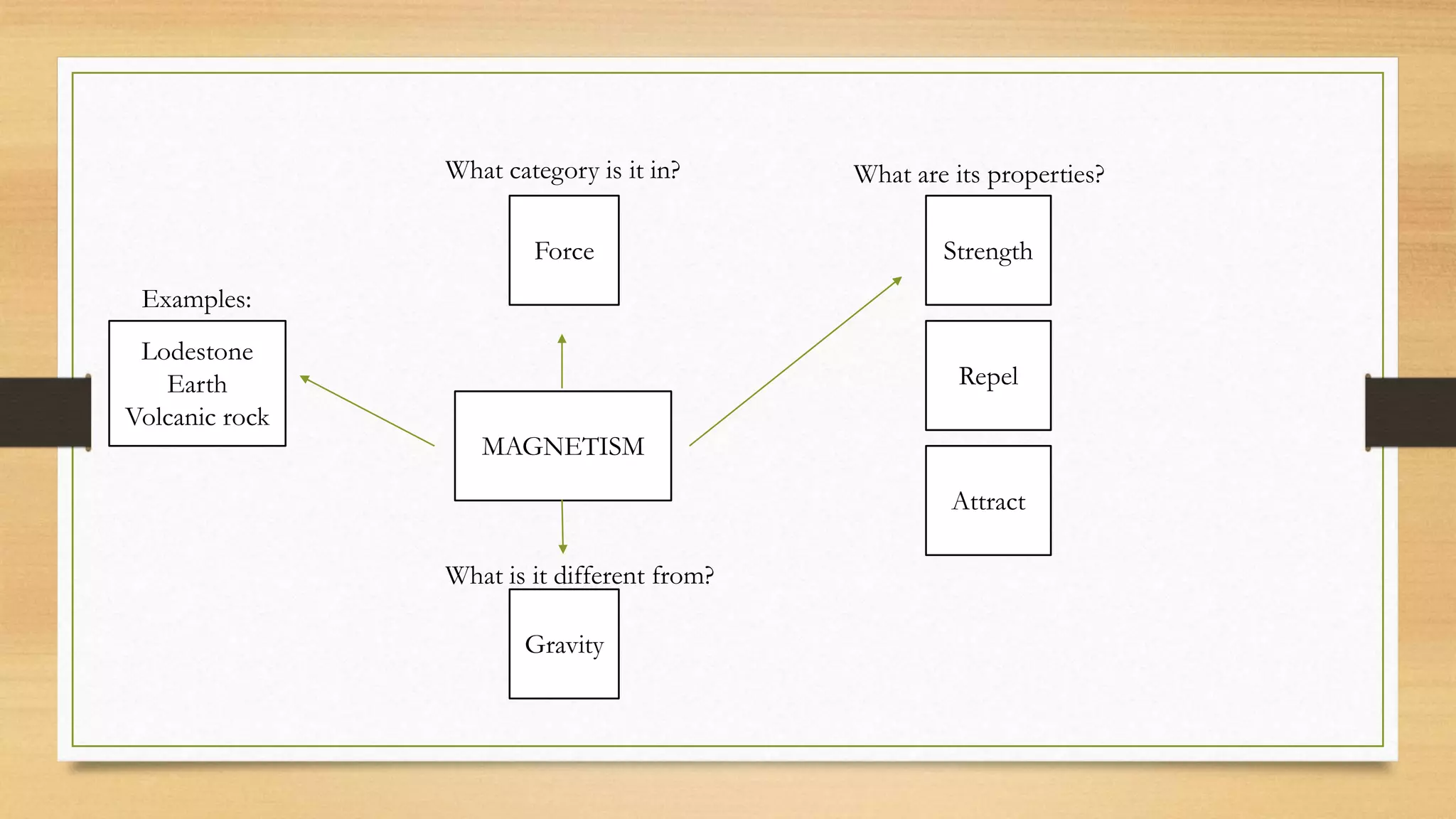
Concept Definition Map
• Write the term “magnetism” (concept) in the center of your concept map.
• Read the text about the Science of Magnets (concept) to find information to
fill in the parts of the concept map. Compare your map with a partner’s map,
use text to defend, and adjust as needed.
• Debrief with class and then write a one paragraph definition of
“magnetism.”
MAGNETISM
Examples:
What category is it in?
What is it different from?
What are its properties?
Force Strength
Repel
Attract
MAGNETISM
Gravity
Lodestone
Earth
Volcanic rock
Examples:
What category is it in?
What is it different from?
What are its properties?
Cornell Graphic Organizer
• With a partner or group, survey passage (title, subheadings, captions,
pictures, first and last sentences).
• Develop questions from the above and write in the first column.
• Read passage and highlight details that will help answer questions.
• When you finish reading, use information to answer questions (second
column).
Cornell Graphic Organizer
• As a group, discuss the details/answers you recorded in the second column
and determine a main idea (What do all of these details have in common?)
and write the main idea in the third column.
• Use the self-evaluation key and code your details and questions.
• Prepare a group presentation for the class on your section of the reading
passage.
Cornell Graphic Organizer
Pg. 60: Why is there a photo of hot
Lava?
Pg. 61: How do geologists read
rocks?
Pg. 62: How is the geographic pole
different from the magnetic pole?
Questions Details Main Idea
Lava contains magnetite.
When it is cool, it behaves like a
small magnet.
They use a magnetometer to
measure the lava rock’s
magnetism.
Geographic pole tells the earth’s
point of rotation. Magnetic
poles are where the Earth’s
magnetic force is greatest.
Geologists study volcanic
rock to determine the
movement of Earth’s
magnetic poles.
Self Assessment Key:
Check mark: I know this
Question mark: I have a
question about this
Exclamation point:: I need to
review this more
Jigsaw Activity
• Students will complete a jigsaw activity for remaining parts of the book, The
Science of Magnets
• Part One of the jigsaw activity: Table groups will be assigned one of the four
remaining areas: Electromagnets- p. 16-17, Finding Directions- p. 22-23, Magnets and
Medicine- p. 26-27, and Magnets in Unexpected Places- p. 28-29.
• The groups will work together to read their assigned section of text and record any
information they would like to teach to the other groups (students are not filling in
their tree maps until after the second part of the jigsaw activity).
Jigsaw Activity
• Part Two of the jigsaw activity: Students will then breakaway from their Part One table group
and get into groups of four (one student to represent each area) and will discuss the information
from their previous group. Therefore, each group of four should include a student that can
discuss Electromagnets, one that can discuss Finding Directions, one that can discuss Magnets and
Medicine, and one that can discuss Magnets in Unexpected Places. The students will be expected to
teach the information from the Part One task. While each student is sharing, the other three
students should be taking notes. All the information will be used to fill in the last part of the tree
map entitled "Everyday Uses of Magnets." Using the details from the tree map, students should
now be able to determine a main idea (Ex: Magnetism is an invisible force that attracts metals
made of steel or iron and can be used to help us in everyday life.)
• Students can use the graphic organizers, text, and discussion notes to summarize the information
and answer the essential question
Session Goals
Explore examples of current research and best
practices in achieving literacy through science
education
Model strategies that demonstrate how reading,
writing, and discussion promote science literacy
Bibliography
Carolina Curriculum Leadership Series
http://www.carolinacurriculum.com/leadership/downloads/2012/integrating+literacy.pdf
CPALMS WHERE Educators Go For Bright Ideas
http://www.cpalms.org/Public/PreviewResourceLesson/Preview/36075
John Hattie: The leader as evaluator, part 3: seeing learning through the eyes of students
https://vimeo.com/23887656
MARZANO Research Leading the Way
http://www.marzanoresearch.com/instructional-strategies
Persuasion and Argument
share the goal of asserting a claim and trying to
convince a reader or audience of its validity
Persuasion
Uses unverifiable personal anecdotes and
a more apparent emotional appeal to
make its case.
The claim usually comes first; then the
persuader builds a case to convince a
particular audience to think or feel the
same way.
Argumentation
The focus is on logic supported by
verifiable examples and facts
Evidence-based argument builds the case
for its claim out of available evidence.
Solid understanding of the material at
hand is necessary in order to argue
effectively.
Extra Slides
Writing in Science
Persuasion and Argument
share the goal of asserting a claim and trying to
convince a reader or audience of its validity
Persuasion
Uses unverifiable personal anecdotes and
a more apparent emotional appeal to
make its case.
The claim usually comes first; then the
persuader builds a case to convince a
particular audience to think or feel the
same way.
Argumentation
The focus is on logic supported by
verifiable examples and facts
Evidence-based argument builds the case
for its claim out of available evidence.
Solid understanding of the material at
hand is necessary in order to argue
effectively.
CLAIM
Statement about the results of an investigation
• A one-sentence answer to the question you investigated
• It answers, what can you conclude?
• It should not start with yes or no
• It should describe the relationship between dependent and independent
variables
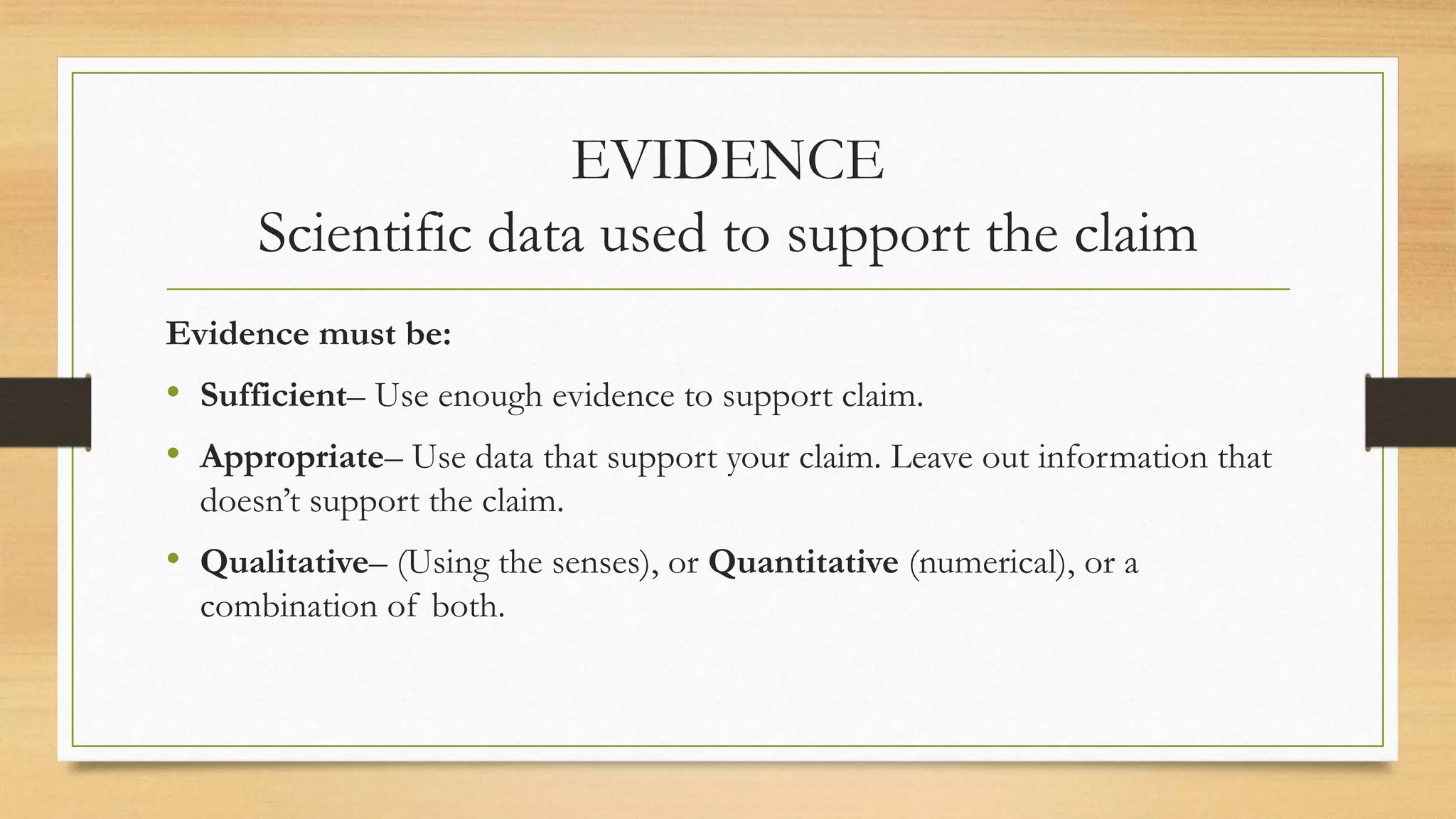
EVIDENCE
Scientific data used to support the claim
Evidence must be:
• Sufficient– Use enough evidence to support claim.
• Appropriate– Use data that support your claim. Leave out information that
doesn’t support the claim.
• Qualitative– (Using the senses), or Quantitative (numerical), or a
combination of both.
What words, lines, ideas, and phrases seem important and interesting in
this text? (These ideas may come from responses to text-dependent
questions or other close reading activities.)
What patterns do you see? What connections seem to exist among
these important ideas and details
What evidence-based claims would these patterns allow
you to make about the text? What conclusion can you
draw from the text and support with evidence from the
text?
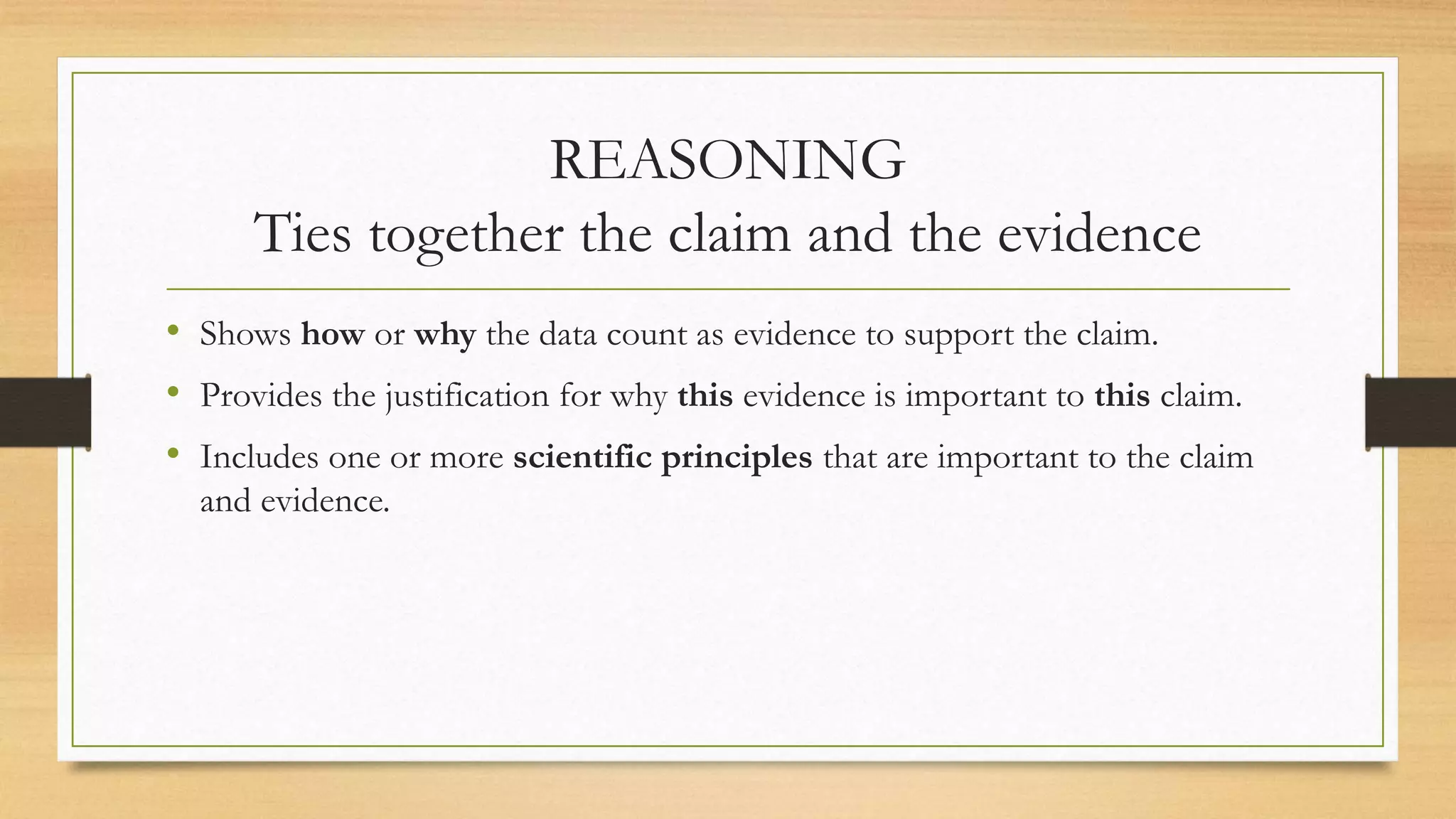
REASONING
Ties together the claim and the evidence
• Shows how or why the data count as evidence to support the claim.
• Provides the justification for why this evidence is important to this claim.
• Includes one or more scientific principles that are important to the claim
and evidence.
Evidence-Based Argument Checklist
Early in the piece, I offer a clear and interesting claim about the text.
The claim is arguable—someone could use evidence to offer a different interpretation or
disagree with me.
I use at least three pieces of direct evidence from the text, video, and lab data to support my
claim.
The evidence I use shows that I know the text well and have thought about it more than just
a superficial reading.
I organize my evidence into meaningful points using reasoning/justification as to how or
why this text or data count as evidence to support the claim.
The reader understands and why the evidence supports the claim.

English science-kathy caton

  • 1.
    English and Science IntegratingLiteracy Strategies into Science Instruction Kathy Caton, Masters in Education Rogers, Arkansas U.S.A. America
  • 2.
    Session Goals Explore examplesof current research and best practices in achieving literacy through science education Model strategies that demonstrate how reading, writing, and discussion promote science literacy
  • 3.
    Research Shows… If teachersuse literacy in the content area strategies 15-20 minutes (a couple of times each week), students increase reading levels and significantly improve performance on content area standardized testing.
  • 4.
    Are Literacy andScience a Natural Fit? Content Area Literacy is defined as… The level of reading, writing, and speaking skill necessary to read, comprehend, and respond to appropriate instructional materials in a given subject area.
  • 5.
    Comparison of Skill Science •Observing • Predicting • Inferring • Comparing & Contrasting • Communicating • Classifying • Collecting & Organizing Data • Interpreting Data • Linking Cause & Effect • Formulating Conclusions Reading • Note Taking • Predicting • Inferring • Comparing & Contrasting • Communicating • Sequencing • Summarizing • Recognizing Main Idea • Recognizing Cause & Effect • Drawing Conclusions
  • 6.
    Marzano says… ContentArea Terms/Vocabulary Provide direct instruction in vocabulary and phrases that are important to specific subject matter content.
  • 7.
    VOCABULARY Explain vs. Define OnChart Paper… • List words that will be new to their speaking, listening, or reading vocabulary (key terms). • Explain in “student friendly” terms what the word means. • Use movement whenever possible to engage students. • Post-it-notes • Word walls • Gallery walk
  • 8.
    Customer Focus The U.S.Dept. of Education states there are 2 types of reading all workers must be able to do: 1. Comprehend reading materials related to daily core job responsibilities 2. Read occupational materials related to organizations, trade journals, etc.
  • 9.
    Close Reading ofText Think-aloud Teachers verbalize their thinking for students while reading a text.
  • 10.
    Successful Comprehension • Activatebackground knowledge through predictions and prior knowledge • Setting a purpose for reading • Review and clarify vocabulary • Questioning • Identify and clarify main ideas and details • Paraphrasing important information • Summarizing • Drawing Conclusions
  • 11.
    Format for Integration •Focus – Text Navigation– Build background knowledge, vocabulary, and engagement through predictions and prior knowledge • Explore – Inquiry, Hands-On Science • Reflect – Notebooking (teacher modeling is a must); Written justification, analysis, definition • Apply –Reading Selection with Strategy (teacher modeling is a must) (Anticipation Guide, Concept Map, Cornell Note taking, Jigsaw, etc.)
  • 12.
  • 13.
    Anticipation Guide • Identifyconcepts you want students to learn from the reading. • Create 4-6 statements that support or challenge beliefs or experiences. • Before reading the text, have students read and code each statement as to whether the text will agree or disagree with each statement (predictions, prior knowledge). • Have students read the selection to find evidence that either supports or disconfirms each statement. • While reading, students may change coding. • Partners share their coding and refer back to text for accuracy. • Discuss what was learned from reading. • Have students rewrite false statements to make them true (individually, partners, or whole group).
  • 14.
    Earth’s Magnetic Personality A=Agreewith Text D= Disagree with Text NS = Not Sure • _____Changes in Earth’s circulation patterns in the inner core cause the magnetic poles to change location. • ____The geographic north pole is now located in Antarctica. • _____The magnetic south pole is located approximately 11 degrees from the northern point of rotation. • _____Scientists predict that the Earth will flip upside down when the poles change.
  • 15.
    Concept Definition Map •Write the term “magnetism” (concept) in the center of your concept map. • Read the text about the Science of Magnets (concept) to find information to fill in the parts of the concept map. Compare your map with a partner’s map, use text to defend, and adjust as needed. • Debrief with class and then write a one paragraph definition of “magnetism.”
  • 16.
    MAGNETISM Examples: What category isit in? What is it different from? What are its properties?
  • 17.
    Force Strength Repel Attract MAGNETISM Gravity Lodestone Earth Volcanic rock Examples: Whatcategory is it in? What is it different from? What are its properties?
  • 18.
    Cornell Graphic Organizer •With a partner or group, survey passage (title, subheadings, captions, pictures, first and last sentences). • Develop questions from the above and write in the first column. • Read passage and highlight details that will help answer questions. • When you finish reading, use information to answer questions (second column).
  • 19.
    Cornell Graphic Organizer •As a group, discuss the details/answers you recorded in the second column and determine a main idea (What do all of these details have in common?) and write the main idea in the third column. • Use the self-evaluation key and code your details and questions. • Prepare a group presentation for the class on your section of the reading passage.
  • 20.
    Cornell Graphic Organizer Pg.60: Why is there a photo of hot Lava? Pg. 61: How do geologists read rocks? Pg. 62: How is the geographic pole different from the magnetic pole? Questions Details Main Idea Lava contains magnetite. When it is cool, it behaves like a small magnet. They use a magnetometer to measure the lava rock’s magnetism. Geographic pole tells the earth’s point of rotation. Magnetic poles are where the Earth’s magnetic force is greatest. Geologists study volcanic rock to determine the movement of Earth’s magnetic poles. Self Assessment Key: Check mark: I know this Question mark: I have a question about this Exclamation point:: I need to review this more
  • 21.
    Jigsaw Activity • Studentswill complete a jigsaw activity for remaining parts of the book, The Science of Magnets • Part One of the jigsaw activity: Table groups will be assigned one of the four remaining areas: Electromagnets- p. 16-17, Finding Directions- p. 22-23, Magnets and Medicine- p. 26-27, and Magnets in Unexpected Places- p. 28-29. • The groups will work together to read their assigned section of text and record any information they would like to teach to the other groups (students are not filling in their tree maps until after the second part of the jigsaw activity).
  • 22.
    Jigsaw Activity • PartTwo of the jigsaw activity: Students will then breakaway from their Part One table group and get into groups of four (one student to represent each area) and will discuss the information from their previous group. Therefore, each group of four should include a student that can discuss Electromagnets, one that can discuss Finding Directions, one that can discuss Magnets and Medicine, and one that can discuss Magnets in Unexpected Places. The students will be expected to teach the information from the Part One task. While each student is sharing, the other three students should be taking notes. All the information will be used to fill in the last part of the tree map entitled "Everyday Uses of Magnets." Using the details from the tree map, students should now be able to determine a main idea (Ex: Magnetism is an invisible force that attracts metals made of steel or iron and can be used to help us in everyday life.) • Students can use the graphic organizers, text, and discussion notes to summarize the information and answer the essential question
  • 23.
    Session Goals Explore examplesof current research and best practices in achieving literacy through science education Model strategies that demonstrate how reading, writing, and discussion promote science literacy
  • 24.
    Bibliography Carolina Curriculum LeadershipSeries http://www.carolinacurriculum.com/leadership/downloads/2012/integrating+literacy.pdf CPALMS WHERE Educators Go For Bright Ideas http://www.cpalms.org/Public/PreviewResourceLesson/Preview/36075 John Hattie: The leader as evaluator, part 3: seeing learning through the eyes of students https://vimeo.com/23887656 MARZANO Research Leading the Way http://www.marzanoresearch.com/instructional-strategies
  • 25.
    Persuasion and Argument sharethe goal of asserting a claim and trying to convince a reader or audience of its validity Persuasion Uses unverifiable personal anecdotes and a more apparent emotional appeal to make its case. The claim usually comes first; then the persuader builds a case to convince a particular audience to think or feel the same way. Argumentation The focus is on logic supported by verifiable examples and facts Evidence-based argument builds the case for its claim out of available evidence. Solid understanding of the material at hand is necessary in order to argue effectively.
  • 26.
  • 27.
    Persuasion and Argument sharethe goal of asserting a claim and trying to convince a reader or audience of its validity Persuasion Uses unverifiable personal anecdotes and a more apparent emotional appeal to make its case. The claim usually comes first; then the persuader builds a case to convince a particular audience to think or feel the same way. Argumentation The focus is on logic supported by verifiable examples and facts Evidence-based argument builds the case for its claim out of available evidence. Solid understanding of the material at hand is necessary in order to argue effectively.
  • 28.
    CLAIM Statement about theresults of an investigation • A one-sentence answer to the question you investigated • It answers, what can you conclude? • It should not start with yes or no • It should describe the relationship between dependent and independent variables
  • 29.
    EVIDENCE Scientific data usedto support the claim Evidence must be: • Sufficient– Use enough evidence to support claim. • Appropriate– Use data that support your claim. Leave out information that doesn’t support the claim. • Qualitative– (Using the senses), or Quantitative (numerical), or a combination of both.
  • 30.
    What words, lines,ideas, and phrases seem important and interesting in this text? (These ideas may come from responses to text-dependent questions or other close reading activities.) What patterns do you see? What connections seem to exist among these important ideas and details What evidence-based claims would these patterns allow you to make about the text? What conclusion can you draw from the text and support with evidence from the text?
  • 31.
    REASONING Ties together theclaim and the evidence • Shows how or why the data count as evidence to support the claim. • Provides the justification for why this evidence is important to this claim. • Includes one or more scientific principles that are important to the claim and evidence.
  • 32.
    Evidence-Based Argument Checklist Earlyin the piece, I offer a clear and interesting claim about the text. The claim is arguable—someone could use evidence to offer a different interpretation or disagree with me. I use at least three pieces of direct evidence from the text, video, and lab data to support my claim. The evidence I use shows that I know the text well and have thought about it more than just a superficial reading. I organize my evidence into meaningful points using reasoning/justification as to how or why this text or data count as evidence to support the claim. The reader understands and why the evidence supports the claim.