READING, WRITING AND SCIENCE: SYNERGISTIC LEARNING OPPORTUNITIES Inverness Research March 30, 2011A Briefing for the STEM Caucus www.inverness-research.org
MAIN MESSAGESEARLY LEARNING IN SCIENCE, WRITING AND READING ARE ALL IMPORTANTEARLY SCIENCE LEARNING IS BEING PUSHED OUT OF THE SCHOOLS GREAT POTENTIAL FOR SYNERGISTIC STEM LEARNING OPPORTUNITIES IN SCHOOL OUT OF SCHOOL OPPORTUNITIES DO NOT REALIZE THEMSELVES; THEY NEED INFRASTRUCTURE SUPPORT
EARLY SCIENCE LEARNING IS IMPORTANT
Finis Origine PendetMeaningful engagement with science in early years is a critical influence on the academic pathways studentschoose in middle and high school.(Tai, Liu, Maltese, & Fan, 2006)
Finis Origine Pendet“Encouragement of interest and exposure to the sciences should not be ignored in favor of an emphasis on standardized test preparation…*Tai, R.H.; Liu, Chrinstine Qu Liu, Maltese, Adam V.; Fan, Sitano. (2006). Planning Early for Careers in Science. Science (312)1143-1144
Contributions of Early STEM Learning Potential Benefits of Early Science Learning ExperiencesFoundation to further science learningFoundation to further intellectual developmentFostering “activation” -- further engagement and excitement in school/out of school STEM activities Providing a broader contribution to literacy
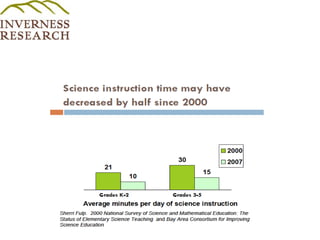
ELEMENTARY SCIENCE IS DISAPPEARING FROM THE  SCHOOLS
The importance of learning to write at an early age
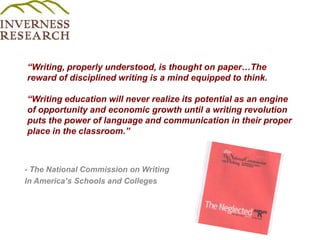
“Writing, properly understood, is thought on paper…The reward of disciplined writing is a mind equipped to think.  “Writing education will never realize its potential as an engine of opportunity and economic growth until a writing revolution puts the power of language and communication in their proper place in the classroom.”- The National Commission on WritingIn America’s Schools and Colleges
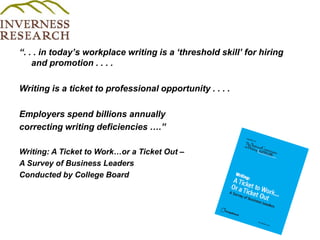
“. . . in today’s workplace writing is a ‘threshold skill’ for hiring and promotion . . . .Writing is a ticket to professional opportunity . . . . Employers spend billions annuallycorrecting writing deficiencies ….”Writing: A Ticket to Work…or a Ticket Out – A Survey of Business LeadersConducted by College Board
“Effective writing skills are important in all stages of life from early education to future employment.”- National Center for Education Statistics (U.S. Department of Education), The Condition of Education, p. 70
THE IMPORTANCE OF LEARNING TO READ AT AN EARLY AGE  (Can you read this powerpoint?)(Did it matter that you learned how to read at an early age?) RES IPSA LOQUITUR
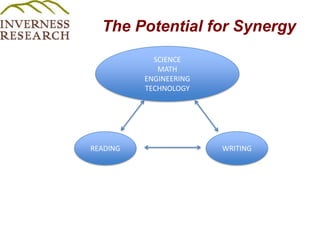
The Potential for SynergySCIENCEMATHENGINEERINGTECHNOLOGY WRITING READING
Science  Literacy Inquiry science, which promotes students’ construction of meaning through exploration of scientific phenomenon, observations, experiments, and hands-on activities, provides an authentic context for language use.(National Research Council, 1996)
Science  Literacy Cultivating science skills within literacy development can be a powerful way to build reading students’ skills and learn science content at the same time.(Carnegie Corp. of NY and Institute for Advanced Study Report, 2007)
Science  Literacy As children engage in scientific activities, they use and learn academic language that accomplishes a range of scientific purposes, e.g., description, formulating scientific hypothesis, proposing alternatives, classifying, inferring, interpreting, predicting and generalizing.  In addition inquiry based science environments provide children with a meaningful and engaging context for learning language.(T. Stoddart, A. Pinal, M. Latzke, D. Canaday, 2002)
Science   Literacy“Hands-on, investigation-based science is an effective context for the teaching and learning of expository writing. Writing fosters thinking about and internalization of concepts through language; science experience generates important, compelling content about which to write.” -Finding, 2003 Inverness Research evaluation
Writing In Elementary Science Can Raise Science Achievement And Help Shrink the Achievement GapSeattle Public Schools out-performed WA average in 5th grade State Science Assessment in 2003-4 and 2004-5District demographics predicted lower scores, but science scores were higherShrinking the achievement gapHigher science scores in lowest-SES schools correlated to teacher participation in Science-Writing Program Two-year Evaluation by National Center for Research on Evaluation, Standards and Student Testing, UCLA
Effective integration does not happen automatically
A Need for Research on Design and Implementation Although there is strong support for the use of science and literacy strategies at the elementary level, little research has been conducted on the issues that teachers encounter as they incorporate these new practices into their instruction.  Pegg, Jerine (2010).  Integrating Literacy into Elementary Science:  Teacher Concerns and their Resolutions. Electronic Journal of Literacy Through Science, v. 9.  http://ejlts.ucdavis.edu/sites/ejlts.ucdavis.edu/files/articles/Pegg_EJLTS_final.pdf
An I3 Project Integrating English Language Development and Science: A Professional Development Approach The framing hypothesis for this project is that strategically designed professional development focused on integrated ELD and science will increase the percentage of highly effective teachers, as measured by both teacher performance and student achievement in English language development and in scienceThe Exploratorium and the Sonoma Valley Unified School District
Integration – A topic of study The Electronic Journal of Literacy through Science (EJLTS) will be devoted to addressing science education by focusing on "Literacy through Science" in the areas of:   1. Language Development (Reading and Writing) and Science Education   2. Bilingualism and Science Education   3. Scientific Literacy for All
A Need for Infrastructure as well as “Projects”The National Writing Project Reading is Fundamental The National Science Project, Math Project, Reading Project…? THE FEDERAL ROLE IN EDUCATION IS TO HELP DEVELOP AND SUPPORT STABLE NATIONAL “IMPROVEMENT INFRASTRUCTURES” THAT CAN SUPPORT IMPROVEMENT AND DISSEMINATE INNOVATIONS ON AN ONGOING BASIS …  Dr. Mark St. John…
A need for materials, books,  activities, kits, tools…  Materials designed for a range of venues and audiences:SchoolsAfter school programs Informal science settings (museums, camps, nature centers…) FamiliesYouth (autonomous)
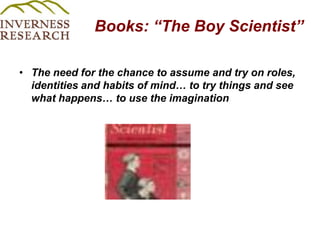
Books: “The Boy Scientist” The need for the chance to assume and try on roles, identities and habits of mind… to try things and see what happens… to use the imagination
Supporting the enthusiasm of the next generation

Reading, writing and science synergistic learning opportunities

  • 1.
    READING, WRITING ANDSCIENCE: SYNERGISTIC LEARNING OPPORTUNITIES Inverness Research March 30, 2011A Briefing for the STEM Caucus www.inverness-research.org
  • 2.
    MAIN MESSAGESEARLY LEARNINGIN SCIENCE, WRITING AND READING ARE ALL IMPORTANTEARLY SCIENCE LEARNING IS BEING PUSHED OUT OF THE SCHOOLS GREAT POTENTIAL FOR SYNERGISTIC STEM LEARNING OPPORTUNITIES IN SCHOOL OUT OF SCHOOL OPPORTUNITIES DO NOT REALIZE THEMSELVES; THEY NEED INFRASTRUCTURE SUPPORT
  • 3.
  • 4.
    Finis Origine PendetMeaningfulengagement with science in early years is a critical influence on the academic pathways studentschoose in middle and high school.(Tai, Liu, Maltese, & Fan, 2006)
  • 5.
    Finis Origine Pendet“Encouragementof interest and exposure to the sciences should not be ignored in favor of an emphasis on standardized test preparation…*Tai, R.H.; Liu, Chrinstine Qu Liu, Maltese, Adam V.; Fan, Sitano. (2006). Planning Early for Careers in Science. Science (312)1143-1144
  • 6.
    Contributions of EarlySTEM Learning Potential Benefits of Early Science Learning ExperiencesFoundation to further science learningFoundation to further intellectual developmentFostering “activation” -- further engagement and excitement in school/out of school STEM activities Providing a broader contribution to literacy
  • 7.
    ELEMENTARY SCIENCE ISDISAPPEARING FROM THE SCHOOLS
  • 9.
    The importance oflearning to write at an early age
  • 10.
    “Writing, properly understood,is thought on paper…The reward of disciplined writing is a mind equipped to think. “Writing education will never realize its potential as an engine of opportunity and economic growth until a writing revolution puts the power of language and communication in their proper place in the classroom.”- The National Commission on WritingIn America’s Schools and Colleges
  • 11.
    “. . .in today’s workplace writing is a ‘threshold skill’ for hiring and promotion . . . .Writing is a ticket to professional opportunity . . . . Employers spend billions annuallycorrecting writing deficiencies ….”Writing: A Ticket to Work…or a Ticket Out – A Survey of Business LeadersConducted by College Board
  • 12.
    “Effective writing skillsare important in all stages of life from early education to future employment.”- National Center for Education Statistics (U.S. Department of Education), The Condition of Education, p. 70
  • 13.
    THE IMPORTANCE OFLEARNING TO READ AT AN EARLY AGE (Can you read this powerpoint?)(Did it matter that you learned how to read at an early age?) RES IPSA LOQUITUR
  • 14.
    The Potential forSynergySCIENCEMATHENGINEERINGTECHNOLOGY WRITING READING
  • 15.
    Science  LiteracyInquiry science, which promotes students’ construction of meaning through exploration of scientific phenomenon, observations, experiments, and hands-on activities, provides an authentic context for language use.(National Research Council, 1996)
  • 16.
    Science  LiteracyCultivating science skills within literacy development can be a powerful way to build reading students’ skills and learn science content at the same time.(Carnegie Corp. of NY and Institute for Advanced Study Report, 2007)
  • 17.
    Science  LiteracyAs children engage in scientific activities, they use and learn academic language that accomplishes a range of scientific purposes, e.g., description, formulating scientific hypothesis, proposing alternatives, classifying, inferring, interpreting, predicting and generalizing. In addition inquiry based science environments provide children with a meaningful and engaging context for learning language.(T. Stoddart, A. Pinal, M. Latzke, D. Canaday, 2002)
  • 18.
    Science  Literacy“Hands-on, investigation-based science is an effective context for the teaching and learning of expository writing. Writing fosters thinking about and internalization of concepts through language; science experience generates important, compelling content about which to write.” -Finding, 2003 Inverness Research evaluation
  • 19.
    Writing In ElementaryScience Can Raise Science Achievement And Help Shrink the Achievement GapSeattle Public Schools out-performed WA average in 5th grade State Science Assessment in 2003-4 and 2004-5District demographics predicted lower scores, but science scores were higherShrinking the achievement gapHigher science scores in lowest-SES schools correlated to teacher participation in Science-Writing Program Two-year Evaluation by National Center for Research on Evaluation, Standards and Student Testing, UCLA
  • 20.
    Effective integration doesnot happen automatically
  • 21.
    A Need forResearch on Design and Implementation Although there is strong support for the use of science and literacy strategies at the elementary level, little research has been conducted on the issues that teachers encounter as they incorporate these new practices into their instruction.  Pegg, Jerine (2010).  Integrating Literacy into Elementary Science:  Teacher Concerns and their Resolutions. Electronic Journal of Literacy Through Science, v. 9.  http://ejlts.ucdavis.edu/sites/ejlts.ucdavis.edu/files/articles/Pegg_EJLTS_final.pdf
  • 22.
    An I3 ProjectIntegrating English Language Development and Science: A Professional Development Approach The framing hypothesis for this project is that strategically designed professional development focused on integrated ELD and science will increase the percentage of highly effective teachers, as measured by both teacher performance and student achievement in English language development and in scienceThe Exploratorium and the Sonoma Valley Unified School District
  • 23.
    Integration – Atopic of study The Electronic Journal of Literacy through Science (EJLTS) will be devoted to addressing science education by focusing on "Literacy through Science" in the areas of: 1. Language Development (Reading and Writing) and Science Education 2. Bilingualism and Science Education 3. Scientific Literacy for All
  • 24.
    A Need forInfrastructure as well as “Projects”The National Writing Project Reading is Fundamental The National Science Project, Math Project, Reading Project…? THE FEDERAL ROLE IN EDUCATION IS TO HELP DEVELOP AND SUPPORT STABLE NATIONAL “IMPROVEMENT INFRASTRUCTURES” THAT CAN SUPPORT IMPROVEMENT AND DISSEMINATE INNOVATIONS ON AN ONGOING BASIS … Dr. Mark St. John…
  • 25.
    A need formaterials, books, activities, kits, tools… Materials designed for a range of venues and audiences:SchoolsAfter school programs Informal science settings (museums, camps, nature centers…) FamiliesYouth (autonomous)
  • 26.
    Books: “The BoyScientist” The need for the chance to assume and try on roles, identities and habits of mind… to try things and see what happens… to use the imagination
  • 27.
    Supporting the enthusiasmof the next generation