Keep Counting
Numbers /How many?
Level : 2nd Primary
Marta Saballs Pla
Background Information:
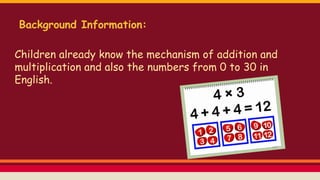
Children already know the mechanism of addition and
multiplication and also the numbers from 0 to 30 in
English.
Learning objectives:
Use the question "How many (noun) are there?"
Answer with the sentence "There are (number) (noun)”
Being able to calculate how many objects are using
addition and / or multiplication.
Reinforce and increase the knowledge of numbers in
English.
Being aware that mistakes is a way of learning.
Competencies involved:
Using Tools Interactively
Continuous speaking learning
Aplication of thinking skills
Participating and contributing
Well-being and confidence
Math skills
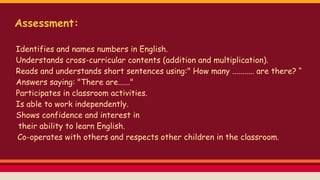
Assessment:
Identifies and names numbers in English.
Understands cross-curricular contents (addition and multiplication).
Reads and understands short sentences using:" How many ........... are there? “
Answers saying: "There are......"
Participates in classroom activities.
Is able to work independently.
Shows confidence and interest in
their ability to learn English.
Co-operates with others and respects other children in the classroom.
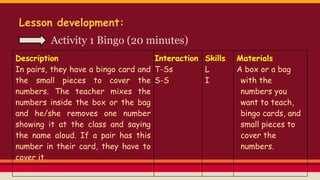
Lesson development:
Description
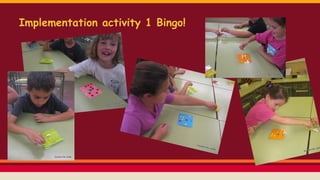
In pairs, they have a bingo card and
the small pieces to cover the
numbers. The teacher mixes the
numbers inside the box or the bag
and he/she removes one number
showing it at the class and saying
the name aloud. If a pair has this
number in their card, they have to
cover it.
Interactio
n
T-Ss
S-S
Skills
L
I
Materials
A box or a bag
with the
numbers you
want to teach,
bingo cards, and
small pieces to
cover the
numbers.
Activity 1 Bingo (20 minutes)
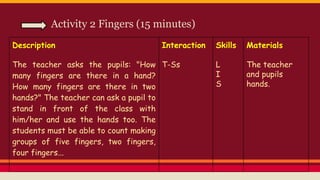
Activity 2 Fingers (15 minutes)
Description
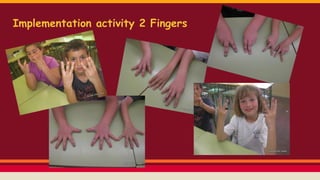
The teacher asks the pupils: "How
many fingers are there in a hand?
How many fingers are there in two
hands?" The teacher can ask a pupil
to stand in front of the class with
him/her and use the hands too. The
students must be able to count
making groups of five fingers, two
fingers, four fingers...
Interaction
T-Ss
Skills
L
I
S
Materials
The teacher
and pupils
hands.
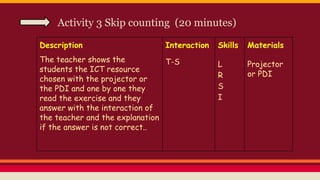
Activity 3 Skip counting (20 minutes)
Description
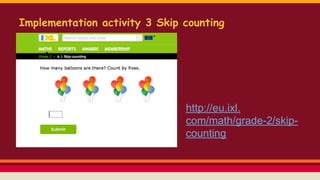
The teacher shows the
students the ICT resource
chosen with the projector or
the PDI and one by one they
read the exercise and they
answer with the interaction of
the teacher and the
explanation if the answer is not
correct..
Interaction
T-S
Skills
L
R
S
I
Materials
Projector
or PDI
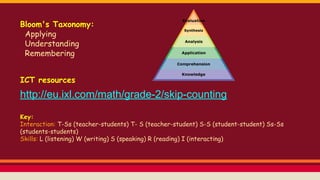
Bloom's Taxonomy:
Applying
Understanding
Remembering
ICT resources
http://eu.ixl.com/math/grade-2/skip-counting
Key:
Interaction: T-Ss (teacher-students) T- S (teacher-student) S-S (student-student) Ss-
Ss (students-students)
Skills: L (listening) W (writing) S (speaking) R (reading) I (interacting)
Implementation activity 1 Bingo!
Reflections activity 1 Bingo!
Children have really enjoyed with the first part of the
project: the bingo game.
The fact to play this game in pairs I think that has been very
useful for the students because they help each other to
remember the names of the numbers in English without
start counting from number one.
I have to say that the children get a little bit excited, so I
had to calm them down before doing the second part of the
project; maybe is not a good idea to do a bingo game at the
very beginning of the class.
Implementation activity 2 Fingers
Reflections activity 2 Fingers
The counting game using the fingers was great once they
got it. At the beginning some pupils used to count one by
one and they don't count in groups, but when they
realized they can make groups and multiply it was easy
and quick.
The students enjoyed thinking by themselves many
fingers groups and I walked around the class checking
their answers, it was great fun!
Implementation activity 3 Skip counting
http://eu.ixl.com/math/grade-2/skip-counting
http://eu.ixl.com/math/gra
de-2/skip-counting
Reflections activity 3 Skip counting
It was less time to practice the third part of the project.
Really a pity. But I promise them to do it on another
session.
The positive point is that now they all know how it works
and I can take it as a CLIL resource to review numbers,
addition and multiplication at any time.

English project

  • 1.
    Keep Counting Numbers /Howmany? Level : 2nd Primary Marta Saballs Pla
  • 2.
    Background Information: Children alreadyknow the mechanism of addition and multiplication and also the numbers from 0 to 30 in English.
  • 3.
    Learning objectives: Use thequestion "How many (noun) are there?" Answer with the sentence "There are (number) (noun)” Being able to calculate how many objects are using addition and / or multiplication. Reinforce and increase the knowledge of numbers in English. Being aware that mistakes is a way of learning.
  • 4.
    Competencies involved: Using ToolsInteractively Continuous speaking learning Aplication of thinking skills Participating and contributing Well-being and confidence Math skills
  • 5.
    Assessment: Identifies and namesnumbers in English. Understands cross-curricular contents (addition and multiplication). Reads and understands short sentences using:" How many ........... are there? “ Answers saying: "There are......" Participates in classroom activities. Is able to work independently. Shows confidence and interest in their ability to learn English. Co-operates with others and respects other children in the classroom.
  • 6.
    Lesson development: Description In pairs,they have a bingo card and the small pieces to cover the numbers. The teacher mixes the numbers inside the box or the bag and he/she removes one number showing it at the class and saying the name aloud. If a pair has this number in their card, they have to cover it. Interactio n T-Ss S-S Skills L I Materials A box or a bag with the numbers you want to teach, bingo cards, and small pieces to cover the numbers. Activity 1 Bingo (20 minutes)
  • 7.
    Activity 2 Fingers(15 minutes) Description The teacher asks the pupils: "How many fingers are there in a hand? How many fingers are there in two hands?" The teacher can ask a pupil to stand in front of the class with him/her and use the hands too. The students must be able to count making groups of five fingers, two fingers, four fingers... Interaction T-Ss Skills L I S Materials The teacher and pupils hands.
  • 8.
    Activity 3 Skipcounting (20 minutes) Description The teacher shows the students the ICT resource chosen with the projector or the PDI and one by one they read the exercise and they answer with the interaction of the teacher and the explanation if the answer is not correct.. Interaction T-S Skills L R S I Materials Projector or PDI
  • 9.
    Bloom's Taxonomy: Applying Understanding Remembering ICT resources http://eu.ixl.com/math/grade-2/skip-counting Key: Interaction:T-Ss (teacher-students) T- S (teacher-student) S-S (student-student) Ss- Ss (students-students) Skills: L (listening) W (writing) S (speaking) R (reading) I (interacting)
  • 10.
  • 11.
    Reflections activity 1Bingo! Children have really enjoyed with the first part of the project: the bingo game. The fact to play this game in pairs I think that has been very useful for the students because they help each other to remember the names of the numbers in English without start counting from number one. I have to say that the children get a little bit excited, so I had to calm them down before doing the second part of the project; maybe is not a good idea to do a bingo game at the very beginning of the class.
  • 12.
  • 13.
    Reflections activity 2Fingers The counting game using the fingers was great once they got it. At the beginning some pupils used to count one by one and they don't count in groups, but when they realized they can make groups and multiply it was easy and quick. The students enjoyed thinking by themselves many fingers groups and I walked around the class checking their answers, it was great fun!
  • 14.
    Implementation activity 3Skip counting http://eu.ixl.com/math/grade-2/skip-counting http://eu.ixl.com/math/gra de-2/skip-counting
  • 15.
    Reflections activity 3Skip counting It was less time to practice the third part of the project. Really a pity. But I promise them to do it on another session. The positive point is that now they all know how it works and I can take it as a CLIL resource to review numbers, addition and multiplication at any time.