MORPHOLOGICAL
ANALYSIS
ELT 333
MORPHEME
• The smallest meaningful part of a word. It is a single
minimal unit of meaning.
• Examples:
– fly (word) – flies is a morpheme
– fly  “s”  present tense morpheme
“s”  plural morpheme
TYPES OF MORPHEMES
1. Free Morpheme – single morpheme or the
base/root word
Ex.
beauty cloud
act look
people freeze
2. Bound Morpheme – those that are attached to
their free morpheme called affixes.
Types of Bound Morphemes
a. Plural Morpheme [-s]
b. Tense Morphemes
Phonologically conditioning
[-s] – present tense – acts
[-ed] – past tense – acted
[-ing] – progressive tense – acting
[-en] – past participle – eaten/acted
TYPES OF MORPHEMES
c. Genitive/Possessive Morpheme
[‘s] – Mary’s sister
d. Adjective Morpheme
[er] – comparative
[est] - superlative
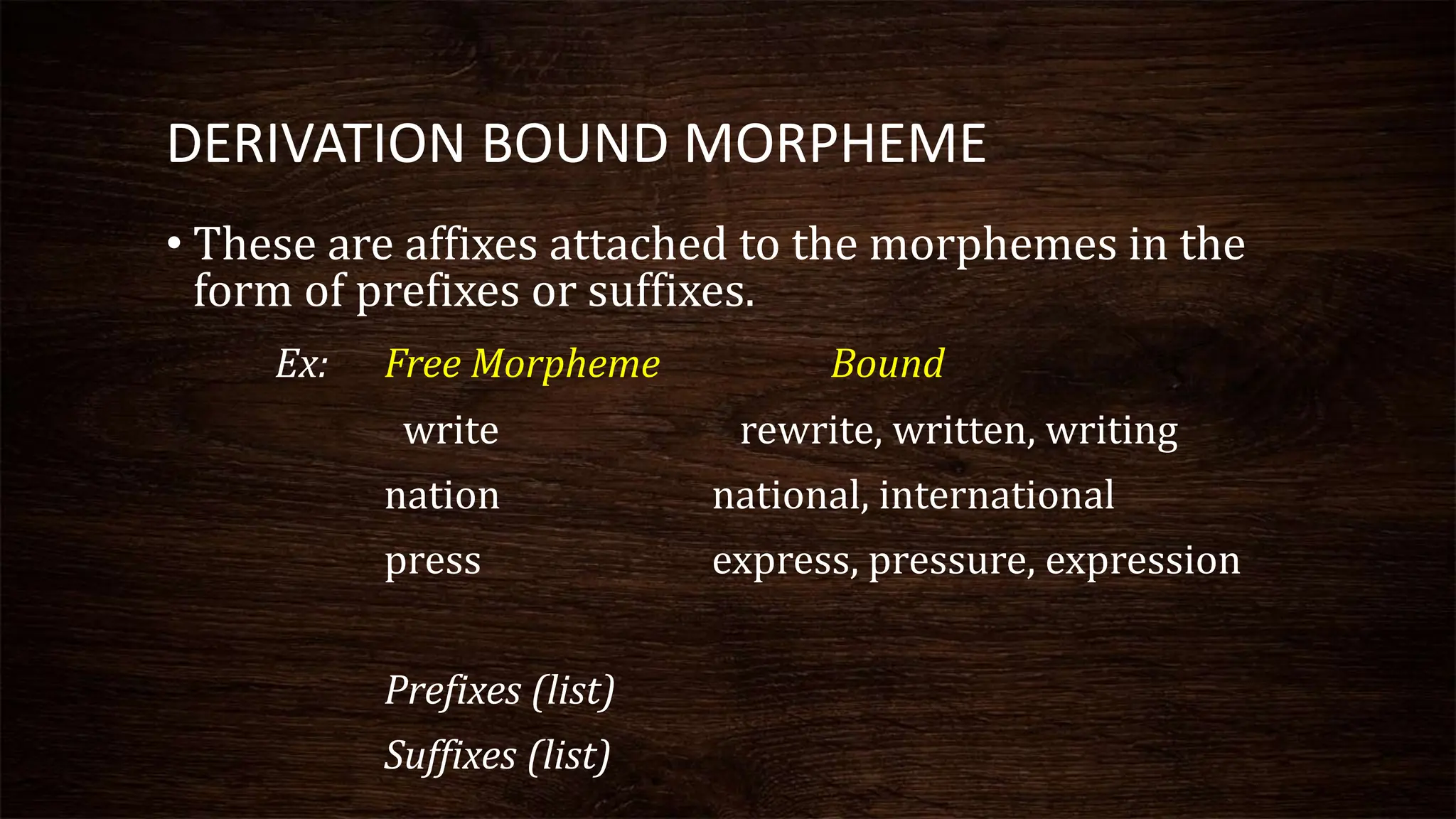
DERIVATION BOUND MORPHEME
• These are affixes attached to the morphemes in the
form of prefixes or suffixes.
Ex: Free Morpheme Bound
write rewrite, written, writing
nation national, international
press express, pressure, expression
Prefixes (list)
Suffixes (list)
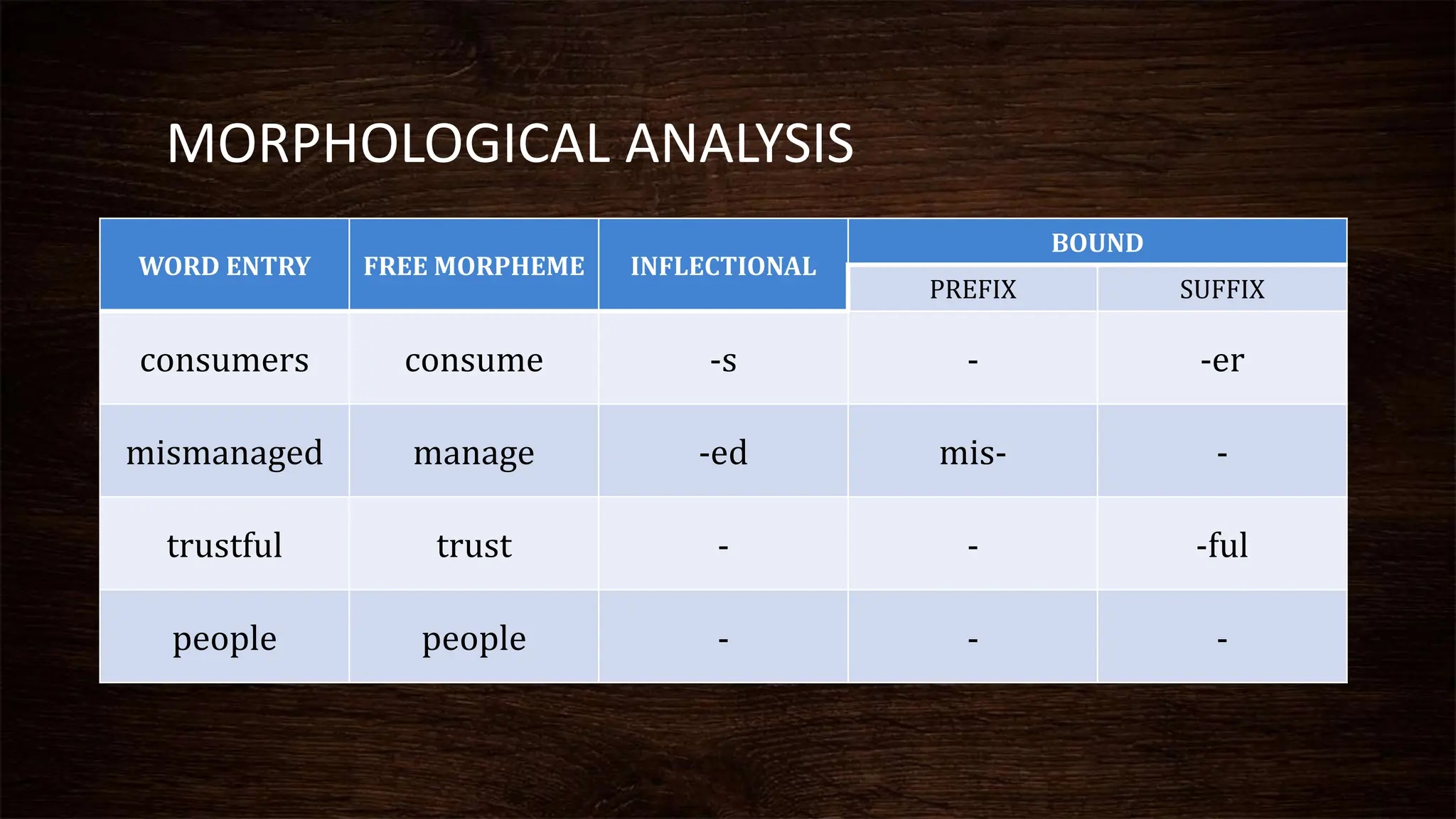
MORPHOLOGICAL ANALYSIS
WORD ENTRY FREE MORPHEME INFLECTIONAL
BOUND
PREFIX SUFFIX
consumers consume -s - -er
mismanaged manage -ed mis- -
trustful trust - - -ful
people people - - -
WORDS ARE OF THREE DIFFERENT TYPES
1. Lexical items – dictionary entries
Ex. hit (n) – a blow, a strike
hit (v) – strike with a blow
2. Syntactic words – different syntactic rules played by
words in a sentence.
Ex. The play was a big hit
Good tennis
WORS ARE OF THREE DIFFERENT TYPES
3. Phonological words – words with sequence of
phonemes.
Ex. hit – [hIt] language – [lӕŋuIdʒ]
beat – [bIt] make – [mek]
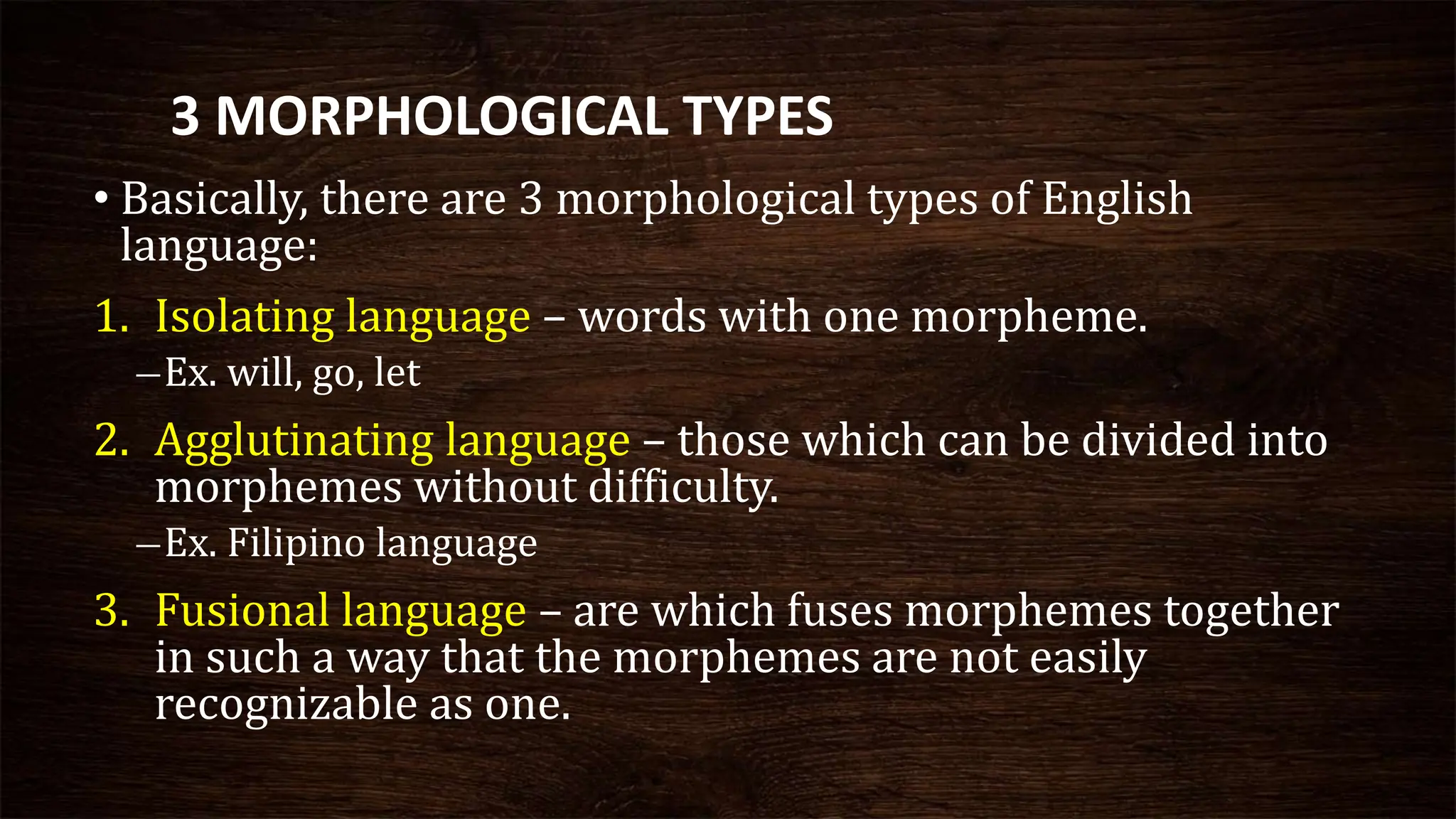
3 MORPHOLOGICAL TYPES
• Basically, there are 3 morphological types of English
language:
1. Isolating language – words with one morpheme.
–Ex. will, go, let
2. Agglutinating language – those which can be divided into
morphemes without difficulty.
–Ex. Filipino language
3. Fusional language – are which fuses morphemes together
in such a way that the morphemes are not easily
recognizable as one.
OTHER FORMS OF WORD FORMATION
• Originally, English words were formed with
tremendous borrowing (OE, ME) and coming from
other countries.
• As your advance English linguists and several
proponents/authors proposed other forms of how
words are formed.
OTHER FORMS OF WORD FORMATION
1. Derivation – (old)
2. Clipping – a common form or process whereby the
beginning or the end of the word is cut off or may mean
cutting from both ends leaving a part to stand for the
whole
Example: telephone  phone
psychology  psyche
chemistry  chem
laboratory  lab
influenza  flu
OTHER FORMS OF WORD FORMATION
3. Blending – fusing/putting 2 words together. The
usual process is first part of one word is blended or
fused with the last part of another.
Ex. Filipino, American – Fil-Am
European, Asian – Eurasian
medical, care – medicare
Philippine health - Philhealth
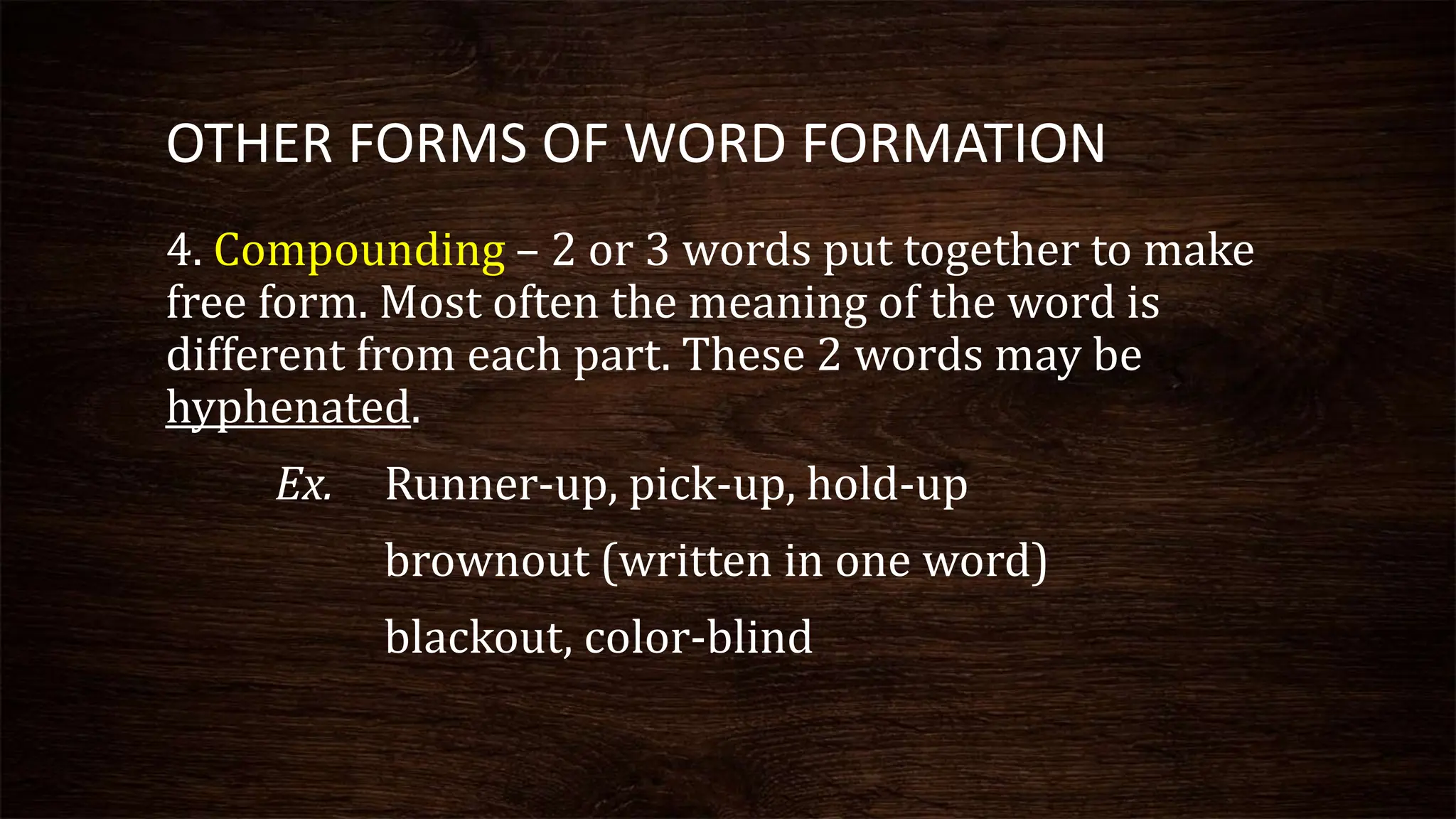
OTHER FORMS OF WORD FORMATION
4. Compounding – 2 or 3 words put together to make
free form. Most often the meaning of the word is
different from each part. These 2 words may be
hyphenated.
Ex. Runner-up, pick-up, hold-up
brownout (written in one word)
blackout, color-blind
OTHER FORMS OF WORD FORMATION
5. Acronymy – words are formed together from the
initial letter or syllables of several words in
succession.
Ex. PNU – Philippine Normal University
HNU – Holy Name University
SSS – Social Security System
OTHER FORMS OF WORD FORMATION
6. Root Creation – creating new word with no pre-
existing morphemes.
Ex. blog, twitter, poke
7. Substitution – a result of substituting a standard
word with an idiom.
Ex. Guys – for boys, girls
money – buck, bread
children - kids
OTHER FORMS OF WORD FORMATION
8. Category Extension – extending morpheme from
one systematic category to another.
9. Proper Names – formation of a word from proper
names.
Ex. Philippines – Filipino
Holy Name - Holynamians
OTHER FORMS OF WORD FORMATION
10. Abbreviation – includes formation of a word by
substituting a standard word from the first letters of a
word’s prominent syllables (inf idiom)
TV – television
JR – junior
TY – thank you
OMG – Oh my God
internet – international network
EXERCISES

English Language Teaching-333-Morphological-Analysis.pptx

  • 1.
  • 2.
    MORPHEME • The smallestmeaningful part of a word. It is a single minimal unit of meaning. • Examples: – fly (word) – flies is a morpheme – fly  “s”  present tense morpheme “s”  plural morpheme
  • 3.
    TYPES OF MORPHEMES 1.Free Morpheme – single morpheme or the base/root word Ex. beauty cloud act look people freeze
  • 4.
    2. Bound Morpheme– those that are attached to their free morpheme called affixes. Types of Bound Morphemes a. Plural Morpheme [-s] b. Tense Morphemes Phonologically conditioning [-s] – present tense – acts [-ed] – past tense – acted [-ing] – progressive tense – acting [-en] – past participle – eaten/acted
  • 5.
    TYPES OF MORPHEMES c.Genitive/Possessive Morpheme [‘s] – Mary’s sister d. Adjective Morpheme [er] – comparative [est] - superlative
  • 6.
    DERIVATION BOUND MORPHEME •These are affixes attached to the morphemes in the form of prefixes or suffixes. Ex: Free Morpheme Bound write rewrite, written, writing nation national, international press express, pressure, expression Prefixes (list) Suffixes (list)
  • 7.
    MORPHOLOGICAL ANALYSIS WORD ENTRYFREE MORPHEME INFLECTIONAL BOUND PREFIX SUFFIX consumers consume -s - -er mismanaged manage -ed mis- - trustful trust - - -ful people people - - -
  • 8.
    WORDS ARE OFTHREE DIFFERENT TYPES 1. Lexical items – dictionary entries Ex. hit (n) – a blow, a strike hit (v) – strike with a blow 2. Syntactic words – different syntactic rules played by words in a sentence. Ex. The play was a big hit Good tennis
  • 9.
    WORS ARE OFTHREE DIFFERENT TYPES 3. Phonological words – words with sequence of phonemes. Ex. hit – [hIt] language – [lӕŋuIdʒ] beat – [bIt] make – [mek]
  • 10.
    3 MORPHOLOGICAL TYPES •Basically, there are 3 morphological types of English language: 1. Isolating language – words with one morpheme. –Ex. will, go, let 2. Agglutinating language – those which can be divided into morphemes without difficulty. –Ex. Filipino language 3. Fusional language – are which fuses morphemes together in such a way that the morphemes are not easily recognizable as one.
  • 11.
    OTHER FORMS OFWORD FORMATION • Originally, English words were formed with tremendous borrowing (OE, ME) and coming from other countries. • As your advance English linguists and several proponents/authors proposed other forms of how words are formed.
  • 12.
    OTHER FORMS OFWORD FORMATION 1. Derivation – (old) 2. Clipping – a common form or process whereby the beginning or the end of the word is cut off or may mean cutting from both ends leaving a part to stand for the whole Example: telephone  phone psychology  psyche chemistry  chem laboratory  lab influenza  flu
  • 13.
    OTHER FORMS OFWORD FORMATION 3. Blending – fusing/putting 2 words together. The usual process is first part of one word is blended or fused with the last part of another. Ex. Filipino, American – Fil-Am European, Asian – Eurasian medical, care – medicare Philippine health - Philhealth
  • 14.
    OTHER FORMS OFWORD FORMATION 4. Compounding – 2 or 3 words put together to make free form. Most often the meaning of the word is different from each part. These 2 words may be hyphenated. Ex. Runner-up, pick-up, hold-up brownout (written in one word) blackout, color-blind
  • 15.
    OTHER FORMS OFWORD FORMATION 5. Acronymy – words are formed together from the initial letter or syllables of several words in succession. Ex. PNU – Philippine Normal University HNU – Holy Name University SSS – Social Security System
  • 16.
    OTHER FORMS OFWORD FORMATION 6. Root Creation – creating new word with no pre- existing morphemes. Ex. blog, twitter, poke 7. Substitution – a result of substituting a standard word with an idiom. Ex. Guys – for boys, girls money – buck, bread children - kids
  • 17.
    OTHER FORMS OFWORD FORMATION 8. Category Extension – extending morpheme from one systematic category to another. 9. Proper Names – formation of a word from proper names. Ex. Philippines – Filipino Holy Name - Holynamians
  • 18.
    OTHER FORMS OFWORD FORMATION 10. Abbreviation – includes formation of a word by substituting a standard word from the first letters of a word’s prominent syllables (inf idiom) TV – television JR – junior TY – thank you OMG – Oh my God internet – international network
  • 19.