English Language 1123 Essential
2k17
Workshop by: Sir Abdul Majid Khan @ Language Guru
Reading Paper
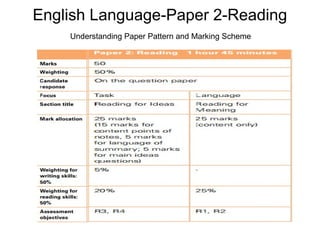
English Language-Paper 2-Reading
Understanding Paper Pattern and Marking Scheme
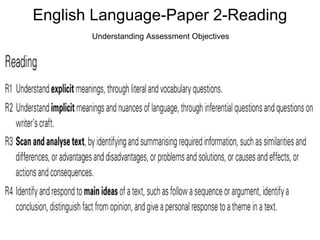
English Language-Paper 2-Reading
Understanding Assessment Objectives
English Language-Paper 2-Reading
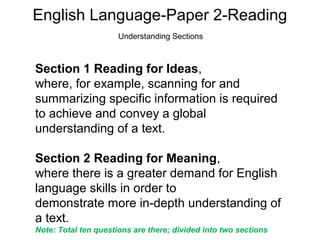
Understanding Sections
Section 1 Reading for Ideas,
where, for example, scanning for and
summarizing specific information is required
to achieve and convey a global
understanding of a text.
Section 2 Reading for Meaning,
where there is a greater demand for English
language skills in order to
demonstrate more in-depth understanding of
a text.
Note: Total ten questions are there; divided into two sections
English Language-Paper 2-Reading
Understanding Section 1 Reading for Ideas
“An insert of Non-fictional / Factual passage is given of around seven
hundred words, comprises of seven paragraphs.”
Question 1 (a) Notes [15 marks]
In order to attempt this question students have to skim and scan the required answer and
have lift from the passage and jot them in the relevant section. Here students are NOT
required to use their own words. the first point in each section of notes is done for you. You
will be awarded up to 15 marks for content points.
Question 1 (b) Summary [5 marks]
Now use your notes to write a summary in which you describe the content. This time, you
will be awarded up to 5 marks for using your own words wherever possible and for
accurate use of language.
Your summary, which must be in continuous writing (not note form), must be no longer than
160 words, including the 10 words given below.
Question 2 [3 marks]
Decide whether each of the following statements is true or false
and tick the boxes you have chosen.
Question 3 [2 marks]
Write opinion(s) / Fact(s) from the passage.
Note: Occasionally, Question 4 [1 mark] is also there; in that case question 3 carries [1
mark]
English Language-Paper 2-Reading
Understanding Section 1 Reading for Ideas
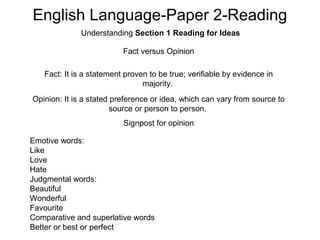
Fact versus Opinion
Fact: It is a statement proven to be true; verifiable by evidence in
majority.
Opinion: It is a stated preference or idea, which can vary from source to
source or person to person.
Signpost for opinion
Emotive words:
Like
Love
Hate
Judgmental words:
Beautiful
Wonderful
Favourite
Comparative and superlative words
Better or best or perfect
English Language-Paper 2-Reading
Understanding Section 1 Reading for Ideas
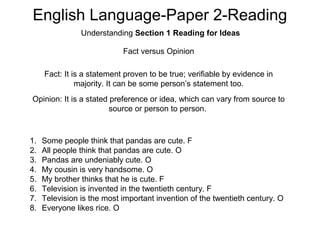
Fact versus Opinion
Fact: It is a statement proven to be true; verifiable by evidence in
majority. It can be some person’s statement too.
Opinion: It is a stated preference or idea, which can vary from source to
source or person to person.
1. Some people think that pandas are cute. F
2. All people think that pandas are cute. O
3. Pandas are undeniably cute. O
4. My cousin is very handsome. O
5. My brother thinks that he is cute. F
6. Television is invented in the twentieth century. F
7. Television is the most important invention of the twentieth century. O
8. Everyone likes rice. O
English Language-Paper 2-Reading
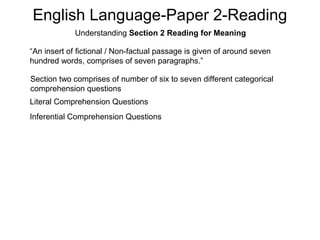
Understanding Section 2 Reading for Meaning
“An insert of fictional / Non-factual passage is given of around seven
hundred words, comprises of seven paragraphs.”
Section two comprises of number of six to seven different categorical
comprehension questions
Literal Comprehension Questions
Inferential Comprehension Questions
English Language-Paper 2-Reading
Understanding Section 2 Reading for Meaning
Categorical Comprehension Questions
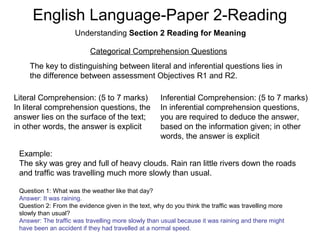
The key to distinguishing between literal and inferential questions lies in
the difference between assessment Objectives R1 and R2.
Literal Comprehension: (5 to 7 marks)
In literal comprehension questions, the
answer lies on the surface of the text;
in other words, the answer is explicit
Inferential Comprehension: (5 to 7 marks)
In inferential comprehension questions,
you are required to deduce the answer,
based on the information given; in other
words, the answer is explicit
Example:
The sky was grey and full of heavy clouds. Rain ran little rivers down the roads
and traffic was travelling much more slowly than usual.
Question 1: What was the weather like that day?
Answer: It was raining.
Question 2: From the evidence given in the text, why do you think the traffic was travelling more
slowly than usual?
Answer: The traffic was travelling more slowly than usual because it was raining and there might
have been an accident if they had travelled at a normal speed.
English Language-Paper 2-Reading
Understanding Section 2 Reading for Meaning
Categorical Comprehension Questions
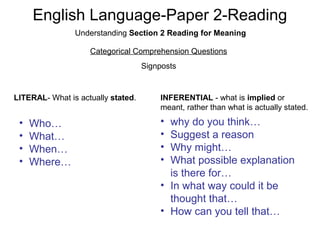
Signposts
LITERAL- What is actually stated. INFERENTIAL - what is implied or
meant, rather than what is actually stated.
• Who…
• What…
• When…
• Where…
• why do you think…
• Suggest a reason
• Why might…
• What possible explanation
is there for…
• In what way could it be
thought that…
• How can you tell that…
English Language-Paper 2-Reading
Understanding Section 2 Reading for Meaning
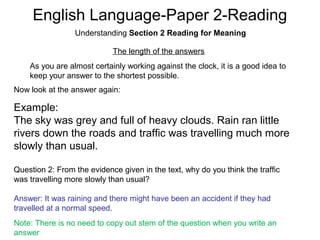
The length of the answers
As you are almost certainly working against the clock, it is a good idea to
keep your answer to the shortest possible.
Now look at the answer again:
Example:
The sky was grey and full of heavy clouds. Rain ran little
rivers down the roads and traffic was travelling much more
slowly than usual.
Question 2: From the evidence given in the text, why do you think the traffic
was travelling more slowly than usual?
Answer: It was raining and there might have been an accident if they had
travelled at a normal speed.
Note: There is no need to copy out stem of the question when you write an
answer
English Language-Paper 2-Reading
Understanding Section 2 Reading for Meaning
Categorical Comprehension Questions
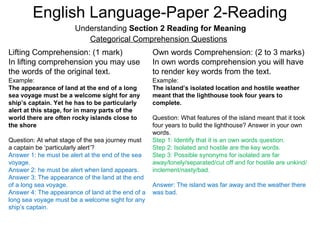
Lifting Comprehension: (1 mark)
In lifting comprehension you may use
the words of the original text.
Own words Comprehension: (2 to 3 marks)
In own words comprehension you will have
to render key words from the text.
Example:
The appearance of land at the end of a long
sea voyage must be a welcome sight for any
ship’s captain. Yet he has to be particularly
alert at this stage, for in many parts of the
world there are often rocky islands close to
the shore
Question: At what stage of the sea journey must
a captain be ‘particularly alert’?
Answer 1: he must be alert at the end of the sea
voyage.
Answer 2: he must be alert when land appears.
Answer 3: The appearance of the land at the end
of a long sea voyage.
Answer 4: The appearance of land at the end of a
long sea voyage must be a welcome sight for any
ship’s captain.
Example:
The island’s isolated location and hostile weather
meant that the lighthouse took four years to
complete.
Question: What features of the island meant that it took
four years to build the lighthouse? Answer in your own
words.
Step 1: Identify that it is an own words question.
Step 2: Isolated and hostile are the key words.
Step 3: Possible synonyms for isolated are far
away/lonely/separated/cut off and for hostile are unkind/
inclement/nasty/bad.
Answer: The island was far away and the weather there
was bad.
English Language-Paper 2-Reading
Understanding Section 2 Reading for Meaning
Categorical Comprehension Questions
Signposts
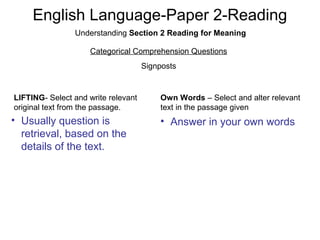
LIFTING- Select and write relevant
original text from the passage.
Own Words – Select and alter relevant
text in the passage given
• Answer in your own words• Usually question is
retrieval, based on the
details of the text.
English Language-Paper 2-Reading
Understanding Section 2 Reading for Meaning
Categorical Comprehension Questions
Combining Information Comprehension: (2 to 3 marks)
Combining comprehension require you to combine two or more separated
information, you must follow the normal procedure for selection and retrieval of
information as you do in literal and lifting.
Example:
The sun beat down on the pavements of the town. It was home to three thousand or so inhabitants,
with its quaint little market stalls selling hot food, its winding streets and crowded shops. Outside
the town, boys played on the banks of the dried up river.
Question: How can you tell that the weather is hot? Give two reasons for your answer. [2 marks]
Answer:
1. I know it is hot because the sun beat down the on the pavements.
2. I know it is hot because the river had dried up.
Example: The Storm
Huge waves pounded the stone walls built to keep the sea at bay, smashing free huge blocks of
marble and flinging them aside like pebbles, until the walls cracked and then collapsed.
Question: ‘Huge waves” pounded the sea walls. Explain fully the comparison used to show the strength of
these waves. [2 marks]
Answer: They smashed free blocks of marble and flung them aside like pebbles.
English Language-Paper 2-Reading
Understanding Section 2 Reading for Meaning
Categorical Comprehension Questions
Signposts
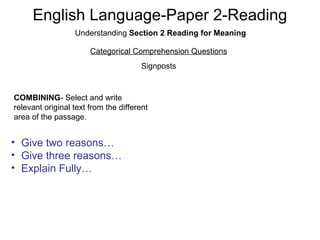
COMBINING- Select and write
relevant original text from the different
area of the passage.
• Give two reasons…
• Give three reasons…
• Explain Fully…
English Language-Paper 2-Reading
Understanding Section 2 Reading for Meaning
Categorical Comprehension Questions
Quotation Comprehension: (1 - 2 marks)
In quotation comprehension, you are asked to find a word or expression in the text
which means the same as other word or expression which comes either from the
text or which is a synonym provided by the writer of the question.
Example: Amy
The next moment, though,, she saw something more reassuring. In the far corner of the cave a large
white cloth screen was erected, musicians were gathering and people were taking their places for some
sort of show.
An old man made his entrance by the side of the screen, dressed in a tattered, grimy cloak, but it was his
intense expression that startled Amy. Her feelings of uneasiness returned as she watched him gaze
round the audience.
Amy panicked wildly. She ran outside, stumbling down the steps, blundering past the crowd, desperate
from the ghastly presence of the cave.
Question 1: Amy saw something ‘reassuring’. What single word used later in the passage shows that
later she was no longer feeling reassured? [1 mark]
Answer 1: Uneasiness.
Question 2: Pick out and write down the single word which shows that the older man’s clothes were dirty.
[1 mark]
Answer 2: Grimy
Question 3: Amy ‘ran outside’. Write down two separate words which shows that she was frightened as
she ran. [2 marks]
Answer 3: Stumbling and blundering.
English Language-Paper 2-Reading
Understanding Section 2 Reading for Meaning
Categorical Comprehension Questions
Signposts
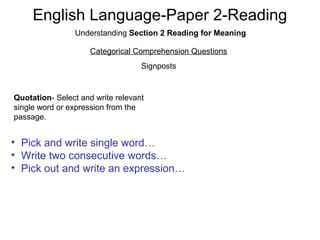
Quotation- Select and write relevant
single word or expression from the
passage.
• Pick and write single word…
• Write two consecutive words…
• Pick out and write an expression…
English Language-Paper 2-Reading
Understanding Section 2 Reading for Meaning
Categorical Comprehension Questions
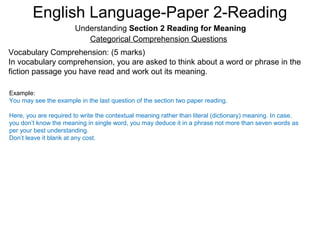
Vocabulary Comprehension: (5 marks)
In vocabulary comprehension, you are asked to think about a word or phrase in the
fiction passage you have read and work out its meaning.
Example:
You may see the example in the last question of the section two paper reading.
Here, you are required to write the contextual meaning rather than literal (dictionary) meaning. In case,
you don’t know the meaning in single word, you may deduce it in a phrase not more than seven words as
per your best understanding.
Don’t leave it blank at any cost.
English Language-Paper 2-Reading
Understanding Section 2 Reading for Meaning
Categorical Comprehension Questions
Writer’s Craft Comprehension: (1 - 2 marks)
In writer’s craft comprehension, you are asked to think about:
•Is the question asking only about the story or argument of the text?
•Is the question asking only about particular features of language, e.g. figures of
speech?
Question about writer’s craft go beyong literal and inferential comprehension. They
assume that the reader understands the meaning of what has been written but draw
the reader into responding to writing skills which are signs of a good piece of writing.
The answers to literal and inferential questions really answer the questions “What?”
or “Who?”, whereas answers to questions about the writer’s craft really answer the
questions “How?”
Example:
You may see the example in the last question of the section two paper reading.
Here, you are required to write the contextual meaning rather than literal (dictionary) meaning. In case,
you don’t know the meaning in single word, you may deduce it in a phrase not more than seven words as
English Language-Paper 2-Reading
Understanding Section 2 Reading for Meaning
Categorical Comprehension Questions
Writer’s Craft Comprehension: (1-2 marks)
Example: The Market in Mumbai
Rohit meandered through the market in Mumbai. He was on holiday after all, and the day was
stretched out before him like a century.
Question 1: Explain fully what effect the writer gains by her use of the word ‘meandered’. [2 marks]
Answer: He wandered/had no fix aim/was relaxed (any two for 1 mark each)
Question 2 Rohit was on holidays for the day. Why, therefore, does the writer compare the day to a
century? [1 mark]
Answer: he was relaxed/ felt he had plenty of time.
The End

English Language 1123 Essential 2k17 comprehension

  • 1.
    English Language 1123Essential 2k17 Workshop by: Sir Abdul Majid Khan @ Language Guru Reading Paper
  • 2.
    English Language-Paper 2-Reading UnderstandingPaper Pattern and Marking Scheme
  • 3.
  • 4.
    English Language-Paper 2-Reading UnderstandingSections Section 1 Reading for Ideas, where, for example, scanning for and summarizing specific information is required to achieve and convey a global understanding of a text. Section 2 Reading for Meaning, where there is a greater demand for English language skills in order to demonstrate more in-depth understanding of a text. Note: Total ten questions are there; divided into two sections
  • 5.
    English Language-Paper 2-Reading UnderstandingSection 1 Reading for Ideas “An insert of Non-fictional / Factual passage is given of around seven hundred words, comprises of seven paragraphs.” Question 1 (a) Notes [15 marks] In order to attempt this question students have to skim and scan the required answer and have lift from the passage and jot them in the relevant section. Here students are NOT required to use their own words. the first point in each section of notes is done for you. You will be awarded up to 15 marks for content points. Question 1 (b) Summary [5 marks] Now use your notes to write a summary in which you describe the content. This time, you will be awarded up to 5 marks for using your own words wherever possible and for accurate use of language. Your summary, which must be in continuous writing (not note form), must be no longer than 160 words, including the 10 words given below. Question 2 [3 marks] Decide whether each of the following statements is true or false and tick the boxes you have chosen. Question 3 [2 marks] Write opinion(s) / Fact(s) from the passage. Note: Occasionally, Question 4 [1 mark] is also there; in that case question 3 carries [1 mark]
  • 6.
    English Language-Paper 2-Reading UnderstandingSection 1 Reading for Ideas Fact versus Opinion Fact: It is a statement proven to be true; verifiable by evidence in majority. Opinion: It is a stated preference or idea, which can vary from source to source or person to person. Signpost for opinion Emotive words: Like Love Hate Judgmental words: Beautiful Wonderful Favourite Comparative and superlative words Better or best or perfect
  • 7.
    English Language-Paper 2-Reading UnderstandingSection 1 Reading for Ideas Fact versus Opinion Fact: It is a statement proven to be true; verifiable by evidence in majority. It can be some person’s statement too. Opinion: It is a stated preference or idea, which can vary from source to source or person to person. 1. Some people think that pandas are cute. F 2. All people think that pandas are cute. O 3. Pandas are undeniably cute. O 4. My cousin is very handsome. O 5. My brother thinks that he is cute. F 6. Television is invented in the twentieth century. F 7. Television is the most important invention of the twentieth century. O 8. Everyone likes rice. O
  • 8.
    English Language-Paper 2-Reading UnderstandingSection 2 Reading for Meaning “An insert of fictional / Non-factual passage is given of around seven hundred words, comprises of seven paragraphs.” Section two comprises of number of six to seven different categorical comprehension questions Literal Comprehension Questions Inferential Comprehension Questions
  • 9.
    English Language-Paper 2-Reading UnderstandingSection 2 Reading for Meaning Categorical Comprehension Questions The key to distinguishing between literal and inferential questions lies in the difference between assessment Objectives R1 and R2. Literal Comprehension: (5 to 7 marks) In literal comprehension questions, the answer lies on the surface of the text; in other words, the answer is explicit Inferential Comprehension: (5 to 7 marks) In inferential comprehension questions, you are required to deduce the answer, based on the information given; in other words, the answer is explicit Example: The sky was grey and full of heavy clouds. Rain ran little rivers down the roads and traffic was travelling much more slowly than usual. Question 1: What was the weather like that day? Answer: It was raining. Question 2: From the evidence given in the text, why do you think the traffic was travelling more slowly than usual? Answer: The traffic was travelling more slowly than usual because it was raining and there might have been an accident if they had travelled at a normal speed.
  • 10.
    English Language-Paper 2-Reading UnderstandingSection 2 Reading for Meaning Categorical Comprehension Questions Signposts LITERAL- What is actually stated. INFERENTIAL - what is implied or meant, rather than what is actually stated. • Who… • What… • When… • Where… • why do you think… • Suggest a reason • Why might… • What possible explanation is there for… • In what way could it be thought that… • How can you tell that…
  • 11.
    English Language-Paper 2-Reading UnderstandingSection 2 Reading for Meaning The length of the answers As you are almost certainly working against the clock, it is a good idea to keep your answer to the shortest possible. Now look at the answer again: Example: The sky was grey and full of heavy clouds. Rain ran little rivers down the roads and traffic was travelling much more slowly than usual. Question 2: From the evidence given in the text, why do you think the traffic was travelling more slowly than usual? Answer: It was raining and there might have been an accident if they had travelled at a normal speed. Note: There is no need to copy out stem of the question when you write an answer
  • 12.
    English Language-Paper 2-Reading UnderstandingSection 2 Reading for Meaning Categorical Comprehension Questions Lifting Comprehension: (1 mark) In lifting comprehension you may use the words of the original text. Own words Comprehension: (2 to 3 marks) In own words comprehension you will have to render key words from the text. Example: The appearance of land at the end of a long sea voyage must be a welcome sight for any ship’s captain. Yet he has to be particularly alert at this stage, for in many parts of the world there are often rocky islands close to the shore Question: At what stage of the sea journey must a captain be ‘particularly alert’? Answer 1: he must be alert at the end of the sea voyage. Answer 2: he must be alert when land appears. Answer 3: The appearance of the land at the end of a long sea voyage. Answer 4: The appearance of land at the end of a long sea voyage must be a welcome sight for any ship’s captain. Example: The island’s isolated location and hostile weather meant that the lighthouse took four years to complete. Question: What features of the island meant that it took four years to build the lighthouse? Answer in your own words. Step 1: Identify that it is an own words question. Step 2: Isolated and hostile are the key words. Step 3: Possible synonyms for isolated are far away/lonely/separated/cut off and for hostile are unkind/ inclement/nasty/bad. Answer: The island was far away and the weather there was bad.
  • 13.
    English Language-Paper 2-Reading UnderstandingSection 2 Reading for Meaning Categorical Comprehension Questions Signposts LIFTING- Select and write relevant original text from the passage. Own Words – Select and alter relevant text in the passage given • Answer in your own words• Usually question is retrieval, based on the details of the text.
  • 14.
    English Language-Paper 2-Reading UnderstandingSection 2 Reading for Meaning Categorical Comprehension Questions Combining Information Comprehension: (2 to 3 marks) Combining comprehension require you to combine two or more separated information, you must follow the normal procedure for selection and retrieval of information as you do in literal and lifting. Example: The sun beat down on the pavements of the town. It was home to three thousand or so inhabitants, with its quaint little market stalls selling hot food, its winding streets and crowded shops. Outside the town, boys played on the banks of the dried up river. Question: How can you tell that the weather is hot? Give two reasons for your answer. [2 marks] Answer: 1. I know it is hot because the sun beat down the on the pavements. 2. I know it is hot because the river had dried up. Example: The Storm Huge waves pounded the stone walls built to keep the sea at bay, smashing free huge blocks of marble and flinging them aside like pebbles, until the walls cracked and then collapsed. Question: ‘Huge waves” pounded the sea walls. Explain fully the comparison used to show the strength of these waves. [2 marks] Answer: They smashed free blocks of marble and flung them aside like pebbles.
  • 15.
    English Language-Paper 2-Reading UnderstandingSection 2 Reading for Meaning Categorical Comprehension Questions Signposts COMBINING- Select and write relevant original text from the different area of the passage. • Give two reasons… • Give three reasons… • Explain Fully…
  • 16.
    English Language-Paper 2-Reading UnderstandingSection 2 Reading for Meaning Categorical Comprehension Questions Quotation Comprehension: (1 - 2 marks) In quotation comprehension, you are asked to find a word or expression in the text which means the same as other word or expression which comes either from the text or which is a synonym provided by the writer of the question. Example: Amy The next moment, though,, she saw something more reassuring. In the far corner of the cave a large white cloth screen was erected, musicians were gathering and people were taking their places for some sort of show. An old man made his entrance by the side of the screen, dressed in a tattered, grimy cloak, but it was his intense expression that startled Amy. Her feelings of uneasiness returned as she watched him gaze round the audience. Amy panicked wildly. She ran outside, stumbling down the steps, blundering past the crowd, desperate from the ghastly presence of the cave. Question 1: Amy saw something ‘reassuring’. What single word used later in the passage shows that later she was no longer feeling reassured? [1 mark] Answer 1: Uneasiness. Question 2: Pick out and write down the single word which shows that the older man’s clothes were dirty. [1 mark] Answer 2: Grimy Question 3: Amy ‘ran outside’. Write down two separate words which shows that she was frightened as she ran. [2 marks] Answer 3: Stumbling and blundering.
  • 17.
    English Language-Paper 2-Reading UnderstandingSection 2 Reading for Meaning Categorical Comprehension Questions Signposts Quotation- Select and write relevant single word or expression from the passage. • Pick and write single word… • Write two consecutive words… • Pick out and write an expression…
  • 18.
    English Language-Paper 2-Reading UnderstandingSection 2 Reading for Meaning Categorical Comprehension Questions Vocabulary Comprehension: (5 marks) In vocabulary comprehension, you are asked to think about a word or phrase in the fiction passage you have read and work out its meaning. Example: You may see the example in the last question of the section two paper reading. Here, you are required to write the contextual meaning rather than literal (dictionary) meaning. In case, you don’t know the meaning in single word, you may deduce it in a phrase not more than seven words as per your best understanding. Don’t leave it blank at any cost.
  • 19.
    English Language-Paper 2-Reading UnderstandingSection 2 Reading for Meaning Categorical Comprehension Questions Writer’s Craft Comprehension: (1 - 2 marks) In writer’s craft comprehension, you are asked to think about: •Is the question asking only about the story or argument of the text? •Is the question asking only about particular features of language, e.g. figures of speech? Question about writer’s craft go beyong literal and inferential comprehension. They assume that the reader understands the meaning of what has been written but draw the reader into responding to writing skills which are signs of a good piece of writing. The answers to literal and inferential questions really answer the questions “What?” or “Who?”, whereas answers to questions about the writer’s craft really answer the questions “How?” Example: You may see the example in the last question of the section two paper reading. Here, you are required to write the contextual meaning rather than literal (dictionary) meaning. In case, you don’t know the meaning in single word, you may deduce it in a phrase not more than seven words as
  • 20.
    English Language-Paper 2-Reading UnderstandingSection 2 Reading for Meaning Categorical Comprehension Questions Writer’s Craft Comprehension: (1-2 marks) Example: The Market in Mumbai Rohit meandered through the market in Mumbai. He was on holiday after all, and the day was stretched out before him like a century. Question 1: Explain fully what effect the writer gains by her use of the word ‘meandered’. [2 marks] Answer: He wandered/had no fix aim/was relaxed (any two for 1 mark each) Question 2 Rohit was on holidays for the day. Why, therefore, does the writer compare the day to a century? [1 mark] Answer: he was relaxed/ felt he had plenty of time.
  • 21.