Lesson Plan in English 7: Literary writing and Academic writing
Name of Teacher Paul Jayson P. Toledo
Grade Level/Section 7-Amiable
Time 8:30-9:30
Time Frame 60 minutes
I. Objectives
A. Content Standard
The learner demonstrates understanding of precolonial
Philippine literature as a means of connecting to the past;
various reading styles; ways of determining word meanings; the
sounds of English and the prosodic features of speech; and
correct subject-verb agreement.
B. Performance Standard
The learner transfers learning by: showing appreciation for the
literature of the past; comprehending texts using appropriate
reading styles; participating in conversations using appropriate
context-dependent expressions; producing English sounds
correctly and using the prosodic features of speech effectively
in various situations; and observing correct subject-verb
agreements.
C. Learning Competencies
EN7WC-I-c-4.2: Differentiate literary writing from
academic writing
D. Learning Objectives
1. Define literary writing and academic writing.
2.Differentiate literary writing from academic
writing.
3. Share insights about the importance of the lesson
in the class.
II. Content /Subject Matter
A. Subject Integration ESP
B. Values Integration Valuing reliable information
III. Learning Resources
A. References
1. Teacher’s Guide Page
2. Learner’s Materials pages
3. Textbook pages
4. Additional Learning Materials
DepEd LR Portal,
http://www.writerstreasure.com/creative-writing-
technical-writing/https://freelance-
writing.lovetoknow.com/kind
5. Materials Laptop, TV, Activity Sheets, Book
IV. Learning Activities
Teachers’ Activity Learners’ Activity Indicator
A. Reviewing Previous Lesson or
Presenting the New Lesson.
Ask the students about the
discussion yesterday. (The Origin
of the World by Maranaw)
The students are expected to
recall the main events in the
story read.
Applied knowledge
of content within
and across
curriculum
teaching areas.
Activity
B. Establishing a Purpose for the
Lesson
The students are expected to answer
the following questions based on
what they observed and from what
they remembered from the discussion
yesterday.
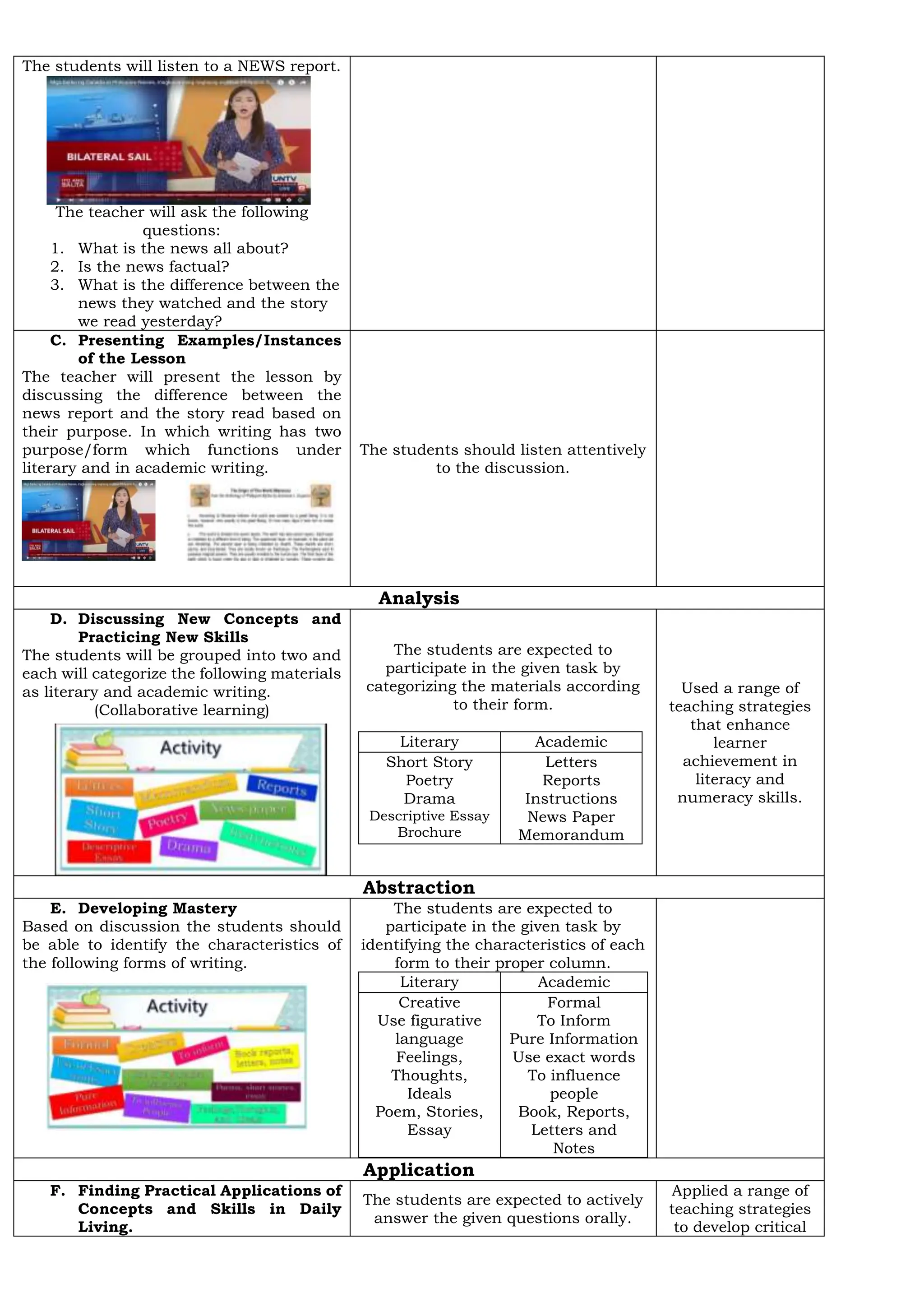
The students will listen to a NEWS report.
The teacher will ask the following
questions:
1. What is the news all about?
2. Is the news factual?
3. What is the difference between the
news they watched and the story
we read yesterday?
C. Presenting Examples/Instances
of the Lesson
The teacher will present the lesson by
discussing the difference between the
news report and the story read based on
their purpose. In which writing has two
purpose/form which functions under
literary and in academic writing.
The students should listen attentively
to the discussion.
Analysis
D. Discussing New Concepts and
Practicing New Skills
The students will be grouped into two and
each will categorize the following materials
as literary and academic writing.
(Collaborative learning)
The students are expected to
participate in the given task by
categorizing the materials according
to their form.
Literary Academic
Short Story
Poetry
Drama
Descriptive Essay
Brochure
Letters
Reports
Instructions
News Paper
Memorandum
Used a range of
teaching strategies
that enhance
learner
achievement in
literacy and
numeracy skills.
Abstraction
E. Developing Mastery
Based on discussion the students should
be able to identify the characteristics of
the following forms of writing.
The students are expected to
participate in the given task by
identifying the characteristics of each
form to their proper column.
Literary Academic
Creative
Use figurative
language
Feelings,
Thoughts,
Ideals
Poem, Stories,
Essay
Formal
To Inform
Pure Information
Use exact words
To influence
people
Book, Reports,
Letters and
Notes
Application
F. Finding Practical Applications of
Concepts and Skills in Daily
Living.
The students are expected to actively
answer the given questions orally.
Applied a range of
teaching strategies
to develop critical
The teacher will ask the following
questions:
1. How will you use this knowledge in
your daily life?
2. Why is it important to know where
to find reliable information?
and creative
thinking, as
well as other
higher-order
thinking skills.
G. Making Generalizations and
Abstractions about the Lesson
The teacher will ask some volunteers to
summarize the lesson.
The students are expected to
enumerate the main points of the
discussion/lesson.
H. Evaluating Learning
Identify the following forms whether they
are literary or academic writing. Write
your answer on the space provided for.
_________1. A piece of writing that explores
the emotional and psychological
experiences of characters in a fictional
story.
_________2. An article written for a peer-
reviewed journal that presents original
research findings, includes citations, and
follows a specific format.
_________3. A poem that uses vivid imagery
and figurative language to evoke emotions
and convey complex themes.
_________4. A research paper that analyzes
data, presents arguments, and aims to
contribute to a specific field of study.
_________5. A personal essay that reflects
on the author's life experiences, beliefs,
and opinions.
_________6. A scholarly book that provides
an in-depth examination of a historical
event or a literary work, often including
extensive references and citations.
_________7. A short story that uses
symbolism and allegory to convey a deeper
meaning or moral lesson.
_________8. A thesis statement written for
a college-level research paper.
________9. An annotated bibliography that
compiles sources and provides brief
summaries and evaluations of each
source.
________10. A play script that is meant to
be performed on stage and includes
dialogue.
The students are expected to get at
least 80% of the quiz.
I. Assignment
Prepared By:
PAUL JAYSON P. TOLEDO
Teacher I

English Grade 7 Lesson Plan by: Sir PAUL

  • 1.
    Lesson Plan inEnglish 7: Literary writing and Academic writing Name of Teacher Paul Jayson P. Toledo Grade Level/Section 7-Amiable Time 8:30-9:30 Time Frame 60 minutes I. Objectives A. Content Standard The learner demonstrates understanding of precolonial Philippine literature as a means of connecting to the past; various reading styles; ways of determining word meanings; the sounds of English and the prosodic features of speech; and correct subject-verb agreement. B. Performance Standard The learner transfers learning by: showing appreciation for the literature of the past; comprehending texts using appropriate reading styles; participating in conversations using appropriate context-dependent expressions; producing English sounds correctly and using the prosodic features of speech effectively in various situations; and observing correct subject-verb agreements. C. Learning Competencies EN7WC-I-c-4.2: Differentiate literary writing from academic writing D. Learning Objectives 1. Define literary writing and academic writing. 2.Differentiate literary writing from academic writing. 3. Share insights about the importance of the lesson in the class. II. Content /Subject Matter A. Subject Integration ESP B. Values Integration Valuing reliable information III. Learning Resources A. References 1. Teacher’s Guide Page 2. Learner’s Materials pages 3. Textbook pages 4. Additional Learning Materials DepEd LR Portal, http://www.writerstreasure.com/creative-writing- technical-writing/https://freelance- writing.lovetoknow.com/kind 5. Materials Laptop, TV, Activity Sheets, Book IV. Learning Activities Teachers’ Activity Learners’ Activity Indicator A. Reviewing Previous Lesson or Presenting the New Lesson. Ask the students about the discussion yesterday. (The Origin of the World by Maranaw) The students are expected to recall the main events in the story read. Applied knowledge of content within and across curriculum teaching areas. Activity B. Establishing a Purpose for the Lesson The students are expected to answer the following questions based on what they observed and from what they remembered from the discussion yesterday.
  • 2.
    The students willlisten to a NEWS report. The teacher will ask the following questions: 1. What is the news all about? 2. Is the news factual? 3. What is the difference between the news they watched and the story we read yesterday? C. Presenting Examples/Instances of the Lesson The teacher will present the lesson by discussing the difference between the news report and the story read based on their purpose. In which writing has two purpose/form which functions under literary and in academic writing. The students should listen attentively to the discussion. Analysis D. Discussing New Concepts and Practicing New Skills The students will be grouped into two and each will categorize the following materials as literary and academic writing. (Collaborative learning) The students are expected to participate in the given task by categorizing the materials according to their form. Literary Academic Short Story Poetry Drama Descriptive Essay Brochure Letters Reports Instructions News Paper Memorandum Used a range of teaching strategies that enhance learner achievement in literacy and numeracy skills. Abstraction E. Developing Mastery Based on discussion the students should be able to identify the characteristics of the following forms of writing. The students are expected to participate in the given task by identifying the characteristics of each form to their proper column. Literary Academic Creative Use figurative language Feelings, Thoughts, Ideals Poem, Stories, Essay Formal To Inform Pure Information Use exact words To influence people Book, Reports, Letters and Notes Application F. Finding Practical Applications of Concepts and Skills in Daily Living. The students are expected to actively answer the given questions orally. Applied a range of teaching strategies to develop critical
  • 3.
    The teacher willask the following questions: 1. How will you use this knowledge in your daily life? 2. Why is it important to know where to find reliable information? and creative thinking, as well as other higher-order thinking skills. G. Making Generalizations and Abstractions about the Lesson The teacher will ask some volunteers to summarize the lesson. The students are expected to enumerate the main points of the discussion/lesson. H. Evaluating Learning Identify the following forms whether they are literary or academic writing. Write your answer on the space provided for. _________1. A piece of writing that explores the emotional and psychological experiences of characters in a fictional story. _________2. An article written for a peer- reviewed journal that presents original research findings, includes citations, and follows a specific format. _________3. A poem that uses vivid imagery and figurative language to evoke emotions and convey complex themes. _________4. A research paper that analyzes data, presents arguments, and aims to contribute to a specific field of study. _________5. A personal essay that reflects on the author's life experiences, beliefs, and opinions. _________6. A scholarly book that provides an in-depth examination of a historical event or a literary work, often including extensive references and citations. _________7. A short story that uses symbolism and allegory to convey a deeper meaning or moral lesson. _________8. A thesis statement written for a college-level research paper. ________9. An annotated bibliography that compiles sources and provides brief summaries and evaluations of each source. ________10. A play script that is meant to be performed on stage and includes dialogue. The students are expected to get at least 80% of the quiz. I. Assignment Prepared By: PAUL JAYSON P. TOLEDO Teacher I