ENGLISH FOR INTERNATIONAL
                 COMMUNICATION

                               Mod:CEI-2


      This is a multi-level course in English as a second or foreign language
for young adults or adults. This course covers all the skills to learn a new
language; listening, speaking, reading and writing.

      It reflects the fact that English is the world’s major language of
international communication and it is not limited to any country, region or
culture.

      This course is designed for beginner students needing a through
presentation of basic functions, grammar and vocabulary. It is a self-
contained course covering all four language skills. Each level provides
between 60 to 90 hours of class instruction whichprepares students to
enter into a stimulating English world.

GOALS
      The primary goal is to teach communicative competence – that is
      the ability to communicate in English according to the situation,
      purpose, and role of the students.
      To improve students self-confidence on English learning.
      To masterize students’ pronunciation focusing on North American
      accent.
      To motivate students with technological tools.
      To reinforce information learned in previous courses.
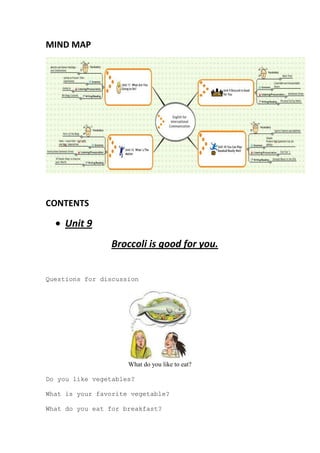
MIND MAP


CONTENTS

    Unit 9
                Broccoli is good for you.


Questions for discussion


                     What do you like to eat?

Do you like vegetables?

What is your favorite vegetable?

What do you eat for breakfast?
What do you eat for lunch?

What do you usually eat for dinner?

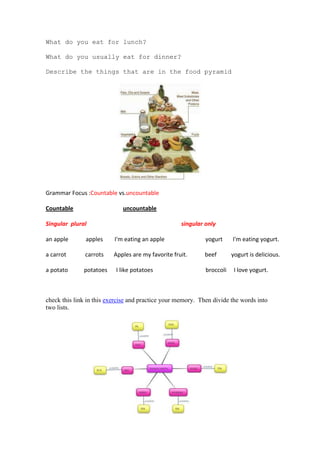
Describe the things that are in the food pyramid


Grammar Focus :Countable vs.uncountable

Countable                    uncountable

Singular plural                                     singular only

an apple       apples     I'm eating an apple                yogurt     I'm eating yogurt.

a carrot       carrots    Apples are my favorite fruit.     beef        yogurt is delicious.

a potato      potatoes    I like potatoes                    broccoli    I love yogurt.


check this link in this exercise and practice your memory. Then divide the words into
two lists.
Unit 10
               You can play baseball really well!


*What sports do people play in your country?

*Do you like sports?

*What sports do you play?


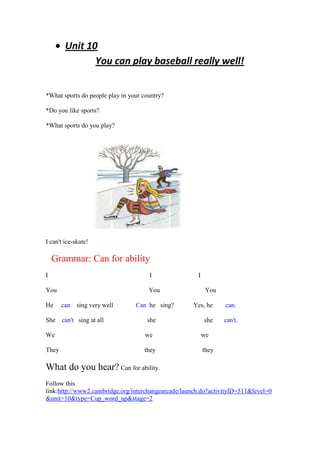
I can't ice-skate!

    Grammar: Can for ability
I                                     I               I

You                                   You                  You

He     can   sing very well      Can he sing?       Yes, he      can.

She can't sing at all                she                  she    can't.

We                                   we                   we

They                                they                  they

What do you hear? Can for ability.
Follow this
link:http://www2.cambridge.org/interchangearcade/launch.do?activityID=511&level=0
&unit=10&type=Cup_word_up&stage=2
SIMPLE PRESENT: WH-QUESTIONS

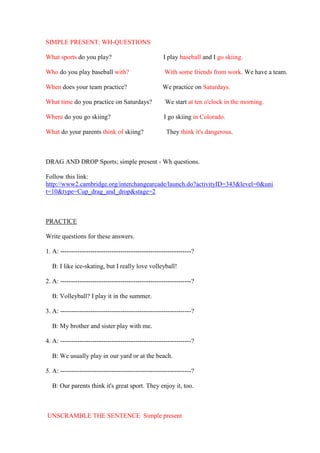
What sports do you play?                             I play baseball and I go skiing.

Who do you play baseball with?                        With some friends from work. We have a team.

When does your team practice?                        We practice on Saturdays.

What time do you practice on Saturdays?               We start at ten o'clock in the morning.

Where do you go skiing?                               I go skiing in Colorado.

What do your parents think of skiing?                  They think it's dangerous.


DRAG AND DROP Sports; simple present - Wh questions.

Follow this link:
http://www2.cambridge.org/interchangearcade/launch.do?activityID=343&level=0&uni
t=10&type=Cup_drag_and_drop&stage=2


PRACTICE

Write questions for these answers.

1. A: -------------------------------------------------------------?

  B: I like ice-skating, but I really love volleyball!

2. A: -------------------------------------------------------------?

  B: Volleyball? I play it in the summer.

3. A: -------------------------------------------------------------?

  B: My brother and sister play with me.

4. A: -------------------------------------------------------------?

  B: We usually play in our yard or at the beach.

5. A: -------------------------------------------------------------?

  B: Our parents think it's great sport. They enjoy it, too.


UNSCRAMBLE THE SENTENCE Simple present
Follow this link:

http://www2.cambridge.org/interchangearcade/launch.do?activityID=491&level=0&uni
t=10&type=Cup_sentence_ordering&stage=2

WORD SEARCH: Sports.

Follow this
link: http://www2.cambridge.org/interchangearcade/launch.do?activityID=326&level=0
&unit=10&type=Cup_word_search&stage=2

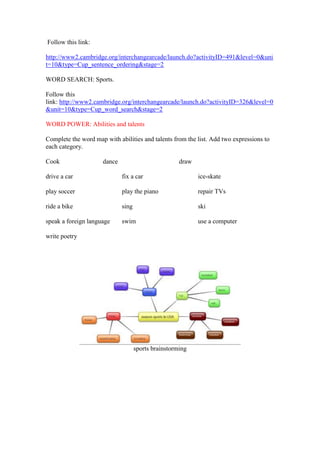
WORD POWER: Abilities and talents

Complete the word map with abilities and talents from the list. Add two expressions to
each category.

Cook                 dance                           draw

drive a car                  fix a car                      ice-skate

play soccer                  play the piano                 repair TVs

ride a bike                  sing                           ski

speak a foreign language     swim                           use a computer

write poetry


                                    sports brainstorming
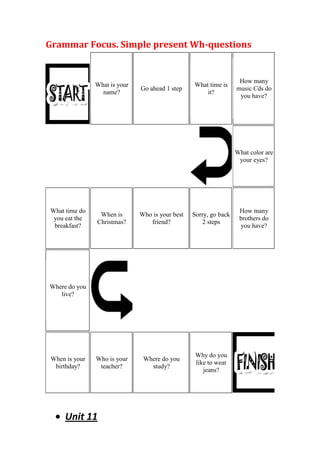
Grammar Focus. Simple present Wh-questions


                                                                   How many
               What is your                      What time is
                              Go ahead 1 step                     music Cds do
                 name?                               it?
                                                                   you have?


                                                                  What color are
                                                                   your eyes?


What time do                                                       How many
                When is       Who is your best   Sorry, go back
 you eat the                                                       brothers do
               Christmas?        friend?            2 steps
 breakfast?                                                        you have?


Where do you
   live?


                                                  Why do you
When is your   Who is your     Where do you
                                                  like to wear
 birthday?      teacher?         study?
                                                     jeans?


     Unit 11
What are you going to do?


WORD POWER

Dates


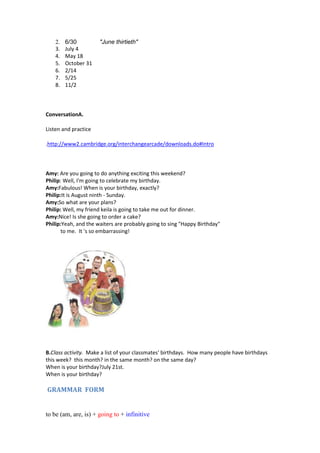
A. Practice the months and the ordinal numbers.


Solve the crossword following this link:

Ordinal Numbers - Crossword


B. Pair Work. Practice saying these dates.

   1. January 1     "January first"
2.   6/30         "June thirtieth"
    3.   July 4
    4.   May 18
    5.   October 31
    6.   2/14
    7.   5/25
    8.   11/2


ConversationA.

Listen and practice

.http://www2.cambridge.org/interchangearcade/downloads.do#Intro


Amy: Are you going to do anything exciting this weekend?
Philip: Well, I'm going to celebrate my birthday.
Amy:Fabulous! When is your birthday, exactly?
Philip:It is August ninth - Sunday.
Amy:So what are your plans?
Philip: Well, my friend keila is going to take me out for dinner.
Amy:Nice! Is she going to order a cake?
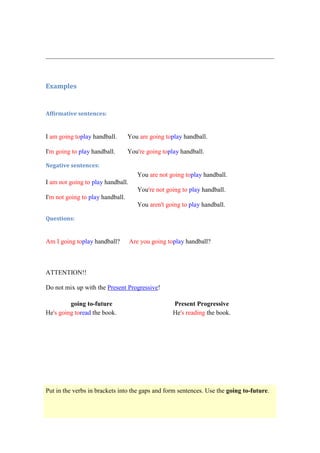
Philip:Yeah, and the waiters are probably going to sing "Happy Birthday"
       to me. It 's so embarrassing!


B.Class activity. Make a list of your classmates' birthdays. How many people have birthdays
this week? this month? in the same month? on the same day?
When is your birthday?July 21st.
When is your birthday?

GRAMMAR FORM


to be (am, are, is) + going to + infinitive
Examples


Affirmative sentences:


I am going toplay handball.       You are going toplay handball.

I'm going to play handball.       You're going toplay handball.

Negative sentences:
                                      You are not going toplay handball.
I am not going to play handball.
                                      You're not going to play handball.
I'm not going to play handball.
                                      You aren't going to play handball.

Questions:


Am I going toplay handball?        Are you going toplay handball?


ATTENTION!!

Do not mix up with the Present Progressive!

         going to-future                           Present Progressive
He's going toread the book.                        He's reading the book.


Put in the verbs in brackets into the gaps and form sentences. Use the going to-future.
Example: She _____________ a present for her mother. (to buy)


Answer: She is going to buy a present for her mother. or She's going to buy a present
for her mother.

1) He              his friend. (to phone)
2) We                 a new computer game. (to play)
3) My sister                 TV. (to watch)
4) You                 a picnic next Tuesday. (to have)
5) Jane                to the office. (to go)
6) They                 to the bus stop this afternoon. (to walk)
7) His brother                 a letter to his uncle today. (to write)
8) She                 her aunt. (to visit)
9) I                my homework after school. (to do)
10) Sophie and Nick                   her friends. (to meet)


Would you like to have more fun with "be going to"?.. the following link is going to
help you to reinforce this new grammar structure...
http://www2.cambridge.org/interchangearcade/launch.do?activityID=440&level=0&uni
t=11&type=Cup_matching&stage=

Grammar Practice.

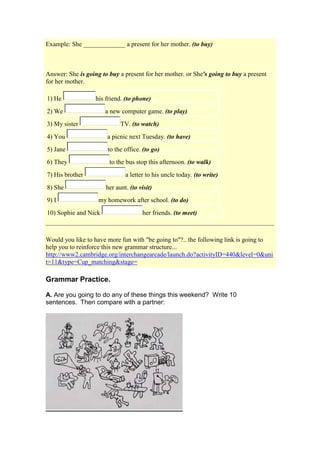
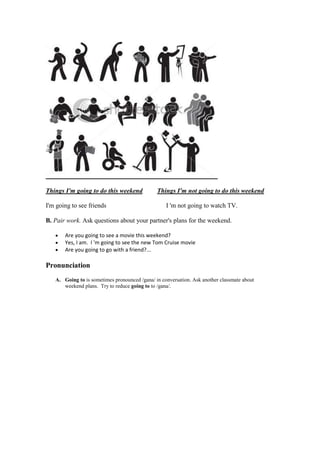
A. Are you going to do any of these things this weekend? Write 10
sentences. Then compare with a partner:
Things I'm going to do this weekend            Things I'm not going to do this weekend

I'm going to see friends                           I 'm not going to watch TV.

B. Pair work. Ask questions about your partner's plans for the weekend.

       Are you going to see a movie this weekend?
       Yes, I am. I 'm going to see the new Tom Cruise movie
       Are you going to go with a friend?...

Pronunciation
   A. Going to is sometimes pronounced /gana/ in conversation. Ask another classmate about
      weekend plans. Try to reduce going to to /gana/.
Unit 12
                              What’s the matter?
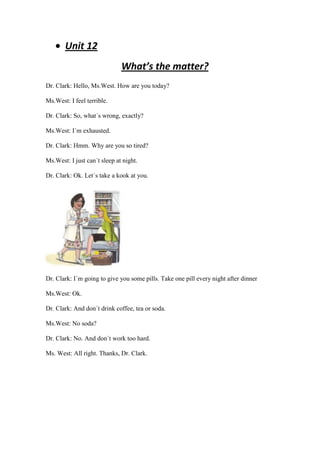
Dr. Clark: Hello, Ms.West. How are you today?

Ms.West: I feel terrible.

Dr. Clark: So, what´s wrong, exactly?

Ms.West: I´m exhausted.

Dr. Clark: Hmm. Why are you so tired?

Ms.West: I just can´t sleep at night.

Dr. Clark: Ok. Let´s take a kook at you.


Dr. Clark: I´m going to give you some pills. Take one pill every night after dinner

Ms.West: Ok.

Dr. Clark: And don´t drink coffee, tea or soda.

Ms.West: No soda?

Dr. Clark: No. And don´t work too hard.

Ms. West: All right. Thanks, Dr. Clark.
Giving Advice


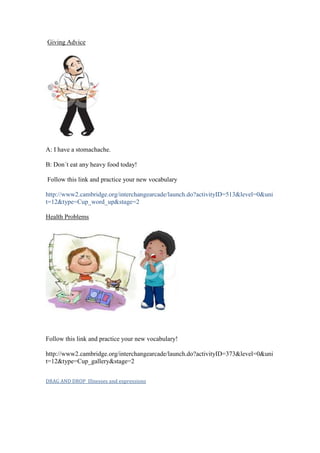
A: I have a stomachache.

B: Don´t eat any heavy food today!

Follow this link and practice your new vocabulary

http://www2.cambridge.org/interchangearcade/launch.do?activityID=513&level=0&uni
t=12&type=Cup_word_up&stage=2

Health Problems


Follow this link and practice your new vocabulary!

http://www2.cambridge.org/interchangearcade/launch.do?activityID=373&level=0&uni
t=12&type=Cup_gallery&stage=2


DRAG AND DROP Illnesses and expressions
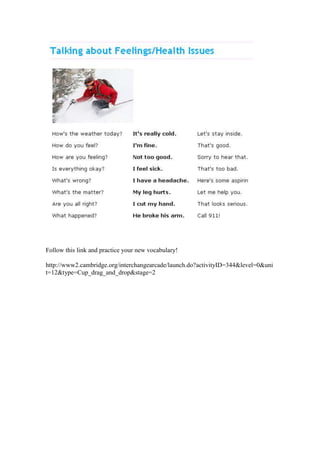
Follow this link and practice your new vocabulary!

http://www2.cambridge.org/interchangearcade/launch.do?activityID=344&level=0&uni
t=12&type=Cup_drag_and_drop&stage=2
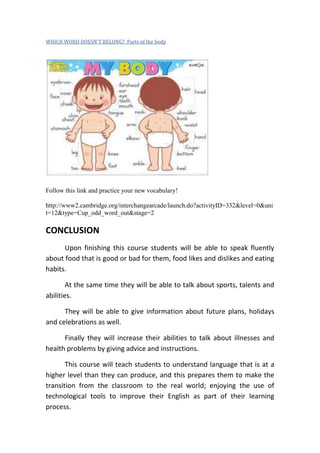
WHICH WORD DOESN'T BELONG? Parts of the body


Follow this link and practice your new vocabulary!

http://www2.cambridge.org/interchangearcade/launch.do?activityID=332&level=0&uni
t=12&type=Cup_odd_word_out&stage=2

CONCLUSION
      Upon finishing this course students will be able to speak fluently
about food that is good or bad for them, food likes and dislikes and eating
habits.

        At the same time they will be able to talk about sports, talents and
abilities.

      They will be able to give information about future plans, holidays
and celebrations as well.

      Finally they will increase their abilities to talk about illnesses and
health problems by giving advice and instructions.

       This course will teach students to understand language that is at a
higher level than they can produce, and this prepares them to make the
transition from the classroom to the real world; enjoying the use of
technological tools to improve their English as part of their learning
process.

English for international communication

  • 1.
    ENGLISH FOR INTERNATIONAL COMMUNICATION Mod:CEI-2 This is a multi-level course in English as a second or foreign language for young adults or adults. This course covers all the skills to learn a new language; listening, speaking, reading and writing. It reflects the fact that English is the world’s major language of international communication and it is not limited to any country, region or culture. This course is designed for beginner students needing a through presentation of basic functions, grammar and vocabulary. It is a self- contained course covering all four language skills. Each level provides between 60 to 90 hours of class instruction whichprepares students to enter into a stimulating English world. GOALS The primary goal is to teach communicative competence – that is the ability to communicate in English according to the situation, purpose, and role of the students. To improve students self-confidence on English learning. To masterize students’ pronunciation focusing on North American accent. To motivate students with technological tools. To reinforce information learned in previous courses.
  • 2.
    MIND MAP CONTENTS Unit 9 Broccoli is good for you. Questions for discussion What do you like to eat? Do you like vegetables? What is your favorite vegetable? What do you eat for breakfast?
  • 3.
    What do youeat for lunch? What do you usually eat for dinner? Describe the things that are in the food pyramid Grammar Focus :Countable vs.uncountable Countable uncountable Singular plural singular only an apple apples I'm eating an apple yogurt I'm eating yogurt. a carrot carrots Apples are my favorite fruit. beef yogurt is delicious. a potato potatoes I like potatoes broccoli I love yogurt. check this link in this exercise and practice your memory. Then divide the words into two lists.
  • 4.
    Unit 10 You can play baseball really well! *What sports do people play in your country? *Do you like sports? *What sports do you play? I can't ice-skate! Grammar: Can for ability I I I You You You He can sing very well Can he sing? Yes, he can. She can't sing at all she she can't. We we we They they they What do you hear? Can for ability. Follow this link:http://www2.cambridge.org/interchangearcade/launch.do?activityID=511&level=0 &unit=10&type=Cup_word_up&stage=2
  • 5.
    SIMPLE PRESENT: WH-QUESTIONS Whatsports do you play? I play baseball and I go skiing. Who do you play baseball with? With some friends from work. We have a team. When does your team practice? We practice on Saturdays. What time do you practice on Saturdays? We start at ten o'clock in the morning. Where do you go skiing? I go skiing in Colorado. What do your parents think of skiing? They think it's dangerous. DRAG AND DROP Sports; simple present - Wh questions. Follow this link: http://www2.cambridge.org/interchangearcade/launch.do?activityID=343&level=0&uni t=10&type=Cup_drag_and_drop&stage=2 PRACTICE Write questions for these answers. 1. A: -------------------------------------------------------------? B: I like ice-skating, but I really love volleyball! 2. A: -------------------------------------------------------------? B: Volleyball? I play it in the summer. 3. A: -------------------------------------------------------------? B: My brother and sister play with me. 4. A: -------------------------------------------------------------? B: We usually play in our yard or at the beach. 5. A: -------------------------------------------------------------? B: Our parents think it's great sport. They enjoy it, too. UNSCRAMBLE THE SENTENCE Simple present
  • 6.
    Follow this link: http://www2.cambridge.org/interchangearcade/launch.do?activityID=491&level=0&uni t=10&type=Cup_sentence_ordering&stage=2 WORDSEARCH: Sports. Follow this link: http://www2.cambridge.org/interchangearcade/launch.do?activityID=326&level=0 &unit=10&type=Cup_word_search&stage=2 WORD POWER: Abilities and talents Complete the word map with abilities and talents from the list. Add two expressions to each category. Cook dance draw drive a car fix a car ice-skate play soccer play the piano repair TVs ride a bike sing ski speak a foreign language swim use a computer write poetry sports brainstorming
  • 7.
    Grammar Focus. Simplepresent Wh-questions How many What is your What time is Go ahead 1 step music Cds do name? it? you have? What color are your eyes? What time do How many When is Who is your best Sorry, go back you eat the brothers do Christmas? friend? 2 steps breakfast? you have? Where do you live? Why do you When is your Who is your Where do you like to wear birthday? teacher? study? jeans? Unit 11
  • 8.
    What are yougoing to do? WORD POWER Dates A. Practice the months and the ordinal numbers. Solve the crossword following this link: Ordinal Numbers - Crossword B. Pair Work. Practice saying these dates. 1. January 1 "January first"
  • 9.
    2. 6/30 "June thirtieth" 3. July 4 4. May 18 5. October 31 6. 2/14 7. 5/25 8. 11/2 ConversationA. Listen and practice .http://www2.cambridge.org/interchangearcade/downloads.do#Intro Amy: Are you going to do anything exciting this weekend? Philip: Well, I'm going to celebrate my birthday. Amy:Fabulous! When is your birthday, exactly? Philip:It is August ninth - Sunday. Amy:So what are your plans? Philip: Well, my friend keila is going to take me out for dinner. Amy:Nice! Is she going to order a cake? Philip:Yeah, and the waiters are probably going to sing "Happy Birthday" to me. It 's so embarrassing! B.Class activity. Make a list of your classmates' birthdays. How many people have birthdays this week? this month? in the same month? on the same day? When is your birthday?July 21st. When is your birthday? GRAMMAR FORM to be (am, are, is) + going to + infinitive
  • 10.
    Examples Affirmative sentences: I amgoing toplay handball. You are going toplay handball. I'm going to play handball. You're going toplay handball. Negative sentences: You are not going toplay handball. I am not going to play handball. You're not going to play handball. I'm not going to play handball. You aren't going to play handball. Questions: Am I going toplay handball? Are you going toplay handball? ATTENTION!! Do not mix up with the Present Progressive! going to-future Present Progressive He's going toread the book. He's reading the book. Put in the verbs in brackets into the gaps and form sentences. Use the going to-future.
  • 11.
    Example: She _____________a present for her mother. (to buy) Answer: She is going to buy a present for her mother. or She's going to buy a present for her mother. 1) He his friend. (to phone) 2) We a new computer game. (to play) 3) My sister TV. (to watch) 4) You a picnic next Tuesday. (to have) 5) Jane to the office. (to go) 6) They to the bus stop this afternoon. (to walk) 7) His brother a letter to his uncle today. (to write) 8) She her aunt. (to visit) 9) I my homework after school. (to do) 10) Sophie and Nick her friends. (to meet) Would you like to have more fun with "be going to"?.. the following link is going to help you to reinforce this new grammar structure... http://www2.cambridge.org/interchangearcade/launch.do?activityID=440&level=0&uni t=11&type=Cup_matching&stage= Grammar Practice. A. Are you going to do any of these things this weekend? Write 10 sentences. Then compare with a partner:
  • 12.
    Things I'm goingto do this weekend Things I'm not going to do this weekend I'm going to see friends I 'm not going to watch TV. B. Pair work. Ask questions about your partner's plans for the weekend. Are you going to see a movie this weekend? Yes, I am. I 'm going to see the new Tom Cruise movie Are you going to go with a friend?... Pronunciation A. Going to is sometimes pronounced /gana/ in conversation. Ask another classmate about weekend plans. Try to reduce going to to /gana/.
  • 13.
    Unit 12 What’s the matter? Dr. Clark: Hello, Ms.West. How are you today? Ms.West: I feel terrible. Dr. Clark: So, what´s wrong, exactly? Ms.West: I´m exhausted. Dr. Clark: Hmm. Why are you so tired? Ms.West: I just can´t sleep at night. Dr. Clark: Ok. Let´s take a kook at you. Dr. Clark: I´m going to give you some pills. Take one pill every night after dinner Ms.West: Ok. Dr. Clark: And don´t drink coffee, tea or soda. Ms.West: No soda? Dr. Clark: No. And don´t work too hard. Ms. West: All right. Thanks, Dr. Clark.
  • 14.
    Giving Advice A: Ihave a stomachache. B: Don´t eat any heavy food today! Follow this link and practice your new vocabulary http://www2.cambridge.org/interchangearcade/launch.do?activityID=513&level=0&uni t=12&type=Cup_word_up&stage=2 Health Problems Follow this link and practice your new vocabulary! http://www2.cambridge.org/interchangearcade/launch.do?activityID=373&level=0&uni t=12&type=Cup_gallery&stage=2 DRAG AND DROP Illnesses and expressions
  • 15.
    Follow this linkand practice your new vocabulary! http://www2.cambridge.org/interchangearcade/launch.do?activityID=344&level=0&uni t=12&type=Cup_drag_and_drop&stage=2
  • 16.
    WHICH WORD DOESN'TBELONG? Parts of the body Follow this link and practice your new vocabulary! http://www2.cambridge.org/interchangearcade/launch.do?activityID=332&level=0&uni t=12&type=Cup_odd_word_out&stage=2 CONCLUSION Upon finishing this course students will be able to speak fluently about food that is good or bad for them, food likes and dislikes and eating habits. At the same time they will be able to talk about sports, talents and abilities. They will be able to give information about future plans, holidays and celebrations as well. Finally they will increase their abilities to talk about illnesses and health problems by giving advice and instructions. This course will teach students to understand language that is at a higher level than they can produce, and this prepares them to make the transition from the classroom to the real world; enjoying the use of technological tools to improve their English as part of their learning process.