Property of Ministry of Education
NOT FORRESALE
Student’s Book10
Property of Ministry of
Education
NOT FOR RESALE
Finding out about the books
How many main units are there? There are ten.
How many revision units are there? There are three.
How many pages are there in Unit 1? There are ten.
How many pages are there in the Activity Book? There are 80.
How many pages are there in a revision unit? There are four or six.
Finding out about people
Personal Details
1- Rasheed
2- Nearly 16
3- on 5th of October
4- In Slemani
5- 07704534321
Wh-questions
Present simple
When …….? Where …….? What ……? How ……? Who……?
Is, are, how much……? How many ….? How old ……? Do, Does
Finding out about people
…………. is your family name?
………… old are you?
……….. is your birthday?
………. do you live?
………. is your phone number?
………… homework do you usually do every day?
…………. hours of TV do you watch most days?
…………. brothers and sisters have you got?
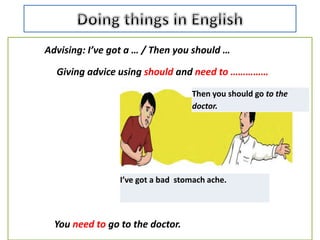
Advising: I’ve got a … / Then you should …
Giving advice using should and need to ……………
You need to go to the doctor.
I’ve got a bad stomach ache.
Then you should go to the
doctor.
Advising: I’ve got a … / Then you should …
Giving advice using should and need to ……………
Problems Advice
I’ve( have ) got a problem with this CD. You need to go the music shop.
I haven’t got any fruit. You should go to the market.
I really need some ice cream. You need to go to the supermarket.
Haveen: Let’s meet on Saturday afternoon.
Gulistan: Sorry, I can’t. I have to revise for math test.
Perhaps we can meet on …………
Haveen: I’m afraid I can’t. I have to go to Duhok on Tuesday.
Suggestions Refusing Accepting
Let’s met on Friday. Sorry, I can’t Yes, that’s fine.
Perhaps we can meet on …….. I’m afraid I can’t Fine. No problem.
1LESSONS
1&2
M A K I N G C O N T A C T
I play basketball, too.
Present continuous • Present simple
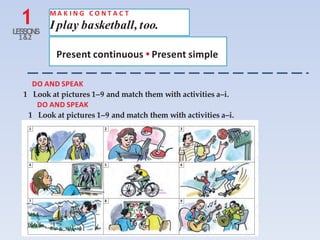
DO AND SPEAK
1 Look at pictures 1–9 and match them with activities a–i.
DO AND SPEAK
1 Look at pictures 1–9 and match them with activities a–i.
1 2 3
4 5 6
7 8 9
 They are playing basketball.
 They are playing computer games.
 They are playing the guitar.
 She is reading a book.
 He is riding a bike.
 He is taking photos.
 They are talking on the phone.
 They are skateboarding.
 She is watching T.V .
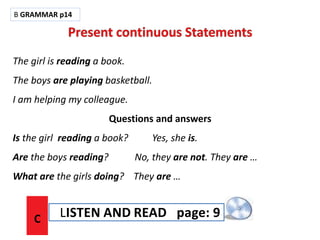
The girl is reading a book.
The boys are playing basketball.
I am helping my colleague.
Questions and answers
Is the girl reading a book? Yes, she is.
Are the boys reading? No, they are not. They are …
What are the girls doing? They are …
B GRAMMAR p14
C LISTEN AND READ page: 9
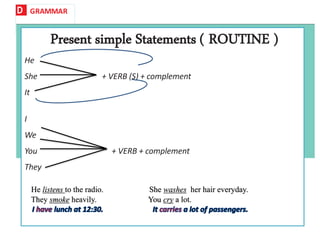
D GRAMMAR
Present simple Statements ( ROUTINE )
He
She + VERB (S) + complement
It
I
We
You + VERB + complement
They
He listens to the radio. She washes her hair everyday.
They smoke heavily. You cry a lot.
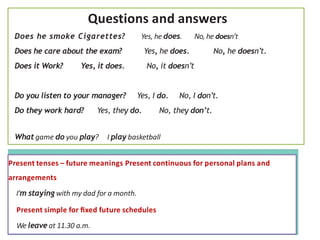
Present tenses – future meanings Present continuous for personal plans and
arrangements
I’m staying with my dad for a month.
Present simple for fixed future schedules
We leave at 11.30 a.m.
Questions and answers
Does he smoke Cigarettes? Yes, he does. No, he doesn’t
Does he care about the exam? Yes, he does. No, he doesn’t.
Does it Work? Yes, it does. No, it doesn’t
Do you listen to your manager? Yes, I do. No, I don’t.
Do they work hard? Yes, they do. No, they don’t.
What game do you play? I play basketball
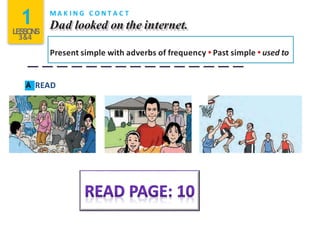
1LESSONS
3&4
M A K I N G C O N T A C T
Dad looked on the internet.
Present simple with adverbs of frequency • Past simple • used to
A READ
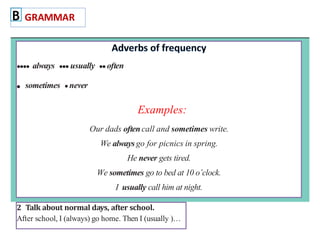
●●●● always ●●● usually ●● often
● sometimes ● never
Examples:
Our dads oftencall and sometimes write.
We alwaysgo for picnics in spring.
He never gets tired.
We sometimes go to bed at 10 o’clock.
I usually call him at night.
2 Talk about normal days, after school.
After school, I (always) go home. Then I (usually )…
B GRAMMAR
D GRAMMAR
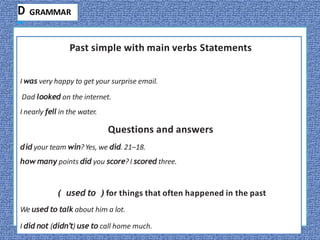
Past simple with main verbs Statements
I was very happy to get your surprise email.
Dad looked on the internet.
I nearly fell in the water.
Questions and answers
did your team win?Yes, we did. 21–18.
how many points did you score?I scored three.
( used to ) for things that often happened in the past
We used to talk about him a lot.
I did not (didn’t) use to call home much.
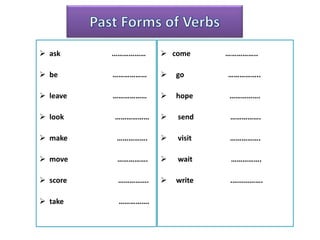
 ask ………………
 be ………………
 leave ………………
 look ………………
 make …………….
 move …………….
 score …………….
 take …………….
 come ……………..
 go ……………..
 hope …………….
 send …………….
 visit …………….
 wait …………….
 write .…………….
1LESSONS
5&6
M A K I N G C O N T A C T
Staying in contact
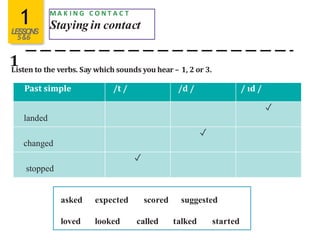
1Listen to the verbs. Say which sounds you hear – 1, 2 or 3.
Past simple /t / /d / / ıd /
landed
✓
changed
✓
stopped
✓
asked expected scored suggested
loved looked called talked started
D READ AND SPEAK
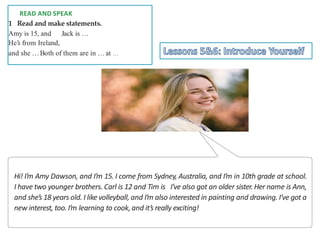
1 Read and make statements.
Amy is 15, and Jack is …
He’s from Ireland,
and she …Both of them are in …at …
Hi! I’m Amy Dawson, and I’m 15. I come from Sydney, Australia, and I’m in 10th grade at school.
I have two younger brothers. Carl is 12 and Tim is I’ve also got an older sister. Her name is Ann,
and she’s 18 years old. I like volleyball, and I’m also interested in painting and drawing. I’ve got a
new interest, too.I’m learning to cook,and it’s really exciting!
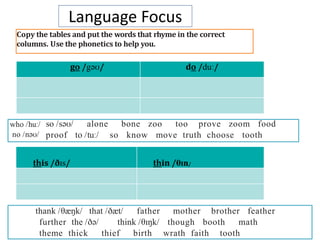
who /huː/
no /nəʊ/
so /səʊ/ alone bone zoo too prove zoom food
proof to /tuː/ so know move truth choose tooth
thank /θæŋk/ that /ðæt/ father mother brother feather
further the /ðə/ think /θɪŋk/ though booth math
theme thick thief birth wrath faith tooth
Copy the tables and put the words that rhyme in the correct
columns. Use the phonetics to help you.
go /gəʊ/ do /duː/
this /ðɪs/ thin /θɪn/
Language Focus
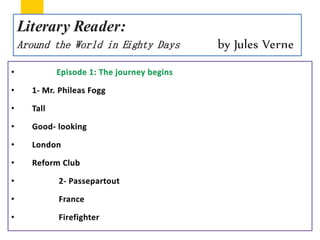
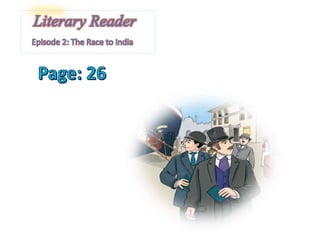
Literary Reader:
Around the World in Eighty Days by Jules Verne
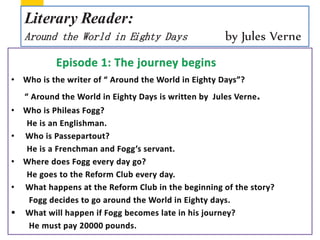
Literary Reader:
Around the World in Eighty Days by Jules Verne
2LESSONS
1&2
H E L P !
I was riding throughthe woods.
Reflexive Pronouns •Past Continuous + Point in time
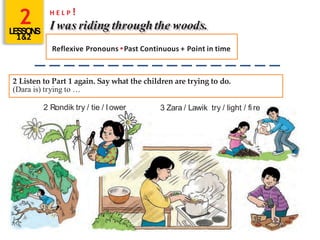
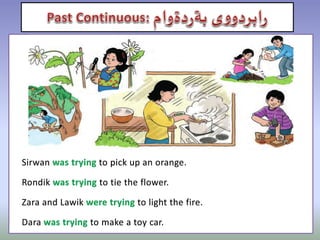
2 Listen to Part 1 again. Say what the children are trying to do.
(Dara is) trying to …
2 Rondik try / tie / l ower 3 Zara / Lawik try / light / fi re
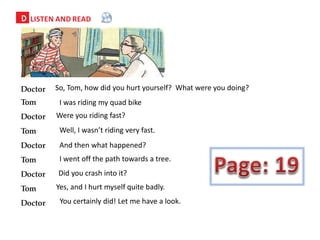
D LISTEN AND READ
Doctor
Tom
Doctor
Tom
Doctor
Tom
Doctor
Tom
Doctor
So, Tom, how did you hurt yourself? What were you doing?
I was riding my quad bike
Were you riding fast?
Well, I wasn’t riding very fast.
And then what happened?
I went off the path towards a tree.
Did you crash into it?
Yes, and I hurt myself quite badly.
You certainly did! Let me have a look.
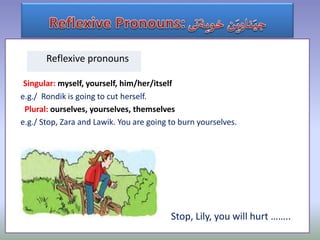
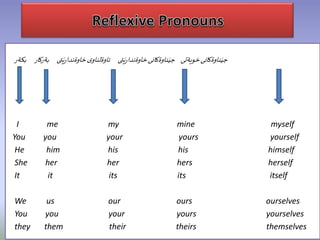
Singular: myself, yourself, him/her/itself
e.g./ Rondik is going to cut herself.
Plural: ourselves, yourselves, themselves
e.g./ Stop, Zara and Lawik. You are going to burn yourselves.
Stop, Lily, you will hurt ……..
Reflexive pronouns
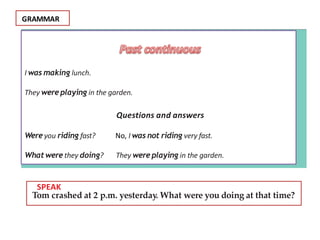
GRAMMAR
I was making lunch.
They were playing in the garden.
Questions and answers
Were you riding fast? No, I was not riding very fast.
What were they doing? They were playing in the garden.
F SPEAK
Tom crashed at 2 p.m. yesterday. What were you doing at that time?
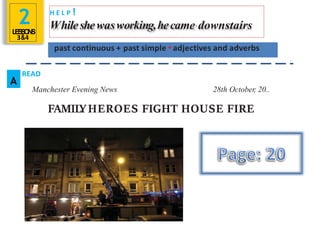
A
READ
Manchester Evening News 28th October, 20..
FAMILYHEROES FIGHT HOUSE FIRE
2LESSONS
3&4
H E L P !
Whileshewasworking,hecame downstairs
past continuous + past simple • adjectives and adverbs
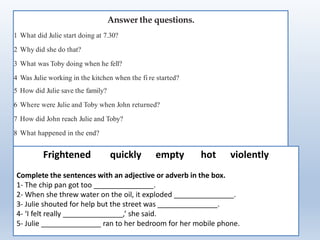
Answer the questions.
1 What did Julie start doing at 7.30?
2 Why did she do that?
3 What was Toby doing when he fell?
4 Was Julie working in the kitchen when the fi re started?
5 How did Julie save the family?
6 Where were Julie and Toby when John returned?
7 How did John reach Julie and Toby?
8 What happened in the end?
Frightened quickly empty hot violently
Complete the sentences with an adjective or adverb in the box.
1- The chip pan got too _______________.
2- When she threw water on the oil, it exploded _______________.
3- Julie shouted for help but the street was _______________.
4- ‘I felt really _______________,’ she said.
5- Julie _______________ ran to her bedroom for her mobile phone.
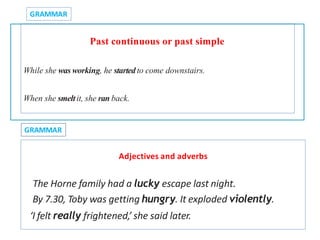
Past continuous or past simple
While she wasworking, he startedto come downstairs.
When she smeltit, she ranback.
GRAMMAR
GRAMMAR
Adjectives and adverbs
The Horne family had a lucky escape last night.
By 7.30, Toby was getting hungry. It exploded violently.
‘I felt really frightened,’ she said later.
‫بكةر‬ ‫بةركار‬ ‫تى‬ َ‫ي‬‫ر‬‫خاوةندا‬‫ى‬‫ئاوةلناو‬ ‫تى‬ َ‫ي‬‫ر‬‫خاوةندا‬‫ناوةكانى‬ َ‫جي‬ ‫خويةتى‬‫ناوةكانى‬ َ‫جي‬
I me my mine myself
You you your yours yourself
He him his his himself
She her her hers herself
It it its its itself
We us our ours ourselves
You you your yours yourselves
they them their theirs themselves
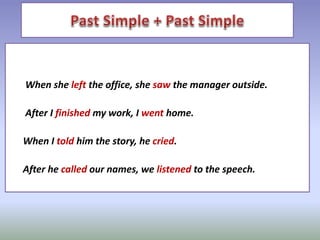
When she left the office, she saw the manager outside.
After I finished my work, I went home.
When I told him the story, he cried.
After he called our names, we listened to the speech.
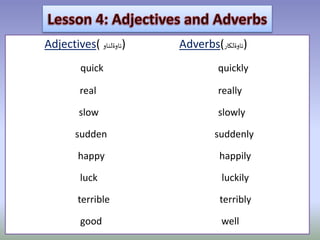
Adjectives( ‫ئاوةلناو‬) Adverbs(‫ئاوةلكار‬)
quick quickly
real really
slow slowly
sudden suddenly
happy happily
luck luckily
terrible terribly
good well
3LESSONS
1&2
E A TWE L L – B E WE L L
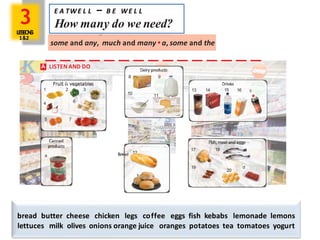
How many do we need?
some and any, much and many • a, some and the
A LISTEN AND DO
1 2 3
4
5
6
7
a
12
b
c15
18
11
17
20
19 d
98
10
13 14 16
bread butter cheese chicken legs coffee eggs fish kebabs lemonade lemons
lettuces milk olives onions orange juice oranges potatoes tea tomatoes yogurt
Some and any, much and many, a and the
some and any
We need some ground meat. Get a pan, and cut some onions.
Do we need any vegetables? Take some meat, and some tomato paste.
We don’t need any tomatoes. Mix the meat and the paste together.
much, many, a little, a few, a lot of
How much meat do we need?
How many people are coming? We only have a little time.
There isn’t much time. We only need a few onions.
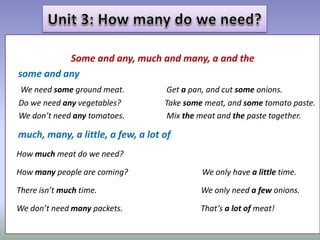
We don’t need many packets. That’s a lot of meat!
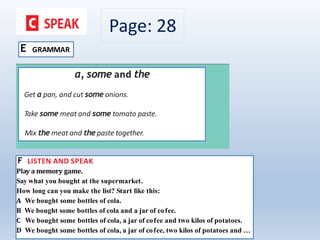
Page: 28
E GRAMMAR
a, some and the
Get a pan, and cut some onions.
Take some meat and some tomato paste.
Mix the meat and the paste together.
F LISTEN AND SPEAK
Play a memory game.
Say what you bought at the supermarket.
How long can you make the list? Start like this:
A We bought some bottles of cola.
B We bought some bottles of cola and a jar of cofee.
C We bought some bottles of cola, a jar of cofee and two kilos of potatoes.
D We bought some bottles of cola, a jar of cofee, two kilos of potatoes and …
3LESSONS
3&4
E A T WE L L – B E WE L L
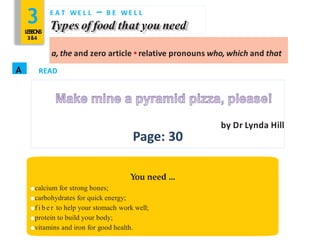
Types of food that you need
a, the and zero article • relative pronouns who, which and that
A READ
by Dr Lynda Hill
Page: 30
You need …
●calcium for strong bones;
●carbohydrates for quick energy;
●f i b e r to help your stomach work well;
●protein to build your body;
●vitamins and iron for good health.
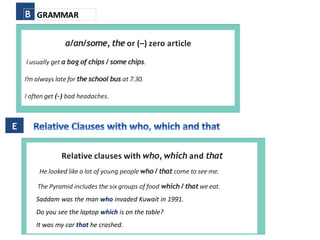
B GRAMMAR
a/an/some, the or (–) zero article
I usually get a bag of chips / some chips.
I’m always late for the school bus at 7.30.
I often get (–) bad headaches.
E
Relative clauses with who, which and that
He looked like a lot of young people who / that come to see me.
The Pyramid includes the six groups of food which / thatwe eat.
Saddam was the man who invaded Kuwait in 1991.
Do you see the laptop which is on the table?
It was my car that he crashed.
3LESSONS
5&6
E A T WE L L – B E WE L L
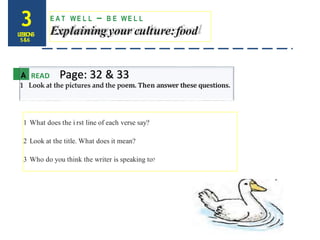
Explainingyour culture:food
A READ Page: 32 & 33
1 Look at the pictures and the poem. Then answer these questions.
1 What does the i rst line of each verse say?
2 Look at the title. What does it mean?
3 Who do you think the writer is speaking to?
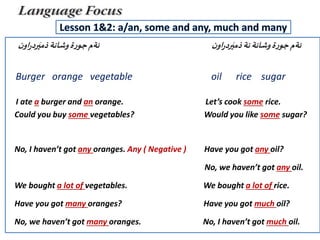
‫ن‬‫او‬‫ر‬‫رد‬ َ‫ذمي‬‫وشانة‬‫ة‬‫ر‬‫جو‬‫ئةم‬ ‫وشانة‬‫ة‬‫ر‬‫جو‬‫ئةم‬‫ن‬‫او‬‫ر‬‫رد‬ َ‫ذمي‬‫نة‬
Burger orange vegetable oil rice sugar
I ate a burger and an orange. Let’s cook some rice.
Could you buy some vegetables? Would you like some sugar?
No, I haven’t got any oranges. Any ( Negative ) Have you got any oil?
No, we haven’t got any oil.
We bought a lot of vegetables. We bought a lot of rice.
Have you got many oranges? Have you got much oil?
No, we haven’t got many oranges. No, I haven’t got much oil.
bread [bred] meat [miːt] meal [miəl]
SEAT, FEET, FREE, READ, SPEAK, BEAT, HEAT, SHEET, ME, BEE, FEEL, MEET,
SHEEP, SEE, SEA, TEACHER, BEACH, TREE, BEEN, TEA, PEACH, CLEAN, SLEEP,
STEEP, DREAM, KEY, MEAT, REACH, NEED, SEED, WEED,
Bed, said, paid, head, neck, pen, men, hen, red, led, get, let, net, pet, wet, set, yet
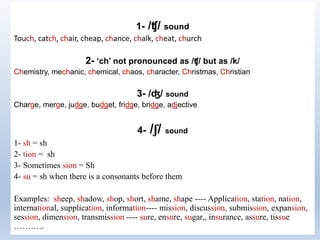
1- /ʧ/ sound
Touch, catch, chair, cheap, chance, chalk, cheat, church
2- ‘ch’ not pronounced as /ʧ/ but as /k/
Chemistry, mechanic, chemical, chaos, character, Christmas, Christian
3- /ʤ/ sound
Charge, merge, judge, budget, fridge, bridge, adjective
4- /ʃ/ sound
1- sh = sh
2- tion = sh
3- Sometimes sion = Sh
4- su = sh when there is a consonants before them
Examples: sheep, shadow, shop, short, shame, shape ---- Application, station, nation,
international, supplication, information---- mission, discussion, submission, expansion,
session, dimension, transmission ---- sure, ensure, sugar,, insurance, assure, tissue
………..
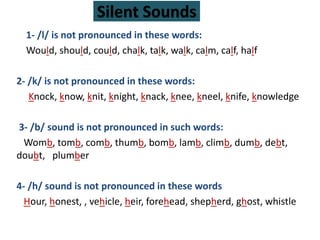
Silent Sounds
1- /l/ is not pronounced in these words:
Would, should, could, chalk, talk, walk, calm, calf, half
2- /k/ is not pronounced in these words:
Knock, know, knit, knight, knack, knee, kneel, knife, knowledge
3- /b/ sound is not pronounced in such words:
Womb, tomb, comb, thumb, bomb, lamb, climb, dumb, debt,
doubt, plumber
4- /h/ sound is not pronounced in these words
Hour, honest, , vehicle, heir, forehead, shepherd, ghost, whistle
5- /t/ is not pronounced in these words:
Catch, ditch, switch, often, pitch, whistle, castle, watch, match,
hitch
6- /w/ is not pronounced in these words:
wrong, wrap, wrath, wrestle, wreck, wring, write, whose, who,
snow
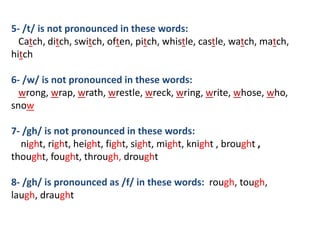
7- /gh/ is not pronounced in these words:
night, right, height, fight, sight, might, knight , brought ,
thought, fought, through, drought
8- /gh/ is pronounced as /f/ in these words: rough, tough,
laugh, draught
4LESSONS
1&2
A READ
R E V I S I O N
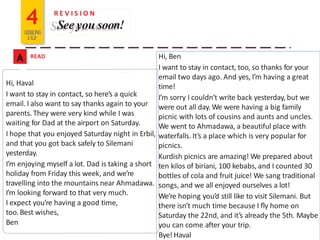
See you soon!
Hi, Haval
I want to stay in contact, so here’s a quick
email. I also want to say thanks again to your
parents. They were very kind while I was
waiting for Dad at the airport on Saturday.
I hope that you enjoyed Saturday night in Erbil,
and that you got back safely to Silemani
yesterday.
I’m enjoying myself a lot. Dad is taking a short
holiday from Friday this week, and we’re
travelling into the mountains near Ahmadawa.
I’m looking forward to that very much.
I expect you’re having a good time,
too.Best wishes,
Ben
Hi, Ben
I want to stay in contact, too, so thanks for your
email two days ago. And yes, I’m having a great
time!
I’m sorry I couldn’t write back yesterday, but we
were out all day. We were having a big family
picnic with lots of cousins and aunts and uncles.
We went to Ahmadawa, a beautiful place with
waterfalls. It’s a place which is very popular for
picnics.
Kurdish picnics are amazing! We prepared about
ten kilos of biriani, 100 kebabs, and I counted 30
bottles of cola and fruit juice! We sang traditional
songs, and we all enjoyed ourselves a lot!
We’re hoping you’d still like to visit Silemani. But
there isn’t much time because I fly home on
Saturday the 22nd, and it’s already the 5th. Maybe
you can come after your trip.
Bye! Haval
4LESSONS
5&6
R E V I S I O N
Vocabulary and skills
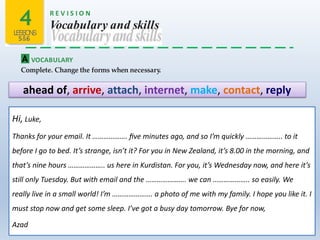
A VOCABULARY
Complete. Change the forms when necessary.
ahead of, arrive, attach, internet, make, contact, reply
Hi, Luke,
Thanks for your email. It ………………. five minutes ago, and so I’m quickly ……………….. to it
before I go to bed. It’s strange, isn’t it? For you in New Zealand, it’s 8.00 in the morning, and
that’s nine hours ……………….. us here in Kurdistan. For you, it’s Wednesday now, and here it’s
still only Tuesday. But with email and the …………………. we can ……………….. so easily. We
really live in a small world! I’m …………………. a photo of me with my family. I hope you like it. I
must stop now and get some sleep. I’ve got a busy day tomorrow. Bye for now,
Azad
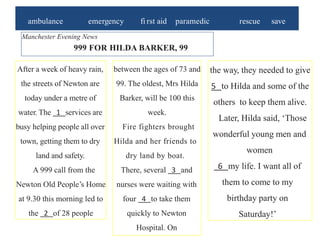
ambulance emergency fi rst aid paramedic rescue save
After a week of heavy rain,
the streets of Newton are
today under a metre of
water. The 1 services are
busy helping people all over
town, getting them to dry
land and safety.
A 999 call from the
Newton Old People’s Home
at 9.30 this morning led to
the 2 of 28 people
between the ages of 73 and
99. The oldest, Mrs Hilda
Barker, will be 100 this
week.
Fire fighters brought
Hilda and her friends to
dry land by boat.
There, several 3 and
nurses were waiting with
four 4 to take them
quickly to Newton
Hospital. On
the way, they needed to give
5 to Hilda and some of the
others to keep them alive.
Later, Hilda said, ‘Those
wonderful young men and
women
6 my life. I want all of
them to come to my
birthday party on
Saturday!’
Manchester Evening News
999 FOR HILDA BARKER, 99
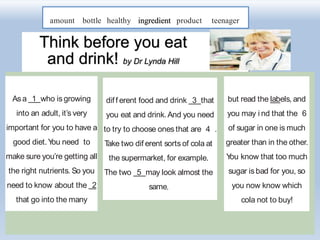
amount bottle healthy ingredient product teenager
Think before you eat
and drink! by Dr Lynda Hill
Asa 1 who is growing
into an adult, it’s very
important for you to have a
good diet.You need to
make sure you’re getting all
the right nutrients. So you
need to know about the 2
that go into the many
diff erent food and drink 3 that
you eat and drink.And you need
to try to choose ones that are 4 .
Take two dif erent sorts of cola at
the supermarket, for example.
The two 5 may look almost the
same,
but read the labels, and
you may i nd that the 6
of sugar in one is much
greater than in the other.
You know that too much
sugar is bad for you, so
you now know which
cola not to buy!
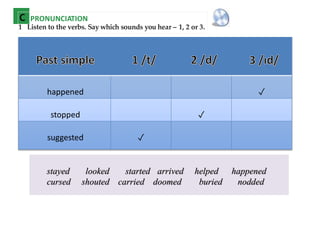
C PRONUNCIATION
1 Listen to the verbs. Say which sounds you hear – 1, 2 or 3.
stayed looked started arrived helped happened
cursed shouted carried doomed buried nodded
happened ✓
stopped ✓
suggested ✓
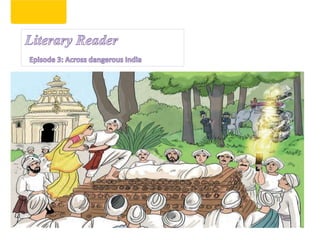
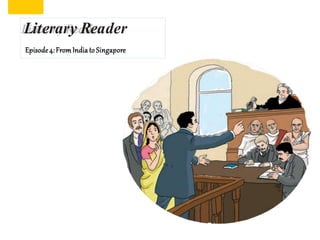
Literary Reader
Episode 4:From India to Singapore
DID YOU KNOW?
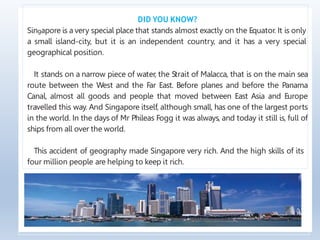
Singapore is a very special place that stands almost exactly on the Equator. It is only
a small island-city, but it is an independent country, and it has a very special
geographical position.
It stands on a narrow piece of water, the Strait of Malacca, that is on the main sea
route between the West and the Far East. Before planes and before the Panama
Canal, almost all goods and people that moved between East Asia and Europe
travelled this way. And Singapore itself, although small, has one of the largest ports
in the world. In the days of Mr Phileas Fogg it was always, and today it still is, full of
ships from all over the world.
This accident of geography made Singapore very rich. And the high skills of its
four million people are helping to keep it rich.
Moving into space
I’ve just had an idea!
present perfect with , , , so and • past simple
We have nearly finished
I have already finished.
I have not finished yet, but I am going to soon.
Questions
Have you studied for the exam?
No, I haven’t studied for the exam yet.
Present perfect with just
We have just had some big news from the ISS.
He has just studied homework.
Have you ever looked up?
Present perfect with ever and never, for and since • Past simple
A READ Page: 48
Present perfect with ever, never
Have you ever looked up at the night sky?
Humans have never travelled beyond the moon.
She has been here since 1990.
I have been in New York for 2 days.
DID YOU KNOW?
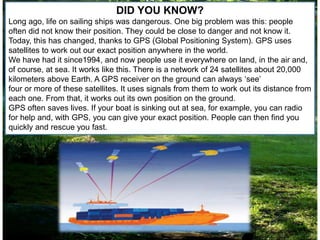
Long ago, life on sailing ships was dangerous. One big problem was this: people
often did not know their position. They could be close to danger and not know it.
Today, this has changed, thanks to GPS (Global Positioning System). GPS uses
satellites to work out our exact position anywhere in the world.
We have had it since1994, and now people use it everywhere on land, in the air and,
of course, at sea. It works like this. There is a network of 24 satellites about 20,000
kilometers above Earth. A GPS receiver on the ground can always ‘see’
four or more of these satellites. It uses signals from them to work out its distance from
each one. From that, it works out its own position on the ground.
GPS often saves lives. If your boat is sinking out at sea, for example, you can radio
for help and, with GPS, you can give your exact position. People can then find you
quickly and rescue you fast.
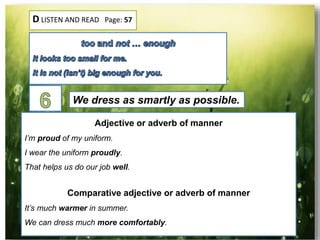
D LISTEN AND READ Page: 57
We dress as smartly as possible.
Adjective or adverb of manner
I’m proud of my uniform.
I wear the uniform proudly.
That helps us do our job well.
Comparative adjective or adverb of manner
It’s much warmer in summer.
We can dress much more comfortably.
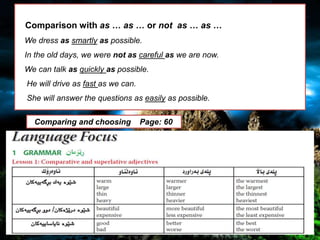
Comparison with as … as … or not
as … as …
We dress as smartly as possible.
In the old days, we were not as careful as
we are now.
Comparison with as … as … or not as … as …
We dress as smartly as possible.
In the old days, we were not as careful as we are now.
We can talk as quickly as possible.
He will drive as fast as we can.
She will answer the questions as easily as possible.
Comparing and choosing Page: 60
DID YOU KNOW?
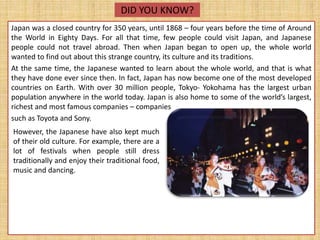
Japan was a closed country for 350 years, until 1868 – four years before the time of Around
the World in Eighty Days. For all that time, few people could visit Japan, and Japanese
people could not travel abroad. Then when Japan began to open up, the whole world
wanted to find out about this strange country, its culture and its traditions.
At the same time, the Japanese wanted to learn about the whole world, and that is what
they have done ever since then. In fact, Japan has now become one of the most developed
countries on Earth. With over 30 million people, Tokyo- Yokohama has the largest urban
population anywhere in the world today. Japan is also home to some of the world’s largest,
richest and most famous companies – companies
such as Toyota and Sony.
However, the Japanese have also kept much
of their old culture. For example, there are a
lot of festivals when people still dress
traditionally and enjoy their traditional food,
music and dancing.
66
Unit
7
Revision
I’ve lost my wallet!
Revision
Vocabulary and skills
Complete the following with the correct words. Change the forms when necessary.
all over amazing beyond humans planets signals
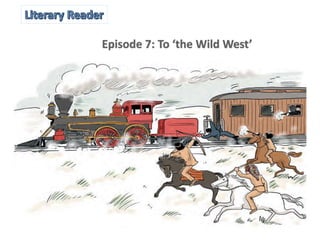
Europeans started arriving to live in America in the early seventeenth century.
Their numbers grew during the next two centuries, but they remained on or near
the east coast. Then, in the early nineteenth century, many more Europeans began
arriving, and people moved west.
These people were poor, and they were looking for land and a new life in ‘the New
World’. However, that land was the land of five million native Americans, who
fought hard to keep the Europeans out. Also, there was often trouble between the
new Americans themselves. People rightly called it ‘the Wild West’, and thousands
died over the years.
Trains were one of the first signs of a quieter future. In 1869, a railroad connected
the east and west coasts for the first time. This was the still-dangerous, seven-day
journey that Phileas Fogg and the others made only three years later.
If you do the housework, I’ll …
open conditional • First Conditional
Unit
8
A LISTEN AND SPEAK Page: 72
GRAMMAR
Open conditionals if / when + present simple, present simple
if Mum is very tired, I make dinner for the family.
I usually help Dad when he washes the car.
DLISTEN AND READ Page: 73
First conditionals if + present simple, future with will
if we do the cooking, she will (she’ll) be free to relax.
It will (It’ll) help if you wash the dishes.
What would you do?
Second conditional
8
Quiz:
What would you do in these situations? Page: 74
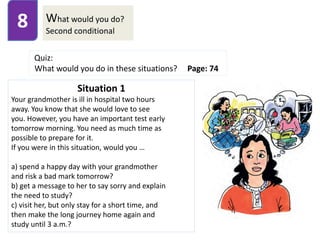
Situation 1
Your grandmother is ill in hospital two hours
away. You know that she would love to see
you. However, you have an important test early
tomorrow morning. You need as much time as
possible to prepare for it.
If you were in this situation, would you …
a) spend a happy day with your grandmother
and risk a bad mark tomorrow?
b) get a message to her to say sorry and explain
the need to study?
c) visit her, but only stay for a short time, and
then make the long journey home again and
study until 3 a.m.?
Second conditionals 1
if + past simple, would + verb
if everything went well, it would lead to things.
if this happened, would you do the safe thing?
Second conditionals 2
if + past simple, would / might / could + verb
if you did this, you would be very tired.
You might succeed, but you could easily fail.
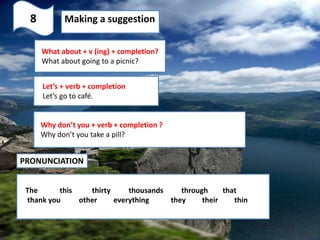
8 Making a suggestion
What about + v (ing) + completion?
What about going to a picnic?
Let’s + verb + completion
Let’s go to café.
Why don’t you + verb + completion ?
Why don’t you take a pill?
PRONUNCIATION
The this thirty thousands through that
thank you other everything they their thin
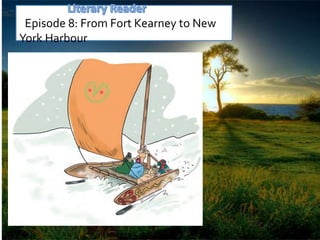
Episode 8: From Fort Kearney to New
York Harbour
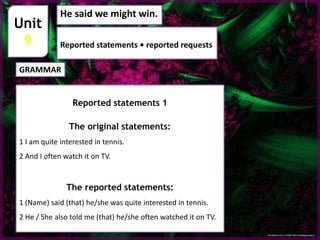
Unit
9
He said we might win.
Reported statements • reported requests
GRAMMAR
Reported statements 1
The original statements:
1 I am quite interested in tennis.
2 And I often watch it on TV.
The reported statements:
1 (Name) said (that) he/she was quite interested in tennis.
2 He / She also told me (that) he/she often watched it on TV.
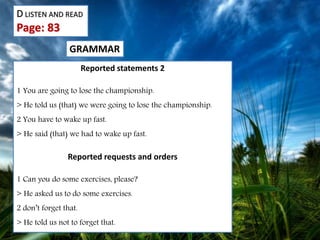
D LISTEN AND READ
Page: 83
GRAMMAR
Reported statements 2
1 You are going to lose the championship.
> He told us (that) we were going to lose the championship.
2 You have to wake up fast.
> He said (that) we had to wake up fast.
Reported requests and orders
1 Can you do some exercises, please?
> He asked us to do some exercises.
2 don’t forget that.
> He told us not to forget that.
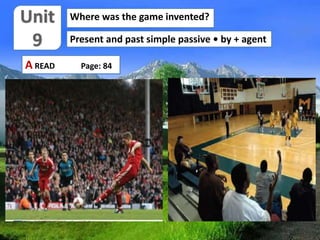
Where was the game invented?
Present and past simple passive • by + agent
A READ Page: 84
GRAMMAR
Present and past simple passive
Active: People place teams in leagues.
Passive: Teams are placed in leagues.
Active: People invented football in Britain.
Passive: Football was invented in Britain
by + agent
Active: Coaches train members.
Passive: Members are trained by coaches.
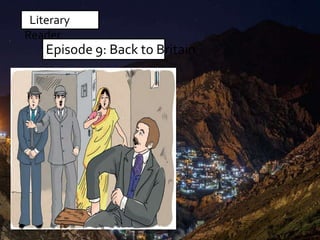
Literary
Reader
Episode 9: Back to Britain
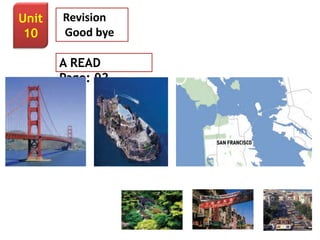
Unit
10
Revision
Good bye
A READ
Page: 92
10
Page:
94
C PRONUNCIATION
1 Read the sentences and the phonetics. Then listen.
1 The important thing is this. I’m having a /ði/ /θɪŋ/ /ðɪs/
birthday party. /ˈbɜːθdeɪ/
2 Of course, could you give him our best wishes?
/kɔːs/ /kʊd/ /juː/ /aʊə/
Sunrise 10

Sunrise 10

  • 1.
    Property of Ministryof Education NOT FORRESALE Student’s Book10 Property of Ministry of Education NOT FOR RESALE
  • 2.
    Finding out aboutthe books How many main units are there? There are ten. How many revision units are there? There are three. How many pages are there in Unit 1? There are ten. How many pages are there in the Activity Book? There are 80. How many pages are there in a revision unit? There are four or six.
  • 3.
    Finding out aboutpeople Personal Details 1- Rasheed 2- Nearly 16 3- on 5th of October 4- In Slemani 5- 07704534321 Wh-questions Present simple When …….? Where …….? What ……? How ……? Who……? Is, are, how much……? How many ….? How old ……? Do, Does
  • 4.
    Finding out aboutpeople …………. is your family name? ………… old are you? ……….. is your birthday? ………. do you live? ………. is your phone number? ………… homework do you usually do every day? …………. hours of TV do you watch most days? …………. brothers and sisters have you got?
  • 5.
    Advising: I’ve gota … / Then you should … Giving advice using should and need to …………… You need to go to the doctor. I’ve got a bad stomach ache. Then you should go to the doctor.
  • 6.
    Advising: I’ve gota … / Then you should … Giving advice using should and need to …………… Problems Advice I’ve( have ) got a problem with this CD. You need to go the music shop. I haven’t got any fruit. You should go to the market. I really need some ice cream. You need to go to the supermarket.
  • 7.
    Haveen: Let’s meeton Saturday afternoon. Gulistan: Sorry, I can’t. I have to revise for math test. Perhaps we can meet on ………… Haveen: I’m afraid I can’t. I have to go to Duhok on Tuesday. Suggestions Refusing Accepting Let’s met on Friday. Sorry, I can’t Yes, that’s fine. Perhaps we can meet on …….. I’m afraid I can’t Fine. No problem.
  • 8.
    1LESSONS 1&2 M A KI N G C O N T A C T I play basketball, too. Present continuous • Present simple DO AND SPEAK 1 Look at pictures 1–9 and match them with activities a–i. DO AND SPEAK 1 Look at pictures 1–9 and match them with activities a–i. 1 2 3 4 5 6 7 8 9
  • 9.
     They areplaying basketball.  They are playing computer games.  They are playing the guitar.  She is reading a book.  He is riding a bike.  He is taking photos.  They are talking on the phone.  They are skateboarding.  She is watching T.V .
  • 10.
    The girl isreading a book. The boys are playing basketball. I am helping my colleague. Questions and answers Is the girl reading a book? Yes, she is. Are the boys reading? No, they are not. They are … What are the girls doing? They are … B GRAMMAR p14 C LISTEN AND READ page: 9
  • 11.
    D GRAMMAR Present simpleStatements ( ROUTINE ) He She + VERB (S) + complement It I We You + VERB + complement They He listens to the radio. She washes her hair everyday. They smoke heavily. You cry a lot.
  • 12.
    Present tenses –future meanings Present continuous for personal plans and arrangements I’m staying with my dad for a month. Present simple for fixed future schedules We leave at 11.30 a.m. Questions and answers Does he smoke Cigarettes? Yes, he does. No, he doesn’t Does he care about the exam? Yes, he does. No, he doesn’t. Does it Work? Yes, it does. No, it doesn’t Do you listen to your manager? Yes, I do. No, I don’t. Do they work hard? Yes, they do. No, they don’t. What game do you play? I play basketball
  • 13.
    1LESSONS 3&4 M A KI N G C O N T A C T Dad looked on the internet. Present simple with adverbs of frequency • Past simple • used to A READ
  • 14.
    ●●●● always ●●●usually ●● often ● sometimes ● never Examples: Our dads oftencall and sometimes write. We alwaysgo for picnics in spring. He never gets tired. We sometimes go to bed at 10 o’clock. I usually call him at night. 2 Talk about normal days, after school. After school, I (always) go home. Then I (usually )… B GRAMMAR
  • 15.
    D GRAMMAR Past simplewith main verbs Statements I was very happy to get your surprise email. Dad looked on the internet. I nearly fell in the water. Questions and answers did your team win?Yes, we did. 21–18. how many points did you score?I scored three. ( used to ) for things that often happened in the past We used to talk about him a lot. I did not (didn’t) use to call home much.
  • 16.
     ask ……………… be ………………  leave ………………  look ………………  make …………….  move …………….  score …………….  take …………….  come ……………..  go ……………..  hope …………….  send …………….  visit …………….  wait …………….  write .…………….
  • 17.
    1LESSONS 5&6 M A KI N G C O N T A C T Staying in contact 1Listen to the verbs. Say which sounds you hear – 1, 2 or 3. Past simple /t / /d / / ıd / landed ✓ changed ✓ stopped ✓ asked expected scored suggested loved looked called talked started
  • 18.
    D READ ANDSPEAK 1 Read and make statements. Amy is 15, and Jack is … He’s from Ireland, and she …Both of them are in …at … Hi! I’m Amy Dawson, and I’m 15. I come from Sydney, Australia, and I’m in 10th grade at school. I have two younger brothers. Carl is 12 and Tim is I’ve also got an older sister. Her name is Ann, and she’s 18 years old. I like volleyball, and I’m also interested in painting and drawing. I’ve got a new interest, too.I’m learning to cook,and it’s really exciting!
  • 19.
    who /huː/ no /nəʊ/ so/səʊ/ alone bone zoo too prove zoom food proof to /tuː/ so know move truth choose tooth thank /θæŋk/ that /ðæt/ father mother brother feather further the /ðə/ think /θɪŋk/ though booth math theme thick thief birth wrath faith tooth Copy the tables and put the words that rhyme in the correct columns. Use the phonetics to help you. go /gəʊ/ do /duː/ this /ðɪs/ thin /θɪn/ Language Focus
  • 20.
    Literary Reader: Around theWorld in Eighty Days by Jules Verne
  • 21.
    Literary Reader: Around theWorld in Eighty Days by Jules Verne
  • 22.
    2LESSONS 1&2 H E LP ! I was riding throughthe woods. Reflexive Pronouns •Past Continuous + Point in time 2 Listen to Part 1 again. Say what the children are trying to do. (Dara is) trying to … 2 Rondik try / tie / l ower 3 Zara / Lawik try / light / fi re
  • 24.
    D LISTEN ANDREAD Doctor Tom Doctor Tom Doctor Tom Doctor Tom Doctor So, Tom, how did you hurt yourself? What were you doing? I was riding my quad bike Were you riding fast? Well, I wasn’t riding very fast. And then what happened? I went off the path towards a tree. Did you crash into it? Yes, and I hurt myself quite badly. You certainly did! Let me have a look.
  • 25.
    Singular: myself, yourself,him/her/itself e.g./ Rondik is going to cut herself. Plural: ourselves, yourselves, themselves e.g./ Stop, Zara and Lawik. You are going to burn yourselves. Stop, Lily, you will hurt …….. Reflexive pronouns
  • 26.
    GRAMMAR I was makinglunch. They were playing in the garden. Questions and answers Were you riding fast? No, I was not riding very fast. What were they doing? They were playing in the garden. F SPEAK Tom crashed at 2 p.m. yesterday. What were you doing at that time?
  • 27.
    A READ Manchester Evening News28th October, 20.. FAMILYHEROES FIGHT HOUSE FIRE 2LESSONS 3&4 H E L P ! Whileshewasworking,hecame downstairs past continuous + past simple • adjectives and adverbs
  • 28.
    Answer the questions. 1What did Julie start doing at 7.30? 2 Why did she do that? 3 What was Toby doing when he fell? 4 Was Julie working in the kitchen when the fi re started? 5 How did Julie save the family? 6 Where were Julie and Toby when John returned? 7 How did John reach Julie and Toby? 8 What happened in the end? Frightened quickly empty hot violently Complete the sentences with an adjective or adverb in the box. 1- The chip pan got too _______________. 2- When she threw water on the oil, it exploded _______________. 3- Julie shouted for help but the street was _______________. 4- ‘I felt really _______________,’ she said. 5- Julie _______________ ran to her bedroom for her mobile phone.
  • 29.
    Past continuous orpast simple While she wasworking, he startedto come downstairs. When she smeltit, she ranback. GRAMMAR GRAMMAR Adjectives and adverbs The Horne family had a lucky escape last night. By 7.30, Toby was getting hungry. It exploded violently. ‘I felt really frightened,’ she said later.
  • 30.
    ‫بكةر‬ ‫بةركار‬ ‫تى‬َ‫ي‬‫ر‬‫خاوةندا‬‫ى‬‫ئاوةلناو‬ ‫تى‬ َ‫ي‬‫ر‬‫خاوةندا‬‫ناوةكانى‬ َ‫جي‬ ‫خويةتى‬‫ناوةكانى‬ َ‫جي‬ I me my mine myself You you your yours yourself He him his his himself She her her hers herself It it its its itself We us our ours ourselves You you your yours yourselves they them their theirs themselves
  • 31.
    When she leftthe office, she saw the manager outside. After I finished my work, I went home. When I told him the story, he cried. After he called our names, we listened to the speech.
  • 32.
    Adjectives( ‫ئاوةلناو‬) Adverbs(‫ئاوةلكار‬) quickquickly real really slow slowly sudden suddenly happy happily luck luckily terrible terribly good well
  • 34.
    3LESSONS 1&2 E A TWEL L – B E WE L L How many do we need? some and any, much and many • a, some and the A LISTEN AND DO 1 2 3 4 5 6 7 a 12 b c15 18 11 17 20 19 d 98 10 13 14 16 bread butter cheese chicken legs coffee eggs fish kebabs lemonade lemons lettuces milk olives onions orange juice oranges potatoes tea tomatoes yogurt
  • 35.
    Some and any,much and many, a and the some and any We need some ground meat. Get a pan, and cut some onions. Do we need any vegetables? Take some meat, and some tomato paste. We don’t need any tomatoes. Mix the meat and the paste together. much, many, a little, a few, a lot of How much meat do we need? How many people are coming? We only have a little time. There isn’t much time. We only need a few onions. We don’t need many packets. That’s a lot of meat!
  • 36.
    Page: 28 E GRAMMAR a,some and the Get a pan, and cut some onions. Take some meat and some tomato paste. Mix the meat and the paste together. F LISTEN AND SPEAK Play a memory game. Say what you bought at the supermarket. How long can you make the list? Start like this: A We bought some bottles of cola. B We bought some bottles of cola and a jar of cofee. C We bought some bottles of cola, a jar of cofee and two kilos of potatoes. D We bought some bottles of cola, a jar of cofee, two kilos of potatoes and …
  • 37.
    3LESSONS 3&4 E A TWE L L – B E WE L L Types of food that you need a, the and zero article • relative pronouns who, which and that A READ by Dr Lynda Hill Page: 30 You need … ●calcium for strong bones; ●carbohydrates for quick energy; ●f i b e r to help your stomach work well; ●protein to build your body; ●vitamins and iron for good health.
  • 38.
    B GRAMMAR a/an/some, theor (–) zero article I usually get a bag of chips / some chips. I’m always late for the school bus at 7.30. I often get (–) bad headaches. E Relative clauses with who, which and that He looked like a lot of young people who / that come to see me. The Pyramid includes the six groups of food which / thatwe eat. Saddam was the man who invaded Kuwait in 1991. Do you see the laptop which is on the table? It was my car that he crashed.
  • 40.
    3LESSONS 5&6 E A TWE L L – B E WE L L Explainingyour culture:food A READ Page: 32 & 33 1 Look at the pictures and the poem. Then answer these questions. 1 What does the i rst line of each verse say? 2 Look at the title. What does it mean? 3 Who do you think the writer is speaking to?
  • 41.
    ‫ن‬‫او‬‫ر‬‫رد‬ َ‫ذمي‬‫وشانة‬‫ة‬‫ر‬‫جو‬‫ئةم‬ ‫وشانة‬‫ة‬‫ر‬‫جو‬‫ئةم‬‫ن‬‫او‬‫ر‬‫رد‬َ‫ذمي‬‫نة‬ Burger orange vegetable oil rice sugar I ate a burger and an orange. Let’s cook some rice. Could you buy some vegetables? Would you like some sugar? No, I haven’t got any oranges. Any ( Negative ) Have you got any oil? No, we haven’t got any oil. We bought a lot of vegetables. We bought a lot of rice. Have you got many oranges? Have you got much oil? No, we haven’t got many oranges. No, I haven’t got much oil.
  • 42.
    bread [bred] meat[miːt] meal [miəl] SEAT, FEET, FREE, READ, SPEAK, BEAT, HEAT, SHEET, ME, BEE, FEEL, MEET, SHEEP, SEE, SEA, TEACHER, BEACH, TREE, BEEN, TEA, PEACH, CLEAN, SLEEP, STEEP, DREAM, KEY, MEAT, REACH, NEED, SEED, WEED, Bed, said, paid, head, neck, pen, men, hen, red, led, get, let, net, pet, wet, set, yet
  • 43.
    1- /ʧ/ sound Touch,catch, chair, cheap, chance, chalk, cheat, church 2- ‘ch’ not pronounced as /ʧ/ but as /k/ Chemistry, mechanic, chemical, chaos, character, Christmas, Christian 3- /ʤ/ sound Charge, merge, judge, budget, fridge, bridge, adjective 4- /ʃ/ sound 1- sh = sh 2- tion = sh 3- Sometimes sion = Sh 4- su = sh when there is a consonants before them Examples: sheep, shadow, shop, short, shame, shape ---- Application, station, nation, international, supplication, information---- mission, discussion, submission, expansion, session, dimension, transmission ---- sure, ensure, sugar,, insurance, assure, tissue ………..
  • 44.
    Silent Sounds 1- /l/is not pronounced in these words: Would, should, could, chalk, talk, walk, calm, calf, half 2- /k/ is not pronounced in these words: Knock, know, knit, knight, knack, knee, kneel, knife, knowledge 3- /b/ sound is not pronounced in such words: Womb, tomb, comb, thumb, bomb, lamb, climb, dumb, debt, doubt, plumber 4- /h/ sound is not pronounced in these words Hour, honest, , vehicle, heir, forehead, shepherd, ghost, whistle
  • 45.
    5- /t/ isnot pronounced in these words: Catch, ditch, switch, often, pitch, whistle, castle, watch, match, hitch 6- /w/ is not pronounced in these words: wrong, wrap, wrath, wrestle, wreck, wring, write, whose, who, snow 7- /gh/ is not pronounced in these words: night, right, height, fight, sight, might, knight , brought , thought, fought, through, drought 8- /gh/ is pronounced as /f/ in these words: rough, tough, laugh, draught
  • 47.
    4LESSONS 1&2 A READ R EV I S I O N See you soon! Hi, Haval I want to stay in contact, so here’s a quick email. I also want to say thanks again to your parents. They were very kind while I was waiting for Dad at the airport on Saturday. I hope that you enjoyed Saturday night in Erbil, and that you got back safely to Silemani yesterday. I’m enjoying myself a lot. Dad is taking a short holiday from Friday this week, and we’re travelling into the mountains near Ahmadawa. I’m looking forward to that very much. I expect you’re having a good time, too.Best wishes, Ben Hi, Ben I want to stay in contact, too, so thanks for your email two days ago. And yes, I’m having a great time! I’m sorry I couldn’t write back yesterday, but we were out all day. We were having a big family picnic with lots of cousins and aunts and uncles. We went to Ahmadawa, a beautiful place with waterfalls. It’s a place which is very popular for picnics. Kurdish picnics are amazing! We prepared about ten kilos of biriani, 100 kebabs, and I counted 30 bottles of cola and fruit juice! We sang traditional songs, and we all enjoyed ourselves a lot! We’re hoping you’d still like to visit Silemani. But there isn’t much time because I fly home on Saturday the 22nd, and it’s already the 5th. Maybe you can come after your trip. Bye! Haval
  • 48.
    4LESSONS 5&6 R E VI S I O N Vocabulary and skills A VOCABULARY Complete. Change the forms when necessary. ahead of, arrive, attach, internet, make, contact, reply Hi, Luke, Thanks for your email. It ………………. five minutes ago, and so I’m quickly ……………….. to it before I go to bed. It’s strange, isn’t it? For you in New Zealand, it’s 8.00 in the morning, and that’s nine hours ……………….. us here in Kurdistan. For you, it’s Wednesday now, and here it’s still only Tuesday. But with email and the …………………. we can ……………….. so easily. We really live in a small world! I’m …………………. a photo of me with my family. I hope you like it. I must stop now and get some sleep. I’ve got a busy day tomorrow. Bye for now, Azad
  • 49.
    ambulance emergency first aid paramedic rescue save After a week of heavy rain, the streets of Newton are today under a metre of water. The 1 services are busy helping people all over town, getting them to dry land and safety. A 999 call from the Newton Old People’s Home at 9.30 this morning led to the 2 of 28 people between the ages of 73 and 99. The oldest, Mrs Hilda Barker, will be 100 this week. Fire fighters brought Hilda and her friends to dry land by boat. There, several 3 and nurses were waiting with four 4 to take them quickly to Newton Hospital. On the way, they needed to give 5 to Hilda and some of the others to keep them alive. Later, Hilda said, ‘Those wonderful young men and women 6 my life. I want all of them to come to my birthday party on Saturday!’ Manchester Evening News 999 FOR HILDA BARKER, 99
  • 50.
    amount bottle healthyingredient product teenager Think before you eat and drink! by Dr Lynda Hill Asa 1 who is growing into an adult, it’s very important for you to have a good diet.You need to make sure you’re getting all the right nutrients. So you need to know about the 2 that go into the many diff erent food and drink 3 that you eat and drink.And you need to try to choose ones that are 4 . Take two dif erent sorts of cola at the supermarket, for example. The two 5 may look almost the same, but read the labels, and you may i nd that the 6 of sugar in one is much greater than in the other. You know that too much sugar is bad for you, so you now know which cola not to buy!
  • 51.
    C PRONUNCIATION 1 Listento the verbs. Say which sounds you hear – 1, 2 or 3. stayed looked started arrived helped happened cursed shouted carried doomed buried nodded happened ✓ stopped ✓ suggested ✓
  • 52.
  • 53.
    DID YOU KNOW? Singaporeis a very special place that stands almost exactly on the Equator. It is only a small island-city, but it is an independent country, and it has a very special geographical position. It stands on a narrow piece of water, the Strait of Malacca, that is on the main sea route between the West and the Far East. Before planes and before the Panama Canal, almost all goods and people that moved between East Asia and Europe travelled this way. And Singapore itself, although small, has one of the largest ports in the world. In the days of Mr Phileas Fogg it was always, and today it still is, full of ships from all over the world. This accident of geography made Singapore very rich. And the high skills of its four million people are helping to keep it rich.
  • 54.
    Moving into space I’vejust had an idea! present perfect with , , , so and • past simple We have nearly finished I have already finished. I have not finished yet, but I am going to soon. Questions Have you studied for the exam? No, I haven’t studied for the exam yet.
  • 55.
    Present perfect withjust We have just had some big news from the ISS. He has just studied homework. Have you ever looked up? Present perfect with ever and never, for and since • Past simple A READ Page: 48 Present perfect with ever, never Have you ever looked up at the night sky? Humans have never travelled beyond the moon. She has been here since 1990. I have been in New York for 2 days.
  • 57.
    DID YOU KNOW? Longago, life on sailing ships was dangerous. One big problem was this: people often did not know their position. They could be close to danger and not know it. Today, this has changed, thanks to GPS (Global Positioning System). GPS uses satellites to work out our exact position anywhere in the world. We have had it since1994, and now people use it everywhere on land, in the air and, of course, at sea. It works like this. There is a network of 24 satellites about 20,000 kilometers above Earth. A GPS receiver on the ground can always ‘see’ four or more of these satellites. It uses signals from them to work out its distance from each one. From that, it works out its own position on the ground. GPS often saves lives. If your boat is sinking out at sea, for example, you can radio for help and, with GPS, you can give your exact position. People can then find you quickly and rescue you fast.
  • 59.
    D LISTEN ANDREAD Page: 57 We dress as smartly as possible. Adjective or adverb of manner I’m proud of my uniform. I wear the uniform proudly. That helps us do our job well. Comparative adjective or adverb of manner It’s much warmer in summer. We can dress much more comfortably.
  • 60.
    Comparison with as… as … or not as … as … We dress as smartly as possible. In the old days, we were not as careful as we are now. Comparison with as … as … or not as … as … We dress as smartly as possible. In the old days, we were not as careful as we are now. We can talk as quickly as possible. He will drive as fast as we can. She will answer the questions as easily as possible. Comparing and choosing Page: 60
  • 63.
    DID YOU KNOW? Japanwas a closed country for 350 years, until 1868 – four years before the time of Around the World in Eighty Days. For all that time, few people could visit Japan, and Japanese people could not travel abroad. Then when Japan began to open up, the whole world wanted to find out about this strange country, its culture and its traditions. At the same time, the Japanese wanted to learn about the whole world, and that is what they have done ever since then. In fact, Japan has now become one of the most developed countries on Earth. With over 30 million people, Tokyo- Yokohama has the largest urban population anywhere in the world today. Japan is also home to some of the world’s largest, richest and most famous companies – companies such as Toyota and Sony. However, the Japanese have also kept much of their old culture. For example, there are a lot of festivals when people still dress traditionally and enjoy their traditional food, music and dancing.
  • 64.
    66 Unit 7 Revision I’ve lost mywallet! Revision Vocabulary and skills Complete the following with the correct words. Change the forms when necessary. all over amazing beyond humans planets signals
  • 66.
    Europeans started arrivingto live in America in the early seventeenth century. Their numbers grew during the next two centuries, but they remained on or near the east coast. Then, in the early nineteenth century, many more Europeans began arriving, and people moved west. These people were poor, and they were looking for land and a new life in ‘the New World’. However, that land was the land of five million native Americans, who fought hard to keep the Europeans out. Also, there was often trouble between the new Americans themselves. People rightly called it ‘the Wild West’, and thousands died over the years. Trains were one of the first signs of a quieter future. In 1869, a railroad connected the east and west coasts for the first time. This was the still-dangerous, seven-day journey that Phileas Fogg and the others made only three years later.
  • 67.
    If you dothe housework, I’ll … open conditional • First Conditional Unit 8 A LISTEN AND SPEAK Page: 72 GRAMMAR Open conditionals if / when + present simple, present simple if Mum is very tired, I make dinner for the family. I usually help Dad when he washes the car. DLISTEN AND READ Page: 73 First conditionals if + present simple, future with will if we do the cooking, she will (she’ll) be free to relax. It will (It’ll) help if you wash the dishes.
  • 68.
    What would youdo? Second conditional 8 Quiz: What would you do in these situations? Page: 74 Situation 1 Your grandmother is ill in hospital two hours away. You know that she would love to see you. However, you have an important test early tomorrow morning. You need as much time as possible to prepare for it. If you were in this situation, would you … a) spend a happy day with your grandmother and risk a bad mark tomorrow? b) get a message to her to say sorry and explain the need to study? c) visit her, but only stay for a short time, and then make the long journey home again and study until 3 a.m.?
  • 69.
    Second conditionals 1 if+ past simple, would + verb if everything went well, it would lead to things. if this happened, would you do the safe thing? Second conditionals 2 if + past simple, would / might / could + verb if you did this, you would be very tired. You might succeed, but you could easily fail.
  • 70.
    8 Making asuggestion What about + v (ing) + completion? What about going to a picnic? Let’s + verb + completion Let’s go to café. Why don’t you + verb + completion ? Why don’t you take a pill? PRONUNCIATION The this thirty thousands through that thank you other everything they their thin
  • 71.
    Episode 8: FromFort Kearney to New York Harbour
  • 72.
    Unit 9 He said wemight win. Reported statements • reported requests GRAMMAR Reported statements 1 The original statements: 1 I am quite interested in tennis. 2 And I often watch it on TV. The reported statements: 1 (Name) said (that) he/she was quite interested in tennis. 2 He / She also told me (that) he/she often watched it on TV.
  • 73.
    D LISTEN ANDREAD Page: 83 GRAMMAR Reported statements 2 1 You are going to lose the championship. > He told us (that) we were going to lose the championship. 2 You have to wake up fast. > He said (that) we had to wake up fast. Reported requests and orders 1 Can you do some exercises, please? > He asked us to do some exercises. 2 don’t forget that. > He told us not to forget that.
  • 74.
    Where was thegame invented? Present and past simple passive • by + agent A READ Page: 84
  • 75.
    GRAMMAR Present and pastsimple passive Active: People place teams in leagues. Passive: Teams are placed in leagues. Active: People invented football in Britain. Passive: Football was invented in Britain by + agent Active: Coaches train members. Passive: Members are trained by coaches.
  • 76.
  • 77.
  • 78.
    10 Page: 94 C PRONUNCIATION 1 Readthe sentences and the phonetics. Then listen. 1 The important thing is this. I’m having a /ði/ /θɪŋ/ /ðɪs/ birthday party. /ˈbɜːθdeɪ/ 2 Of course, could you give him our best wishes? /kɔːs/ /kʊd/ /juː/ /aʊə/