ÓÄÊ 811.111(075.3)
ÁÁÊ 81.2ÀÍÃË.922
Ê17
© Êàëіíіíà Ë.Â.,
Ñàìîéëþêåâè÷ І.Â., 2015
© Âèäàâíèöòâî «Ãåíåçà»,
îðèãіíàë-ìàêåò, 2015ISBN 978-966-11-0655-9
Ðåêîìåíäîâàíî Ìіíіñòåðñòâîì îñâіòè і íàóêè Óêðàїíè
(Íàêàç ÌÎÍ Óêðàїíè âіä № )
Ê17
Êàëіíіíà Ë.Â.
Àíãëіéñüêà ìîâà äëÿ ñïåöіàëіç. øê. ç ïîãëèáë.
âèâ÷. àíãë. ìîâè : ïіäðó÷. äëÿ 7 êë. çàãàëüíîîñâіò.
íàâ÷. çàêë. / Ë.Â. Êàëіíіíà, І.Â. Ñàìîéëþêåâè÷. — Ê. :
Ãåíåçà, 2015. — 256 ñ. : іë.
ISBN 978-966-11-0655-9.
Ïіäðó÷íèê «Àíãëіéñüêà ìîâà. 7 êëàñ» ïðîäîâæóє ñåðіþ
ÍÌÊ äëÿ îâîëîäіííÿ àíãëіéñüêîþ ìîâîþ â ñïåöіàëіçîâàíèõ
íàâ÷àëüíèõ çàêëàäàõ ç ïîãëèáëåíèì âèâ÷åííÿì іíîçåìíîї
ìîâè. Cêëàäàєòüñÿ ç 7 ðîçäіëіâ (Units). Íàïðèêіíöі êîæíî-
ãî ðîçäіëó ïîäàíî ðóáðèêó My progress in English äëÿ êîíòð-
îëþ і ñàìîêîíòðîëþ çäîáóòèõ ó÷íÿìè çíàíü.
 êіíöі ïіäðó÷íèêà — ëåêñèêî-ãðàìàòè÷íèé êîìåíòàð
First Aid Kit, òåêñòè äëÿ àóäіþâàííÿ, êëþ÷і äî òåñòîâèõ çà-
âäàíü My progress in English, òàáëèöÿ íåïðàâèëüíèõ äієñëіâ
òà àíãëî-óêðàїíñüêèé ñëîâíèê.
ÓÄÊ 811.111(075.3)
ÁÁÊ 81.2ÀÍÃË.922
УМОВНІ ПОЗНАЧЕННЯ:
– Вправи на аудіювання, фонетичне опрацювання мовленнєвого матеріалу
– Письмові вправи
– Домашнє завдання
– Завдання підвищеної складності
Íå ç à ëå æ í і åêñïåð ò è:
Äæîí Õîëë, Øîí Øåðìåðõîðí, Äåðåê Õüþіòò, Ëіàíà Îíіë, Âåíäі Ñòåíõàóñ,
âèêëàäà÷і Ìîâíîї øêîëè «Ìіæíàðîäíèé Äіì», ì. Êèїâ
Âèäàíî çà ðàõóíîê äåðæàâíèõ êîøòіâ. Ïðîäàæ çàáîðîíåíî
3
Ëþáèé äðóæå!
Öüîãî ðîêó òè ïðîäîâæèø âèâ÷àòè àíãëіéñüêó ìîâó. Ïіäðó÷íèê ìіñòèòü
ñіì ðîçäіëіâ, êîæåí ç ÿêèõ – öå âåëèêà òåìà, íàïðèêëàä “Family and
Friends” àáî “Balance Your School Life”. Äëÿ òîãî ùîá ç êíèæêîþ áóëî
çðó÷íіøå ïðàöþâàòè, óðîêè ïîäіëåíî íà äåêіëüêà ÷àñòèí: Pronunciation
Warm-up, Grammar Smart, Word Smart, Time to Read, Conversation Warm-
up, Time to Listen, Time to Write.
Êîæåí óðîê ïî÷èíàєòüñÿ ç áåñіäè – Conversation Warm-up. Öå äîïîìîæå
òîáі àêòèâíî âêëþ÷èòèñÿ â ðîáîòó, «çàíóðèòèñÿ» â ñåðåäîâèùå àíãëіéñüêîї
ìîâè, âіäíîâèòè â ïàì’ÿòі íàáóòі çíàííÿ.
Ó òåáå ç’ÿâëÿòüñÿ íîâі äðóçі, òåæ ñåìèêëàñíèêè. Öå ïåðñîíàæі Ann,
Steve, Lucy, Helen òà іíøі, ç ÿêèìè òè áóäåø ñïіëêóâàòèñÿ àíãëіéñüêîþ,
âèâ÷àòè ãðàìàòèêó, ïîïîâíþâàòè ñëîâíèêîâèé çàïàñ.
Äіòè ðîçêàæóòü òîáі ïðî æèòòÿ øêîëÿðіâ ó ñâîїõ êðàїíàõ, íàâ÷àòü
ñïіëêóâàòèñÿ ìîâîþ, ÿêà є äëÿ íèõ ðіäíîþ. Ðàçîì âè ïîãîâîðèòå ïðî óëþá-
ëåíі êіíîôіëüìè, âіäîìèõ ñïîðòñìåíіâ, ïîáóâàєòå â ïîïóëÿðíèõ òåàòðàõ
âàøèõ êðàїí. Òè çìîæåø ðîçêàçàòè ñâîїì çàêîðäîííèì äðóçÿì ïðî
ñòîëèöþ Óêðàїíè – Êèїâ, îçíàéîìèø їõ ç âèçíà÷íèìè ìіñöÿìè ìіñòà.
Ó êіíöі ïіäðó÷íèêà òè çíàéäåø äîâіäíèê (First Aid Kit), òåêñòè äëÿ
àóäіþâàííÿ (Audioscripts), êëþ÷і äî òåñòîâèõ çàâäàíü (My progress in
English), àíãëî-óêðàїíñüêèé ñëîâíèê (Vocabulary) òà òàáëèöþ íåïðàâèëü-
íèõ äієñëіâ (Irregular Verbs).
Çâåðíè óâàãó íà çàâäàííÿ, ÿêі ïîòðіáíî áóäå âèêîíàòè â ðîáî÷îìó
çîøèòі. Öå äîïîìîæå òîáі øâèäøå é êðàùå çàñâîїòè ìàòåðіàë.
Ç óðèâêіâ òâîðіâ âіäîìèõ àíãëіéñüêèõ òà àìåðèêàíñüêèõ ïèñüìåííèêіâ,
âìіùåíèõ ó ïіäðó÷íèêó, òè áіëüøå äіçíàєøñÿ ïðî àíãëîìîâíі êðàїíè. Öå
äîïîìîæå òîáі ïîãëèáèòè çíàííÿ ç àíãëіéñüêîї ìîâè, ùîá çãîäîì ñòàòè
öіêàâèì ñïіâðîçìîâíèêîì.
Good luck!
Õàé ùàñòèòü!
Àâòîðè
4
Summer Travel
I. Conversation Warm-up
Look and say where children travelled in summer. Where did you travel in summer?
Kyiv London
seaside children’s camp
E x a m p l e: Some children visited Kyiv and saw many places of interest. My
family and I travelled to Turkey.
II. Pronunciation Warm-up
Read the chant and practise the rhythm. Say what your favourite kind of travel-
ling is.
Travelling Chant
– Do you like travelling?
– Yes, I do.
– Are you fond of sightseeing?
– Yes, I am.
– Do you enjoy swimming and lying in the sun?
– Sure, I do. Summer is fun.
III. Grammar Smart
Read and recall: the Present Perfect and the Past Indefinite
1. Let’s play a completion game.
E x a m p l e: We went to … last summer.  We went to Odessa last summer.
5
1. We have just … .
2. My friend has already… .
3. … yesterday.
4. … a month ago.
5. I have never … .
6. … last weekend.
2. Make up sentences on the table.
E x a m p l e: I was the best at swimming at school, that’s why I went to a
swimming camp in summer.
1. I was the best at swim-
ming at school,
2. It was dark,
3. Our class decided to go on
a hike,
4. The weather was wonder-
ful,
5. I like the sights,
6. Nick is a great traveller,
that’s why
a) we packed rucksacks.
b) I went to the swimming
camp in summer.
c) I have taken pictures of
them.
d) we decided to put up a tent.
e) we spent the last weekend
out of town.
f) he has chosen a walking
tour for Sunday.
IV. Time to Read
1. Read/listen to the children discussing their summer travel and say why Ann
enjoys travelling.
Travelling Experience
Ann: Look here, Helen, there are pictures of Big Ben and Westminster
Palace on your T-shirt and I can see the Union Jack on your schoolbag.
Does it mean that you have accomplished your dream and visited Lon-
don this summer or just had a shopping trip for a new school year?
Helen: I adore shopping, of course, and I did do some shopping but in Lon-
don.
Ann: Great! Was it a sightseeing tour or a study visit?
Helen: Both. We had English lessons four days a week at a private school
and the rest of the week was given to sightseeing. I was very im-
pressed by visiting the British Museum, especially by its Egyptian
collection.
Ann: No wonder, travelling is always exciting. The more you travel, the
more you learn.
Helen: I knew you would say this as you are the most experienced traveller
in our class. Where have you been this time?
Ann: I’ve been on the move all my summer holidays. At the beginning of
the summer I visited Lviv. My cousin Denis invited me. He was having
his international friends over from Canada and I participated in the
welcoming party.
6
Summer Travel
Helen: Let me guess your contribution. You cooked Ukrainian national di-
shes – varenyks, pancakes, pies and you sang your favourite Ukrai-
nian folk songs.
Ann: Poor guess. I did nothing of the sort. The Canadian girls liked my
vyshyvanka and I taught them how to embroider in Ukrainian na-
tional style.
Helen: Great! You had a chance to practise your hobby, I believe.
Ann: In a way, but it was a good experience. Then I went to Odessa and
spent three weeks there swimming in the sea and lying in the sun.
And finally, I went to my granny’s place to Belarus and stayed there
up to the end of my holidays. I saw and learned a lot there.
Helen: So, we prove the truth of the old saying again, ‘Travelling is worth
trouble taking’.
2. Answer the questions.
1. What was Helen’s dream?
2. Did Helen accomplish it?
3. Which girl is an experienced traveller?
4. How did Ann practise her hobby?
5. What did you learn about the Ann other hobbies?
6. Where did Ann spend the last days of her summer holidays?
3. Look at the pictures and describe the situations in them, using the text
“Travelling Experience”.
E x a m p l e : Helen was wearing a T-shirt with pictures of Big Ben and West-
minster Palace on it.
V. Time to Communicate
a) Act as Helen and describe your trip to
London. Use:
to accomplish one’s dream;
a shopping trip;
to have a sightseeing tour;
to be impressed by something;
to have memorable holidays.
7
b) Act as Ann and describe your travelling expe-
rience.
to be on the move;
to participate in a welcoming party;
to practise one’s hobby;
to embroider;
to have a great travelling experience.
c) In pairs, talk about your summer travel. Follow the pattern.
Pattern:
– Look here, … . There is… . Did you … ?
– I adore …, of course, but … .
– Great! Was it … or … ?
– Both. We had … and … . I’ve got the most … .
– No wonder … .
– And where did you … ?
– Personally, I … . At the beginning of the summer I … .
– Let me guess … . You … and … .
– Poor guess! I … and … .
– Great, you had a chance … .
– In a way, but then … and finally I … .
– So, we prove the truth of the old saying: … .
VI. Time to Write
Write a short essay about your summer travel.
Go to Ex. 1, 2 of your WB
In Grade 7
I. Conversation Warm-up
Read what the children say about their expectations of studying in Grade 7 and
tell your friends who you agree with.
I think we’ll learn new subjects this year. It’ll be very inte-
resting to learn new things.
Ann
I hope we’ll have more lessons in the computer labs and
work more on the Internet.
Andrew
8
Summer Travel
Personally, I’d like to meet new teachers and new classmates.
It’s fun to have new people around.
Denis
I believe we’ll have more after-school activities, like sport,
drama or music.
Helen
E x a m p l e : I agree with Andrew. I like to work on the computer, because it
is easier to learn.
II. Pronunciation Warm-up
Read and practise the rhythm. Say what you think about your studying English
in Grade 7 form.
The Seventh Form Rap
We are one year older.
We are in the Seventh form
We’ve got new language folders
and learn behavior norms:
How native speakers talk,
Gesticulate and mime.
What codes and rules they stick to
At work and leisure time.
It’s fun to learn a foreign language.
It’s great to know its culture,
For it unites the people
And makes relations tighter.
III. Grammar Smart
The Present and Past Continuous
a) Look at the pictures and say what the children are doing in the school yard.
E x a m p l e: The boys are playing football in the school yard.
9
b) Play a grammar combination game using when or while.
E x a m p l e: I came home. My mum was cooking dinner. When I came home,
my mum was cooking dinner.
1. My sister was sleeping. I was doing my lessons.
2. A teacher entered the classroom. The pupils were discussing a problem.
3. The boys were playing football. The girls were swimming.
4. The children were role-playing. The teacher was watching them.
5. The coach came to the gym. The athletes were practising high and long
jumps.
6. Oksana was setting the table. Her mum was cutting vegetables in the
kitchen.
c) In groups, make up your own stories under the titles given.
On a Shopping Trip Let’s Have Dinner
IV. Time to Read
Read the children’s most memorable impressions of the previous school year and
say what impressed them most.
Oksana: Of all my hobbies I like cooking the best. My granny is great at
baking and her apple pies have a taste like nothing else on Earth. I always
watched her while she was baking and enjoyed it. While making pies, my
granny taught me how to make them look appetizing.
In summer we celebrated my granny’s 70th
birthday and many guests came
to our place to wish her a happy birthday. We treated our guests to different
dishes but most of all they liked the pies. My granny was proud to say that
it was me who baked them and everybody asked me for the recipe. I was the
happiest guest at the party. I’m a good learner, aren’t I?
Andrew: My most memorable impression is my visit to Australia. You’ll
be surprised to know that Australians celebrate New Year in summer. We
decorated a New Year tree on the beach. There were no New Year costumes,
we wore only bathing suits, sun glasses and caps. It was so hot! But there
were New Year presents and a real Santa Claus! He was walking from group
to group, singing Christmas carols and all the picnickers joined him. I was so
excited! It looked so different from what we have in Ukraine.
10
Summer Travel
Denis: I also had a new experience in summer. My family moved into a
new flat, which was in another district of our town. So I had to go to a new
school. Frankly speaking, I was scared. I loved my old school and teachers
and I had so many school friends there. What was going to happen in the new
school?
Luckily, Boris Voitenko, who goes to the same karate club with me, was
my classmate now. He introduced me to his friends and they showed me
round their school. I liked their computer centre, the library and the lan-
guage lab. Boris’s friends are good musicians and they play in the school
orchestra. At that time they had a problem – their drummer was in hospital
and that’s why they couldn’t participate in the city festival. Can you imagine
how happy they were to learn that I could play the drums? So we played in
the festival and we were a great success. All my worries have gone by now.
Now I have more friends and more possibilities to practise my music.
Helen: My family went to Chicago, at the invitation of my aunt last summer
and I’m still impressed by my visit and especially of my shopping tour.
My cousin Polly invited me to the Mall to hang out with her friends. When
we came, the girls decided to do the window shopping. Polly said it was their
habit to do it. I never thought it could be so exciting. We looked at the goods
displayed on the counters, watched the customers trying on new clothes,
talked to shop assistants, discussed the latest fashions. I was surprised that
the girls knew so much not only about fashion but about what and where to
buy different goods like clothes, shoes, music discs, computer games, etc. It was
quite a new experience for me because I’m used to doing the shopping only
with my mum.
2. Mark the true statements.
1. The children had different impressions of their summer.
2. Denis had a chance to visit Chicago.
3. Andrew loved his New Year celebrations.
4. Oksana had a good shopping experience.
5. Helen was a good drummer and played in the school orchestra.
6. Denis worried about his studying in the new school.
3. Look at the pictures (p. 10–11) and reproduce the episodes from the texts.
11
V. Time to Communicate
1. Act as one of the children and speak about the most memorable events of the
previous school year. Use:
to be impressed by something;
to be exciting;
to take part in something;
to be surprised;
to learn a lot about something;
to have the most memorable time.
2. In pairs, discuss with your friends your plans for Grade 7 as in the pattern.
Pattern:
A: Hey, …we are in Grade 7 now. What … ?
B: Yes, we are one year older and … . I think … .
A: Besides, this year … and … .
B: Personally, … .
A: Great! And I … .
B: I know you … . Are you going … ?
A: Sure. I believe … .
B: Agreed. We can also … and … .
A: Exactly, and … .
B: I hope we’ll … .
3. Speak about your future studies in Grade 7.
VI. Time to Write
Write about a new activity you are going to take part in being a seventh-grader.
Go to Ex. 3, 4 of your WB
12
UNIT 1. Family and Friends
1.1. Family album
Word Bank
newly born
cute
caring
wise
Phrase Bank
to display family photos
to have a full set of …
to be on a visit to somebody
to be the heart of the family
to be of the same age
to be everybody’s pet
to have a combined age of …
Communication Box
… namely, …
I. Conversation Warm-up
This is a photo of Phil’s family. In pairs, compare his family to
your family.
my grandpamy grandpa mum dadmy grandma
my elder sister my younger brother
my elder
brother
my niece
my nephew
E x a m p l e: A: Phil’s family is bigger than mine.
B: My family is also big: I have …
II. Pronunciation Warm-up
Read the family rules with correct intonation. Say what rules you have in your
family.
Phil
14
Unit 1
b) Look at the pictures and fill in the right form of the verb to be.
E x a m p l e: My granddad … in his early forties. 
My granddad isn’t in his early forties.
1. My grandparents … in the garden now.
2. The baby girl … so sweet!
3. Tim … a very caring brother.
4. The children … in the kindergarten now.
5. Why … I in this photo?
2. Read and remember!
 Use was / were as the Past Simple forms of the verb to be to talk about
your family history:
E x a m p l e: My mother was on a visit to her in-laws then.
 Don’t forget to use adverbs of time:
then, last year, two months ago, for five years, etc.
 Use have been / has been as the Present Perfect forms of the verb to be
to talk about your family experiences that have happened in your life up
to now:
E x a m p l e: I have been to Canada.
 Use expressions often, once, twice, several times to say how often
something has happened to your family members.
E x a m p l e: My parents have been to Poland several times.
 Don’t forget the difference in meaning between been and gone:
My sister has gone to the Carpathians on holiday. (= She is there now.)
My sister has been to the Carpathians. (= She visited them in the past,
and is back by now.)
15
1.1
 Use will be as the Future Simple form of the verb to be to talk about
events that might happen in your family:
E x a m p l e: My uncle will probably be with us at Christmas.
 Don’t forget to use the adverbs probably, certainly and definitely.
 Use am/is/are going to talk about your family’s future plans and ar-
rangements.
E x a m p l e: We are going to have a family reunion next month.
a) Play a grammar ‘time-machine’ game using the pictures.
E x a m p l e: A: I was on a visit to my great-grandparents last weekend.
B: I have been on family visits many times.
C: I am going to visit my aunt on holiday.
b) Say:
 what happened in your family some time ago;
 what makes your family experience up to now;
 what events might happen in your family in the near future;
 what your family’s future plans and arrangements are.
E x a m p l e: My cousins were at the seaside with us last summer.
16
Unit 1
IV. Word Smart
Family Members Family member’s characteristics
granny (grandma)
granddad (grandpa)
uncle
aunt
cousin
on one’s side
on the father’s/mother’s side
wife
husband
niece
nephew
grandparent
granddaughter
kind
wise
caring
cute
lovely
everybody’s pet
friendly
to be the heart of the family
to look after a baby
to be fond of…
something you can’t do without
to enjoy every minute of one’s stay
to get to know relatives
Study these words and word combinations and:
a) Say what you call:
– your mother’s sister;  It is my aunt.
– your mother’s brother;
– your aunt’s son;
– your uncle’s daughter;
– your sister’s daughter;
– your brother’s son;
– your father’s parents;
– your mother’s mum.
b) Say how the members of your family can be characterized.
E x a m p l e: My grandma is the heart of the family.
c) Answer the questions.
1. What new relatives have you become acquainted with recently?
2. What relatives on your mother’s/father’s side have you got?
3. Who is the heart of your family?
4. Who is very caring in your family?
5. What relatives do you enjoy spending time with? Why?
6. Who is the oldest/youngest in your family?
At Home: Take a family photo and describe the people in it (6–8 sentences).
Go to Ex. 5, 6 of your WB
17
1.1
V. Time to Read
1. On the website “Family Album Pages” Sonya and Kate displayed their family
photos with some information. Read and match the information to the pictures.
A B C
ED
1. Hi there! This is me. My name is Kate and I’m 13. In this photo I’m
with my granny and my two cousins. They are my relatives on my mum’s
side, namely, my aunt’s son and daughter. We are on a visit to our granny.
She is the heart of our big family, very kind and wise.
2. These are my mum and dad. They are of the same age and have the same
interests. You see them in the garden. Gardening is something they can’t do
without. Now they are grandparents and spend more time with their grand-
daughter.
3. Hi, it’s me, Sonya. In this photo you see my elder sister Helen, her hus-
band Boris and my niece Olha. Her baby is such a lovely little thing, so cute
and funny. Boris is very caring and likes to look after his little daughter.
4. In this photo you see my two uncles on my father’s side and my father.
The brothers are very friendly and like to fish in the pond near my granny’s
house. My uncle Denis is the youngest and he is not married yet.
5. This is my niece Lidia. She is only six months old and she is very lucky
to have a full set of grandparents (four) and all eight great-grandparents,
too. The three generations above her have a combined age of more than
1,000. They are sure to spoil her on special occasions!
2. Fill in: older or elder.
1. My … sister is married.
2. Next year I’ll be one year … .
3. What’s your … brother’s job?
4. My father is … than my mum.
5. Who is … : you or your cousin?
6. Have you got an … brother?
Older – elder
Compare: My elder sister
is 3 years older than me.
See First Aid Kit: Gram-
mar in Use, p. 222
20
Unit 1
I. Conversation Warm-up
In pairs, look at the pictures and ask your friend what professions his/her rela-
tives have.
en engineer a doctor a teacher a shop
assistant
a programmer
E x a m p l e: A: Is there an engineer in your family?
B: We haven’t got engineers. My Dad is a doctor and my Mum is
a lawyer.
II. Pronunciation Warm-up
Read and practise the sounds /Á/ and /t/. Say what jobs run in this family.
Profession Round Chant
Is your mother a teacher?
No, she’s not. She’s a doctor.
Is your father a doctor?
No, he’s not. He’s a pilot.
Is your uncle a pilot?
No, he’s not. He is an engineer.
Is your aunt an engineer?
No, she’s not. She’s an economist.
Are you an economist?
No, I’m not. I am a pupil.
III. Grammar Smart
1. Look and recall.
The Present Simple The Present Continuous
Describe opinions using verbs of
thinking: mean, know, understand,
think, remember, forget.
E x a m p l e: My mum thinks tea-
ching is the best job in the world.
Describe actions happening around
the time of speaking using time ex-
pressions now, at the moment, to-
day, this week.
E x a m p l e: I’m looking for a part-
time job this week.
Describe likes and dislikes using
verbs of feeling/wanting: like, dis-
like, want, prefer.
E x a m p l e: My uncle doesn’t like
his job.
Describe what is happening in a
photo or picture.
E x a m p l e: In this photo, my aunt
is performing an operation.
21
1.2
a) Play a grammar picture description game using the given verbs. Say what you
think about these families.
E x a m p l e: A: In this picture, the grandfather is working in the field.
B: His grandson is working in the field, too.
to work
to help
to teach
to learn
to show
to explain
to try
to clean
to paint
to draw
to colour
to sketch
b) Say whether you like or dislike these jobs. Give your reasons.
E x a m p l e: a lawyer/to help in legal issues  I like this job because it is
essential to help people in legal issues.
1. a teacher/to inspire children to learn
2. a doctor/to cure people
3. a librarian/to recommend books
4. a mechanic/to repair cars
5. a hotel receptionist/to make people comfortable
6. a tourist agent/to arrange holiday trips
2. Read and remember!
 Use the Present Simple tense to talk about permanent situations:
E x a m p l e: My aunt works in a hospital.
 Use the Present Continuous tense to talk about temporary situations:
E x a m p l e: My cousin is a student. He is currently working part-time.
Time expressions: right now, currently, at the moment, these days
 Describe changes and trends using verbs of change: get, turn, go,
become in the Present Continuous:
E x a m p l e: This profession is getting more and more popular.
22
Unit 1
a) Play a grammar contrast game using the ideas from the box.
Permanent situations Temporary situations
to live in town
to work in a shop
to study at university
to travel on business
to drive a car
to stay out of town
to work at home
to take an online course
to visit Poland
to ride a bicycle
E x a m p l e: A: He lives in town.
B: He is staying out of town now.
b) Say how life and people around you are changing these days.
E x a m p l e: parents/to work more  My parents are working more and more.
1. school/to get more complicated
2. people/to get friendlier
3. your neighbourhood/to become safer
4. the world/to become more peaceful
5. life/to get easier
IV. Word Smart
1. Study these words and word combinations and:
a) Say who works in the medical profession.
E x a m p l e: There are doctors and nurses in the medical profession.
b) Look at the photos and say what profession
runs in this family (4–5 sentences).
to follow in her father’s footsteps;
to become a doctor;
to be retired;
to have many striking stories to tell;
to run in the family.
E x a m p l e: Kateryna Amosova followed in her
father’s footsteps.
Mykola Amosov
and his daughter
Kateryna Amosova
ambulance;
to be taken to hospital
nurse, pediatrician
surgeon; to perform an
operation; appendicitis
23
1.2
2. Complete the sentences and speak about a profession that runs in your family.
1. I think it’s best to…. 4. My … says … is the best job in the world.
2. I want to become … 5. … has many striking stories to tell.
3. I’d like to follow in … 6. As you see, … runs in our family.
At Home: Describe your parents’ professions/jobs (8–10 sentences).
Go to Ex. 9, 10 of your WB
V. Time to Read
1. Read/listen to the dialogue and say what professions run in Helen’s family.
Talking about Professions in the Family
Steve: Hey, Helen, you are very good at English. Do you plan to become a
teacher?
Helen: Maybe. My mum is a teacher and she loves it. She says teaching is the
best job in the world. I think she is a very good teacher as she can
inspire her students to learn. Sometimes she lets me help her with
marking their papers.
Steve: We all have someone in our family who we most admire. In my opi-
nion, these people are essential for us as we have somebody to model
ourselves after.
Helen: I think it’s best to do something that makes you happy.
Steve: Right you are. In my case, I want to help sick people and become a
doctor, maybe a general practitioner. When I was a child, I had a
sharp pain in my right side. My mum called an ambulance and I was
taken to hospital. The next day I was operated on for appendicitis.
The doctors and nurses were so helpful and kind!
Helen: My aunt is a doctor. She works in a big hospital as a pediatrician and
a surgeon. She performs very complicated operations, my mum says.
Steve: Could I possibly meet her and talk with her about the medical profes-
sion?
Helen: Certainly. With twenty years of experience, she has a lot of interesting
stories to tell. By the way, my aunt followed in my granddad’s footsteps.
Steve: Really? And what did your grandfather do?
Helen: He was a dentist. He cured people’s teeth. He is retired, though.
Steve: So, the medical profession runs in your family, doesn’t it?
Helen: It sure does.
BrE – paediatrician
AmE – pediatrician
25
1.3
2. In pairs, discuss the professions in your families. Use the pattern.
Pattern:
A: I say, … , you’re good at … . Do you plan to become …?
B: Maybe. My … is a … and … loves it. … says it’s the best … .
A: I think it’s best to …. . From my perspective, … .
B: Right you are. In my case, I want to … .
A: My … is a … . … works … .
B: Could I possibly … and …?
A: Certainly. With … years of experience, … has … to tell. By the way, …
followed … .
B: Really? And what … , I wonder?
A: … retired, though.
B: So, the … profession runs in your family, doesn’t it?
A: It sure does.
VII. Time to Write
Write a paragraph about someone in your family you admire. Begin with:
We all have someone in our family who we most admire. From my perspec-
tive, these people are essential for us as we have somebody to model ourselves
after. In my case, …
Go to Ex. 11, 12 of your WB
1.3. People around me
Word Bank
survey
poll
respondent
teenager
top answer
weary
embarrassed
male
female
Phrase Bank
to win by a nose
to ask open-ended questions
to spend time with a signifi-
cant other
to feel stressed
to be one’s foundation
to fill in a questionnaire
to be a predictor of happiness
Communication Box
It turns out that …
Overwhelmingly, …
I. Conversation Warm-up
Read the sentences (p. 26) and match them to the people around you. Say how
the people around you make you feel.
26
Unit 1
Good morning,
boys and girls!
Dinner is ready,
honey!
Come, guys, let’s go
for a walk.
Well, honey, how about a
game of basketball?
Mum Dad friends teachers
E x a m p l e: My parents are my foundation. If I do something stupid, they
will still love me no matter what. Just knowing that makes me feel happy.
II. Pronunciation Warm-up
Read the proverbs about people around us and practise the sounds /Ц/ and /t/.
Say which of them you agree with.
Who chatters to you,
will chatter of you.
A friend in need is
a friend indeed.
Friends are thieves
of time.
Love makes people good.
III. Grammar Smart
1. Look and recall.
The verb to have in its lexical meaning
have / have got have + noun
Relationships:
I’ve got an elder sister.
She has two kids.
Experiences:
Have fun!
We are having a good time.
Possessions:
I’ve got a present for you. (BrE)
They have a lot of money. (AmE)
Special events:
Let’s have a party.
Have a wonderful trip!
Features:
Everyone in his family has got higher
education. (BrE)
She has big brown eyes. (AmE)
Activity:
My friend and I have a jog every
morning.
I’m tired – let’s relax.
Use forms of have, not have got with past and future tenses.
E x a m p l e: When I was a child, I had a pet hamster.
When I grow up, I will have a family of my own.
27
1.3
a) Play a grammar comparison game using the pictures.
Laura Bill
E x a m p l e: A: Laura’s got an elder brother.
B: Bill has a younger brother.
b) Answer the ‘how often’ questions.
1. How often do you have a jog?  I have a jog every morning.
2. How often do you have a swim?
3. How often do you have a walk?
4. How often do you have a trip?
5. How often do you have parties?
6. How often do you have a conversation on the phone?
2. Read and remember!
The verb to have in its grammatical meaning
Tense form Meaning Example
have done/has done
Past experiences I have travelled a lot.
Past actions with pres-
ent results
I have already answered
all the survey questions.
Situations up to the
present
I’ve known Jack for a
long time.
have been doing/ has
been doing
Actions up to the pre-
sent
I’ve been walking since
three o’clock.
Recent continuous ac-
tions with present re-
sults
I’m tired – I’ve been
cleaning my room.
a) Play a grammar completion game.
E x a m p l e: A: …travelled a lot.
B: I have travelled a lot.
1. … answered all the survey questions.
28
Unit 1
2. … been to the Carpathians.
3. … felt happy.
4. … done something stupid.
5. … made new friends.
6. … taken part in a survey.
b) Say what your family and friends have been doing since morning.
E x a m p l e: My mum has been working since morning.
IV. Word Smart
1. Study these words and word combinations and:
a) Say how much time you spend with these people and what you do together.
teenage friends a significant other family members
E x a m p l e: I play sports with my teenage friends three times a week.
b) Match the words to their definitions. Say what we can learn about ourselves
in this way.
1.survey a) the most frequent response;
2.top answer b) a person who just wins;
3.respondent c) a general study done by asking people questions;
4.winner, by a nose d) a person who has to answer questions.
2. In pairs, ask each other open-ended questions on the nature of these feel-
ings. Compare your answers and decide what makes both of you happy.
to make somebody feel:
 
happy worried
excited weary
blessed embarrassed
E x a m p l e: What makes you fell happy?
At Home: Conduct a mini-survey among your teenage friends about the role
of family, friends, education and money in their lives. Report your findings in
8–10 sentences.
Go to Ex. 13, 14 of your WB
29
1.3
V. Time to Read
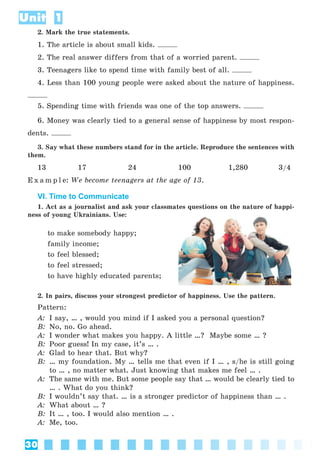
1. Read the Internet article and say what makes a teenager happy.
What Makes a Teenager Happy
So, you are between the ages 13 and 24. What makes you happy? A wor-
ried, weary parent might imagine the answer to sound something like this: a
little rock’n’roll, maybe some cash, or at least the car keys.
It turns out the real answer is quite different. Spending time with family
was the top answer to that open-ended question, according to an extensive
survey – more than 100 questions asked of 1,280 people ages 13–24 – con-
ducted by The Associated Press and MTV on the nature of happiness among
America’s young people.
Next was spending time with friends, followed by time with a significant
other. And even better for parents: nearly three-quarters of young people say
their relationship with their parents makes them happy.
“They’re my foundation,” says Kristina St. John, 17, a high-school stu-
dent from Queens in New York. “My mom tells me that even if I do some-
thing stupid, she’s still going to love me no matter what. Just knowing that
makes me feel very happy and blessed.”
Other results are more disconcerting. While most young people are happy
overall with the way their lives are going, there are racial differences: the
poll shows whites to be happier, across economic categories, than blacks and
Hispanics. A lot of young people feel stressed, particularly those from the
middle class, and females more than males.
You might think money would be clearly tied to a general sense of happi-
ness. But almost no one said “money” when asked what makes them happy,
though people with the highest family incomes are generally happier with
life. However, having highly educated parents is a stronger predictor of hap-
piness than income.
All parents, here is some more for you: most young people in school say it
makes them happy. Overwhelmingly, young people think marriage would
make them happy and want to be married some day. Most also want to have
kids.
Finally, when asked to name their heroes, nearly half of respondents men-
tioned one or both of their parents. The winner, by a nose: Mom.
(Adapted from the Internet)
Across Cultures: the USA
The Associated Press – the oldest and largest US news service, with of-
fices all over the world. Its members include newspapers and television
and radio stations.
MTV – an American television company whose programmes are shown
around the world. It broadcasts popular music 24 hours a day.
30
Unit 1
2. Mark the true statements.
1. The article is about small kids.
2. The real answer differs from that of a worried parent.
3. Teenagers like to spend time with family best of all.
4. Less than 100 young people were asked about the nature of happiness.
5. Spending time with friends was one of the top answers.
6. Money was clearly tied to a general sense of happiness by most respon-
dents.
3. Say what these numbers stand for in the article. Reproduce the sentences with
them.
13 17 24 100 1,280 3/4
E x a m p l e: We become teenagers at the age of 13.
VI. Time to Communicate
1. Act as a journalist and ask your classmates questions on the nature of happi-
ness of young Ukrainians. Use:
to make somebody happy;
family income;
to feel blessed;
to feel stressed;
to have highly educated parents;
2. In pairs, discuss your strongest predictor of happiness. Use the pattern.
Pattern:
A: I say, … , would you mind if I asked you a personal question?
B: No, no. Go ahead.
A: I wonder what makes you happy. A little …? Maybe some … ?
B: Poor guess! In my case, it’s … .
A: Glad to hear that. But why?
B: … my foundation. My … tells me that even if I … , s/he is still going
to … , no matter what. Just knowing that makes me feel … .
A: The same with me. But some people say that … would be clearly tied to
… . What do you think?
B: I wouldn’t say that. … is a stronger predictor of happiness than … .
A: What about … ?
B: It … , too. I would also mention … .
A: Me, too.
31
1.3
VII. Time to Write
Into Your Writing Portfolio:
– Advice-seeking letters appear in newspapers and magazine. They can be
about any problem imaginable.
– The letters are written in an informal style.
– The introduction will state why this letter is written.
– The body will expand on the problem.
– The conclusion will ask for help from the addressee.
How to write an advice-seeking letter
Introduction Body Conclusion
Dear editor,
Never in my wildest
dreams did I ever think
that …
But I have a situation
in which …
So I am writing you in
hopes …
To complicate mat-
ters,…
I very much would like
to …
The problem is that …
One point is …
The second point is …
What should I do?
Should I … or …?
Please answer as soon
as possible because …
E x a m p l e:
Dear Editor,
Never in my wildest dreams did I ever think that I would be writing to
someone asking for advice. But I have a situation in which I need help and
there is no one I can ask.
I am in my early teens now and nothing seems to make me happy: nei-
ther my relationship with my parents nor spending time with friends.
One point is that my mum often tells me that I’ve done something stupid.
I wish she said she would love me no matter what.
The second point is that I don’t have enough pocket money to go out. It
seems that my friends with higher family incomes are happier with life.
What should I do?
Go to Ex. 15, 16 of your WB
32
Unit 1
1.4. In comfort with yourself
Word Bank
outfit
worrier
genes
family budget
generation gap
tolerant
Phrase Bank
to look stressed
to lose one’s temper
to be out of one’s element
to crown it all
to cost a fortune
Communication Box: How to Talk about Your Worries
What’s wrong? You look stressed.
What’s your worry?
The problem is that ... .
The only snag with ... is ... .
I feel so uncomfortable.
I often find it difficult to ... .
I am out of my element.
I started to have difficulty with ... .
Calm down!
There is no point ... .
Let’s hope for the best.
You are a worrier!
There are no easy answers to ... .
Just try a little harder.
I. Conversation Warm-up
Look at the pictures and say in which of the situations you will be comfortable.
Explain why.
to get together with
friends
to have a fight to stay home alone
E x a m p l e: I will be in comfort with myself if I often get together with friends,
because we have a lot of fun.
II. Pronunciation Warm-up
Read and beat the rhythm. What advice can you give to this person?
The Worrier’s Chant
Gee, I’m thirsty.
Drink some water.
Gee, I’m angry.
33
1.4
Calm down.
Gee, I’m tired.
Have a rest.
Gee, I’m cold.
Wrap up warm.
I’m lonely.
Call up a friend.
I’m bored.
Go to a movie.
My outfit is wrong.
Wear something new.
I am a worrier.
Relax!
III. Function Smart.
Read and learn how to talk about your worries.
Look at the pictures and fill in the mini-dialogues.
a) – You look stressed. What’s your worry?
– The problem is that I ... .
What shall I do?
– I think you should ... more.
b) – Gee, I’m angry!
– Calm down! There is no point in … .
c) – Terrible, just terrible!
My ... is completely wrong!
– You are a worrier! If you don’t like it,
just ... .
d) – I feel so uncomfortable.
I often find it difficult to tell
my parents about my ... .
– It happens to the best of us.
There are no easy answers to the ... problem.
e) – What’s wrong?
– I feel out of my element. I started
to have difficulties with ... .
– There is no instant solution for doing Maths.
Just ... .
f) – What do you say to going on holiday in ... ?
– The only problem with it is ... .
– Let’s hope for the best.
to feel lonely;
to socialize with friends
to lose your temper
troubles;
generation gap
outfit;
to wear something new
Maths;
to try a little harder
The Carpathians;
the weather
34
Unit 1
IV. Word Smart
1. Study these words and word combinations and:
a) Say how you understand the generation gap.
to look stressed;
to find something difficult;
to lose one’s temper;
to be out of one’s element.
b) Say what problem a teenage girl might have.
family budget; new outfit; to cost a fortune.
The problem is that…
2. In pairs, share your little worries and comfort each other.
There are no easy answers.
Just try a little harder.
There is no instant solution.
Let’s hope for the best.
At Home: Write about your friend’s problem and suggest a solution (8–
10 sentences).
Go to Ex. 17, 18 of your WB
V. Time to Read
1. Read/listen to the conversation between two teenage friends and say how they
deal with their worries.
Talking about Worries
Part One
Helen: Hi, Ann! How are you?
Ann: Hi, Helen. Could be better.
35
1.4
BrE Maths
AmE Math
Helen: Why, you look stressed. What’s your worry?
Ann: So many things have gone wrong!
Helen: Calm down! Please! There is no point in losing your
temper. So what is it?
Ann: I am out of my element. I started to have difficulties with Maths.
Besides, I find it uncomfortable to tell my parents about my troubles,
and on top of it all, my outfit is completely wrong.
Helen: What a mess you’ve made of your life! I advise you, first of all, to
stop worrying.
Ann: I know I am a worrier! I have worry genes from both sides of my family.
My dad is also a skilled worrier. Only he worries about different
things: nuclear waste, his bank account and the future of science at
the age of computers. My mum specializes in big worries, too.
Helen: Such as?
Ann: Housekeeping, family budget, her friends’ family problems, that kind
of thing.
Part Two
Helen: I’m glad your worries aren’t that big. But there are certainly a lot
of them. Let’s deal with each of them separately. So, your Maths:
there is no instant solution for doing Maths, you know. Just try a
little harder.
Ann: It’s easier said than done. Thanks, anyway. How about the generation
gap? I feel so uncomfortable about it!
Helen: It happens to the best of us. Of course, there are no easy answers to
this problem. I think you should be more tolerant and wait for the
right moment to remind your parents about their own childhood.
Ann: Let’s hope for the best. And what do you say to my clothes? Should
I wear them?
Helen: Sure. Your outfit is perfectly okay, if you ask me. But if you don’t
like it, just wear something new, for a change. How about your new
jeans? They are the latest style. They look terrific! Where did you get
them?
Ann: At the Denim Barn. They cost a fortune. I had to use some of my
birthday money, but it’s worth it…
jeans /dʒЦnz/ äæèíñè
genes /dʒi:nz/ ãåíè
denim – äæèíñîâà òêàíèíà
See First Aid Kit: Word Meaning, p. 226
36
Unit 1
Across Cultures
Denim Barn (the USA) – a big plain building which houses a store selling
denim clothes.
2. Fill in the chart with the problems and solutions (Ex. 1, p. 34).
Problem Solution
3. In pairs, complete the conversation between Ann and Helen.
A: Hi, … . You look ... . What’s your ... ?
B: So many things ... .
A: Calm down! Please! There is no point in ... . So what is it?
B: I feel .... . I started to have ... . Besides, I find it uncomfortable ... and
to crown it all, ... .
A: Let’s deal with ... . So, your ... . There is no magic bullet for ... .
Just ... .
B: It’s ... . How about ... ?
A: It happens ... . Of course, there are no easy answers ... . I think you
should ... .
B: Let’s hope ... . And what do you say to ... ?
A: If you ask me, ... . But if you don’t like it, just ... .
VI. Time to Communicate
1. Act as Ann and describe your worries.
to have worry genes;
to worry about different things;
to specialise in big worries;
to make a mess of one’s life.
38
Unit 1
The most serious drawback of spending time with friends is that it takes a
lot of time, day after day. As the proverb goes, friends are thieves of time.
Another negative thing is that some friends can’t share your interests to
the fullest. They may find them strange and sometimes try to make you do
what they think to be more fun…
Go to Ex. 19, 20 of your WB
1.5. My progress in English
I. Grammar Smart
Fill in the right forms of the verbs to be or to have.
1. ... your elder sister married?
2. My father ... been to Canada.
3. Why ... I in the photo?
4. My mum ... on a visit to her in-laws then.
5. I ... looking for a part-time job now.
6. Let’s ... a rest.
Check if you can:
use correct grammatical forms in context. Yes No
II. Word Smart
Add one word to each sentence in the blank.
1. My father’s brother is my … .
2. I’m going to follow in my mum’s … .
3. My aunt is a surgeon, she performs complicated … .
4. Please answer all the questions of the … .
5. What makes you feel …?
6. Calm down, there is no point in losing your … .
Check if you can:
use words in context. Yes No
39
1.5
III. Function Smart
Match conversation lines A to conversation lines B.
A B
1. Gee, I’m angry!
2. What’s wrong?
3. Terrible! Just terrible!
4. I often find it difficult to talk
with my parents.
5. What shall I do?
6. I started to have difficulties with
Maths.
a) I feel out of my element.
b) It happens to the best of us.
c) Try a little harder.
d) Calm down.
e) I think you should socialize with
friends more.
f) You are a worrier.
Check if you can:
talk about problems and solutions. Yes No
IV. Time to Read
Read the text and choose the correct facts.
Family Footsteps
We all have someone in our family who we admire. From my perspective,
these people are essential for us as we have somebody to mirror ourselves. In
my case, the person I most admire is certainly my grandfather, whose life
story inspires me.
He was born in a small village. He was the son of a journalist who used to
fight alongside the small farmers against powerful landowners. He, his moth-
er and brothers used to live happily until the day his dad was killed. He was
just six years old when he started working to help his mother. Life was hard
but he never gave up, so after a lot of work and dedication he achieved his
dream and graduated in law from one of the best colleges in the country.
Everyone has dreams but there are few people in the world strong enough
to fight for them. Surely, my grandfather is one of these people. It is always
a pleasure to hear about his life experiences. I’m going to follow in his foot-
steps so that I can be a better person.
1. The storyteller admires his grandfather.
2. The old man was born in a city.
3. He came from a small family.
4. He was a hard worker.
5. He got a higher education.
6. His dream came true.
Check if you can:
read and understand life stories. Yes No
40
Unit 1
V. Time to Listen
Listen to the funny story ‘The Trouble with Teenagers’ and correct the mistakes
in the statements given.
Statements:
1. Kevin was in his mid-teens.
2. His parents bought him a new board game as a present.
3. His appearance changes a little.
4. Kevin’s parents are crying.
5. Kevin loses the ability to shout.
6. Teenage years are easy.
Check if you can:
listen to funny stories and fully understand
them.
Yes No
VI. Time to Write
Describe your family and friends.
Check if you can:
write a description of your family and friends Yes No
41
UNIT 2.
Balance Your School Life
2.1. Making the most of your school day
Word Bank
day planner
to prioritise
schedule
due-date
margin
random
Phrase Bank
to surf the Internet a lot
to study in a quiet environment
to avoid distractions
to organise oneself
to sort out one’s life as a teena-
ger
to set homework time
to run off one’s feet
to take control of something
to get good grades
Communication Box
Let’s go for it!
... I bet.
Thanks for sharing.
It’s up to us to ...
For instance, ...
I. Conversation Warm-up
Read what you can hear at different times of your school day. Say who usually
says these words and when.
Wake up! Wake up!
It’s time to get up!
It’s time you got down to
doing your home work,
isn’t it dear?
Number One bus
is coming.
Good morning,
boys and girls!
I’ve made your favou-
rite meal for dinner.
Are you hungry?
E x a m p l e: My mum usually wakes me up at half past six.
II. Pronunciation Warm-up
Read the extract from the teen poem “School Life” and practise the sounds /ö/
and /U/. Say how you look at school.
School Life
School is a daily routine for us,
In the morning, we’re sure to make a fuss.
Even when the sun is still not up,
Here we are, awake at 6 a.m. sharp.
42
Unit 2
Late a minute and we have to run,
Eyes half open, shoelaces undone.
We reach school and we see our friends,
Immediately, discomfort ends.
Some may see school as a lot of pressure
Some cannot wait for the winter vacation
But it depends on how we look at school
Honestly, positively, school is cool!
Cheryl Theseira
(Abridged and adapted from the source:http://www.bestteenpoems.com/poem/
school-life#6Zkmo5x3HVrwd9tb.99)
III. Grammar Smart
1. Look and recall.
Personal and possessive pronouns
I me my mine
you you your yours
he him his his
she her her hers
it it its –
we us our ours
they them their theirs
a) Play a grammar completion game. Use the pictures and the information given.
E x a m p l e: A: This is my friend Sam.
B: He is a teenager, isn’t he?
C: His hobby is football, isn’t it?
A: Right.
friend
Sam
thirteen
football
niece
Alice
Grade One
backpack
classmates
classroom
English lesson
homework
teacher
Maths
technology
interactive white
board
b) Paraphrase the sentences.
E x a m p l e: This is my daily planner.  This daily planner is mine.
44
Unit 2
to organise oneself to wash oneself to behave oneself
to help oneself to enjoy oneself to hurt oneself
E x a m p l e: A: to organise oneself
B: He can’t ...
A: He can’t organise himself.
b) Add a reflexive pronoun.
E x a m p l e: I’ll do it myself.
1. Behave ! 4. Please help to peaches.
2. You should organise . 5. Enjoy .
3. How did you hurt ? 6. Have you washed yet?
IV. Word Smart
1. Study these words and word combinations and:
a) Say what time management tips you are ready to follow. Give your reasons.
Time Management Tips
Get a day planner  Make sure it is big enough to hold all your notes;
 Write everything down;
 Put your homework assignments, test dates and
project due-dates on paper.
Organise yourself  Keep your schoolwork and papers organised;
 Keep each class or subject in its own folder;
Set homework time;
 Make sure you study in a quiet environment to
avoid distractions.
Prioritise your acti-
vities
 Make sure academic studies come first;
 List your leisure activities as the least impor-
tant;
 Don’t spend too much time on the Internet.
E x a m p l e: I am ready to get a day planner so that I could have all the impor-
tant information in one place rather than on random pieces of paper.
b) Group up the word-combinations into Have-to’s and Want-to’s and say how
you manage to balance between them (p. 44–45).
to watch a TV show; to do school assignments;
to hang out with friends; to be alone with your thoughts;
to read a book; to practise a hobby; to do sports;
to keep your room clean; to surf the Internet a lot;
to help your little brother with homework; to revise for a test.
45
2.1
HAVE-TO’S WANT-TO’S
to revise for a test to watch a TV show
E x a m p l e: Suppose I have to revise for a test, though I want to watch my
favourite TV show. If I am trying to concentrate on my studies while the TV
is on, I will be constantly distracted. So I have to stay away from the TV.
2. Complete the sentences and speak about your method of finding the perfect
balance in your school life.
1. Sometimes I feel there isn’t enough ... .
2. I just don’t know how ... .
3. So I have worked out my own method of ... .
4. It has ... steps.
5. Step One is about ... .
6. Step Two is ... .
7. Step Three ... .
8. It helps me to ... .
At Home: Describe your recent school day and decide if you made the most of
it (8–10 sentences).
Go to Ex. 21, 22 of your WB
V. Time to Read
1. Read/listen to the dialogue and say what tips for time management it has.
Talking about Managing your Time
Cheryl: Hi, Mike, where are you going? What’s your hurry?
Mike: Hi, Cheryl. I’ve been trying hard to keep up with school work, get-
ting good grades, and after-school activities.
Cheryl: I know what you mean. Do you feel there aren’t enough hours in the
day and you just don’t know how some people manage to do every-
thing in time?
Mike: Exactly. Have you got your own method for taking control of school-
related have-to’s?
Cheryl: Not yet, but I’ve got some good tips. During the school day our
schedule is made up for us. Once the bell rings, though, it’s up to us
to find the perfect balance between have-to’s and want-to’s.
Mike: Let’s have a try!
Cheryl: Okay, okay. First of all, get a day planner to put your homework
assignments, test dates and project due-dates on paper as soon as the
teacher gives them to you.
46
Unit 2
Mike: Are you serious? I’m quite happy with writing everything down in
my notebook margin or…
Cheryl: Or on random pieces of paper? If you keep your day planner with
you, all this information will be in one place. Make sure you get the
big day planner because little ones won’t hold all your notes.
Mike: Well, perhaps, I’ll try. What is next?
Cheryl: Then you need to organize yourself. Keep each class or subject in its
own folder, set homework time and make sure you study in a quiet
environment to avoid distractions, such as TV, the phone, or the
Web.
Mike: It’s easier said than done. I prefer to have business and pleasure
combined. For instance, I can read my homework while my favourite
TV show is on.
Cheryl: I bet it will take you much longer to finish your reading because
you’ll probably spend half your time listening to the show.
half the time
half of it
See First Aid Kit: Grammar in Use, p. 222
Mike: Perhaps you are right. But I’ve got so many things to do that I can’t
afford to just sit and watch TV.
Cheryl: Same with me. Yet I’ve learnt to prioritise my activities. Academic
studies should always come first, and I try not to spend too much
time on the Internet.
Mike: Well, thanks for sharing. It seems to be an easy-to-follow guide.
I hope it will help me to manage my time.
Cheryl: It sure will. Good luck!
2. Choose the right variant.
E x a m p l e: Half – (of; –) a kilo of meat, please.
1. I spent half (– ; of) my time listening to the show.
2. Nearly half (of; –) my classmates use daily planners.
3. There were half (– ; of) a dozen people in the line.
4. Don’t worry, it will only take half (–; of) a minute.
5. She was only telling them half (of; –) the story.
6. It happened in the second half (of; –) the twentieth century.
3. Read the replies (p. 47) and match them to the characters of the dialogue.
Reproduce the parts of the dialogue with them.
47
2.1
Mike
Cheryl
– I’ve been trying hard to keep up with school work, getting
good grades, and after-school activities.
– I’ve got some good tips.
– Then you need to organize yourself.
– It’s easier said than done.
– I’ve learnt to prioritise my activities.
– It seems to be an easy-to-follow guide.
VI. Time to Communicate
1. Act as one of the teenagers and describe your
time management method. Use:
to try to keep up with something;
to take control of something;
to find the perfect balance between … and …;
to organize oneself;
to study in a quiet environment;
to avoid distractions.
2. In pairs, discuss your time management methods. Use the pattern.
Pattern:
A: Hi, … , Where … ? What’s your hurry?
B: Hi, … . I’ve run off … .
A: I know what you mean. Do you feel …?
B: Exactly. Have you got your own method for… ?
A: Not yet, but I’ve got … .
B: Let’s go for it!
A: Okay, okay. First of all, get … .
B: Are you serious? I’m quite happy with … .
A: Make sure … .
B: Well, perhaps, I’ll try. Whatever next?
A: Then you need to … .
B: It’s easier said than done. I prefer … . For instance, … .
A: I bet it will … because … .
B: Perhaps you are right. But I’ve got so … .
A: Same with me. Yet I’ve learnt to … .
B: Well, thanks for sharing. It seems to be … . I hope … .
A: It sure will. Good luck!
Go to Ex. 23, 24 of your WB
48
Unit 2
VII. Time to Listen
1. Listen to the story about Philip’s day at Blackstable and say if the boy enjoyed
his daily routine.
2. Match the times and the pictures. Describe Philip’s activity during the day.
9 a.m. 1 p.m. 8 p.m.
VIII. Time to Write
Into Your Writing Portfolio:
A day planner is a chart, a book, or a computer programme with sections
for each day and the different times of the day that helps you organize eve-
rything you have to do.
It contains personal information, a daily to-do list, ideas, and long-term
goals, etc.
How to write in a day planner
Personal
information
Daily to-do list Ideas Long-term goals
Phone number
E-mail address
Start with the
most important
items and end
with the least
important.
Write random
things so that
you don’t forget
later.
Create a list of
long-term goals
and mark dates
or deadlines.
2.2. Active after school
Word Bank
leisure
fabulous
endurance
flexibility
strength
clay model
Phrase Bank
to owe something to oneself
to sign up for something
to make an informed decision
to support self-expression
to give encouragement
to have the right to do some-
thing
Communication Box
It happens to the best of
us.
It’s almost a classic.
…for instance.
Ready-steady-go!
Got it!
49
2.2
I. Conversation Warm-up
Look at the photos and choose three activities for your after-school activity plan.
Account for your choice.
biking climbing singing in a choir
swimming arts drama
E x a m p l e: I will choose climbing because it is less difficult than running.
II. Pronunciation Warm-up
Read and practise the sounds /w/ and /ŋ/. Say what you do for relaxation.
The After-school Activity Plan Chant
– Where are you going?
Where are you going?
What’s your destination?
– I’m walking out of town
for some relaxation.
That’ll be nice.
What’s on your agenda?
– I’ll go riding, and biking,
and swinging, and climbing.
Do you think you can?
Are you sure you are able?
– Of course, I can.
I work out, I’m in shape.
I’ll do even more.
51
2.2
b) Make up as many sentences about after-school activity plans as you can. Use
the substitution table.
IF
you
I
we
my friend
my classmates
walk thirty minu-
tes a day,
exercises regular-
ly,
do yoga,
breathe freely,
feels pain,
go for a jog,
feel tired,
you
I
we
my friend
my classmates
WILL
WON’T
stop the
workout;
stay healthy;
relax well;
be in shape;
feel great;
lose weight;
have a rest.
E x a m p l e: If you walk thirty minutes a day, you will stay healthy.
2. Read and remember.
Advice: should or must?
If you think something is a good or bad idea for staying active after
school, use should + do/be/have etc.:
E x a m p l e: There should always be time for a child to have the right to
choose their own activities.
If you think something is a bad idea for staying active after school, use
shouldn’t+ do/be/have etc.:
E x a m p l e: You shouldn’t start physical activities without warming up.
If you want to ask for advice, use should in questions:
E x a m p l e: Should I sign up for yoga?
If you want to give strong advice, use must+do/be/ have, etc.:
E x a m p l e: You must sign up for clay modelling – it’s so creative!
Don’t forget!
Should is often used with I (don’t) think and do you think:
E x a m p l e: I don’t think you should sign up for leisure activities – they
are not active enough.
a) Let’s play a grammar advice-giving game using these word chains.
E x a m p l e: drama – new
A: Should I sign up for drama?
B: I think you should. You must try something new.
1. soccer – enduring 4. climbing – strong
2. yoga – flexible 5. puzzles – smart
3. arts – creative 6. project – useful
52
Unit 2
b) Fill in should or shouldn’t.
E x a m p l e: We should stay active after school.
1. ... I join this music band?
2. You ... make an informed decision.
3. Children ... be given encouragement.
4. Teachers ... choose activities for us.
5. I think you ... warm up before physical activities.
6. ... we have the right to express ourselves in healthy ways?
IV. Word Smart
1. Study the words and words combinations and say:
a) how you can develop yourself after classes;
participate in a project; sign up for creative art
activities;
play soccer to develop
endurance;
do yoga to develop flexibility; offer strength activities.
E x a m p l e: I can participate in a group project.
b) How you can choose an activity:
to owe something to oneself; to make an informed decision;
to have the right to do something; to express oneself.
E x a m p l e: I owe it to myself to do something I love.
2. Interview your classmates and find out:
 how they develop themselves after classes;
 what opportunities they have to stay active after school;
 how they choose activities for themselves.
53
2.2
Tell your classmates about your findings.
E x a m p l e: A: How do you develop yourselves after classes?
B: I play soccer to develop endurance.
C: I participate in a group project.
A: I have found out that Bob plays soccer to develop endurance
and Helen participates in a group project.
At Home: Make a list of opportunities you have to stay active after school
and tick off your first important priority. Account for your choice in writing.
Go to Ex. 25, 26 of your WB
V. Time to Read
1. Read the information about types of after-school activities and say how they
support your development.
What after-school activity should you join this year?
After a long day at school, you owe it to yourself to do
something you love. What type of activities will you sign
up for this fall – creative art, leisure or physical activi-
ties? Read the information from “On After School” to
make an informed decision.
Creative Art Activities
Creative art activities are a fabulous way to support self-expression and
creativity in children. Kids will experience self-confidence and relationship
development while participating in individual projects such as clay models or
group projects such as murals, that is, painting on the wall. Children should
be given encouragement throughout the activity. The children art can be
displayed for parents and participants to see.
Leisure Activities
Leisure activities are free-play opportunities. This time can be used for
board games, reading, puzzles and passive games. These activities will sup-
port children’s emotional, cognitive and social development. A child will ex-
perience a lot of scheduled activities throughout their school day, so there
should always be time for a child to have the right to choose their own acti-
vities. Leisure activities will allow children to express themselves in healthy
and fun ways.
Physical Activities
A physical activity gets children moving and engaged in active games.
There are three categories a physical activity falls under: endurance, flexibi-
lity and strength. An endurance activity for children can be soccer. Yoga is
an example of a flexibility activity that can be done with children. Many
options in outdoor play parks offer strength activities, such as climbing and
BrE autumn
AmE fall
54
Unit 2
swinging. It is important for all individuals to warm up before physical ac-
tivities.
(Adapted from http://activeafterschool.ca/ontario/program-planning/
activity-types#Leisure
activity – active
strength – strong
flexibility – flexible
endurance – enduring
See First Aid Kit:Word Building, p. 222
Across Cultures: Canada
On After School – (Canada) This Ontario portal is
part of the National website activeafterschool.ca,
designed to engage schoolchildren in physical ac-
tivity and healthy living.
2. Paraphrase the sentences as in the pattern.
Pattern: Soccer is an endurance activity for children. 
Soccer will make children enduring.
1. Yoga is a flexibility activity for children.
2. Climbing is a strength activity for children.
3. Art is a creativity activity for children.
4. Outdoor play is a health activity for children.
3. Look at the pictures, name the activities and define their types. Say which
of them could be your choice.
55
2.2
VI. Time to Сommunicate
a) Read the information and describe this after-school activity.
Ever Changing Relay Race
Age Group: 6–9 yrs, 9–12 yrs, 13 + yrs
Time Requirement: 10 minutes
Activity Type: Physical
Play Area: Gymnasium (large indoor space), Outdoor – Field
Group Size: Large Group, Medium Group, Small Group
Objective: Teams collect all of the objects in the hoop across from them
and bring them back to their hoop. The way they move to the hoop and back
will be changing all the time, so they have to listen to the leader.
b) Imagine Martha is telling you about her after-school activities. Ask her the
following questions and role-play the dialogue in pairs. Follow the pattern below.
Pattern:
A: What type of activities will you sign up for this fall?
B: I think I should...
A: What will you experience?
B: ...
A: How will it support your development?
B: ...
A: What kinds of activity will you do if you want more opportunity to
express yourself?
B: ...
A: How often will you practise it?
B: ...
VII. Time to Write
Write a notice about a new after-school activity for your class. Use the format
below.
(title)
Age Group:
Time Requirement:
Activity Type:
Play Area:
Group Size:
Go to Ex. 27, 28 of your WB
56
Unit 2
2.3. Who is absent today?
Word Bank
to attend
frostbite
exhaustion
absentee
to pretend
tardy
Phrase Bank
to be away from school
to miss school
to keep one’s perfect at-
tendance
to be the centre of one’s
universe
to be in session
to bring a note from
somebody
to catch up with one’s
class
to lag behind one’s class
Communication Box
There was no chance
that …
Surely, …
I. Conversation Warm-up
Look at the pictures and say why these schoolchildren are absent from school.
Have you had excuses for not going to school? If yes, what excuses?
a sick day off to be away on
holiday
to be absent
from school
without a good
reason
a snow day to oversleep
E x a m p l e: This girl has a sick day off. Perhaps, she is ill with flu.
II. Pronunciation Warm-up
Read the parts of the funny school poems and practise the sounds /eIeI/ and /ü/.
Say if the school situations are the same or different in them.
I’m Staying Home From School Today
I’m staying home from school today.
I’d rather be in bed
57
2.3
pretending that I have a pain
that’s pounding in my head.
I’ll say I have a stomach ache.
I’ll claim I’ve got the flu.
I’ll shiver like I’m cold
and hold my breath until I’m blue…
Kenn Nesbitt
Today I’m not going to school
Today I’m not going to school,
I can’t face my lessons today,
problem is my Mum’s no fool,
she’s gonna make me go any way.
I can’t face my lessons today,
my fever’s a hundred and four,
she’s gonna make me go anyway,
Mum, I really can’t take any more…
Aoife Mannix
III. Grammar Smart
Read and remember.
Necessity: must or have to?
 If you want to say that something is necessary, use have to:
E x a m p l e: You have to go to school every day it is in session.
 If you want to say that something is a positive rule, use have to:
E x a m p l e: You have to wear a uniform to school.
 If you want to say that something is a rule you give to another person
or to yourself, use must:
E x a m p l e: I know I must hurry.
 If you want to say explain rules or instructions, use must not:
E x a m p l e: Remember, children, you must not be tardy.
 If there is no rule, use don’t have to, not mustn’t:
E x a m p l e: You don’t have to go to school on holiday.
Don’t forget!
Don’t use must for past or future situations, use forms of have to in-
stead:
E x a m p l e s: I got sick and had to stay at home. (past)
You’ll have to bring a note from your parents (future).
58
Unit 2
1. Fill in must or have to.
1. We will … call your father to come after you.
2. You … wrap up warm, it’s very cold outside.
3. You will … keep moving to keep warm.
4. The girl … keep her perfect attendance that school year.
5. On her way to school, the girl … look at her watch.
6. Father said I … stay at home in such stormy weather.
2. Look at the pictures and explain the school rules.
not to be tardy to bring a note from
one’s parents
to do homework
E x a m p l e: You have to wear a uniform to school.
3. Read the school problem page and give instructions.
Matt I don’t want to go to school now. I can’t face my lessons today.
Sonia I’m often late for school. What do I have to say when I come into
the classroom?
Alex I’ve been sick several times this semester. I’m lagging behind my
class now.
Kate I’ll be away from school on holiday. My parents are going to India
and are taking me with them.
IV. Word Smart
1. Study the words and words combinations and:
a) Say which of them can help you talk about attending school and which – about
being absent from school. Give examples.
excuse to attend absentee to be away from school
to miss school to keep one’s perfect attendance
to bring a note from somebody to be away with the flu/on holiday
E x a m p l e: You must bring a note from your parents if you have been away
from school.
59
2.3
b) Say if school is the centre of your universe.
to be in session;
to be the centre of one’s universe;
to be of a different turn of mind;
to pretend;
to face one’s lessons;
to lag behind one’s class;
to catch up with one’s class.
E x a m p l e: For me, school is the centre of my universe. I have attended
school every day this semester.
2. Interview your classmates and find out:
 what they think about attending school regularly;
 their reasons for staying home from school;
 how they catch up with their class after missing school.
Tell your classmates about your findings.
E x a m p l e: A: What do you think about attending school regularly?
B: It is highly important to me. Otherwise I have to catch up with
my class.
C: I’m of a different turn of mind. There are quite a few reasons
not to attend.
A: I have found out that it is highly important for Ann to attend
school and Helen is of a different turn of mind.
At Home: Make a list of dates on which you/your friend didn’t go to school
last month and write your reasons for being absent. Use the format below.
Dates of absence from school Reasons for being absent
Go to Ex. 29, 30 of your WB
60
Unit 2
V. Time to Read
1. Read the story “Perfect Attendance” and say who was right – the girl’s mother
or father.
Perfect Attendance
Part One
For Mother, school was the center of her universe. As
a teacher, she thought pupils should be in their seat when
the first bell rang, each day school was in session. Things
such as rain, sleet, snow, and bitter cold were no excuse to
miss school.
Father, on the other hand, was of a different turn of mind. School for him
had been a place to socialize and have fun. Lessons were to be tolerated, so
any reason not to attend was good enough for him.
This morning when I awoke, there was a snowstorm. There was no chance
that Father could take me to school in the car. Surely Mother wouldn’t make
me go out in this blizzard to keep my perfect attendance at school.
As I climbed out of bed on this awful morning, I could hear Mother and
Father arguing about whether I should go to school.
“This girl can’t go to school today. It’s too bad out there!”
“But she hasn’t missed a day this year,” Mother said, “I know she doesn’t
want to be absent.” Of course, she hadn’t asked me what I thought about it.
“There is a blizzard out there. She can’t go out in it.” Father tried again
to convince Mother of the nonsense of sending a child out in a blizzard.
Mother was insistent, “I’ll wrap her up good. She’ll be fine.”
By then I had run out of my freezing bedroom and was standing in front
of the wood heating stove in the dining room enjoying the warmth.
“Can I ride my pony?” I asked.
“Oh, no!” exclaimed Father, “You would freeze for sure. You will have to
keep moving to keep warm. So if you go, walking is the only way.”
This told me that Mother had won…
Part Two
As I walked along the road, the swirling snowflakes bit my face. It was
cold and the wind was so strong I had to struggle to push my eight-year-old
body against it. I frequently pulled up my left coat sleeve to look at my
watch. As long as I was going, I did not want to be tardy. The snow stuck to
my clothes and the scarf around my mouth froze from the humidity of my
breathing. I knew I had to hurry.
Finally, the schoolhouse appeared on top of the hill. I knocked on the door
of the house and was greeted by Mrs. Crawford. With a surprised look, she
rushed me in and began to unwrap my frozen clothes. My wrist had some
frostbite where I had kept looking at my watch.
“Don’t you know there isn’t any school today? The weather is too bad; you
should not be out in this!”
“Mother said I had to go so I could keep my perfect attendance.”
BrE centre
AmE centre
61
2.3
“Well, we will have to call your father to come after you because you
can’t walk back home in the storm.”
(Adapted from “Perfect Attendance” by Anna Lou Martin)
Across Cultures: the USA
perfect attendance – (USA) a person with perfect at-
tendance would be one who never missed to be present
whenever school, was in session.
to wrap – to unwrap to dress – to undress
to do – to undo to pack – to unpack
See First Aid Kit: Word Building, p. 223
2. Choose the right variant.
E x a m p l e: Mrs. Crawford began to … (wrap; unwrap) my frozen clothes. 
Mrs. Crawford began to unwrap my frozen clothes.
1. The mother promised to … (wrap; unwrap) me up warm.
2. She … (packed; unpacked) her school bag and headed off to school.
3. Maggie carefully … (packed; unpacked) her birthday presents.
4. The mother said, “Please … (dress; undress) and get into bed. You are sick.”
5. What is … (done; undone) cannot be … (done, undone).
6. We should … (do; undo) something to help him.
3. Find the questions where the following statements are the answers.
E x a m p l e: Did the mother allow the girl to stay away from school on that
stormy day? No, she thought it wasn’t an excuse to miss school.
1. ?
To keep her perfect attendance.
2. ?
No, walking was the only way.
3. ?
No, there wasn’t any school that day.
4. ?
To look at her watch.
5. ?
She did not want to be tardy.
6. ?
She was very surprised and began to unwrap the child’s frozen clothes.
62
Unit 2
VI. Time to Communicate
1. Act as the storyteller, look at the set of pictures and describe your hard way
to school.
Use:
That morning when I awoke … . There was no chance … . Surely … . As I
walked along the road, … . I did not want … . I knew … . Finally, … .
2. Role-play the dialogue between the girl and her classmate the next day at
school as in the pattern.
Pattern:
Classmate: Hi, … . What a snowstorm … ! I stayed … the whole day. How
was your day … ?
Girl: It was ... . I had to ... because my mother ... .
Classmate: Oh no! What did your father ... ?
Girl: He was of ... . But ... .
Classmate: How did you manage ... ? It was so... !
Girl: I didn’t want to ... . I knew I must ... . So I kept looking ...
and as a result my wrist has ... .
Classmate: Poor ... ! What a pity! Surely, it is highly important to ... ,
but ... is a good reason not to attend.
Girl: School is the center of ... , you know, and she thinks pupils
should ... .
Classmate: What about snow or ... ? Isn’t it an excuse not to ... ?
Girl: I think so. Now I even know it for sure from my own expe-
rience.
VII. Time to Write
You know you must bring a note from your parents if you have been away from
school. Help your parents to write such a note about the last time you stayed home.
Begin with:
Dear Miss/Mr. ... ,
Our son/daughter had ... yesterday and was away from ... .
He/she will ... for sure.
Thank you for ... .
Mr. and Mrs. ... .
Go to Ex. 31, 32 of your WB
63
2.4
2.4. How to manage your English
language learning
Word Box
encouragement
frustrated
success
failure
to master
Phrase Box
to feel down
to put in a lot of effort
to get discouraged
to leave much to be de-
sired
to come easy/difficult to
somebody
Communication Box: How
to Give Encouragement
What’s up?
Go on.
Have another try/go.
Keep going.
Don’t give up.
You can do it.
You are doing great.
I. Conversation Warm-up
Look at the pictures and say how schoolchildren manage their English language
learning. Does English come easy or difficult to you?
word study grammar spelling reading
E x a m p l e: Children have to master pronunciation. English sounds come easy
with me.
II. Pronunciation Warm-up
Read the quotations of great people about encouragement and practise sentence
stress. Comment on one of the quotes.
Johann Wolfgang
von Goethe
“Instruction does much, but encouragement is
everything.”
J. R. R.Tolkien “All we have to decide is what to do with the time
that is given us.”
Stephanie Lahart “Encourage yourself, believe in yourself, and love
yourself. Never doubt who you are.”
C. JoyBell C. “We can’t be afraid of change. ”
64
Unit 2
Catherine Pulsifer “Be all that you can be.”
Aristotle “Happiness depends on ourselves.”
III. Function Smart
Read and learn how to give encouragement. Look at
the pictures and fill in the mini-dialogues.
a) – You look sad. What’s up?
– I’m trying very hard to improve my ... ,
but it is not happening.
– Go on. Have another try. You’ve almost got it.
b)
– I’m so frustrated. I’ve got a low grade for my ...
again.
– Remember, everyone makes mistakes,
but you have to keep going, and eventually
you will be nearly perfect.
c)
– Are you feeling down about ... ?
– Yeah, I’m putting in a lot of effort,
but there have been only small results.
– Don’t give up. You can do it!
d)
– Why are you upset?
– I’m getting discouraged about my English lan-
guage learning.
My ... leaves much to be desired.
– Don’t worry about your spelling. You are doing
great.
e)
– I give up. ... is more than I can manage.
– Have another go. I’m sure you’ll do better.
IV. Word Smart
1. Fill in the chart with the words and word-combinations about your successes
and failures in language learning. Use the mini-dialogues above.
Success Failure
to try hard
to improve one’s grammar
…
to get a low grade for something
to make mistakes
…
E x a m p l e: I must try hard to be a success in learning English.
English grammar
English test
language learning
spelling
English pronunciation
65
2.4
2. Complete the sentences of encouragement with the right forms of the verbs to
do, to go, to have and to try. Use them in context.
E x a m p l e: I’m sure you’ll do better.
– I give up. English grammar is more than I can manage.
– Have another go. I’m sure you’ll do better.
1. Keep ... . 4. Don’t ... up.
2. Have another ... . (Option One) 5. You are ... great.
3. Have another ... . (Option Two) 6. You can ... it!
3. Interview your classmates, find out about their successes and failures in lear-
ning English and give encouragement. Report your findings to the class.
E x a m p l e: A: What are your successes and failures in learning English, Olha?
B: English grammar comes easy to me but my writing leaves
much to be desired.
A: Keep going. Don’t give up.
A: I have found out that English grammar comes easy to
Olha, but her writing leaves much to be desired. She must keep
going. She mustn’t give up.
At Home: Write encouraging words for your friends to make better progress
in learning English.
Go to Ex. 33, 34 of your WB
V. Time to Read
1. Read/listen to the dialogue of two friends and say:
How they manage their English language learning;
 What docs not come easily to each of them;
 How they encourage each other to make better progress.
Talking about Successes and Failures
in Learning English
Helen: Hey, Ann. You look sad. What’s up?
Ann: I’m so frustrated. I’ve got a low grade for my English test again.
I’m trying very hard to improve my English but it is not happening.
Helen: Remember, everyone makes mistakes, but you have to keep going and
eventually you will be nearly perfect.
Ann: Thank you, Helen, but it’s easier said than done. I’m about to give
up. English grammar is more than I can manage.
Helen: I know what you mean. I had difficulties with my English last year.
To be honest, I felt down about my writing as my spelling left much to
be desired. You won’t believe it but I used to make spelling mistakes
in every other word. I was getting more and more discouraged. I was
putting in a lot of effort, but there were only small results until...
66
Unit 2
Ann: Until what – a miracle happened?
Helen: No, not quite. It was until we got a new teacher, Miss Joy, in our
class. She was very encouraging. She believed that we were all capa-
ble and that our efforts were worthwhile.
Ann: Do you mean to say that your progress in English started when your
teacher just said you could work through it?! And you have made no
spelling mistakes ever since? It sounds too good to be true.
Helen: No, nothing of the kind. Miss Joy explained that everyone expe-
riences both success and failure in various ways throughout life; it is
important to learn from both.
Ann: So what did you do?
Helen: Her words encouraged me to take action.
I practised, and practised, and practised.
For instance, I wrote spelling dictations, played spelling games, and,
generally, paid more attention to spelling rules.
Ann: Great! By the way, are you interested in taking part in the Scripps
Howard National Spelling Bee?
Helen: Actually, I have won the school spelling bee this year and I’m prepa-
ring for the district tournament these days.
Ann: I’m so proud of you! Good luck at the competition!
Helen: Thank you. If I can do it, you can do it, too.
Ann: I’ll try.
Across Cultures: the USA
Scripps Howard National Spelling Bee (the) – an annu-
al spelling bee held in the United States; participants
cannot be older than fifteen.
frustrated – frustrating
discouraged – discouraging
interesting – interested
See First Aid Kit: Word Building, p. 223
2. Fill in the right form of the word.
E x a m p l e: Ann is so frustrated with her low grades. frustration
1. English is a very ... school subject. interest
2. Phil is getting ... about his English language learning. discourage
3. It is so ... ! surprise
4. This book is ... . bored
5. What a ... story! shocked
BrE to practise
AmE to practice
67
2.4
3. Mark where Ann and Helen can find themselves on the 7-point scale in
learning English. Give your reasons.
failure 1 2 3 4 5 6 7 success
VI. Time to Communicate
1. Act as Helen and describe your difficulties and progress in learning English.
to have difficulties with something;
to feel down about something;
to leave much to be desired;
to make mistakes;
to experience both success and failure;
to learn from something;
to take action;
to pay more attention to something.
2. In pairs, encourage each other to make better progress in English as in the
pattern.
Pattern:
A: Hey, ... . You look ... . What’s up?
B: I’m so ... . I’ve got ... . I’m trying ... but ... .
A: Remember ... but you have to ... and eventually you will ... .
B: Thank you, ... , but it’s easier ... . ... is more than I can manage.
A: I know what ... . I have difficulties with ... . To be honest, I feel down
about ... .
B: My ... says that everyone experiences both ... ; it is important to ... .
A: So, what do you recommend?
B: You should ... . For instance, ... . I’ve tried ... myself.
A: Thank you. You are very ... .
B: If I can ... , you can ... too.
A: I’ll try.
VII. Time to Listen
1. Listen to the schoolchildren and say what reasons they gave for not doing their
English homework.
2. Listen to the children again and role-play the situations encouraging them to
make progress in learning English.
68
Unit 2
VIII. Time to Write
Write out a certificate for Helen for her participation in the School Spelling Bee.
This is to Certify that
participated in the
Spelling Bee
On , 20 at
Your participation is greatly appreciated.
Thank you for helping to make our bee a success!
Principal/Spelling Bee Coordinator Teacher
Go to Ex. 35, 36 of your WB
2.5. My progress in English
I. Grammar Smart
Fill in the right modal verb.
1. ... (should/must) I sign up for yoga?
2. You ... (should/must) sign up for clay modelling – it’s so creative!
3. You ... (could/shouldn’t) start physical activities without warming up.
4. I know I ... (must/should) hurry.
5. Remember, children, you ... (don’t have to/must not) be cute.
6. You... (must/will have to) bring a note from your parents tomorrow.
Check if you can:
use modal verbs in context correctly. Yes No
II. Word Smart
In each sentence, fill the gap with one word.
1. Please, organize ... .
2. Don’t ... yourself on the Internet too much.
69
2.5
3. I ... it to myself to do something I love.
4. What type of activities will you ... up for this fall?
5. I ... school regularly.
6. He, who ... no mistakes, makes nothing.
Check if you can:
complete your ideas logically. Yes No
III. Function Smart
Match conversation lines A to conversation lines B.
A B
1. What’s up?
2. Are you feeling down about your
English?
3. I’m putting in a lot of effort, but
there have been only small results.
4. My spelling leaves much to be
desired.
5. English grammar is more than I
can manage.
6. How did your teacher encourage
you to learn English?
a) Don’t give up. You can do it!
b) I used to have difficulties with
grammar, too.
c) Yes. I’m trying very hard to im-
prove it but it is not happening.
d) She said we were all capable.
e) I’ve got a low grade for my Eng-
lish test again.
f) Don’t worry about your spelling.
You are doing great.
Check if you can:
give encouragement. Yes No
IV. Time to Read
Read the encouragement letter and mark the true statements (p. 70).
Dear Helen,
Congratulations on your class winning the School Spelling Bee recently.
I know how much effort you and your classmates put in while competing
against other classes in the same grade, and I can see you were determined to
be the winning class by your score.
Now I have very good news to give you: our School Spelling Bee Commit-
tee has determined which child will represent our school at the district com-
petition. I have the honour to inform you that due to your highest score in
your class, you have been voted for by all the members of the committee. We
are all so proud of you and are ready to help you to prepare for the district
tournament in every way.
We would like to encourage you to take action and to practice the spelling
of a broad selection of words with a varying degree of difficulty.
We wish you all the luck in the world. Please let us know what help you
need.
70
Unit 2
Sincerely,
Miss Joy,
on behalf of the School Spelling Bee Committee.
Statements T F
1. Helen’s class is the winner of the school spelling bee round.
2. Helen showed better results than her classmates.
3. Miss Joy has written this letter on her own behalf.
4. The letter sounds discouraging.
5. Helen will take part in another spelling bee.
6. The girl is going to get a lot of support in her school.
Check if you can:
read and understand formal letters. Yes No
V. Time to Listen
Listen to the story “Perfect December” and correct the underlined words in the
statements given.
Statements
1. It was the last week of December.
2. The whole school gathered in the assembly hall for the annual Spelling Bee.
3. There were five participants.
4. Jane’s speech was boring.
5. She was far from being the best.
6. The district competition would be held in Columbus.
Check if you can:
listen to school stories and fully understand them. Yes No
VI. Time to Write
Describe your school life.
Check if you can:
write a description of your school life. Yes No
71
UNIT 3. Food and Cooking
3.1. Soup and salad every day…
Word Box
starter
garlic
cabbage rolls
pancake
varenyks
to blend
Phrase Box
to cut in half
to have a passion for some-
thing
to keep on doing something
to taste better with…
to be out of the question
to put on weight
to be good at doing something
Communication Box
I don’t feel like …
Be a good boy!
OK, OK, so much pres-
sure.
Not me.
Would you mind doing …
That’s better.
I. Conversation Warm-up
Look at the pictures and say what food you eat more often. Is it healthy?
milk products meat products sweet things fruit and vegetables
E x a m p l e: I often have milk products like cheese and milk every day.
I think they are healthy.
II. Pronunciation Warm-up
Read and guess the food riddles. Practise the sounds /i:/ and /w/. Say which of
them you like most.
I can be yellow or green
But even sweet like a tangerine.
It’s long and green
With many seeds in.
Green at birth, yellow while living
And black I put on when death is near.
74
Unit 3
C: Ann asked me to write her a recipe. Have some meat.
D: Mum asked me to have some meat.
b) Say what your parents tell or ask you to do (or not to do):
at dinner table; at your friend’s party;
at a cafå; in the kitchen;
at the canteen; at school.
E x a m p l e: My mum often asks me to have some more soup for dinner.
IV. Word Smart
1. Study these words and word combinations and:
a) Say which dishes you often eat at home.
borsch pampushkas
with garlic
cabbage
rolls
pancakes varenyks
E x a m p l e: We often have borsch for the first course at home.
b) Look at the dishes and say:
1. which of them you have a passion for;
2. which of them are out of the question and why;
3. what other food they taste better with;
4. which of them are used as starters;
5. when you eat these dishes;
6. what dish you are good at cooking.
E x a m p l e: For me, I have a passion for vegetable salads. They taste better
with sour cream. I usually have them as starters for dinner. I am
good at cooking vegetable salads.
2. Complete the sentences and speak about your favourite home meal.
I like to have my meals at home because … . My mum and I are good at … .
I have a passion for… , that’s why… . My mum keeps on saying … .
… tastes better with … . As for my brother/sister, … . He/she says … .
As you see, … .
76
Unit 3
2. Choose the right form of the word to complete the sentences:
1. Don’t eat the cucumbers. They taste bitter. bitterly
2. Your words sound … to me. greatly
3. What a nice pie. It looks … . to taste
4. I like grapes. They taste … . to sweeten
5. I like these fruits. They smell …. . wonderfully
6. Granny, your pancakes look so …. . deliciously
It tastes good.
It smells sweet.
It looks nice.
See First Aid Kit: Grammar in Use, p. 222
3. Read the replies and match them to the characters of the dialogue. Reproduce
the parts of the dialogue with them.
 We are so hungry!
 If only one … the smallest.
 How was your day?
 Well, mum, I don’t feel like eating borsch or cabbage rolls
today.
 You seem to have a passion for fast food, you, flatterer.
 Sour cream and pampushkas are out of the question.
 OK, OK, so much pressure.
Mum
Oksana
Peter
VI. Time to Communicate
1. Act as one of the children and describe
your tastes in food. Use:
to be hungry;
not to feel like eating;
to have a passion for something;
to taste better with something;
to be out of the question;
to taste delicious.
2. In pairs, discuss your favourite food. Use the pattern.
Pattern:
A: I’m so … . I wonder, what … ?
B: I’m going to … for the first course, … for the main course and … for
dessert.
78
Unit 3
E x a m p l e:
Dear Alex Wright,
You are cordially invited to Katy Anderson’s birthday party. It will be
held on Sunday, January, 10, 2007, at 7p.m. at the Tea House, 1034 Flo-
rence Blvd, Ohama, Nebraska.
RSVP (318) 624-5823.
Go to Ex. 39, 40 of your WB
3.2. Bon appetite
Word Box
cruet
frying pen
kitchen utensils
baking tray
speciality
Phrase Box
to lay the table
to expect guests
to need something badly
to spread a table cloth
to know much about something
to make one’s mouth water
Communication
Box
First of all…
For goodness sake!
What a relief!
I. Conversation Warm-up
Your family is expecting guests and your mum asks you to lay the table. Look at
the pictures and say what should be on the table.
serviette cruets
for spices
frying pen plate fork, spoon,
knife
E x a m p l e: I think there should be serviettes on the table.
II. Pronunciation Warm-up
Listen to the Festive Table Dialogue and practise the sounds /{/, /e/ and /aiai/.
Say if you can lay the table for dinner.
Festive Table Dialogue
– Have you laid the table, Ann?
– I’ve laid it for ten.
– For ten? But why so many?
81
3.2
b) how you lay the table;
to spread a white tablecloth;
to need something badly;
for each person;
serviettes;
person.
E x a m p l e: First of all I spread a white tablecloth.
2. Interview your classmates and find out:
 how they lay the table when their family is expecting guests;
 how they help their mother in cooking and laying the table;
 what dishes are cooked for a festive dinner.
Tell your classmates about your findings.
E x a m p l e: A: How do you lay the table when your family is expecting
guests?
B: We spread a beautiful tablecloth on the table.
C: I put a vase with flowers in the middle of the table.
A: I have found out that Ann spreads a beautiful table cloth on
the table and Helen puts a vase with flowers in the middle.
At Home: Write how you use your kitchen utensils to prepare meals (8–
10 sentences).
Go to Ex. 41, 42 of your WB
V. Time to Read
1. Read/listen to how Ann’s mum was getting ready for receiving guests and say
how Ann helped her mum.
Expecting Guests
Ann, we are expecting guests today and I need your help badly. There’s so
much work to do! Let’s lay the table for dinner. We’ll be 12 altogether, so lay
12 places.
Spread a white tablecloth. Then take the dishes, knives and forks from the
sideboard and put one for each person. Now, fetch cruets for spices – salt,
pepper, oil and vinegar – and put them in the middle of the table. Don’t for-
get about serviettes and a bread plate.
Now, will you help me with cooking? Please, get the mincing machine
from the table where all the kitchen utensils are and mince this piece of meat,
83
3.2
VI. Time to Communicate
1. Act as Ann and say how you helped your mum to cook a festive dinner and lay
the table.
to need one’s help badly;
to spread a white tablecloth;
to put knives and forks for each person;
to mince meat;
to be out of order;
to make one’s mouth water.
2. In pairs, discuss how you help your mother to cook a festive dinner and lay the
table. Use the pattern.
Pattern:
A: I say, … how do you help you mum … ?
B: Oh, my mum needs … and … .
A: How many guests … ?
B: As a rule, … .
A: How do you … ?
B: At first, …, then … .
A: And what … speciality, I wonder?
B: It is … and it makes my mother … .
A: And what about … ?
B: I like … and my mom … .
A: If I were … .
B: Sure.
VII. Time to Write
Write a letter to your friend telling him/her how you helped your mum to lay the
table. Use:
Dear, …
Yesterday, my family was expecting guests and my mum needed my
help badly. …
Go to Ex. 43, 44 of your WB
84
Unit 3
3.3. From the cookery book
Word Box
cookery book
afford
ingredients
salmon
waiter
caviar
Phrase Box
to have food preferences
to overload one’s stomach
to have a habit of doing some-
thing
to be in season
to be startled
eating habits
Communication Box
I never mind.
I’ll do better than that.
I. Conversation Warm-up
Look at the pictures and name the ingredients of the dishes. Which of them would
you like to try? Why?
fruit salad pilau meat salad
vegetable stew mushroom soup
E x a m p l e: I think fruit salad has many ingredients like: apples, bananas,
cherries and cream. It looks appetizing and I’d like to try it.
II. Pronunciation Warm-up
Read the food proverbs and practise them with correct rhythm. Say which of
them characterize your eating habits.
Eat with pleasure,
drink with measure.
Good food is enjoyable
and healthy.
After dinner sleep a while,
after supper walk a mile.
Appetite comes with eating.
An apple a day keeps
the doctor away.
85
3.3
III. Grammar Smart
1. Complete the sentences as in the example.
E x a m p l e: I’ll see you tomorrow.  She said she would see me the next day.
1. ‘I don’t like it here’.  She said she didn’t like it … .
2. ‘This meat tastes spicy’.  Granny said … meat tasted spicy.
3. ‘We are having dinner now’.  Mum said they were having dinner … .
4. ‘I haven’t eaten porridge this morning’.  Bill said he hadn’t had … .
5. ‘I’ll cook borsch tomorrow’.  Mum said she would cook borsch … .
6. ‘Put a bread plate in the middle here, Ann’.  Mum asked Ann to put
a bread plate … .
2. Look at the picture and say what the mother asked her children to do.
E x a m p l e: The mother asked her daughter to spread a white tablecloth.
3. Look at the dishes and say what they look/smell/taste like.
cocktail cherry pie Pepper and
cucumber salad
sponge cake
E x a m p l e: I think this cocktail looks appetizing. It tastes delicious and
smells good.
IV. Word Smart
1. Look at the pictures given in logical order (p. 86) and give the recipe of the
dish. Guess what it is.
86
Unit 3
to cut into pieces;
to mix;
to add something to something;
to taste better with something;
to be salted;
to taste.
2. Read the ingredients and say what Ukrainian
dish it might. Describe the cooking process.
300 g flour
2 eggs
0.5 litre of water
0.5 kg cottage cheese
a pinch of salt
3. Interview your classmates find out about their favourite dishes and the ingre-
dients they need to cook them. Report your findings to the class.
E x a m p l e: A: What is your favourite dish, Olha?
B: It’s mashed potatoes.
A: What ingredients do you need to cook it?
B: Boiled potatoes, hot milk and butter.
A: I have found out that Olha’s favourite dish is mashed potatoes.
She needs boiled potatoes which she mashes adding hot milk
and butter to it.
At Home: Write 10–12 sentences about how you cook your favourite dish.
V. Time to Read
1. Read the story “The Luncheon” and say what you think of the lady’s eating habits.
The Luncheon*
Part One
... So we came to Foyot’s restaurant. I was startled when the menu was
brought, for the prices were much higher than I had expected. But she reas-
sured me, “I never eat anything for luncheon”, she said. “I never eat more
*
luncheon – formal lunch
Go to Ex. 45, 46 of your WB
87
3.3
than one thing. I think people eat too much nowadays. A little fish, perhaps.
I wonder if they have any salmon”.
Well, it was early in the year for salmon, but I ordered it for my guest.
The waiter asked her if she would have something while it was being cooked.
“No”, she answered, “I never eat more than one thing. Unless you have a
little caviar. I never mind caviar”.
My heart sank a little. I knew I could not afford either salmon or caviar,
but I couldn’t tell her that. I told the waiter to bring caviar. For myself
I chose the cheapest dish on the menu and that was a mutton chop.
“I think you are unwise to eat meat”, she said. “I don’t know how you can
work after eating heavy things like chops. I never overload my stomach”.
Then came the question of drink.
“I never drink anything for luncheon”, she said.
“I don’t drink either”, I answered quickly.
“Except white wine”, she continued as if I had not spoken. “It is wonderful
for the digestion. My doctors don’t let me drink anything except champagne”.
I ordered half a bottle and mentioned casually that my doctor had absolutely
forbidden me to drink champagne.
“What are you going to drink, then?”
“Water”.
She ate the caviar and she ate the salmon. I wondered what the bill would
come to.
Part Two
When my mutton chop arrived, she said:
“I see that you have a habit of eating a heavy luncheon. I’m sure it’s a mis-
take. Why don’t you follow my example and just eat one thing? I’m sure you
feel much better then. I never eat anything for luncheon. Just a bite, never
want more than that. I can’t eat anything more unless they have some of those
giant asparagus. It would be a pity to leave Paris without eating them”.
My heart sank. I had seen them in the shops. And I know that they are
horribly expensive. The waiter said that they had some so large, so splendid,
so tender that it was a marvel.
“I’m not in the least hungry”, my guest sighed, “but if you don’t mind
having some asparagus”.
I ordered them. We waited for the asparagus to be cooked.
Panic seized me. It was not a question now how much money I should have
left for the rest of the month, but whether I had enough to pay the bill.
At last she finished the asparagus.
“Coffee?” I said.
“Yes, just an ice cream and coffee”, she answered. It didn’t matter to me
now, so I ordered coffee for myself and ice cream and coffee for her.
“You know, here’s one thing I absolutely believe in, she said”, as she ate the ice
cream. “One should always get up from a meal feeling one could eat a little more”.
“Are you still hungry?” I asked with horror. “Oh, no, I’m not hungry.
I don’t eat luncheon. I have a cup of coffee in the morning and then dinner,
but I never eat more than one thing for luncheon”.
89
3.3
3. Read the sentences and complete them in a guided way.
E x a m p l e: So we came to the restaurant and I was startled. Why? They
brought the menu and the prices were very high.
1. My heart sank a little…Why?
2. I never drink anything for luncheon, but… What?
3. It would be a pity to leave Paris without…What?
4. Panic seized me…Why?
5. You know, there is one thing I absolutely believe in…What?
6. Then a terrible thing happened…What?
7. Follow my example…What?
VI. Time to Communicate
1. Act as the storyteller, look at the set of pictures and describe your luncheon
with the lady.
Use:
 Once I invited….
 When we came to the restaurant…
 The woman told me…
 She started her luncheon…
 When a question of drink came…
 Then she said it would be a pity…
 After that the woman ordered…
 Suddenly, the waiter brought…
 The woman kept on saying…
 When the luncheon was over…
90
Unit 3
2. Role-play the dialogue between the lady and the storyteller as in the pattern.
Pattern:
Storyteller: Is there anything to your taste on the menu? I think … .
Lady: Oh, thank you, but I never … . A little … perhaps.
Storyteller: That’s all right. Would you like … ?
Lady: No, unless they have … . I never mind … .
Storyteller: OK. I’ll order … .
Lady: What about drink? What are you drinking?
Storyteller: I never drink anything, except … and I like some … . It would be
a pity to leave Paris … .
Storyteller: Coffee?
Lady: Yes, just an ice cream and … . You should always get up from a
meal … .
Storyteller: Are you still hungry?
Lady: You see, you’ve filled your stomach … . But I’ve just … . Follow
my example and … .
Storyteller: I’ll do better than that. I’ll … .
VII. Time to Write
Write a page from your/your mum’s cookery book with one of the recipes. Use:
Ingredients: Steps:
 meat 1. Put meat into a large saucepan.
 2.
… is ready. Bon Appetite!
Go to Ex. 47, 48 of your WB
3.4. Let’s have a bite
Word Box
cafeteria
buffet
Pizza Hut
feed
ritual
Phrase Box
to accept an invitation
to have a word with
somebody
to have a bite
Communication Box: How to
Make an Invitation
What about going to … ?
I’d like to invite you … .
Would you be able to come … .
Let’s go … for … .
I’d be delighted to … .
Thanks a lot for thinking of me,
but … .
Well, it sounds like fun!
I’m awfully sorry, but … .
Let’s make it round about … .
91
3.4
I. Conversation Warm-up
Look at the pictures and say where you would like to invite your friend for a bite.
cafeteria Pizza Hut
McDonald’s Ice cream cafå
E x a m p l e: I would like to invite my friend to a cafeteria, because there are
so many tasty desserts there.
II. Pronunciation Warm-up
Read the quotations of great people about food and practise sentence stress.
Comment on one of the quotes.
There’s no sincerer love than love of food.
George Bernard
Show
What is food for one man is bitter poison to others.
Lucretius
92
Unit 3
Food is the most primitive form of comfort.
Sheila Graham
Feeding is a very important ritual for me. I don’t trust
people who don’t like to eat.
Gina Gershon
III. Function Smart
Read and learn how to make invitations. Look at the pictures and fill in the mini-
dialogues.
a)
– I’d like to invite you to ... . They have
a great choice of pizza here.
– Oh, thank you. I’d be delighted to go.
Pizza Hut
b)
– I’m going to have a … . Would you be
able to come on Sunday?
– Sounds great, thank you.
birthday party
c)
– Ann and I are wondering if you are free
on Saturday.
Would you like to go to … with us?
– Thanks a lot for thinking of me, but I have
to look after my little sister. My parents
are away on business.
McDonald’s
93
3.4
d)
– Hey … . What about going to a … ?
– Thank you, I’d love to. I have a sweet
tooth, you know.
Ice cream cafå
e)
– I say, Ann, let’s go to a … for … around
5 o’clock.
– I’m awfully sorry, but I have my sports
training at that time.
cafeteria, a sweet
IV. Word Smart
1. Fill in the chart with food you usually have for a snack.
Usually Sometimes Never
Sandwich
E x a m p l e: I usually have a sausage or cheese sandwich for a snack.
a) Interview your friends and find out:
1. What your friends prefer for a snack;
2. How often they have a snack out;
3. What their favourite place for eating out is.
b) Present your findings to the class.
E x a m p l e: A: I say, Ann, what do you usually have for a snack?
B: I like to have a piece of pie.
A: Do you often have a snack in a cafå?
B: From time to time.
A: What is your favoutire cafå?
B: For me, I like to go to ‘Pizza Hut’ with my friends.
A: I’ve found out that Ann likes to have a pie for a snack. She
has a snack in a cafå from time to time. Her favourite place
is Pizza Hut.
2. In pairs, discuss your food preferences for a bite as in the pattern.
Pattern:
A: I say, … , I’m a little hungry. Let’s … .
94
Unit 3
B: Oh, I’d love to. What about … ?
A: Oh, what is … ?
B: As for me, … is to my taste. And … ?
A: I differ. I prefer … instead.
B: Ok. Let’s … and … .
A: Agreed.
At Home: Write about your last visit to a cafå for a bite.
Go to Ex. 49, 50 of your WB
V. Time to Read
1. Read/listen to the dialogue of two friends and say:
2. What event one of them is going to celebrate;
3. Where the event will take place;
4. When this event will be.
Celebrating Together
Helen: Hey, Ann. Are you waiting for me?
Ann: Exactly. I’d like to have a word with you.
Helen: What’s happened? Can I be of any help?
Ann: Thank you, Helen, but it’s not about school. I am going to celebrate
my 14-th birthday on Saturday. Would you be able to come?
Helen: Thank you for the invitation. I’d be delighted to, Ann. Saturday, did
you say?
Ann: That’s right. Saturday afternoon.
Helen: Will you be celebrating your birthday at home? I like your mum’s
speciality – an apple pie. Now that I’m talking about it, it makes my
mouth water.
Ann: I’m awfully sorry, Helen, but I’ve invited nearly half of my class
and mum says we’d better go and celebrate at the “Orange” cafå.
There’ll be more space for dancing, games and different funny com-
petitions.
Helen: That sounds great.
Ann: And besides, mum knows that you love her apple pie. This time it’ll
be a real English apple pie with custard.
Helen: Custard? What is it?
Ann: It’s a surprise! Come to my birthday party and see for yourself.
Helen: By all means! I think you’ll have a great party.
Ann: Ok, then, let’s make it round about 2 o’clock on Saturday.
Helen: Agreed.
96
Unit 3
2. In pairs, invite your friend to a cafå for a special occasion as in the pattern.
Pattern:
A: Hey, … . I’d like to invite you … .
B: Thank you for … . I’d be delighted … . When … ?
A: Sunday afternoon. Will you … ? I like … . Now I’m talking about it and
… .
B: I’m awfully sorry, but … . Mum says … .
A: That sounds great!
B: And besides, … .
A: … .? What is it?
B: It’s a surprise! Come to my … and … .
A: Of course. I think it’ll be … .
B: Then, let’s make it round … .
A: Agreed.
VII. Time to Listen
1. Listen to the story “A Wise Decision” and say what it was.
2. Listen to the story again and role-play it.
VIII. Time to Write
Write a letter to your friend and describe your meal in a cafå. Use:
 Once my friend invited me…
 I accepted the invitation and…
 I like the cafå, because…
 Besides…
 There was a lot of space…
 We were delighted…
 … my mouth watered.
 It was great fun…
 But a real surprise was when…
 It was great…
 Next time…
Go to Ex. 51, 52 of your WB
3.5. My progress in English
I. Grammar Smart
Report the children’s requests or invitations.
1. ‘Come to my party, Ann’, he said.
2. ‘Have some tea with me, Boris’, his mum said.
3. ‘Eat this piece of pie, please’, my mum asked me.
97
3.5
4. ‘Would you like to go with us go to McDonald’s tomorrow?’, Peter asked.
5. ‘Have a snack here’, Mark said to me.
6. ‘Look through the menu, boys’, said the mother.
Check if you can:
report requests/commands/invitation correctly. Yes No
II. Word Smart
Paraphrase the sentences.
1. I like sweet things very much.
2. I’ll present you with a book of recipes.
3. My friend invited me to a cafå and I agreed to come.
4. My granny can cook borsch very well.
5. When I see this pie, I want to try it at once.
6. I’m afraid I’ve eaten too much.
Check if you can:
express your ideas in several ways. Yes No
III. Function Smart
Match conversation lines A to conversation lines B.
A B
1. What about going to the “Orange”
cafå?
2. Would you be able to come to my
birthday party?
3. Let’s have a snack.
4. I’d like to invite you out.
5. Will you go with me to an ice
cream cafå?
6. What would you say to a piece of
pizza?
a) Sure. I’d like to congratulate you.
b) Thank you for inviting me, but I
have a very important competi-
tion today.
c) With pleasure. I know chicken
pizza is your speciality.
d) I’d love to. It’s my favourite cafå.
e) Not for me. I can’t eat ice cream.
f) Yes, let’s. I have some sandwiches
with me.
Check if you can:
make invitations. Yes No
IV. Time to Read
Read the text and choose the correct answers.
About Potatoes
Can you imagine your life without potatoes? For me, I can’t because pota-
toes are extremely popular everywhere. Each country has its potato dishes.
98
Unit 3
The Germans and Americans eat potato salad, the Ukrainians prefer potatoes
in jackets, the French invented French fries, which have become a favourite
dish all over the world. The English eat them with salt and vinegar, the
French eat them with salt and pepper, and the Americans – with ketchup.
Tastes differ, you know. But the history of this vegetable is also interesting.
Potatoes grew in South America five thousand years ago. In England po-
tatoes appeared only in the 16th
century. Surprisingly, Europeans didn’t like
the strange vegetable at first. They couldn’t believe that it was possible to
eat the underground part of the plant. Now potato is the main food in many
countries including Ukraine. We enjoy potatoes of any kind: baked, fried,
and boiled. They have a taste like nothing else on Earth. Do you agree?
1. Potatoes are not popular in Europe.
2. French fries is a French dish.
3. Different people eat French fries differently.
4. Europeans were the first to grow potatoes.
5. They didn’t like this vegetable at first.
6. Ukrainian people enjoy potatoes of any kind.
Check if you can:
read and understand informative texts. Yes No
V. Time to Listen
Listen to the story “Surprising Delicacies” and correct the mistakes in the state-
ments given.
1. People pay little money for delicacies.
2. There are special restaurants which serve snakes in Africa.
3. Some dishes on the menu are made of snakes.
4. In America people like ants for food.
5. In India people add snakes to other dishes.
6. Australians say drinks with ants taste like cocoa.
Check if you can:
listen to unusual stories and fully understand them. Yes No
VI. Time to Write
Describe your eating habits.
Check if you can:
write a description of your eating habits. Yes No
99
UNIT 4. Every Country Has its
Customs
4.1. When in England…
Word Box
continental
stereotype
security
purely
conductor
Phrase Box
to find something out
to be different from something
to keep one’s eyes/ears open
to have a chat with somebody
to feature something
to be of great importance
to be competitive by nature
Communication Box
How do you know?
Interestingly,…
It’s not cricket.
I. Conversation Warm-up
Look at the pictures and say what symbols of England you can see.
a red rose a five-pound note Trafalgar Square
William Shakespeare Robin Hood
E x a m p l e: A red rose is thought to be a typically English flower.
II. Pronunciation Warm-up
Read the poem about England and practise the sounds /s/ and /t/.
Poem
The sea is calm tonight,
The tide is full, the moon lies fair
100
Unit 4
Upon the Straights; – on the French coast, the light
Gleams, and is gone; the cliffs of England stand…
(From “Dover Beach” by Matthew Arnold)
III. Grammar Smart
1. Look and compare.
Tense Active Passive
Present Simple Joanne Rowling writes
books about Harry Potter.
The books about Harry Pot-
ter are written by Joanne
Rowling.
Past Simple I read a lot of fairy tales in
my childhood.
The book was read by mil-
lions of children last years.
a) Fill in the verb chart.
Partisiple II Past Simple Infinitive Meaning
taken
was/were
say
ðîçïîâіñòè
left
steal
chosen
÷èòàòè
write
meant
made
b) Pair up and play a grammar transformation game.
E x a m p l e: Ann: Tourists visit the National Gallery every day.
Steve: The National Gallery is visited by tourists every day.
1. The postman delivers the newspapers every morning.
2. The technician fixed my computer last Tuesday.
3. They posted the letter yesterday.
4. The pupils of this school learn three foreign languages.
5. The readers return books to the library every two weeks.
6. Susan redecorated her flat last year.
7. They translated the book into twelve foreign languages.
8. They make ice cream from milk.
101
4.1
2. Read and remember!
When you don’t know who does, or did the action, use the Passive Voice
(noun/pronoun + to be + the third form of the verb).
E x a m p l e: My uncle’s briefcase was stolen last night.
The Past Simple Passive
Also, use the Passive Voice when:
 it is not important to know who does, or did, the action
E x a m p l e: These televisions are made in Japan.
The Present Simple Passive
 you are interested in the action itself rather than the person who does it.
E x a m p l e: The museum is visited by hundreds of people every day
The Present Simple Passive
The Passive Voice can take:
by + doer of the action or with + instrument
E x a m p l e: 1. St Paul’s cathedral was built by Sir Christopher Wren.
doer of the action
The gallery is filled with hundreds of paintings from all over the world.
instrument
a) Use the words in the correct order.
E x a m p l e: was, the, first, 1895, held, festival, in.  The festival was first
held in 1895.
1. is, the, of, hundreds, every, museum, people, day, visited.
2. was, the, in, cathedral, seventeenth, the, century, built.
3. up, Rod, Liverpool, in, grew.
4. played, in, cricket, summer, is.
5. are, words, Tower, in, the, the, these, heard, London, of.
6. gallery, ticket, to, have, the, lost, I, picture, the.
b) Say:
 what traditions are kept in your family;
 what museums are situated in your town;
 what historical places were visited by your parents last year;
Go to Ex. 53 of your WB
102
Unit 4
IV. Word Smart
Study the following words, match them to their definitions and make up sen-
tences with them.
Words Definitions
stereotype
continental
security
conductor
purely
competitive
 someone who stands in front of a group of musicians or
singers and directs their playing or singing;
 completely and only;
 trying very hard to be more successful than other people;
 protection from danger;
 a belief or idea of what a particular type of person or
thing is like;
 about countries that are not on islands.
E x a m p l e: You can hardly trust stereotypes.
b) Study the following phrases. What
will you say if:
1. you want to get more information
about London;
2. you want to advise your friend
not to trust stereotypes too much;
3. you think it is crucial to visit the Tower of London;
4. want to communicate with Londoners.
E x a m p l e: You think London is not like any other city in Britain  I think
London is different from other cities in Britain.
c) Look at the photos of some historical places of London and say which of
them you would like to visit and why.
The British Museum Buckingham Palace
The Tower of London St Paul’s Cathedral
to be different from something;
to find something out;
to keep one’s eyes open;
to be of great importance;
to have a chat with somebody.
103
4.1
E x a m p l e: For me, I’d like to visit the British Museum in London to learn
more about some historical events of the country.
At Home: Find some more information about any historical place in London
and present it to the class.
Go to Ex. 54 of your WB
V. Time to Read.
1. Two friends are talking about England and the English. Read/listen to their
conversation and say what English traditions they know.
Talking about England and the English
Part One
Steve: Are you ready for your English holiday, Ann?
Ann: Actually, I can’t wait to find out in what way England and the Eng-
lish are different from the continental countries and the continental
peoples in many respects.
Steve: I think we have many stereotypes about the English. If you keep your
eyes and ears open, you’ll soon see if they are right or wrong.
Ann: One thing I have found out on my way to London is that the English
are very sociable.
Steve: So you had some nice company?
Ann: On the plane I made friends with an elderly couple from Durham, and
on the train I had a chat with two young ladies. They told me a lot
about English traditions.
Steve: How nice of them! I bet they mentioned the Ceremony of the Keys.
Ann: How do you know? You mean,
“Halt! Who goes there?”
“The Keys.”
“Whose keys?”
“Queen Elizabeth’s keys.”
“Pass Queen Elizabeth’s Keys – all’s well.”
Steve: Exactly. It is one of the oldest military ceremonies in the world.
These words are heard every night at the Tower of London just as it
104
Unit 4
has been for 700 years or more. As home to the Crown Jewels, secu-
rity at the Tower has always been of great importance. Yes, English
people are fond of their history, aren’t they?
Part Two
Ann: And have you heard about the Proms?
Steve: Never.
Ann: These are the Promenade Concerts. They were first held in London in
1895. The tradition was set up by the conductor, Sir Henry Wood.
Interestingly, in those days the audience walked or “promenaded”
during the performance.
Steve: And nowadays the festival is held at the Royal Albert Hall.
Ann: Today, it is more usual to sit or stand. The Royal Albert Hall features
classical music, jazz, world music and other music styles.
Steve: I see. So the English are a music-loving nation. Am I right?
Ann: Absolutely, and a sporting one at that. Can you guess what summer
sport is purely English?
Steve: Football? Tennis? Rugby?
Ann: Unlucky guess! It’s cricket. The Sunday afternoon match on the vil-
lage green is thought of as a dream come true for many sports fans in
England. When something is unfair, they even say, “It’s not cricket.”
Steve: How exciting! That’s what it means to be competitive by nature. Do
tell me all when you’re back.
Ann: Don’t worry, I will.
Across Cultures: England
Durham – a city in North-east England with a university
and a cathedral.
Crown Jewels – the crowns, swords, jewels, etc., worn by a
king or queen on important state occasions.
The Tower of London – an ancient fortress on the north side
of the River Thames, where the king and queen lived. It was
also a prison for important people; now it is a museum.
The Royal Albert Hall – a very large concert hall in Lon-
don.
cricket – an outdoor game played in summer with a small
ball by two teams of 11 players each, usually dressed all in
white.
105
4.1
2. Read the beginnings of the sentences and complete them summarizing the in-
formation from the text ‘Talking about England and the English”.
E x a m p l e: Actually, I can’t wait to find out... in what way England and the
English are different from the continental countries and the continental peo-
ples in many respects.
1. If you keep your eyes and ears open…
2. One thing I have found out is that…
3. They mentioned…
4. The tradition was set up by….
5. Nowadays…
3. Fill in the semantic map for London’s sights and comment on it.
London’s Sights
Sir Christopher
Wren
when
what
why
why
who
VI. Time to Communicate
a) Look at the pictures and describe Ann’s and Steve’s ideas about England and
the English.
to be different from something/somebody;
to have stereotypes about somebody;
… can’t wait to… ;
to keep one’s eyes/ears open.
to be of great importance;
to be fond of history;
to be thought of as…;
It’s not cricket.
b) Imagine you are talking to Ann/Steve
about England and the English. Ask him/her the following questions and answer
them. Role-play the dialogue in pairs.
A: What stereotypes about England and the English do you have?
B: ... .
A: English people are fond of their history, aren’t they?
B: ... .
107
4.2
4.2. My heart’s in the Highlands
Word Box
fortress
castle
clan
descendant
tartan
bagpipes
kilt
to defend
to invade
to defeat
Phrase Box
to belong to somebody
to let somebody know
to have a title
to recognize somebody by/as…
to be known to the world as…
Communication Box
In other words, …
All in all, …
I. Conversation Warm-up
Look at the photos and say what is special about Scotland.
the Highlands Edinburgh a kilt the Loch Ness
monster
E x a m p l e: The Highlands are a typical landscape in Scotland.
II. Pronunciation Warm-up
Read the first part of the poem “My Heart’s in the Highlands” by Robert Burns
and practise it with rhythm. Say where your heart is.
My Heart in the Highlands
My 'heart’s in the
`
Highlands,
My 'heart isn’t
`
here,
My 'heart’s in the
`
Highlands,
'chasing the
`
deer;
'Chasing the
`
wild deer
And 'following the
`
roe,
My heart’s in the
`
Highlands,
Wher'ever I
`
go…
(Robert Burns)
108
Unit 4
III. Grammar Smart
1. Look and recall.
1. If you want to speak about things that have happened recently, use the
Present Perfect:
1) actions which have just/already taken place.
E x a m p l e: I have just read an interesting article about famous musi-
cians.
2) actions which have taken place today/this year/this month/this week/
this morning.
E x a m p l e: I have read about Ray Charles today.
Don’t forget!
The Present Perfect of regular verbs is formed by have/has + Verb with -ed:
have/has lived have/has joined
The Present Perfect of irregular verbs is formed by have/has + the third
form of the Verb (find it in the irregular verbs table).
2. If you want to report about what you have read/heard/seen, use the
Past Perfect.
E x a m p l e: John said, “I have read a lot about famous people”.
John said that he had read a lot about famous people.
a) In chain, play a Chinese whispers grammar game.
E x a m p l e: Ann (to Bob): I have read “Ivanhoe” by Walter Scott.
Bob (to Steve): Ann said that she had read “Ivanhoe” by Walter
Scott.
Steve (to another pupil): Bob said Ann had read “Ivanhoe” by
Walter Scott.
“Harry Potter” “Gulliver’s Travels” “The Prince and
the Pauper”
“Ann of Green
Gables”
b) Say what interesting information you have read/heard/seen:
 today;  in a magazine;
109
4.2
 this week;  on TV;
 this month;  on the radio/on the Internet.
E x a m p l e: I have heard the results of polling in Scotland this week. Over
53 per cent of Scottish people voted to remain British.
2. Read and remember.
1. If you want to talk about an action that has happened recently rather
than a person or thing that has done the action, use the Present Perfect
Passive.
E x a m p l e: An interesting article about Scotland has been published in
The Independent this week.
2. If you want to talk about an action that has been happening for a long
time, use the Present Perfect Passive and a time expression with the
preposition for or since.
E x a m p l e: Tartan has been worn by Scots for many centuries.
3. If you want to report about what has happened, use the Past Perfect
Passive.
E x a m p l e: The guide said that tartan had been worn by Scots for many
centuries.
a) Play an opinion-or-fact game. Use the prompts below.
Prompts:
 The northern part of Great Britain – to be inhabited for centuries.
 Scotland – to be invaded by Scandinavians.
 Scotland – to be divided by clans.
 Kilts – to be worn by Scots.
E x a m p l e: A: I think the northern part of Great Britain has been inhabited
by Scots for centuries.
B: Yes, it’s true. I know for sure that the northern part of Great
Britain has been inhabited by Scots for centuries.
b) Say what events have recently happened:
 in your class; in your school;
 in your neighbourhood; in your town/village;
 in your country; in the world.
IV. Word Smart
1. Study the words and word combinations (p. 110) and:
a) Say what you can learn about the history of Scotland.
E x a m p l e: I think Scots defended their land from Scandinavians.
110
Unit 4
tartan
kilt
bagpipes
castle
fortress
clan
descendant
to belong
to defend
to keep off
Scandinavians
Angles, Saxons and JutesRomans
to invade
to defeat
Normans
b) Match the words to their definition.
1. castle a) a group of families having the same family name;
2. clan b) a skirt of checkered pattern, worn by Scotsmen;
3. tartan c) a large strongly-built building;
4. kilt d) woolen cloth for making skirts in Scotland;
5. bagpipes e) a musical instrument played by blowing air into a bag.
2. Look at the photos of different children, read their brief characteristics and
decide what Scottish traditions they might be interested in.
I’d like to know more about armies, famous
battles and wars. I have a big collection of toy
soldiers and models.
I’m so thrilled to learn about people’s travels to
different countries. I wish I could do it myself.
111
4.2
I dream of going to a real dancing party. It is
so exciting to meet other people there.
E x a m p l e: I think the boy might be interested in how the Scots defended
their land.
At Home: Find some more information about any Scottish tradition and pre-
sent it to the class.
Go to Ex. 57, 58 of your WB
V. Time to Read.
1. Read the story about Scots and their traditions and say how they relate to:
 time
 places
 events
The Free Scots
The people who inhabit the Northern part of Great Britain belong to the
native population of the British Isles together with the Welsh and the Irish.
They were driven away from the south and central part of the islands by the
invading Romans, Anglo-Saxons, Jutes, Scandinavians and Normans. But
they let the invading armies know that they were not defeated.
They built fortress-like castles in the Highlands to keep out the enemy.
Their territory was divided by clans. In other words, they were relatives and
had the same surnames. The head of the clan had a distinct title by using the
definite article before his name like The Mac-Greggors or the clan Mac-Greg-
gor. Thus, Scottish surnames that begin with Mac mean “the descendant of”,
not “the son of” as many might think.
Each clan had a different coloured pattern cloth for their tartans and even
to this very day one can easily recognize each pattern as belonging to a cer-
tain clan. People in Scotland recognize the surname of a person by the tartan
or the pattern. The Royal Stuart is worn by the descendants of the Stuart
clan famous for their Queen-Mary Stuart, Queen of Scots who was beheaded
by Elizabeth I, queen of England, in 1567.
Tartan has been worn by Scots for many centuries. It is known to the
world as kilts, or a skirt-like dress for men only. It is very comfortable in the
mountainous country and keeps off the rain for several hours. All in all, it
has a length of about five meters in one piece and is used also as a blanket at
night outdoors.
112
Unit 4
Across Cultures: Scotland
Romans – peoples who occupied Britain for over 300 years from the inva-
sion in AD 43.
Angles, Saxons and Jutes – Germanic peoples who began settling in Bri-
tain from the third century.
Scandinavians – the Vikings who invaded and settled areas of Britain and
Ireland from the end of the eighth century.
Normans – the peoples from France, who invaded England in 1066.
Mary Stuart – also Mary Queen of Scots (1542–87), the
daughter of James V of Scotland and cousin of Elizabeth I
of England. She became queen of Scotland as a baby.
Elizabeth I (1533–1603) – a queen of England, daughter of
Henry VIII.
title = íàçâà
title = òèòóë
See First Aid Kit: Word Meaning, p. 226
2. Look at the pictures and say which meaning of the word ‘title’ the underlined
words refer to.
“My Heart’s in the Highlands” is my favou-
rite poem about Scotland.
Prince Philip, the Duke of Edinburgh, is
the husband of Queen Elizabeth the Second.
3. Group up the information from the text “The Free Scots” into these content
areas (p. 112–113). Say how it can help you understand Scotland better.
Content Areas Information
People  native population

114
Unit 4
Meanwhile the Northmen were near. Noticing that there were no guards
protecting the camp, they crossed the river – they wanted to take the Scots by
surprise. Next, they took off their shoes so as to make the least noise possible.
But one of the Northmen stepped on a thistle. The sudden pain caused him to
scream. Naturally, the alarm was given in the Scots’ camp…
Go to Ex. 59, 60 of your WB
4.3. Welcome to Wales
Word Box
to conquer
to rebel
to wrong
to rule
chieftain
shield
bundle
Phrase Box
to be ruled by somebody
to meet somebody’s conditions
to be pleased with the prospect
to wrong no man by word or
deed
to be jealous of somebody
Communication Box
Moreover, …
From that day to this, …
I. Conversation Warm-up
Read the words and word combinations and match them to the elements of Welsh
culture. Say what you can learn about Wales from them.
1. the Welsh language a) the official symbol of Wales
2. the Welsh Assembly b) the industrial region of South Wales
3. the Welsh Dragon c) a regiment in the British Army
4. the Welsh valleys d) an ancient Celtic language of Wales
5. the Welsh Guards e) the people who are elected as a government for Wales
E x a m p l e: I think Welsh is an ancient Celtic language of Wales. If I am not
mistaken, all road signs in Wales are in both Welsh and English.
II. Pronunciation Warm-up
Read the acrostic about Wales and the lines of the Welsh National Anthem and
practise the sounds /w/ and /aI/. Say what the poems have in common.
Acrostic
Welsh language that stood the test of time,
Arthur the King who led the Welsh to fight against William the Conqueror,
Llewellyn, Prince of Wales, and his faithful dog Gelert,
Eisteddfod the word understood by almost everybody,
Singing in a choir, a nation of singers.
115
4.3
Welsh National Anthem
The land of my fathers so dear to my soul,
The land which the poet and minstrel extol,
Her valiant defenders, her patriots so brave,
For freedom their life-blood they gave…
(From ”Stand of Poets and Singers” by James E. Thomas)
III. Grammar Smart
Read and remember.
1. If you want to ask about something which is/was done by someone, use
yes/no questions. Begin with is/are, was/were.
E x a m p l e: Is the legend known far and wide?
Was the story about Llewellyn translated into Ukrainian?
2. If you want to ask about some particular details, which are/were done
by someone, put a question word (when, what, why, where) before is/are/
was/were.
E x a m p l e: Where was the legend told?
What is said in the legend?
a) Let’s play a grammar tennis game. Ask yes/no questions to the statements.
E x a m p l e: A: Someone bought a magazine about Wales.
B: Was the magazine bought?
1. The postman delivers the newspapers every morning.
2. The technician fixed my computer last Tuesday.
3. They posted the letter yesterday.
4. The pupils of this school learn three foreign languages.
5. The readers return books to the library every two weeks.
6. Susan redecorated her flat last year.
7. They translated the book into twelve foreign languages.
8. They make ice cream from milk.
b) Ask questions to the statements using the question words below.
E x a m p l e: The doctor was sent for. (Who?)  Who was sent for?
1. The new book is much spoken about. (What?)
2. Your dress was finished in the morning. (When?)
3. A telegram was sent to my dad. (What?)
4. Nelly was laughed at. (Why?)
5. The book was lost yesterday. (When?)
6. I was offered an interesting job. (What?)
Go to Ex. 61 of your WB
116
Unit 4
IV. Word Smart
a) Look at the pictures and label them. Make up sentences with these words.
Knight; shield; Caernarvon Castle; King Arthur; Prince of Wales.
b) Find six pairs of synonyms. Make up your own sentences with them.
to conquer to rule
to quarrel to protest
to complain to harm
to rebel to beat
to wrong to argue
to control to grumble
E x a m p l e: Edward I had conquered Wales.
At Home: Describe a historic event of your choice in writing (8–10 sentences).
Go to Ex. 62 of your WB
V. Time to Read
1. Read the story about the Prince of Wales and say who has always been the
Prince of Wales.
The Prince of Wales
Part One
Edward I had conquered Wales. The two great Welsh leaders, Llewellyn
and his brother David, had been killed. But the Welsh people, though they
were beaten, were rebellious. They had no great leader, but there were a num-
ber of chieftains – most of whom were jealous of one another. Finally, three
or four of them came to see Edward, who with his wife Eleanor was staying
at Caernarvon Castle, to tell him their complaints.
They wanted, they said, to be ruled not by an English King, but by a
Prince of Wales, of royal blood, and not speaking English or French. They
wanted a prince whose life was good, and who had not wronged any man.
117
4.3
Well, they were certainly asking a lot, but Edward, after a little thought,
told them to ask all the chieftains and their followers to come to Caernarvon
Castle in a week’s time and he would give them what they had asked, a Prince
of Wales who met all their conditions.
So the next week the great square outside the castle was crowded with
excited people, all wondering which of their chieftains Edward had chosen.
English soldiers tried to keep the crowd back. One of the Welshmen pushed
an English soldier.
– You won’t be here long, – he said.
– What do you mean? – asked the soldier.
– When we get our Welsh prince, you, English soldiers, will all be sent
back to England.
But the soldier seemed pleased with the prospect. He said he was tired of
the sight of Welsh mountains and the rain and the fog.
Meanwhile the chieftains wondered who the new ruler was to be.
– Of course, you know my mother was a distant relative of the Llewellyns’, –
one of them said.
– Yes, very distant, about as distant as mine to King Arthur. But it’s a
pity you took all the trouble to learn English.
– I have 2,000 men. Once the English go, there is no one in Wales who
would be stronger than I, – said the third chieftain.
– But I haven’t forgotten those fifty sheep of mine that you stole. I’ll not
have a thief for a prince over me.
Part Two
The chieftains were ready to quarrel, but at that moment Edward stepped
on to the balcony in front of the castle. Behind him a knight carefully carried
Edward’s shield. On the shield lay a bundle covered with a blanket. The whole
crowd was excited but silent, waiting for Edward to speak. And he began.
– Chieftains and people of Wales, you have asked for a prince and I have
promised you one to rule over you, of royal birth.
– Yes, yes! – they cried in return.
– Born in Wales?
– Yes, yes!
– And not able to speak a word of English?
– Yes, yes!
– And one, moreover, who has wronged no man by word or deed in all his life?
If I give you such a prince to rule over you, will you promise to be ruled by him?
– We promise, – they answered readily.
– Here is your prince, – the King said and turned to the knight behind,
lifted the blanket and showed a small boy, – my son, a prince of royal blood,
born a week ago, in Caernarvon Castle; he speaks no word of English and he
has wronged no man alive. Edward, Prince of Wales!
And from that day to this, the eldest son of the King of England has al-
ways been the Prince of Wales.
(Welsh legend)
118
Unit 4
Across Cultures: Wales
Caernarvon Castle – a famous sight in a small holiday town
on the north-western coast of Wales.
Prince of Wales – title given to the first son of a British
king or queen. Prince Charles was given this title in a ce-
remony at Caernarvon Castle in 1969.
wrong – to wrong
See First Aid Kit: Word Building, ð. 223
3. In the text, find words and word-combinations with the same meaning as the
words below. Use them in your own sentences.
 to be full of people to be crowded with  a robber
 possibility that something will happen  far away
 to make a special effort  a member of the
extended family
 to argue  doing
 envious  anxious
E x a m p l e: The castle was crowded with excited people.
4. In the text, find all the words which are used with the words Wales and Welsh.
Reproduce the sentences with them.
Wales/Welsh
to conquer Wales
VI. Time to Communicate
1. Look at the pictures of the story characters (p. 118–119) and match them to
their sayings.
I’ll not have a thief for a prince over me.
Edward, Prince of Wales!
What do you mean?
120
Unit 4
4.4. The Emerald Isle
Word Box
to mingle
horsemanship
to gallop
spacious
Phrase Box
to focus on something
to drop somebody a
hint
to practise the skill of
doing something
to do something cere-
moniously
Communication Box
In my view...
In my opinion ...
As far as I’m concerned ...
There is something in what
you say but...
I don’t think I like ...
As much as you do ...
I’m with you on that and ...
I disagree. I’m afraid ... be-
cause...
It’s on my list of likes...
If you ask me ...
I’m absolutely positive about
it.
It’s really good stuff.
That accounts for something.
I. Conversation Warm-up
Look at the names of Irish legends and say which of them is depicted on the Irish
coat of arms.
1. The legend about how St Patrick cleared Ireland
of snakes.
2. The legend about the red right hand.
3. The legend about leprechauns who wear green,
make shoes for the fairies, and know where gold is hid-
den.
II. Pronunciation Warm-up
Read the Irish legend with correct pauses and practise the sounds /s/ and /S/. In
pairs, share your opinion on this legend.
The Irish Legend
The story goes that one old snake – the king of snakes – resisted St Pat-
rick, | so he made a box and invited the snake to enter it | |. The snake refused
saying it was too small; | but St Patrick insisted it was large enough to be
comfortable | |. Finally, the snake got into the box to prove that it was too
small | |. At that moment St Patrick shut the box and threw it into the sea | |.
The other snakes jumped into the water after their king and drowned | |.
One fact remains: there are no snakes in Ireland and probably never were, |
but the legend lives in the folklore of the Irish | |.
«–» – íàéêîðîòøà ïàóçà; | – êîðîòêà ïàóçà; | | – äîâøà ïàóçà.
121
4.4
III. Function Smart
Read and learn how to share opinions on traditions. Look at the pictures and fill
in the mini-dialogues.
The Ulster Folk and Transport
Museum
a) – Do you like ... ?
– In my view, it’s worth visiting.
The Wexford Festival of Music
and the Arts
b) – I enjoy ... and what do you think
about it?
– I’m with you on that. It’s a great
tradition.
Puck Fair
c) – ... is an enjoyable tradition, isn’t
it?
– I disagree. I’m afraid it is not on
my list of likes.
horses; horsemanship
d) – Ireland is known the world over
for its ... .
– The tradition of ... can’t leave
anybody indifferent.
122
Unit 4
“Legends of Ireland”
e) – In my view, ... is both for grown-
ups and kids.
– I’m absolutely positive about it.
The Ulster Orchestra
f) – I think ... is a real success story.
– If you ask me, I prefer local arts
festivals.
IV. Word Smart
1. Study new words and word combinations and say what traditions help you and
your friends to practise your skills.
E x a m p l e: My friends and I favour the tradition of music festivals. It helps
us to practise our skills of singing and playing the guitar.
2. Do a mini-project.
a) Interview your friends and find out:
 what opinions they have on traditions;
 what traditions are in their list of likes;
 the way they keep them.
E x a m p l e: A: I say, Ann, what do you think of traditions?
B: It depends. Some traditions can’t leave anybody indifferent,
others are not in my list of likes.
A: What traditions do you prefer?
B: I like the tradition of painting Easter eggs. It helps me to
practise my skills of painting my messages on the pysankas.
A: How do you keep it?
B: Every year in early spring I take lessons in this kind of folk
art to improve my skills. When Easter comes, I give my pysankas
as a gift to my nearest and dearest.
123
4.4
b) Present your findings to the class.
E x a m p l e: A: I’ve found out that some traditions can’t leave Ann indiffe-
rent, while others are not on her list of likes. Her favourite tradition is painting
Easter eggs. It helps her to practise her skills of painting her messages on the
pysankas. Every year in early spring she takes lessons in this kind of folk art
to improve her skills. When Easter comes, she gives her pysankas as a gift to
her nearest and dearest.
c) In pairs, discuss what exhibition you’d like to see together with your friend as
in the pattern.
Pattern:
A: I say, ... , are you doing anything special ... ?
B: No, not really. But why?
A: I know that you are interested in ... . There is a good ... . What about ... ?
B: Thank you for the invitation. I’d love to go to the ... with you, because
you know much about ... .
A: ... is certainly on my list of likes. The tradition of ... can’t leave any-
body indifferent.
B: I’m absolutely certain of that. It helps to practise ... . How ... , I won-
der?
A: I usually ... . We can have a nice time together ... , can’t we?
B: Sure. Let’s ... .
At Home: Say what tradition you like the best. Account for your choice in
writing (8–10 sentences).
Go to Ex. 65, 66 of your WB
V. Time to Read
1. In pairs, read the dialogue between two friends and say what projects in Ireland
they are working on.
124
Unit 4
Talking about Ireland and the Irish
Part One
Helen: Hey, Steve! How are you doing with the project on Ireland?
Steve: On Northern Ireland, to be exact.
Helen: Is there much difference?
Steve: Sure. Ireland is the second largest island in the British Isles. And it
is divided into Northern Ireland and the Republic of Ireland. Northern
Ireland is part of the United Kingdom.
Helen: And what about the Republic of Ireland?
Steve: It has been an independent state since 1921.
Helen: And what is called the Emerald Isle, then?
Steve: Ah, that’s pretty easy. They say the whole island is known for its
beautiful, green countryside. That accounts for it.
Helen: I see…
Part Two
Helen: And my project focusses on Irish customs and traditions. Could you
possibly drop me a hint what to search on the Internet for, please?
Steve: Certainly. Ancient and modern mingle everywhere in Ireland: music,
fairs, festivals, you name it.
Helen: I’ve just read that above all Ireland is known the world over for its
horses.
Steve: That’s true. The tradition of horsemanship can’t leave anybody indif-
ferent. It’s a matter of personal pride for any Irishman to practise
the skill of horse riding.
Helen: That reminds me. I’ve seen the famous film “Gone with the Wind”
recently, and the picture of Scarlett’s father galloping across the
country keeps haunting me.
Steve: No wonder, he was a typical Irishman. By the way, there is a special
museum in Northern Ireland – the Ulster Folk and Transport Muse-
um where you can see the Irish lifestyle with your own eyes.
Helen: I’m sure it’s worth visiting, as well
as Puck Fair.
Steve: Do you mean the three-day fair in the
first half of August?
Helen: Yes, “Gathering Day”, “Puck Fair
Day” and “Scattering Day”. It’s a real
success story.
Steve: And right on the first evening, isn’t
it funny to see a large goat in a spa-
cious cage ceremoniously carried to
a raised platform in the central
square of the town? It’s King Puck, and he remains on this throne for
the next two days.
Helen: Are you serious? It would surely be on my list of things to see.
125
4.4
Steve: Besides, if I were you, I would do two more things for the project.
Helen: Such as?
Steve: I’d read “Legends of Ireland” written by Oscar Wilde’s mother who
was born in Ireland. Next, I’d search the Internet for information
about the Wexford Festival of Music and the Arts. It must be most
unusual.
Helen: I’m absolutely certain about it. Thanks for the ideas.
Across Cultures: Ireland
Oscar Wilde (1854–1900) – a famous Irish writer best
known for his play “The Importance of Being Earnest”
and his story “The Picture of Dorian Grey”.
“Gone with the Wind” – a novel by Margaret
Mitchell, set in Georgia, USA, during the Ameri-
can Civil War. The novel and the film of it (1939)
are extremely popular.
BrE focusses, focussed
AmE focuses, focused
See First Aid Kit: Word Spelling, p. 228
2. Answer the questions.
1. What have you learnt about Ireland?
2. What Irish traditions did the friends mention in their conversation?
3. Which of the traditions would you like to see with your own eyes?
4. What do you think of these Irish traditions?
5. What did Steve recommend Helen to see and read for her project?
6. What can make Helen’s project successful?
3. In groups, share your opinions on Ireland and the Irish. Begin with:
I’m working on ... .
It is ... , to be exact.
There is a lot of difference between ... .
I have just read ... .
... can’t leave anybody indifferent.
That reminded me of ... .
No wonder, ... .
By the way, there is ... .
I’m sure it’s worth ... .
127
4.5
4.5. My progress in English
I. Grammar Smart
Fill in the verbs in brackets in their active or passive forms.
1. Joanne Rowling ... (to write) books about Harry Potter.
2. My uncle’s briefcase ... (to steal) last night.
3. The museum ... (to visit) by hundreds of people every day.
4. Sir Christopher Wren ... (to build) St Paul’s Cathedral.
5. The book ... (to translate) into twelve foreign languages recently.
6. Ireland ... (to know) the world over for its legends.
Check if you can:
use passive and active verb forms correctly. Yes No
II. Word Smart
Insert the correct preposition.
1. I think London is different ... other cities in Britain.
2. Scots defended their land ... Scandinavians.
3. English people are fond ... their history, aren’t they?
4. “My heart’s ... the Highlands”.
5. I’m afraid sightseeing is not ... my list of likes.
6. Ireland is known the world over ... its horsemanship.
Check if you can:
connect words in sentences correctly. Yes No
III. Function Smart
Match conversation lines A to conversation lines B.
A B
1. I’ve just read that above all Ire-
land is known the world over for its
horses.
a) I’m sure, it’s worth visiting.
2. There is a special museum in Nor-
thern Ireland – the Ulster Folk and
Transport Museum
b) Sure. They are on my list of likes.
3. If I were you, I would search the
Internet for information about the
Wexford Festival of Music and the
Arts.
c) That’s true. The tradition of hor-
semanship can’t leave anybody in-
different.
4. Do you like Irish traditions? d) Both.
5. Puck Fair is a great tradition,
isn’t it?
e) I’m absolutely certain about it.
Thanks for the idea.
6. Do you think this tradition is for
grown-ups or kids?
f) If you ask me, I prefer music fes-
tivals.
128
Unit 4
Check if you can:
share opinions on traditions. Yes No
IV. Time to Read
Read the text and mark the true statements.
A Letter from London
Hello, my name is Maryna. I am a Ukrainian girl. I am in my early teens.
I live in London with my parents who work as journalists.
I came to London from Kyiv almost four years ago. Back then London
looked to me like a huge metropolis with lots of beautiful buildings, very
narrow streets, funny looking buses and a very dirty underground. But of
course, it had Big Ben and the Houses of Parliament, Buckingham Palace and
St Paul’s. In the first year I still felt like a tourist, so I did most of the sight-
seeing then. I climbed St Paul’s (a healthy and fun exercise, if you ask me,
complete with gorgeous views), I went to the Tower of London (you MUST see
all the Crown Jewels!) and I watched the Changing of the Guards at Bucking-
ham Palace. But since then I got lazy – I still haven’t managed to see the
inside of Westminster Abbey and the Houses of Parliament. I keep promising
myself that I will go, but never seem to find time…
Statements
1. Maryna was born in London.
2. Her parents are diplomats.
3. She has been living in London for four years.
129
4.5
4. Maryna saw a lot of tourist attractions after she had first arrived in
London.
5. She hasn’t been inside Westminster Abbey yet.
6. She is not interested in sightseeing any more.
Check if you can:
read and understand informal letters. Yes No
V. Time to Listen
Listen to Phil talking about English traditions and choose the correct answer.
1. What season is especially rich in traditions in England?
a) spring; b) summer; c) autumn; d) winter.
2. What does NOT take place on May 1st
in England?
a) singing; b) dancing;
c) lighting bonfires; d) electing a May king.
3. Where is this holiday celebrated these days?
a) in every town;
b) in every villages;
c) in certain parts of the country;
d) in all parts of the country.
4. Where does the choir sing at dawn?
a) in Cambridge; b) in Oxford; c) in London; d) in Cornwall.
5. What does Floral dance mean?
a) dancing in a field; b) dancing in the house;
c) dancing out of the house; d) dancing in and out of the house.
6. What superstitions did Phil NOT mention?
a) about summer clothes; b) about spring blossom;
c) about fruit; d) bad luck.
Check if you can:
listen to people’s opinions and understand them. Yes No
VI. Time to Write
Write a narrative paragraph for Maryna’s letter from London about her life in
Great Britain (see Task IV).
Check if you can:
write a narrative paragraph. Yes No
130
UNIT 5. A Question of Sport
5.1. Sports popular in Ukraine
Word Box Phrase Box Communication Box
tournament
championship
graceful
prestigious
biathlon
rhythmic
gymnastics
track and field events
sports person
to make progress in some-
thing
to score a goal
to set/break a record
to train strenuously
How do you feel about do-
ing something?
On the one hand… , on the
other hand…
I. Conversation Warm-up
Look at the photos and say which of these sports are popular in your country and
which of them you would like to try.
football swimming track and field
events
tennis
rhythmic
gymnastics
boxing biathlon cycling
E x a m p l e: Swimming is popular in Ukraine among boys and girls, but I want
to try tennis.
133
5.1
Jeremy (to take the 1st
place in hockey)
Helen (to receive a
sport medal in rhyth-
mic gymnastics)
Alex (to break a school
record in high jump)
Taras (to get a medal for the
best footballer of the school)
Andrew (to set a new
record in swimming)
E x a m p l e: The 1st
place in hockey has been taken by Jeremy.
IV. Word Smart
Study the words and phrases and say:
a) What kinds of sport are:
the most interesting to you; the best for keeping fit;
the most exotic (exciting); the most (least) dangerous;
the most common.
Explain why.
E x a m p l e: Cycling is the most attractive to me, because it develops my
muscles. Besides, it’s fun to go cycling.
b) Say which category the sporting activities (p. 134) belong to and which of them
is especially popular among your friends.
134
Unit 5
Field
sports/
games
Water
sports/
games
Team
sports
Individual
sports
Non-
contact
sports
Contact
sports
Outdoor
sports
Indoor
sports
E x a m p l e: Basketball is a team sport and we can play it indoors in winter
and outdoors in summer. I think it’s popular with many teenagers
as it needs energy and speed.
Sporting Activities
aerobics jogging badminton
judo bowling tennis
karate ice skating volleyball
to do gymnastics to go cycling to play hockey
weight lifting roller skating football (soccer)
tae-kwon do skiing golf
wrestling windsurfing basketball
athletics swimming cricket
c) Read the e-mails on the websites of famous Ukrainian athletes from their fans
and fill in the missing words from the box (p. 135). Speak about one of them.
Dear Yevhen,
I always watch when you play in the European football
matches as the best forward. You are my favourite … . You
have scored some memorable … . Not for nothing you are
compared to world famous football players like Mark
Rooney, or David Beckham. I think there is no other scor-
er as good as you. You show everyone that Ukrainian play-
ers can be strong and unrivalled. Your success is sure to
raise the … of Ukraine. I want to be a footballer like you
and this year I have ... up for football.
Petro
Dear Volodymyr,
Due to your victories, … has become a very popular sport
in Ukraine. I think you are the … man in the world. I al-
ways support you in international … and I’m proud that
you have become world … in the most prestigious weight
categories. Many young promising … like Olexander Usyk
follow your example and also bring fame to Ukraine. I wish
all of you every success.
Dmytro
137
5.1
2. In pairs, discuss the sport you like most as in the pattern.
Pattern:
A: I say, … where are you … ? To a … ? Are you … ?
B: Poor guess! To the … . Today is … and I have been … .
A: … ? Is it … in which … ?
B: Exactly. I think it is … , although …. .
A: My friend adores … and … .
B: She/he is right. At different times … . By the way, how do you feel
about … ?
A: Thank you for inviting me, but I … .
B: I know you are … and … at that.
A: This year I … .
B: My heartiest congrats! I’m sure … and … .
A: It’s easier said than done, but … .
B: I wish you well … .
A: Thanks, … and you … .
B: Sure, I will.
3. Your foreign friend wants to know about sports, popular in your country.
What will you tell him? Use:
Ukraine is … . There are many … and … . Normally children … . Parents
think … .
On the one hand, … . On the other hand, … .Besides … . … popular. So if
you … , …very exciting.
VII. Time to Listen
1. Listen to what three children say about the most popular Ukrainian sports and
choose the correct photos.
golf tennis rugby hockey swimming
139
5.2
5.2. Made in Great Britain
Word Box
newcomer
amateur
to reassure
discus throwing
exchange
Phrase Box
to originate
to maintain health
to take up sport
to focus on something
to train for a competition
to try out
to keep fit
to argue for/against some-
thing
Communication Box
Traditionally…
I’m all for some-
thing.
At the request of ... ,
I. Conversation Warm-up
Look at the photos and say which of the games originated in Britain. Have they
become popular in Ukraine?
football rugby tennis
cricket golf volleyball
E x a m p l e: I think football originated in Britain. It has become popular in
Ukraine.
II. Pronunciation Warm-up
Read the limerick and practise the sounds /eIeI/ and /aIaI/. Say if you like speed and
risk.
Too Fast
There was a young woman named Bright,
Whose speed was much faster than light,
She set out one day,
In a relative way
And returned on the previous night.
142
Unit 5
We are all for cricket, though it is a
very complicated game. In England it is
played between April and September,
and there are matches between schools,
villages and cities. Our team had been
awarded the first prize. You can see us
playing in this photo. Players tradition-
ally wear white and matches may last
for several days. One-day matches are
popular with schoolchildren. We work
hard because we want to play for the
English National team. Who knows, maybe we’ll participate in the Cricket
World Cup some day. It’s our dream.
IV. Word Smart
1. Study the words and word combinations and:
a) Say which of them you would like to try.
pole vaulting
high (long) jump
short (long) distance running
javelin throwing discus throwing
track and field events
E x a m p l e: I’d like to try javelin throwing. It requires a lot of skill, but I’ll
try.
b) Say why many parents argue for or against some sport for their children. Fill
in the chart.
to maintain teenagers’ health;
contact sports;
to take up sport;
amateur;
to require skills;
to keep fit.
E x a m p l e: Many parents are against contact sports because children are
often hurt.
For Against
143
5.2
2. Match the sports to their definitions and make up sentences with them.
it is a game in which players use
racquets and may play single and
doubles;
a game that is played between two
teams of 11 players using an oval
egg-shaped ball that can be handled
or kicked;
a game played with a bat and a ball
between two teams of 9 players each
on a large field that has four bases
which a player must touch in order
to make a run;
a game between two teams of usu-
ally 5 players each, in which each
team tries to throw a ball through
the other team’s basket;
the sport of fighting with fists;
the sport exercises done to music.
E x a m p l e: I like tennis a lot and often practise it after classes in our school
gym.
At Home: Write what English sport you’d like to try and why.
Go to Ex. 73, 74 of your WB
V. Time to Read
1. Read/listen to Phil’s story about his after-school activities and say what option
he wants to choose for himself and why.
This year my PE teacher, Mr Ward, has written a big note for all the pa-
rents, in which he described possible after-school sporting activities that our
schoolchildren could take up. Mr Ward recommended that at least one acti-
vity should be chosen to help to maintain a teenager’s health. He stressed that
exercise was very important at that stage of our growth. Surely, no parent
could say anything against such an argument. That’s how Mr Ward described
after-school sporting activities for every day.
144
Unit 5
Monday – Football
Football is a very good activity for both
boys and girls. It’s a team sport, with two
teams, each of 11 players. They try to score
goals by kicking a ball into a net at opposite
ends of the pitch. Our male and female teams
take part in local competitions. Women’s foot-
ball is becoming more and more popular in the
UK and there are many amateur teams in many
towns and cities.
Tuesday – Hockey
In our school, like in the UK, we play hockey
on the grass. As with ice hockey, two teams
use sticks to hit a small hard ball into their op-
ponents’ net. We have teams for both boys and
girls. Newcomers can learn the skills before
they begin to play.
Wednesday – Rugby
Rugby is an old contact sport, traditionally
played by gentlemen and requires great skills
and coordination. Two teams of 15 players try
to score a ‘try’ by passing an oval ball to the
opposite end of the field. They try to stop each
other by tackling. We wish to reassure parents
that we will teach the students how to tackle as
wisely as possible. At the request of our female
students. There will be a girls’ team this year
for the first time.
Thursday – Athletics
We offer all kinds of athletics at our school
ranging from track-and-field events to gym-
nastics. All activities are open to both boys and
girls. There is an opportunity in the first
few weeks to try out many different kinds of
athletics before choosing one of them. We coach
those training for high or long jumping, long/
short distance running and discus-throwing.
146
Unit 5
3. What … are you going to sign up for?
4. Jack likes team … .
5. Rugby is a very violent … .
6. The Ukrainian team won some medals at the last Olympic … in Sochi.
VI. Time to Communicate
1. Act as Phil and describe your after-school sporting activities. Say which of
them you would like to try. Begin with:
In Phil’s school … . Every Monday… . On Tuesday, the students can … .
Thursday activities … . In my view… . Wednesday is given for… . Friday is
the day for … . It’s a good idea … . I think it is … .
2. In pairs, talk about British sporting activities as in the pattern.
Pattern:
A. I think it’s good when … , isn’t it?
B. Sure. Children can sign up for … and … .
A. Don’t you think … ?
B. Exactly, and they can … .
A. If they … , they will … .
B. It sounds exciting, and they … .
A. Phil has chosen sports … and … .
B. That’s it, and he can also … .
A. I believe it’s a good idea … . Do you think … ?
B. I think … .
A. Agreed.
3. Suppose you’ve been to Britain. On coming back, tell your friends about the
most popular sports in this country.
the name of a sport; the sport rules;
the season it usually takes place; this sport competition;
the place; your attitude to this kind of sport;
the number of athletes; its popularity in Ukraine.
VII. Time to Write.
Into your Writing Portfolio:
Describe the sport event.
Give a reason for writing.
Give possible explanations.
How to write a letter of invitation to a sport event
I would like to ... It would be great if ...
It would be most useful to ... I would be delighted if ...
Please let us know ...
147
5.3
E x a m p l e:
Dear Friends,
There are different sporting activities planned for the weekend which
will take place on the 9th
and 10th
of May. We know that you are number
one in basketball at your school. I would like to ask you if it is OK to
include a basketball match into our programme for junior students.
Please, let us know about your decusion before 15 April.
Best regards,
Members of the Organising Committee.
Go to Ex. 75, 76 of your WB
5.3. American pastime
Word Box
to roar
spectacular
dressing room
tough
gloomy
armchair fan
League
Phrase Box
to be awarded something
to get out of the game
to build hopes on somebody
to be badly injured
to pay somebody a tribute
to take place
to be in a panic
Communication Box
My heartiest
congrats!
Well done!
I. Conversation Warm-up
Look at the pictures and say in which American sports these things are used.
What do you know about these sports?
E x a m p l e: I think that this glove is used in baseball. All teenagers like to
wear baseball caps, but we don’t play baseball.
II. Pronunciation Warm-up
Read the rhyme and practise the sounds /ц/, /eIeI/ and /@V@V/. Say how well
you can skate.
148
Unit 5
Skating Rhyme
Lessons are over: away we run
To ski through the snow – what fun.
We are off to the pond to skate,
All go altogether, and none is late.
Nelly can dance on ice like a fairy!
Andy cuts figures and so does Mary,
Ann is the best, like the wind she goes,
Peter is clumsy and falls on his nose.
III. Grammar Smart
1. Read what the children say about their sport achievements and change the
sentences into passive.
E x a m p l e:
A diploma and the first prize
have been given to Alex because
now he is a school champion in
tennis.
Hooray! The Youth Football League has invited our football
team to Kyiv to compete with other football teams.
Denis
We congratulate our boys. They scored 5 goals during the
school championship in hockey.
Martha
Our school has introduced contact sports this year. I’m so
excited. No doubt, I’ll sign up for it.
Taras
My coach is proud of me. I have just broken an old record in
long jumping.
Ann
I’ve got a letter from my e-pal Jeremy. His junior school-
children, whom he coaches for hockey, have won a victo-
ry. I’m so glad!
Andrew
2. Complete the sport interview with the famous American basketball player
Michael Jordan by putting questions to these answers.
E x a m p l e: – When was the interview given by Michael
Jordan?
– Today the interview of Michael Jordan has
been given to us. Many questions have already
been asked.
I have become a school
champion in tennis. Today
our couch has given me a
diploma and the first prize.
Alex
151
5.3
the game. The next station was forty miles away and Johnny couldn’t get
back before the next morning.
I was afraid Matt, our coach, would go crazy. He even tried to reach
Johnny but failed. Matt had built all hopes on the boy since last year when
Bucko was badly injured. What could we do? We had to go on the ice. Oh, we
played tough hockey and managed to score a goal in the second quarter, but
the Eskimos had two more. In the dressing room, the boys were gloomy. Sud-
denly the door opened and Johnny ran in.
“Where have you been?” shouted Matt.
“What difference does it make where I have been? I am back and you needn’t
worry. The score is only two to one. I’ll show them how to play hockey”.
And he really did. I know that I will never see hockey as we played in that
last quarter. When we appeared on the ice, I thought the roof would go up
with the shouts as the crowd welcomed Johnny warmly.
The whistle was blown and the game started again. It was a quick game,
both teams played tough hockey, but the Eskimos could do nothing against
Johnny. He scored two more goals before the referee’s final signal sounded.
The crowd roared when their favourite was leaving the field. We won! We
had become champions!
In the dressing room we heard Johnny’s story. “Abe paid me two thousand
to take that train out of town tonight. So I got on the train but when the
train slowed down at Crocket I jumped off and ran back. It took time, but
I knew I would be in time for the last quarter to help you win the game.
Bucko needs money to pay his hospital bills. I’m sending him Abe’s two thou-
sand in the morning”.
Old Matt was happy. “I knew you would take Bucko’s place when I first
saw you on the ice, kid”.
“Take his place, Matt? I came here to take my place. And I also wanted to
pay back for Bucko’s injury. I’m Bucko’s brother”.
(Adapted from “Double for Trouble” by B.B. Fowler)
judge – referee
See First Aid Kit: Word Meaning, p. 227
2. Read the statements and reproduce the situations from the text. Comment on
them.
E x a m p l e: We all began to worry. It’s about Johnny who was late for the game.
1. By five o’clock we were still in a panic.
2. I was afraid that Matt would go crazy.
3. In the dressing room the boys were gloomy.
4. When we appeared on the ice, I thought the roof would go up with the
shouts as the crowd welcomed Johnny.
5. Old Matt was happy.
6. The crowd roared when their favourite was leaving the field.
153
5.3
Use:
to score a goal; to jump off the train;
to hand in money; to get somebody out of the game;
to get on a train; to welcome warmly;
to slow down; to pay hospital bills.
to become champions;
2. In pairs, role-play the dialogue between Johnny and his brother Bucko.
J: Hi, Bucko, we … .
B: My heartiest congrats! I’m proud … . Will you … ?
J: Sure. At first we … . He gave me … and I … .
B: Why … ?
J: I wanted … and I … .
B: But you could … and the Wolves … .
J: Oh, no. The train should slow down … and I knew … .
B: And how did the team … ?
J: On the one hand, they … , but on the other hand … .The crowd roared
when … .
B: Really? I suppose … .
J: Right you are. I’m your brother and … .
B: Thank you, Johnny.
3. Suppose you’ve been to the USA and learned much about American sport.
Tell your Ukrainian friends about it. Begin with:
Americans take up sport at a very early age. Parents are sure that sport
helps maintain children’s health, and I think they are right.
Many kinds of sport originated in America, for example, basketball…
VII. Time to Write
Design a sports page on which you can give:
the latest sports news in Ukraine;
the reports about the sports of your school teams;
a 10-sentence article about a sport personality.
Go to Ex. 79, 80 of your WB
154
Unit 5
5.4. Sport stars
Word Box
underdog
top ranked
pathetic
loser
fan
(fair-weather,
die-hard)
Phrase Box
to equal one’s personal
best
to have a chance
to be victorious
to slack off
to have loyalty to a team
to make predictions
Communication Box:
How to Make Predictions
in Sport
I bet … .
I think the odds are (not) in
his/her favour.
I have a feeling to win.
Nothing of the kind.
I. Conversation Warm-up
Read the names of some great sport stars and say what sports made them famous.
Volodymyr
Klychko
Ben Gordon
Serhiy Bubka Wayne Mark
Rooney
Kelly Clark
Olena
Pidhrushna
snowboarding
basketboall boxing biathlon
pole vault football
E x a m p l e: Kelly Clark is the world’s Number One in snowboarding.
II. Pronunciation Warm-Up
Read the ‘Sports Prediction Chant’ and practise the logical stress. Make predic-
tions in your current sports situation.
Sports Prediction Chant
Do you think he’s going to win?
He might, but I don’t think he will.
The odds are not in his favour.
Do you think she’s going to win?
She might, but I don’t think she will.
The odds are not in her favour.
155
5.4
Do you think they’re going to win?
They are mostly likely to win.
I bet they’ll win.
They certainly will.
I have a feeling they will.
III. Function Smart
Read and learn how to make predictions in sport. Look at the pictures and fill in
the mini-dialogues.
hockey team
a)
– Do you think this … is going to win?
– They might, but I don’t think they will. The
odds are not in their favour.
figure-skating
b)
– I bet they will win the World Championship in
… .
– No doubt about it. The odds are definitely in
their favour.
the Most Valuable Player
c)
– With his statistics, he is likely to be named
“…” in the European Cup.
– You know, I have a feeling he will.
world record
e)
– Look! She’s going to break the … !
– She might, but I don’t think she will. At most,
she will equal her personal best.
victorious
f)
– I’m sure he’ll never win. He’s a typical under-
dog.
– Nothing of the kind. He has a chance to be …
today, for a change.
156
Unit 5
IV. Word Smart
1. Match the definitions to the word combinations and say to what kind of ath-
letes they may describe.
1. a typical underdog
2. a top-ranked athlete
3. a pathetic loser
4. a winner
5. the most valuable player
6. a fair-weather fan
a) weak, unsuccessful that may annoy you
or make you feel pity or sympathy;
b) a person (a team) that is weaker than
others, is always expected to be unsuc-
cessful, and that is often treated badly;
c) most powerful, very successful;
d) the most important and useful;
e) having won a victory, or ending in a
victory;
f) someone who only wants to be a fan
when an athlete (a team) is successful
2. Read the profiles of some renowned athletes and speak about their contribu-
tions to the development of world sports.
1982
1983
1991
1994
up-to-date
Serhiy Bubka – the Star
of the pole vault.
born in Voroshilovgrad
(now Luhansk), Ukraine.
qualified for the rating
of Master of Sports, Inter-
national class.
became the first pole va-
ulter to clear 6,10 m, in
San Sebastian, Spain.
set the world record of
6,14 m.
is named in an Associated
Press Poll as one of the
best Olympic Champions
of the 20th
century. The
chairman of the Ukrainian
Olympic Committee.
1983
2000
2001
2002
2010
2012–2013
2014
Kelly Clark – a sportstar in
snowboarding.
born in New Port, the USA.
became a member of the
American national team
and a world champion in
half pipe among young
snowboarders.
graduated from Mount
Snow Academy in Vermont.
is considered to be the
youngest winner of the
Olympic Games.
won a bronze medal in the
Olympic Games in Vancou-
ver.
The owner of the World Cup
in snowboarding.
Repeated Olympic Champi-
on in half pipe.
157
5.4
1985 2002 2004
Wayne Rooney –
a famous British
footballer.
born in Liverpool,
England.
started to play
professionally.
became a member
of the Manchester
United football
team.
2005 2010 2012–2013 up-to-date
is considered to be
the best young
footballer in Eng-
land.
is called the best
striker in the his-
tory of Manches-
ter United.
the author of the
best goals.
the best striker in
the national foot-
ball team of Eng-
land.
3. In pairs, discuss your favourite sport stars as in the pattern.
Pattern:
A: I say, … , who … ?
B: Personally, I like … . He/she is a victorious … .
A: Are you a die-hard fan of … ? I have a feeling … .
B: Nothing of the kind. … is a top-ranked athlete. And what’s … , I wonder?
A: Personally, I have loyalty to … . I believe … .
B: I think you adore … , right?
A: Exactly. He/she is the most … . I know he/she participated in … and … .
B: No wonder, … is a real sport star.
A: The same can be said about … .
B: To each his own.
At Home: Find some information about
your favourite Ukrainian athlete and
present it to the class.
V. Time to Read
1. Two friends are talking on the phone about their predictions for the coming
Cup Final of the city-wide soccer league. Read/listen to their conversation and name
the likely winner and loser.
Making Predictions in Sport
Steve: Hi, Tom. It’s Steve. How is it going?
Tom: Couldn’t be better. I’m going to the Cup Final this evening. It starts at
six in the Community sports centre, you know. Do you want to join me?
Steve: I’d love to! But my mom will be mad at me if she sees me slacking off
like this. I am supposed to be working in the garden. Who’s playing?
Go to Ex. 81, 82 of your WB
159
5.4
4. Some athletes are … for taking drugs. qualify
5. It is not easy for cyclists to ride on a … path. mountain
6. My favourite volleyball team lost the game and pleased
I’m very … .
4. Read the statements and say which characters – Steve or Tom – said them and
in what context.
E x a m p l e: My mom will be mad at me if she sees me slacking off like this.
– Steve said that when Tom invited him to the football match.
1. You don’t support our school team.
2. They don’t impress me very much.
3. Frankly speaking, the odds are not in their favour.
4. That’s an interesting turn of events!
5. They’ll have to try a little harder if they don’t want to be pathetic lo-
sers.
VI. Time to Communicate
1. Act as one of the boys and speak about your favourite sport star. Use:
to support something;
to be victorious;
to be disqualified;
to be the most valuable player;
to be a fair-weather fan;
to be a die-hard fan.
2. In pairs, complete the conversation between Steve and Tom. Use the pattern.
Pattern:
A: Hi, … . It’s … . How is it going?
B: Couldn’t be better. I’m going to … . Do you want to … ?
A: I’d love to! But … . Who’s playing?
B: … against … .
A: … are really good team. I bet … .
B: What?! You don’t support … ?
A: No, not really. They don’t impress … . I think … . Do you think … ?
B: They might, but I don’t think they will. Frankly speaking, … . Have
you heard … ?
A: Really? That’s an interesting turn of events! So … .
B: I have a feeling … .
A: You sound so … . I remember … .
B: What?! Do you mean to say that … ? Nothing of the kind. As any … .
But I understand … .
A: Okay, Okay, I got it. Let’s … .
160
Unit 5
VII. Time to Listen
1. Listen to the joke “A Real Sport Star” and say who was a pathetic loser.
2. Listen to the joke again and mark the correct statements.
1. Jim was famous for his love of football.
2. He adored watching chess tournaments.
3. Jim invited his friend for a game of chess.
4. When his friend came, Jim was sitting at the table with his dog.
5. Jim was feeding his dog Spot.
6. It was Jim, who had lost the game.
VIII. Time to Write
Write a paragraph about your attitude to winners/losers.
Go to Ex. 83, 84 of your WB
5.5. My progress in English
I. Grammar Smart
Change the sentences from Active into Passive.
1. Our class chess player has won the game this week.
2. The coach has criticized Mike for his results in swimming this year.
3. We have taken pictures of our city sport star recently.
4. My dad has invited me to a hockey match today.
5. The boys have already made predictions for the coming Cup Final of the
city-wide soccer league.
6. They have bought a poster of their favourite gymnast Anna Bessonova.
Check if you can:
transform Active into Passive. Yes No
II. Word Smart
Insert the prepositions.
1. My sister has taken rhythmic gymnastics recently.
2. We all have loyalty our school football team.
3. My coach builds hopes best players.
4. It’s a pity to lose a sport competition.
161
5.5
5. I have signed for swimming today.
6. Best footballers participate a city competition.
Check if you can:
express the same ideas differently. Yes No
III. Function Smart
Match conversation lines A to conversation lines B.
A B
1. Try a little harder if you don’t
want to be a pathetic loser in swim-
ming.
2. I don’t think she will break her
old record.
3. Mark will never win. He is a
typical underdog.
4. Do you think the ‘Wolves’ are
going to win?
5. I can’t help admiring this gym-
nast.
6. I bet Ann is a top-ranked tennis
player.
a) And I think she’ll equal her per-
sonal best.
b) Mark? Nothing of the kind. He
has a chance to become a winner
today.
c) Don’t worry. I certainly won’t.
I have been swimming for 3 years
already.
d) Me too. She’ll be the best in her
performance with a hoop. The odds
are definitely in her favour.
e) Sure. This team is the best in ice
hockey.
f) Agreed. I have a feeling she will
become a champion.
Check if you can:
make predictions in sport. Yes No
IV. Time to Read
Read the text and choose the right continuations of the statements.
Lennox Louis
All ardent fans of boxing know the name of Lennox Louis, a renowned
British boxer.
Being a tweener Lennox chose a boxing career. Five years after taking up
boxing, he became the World Junior Champion at the age of 17. Unfortuna-
tely, he didn’t become a champion in the 1984 Olympic Games in Los Ange-
les. Gold came four years later at the Seoul Olympic Games boxing final in
1988. Beginning with 1989, he continued to win the British Heavy Weight
Commonwealth and European titles. Four years later Lennox was crowned
WBC Heavy Weight Champion of the World. So he became the first British
Heavy Weight Champion of the 20th
century.
162
Unit 5
The athlete proved his title more than once. In June of 2002 the boxer had
his most difficult fight of his career against Mike Tyson. In spite of Tyson’s
aggression, Lennox knocked Tyson out proving to be the greatest boxer of his
time.
1. Lennox Louis is a famous British … .
a) boxer; b) gymnast; c) footballer.
2. Lennox started his career when he was … .
a) small; b) twelve; c) an adult.
3. He won gold in the Olympic Games in … .
a) Los Angeles; b) Seoul; c) London.
4. Lennox became WBC Heavy-Weight Champion in … .
a) 1989; b) 1980; c) 1993.
5. The boxer had his most difficult fight with … .
a) Volodymyr Klychko; b) Mike Tyson; c) Oliver McCall.
6. He beat that boxer in … .
a) 2000; b) 2001; c) 2002.
Check if you can:
read and understand informative texts about
sport.
Yes No
V. Time to Listen
Listen to the “Baseball” story and correct the mistakes in the statements given.
1. Baseball is Britain’s most popular sport.
2. There are two teams of six players.
3. In 1845 Alexander Cartwrite invented the rules of the game.
4. The first baseball teams were professional.
5. The most prestigious baseball competition is the National League.
6. This competition takes place once in four years.
Check if you can:
listen and understand descriptive texts about
sport.
Yes No
VI.Time to Write
Describe a sport you’d advise your friend to take up.
Check if you can:
write a description of a sport. Yes No
163
UNIT 6. On Screen and on Stage
6.1. Are you a cinema-goer?
Word Box
cartoon
science fiction
block buster
gripping
touching
impressive
acting
relaxing
thriller
cast
Phrase Box
to create a vivid image of
somebody
to be true to life
to take one’s eyes off the
screen
to be a big hit
to be a box office success
to have a long run
to book the tickets
to be action-packed
to be a real breath of fresh air
Communication Box
What is on at the
cinema?
I’m dead sure … .
How about going … .
I’m a way … .
I. Conversation Warm-up
Look at the pictures and say what films you like best and why.
a cartoon a science fiction film a horror film
a thriller a musical
E x a m p l e: Personally, I like cartoons best because
they are funny.
Br E – film
Am E – movie
168
Unit 6
excited – exciting
disappointed – disappointing
interested – interesting
impressed – impressive
See First Aid Kit: Word Building, p. 224
2. From the “Film Favourites” (p. 166) reproduce and translate the sentences with
words and expressions from “First Aid Kit”. Make up your own sentences as in the
example.
E x a m p l e: I’m not interested in science fiction.
I’m interested in musicals, they are so romantic.
3. Match the words to their characters and say whose opinion you share.
Ann
Steve
Andrew
Helen
a) I like science fiction films.
b) I’d rather see something relaxing like a musical or a cartoon.
c) I’m not interested in science fiction films.
d) Horror films are too scary.
e) It’s a new screen adaptation of Gogol’s story.
f) It’s extremely impressive and touching.
E x a m p l e: Steve likes science fiction films, but I prefer historical films.
VI. Time to Communicate
a) Act as one of the children and speak about your tastes in cinematography. Use:
to be a big hit;
to be true to life;
to take one’s eyes off the screen;
gripping;
to be impressed by something;
to be action packed;
perfect acting.
b) In pairs, discuss your favourite films as in the pattern.
Pattern:
A: Look here … . It’s ages since … . Why don’t we … ?
B: Great. And what is on … ?
A: It’s … . I like … . They are … . I saw … and couldn’t take … .
B: I’m not interested … . Why don’t we … ? My … have seen it and was … .
A: This film is extremely … . I even … and acting … .
B: But I’d rather see … because … .
A: And what about … ? The film is much written and … .
B: I know this film has been running for a long time … .
169
6.2
A: I don’t like … they are too … .
B: They say the costumes … and there are many … and … .
A: I hope … .
c) You are a great cinema-goer. Speak about the films you like to see.
VII. Time to Listen
1. Listen to the story “From the History of Cinema” and say which countries were
the first in making films.
2. Listen again and mark the true statements.
1. Cinema was born in the 19th
century in Hollywood.
2. The first films were shown in clubs, shops and cafås.
3. The first cinema houses were built in 1896.
4. The first American and Russian films were silent.
5. The Lumiere Brothers made the first sound film in 1927.
6. The first colour film appeared three years later.
VIII. Time to Write
Write an e-mail to your friend about the film you like best. Use the plan:
1. The type of the film. 4. The acting
2. The title of the film. 5. Your opinion of the film.
3. The plot of the film.
Go to Ex. 87, 88 of your WB
6.2. Are you a theatre admirer?
Word Box
repertoire
scenery
playwright
rehearsal
spectator
audience
curtains
Phrase Box
to go down (up)
to receive a curtain call
to be a success (a failure)
amateur theatre
to look at something with bated
breath
to convey something to somebody
to burst into applause
to have a creepy feeling
Communication Box
For a start … .
To say more … .
First things first … .
It’s an open secret.
Br E – theatre
Am E – theater
172
Unit 6
a) Play a grammar Nosy Parker game asking about permission from the follo-
wing people.
E x a m p l e: A: What do your parents let you do?
B: My parents let me see films late at
night.
b) Make up 6 sentences on the table.
I
He/she
You
We
They
My friends
My brother/sister
am
is
was
are
were
(not)
allowed
to choose the film I like.
to see horror films.
to shoot a film about my classmates.
to write a film script.
to play in a school performance.
to go to the theatre.
to take pictures at the theatre.
E x a m p l e: I am not allowed to see horror films.
IV. Word Smart
Look at the following words and word combinations and:
a) label the parts of the theatre. Say where you like to sit at the theatre.
1. curtain
2. stalls
3. balcony
4. stage
5. orchestra pit
6. dress circle
7. gallery
8. aisle
E x a m p l e: My favourite seat is in the stalls where I can see the stage better.
your parents;
your teacher;
your friend;
your grandma.
173
6.2
b) Match the words to the definitions and make sentences with them.
1. repertoire
2. scenery
3. playwright
4. rehearsal
5. spectator
6. stage director
7. amateur theatre
8. curtain calls
a) someone who is watching a performance;
b) all the plays that a theatre can perform;
c) someone who writes plays;
d) a time when all the people in a play practise
before a public performance;
e) the painted background, furniture, etc. used on
a theatre stage;
f) someone who stages a play;
g) the time at the end of a performance when the
actors come to the front of the stage to receive
applause;
h) a theatre which stages plays just for pleasure.
E x a m p l e: As I’m a regular theatre-goer, I know the repertoire of our local
theatre well.
c) Describe the spectators’ reaction when they are watching a performance.
to look at the stage with bated breath; to be a success/a failure;
to burst into applause; to have a creepy feeling;
to be breathtaking; to get a powerful theatre
experience.
E x a m p l e: When the performance is interesting, I look at the stage with
bated breath.
At Home: Write about the last performance you have seen in 8–10 sentences.
Go to Ex. 80, 90 of your WB
V. Time to Read
1. Read what children of different countries say about
their theatre experiences and say if all of them have a posi-
tive attitude to the theatre.
– My name is Dan, and I’m passionate about theatre. I’m interested in
American theatre which is over two hundred years old.
Of course, the center of theatre life in America is in New York, and many
people associate it with Broadway. It’s true because Broadway is a magnet for
the best American talents. It’s an open secret that Broadway theatres are
widely considered to represent the highest level of commercial theatre in the
English-speaking world.
As I live in a musical family (my mum is an opera singer and my dad is a
ballet dancer), I adore musicals and my most memorable performance is “The
BrE – centre
AmE – center
174
Unit 6
Phantom of the Opera” – the longest
running Broadway musical. You proba-
bly know that this musical is based on
Gaston Leroux’s novel which was made
into a stage play, and the music was
composed by Andrew Lloyd Webber. The
story centers around the mysterious
phantom of the Paris Opera House and
his love for the singer Christine Daae.
The stage direction is simply fantas-
tic. For a start, the scenery is amazing
and some scenes are really breathtaking. I had a creepy feeling when the
Phantom was flying over the theatre! And the music was really divine! When
the curtains went down, the actors received many curtain calls and flowers.
To say more, I would give everything away for it. I strongly recommend every-
body to see it.
– I am Alice from Britain. All lear-
ners of English know that Britain is
famous for its playwright and poet
William Shakespeare. In Shakespeare’s
birthplace in Stratford-upon-Avon, there
is the world famous Royal Shakespeare
Theatre which stages the plays of our
great countryman.
Last spring Miss Ward, our Litera-
ture teacher, took us to this theatre to
see the play “Romeo and Juliet”. It was the greatest holiday for all of us! But
first things first.
The majestic building of the theatre is situated on the picturesque bank of
the river Avon. The spectators may take a riverside walk from the Bancroft
Gardens, past the theatre to Holy Trinity Church. As we came early, we also
had a chance to enjoy it.
The inside of the theatre was also very impressive. Miss Ward said that the
theatre is called a ‘one-room’ theatre because it allows the actors and the audi-
ence to share the same space, as they did when Shakespeare’s plays were first
produced. And really the stage reached out into the audience who are seated on
three sides of it. As we were sitting very close to the stage, I got the impres-
sion that the actors were talking to me personally. Sometimes I imagined my-
self to be Juliet and even tried to speak to Romeo. You see, it was my first and
very powerful theatre experience. I’m happy I’ve got it at this great place.
– I’m Oksana. As I live in a small town, there is only one musical drama
theatre in my town and I never miss a chance of seeing a new performance
there. My friends and I are real theatre-goers because our school amateur
176
Unit 6
2. Fill in the correct form of the word.
1. Our theatre stages the plays of Ukrainian playwrights. stage
2. I don’t like such … at all. to perform
3. The audience started to … greatly. applause
4. My friend is a great theatre … and goes to the to admire
theatre regularly.
5. The schoolmaster was present at our drama to rehearse
society … and was very pleased.
6. We staged a nice performance under the … to guide
of our Literature teacher.
3. Look at the pictures and say which of the children – Dan, Alice, Oksana –
enjoyed this or that performance. Why was it memorable for him/her?
E x a m p l e: Oksana enjoyed watching “Wedding in Malynivka”. The perfor-
mance was funny and she laughed a lot.
VI. Time to Communicate
a) Act as one of the children and describe your visit to the theatre. Use:
to be a success;
to look at the stage with bated breath;
to convey something to the audience;
to burst into applause;
to receive curtain calls;
to enjoy every minute of the perfor-
mance;
amateur theatre/musical/drama;
to recommend something to see.
177
6.3
b) In pairs, discuss your interests in theatre as in the pattern.
Pattern:
A: I say … , where are you going, so beautifully dressed?
B: Don’t you know? Today … at our local theatre and I never miss a chance
of … .
A: They say the performance … and … .
B: Exactly. I adore … . It always … and what … ?
A: I’m not a great theatre-goer as you are, but … .
B: What is your most … , I wonder?
A: Not long ago I … and enjoyed every minute of it.
B: Really? Why … ?
A: For a start … . Besides … was fantastic and … was … .
B: I see … produced a lasting impression on you. Let’s … .
A: Thank you for inviting me, but … . Perhaps some other day.
B: OK.
VII. Time to Write
Write a letter to your friend about your theatre experience. Use:
Dear … ,
I’m burning with impatience to tell you about my last visit to the thea-
tre. I’m still under a great impression and want to share it with you. …
…
I hope to hear about your most memorable performance. Please, write to
me soon.
Yours, … .
Go to Ex. 91, 92 of your WB
6.3. Meet cinema and theatre celebrities
Word Box
dressing room
modest
brilliance
mature
renowned
Phrase Box
to make the most of one’s role
to held the attention of the
audience
to be sure of oneself
to gain favourable notices from
critics
theatrical credit
to make a debut
to rise to prominence
to make one’s name
to make one’s appearance on
TV stage/screen
Communication Box
There was not ano-
ther … who …
That’s the sorf of …
178
Unit 6
I. Conversation Warm-up
Look at the portraits and say who the people in them are and in what films or
performances you saw them.
Bohdan Stupka Johny Depp Walt Disney
Olha Sumska Rowan Atkinson Elton John
E x a m p l e: Bohdan Stupka is a well-known Ukrainian theatre and cinema
actor. He played the main role in the film “Vognem i mechem”.
I saw the film and liked it a lot.
II. Pronunciation Warm-up
Read the proverbs and practise sentence-stress. Say what you think about talent
and talented people.
Talent cannot be hidden.
All talents are not alike. Great talent takes time to ripen.
Talented persons are short lived.
III. Grammar Smart
1. Say what your parents let or made you do when you were small.
E x a m p l e: My parents made me go to the kindergarten, but I didn’t want to.
2. Complete the sentences.
1. Let’s buy the tickets to the cinema beforehand.
2. I was made … .
3. Our teacher let … .
4. My dad made me … .
5. My brother and I are allowed … .
6. My younger brother/sister is not allowed … .
179
6.3
3. Look at the pictures and say what the spectators are allowed or not allowed to
do at the theatre.
E x a m p l e: I think the spectators are not allowed to talk during the perfor-
mance.
IV. Word Smart
Study the following words and word combinations and:
a) Describe an actor/actress you like best.
to make
a good image of
the most of
one’s role
one’s appearance
on TV,
stage/screen
a debut
one’s name
E x a m p l e: The well-known English comedian Rowan Atkinson made his
first appearance on TV in the programme “Mr Bean”.
b) Say how a talented actor/actress can play (see example, p. 180).
to play with
brilliance
variety
spirit
understanding
181
6.3
V. Time to Read
1. Read a part of the novel and say what actress Julia was.
Theatre
… Four hours later the performance was over. The play went well from the
beginning, the audience were pleased to find themselves once more in a play-
house and were ready to be amused. It was also a good beginning for the
theatrical season in London.
There had been great applause after each act and at the end a dozen cur-
tain calls; astonished by the warmth of the reception after a final call of all
the actors, the orchestra played the National Anthem. Though she was a ma-
ture actress, Julia was extremely pleased, excited and happy. She went to her
dressing room.
She had never felt more sure of herself, never acted with greater brilliance,
variety and spirit. Her role was two pages long, but in spite of its length Julia
managed it all right. There was not another actress in England who could have
held the attention of the audience better. With the exquisite modulation of
her beautiful voice, with her extraordinary command of emotions Julia made
the most of her role. And the climax was thrilling, almost spectacular.
… In her dressing room, her husband Michael said to her:
‘By God, what a performance you gave!’
‘You weren’t so bad yourself, dear’, she responded.
‘That’s the sort of part I can play on my head’, he answered correctly,
modest as usual about his acting. ‘But you are the greatest actress in the
world, darling!’
(Adapted from “Theatre” by W.S. Maugham)
strong – strength
warm – warmth
long – length
See First Aid Kit: Word Building
2. Complete the sentences using the nouns.
1. The river is wide, what is its width exacty? (wide)
2. The road isn’t very long, do you know its …? (long)
3. He treated me warmly, I didn’t expect such … . (warm)
4. Jack is a strong man and I read much about the champion’s … . (strong)
5. The Dnipro is the deepest river, but I don’t know its exact … . (deep)
3. Answer the questions.
1. Why were the spectators amused?
2. Who received many curtain calls?
3. What did the orchestra play when the performance was over?
4. How did Julia play?
5. Who complemented her after the performance?
6. What was Julia’s husband?
182
Unit 6
VI. Time to Communicate
a) Act as Julia and describe your performance. Use:
a mature actress;
to be astonished by the warmth of the
reception;
to act with great brilliance, variety and
spirit;
to hold the attention of the audience;
to make the most of one’s role;
a thrilling climax;
to receive two curtain calls.
b) In pairs, talk about your favourite theatre or cinema actor/actress as in the
pattern.
Pattern:
A: I say … , who is your favourite … ?
B: Oh, as I’m interested in cinema, I … .
A: What film does … ?
B: … starred in many films, but my favourite … . I think … made the most
of … .
A: Agreed. … is a talented … and … acting is always … .
B: Is … also one of your favourite?
A: Oh, no. As I prefer theatre to … . I like … best.
B: But he/she made her/his first appearance in the film and … .
A: Right, but … made his/her names as a theatre actress/actor … .
B: Why do you like … ?
A: … a very talented person. Her … is convincing and true to life.
B: I have a video film … . Let’s go and see it together.
A: With pleasure.
VII. Time to Write
Fill in the chart about your favourite actor/actress and use it to design a poster.
Present to the class.
actor’s/actress’s name
age
the country he/she lives in
the films/theatres he/she played in
the most known roles
Go to Ex. 95, 96 of your WB
183
6.4
6.4. Let’s see it!
Word Box
delightful
violence
gripping
scene
Phrase Box
a screen adaptation of a novel
an outstanding plot
without question
to see all the films (performances)
running
to have much in common
to share one’s interests
Communication Box:
How to Express
Evaluation
I find it a bit … .
There’s really no com-
parison.
Well, it’s a bit of a drag.
It’s a waste of time.
I. Conversation Warm-up
Look at the posters and say where you would like to go with your friend.
the Nutcracker Monsters’ Castle Mary Poppins
E x a m p l e: As my friend adores theatre, I’d like to invite her to the perfor-
mance “Mary Poppins”. I’ve read the book “Mary Poppins” by
Pamela Travers and I liked it a lot.
II. Pronunciation Warm-up
Read and practise the sounds /e/ and /ŋ/. Say why you like to go to cinema/
theatre with your friend.
Together Rap
Seeing a film together
Means for us a lot of pleasure.
Sharing opinions,
Exchanging views,
Telling about the latest news.
Discussing the films we like the best
Enjoying together our rest.
184
Unit 6
III. Function Smart
Read and learn how to express evaluation. Look at pictures and fill in the mini-
dialogues.
horror films
a) – What do you think of … ?
– I find them a bit scary, really.
– I also try not to see them.
a space comedy/ a science
fiction
b) – How would you compare … and …?
– There is really no comparison, … is much
better than ... .
musical/music
c) – How do you like this …?
– The great thing about it for me is … because
I adore it.
performance/plot
d) – What’s your opinion of the … ?
– Well, it’s a bit of a drag. The … is really
boring. It’s a waste of time, I’m afraid.
IV. Word Smart
1. Study the words and word combinations (p. 183) and say what common inter-
ests in cinema/theatre you have with your friends.
E x a m p l e: My friends and I have much in common. We like to go to our
drama musical theatre because we share our interests in music.
2. a) Interview your friends and find out:
1. How often they go to the cinema/theatre.
2. Why they like to go there together.
3. What films or performances they like to see.
185
6.4
b) Present your findings to the class.
E x a m p l e: A: I say, Ann, how often do you go to the cinema/theatre together?
B: My friends and I go to the cinema almost every weekend.
A: Why do you like to go to the cinema together?
B: I like to see films with my friends because we can discuss
them after it.
A: Do you see all the films running?
B: Far from it, my friends enjoy adventure films.
A: I’ve found out that Ann goes to the cinema with her friends
nearly every weekend. She likes to see adventure films and
discuss them with her friends.
3. In pairs, discuss what film you’d like to see together with your friend as in the
pattern.
Pattern:
A: I say, … , do you have anything special … ?
B: No, not really. But why?
A: I know that you prefer … to … . There is a good … . What about … ?
B: Thank you for the invitation. I’d love to see the … with you because you
know much about … .
A: I also adore to see … with you. We have much in common, especially … .
So … .
B: And what actors … , I wonder?
A: I’ve no idea. But we can have a nice time together, can’t we?
B: Sure. Let’s … .
At Home: Say what you like better – cinema or theatre. Explain your choice
in writing (8–10 sentences).
Go to Ex. 97, 98 of your WB
V. Time to Read
1. Read/listen to the dialogue and say what scenes in the film one of the friends
enjoyed.
A book or a Film?
Oksana: I say, where have you been today, Andrew?
Andrew: I went to the cinema with my friends, you know we are great cine-
ma-goers and share our interests in that. This time we saw a really
delightful film “Captain Nemo”. Have you seen it?
Oksana: No, but I’ve been meaning to go. Is it a screen adaptation of the novel?
Andrew: Exactly. I’ve also read this book by Jules Verne.
Oksana: How would you compare the book and the film?
Andrew: There’s really no comparison. I like the film much better than the
book. It’s full of graphic and computer effects. You really mustn’t
187
6.4
VI. Time to Communicate
a) Act as Andrew and describe your visit to the cinema. Use:
to have much in common; to be full of graphic and computer effects;
to see a delightful film; to be a real breath of fresh air;
to share interests; a powerful and a memorable ending;
an outstanding plot; to watch something with bated breath.
b) In pairs, recommend your friend to watch a film you’ve seen recently. Use the
pattern.
Pattern:
A: I say … , where … ?
B: My friends and I … . We are … and we share our interests … . This time
we … . Have you seen it?
A: No, but I’ve been meaning to go. Is it … ?
B: Exactly. I’ve also … .
A: How would you compare … and … ?
B: There’s really no comparison. I like … better than … . It is … .
A: Right. … .
B: The film is absolutely … with a very … .
A: And what is your favourite scene … ?
B: Oh, I think, it’s … without question. I watched it … . It’s something
that you should see.
A: Without doubt. I’ll … .
VII. Time to Listen
1. Listen to the text “The History of Ukrainian Cinema” and say what the golden
age of Ukrainian cinema is.
2. Listen to the text again and mark the true statements.
1. The first coloured Ukrainian film was released in 1927.
2. Dovzhenko was a war journalist during World War II.
188
Unit 6
3. Dovzhenko directed more than 75 films.
4. Works of the studio received 75 international awards.
5. Many masterpieces were shot at the Dovzhenko Film Studio.
6. The largest stage in Europe is in the Dovzhenko Film Studio.
VIII. Time to Write
Read the remark of theatre critics’ and choose a play you’d like to see with your
friends. Write why you’ve chosen the play.
Write an e-mail to invite him/her.
The Ballet is well staged and
the scenery is fantastic. But the
dancing of the swans is espe-
cially impressive.
The performance is really worth seeing. It
appeals to children’s feelings and emotions
and shows how goodness triumphs over
evil. “The Children of Captain Grant” is a
successful stage adaptation.
Go to Ex. 99, 100 of your WB
6.5. Your progress in English
I. Grammar Smart
Fill in let or make.
1. It was late, but my parents … me stay out with my friends longer.
2. Nina speaks English well, … her recite the poem.
3. The coach … the footballers work harder.
4. The child was … to rewrite the exercise again.
5. The ending of the film was so sad that it … many spectators cry.
6. “Will you… me go to the cinema, Mum?”, a child asked.
Check if you can:
fill in correct words. Yes No
II. Word Smart
Insert the correct preposition.
1. The scenery of the performance is true … life.
2. The film was so catching that I couldn’t take my eyes … it.
3. The children looked … the stage … bated breath.
4. When the performance was over, the house burst … applause.
189
6.5
5. My friends and I have much … common.
6. Julia made the most … her role.
Check if you can:
connect words in sentences correctly. Yes No
III. Function Smart
Match conversation lines A to conversation lines B.
A B
1. What do you think of the ballet?
2. How would you compare the book
and the play?
3. How do you like the plot of the film?
4. What’s your opinion of the cartoon?
5. I know you are a great cinema-goer,
did you enjoy the horror film?
6. How did you like the comedy?
a) There’s really no comparison.
I like the book better.
b) Not very much. Some scenes are
really scary.
c) The dancing is fantastic.
d) It’s really exciting.
e) The comedy? It was a bit of a
drag.
f) It’s a film for little kids.
Check if you can:
evaluate films/performances. Yes No
IV. Time to Read
Read the information about theatres in America and correct the mistakes in the
statements given below.
Theatres in the USA
Broadway is New York City’s legendary theatre district. Here new plays
were born and nurtured and stars were made. All the large Commercial
theatres are located there. Today the musical play dominates Broadway and
captures the attention of audiences at home and from abroad.
During the 1980s, the center of theater has shifted to off-Broadway. To-
day off-Broadway theatres are found throughout the city. You can find them
in the buildings of former garages, offices and even stores. They are also
known as ‘theatre-in-the-round’. If you come to such a theatre, you’ll see
that the actors perform in the center of the room, while the audience sur-
rounds it in all sides.
Real theatrical adventure can also be found in the hundreds of regional
theatres. They often experiment and try to introduce the plays of new play-
wrights. Many of them regularly send the best of their seasons to New York.
As you see, these theatres play an important role in developing American
theater.
190
Unit 6
Statements
1. New York is a theater district.
2. Amateur theaters are located in Broadway.
3. Off-Broadway theaters are situated in new fashionable buildings.
4. In ‘theatres-in-the-round’ the audience sit in the center.
5. Regional theaters stage the plays of mature playwrights.
6. Regional theaters seldom show their performances in New York.
Check if you can:
read and understand informative texts about theatre. Yes No
V. Time to Listen
Listen to the information about the famous British actors Timothy Dulton and
John Oliver and choose the correct answer.
1. Where was Timothy Dulton born?
a) England; b) Wales; c) Scotland.
2. When did Dulton decide to become an actor?
a) at the age of 16; b) when he was 17; c) after the age of 18.
3. What Dulton’s work made the film critics praise him?
a) Mr Rochester’s in the TV serial “Jane Eyre”;
b) 007 agent; c) Philip II of France.
4. What kind of actor is John Oliver?
a) a drama actor; b) a cinema actor; c) a comedian.
5. What did John Oliver study in Cambridge?
a) drama; b) law; c) English.
6. What did John Oliver successfully create?
a) a stand-up comedy; b) a political TV serial; c) a new musical.
Check if you can:
listen and understand the informative texts about
theatrical actors.
Yes No
VI. Time to Write
Write about your preferences in cinema and theatre.
Check if you can:
express your thoughts about theatre/cinema in writing. Yes No
191
UNIT 7. A City to Explore
7.1. As legend goes…
Word Box
to found
chronicle
immortal
to conquer
to announce
disciple
restore
Phrase Box
to tell somebody the way to
some place
to be full of something
to be connected with something
to be named after somebody/
something
to be impressed by somebody/
something
Communication Box
As legend goes, …
According to…
That reminds me…
Look out here!
I can’t wait to see…
I. Conversation Warm-up
Look at the photos and say what places can tell us about the past of Kyiv.
The monument
to Volodymyr the Great
Three brothers and their
sister Lybid
The Golden Gates
St Andrew’s Church The Dnipro River
E x a m p l e: As legend goes, there lived three brothers and their sister Lybid.
They founded a town on the hills along the Dnipro.
194
Unit 7
a) Play a grammar question-and-answer game.
A: How much is one hundred plus twenty?
B: It is one hundred and twenty.
b) Look at the pictures and say how old some of the historical places of Kyiv are.
St Volodymyr’s Cathedral
built in 1896
The Mariyinskyi Palace
built in 1744
The Park of Eternal Glory
built in 1967
The Historical Museum
built in 1904
The Golden Gates built
in 1019
St Andrew’s Church built
in the 18th
century
E x a m p l e: St Volodymyr’s Cathedral was built in 1896. So it is one hundred
and eighteen years old.
IV. Word Smart
a) Study the following words, match them to their definitions and make up sen-
tences with them.
1. chronicle
2. conquer
3. disciple
4. announce
5. immortal
6. restore
a) one of the first 12 men to follow Christ
b) a written record of historical events
c) living or continuing forever
d) to make something return to its former state or condition
e) to get control of a country by fight
f) to officially tell people about something, a plan or a de-
cision.
E x a m p l e: The chronicle says that in 862 the Novgorod Prince Oleh and his
Army conquered the city.
196
Unit 7
V. Time to Read
Read/listen to the dialogue between Steve, Helen and a Kyivite talking about
Kyiv’s past and say who knows more about the history of the city.
Talking about Kyiv’s Past
Part One
Steve: Excuse me, can you tell us the way to Andriyivskyi Uzviz?
Kyivite: Sure. It’s over there, up the hill. Can you see that small toy-like
structure? It’s St Andrew’s Church. Just go straight ahead.
Steve: Is it the one named after Saint Andrew, the disciple of Jesus Christ?
Kyivite: Exactly. As legend goes, apostle Andrew came to this land in the first
century A. D. and predicted that a magnificent city would appear here.
Steve: They say, he put a cross on the hill and later on people built a
church on that spot. It was restored several times.
Kyivite: Yes, Kyivites built this building in the 18th
century. And since then
Andriyivskyi Uzviz has been full of admirers.
Ann: Is the name of the city connected with this story in any way, I wonder?
Kyivite: No, dear. According to another widely known legend, Kyiv was
founded by three brothers, Kyy, Shchek, Khoryv, and their sister
Lybid. They settled on the hills along the Dnipro, founded a town
and named it after the eldest brother.
Part Two
Ann: That reminds me, our History teacher said that it had been told by
Nestor, the ancient Russian chronicler, in his immortal work “The
Tale of the Bygone Years”.
Kyivite: Good girl! You know so much about the past of our great city.
Steve: Look out there, please! Am I right to believe that those two hills were
named after the other two brothers – Shchekavytsa and Khorevytsa?
Kyivite: That’s it. And a narrow river was named Lybid after the sister. It
happened more than 1,500 years ago.
Ann: And do you happen to know how it became the capital city? It was
in 862 that the Novgorod Prince Oleh and his army reached the hills
of Kyiv. They were impressed by its beauty and riches. So they con-
quered the city and the Prince officially announced Kyiv the capital
of Kyivan Rus, the “Mother of all Russian towns”.
Kyivite: You sound like a true chronicler! By the way, tomorrow is the last
Sunday of May, that is Kyiv Day.
Ann: Really? How very lucky we are, Steve! Is there going to be an open-
air festival?
Kyivite: Certainly. Traditionally, there will be a carnival, sports shows, exhibi-
tions, and fairs.
Steve: I can’t wait to see them all!
Kyivite: You are sure to enjoy every minute of it!
Ann: Thank you very much for such a warm wel-
come!
Kyivite: Anytime.
B.C. A.D.
See First Aid Kit:
Word Meaning,
p. 227
198
Unit 7
b) In pairs, discuss the history of Kyiv as in the pattern.
Pattern:
A. Can you see … ? It’s … .
B. Is it the one … ?
A. Exactly, As legend goes … .
B. They say, he put … .
A. Right. Kyivites … .
B. Is the name of the city connected … , I wonder?
A. No, dear. According to another legend… . They … .
B. That reminds me, … .
A. Good girl/boy! And look here, please … .
B. And do you happen to know …?
A. Sure. It was in … .
B. Thank you for the information. You sound … .
c) Imagine you are an expert on Kyiv’s past. Look at the photos and present
the history of our capital to the class.
St Andrew’s Church
Andriyivskyi Uzviz
The Monument to the founders
of Kyiv
Prince Volodymyr Kyiv Day
199
7.1
VІI. Time to Listen
a) Listen to the story “Yaroslav the Wise” and say how it is related to Kyiv’s
past.
b) Listen to the story again and mark the true statements.
1. Yaroslav the Wise was a brother of Grand Prince Volodymyr.
2. Under the rule of Yaroslav the Wise Kyivan Rus grew very popular.
3. Yaroslav the Wise established diplomatic relations with many European
counties.
4. Prince Yaroslav was married to the daughter of the King of Norway.
5. His daughters were also married to foreign kings.
6. St Sophia’s Cathedral was founded to honour the Prince’s family.
VІII. Time to Write
Info your Writing Portfolio:
Fliers are used to advertise special events, cultural places, services to the
public.
How to write a leaflet:
larger-than-life;
nation’s premier event;
landmark;
to make contribution to something;
to keep the spirit of something alive;
to serve as a reminder of something;
to develop and grow into something;
to beat out others for the honour of
somebody/something.
Sample Flier
Kyiv Day has developed and grown into one of the nation’s premier events
celebrating this ancient city. In the last decade, the festival has grown from
a concert and a cruise down Khreshchatyk with about 4,000 in attendance to
a two-day event which attracts over 500,000 spectators. Some of the featured
attractions are a carnival, sports shows, theatre exhibitions, and markets.
In addition, Kyivites can spend the whole day in the parks waiting for the
night to fall and the traditional fireworks show to begin. Don’t miss it!
Go to Ex. 103, 104 of your WB
200
Unit 7
7.2. The Heart of Kyiv
Word Box
guide
legendary
indescribable
ancestor
interior
incomplete
breathless
souvenir
Phrase Box
to burn with impatience
to be under the impression of
something
underground entertainment cen-
tre
a breathtaking view
to make an excursion
to take one’s eyes off something
to end in something
to leave somebody open-mouthed
Communication Box
I couldn’t utter a
word.
I. Conversation Warm-up
Look at the sights of Kyiv and say what you know about them.
Independence Square Mariyinskyi Palace
Khreschatyk Kyiv Pechersk Lavra
E x a m p l e: I’ve been to Khreschatyk, it is the main street of Kyiv.
203
7.2
a) Play a grammar comparison game as in the models.
Model 1: Visiting different cities – exploring your capital – useful 
 Visiting different cities is as useful as exploring your capital.
Model 2: Kharkiv – Kyiv – ancient Kharkiv isn’t so ancient as Kyiv.
1. history of Kyiv – modern life – interesting;
2. Kyivites – citizens of other towns – friendly;
3. modern cities – ancient cities – beautiful;
4. sights of small towns – places of interest in Kyiv – popular;
5. metro in Kharkiv – metro in Kyiv – big;
6. maple trees in Canada – chestnut trees in Kyiv – magnificent.
b) Fill in …as…as… or …not so…as… in the following sentences;
E x a m p l e: Zhytomyr is not so popular as Kyiv.
1. The historical places in Kyiv are … important … in any city.
2. Churches and cathedrals of Kyiv are … in any ancient city.
3. The shopping centres of Kyiv are … in any big city of Ukraine.
4. The architecture of Kyiv’s Cathedrals is … unique … in London’s cathed-
rals.
5. The sightseeing tours around Kyiv are … exciting … tours of other
capitals of the world.
IV. Word Smart
a) Study the following nouns, choose the attributable adjectives to them and
make up your sentences with them.
1. beauty
2. architecture
3. ancestor
4. interior
5. souvenir
6. excursion
7. view
8. tour
a) unique
b) incomparable
c) memorable
d) indescribable
e) legendary
f) breathtaking
g) interesting
h) sightseeing
E x a m p l e: I believe our capital has an indescribable beauty in any season.
b) Answer the questions and ground your answer.
E x a m p l e: What can be a breathtaking view for you? The Kyiv Pechersk
Lavra is a breathtaking view for me. The beauty of its interior is
incomparable. It just leaves me breathless.
1. What sight can’t you take your eyes off?
2. What excursion are you still under the impression of?
3. What are you burning with impatience to tell your friend about?
4. A visit to what place of interest in Kyiv left you open-mouthed?
5. What souvenirs would you like to have after the excursion around Kyiv?
204
Unit 7
ñ) Look at the photos and read the information about them. Present the most
important facts to the class, opening the brackets.
The Kyiv Pechersk Lavra is a monastery and a spiritual and cultural
treasury of Ukraine.
(to become) the State Historical and Cultural
Museum in 1926;
E x a m p l e: In 1926 the Kyiv Pechersk Lavra be-
came the State Historical and Cultur-
al museum.
(to cover) an area of 28 hectares;
(to consist) of 80 buildings, among them 37
monuments of the 11th
– 18th
centuries
(to have) unique caves, created by nature and
human hands;
(to build) underground churches in the caves and to set up icons and
crosses there;
(to rise) from ruins and ashes after many destructions;
(to include) several museums of the history of art.
St Volodymyr’s Cathedral is a fine piece of architecture
(to function) as church in Kyiv;
(to be) built in 1896 in honour of the 900th
anni-
versary of Christianization of Kievan Rus;
(to see) bronze sculptures of Princess Olha and
Prince Volodymyr in its doorway;
(to present) frescoes – masterpieces painted by
great Russian artists V. Vasnetsov, M. Vrubel,
M. Nesterov and others;
(to become) a sacred place for many Ukrainians.
The Mariyinskyi Palace or Tsar’s Palace is a fine monument of the 18th
–19th
century architecture
(to build) a palace at a picturesque spot on the
banks of the Dnipro river by the order of the
Russian Empress in 1744;
(to be) destroyed by fire in 1819 and rebuilt in
15 years;
(to face) a beautiful park, which is 119 metres
long;
(to serve) as a residence of the military gover-
nors of Kyiv;
(to become) the place of official receptions for
the city’s most honoured guests.
205
7.2
At Home: What places of interest in Kyiv would you recommend your foreign
friend to see and why? Write 7–8 sentences about it.
Go to Ex. 105, 106 of your WB
V. Time to Read
Read Helen’s letter to Martha with the impressions of their visit to Kyiv and say
which sights she enjoyed the most and why.
Touring Kyiv
Dear Martha,
I am burning with impatience to tell you about my visit to the capital of
my country – Kyiv. It was the first time I had a guided tour of this mag-
nificent city. I’m still under the impression of my visit and want to share it
with you.
We started with the heart of Kyiv –
Independence Square. Our guide said that
many years ago it had just been a swampy
place where people hunted. It was cress-
crossed and the street which appeared here
200 years ago was called Khreschatyk.
Today it is the main street in Kyiv. Although
it is only 1,5 km long, it is very wide –
75–100 m.
I should never have thought that there
is so much to see in Independence Square:
a model of the old gates through which
Khan Baty’s hordes entered the city in
1240, a monument to the legendary foun-
ders of Kyiv, an underground entertain-
ment and shopping centre Globus, the
building of the central post office with a
globe in front of it and the signs marking
the distances to many cities.
But the main structure in the square is
the monument to the Independence of
Ukraine. Just imagine a tall white column
on the top of which you can see a statue of
a Ukrainian girl in the traditional costume.
It is really a breathtaking view!
Then the excursion moved on to one of
the most ancient structures in Ukraine,
St Sophia’s Cathedral. It was interesting
206
Unit 7
for me to learn that in this center in the
11th
century the Cathedral was a major cul-
tural centre famous for its libraries and
schools. When we came inside I couldn’t
take my eyes off its frescoes and mosaics.
The guide said the Cathedral’s interior had
been touched by very few changes. I looked
at that indescribable beauty and tried to
imagine the life of our ancestors.
The tour ended in Kontraktova Square.
We visited St Andrew’s Church about
which I had heard a lot before. I have read
that it took 6 years to build the church and
15 more to decorate its interior. But the
sight of the church left me open-mouthed.
Then I realized the truth of the old saying:
seeing is believing. St Andrew’s Church is
incomparable! I couldn’t utter a word the
first ten minutes. I was looking around and
its magnificence left me breathless. It is
the most memorable place I have ever visited.
When the excursion came to an end we were given half an hour for shop-
ping at Andriyivskyi Uzviz. You know, it has become a good tradition for
amateur artists, sculptors and photographers to exhibit their works there.
You can even buy them as souvenirs there.
I’m sending you some photos of Kyiv’s sights. I hope you’ll like them. If
you come to Ukraine next summer, you’ll see them with your own eyes. I’m
looking forward to hearing from you soon.
Yours,
Helen.
comparable – incomparable
describable – indescribable
architect – architecture
sculpture – sculptor
See First Aid Kit: Word Building, p. 225
2. Fill in the correct word.
1. The history of Kyiv is immortal.
2. A guide’s story about the history of the monument left me … .
3. I can’t help admiring Kyiv’s … beauty.
4. … of this church is very impressive.
5. Yesterday we visited the exhibition of a modern English … .
6. I think the interior of the Kyiv Pechersk Lavra is just … .
mortal
speech
describable
architect
sculpture
comparable
207
7.2
3. Look at the photos and say what information Helen learned about them.
Khreschatyk Andriyivskyi Uzviz The monument to the
Independence of Ukraine
VI. Time to Communicate.
a) Act as Helen and say what you felt while
touring Kyiv. Use:
to make an excursion;
to be under the impression of something;
a breathtaking view;
to take one’s eyes off something;
to leave somebody open-mouthed;
indescribable beauty.
b) In pairs, talk about Helen’s visit to Kyiv as in the pattern. Use the text
“Touring Kyiv”.
Pattern:
A: I say … , what do you think of … ?
B: I’m sure she … and … .
A: Did she … or … ?
B: Oh, she was under the impression of … and … left her breathless.
A: It sounds … but … .
B: She is interested in history and … .
A: But if she … she would … .
B: Exactly. But … and … .
A: Well, why not … ?
B: Agreed … is worth seeing.
c) Suppose you are a guide. Summarize all the information and make a mind
trip round Kyiv.
VII. Time to Write
Info your Writing Portfolio:
Brochures are written to attract people to museums, libraries, theaters,
amusement or parks etc. They consist of 4–5 paragraphs of interesting infor-
mation about the place to attract tourists’ attention.
208
Unit 7
How to write a brochure:
The history of … goes back to … .
… keeps the spirit of … alive.
It beats other sights for … .
… has many … which are open to public.
You’ll be surprised to see … .
Go to Ex. 107, 108 of your WB
7.3. The city and people
Word Box
wealth
countrymen
highly-educated
versatile
noticeable
promote
Phrase Box
to go back to something
to make a will
to be revived
to remind somebody of
something
to pay tribute to somebody
to be grateful to somebody
to honour the memory of
somebody
Communication Box
No wonder,
Thanks to…
I. Conversation Warm-up
Look at the portraits of great Kyivites (p. 208–209) and say what sights of the
capital are connected with their names.
Ivan
Franko
Petro
Mohyla
Bohdan
Khmelnytskyi
Mykhailo
Hrushevskyi
209
7.3
Taras Yevhen Olexander
Shevchenko Paton Dovzhenko
E x a m p l e: As far as I know, there is the Ivan Franko Ukrainian Drama
Theatre in Kyiv.
II. Pronunciation Warm-up
Read the quotes of famous people and practise rhythm. Say who you agree with
and why.
“We judge ourselves by what we feel
capable of doing, while others judge us
by what we have already done”.
Henry W. Longfellow
“Our deeds determine us as much as
we determine our deeds”.
George Eliot
“One of the greatest pains
to human nature is the pain
of a new idea”.
Walter Bagehot
“The celebrity is a person
who is known for his well-
knowness”.
Daniel J. Boorstin
III. Grammar Smart
1. Look at the information chart about Andrew, Helen and Ann, the great admir-
ers of Kyiv, and compare them using … as … as …; … not so… as… .
Comparison items Helen Andrew Ann
Age 14 16 14
Address Sadova Street,
Zhytomyr
Shevchenko
Street, Kyiv
Kashtanova
street, Kyiv
Interests history, flora history flora
Favourite pastime travelling travelling,
sightseeing
sightseeing
Favourite places in Kyiv The Botanical
Garden
The park of
Eternal Glory
The historical
places
E x a m p l e: Helen is not so old as Andrew, but she is as old as Ann.
210
Unit 7
2. Look at the places of interest in Kyiv and fill in the article if necessary.
This is … National Art Gallery. The
works of … Tetyana Yablonska
are exhibited in … museum.
This is … Ukrainian Drama Theatre.
It got the name of … Ivan Franko,
a well-known writer, poet, translator.
3. Read the text and fill in the blanks with numbers.
This is Taras Shevchenko National University
of Kyiv. … students study there. … of them came
from other countries. There are … linguistic stu-
dents, … students learn English, … and … stu-
dents learn French and Spanish.
25000 more than 700 approximately 1000 200 400 100
IV. Word Smart
a) Study the following words and word combinations and say why many sights in
the capital are named after great Ukrainians.
to be greatful to somebody; highly educated;
versatile; noticeable;
to remind of; to pay tribute to;
to promote somebody.
E x a m p l e: I think there are a lot of sights of this kind in Kyiv, because
Kyivites are grateful to their famous countrymen.
b) Say how grateful Kyivites honour the memory of their great countrymen. Give
your examples.
E x a m p l e: Kyivites honour the memory of their countrymen in different
ways. For example, they name streets and squares after them.
I know there is Sahaidachnyi street in the centre of Kyiv.
211
7.3
c) Play a guessing game. Think of any sight connected with a great person and
describe it. Your classmates will try to guess it by asking yes/no questions.
E x a m p l e: A: This is the most memorable place for many Kyivites.
B: Is it a monument?
A: No, it isn’t,
B: Is it an obelisk?
A: No, it isn’t. etc.
At Home: Find some information about any great Kyivite and present it to
the class. Say how his/her memory is honoured in Kyiv.
Go to Ex. 109, 110 of your WB
V. Time to Read
1. Read the story told by a historian about one of the most ancient places in Kyiv
and say what role these great Ukrainians played in its life.
Petro Mohyla Petro Sahaidachnyi Leonid Kravchuk
Once and Forever
Today I’d like to tell you about the past and the present of the most an-
cient and prestigious place in Kyiv.
Let’s start with its foundation first, which goes back to 1015, when a
brotherhood of Ukrainian nobility, cossacks and priests founded a school.
The school differed from all other schools as it gave a very good education.
Hetman Petro Sahaidachnyi likes the idea of a new school and supported it
in all possible ways. Affer his death, according to his will, much of his wealth
was left to school. To honour his memory, grateful teachers, parents and
members of the brotherhood buried Petro Sahaidachnyi near the school.
In 1632 another great man, Metropolitan Petro Mohyla, united Kyiv Lavra
School, founded by him, and the brotherhood school. Thus, Kyiv Collegium
appeared, which soon became the first university in Eastern Europe.
213
7.3
3. Say what the following dates from the text “Once and Forever” stand for:
1015; 1632; 1991; 2014.
VI. Time to Communicate
1. Act as a student and speak about the first
Ukrainian University in Eastern Europe. Use:
to go back to something;
to be revived;
to remind somebody of something
brotherhood;
highly-educated;
to become increasingly noticeable.
2. In pairs, talk about any remarkable place in Kyiv connected with the name of
a great person. Use the pattern.
Pattern:
A: I say … , have you ever … ?
B: No, but why?
A: It’ll be interesting for you to know … .
B: Really? Who was … ?
A: According to … . Thanks to … .
B: I see. And when … , I wonder?
A: Largely thanks to ... it … .
B: Can you say … and … ?
A: Sure. If you go … . By the way, do you … ?
B: I’ve read about … and can … .
A: Let’s … and … .
B: With pleasure.
3. Find some information about any place of interest in Kyiv connected with
great Kyivite and present your findings to the class.
VII. Time to Write
Write a tourist flier or a brochure about sights in Kyiv named after great
Kyivites.
Go to Ex. 111, 112 of your WB
214
Unit 7
7.4. In blossom and in bloom
Word Box
lilac
glorious
ignore
horse chestnut
scent
Phrase Box
to be in full blossom
to have much to offer
to have a wide range of colours
to celebrate the awakening of
nature
to move somebody’s heart
to come in all possible shades
Communication Box
What a view!
It’s just the time
for… .
What a miracle is… .
…can move even to
coldest hearts.
Not for nothing.
I. Conversation Warm-up
Read the botanical names and match them to the right pictures. Say which plant
you can see: a) in the Botanical Gardens in Kyiv; b) on Kyiv’s coat of arms.
horse chestnut
tree
azalea rhododendron magnolia lilac
E x a m p l e: I think we can see a lot of lilacs in the Botanical Gardens in
Kyiv in May. They come in all colours – from snow white to deep
purple.
II. Pronunciation Warm-up
Read the poem and practise the rhythm. Say if nature beauty can move your
hearts.
In the Fields
Lord, when I look at lovely things which passed,
Under old trees the shadow of young leaves
Dancing to please the wind along the grass,
On the gold stillness of the August seen and the August sheaves*;
Can I believe there is a heavenlier world than this?
(Ñharlotte Mew)
* sheaves – ñíîïè.
215
7.4
III. Function Smart
Read and learn how to express admiration and optimism when talking about the
natural beauty of Kyiv. Look at the pictures and fill in the mini-dialogues.
a) spring/nature
– Look, how beautiful Kyiv is in … .
– Let’s celebrate the awakening of … !
b) blossom/festive
– What a wonderful view! The trees begin to … .
– Great! It sets me into a … mood.
c) lilacs/botanical garden
– Can you smell the … scent?
– It’s just the time for lilacs in the Botanical
Gardens to be in full bloom. They make Kyiv
such a special place.
d) stars/the Milky Way
– Wow! Millions of … shine in the darkness!
– What a glorious spectacle of … ! It can move
even the coldest of hearts!
e) greenest/colours
– Probably Kyiv is one of the … cities in Europe!
– It sure is. Its blossoming … and scents are
just impossible to ignore.
f) miracle/magnolias
– These botanical gardens have much to offer
to nature lovers, for example, … .
– What a … ! They are not supposed to be
growing in the open here.
– But they do.
216
Unit 7
IV. Word Smart
a) Describe Kyiv’s beauty in spring in 5–6 sentences.
to be in full bloom/blossom; to make Kyiv a special place;
to have a wide range of colours; a glorious spectacle of something.
to come in all possible shades;
E x a m p l e: Blossoming horse chestnut trees make Kyiv a special place. It’s
really a breathtaking view.
b) Study the following words and word combinations and say what feelings and
emotions Kyiv in blossom and in bloom arouses in you.
to have a lot to offer;
to celebrate the awakening of nature;
to move somebody’s heart;
impossible to ignore;
to set into a festive mood.
E x a m p l e: The sight of Kyiv in blossom and in bloom sets me into a festive
mood.
c) Answer the questions:
1. What season makes Kyiv à special place?
2. What does Kyiv have to offer in this season?
3. What is impossible to ignore at this time?
4. Where can tourists enjoy the beauty of Kyiv?
5. What view in the capital can move even the coldest of hearts?
6. What sets Kyivites and their guests into a festive mood?
4. In pairs, discuss the beauty of Kyiv in blossom and in bloom as in the pattern.
Pattern:
A: Look, how beautiful … . Let’s celebrate … .
B: Agreed. In spring Kyiv … and … .
A: The blossoming trees set me … .
B: Me too. Can you smell… ?
A: Sure. It’s just the time for … . They make Kyiv … .
B: Look around! What a … . It can move even … , right?
A: Exactly. I think our capital is one … in Europe.
B: It sure is! It’s … and … are just impossible to ignore.
A: Not for nothing so many poets, composers and artists … .
B: I believe … our capital really deserves it, because … .
A: I can’t agree more.
At Home: Find a photo/picture of any place in Kyiv in blossom and in bloom
and write about its indescribable beauty in 8–10 sentences.
Go to Ex. 113, 114 of your WB
218
Unit 7
odour – scent – fragrance;
to visit – to drop in
to offer – to suggest
See First Aid Kit: Word Meaning, p. 228
b) Fill in the sentences with odour/scent/fragrance; to drop in/to visit; to offer/
to suggest.
E x a m p l e: I can smell the scent of azalea in the streets of Kyiv.
1. Would you like … Kyiv on Sunday?
2. I …going to the Pechersk Botanical Garden.
3. The Botanical Gardens have so much … , I must say.
4. Look! The museum is still open. Let’s … for an hour or so.
5. The fruit trees blossom and fill the air with delicate … I can’t help
admiring it.
c) Read out how Steve and Helen described the beauty of Kyiv and fill in the chart
with suitable words and words combinations. Make up your own sentences with them.
Steve Helen
blossoming colours and scents
E x a m p l e: Lilacs have many blossoming colours and scents.
VI. Time to Communicate
a) Act as one of the children and describe your visit to the Pechersk Botanical
Gardens. Use:
impossible to ignore;
nature lovers;
to have much to offer;
hundreds of species of lilacs;
the symphony of colours;
exciting visual music;
to come in all possible shades;
to move even the coldest hearts.
b) In pairs, complete the conversation between Helen and Steve as in the pattern.
Use the text “Talking about Kyiv in Bloom and Blossom”.
Pattern:
A: Hi, … ! Where … ?
B: As a matter of fact, I’m just … . Look, how beautiful … .
A: Yeah, … are just impossible to ignore.
B: I have an idea. There is … . Let’s … . As far, as I know, … has much to
offer to … .
A: Good idea! It is just the time … . There are … .
219
7.4
B: Oh, I would really love to … . Just imagine … .
A: Not only that! … so that you forget … .
B: Probably … .
A: It sure is … .
B: By the way, I am right to believe that … .
A: Absolutely. They say … .
B: What a miracle! It can move even … .
VII. Time to Listen
1. Listen to the story “The Enchanted Place” and say what the place was like.
2. Listen to the story again and mark the true statements.
1. The girl has never seen the enchanted place.
2. Soon she saw a usual desert.
3. Her partner visited that place and it was the Country of Oz.
4. The girl didn’t like the idea of any sign at that place.
5. The girl expected to see an extraordinary place.
6. She was looking forward to the enchantment.
VIII. Time to Write
Write a page for a tourist guide book advertising the beauty of Kyiv in blossom
and in bloom.
Go to Ex. 115, 116 of your WB
7.5. My progress in English
I. Grammar Smart
Fill in the article if necessary.
1. Kyiv is the capital of Ukraine.
2. The main street in our capital is Khreschatyk.
3. Our capital is situated on the picturesque banks of Dnipro.
4. If I have a chance, I go to Kyiv Opera House, because I’m a great
admirer of ballet.
5. ‘Excuse me, is this Bohdan Khmelnytskyi Monument?’
6. Dear tourists, we are now at Independence Square.
Check if you can:
use the articles with monuments, streets, squares
etc. correctly.
Yes No
220
Unit 7
II. Word Smart
Paraphrase the sentences.
1. Kyivites are thankful to their great countrymen.
2. I’m impressed by St Andrew’s Church.
3. The view of Kyiv in blossom and in bloom took my breath away.
4. How can I get to the theatre?
5. The street bears the name of Ivan Franko.
6. The history of Kyiv will live forever.
Check if you can:
express the same ideas in different ways. Yes No
III. Function Smart
Match conversation lines A to conversation lines B.
A B
1. Spring has come!
2. Look at the lilacs in bloom.
3. Kyiv is one of the greenest cities
in Europe.
4. It’s just the time for horse chest-
nut trees to be in blossom.
5. What makes Kyiv a special place?
6. I believe Kyiv in blossom and can
move even the coldest hearts.
a) It sure is. You can see green trees
everywhere.
b) Let’s celebrate the reawakening
of nature.
c) I think horse chestnuts make it.
d) I can smell the scent of lilacs.
e) So it can! The capital is really
wonderful at this period of the year.
f) I can’t help admiring them.
Check if you can:
express your admiration about the beauty of Kyiv. Yes No
III. Time to Read
Read the information and choose the right continuations of the statements.
The Park of Eternal Glory
The Park of Eternal Glory is one of the most beautiful places in Kyiv. It
is extremely popular among Kyivites. The memorial Complex of the Park of
Eternal Glory in honour of the Soviet soldiers, who fell during the Great
Patriotic War, was erected in 1957. In the centre of the memorial there is the
Tomb of the Unknown Soldier, an Eternal Flame burns at the foot of the
granite obelisk. The names of 34 fightingmen killed in the battles against the
fascists during the defence and liberation of Kyiv are on the marble grave-
stone. The war brought them together here forever – soldiers, officers and
generals – on the banks of the ancient Dnipro in the capital of Ukraine. They
have now entered the world of legends and become heroes for all time. The
221
7.5
grateful inhabitants of Kyiv and all Ukrainian people come here on the 9th
of
May to pay tribute to Kyiv defenders.
1. The memorial complex of the Park of Eternal Glory was erected … .
a) to honour the memory of all dead people;
b) to honour the memory of soldiers of the Great Patriotic War;
c) to make the city more beautiful.
2. An Eternal Flame burns … .
a) at the Tomb of the Unknown Soldier;
b) on the bank of the Dnipro;
c) in the main square of the capital.
3. You can read the names of Kyiv defenders … .
a) on the granite obelisk; b) on the main valley;
c) on the gravestone.
4. The number of Kyiv defenders is … .
a) twenty four; b) thirty two; c) thirty four.
5. Many people became heroes for… .
a) liberating Kyiv; b) erecting monuments;
c) writing legends about the war.
6. This Park is … .
a) one of the eldest parks; b) the greenest park in Kyiv;
c) the most popular among Kyivites.
Check if you can:
read the informative texts about Kyiv. Yes No
IV. Time to Listen
Listen to the story “Kyiv Day” and correct the mistakes in the statements.
1. Kyiv Day is celebrated on the first Sunday of May.
2. Lilacs set people into a festive mood.
3. Kyiv Day is celebrated twice a year.
4. As a rule, this holiday is a three day event.
5. You can hear folk music everywhere.
6. Ice cream gardens are the greatest attractions.
Check if you can:
understand descriptions of holidays. Yes No
V. Time to Write
Write an information leaflet. The title: “Come to Kyiv Only Once and You Are
Sure to Love It”.
write a description of Kyiv. Yes No
222
First Aid Kit
First Aid Kit
A. GRAMMAR IN USE
Unit One
Äëÿ òîãî ùîá ðîçïîâіñòè ïðî ñâîãî ñòàðøîãî áðàòà àáî ñòàðøó ñåñòðó,
âæèâàé ôîðìè ïðèêìåòíèêà old ó ïîðіâíÿëüíîìó ñòóïåíі:
elder + brother/sister
E x a m p l e: Alice is my elder sister.
older + than
E x a m p l e: Alice is three years older than me.
Unit Two
ßêùî òè õî÷åø ðîçïîâіñòè ïðî 50 % êіëüêîñòі ÷îãîñü (÷àñó, âіäñòàíі,
öіíè òîùî), óæèâàé ñëîâî half, íàïðèêëàä:
half an hour half the time
half a mile half the length
half a pound half the price
E x a m p l e: I spent half the time doing my English homework.
Óæèâàé half (of) ïåðåä çàéìåííèêàìè it /them /us.
E x a m p l e: His story was so long and boring that I missed half of it.
Unit Three
1. Äëÿ òîãî ùîá ñêàçàòè, ÿê ïàõíóòü àáî âèãëÿäàþòü äåÿêі ñòðàâè, ÿêі
âîíè íà ñìàê, ïіñëÿ äієñëіâ to smell, to look, to taste âæèâàé ïðèêìåòíèêè.
E x a m p l e: The soup looks appetizing. It smells good.
2. Äëÿ òîãî ùîá ñêàçàòè, ùî òè íå ëþáèø îäðàçó äâі ñòðàâè, âæèâàé
either…or ó ðîçïîâіäíèõ ðå÷åííÿõ.
E x a m p l e: I don’t eat either fish or meat.
3. Äëÿ òîãî ùîá ïðàâèëüíî ñêàçàòè, ùî òè ëþáèø àáî íå ëþáèø òå
ñàìå, ùî і òâіé ñïіâðîçìîâíèê, óæèâàé ó çàïåðå÷åííі either.
E x a m p l e: A: I don’t drink wine for lunch.
B: I don’t drink either. (Neither do I.)
B. WORD BUILDING
Unit Two
1. Óòâîðåííÿ іìåííèêіâ
Äëÿ òîãî ùîá óòâîðèòè äåÿêі іìåííèêè, додай до ïðèêìåòíèêà àáî îñíîâè
ñëîâà òàêі ñóôіêñè:
-ity -ance
flexible – flexibility enduring – endurance
creative – creativity
active – activity
223
First Aid Kit
E x a m p l e: Creative art activities are a fabulous way to support self-expres-
sion and creativity in children.
Ó äåÿêèõ âèïàäêàõ çìіíþєòüñÿ îñíîâà ñëîâà: strong – strength.
E x a m p l e: There are three categories a physical activity falls under: endu-
rance, flexibility and strength.
2. Äëÿ óòâîðåííÿ ñëіâ ç ïðîòèëåæíèì çíà÷åííÿì (àíòîíіìіâ) äîäàé äî
îñíîâè ïðåôіêñ un-:
to wrap – to unwrap
to do – to undo
to dress – to undress
to pack – to unpack
E x a m p l e: With a surprised look, Mrs Crawford rushed me in and began to
unwrap my frozen clothes.
3. Âіä äåÿêèõ äієñëіâ ìîæíà óòâîðèòè äâà ïðèêìåòíèêè, äîäàâøè -ing
(àêòèâíå çíà÷åííÿ) àáî -ed (ïàñèâíå çíà÷åííÿ). Ïîðіâíÿé:
verb -ing -ed
to frustrate frustrating frustrated
to encourage encouraging encouraged
to discourage discouraging discouraged
to interest interesting interested
to surprise surprising surprised
to bore boring bored
E x a m p l e: She was very encouraging. I felt encouraged and decided to take
action.
Unit Three
Äëÿ òîãî ùîá óòâîðèòè äåÿêі ïðèêìåòíèêè, äîäàé äî іìåííèêà àáî
îñíîâè ñëîâà ñóôіêñ -tion:
to celebrate – celebration
to invite – invitation
E x a m p l e: Thank you for the invitation.
Unit Four
Äåÿêі äієñëîâà óòâîðþþòüñÿ âіä ïðèêìåòíèêіâ áåç çìіíè ñëîâîôîðìè:
wrong – to wrong
clean – to clean
bitter – to bitter
close – to close
fast – to fast
E x a m p l e: He has wronged no man alive.
224
First Aid Kit
Unit Five
1. Ñëîâà íà ïîçíà÷åííÿ ñïîðòñìåíіâ, ÿêі çàéìàþòüñÿ ïåâíèì âèäîì
ñïîðòó, óòâîðþþòüñÿ ïî-ðіçíîìó.
à) äîäàâàííÿì äî äієñëîâà ñóôіêñà -er.
E x a m p l e: swimmer, boxer, horse rider, golfer, etc.
á) äîäàâàííÿì ñëîâà player äî íàçâè âèäó ñïîðòó:
E x a m p l e: tennis player, chess player etc.
Äåÿêі íàçâè íåîáõіäíî çàïàì’ÿòàòè
E x a m p l e: mountaineer, archer, gymnast.
2. Äëÿ óòâîðåííÿ ïðèêìåòíèêіâ âіä іìåííèêіâ äîäàé ñóôіêñ -ous:
victory – victorious
courage – courageous
mountain – mountainous
E x a m p l e: I bet the All Greens will be victorious today.
3. Äëÿ óòâîðåííÿ ñëіâ ç ïðîòèëåæíèì çíà÷åííÿì äîäàé äî îñíîâè ïðå-
ôіêñ dis-:
qualified – disqualified
satisfied – dissatisfied
pleased – displeased
E x a m p l e: He was disqualified because of the rule violation during the semi-
final game.
Unit Six
1. ßêùî òè õî÷åø ñêàçàòè, ùî õòîñü àáî ùîñü âèêëèêàє â òåáå ïåâíі
âіä÷óòòÿ, âèêîðèñòîâóé ïðèêìåòíèê іç çàêіí÷åííÿì -ing.
E x a m p l e: The film was really interesting.
ßêùî òè õî÷åø ñêàçàòè, ùî òè âіä÷óâàєø, âèêîðèñòîâóé ïðèêìåòíèê
іç çàêіí÷åííÿì -ed-.
E x a m p l e: I was greatly interested by the film.
2. Äåÿêі іìåííèêè óòâîðþþòüñÿ âіä äієñëіâ:
a) áåç çìіí ó ïðàâîïèñó:
to stage – a stage
á) çі çìіíàìè ó ïðàâîïèñó:
to perform – performance
to rehearse – rehearsal
to guide – guidance
to applaud – applause
3. Ïàì’ÿòàé, äåÿêі іìåííèêè, ùî ïîçíà÷àþòü ÿêîñòі, óòâîðþþòüñÿ âіä
ïðèêìåòíèêіâ äîäàâàííÿì çàêіí÷åííÿ -th:
E x a m p l e: warm–warmth
Äåÿêі ç íèõ çìіíþþòü ïðàâîïèñ:
E x a m p l e: long – length
225
First Aid Kit
wide – width
strong – strength
deep-depth
Unit Seven
1. ßêùî òè õî÷åø îõàðàêòåðèçóâàòè ïîáà÷åíå àáî ïî÷óòå іç çàõîïëåííÿì,
óæèâàé:
E x a m p l e: comparable – incomparable
describable – indescribable
mortal – immortal
E x a m p l e: Blossoming chestnut trees in spring are of indescribable beauty.
Äåÿêі ïðèêìåòíèêè, ÿêі òàêîæ âèðàæàþòü ïîçèòèâíі âðàæåííÿ, óòâî-
ðþþòüñÿ çà äîïîìîãîþ ñóôіêñà -less:
breath – breathless
speech – speechless
E x a m p l e: The beauty of the monument left me breathless.
3. Ïàì’ÿòàé, ùî íàçâè ïðîôåñіé і ñôåðè їõ äіÿëüíîñòі çâó÷àòü ïî-ðіçíîìó:
architect – architecture
sculpture – sculptor
E x a m p l e: The architecture of the cathedral is beautiful. It was designed by
a famous architect.
4. Ïàì’ÿòàé, ùî äåÿêі іìåííèêè óòâîðþþòüñÿ âіä іíøèõ іìåííèêіâ çà
äîïîìîãîþ ñóôіêñà -hood.
E x a m p l e: brother – brotherhood
child – childhood
mother – motherhood
woman – womanhood
knight – knighthood
C. WORD MEANING
Unit One
1. ßêùî òè õî÷åø ðîçïîâіñòè ïðî ëіêóâàííÿ, âèêîðèñòîâóé äієñëîâî treat.
E x a m p l e: The doctor treated me for pneumonia. (= ëіêóâàâ)
ßêùî òè õî÷åø ñêàçàòè, ùî òåáå âèëіêóâàëè âіä ÷îãîñü, âèêîðèñòîâóé
äієñëîâî cure.
E x a m p l e: My granny cured me of a bad cough. (= âèëіêóâàëà)
Òè òàêîæ ìîæåø âæèâàòè äієñëîâî treat â éîãî іíøèõ çíà÷åííÿõ:
÷àñòóâàòè:
E x a m p l e: Let me treat you to some ice cream.
ïîâîäèòèñü ç êèìîñü:
E x a m p l e: Don’t treat me like a child.
226
First Aid Kit
2. Äåÿêі ñëîâà â àíãëіéñüêіé ìîâі âèìîâëÿþòüñÿ îäíàêîâî, àëå ïèøóòüñÿ
ïî-ðіçíîìó òà âіäðіçíÿþòüñÿ çíà÷åííÿì. Ïîðіâíÿé:
jeans /dÆi:nz/ äæèíñè (àëå äæèíñîâà òêàíèíà – denim)
E x a m p l e: Your new jeans and your denim jacket are the latest style.
genes /dÆi:nz/ – ãåíè
E x a m p l e: People get their genes from their parents.
Unit Two
1. Ó áðèòàíñüêîìó òà àìåðèêàíñüêîìó âàðіàíòàõ àíãëіéñüêîї ìîâè âæè-
âàþòüñÿ ðіçíі ñëîâà äëÿ ïîçíà÷åííÿ äåÿêèõ ÿâèù. Ïîðіâíÿé:
BrE AmE Ukrainian
autumn fall îñіíü
holidays vacation êàíіêóëè
timetable schedule ðîçêëàä
sweets candy öóêåðêè
biscuit cookie ïå÷èâî
lift elevator ëіôò
garden yard ïîäâіð’ÿ
Unit Three
1. Ðіçíі àíãëіéñüêі ñëîâà є ñõîæèìè çà çâó÷àííÿì òà ïðàâîïèñîì.
a) refreshment – ëåãêà їæà;
refreshments – їæà òà íàïîї, ÿêі ïîäàþòü ÿê ëåãêó çàêóñêó.
b) cover – ìіñöå äëÿ êîæíîї ïåðñîíè çà ñòîëîì;
cover – ïіäñòàâêà äëÿ êîæíîãî áëþäà.
c) dish – áóäü-ÿêà òàðіëêà àáî ìèñêà;
dish – ñòðàâà, ÿêó ïðèãîòóâàëè çà ðåöåïòîì.
Unit Four
Äåÿêі àíãëіéñüêі ñëîâà âèìîâëÿþòüñÿ і ïèøóòüñÿ òîòîæíî, àëå ìàþòü
ðіçíі çíà÷åííÿ. Öå îìîíіìè. Íàïðèêëàä:
title – íàçâà bank – áåðåã ðі÷êè fair – ñïðàâåäëèâèé
title – òèòóë bank – áàíê fair – ÿðìàðîê
Unit Five
1. Çìàãàííÿ, â ÿêèõ äâà ãðàâöі çìàãàþòüñÿ îäèí ç îäíèì, ïîêè îäèí íå
âèãðàє, íàçèâàєòüñÿ tournament.
E x a m p l e: tennis/chess/badminton tournament
Çìàãàííÿ, â ÿêèõ çìàãàєòüñÿ êîìàíäà, íàçèâàєòüñÿ competition.
E x a m p l e: football/basketball/volleyball competition.
227
First Aid Kit
2. Äëÿ òîãî ùîá ãîâîðèòè ïðî ôіçè÷íó àêòèâíіñòü, óæèâàé ñëîâî sport.
E x a m p l e: I’m keen on sport.
Äëÿ òîãî ùîá ðîçïîâіäàòè ïðî ðіçíі âèäè ñïîðòó, âæèâàé sports.
E x a m p l e: He likes watching sports on TV.
3. Äіÿëüíіñòü àáî âèä ñïîðòó, êîëè ëþäè ãðàþòü çà ïðàâèëàìè, ïåðå-
äàєòüñÿ ñëîâîì game.
E x a m p l e: Let’s play a game of chess.
Àëå âåëèêà îðãàíіçîâàíà ñïîðòèâíà ïîäіÿ ïåðåäàєòüñÿ ñëîâîì games.
E x a m p l e: I like to watch the Olympic Games.
4. Êîëè ãîâîðÿòü ïðî ñóääіâ ñïîðòèâíèõ çìàãàíü, âèêîðèñòîâóþòü ñëîâî
judge.
E x a m p l e: At last the judge named the champions and the crowd applauded.
Êîëè ãîâîðÿòü ïðî ñóääþ ñïîðòèâíèõ іãîð (áàñêåòáîë, ôóòáîë, õîêåé)
âèêîðèñòîâóþòü ñëîâî referee.
E x a m p l e: The referee gave a signal and the game began.
Unit Six
1. ßêùî òè õî÷åø ðîçïîâіñòè ïðî ïðåäñòàâëåííÿ àêòîðіâ àáî ìóçèêàíòіâ
íà ñöåíі, âèêîðèñòîâóé ñëîâî performance.
E x a m p l e: It was the most memorable performance for me.
ßêùî òè õî÷åø ðîçïîâіñòè ïðî âèñòàâó, ÿêà áóëà íàïèñàíà äðàìàòóðãîì
äëÿ ïîñòàíîâêè íà ñöåíі, âèêîðèñòîâóé ñëîâî play.
E x a m p l e: Jack’s father wrote plays as well as poems.
2. ßêùî òè õî÷åø âèñëîâèòè äóìêó іíøèìè ñëîâàìè, âèêîðèñòîâóé
ñèíîíіìè (ñëîâà, ñõîæі çà ñìèñëîì):
famous – outstanding;
delightful – pleasant;
thrilling – exciting;
gripping – catching;
modest – shy;
moving – touching.
Unit Seven
1. ßêùî òè õî÷åø ðîçïîâіñòè ïðî ïîäії, ÿêі âіäáóâàëèñÿ äî íàøîї åðè,
âèêîðèñòîâóé ñêîðî÷åííÿ Â.Ñ. (before Christ).
Ïîäії íàøîї åðè ïîçíà÷àþòüñÿ ñêîðî÷åííÿì A.D. (anno domini)
E x a m p l e: The city of Andrew Chersonese Taurica was founded in 5 B.C.
Apostle came to this land in the first century A.D.
228
2. ßêùî òè õî÷åø ñêàçàòè ïðî ïðèєìíèé àðîìàò, âèêîðèñòîâóé ñëîâà
scent àáî fragrance.
E x a m p l e: The flower has a lovely scent.
ßêùî òè õî÷åø ñêàçàòè, ùî àðîìàò íåïðèєìíèé, âèêîðèñòîâóé ñëîâî
odour.
E x a m p l e: I don’t like this strong odour from a factory.
3. ßêùî òè õî÷åø çàéòè êóäèñü (çàñêî÷èòè), íå ïëàíóþ÷è çàçäàëåãіäü
÷àñ і ìіñöå, âèêîðèñòîâóé âèñëіâ drop in.
E x a m p l e: There is a good garden nearby. Let’s drop in.
ßêùî òè ïëàíóєø ïіòè êóäèñü і ïðîâåñòè òàì äåÿêèé ÷àñ, âèêîðèñòîâóé
äієñëîâî to visit.
E x a m p l e: I like to visit Kyiv in spring.
4. ßêùî òè õî÷åø çàïðîïîíóâàòè êîìóñü іäåþ ç ïðèâîäó òîãî, ùî âè
ðàçîì ìîæåòå çðîáèòè, âèêîðèñòîâóé äієñëîâî to suggest+äієñëîâî+ing.
E x a m p l e: I suggest going to Kyiv.
ßêùî òè õî÷åø çàïðîïîíóâàòè ùîñü ñïіâáåñіäíèêó, ùî âіí ìîæå âçÿòè
àáî òè ìîæåø äàòè, âèêîðèñòîâóé äієñëîâî to offer+to do.
E x a m p l e: My friend offered me a cup of tea.
The Theater offered a lot of new plays to see.
D. WORD SPELLING
Ïàì’ÿòàé, ùî äåÿêі ñëîâà ïèøóòüñÿ ïî-ðіçíîìó â áðèòàíñüêîìó òà àìåðè-
êàíñüêîìó âàðіàíòàõ àíãëіéñüêîї ìîâè. Ïîðіâíÿé:
BrE AmE
paediatrician pediatrician
Maths Math
centre center
to practise to practice
focusses, focussed focuses, focused
theatre theater
travelled, travelling traveled, traveling
grey gray
229
AUDIOSCRIPTS
AUDIOSCRIPTS
UNIT ONE
1.1, VII, p. 18
Two girls, Kate and Sonya, meet after Kate’s visit to her relatives.
Sonya: Hi, Kate. Glad to see you again.
Kate: Me, too.
Sonya: How was your visit?
Kate: Oh, it was fantastic! I enjoyed every minute of my stay at my gran-
ny’s.
Sonya: Did you get to know any new relatives?
Kate: Sure. I became acquainted with my aunt and uncle on my Mum’s side,
a boy cousin and a girl cousin on my Dad’s side. We had much fun
together. And did you happen to meet your elder sister and her hus-
band?
Sonya: I did. It was the first time I saw my little niece Lidia. She is such a
lovely little thing! So cute and funny. My Mum and Dad are grand-
parents now.
Kate: Lucky you! I haven’t got any nieces or nephews yet. My sister Ann is
younger than me.
Sonya: By the way, I took a lot of pictures of the kid. Would you like to have
a look?
Kate: I’d love to.
1.4, VII, p. 37
A Wise Judge
Once there lived two brothers. They worked together on their father’s
farm. They were very honest and got along together very well. One day their
father died leaving his farm to his sons. In his last will he told them to divide
it between them.
But the brothers could not agree how. Each wanted to have the better part
for himself. After some time they even did not speak to each other. At last
they went to a judge who was very wise and always knew how to deal with
such difficult problems.
The judge listened to them carefully and then said, “The problem is very
simple. We shall divide the farm in this way. One of you will divide it in the
way he thinks is best and the other one will then have the right to choose
whichever of the two parts he prefers.”
1.5. My progress in English, p. 40
The Trouble with Teenagers
A popular British comedian, Harry Enfield, perfectly captured the essence
of those difficult teenage years in his character “Kevin the Teenager”. On the
230
Audioscripts
eve of his 13th
birthday, Kevin and his parents are eagerly counting down the
seconds till midnight. Kevin is excited about the new computer game that he
would be receiving. However, on the stroke of midnight, something goes
dreadfully wrong. His parents’ joyous shouts of “Happy Birthday” are si-
lenced as Kevin begins to change before their eyes. His hair becomes long and
greasy; his skin breaks out in spots; his clothes become scruffy and ill fit-
ting, and he loses the ability to speak properly. In response to their amazed
silence, Kevin looks up and shouts “What?”, before declaring “I hate you!”
As they try to give him his gift, he throws it back at them with the words
“It’s stupid. You are ruining my life!” and storms out, slamming the door
behind him. His shell-shocked parents look at each other with the realisation
that those few phrases would be repeated many times over the next few
years. Yes, Kevin had become ... a teenager.
Although exaggerated for comic effect, most teenagers and parents can
certainly identify with Kevin’s family at some point. The teenage years are
difficult transitional years between adulthood and childhood.
Keys
I. 1. is; 2. has; 3. aren’t; 4. was; 5. am; 6. have. II. 1. uncle; 2. footsteps;
3. operations; 4. survey; 5. happy/blessed; 6. temper. III. 1d; 2a, 3f; 4b; 5e; 6c. IV. 1;
4; 5; 6. V. 1. early; 2. computer; 3. a lot/greatly; 4. Silent/shell-shocked; 5. speak;
6. difficult.
UNIT TWO
2.1, VII, p. 48
Philip at Blackstable
When Philip’s mother died, Mr. Carey, his uncle, came to London to take
the boy to Blackstable, where he was a vicar. So Philip began his new life at
that place.
Philip came gradually to know the people he was to live with. One day was
very much like another at the vicarage. Soon after breakfast at 9 o’clock
Mary Ann brought in “The Times”. Mr. Carey shared it with two neighbours.
He had it from ten till one, when the gardener took it over to Mr. Ellis with
whom it remained till seven; then it was taken to Miss Brooks, who had the
advantage of keeping it.
When the vicar settled down to his paper, his wife put on her bonnet and
went out to do the shopping. Philip accompanied her.
Dinner was at one o’clock. On Monday, Tuesday and Wednesday it con-
sisted of beef and on Thursday, Friday and Saturday of mutton. On Sundays
they ate one of their own chickens. In the afternoon Philip did his lessons.
He was taught Latin and Mathematics by his uncle who knew neither, and
playing the piano by his aunt. Her French was poor, but she knew the piano
well enough to accompany the old-fashioned songs she had sung for thirty
years. She often sang when there was a tea party at the vicarage.
But the Careys did not give tea parties of ten. They preferred to have tea
by themselves and after tea they played cards. Mrs. Carey arranged that her
231
AUDIOSCRIPTS
husband should win, because he didn’t like losing. They had cold supper at
eight. Immediately after supper Philip went to bed. Mary Ann undressed
him, kissed him after she tucked him in.
Philip had always led the lonely life of an only child. He made friends with
Mary Ann. Philip was more comfortable in the kitchen than in the dining
room, and whenever he could he took his toys and played there. His aunt was
pleased. She didn’t like disorder and preferred that he should make a mess in
the kitchen.
“He seems happier with Mary Ann than with us, William”, Mrs. Carey
often said.
“Because he has been badly brought up”, answered her husband.
(Adapted from “Philip at Blackstable” by W. Somerset Maugham)
2.4, VII, p. 67
TOM: I fell asleep on the underground train because I stayed up all night
doing my English homework, so when it stopped at my station I ran
through the door not to be late and left it on the seat of the train.
MATT: I know homework is important for doing well in school, and I did it
but I got into a fight with some kid on our way to school and he
threw it away.
BETTY: I lost my English course book, and when I found it the homework
page was missing from it. Probably, my dog chewed it.
BILL: My brother took “my” English homework instead of ‘his’ by mistake.
He is so absent-minded. I’ll bring it tomorrow. That’s a promise.
KATE: What homework? I didn’t know we were supposed to do it. I even
called Bill and he said he had no idea.
2.5. My Progress in English, V, p. 70
Perfect December
It was the first week of December. All the students and teachers of Perrys-
burg Junior High School were gathered in the assembly hall for the annual
oratorical contest. Sponsored by the Ohio League of Women Voters, the event
was open to any middle school student who cared to show his or her skills as
a public speaker. The microphone was yours for five minutes. Talk about
anything you like. The winner would move on to the district competition.
Usually only four or five students entered the contest at Perrysburg Ju-
nior High School. That year there were thirteen, including Jane. You didn’t
have to be a judge to see that she was far and away the best. She gave an
animated speech – a performance, really – entitled “Learning from both Suc-
cess and Failure”. She talked about the ups and downs of her school life and
the impact they had on her character. When she finished, the audience whis-
tled and shouted for more.
The judges proclaimed Jane the winner. She would now go to the district
competition in Toledo, they said. The state finals would be held in Columbus
in April. Again and again the audience whistled and shouted…
232
Audioscripts
Keys
I. 1. should; 2.must; 3.shouldn’t;4.must; 5. must not; 6. will have to.II.1. your-
self/yourselves; 2. find; 3. owe; 4. sign; 5. attend; 6. makes.III. 1 e; 2 c; 3 a; 4 f;
5 b; 6 d. IV. True: 2; 5; 6.V. 1. first; 2. oratorical contest; 3. thirteen; 4. animated;
5. and away; 6. state.
UNIT THREE
3.1, VII , p. 77
– My name is Ben and I live in England. As all English people, I am proud
of our tea traditions. We have our first tea at 11 o’clock that’s why it is
called ‘elevenses’. As a rule, we have a cup of tea with a biscuit or a piece of
cake. At about four o’clock we have afternoon tea. You can hear people say
‘white English tea’. It means the English have their tea with milk or cream,
but never with sugar.
Tea traditions are very strong in England. If you travel abroad and dine
out, the waiter can ask you such a question: Would you like English break-
fast? Traditional English breakfast consists of 2 sausages, a piece of bacon,
fried tomatoes, mushrooms and beans. Many families have this type of break-
fast at the weekdays. Every day breakfast is simpler. In my family it is corn-
flakes with milk and tea and toasts with marmalade.
– My name is Barbara and I am from Scotland. I’m proud to say that a
well-known dish ‘porridge’ came from Scotland. It is a traditional Scottish
dish of oats boiled in milk. Many families in all parts of Britain have por-
ridge for breakfast. It is useful for health, especially for children. On special
occasions, like big holidays, another traditional Scottish dish Haggis is
served. It’s a meat dish made from sheep’s stomach.
3.4, VII, p. 96
A Wise Decision
A young man was very fond of travelling. He visited many different count-
ries and boasted of his adventures.
Once he invited his girlfriend to join him in his trip to England. He told
her a lot of interesting things not only about places of interest there but
about eating habits as well. As the girl wanted to become a cook, she accepted
her friend’s invitation willingly. But neither of them could speak English.
So one day they came to a café to have a bite. There were many tasty
things on the menu. The man studied the English menu for a time and then,
not wishing to appear ignorant before his girlfriend, said to the waiter: “I think
we’ll have some of that. I tried it once and liked it a lot. I hope my girlfriend
will also enjoy it”.
The waiter looked where the man was pointing and was greatly surprised.
Then he said politely, “I’m sorry, sir, but that’s what the orchestra’s playing”.
The man was awfully embarrassed but tried not to show it to his girl-
friend. He explained to her that the dish he wanted to treat her to, took a lot
233
AUDIOSCRIPTS
of time to cook. The girl didn’t mind having tea with cakes instead and the
young man was happy and proud of himself that he didn’t lose his face. Nev-
ertheless, he swore to himself to learn English before starting another trip.
A very wise decision, isn’t it? One can’t be so lucky all the time!
3.5. My progress in English,V, p. 98
Surprising Delicacies
It’s a delicacy that people pay a lot of money for. Some delicacies may be
very surprising. Snakes and eels are delicacies in most parts of the world.
In Asia, there are special restaurants for snakes. Everything on the menu
is snake: snake soup, snake appetizers, snake main courses, snake desserts.
What is to your taste? Snake skin salad or snake served with rice?
In Africa and India people adore ants. They make the ants into a paste and
add it to different dishes, like rice or macaroni. They say it gives the food a
special flavour.
In Australia, the native people even drink ants. They put them in water
and say the drink tastes like lemonade. Chocolate ants, in their opinion, are
really delicious. Do you want to try these surprising delicacies? I’d rather
not. I have another idea of delicacies.
Keys
I. 1. He invited Ann to his party. 2. His Mum invited Boris to have tea with her.
3. My Mum asked me to eat that piece of pie. 4. Peter invited me to go to McDonald’s
the next day. 5. Mark asked me to have a bite there. 6. The mother asked the boys to
look through the menu. II.1. I have a sweet tooth. 2. I’ll present you with a cookery
book. 3. I accepted my friend’s invitation. 4. My granny is good at cooking borsch.
5. When I see this pie, it makes my mouth water. 6. I’m afraid I’ve overloaded my
stomach. III. 1 d; 2a, 3f; 4b; 5e; 6c. IV. 2; 3; 5; 6. V.1. much money; 2. in Asia;
3. all dishes; 4. Africa; 5. ants; 6. lemonade.
UNIT FOUR
4.1, VI, p. 106
Dino’s Day in London
Dino’s Day in London is a story about a taxi driver called Tommy. He gets a
phone call from his boss Sam, who asks him to pick up Dino, a famous film star’s
son and take him around London. He gets a letter from Dino’s mother with in-
structions to take Dino to Buckingham Palace, Harrods and the British Museum.
She also leaves him ‡50 for Dino’s expenses, which is a lot of money for Tommy.
Dino doesn’t want to visit Buckingham Palace, though. He wants to go to
the Video Palace instead. He makes Tommy wait for three hours and spends
‡20. Dino is hungry, but he doesn’t want to eat at Harrods. He spends ‡20
at a burger restaurant. Tommy takes him to the British Museum but Dino
goes to the cinema across the road from the museum.
When Tommy takes him back to the hotel, the star is angry because her
son has been waiting all day at the hotel. She wants her money back. Tommy
234
Audioscripts
looks outside but the boy he thought was Dino has gone. It was really Billy,
Sam’s son, who had heard the conversation in the morning.
4.4, VII, p. 126
Martha: They say that a picture is worth a thousand words. I had never
believed it until I took part in Mardi Gras. Mardi Gras is French for “Fat
Tuesday”. It’s a carnival period held in some countries on Shrove Tuesday, a
day when people traditionally eat a lot before the start of Lent (when Chris-
tians fast and eat only certain food). In the US, the city of New Orleans,
Louisiana, before it was swept away by a disastrous hurricane, used to hold
famous Mardi Gras celebrations which many people traveled to see. I was
lucky to visit it a couple of years ago with my Mom and Dad. They took that
picture of me in the middle of merrymaking, with the parade in the back-
ground. Now that I look at it hanging on the wall above my bed, I can’t help
feeling the spirit of the day; seeing people, wearing fancy costumes and
beads, enjoying themselves to their hearts’ content, with eating and dancing,
choosing Mardi Gras “Kings” and “Queens”.
4.5. My progress in English,V, p. 128
Phil: Where I live, spring is the very season for customs and traditions.
Let’s take May 1st
. It is marked with singing and Maypole dancing, electing
a May Queen and lighting bonfires. It used to be celebrated in every town and
village, but today the celebrations are restricted to certain parts of the coun-
try. In Oxford, for example, the choir of Magdalen College sings at dawn
from the College Tower. In some villages in Cornwall, such as the pink-cot-
taged Helsten, villagers join in the so-called Floral dance: it means dancing
in and out of their houses to bring luck to them.
Isn’t it fun to learn sayings and superstitions for May? Two of my mum’s
favourites are the one which forbids the bringing into the house of the lovely
pink and white May blossom because it apparently brings bad luck, and the
other – “cast never a cloud till May be out” – is about the danger of going
into “summer clothes” until May is over.
Keys
I. 1. wrote; 2. was stolen; 3. is visited; 4. built; 5. has been translated; 6. is
known. II. 1. from; 2. from; 3. of; 4. in; 5. in; 6. for. III. 1 c; 2 a; 3 e; 4 b; 5 f; 6 d.
IV.3; 4; 5. V.1a; 2d; 3c; 4b; 5d; 6c.
UNIT FIVE
5.1, VII, p.137
1. My name is Andrew and he likes hockey the best. I believe it’s the sport
for brave boys because sometimes it may involve bruises. Those who are afraid
to be hurt never play this game. But I’m not a coward. As many boys in
Ukraine, we play hockey in our yards, when there is a lot of snow and we can
make our skating rink ourselves. Sometimes our coach takes us to the stadium
and we play hockey there. It’s my dream to become a good hockey player.
235
AUDIOSCRIPTS
2. I’m Helen and I really like tennis. I go to a tennis club and train strenu-
ously all the time. Once I even won a small tournament for under 16’s. I spent
a lot of time in the tennis court and was able to experience singles and doubles.
It was rather hard, I should say, but it was fun. Not only children of my age
enjoy playing tennis. They often come with their parents and elder brothers or
sisters. A game of tennis sets everybody into a cheerful working mood.
3. My brother and I are twins and as a rule we share our tastes in every-
thing, including sport. Our parents took us to the swimming pool when we
were six. I can’t say that we liked this idea a lot. But due to our coach this
sport has become part and parcel of our lives. Today swimming is something
we can’t do without. We swim a lot in any season and it makes us strong and
healthy. Believe it or not, but we never fall ill! We think that swimming is
the best sport and we practise much to become proficient in it. There are
many great swimmers in Ukraine like Oleh Lisogor or Denis Sylantyev and
we want to follow their examples.
5.4, VII, p. 160
A Real Sport Star
The other day I went to see Jim, an old friend of mine, at his home in Buc-
clench Place. John is known as a die-hard fan of chess. He never missed a
chance of watching a chess tournament. And after each game he analyzed it at
length. Evidently, he was learning from them and then practised with his
friends. This time it was me. He rang me a couple of days ago and invited me
for a game of chess.
When I rang the bell, his wife answered the door and said that Jim was in
the sitting room playing chess. I took a step back, intending to go away, but
she said I should not worry about that and asked me to go right in.
I did as she told me. What I saw there surprised me ... There was Jim sit-
ting at the head of the table and facing him was his dog Spot. Between them
there was a chess board. Their eyes were fixed on it. There was no doubt
about it: they were concentrating on their game.
At the sound of my voice, Spot began wagging his fail but as to Jim, I must
admit, he was perfectly calm, though he must have heard me and seen me out
of the corner of his eye.
“Spot is a real sport star!” I remarked. “You have got a top-ranked athlete
here!”
“Not at all”, answered Jim absent-mindedly. “He’s a pathetic loser – he
has just lost his third!”
5.5, My progress in English,V, p. 162
Baseball
Baseball is America’s most popular sport. In a baseball game there are two
teams of nine players. Players must hit a ball with a bat and then run around
four bases. A player who goes around all the bases scores a run for his team.
The team that finishes with more runs wins the game.
236
Audioscripts
Where did baseball come from? No one knows for sure. Many people believe
that the idea came from a game played by children in England. Other people
believe that a man named Abner Doubleday invented the game in Cooperstown,
New York, in 1839. But the first real rules of baseball were written in 1845 by
Alexander Cartwright. Two teams from New York played a game following
Cartwright’s rules. The rules worked well. Soon there were many teams.
These early teams were not professional. They played only for fun, not for
money. But baseball was very popular from the start. Businessmen saw that
they could make money with professional baseball teams.
The first professional team was started in 1869. This team was the Red
Stockings of Cincinati. Within a few years there were a lot of professional
teams in other cities. In 1876 these teams came together in a league, or a
group, called the National League. The teams in the National League played
one another.
In 1901 a new league, called the American League, was formed. To create
some excitement, in 1903 the two leagues decided to have their first-place
teams play each other. This event was called the World Series.
Each year since then the National League winner and the American League
winner play in the World Series. And, each year, millions of people look for-
ward to this exciting sports event.
Keys
I. 1. The game has been won. 2. Mike has been criticized. 3. The pictures have been
taken. 4. I have been invited. 5. The predictions have already been made. 6. A poster
has been bought. II. 1. up; 2. to; 3. on; 4. in; 5. up; 6. in. III. 1c; 2a; 3b; 4e; 5d; 6f.
IV. 1A; 2B; 3B; 4C; 5B; 6C. V. 1. America’s; 2. nine; 3. rules; 4. amateur; 5. the
World Series; 6. each year.
UNIT SIX
6.1 , VII, p. 169
From the History of Cinema
Cinema was born at the end of the 19th
century in France. The Lumiere Bro-
thers were the first to show movies to the public at the Grand Cafå, Boulevard
des Capucines in 1896. The first films were short comedies and the public
enjoyed watching them. Later in 1901, the first dramatic films were pro-
duced. The citizens of France were the first to see ‘The Story of a Crime’. The
film was a great success and it was shown in the shops, clubs and music halls.
Only in seven years special cinema houses were built which gave regular prog-
rammes.
People all over the world liked this new entertainment. Creative people
tried their hands at making their own films. In 1914 Charlie Chaplin made
his first film in the USA. Then Russian film industry made a big step for-
ward and released films, which contributed to the development of world cine-
matography. All of them were silent films. Only 13 years later Warner Bro-
thers in Hollywood made the first sound film. It was the film “Jazz Singer”,
which symbolized a new era – the era of the ‘talkies’. Though the film told
237
AUDIOSCRIPTS
the story with subtitles and had only three songs and a short dialogue, it was
very successful. In the 1930s the first colour film was made, though black-
and-white films were also popular.
6.4 , VII, p. 187
The History of Ukrainian Cinema
The history of Ukrainian cinema starts from the Kyiv Film Studio which
was built in 1927. From the first years of its existence, the Kyiv Film Studio
explored all the developments in world cinema. For example, it released its
first coloured film as early as 1939. Ukrainian cinema really achieved world
fame thanks to Oleksandr Dovzhenko, – a talented Ukrainian director. He
gained fame in 1928 with “Zvenihora” which established him as a major film-
maker of the times. Then his “Ukrainian Trilogy”: “Arsenal”, “Earth”, and
“Ivan” was issued.
Dovzhenko also served as a wartime journalist during World War II.Over
a twenty-year career, Dovzhenko directed only seven films. Works of the
Kyiv Film Studio (was named the Dovzhenko Film Studio) received awards in
75 international and 65 USSR film festivals.
The Dovzhenko Film Studio gave the world many masterpieces, and al-
lowed the talents of dozens of directors and actors to blossom: The Golden
Age of Ukrainian cinema was the 1960’s and 1970’s, when most of Ukrainian
masterpieces were shot and best directors’ ideas expressed through national
images that achieved the power, of true myth.
The Dovzhenko Film Studio became one of the largest film producers in
the USSR and played a great role in the world cinematography. One of its
stages is still among the largest in Europe with an area of 2520 square me-
tres. The studio could accommodate twenty film shoots at a time.
6.5. Your progress in English, V, p. 190
There are many outstanding British actors, but I’d like to tell you about
two of them – Timothy Dulton and John Oliver.
Timothy Dulton was born in North Wales. His father was English and his
mother was American. Dulton grew a very sensitive boy and decided to be-
come an actor at the age of 16 after seeing a production of ‘Macbeth’.
He made his first appearance on TV working mainly with BBC. He remai-
ned a theatre actor until 1978 and that year he returned to cinema and his
American career began. The spectators saw his brilliant acting in the 1983
BBC serial of Jane Eyre. The actor managed to create a vivid image of Mr.
Rochester and millions of televiewers were glued to the screen.
After that came Dulton’t first appearance as 007. Film critics praised
Dulton’s work and found it very successful.
If Timothy Dulton is a theatre and cinema actor who starred in the films
with serial plots, John Oliver is a British comedian. He was born in England,
in Birmingham, though his parents came from Liverpool. John got his educa-
tion in Cambridge where he studied English. He played in some stand-up
comedies in Britain and in 2004 he moved to New York, where he began
performing stand-up. His first stand-up, entitled ‘John Oliver: Terrifying
238
Audioscripts
Times’, debuted in 2008. It has become extremely popular. Since 2010, Oliver
gave 4 seasons of John Oliver’s New York stand-up show. Both actors are
contributing greatly to the development of British cinematography.
Keys
I. 1. let; 2. let; 3. made; 4. made; 5. made; 6. let. II. 1. to; 2. off; 3. at; with;
4. into; 5. in; 6.of. III. 1c; 2a; 3d; 4f; 5b; 6e. IV. 1. Broadway; 2. commercial;
3. garages, offices and stores; 4. in all sides; 5. new playwrights; 6. regularly.V. 1b;
2 a; 3a; 4c; 5c; 6a.
UNIT SEVEN
7.1, VII, p. 199
Yaroslav the Wise
Yaroslav the Wise – Grand Prince of Kyiv – was born in Kyiv in 978. He
was a son of Grand Prince Volodymyr, who christinized Kyivan Rus.
After his father’s death, Yaroslav fought against his brother Svyatopolk
I and gained the Kyiv throne. Under the rule of Yaroslav the Wise, Kyivan
Rus, with Kyiv as its capital, grew stronger than ever. Trade with the East
and the West played an important role in Kyivan Rus in the 11th
century.
Yaroslav developed diplomatic relations with European countries. His daugh-
ters Elizabeth, Anna and Anastasia were married to the kings of Norway,
France and Hungary. Yaroslav himself was married to the daughter of the
King of Sweden.
Yaroslav the Wise defended his state from the attacks of nomadic tribes.
He defeated the Pechenegs, who had attacked Kyiv for 120 years. To honour
this victory, he built St Sophia’s Cathedral, the main church of Kyivan Rus.
Yaroslav the Wise valued wisdom, knowledge and books most of all. He
founded a primary school and a library. There were more than 1,000 books in
it. He also wrote a book of laws called Yaroslav’s Justice. No wonder he was
called Yaroslav the Wise.
He died in 1054 in Kyiv and was buried in St Sophia’s Cathedral in
a sarcophagus made of white marble. In front of the Cathedral, there is
a marble stone with his portrait on it to remember the first library of
Kyivan Rus by.
7.4, VII, p. 219
The Enchanted Place
...After school she said, “Do you believe in enchanted places?”
“I don’t know”, I said. “I never thought about it”.
“I’m going to show you one”.
She grabbed my hand, and we flew across the school fields, swinging
hands for all the world to see.
We walked for miles, out past the business park, the golf course, into the
desert.
239
AUDIOSCRIPTS
To the person who expects every desert to be sand dunes, the Sonoran
must come as a surprise. Not only are there no dunes, there is no sand. At
least not the sort of sand you find at the beach – your feet won’t sink in.
“Are we ever going to get to this enchanted place?” I felt silly just saying
the words.
“Just a little farther”, she said.
I humoured her. “So how do you know an enchanted place when you come
to it?”
“You’ll see”, she squeezed my hand.
“Did you know there’s a country with officially designated ‘enchanted
places’?”
“No”, I said. “Where would that be? Oz?”
“Iceland”.
“Imagine that.”
“I’m ignoring your sarcasm. I think it would be neat if we had that here.
You’d be walking or riding along, and there would be this stone marker with
a brass plate: “Enchanted Site. U. S. Department of Interior”.
“We’d litter it up”, I said.
She stared at me, her smile gone. “Would we?” I felt bad, as if I had ru-
ined something. “Not really”, I told her. “Not if there’s a Don’t Be a Litter-
bug sign”.
A minute later she stopped. “We’re here”. I looked around. The place was
absolutely ordinary. “
I thought it might look different”, I said.
“Special? Scenic?”
“Yeah, I guess”.
“It’s a different kind of scenery”, she said. “Shoes off”.
We pulled off our shoes.
“Sit”.
We sat, legs crossed.
“So”, I said, “When does the enchantment start?” We were sitting side by
side, facing the mountains. “It started when the earth was born”.
Her eyes were closed. Her face was golden in the setting sun. “It never
stops. It is always. It’s just here…”.
(Adapted from “Stargirl” by Jerry Spinelli)
7.5, Your progress in English, V, p. 221
Kyiv Day
Today is the last Sunday of May. On this day Kyiv is especially beautiful.
On the one hand, blossoming horse chestnut trees make the city a special
place. The air is full of delicate fragrance which sets all people into a festive
mood. On the other hand, the festive mood of the people can be explained by
the celebration of Kyiv Day. It is the greatest open-air festival a year and
Kyivites are looking forward to participating in sports shows, watching
street performances and visiting a lot of various exhibitions.
240
Audioscripts
Kyiv Day has developed and grown into one of the nation’s premier events
celebrating this ancient city. In the last decade, the festival has grown from
a concert and a cruise do Khreschatyk with about 4,000 in attendance to a
day event which attracts over 500,000 spectators. So one of the featured at-
tractions is a carnival, sports shows, theatre exhibitions, and markets.
The event also offers displays, food courts and ice cream gardens popular
music throughout the main street area and an entertainment parades with
amusement rides and interactive kids’ activities.
In addition, Kyivites can spend the whole day in the parks waiting for
night to fall and the traditional fireworks show to begin. Don’t miss it!
Keys
I. 1. -, -; 2. -; 3. the; 4. the; 5. the; 6. -. II. 1. grateful to; 2. I’m under the impres-
sion of; 3. breathtaking view; 4. tell me the way to the theatre; 5. is named after;
6. immortal. III. 1b; 2d; 3a; 4f; 5c; 6e. IV. 1b; 2a; 3c; 4c; 5a; c. V. 1. last; 2. blos-
soming horse chestnut trees; 3. once a year; 4. two day event 5. popular; 6. fireworks
show.
241
Vocabulary
À
ability (n) /əbɪlɪtɪ/ ñïðîìîæíіñòü
about /əbaʊt/ ïðî
abroad /əbrɔ:d/ çà êîðäîíîì
accommodate (v) /əkɔmədeɪt/ çàñåëÿòè
according to /əkɔ:dɪŋ/ âіäïîâіäíî äî
acting (n) /æktɪŋ/ ãðà àêòîðіâ ó êіíî
(òåàòðі)
activity (n) /æktɪvɪtɪ/ äіÿëüíіñòü
add (v) /æd/ äîäàâàòè
admirer (n) /əd’maɪərə/ ïðèõèëüíèê
adore (v) /ədɔ:/ îáîæíþâàòè
adventure (v) /ədventʃɚ/ ïðèãîäè
advertise (v) /ædvətaɪz/ ðåêëàìóâàòè
afford (v) /əfɔ:d/ äîçâîëÿòè
again /əgeɪn/ çíîâó
agree (v) /əgri:/ ïîãîäæóâàòè
allow (v) /əlaʊ/ äîçâîëÿòè
already /ɔ:lredɪ/ óæå
always /ɔ:lweɪz/ çàâæäè
amazing (adj) /əmeɪzɪŋ/ äèâîâèæíèé
ancestor (n) /ænsɪstə/ ïðåäîê
ancient (adj) /eɪnʃənt/ äðåâíіé
animal (n) /ænɪml/ òâàðèíà
announce (v) /ənaʊns/ îãîëîøóâàòè
annoy (v) /ənɔɪ/ äðàòóâàòè
ant (n) /ænt/ ìóðàõà
anytime /enɪtaɪm/ áóäü-êîëè
appetizing (adj) /æpɪtaɪzɪŋ/ àïåòèòíèé
applause (n) /əplɔ:z/ îïëåñêè
architecture (n) /ɑ:kɪtektʃə/ àðõіòåêòóðà
argue (v) /ɑ:gju:/ ñïåðå÷àòèñÿ
army (n) /ɑ:mɪ/ àðìіÿ
around /əraʊnd/ íàâêîëî
arrest (n) /ərest/ àðåøò
arrive (v) /əraɪv/ ïðèїæäæàòè
article (n) /ɑ:tɪkl/ ñòàòòÿ
assembly hall /əsembli hɔ:l/ àêòîâà çàëà
associate (v) /əsəʊʃɪɪt/ àñîöіþâàòè
athlete (v) /æθli:t/ ñïîðòñìåí
attach (v) /ətætʃ/ ïðèêðіïèòè
attitude (n) /ætɪtju:d/ âіäíîøåííÿ
attraction (n) /ətrækʃn/ ïðèâàáëèâіñòü
attractive (adj) /ətræktɪv/ ïðèâàáëèâèé
audience (n) /ɔ:dɪəns/ àóäèòîðіÿ
author (n) /ɔ:θə/ àâòîð
autumn (n) /ɔ:təm/ îñіíü
award (n) /əwɔ:d/ íàãîðîäà
awful (adj) /ɔ:fəl/ æàõëèâèé
Â
background (n) /bækgraʊnd/ фон
bake (v) /beɪk/ ïåêòè
balloon (n) /bəlu:n/ ïîâіòðÿíà êóëÿ
bathe (v) /beɪð/ êóïàòèñÿ
bathroom (n) /bɑ:θru:m/ âàííà êіìíàòà
beach (n) /bi:tʃ/ ïëÿæ
beautiful (adj) /bju:tɪfəl/ ãàðíèé
bedroom (n) /bed ru:m/ ñïàëüíÿ
bedtime /bedtaɪm/ ÷àñ âіäïî÷èâàòè
beforehand /bɪfɔ:hænd/ çàçäàëåãіäü
behave (v) /bɪheɪv/ ïîâîäèòèñÿ
believe (v) /bɪli:v/ âіðèòè
below /bɪləʊ/ çíèçó
besides /bɪsaɪdz/ êðіì òîãî
between /bɪtwiːn/ ìіæ
biathlon (n) /baɪæθlən/ áіàòëîí
bill (n) /bɪl/ ðàõóíîê
bird (n) /bɜ:d/ ïòàõ
birth (n) /bɜ:θ/ íàðîäæåííÿ
birthday (n) /bɜ:θdeɪ/ äåíü íàðîäæåííÿ
bite (v) /baɪt/ êóñàòè
bitter (adj) /bɪtə/ ãіðêèé
blend (v) /blend/ çìіøóâàòè
blockbuster (n) /blɒk

bʌstə/ áîéîâèê
blossom (v) /blɒsəm/ öâіñòè
boast (v) /bəʊst/ õâàëèòèñÿ
boat (n) /bəʊt/ ÷îâåí
boil (v) /bɔɪl/ âàðèòèñÿ
bonfire (n) /bɒnfaɪə/ âåëèêå ïîëóì’ÿ
bookshelf (n) /bʋk ʃelf/ êíèæêîâà ïî-
ëèöÿ
boring (adj) /bɔ:rɪŋ/ íóäíèé
both /bəʊθ/ îáèäâà
boxing (n) /bɒksɪŋ/ áîêñ
brand new /brænd nju:/ çîâñіì íîâèé
brave (adj) /breɪv/ õîðîáðèé
bread plate /bred pleɪt/ õëіáíèöÿ
breath (n) /breθ/ äèõàííÿ
breathtaking (adj) /breθteɪkɪŋ/ ïåðåõîï-
ëþþ÷èé ïîäèõ
brotherhood (n) /brʌðəhʊd/ áðàòñòâî
Vocabulary
242
Vocabulary
building (n) /bɪldɪŋ/ áóäіâëÿ
butter (n) /bʌtə/ ìàñëî
butterfly (n) /bʌtəflaɪ/ ìåòåëèê
Ñ
cabbage roll (n) /kæbɪdʒ rəʊl/ ãîëóáöі
callisthenics (n) /kælɪsθenɪks/ õóäîæíÿ
ãіìíàñòèêà
camera (n) /kæmərə/ ôîòîàïàðàò
candle (n) /kændl/ ñâі÷êà
ñanteen (n) /kænti:n/ їäàëüíÿ
capital (n) /kæpɪtl/ ñòîëèöÿ
carol (n) /kærəl/ êîëÿäêà
carpet (n) /kɑ:pɪt/ êèëèì
cartoon (n) /kɑ:tu:n/ ìóëüòôіëüì
carving (n) /kɑ:vɪŋ/ ðіçüáëåííÿ ïî
äåðåâó
cast (n) /kɑ:st/ ñêëàä àêòîðіâ
catch /kætʃ/ ëîâèòè
cathedral (n) /kəθi:drəl/ ñîáîð
cave (n) /keɪv/ ïå÷åðà
caviar (n) /kævɪɑ:/ іêðà ëîñîñÿ
celebrate (v) /selɪbreɪt/ ñâÿòêóâàòè
celebrity (n) /sɪlebrɪtɪ/ çíàìåíèòіñòü
ceremony (n) /serɪmənɪ/ öåðåìîíіÿ
chain (n) /tʃeɪn/ ëàíöþã
chair (n) /tʃeə/ ñòіëåöü
champagne (n) /ʃæmpeɪn/ øàìïàíñüêå
championship (n) /tʃæmpɪənʃɪp/ ÷åìïіî-
íàò
change (v) /tʃeɪndʒ/ ìіíÿòèñÿ
cheap (adj) /tʃi:p/ äåøåâèé
cherry (n) /tʃerɪ/ âèøíÿ
chess (n) /tʃes/ øàõè
children (n) /tʃɪldr(ə)n/ äіòè
chimney (n) /tʃɪmnɪ/ òðóáà
Chinese (adj) /tʃaɪni:z/ êèòàéñüêèé
choice (n) /tʃɔɪs/ âèáіð
chop (n) /tʃɒp/ âіäáèâíà
Christmas /krɪsməs/ Ðіçäâî
church (n) /tʃɜ:tʃ/ öåðêâà
city (n) /sɪtі/ âåëèêå ìіñòî
class (n) /klɑ:s/ êëàñ (äіòè)
classroom (n) /klɑ:srʊm/ êëàñíà êіìíàòà
clean (adj) /kli:n/ ÷èñòèé
clever (adj) /klevə/ ðîçóìíèé
climax (n) /klaɪmæks/ êóëüìіíàöіÿ (íàé-
âèùèé ìîìåíò íàïðóãè)
climb (v) /klaɪm/ âèäèðàòèñÿ âãîðó
clothes (n) /kləʊðz/ îäÿã
club (n) /klʌb/ áóëàâà
clumsy (adj) /klʌmzі/ íåçãðàáíèé
coach (n) /kəʊtʃ/ òðåíåð
coat (n) /kəʊt/ ïàëüòî
colour (n, v) /kʌlə/ êîëіð, ðîçôàðáî-
âóâàòè
comfortable (adj) /kʌmftəbl/ çðó÷íèé
compare (v) /kəmpɛə/ ïîðіâíÿòè
competition (n) /

kɒmpətɪʃn/ çìàãàííÿ
complete (v) /kəmpli:t/ çàâåðøóâàòè
composer (n) /kəmpəʊzə/ êîìïîçèòîð
congratulate (v) /kəngrætʃʊleɪt/ âіòàòè
concert (n) /kɒnsət/ êîíöåðò
connect (v) /kənekt/ ç’єäíóâàòè
conquer (v) /kɒŋkə/ çàâîéîâóâàòè
consider (v) /kənsɪdə/ ââàæàòè
consist (v) /kənsɪst/ ñêëàäàòèñÿ
convey (v) /kənveɪ/ ïåðåäàâàòè
cook (n, v) /kʊk/ ïîâàð, ãîòóâàòè
cookery book /kʊkərі bʊk/ êóëіíàðíà
êíèãà
coordination (n) /kəʊ

ɔ:dɪneɪʃən/ êîîðäè-
íàöіÿ
corner (n) /kɔ:nə/ êóò
correct (adj) /kərekt/ ïðàâèëüíèé
cosy (adj) /kəʊzі/ çàòèøíèé
cottage cheese (n) /kɒtɪdʒ tʃi:z/ ñèð
countryman (n) /kʌntrɪmən/ ñïіââіò÷èç-
íèê
courageous (adj) /kəreɪdʒəs/ ñìіëèâèé
create (v) /kri:eɪt/ ñòâîðþâàòè
cross (n) /krɒs/ õðåñò
crow (v) /krəʊ/ êóêóðіêàòè
crowd (n) /kraʊd/ íàòîâï ëþäåé
cruet (n) /kru:ɪt/ ãðàôèí÷èê, ñóäîê
cry (v) /kraɪ/ ïëàêàòè, êðè÷àòè
cultural (adj) /kʌltʃərəl/ êóëüòóðíèé
cup (n) /kʌp/ êóáîê
curtain calls /kɜ:tn kɔ:lz/ âèêëèê íà áіñ
curtains (n) /kɜ:tnz/ çàâіñà â òåàòðі,
òþëü
custard (n) /kʌstəd/ ïіäëèâà
cut (v) /kʌt/ ðіçàòè
cycling (n) /saɪklɪŋ/ âåëîñèïåäíèé ñïîðò
D
dairy (n) /dɛərі/ ìîëî÷íèé ìàãàçèí
dangerous (adj) /deɪndʒrəs/ íåáåçïå÷íèé
243
Vocabulary
dark (adj) /dɑ:k/ òåìíèé
daughter (n) /dɔ:tə/ äî÷êà
death (n) /deθ/ ñìåðòü
debut (n) /deɪbju:/ äåáþò
decision (n) /dɪsɪʒən/ ðіøåííÿ
decorate (v) /dekəreɪt/ ïðèêðàøàòè
deep (adj) /di:p/ ãëèáîêèé
defender (n) /dɪfendə/ çàõèñíèê
definite (adj) /defɪnɪt/ ïåâíèé
delicacy (n) /delɪkəsі/ äåëіêàòåñ
delicious (adj) /dɪlɪʃəs/ ñìà÷íèé
delight (n) /dɪlaɪt/ çàäîâîëåííÿ
descriptive (adj) /dɪskrɪptɪv/ îïèñîâèé
dessert (n) /dɪzɜ:rt/ äåñåðò
destroy (v) /dɪstrɔɪ/ çíèùóâàòè
develop (v) /dɪveləp/ ðîçâèâàòè
diary /daɪərі/ ùîäåííèê
diet (n) /daɪɪt/ äієòà
differ (v) /dɪfə/ âіäðіçíÿòèñÿ
different (adj) /dɪfrənt/ ðіçíі
dining room /daɪnɪŋ ru:m/ їäàëüíÿ
disappear (v) /dɪsəpɪə/ çíèêàòè
disappoint (v) /dɪsəpɔɪnt/ çàñìó÷óâàòè
disciple (n) /dɪsaɪpl/ ïîñëіäîâíèê
discuss (v) /dɪskʌs/ îáãîâîðþâàòè
dish (n) /dɪʃ/ ñòðàâà, âåëèêå áëþäî
district (n) /dɪstrɪkt/ ðàéîí
donkey (n) /dɒŋkі/ âіñëþê
door (n) /dɔ:/ äâåðі
doubt (v, n) /daʊt/ ñóìíіâàòèñÿ, ñóìíіâè
downstairs /

daʊnsteəz/ çíèçó
draw (v) /drɔ:/ ìàëþâàòè
dream (v,n) /dri:m/ ìðіÿòè, ìðіÿ
dress circle /dres sɜ:kl/ áåëüåòàæ
dressing room /dresɪŋ rʊm/ ðîçäÿãàëüíÿ
drive (v) /draɪv/ їçäèòè íà àâòî
during /djʊərɪŋ/ ïіä ÷àñ
E
each /i:tʃ/ êîæåí
early (adv) /ɜ:lɪ/ ðàíî
eastern (adj) /i:stən/ ñõіäíèé
easy (adj) /i:zɪ/ ëåãêèé
educated (adj) /edjʊkeɪtɪd/ îñâі÷åíèé
elegant (adj) /elɪgənt/ åëåãàíòíèé
elephant (n) /elɪfənt/ ñëîí
embroider (v) /ɪmbrɔɪdə/ âèøèâàòè
emotion (n) /ɪməʊʃən/ åìîöіÿ
end (n, v) /end/ êіíåöü, çàêіí÷óâàòèñÿ
enjoy (v) /ɪndʒɔɪ/ íàñîëîäæóâàòèñÿ
enough /ɪnʌf/ äîñèòü
entertainment (n) /entəteɪnm(ə)nt/ ðîç-
âàãà
enthusiasm (n) /ɪnθu:zɪæzəm/ åíòóçіàçì
episode (n) /epɪsəʊd/ åïіçîä
equipment (n) /ɪkwɪpmənt/ îáëàäíàííÿ
especially (adv) /ɪspeʃəlɪ/ îñîáëèâî
establish (v) /ɪstæblɪʃ/ âñòàíîâëþâàòè
eternal (adj) /ɪtɜ:nl/ âі÷íèé
evaluate (v) /ɪvæljʊeɪt/ îöіíþâàòè
even /i:vn/ íàâіòü
event (n) /ɪvent/ ïîäіÿ
every /evrі/ êîæíèé
everything /evrɪθɪŋ/ âñå
everywhere /evrɪweə/ ñêðіçü
exact (adj) /ɪgzækt/ òî÷íèé
exactly /ɪgzæktlі/ ñàìå òàê
excellent (adj) /eksələnt/ âіäìіííèé
exciting (adj) /ɪksaɪtɪŋ/ çàõîïëþþ÷èé
excursion (n) /ɪkskə:ʃən/ åêñêóðñіÿ
exhibition (n) /

eksɪbɪʃn/ âèñòàâêà
existence (n) /ɪgzɪstəns/ іñíóâàííÿ
exotic (adj) /ɪgzɒtɪk/ åêçîòè÷íèé
expensive (adj) /ɪkspensɪv/ äîðîãèé
experience (n) /ɪkspIərIəns/ äîñâіä
experienced /ɪkspɪərɪənst/ äîñâіä÷åíèé
explain (v) /ɪkspleɪn/ ïîÿñíþâàòè
extraordinary /ɪkstrɔ:dnrі/ íåçâè÷àéíèé
extremely (adv) /ɪkstri:mlі/ íàäçâè÷àéíî
F
face (n) /feɪs/ îáëè÷÷ÿ
failure (n) /feɪljə/ ïðîâàë
fairytale (n) /feərɪteɪl/ êàçêà
famous (adj) /feɪməs/ âіäîìèé
fashionable (adj) /fæʃnəbl/ ìîäíèé
fast (adj) /fɑ:st/ øâèäêèé
favourite (adj) /feɪvərɪt/ óëþáëåíèé
feed (v) /fi:d/ ãîäóâàòè
feeling (n) /fi:lɪŋ/ ïî÷óòòÿ
female (adj) /fi:meɪl/ æіíî÷èé
festive (adj) /festɪv/ ñâÿòêîâèé
few /fju:/ äåêіëüêà
figure (n) /fɪgə/ ôіãóðà
figure-skating /fɪgə skeɪtɪŋ/ ôіãóðíå êà-
òàííÿ
fireplace (n) /faɪəpleɪs/ êàìіí
firework (n) /faɪəwɜ:k/ ôåєðâåðê
244
Vocabulary
fish (n) /fɪʃ/ ðèáà
fishbowl (n) /fɪʃbəʊl/ àêâàðіóì
fishing (n) /fɪʃɪŋ/ ðèáîëîâëÿ
flat (n) /flæt/ êâàðòèðà
flatterer (n) /flætərə/ ïіäëåñíèê
floor (n) /flɔ:/ ïîâåðõ
flour (n) /flaʊə/ áîðîøíî
flowerbed (n) /flaʊəbed/ êëóìáà
folk (adj) /fəʊk/ íàðîäíèé
food processor /fu:d prəʊsesə/ êóõîííèé
êîìáàéí
forbid (v) /fəbɪd/ çàáîðîíÿòè
foreign (adj) /fɒrən/ іíîçåìíèé
fortress (n) /fɔ:trɪs/ ôîðòåöÿ
fortunately /fɔ:tʃənətli/ íà ùàñòÿ
found (v) /faʊnd/ çàñíîâóâàòè
friendly (adj) /frendlі/ äðóæíіé
frosty (adj) /frɒstі/ ìîðîçíèé
frying pan /fraɪɪŋ pæn/ ñêîâîðîäà
funny (adj) /fʌnі/ ñìіøíèé
furniture (n) /fɜ:nɪtʃə/ ìåáëі
G
gallery (n) /gælərі/ ãàëåðåÿ
game (n) /geɪm/ ãðà
garlic (n) /gɑ:lɪk/ ÷àñíèê
gate (n) /geɪt/ âîðîòà
gather (v) /gæðə/ çáèðàòè
geography /dʒɪɒgrəfі/ ãåîãðàôіÿ
get together /get təgeðə/ çáèðàòèñÿ ðà-
çîì
gift (n) /gɪft/ ïîäàðóíîê
global (adj) /gləʊbl/ ãëîáàëüíèé
gloomy (adj) /glu:mі/ ïîõìóðèé
glory (n) /glɔ:rі/ ñëàâà
glove (n) /glʌv/ ðóêàâè÷êà
golden (adj) /gəʊldən/ çîëîòèé
government (n) /gʌvnmənt/ óðÿä
graceful (adj) /greɪsfʊl/ ãðàöіîçíèé
grade (n) /greɪd/ êëàñ
grand(d)ad (n) /grændæd/ äіäóñü
graphic (adj) /græfɪk/ ãðàôі÷íèé
greateful (adj) /greɪtfʊl/ âäÿ÷íèé
great (adj) /greɪt/ ÷óäîâèé
greeting card /gri:tɪŋ kɑ:d/ âіòàëüíà ëè-
ñòіâêà
gripping (adj) /grɪpɪŋ/ çàõîïëþþ÷èé
ground floor /graʊnd flɔ:/ ïåðøèé ïî-
âåðõ
groundhog (n) /graʊndhɒg/ áàáàê
guest (n) /gest/ ãіñòü
guide (n) /gaɪd/ ãіä
guy (n) /gaɪ/ õëîïåöü
gymnastics (n) /dʒɪmnæstɪks/ ãіìíàñòèêà
H
habit (n) /hæbɪt/ çâè÷êà
half (n) /hɑ:f/ ïîëîâèíà
handmade (adj) /

hændmeɪd/ âèãîòîâëå-
íèé âðó÷íó
happen (v) /hæpən/ òðàïëÿòèñÿ
hard (adv) /hɑ:d/ íàïîëåãëèâî
harvest (n) /hɑ:vɪst/ âðîæàé
healthy (adj) /helθі/ çäîðîâèé
heart (n) /hɑ:t/ ñåðöå
hen (n) /hen/ êóðêà
hide-and-seek /

haɪdnsi:k/ ïіæìóðêè (ãðà)
high (adj) /haɪ/ âèñîêèé
hike (n) /haɪk/ ïîäîðîæ
hill (n) /hɪl/ ïàãîðá
historian (n) /hɪstɔ:rɪən/ іñòîðèê
hockey (n) /hɒkі/ õîêåé
hole (n) /həʊl/ äіðêà
holiday (n) /hɒlədeɪ/ ñâÿòî
holidays (n) /hɒlədeɪz/ êàíіêóëè
home-made food /həʊmmeɪd fu:d/ äîìàø-
íÿ їæà
honour (n) /ɒnə/ ÷åñòü
hoop (n) /hu:p/ îáðó÷
hope (v, n) /həʊp/ ñïîäіâàòèñÿ, íàäіÿ
horrible (adj) /hɒrɪbl/ æàõëèâèé
horse (n) /hɔ:s/ êіíü
horse chestnut /hɔ:s tʃesnʌt/ êіíñüêèé
êàøòàí
hospital (n) /hɒspɪtl/ ëіêàðíÿ
hour (n) /aʊə/ ãîäèíà
house (n) /haʊs/ áóäèíîê
hundred /hʌndrɪd/ ñòî
hunger (n) /hʌŋgə/ ãîëîä
hunter (n) /hʌntə/ ìèñëèâåöü
human (adj) /hju:mən/ ëþäñüêèé
hurry (v, n) /hʌrɪ/ ïîñïіøàòè, ïîñïіõ
husband (n) /hʌzbənd/ ÷îëîâіê
I
ice cream (n) /aɪs kri:m/ ìîðîçèâî
icon (n) /aɪkɒn/ іêîíà
idea (n) /aɪdɪə/ іäåÿ
ignorant (adj) /ɪgnərənt/ íåîñâі÷åíèé
image (n) /ɪmɪdʒ/ çîáðàæåííÿ, îáðàç
245
Vocabulary
imagine /ɪmædʒɪn/ óÿâëÿòè
immortal (adj) /ɪmɔ:tl/ áåçñìåðòíèé
impatient (adj) /ɪmpeɪʃənt/ íåòåðïëÿ÷èé
important (adj) /ɪmpɔ:tənt/ âàæëèâèé
impress (v) /ɪmpres/ âðàæàòè
include (v) /ɪnklu:d/ âêëþ÷àòè
increase (v) /ɪnkri:s/ çáіëüøóâàòè
indeed /ɪndi:d/ íàñïðàâäі
independence (n) /

ɪndɪpendəns/ íåçà-
ëåæíіñòü
information (n) /

ɪnfəmeɪʃn/ іíôîðìàöіÿ
ingredient (n) /ɪngri:dɪənt/ іíãðåäієíò,
ñêëàäîâà ÷àñòèíà
inhabitant (n) /ɪnhæbɪtənt/ ìåøêàíåöü
injury (n) /ɪndʒərɪ/ òðàâìà
inside /ɪnsaɪd/ âíóòðіøíіé
intend (v) /ɪntend/ ìàòè íàìіð
interesting (adj) /ɪntrəstɪŋ/ öіêàâèé
international (adj) /

ɪntənæʃnəl/ ìіæíà-
ðîäíèé
interview (n,v) /ɪntəvju:/ іíòåðâ’þ, áðà-
òè іíòåðâ’þ
intriguing (adj) /ɪntri:gɪŋ/ іíòðèãóþ÷èé
invitation (n) /

ɪnvɪteɪʃn/ çàïðîøåííÿ
invite (v) /ɪnvaɪt/ çàïðîøóâàòè
involve (v) /ɪnvɒlv/ âòÿãóâàòè
iron (adj) /aɪən/ çàëіçíèé
J
jacket (n) /dʒækɪt/ êóðòêà
Japanese (adj) /

dʒæpəni:z/ ÿïîíñüêèé
javelin throwing /dʒævlɪn θrəʊɪŋ/ êè-
äàòè ñïèñ
Jewish (adj) /dʒu:ɪʃ/ єâðåéñüêèé
jogging /dʒɒgɪŋ/ áіã ïіäòþïöåì
join (v) /dʒɔɪn/ ïðèєäíóâàòèñÿ
joke (n) /dʒəʊk/ æàðò
journalist (n) /dʒɜ:nəlɪst/ æóðíàëіñò
judge (n,v) /dʒʌdʒ/ ñóääÿ, ñóäèòè
judo (n) /dʒu:dəʊ/ äçþäî
juice (n) /dʒu:s/ ñіê
jump (v, n) /dʒʌmp/ ñòðèáàòè, ñòðèáîê
just /dʒʌst/ ùîéíî
Ê
kind (adj) /kaɪnd/ äîáðèé
king (n) /kɪŋ/ êîðîëü
kingdom (n) /kɪŋdəm/ êîðîëіâñòâî
kitchen (n) /kɪtʃɪn/ êóõíÿ
knife (n) /naɪf/ íіæ
knight (n) /naɪt/ ëèöàð
know (v) /nəʊ/ çíàòè
knowledge (n) /nɒlɪdʒ/ çíàííÿ
L
land (n,v) /lænd/ çåìëÿ, ïðèçåìëÿòèñÿ
lane (n) /leɪn/ ïðîâóëîê
language (n) /læŋgwɪdʒ/ ìîâà
last (adj) /lɑ:st/ îñòàííіé
late /leɪt/ ïіçíî
laugh (v) /lɑ:f/ óñìіõàòèñÿ
lawn (n) /lɔ:n/ ãàëÿâèíà
lay the table /leɪ ðə teɪbl/ íàêðèâàòè íà
ñòіë
legend (n) /ledʒənd/ ëåãåíäà
length (n) /leŋθ/ äîâæèíà
liberation (n) /

lɪbəreɪʃən/ çâіëüíåííÿ
library (n) /laɪbrərі/ áіáëіîòåêà
life (n) /laɪf/ æèòòÿ
light (n,v) /laɪt/ ñâіòëî, ñâіòèòè
lilac (n) /laɪlək/ áóçîê
link (n,v) /lɪŋk/ ëàíêà, ç’єäíóâàòè
list (n) /lɪst/ ñïèñîê
local (adj) /ləʊkəl/ ìіñöåâèé
long (adj) /lɒŋ/ äîâãèé
look after /lʊk ɑ:ftə/ ïіêëóâàòèñÿ
loyalty (n) /lɔɪəltі/ ëîÿëüíіñòü
luck (n) /lʌk/ âäà÷à
lucky (adj) /lʌkі/ âäà÷ëèâèé
lunch (n) /lʌntʃ/ îáіä
luxurious (adj) /lʌgzjʊərɪəs/ ðîçêіøíèé
M
mad (adj) /mæd/ áîæåâіëüíèé
magazine (n) /

mægəzi:n/ æóðíàë
magic (adj) /mædʒɪk/ ìàãі÷íèé
magnificent (adj) /mægnɪfɪsnt/ ÷óäîâèé
main course /meɪn kɔ:s/ äðóãà ñòðàâà
maintain (v) /meɪnteɪn/ ïіäòðèìóâàòè
male (adj) /meɪl/ ÷îëîâі÷èé
manner (n) /mænə/ ìàíåðà
marble (adj) /mɑ:bl/ ìàðìóðîâèé
market (n) /mɑ:kɪt/ ðèíîê
married (adj) /mærɪd/ îäðóæåíèé/çà-
ìіæíÿ
marvel (v) /mɑ:vəl/ çàõîïëþâàòèñÿ
246
Vocabulary
mask (n) /mɑ:sk/ ìàñêà
mashed potatoes /mæʃt pəteɪtəʋs/ êàð-
òîïëÿíå ïþðå
masterpiece (n) /mɑ:stəpi:s/ øåäåâð
mature (adj) /mətjʊə/ çðіëèé
meal (n) /mi:l/ їæà
mean (v) /mi:n/ çíà÷èòè
means of transport /mi:nz əv trænspɔ:t/
òðàíñïîðòíèé çàñіá
meet (v) /mi:t/ çóñòðі÷àòè
memorable (adj) /memərəbl/ ïàì’ÿòíèé
memory (n) /memərɪ/ ïàì’ÿòü
menu (n) /menju:/ ìåíþ
middle (n) /mɪdl/ ñåðåäèíà
military (adj) /mɪlɪtərі/ âіéñüêîâèé
mime (n,v) /maɪm/ ïàíòîìіìà, іìіòó-
âàòè
mince (v) /mɪns/ ìîëîòèòè
mincing machine /mɪnsɪŋ məʃi:n/ ì’ÿñî-
ðóáêà
miracle (n) /mɪrəkl/ äèâî
mirror (n) /mɪrə/ äçåðêàëî
miss (v) /mɪs/ ïðîïóñêàòè
mistake (n) /mɪsteɪk/ ïîìèëêà
mix (v) /mɪks/ çìіøóâàòè
mixed (adj) /mɪkst/ çìіøàíèé
modern (adj) /mɒdən/ ñó÷àñíèé
modest (adj) /mɒdɪst/ ñêðîìíèé
money (n) /mʌnі/ ãðîøі
monument (n) /mɒnjʊmənt/ ïàì’ÿòíèê
mood (n) /mu:d/ íàñòðіé
moon (n) /mu:n/ ìіñÿöü
mouth (n) /maʊθ/ ðîò
multinational (adj) /

mʌltɪnæʃənl/ ìіæ-
íàðîäíèé
multistor(e)yed /

mʌltɪstɔ:rid/ áàãàòîïî-
âåðõîâèé
mushroom (n) /mʌʃrʊm/ ãðèá
museum (n) /mju:zɪəm/ ìóçåé
musical (adj) /mju:zɪkəl/ ìóçè÷íèé
mutton (n) /mʌtn/ áàðàíèíà
N
narrow (adj) /nærəʊ/ âóçüêèé
nasty (adj) /nɑ:stі/ æàõëèâèé
nature (n) /neɪtʃə/ ïðèðîäà
near /nɪə/ áіëÿ
nearby /nɪəbaɪ/ ïîðÿä
need (v, n) /ni:d/ ïîòðåáóâàòè, ïîòðåáà
neighbour (n) /neɪbə/ ñóñіä
neighbourhood (n) /neɪbəhʊd/ ñóñіäñòâî
neutral (adj) /nju:trəl/ íåéòðàëüíèé
never /nevə/ íіêîëè
nevertheless /

nevəðəles/ ïðîòå, îäíàê,
à âòіì
newcomer (n) /nju:

kʌmə/ íîâåíüêèé
news (n) /nju:z/ íîâèíè
newspaper (n) /nju:speɪpə/ ãàçåòà
night (n) /naɪt/ íі÷
nobility (n) /nəʊbɪlɪtɪ/ çíàòü
nobody /nəʊbədі/ íіõòî
noise (n) /nɔɪz/ øóì
normal (adj) /nɔ:məl/ íîðìàëüíèé
noticeable (adj) /nəʊtɪsəbl/ ïîìіòíèé
nothing /nʌθɪŋ/ íіùî
number (n) /nʌmbə/ ÷èñëî
nursery (n) /nɜ:sərі/ äèòÿ÷à (êіìíàòà)
Î
obelisk (n) /ɒbɪlɪsk/ îáåëіñê
obey (v) /əbeɪ/ ïіäêîðÿòèñÿ
often (adv) /ɒfn/ ÷àñòî
one-storeyed (adj) /wʌnstɔ:rɪd/ îäíîïî-
âåðõîâèé
opinion (n) /əpɪnjən/ äóìêà
opponent (n) /əpəʊnənt/ ñóïðîòèâíèê
opposite /ɒpəzɪt/ íàâïðîòè
option (n) /ɒpʃən/ âèáіð
orange (n) /ɒrɪndʒ/ àïåëüñèí
orchestra (n) /ɔ:kɪstrə/ îðêåñòð
order (n,v) /ɔ:də/ ïîðÿäîê, íàêàç;
íàêàçóâàòè
ordinary (adj) /ɔ:dnrі/ çâè÷àéíèé
organize (v) /ɔ:gənaɪz/ îðãàíіçîâóâàòè
outdoor /aʊtdɔ:/ çîâíіøíіé (òîé, ÿêèé
íà âóëèöі)
oval (adj) /əuvl/ îâàëüíèé
oven (n) /ʌvn/ äóõîâêà
over /əʊvə/ ÷åðåç ùîñü
owner (n) /əʊnə/ âëàñíèê
P
page (n) /peɪdʒ/ ñòîðіíêà
pain (n) /peɪn/ áіëü
palace (n) /pælɪs/ ïàëàö
pancake (n) /pænkeɪk/ ìëèíåöü
parents /peərənts/ áàòüêè
247
Vocabulary
participate (v) /pɑ:tɪsɪpeɪt/ áðàòè ó÷àñòü
passenger (n) /pæsndʒə/ ïàñàæèð
passion (n) /pæʃən/ ïðèñòðàñòü
past /pɑ:st/ ïіñëÿ
peach (n) /pi:tʃ/ ïåðñèê
people (n) /pi:pl/ ëþäè
pepper (n) /pepə/ ïåðåöü
performance (n) /pəfɔ:məns/ âèñòàâà
perhaps /pəhæps/ ìîæëèâî
permisson (n) /pəmɪʃən/ äîçâіë
photo (n) /fəʊtəʊ/ ôîòîãðàôіÿ
picnic (n) /pɪknɪk/ ïіêíіê
pie (n) /paɪ/ ïèðіã
picture (n) /pɪktʃə/ ìàëþíîê
picturesque (adj) /

pɪktʃəresk/ ìàëüîâ-
íè÷èé
pink (adj) /pɪŋk/ ðîæåâèé
pitch (n) /pɪtʃ/ ôóòáîëüíå ïîëå
place (n) /pleɪs/ ìіñöå
plane (n) /pleɪn/ ëіòàê
plate (n) /pleɪt/ òàðіëêà
playground (n) /pleɪgraʊnd/ äèòÿ÷èé ìàé-
äàí÷èê
playwright (n) /pleɪraɪt/ äðàìàòóðã
please (v) /pli:z/ äîãîäæóâàòè êîìó-
íåáóäü
pleasure (n) /pleʒə/ çàäîâîëåííÿ
plot (n) /plɒt/ çìіñò
poison (n) /pɔɪzn/ îòðóòà
pole vault /pəʊl vɔ:lt/ ñòðèáêè ç æåðäè-
íîþ
polite (adj) /pəlaɪt/ ââі÷ëèâèé
popular (adj) /pɒpjʊlə/ ïîïóëÿðíèé
population (n) /

pɒpjʊleɪʃən/ íàñåëåííÿ
possible (adj) /pɒsəbl/ ìîæëèâèé
postcard (n) /pəʊstkɑ:d/ ëèñòіâêà
potato (n) /pəteɪtəʊ/ êàðòîïëÿ
powerful (adj) /paʊəfʊl/ ìîãóòíіé
predict (v) /prɪdɪkt/ ïðîðîêóâàòè
prefer (v) /prɪfɜ:/ íàäàâàòè ïåðåâàãó
preference (n) /prɛfrəns/ ïåðåâàãà
prepare (v) /prɪpɛə/ ïіäãîòóâàòè
pressure (n) /preʃə/ òèñê
prestigious (adj) /prestɪdʒəs/ ïðåñòèæ-
íèé
previous (adj) /pri:vɪəs/ ïîïåðåäíіé
price (n) /praɪs/ öіíà
pride (n) /praɪd/ ãîðäіñòü
priest (n) /pri:st/ ñâÿùåíèê
primary (adj) /praɪmərɪ/ ïî÷àòêîâèé
prize (n) /praɪz/ ïðèç
proficient (n) /prəfɪʃənt/ óìіëèé
project (n) /prɒdʒekt/ ïðîåêò
promise (v, n) /prɒmɪs/ îáіöÿòè, îáіöÿíêà
prominent (adj) /prɒmɪnənt/ âèçíà÷íèé
protective (adj) /prətektɪv/ çàõèñíèé
proverb (n) /prɒv3:b/ ïðèêàçêà
proud (adj) /praʊd/ ãîðäèé
pudding (n) /pʊdɪŋ/ ïóäèíã
pumpkin (n) /pʌmpkɪn/ ãàðáóç
puppet theatre /pʌpɪt θɪətə/ ëÿëüêîâèé
òåàòð
purple (adj) /pɜ:pl/ ôіîëåòîâèé
put on /pʊt ɒn/ îäÿãàòè (ùîñü)
Q
qualified (adj) /kwɒlɪfaɪd/ êâàëіôіêîâà-
íèé
queen (n) /kwi:n/ êîðîëåâà
question (n) /kwestʃən/ ïèòàííÿ
quickly (adv) /kwɪklɪ/ øâèäêî
quite /kwaɪt/ öіëêîì
quote (n) /kwəʊt/ öèòàòà
R
racket (n) /rækɪt/ ðàêåòêà
railway (n) /reɪlweɪ/ çàëіçíà äîðîãà
reach (v) /ri:tʃ/ äîñÿãàòè
real (adj) /rɪəl/ ñïðàâæíіé
reassure (v) /ri:əʃʊə/ ïåðåêîíóâàòè
reawaken(v)/ri:əweɪkən/ïðîáóäæóâàòè
receive (v) /rɪsi:v/ îòðèìóâàòè
recently (adv) /ri:sntlі/ íåùîäàâíî
reception (n) /rɪsepʃən/ ïðèéîì
recipe (n) /resɪpɪ/ ðåöåïò
recognize (v) /rekəgnaɪz/ óïіçíàâàòè
record (n) /rekɔ:d/ ðåêîðä
refreshment (n) /rɪfreʃmənt/ çàêóñêà
refuse (v) /rɪfju:z/ âіäìîâëÿòèñÿ
regional (adj) /ri:dʒənl/ îáëàñíèé
rehearsal (n) /rɪhɜ:səl/ ðåïåòèöіÿ
relate to /rɪleɪt/ íàëåæàòè äî
relax (v) /rɪlæks/ ðîçñëàáëÿòèñÿ
relief (n) /rɪli:f/ ïîëåãøåííÿ
remember (v) /rɪmembə/ ïàì’ÿòàòè
repertoire (n) /repətwa:/ ðåïåðòóàð
248
Vocabulary
request (n,v) /rekwest/ ïðîõàííÿ, ïðî-
ñèòè
restaurant (n) /restərɒnt/ ðåñòîðàí
restore (v) /rɪstɔ:/ âіäíîâëþâàòè
revive (v) /rɪvaɪv/ ïîâåðòàòè
rhythmic(al) (adj) /rɪðmɪk(l)/ ðèòìі÷íèé
ribbon (n) /rɪbən/ ñòðі÷êà
rice (n) /raɪs/ ðèñ
riches (n) /rɪtʃɪz/ áàãàòñòâî
ritual (n) /rɪtjʊəl/ ðèòóàë
rival (n) /raɪvəl/ ñóïåðíèê
river (n) /rɪvə/ ðі÷êà
road (n) /rəʊd/ äîðîãà
roar (n,v) /rɔ:/ ðåâ, ðåâіòè
roast (n,v) /rəʊst/ ïå÷åíÿ, çàïіêàòè
root (n) /ru:t/ êîðіíü
rope (n) /rəʊp/ ìîòóçêà
round (adj) /raʊnd/ êðóãëèé
ruin (v) /ru:ɪn/ ðóéíóâàòè
rule (n,v) /ru:l/ ïðàâèëî, ïðàâèòè
S
saint (adj,n) /seɪnt/ ñâÿòèé
safe (adj) /seɪf/ áåçïå÷íèé
salmon (n) /sæmən/ ëîñîñü
salt (n) /sɔ:lt/ ñіëü
same /seɪm/ òîé ñàìèé
sandwich (n) /sænwɪdʒ/ áóòåðáðîä
satisfy (v) /sætɪsfaɪ/ çàäîâîëüíÿòè
saucepan (n) /sɔ:spən/ êàñòðóëÿ
sausage (n) /sɒsɪdʒ/ êîâáàñà
scary (adj) /skeəri/ ñòðàøíèé
scene (n) /si:n/ ñöåíà
scenery (n) /siːnərі/ äåêîðàöії
scent (n) /sent/ çàïàõ
score a goal /skɔ: ə ɡəʊl/ çàáèâàòè ãîë
screen (n) /skri:n/ åêðàí
scuba diving /sku:bə daɪvɪŋ/ çàíóðþâàí-
íÿ ç àêâàëàíãîì
sculptor (n) /skʌlptə/ ñêóëüïòîð
see (v) /si:/ áà÷èòè
seeds (n) /si:ds/ çåðíà
sentence (n,v) /sentəns/ ðå÷åííÿ, âèíî-
ñèòè âèðîê
serious (adj) /sɪəriəs/ ñåðéîçíèé
serviette (n) /

sɜ:viet/ ñåðâåòêà
settle (v) /setl/ çàñåëÿòèñÿ
several /sevrəl/ äåêіëüêà
shade (n) /ʃeɪd/ âіäòіíîê
shadow (n) /ʃædəʊ/ òіíü
share (v) /ʃeə/ äіëèòè(ñÿ)
shop (n,v) /ʃɒp/ ìàãàçèí, ðîáèòè ïî-
êóïêè
shopping bag /ʃɒpɪŋ bæɡ/ ñóìêà äëÿ ïî-
êóïîê
short (adj) /ʃɔ:t/ êîðîòêèé
shot (n) /ʃɒt/ âèñòðіë
shout (v) /ʃaʊt/ êðè÷àòè
sideboard (n) /saɪdbɔ:d/ áóôåò
science fiction /saɪəns fɪkʃən/ íàóêîâî-
ïîïóëÿðíèé ôіëüì
sign (v) /saɪn/ ïîäàâàòè çíàê, ïіäìîð-
ãóâàòè
sights /saɪts/ âèçíà÷íі ìіñöÿ
silent (adj) /saɪlənt/ òèõèé
sincere (adj) /sɪnsɪə/ ùèðèé
sitting room /sɪtɪŋ ru:m/ âіòàëüíÿ
skates (n) /skeɪts/ êîâçàíè
skating rink /skeɪtɪŋ rɪŋk/ êîâçàíêà
skill (n) /skɪl/ óìіííÿ
skin (n) /skɪn/ øêіðà
sleep (v) /sli:p/ ñïàòè
sleigh (n) /sleɪ/ ñàíè
slice (n,v) /slaɪs/ øìàòîê, ðіçàòè
slow (v, adj) /sləʊ/ ñïîâіëüíþâàòè, ïî-
âіëüíèé
snake (n) /sneɪk/ çìіÿ
shoot a film /ʃu:t ə fɪlm/ çíіìàòè ôіëüì
social (adj) /səʊʃl/ ñóñïіëüíèé
socialize (v) /səʊʃəlaɪz/ ñïіëêóâàòèñÿ
sofa (n) /səʊfə/ äèâàí
soldier (n) /səʊldʒə/ ñîëäàò
sometimes /sʌmtaɪmz/ іíîäі
soon /su:n/ íåçàáàðîì
soup (n) /su:p/ ñóï
sour cream /saʊə kri:m/ ñìåòàíà
souvenir (n) /

suːvənɪər/ ñóâåíіð
special (adj) /speʃl/ îñîáëèâèé
speciality (n) /

speʃiælɪti/ ôіðìîâà ñòðà-
âà
species (n) /spi:ʃi:z/ âèä
spectacular (adj) /spektækjʊlər/ âèäî-
âèùíèé
spectator (n) /spekteɪtər/ ãëÿäà÷
speech (n) /spi:tʃ/ ïðîìîâà
speed (n) /spi:d/ øâèäêіñòü
spice /spaɪs/ ñïåöіÿ
splendid (adj) /splendɪd/ ÷óäîâèé
249
Vocabulary
spoon (n) /spu:n/ ëîæêà
square /skweə/ ïëîùà
stall /stɔ:l/ ïàðòåð
start (v,n) /stɑ:t/ ïî÷èíàòè, ïî÷àòîê
starter (n) /stɑ:tə/ õîëîäíà ñòðàâà
stay (v) /steɪ/ çàëèøàòèñÿ
stocking (n) /stɒkɪŋ/ ïàí÷îõà
stomach (n) /stʌmək/ øëóíîê
story (n) /stɔːri/ îïîâіäàííÿ
storyteller (n) /stɔ:ri

telər/ îïîâіäà÷
stage (n) /steɪdʒ/ ñöåíà
stick (n) /stɪk/ ïàëêà
straw (n) /strɔ:/ ñîëîìà
street (n) /stri:t/ âóëèöÿ
stress (v) /stres/ íàãîëîøóâàòè
strong (adj) /strɒŋ/ ñèëüíèé
study (n,v) /stʌdi/ êàáіíåò, íàâ÷àòèñÿ
subject (n) /sʌbdʒɪkt/ ïðåäìåò
success (n) /səkses/ óñïіõ
sugar (n) /ʃʊɡə/ öóêîð
suggestion (n) /sədʒestʃən/ ïðîïîçèöіÿ
sunbathe (v) /sʌnbeɪð/ çàñìàãàòè
sunny (adj) /sʌni/ ñîíÿ÷íèé
superlative (adj) /su:pɜ:lətɪv/ ÷óäîâèé
support (v,n) /səpɔ:t/ ïіäòðèìóâàòè,
ïіäòðèìêà
suppose (v) /səpəʊz/ óÿâèòè, ïðèïóñ-
êàòè
surprise (n,v) /səpraɪz/ ñþðïðèç, çäè-
âóâàòè
swampy (adj) /swɒmpi/ áîëîòèñòèé
swan (n) /swɒn/ ëåáіäü
sweep (v) /swi:p/ ïіäìіòàòè
sweet (n,adj) /swi:t/ öóêåðêè, ñîëîäêèé
swim (v) /swɪm/ ïëàâàòè
swimming pool /swɪmɪŋ puːl/ áàñåéí
symbolize (v) /sɪmbəlaɪz/ ñèìâîëіçóâàòè
sympathy (n) /sɪmpəθi/ ñïіâ÷óòòÿ
T
table cloth /teɪbl klɒθ/ ñêàòåðòèíà
talented (adj) /tæləntɪd/ òàëàíîâèòèé
talk (v,n) /tɔ:k/ ðîçìîâëÿòè, ðîçìîâà
tall (adj) /tɔ:l/ âèñîêèé
tangerine (n) /

tændʒəri:n/ ìàíäàðèí
taste (v,n) /teɪst/ êóøòóâàòè, ñìàê
tasty (adj) /teɪsti/ ñìà÷íèé
tea (n) /ti:/ ÷àé
team (n) /ti:m/ êîìàíäà
teenager (n) /tiːn

eɪdʒə/ ïіäëіòîê
tender (adj) /tendə/ íіæíèé
terrible (adj) /terəbl/ æàõëèâèé
thank (v) /θæŋk/ äÿêóâàòè
theatre (n) /θɪətə/ òåàòð
think (v) /θɪŋk/ äóìàòè
thriller (n) /θrɪlə/ òðèëåð
though /ðəʊ/ õî÷à
thousand /θaʊznd/ òèñÿ÷à
thunder (n) /θʌndə/ ãðіì
ticket (n) /tɪkɪt/ êâèòîê
time (n) /taɪm/ ÷àñ
title (n) /taɪtl/ íàçâà, çàãîëîâîê
toboggan (v) /təbɒɡən/ êàòàòèñÿ íà
ñàíÿõ
today /tədeɪ/ ñüîãîäíі
together /təɡeðə/ ðàçîì
tomorrow /təmɒrəʊ/ çàâòðà
tooth (n) /tu:θ/ çóá
top (n) /tɒp/ âåðøèíà
top-ranked (adj) /tɒp ræŋkt/ êëàñíèé
touch (v,n) /tʌtʃ/ òîðêàòèñÿ, äîòèê
tough (adj) /tʌf/ êðóòèé
tourist (n) /tʊərɪst/ òóðèñò
tournament (n) /tʊənəmənt/ ÷åìïіîíàò
town (n) /taʊn/ ìіñòî
traditional (adj) /trədɪʃənl/ òðàäèöіéíèé
train (n) /treɪn/ ïîїçä
track-and-field athletics /æθletɪks/ ëåãêà
àòëåòèêà
travel (v) /trævl/ ïîäîðîæóâàòè
triumph (n) /traɪəmf/ òðіóìô
trip (n) /trɪp/ ïîäîðîæ
true (n) /tru:/ ïðàâäà
trust (v,n) /trʌst/ äîâіðÿòè, äîâіðà
try (v) /traɪ/ ñïðîáóâàòè
turkey (n) /tɜːki/ іíäè÷êà
turn (v) /tɜ:n/ ïåðåòâîðèòèñÿ
twice /twaɪs/ äâі÷і
twins (n) /twɪnz/ áëèçíþêè
typical (adj) /tɪpɪkl/ òèïîâèé
U
umbrella (n) /ʌmbrelə/ ïàðàñîëüêà
underdog (n) /ʌndədɒɡ/ íåâäàõà
underground (adj) /

ʌndəɡraʊnd/ ïіä-
çåìíèé
understand (v) /

ʌndəstænd/ ðîçóìіòè
unforgettable (adj) /

ʌnfə′ɡetəbl/ íåçà-
áóòíіé
uniform (n) /juːnɪfɔːm/ ôîðìà
250
Vocabulary
unique (adj) /juniːk/ óíіêàëüíèé
unite (v) /junaɪt/ îá’єäíóâàòè
university (n) /

juːnɪvɜːsəti/ óíіâåðñèòåò
unless /ənles/ ïîêè
unusual (adj) /ʌnjuːʒuəl/ íåçâè÷àéíèé
upstairs /

ʌpsteəz/ íàãîðі
usually (adv) /juːʒuəli/ çàçâè÷àé
useful (adj) /juːsfl/ êîðèñíèé
utter (v) /ʌtə/ âèìîâèòè
V
valuable (adj) /væljuəbl/ öіííèé
vanish (v) /vænɪʃ/ ÷èñòèòè
vase (n) /vɑːz/ âàçà
vegetable (n) /vedʒtəbl/ îâî÷
veranda(h) (n) /vərændə/ âåðàíäà
verb (n) /vɜːb/ äієñëîâî
versatile (adj) /vɜːsətaɪl/ ðіçíîñòîðîííіé
very /veri/ äóæå
victory (n) /vɪktəri/ ïåðåìîãà
view (n) /vju:/ âèãëÿä
village (n) /vɪlɪdʒ/ ñåëî
violent (adj) /vaɪələnt/ æîðñòîêèé
visit (v,n) /vɪzɪt/ âіäâіäóâàòè, âіçèò
vivid (adj) /vɪvɪd/ ÿñêðàâèé
voice (n) /vɔɪs/ ãîëîñ
W
wait (v) /weɪt/ ÷åêàòè
waiter (n) /weɪtə/ îôіöіàíò
walk (v,n) /wɔ:k/ ïðîãóëþâàòèñÿ,
ïðîãóëÿíêà
wall (n) /wɔ:l/ ñòіíà
want (v) /wɒnt/ õîòіòè
war (n) /wɔ:/ âіéíà
wardrobe (n) /wɔːdrəʊb/ ãàðäåðîá
warm (adj) /wɔ:m/ òåïëèé
wash (v) /wɒʃ/ ìèòè
waste (v) /weɪst/ ãàÿòè ÷àñ
water (v,n) /wɔːtə/ ïîëèâàòè, âîäà
way (n) /weɪ/ äîðîãà
weak (adj) /wi:k/ ñëàáêèé
wealth (n) /welθ/ áàãàòñòâî
wear (v) /wɛə/ íîñèòè
weather (n) /weðə/ ïîãîäà
week (n) /wiːk/ òèæäåíü
weight (n) /weɪt/ âàãà
welcome (v) /welkəm/ çàïðîøóâàòè
wet (adj) /wet/ âîëîãèé
whole day /həʊl deɪ/ öіëèé äåíü
wide (adj) /waɪd/ øèðîêèé
width (n) /wɪdθ/ øèðèíà
will (n) /wɪl/ çàïîâіò
willingly (adv) /wɪlɪŋlɪ/ іç çàäîâîëåííÿì
win (v) /wɪn/ ïåðåìàãàòè
windsurfing /wɪnds3ːfɪŋ/ âіíäñåðôіíã
windy (adv) /wɪndɪ/ âіòðÿíî
wise (adj) /waɪz/ ìóäðèé
wish (v,n) /wɪʃ/ áàæàòè, áàæàííÿ
with /wɪð/ ç
without /wɪðaʊt/ áåç
wizard (n) /wɪzəd/ ÷àêëóí
wonder (v) /wʌndə/ öіêàâèòèñÿ, äèâî
word (n) /wɜːd/ ñëîâî
work (v,n) /wɜːk/ ïðàöþâàòè, ðîáîòà
world (n) /wɜːld/ ñâіò
worry (v,n) /wʌrɪ/ õâèëþâàòèñÿ, õâè-
ëþâàííÿ
wreath (n) /riːθ/ âіíîê
wrestling (n) /reslɪŋ/ áîðîòüáà (âèä
ñïîðòó)
writer (n) /raɪtə/ ïèñüìåííèê
Y
yard (n) /jɑːd/ ïîäâіð’ÿ
year (n) /jɪə/ ðіê
yesterday /jestədeɪ/ ó÷îðà
young (adj) /jʌŋ/ ìîëîäèé
youth (n) /juːθ/ ìîëîäіñòü
Z
zoologist (n) /zəʊɒlədʒɪst/ çîîëîã
251
Irregular Verbs
Irregular Verbs
Verb/
Infinitive
Past
Simple
Past
Participle
Translation
1 awake awoke awoken ïðîêèäàòèñÿ
2 be was/were been áóòè
3 beat beat beaten áèòè
4 become became become ñòàâàòè
5 begin began begun ïî÷èíàòè
6 break broke broken ëàìàòè
7 bring brought brought ïðèíîñèòè
8 build built built áóäóâàòè
9 buy bought bought êóïóâàòè
10 catch caught caught ëîâèòè
11 choose chose chosen âèáèðàòè
12 come came come ïðèõîäèòè
13 do did done ðîáèòè
14 drink drank drunk ïèòè
15 eat ate eaten їñòè
16 fall fell fallen ïàäàòè
17 fight fought fought áîðîòèñÿ
18 find found found çíàõîäèòè
19 fly flew flown ëіòàòè
20 forget forgot forgotten çàáóâàòè
21 get got got îòðèìóâàòè
22 give gave given äàâàòè
23 go went gone õîäèòè
24 have had had ìàòè
25 hear heard heard ÷óòè
26 keep kept kept òðèìàòè
27 know knew known çíàòè
252
Irregular Verbs
Verb/
Infinitive
Past
Simple
Past
Participle
Translation
28 lay laid laid êëàñòè
29 leave left left çàëèøàòè
30 learn learnt learnt â÷èòè
31 lose lost lost ãóáèòè
32 make made made ðîáèòè
33 meet met met çóñòðі÷àòè
34 put put put êëàñòè
35 read read read ÷èòàòè
36 ring rang rung äçâîíèòè
37 run ran run áіãòè
38 say said said êàçàòè
39 see saw seen áà÷èòè
40 send sent sent âіäñèëàòè
41 show showed shown ïîêàçóâàòè
42 sing sang sung ñïіâàòè
43 sit sat sat ñèäіòè
44 sleep slept slept ñïàòè
45 speak spoke spoken ðîçìîâëÿòè
46 stand stood stood ñòîÿòè
47 swim swam swum ïëàâàòè
48 take took taken áðàòè
49 teach taught taught íàâ÷àòè
50 tell told told êàçàòè
51 think thought thought äóìàòè
52 understand understood understood ðîçóìіòè
53 wear wore worn íîñèòè
54 win won won ïåðåìàãàòè
55 write wrote written ïèñàòè
Ïðîäîâæåííÿ òàáëèöі

калініна ам спец-п_7анг_(120-14)_s

  • 2.
    ÓÄÊ 811.111(075.3) ÁÁÊ 81.2ÀÍÃË.922 Ê17 ©Êàëіíіíà Ë.Â., Ñàìîéëþêåâè÷ І.Â., 2015 © Âèäàâíèöòâî «Ãåíåçà», îðèãіíàë-ìàêåò, 2015ISBN 978-966-11-0655-9 Ðåêîìåíäîâàíî Ìіíіñòåðñòâîì îñâіòè і íàóêè Óêðàїíè (Íàêàç ÌÎÍ Óêðàїíè âіä № ) Ê17 Êàëіíіíà Ë.Â. Àíãëіéñüêà ìîâà äëÿ ñïåöіàëіç. øê. ç ïîãëèáë. âèâ÷. àíãë. ìîâè : ïіäðó÷. äëÿ 7 êë. çàãàëüíîîñâіò. íàâ÷. çàêë. / Ë.Â. Êàëіíіíà, І.Â. Ñàìîéëþêåâè÷. — Ê. : Ãåíåçà, 2015. — 256 ñ. : іë. ISBN 978-966-11-0655-9. Ïіäðó÷íèê «Àíãëіéñüêà ìîâà. 7 êëàñ» ïðîäîâæóє ñåðіþ ÍÌÊ äëÿ îâîëîäіííÿ àíãëіéñüêîþ ìîâîþ â ñïåöіàëіçîâàíèõ íàâ÷àëüíèõ çàêëàäàõ ç ïîãëèáëåíèì âèâ÷åííÿì іíîçåìíîї ìîâè. Cêëàäàєòüñÿ ç 7 ðîçäіëіâ (Units). Íàïðèêіíöі êîæíî- ãî ðîçäіëó ïîäàíî ðóáðèêó My progress in English äëÿ êîíòð- îëþ і ñàìîêîíòðîëþ çäîáóòèõ ó÷íÿìè çíàíü.  êіíöі ïіäðó÷íèêà — ëåêñèêî-ãðàìàòè÷íèé êîìåíòàð First Aid Kit, òåêñòè äëÿ àóäіþâàííÿ, êëþ÷і äî òåñòîâèõ çà- âäàíü My progress in English, òàáëèöÿ íåïðàâèëüíèõ äієñëіâ òà àíãëî-óêðàїíñüêèé ñëîâíèê. ÓÄÊ 811.111(075.3) ÁÁÊ 81.2ÀÍÃË.922 УМОВНІ ПОЗНАЧЕННЯ: – Вправи на аудіювання, фонетичне опрацювання мовленнєвого матеріалу – Письмові вправи – Домашнє завдання – Завдання підвищеної складності Íå ç à ëå æ í і åêñïåð ò è: Äæîí Õîëë, Øîí Øåðìåðõîðí, Äåðåê Õüþіòò, Ëіàíà Îíіë, Âåíäі Ñòåíõàóñ, âèêëàäà÷і Ìîâíîї øêîëè «Ìіæíàðîäíèé Äіì», ì. Êèїâ Âèäàíî çà ðàõóíîê äåðæàâíèõ êîøòіâ. Ïðîäàæ çàáîðîíåíî
  • 3.
    3 Ëþáèé äðóæå! Öüîãî ðîêóòè ïðîäîâæèø âèâ÷àòè àíãëіéñüêó ìîâó. Ïіäðó÷íèê ìіñòèòü ñіì ðîçäіëіâ, êîæåí ç ÿêèõ – öå âåëèêà òåìà, íàïðèêëàä “Family and Friends” àáî “Balance Your School Life”. Äëÿ òîãî ùîá ç êíèæêîþ áóëî çðó÷íіøå ïðàöþâàòè, óðîêè ïîäіëåíî íà äåêіëüêà ÷àñòèí: Pronunciation Warm-up, Grammar Smart, Word Smart, Time to Read, Conversation Warm- up, Time to Listen, Time to Write. Êîæåí óðîê ïî÷èíàєòüñÿ ç áåñіäè – Conversation Warm-up. Öå äîïîìîæå òîáі àêòèâíî âêëþ÷èòèñÿ â ðîáîòó, «çàíóðèòèñÿ» â ñåðåäîâèùå àíãëіéñüêîї ìîâè, âіäíîâèòè â ïàì’ÿòі íàáóòі çíàííÿ. Ó òåáå ç’ÿâëÿòüñÿ íîâі äðóçі, òåæ ñåìèêëàñíèêè. Öå ïåðñîíàæі Ann, Steve, Lucy, Helen òà іíøі, ç ÿêèìè òè áóäåø ñïіëêóâàòèñÿ àíãëіéñüêîþ, âèâ÷àòè ãðàìàòèêó, ïîïîâíþâàòè ñëîâíèêîâèé çàïàñ. Äіòè ðîçêàæóòü òîáі ïðî æèòòÿ øêîëÿðіâ ó ñâîїõ êðàїíàõ, íàâ÷àòü ñïіëêóâàòèñÿ ìîâîþ, ÿêà є äëÿ íèõ ðіäíîþ. Ðàçîì âè ïîãîâîðèòå ïðî óëþá- ëåíі êіíîôіëüìè, âіäîìèõ ñïîðòñìåíіâ, ïîáóâàєòå â ïîïóëÿðíèõ òåàòðàõ âàøèõ êðàїí. Òè çìîæåø ðîçêàçàòè ñâîїì çàêîðäîííèì äðóçÿì ïðî ñòîëèöþ Óêðàїíè – Êèїâ, îçíàéîìèø їõ ç âèçíà÷íèìè ìіñöÿìè ìіñòà. Ó êіíöі ïіäðó÷íèêà òè çíàéäåø äîâіäíèê (First Aid Kit), òåêñòè äëÿ àóäіþâàííÿ (Audioscripts), êëþ÷і äî òåñòîâèõ çàâäàíü (My progress in English), àíãëî-óêðàїíñüêèé ñëîâíèê (Vocabulary) òà òàáëèöþ íåïðàâèëü- íèõ äієñëіâ (Irregular Verbs). Çâåðíè óâàãó íà çàâäàííÿ, ÿêі ïîòðіáíî áóäå âèêîíàòè â ðîáî÷îìó çîøèòі. Öå äîïîìîæå òîáі øâèäøå é êðàùå çàñâîїòè ìàòåðіàë. Ç óðèâêіâ òâîðіâ âіäîìèõ àíãëіéñüêèõ òà àìåðèêàíñüêèõ ïèñüìåííèêіâ, âìіùåíèõ ó ïіäðó÷íèêó, òè áіëüøå äіçíàєøñÿ ïðî àíãëîìîâíі êðàїíè. Öå äîïîìîæå òîáі ïîãëèáèòè çíàííÿ ç àíãëіéñüêîї ìîâè, ùîá çãîäîì ñòàòè öіêàâèì ñïіâðîçìîâíèêîì. Good luck! Õàé ùàñòèòü! Àâòîðè
  • 4.
    4 Summer Travel I. ConversationWarm-up Look and say where children travelled in summer. Where did you travel in summer? Kyiv London seaside children’s camp E x a m p l e: Some children visited Kyiv and saw many places of interest. My family and I travelled to Turkey. II. Pronunciation Warm-up Read the chant and practise the rhythm. Say what your favourite kind of travel- ling is. Travelling Chant – Do you like travelling? – Yes, I do. – Are you fond of sightseeing? – Yes, I am. – Do you enjoy swimming and lying in the sun? – Sure, I do. Summer is fun. III. Grammar Smart Read and recall: the Present Perfect and the Past Indefinite 1. Let’s play a completion game. E x a m p l e: We went to … last summer.  We went to Odessa last summer.
  • 5.
    5 1. We havejust … . 2. My friend has already… . 3. … yesterday. 4. … a month ago. 5. I have never … . 6. … last weekend. 2. Make up sentences on the table. E x a m p l e: I was the best at swimming at school, that’s why I went to a swimming camp in summer. 1. I was the best at swim- ming at school, 2. It was dark, 3. Our class decided to go on a hike, 4. The weather was wonder- ful, 5. I like the sights, 6. Nick is a great traveller, that’s why a) we packed rucksacks. b) I went to the swimming camp in summer. c) I have taken pictures of them. d) we decided to put up a tent. e) we spent the last weekend out of town. f) he has chosen a walking tour for Sunday. IV. Time to Read 1. Read/listen to the children discussing their summer travel and say why Ann enjoys travelling. Travelling Experience Ann: Look here, Helen, there are pictures of Big Ben and Westminster Palace on your T-shirt and I can see the Union Jack on your schoolbag. Does it mean that you have accomplished your dream and visited Lon- don this summer or just had a shopping trip for a new school year? Helen: I adore shopping, of course, and I did do some shopping but in Lon- don. Ann: Great! Was it a sightseeing tour or a study visit? Helen: Both. We had English lessons four days a week at a private school and the rest of the week was given to sightseeing. I was very im- pressed by visiting the British Museum, especially by its Egyptian collection. Ann: No wonder, travelling is always exciting. The more you travel, the more you learn. Helen: I knew you would say this as you are the most experienced traveller in our class. Where have you been this time? Ann: I’ve been on the move all my summer holidays. At the beginning of the summer I visited Lviv. My cousin Denis invited me. He was having his international friends over from Canada and I participated in the welcoming party.
  • 6.
    6 Summer Travel Helen: Letme guess your contribution. You cooked Ukrainian national di- shes – varenyks, pancakes, pies and you sang your favourite Ukrai- nian folk songs. Ann: Poor guess. I did nothing of the sort. The Canadian girls liked my vyshyvanka and I taught them how to embroider in Ukrainian na- tional style. Helen: Great! You had a chance to practise your hobby, I believe. Ann: In a way, but it was a good experience. Then I went to Odessa and spent three weeks there swimming in the sea and lying in the sun. And finally, I went to my granny’s place to Belarus and stayed there up to the end of my holidays. I saw and learned a lot there. Helen: So, we prove the truth of the old saying again, ‘Travelling is worth trouble taking’. 2. Answer the questions. 1. What was Helen’s dream? 2. Did Helen accomplish it? 3. Which girl is an experienced traveller? 4. How did Ann practise her hobby? 5. What did you learn about the Ann other hobbies? 6. Where did Ann spend the last days of her summer holidays? 3. Look at the pictures and describe the situations in them, using the text “Travelling Experience”. E x a m p l e : Helen was wearing a T-shirt with pictures of Big Ben and West- minster Palace on it. V. Time to Communicate a) Act as Helen and describe your trip to London. Use: to accomplish one’s dream; a shopping trip; to have a sightseeing tour; to be impressed by something; to have memorable holidays.
  • 7.
    7 b) Act asAnn and describe your travelling expe- rience. to be on the move; to participate in a welcoming party; to practise one’s hobby; to embroider; to have a great travelling experience. c) In pairs, talk about your summer travel. Follow the pattern. Pattern: – Look here, … . There is… . Did you … ? – I adore …, of course, but … . – Great! Was it … or … ? – Both. We had … and … . I’ve got the most … . – No wonder … . – And where did you … ? – Personally, I … . At the beginning of the summer I … . – Let me guess … . You … and … . – Poor guess! I … and … . – Great, you had a chance … . – In a way, but then … and finally I … . – So, we prove the truth of the old saying: … . VI. Time to Write Write a short essay about your summer travel. Go to Ex. 1, 2 of your WB In Grade 7 I. Conversation Warm-up Read what the children say about their expectations of studying in Grade 7 and tell your friends who you agree with. I think we’ll learn new subjects this year. It’ll be very inte- resting to learn new things. Ann I hope we’ll have more lessons in the computer labs and work more on the Internet. Andrew
  • 8.
    8 Summer Travel Personally, I’dlike to meet new teachers and new classmates. It’s fun to have new people around. Denis I believe we’ll have more after-school activities, like sport, drama or music. Helen E x a m p l e : I agree with Andrew. I like to work on the computer, because it is easier to learn. II. Pronunciation Warm-up Read and practise the rhythm. Say what you think about your studying English in Grade 7 form. The Seventh Form Rap We are one year older. We are in the Seventh form We’ve got new language folders and learn behavior norms: How native speakers talk, Gesticulate and mime. What codes and rules they stick to At work and leisure time. It’s fun to learn a foreign language. It’s great to know its culture, For it unites the people And makes relations tighter. III. Grammar Smart The Present and Past Continuous a) Look at the pictures and say what the children are doing in the school yard. E x a m p l e: The boys are playing football in the school yard.
  • 9.
    9 b) Play agrammar combination game using when or while. E x a m p l e: I came home. My mum was cooking dinner. When I came home, my mum was cooking dinner. 1. My sister was sleeping. I was doing my lessons. 2. A teacher entered the classroom. The pupils were discussing a problem. 3. The boys were playing football. The girls were swimming. 4. The children were role-playing. The teacher was watching them. 5. The coach came to the gym. The athletes were practising high and long jumps. 6. Oksana was setting the table. Her mum was cutting vegetables in the kitchen. c) In groups, make up your own stories under the titles given. On a Shopping Trip Let’s Have Dinner IV. Time to Read Read the children’s most memorable impressions of the previous school year and say what impressed them most. Oksana: Of all my hobbies I like cooking the best. My granny is great at baking and her apple pies have a taste like nothing else on Earth. I always watched her while she was baking and enjoyed it. While making pies, my granny taught me how to make them look appetizing. In summer we celebrated my granny’s 70th birthday and many guests came to our place to wish her a happy birthday. We treated our guests to different dishes but most of all they liked the pies. My granny was proud to say that it was me who baked them and everybody asked me for the recipe. I was the happiest guest at the party. I’m a good learner, aren’t I? Andrew: My most memorable impression is my visit to Australia. You’ll be surprised to know that Australians celebrate New Year in summer. We decorated a New Year tree on the beach. There were no New Year costumes, we wore only bathing suits, sun glasses and caps. It was so hot! But there were New Year presents and a real Santa Claus! He was walking from group to group, singing Christmas carols and all the picnickers joined him. I was so excited! It looked so different from what we have in Ukraine.
  • 10.
    10 Summer Travel Denis: Ialso had a new experience in summer. My family moved into a new flat, which was in another district of our town. So I had to go to a new school. Frankly speaking, I was scared. I loved my old school and teachers and I had so many school friends there. What was going to happen in the new school? Luckily, Boris Voitenko, who goes to the same karate club with me, was my classmate now. He introduced me to his friends and they showed me round their school. I liked their computer centre, the library and the lan- guage lab. Boris’s friends are good musicians and they play in the school orchestra. At that time they had a problem – their drummer was in hospital and that’s why they couldn’t participate in the city festival. Can you imagine how happy they were to learn that I could play the drums? So we played in the festival and we were a great success. All my worries have gone by now. Now I have more friends and more possibilities to practise my music. Helen: My family went to Chicago, at the invitation of my aunt last summer and I’m still impressed by my visit and especially of my shopping tour. My cousin Polly invited me to the Mall to hang out with her friends. When we came, the girls decided to do the window shopping. Polly said it was their habit to do it. I never thought it could be so exciting. We looked at the goods displayed on the counters, watched the customers trying on new clothes, talked to shop assistants, discussed the latest fashions. I was surprised that the girls knew so much not only about fashion but about what and where to buy different goods like clothes, shoes, music discs, computer games, etc. It was quite a new experience for me because I’m used to doing the shopping only with my mum. 2. Mark the true statements. 1. The children had different impressions of their summer. 2. Denis had a chance to visit Chicago. 3. Andrew loved his New Year celebrations. 4. Oksana had a good shopping experience. 5. Helen was a good drummer and played in the school orchestra. 6. Denis worried about his studying in the new school. 3. Look at the pictures (p. 10–11) and reproduce the episodes from the texts.
  • 11.
    11 V. Time toCommunicate 1. Act as one of the children and speak about the most memorable events of the previous school year. Use: to be impressed by something; to be exciting; to take part in something; to be surprised; to learn a lot about something; to have the most memorable time. 2. In pairs, discuss with your friends your plans for Grade 7 as in the pattern. Pattern: A: Hey, …we are in Grade 7 now. What … ? B: Yes, we are one year older and … . I think … . A: Besides, this year … and … . B: Personally, … . A: Great! And I … . B: I know you … . Are you going … ? A: Sure. I believe … . B: Agreed. We can also … and … . A: Exactly, and … . B: I hope we’ll … . 3. Speak about your future studies in Grade 7. VI. Time to Write Write about a new activity you are going to take part in being a seventh-grader. Go to Ex. 3, 4 of your WB
  • 12.
    12 UNIT 1. Familyand Friends 1.1. Family album Word Bank newly born cute caring wise Phrase Bank to display family photos to have a full set of … to be on a visit to somebody to be the heart of the family to be of the same age to be everybody’s pet to have a combined age of … Communication Box … namely, … I. Conversation Warm-up This is a photo of Phil’s family. In pairs, compare his family to your family. my grandpamy grandpa mum dadmy grandma my elder sister my younger brother my elder brother my niece my nephew E x a m p l e: A: Phil’s family is bigger than mine. B: My family is also big: I have … II. Pronunciation Warm-up Read the family rules with correct intonation. Say what rules you have in your family. Phil
  • 14.
    14 Unit 1 b) Lookat the pictures and fill in the right form of the verb to be. E x a m p l e: My granddad … in his early forties.  My granddad isn’t in his early forties. 1. My grandparents … in the garden now. 2. The baby girl … so sweet! 3. Tim … a very caring brother. 4. The children … in the kindergarten now. 5. Why … I in this photo? 2. Read and remember!  Use was / were as the Past Simple forms of the verb to be to talk about your family history: E x a m p l e: My mother was on a visit to her in-laws then.  Don’t forget to use adverbs of time: then, last year, two months ago, for five years, etc.  Use have been / has been as the Present Perfect forms of the verb to be to talk about your family experiences that have happened in your life up to now: E x a m p l e: I have been to Canada.  Use expressions often, once, twice, several times to say how often something has happened to your family members. E x a m p l e: My parents have been to Poland several times.  Don’t forget the difference in meaning between been and gone: My sister has gone to the Carpathians on holiday. (= She is there now.) My sister has been to the Carpathians. (= She visited them in the past, and is back by now.)
  • 15.
    15 1.1  Use willbe as the Future Simple form of the verb to be to talk about events that might happen in your family: E x a m p l e: My uncle will probably be with us at Christmas.  Don’t forget to use the adverbs probably, certainly and definitely.  Use am/is/are going to talk about your family’s future plans and ar- rangements. E x a m p l e: We are going to have a family reunion next month. a) Play a grammar ‘time-machine’ game using the pictures. E x a m p l e: A: I was on a visit to my great-grandparents last weekend. B: I have been on family visits many times. C: I am going to visit my aunt on holiday. b) Say:  what happened in your family some time ago;  what makes your family experience up to now;  what events might happen in your family in the near future;  what your family’s future plans and arrangements are. E x a m p l e: My cousins were at the seaside with us last summer.
  • 16.
    16 Unit 1 IV. WordSmart Family Members Family member’s characteristics granny (grandma) granddad (grandpa) uncle aunt cousin on one’s side on the father’s/mother’s side wife husband niece nephew grandparent granddaughter kind wise caring cute lovely everybody’s pet friendly to be the heart of the family to look after a baby to be fond of… something you can’t do without to enjoy every minute of one’s stay to get to know relatives Study these words and word combinations and: a) Say what you call: – your mother’s sister;  It is my aunt. – your mother’s brother; – your aunt’s son; – your uncle’s daughter; – your sister’s daughter; – your brother’s son; – your father’s parents; – your mother’s mum. b) Say how the members of your family can be characterized. E x a m p l e: My grandma is the heart of the family. c) Answer the questions. 1. What new relatives have you become acquainted with recently? 2. What relatives on your mother’s/father’s side have you got? 3. Who is the heart of your family? 4. Who is very caring in your family? 5. What relatives do you enjoy spending time with? Why? 6. Who is the oldest/youngest in your family? At Home: Take a family photo and describe the people in it (6–8 sentences). Go to Ex. 5, 6 of your WB
  • 17.
    17 1.1 V. Time toRead 1. On the website “Family Album Pages” Sonya and Kate displayed their family photos with some information. Read and match the information to the pictures. A B C ED 1. Hi there! This is me. My name is Kate and I’m 13. In this photo I’m with my granny and my two cousins. They are my relatives on my mum’s side, namely, my aunt’s son and daughter. We are on a visit to our granny. She is the heart of our big family, very kind and wise. 2. These are my mum and dad. They are of the same age and have the same interests. You see them in the garden. Gardening is something they can’t do without. Now they are grandparents and spend more time with their grand- daughter. 3. Hi, it’s me, Sonya. In this photo you see my elder sister Helen, her hus- band Boris and my niece Olha. Her baby is such a lovely little thing, so cute and funny. Boris is very caring and likes to look after his little daughter. 4. In this photo you see my two uncles on my father’s side and my father. The brothers are very friendly and like to fish in the pond near my granny’s house. My uncle Denis is the youngest and he is not married yet. 5. This is my niece Lidia. She is only six months old and she is very lucky to have a full set of grandparents (four) and all eight great-grandparents, too. The three generations above her have a combined age of more than 1,000. They are sure to spoil her on special occasions! 2. Fill in: older or elder. 1. My … sister is married. 2. Next year I’ll be one year … . 3. What’s your … brother’s job? 4. My father is … than my mum. 5. Who is … : you or your cousin? 6. Have you got an … brother? Older – elder Compare: My elder sister is 3 years older than me. See First Aid Kit: Gram- mar in Use, p. 222
  • 20.
    20 Unit 1 I. ConversationWarm-up In pairs, look at the pictures and ask your friend what professions his/her rela- tives have. en engineer a doctor a teacher a shop assistant a programmer E x a m p l e: A: Is there an engineer in your family? B: We haven’t got engineers. My Dad is a doctor and my Mum is a lawyer. II. Pronunciation Warm-up Read and practise the sounds /Á/ and /t/. Say what jobs run in this family. Profession Round Chant Is your mother a teacher? No, she’s not. She’s a doctor. Is your father a doctor? No, he’s not. He’s a pilot. Is your uncle a pilot? No, he’s not. He is an engineer. Is your aunt an engineer? No, she’s not. She’s an economist. Are you an economist? No, I’m not. I am a pupil. III. Grammar Smart 1. Look and recall. The Present Simple The Present Continuous Describe opinions using verbs of thinking: mean, know, understand, think, remember, forget. E x a m p l e: My mum thinks tea- ching is the best job in the world. Describe actions happening around the time of speaking using time ex- pressions now, at the moment, to- day, this week. E x a m p l e: I’m looking for a part- time job this week. Describe likes and dislikes using verbs of feeling/wanting: like, dis- like, want, prefer. E x a m p l e: My uncle doesn’t like his job. Describe what is happening in a photo or picture. E x a m p l e: In this photo, my aunt is performing an operation.
  • 21.
    21 1.2 a) Play agrammar picture description game using the given verbs. Say what you think about these families. E x a m p l e: A: In this picture, the grandfather is working in the field. B: His grandson is working in the field, too. to work to help to teach to learn to show to explain to try to clean to paint to draw to colour to sketch b) Say whether you like or dislike these jobs. Give your reasons. E x a m p l e: a lawyer/to help in legal issues  I like this job because it is essential to help people in legal issues. 1. a teacher/to inspire children to learn 2. a doctor/to cure people 3. a librarian/to recommend books 4. a mechanic/to repair cars 5. a hotel receptionist/to make people comfortable 6. a tourist agent/to arrange holiday trips 2. Read and remember!  Use the Present Simple tense to talk about permanent situations: E x a m p l e: My aunt works in a hospital.  Use the Present Continuous tense to talk about temporary situations: E x a m p l e: My cousin is a student. He is currently working part-time. Time expressions: right now, currently, at the moment, these days  Describe changes and trends using verbs of change: get, turn, go, become in the Present Continuous: E x a m p l e: This profession is getting more and more popular.
  • 22.
    22 Unit 1 a) Playa grammar contrast game using the ideas from the box. Permanent situations Temporary situations to live in town to work in a shop to study at university to travel on business to drive a car to stay out of town to work at home to take an online course to visit Poland to ride a bicycle E x a m p l e: A: He lives in town. B: He is staying out of town now. b) Say how life and people around you are changing these days. E x a m p l e: parents/to work more  My parents are working more and more. 1. school/to get more complicated 2. people/to get friendlier 3. your neighbourhood/to become safer 4. the world/to become more peaceful 5. life/to get easier IV. Word Smart 1. Study these words and word combinations and: a) Say who works in the medical profession. E x a m p l e: There are doctors and nurses in the medical profession. b) Look at the photos and say what profession runs in this family (4–5 sentences). to follow in her father’s footsteps; to become a doctor; to be retired; to have many striking stories to tell; to run in the family. E x a m p l e: Kateryna Amosova followed in her father’s footsteps. Mykola Amosov and his daughter Kateryna Amosova ambulance; to be taken to hospital nurse, pediatrician surgeon; to perform an operation; appendicitis
  • 23.
    23 1.2 2. Complete thesentences and speak about a profession that runs in your family. 1. I think it’s best to…. 4. My … says … is the best job in the world. 2. I want to become … 5. … has many striking stories to tell. 3. I’d like to follow in … 6. As you see, … runs in our family. At Home: Describe your parents’ professions/jobs (8–10 sentences). Go to Ex. 9, 10 of your WB V. Time to Read 1. Read/listen to the dialogue and say what professions run in Helen’s family. Talking about Professions in the Family Steve: Hey, Helen, you are very good at English. Do you plan to become a teacher? Helen: Maybe. My mum is a teacher and she loves it. She says teaching is the best job in the world. I think she is a very good teacher as she can inspire her students to learn. Sometimes she lets me help her with marking their papers. Steve: We all have someone in our family who we most admire. In my opi- nion, these people are essential for us as we have somebody to model ourselves after. Helen: I think it’s best to do something that makes you happy. Steve: Right you are. In my case, I want to help sick people and become a doctor, maybe a general practitioner. When I was a child, I had a sharp pain in my right side. My mum called an ambulance and I was taken to hospital. The next day I was operated on for appendicitis. The doctors and nurses were so helpful and kind! Helen: My aunt is a doctor. She works in a big hospital as a pediatrician and a surgeon. She performs very complicated operations, my mum says. Steve: Could I possibly meet her and talk with her about the medical profes- sion? Helen: Certainly. With twenty years of experience, she has a lot of interesting stories to tell. By the way, my aunt followed in my granddad’s footsteps. Steve: Really? And what did your grandfather do? Helen: He was a dentist. He cured people’s teeth. He is retired, though. Steve: So, the medical profession runs in your family, doesn’t it? Helen: It sure does. BrE – paediatrician AmE – pediatrician
  • 25.
    25 1.3 2. In pairs,discuss the professions in your families. Use the pattern. Pattern: A: I say, … , you’re good at … . Do you plan to become …? B: Maybe. My … is a … and … loves it. … says it’s the best … . A: I think it’s best to …. . From my perspective, … . B: Right you are. In my case, I want to … . A: My … is a … . … works … . B: Could I possibly … and …? A: Certainly. With … years of experience, … has … to tell. By the way, … followed … . B: Really? And what … , I wonder? A: … retired, though. B: So, the … profession runs in your family, doesn’t it? A: It sure does. VII. Time to Write Write a paragraph about someone in your family you admire. Begin with: We all have someone in our family who we most admire. From my perspec- tive, these people are essential for us as we have somebody to model ourselves after. In my case, … Go to Ex. 11, 12 of your WB 1.3. People around me Word Bank survey poll respondent teenager top answer weary embarrassed male female Phrase Bank to win by a nose to ask open-ended questions to spend time with a signifi- cant other to feel stressed to be one’s foundation to fill in a questionnaire to be a predictor of happiness Communication Box It turns out that … Overwhelmingly, … I. Conversation Warm-up Read the sentences (p. 26) and match them to the people around you. Say how the people around you make you feel.
  • 26.
    26 Unit 1 Good morning, boysand girls! Dinner is ready, honey! Come, guys, let’s go for a walk. Well, honey, how about a game of basketball? Mum Dad friends teachers E x a m p l e: My parents are my foundation. If I do something stupid, they will still love me no matter what. Just knowing that makes me feel happy. II. Pronunciation Warm-up Read the proverbs about people around us and practise the sounds /Ц/ and /t/. Say which of them you agree with. Who chatters to you, will chatter of you. A friend in need is a friend indeed. Friends are thieves of time. Love makes people good. III. Grammar Smart 1. Look and recall. The verb to have in its lexical meaning have / have got have + noun Relationships: I’ve got an elder sister. She has two kids. Experiences: Have fun! We are having a good time. Possessions: I’ve got a present for you. (BrE) They have a lot of money. (AmE) Special events: Let’s have a party. Have a wonderful trip! Features: Everyone in his family has got higher education. (BrE) She has big brown eyes. (AmE) Activity: My friend and I have a jog every morning. I’m tired – let’s relax. Use forms of have, not have got with past and future tenses. E x a m p l e: When I was a child, I had a pet hamster. When I grow up, I will have a family of my own.
  • 27.
    27 1.3 a) Play agrammar comparison game using the pictures. Laura Bill E x a m p l e: A: Laura’s got an elder brother. B: Bill has a younger brother. b) Answer the ‘how often’ questions. 1. How often do you have a jog?  I have a jog every morning. 2. How often do you have a swim? 3. How often do you have a walk? 4. How often do you have a trip? 5. How often do you have parties? 6. How often do you have a conversation on the phone? 2. Read and remember! The verb to have in its grammatical meaning Tense form Meaning Example have done/has done Past experiences I have travelled a lot. Past actions with pres- ent results I have already answered all the survey questions. Situations up to the present I’ve known Jack for a long time. have been doing/ has been doing Actions up to the pre- sent I’ve been walking since three o’clock. Recent continuous ac- tions with present re- sults I’m tired – I’ve been cleaning my room. a) Play a grammar completion game. E x a m p l e: A: …travelled a lot. B: I have travelled a lot. 1. … answered all the survey questions.
  • 28.
    28 Unit 1 2. …been to the Carpathians. 3. … felt happy. 4. … done something stupid. 5. … made new friends. 6. … taken part in a survey. b) Say what your family and friends have been doing since morning. E x a m p l e: My mum has been working since morning. IV. Word Smart 1. Study these words and word combinations and: a) Say how much time you spend with these people and what you do together. teenage friends a significant other family members E x a m p l e: I play sports with my teenage friends three times a week. b) Match the words to their definitions. Say what we can learn about ourselves in this way. 1.survey a) the most frequent response; 2.top answer b) a person who just wins; 3.respondent c) a general study done by asking people questions; 4.winner, by a nose d) a person who has to answer questions. 2. In pairs, ask each other open-ended questions on the nature of these feel- ings. Compare your answers and decide what makes both of you happy. to make somebody feel:   happy worried excited weary blessed embarrassed E x a m p l e: What makes you fell happy? At Home: Conduct a mini-survey among your teenage friends about the role of family, friends, education and money in their lives. Report your findings in 8–10 sentences. Go to Ex. 13, 14 of your WB
  • 29.
    29 1.3 V. Time toRead 1. Read the Internet article and say what makes a teenager happy. What Makes a Teenager Happy So, you are between the ages 13 and 24. What makes you happy? A wor- ried, weary parent might imagine the answer to sound something like this: a little rock’n’roll, maybe some cash, or at least the car keys. It turns out the real answer is quite different. Spending time with family was the top answer to that open-ended question, according to an extensive survey – more than 100 questions asked of 1,280 people ages 13–24 – con- ducted by The Associated Press and MTV on the nature of happiness among America’s young people. Next was spending time with friends, followed by time with a significant other. And even better for parents: nearly three-quarters of young people say their relationship with their parents makes them happy. “They’re my foundation,” says Kristina St. John, 17, a high-school stu- dent from Queens in New York. “My mom tells me that even if I do some- thing stupid, she’s still going to love me no matter what. Just knowing that makes me feel very happy and blessed.” Other results are more disconcerting. While most young people are happy overall with the way their lives are going, there are racial differences: the poll shows whites to be happier, across economic categories, than blacks and Hispanics. A lot of young people feel stressed, particularly those from the middle class, and females more than males. You might think money would be clearly tied to a general sense of happi- ness. But almost no one said “money” when asked what makes them happy, though people with the highest family incomes are generally happier with life. However, having highly educated parents is a stronger predictor of hap- piness than income. All parents, here is some more for you: most young people in school say it makes them happy. Overwhelmingly, young people think marriage would make them happy and want to be married some day. Most also want to have kids. Finally, when asked to name their heroes, nearly half of respondents men- tioned one or both of their parents. The winner, by a nose: Mom. (Adapted from the Internet) Across Cultures: the USA The Associated Press – the oldest and largest US news service, with of- fices all over the world. Its members include newspapers and television and radio stations. MTV – an American television company whose programmes are shown around the world. It broadcasts popular music 24 hours a day.
  • 30.
    30 Unit 1 2. Markthe true statements. 1. The article is about small kids. 2. The real answer differs from that of a worried parent. 3. Teenagers like to spend time with family best of all. 4. Less than 100 young people were asked about the nature of happiness. 5. Spending time with friends was one of the top answers. 6. Money was clearly tied to a general sense of happiness by most respon- dents. 3. Say what these numbers stand for in the article. Reproduce the sentences with them. 13 17 24 100 1,280 3/4 E x a m p l e: We become teenagers at the age of 13. VI. Time to Communicate 1. Act as a journalist and ask your classmates questions on the nature of happi- ness of young Ukrainians. Use: to make somebody happy; family income; to feel blessed; to feel stressed; to have highly educated parents; 2. In pairs, discuss your strongest predictor of happiness. Use the pattern. Pattern: A: I say, … , would you mind if I asked you a personal question? B: No, no. Go ahead. A: I wonder what makes you happy. A little …? Maybe some … ? B: Poor guess! In my case, it’s … . A: Glad to hear that. But why? B: … my foundation. My … tells me that even if I … , s/he is still going to … , no matter what. Just knowing that makes me feel … . A: The same with me. But some people say that … would be clearly tied to … . What do you think? B: I wouldn’t say that. … is a stronger predictor of happiness than … . A: What about … ? B: It … , too. I would also mention … . A: Me, too.
  • 31.
    31 1.3 VII. Time toWrite Into Your Writing Portfolio: – Advice-seeking letters appear in newspapers and magazine. They can be about any problem imaginable. – The letters are written in an informal style. – The introduction will state why this letter is written. – The body will expand on the problem. – The conclusion will ask for help from the addressee. How to write an advice-seeking letter Introduction Body Conclusion Dear editor, Never in my wildest dreams did I ever think that … But I have a situation in which … So I am writing you in hopes … To complicate mat- ters,… I very much would like to … The problem is that … One point is … The second point is … What should I do? Should I … or …? Please answer as soon as possible because … E x a m p l e: Dear Editor, Never in my wildest dreams did I ever think that I would be writing to someone asking for advice. But I have a situation in which I need help and there is no one I can ask. I am in my early teens now and nothing seems to make me happy: nei- ther my relationship with my parents nor spending time with friends. One point is that my mum often tells me that I’ve done something stupid. I wish she said she would love me no matter what. The second point is that I don’t have enough pocket money to go out. It seems that my friends with higher family incomes are happier with life. What should I do? Go to Ex. 15, 16 of your WB
  • 32.
    32 Unit 1 1.4. Incomfort with yourself Word Bank outfit worrier genes family budget generation gap tolerant Phrase Bank to look stressed to lose one’s temper to be out of one’s element to crown it all to cost a fortune Communication Box: How to Talk about Your Worries What’s wrong? You look stressed. What’s your worry? The problem is that ... . The only snag with ... is ... . I feel so uncomfortable. I often find it difficult to ... . I am out of my element. I started to have difficulty with ... . Calm down! There is no point ... . Let’s hope for the best. You are a worrier! There are no easy answers to ... . Just try a little harder. I. Conversation Warm-up Look at the pictures and say in which of the situations you will be comfortable. Explain why. to get together with friends to have a fight to stay home alone E x a m p l e: I will be in comfort with myself if I often get together with friends, because we have a lot of fun. II. Pronunciation Warm-up Read and beat the rhythm. What advice can you give to this person? The Worrier’s Chant Gee, I’m thirsty. Drink some water. Gee, I’m angry.
  • 33.
    33 1.4 Calm down. Gee, I’mtired. Have a rest. Gee, I’m cold. Wrap up warm. I’m lonely. Call up a friend. I’m bored. Go to a movie. My outfit is wrong. Wear something new. I am a worrier. Relax! III. Function Smart. Read and learn how to talk about your worries. Look at the pictures and fill in the mini-dialogues. a) – You look stressed. What’s your worry? – The problem is that I ... . What shall I do? – I think you should ... more. b) – Gee, I’m angry! – Calm down! There is no point in … . c) – Terrible, just terrible! My ... is completely wrong! – You are a worrier! If you don’t like it, just ... . d) – I feel so uncomfortable. I often find it difficult to tell my parents about my ... . – It happens to the best of us. There are no easy answers to the ... problem. e) – What’s wrong? – I feel out of my element. I started to have difficulties with ... . – There is no instant solution for doing Maths. Just ... . f) – What do you say to going on holiday in ... ? – The only problem with it is ... . – Let’s hope for the best. to feel lonely; to socialize with friends to lose your temper troubles; generation gap outfit; to wear something new Maths; to try a little harder The Carpathians; the weather
  • 34.
    34 Unit 1 IV. WordSmart 1. Study these words and word combinations and: a) Say how you understand the generation gap. to look stressed; to find something difficult; to lose one’s temper; to be out of one’s element. b) Say what problem a teenage girl might have. family budget; new outfit; to cost a fortune. The problem is that… 2. In pairs, share your little worries and comfort each other. There are no easy answers. Just try a little harder. There is no instant solution. Let’s hope for the best. At Home: Write about your friend’s problem and suggest a solution (8– 10 sentences). Go to Ex. 17, 18 of your WB V. Time to Read 1. Read/listen to the conversation between two teenage friends and say how they deal with their worries. Talking about Worries Part One Helen: Hi, Ann! How are you? Ann: Hi, Helen. Could be better.
  • 35.
    35 1.4 BrE Maths AmE Math Helen:Why, you look stressed. What’s your worry? Ann: So many things have gone wrong! Helen: Calm down! Please! There is no point in losing your temper. So what is it? Ann: I am out of my element. I started to have difficulties with Maths. Besides, I find it uncomfortable to tell my parents about my troubles, and on top of it all, my outfit is completely wrong. Helen: What a mess you’ve made of your life! I advise you, first of all, to stop worrying. Ann: I know I am a worrier! I have worry genes from both sides of my family. My dad is also a skilled worrier. Only he worries about different things: nuclear waste, his bank account and the future of science at the age of computers. My mum specializes in big worries, too. Helen: Such as? Ann: Housekeeping, family budget, her friends’ family problems, that kind of thing. Part Two Helen: I’m glad your worries aren’t that big. But there are certainly a lot of them. Let’s deal with each of them separately. So, your Maths: there is no instant solution for doing Maths, you know. Just try a little harder. Ann: It’s easier said than done. Thanks, anyway. How about the generation gap? I feel so uncomfortable about it! Helen: It happens to the best of us. Of course, there are no easy answers to this problem. I think you should be more tolerant and wait for the right moment to remind your parents about their own childhood. Ann: Let’s hope for the best. And what do you say to my clothes? Should I wear them? Helen: Sure. Your outfit is perfectly okay, if you ask me. But if you don’t like it, just wear something new, for a change. How about your new jeans? They are the latest style. They look terrific! Where did you get them? Ann: At the Denim Barn. They cost a fortune. I had to use some of my birthday money, but it’s worth it… jeans /dʒЦnz/ äæèíñè genes /dʒi:nz/ ãåíè denim – äæèíñîâà òêàíèíà See First Aid Kit: Word Meaning, p. 226
  • 36.
    36 Unit 1 Across Cultures DenimBarn (the USA) – a big plain building which houses a store selling denim clothes. 2. Fill in the chart with the problems and solutions (Ex. 1, p. 34). Problem Solution 3. In pairs, complete the conversation between Ann and Helen. A: Hi, … . You look ... . What’s your ... ? B: So many things ... . A: Calm down! Please! There is no point in ... . So what is it? B: I feel .... . I started to have ... . Besides, I find it uncomfortable ... and to crown it all, ... . A: Let’s deal with ... . So, your ... . There is no magic bullet for ... . Just ... . B: It’s ... . How about ... ? A: It happens ... . Of course, there are no easy answers ... . I think you should ... . B: Let’s hope ... . And what do you say to ... ? A: If you ask me, ... . But if you don’t like it, just ... . VI. Time to Communicate 1. Act as Ann and describe your worries. to have worry genes; to worry about different things; to specialise in big worries; to make a mess of one’s life.
  • 38.
    38 Unit 1 The mostserious drawback of spending time with friends is that it takes a lot of time, day after day. As the proverb goes, friends are thieves of time. Another negative thing is that some friends can’t share your interests to the fullest. They may find them strange and sometimes try to make you do what they think to be more fun… Go to Ex. 19, 20 of your WB 1.5. My progress in English I. Grammar Smart Fill in the right forms of the verbs to be or to have. 1. ... your elder sister married? 2. My father ... been to Canada. 3. Why ... I in the photo? 4. My mum ... on a visit to her in-laws then. 5. I ... looking for a part-time job now. 6. Let’s ... a rest. Check if you can: use correct grammatical forms in context. Yes No II. Word Smart Add one word to each sentence in the blank. 1. My father’s brother is my … . 2. I’m going to follow in my mum’s … . 3. My aunt is a surgeon, she performs complicated … . 4. Please answer all the questions of the … . 5. What makes you feel …? 6. Calm down, there is no point in losing your … . Check if you can: use words in context. Yes No
  • 39.
    39 1.5 III. Function Smart Matchconversation lines A to conversation lines B. A B 1. Gee, I’m angry! 2. What’s wrong? 3. Terrible! Just terrible! 4. I often find it difficult to talk with my parents. 5. What shall I do? 6. I started to have difficulties with Maths. a) I feel out of my element. b) It happens to the best of us. c) Try a little harder. d) Calm down. e) I think you should socialize with friends more. f) You are a worrier. Check if you can: talk about problems and solutions. Yes No IV. Time to Read Read the text and choose the correct facts. Family Footsteps We all have someone in our family who we admire. From my perspective, these people are essential for us as we have somebody to mirror ourselves. In my case, the person I most admire is certainly my grandfather, whose life story inspires me. He was born in a small village. He was the son of a journalist who used to fight alongside the small farmers against powerful landowners. He, his moth- er and brothers used to live happily until the day his dad was killed. He was just six years old when he started working to help his mother. Life was hard but he never gave up, so after a lot of work and dedication he achieved his dream and graduated in law from one of the best colleges in the country. Everyone has dreams but there are few people in the world strong enough to fight for them. Surely, my grandfather is one of these people. It is always a pleasure to hear about his life experiences. I’m going to follow in his foot- steps so that I can be a better person. 1. The storyteller admires his grandfather. 2. The old man was born in a city. 3. He came from a small family. 4. He was a hard worker. 5. He got a higher education. 6. His dream came true. Check if you can: read and understand life stories. Yes No
  • 40.
    40 Unit 1 V. Timeto Listen Listen to the funny story ‘The Trouble with Teenagers’ and correct the mistakes in the statements given. Statements: 1. Kevin was in his mid-teens. 2. His parents bought him a new board game as a present. 3. His appearance changes a little. 4. Kevin’s parents are crying. 5. Kevin loses the ability to shout. 6. Teenage years are easy. Check if you can: listen to funny stories and fully understand them. Yes No VI. Time to Write Describe your family and friends. Check if you can: write a description of your family and friends Yes No
  • 41.
    41 UNIT 2. Balance YourSchool Life 2.1. Making the most of your school day Word Bank day planner to prioritise schedule due-date margin random Phrase Bank to surf the Internet a lot to study in a quiet environment to avoid distractions to organise oneself to sort out one’s life as a teena- ger to set homework time to run off one’s feet to take control of something to get good grades Communication Box Let’s go for it! ... I bet. Thanks for sharing. It’s up to us to ... For instance, ... I. Conversation Warm-up Read what you can hear at different times of your school day. Say who usually says these words and when. Wake up! Wake up! It’s time to get up! It’s time you got down to doing your home work, isn’t it dear? Number One bus is coming. Good morning, boys and girls! I’ve made your favou- rite meal for dinner. Are you hungry? E x a m p l e: My mum usually wakes me up at half past six. II. Pronunciation Warm-up Read the extract from the teen poem “School Life” and practise the sounds /ö/ and /U/. Say how you look at school. School Life School is a daily routine for us, In the morning, we’re sure to make a fuss. Even when the sun is still not up, Here we are, awake at 6 a.m. sharp.
  • 42.
    42 Unit 2 Late aminute and we have to run, Eyes half open, shoelaces undone. We reach school and we see our friends, Immediately, discomfort ends. Some may see school as a lot of pressure Some cannot wait for the winter vacation But it depends on how we look at school Honestly, positively, school is cool! Cheryl Theseira (Abridged and adapted from the source:http://www.bestteenpoems.com/poem/ school-life#6Zkmo5x3HVrwd9tb.99) III. Grammar Smart 1. Look and recall. Personal and possessive pronouns I me my mine you you your yours he him his his she her her hers it it its – we us our ours they them their theirs a) Play a grammar completion game. Use the pictures and the information given. E x a m p l e: A: This is my friend Sam. B: He is a teenager, isn’t he? C: His hobby is football, isn’t it? A: Right. friend Sam thirteen football niece Alice Grade One backpack classmates classroom English lesson homework teacher Maths technology interactive white board b) Paraphrase the sentences. E x a m p l e: This is my daily planner.  This daily planner is mine.
  • 44.
    44 Unit 2 to organiseoneself to wash oneself to behave oneself to help oneself to enjoy oneself to hurt oneself E x a m p l e: A: to organise oneself B: He can’t ... A: He can’t organise himself. b) Add a reflexive pronoun. E x a m p l e: I’ll do it myself. 1. Behave ! 4. Please help to peaches. 2. You should organise . 5. Enjoy . 3. How did you hurt ? 6. Have you washed yet? IV. Word Smart 1. Study these words and word combinations and: a) Say what time management tips you are ready to follow. Give your reasons. Time Management Tips Get a day planner  Make sure it is big enough to hold all your notes;  Write everything down;  Put your homework assignments, test dates and project due-dates on paper. Organise yourself  Keep your schoolwork and papers organised;  Keep each class or subject in its own folder; Set homework time;  Make sure you study in a quiet environment to avoid distractions. Prioritise your acti- vities  Make sure academic studies come first;  List your leisure activities as the least impor- tant;  Don’t spend too much time on the Internet. E x a m p l e: I am ready to get a day planner so that I could have all the impor- tant information in one place rather than on random pieces of paper. b) Group up the word-combinations into Have-to’s and Want-to’s and say how you manage to balance between them (p. 44–45). to watch a TV show; to do school assignments; to hang out with friends; to be alone with your thoughts; to read a book; to practise a hobby; to do sports; to keep your room clean; to surf the Internet a lot; to help your little brother with homework; to revise for a test.
  • 45.
    45 2.1 HAVE-TO’S WANT-TO’S to revisefor a test to watch a TV show E x a m p l e: Suppose I have to revise for a test, though I want to watch my favourite TV show. If I am trying to concentrate on my studies while the TV is on, I will be constantly distracted. So I have to stay away from the TV. 2. Complete the sentences and speak about your method of finding the perfect balance in your school life. 1. Sometimes I feel there isn’t enough ... . 2. I just don’t know how ... . 3. So I have worked out my own method of ... . 4. It has ... steps. 5. Step One is about ... . 6. Step Two is ... . 7. Step Three ... . 8. It helps me to ... . At Home: Describe your recent school day and decide if you made the most of it (8–10 sentences). Go to Ex. 21, 22 of your WB V. Time to Read 1. Read/listen to the dialogue and say what tips for time management it has. Talking about Managing your Time Cheryl: Hi, Mike, where are you going? What’s your hurry? Mike: Hi, Cheryl. I’ve been trying hard to keep up with school work, get- ting good grades, and after-school activities. Cheryl: I know what you mean. Do you feel there aren’t enough hours in the day and you just don’t know how some people manage to do every- thing in time? Mike: Exactly. Have you got your own method for taking control of school- related have-to’s? Cheryl: Not yet, but I’ve got some good tips. During the school day our schedule is made up for us. Once the bell rings, though, it’s up to us to find the perfect balance between have-to’s and want-to’s. Mike: Let’s have a try! Cheryl: Okay, okay. First of all, get a day planner to put your homework assignments, test dates and project due-dates on paper as soon as the teacher gives them to you.
  • 46.
    46 Unit 2 Mike: Areyou serious? I’m quite happy with writing everything down in my notebook margin or… Cheryl: Or on random pieces of paper? If you keep your day planner with you, all this information will be in one place. Make sure you get the big day planner because little ones won’t hold all your notes. Mike: Well, perhaps, I’ll try. What is next? Cheryl: Then you need to organize yourself. Keep each class or subject in its own folder, set homework time and make sure you study in a quiet environment to avoid distractions, such as TV, the phone, or the Web. Mike: It’s easier said than done. I prefer to have business and pleasure combined. For instance, I can read my homework while my favourite TV show is on. Cheryl: I bet it will take you much longer to finish your reading because you’ll probably spend half your time listening to the show. half the time half of it See First Aid Kit: Grammar in Use, p. 222 Mike: Perhaps you are right. But I’ve got so many things to do that I can’t afford to just sit and watch TV. Cheryl: Same with me. Yet I’ve learnt to prioritise my activities. Academic studies should always come first, and I try not to spend too much time on the Internet. Mike: Well, thanks for sharing. It seems to be an easy-to-follow guide. I hope it will help me to manage my time. Cheryl: It sure will. Good luck! 2. Choose the right variant. E x a m p l e: Half – (of; –) a kilo of meat, please. 1. I spent half (– ; of) my time listening to the show. 2. Nearly half (of; –) my classmates use daily planners. 3. There were half (– ; of) a dozen people in the line. 4. Don’t worry, it will only take half (–; of) a minute. 5. She was only telling them half (of; –) the story. 6. It happened in the second half (of; –) the twentieth century. 3. Read the replies (p. 47) and match them to the characters of the dialogue. Reproduce the parts of the dialogue with them.
  • 47.
    47 2.1 Mike Cheryl – I’ve beentrying hard to keep up with school work, getting good grades, and after-school activities. – I’ve got some good tips. – Then you need to organize yourself. – It’s easier said than done. – I’ve learnt to prioritise my activities. – It seems to be an easy-to-follow guide. VI. Time to Communicate 1. Act as one of the teenagers and describe your time management method. Use: to try to keep up with something; to take control of something; to find the perfect balance between … and …; to organize oneself; to study in a quiet environment; to avoid distractions. 2. In pairs, discuss your time management methods. Use the pattern. Pattern: A: Hi, … , Where … ? What’s your hurry? B: Hi, … . I’ve run off … . A: I know what you mean. Do you feel …? B: Exactly. Have you got your own method for… ? A: Not yet, but I’ve got … . B: Let’s go for it! A: Okay, okay. First of all, get … . B: Are you serious? I’m quite happy with … . A: Make sure … . B: Well, perhaps, I’ll try. Whatever next? A: Then you need to … . B: It’s easier said than done. I prefer … . For instance, … . A: I bet it will … because … . B: Perhaps you are right. But I’ve got so … . A: Same with me. Yet I’ve learnt to … . B: Well, thanks for sharing. It seems to be … . I hope … . A: It sure will. Good luck! Go to Ex. 23, 24 of your WB
  • 48.
    48 Unit 2 VII. Timeto Listen 1. Listen to the story about Philip’s day at Blackstable and say if the boy enjoyed his daily routine. 2. Match the times and the pictures. Describe Philip’s activity during the day. 9 a.m. 1 p.m. 8 p.m. VIII. Time to Write Into Your Writing Portfolio: A day planner is a chart, a book, or a computer programme with sections for each day and the different times of the day that helps you organize eve- rything you have to do. It contains personal information, a daily to-do list, ideas, and long-term goals, etc. How to write in a day planner Personal information Daily to-do list Ideas Long-term goals Phone number E-mail address Start with the most important items and end with the least important. Write random things so that you don’t forget later. Create a list of long-term goals and mark dates or deadlines. 2.2. Active after school Word Bank leisure fabulous endurance flexibility strength clay model Phrase Bank to owe something to oneself to sign up for something to make an informed decision to support self-expression to give encouragement to have the right to do some- thing Communication Box It happens to the best of us. It’s almost a classic. …for instance. Ready-steady-go! Got it!
  • 49.
    49 2.2 I. Conversation Warm-up Lookat the photos and choose three activities for your after-school activity plan. Account for your choice. biking climbing singing in a choir swimming arts drama E x a m p l e: I will choose climbing because it is less difficult than running. II. Pronunciation Warm-up Read and practise the sounds /w/ and /ŋ/. Say what you do for relaxation. The After-school Activity Plan Chant – Where are you going? Where are you going? What’s your destination? – I’m walking out of town for some relaxation. That’ll be nice. What’s on your agenda? – I’ll go riding, and biking, and swinging, and climbing. Do you think you can? Are you sure you are able? – Of course, I can. I work out, I’m in shape. I’ll do even more.
  • 51.
    51 2.2 b) Make upas many sentences about after-school activity plans as you can. Use the substitution table. IF you I we my friend my classmates walk thirty minu- tes a day, exercises regular- ly, do yoga, breathe freely, feels pain, go for a jog, feel tired, you I we my friend my classmates WILL WON’T stop the workout; stay healthy; relax well; be in shape; feel great; lose weight; have a rest. E x a m p l e: If you walk thirty minutes a day, you will stay healthy. 2. Read and remember. Advice: should or must? If you think something is a good or bad idea for staying active after school, use should + do/be/have etc.: E x a m p l e: There should always be time for a child to have the right to choose their own activities. If you think something is a bad idea for staying active after school, use shouldn’t+ do/be/have etc.: E x a m p l e: You shouldn’t start physical activities without warming up. If you want to ask for advice, use should in questions: E x a m p l e: Should I sign up for yoga? If you want to give strong advice, use must+do/be/ have, etc.: E x a m p l e: You must sign up for clay modelling – it’s so creative! Don’t forget! Should is often used with I (don’t) think and do you think: E x a m p l e: I don’t think you should sign up for leisure activities – they are not active enough. a) Let’s play a grammar advice-giving game using these word chains. E x a m p l e: drama – new A: Should I sign up for drama? B: I think you should. You must try something new. 1. soccer – enduring 4. climbing – strong 2. yoga – flexible 5. puzzles – smart 3. arts – creative 6. project – useful
  • 52.
    52 Unit 2 b) Fillin should or shouldn’t. E x a m p l e: We should stay active after school. 1. ... I join this music band? 2. You ... make an informed decision. 3. Children ... be given encouragement. 4. Teachers ... choose activities for us. 5. I think you ... warm up before physical activities. 6. ... we have the right to express ourselves in healthy ways? IV. Word Smart 1. Study the words and words combinations and say: a) how you can develop yourself after classes; participate in a project; sign up for creative art activities; play soccer to develop endurance; do yoga to develop flexibility; offer strength activities. E x a m p l e: I can participate in a group project. b) How you can choose an activity: to owe something to oneself; to make an informed decision; to have the right to do something; to express oneself. E x a m p l e: I owe it to myself to do something I love. 2. Interview your classmates and find out:  how they develop themselves after classes;  what opportunities they have to stay active after school;  how they choose activities for themselves.
  • 53.
    53 2.2 Tell your classmatesabout your findings. E x a m p l e: A: How do you develop yourselves after classes? B: I play soccer to develop endurance. C: I participate in a group project. A: I have found out that Bob plays soccer to develop endurance and Helen participates in a group project. At Home: Make a list of opportunities you have to stay active after school and tick off your first important priority. Account for your choice in writing. Go to Ex. 25, 26 of your WB V. Time to Read 1. Read the information about types of after-school activities and say how they support your development. What after-school activity should you join this year? After a long day at school, you owe it to yourself to do something you love. What type of activities will you sign up for this fall – creative art, leisure or physical activi- ties? Read the information from “On After School” to make an informed decision. Creative Art Activities Creative art activities are a fabulous way to support self-expression and creativity in children. Kids will experience self-confidence and relationship development while participating in individual projects such as clay models or group projects such as murals, that is, painting on the wall. Children should be given encouragement throughout the activity. The children art can be displayed for parents and participants to see. Leisure Activities Leisure activities are free-play opportunities. This time can be used for board games, reading, puzzles and passive games. These activities will sup- port children’s emotional, cognitive and social development. A child will ex- perience a lot of scheduled activities throughout their school day, so there should always be time for a child to have the right to choose their own acti- vities. Leisure activities will allow children to express themselves in healthy and fun ways. Physical Activities A physical activity gets children moving and engaged in active games. There are three categories a physical activity falls under: endurance, flexibi- lity and strength. An endurance activity for children can be soccer. Yoga is an example of a flexibility activity that can be done with children. Many options in outdoor play parks offer strength activities, such as climbing and BrE autumn AmE fall
  • 54.
    54 Unit 2 swinging. Itis important for all individuals to warm up before physical ac- tivities. (Adapted from http://activeafterschool.ca/ontario/program-planning/ activity-types#Leisure activity – active strength – strong flexibility – flexible endurance – enduring See First Aid Kit:Word Building, p. 222 Across Cultures: Canada On After School – (Canada) This Ontario portal is part of the National website activeafterschool.ca, designed to engage schoolchildren in physical ac- tivity and healthy living. 2. Paraphrase the sentences as in the pattern. Pattern: Soccer is an endurance activity for children.  Soccer will make children enduring. 1. Yoga is a flexibility activity for children. 2. Climbing is a strength activity for children. 3. Art is a creativity activity for children. 4. Outdoor play is a health activity for children. 3. Look at the pictures, name the activities and define their types. Say which of them could be your choice.
  • 55.
    55 2.2 VI. Time toСommunicate a) Read the information and describe this after-school activity. Ever Changing Relay Race Age Group: 6–9 yrs, 9–12 yrs, 13 + yrs Time Requirement: 10 minutes Activity Type: Physical Play Area: Gymnasium (large indoor space), Outdoor – Field Group Size: Large Group, Medium Group, Small Group Objective: Teams collect all of the objects in the hoop across from them and bring them back to their hoop. The way they move to the hoop and back will be changing all the time, so they have to listen to the leader. b) Imagine Martha is telling you about her after-school activities. Ask her the following questions and role-play the dialogue in pairs. Follow the pattern below. Pattern: A: What type of activities will you sign up for this fall? B: I think I should... A: What will you experience? B: ... A: How will it support your development? B: ... A: What kinds of activity will you do if you want more opportunity to express yourself? B: ... A: How often will you practise it? B: ... VII. Time to Write Write a notice about a new after-school activity for your class. Use the format below. (title) Age Group: Time Requirement: Activity Type: Play Area: Group Size: Go to Ex. 27, 28 of your WB
  • 56.
    56 Unit 2 2.3. Whois absent today? Word Bank to attend frostbite exhaustion absentee to pretend tardy Phrase Bank to be away from school to miss school to keep one’s perfect at- tendance to be the centre of one’s universe to be in session to bring a note from somebody to catch up with one’s class to lag behind one’s class Communication Box There was no chance that … Surely, … I. Conversation Warm-up Look at the pictures and say why these schoolchildren are absent from school. Have you had excuses for not going to school? If yes, what excuses? a sick day off to be away on holiday to be absent from school without a good reason a snow day to oversleep E x a m p l e: This girl has a sick day off. Perhaps, she is ill with flu. II. Pronunciation Warm-up Read the parts of the funny school poems and practise the sounds /eIeI/ and /ü/. Say if the school situations are the same or different in them. I’m Staying Home From School Today I’m staying home from school today. I’d rather be in bed
  • 57.
    57 2.3 pretending that Ihave a pain that’s pounding in my head. I’ll say I have a stomach ache. I’ll claim I’ve got the flu. I’ll shiver like I’m cold and hold my breath until I’m blue… Kenn Nesbitt Today I’m not going to school Today I’m not going to school, I can’t face my lessons today, problem is my Mum’s no fool, she’s gonna make me go any way. I can’t face my lessons today, my fever’s a hundred and four, she’s gonna make me go anyway, Mum, I really can’t take any more… Aoife Mannix III. Grammar Smart Read and remember. Necessity: must or have to?  If you want to say that something is necessary, use have to: E x a m p l e: You have to go to school every day it is in session.  If you want to say that something is a positive rule, use have to: E x a m p l e: You have to wear a uniform to school.  If you want to say that something is a rule you give to another person or to yourself, use must: E x a m p l e: I know I must hurry.  If you want to say explain rules or instructions, use must not: E x a m p l e: Remember, children, you must not be tardy.  If there is no rule, use don’t have to, not mustn’t: E x a m p l e: You don’t have to go to school on holiday. Don’t forget! Don’t use must for past or future situations, use forms of have to in- stead: E x a m p l e s: I got sick and had to stay at home. (past) You’ll have to bring a note from your parents (future).
  • 58.
    58 Unit 2 1. Fillin must or have to. 1. We will … call your father to come after you. 2. You … wrap up warm, it’s very cold outside. 3. You will … keep moving to keep warm. 4. The girl … keep her perfect attendance that school year. 5. On her way to school, the girl … look at her watch. 6. Father said I … stay at home in such stormy weather. 2. Look at the pictures and explain the school rules. not to be tardy to bring a note from one’s parents to do homework E x a m p l e: You have to wear a uniform to school. 3. Read the school problem page and give instructions. Matt I don’t want to go to school now. I can’t face my lessons today. Sonia I’m often late for school. What do I have to say when I come into the classroom? Alex I’ve been sick several times this semester. I’m lagging behind my class now. Kate I’ll be away from school on holiday. My parents are going to India and are taking me with them. IV. Word Smart 1. Study the words and words combinations and: a) Say which of them can help you talk about attending school and which – about being absent from school. Give examples. excuse to attend absentee to be away from school to miss school to keep one’s perfect attendance to bring a note from somebody to be away with the flu/on holiday E x a m p l e: You must bring a note from your parents if you have been away from school.
  • 59.
    59 2.3 b) Say ifschool is the centre of your universe. to be in session; to be the centre of one’s universe; to be of a different turn of mind; to pretend; to face one’s lessons; to lag behind one’s class; to catch up with one’s class. E x a m p l e: For me, school is the centre of my universe. I have attended school every day this semester. 2. Interview your classmates and find out:  what they think about attending school regularly;  their reasons for staying home from school;  how they catch up with their class after missing school. Tell your classmates about your findings. E x a m p l e: A: What do you think about attending school regularly? B: It is highly important to me. Otherwise I have to catch up with my class. C: I’m of a different turn of mind. There are quite a few reasons not to attend. A: I have found out that it is highly important for Ann to attend school and Helen is of a different turn of mind. At Home: Make a list of dates on which you/your friend didn’t go to school last month and write your reasons for being absent. Use the format below. Dates of absence from school Reasons for being absent Go to Ex. 29, 30 of your WB
  • 60.
    60 Unit 2 V. Timeto Read 1. Read the story “Perfect Attendance” and say who was right – the girl’s mother or father. Perfect Attendance Part One For Mother, school was the center of her universe. As a teacher, she thought pupils should be in their seat when the first bell rang, each day school was in session. Things such as rain, sleet, snow, and bitter cold were no excuse to miss school. Father, on the other hand, was of a different turn of mind. School for him had been a place to socialize and have fun. Lessons were to be tolerated, so any reason not to attend was good enough for him. This morning when I awoke, there was a snowstorm. There was no chance that Father could take me to school in the car. Surely Mother wouldn’t make me go out in this blizzard to keep my perfect attendance at school. As I climbed out of bed on this awful morning, I could hear Mother and Father arguing about whether I should go to school. “This girl can’t go to school today. It’s too bad out there!” “But she hasn’t missed a day this year,” Mother said, “I know she doesn’t want to be absent.” Of course, she hadn’t asked me what I thought about it. “There is a blizzard out there. She can’t go out in it.” Father tried again to convince Mother of the nonsense of sending a child out in a blizzard. Mother was insistent, “I’ll wrap her up good. She’ll be fine.” By then I had run out of my freezing bedroom and was standing in front of the wood heating stove in the dining room enjoying the warmth. “Can I ride my pony?” I asked. “Oh, no!” exclaimed Father, “You would freeze for sure. You will have to keep moving to keep warm. So if you go, walking is the only way.” This told me that Mother had won… Part Two As I walked along the road, the swirling snowflakes bit my face. It was cold and the wind was so strong I had to struggle to push my eight-year-old body against it. I frequently pulled up my left coat sleeve to look at my watch. As long as I was going, I did not want to be tardy. The snow stuck to my clothes and the scarf around my mouth froze from the humidity of my breathing. I knew I had to hurry. Finally, the schoolhouse appeared on top of the hill. I knocked on the door of the house and was greeted by Mrs. Crawford. With a surprised look, she rushed me in and began to unwrap my frozen clothes. My wrist had some frostbite where I had kept looking at my watch. “Don’t you know there isn’t any school today? The weather is too bad; you should not be out in this!” “Mother said I had to go so I could keep my perfect attendance.” BrE centre AmE centre
  • 61.
    61 2.3 “Well, we willhave to call your father to come after you because you can’t walk back home in the storm.” (Adapted from “Perfect Attendance” by Anna Lou Martin) Across Cultures: the USA perfect attendance – (USA) a person with perfect at- tendance would be one who never missed to be present whenever school, was in session. to wrap – to unwrap to dress – to undress to do – to undo to pack – to unpack See First Aid Kit: Word Building, p. 223 2. Choose the right variant. E x a m p l e: Mrs. Crawford began to … (wrap; unwrap) my frozen clothes.  Mrs. Crawford began to unwrap my frozen clothes. 1. The mother promised to … (wrap; unwrap) me up warm. 2. She … (packed; unpacked) her school bag and headed off to school. 3. Maggie carefully … (packed; unpacked) her birthday presents. 4. The mother said, “Please … (dress; undress) and get into bed. You are sick.” 5. What is … (done; undone) cannot be … (done, undone). 6. We should … (do; undo) something to help him. 3. Find the questions where the following statements are the answers. E x a m p l e: Did the mother allow the girl to stay away from school on that stormy day? No, she thought it wasn’t an excuse to miss school. 1. ? To keep her perfect attendance. 2. ? No, walking was the only way. 3. ? No, there wasn’t any school that day. 4. ? To look at her watch. 5. ? She did not want to be tardy. 6. ? She was very surprised and began to unwrap the child’s frozen clothes.
  • 62.
    62 Unit 2 VI. Timeto Communicate 1. Act as the storyteller, look at the set of pictures and describe your hard way to school. Use: That morning when I awoke … . There was no chance … . Surely … . As I walked along the road, … . I did not want … . I knew … . Finally, … . 2. Role-play the dialogue between the girl and her classmate the next day at school as in the pattern. Pattern: Classmate: Hi, … . What a snowstorm … ! I stayed … the whole day. How was your day … ? Girl: It was ... . I had to ... because my mother ... . Classmate: Oh no! What did your father ... ? Girl: He was of ... . But ... . Classmate: How did you manage ... ? It was so... ! Girl: I didn’t want to ... . I knew I must ... . So I kept looking ... and as a result my wrist has ... . Classmate: Poor ... ! What a pity! Surely, it is highly important to ... , but ... is a good reason not to attend. Girl: School is the center of ... , you know, and she thinks pupils should ... . Classmate: What about snow or ... ? Isn’t it an excuse not to ... ? Girl: I think so. Now I even know it for sure from my own expe- rience. VII. Time to Write You know you must bring a note from your parents if you have been away from school. Help your parents to write such a note about the last time you stayed home. Begin with: Dear Miss/Mr. ... , Our son/daughter had ... yesterday and was away from ... . He/she will ... for sure. Thank you for ... . Mr. and Mrs. ... . Go to Ex. 31, 32 of your WB
  • 63.
    63 2.4 2.4. How tomanage your English language learning Word Box encouragement frustrated success failure to master Phrase Box to feel down to put in a lot of effort to get discouraged to leave much to be de- sired to come easy/difficult to somebody Communication Box: How to Give Encouragement What’s up? Go on. Have another try/go. Keep going. Don’t give up. You can do it. You are doing great. I. Conversation Warm-up Look at the pictures and say how schoolchildren manage their English language learning. Does English come easy or difficult to you? word study grammar spelling reading E x a m p l e: Children have to master pronunciation. English sounds come easy with me. II. Pronunciation Warm-up Read the quotations of great people about encouragement and practise sentence stress. Comment on one of the quotes. Johann Wolfgang von Goethe “Instruction does much, but encouragement is everything.” J. R. R.Tolkien “All we have to decide is what to do with the time that is given us.” Stephanie Lahart “Encourage yourself, believe in yourself, and love yourself. Never doubt who you are.” C. JoyBell C. “We can’t be afraid of change. ”
  • 64.
    64 Unit 2 Catherine Pulsifer“Be all that you can be.” Aristotle “Happiness depends on ourselves.” III. Function Smart Read and learn how to give encouragement. Look at the pictures and fill in the mini-dialogues. a) – You look sad. What’s up? – I’m trying very hard to improve my ... , but it is not happening. – Go on. Have another try. You’ve almost got it. b) – I’m so frustrated. I’ve got a low grade for my ... again. – Remember, everyone makes mistakes, but you have to keep going, and eventually you will be nearly perfect. c) – Are you feeling down about ... ? – Yeah, I’m putting in a lot of effort, but there have been only small results. – Don’t give up. You can do it! d) – Why are you upset? – I’m getting discouraged about my English lan- guage learning. My ... leaves much to be desired. – Don’t worry about your spelling. You are doing great. e) – I give up. ... is more than I can manage. – Have another go. I’m sure you’ll do better. IV. Word Smart 1. Fill in the chart with the words and word-combinations about your successes and failures in language learning. Use the mini-dialogues above. Success Failure to try hard to improve one’s grammar … to get a low grade for something to make mistakes … E x a m p l e: I must try hard to be a success in learning English. English grammar English test language learning spelling English pronunciation
  • 65.
    65 2.4 2. Complete thesentences of encouragement with the right forms of the verbs to do, to go, to have and to try. Use them in context. E x a m p l e: I’m sure you’ll do better. – I give up. English grammar is more than I can manage. – Have another go. I’m sure you’ll do better. 1. Keep ... . 4. Don’t ... up. 2. Have another ... . (Option One) 5. You are ... great. 3. Have another ... . (Option Two) 6. You can ... it! 3. Interview your classmates, find out about their successes and failures in lear- ning English and give encouragement. Report your findings to the class. E x a m p l e: A: What are your successes and failures in learning English, Olha? B: English grammar comes easy to me but my writing leaves much to be desired. A: Keep going. Don’t give up. A: I have found out that English grammar comes easy to Olha, but her writing leaves much to be desired. She must keep going. She mustn’t give up. At Home: Write encouraging words for your friends to make better progress in learning English. Go to Ex. 33, 34 of your WB V. Time to Read 1. Read/listen to the dialogue of two friends and say: How they manage their English language learning;  What docs not come easily to each of them;  How they encourage each other to make better progress. Talking about Successes and Failures in Learning English Helen: Hey, Ann. You look sad. What’s up? Ann: I’m so frustrated. I’ve got a low grade for my English test again. I’m trying very hard to improve my English but it is not happening. Helen: Remember, everyone makes mistakes, but you have to keep going and eventually you will be nearly perfect. Ann: Thank you, Helen, but it’s easier said than done. I’m about to give up. English grammar is more than I can manage. Helen: I know what you mean. I had difficulties with my English last year. To be honest, I felt down about my writing as my spelling left much to be desired. You won’t believe it but I used to make spelling mistakes in every other word. I was getting more and more discouraged. I was putting in a lot of effort, but there were only small results until...
  • 66.
    66 Unit 2 Ann: Untilwhat – a miracle happened? Helen: No, not quite. It was until we got a new teacher, Miss Joy, in our class. She was very encouraging. She believed that we were all capa- ble and that our efforts were worthwhile. Ann: Do you mean to say that your progress in English started when your teacher just said you could work through it?! And you have made no spelling mistakes ever since? It sounds too good to be true. Helen: No, nothing of the kind. Miss Joy explained that everyone expe- riences both success and failure in various ways throughout life; it is important to learn from both. Ann: So what did you do? Helen: Her words encouraged me to take action. I practised, and practised, and practised. For instance, I wrote spelling dictations, played spelling games, and, generally, paid more attention to spelling rules. Ann: Great! By the way, are you interested in taking part in the Scripps Howard National Spelling Bee? Helen: Actually, I have won the school spelling bee this year and I’m prepa- ring for the district tournament these days. Ann: I’m so proud of you! Good luck at the competition! Helen: Thank you. If I can do it, you can do it, too. Ann: I’ll try. Across Cultures: the USA Scripps Howard National Spelling Bee (the) – an annu- al spelling bee held in the United States; participants cannot be older than fifteen. frustrated – frustrating discouraged – discouraging interesting – interested See First Aid Kit: Word Building, p. 223 2. Fill in the right form of the word. E x a m p l e: Ann is so frustrated with her low grades. frustration 1. English is a very ... school subject. interest 2. Phil is getting ... about his English language learning. discourage 3. It is so ... ! surprise 4. This book is ... . bored 5. What a ... story! shocked BrE to practise AmE to practice
  • 67.
    67 2.4 3. Mark whereAnn and Helen can find themselves on the 7-point scale in learning English. Give your reasons. failure 1 2 3 4 5 6 7 success VI. Time to Communicate 1. Act as Helen and describe your difficulties and progress in learning English. to have difficulties with something; to feel down about something; to leave much to be desired; to make mistakes; to experience both success and failure; to learn from something; to take action; to pay more attention to something. 2. In pairs, encourage each other to make better progress in English as in the pattern. Pattern: A: Hey, ... . You look ... . What’s up? B: I’m so ... . I’ve got ... . I’m trying ... but ... . A: Remember ... but you have to ... and eventually you will ... . B: Thank you, ... , but it’s easier ... . ... is more than I can manage. A: I know what ... . I have difficulties with ... . To be honest, I feel down about ... . B: My ... says that everyone experiences both ... ; it is important to ... . A: So, what do you recommend? B: You should ... . For instance, ... . I’ve tried ... myself. A: Thank you. You are very ... . B: If I can ... , you can ... too. A: I’ll try. VII. Time to Listen 1. Listen to the schoolchildren and say what reasons they gave for not doing their English homework. 2. Listen to the children again and role-play the situations encouraging them to make progress in learning English.
  • 68.
    68 Unit 2 VIII. Timeto Write Write out a certificate for Helen for her participation in the School Spelling Bee. This is to Certify that participated in the Spelling Bee On , 20 at Your participation is greatly appreciated. Thank you for helping to make our bee a success! Principal/Spelling Bee Coordinator Teacher Go to Ex. 35, 36 of your WB 2.5. My progress in English I. Grammar Smart Fill in the right modal verb. 1. ... (should/must) I sign up for yoga? 2. You ... (should/must) sign up for clay modelling – it’s so creative! 3. You ... (could/shouldn’t) start physical activities without warming up. 4. I know I ... (must/should) hurry. 5. Remember, children, you ... (don’t have to/must not) be cute. 6. You... (must/will have to) bring a note from your parents tomorrow. Check if you can: use modal verbs in context correctly. Yes No II. Word Smart In each sentence, fill the gap with one word. 1. Please, organize ... . 2. Don’t ... yourself on the Internet too much.
  • 69.
    69 2.5 3. I ...it to myself to do something I love. 4. What type of activities will you ... up for this fall? 5. I ... school regularly. 6. He, who ... no mistakes, makes nothing. Check if you can: complete your ideas logically. Yes No III. Function Smart Match conversation lines A to conversation lines B. A B 1. What’s up? 2. Are you feeling down about your English? 3. I’m putting in a lot of effort, but there have been only small results. 4. My spelling leaves much to be desired. 5. English grammar is more than I can manage. 6. How did your teacher encourage you to learn English? a) Don’t give up. You can do it! b) I used to have difficulties with grammar, too. c) Yes. I’m trying very hard to im- prove it but it is not happening. d) She said we were all capable. e) I’ve got a low grade for my Eng- lish test again. f) Don’t worry about your spelling. You are doing great. Check if you can: give encouragement. Yes No IV. Time to Read Read the encouragement letter and mark the true statements (p. 70). Dear Helen, Congratulations on your class winning the School Spelling Bee recently. I know how much effort you and your classmates put in while competing against other classes in the same grade, and I can see you were determined to be the winning class by your score. Now I have very good news to give you: our School Spelling Bee Commit- tee has determined which child will represent our school at the district com- petition. I have the honour to inform you that due to your highest score in your class, you have been voted for by all the members of the committee. We are all so proud of you and are ready to help you to prepare for the district tournament in every way. We would like to encourage you to take action and to practice the spelling of a broad selection of words with a varying degree of difficulty. We wish you all the luck in the world. Please let us know what help you need.
  • 70.
    70 Unit 2 Sincerely, Miss Joy, onbehalf of the School Spelling Bee Committee. Statements T F 1. Helen’s class is the winner of the school spelling bee round. 2. Helen showed better results than her classmates. 3. Miss Joy has written this letter on her own behalf. 4. The letter sounds discouraging. 5. Helen will take part in another spelling bee. 6. The girl is going to get a lot of support in her school. Check if you can: read and understand formal letters. Yes No V. Time to Listen Listen to the story “Perfect December” and correct the underlined words in the statements given. Statements 1. It was the last week of December. 2. The whole school gathered in the assembly hall for the annual Spelling Bee. 3. There were five participants. 4. Jane’s speech was boring. 5. She was far from being the best. 6. The district competition would be held in Columbus. Check if you can: listen to school stories and fully understand them. Yes No VI. Time to Write Describe your school life. Check if you can: write a description of your school life. Yes No
  • 71.
    71 UNIT 3. Foodand Cooking 3.1. Soup and salad every day… Word Box starter garlic cabbage rolls pancake varenyks to blend Phrase Box to cut in half to have a passion for some- thing to keep on doing something to taste better with… to be out of the question to put on weight to be good at doing something Communication Box I don’t feel like … Be a good boy! OK, OK, so much pres- sure. Not me. Would you mind doing … That’s better. I. Conversation Warm-up Look at the pictures and say what food you eat more often. Is it healthy? milk products meat products sweet things fruit and vegetables E x a m p l e: I often have milk products like cheese and milk every day. I think they are healthy. II. Pronunciation Warm-up Read and guess the food riddles. Practise the sounds /i:/ and /w/. Say which of them you like most. I can be yellow or green But even sweet like a tangerine. It’s long and green With many seeds in. Green at birth, yellow while living And black I put on when death is near.
  • 74.
    74 Unit 3 C: Annasked me to write her a recipe. Have some meat. D: Mum asked me to have some meat. b) Say what your parents tell or ask you to do (or not to do): at dinner table; at your friend’s party; at a cafå; in the kitchen; at the canteen; at school. E x a m p l e: My mum often asks me to have some more soup for dinner. IV. Word Smart 1. Study these words and word combinations and: a) Say which dishes you often eat at home. borsch pampushkas with garlic cabbage rolls pancakes varenyks E x a m p l e: We often have borsch for the first course at home. b) Look at the dishes and say: 1. which of them you have a passion for; 2. which of them are out of the question and why; 3. what other food they taste better with; 4. which of them are used as starters; 5. when you eat these dishes; 6. what dish you are good at cooking. E x a m p l e: For me, I have a passion for vegetable salads. They taste better with sour cream. I usually have them as starters for dinner. I am good at cooking vegetable salads. 2. Complete the sentences and speak about your favourite home meal. I like to have my meals at home because … . My mum and I are good at … . I have a passion for… , that’s why… . My mum keeps on saying … . … tastes better with … . As for my brother/sister, … . He/she says … . As you see, … .
  • 76.
    76 Unit 3 2. Choosethe right form of the word to complete the sentences: 1. Don’t eat the cucumbers. They taste bitter. bitterly 2. Your words sound … to me. greatly 3. What a nice pie. It looks … . to taste 4. I like grapes. They taste … . to sweeten 5. I like these fruits. They smell …. . wonderfully 6. Granny, your pancakes look so …. . deliciously It tastes good. It smells sweet. It looks nice. See First Aid Kit: Grammar in Use, p. 222 3. Read the replies and match them to the characters of the dialogue. Reproduce the parts of the dialogue with them.  We are so hungry!  If only one … the smallest.  How was your day?  Well, mum, I don’t feel like eating borsch or cabbage rolls today.  You seem to have a passion for fast food, you, flatterer.  Sour cream and pampushkas are out of the question.  OK, OK, so much pressure. Mum Oksana Peter VI. Time to Communicate 1. Act as one of the children and describe your tastes in food. Use: to be hungry; not to feel like eating; to have a passion for something; to taste better with something; to be out of the question; to taste delicious. 2. In pairs, discuss your favourite food. Use the pattern. Pattern: A: I’m so … . I wonder, what … ? B: I’m going to … for the first course, … for the main course and … for dessert.
  • 78.
    78 Unit 3 E xa m p l e: Dear Alex Wright, You are cordially invited to Katy Anderson’s birthday party. It will be held on Sunday, January, 10, 2007, at 7p.m. at the Tea House, 1034 Flo- rence Blvd, Ohama, Nebraska. RSVP (318) 624-5823. Go to Ex. 39, 40 of your WB 3.2. Bon appetite Word Box cruet frying pen kitchen utensils baking tray speciality Phrase Box to lay the table to expect guests to need something badly to spread a table cloth to know much about something to make one’s mouth water Communication Box First of all… For goodness sake! What a relief! I. Conversation Warm-up Your family is expecting guests and your mum asks you to lay the table. Look at the pictures and say what should be on the table. serviette cruets for spices frying pen plate fork, spoon, knife E x a m p l e: I think there should be serviettes on the table. II. Pronunciation Warm-up Listen to the Festive Table Dialogue and practise the sounds /{/, /e/ and /aiai/. Say if you can lay the table for dinner. Festive Table Dialogue – Have you laid the table, Ann? – I’ve laid it for ten. – For ten? But why so many?
  • 81.
    81 3.2 b) how youlay the table; to spread a white tablecloth; to need something badly; for each person; serviettes; person. E x a m p l e: First of all I spread a white tablecloth. 2. Interview your classmates and find out:  how they lay the table when their family is expecting guests;  how they help their mother in cooking and laying the table;  what dishes are cooked for a festive dinner. Tell your classmates about your findings. E x a m p l e: A: How do you lay the table when your family is expecting guests? B: We spread a beautiful tablecloth on the table. C: I put a vase with flowers in the middle of the table. A: I have found out that Ann spreads a beautiful table cloth on the table and Helen puts a vase with flowers in the middle. At Home: Write how you use your kitchen utensils to prepare meals (8– 10 sentences). Go to Ex. 41, 42 of your WB V. Time to Read 1. Read/listen to how Ann’s mum was getting ready for receiving guests and say how Ann helped her mum. Expecting Guests Ann, we are expecting guests today and I need your help badly. There’s so much work to do! Let’s lay the table for dinner. We’ll be 12 altogether, so lay 12 places. Spread a white tablecloth. Then take the dishes, knives and forks from the sideboard and put one for each person. Now, fetch cruets for spices – salt, pepper, oil and vinegar – and put them in the middle of the table. Don’t for- get about serviettes and a bread plate. Now, will you help me with cooking? Please, get the mincing machine from the table where all the kitchen utensils are and mince this piece of meat,
  • 83.
    83 3.2 VI. Time toCommunicate 1. Act as Ann and say how you helped your mum to cook a festive dinner and lay the table. to need one’s help badly; to spread a white tablecloth; to put knives and forks for each person; to mince meat; to be out of order; to make one’s mouth water. 2. In pairs, discuss how you help your mother to cook a festive dinner and lay the table. Use the pattern. Pattern: A: I say, … how do you help you mum … ? B: Oh, my mum needs … and … . A: How many guests … ? B: As a rule, … . A: How do you … ? B: At first, …, then … . A: And what … speciality, I wonder? B: It is … and it makes my mother … . A: And what about … ? B: I like … and my mom … . A: If I were … . B: Sure. VII. Time to Write Write a letter to your friend telling him/her how you helped your mum to lay the table. Use: Dear, … Yesterday, my family was expecting guests and my mum needed my help badly. … Go to Ex. 43, 44 of your WB
  • 84.
    84 Unit 3 3.3. Fromthe cookery book Word Box cookery book afford ingredients salmon waiter caviar Phrase Box to have food preferences to overload one’s stomach to have a habit of doing some- thing to be in season to be startled eating habits Communication Box I never mind. I’ll do better than that. I. Conversation Warm-up Look at the pictures and name the ingredients of the dishes. Which of them would you like to try? Why? fruit salad pilau meat salad vegetable stew mushroom soup E x a m p l e: I think fruit salad has many ingredients like: apples, bananas, cherries and cream. It looks appetizing and I’d like to try it. II. Pronunciation Warm-up Read the food proverbs and practise them with correct rhythm. Say which of them characterize your eating habits. Eat with pleasure, drink with measure. Good food is enjoyable and healthy. After dinner sleep a while, after supper walk a mile. Appetite comes with eating. An apple a day keeps the doctor away.
  • 85.
    85 3.3 III. Grammar Smart 1.Complete the sentences as in the example. E x a m p l e: I’ll see you tomorrow.  She said she would see me the next day. 1. ‘I don’t like it here’.  She said she didn’t like it … . 2. ‘This meat tastes spicy’.  Granny said … meat tasted spicy. 3. ‘We are having dinner now’.  Mum said they were having dinner … . 4. ‘I haven’t eaten porridge this morning’.  Bill said he hadn’t had … . 5. ‘I’ll cook borsch tomorrow’.  Mum said she would cook borsch … . 6. ‘Put a bread plate in the middle here, Ann’.  Mum asked Ann to put a bread plate … . 2. Look at the picture and say what the mother asked her children to do. E x a m p l e: The mother asked her daughter to spread a white tablecloth. 3. Look at the dishes and say what they look/smell/taste like. cocktail cherry pie Pepper and cucumber salad sponge cake E x a m p l e: I think this cocktail looks appetizing. It tastes delicious and smells good. IV. Word Smart 1. Look at the pictures given in logical order (p. 86) and give the recipe of the dish. Guess what it is.
  • 86.
    86 Unit 3 to cutinto pieces; to mix; to add something to something; to taste better with something; to be salted; to taste. 2. Read the ingredients and say what Ukrainian dish it might. Describe the cooking process. 300 g flour 2 eggs 0.5 litre of water 0.5 kg cottage cheese a pinch of salt 3. Interview your classmates find out about their favourite dishes and the ingre- dients they need to cook them. Report your findings to the class. E x a m p l e: A: What is your favourite dish, Olha? B: It’s mashed potatoes. A: What ingredients do you need to cook it? B: Boiled potatoes, hot milk and butter. A: I have found out that Olha’s favourite dish is mashed potatoes. She needs boiled potatoes which she mashes adding hot milk and butter to it. At Home: Write 10–12 sentences about how you cook your favourite dish. V. Time to Read 1. Read the story “The Luncheon” and say what you think of the lady’s eating habits. The Luncheon* Part One ... So we came to Foyot’s restaurant. I was startled when the menu was brought, for the prices were much higher than I had expected. But she reas- sured me, “I never eat anything for luncheon”, she said. “I never eat more * luncheon – formal lunch Go to Ex. 45, 46 of your WB
  • 87.
    87 3.3 than one thing.I think people eat too much nowadays. A little fish, perhaps. I wonder if they have any salmon”. Well, it was early in the year for salmon, but I ordered it for my guest. The waiter asked her if she would have something while it was being cooked. “No”, she answered, “I never eat more than one thing. Unless you have a little caviar. I never mind caviar”. My heart sank a little. I knew I could not afford either salmon or caviar, but I couldn’t tell her that. I told the waiter to bring caviar. For myself I chose the cheapest dish on the menu and that was a mutton chop. “I think you are unwise to eat meat”, she said. “I don’t know how you can work after eating heavy things like chops. I never overload my stomach”. Then came the question of drink. “I never drink anything for luncheon”, she said. “I don’t drink either”, I answered quickly. “Except white wine”, she continued as if I had not spoken. “It is wonderful for the digestion. My doctors don’t let me drink anything except champagne”. I ordered half a bottle and mentioned casually that my doctor had absolutely forbidden me to drink champagne. “What are you going to drink, then?” “Water”. She ate the caviar and she ate the salmon. I wondered what the bill would come to. Part Two When my mutton chop arrived, she said: “I see that you have a habit of eating a heavy luncheon. I’m sure it’s a mis- take. Why don’t you follow my example and just eat one thing? I’m sure you feel much better then. I never eat anything for luncheon. Just a bite, never want more than that. I can’t eat anything more unless they have some of those giant asparagus. It would be a pity to leave Paris without eating them”. My heart sank. I had seen them in the shops. And I know that they are horribly expensive. The waiter said that they had some so large, so splendid, so tender that it was a marvel. “I’m not in the least hungry”, my guest sighed, “but if you don’t mind having some asparagus”. I ordered them. We waited for the asparagus to be cooked. Panic seized me. It was not a question now how much money I should have left for the rest of the month, but whether I had enough to pay the bill. At last she finished the asparagus. “Coffee?” I said. “Yes, just an ice cream and coffee”, she answered. It didn’t matter to me now, so I ordered coffee for myself and ice cream and coffee for her. “You know, here’s one thing I absolutely believe in, she said”, as she ate the ice cream. “One should always get up from a meal feeling one could eat a little more”. “Are you still hungry?” I asked with horror. “Oh, no, I’m not hungry. I don’t eat luncheon. I have a cup of coffee in the morning and then dinner, but I never eat more than one thing for luncheon”.
  • 89.
    89 3.3 3. Read thesentences and complete them in a guided way. E x a m p l e: So we came to the restaurant and I was startled. Why? They brought the menu and the prices were very high. 1. My heart sank a little…Why? 2. I never drink anything for luncheon, but… What? 3. It would be a pity to leave Paris without…What? 4. Panic seized me…Why? 5. You know, there is one thing I absolutely believe in…What? 6. Then a terrible thing happened…What? 7. Follow my example…What? VI. Time to Communicate 1. Act as the storyteller, look at the set of pictures and describe your luncheon with the lady. Use:  Once I invited….  When we came to the restaurant…  The woman told me…  She started her luncheon…  When a question of drink came…  Then she said it would be a pity…  After that the woman ordered…  Suddenly, the waiter brought…  The woman kept on saying…  When the luncheon was over…
  • 90.
    90 Unit 3 2. Role-playthe dialogue between the lady and the storyteller as in the pattern. Pattern: Storyteller: Is there anything to your taste on the menu? I think … . Lady: Oh, thank you, but I never … . A little … perhaps. Storyteller: That’s all right. Would you like … ? Lady: No, unless they have … . I never mind … . Storyteller: OK. I’ll order … . Lady: What about drink? What are you drinking? Storyteller: I never drink anything, except … and I like some … . It would be a pity to leave Paris … . Storyteller: Coffee? Lady: Yes, just an ice cream and … . You should always get up from a meal … . Storyteller: Are you still hungry? Lady: You see, you’ve filled your stomach … . But I’ve just … . Follow my example and … . Storyteller: I’ll do better than that. I’ll … . VII. Time to Write Write a page from your/your mum’s cookery book with one of the recipes. Use: Ingredients: Steps:  meat 1. Put meat into a large saucepan.  2. … is ready. Bon Appetite! Go to Ex. 47, 48 of your WB 3.4. Let’s have a bite Word Box cafeteria buffet Pizza Hut feed ritual Phrase Box to accept an invitation to have a word with somebody to have a bite Communication Box: How to Make an Invitation What about going to … ? I’d like to invite you … . Would you be able to come … . Let’s go … for … . I’d be delighted to … . Thanks a lot for thinking of me, but … . Well, it sounds like fun! I’m awfully sorry, but … . Let’s make it round about … .
  • 91.
    91 3.4 I. Conversation Warm-up Lookat the pictures and say where you would like to invite your friend for a bite. cafeteria Pizza Hut McDonald’s Ice cream cafå E x a m p l e: I would like to invite my friend to a cafeteria, because there are so many tasty desserts there. II. Pronunciation Warm-up Read the quotations of great people about food and practise sentence stress. Comment on one of the quotes. There’s no sincerer love than love of food. George Bernard Show What is food for one man is bitter poison to others. Lucretius
  • 92.
    92 Unit 3 Food isthe most primitive form of comfort. Sheila Graham Feeding is a very important ritual for me. I don’t trust people who don’t like to eat. Gina Gershon III. Function Smart Read and learn how to make invitations. Look at the pictures and fill in the mini- dialogues. a) – I’d like to invite you to ... . They have a great choice of pizza here. – Oh, thank you. I’d be delighted to go. Pizza Hut b) – I’m going to have a … . Would you be able to come on Sunday? – Sounds great, thank you. birthday party c) – Ann and I are wondering if you are free on Saturday. Would you like to go to … with us? – Thanks a lot for thinking of me, but I have to look after my little sister. My parents are away on business. McDonald’s
  • 93.
    93 3.4 d) – Hey …. What about going to a … ? – Thank you, I’d love to. I have a sweet tooth, you know. Ice cream cafå e) – I say, Ann, let’s go to a … for … around 5 o’clock. – I’m awfully sorry, but I have my sports training at that time. cafeteria, a sweet IV. Word Smart 1. Fill in the chart with food you usually have for a snack. Usually Sometimes Never Sandwich E x a m p l e: I usually have a sausage or cheese sandwich for a snack. a) Interview your friends and find out: 1. What your friends prefer for a snack; 2. How often they have a snack out; 3. What their favourite place for eating out is. b) Present your findings to the class. E x a m p l e: A: I say, Ann, what do you usually have for a snack? B: I like to have a piece of pie. A: Do you often have a snack in a cafå? B: From time to time. A: What is your favoutire cafå? B: For me, I like to go to ‘Pizza Hut’ with my friends. A: I’ve found out that Ann likes to have a pie for a snack. She has a snack in a cafå from time to time. Her favourite place is Pizza Hut. 2. In pairs, discuss your food preferences for a bite as in the pattern. Pattern: A: I say, … , I’m a little hungry. Let’s … .
  • 94.
    94 Unit 3 B: Oh,I’d love to. What about … ? A: Oh, what is … ? B: As for me, … is to my taste. And … ? A: I differ. I prefer … instead. B: Ok. Let’s … and … . A: Agreed. At Home: Write about your last visit to a cafå for a bite. Go to Ex. 49, 50 of your WB V. Time to Read 1. Read/listen to the dialogue of two friends and say: 2. What event one of them is going to celebrate; 3. Where the event will take place; 4. When this event will be. Celebrating Together Helen: Hey, Ann. Are you waiting for me? Ann: Exactly. I’d like to have a word with you. Helen: What’s happened? Can I be of any help? Ann: Thank you, Helen, but it’s not about school. I am going to celebrate my 14-th birthday on Saturday. Would you be able to come? Helen: Thank you for the invitation. I’d be delighted to, Ann. Saturday, did you say? Ann: That’s right. Saturday afternoon. Helen: Will you be celebrating your birthday at home? I like your mum’s speciality – an apple pie. Now that I’m talking about it, it makes my mouth water. Ann: I’m awfully sorry, Helen, but I’ve invited nearly half of my class and mum says we’d better go and celebrate at the “Orange” cafå. There’ll be more space for dancing, games and different funny com- petitions. Helen: That sounds great. Ann: And besides, mum knows that you love her apple pie. This time it’ll be a real English apple pie with custard. Helen: Custard? What is it? Ann: It’s a surprise! Come to my birthday party and see for yourself. Helen: By all means! I think you’ll have a great party. Ann: Ok, then, let’s make it round about 2 o’clock on Saturday. Helen: Agreed.
  • 96.
    96 Unit 3 2. Inpairs, invite your friend to a cafå for a special occasion as in the pattern. Pattern: A: Hey, … . I’d like to invite you … . B: Thank you for … . I’d be delighted … . When … ? A: Sunday afternoon. Will you … ? I like … . Now I’m talking about it and … . B: I’m awfully sorry, but … . Mum says … . A: That sounds great! B: And besides, … . A: … .? What is it? B: It’s a surprise! Come to my … and … . A: Of course. I think it’ll be … . B: Then, let’s make it round … . A: Agreed. VII. Time to Listen 1. Listen to the story “A Wise Decision” and say what it was. 2. Listen to the story again and role-play it. VIII. Time to Write Write a letter to your friend and describe your meal in a cafå. Use:  Once my friend invited me…  I accepted the invitation and…  I like the cafå, because…  Besides…  There was a lot of space…  We were delighted…  … my mouth watered.  It was great fun…  But a real surprise was when…  It was great…  Next time… Go to Ex. 51, 52 of your WB 3.5. My progress in English I. Grammar Smart Report the children’s requests or invitations. 1. ‘Come to my party, Ann’, he said. 2. ‘Have some tea with me, Boris’, his mum said. 3. ‘Eat this piece of pie, please’, my mum asked me.
  • 97.
    97 3.5 4. ‘Would youlike to go with us go to McDonald’s tomorrow?’, Peter asked. 5. ‘Have a snack here’, Mark said to me. 6. ‘Look through the menu, boys’, said the mother. Check if you can: report requests/commands/invitation correctly. Yes No II. Word Smart Paraphrase the sentences. 1. I like sweet things very much. 2. I’ll present you with a book of recipes. 3. My friend invited me to a cafå and I agreed to come. 4. My granny can cook borsch very well. 5. When I see this pie, I want to try it at once. 6. I’m afraid I’ve eaten too much. Check if you can: express your ideas in several ways. Yes No III. Function Smart Match conversation lines A to conversation lines B. A B 1. What about going to the “Orange” cafå? 2. Would you be able to come to my birthday party? 3. Let’s have a snack. 4. I’d like to invite you out. 5. Will you go with me to an ice cream cafå? 6. What would you say to a piece of pizza? a) Sure. I’d like to congratulate you. b) Thank you for inviting me, but I have a very important competi- tion today. c) With pleasure. I know chicken pizza is your speciality. d) I’d love to. It’s my favourite cafå. e) Not for me. I can’t eat ice cream. f) Yes, let’s. I have some sandwiches with me. Check if you can: make invitations. Yes No IV. Time to Read Read the text and choose the correct answers. About Potatoes Can you imagine your life without potatoes? For me, I can’t because pota- toes are extremely popular everywhere. Each country has its potato dishes.
  • 98.
    98 Unit 3 The Germansand Americans eat potato salad, the Ukrainians prefer potatoes in jackets, the French invented French fries, which have become a favourite dish all over the world. The English eat them with salt and vinegar, the French eat them with salt and pepper, and the Americans – with ketchup. Tastes differ, you know. But the history of this vegetable is also interesting. Potatoes grew in South America five thousand years ago. In England po- tatoes appeared only in the 16th century. Surprisingly, Europeans didn’t like the strange vegetable at first. They couldn’t believe that it was possible to eat the underground part of the plant. Now potato is the main food in many countries including Ukraine. We enjoy potatoes of any kind: baked, fried, and boiled. They have a taste like nothing else on Earth. Do you agree? 1. Potatoes are not popular in Europe. 2. French fries is a French dish. 3. Different people eat French fries differently. 4. Europeans were the first to grow potatoes. 5. They didn’t like this vegetable at first. 6. Ukrainian people enjoy potatoes of any kind. Check if you can: read and understand informative texts. Yes No V. Time to Listen Listen to the story “Surprising Delicacies” and correct the mistakes in the state- ments given. 1. People pay little money for delicacies. 2. There are special restaurants which serve snakes in Africa. 3. Some dishes on the menu are made of snakes. 4. In America people like ants for food. 5. In India people add snakes to other dishes. 6. Australians say drinks with ants taste like cocoa. Check if you can: listen to unusual stories and fully understand them. Yes No VI. Time to Write Describe your eating habits. Check if you can: write a description of your eating habits. Yes No
  • 99.
    99 UNIT 4. EveryCountry Has its Customs 4.1. When in England… Word Box continental stereotype security purely conductor Phrase Box to find something out to be different from something to keep one’s eyes/ears open to have a chat with somebody to feature something to be of great importance to be competitive by nature Communication Box How do you know? Interestingly,… It’s not cricket. I. Conversation Warm-up Look at the pictures and say what symbols of England you can see. a red rose a five-pound note Trafalgar Square William Shakespeare Robin Hood E x a m p l e: A red rose is thought to be a typically English flower. II. Pronunciation Warm-up Read the poem about England and practise the sounds /s/ and /t/. Poem The sea is calm tonight, The tide is full, the moon lies fair
  • 100.
    100 Unit 4 Upon theStraights; – on the French coast, the light Gleams, and is gone; the cliffs of England stand… (From “Dover Beach” by Matthew Arnold) III. Grammar Smart 1. Look and compare. Tense Active Passive Present Simple Joanne Rowling writes books about Harry Potter. The books about Harry Pot- ter are written by Joanne Rowling. Past Simple I read a lot of fairy tales in my childhood. The book was read by mil- lions of children last years. a) Fill in the verb chart. Partisiple II Past Simple Infinitive Meaning taken was/were say ðîçïîâіñòè left steal chosen ÷èòàòè write meant made b) Pair up and play a grammar transformation game. E x a m p l e: Ann: Tourists visit the National Gallery every day. Steve: The National Gallery is visited by tourists every day. 1. The postman delivers the newspapers every morning. 2. The technician fixed my computer last Tuesday. 3. They posted the letter yesterday. 4. The pupils of this school learn three foreign languages. 5. The readers return books to the library every two weeks. 6. Susan redecorated her flat last year. 7. They translated the book into twelve foreign languages. 8. They make ice cream from milk.
  • 101.
    101 4.1 2. Read andremember! When you don’t know who does, or did the action, use the Passive Voice (noun/pronoun + to be + the third form of the verb). E x a m p l e: My uncle’s briefcase was stolen last night. The Past Simple Passive Also, use the Passive Voice when:  it is not important to know who does, or did, the action E x a m p l e: These televisions are made in Japan. The Present Simple Passive  you are interested in the action itself rather than the person who does it. E x a m p l e: The museum is visited by hundreds of people every day The Present Simple Passive The Passive Voice can take: by + doer of the action or with + instrument E x a m p l e: 1. St Paul’s cathedral was built by Sir Christopher Wren. doer of the action The gallery is filled with hundreds of paintings from all over the world. instrument a) Use the words in the correct order. E x a m p l e: was, the, first, 1895, held, festival, in.  The festival was first held in 1895. 1. is, the, of, hundreds, every, museum, people, day, visited. 2. was, the, in, cathedral, seventeenth, the, century, built. 3. up, Rod, Liverpool, in, grew. 4. played, in, cricket, summer, is. 5. are, words, Tower, in, the, the, these, heard, London, of. 6. gallery, ticket, to, have, the, lost, I, picture, the. b) Say:  what traditions are kept in your family;  what museums are situated in your town;  what historical places were visited by your parents last year; Go to Ex. 53 of your WB
  • 102.
    102 Unit 4 IV. WordSmart Study the following words, match them to their definitions and make up sen- tences with them. Words Definitions stereotype continental security conductor purely competitive  someone who stands in front of a group of musicians or singers and directs their playing or singing;  completely and only;  trying very hard to be more successful than other people;  protection from danger;  a belief or idea of what a particular type of person or thing is like;  about countries that are not on islands. E x a m p l e: You can hardly trust stereotypes. b) Study the following phrases. What will you say if: 1. you want to get more information about London; 2. you want to advise your friend not to trust stereotypes too much; 3. you think it is crucial to visit the Tower of London; 4. want to communicate with Londoners. E x a m p l e: You think London is not like any other city in Britain  I think London is different from other cities in Britain. c) Look at the photos of some historical places of London and say which of them you would like to visit and why. The British Museum Buckingham Palace The Tower of London St Paul’s Cathedral to be different from something; to find something out; to keep one’s eyes open; to be of great importance; to have a chat with somebody.
  • 103.
    103 4.1 E x am p l e: For me, I’d like to visit the British Museum in London to learn more about some historical events of the country. At Home: Find some more information about any historical place in London and present it to the class. Go to Ex. 54 of your WB V. Time to Read. 1. Two friends are talking about England and the English. Read/listen to their conversation and say what English traditions they know. Talking about England and the English Part One Steve: Are you ready for your English holiday, Ann? Ann: Actually, I can’t wait to find out in what way England and the Eng- lish are different from the continental countries and the continental peoples in many respects. Steve: I think we have many stereotypes about the English. If you keep your eyes and ears open, you’ll soon see if they are right or wrong. Ann: One thing I have found out on my way to London is that the English are very sociable. Steve: So you had some nice company? Ann: On the plane I made friends with an elderly couple from Durham, and on the train I had a chat with two young ladies. They told me a lot about English traditions. Steve: How nice of them! I bet they mentioned the Ceremony of the Keys. Ann: How do you know? You mean, “Halt! Who goes there?” “The Keys.” “Whose keys?” “Queen Elizabeth’s keys.” “Pass Queen Elizabeth’s Keys – all’s well.” Steve: Exactly. It is one of the oldest military ceremonies in the world. These words are heard every night at the Tower of London just as it
  • 104.
    104 Unit 4 has beenfor 700 years or more. As home to the Crown Jewels, secu- rity at the Tower has always been of great importance. Yes, English people are fond of their history, aren’t they? Part Two Ann: And have you heard about the Proms? Steve: Never. Ann: These are the Promenade Concerts. They were first held in London in 1895. The tradition was set up by the conductor, Sir Henry Wood. Interestingly, in those days the audience walked or “promenaded” during the performance. Steve: And nowadays the festival is held at the Royal Albert Hall. Ann: Today, it is more usual to sit or stand. The Royal Albert Hall features classical music, jazz, world music and other music styles. Steve: I see. So the English are a music-loving nation. Am I right? Ann: Absolutely, and a sporting one at that. Can you guess what summer sport is purely English? Steve: Football? Tennis? Rugby? Ann: Unlucky guess! It’s cricket. The Sunday afternoon match on the vil- lage green is thought of as a dream come true for many sports fans in England. When something is unfair, they even say, “It’s not cricket.” Steve: How exciting! That’s what it means to be competitive by nature. Do tell me all when you’re back. Ann: Don’t worry, I will. Across Cultures: England Durham – a city in North-east England with a university and a cathedral. Crown Jewels – the crowns, swords, jewels, etc., worn by a king or queen on important state occasions. The Tower of London – an ancient fortress on the north side of the River Thames, where the king and queen lived. It was also a prison for important people; now it is a museum. The Royal Albert Hall – a very large concert hall in Lon- don. cricket – an outdoor game played in summer with a small ball by two teams of 11 players each, usually dressed all in white.
  • 105.
    105 4.1 2. Read thebeginnings of the sentences and complete them summarizing the in- formation from the text ‘Talking about England and the English”. E x a m p l e: Actually, I can’t wait to find out... in what way England and the English are different from the continental countries and the continental peo- ples in many respects. 1. If you keep your eyes and ears open… 2. One thing I have found out is that… 3. They mentioned… 4. The tradition was set up by…. 5. Nowadays… 3. Fill in the semantic map for London’s sights and comment on it. London’s Sights Sir Christopher Wren when what why why who VI. Time to Communicate a) Look at the pictures and describe Ann’s and Steve’s ideas about England and the English. to be different from something/somebody; to have stereotypes about somebody; … can’t wait to… ; to keep one’s eyes/ears open. to be of great importance; to be fond of history; to be thought of as…; It’s not cricket. b) Imagine you are talking to Ann/Steve about England and the English. Ask him/her the following questions and answer them. Role-play the dialogue in pairs. A: What stereotypes about England and the English do you have? B: ... . A: English people are fond of their history, aren’t they? B: ... .
  • 107.
    107 4.2 4.2. My heart’sin the Highlands Word Box fortress castle clan descendant tartan bagpipes kilt to defend to invade to defeat Phrase Box to belong to somebody to let somebody know to have a title to recognize somebody by/as… to be known to the world as… Communication Box In other words, … All in all, … I. Conversation Warm-up Look at the photos and say what is special about Scotland. the Highlands Edinburgh a kilt the Loch Ness monster E x a m p l e: The Highlands are a typical landscape in Scotland. II. Pronunciation Warm-up Read the first part of the poem “My Heart’s in the Highlands” by Robert Burns and practise it with rhythm. Say where your heart is. My Heart in the Highlands My 'heart’s in the ` Highlands, My 'heart isn’t ` here, My 'heart’s in the ` Highlands, 'chasing the ` deer; 'Chasing the ` wild deer And 'following the ` roe, My heart’s in the ` Highlands, Wher'ever I ` go… (Robert Burns)
  • 108.
    108 Unit 4 III. GrammarSmart 1. Look and recall. 1. If you want to speak about things that have happened recently, use the Present Perfect: 1) actions which have just/already taken place. E x a m p l e: I have just read an interesting article about famous musi- cians. 2) actions which have taken place today/this year/this month/this week/ this morning. E x a m p l e: I have read about Ray Charles today. Don’t forget! The Present Perfect of regular verbs is formed by have/has + Verb with -ed: have/has lived have/has joined The Present Perfect of irregular verbs is formed by have/has + the third form of the Verb (find it in the irregular verbs table). 2. If you want to report about what you have read/heard/seen, use the Past Perfect. E x a m p l e: John said, “I have read a lot about famous people”. John said that he had read a lot about famous people. a) In chain, play a Chinese whispers grammar game. E x a m p l e: Ann (to Bob): I have read “Ivanhoe” by Walter Scott. Bob (to Steve): Ann said that she had read “Ivanhoe” by Walter Scott. Steve (to another pupil): Bob said Ann had read “Ivanhoe” by Walter Scott. “Harry Potter” “Gulliver’s Travels” “The Prince and the Pauper” “Ann of Green Gables” b) Say what interesting information you have read/heard/seen:  today;  in a magazine;
  • 109.
    109 4.2  this week; on TV;  this month;  on the radio/on the Internet. E x a m p l e: I have heard the results of polling in Scotland this week. Over 53 per cent of Scottish people voted to remain British. 2. Read and remember. 1. If you want to talk about an action that has happened recently rather than a person or thing that has done the action, use the Present Perfect Passive. E x a m p l e: An interesting article about Scotland has been published in The Independent this week. 2. If you want to talk about an action that has been happening for a long time, use the Present Perfect Passive and a time expression with the preposition for or since. E x a m p l e: Tartan has been worn by Scots for many centuries. 3. If you want to report about what has happened, use the Past Perfect Passive. E x a m p l e: The guide said that tartan had been worn by Scots for many centuries. a) Play an opinion-or-fact game. Use the prompts below. Prompts:  The northern part of Great Britain – to be inhabited for centuries.  Scotland – to be invaded by Scandinavians.  Scotland – to be divided by clans.  Kilts – to be worn by Scots. E x a m p l e: A: I think the northern part of Great Britain has been inhabited by Scots for centuries. B: Yes, it’s true. I know for sure that the northern part of Great Britain has been inhabited by Scots for centuries. b) Say what events have recently happened:  in your class; in your school;  in your neighbourhood; in your town/village;  in your country; in the world. IV. Word Smart 1. Study the words and word combinations (p. 110) and: a) Say what you can learn about the history of Scotland. E x a m p l e: I think Scots defended their land from Scandinavians.
  • 110.
    110 Unit 4 tartan kilt bagpipes castle fortress clan descendant to belong todefend to keep off Scandinavians Angles, Saxons and JutesRomans to invade to defeat Normans b) Match the words to their definition. 1. castle a) a group of families having the same family name; 2. clan b) a skirt of checkered pattern, worn by Scotsmen; 3. tartan c) a large strongly-built building; 4. kilt d) woolen cloth for making skirts in Scotland; 5. bagpipes e) a musical instrument played by blowing air into a bag. 2. Look at the photos of different children, read their brief characteristics and decide what Scottish traditions they might be interested in. I’d like to know more about armies, famous battles and wars. I have a big collection of toy soldiers and models. I’m so thrilled to learn about people’s travels to different countries. I wish I could do it myself.
  • 111.
    111 4.2 I dream ofgoing to a real dancing party. It is so exciting to meet other people there. E x a m p l e: I think the boy might be interested in how the Scots defended their land. At Home: Find some more information about any Scottish tradition and pre- sent it to the class. Go to Ex. 57, 58 of your WB V. Time to Read. 1. Read the story about Scots and their traditions and say how they relate to:  time  places  events The Free Scots The people who inhabit the Northern part of Great Britain belong to the native population of the British Isles together with the Welsh and the Irish. They were driven away from the south and central part of the islands by the invading Romans, Anglo-Saxons, Jutes, Scandinavians and Normans. But they let the invading armies know that they were not defeated. They built fortress-like castles in the Highlands to keep out the enemy. Their territory was divided by clans. In other words, they were relatives and had the same surnames. The head of the clan had a distinct title by using the definite article before his name like The Mac-Greggors or the clan Mac-Greg- gor. Thus, Scottish surnames that begin with Mac mean “the descendant of”, not “the son of” as many might think. Each clan had a different coloured pattern cloth for their tartans and even to this very day one can easily recognize each pattern as belonging to a cer- tain clan. People in Scotland recognize the surname of a person by the tartan or the pattern. The Royal Stuart is worn by the descendants of the Stuart clan famous for their Queen-Mary Stuart, Queen of Scots who was beheaded by Elizabeth I, queen of England, in 1567. Tartan has been worn by Scots for many centuries. It is known to the world as kilts, or a skirt-like dress for men only. It is very comfortable in the mountainous country and keeps off the rain for several hours. All in all, it has a length of about five meters in one piece and is used also as a blanket at night outdoors.
  • 112.
    112 Unit 4 Across Cultures:Scotland Romans – peoples who occupied Britain for over 300 years from the inva- sion in AD 43. Angles, Saxons and Jutes – Germanic peoples who began settling in Bri- tain from the third century. Scandinavians – the Vikings who invaded and settled areas of Britain and Ireland from the end of the eighth century. Normans – the peoples from France, who invaded England in 1066. Mary Stuart – also Mary Queen of Scots (1542–87), the daughter of James V of Scotland and cousin of Elizabeth I of England. She became queen of Scotland as a baby. Elizabeth I (1533–1603) – a queen of England, daughter of Henry VIII. title = íàçâà title = òèòóë See First Aid Kit: Word Meaning, p. 226 2. Look at the pictures and say which meaning of the word ‘title’ the underlined words refer to. “My Heart’s in the Highlands” is my favou- rite poem about Scotland. Prince Philip, the Duke of Edinburgh, is the husband of Queen Elizabeth the Second. 3. Group up the information from the text “The Free Scots” into these content areas (p. 112–113). Say how it can help you understand Scotland better. Content Areas Information People  native population 
  • 114.
    114 Unit 4 Meanwhile theNorthmen were near. Noticing that there were no guards protecting the camp, they crossed the river – they wanted to take the Scots by surprise. Next, they took off their shoes so as to make the least noise possible. But one of the Northmen stepped on a thistle. The sudden pain caused him to scream. Naturally, the alarm was given in the Scots’ camp… Go to Ex. 59, 60 of your WB 4.3. Welcome to Wales Word Box to conquer to rebel to wrong to rule chieftain shield bundle Phrase Box to be ruled by somebody to meet somebody’s conditions to be pleased with the prospect to wrong no man by word or deed to be jealous of somebody Communication Box Moreover, … From that day to this, … I. Conversation Warm-up Read the words and word combinations and match them to the elements of Welsh culture. Say what you can learn about Wales from them. 1. the Welsh language a) the official symbol of Wales 2. the Welsh Assembly b) the industrial region of South Wales 3. the Welsh Dragon c) a regiment in the British Army 4. the Welsh valleys d) an ancient Celtic language of Wales 5. the Welsh Guards e) the people who are elected as a government for Wales E x a m p l e: I think Welsh is an ancient Celtic language of Wales. If I am not mistaken, all road signs in Wales are in both Welsh and English. II. Pronunciation Warm-up Read the acrostic about Wales and the lines of the Welsh National Anthem and practise the sounds /w/ and /aI/. Say what the poems have in common. Acrostic Welsh language that stood the test of time, Arthur the King who led the Welsh to fight against William the Conqueror, Llewellyn, Prince of Wales, and his faithful dog Gelert, Eisteddfod the word understood by almost everybody, Singing in a choir, a nation of singers.
  • 115.
    115 4.3 Welsh National Anthem Theland of my fathers so dear to my soul, The land which the poet and minstrel extol, Her valiant defenders, her patriots so brave, For freedom their life-blood they gave… (From ”Stand of Poets and Singers” by James E. Thomas) III. Grammar Smart Read and remember. 1. If you want to ask about something which is/was done by someone, use yes/no questions. Begin with is/are, was/were. E x a m p l e: Is the legend known far and wide? Was the story about Llewellyn translated into Ukrainian? 2. If you want to ask about some particular details, which are/were done by someone, put a question word (when, what, why, where) before is/are/ was/were. E x a m p l e: Where was the legend told? What is said in the legend? a) Let’s play a grammar tennis game. Ask yes/no questions to the statements. E x a m p l e: A: Someone bought a magazine about Wales. B: Was the magazine bought? 1. The postman delivers the newspapers every morning. 2. The technician fixed my computer last Tuesday. 3. They posted the letter yesterday. 4. The pupils of this school learn three foreign languages. 5. The readers return books to the library every two weeks. 6. Susan redecorated her flat last year. 7. They translated the book into twelve foreign languages. 8. They make ice cream from milk. b) Ask questions to the statements using the question words below. E x a m p l e: The doctor was sent for. (Who?)  Who was sent for? 1. The new book is much spoken about. (What?) 2. Your dress was finished in the morning. (When?) 3. A telegram was sent to my dad. (What?) 4. Nelly was laughed at. (Why?) 5. The book was lost yesterday. (When?) 6. I was offered an interesting job. (What?) Go to Ex. 61 of your WB
  • 116.
    116 Unit 4 IV. WordSmart a) Look at the pictures and label them. Make up sentences with these words. Knight; shield; Caernarvon Castle; King Arthur; Prince of Wales. b) Find six pairs of synonyms. Make up your own sentences with them. to conquer to rule to quarrel to protest to complain to harm to rebel to beat to wrong to argue to control to grumble E x a m p l e: Edward I had conquered Wales. At Home: Describe a historic event of your choice in writing (8–10 sentences). Go to Ex. 62 of your WB V. Time to Read 1. Read the story about the Prince of Wales and say who has always been the Prince of Wales. The Prince of Wales Part One Edward I had conquered Wales. The two great Welsh leaders, Llewellyn and his brother David, had been killed. But the Welsh people, though they were beaten, were rebellious. They had no great leader, but there were a num- ber of chieftains – most of whom were jealous of one another. Finally, three or four of them came to see Edward, who with his wife Eleanor was staying at Caernarvon Castle, to tell him their complaints. They wanted, they said, to be ruled not by an English King, but by a Prince of Wales, of royal blood, and not speaking English or French. They wanted a prince whose life was good, and who had not wronged any man.
  • 117.
    117 4.3 Well, they werecertainly asking a lot, but Edward, after a little thought, told them to ask all the chieftains and their followers to come to Caernarvon Castle in a week’s time and he would give them what they had asked, a Prince of Wales who met all their conditions. So the next week the great square outside the castle was crowded with excited people, all wondering which of their chieftains Edward had chosen. English soldiers tried to keep the crowd back. One of the Welshmen pushed an English soldier. – You won’t be here long, – he said. – What do you mean? – asked the soldier. – When we get our Welsh prince, you, English soldiers, will all be sent back to England. But the soldier seemed pleased with the prospect. He said he was tired of the sight of Welsh mountains and the rain and the fog. Meanwhile the chieftains wondered who the new ruler was to be. – Of course, you know my mother was a distant relative of the Llewellyns’, – one of them said. – Yes, very distant, about as distant as mine to King Arthur. But it’s a pity you took all the trouble to learn English. – I have 2,000 men. Once the English go, there is no one in Wales who would be stronger than I, – said the third chieftain. – But I haven’t forgotten those fifty sheep of mine that you stole. I’ll not have a thief for a prince over me. Part Two The chieftains were ready to quarrel, but at that moment Edward stepped on to the balcony in front of the castle. Behind him a knight carefully carried Edward’s shield. On the shield lay a bundle covered with a blanket. The whole crowd was excited but silent, waiting for Edward to speak. And he began. – Chieftains and people of Wales, you have asked for a prince and I have promised you one to rule over you, of royal birth. – Yes, yes! – they cried in return. – Born in Wales? – Yes, yes! – And not able to speak a word of English? – Yes, yes! – And one, moreover, who has wronged no man by word or deed in all his life? If I give you such a prince to rule over you, will you promise to be ruled by him? – We promise, – they answered readily. – Here is your prince, – the King said and turned to the knight behind, lifted the blanket and showed a small boy, – my son, a prince of royal blood, born a week ago, in Caernarvon Castle; he speaks no word of English and he has wronged no man alive. Edward, Prince of Wales! And from that day to this, the eldest son of the King of England has al- ways been the Prince of Wales. (Welsh legend)
  • 118.
    118 Unit 4 Across Cultures:Wales Caernarvon Castle – a famous sight in a small holiday town on the north-western coast of Wales. Prince of Wales – title given to the first son of a British king or queen. Prince Charles was given this title in a ce- remony at Caernarvon Castle in 1969. wrong – to wrong See First Aid Kit: Word Building, ð. 223 3. In the text, find words and word-combinations with the same meaning as the words below. Use them in your own sentences.  to be full of people to be crowded with  a robber  possibility that something will happen  far away  to make a special effort  a member of the extended family  to argue  doing  envious  anxious E x a m p l e: The castle was crowded with excited people. 4. In the text, find all the words which are used with the words Wales and Welsh. Reproduce the sentences with them. Wales/Welsh to conquer Wales VI. Time to Communicate 1. Look at the pictures of the story characters (p. 118–119) and match them to their sayings. I’ll not have a thief for a prince over me. Edward, Prince of Wales! What do you mean?
  • 120.
    120 Unit 4 4.4. TheEmerald Isle Word Box to mingle horsemanship to gallop spacious Phrase Box to focus on something to drop somebody a hint to practise the skill of doing something to do something cere- moniously Communication Box In my view... In my opinion ... As far as I’m concerned ... There is something in what you say but... I don’t think I like ... As much as you do ... I’m with you on that and ... I disagree. I’m afraid ... be- cause... It’s on my list of likes... If you ask me ... I’m absolutely positive about it. It’s really good stuff. That accounts for something. I. Conversation Warm-up Look at the names of Irish legends and say which of them is depicted on the Irish coat of arms. 1. The legend about how St Patrick cleared Ireland of snakes. 2. The legend about the red right hand. 3. The legend about leprechauns who wear green, make shoes for the fairies, and know where gold is hid- den. II. Pronunciation Warm-up Read the Irish legend with correct pauses and practise the sounds /s/ and /S/. In pairs, share your opinion on this legend. The Irish Legend The story goes that one old snake – the king of snakes – resisted St Pat- rick, | so he made a box and invited the snake to enter it | |. The snake refused saying it was too small; | but St Patrick insisted it was large enough to be comfortable | |. Finally, the snake got into the box to prove that it was too small | |. At that moment St Patrick shut the box and threw it into the sea | |. The other snakes jumped into the water after their king and drowned | |. One fact remains: there are no snakes in Ireland and probably never were, | but the legend lives in the folklore of the Irish | |. «–» – íàéêîðîòøà ïàóçà; | – êîðîòêà ïàóçà; | | – äîâøà ïàóçà.
  • 121.
    121 4.4 III. Function Smart Readand learn how to share opinions on traditions. Look at the pictures and fill in the mini-dialogues. The Ulster Folk and Transport Museum a) – Do you like ... ? – In my view, it’s worth visiting. The Wexford Festival of Music and the Arts b) – I enjoy ... and what do you think about it? – I’m with you on that. It’s a great tradition. Puck Fair c) – ... is an enjoyable tradition, isn’t it? – I disagree. I’m afraid it is not on my list of likes. horses; horsemanship d) – Ireland is known the world over for its ... . – The tradition of ... can’t leave anybody indifferent.
  • 122.
    122 Unit 4 “Legends ofIreland” e) – In my view, ... is both for grown- ups and kids. – I’m absolutely positive about it. The Ulster Orchestra f) – I think ... is a real success story. – If you ask me, I prefer local arts festivals. IV. Word Smart 1. Study new words and word combinations and say what traditions help you and your friends to practise your skills. E x a m p l e: My friends and I favour the tradition of music festivals. It helps us to practise our skills of singing and playing the guitar. 2. Do a mini-project. a) Interview your friends and find out:  what opinions they have on traditions;  what traditions are in their list of likes;  the way they keep them. E x a m p l e: A: I say, Ann, what do you think of traditions? B: It depends. Some traditions can’t leave anybody indifferent, others are not in my list of likes. A: What traditions do you prefer? B: I like the tradition of painting Easter eggs. It helps me to practise my skills of painting my messages on the pysankas. A: How do you keep it? B: Every year in early spring I take lessons in this kind of folk art to improve my skills. When Easter comes, I give my pysankas as a gift to my nearest and dearest.
  • 123.
    123 4.4 b) Present yourfindings to the class. E x a m p l e: A: I’ve found out that some traditions can’t leave Ann indiffe- rent, while others are not on her list of likes. Her favourite tradition is painting Easter eggs. It helps her to practise her skills of painting her messages on the pysankas. Every year in early spring she takes lessons in this kind of folk art to improve her skills. When Easter comes, she gives her pysankas as a gift to her nearest and dearest. c) In pairs, discuss what exhibition you’d like to see together with your friend as in the pattern. Pattern: A: I say, ... , are you doing anything special ... ? B: No, not really. But why? A: I know that you are interested in ... . There is a good ... . What about ... ? B: Thank you for the invitation. I’d love to go to the ... with you, because you know much about ... . A: ... is certainly on my list of likes. The tradition of ... can’t leave any- body indifferent. B: I’m absolutely certain of that. It helps to practise ... . How ... , I won- der? A: I usually ... . We can have a nice time together ... , can’t we? B: Sure. Let’s ... . At Home: Say what tradition you like the best. Account for your choice in writing (8–10 sentences). Go to Ex. 65, 66 of your WB V. Time to Read 1. In pairs, read the dialogue between two friends and say what projects in Ireland they are working on.
  • 124.
    124 Unit 4 Talking aboutIreland and the Irish Part One Helen: Hey, Steve! How are you doing with the project on Ireland? Steve: On Northern Ireland, to be exact. Helen: Is there much difference? Steve: Sure. Ireland is the second largest island in the British Isles. And it is divided into Northern Ireland and the Republic of Ireland. Northern Ireland is part of the United Kingdom. Helen: And what about the Republic of Ireland? Steve: It has been an independent state since 1921. Helen: And what is called the Emerald Isle, then? Steve: Ah, that’s pretty easy. They say the whole island is known for its beautiful, green countryside. That accounts for it. Helen: I see… Part Two Helen: And my project focusses on Irish customs and traditions. Could you possibly drop me a hint what to search on the Internet for, please? Steve: Certainly. Ancient and modern mingle everywhere in Ireland: music, fairs, festivals, you name it. Helen: I’ve just read that above all Ireland is known the world over for its horses. Steve: That’s true. The tradition of horsemanship can’t leave anybody indif- ferent. It’s a matter of personal pride for any Irishman to practise the skill of horse riding. Helen: That reminds me. I’ve seen the famous film “Gone with the Wind” recently, and the picture of Scarlett’s father galloping across the country keeps haunting me. Steve: No wonder, he was a typical Irishman. By the way, there is a special museum in Northern Ireland – the Ulster Folk and Transport Muse- um where you can see the Irish lifestyle with your own eyes. Helen: I’m sure it’s worth visiting, as well as Puck Fair. Steve: Do you mean the three-day fair in the first half of August? Helen: Yes, “Gathering Day”, “Puck Fair Day” and “Scattering Day”. It’s a real success story. Steve: And right on the first evening, isn’t it funny to see a large goat in a spa- cious cage ceremoniously carried to a raised platform in the central square of the town? It’s King Puck, and he remains on this throne for the next two days. Helen: Are you serious? It would surely be on my list of things to see.
  • 125.
    125 4.4 Steve: Besides, ifI were you, I would do two more things for the project. Helen: Such as? Steve: I’d read “Legends of Ireland” written by Oscar Wilde’s mother who was born in Ireland. Next, I’d search the Internet for information about the Wexford Festival of Music and the Arts. It must be most unusual. Helen: I’m absolutely certain about it. Thanks for the ideas. Across Cultures: Ireland Oscar Wilde (1854–1900) – a famous Irish writer best known for his play “The Importance of Being Earnest” and his story “The Picture of Dorian Grey”. “Gone with the Wind” – a novel by Margaret Mitchell, set in Georgia, USA, during the Ameri- can Civil War. The novel and the film of it (1939) are extremely popular. BrE focusses, focussed AmE focuses, focused See First Aid Kit: Word Spelling, p. 228 2. Answer the questions. 1. What have you learnt about Ireland? 2. What Irish traditions did the friends mention in their conversation? 3. Which of the traditions would you like to see with your own eyes? 4. What do you think of these Irish traditions? 5. What did Steve recommend Helen to see and read for her project? 6. What can make Helen’s project successful? 3. In groups, share your opinions on Ireland and the Irish. Begin with: I’m working on ... . It is ... , to be exact. There is a lot of difference between ... . I have just read ... . ... can’t leave anybody indifferent. That reminded me of ... . No wonder, ... . By the way, there is ... . I’m sure it’s worth ... .
  • 127.
    127 4.5 4.5. My progressin English I. Grammar Smart Fill in the verbs in brackets in their active or passive forms. 1. Joanne Rowling ... (to write) books about Harry Potter. 2. My uncle’s briefcase ... (to steal) last night. 3. The museum ... (to visit) by hundreds of people every day. 4. Sir Christopher Wren ... (to build) St Paul’s Cathedral. 5. The book ... (to translate) into twelve foreign languages recently. 6. Ireland ... (to know) the world over for its legends. Check if you can: use passive and active verb forms correctly. Yes No II. Word Smart Insert the correct preposition. 1. I think London is different ... other cities in Britain. 2. Scots defended their land ... Scandinavians. 3. English people are fond ... their history, aren’t they? 4. “My heart’s ... the Highlands”. 5. I’m afraid sightseeing is not ... my list of likes. 6. Ireland is known the world over ... its horsemanship. Check if you can: connect words in sentences correctly. Yes No III. Function Smart Match conversation lines A to conversation lines B. A B 1. I’ve just read that above all Ire- land is known the world over for its horses. a) I’m sure, it’s worth visiting. 2. There is a special museum in Nor- thern Ireland – the Ulster Folk and Transport Museum b) Sure. They are on my list of likes. 3. If I were you, I would search the Internet for information about the Wexford Festival of Music and the Arts. c) That’s true. The tradition of hor- semanship can’t leave anybody in- different. 4. Do you like Irish traditions? d) Both. 5. Puck Fair is a great tradition, isn’t it? e) I’m absolutely certain about it. Thanks for the idea. 6. Do you think this tradition is for grown-ups or kids? f) If you ask me, I prefer music fes- tivals.
  • 128.
    128 Unit 4 Check ifyou can: share opinions on traditions. Yes No IV. Time to Read Read the text and mark the true statements. A Letter from London Hello, my name is Maryna. I am a Ukrainian girl. I am in my early teens. I live in London with my parents who work as journalists. I came to London from Kyiv almost four years ago. Back then London looked to me like a huge metropolis with lots of beautiful buildings, very narrow streets, funny looking buses and a very dirty underground. But of course, it had Big Ben and the Houses of Parliament, Buckingham Palace and St Paul’s. In the first year I still felt like a tourist, so I did most of the sight- seeing then. I climbed St Paul’s (a healthy and fun exercise, if you ask me, complete with gorgeous views), I went to the Tower of London (you MUST see all the Crown Jewels!) and I watched the Changing of the Guards at Bucking- ham Palace. But since then I got lazy – I still haven’t managed to see the inside of Westminster Abbey and the Houses of Parliament. I keep promising myself that I will go, but never seem to find time… Statements 1. Maryna was born in London. 2. Her parents are diplomats. 3. She has been living in London for four years.
  • 129.
    129 4.5 4. Maryna sawa lot of tourist attractions after she had first arrived in London. 5. She hasn’t been inside Westminster Abbey yet. 6. She is not interested in sightseeing any more. Check if you can: read and understand informal letters. Yes No V. Time to Listen Listen to Phil talking about English traditions and choose the correct answer. 1. What season is especially rich in traditions in England? a) spring; b) summer; c) autumn; d) winter. 2. What does NOT take place on May 1st in England? a) singing; b) dancing; c) lighting bonfires; d) electing a May king. 3. Where is this holiday celebrated these days? a) in every town; b) in every villages; c) in certain parts of the country; d) in all parts of the country. 4. Where does the choir sing at dawn? a) in Cambridge; b) in Oxford; c) in London; d) in Cornwall. 5. What does Floral dance mean? a) dancing in a field; b) dancing in the house; c) dancing out of the house; d) dancing in and out of the house. 6. What superstitions did Phil NOT mention? a) about summer clothes; b) about spring blossom; c) about fruit; d) bad luck. Check if you can: listen to people’s opinions and understand them. Yes No VI. Time to Write Write a narrative paragraph for Maryna’s letter from London about her life in Great Britain (see Task IV). Check if you can: write a narrative paragraph. Yes No
  • 130.
    130 UNIT 5. AQuestion of Sport 5.1. Sports popular in Ukraine Word Box Phrase Box Communication Box tournament championship graceful prestigious biathlon rhythmic gymnastics track and field events sports person to make progress in some- thing to score a goal to set/break a record to train strenuously How do you feel about do- ing something? On the one hand… , on the other hand… I. Conversation Warm-up Look at the photos and say which of these sports are popular in your country and which of them you would like to try. football swimming track and field events tennis rhythmic gymnastics boxing biathlon cycling E x a m p l e: Swimming is popular in Ukraine among boys and girls, but I want to try tennis.
  • 133.
    133 5.1 Jeremy (to takethe 1st place in hockey) Helen (to receive a sport medal in rhyth- mic gymnastics) Alex (to break a school record in high jump) Taras (to get a medal for the best footballer of the school) Andrew (to set a new record in swimming) E x a m p l e: The 1st place in hockey has been taken by Jeremy. IV. Word Smart Study the words and phrases and say: a) What kinds of sport are: the most interesting to you; the best for keeping fit; the most exotic (exciting); the most (least) dangerous; the most common. Explain why. E x a m p l e: Cycling is the most attractive to me, because it develops my muscles. Besides, it’s fun to go cycling. b) Say which category the sporting activities (p. 134) belong to and which of them is especially popular among your friends.
  • 134.
    134 Unit 5 Field sports/ games Water sports/ games Team sports Individual sports Non- contact sports Contact sports Outdoor sports Indoor sports E xa m p l e: Basketball is a team sport and we can play it indoors in winter and outdoors in summer. I think it’s popular with many teenagers as it needs energy and speed. Sporting Activities aerobics jogging badminton judo bowling tennis karate ice skating volleyball to do gymnastics to go cycling to play hockey weight lifting roller skating football (soccer) tae-kwon do skiing golf wrestling windsurfing basketball athletics swimming cricket c) Read the e-mails on the websites of famous Ukrainian athletes from their fans and fill in the missing words from the box (p. 135). Speak about one of them. Dear Yevhen, I always watch when you play in the European football matches as the best forward. You are my favourite … . You have scored some memorable … . Not for nothing you are compared to world famous football players like Mark Rooney, or David Beckham. I think there is no other scor- er as good as you. You show everyone that Ukrainian play- ers can be strong and unrivalled. Your success is sure to raise the … of Ukraine. I want to be a footballer like you and this year I have ... up for football. Petro Dear Volodymyr, Due to your victories, … has become a very popular sport in Ukraine. I think you are the … man in the world. I al- ways support you in international … and I’m proud that you have become world … in the most prestigious weight categories. Many young promising … like Olexander Usyk follow your example and also bring fame to Ukraine. I wish all of you every success. Dmytro
  • 137.
    137 5.1 2. In pairs,discuss the sport you like most as in the pattern. Pattern: A: I say, … where are you … ? To a … ? Are you … ? B: Poor guess! To the … . Today is … and I have been … . A: … ? Is it … in which … ? B: Exactly. I think it is … , although …. . A: My friend adores … and … . B: She/he is right. At different times … . By the way, how do you feel about … ? A: Thank you for inviting me, but I … . B: I know you are … and … at that. A: This year I … . B: My heartiest congrats! I’m sure … and … . A: It’s easier said than done, but … . B: I wish you well … . A: Thanks, … and you … . B: Sure, I will. 3. Your foreign friend wants to know about sports, popular in your country. What will you tell him? Use: Ukraine is … . There are many … and … . Normally children … . Parents think … . On the one hand, … . On the other hand, … .Besides … . … popular. So if you … , …very exciting. VII. Time to Listen 1. Listen to what three children say about the most popular Ukrainian sports and choose the correct photos. golf tennis rugby hockey swimming
  • 139.
    139 5.2 5.2. Made inGreat Britain Word Box newcomer amateur to reassure discus throwing exchange Phrase Box to originate to maintain health to take up sport to focus on something to train for a competition to try out to keep fit to argue for/against some- thing Communication Box Traditionally… I’m all for some- thing. At the request of ... , I. Conversation Warm-up Look at the photos and say which of the games originated in Britain. Have they become popular in Ukraine? football rugby tennis cricket golf volleyball E x a m p l e: I think football originated in Britain. It has become popular in Ukraine. II. Pronunciation Warm-up Read the limerick and practise the sounds /eIeI/ and /aIaI/. Say if you like speed and risk. Too Fast There was a young woman named Bright, Whose speed was much faster than light, She set out one day, In a relative way And returned on the previous night.
  • 142.
    142 Unit 5 We areall for cricket, though it is a very complicated game. In England it is played between April and September, and there are matches between schools, villages and cities. Our team had been awarded the first prize. You can see us playing in this photo. Players tradition- ally wear white and matches may last for several days. One-day matches are popular with schoolchildren. We work hard because we want to play for the English National team. Who knows, maybe we’ll participate in the Cricket World Cup some day. It’s our dream. IV. Word Smart 1. Study the words and word combinations and: a) Say which of them you would like to try. pole vaulting high (long) jump short (long) distance running javelin throwing discus throwing track and field events E x a m p l e: I’d like to try javelin throwing. It requires a lot of skill, but I’ll try. b) Say why many parents argue for or against some sport for their children. Fill in the chart. to maintain teenagers’ health; contact sports; to take up sport; amateur; to require skills; to keep fit. E x a m p l e: Many parents are against contact sports because children are often hurt. For Against
  • 143.
    143 5.2 2. Match thesports to their definitions and make up sentences with them. it is a game in which players use racquets and may play single and doubles; a game that is played between two teams of 11 players using an oval egg-shaped ball that can be handled or kicked; a game played with a bat and a ball between two teams of 9 players each on a large field that has four bases which a player must touch in order to make a run; a game between two teams of usu- ally 5 players each, in which each team tries to throw a ball through the other team’s basket; the sport of fighting with fists; the sport exercises done to music. E x a m p l e: I like tennis a lot and often practise it after classes in our school gym. At Home: Write what English sport you’d like to try and why. Go to Ex. 73, 74 of your WB V. Time to Read 1. Read/listen to Phil’s story about his after-school activities and say what option he wants to choose for himself and why. This year my PE teacher, Mr Ward, has written a big note for all the pa- rents, in which he described possible after-school sporting activities that our schoolchildren could take up. Mr Ward recommended that at least one acti- vity should be chosen to help to maintain a teenager’s health. He stressed that exercise was very important at that stage of our growth. Surely, no parent could say anything against such an argument. That’s how Mr Ward described after-school sporting activities for every day.
  • 144.
    144 Unit 5 Monday –Football Football is a very good activity for both boys and girls. It’s a team sport, with two teams, each of 11 players. They try to score goals by kicking a ball into a net at opposite ends of the pitch. Our male and female teams take part in local competitions. Women’s foot- ball is becoming more and more popular in the UK and there are many amateur teams in many towns and cities. Tuesday – Hockey In our school, like in the UK, we play hockey on the grass. As with ice hockey, two teams use sticks to hit a small hard ball into their op- ponents’ net. We have teams for both boys and girls. Newcomers can learn the skills before they begin to play. Wednesday – Rugby Rugby is an old contact sport, traditionally played by gentlemen and requires great skills and coordination. Two teams of 15 players try to score a ‘try’ by passing an oval ball to the opposite end of the field. They try to stop each other by tackling. We wish to reassure parents that we will teach the students how to tackle as wisely as possible. At the request of our female students. There will be a girls’ team this year for the first time. Thursday – Athletics We offer all kinds of athletics at our school ranging from track-and-field events to gym- nastics. All activities are open to both boys and girls. There is an opportunity in the first few weeks to try out many different kinds of athletics before choosing one of them. We coach those training for high or long jumping, long/ short distance running and discus-throwing.
  • 146.
    146 Unit 5 3. What… are you going to sign up for? 4. Jack likes team … . 5. Rugby is a very violent … . 6. The Ukrainian team won some medals at the last Olympic … in Sochi. VI. Time to Communicate 1. Act as Phil and describe your after-school sporting activities. Say which of them you would like to try. Begin with: In Phil’s school … . Every Monday… . On Tuesday, the students can … . Thursday activities … . In my view… . Wednesday is given for… . Friday is the day for … . It’s a good idea … . I think it is … . 2. In pairs, talk about British sporting activities as in the pattern. Pattern: A. I think it’s good when … , isn’t it? B. Sure. Children can sign up for … and … . A. Don’t you think … ? B. Exactly, and they can … . A. If they … , they will … . B. It sounds exciting, and they … . A. Phil has chosen sports … and … . B. That’s it, and he can also … . A. I believe it’s a good idea … . Do you think … ? B. I think … . A. Agreed. 3. Suppose you’ve been to Britain. On coming back, tell your friends about the most popular sports in this country. the name of a sport; the sport rules; the season it usually takes place; this sport competition; the place; your attitude to this kind of sport; the number of athletes; its popularity in Ukraine. VII. Time to Write. Into your Writing Portfolio: Describe the sport event. Give a reason for writing. Give possible explanations. How to write a letter of invitation to a sport event I would like to ... It would be great if ... It would be most useful to ... I would be delighted if ... Please let us know ...
  • 147.
    147 5.3 E x am p l e: Dear Friends, There are different sporting activities planned for the weekend which will take place on the 9th and 10th of May. We know that you are number one in basketball at your school. I would like to ask you if it is OK to include a basketball match into our programme for junior students. Please, let us know about your decusion before 15 April. Best regards, Members of the Organising Committee. Go to Ex. 75, 76 of your WB 5.3. American pastime Word Box to roar spectacular dressing room tough gloomy armchair fan League Phrase Box to be awarded something to get out of the game to build hopes on somebody to be badly injured to pay somebody a tribute to take place to be in a panic Communication Box My heartiest congrats! Well done! I. Conversation Warm-up Look at the pictures and say in which American sports these things are used. What do you know about these sports? E x a m p l e: I think that this glove is used in baseball. All teenagers like to wear baseball caps, but we don’t play baseball. II. Pronunciation Warm-up Read the rhyme and practise the sounds /ц/, /eIeI/ and /@V@V/. Say how well you can skate.
  • 148.
    148 Unit 5 Skating Rhyme Lessonsare over: away we run To ski through the snow – what fun. We are off to the pond to skate, All go altogether, and none is late. Nelly can dance on ice like a fairy! Andy cuts figures and so does Mary, Ann is the best, like the wind she goes, Peter is clumsy and falls on his nose. III. Grammar Smart 1. Read what the children say about their sport achievements and change the sentences into passive. E x a m p l e: A diploma and the first prize have been given to Alex because now he is a school champion in tennis. Hooray! The Youth Football League has invited our football team to Kyiv to compete with other football teams. Denis We congratulate our boys. They scored 5 goals during the school championship in hockey. Martha Our school has introduced contact sports this year. I’m so excited. No doubt, I’ll sign up for it. Taras My coach is proud of me. I have just broken an old record in long jumping. Ann I’ve got a letter from my e-pal Jeremy. His junior school- children, whom he coaches for hockey, have won a victo- ry. I’m so glad! Andrew 2. Complete the sport interview with the famous American basketball player Michael Jordan by putting questions to these answers. E x a m p l e: – When was the interview given by Michael Jordan? – Today the interview of Michael Jordan has been given to us. Many questions have already been asked. I have become a school champion in tennis. Today our couch has given me a diploma and the first prize. Alex
  • 151.
    151 5.3 the game. Thenext station was forty miles away and Johnny couldn’t get back before the next morning. I was afraid Matt, our coach, would go crazy. He even tried to reach Johnny but failed. Matt had built all hopes on the boy since last year when Bucko was badly injured. What could we do? We had to go on the ice. Oh, we played tough hockey and managed to score a goal in the second quarter, but the Eskimos had two more. In the dressing room, the boys were gloomy. Sud- denly the door opened and Johnny ran in. “Where have you been?” shouted Matt. “What difference does it make where I have been? I am back and you needn’t worry. The score is only two to one. I’ll show them how to play hockey”. And he really did. I know that I will never see hockey as we played in that last quarter. When we appeared on the ice, I thought the roof would go up with the shouts as the crowd welcomed Johnny warmly. The whistle was blown and the game started again. It was a quick game, both teams played tough hockey, but the Eskimos could do nothing against Johnny. He scored two more goals before the referee’s final signal sounded. The crowd roared when their favourite was leaving the field. We won! We had become champions! In the dressing room we heard Johnny’s story. “Abe paid me two thousand to take that train out of town tonight. So I got on the train but when the train slowed down at Crocket I jumped off and ran back. It took time, but I knew I would be in time for the last quarter to help you win the game. Bucko needs money to pay his hospital bills. I’m sending him Abe’s two thou- sand in the morning”. Old Matt was happy. “I knew you would take Bucko’s place when I first saw you on the ice, kid”. “Take his place, Matt? I came here to take my place. And I also wanted to pay back for Bucko’s injury. I’m Bucko’s brother”. (Adapted from “Double for Trouble” by B.B. Fowler) judge – referee See First Aid Kit: Word Meaning, p. 227 2. Read the statements and reproduce the situations from the text. Comment on them. E x a m p l e: We all began to worry. It’s about Johnny who was late for the game. 1. By five o’clock we were still in a panic. 2. I was afraid that Matt would go crazy. 3. In the dressing room the boys were gloomy. 4. When we appeared on the ice, I thought the roof would go up with the shouts as the crowd welcomed Johnny. 5. Old Matt was happy. 6. The crowd roared when their favourite was leaving the field.
  • 153.
    153 5.3 Use: to score agoal; to jump off the train; to hand in money; to get somebody out of the game; to get on a train; to welcome warmly; to slow down; to pay hospital bills. to become champions; 2. In pairs, role-play the dialogue between Johnny and his brother Bucko. J: Hi, Bucko, we … . B: My heartiest congrats! I’m proud … . Will you … ? J: Sure. At first we … . He gave me … and I … . B: Why … ? J: I wanted … and I … . B: But you could … and the Wolves … . J: Oh, no. The train should slow down … and I knew … . B: And how did the team … ? J: On the one hand, they … , but on the other hand … .The crowd roared when … . B: Really? I suppose … . J: Right you are. I’m your brother and … . B: Thank you, Johnny. 3. Suppose you’ve been to the USA and learned much about American sport. Tell your Ukrainian friends about it. Begin with: Americans take up sport at a very early age. Parents are sure that sport helps maintain children’s health, and I think they are right. Many kinds of sport originated in America, for example, basketball… VII. Time to Write Design a sports page on which you can give: the latest sports news in Ukraine; the reports about the sports of your school teams; a 10-sentence article about a sport personality. Go to Ex. 79, 80 of your WB
  • 154.
    154 Unit 5 5.4. Sportstars Word Box underdog top ranked pathetic loser fan (fair-weather, die-hard) Phrase Box to equal one’s personal best to have a chance to be victorious to slack off to have loyalty to a team to make predictions Communication Box: How to Make Predictions in Sport I bet … . I think the odds are (not) in his/her favour. I have a feeling to win. Nothing of the kind. I. Conversation Warm-up Read the names of some great sport stars and say what sports made them famous. Volodymyr Klychko Ben Gordon Serhiy Bubka Wayne Mark Rooney Kelly Clark Olena Pidhrushna snowboarding basketboall boxing biathlon pole vault football E x a m p l e: Kelly Clark is the world’s Number One in snowboarding. II. Pronunciation Warm-Up Read the ‘Sports Prediction Chant’ and practise the logical stress. Make predic- tions in your current sports situation. Sports Prediction Chant Do you think he’s going to win? He might, but I don’t think he will. The odds are not in his favour. Do you think she’s going to win? She might, but I don’t think she will. The odds are not in her favour.
  • 155.
    155 5.4 Do you thinkthey’re going to win? They are mostly likely to win. I bet they’ll win. They certainly will. I have a feeling they will. III. Function Smart Read and learn how to make predictions in sport. Look at the pictures and fill in the mini-dialogues. hockey team a) – Do you think this … is going to win? – They might, but I don’t think they will. The odds are not in their favour. figure-skating b) – I bet they will win the World Championship in … . – No doubt about it. The odds are definitely in their favour. the Most Valuable Player c) – With his statistics, he is likely to be named “…” in the European Cup. – You know, I have a feeling he will. world record e) – Look! She’s going to break the … ! – She might, but I don’t think she will. At most, she will equal her personal best. victorious f) – I’m sure he’ll never win. He’s a typical under- dog. – Nothing of the kind. He has a chance to be … today, for a change.
  • 156.
    156 Unit 5 IV. WordSmart 1. Match the definitions to the word combinations and say to what kind of ath- letes they may describe. 1. a typical underdog 2. a top-ranked athlete 3. a pathetic loser 4. a winner 5. the most valuable player 6. a fair-weather fan a) weak, unsuccessful that may annoy you or make you feel pity or sympathy; b) a person (a team) that is weaker than others, is always expected to be unsuc- cessful, and that is often treated badly; c) most powerful, very successful; d) the most important and useful; e) having won a victory, or ending in a victory; f) someone who only wants to be a fan when an athlete (a team) is successful 2. Read the profiles of some renowned athletes and speak about their contribu- tions to the development of world sports. 1982 1983 1991 1994 up-to-date Serhiy Bubka – the Star of the pole vault. born in Voroshilovgrad (now Luhansk), Ukraine. qualified for the rating of Master of Sports, Inter- national class. became the first pole va- ulter to clear 6,10 m, in San Sebastian, Spain. set the world record of 6,14 m. is named in an Associated Press Poll as one of the best Olympic Champions of the 20th century. The chairman of the Ukrainian Olympic Committee. 1983 2000 2001 2002 2010 2012–2013 2014 Kelly Clark – a sportstar in snowboarding. born in New Port, the USA. became a member of the American national team and a world champion in half pipe among young snowboarders. graduated from Mount Snow Academy in Vermont. is considered to be the youngest winner of the Olympic Games. won a bronze medal in the Olympic Games in Vancou- ver. The owner of the World Cup in snowboarding. Repeated Olympic Champi- on in half pipe.
  • 157.
    157 5.4 1985 2002 2004 WayneRooney – a famous British footballer. born in Liverpool, England. started to play professionally. became a member of the Manchester United football team. 2005 2010 2012–2013 up-to-date is considered to be the best young footballer in Eng- land. is called the best striker in the his- tory of Manches- ter United. the author of the best goals. the best striker in the national foot- ball team of Eng- land. 3. In pairs, discuss your favourite sport stars as in the pattern. Pattern: A: I say, … , who … ? B: Personally, I like … . He/she is a victorious … . A: Are you a die-hard fan of … ? I have a feeling … . B: Nothing of the kind. … is a top-ranked athlete. And what’s … , I wonder? A: Personally, I have loyalty to … . I believe … . B: I think you adore … , right? A: Exactly. He/she is the most … . I know he/she participated in … and … . B: No wonder, … is a real sport star. A: The same can be said about … . B: To each his own. At Home: Find some information about your favourite Ukrainian athlete and present it to the class. V. Time to Read 1. Two friends are talking on the phone about their predictions for the coming Cup Final of the city-wide soccer league. Read/listen to their conversation and name the likely winner and loser. Making Predictions in Sport Steve: Hi, Tom. It’s Steve. How is it going? Tom: Couldn’t be better. I’m going to the Cup Final this evening. It starts at six in the Community sports centre, you know. Do you want to join me? Steve: I’d love to! But my mom will be mad at me if she sees me slacking off like this. I am supposed to be working in the garden. Who’s playing? Go to Ex. 81, 82 of your WB
  • 159.
    159 5.4 4. Some athletesare … for taking drugs. qualify 5. It is not easy for cyclists to ride on a … path. mountain 6. My favourite volleyball team lost the game and pleased I’m very … . 4. Read the statements and say which characters – Steve or Tom – said them and in what context. E x a m p l e: My mom will be mad at me if she sees me slacking off like this. – Steve said that when Tom invited him to the football match. 1. You don’t support our school team. 2. They don’t impress me very much. 3. Frankly speaking, the odds are not in their favour. 4. That’s an interesting turn of events! 5. They’ll have to try a little harder if they don’t want to be pathetic lo- sers. VI. Time to Communicate 1. Act as one of the boys and speak about your favourite sport star. Use: to support something; to be victorious; to be disqualified; to be the most valuable player; to be a fair-weather fan; to be a die-hard fan. 2. In pairs, complete the conversation between Steve and Tom. Use the pattern. Pattern: A: Hi, … . It’s … . How is it going? B: Couldn’t be better. I’m going to … . Do you want to … ? A: I’d love to! But … . Who’s playing? B: … against … . A: … are really good team. I bet … . B: What?! You don’t support … ? A: No, not really. They don’t impress … . I think … . Do you think … ? B: They might, but I don’t think they will. Frankly speaking, … . Have you heard … ? A: Really? That’s an interesting turn of events! So … . B: I have a feeling … . A: You sound so … . I remember … . B: What?! Do you mean to say that … ? Nothing of the kind. As any … . But I understand … . A: Okay, Okay, I got it. Let’s … .
  • 160.
    160 Unit 5 VII. Timeto Listen 1. Listen to the joke “A Real Sport Star” and say who was a pathetic loser. 2. Listen to the joke again and mark the correct statements. 1. Jim was famous for his love of football. 2. He adored watching chess tournaments. 3. Jim invited his friend for a game of chess. 4. When his friend came, Jim was sitting at the table with his dog. 5. Jim was feeding his dog Spot. 6. It was Jim, who had lost the game. VIII. Time to Write Write a paragraph about your attitude to winners/losers. Go to Ex. 83, 84 of your WB 5.5. My progress in English I. Grammar Smart Change the sentences from Active into Passive. 1. Our class chess player has won the game this week. 2. The coach has criticized Mike for his results in swimming this year. 3. We have taken pictures of our city sport star recently. 4. My dad has invited me to a hockey match today. 5. The boys have already made predictions for the coming Cup Final of the city-wide soccer league. 6. They have bought a poster of their favourite gymnast Anna Bessonova. Check if you can: transform Active into Passive. Yes No II. Word Smart Insert the prepositions. 1. My sister has taken rhythmic gymnastics recently. 2. We all have loyalty our school football team. 3. My coach builds hopes best players. 4. It’s a pity to lose a sport competition.
  • 161.
    161 5.5 5. I havesigned for swimming today. 6. Best footballers participate a city competition. Check if you can: express the same ideas differently. Yes No III. Function Smart Match conversation lines A to conversation lines B. A B 1. Try a little harder if you don’t want to be a pathetic loser in swim- ming. 2. I don’t think she will break her old record. 3. Mark will never win. He is a typical underdog. 4. Do you think the ‘Wolves’ are going to win? 5. I can’t help admiring this gym- nast. 6. I bet Ann is a top-ranked tennis player. a) And I think she’ll equal her per- sonal best. b) Mark? Nothing of the kind. He has a chance to become a winner today. c) Don’t worry. I certainly won’t. I have been swimming for 3 years already. d) Me too. She’ll be the best in her performance with a hoop. The odds are definitely in her favour. e) Sure. This team is the best in ice hockey. f) Agreed. I have a feeling she will become a champion. Check if you can: make predictions in sport. Yes No IV. Time to Read Read the text and choose the right continuations of the statements. Lennox Louis All ardent fans of boxing know the name of Lennox Louis, a renowned British boxer. Being a tweener Lennox chose a boxing career. Five years after taking up boxing, he became the World Junior Champion at the age of 17. Unfortuna- tely, he didn’t become a champion in the 1984 Olympic Games in Los Ange- les. Gold came four years later at the Seoul Olympic Games boxing final in 1988. Beginning with 1989, he continued to win the British Heavy Weight Commonwealth and European titles. Four years later Lennox was crowned WBC Heavy Weight Champion of the World. So he became the first British Heavy Weight Champion of the 20th century.
  • 162.
    162 Unit 5 The athleteproved his title more than once. In June of 2002 the boxer had his most difficult fight of his career against Mike Tyson. In spite of Tyson’s aggression, Lennox knocked Tyson out proving to be the greatest boxer of his time. 1. Lennox Louis is a famous British … . a) boxer; b) gymnast; c) footballer. 2. Lennox started his career when he was … . a) small; b) twelve; c) an adult. 3. He won gold in the Olympic Games in … . a) Los Angeles; b) Seoul; c) London. 4. Lennox became WBC Heavy-Weight Champion in … . a) 1989; b) 1980; c) 1993. 5. The boxer had his most difficult fight with … . a) Volodymyr Klychko; b) Mike Tyson; c) Oliver McCall. 6. He beat that boxer in … . a) 2000; b) 2001; c) 2002. Check if you can: read and understand informative texts about sport. Yes No V. Time to Listen Listen to the “Baseball” story and correct the mistakes in the statements given. 1. Baseball is Britain’s most popular sport. 2. There are two teams of six players. 3. In 1845 Alexander Cartwrite invented the rules of the game. 4. The first baseball teams were professional. 5. The most prestigious baseball competition is the National League. 6. This competition takes place once in four years. Check if you can: listen and understand descriptive texts about sport. Yes No VI.Time to Write Describe a sport you’d advise your friend to take up. Check if you can: write a description of a sport. Yes No
  • 163.
    163 UNIT 6. OnScreen and on Stage 6.1. Are you a cinema-goer? Word Box cartoon science fiction block buster gripping touching impressive acting relaxing thriller cast Phrase Box to create a vivid image of somebody to be true to life to take one’s eyes off the screen to be a big hit to be a box office success to have a long run to book the tickets to be action-packed to be a real breath of fresh air Communication Box What is on at the cinema? I’m dead sure … . How about going … . I’m a way … . I. Conversation Warm-up Look at the pictures and say what films you like best and why. a cartoon a science fiction film a horror film a thriller a musical E x a m p l e: Personally, I like cartoons best because they are funny. Br E – film Am E – movie
  • 168.
    168 Unit 6 excited –exciting disappointed – disappointing interested – interesting impressed – impressive See First Aid Kit: Word Building, p. 224 2. From the “Film Favourites” (p. 166) reproduce and translate the sentences with words and expressions from “First Aid Kit”. Make up your own sentences as in the example. E x a m p l e: I’m not interested in science fiction. I’m interested in musicals, they are so romantic. 3. Match the words to their characters and say whose opinion you share. Ann Steve Andrew Helen a) I like science fiction films. b) I’d rather see something relaxing like a musical or a cartoon. c) I’m not interested in science fiction films. d) Horror films are too scary. e) It’s a new screen adaptation of Gogol’s story. f) It’s extremely impressive and touching. E x a m p l e: Steve likes science fiction films, but I prefer historical films. VI. Time to Communicate a) Act as one of the children and speak about your tastes in cinematography. Use: to be a big hit; to be true to life; to take one’s eyes off the screen; gripping; to be impressed by something; to be action packed; perfect acting. b) In pairs, discuss your favourite films as in the pattern. Pattern: A: Look here … . It’s ages since … . Why don’t we … ? B: Great. And what is on … ? A: It’s … . I like … . They are … . I saw … and couldn’t take … . B: I’m not interested … . Why don’t we … ? My … have seen it and was … . A: This film is extremely … . I even … and acting … . B: But I’d rather see … because … . A: And what about … ? The film is much written and … . B: I know this film has been running for a long time … .
  • 169.
    169 6.2 A: I don’tlike … they are too … . B: They say the costumes … and there are many … and … . A: I hope … . c) You are a great cinema-goer. Speak about the films you like to see. VII. Time to Listen 1. Listen to the story “From the History of Cinema” and say which countries were the first in making films. 2. Listen again and mark the true statements. 1. Cinema was born in the 19th century in Hollywood. 2. The first films were shown in clubs, shops and cafås. 3. The first cinema houses were built in 1896. 4. The first American and Russian films were silent. 5. The Lumiere Brothers made the first sound film in 1927. 6. The first colour film appeared three years later. VIII. Time to Write Write an e-mail to your friend about the film you like best. Use the plan: 1. The type of the film. 4. The acting 2. The title of the film. 5. Your opinion of the film. 3. The plot of the film. Go to Ex. 87, 88 of your WB 6.2. Are you a theatre admirer? Word Box repertoire scenery playwright rehearsal spectator audience curtains Phrase Box to go down (up) to receive a curtain call to be a success (a failure) amateur theatre to look at something with bated breath to convey something to somebody to burst into applause to have a creepy feeling Communication Box For a start … . To say more … . First things first … . It’s an open secret. Br E – theatre Am E – theater
  • 172.
    172 Unit 6 a) Playa grammar Nosy Parker game asking about permission from the follo- wing people. E x a m p l e: A: What do your parents let you do? B: My parents let me see films late at night. b) Make up 6 sentences on the table. I He/she You We They My friends My brother/sister am is was are were (not) allowed to choose the film I like. to see horror films. to shoot a film about my classmates. to write a film script. to play in a school performance. to go to the theatre. to take pictures at the theatre. E x a m p l e: I am not allowed to see horror films. IV. Word Smart Look at the following words and word combinations and: a) label the parts of the theatre. Say where you like to sit at the theatre. 1. curtain 2. stalls 3. balcony 4. stage 5. orchestra pit 6. dress circle 7. gallery 8. aisle E x a m p l e: My favourite seat is in the stalls where I can see the stage better. your parents; your teacher; your friend; your grandma.
  • 173.
    173 6.2 b) Match thewords to the definitions and make sentences with them. 1. repertoire 2. scenery 3. playwright 4. rehearsal 5. spectator 6. stage director 7. amateur theatre 8. curtain calls a) someone who is watching a performance; b) all the plays that a theatre can perform; c) someone who writes plays; d) a time when all the people in a play practise before a public performance; e) the painted background, furniture, etc. used on a theatre stage; f) someone who stages a play; g) the time at the end of a performance when the actors come to the front of the stage to receive applause; h) a theatre which stages plays just for pleasure. E x a m p l e: As I’m a regular theatre-goer, I know the repertoire of our local theatre well. c) Describe the spectators’ reaction when they are watching a performance. to look at the stage with bated breath; to be a success/a failure; to burst into applause; to have a creepy feeling; to be breathtaking; to get a powerful theatre experience. E x a m p l e: When the performance is interesting, I look at the stage with bated breath. At Home: Write about the last performance you have seen in 8–10 sentences. Go to Ex. 80, 90 of your WB V. Time to Read 1. Read what children of different countries say about their theatre experiences and say if all of them have a posi- tive attitude to the theatre. – My name is Dan, and I’m passionate about theatre. I’m interested in American theatre which is over two hundred years old. Of course, the center of theatre life in America is in New York, and many people associate it with Broadway. It’s true because Broadway is a magnet for the best American talents. It’s an open secret that Broadway theatres are widely considered to represent the highest level of commercial theatre in the English-speaking world. As I live in a musical family (my mum is an opera singer and my dad is a ballet dancer), I adore musicals and my most memorable performance is “The BrE – centre AmE – center
  • 174.
    174 Unit 6 Phantom ofthe Opera” – the longest running Broadway musical. You proba- bly know that this musical is based on Gaston Leroux’s novel which was made into a stage play, and the music was composed by Andrew Lloyd Webber. The story centers around the mysterious phantom of the Paris Opera House and his love for the singer Christine Daae. The stage direction is simply fantas- tic. For a start, the scenery is amazing and some scenes are really breathtaking. I had a creepy feeling when the Phantom was flying over the theatre! And the music was really divine! When the curtains went down, the actors received many curtain calls and flowers. To say more, I would give everything away for it. I strongly recommend every- body to see it. – I am Alice from Britain. All lear- ners of English know that Britain is famous for its playwright and poet William Shakespeare. In Shakespeare’s birthplace in Stratford-upon-Avon, there is the world famous Royal Shakespeare Theatre which stages the plays of our great countryman. Last spring Miss Ward, our Litera- ture teacher, took us to this theatre to see the play “Romeo and Juliet”. It was the greatest holiday for all of us! But first things first. The majestic building of the theatre is situated on the picturesque bank of the river Avon. The spectators may take a riverside walk from the Bancroft Gardens, past the theatre to Holy Trinity Church. As we came early, we also had a chance to enjoy it. The inside of the theatre was also very impressive. Miss Ward said that the theatre is called a ‘one-room’ theatre because it allows the actors and the audi- ence to share the same space, as they did when Shakespeare’s plays were first produced. And really the stage reached out into the audience who are seated on three sides of it. As we were sitting very close to the stage, I got the impres- sion that the actors were talking to me personally. Sometimes I imagined my- self to be Juliet and even tried to speak to Romeo. You see, it was my first and very powerful theatre experience. I’m happy I’ve got it at this great place. – I’m Oksana. As I live in a small town, there is only one musical drama theatre in my town and I never miss a chance of seeing a new performance there. My friends and I are real theatre-goers because our school amateur
  • 176.
    176 Unit 6 2. Fillin the correct form of the word. 1. Our theatre stages the plays of Ukrainian playwrights. stage 2. I don’t like such … at all. to perform 3. The audience started to … greatly. applause 4. My friend is a great theatre … and goes to the to admire theatre regularly. 5. The schoolmaster was present at our drama to rehearse society … and was very pleased. 6. We staged a nice performance under the … to guide of our Literature teacher. 3. Look at the pictures and say which of the children – Dan, Alice, Oksana – enjoyed this or that performance. Why was it memorable for him/her? E x a m p l e: Oksana enjoyed watching “Wedding in Malynivka”. The perfor- mance was funny and she laughed a lot. VI. Time to Communicate a) Act as one of the children and describe your visit to the theatre. Use: to be a success; to look at the stage with bated breath; to convey something to the audience; to burst into applause; to receive curtain calls; to enjoy every minute of the perfor- mance; amateur theatre/musical/drama; to recommend something to see.
  • 177.
    177 6.3 b) In pairs,discuss your interests in theatre as in the pattern. Pattern: A: I say … , where are you going, so beautifully dressed? B: Don’t you know? Today … at our local theatre and I never miss a chance of … . A: They say the performance … and … . B: Exactly. I adore … . It always … and what … ? A: I’m not a great theatre-goer as you are, but … . B: What is your most … , I wonder? A: Not long ago I … and enjoyed every minute of it. B: Really? Why … ? A: For a start … . Besides … was fantastic and … was … . B: I see … produced a lasting impression on you. Let’s … . A: Thank you for inviting me, but … . Perhaps some other day. B: OK. VII. Time to Write Write a letter to your friend about your theatre experience. Use: Dear … , I’m burning with impatience to tell you about my last visit to the thea- tre. I’m still under a great impression and want to share it with you. … … I hope to hear about your most memorable performance. Please, write to me soon. Yours, … . Go to Ex. 91, 92 of your WB 6.3. Meet cinema and theatre celebrities Word Box dressing room modest brilliance mature renowned Phrase Box to make the most of one’s role to held the attention of the audience to be sure of oneself to gain favourable notices from critics theatrical credit to make a debut to rise to prominence to make one’s name to make one’s appearance on TV stage/screen Communication Box There was not ano- ther … who … That’s the sorf of …
  • 178.
    178 Unit 6 I. ConversationWarm-up Look at the portraits and say who the people in them are and in what films or performances you saw them. Bohdan Stupka Johny Depp Walt Disney Olha Sumska Rowan Atkinson Elton John E x a m p l e: Bohdan Stupka is a well-known Ukrainian theatre and cinema actor. He played the main role in the film “Vognem i mechem”. I saw the film and liked it a lot. II. Pronunciation Warm-up Read the proverbs and practise sentence-stress. Say what you think about talent and talented people. Talent cannot be hidden. All talents are not alike. Great talent takes time to ripen. Talented persons are short lived. III. Grammar Smart 1. Say what your parents let or made you do when you were small. E x a m p l e: My parents made me go to the kindergarten, but I didn’t want to. 2. Complete the sentences. 1. Let’s buy the tickets to the cinema beforehand. 2. I was made … . 3. Our teacher let … . 4. My dad made me … . 5. My brother and I are allowed … . 6. My younger brother/sister is not allowed … .
  • 179.
    179 6.3 3. Look atthe pictures and say what the spectators are allowed or not allowed to do at the theatre. E x a m p l e: I think the spectators are not allowed to talk during the perfor- mance. IV. Word Smart Study the following words and word combinations and: a) Describe an actor/actress you like best. to make a good image of the most of one’s role one’s appearance on TV, stage/screen a debut one’s name E x a m p l e: The well-known English comedian Rowan Atkinson made his first appearance on TV in the programme “Mr Bean”. b) Say how a talented actor/actress can play (see example, p. 180). to play with brilliance variety spirit understanding
  • 181.
    181 6.3 V. Time toRead 1. Read a part of the novel and say what actress Julia was. Theatre … Four hours later the performance was over. The play went well from the beginning, the audience were pleased to find themselves once more in a play- house and were ready to be amused. It was also a good beginning for the theatrical season in London. There had been great applause after each act and at the end a dozen cur- tain calls; astonished by the warmth of the reception after a final call of all the actors, the orchestra played the National Anthem. Though she was a ma- ture actress, Julia was extremely pleased, excited and happy. She went to her dressing room. She had never felt more sure of herself, never acted with greater brilliance, variety and spirit. Her role was two pages long, but in spite of its length Julia managed it all right. There was not another actress in England who could have held the attention of the audience better. With the exquisite modulation of her beautiful voice, with her extraordinary command of emotions Julia made the most of her role. And the climax was thrilling, almost spectacular. … In her dressing room, her husband Michael said to her: ‘By God, what a performance you gave!’ ‘You weren’t so bad yourself, dear’, she responded. ‘That’s the sort of part I can play on my head’, he answered correctly, modest as usual about his acting. ‘But you are the greatest actress in the world, darling!’ (Adapted from “Theatre” by W.S. Maugham) strong – strength warm – warmth long – length See First Aid Kit: Word Building 2. Complete the sentences using the nouns. 1. The river is wide, what is its width exacty? (wide) 2. The road isn’t very long, do you know its …? (long) 3. He treated me warmly, I didn’t expect such … . (warm) 4. Jack is a strong man and I read much about the champion’s … . (strong) 5. The Dnipro is the deepest river, but I don’t know its exact … . (deep) 3. Answer the questions. 1. Why were the spectators amused? 2. Who received many curtain calls? 3. What did the orchestra play when the performance was over? 4. How did Julia play? 5. Who complemented her after the performance? 6. What was Julia’s husband?
  • 182.
    182 Unit 6 VI. Timeto Communicate a) Act as Julia and describe your performance. Use: a mature actress; to be astonished by the warmth of the reception; to act with great brilliance, variety and spirit; to hold the attention of the audience; to make the most of one’s role; a thrilling climax; to receive two curtain calls. b) In pairs, talk about your favourite theatre or cinema actor/actress as in the pattern. Pattern: A: I say … , who is your favourite … ? B: Oh, as I’m interested in cinema, I … . A: What film does … ? B: … starred in many films, but my favourite … . I think … made the most of … . A: Agreed. … is a talented … and … acting is always … . B: Is … also one of your favourite? A: Oh, no. As I prefer theatre to … . I like … best. B: But he/she made her/his first appearance in the film and … . A: Right, but … made his/her names as a theatre actress/actor … . B: Why do you like … ? A: … a very talented person. Her … is convincing and true to life. B: I have a video film … . Let’s go and see it together. A: With pleasure. VII. Time to Write Fill in the chart about your favourite actor/actress and use it to design a poster. Present to the class. actor’s/actress’s name age the country he/she lives in the films/theatres he/she played in the most known roles Go to Ex. 95, 96 of your WB
  • 183.
    183 6.4 6.4. Let’s seeit! Word Box delightful violence gripping scene Phrase Box a screen adaptation of a novel an outstanding plot without question to see all the films (performances) running to have much in common to share one’s interests Communication Box: How to Express Evaluation I find it a bit … . There’s really no com- parison. Well, it’s a bit of a drag. It’s a waste of time. I. Conversation Warm-up Look at the posters and say where you would like to go with your friend. the Nutcracker Monsters’ Castle Mary Poppins E x a m p l e: As my friend adores theatre, I’d like to invite her to the perfor- mance “Mary Poppins”. I’ve read the book “Mary Poppins” by Pamela Travers and I liked it a lot. II. Pronunciation Warm-up Read and practise the sounds /e/ and /ŋ/. Say why you like to go to cinema/ theatre with your friend. Together Rap Seeing a film together Means for us a lot of pleasure. Sharing opinions, Exchanging views, Telling about the latest news. Discussing the films we like the best Enjoying together our rest.
  • 184.
    184 Unit 6 III. FunctionSmart Read and learn how to express evaluation. Look at pictures and fill in the mini- dialogues. horror films a) – What do you think of … ? – I find them a bit scary, really. – I also try not to see them. a space comedy/ a science fiction b) – How would you compare … and …? – There is really no comparison, … is much better than ... . musical/music c) – How do you like this …? – The great thing about it for me is … because I adore it. performance/plot d) – What’s your opinion of the … ? – Well, it’s a bit of a drag. The … is really boring. It’s a waste of time, I’m afraid. IV. Word Smart 1. Study the words and word combinations (p. 183) and say what common inter- ests in cinema/theatre you have with your friends. E x a m p l e: My friends and I have much in common. We like to go to our drama musical theatre because we share our interests in music. 2. a) Interview your friends and find out: 1. How often they go to the cinema/theatre. 2. Why they like to go there together. 3. What films or performances they like to see.
  • 185.
    185 6.4 b) Present yourfindings to the class. E x a m p l e: A: I say, Ann, how often do you go to the cinema/theatre together? B: My friends and I go to the cinema almost every weekend. A: Why do you like to go to the cinema together? B: I like to see films with my friends because we can discuss them after it. A: Do you see all the films running? B: Far from it, my friends enjoy adventure films. A: I’ve found out that Ann goes to the cinema with her friends nearly every weekend. She likes to see adventure films and discuss them with her friends. 3. In pairs, discuss what film you’d like to see together with your friend as in the pattern. Pattern: A: I say, … , do you have anything special … ? B: No, not really. But why? A: I know that you prefer … to … . There is a good … . What about … ? B: Thank you for the invitation. I’d love to see the … with you because you know much about … . A: I also adore to see … with you. We have much in common, especially … . So … . B: And what actors … , I wonder? A: I’ve no idea. But we can have a nice time together, can’t we? B: Sure. Let’s … . At Home: Say what you like better – cinema or theatre. Explain your choice in writing (8–10 sentences). Go to Ex. 97, 98 of your WB V. Time to Read 1. Read/listen to the dialogue and say what scenes in the film one of the friends enjoyed. A book or a Film? Oksana: I say, where have you been today, Andrew? Andrew: I went to the cinema with my friends, you know we are great cine- ma-goers and share our interests in that. This time we saw a really delightful film “Captain Nemo”. Have you seen it? Oksana: No, but I’ve been meaning to go. Is it a screen adaptation of the novel? Andrew: Exactly. I’ve also read this book by Jules Verne. Oksana: How would you compare the book and the film? Andrew: There’s really no comparison. I like the film much better than the book. It’s full of graphic and computer effects. You really mustn’t
  • 187.
    187 6.4 VI. Time toCommunicate a) Act as Andrew and describe your visit to the cinema. Use: to have much in common; to be full of graphic and computer effects; to see a delightful film; to be a real breath of fresh air; to share interests; a powerful and a memorable ending; an outstanding plot; to watch something with bated breath. b) In pairs, recommend your friend to watch a film you’ve seen recently. Use the pattern. Pattern: A: I say … , where … ? B: My friends and I … . We are … and we share our interests … . This time we … . Have you seen it? A: No, but I’ve been meaning to go. Is it … ? B: Exactly. I’ve also … . A: How would you compare … and … ? B: There’s really no comparison. I like … better than … . It is … . A: Right. … . B: The film is absolutely … with a very … . A: And what is your favourite scene … ? B: Oh, I think, it’s … without question. I watched it … . It’s something that you should see. A: Without doubt. I’ll … . VII. Time to Listen 1. Listen to the text “The History of Ukrainian Cinema” and say what the golden age of Ukrainian cinema is. 2. Listen to the text again and mark the true statements. 1. The first coloured Ukrainian film was released in 1927. 2. Dovzhenko was a war journalist during World War II.
  • 188.
    188 Unit 6 3. Dovzhenkodirected more than 75 films. 4. Works of the studio received 75 international awards. 5. Many masterpieces were shot at the Dovzhenko Film Studio. 6. The largest stage in Europe is in the Dovzhenko Film Studio. VIII. Time to Write Read the remark of theatre critics’ and choose a play you’d like to see with your friends. Write why you’ve chosen the play. Write an e-mail to invite him/her. The Ballet is well staged and the scenery is fantastic. But the dancing of the swans is espe- cially impressive. The performance is really worth seeing. It appeals to children’s feelings and emotions and shows how goodness triumphs over evil. “The Children of Captain Grant” is a successful stage adaptation. Go to Ex. 99, 100 of your WB 6.5. Your progress in English I. Grammar Smart Fill in let or make. 1. It was late, but my parents … me stay out with my friends longer. 2. Nina speaks English well, … her recite the poem. 3. The coach … the footballers work harder. 4. The child was … to rewrite the exercise again. 5. The ending of the film was so sad that it … many spectators cry. 6. “Will you… me go to the cinema, Mum?”, a child asked. Check if you can: fill in correct words. Yes No II. Word Smart Insert the correct preposition. 1. The scenery of the performance is true … life. 2. The film was so catching that I couldn’t take my eyes … it. 3. The children looked … the stage … bated breath. 4. When the performance was over, the house burst … applause.
  • 189.
    189 6.5 5. My friendsand I have much … common. 6. Julia made the most … her role. Check if you can: connect words in sentences correctly. Yes No III. Function Smart Match conversation lines A to conversation lines B. A B 1. What do you think of the ballet? 2. How would you compare the book and the play? 3. How do you like the plot of the film? 4. What’s your opinion of the cartoon? 5. I know you are a great cinema-goer, did you enjoy the horror film? 6. How did you like the comedy? a) There’s really no comparison. I like the book better. b) Not very much. Some scenes are really scary. c) The dancing is fantastic. d) It’s really exciting. e) The comedy? It was a bit of a drag. f) It’s a film for little kids. Check if you can: evaluate films/performances. Yes No IV. Time to Read Read the information about theatres in America and correct the mistakes in the statements given below. Theatres in the USA Broadway is New York City’s legendary theatre district. Here new plays were born and nurtured and stars were made. All the large Commercial theatres are located there. Today the musical play dominates Broadway and captures the attention of audiences at home and from abroad. During the 1980s, the center of theater has shifted to off-Broadway. To- day off-Broadway theatres are found throughout the city. You can find them in the buildings of former garages, offices and even stores. They are also known as ‘theatre-in-the-round’. If you come to such a theatre, you’ll see that the actors perform in the center of the room, while the audience sur- rounds it in all sides. Real theatrical adventure can also be found in the hundreds of regional theatres. They often experiment and try to introduce the plays of new play- wrights. Many of them regularly send the best of their seasons to New York. As you see, these theatres play an important role in developing American theater.
  • 190.
    190 Unit 6 Statements 1. NewYork is a theater district. 2. Amateur theaters are located in Broadway. 3. Off-Broadway theaters are situated in new fashionable buildings. 4. In ‘theatres-in-the-round’ the audience sit in the center. 5. Regional theaters stage the plays of mature playwrights. 6. Regional theaters seldom show their performances in New York. Check if you can: read and understand informative texts about theatre. Yes No V. Time to Listen Listen to the information about the famous British actors Timothy Dulton and John Oliver and choose the correct answer. 1. Where was Timothy Dulton born? a) England; b) Wales; c) Scotland. 2. When did Dulton decide to become an actor? a) at the age of 16; b) when he was 17; c) after the age of 18. 3. What Dulton’s work made the film critics praise him? a) Mr Rochester’s in the TV serial “Jane Eyre”; b) 007 agent; c) Philip II of France. 4. What kind of actor is John Oliver? a) a drama actor; b) a cinema actor; c) a comedian. 5. What did John Oliver study in Cambridge? a) drama; b) law; c) English. 6. What did John Oliver successfully create? a) a stand-up comedy; b) a political TV serial; c) a new musical. Check if you can: listen and understand the informative texts about theatrical actors. Yes No VI. Time to Write Write about your preferences in cinema and theatre. Check if you can: express your thoughts about theatre/cinema in writing. Yes No
  • 191.
    191 UNIT 7. ACity to Explore 7.1. As legend goes… Word Box to found chronicle immortal to conquer to announce disciple restore Phrase Box to tell somebody the way to some place to be full of something to be connected with something to be named after somebody/ something to be impressed by somebody/ something Communication Box As legend goes, … According to… That reminds me… Look out here! I can’t wait to see… I. Conversation Warm-up Look at the photos and say what places can tell us about the past of Kyiv. The monument to Volodymyr the Great Three brothers and their sister Lybid The Golden Gates St Andrew’s Church The Dnipro River E x a m p l e: As legend goes, there lived three brothers and their sister Lybid. They founded a town on the hills along the Dnipro.
  • 194.
    194 Unit 7 a) Playa grammar question-and-answer game. A: How much is one hundred plus twenty? B: It is one hundred and twenty. b) Look at the pictures and say how old some of the historical places of Kyiv are. St Volodymyr’s Cathedral built in 1896 The Mariyinskyi Palace built in 1744 The Park of Eternal Glory built in 1967 The Historical Museum built in 1904 The Golden Gates built in 1019 St Andrew’s Church built in the 18th century E x a m p l e: St Volodymyr’s Cathedral was built in 1896. So it is one hundred and eighteen years old. IV. Word Smart a) Study the following words, match them to their definitions and make up sen- tences with them. 1. chronicle 2. conquer 3. disciple 4. announce 5. immortal 6. restore a) one of the first 12 men to follow Christ b) a written record of historical events c) living or continuing forever d) to make something return to its former state or condition e) to get control of a country by fight f) to officially tell people about something, a plan or a de- cision. E x a m p l e: The chronicle says that in 862 the Novgorod Prince Oleh and his Army conquered the city.
  • 196.
    196 Unit 7 V. Timeto Read Read/listen to the dialogue between Steve, Helen and a Kyivite talking about Kyiv’s past and say who knows more about the history of the city. Talking about Kyiv’s Past Part One Steve: Excuse me, can you tell us the way to Andriyivskyi Uzviz? Kyivite: Sure. It’s over there, up the hill. Can you see that small toy-like structure? It’s St Andrew’s Church. Just go straight ahead. Steve: Is it the one named after Saint Andrew, the disciple of Jesus Christ? Kyivite: Exactly. As legend goes, apostle Andrew came to this land in the first century A. D. and predicted that a magnificent city would appear here. Steve: They say, he put a cross on the hill and later on people built a church on that spot. It was restored several times. Kyivite: Yes, Kyivites built this building in the 18th century. And since then Andriyivskyi Uzviz has been full of admirers. Ann: Is the name of the city connected with this story in any way, I wonder? Kyivite: No, dear. According to another widely known legend, Kyiv was founded by three brothers, Kyy, Shchek, Khoryv, and their sister Lybid. They settled on the hills along the Dnipro, founded a town and named it after the eldest brother. Part Two Ann: That reminds me, our History teacher said that it had been told by Nestor, the ancient Russian chronicler, in his immortal work “The Tale of the Bygone Years”. Kyivite: Good girl! You know so much about the past of our great city. Steve: Look out there, please! Am I right to believe that those two hills were named after the other two brothers – Shchekavytsa and Khorevytsa? Kyivite: That’s it. And a narrow river was named Lybid after the sister. It happened more than 1,500 years ago. Ann: And do you happen to know how it became the capital city? It was in 862 that the Novgorod Prince Oleh and his army reached the hills of Kyiv. They were impressed by its beauty and riches. So they con- quered the city and the Prince officially announced Kyiv the capital of Kyivan Rus, the “Mother of all Russian towns”. Kyivite: You sound like a true chronicler! By the way, tomorrow is the last Sunday of May, that is Kyiv Day. Ann: Really? How very lucky we are, Steve! Is there going to be an open- air festival? Kyivite: Certainly. Traditionally, there will be a carnival, sports shows, exhibi- tions, and fairs. Steve: I can’t wait to see them all! Kyivite: You are sure to enjoy every minute of it! Ann: Thank you very much for such a warm wel- come! Kyivite: Anytime. B.C. A.D. See First Aid Kit: Word Meaning, p. 227
  • 198.
    198 Unit 7 b) Inpairs, discuss the history of Kyiv as in the pattern. Pattern: A. Can you see … ? It’s … . B. Is it the one … ? A. Exactly, As legend goes … . B. They say, he put … . A. Right. Kyivites … . B. Is the name of the city connected … , I wonder? A. No, dear. According to another legend… . They … . B. That reminds me, … . A. Good girl/boy! And look here, please … . B. And do you happen to know …? A. Sure. It was in … . B. Thank you for the information. You sound … . c) Imagine you are an expert on Kyiv’s past. Look at the photos and present the history of our capital to the class. St Andrew’s Church Andriyivskyi Uzviz The Monument to the founders of Kyiv Prince Volodymyr Kyiv Day
  • 199.
    199 7.1 VІI. Time toListen a) Listen to the story “Yaroslav the Wise” and say how it is related to Kyiv’s past. b) Listen to the story again and mark the true statements. 1. Yaroslav the Wise was a brother of Grand Prince Volodymyr. 2. Under the rule of Yaroslav the Wise Kyivan Rus grew very popular. 3. Yaroslav the Wise established diplomatic relations with many European counties. 4. Prince Yaroslav was married to the daughter of the King of Norway. 5. His daughters were also married to foreign kings. 6. St Sophia’s Cathedral was founded to honour the Prince’s family. VІII. Time to Write Info your Writing Portfolio: Fliers are used to advertise special events, cultural places, services to the public. How to write a leaflet: larger-than-life; nation’s premier event; landmark; to make contribution to something; to keep the spirit of something alive; to serve as a reminder of something; to develop and grow into something; to beat out others for the honour of somebody/something. Sample Flier Kyiv Day has developed and grown into one of the nation’s premier events celebrating this ancient city. In the last decade, the festival has grown from a concert and a cruise down Khreshchatyk with about 4,000 in attendance to a two-day event which attracts over 500,000 spectators. Some of the featured attractions are a carnival, sports shows, theatre exhibitions, and markets. In addition, Kyivites can spend the whole day in the parks waiting for the night to fall and the traditional fireworks show to begin. Don’t miss it! Go to Ex. 103, 104 of your WB
  • 200.
    200 Unit 7 7.2. TheHeart of Kyiv Word Box guide legendary indescribable ancestor interior incomplete breathless souvenir Phrase Box to burn with impatience to be under the impression of something underground entertainment cen- tre a breathtaking view to make an excursion to take one’s eyes off something to end in something to leave somebody open-mouthed Communication Box I couldn’t utter a word. I. Conversation Warm-up Look at the sights of Kyiv and say what you know about them. Independence Square Mariyinskyi Palace Khreschatyk Kyiv Pechersk Lavra E x a m p l e: I’ve been to Khreschatyk, it is the main street of Kyiv.
  • 203.
    203 7.2 a) Play agrammar comparison game as in the models. Model 1: Visiting different cities – exploring your capital – useful   Visiting different cities is as useful as exploring your capital. Model 2: Kharkiv – Kyiv – ancient Kharkiv isn’t so ancient as Kyiv. 1. history of Kyiv – modern life – interesting; 2. Kyivites – citizens of other towns – friendly; 3. modern cities – ancient cities – beautiful; 4. sights of small towns – places of interest in Kyiv – popular; 5. metro in Kharkiv – metro in Kyiv – big; 6. maple trees in Canada – chestnut trees in Kyiv – magnificent. b) Fill in …as…as… or …not so…as… in the following sentences; E x a m p l e: Zhytomyr is not so popular as Kyiv. 1. The historical places in Kyiv are … important … in any city. 2. Churches and cathedrals of Kyiv are … in any ancient city. 3. The shopping centres of Kyiv are … in any big city of Ukraine. 4. The architecture of Kyiv’s Cathedrals is … unique … in London’s cathed- rals. 5. The sightseeing tours around Kyiv are … exciting … tours of other capitals of the world. IV. Word Smart a) Study the following nouns, choose the attributable adjectives to them and make up your sentences with them. 1. beauty 2. architecture 3. ancestor 4. interior 5. souvenir 6. excursion 7. view 8. tour a) unique b) incomparable c) memorable d) indescribable e) legendary f) breathtaking g) interesting h) sightseeing E x a m p l e: I believe our capital has an indescribable beauty in any season. b) Answer the questions and ground your answer. E x a m p l e: What can be a breathtaking view for you? The Kyiv Pechersk Lavra is a breathtaking view for me. The beauty of its interior is incomparable. It just leaves me breathless. 1. What sight can’t you take your eyes off? 2. What excursion are you still under the impression of? 3. What are you burning with impatience to tell your friend about? 4. A visit to what place of interest in Kyiv left you open-mouthed? 5. What souvenirs would you like to have after the excursion around Kyiv?
  • 204.
    204 Unit 7 ñ) Lookat the photos and read the information about them. Present the most important facts to the class, opening the brackets. The Kyiv Pechersk Lavra is a monastery and a spiritual and cultural treasury of Ukraine. (to become) the State Historical and Cultural Museum in 1926; E x a m p l e: In 1926 the Kyiv Pechersk Lavra be- came the State Historical and Cultur- al museum. (to cover) an area of 28 hectares; (to consist) of 80 buildings, among them 37 monuments of the 11th – 18th centuries (to have) unique caves, created by nature and human hands; (to build) underground churches in the caves and to set up icons and crosses there; (to rise) from ruins and ashes after many destructions; (to include) several museums of the history of art. St Volodymyr’s Cathedral is a fine piece of architecture (to function) as church in Kyiv; (to be) built in 1896 in honour of the 900th anni- versary of Christianization of Kievan Rus; (to see) bronze sculptures of Princess Olha and Prince Volodymyr in its doorway; (to present) frescoes – masterpieces painted by great Russian artists V. Vasnetsov, M. Vrubel, M. Nesterov and others; (to become) a sacred place for many Ukrainians. The Mariyinskyi Palace or Tsar’s Palace is a fine monument of the 18th –19th century architecture (to build) a palace at a picturesque spot on the banks of the Dnipro river by the order of the Russian Empress in 1744; (to be) destroyed by fire in 1819 and rebuilt in 15 years; (to face) a beautiful park, which is 119 metres long; (to serve) as a residence of the military gover- nors of Kyiv; (to become) the place of official receptions for the city’s most honoured guests.
  • 205.
    205 7.2 At Home: Whatplaces of interest in Kyiv would you recommend your foreign friend to see and why? Write 7–8 sentences about it. Go to Ex. 105, 106 of your WB V. Time to Read Read Helen’s letter to Martha with the impressions of their visit to Kyiv and say which sights she enjoyed the most and why. Touring Kyiv Dear Martha, I am burning with impatience to tell you about my visit to the capital of my country – Kyiv. It was the first time I had a guided tour of this mag- nificent city. I’m still under the impression of my visit and want to share it with you. We started with the heart of Kyiv – Independence Square. Our guide said that many years ago it had just been a swampy place where people hunted. It was cress- crossed and the street which appeared here 200 years ago was called Khreschatyk. Today it is the main street in Kyiv. Although it is only 1,5 km long, it is very wide – 75–100 m. I should never have thought that there is so much to see in Independence Square: a model of the old gates through which Khan Baty’s hordes entered the city in 1240, a monument to the legendary foun- ders of Kyiv, an underground entertain- ment and shopping centre Globus, the building of the central post office with a globe in front of it and the signs marking the distances to many cities. But the main structure in the square is the monument to the Independence of Ukraine. Just imagine a tall white column on the top of which you can see a statue of a Ukrainian girl in the traditional costume. It is really a breathtaking view! Then the excursion moved on to one of the most ancient structures in Ukraine, St Sophia’s Cathedral. It was interesting
  • 206.
    206 Unit 7 for meto learn that in this center in the 11th century the Cathedral was a major cul- tural centre famous for its libraries and schools. When we came inside I couldn’t take my eyes off its frescoes and mosaics. The guide said the Cathedral’s interior had been touched by very few changes. I looked at that indescribable beauty and tried to imagine the life of our ancestors. The tour ended in Kontraktova Square. We visited St Andrew’s Church about which I had heard a lot before. I have read that it took 6 years to build the church and 15 more to decorate its interior. But the sight of the church left me open-mouthed. Then I realized the truth of the old saying: seeing is believing. St Andrew’s Church is incomparable! I couldn’t utter a word the first ten minutes. I was looking around and its magnificence left me breathless. It is the most memorable place I have ever visited. When the excursion came to an end we were given half an hour for shop- ping at Andriyivskyi Uzviz. You know, it has become a good tradition for amateur artists, sculptors and photographers to exhibit their works there. You can even buy them as souvenirs there. I’m sending you some photos of Kyiv’s sights. I hope you’ll like them. If you come to Ukraine next summer, you’ll see them with your own eyes. I’m looking forward to hearing from you soon. Yours, Helen. comparable – incomparable describable – indescribable architect – architecture sculpture – sculptor See First Aid Kit: Word Building, p. 225 2. Fill in the correct word. 1. The history of Kyiv is immortal. 2. A guide’s story about the history of the monument left me … . 3. I can’t help admiring Kyiv’s … beauty. 4. … of this church is very impressive. 5. Yesterday we visited the exhibition of a modern English … . 6. I think the interior of the Kyiv Pechersk Lavra is just … . mortal speech describable architect sculpture comparable
  • 207.
    207 7.2 3. Look atthe photos and say what information Helen learned about them. Khreschatyk Andriyivskyi Uzviz The monument to the Independence of Ukraine VI. Time to Communicate. a) Act as Helen and say what you felt while touring Kyiv. Use: to make an excursion; to be under the impression of something; a breathtaking view; to take one’s eyes off something; to leave somebody open-mouthed; indescribable beauty. b) In pairs, talk about Helen’s visit to Kyiv as in the pattern. Use the text “Touring Kyiv”. Pattern: A: I say … , what do you think of … ? B: I’m sure she … and … . A: Did she … or … ? B: Oh, she was under the impression of … and … left her breathless. A: It sounds … but … . B: She is interested in history and … . A: But if she … she would … . B: Exactly. But … and … . A: Well, why not … ? B: Agreed … is worth seeing. c) Suppose you are a guide. Summarize all the information and make a mind trip round Kyiv. VII. Time to Write Info your Writing Portfolio: Brochures are written to attract people to museums, libraries, theaters, amusement or parks etc. They consist of 4–5 paragraphs of interesting infor- mation about the place to attract tourists’ attention.
  • 208.
    208 Unit 7 How towrite a brochure: The history of … goes back to … . … keeps the spirit of … alive. It beats other sights for … . … has many … which are open to public. You’ll be surprised to see … . Go to Ex. 107, 108 of your WB 7.3. The city and people Word Box wealth countrymen highly-educated versatile noticeable promote Phrase Box to go back to something to make a will to be revived to remind somebody of something to pay tribute to somebody to be grateful to somebody to honour the memory of somebody Communication Box No wonder, Thanks to… I. Conversation Warm-up Look at the portraits of great Kyivites (p. 208–209) and say what sights of the capital are connected with their names. Ivan Franko Petro Mohyla Bohdan Khmelnytskyi Mykhailo Hrushevskyi
  • 209.
    209 7.3 Taras Yevhen Olexander ShevchenkoPaton Dovzhenko E x a m p l e: As far as I know, there is the Ivan Franko Ukrainian Drama Theatre in Kyiv. II. Pronunciation Warm-up Read the quotes of famous people and practise rhythm. Say who you agree with and why. “We judge ourselves by what we feel capable of doing, while others judge us by what we have already done”. Henry W. Longfellow “Our deeds determine us as much as we determine our deeds”. George Eliot “One of the greatest pains to human nature is the pain of a new idea”. Walter Bagehot “The celebrity is a person who is known for his well- knowness”. Daniel J. Boorstin III. Grammar Smart 1. Look at the information chart about Andrew, Helen and Ann, the great admir- ers of Kyiv, and compare them using … as … as …; … not so… as… . Comparison items Helen Andrew Ann Age 14 16 14 Address Sadova Street, Zhytomyr Shevchenko Street, Kyiv Kashtanova street, Kyiv Interests history, flora history flora Favourite pastime travelling travelling, sightseeing sightseeing Favourite places in Kyiv The Botanical Garden The park of Eternal Glory The historical places E x a m p l e: Helen is not so old as Andrew, but she is as old as Ann.
  • 210.
    210 Unit 7 2. Lookat the places of interest in Kyiv and fill in the article if necessary. This is … National Art Gallery. The works of … Tetyana Yablonska are exhibited in … museum. This is … Ukrainian Drama Theatre. It got the name of … Ivan Franko, a well-known writer, poet, translator. 3. Read the text and fill in the blanks with numbers. This is Taras Shevchenko National University of Kyiv. … students study there. … of them came from other countries. There are … linguistic stu- dents, … students learn English, … and … stu- dents learn French and Spanish. 25000 more than 700 approximately 1000 200 400 100 IV. Word Smart a) Study the following words and word combinations and say why many sights in the capital are named after great Ukrainians. to be greatful to somebody; highly educated; versatile; noticeable; to remind of; to pay tribute to; to promote somebody. E x a m p l e: I think there are a lot of sights of this kind in Kyiv, because Kyivites are grateful to their famous countrymen. b) Say how grateful Kyivites honour the memory of their great countrymen. Give your examples. E x a m p l e: Kyivites honour the memory of their countrymen in different ways. For example, they name streets and squares after them. I know there is Sahaidachnyi street in the centre of Kyiv.
  • 211.
    211 7.3 c) Play aguessing game. Think of any sight connected with a great person and describe it. Your classmates will try to guess it by asking yes/no questions. E x a m p l e: A: This is the most memorable place for many Kyivites. B: Is it a monument? A: No, it isn’t, B: Is it an obelisk? A: No, it isn’t. etc. At Home: Find some information about any great Kyivite and present it to the class. Say how his/her memory is honoured in Kyiv. Go to Ex. 109, 110 of your WB V. Time to Read 1. Read the story told by a historian about one of the most ancient places in Kyiv and say what role these great Ukrainians played in its life. Petro Mohyla Petro Sahaidachnyi Leonid Kravchuk Once and Forever Today I’d like to tell you about the past and the present of the most an- cient and prestigious place in Kyiv. Let’s start with its foundation first, which goes back to 1015, when a brotherhood of Ukrainian nobility, cossacks and priests founded a school. The school differed from all other schools as it gave a very good education. Hetman Petro Sahaidachnyi likes the idea of a new school and supported it in all possible ways. Affer his death, according to his will, much of his wealth was left to school. To honour his memory, grateful teachers, parents and members of the brotherhood buried Petro Sahaidachnyi near the school. In 1632 another great man, Metropolitan Petro Mohyla, united Kyiv Lavra School, founded by him, and the brotherhood school. Thus, Kyiv Collegium appeared, which soon became the first university in Eastern Europe.
  • 213.
    213 7.3 3. Say whatthe following dates from the text “Once and Forever” stand for: 1015; 1632; 1991; 2014. VI. Time to Communicate 1. Act as a student and speak about the first Ukrainian University in Eastern Europe. Use: to go back to something; to be revived; to remind somebody of something brotherhood; highly-educated; to become increasingly noticeable. 2. In pairs, talk about any remarkable place in Kyiv connected with the name of a great person. Use the pattern. Pattern: A: I say … , have you ever … ? B: No, but why? A: It’ll be interesting for you to know … . B: Really? Who was … ? A: According to … . Thanks to … . B: I see. And when … , I wonder? A: Largely thanks to ... it … . B: Can you say … and … ? A: Sure. If you go … . By the way, do you … ? B: I’ve read about … and can … . A: Let’s … and … . B: With pleasure. 3. Find some information about any place of interest in Kyiv connected with great Kyivite and present your findings to the class. VII. Time to Write Write a tourist flier or a brochure about sights in Kyiv named after great Kyivites. Go to Ex. 111, 112 of your WB
  • 214.
    214 Unit 7 7.4. Inblossom and in bloom Word Box lilac glorious ignore horse chestnut scent Phrase Box to be in full blossom to have much to offer to have a wide range of colours to celebrate the awakening of nature to move somebody’s heart to come in all possible shades Communication Box What a view! It’s just the time for… . What a miracle is… . …can move even to coldest hearts. Not for nothing. I. Conversation Warm-up Read the botanical names and match them to the right pictures. Say which plant you can see: a) in the Botanical Gardens in Kyiv; b) on Kyiv’s coat of arms. horse chestnut tree azalea rhododendron magnolia lilac E x a m p l e: I think we can see a lot of lilacs in the Botanical Gardens in Kyiv in May. They come in all colours – from snow white to deep purple. II. Pronunciation Warm-up Read the poem and practise the rhythm. Say if nature beauty can move your hearts. In the Fields Lord, when I look at lovely things which passed, Under old trees the shadow of young leaves Dancing to please the wind along the grass, On the gold stillness of the August seen and the August sheaves*; Can I believe there is a heavenlier world than this? (Ñharlotte Mew) * sheaves – ñíîïè.
  • 215.
    215 7.4 III. Function Smart Readand learn how to express admiration and optimism when talking about the natural beauty of Kyiv. Look at the pictures and fill in the mini-dialogues. a) spring/nature – Look, how beautiful Kyiv is in … . – Let’s celebrate the awakening of … ! b) blossom/festive – What a wonderful view! The trees begin to … . – Great! It sets me into a … mood. c) lilacs/botanical garden – Can you smell the … scent? – It’s just the time for lilacs in the Botanical Gardens to be in full bloom. They make Kyiv such a special place. d) stars/the Milky Way – Wow! Millions of … shine in the darkness! – What a glorious spectacle of … ! It can move even the coldest of hearts! e) greenest/colours – Probably Kyiv is one of the … cities in Europe! – It sure is. Its blossoming … and scents are just impossible to ignore. f) miracle/magnolias – These botanical gardens have much to offer to nature lovers, for example, … . – What a … ! They are not supposed to be growing in the open here. – But they do.
  • 216.
    216 Unit 7 IV. WordSmart a) Describe Kyiv’s beauty in spring in 5–6 sentences. to be in full bloom/blossom; to make Kyiv a special place; to have a wide range of colours; a glorious spectacle of something. to come in all possible shades; E x a m p l e: Blossoming horse chestnut trees make Kyiv a special place. It’s really a breathtaking view. b) Study the following words and word combinations and say what feelings and emotions Kyiv in blossom and in bloom arouses in you. to have a lot to offer; to celebrate the awakening of nature; to move somebody’s heart; impossible to ignore; to set into a festive mood. E x a m p l e: The sight of Kyiv in blossom and in bloom sets me into a festive mood. c) Answer the questions: 1. What season makes Kyiv à special place? 2. What does Kyiv have to offer in this season? 3. What is impossible to ignore at this time? 4. Where can tourists enjoy the beauty of Kyiv? 5. What view in the capital can move even the coldest of hearts? 6. What sets Kyivites and their guests into a festive mood? 4. In pairs, discuss the beauty of Kyiv in blossom and in bloom as in the pattern. Pattern: A: Look, how beautiful … . Let’s celebrate … . B: Agreed. In spring Kyiv … and … . A: The blossoming trees set me … . B: Me too. Can you smell… ? A: Sure. It’s just the time for … . They make Kyiv … . B: Look around! What a … . It can move even … , right? A: Exactly. I think our capital is one … in Europe. B: It sure is! It’s … and … are just impossible to ignore. A: Not for nothing so many poets, composers and artists … . B: I believe … our capital really deserves it, because … . A: I can’t agree more. At Home: Find a photo/picture of any place in Kyiv in blossom and in bloom and write about its indescribable beauty in 8–10 sentences. Go to Ex. 113, 114 of your WB
  • 218.
    218 Unit 7 odour –scent – fragrance; to visit – to drop in to offer – to suggest See First Aid Kit: Word Meaning, p. 228 b) Fill in the sentences with odour/scent/fragrance; to drop in/to visit; to offer/ to suggest. E x a m p l e: I can smell the scent of azalea in the streets of Kyiv. 1. Would you like … Kyiv on Sunday? 2. I …going to the Pechersk Botanical Garden. 3. The Botanical Gardens have so much … , I must say. 4. Look! The museum is still open. Let’s … for an hour or so. 5. The fruit trees blossom and fill the air with delicate … I can’t help admiring it. c) Read out how Steve and Helen described the beauty of Kyiv and fill in the chart with suitable words and words combinations. Make up your own sentences with them. Steve Helen blossoming colours and scents E x a m p l e: Lilacs have many blossoming colours and scents. VI. Time to Communicate a) Act as one of the children and describe your visit to the Pechersk Botanical Gardens. Use: impossible to ignore; nature lovers; to have much to offer; hundreds of species of lilacs; the symphony of colours; exciting visual music; to come in all possible shades; to move even the coldest hearts. b) In pairs, complete the conversation between Helen and Steve as in the pattern. Use the text “Talking about Kyiv in Bloom and Blossom”. Pattern: A: Hi, … ! Where … ? B: As a matter of fact, I’m just … . Look, how beautiful … . A: Yeah, … are just impossible to ignore. B: I have an idea. There is … . Let’s … . As far, as I know, … has much to offer to … . A: Good idea! It is just the time … . There are … .
  • 219.
    219 7.4 B: Oh, Iwould really love to … . Just imagine … . A: Not only that! … so that you forget … . B: Probably … . A: It sure is … . B: By the way, I am right to believe that … . A: Absolutely. They say … . B: What a miracle! It can move even … . VII. Time to Listen 1. Listen to the story “The Enchanted Place” and say what the place was like. 2. Listen to the story again and mark the true statements. 1. The girl has never seen the enchanted place. 2. Soon she saw a usual desert. 3. Her partner visited that place and it was the Country of Oz. 4. The girl didn’t like the idea of any sign at that place. 5. The girl expected to see an extraordinary place. 6. She was looking forward to the enchantment. VIII. Time to Write Write a page for a tourist guide book advertising the beauty of Kyiv in blossom and in bloom. Go to Ex. 115, 116 of your WB 7.5. My progress in English I. Grammar Smart Fill in the article if necessary. 1. Kyiv is the capital of Ukraine. 2. The main street in our capital is Khreschatyk. 3. Our capital is situated on the picturesque banks of Dnipro. 4. If I have a chance, I go to Kyiv Opera House, because I’m a great admirer of ballet. 5. ‘Excuse me, is this Bohdan Khmelnytskyi Monument?’ 6. Dear tourists, we are now at Independence Square. Check if you can: use the articles with monuments, streets, squares etc. correctly. Yes No
  • 220.
    220 Unit 7 II. WordSmart Paraphrase the sentences. 1. Kyivites are thankful to their great countrymen. 2. I’m impressed by St Andrew’s Church. 3. The view of Kyiv in blossom and in bloom took my breath away. 4. How can I get to the theatre? 5. The street bears the name of Ivan Franko. 6. The history of Kyiv will live forever. Check if you can: express the same ideas in different ways. Yes No III. Function Smart Match conversation lines A to conversation lines B. A B 1. Spring has come! 2. Look at the lilacs in bloom. 3. Kyiv is one of the greenest cities in Europe. 4. It’s just the time for horse chest- nut trees to be in blossom. 5. What makes Kyiv a special place? 6. I believe Kyiv in blossom and can move even the coldest hearts. a) It sure is. You can see green trees everywhere. b) Let’s celebrate the reawakening of nature. c) I think horse chestnuts make it. d) I can smell the scent of lilacs. e) So it can! The capital is really wonderful at this period of the year. f) I can’t help admiring them. Check if you can: express your admiration about the beauty of Kyiv. Yes No III. Time to Read Read the information and choose the right continuations of the statements. The Park of Eternal Glory The Park of Eternal Glory is one of the most beautiful places in Kyiv. It is extremely popular among Kyivites. The memorial Complex of the Park of Eternal Glory in honour of the Soviet soldiers, who fell during the Great Patriotic War, was erected in 1957. In the centre of the memorial there is the Tomb of the Unknown Soldier, an Eternal Flame burns at the foot of the granite obelisk. The names of 34 fightingmen killed in the battles against the fascists during the defence and liberation of Kyiv are on the marble grave- stone. The war brought them together here forever – soldiers, officers and generals – on the banks of the ancient Dnipro in the capital of Ukraine. They have now entered the world of legends and become heroes for all time. The
  • 221.
    221 7.5 grateful inhabitants ofKyiv and all Ukrainian people come here on the 9th of May to pay tribute to Kyiv defenders. 1. The memorial complex of the Park of Eternal Glory was erected … . a) to honour the memory of all dead people; b) to honour the memory of soldiers of the Great Patriotic War; c) to make the city more beautiful. 2. An Eternal Flame burns … . a) at the Tomb of the Unknown Soldier; b) on the bank of the Dnipro; c) in the main square of the capital. 3. You can read the names of Kyiv defenders … . a) on the granite obelisk; b) on the main valley; c) on the gravestone. 4. The number of Kyiv defenders is … . a) twenty four; b) thirty two; c) thirty four. 5. Many people became heroes for… . a) liberating Kyiv; b) erecting monuments; c) writing legends about the war. 6. This Park is … . a) one of the eldest parks; b) the greenest park in Kyiv; c) the most popular among Kyivites. Check if you can: read the informative texts about Kyiv. Yes No IV. Time to Listen Listen to the story “Kyiv Day” and correct the mistakes in the statements. 1. Kyiv Day is celebrated on the first Sunday of May. 2. Lilacs set people into a festive mood. 3. Kyiv Day is celebrated twice a year. 4. As a rule, this holiday is a three day event. 5. You can hear folk music everywhere. 6. Ice cream gardens are the greatest attractions. Check if you can: understand descriptions of holidays. Yes No V. Time to Write Write an information leaflet. The title: “Come to Kyiv Only Once and You Are Sure to Love It”. write a description of Kyiv. Yes No
  • 222.
    222 First Aid Kit FirstAid Kit A. GRAMMAR IN USE Unit One Äëÿ òîãî ùîá ðîçïîâіñòè ïðî ñâîãî ñòàðøîãî áðàòà àáî ñòàðøó ñåñòðó, âæèâàé ôîðìè ïðèêìåòíèêà old ó ïîðіâíÿëüíîìó ñòóïåíі: elder + brother/sister E x a m p l e: Alice is my elder sister. older + than E x a m p l e: Alice is three years older than me. Unit Two ßêùî òè õî÷åø ðîçïîâіñòè ïðî 50 % êіëüêîñòі ÷îãîñü (÷àñó, âіäñòàíі, öіíè òîùî), óæèâàé ñëîâî half, íàïðèêëàä: half an hour half the time half a mile half the length half a pound half the price E x a m p l e: I spent half the time doing my English homework. Óæèâàé half (of) ïåðåä çàéìåííèêàìè it /them /us. E x a m p l e: His story was so long and boring that I missed half of it. Unit Three 1. Äëÿ òîãî ùîá ñêàçàòè, ÿê ïàõíóòü àáî âèãëÿäàþòü äåÿêі ñòðàâè, ÿêі âîíè íà ñìàê, ïіñëÿ äієñëіâ to smell, to look, to taste âæèâàé ïðèêìåòíèêè. E x a m p l e: The soup looks appetizing. It smells good. 2. Äëÿ òîãî ùîá ñêàçàòè, ùî òè íå ëþáèø îäðàçó äâі ñòðàâè, âæèâàé either…or ó ðîçïîâіäíèõ ðå÷åííÿõ. E x a m p l e: I don’t eat either fish or meat. 3. Äëÿ òîãî ùîá ïðàâèëüíî ñêàçàòè, ùî òè ëþáèø àáî íå ëþáèø òå ñàìå, ùî і òâіé ñïіâðîçìîâíèê, óæèâàé ó çàïåðå÷åííі either. E x a m p l e: A: I don’t drink wine for lunch. B: I don’t drink either. (Neither do I.) B. WORD BUILDING Unit Two 1. Óòâîðåííÿ іìåííèêіâ Äëÿ òîãî ùîá óòâîðèòè äåÿêі іìåííèêè, додай до ïðèêìåòíèêà àáî îñíîâè ñëîâà òàêі ñóôіêñè: -ity -ance flexible – flexibility enduring – endurance creative – creativity active – activity
  • 223.
    223 First Aid Kit Ex a m p l e: Creative art activities are a fabulous way to support self-expres- sion and creativity in children. Ó äåÿêèõ âèïàäêàõ çìіíþєòüñÿ îñíîâà ñëîâà: strong – strength. E x a m p l e: There are three categories a physical activity falls under: endu- rance, flexibility and strength. 2. Äëÿ óòâîðåííÿ ñëіâ ç ïðîòèëåæíèì çíà÷åííÿì (àíòîíіìіâ) äîäàé äî îñíîâè ïðåôіêñ un-: to wrap – to unwrap to do – to undo to dress – to undress to pack – to unpack E x a m p l e: With a surprised look, Mrs Crawford rushed me in and began to unwrap my frozen clothes. 3. Âіä äåÿêèõ äієñëіâ ìîæíà óòâîðèòè äâà ïðèêìåòíèêè, äîäàâøè -ing (àêòèâíå çíà÷åííÿ) àáî -ed (ïàñèâíå çíà÷åííÿ). Ïîðіâíÿé: verb -ing -ed to frustrate frustrating frustrated to encourage encouraging encouraged to discourage discouraging discouraged to interest interesting interested to surprise surprising surprised to bore boring bored E x a m p l e: She was very encouraging. I felt encouraged and decided to take action. Unit Three Äëÿ òîãî ùîá óòâîðèòè äåÿêі ïðèêìåòíèêè, äîäàé äî іìåííèêà àáî îñíîâè ñëîâà ñóôіêñ -tion: to celebrate – celebration to invite – invitation E x a m p l e: Thank you for the invitation. Unit Four Äåÿêі äієñëîâà óòâîðþþòüñÿ âіä ïðèêìåòíèêіâ áåç çìіíè ñëîâîôîðìè: wrong – to wrong clean – to clean bitter – to bitter close – to close fast – to fast E x a m p l e: He has wronged no man alive.
  • 224.
    224 First Aid Kit UnitFive 1. Ñëîâà íà ïîçíà÷åííÿ ñïîðòñìåíіâ, ÿêі çàéìàþòüñÿ ïåâíèì âèäîì ñïîðòó, óòâîðþþòüñÿ ïî-ðіçíîìó. à) äîäàâàííÿì äî äієñëîâà ñóôіêñà -er. E x a m p l e: swimmer, boxer, horse rider, golfer, etc. á) äîäàâàííÿì ñëîâà player äî íàçâè âèäó ñïîðòó: E x a m p l e: tennis player, chess player etc. Äåÿêі íàçâè íåîáõіäíî çàïàì’ÿòàòè E x a m p l e: mountaineer, archer, gymnast. 2. Äëÿ óòâîðåííÿ ïðèêìåòíèêіâ âіä іìåííèêіâ äîäàé ñóôіêñ -ous: victory – victorious courage – courageous mountain – mountainous E x a m p l e: I bet the All Greens will be victorious today. 3. Äëÿ óòâîðåííÿ ñëіâ ç ïðîòèëåæíèì çíà÷åííÿì äîäàé äî îñíîâè ïðå- ôіêñ dis-: qualified – disqualified satisfied – dissatisfied pleased – displeased E x a m p l e: He was disqualified because of the rule violation during the semi- final game. Unit Six 1. ßêùî òè õî÷åø ñêàçàòè, ùî õòîñü àáî ùîñü âèêëèêàє â òåáå ïåâíі âіä÷óòòÿ, âèêîðèñòîâóé ïðèêìåòíèê іç çàêіí÷åííÿì -ing. E x a m p l e: The film was really interesting. ßêùî òè õî÷åø ñêàçàòè, ùî òè âіä÷óâàєø, âèêîðèñòîâóé ïðèêìåòíèê іç çàêіí÷åííÿì -ed-. E x a m p l e: I was greatly interested by the film. 2. Äåÿêі іìåííèêè óòâîðþþòüñÿ âіä äієñëіâ: a) áåç çìіí ó ïðàâîïèñó: to stage – a stage á) çі çìіíàìè ó ïðàâîïèñó: to perform – performance to rehearse – rehearsal to guide – guidance to applaud – applause 3. Ïàì’ÿòàé, äåÿêі іìåííèêè, ùî ïîçíà÷àþòü ÿêîñòі, óòâîðþþòüñÿ âіä ïðèêìåòíèêіâ äîäàâàííÿì çàêіí÷åííÿ -th: E x a m p l e: warm–warmth Äåÿêі ç íèõ çìіíþþòü ïðàâîïèñ: E x a m p l e: long – length
  • 225.
    225 First Aid Kit wide– width strong – strength deep-depth Unit Seven 1. ßêùî òè õî÷åø îõàðàêòåðèçóâàòè ïîáà÷åíå àáî ïî÷óòå іç çàõîïëåííÿì, óæèâàé: E x a m p l e: comparable – incomparable describable – indescribable mortal – immortal E x a m p l e: Blossoming chestnut trees in spring are of indescribable beauty. Äåÿêі ïðèêìåòíèêè, ÿêі òàêîæ âèðàæàþòü ïîçèòèâíі âðàæåííÿ, óòâî- ðþþòüñÿ çà äîïîìîãîþ ñóôіêñà -less: breath – breathless speech – speechless E x a m p l e: The beauty of the monument left me breathless. 3. Ïàì’ÿòàé, ùî íàçâè ïðîôåñіé і ñôåðè їõ äіÿëüíîñòі çâó÷àòü ïî-ðіçíîìó: architect – architecture sculpture – sculptor E x a m p l e: The architecture of the cathedral is beautiful. It was designed by a famous architect. 4. Ïàì’ÿòàé, ùî äåÿêі іìåííèêè óòâîðþþòüñÿ âіä іíøèõ іìåííèêіâ çà äîïîìîãîþ ñóôіêñà -hood. E x a m p l e: brother – brotherhood child – childhood mother – motherhood woman – womanhood knight – knighthood C. WORD MEANING Unit One 1. ßêùî òè õî÷åø ðîçïîâіñòè ïðî ëіêóâàííÿ, âèêîðèñòîâóé äієñëîâî treat. E x a m p l e: The doctor treated me for pneumonia. (= ëіêóâàâ) ßêùî òè õî÷åø ñêàçàòè, ùî òåáå âèëіêóâàëè âіä ÷îãîñü, âèêîðèñòîâóé äієñëîâî cure. E x a m p l e: My granny cured me of a bad cough. (= âèëіêóâàëà) Òè òàêîæ ìîæåø âæèâàòè äієñëîâî treat â éîãî іíøèõ çíà÷åííÿõ: ÷àñòóâàòè: E x a m p l e: Let me treat you to some ice cream. ïîâîäèòèñü ç êèìîñü: E x a m p l e: Don’t treat me like a child.
  • 226.
    226 First Aid Kit 2.Äåÿêі ñëîâà â àíãëіéñüêіé ìîâі âèìîâëÿþòüñÿ îäíàêîâî, àëå ïèøóòüñÿ ïî-ðіçíîìó òà âіäðіçíÿþòüñÿ çíà÷åííÿì. Ïîðіâíÿé: jeans /dÆi:nz/ äæèíñè (àëå äæèíñîâà òêàíèíà – denim) E x a m p l e: Your new jeans and your denim jacket are the latest style. genes /dÆi:nz/ – ãåíè E x a m p l e: People get their genes from their parents. Unit Two 1. Ó áðèòàíñüêîìó òà àìåðèêàíñüêîìó âàðіàíòàõ àíãëіéñüêîї ìîâè âæè- âàþòüñÿ ðіçíі ñëîâà äëÿ ïîçíà÷åííÿ äåÿêèõ ÿâèù. Ïîðіâíÿé: BrE AmE Ukrainian autumn fall îñіíü holidays vacation êàíіêóëè timetable schedule ðîçêëàä sweets candy öóêåðêè biscuit cookie ïå÷èâî lift elevator ëіôò garden yard ïîäâіð’ÿ Unit Three 1. Ðіçíі àíãëіéñüêі ñëîâà є ñõîæèìè çà çâó÷àííÿì òà ïðàâîïèñîì. a) refreshment – ëåãêà їæà; refreshments – їæà òà íàïîї, ÿêі ïîäàþòü ÿê ëåãêó çàêóñêó. b) cover – ìіñöå äëÿ êîæíîї ïåðñîíè çà ñòîëîì; cover – ïіäñòàâêà äëÿ êîæíîãî áëþäà. c) dish – áóäü-ÿêà òàðіëêà àáî ìèñêà; dish – ñòðàâà, ÿêó ïðèãîòóâàëè çà ðåöåïòîì. Unit Four Äåÿêі àíãëіéñüêі ñëîâà âèìîâëÿþòüñÿ і ïèøóòüñÿ òîòîæíî, àëå ìàþòü ðіçíі çíà÷åííÿ. Öå îìîíіìè. Íàïðèêëàä: title – íàçâà bank – áåðåã ðі÷êè fair – ñïðàâåäëèâèé title – òèòóë bank – áàíê fair – ÿðìàðîê Unit Five 1. Çìàãàííÿ, â ÿêèõ äâà ãðàâöі çìàãàþòüñÿ îäèí ç îäíèì, ïîêè îäèí íå âèãðàє, íàçèâàєòüñÿ tournament. E x a m p l e: tennis/chess/badminton tournament Çìàãàííÿ, â ÿêèõ çìàãàєòüñÿ êîìàíäà, íàçèâàєòüñÿ competition. E x a m p l e: football/basketball/volleyball competition.
  • 227.
    227 First Aid Kit 2.Äëÿ òîãî ùîá ãîâîðèòè ïðî ôіçè÷íó àêòèâíіñòü, óæèâàé ñëîâî sport. E x a m p l e: I’m keen on sport. Äëÿ òîãî ùîá ðîçïîâіäàòè ïðî ðіçíі âèäè ñïîðòó, âæèâàé sports. E x a m p l e: He likes watching sports on TV. 3. Äіÿëüíіñòü àáî âèä ñïîðòó, êîëè ëþäè ãðàþòü çà ïðàâèëàìè, ïåðå- äàєòüñÿ ñëîâîì game. E x a m p l e: Let’s play a game of chess. Àëå âåëèêà îðãàíіçîâàíà ñïîðòèâíà ïîäіÿ ïåðåäàєòüñÿ ñëîâîì games. E x a m p l e: I like to watch the Olympic Games. 4. Êîëè ãîâîðÿòü ïðî ñóääіâ ñïîðòèâíèõ çìàãàíü, âèêîðèñòîâóþòü ñëîâî judge. E x a m p l e: At last the judge named the champions and the crowd applauded. Êîëè ãîâîðÿòü ïðî ñóääþ ñïîðòèâíèõ іãîð (áàñêåòáîë, ôóòáîë, õîêåé) âèêîðèñòîâóþòü ñëîâî referee. E x a m p l e: The referee gave a signal and the game began. Unit Six 1. ßêùî òè õî÷åø ðîçïîâіñòè ïðî ïðåäñòàâëåííÿ àêòîðіâ àáî ìóçèêàíòіâ íà ñöåíі, âèêîðèñòîâóé ñëîâî performance. E x a m p l e: It was the most memorable performance for me. ßêùî òè õî÷åø ðîçïîâіñòè ïðî âèñòàâó, ÿêà áóëà íàïèñàíà äðàìàòóðãîì äëÿ ïîñòàíîâêè íà ñöåíі, âèêîðèñòîâóé ñëîâî play. E x a m p l e: Jack’s father wrote plays as well as poems. 2. ßêùî òè õî÷åø âèñëîâèòè äóìêó іíøèìè ñëîâàìè, âèêîðèñòîâóé ñèíîíіìè (ñëîâà, ñõîæі çà ñìèñëîì): famous – outstanding; delightful – pleasant; thrilling – exciting; gripping – catching; modest – shy; moving – touching. Unit Seven 1. ßêùî òè õî÷åø ðîçïîâіñòè ïðî ïîäії, ÿêі âіäáóâàëèñÿ äî íàøîї åðè, âèêîðèñòîâóé ñêîðî÷åííÿ Â.Ñ. (before Christ). Ïîäії íàøîї åðè ïîçíà÷àþòüñÿ ñêîðî÷åííÿì A.D. (anno domini) E x a m p l e: The city of Andrew Chersonese Taurica was founded in 5 B.C. Apostle came to this land in the first century A.D.
  • 228.
    228 2. ßêùî òèõî÷åø ñêàçàòè ïðî ïðèєìíèé àðîìàò, âèêîðèñòîâóé ñëîâà scent àáî fragrance. E x a m p l e: The flower has a lovely scent. ßêùî òè õî÷åø ñêàçàòè, ùî àðîìàò íåïðèєìíèé, âèêîðèñòîâóé ñëîâî odour. E x a m p l e: I don’t like this strong odour from a factory. 3. ßêùî òè õî÷åø çàéòè êóäèñü (çàñêî÷èòè), íå ïëàíóþ÷è çàçäàëåãіäü ÷àñ і ìіñöå, âèêîðèñòîâóé âèñëіâ drop in. E x a m p l e: There is a good garden nearby. Let’s drop in. ßêùî òè ïëàíóєø ïіòè êóäèñü і ïðîâåñòè òàì äåÿêèé ÷àñ, âèêîðèñòîâóé äієñëîâî to visit. E x a m p l e: I like to visit Kyiv in spring. 4. ßêùî òè õî÷åø çàïðîïîíóâàòè êîìóñü іäåþ ç ïðèâîäó òîãî, ùî âè ðàçîì ìîæåòå çðîáèòè, âèêîðèñòîâóé äієñëîâî to suggest+äієñëîâî+ing. E x a m p l e: I suggest going to Kyiv. ßêùî òè õî÷åø çàïðîïîíóâàòè ùîñü ñïіâáåñіäíèêó, ùî âіí ìîæå âçÿòè àáî òè ìîæåø äàòè, âèêîðèñòîâóé äієñëîâî to offer+to do. E x a m p l e: My friend offered me a cup of tea. The Theater offered a lot of new plays to see. D. WORD SPELLING Ïàì’ÿòàé, ùî äåÿêі ñëîâà ïèøóòüñÿ ïî-ðіçíîìó â áðèòàíñüêîìó òà àìåðè- êàíñüêîìó âàðіàíòàõ àíãëіéñüêîї ìîâè. Ïîðіâíÿé: BrE AmE paediatrician pediatrician Maths Math centre center to practise to practice focusses, focussed focuses, focused theatre theater travelled, travelling traveled, traveling grey gray
  • 229.
    229 AUDIOSCRIPTS AUDIOSCRIPTS UNIT ONE 1.1, VII,p. 18 Two girls, Kate and Sonya, meet after Kate’s visit to her relatives. Sonya: Hi, Kate. Glad to see you again. Kate: Me, too. Sonya: How was your visit? Kate: Oh, it was fantastic! I enjoyed every minute of my stay at my gran- ny’s. Sonya: Did you get to know any new relatives? Kate: Sure. I became acquainted with my aunt and uncle on my Mum’s side, a boy cousin and a girl cousin on my Dad’s side. We had much fun together. And did you happen to meet your elder sister and her hus- band? Sonya: I did. It was the first time I saw my little niece Lidia. She is such a lovely little thing! So cute and funny. My Mum and Dad are grand- parents now. Kate: Lucky you! I haven’t got any nieces or nephews yet. My sister Ann is younger than me. Sonya: By the way, I took a lot of pictures of the kid. Would you like to have a look? Kate: I’d love to. 1.4, VII, p. 37 A Wise Judge Once there lived two brothers. They worked together on their father’s farm. They were very honest and got along together very well. One day their father died leaving his farm to his sons. In his last will he told them to divide it between them. But the brothers could not agree how. Each wanted to have the better part for himself. After some time they even did not speak to each other. At last they went to a judge who was very wise and always knew how to deal with such difficult problems. The judge listened to them carefully and then said, “The problem is very simple. We shall divide the farm in this way. One of you will divide it in the way he thinks is best and the other one will then have the right to choose whichever of the two parts he prefers.” 1.5. My progress in English, p. 40 The Trouble with Teenagers A popular British comedian, Harry Enfield, perfectly captured the essence of those difficult teenage years in his character “Kevin the Teenager”. On the
  • 230.
    230 Audioscripts eve of his13th birthday, Kevin and his parents are eagerly counting down the seconds till midnight. Kevin is excited about the new computer game that he would be receiving. However, on the stroke of midnight, something goes dreadfully wrong. His parents’ joyous shouts of “Happy Birthday” are si- lenced as Kevin begins to change before their eyes. His hair becomes long and greasy; his skin breaks out in spots; his clothes become scruffy and ill fit- ting, and he loses the ability to speak properly. In response to their amazed silence, Kevin looks up and shouts “What?”, before declaring “I hate you!” As they try to give him his gift, he throws it back at them with the words “It’s stupid. You are ruining my life!” and storms out, slamming the door behind him. His shell-shocked parents look at each other with the realisation that those few phrases would be repeated many times over the next few years. Yes, Kevin had become ... a teenager. Although exaggerated for comic effect, most teenagers and parents can certainly identify with Kevin’s family at some point. The teenage years are difficult transitional years between adulthood and childhood. Keys I. 1. is; 2. has; 3. aren’t; 4. was; 5. am; 6. have. II. 1. uncle; 2. footsteps; 3. operations; 4. survey; 5. happy/blessed; 6. temper. III. 1d; 2a, 3f; 4b; 5e; 6c. IV. 1; 4; 5; 6. V. 1. early; 2. computer; 3. a lot/greatly; 4. Silent/shell-shocked; 5. speak; 6. difficult. UNIT TWO 2.1, VII, p. 48 Philip at Blackstable When Philip’s mother died, Mr. Carey, his uncle, came to London to take the boy to Blackstable, where he was a vicar. So Philip began his new life at that place. Philip came gradually to know the people he was to live with. One day was very much like another at the vicarage. Soon after breakfast at 9 o’clock Mary Ann brought in “The Times”. Mr. Carey shared it with two neighbours. He had it from ten till one, when the gardener took it over to Mr. Ellis with whom it remained till seven; then it was taken to Miss Brooks, who had the advantage of keeping it. When the vicar settled down to his paper, his wife put on her bonnet and went out to do the shopping. Philip accompanied her. Dinner was at one o’clock. On Monday, Tuesday and Wednesday it con- sisted of beef and on Thursday, Friday and Saturday of mutton. On Sundays they ate one of their own chickens. In the afternoon Philip did his lessons. He was taught Latin and Mathematics by his uncle who knew neither, and playing the piano by his aunt. Her French was poor, but she knew the piano well enough to accompany the old-fashioned songs she had sung for thirty years. She often sang when there was a tea party at the vicarage. But the Careys did not give tea parties of ten. They preferred to have tea by themselves and after tea they played cards. Mrs. Carey arranged that her
  • 231.
    231 AUDIOSCRIPTS husband should win,because he didn’t like losing. They had cold supper at eight. Immediately after supper Philip went to bed. Mary Ann undressed him, kissed him after she tucked him in. Philip had always led the lonely life of an only child. He made friends with Mary Ann. Philip was more comfortable in the kitchen than in the dining room, and whenever he could he took his toys and played there. His aunt was pleased. She didn’t like disorder and preferred that he should make a mess in the kitchen. “He seems happier with Mary Ann than with us, William”, Mrs. Carey often said. “Because he has been badly brought up”, answered her husband. (Adapted from “Philip at Blackstable” by W. Somerset Maugham) 2.4, VII, p. 67 TOM: I fell asleep on the underground train because I stayed up all night doing my English homework, so when it stopped at my station I ran through the door not to be late and left it on the seat of the train. MATT: I know homework is important for doing well in school, and I did it but I got into a fight with some kid on our way to school and he threw it away. BETTY: I lost my English course book, and when I found it the homework page was missing from it. Probably, my dog chewed it. BILL: My brother took “my” English homework instead of ‘his’ by mistake. He is so absent-minded. I’ll bring it tomorrow. That’s a promise. KATE: What homework? I didn’t know we were supposed to do it. I even called Bill and he said he had no idea. 2.5. My Progress in English, V, p. 70 Perfect December It was the first week of December. All the students and teachers of Perrys- burg Junior High School were gathered in the assembly hall for the annual oratorical contest. Sponsored by the Ohio League of Women Voters, the event was open to any middle school student who cared to show his or her skills as a public speaker. The microphone was yours for five minutes. Talk about anything you like. The winner would move on to the district competition. Usually only four or five students entered the contest at Perrysburg Ju- nior High School. That year there were thirteen, including Jane. You didn’t have to be a judge to see that she was far and away the best. She gave an animated speech – a performance, really – entitled “Learning from both Suc- cess and Failure”. She talked about the ups and downs of her school life and the impact they had on her character. When she finished, the audience whis- tled and shouted for more. The judges proclaimed Jane the winner. She would now go to the district competition in Toledo, they said. The state finals would be held in Columbus in April. Again and again the audience whistled and shouted…
  • 232.
    232 Audioscripts Keys I. 1. should;2.must; 3.shouldn’t;4.must; 5. must not; 6. will have to.II.1. your- self/yourselves; 2. find; 3. owe; 4. sign; 5. attend; 6. makes.III. 1 e; 2 c; 3 a; 4 f; 5 b; 6 d. IV. True: 2; 5; 6.V. 1. first; 2. oratorical contest; 3. thirteen; 4. animated; 5. and away; 6. state. UNIT THREE 3.1, VII , p. 77 – My name is Ben and I live in England. As all English people, I am proud of our tea traditions. We have our first tea at 11 o’clock that’s why it is called ‘elevenses’. As a rule, we have a cup of tea with a biscuit or a piece of cake. At about four o’clock we have afternoon tea. You can hear people say ‘white English tea’. It means the English have their tea with milk or cream, but never with sugar. Tea traditions are very strong in England. If you travel abroad and dine out, the waiter can ask you such a question: Would you like English break- fast? Traditional English breakfast consists of 2 sausages, a piece of bacon, fried tomatoes, mushrooms and beans. Many families have this type of break- fast at the weekdays. Every day breakfast is simpler. In my family it is corn- flakes with milk and tea and toasts with marmalade. – My name is Barbara and I am from Scotland. I’m proud to say that a well-known dish ‘porridge’ came from Scotland. It is a traditional Scottish dish of oats boiled in milk. Many families in all parts of Britain have por- ridge for breakfast. It is useful for health, especially for children. On special occasions, like big holidays, another traditional Scottish dish Haggis is served. It’s a meat dish made from sheep’s stomach. 3.4, VII, p. 96 A Wise Decision A young man was very fond of travelling. He visited many different count- ries and boasted of his adventures. Once he invited his girlfriend to join him in his trip to England. He told her a lot of interesting things not only about places of interest there but about eating habits as well. As the girl wanted to become a cook, she accepted her friend’s invitation willingly. But neither of them could speak English. So one day they came to a café to have a bite. There were many tasty things on the menu. The man studied the English menu for a time and then, not wishing to appear ignorant before his girlfriend, said to the waiter: “I think we’ll have some of that. I tried it once and liked it a lot. I hope my girlfriend will also enjoy it”. The waiter looked where the man was pointing and was greatly surprised. Then he said politely, “I’m sorry, sir, but that’s what the orchestra’s playing”. The man was awfully embarrassed but tried not to show it to his girl- friend. He explained to her that the dish he wanted to treat her to, took a lot
  • 233.
    233 AUDIOSCRIPTS of time tocook. The girl didn’t mind having tea with cakes instead and the young man was happy and proud of himself that he didn’t lose his face. Nev- ertheless, he swore to himself to learn English before starting another trip. A very wise decision, isn’t it? One can’t be so lucky all the time! 3.5. My progress in English,V, p. 98 Surprising Delicacies It’s a delicacy that people pay a lot of money for. Some delicacies may be very surprising. Snakes and eels are delicacies in most parts of the world. In Asia, there are special restaurants for snakes. Everything on the menu is snake: snake soup, snake appetizers, snake main courses, snake desserts. What is to your taste? Snake skin salad or snake served with rice? In Africa and India people adore ants. They make the ants into a paste and add it to different dishes, like rice or macaroni. They say it gives the food a special flavour. In Australia, the native people even drink ants. They put them in water and say the drink tastes like lemonade. Chocolate ants, in their opinion, are really delicious. Do you want to try these surprising delicacies? I’d rather not. I have another idea of delicacies. Keys I. 1. He invited Ann to his party. 2. His Mum invited Boris to have tea with her. 3. My Mum asked me to eat that piece of pie. 4. Peter invited me to go to McDonald’s the next day. 5. Mark asked me to have a bite there. 6. The mother asked the boys to look through the menu. II.1. I have a sweet tooth. 2. I’ll present you with a cookery book. 3. I accepted my friend’s invitation. 4. My granny is good at cooking borsch. 5. When I see this pie, it makes my mouth water. 6. I’m afraid I’ve overloaded my stomach. III. 1 d; 2a, 3f; 4b; 5e; 6c. IV. 2; 3; 5; 6. V.1. much money; 2. in Asia; 3. all dishes; 4. Africa; 5. ants; 6. lemonade. UNIT FOUR 4.1, VI, p. 106 Dino’s Day in London Dino’s Day in London is a story about a taxi driver called Tommy. He gets a phone call from his boss Sam, who asks him to pick up Dino, a famous film star’s son and take him around London. He gets a letter from Dino’s mother with in- structions to take Dino to Buckingham Palace, Harrods and the British Museum. She also leaves him ‡50 for Dino’s expenses, which is a lot of money for Tommy. Dino doesn’t want to visit Buckingham Palace, though. He wants to go to the Video Palace instead. He makes Tommy wait for three hours and spends ‡20. Dino is hungry, but he doesn’t want to eat at Harrods. He spends ‡20 at a burger restaurant. Tommy takes him to the British Museum but Dino goes to the cinema across the road from the museum. When Tommy takes him back to the hotel, the star is angry because her son has been waiting all day at the hotel. She wants her money back. Tommy
  • 234.
    234 Audioscripts looks outside butthe boy he thought was Dino has gone. It was really Billy, Sam’s son, who had heard the conversation in the morning. 4.4, VII, p. 126 Martha: They say that a picture is worth a thousand words. I had never believed it until I took part in Mardi Gras. Mardi Gras is French for “Fat Tuesday”. It’s a carnival period held in some countries on Shrove Tuesday, a day when people traditionally eat a lot before the start of Lent (when Chris- tians fast and eat only certain food). In the US, the city of New Orleans, Louisiana, before it was swept away by a disastrous hurricane, used to hold famous Mardi Gras celebrations which many people traveled to see. I was lucky to visit it a couple of years ago with my Mom and Dad. They took that picture of me in the middle of merrymaking, with the parade in the back- ground. Now that I look at it hanging on the wall above my bed, I can’t help feeling the spirit of the day; seeing people, wearing fancy costumes and beads, enjoying themselves to their hearts’ content, with eating and dancing, choosing Mardi Gras “Kings” and “Queens”. 4.5. My progress in English,V, p. 128 Phil: Where I live, spring is the very season for customs and traditions. Let’s take May 1st . It is marked with singing and Maypole dancing, electing a May Queen and lighting bonfires. It used to be celebrated in every town and village, but today the celebrations are restricted to certain parts of the coun- try. In Oxford, for example, the choir of Magdalen College sings at dawn from the College Tower. In some villages in Cornwall, such as the pink-cot- taged Helsten, villagers join in the so-called Floral dance: it means dancing in and out of their houses to bring luck to them. Isn’t it fun to learn sayings and superstitions for May? Two of my mum’s favourites are the one which forbids the bringing into the house of the lovely pink and white May blossom because it apparently brings bad luck, and the other – “cast never a cloud till May be out” – is about the danger of going into “summer clothes” until May is over. Keys I. 1. wrote; 2. was stolen; 3. is visited; 4. built; 5. has been translated; 6. is known. II. 1. from; 2. from; 3. of; 4. in; 5. in; 6. for. III. 1 c; 2 a; 3 e; 4 b; 5 f; 6 d. IV.3; 4; 5. V.1a; 2d; 3c; 4b; 5d; 6c. UNIT FIVE 5.1, VII, p.137 1. My name is Andrew and he likes hockey the best. I believe it’s the sport for brave boys because sometimes it may involve bruises. Those who are afraid to be hurt never play this game. But I’m not a coward. As many boys in Ukraine, we play hockey in our yards, when there is a lot of snow and we can make our skating rink ourselves. Sometimes our coach takes us to the stadium and we play hockey there. It’s my dream to become a good hockey player.
  • 235.
    235 AUDIOSCRIPTS 2. I’m Helenand I really like tennis. I go to a tennis club and train strenu- ously all the time. Once I even won a small tournament for under 16’s. I spent a lot of time in the tennis court and was able to experience singles and doubles. It was rather hard, I should say, but it was fun. Not only children of my age enjoy playing tennis. They often come with their parents and elder brothers or sisters. A game of tennis sets everybody into a cheerful working mood. 3. My brother and I are twins and as a rule we share our tastes in every- thing, including sport. Our parents took us to the swimming pool when we were six. I can’t say that we liked this idea a lot. But due to our coach this sport has become part and parcel of our lives. Today swimming is something we can’t do without. We swim a lot in any season and it makes us strong and healthy. Believe it or not, but we never fall ill! We think that swimming is the best sport and we practise much to become proficient in it. There are many great swimmers in Ukraine like Oleh Lisogor or Denis Sylantyev and we want to follow their examples. 5.4, VII, p. 160 A Real Sport Star The other day I went to see Jim, an old friend of mine, at his home in Buc- clench Place. John is known as a die-hard fan of chess. He never missed a chance of watching a chess tournament. And after each game he analyzed it at length. Evidently, he was learning from them and then practised with his friends. This time it was me. He rang me a couple of days ago and invited me for a game of chess. When I rang the bell, his wife answered the door and said that Jim was in the sitting room playing chess. I took a step back, intending to go away, but she said I should not worry about that and asked me to go right in. I did as she told me. What I saw there surprised me ... There was Jim sit- ting at the head of the table and facing him was his dog Spot. Between them there was a chess board. Their eyes were fixed on it. There was no doubt about it: they were concentrating on their game. At the sound of my voice, Spot began wagging his fail but as to Jim, I must admit, he was perfectly calm, though he must have heard me and seen me out of the corner of his eye. “Spot is a real sport star!” I remarked. “You have got a top-ranked athlete here!” “Not at all”, answered Jim absent-mindedly. “He’s a pathetic loser – he has just lost his third!” 5.5, My progress in English,V, p. 162 Baseball Baseball is America’s most popular sport. In a baseball game there are two teams of nine players. Players must hit a ball with a bat and then run around four bases. A player who goes around all the bases scores a run for his team. The team that finishes with more runs wins the game.
  • 236.
    236 Audioscripts Where did baseballcome from? No one knows for sure. Many people believe that the idea came from a game played by children in England. Other people believe that a man named Abner Doubleday invented the game in Cooperstown, New York, in 1839. But the first real rules of baseball were written in 1845 by Alexander Cartwright. Two teams from New York played a game following Cartwright’s rules. The rules worked well. Soon there were many teams. These early teams were not professional. They played only for fun, not for money. But baseball was very popular from the start. Businessmen saw that they could make money with professional baseball teams. The first professional team was started in 1869. This team was the Red Stockings of Cincinati. Within a few years there were a lot of professional teams in other cities. In 1876 these teams came together in a league, or a group, called the National League. The teams in the National League played one another. In 1901 a new league, called the American League, was formed. To create some excitement, in 1903 the two leagues decided to have their first-place teams play each other. This event was called the World Series. Each year since then the National League winner and the American League winner play in the World Series. And, each year, millions of people look for- ward to this exciting sports event. Keys I. 1. The game has been won. 2. Mike has been criticized. 3. The pictures have been taken. 4. I have been invited. 5. The predictions have already been made. 6. A poster has been bought. II. 1. up; 2. to; 3. on; 4. in; 5. up; 6. in. III. 1c; 2a; 3b; 4e; 5d; 6f. IV. 1A; 2B; 3B; 4C; 5B; 6C. V. 1. America’s; 2. nine; 3. rules; 4. amateur; 5. the World Series; 6. each year. UNIT SIX 6.1 , VII, p. 169 From the History of Cinema Cinema was born at the end of the 19th century in France. The Lumiere Bro- thers were the first to show movies to the public at the Grand Cafå, Boulevard des Capucines in 1896. The first films were short comedies and the public enjoyed watching them. Later in 1901, the first dramatic films were pro- duced. The citizens of France were the first to see ‘The Story of a Crime’. The film was a great success and it was shown in the shops, clubs and music halls. Only in seven years special cinema houses were built which gave regular prog- rammes. People all over the world liked this new entertainment. Creative people tried their hands at making their own films. In 1914 Charlie Chaplin made his first film in the USA. Then Russian film industry made a big step for- ward and released films, which contributed to the development of world cine- matography. All of them were silent films. Only 13 years later Warner Bro- thers in Hollywood made the first sound film. It was the film “Jazz Singer”, which symbolized a new era – the era of the ‘talkies’. Though the film told
  • 237.
    237 AUDIOSCRIPTS the story withsubtitles and had only three songs and a short dialogue, it was very successful. In the 1930s the first colour film was made, though black- and-white films were also popular. 6.4 , VII, p. 187 The History of Ukrainian Cinema The history of Ukrainian cinema starts from the Kyiv Film Studio which was built in 1927. From the first years of its existence, the Kyiv Film Studio explored all the developments in world cinema. For example, it released its first coloured film as early as 1939. Ukrainian cinema really achieved world fame thanks to Oleksandr Dovzhenko, – a talented Ukrainian director. He gained fame in 1928 with “Zvenihora” which established him as a major film- maker of the times. Then his “Ukrainian Trilogy”: “Arsenal”, “Earth”, and “Ivan” was issued. Dovzhenko also served as a wartime journalist during World War II.Over a twenty-year career, Dovzhenko directed only seven films. Works of the Kyiv Film Studio (was named the Dovzhenko Film Studio) received awards in 75 international and 65 USSR film festivals. The Dovzhenko Film Studio gave the world many masterpieces, and al- lowed the talents of dozens of directors and actors to blossom: The Golden Age of Ukrainian cinema was the 1960’s and 1970’s, when most of Ukrainian masterpieces were shot and best directors’ ideas expressed through national images that achieved the power, of true myth. The Dovzhenko Film Studio became one of the largest film producers in the USSR and played a great role in the world cinematography. One of its stages is still among the largest in Europe with an area of 2520 square me- tres. The studio could accommodate twenty film shoots at a time. 6.5. Your progress in English, V, p. 190 There are many outstanding British actors, but I’d like to tell you about two of them – Timothy Dulton and John Oliver. Timothy Dulton was born in North Wales. His father was English and his mother was American. Dulton grew a very sensitive boy and decided to be- come an actor at the age of 16 after seeing a production of ‘Macbeth’. He made his first appearance on TV working mainly with BBC. He remai- ned a theatre actor until 1978 and that year he returned to cinema and his American career began. The spectators saw his brilliant acting in the 1983 BBC serial of Jane Eyre. The actor managed to create a vivid image of Mr. Rochester and millions of televiewers were glued to the screen. After that came Dulton’t first appearance as 007. Film critics praised Dulton’s work and found it very successful. If Timothy Dulton is a theatre and cinema actor who starred in the films with serial plots, John Oliver is a British comedian. He was born in England, in Birmingham, though his parents came from Liverpool. John got his educa- tion in Cambridge where he studied English. He played in some stand-up comedies in Britain and in 2004 he moved to New York, where he began performing stand-up. His first stand-up, entitled ‘John Oliver: Terrifying
  • 238.
    238 Audioscripts Times’, debuted in2008. It has become extremely popular. Since 2010, Oliver gave 4 seasons of John Oliver’s New York stand-up show. Both actors are contributing greatly to the development of British cinematography. Keys I. 1. let; 2. let; 3. made; 4. made; 5. made; 6. let. II. 1. to; 2. off; 3. at; with; 4. into; 5. in; 6.of. III. 1c; 2a; 3d; 4f; 5b; 6e. IV. 1. Broadway; 2. commercial; 3. garages, offices and stores; 4. in all sides; 5. new playwrights; 6. regularly.V. 1b; 2 a; 3a; 4c; 5c; 6a. UNIT SEVEN 7.1, VII, p. 199 Yaroslav the Wise Yaroslav the Wise – Grand Prince of Kyiv – was born in Kyiv in 978. He was a son of Grand Prince Volodymyr, who christinized Kyivan Rus. After his father’s death, Yaroslav fought against his brother Svyatopolk I and gained the Kyiv throne. Under the rule of Yaroslav the Wise, Kyivan Rus, with Kyiv as its capital, grew stronger than ever. Trade with the East and the West played an important role in Kyivan Rus in the 11th century. Yaroslav developed diplomatic relations with European countries. His daugh- ters Elizabeth, Anna and Anastasia were married to the kings of Norway, France and Hungary. Yaroslav himself was married to the daughter of the King of Sweden. Yaroslav the Wise defended his state from the attacks of nomadic tribes. He defeated the Pechenegs, who had attacked Kyiv for 120 years. To honour this victory, he built St Sophia’s Cathedral, the main church of Kyivan Rus. Yaroslav the Wise valued wisdom, knowledge and books most of all. He founded a primary school and a library. There were more than 1,000 books in it. He also wrote a book of laws called Yaroslav’s Justice. No wonder he was called Yaroslav the Wise. He died in 1054 in Kyiv and was buried in St Sophia’s Cathedral in a sarcophagus made of white marble. In front of the Cathedral, there is a marble stone with his portrait on it to remember the first library of Kyivan Rus by. 7.4, VII, p. 219 The Enchanted Place ...After school she said, “Do you believe in enchanted places?” “I don’t know”, I said. “I never thought about it”. “I’m going to show you one”. She grabbed my hand, and we flew across the school fields, swinging hands for all the world to see. We walked for miles, out past the business park, the golf course, into the desert.
  • 239.
    239 AUDIOSCRIPTS To the personwho expects every desert to be sand dunes, the Sonoran must come as a surprise. Not only are there no dunes, there is no sand. At least not the sort of sand you find at the beach – your feet won’t sink in. “Are we ever going to get to this enchanted place?” I felt silly just saying the words. “Just a little farther”, she said. I humoured her. “So how do you know an enchanted place when you come to it?” “You’ll see”, she squeezed my hand. “Did you know there’s a country with officially designated ‘enchanted places’?” “No”, I said. “Where would that be? Oz?” “Iceland”. “Imagine that.” “I’m ignoring your sarcasm. I think it would be neat if we had that here. You’d be walking or riding along, and there would be this stone marker with a brass plate: “Enchanted Site. U. S. Department of Interior”. “We’d litter it up”, I said. She stared at me, her smile gone. “Would we?” I felt bad, as if I had ru- ined something. “Not really”, I told her. “Not if there’s a Don’t Be a Litter- bug sign”. A minute later she stopped. “We’re here”. I looked around. The place was absolutely ordinary. “ I thought it might look different”, I said. “Special? Scenic?” “Yeah, I guess”. “It’s a different kind of scenery”, she said. “Shoes off”. We pulled off our shoes. “Sit”. We sat, legs crossed. “So”, I said, “When does the enchantment start?” We were sitting side by side, facing the mountains. “It started when the earth was born”. Her eyes were closed. Her face was golden in the setting sun. “It never stops. It is always. It’s just here…”. (Adapted from “Stargirl” by Jerry Spinelli) 7.5, Your progress in English, V, p. 221 Kyiv Day Today is the last Sunday of May. On this day Kyiv is especially beautiful. On the one hand, blossoming horse chestnut trees make the city a special place. The air is full of delicate fragrance which sets all people into a festive mood. On the other hand, the festive mood of the people can be explained by the celebration of Kyiv Day. It is the greatest open-air festival a year and Kyivites are looking forward to participating in sports shows, watching street performances and visiting a lot of various exhibitions.
  • 240.
    240 Audioscripts Kyiv Day hasdeveloped and grown into one of the nation’s premier events celebrating this ancient city. In the last decade, the festival has grown from a concert and a cruise do Khreschatyk with about 4,000 in attendance to a day event which attracts over 500,000 spectators. So one of the featured at- tractions is a carnival, sports shows, theatre exhibitions, and markets. The event also offers displays, food courts and ice cream gardens popular music throughout the main street area and an entertainment parades with amusement rides and interactive kids’ activities. In addition, Kyivites can spend the whole day in the parks waiting for night to fall and the traditional fireworks show to begin. Don’t miss it! Keys I. 1. -, -; 2. -; 3. the; 4. the; 5. the; 6. -. II. 1. grateful to; 2. I’m under the impres- sion of; 3. breathtaking view; 4. tell me the way to the theatre; 5. is named after; 6. immortal. III. 1b; 2d; 3a; 4f; 5c; 6e. IV. 1b; 2a; 3c; 4c; 5a; c. V. 1. last; 2. blos- soming horse chestnut trees; 3. once a year; 4. two day event 5. popular; 6. fireworks show.
  • 241.
    241 Vocabulary À ability (n) /əbɪlɪtɪ/ñïðîìîæíіñòü about /əbaʊt/ ïðî abroad /əbrɔ:d/ çà êîðäîíîì accommodate (v) /əkɔmədeɪt/ çàñåëÿòè according to /əkɔ:dɪŋ/ âіäïîâіäíî äî acting (n) /æktɪŋ/ ãðà àêòîðіâ ó êіíî (òåàòðі) activity (n) /æktɪvɪtɪ/ äіÿëüíіñòü add (v) /æd/ äîäàâàòè admirer (n) /əd’maɪərə/ ïðèõèëüíèê adore (v) /ədɔ:/ îáîæíþâàòè adventure (v) /ədventʃɚ/ ïðèãîäè advertise (v) /ædvətaɪz/ ðåêëàìóâàòè afford (v) /əfɔ:d/ äîçâîëÿòè again /əgeɪn/ çíîâó agree (v) /əgri:/ ïîãîäæóâàòè allow (v) /əlaʊ/ äîçâîëÿòè already /ɔ:lredɪ/ óæå always /ɔ:lweɪz/ çàâæäè amazing (adj) /əmeɪzɪŋ/ äèâîâèæíèé ancestor (n) /ænsɪstə/ ïðåäîê ancient (adj) /eɪnʃənt/ äðåâíіé animal (n) /ænɪml/ òâàðèíà announce (v) /ənaʊns/ îãîëîøóâàòè annoy (v) /ənɔɪ/ äðàòóâàòè ant (n) /ænt/ ìóðàõà anytime /enɪtaɪm/ áóäü-êîëè appetizing (adj) /æpɪtaɪzɪŋ/ àïåòèòíèé applause (n) /əplɔ:z/ îïëåñêè architecture (n) /ɑ:kɪtektʃə/ àðõіòåêòóðà argue (v) /ɑ:gju:/ ñïåðå÷àòèñÿ army (n) /ɑ:mɪ/ àðìіÿ around /əraʊnd/ íàâêîëî arrest (n) /ərest/ àðåøò arrive (v) /əraɪv/ ïðèїæäæàòè article (n) /ɑ:tɪkl/ ñòàòòÿ assembly hall /əsembli hɔ:l/ àêòîâà çàëà associate (v) /əsəʊʃɪɪt/ àñîöіþâàòè athlete (v) /æθli:t/ ñïîðòñìåí attach (v) /ətætʃ/ ïðèêðіïèòè attitude (n) /ætɪtju:d/ âіäíîøåííÿ attraction (n) /ətrækʃn/ ïðèâàáëèâіñòü attractive (adj) /ətræktɪv/ ïðèâàáëèâèé audience (n) /ɔ:dɪəns/ àóäèòîðіÿ author (n) /ɔ:θə/ àâòîð autumn (n) /ɔ:təm/ îñіíü award (n) /əwɔ:d/ íàãîðîäà awful (adj) /ɔ:fəl/ æàõëèâèé  background (n) /bækgraʊnd/ фон bake (v) /beɪk/ ïåêòè balloon (n) /bəlu:n/ ïîâіòðÿíà êóëÿ bathe (v) /beɪð/ êóïàòèñÿ bathroom (n) /bɑ:θru:m/ âàííà êіìíàòà beach (n) /bi:tʃ/ ïëÿæ beautiful (adj) /bju:tɪfəl/ ãàðíèé bedroom (n) /bed ru:m/ ñïàëüíÿ bedtime /bedtaɪm/ ÷àñ âіäïî÷èâàòè beforehand /bɪfɔ:hænd/ çàçäàëåãіäü behave (v) /bɪheɪv/ ïîâîäèòèñÿ believe (v) /bɪli:v/ âіðèòè below /bɪləʊ/ çíèçó besides /bɪsaɪdz/ êðіì òîãî between /bɪtwiːn/ ìіæ biathlon (n) /baɪæθlən/ áіàòëîí bill (n) /bɪl/ ðàõóíîê bird (n) /bɜ:d/ ïòàõ birth (n) /bɜ:θ/ íàðîäæåííÿ birthday (n) /bɜ:θdeɪ/ äåíü íàðîäæåííÿ bite (v) /baɪt/ êóñàòè bitter (adj) /bɪtə/ ãіðêèé blend (v) /blend/ çìіøóâàòè blockbuster (n) /blɒk  bʌstə/ áîéîâèê blossom (v) /blɒsəm/ öâіñòè boast (v) /bəʊst/ õâàëèòèñÿ boat (n) /bəʊt/ ÷îâåí boil (v) /bɔɪl/ âàðèòèñÿ bonfire (n) /bɒnfaɪə/ âåëèêå ïîëóì’ÿ bookshelf (n) /bʋk ʃelf/ êíèæêîâà ïî- ëèöÿ boring (adj) /bɔ:rɪŋ/ íóäíèé both /bəʊθ/ îáèäâà boxing (n) /bɒksɪŋ/ áîêñ brand new /brænd nju:/ çîâñіì íîâèé brave (adj) /breɪv/ õîðîáðèé bread plate /bred pleɪt/ õëіáíèöÿ breath (n) /breθ/ äèõàííÿ breathtaking (adj) /breθteɪkɪŋ/ ïåðåõîï- ëþþ÷èé ïîäèõ brotherhood (n) /brʌðəhʊd/ áðàòñòâî Vocabulary
  • 242.
    242 Vocabulary building (n) /bɪldɪŋ/áóäіâëÿ butter (n) /bʌtə/ ìàñëî butterfly (n) /bʌtəflaɪ/ ìåòåëèê Ñ cabbage roll (n) /kæbɪdʒ rəʊl/ ãîëóáöі callisthenics (n) /kælɪsθenɪks/ õóäîæíÿ ãіìíàñòèêà camera (n) /kæmərə/ ôîòîàïàðàò candle (n) /kændl/ ñâі÷êà ñanteen (n) /kænti:n/ їäàëüíÿ capital (n) /kæpɪtl/ ñòîëèöÿ carol (n) /kærəl/ êîëÿäêà carpet (n) /kɑ:pɪt/ êèëèì cartoon (n) /kɑ:tu:n/ ìóëüòôіëüì carving (n) /kɑ:vɪŋ/ ðіçüáëåííÿ ïî äåðåâó cast (n) /kɑ:st/ ñêëàä àêòîðіâ catch /kætʃ/ ëîâèòè cathedral (n) /kəθi:drəl/ ñîáîð cave (n) /keɪv/ ïå÷åðà caviar (n) /kævɪɑ:/ іêðà ëîñîñÿ celebrate (v) /selɪbreɪt/ ñâÿòêóâàòè celebrity (n) /sɪlebrɪtɪ/ çíàìåíèòіñòü ceremony (n) /serɪmənɪ/ öåðåìîíіÿ chain (n) /tʃeɪn/ ëàíöþã chair (n) /tʃeə/ ñòіëåöü champagne (n) /ʃæmpeɪn/ øàìïàíñüêå championship (n) /tʃæmpɪənʃɪp/ ÷åìïіî- íàò change (v) /tʃeɪndʒ/ ìіíÿòèñÿ cheap (adj) /tʃi:p/ äåøåâèé cherry (n) /tʃerɪ/ âèøíÿ chess (n) /tʃes/ øàõè children (n) /tʃɪldr(ə)n/ äіòè chimney (n) /tʃɪmnɪ/ òðóáà Chinese (adj) /tʃaɪni:z/ êèòàéñüêèé choice (n) /tʃɔɪs/ âèáіð chop (n) /tʃɒp/ âіäáèâíà Christmas /krɪsməs/ Ðіçäâî church (n) /tʃɜ:tʃ/ öåðêâà city (n) /sɪtі/ âåëèêå ìіñòî class (n) /klɑ:s/ êëàñ (äіòè) classroom (n) /klɑ:srʊm/ êëàñíà êіìíàòà clean (adj) /kli:n/ ÷èñòèé clever (adj) /klevə/ ðîçóìíèé climax (n) /klaɪmæks/ êóëüìіíàöіÿ (íàé- âèùèé ìîìåíò íàïðóãè) climb (v) /klaɪm/ âèäèðàòèñÿ âãîðó clothes (n) /kləʊðz/ îäÿã club (n) /klʌb/ áóëàâà clumsy (adj) /klʌmzі/ íåçãðàáíèé coach (n) /kəʊtʃ/ òðåíåð coat (n) /kəʊt/ ïàëüòî colour (n, v) /kʌlə/ êîëіð, ðîçôàðáî- âóâàòè comfortable (adj) /kʌmftəbl/ çðó÷íèé compare (v) /kəmpɛə/ ïîðіâíÿòè competition (n) /  kɒmpətɪʃn/ çìàãàííÿ complete (v) /kəmpli:t/ çàâåðøóâàòè composer (n) /kəmpəʊzə/ êîìïîçèòîð congratulate (v) /kəngrætʃʊleɪt/ âіòàòè concert (n) /kɒnsət/ êîíöåðò connect (v) /kənekt/ ç’єäíóâàòè conquer (v) /kɒŋkə/ çàâîéîâóâàòè consider (v) /kənsɪdə/ ââàæàòè consist (v) /kənsɪst/ ñêëàäàòèñÿ convey (v) /kənveɪ/ ïåðåäàâàòè cook (n, v) /kʊk/ ïîâàð, ãîòóâàòè cookery book /kʊkərі bʊk/ êóëіíàðíà êíèãà coordination (n) /kəʊ  ɔ:dɪneɪʃən/ êîîðäè- íàöіÿ corner (n) /kɔ:nə/ êóò correct (adj) /kərekt/ ïðàâèëüíèé cosy (adj) /kəʊzі/ çàòèøíèé cottage cheese (n) /kɒtɪdʒ tʃi:z/ ñèð countryman (n) /kʌntrɪmən/ ñïіââіò÷èç- íèê courageous (adj) /kəreɪdʒəs/ ñìіëèâèé create (v) /kri:eɪt/ ñòâîðþâàòè cross (n) /krɒs/ õðåñò crow (v) /krəʊ/ êóêóðіêàòè crowd (n) /kraʊd/ íàòîâï ëþäåé cruet (n) /kru:ɪt/ ãðàôèí÷èê, ñóäîê cry (v) /kraɪ/ ïëàêàòè, êðè÷àòè cultural (adj) /kʌltʃərəl/ êóëüòóðíèé cup (n) /kʌp/ êóáîê curtain calls /kɜ:tn kɔ:lz/ âèêëèê íà áіñ curtains (n) /kɜ:tnz/ çàâіñà â òåàòðі, òþëü custard (n) /kʌstəd/ ïіäëèâà cut (v) /kʌt/ ðіçàòè cycling (n) /saɪklɪŋ/ âåëîñèïåäíèé ñïîðò D dairy (n) /dɛərі/ ìîëî÷íèé ìàãàçèí dangerous (adj) /deɪndʒrəs/ íåáåçïå÷íèé
  • 243.
    243 Vocabulary dark (adj) /dɑ:k/òåìíèé daughter (n) /dɔ:tə/ äî÷êà death (n) /deθ/ ñìåðòü debut (n) /deɪbju:/ äåáþò decision (n) /dɪsɪʒən/ ðіøåííÿ decorate (v) /dekəreɪt/ ïðèêðàøàòè deep (adj) /di:p/ ãëèáîêèé defender (n) /dɪfendə/ çàõèñíèê definite (adj) /defɪnɪt/ ïåâíèé delicacy (n) /delɪkəsі/ äåëіêàòåñ delicious (adj) /dɪlɪʃəs/ ñìà÷íèé delight (n) /dɪlaɪt/ çàäîâîëåííÿ descriptive (adj) /dɪskrɪptɪv/ îïèñîâèé dessert (n) /dɪzɜ:rt/ äåñåðò destroy (v) /dɪstrɔɪ/ çíèùóâàòè develop (v) /dɪveləp/ ðîçâèâàòè diary /daɪərі/ ùîäåííèê diet (n) /daɪɪt/ äієòà differ (v) /dɪfə/ âіäðіçíÿòèñÿ different (adj) /dɪfrənt/ ðіçíі dining room /daɪnɪŋ ru:m/ їäàëüíÿ disappear (v) /dɪsəpɪə/ çíèêàòè disappoint (v) /dɪsəpɔɪnt/ çàñìó÷óâàòè disciple (n) /dɪsaɪpl/ ïîñëіäîâíèê discuss (v) /dɪskʌs/ îáãîâîðþâàòè dish (n) /dɪʃ/ ñòðàâà, âåëèêå áëþäî district (n) /dɪstrɪkt/ ðàéîí donkey (n) /dɒŋkі/ âіñëþê door (n) /dɔ:/ äâåðі doubt (v, n) /daʊt/ ñóìíіâàòèñÿ, ñóìíіâè downstairs /  daʊnsteəz/ çíèçó draw (v) /drɔ:/ ìàëþâàòè dream (v,n) /dri:m/ ìðіÿòè, ìðіÿ dress circle /dres sɜ:kl/ áåëüåòàæ dressing room /dresɪŋ rʊm/ ðîçäÿãàëüíÿ drive (v) /draɪv/ їçäèòè íà àâòî during /djʊərɪŋ/ ïіä ÷àñ E each /i:tʃ/ êîæåí early (adv) /ɜ:lɪ/ ðàíî eastern (adj) /i:stən/ ñõіäíèé easy (adj) /i:zɪ/ ëåãêèé educated (adj) /edjʊkeɪtɪd/ îñâі÷åíèé elegant (adj) /elɪgənt/ åëåãàíòíèé elephant (n) /elɪfənt/ ñëîí embroider (v) /ɪmbrɔɪdə/ âèøèâàòè emotion (n) /ɪməʊʃən/ åìîöіÿ end (n, v) /end/ êіíåöü, çàêіí÷óâàòèñÿ enjoy (v) /ɪndʒɔɪ/ íàñîëîäæóâàòèñÿ enough /ɪnʌf/ äîñèòü entertainment (n) /entəteɪnm(ə)nt/ ðîç- âàãà enthusiasm (n) /ɪnθu:zɪæzəm/ åíòóçіàçì episode (n) /epɪsəʊd/ åïіçîä equipment (n) /ɪkwɪpmənt/ îáëàäíàííÿ especially (adv) /ɪspeʃəlɪ/ îñîáëèâî establish (v) /ɪstæblɪʃ/ âñòàíîâëþâàòè eternal (adj) /ɪtɜ:nl/ âі÷íèé evaluate (v) /ɪvæljʊeɪt/ îöіíþâàòè even /i:vn/ íàâіòü event (n) /ɪvent/ ïîäіÿ every /evrі/ êîæíèé everything /evrɪθɪŋ/ âñå everywhere /evrɪweə/ ñêðіçü exact (adj) /ɪgzækt/ òî÷íèé exactly /ɪgzæktlі/ ñàìå òàê excellent (adj) /eksələnt/ âіäìіííèé exciting (adj) /ɪksaɪtɪŋ/ çàõîïëþþ÷èé excursion (n) /ɪkskə:ʃən/ åêñêóðñіÿ exhibition (n) /  eksɪbɪʃn/ âèñòàâêà existence (n) /ɪgzɪstəns/ іñíóâàííÿ exotic (adj) /ɪgzɒtɪk/ åêçîòè÷íèé expensive (adj) /ɪkspensɪv/ äîðîãèé experience (n) /ɪkspIərIəns/ äîñâіä experienced /ɪkspɪərɪənst/ äîñâіä÷åíèé explain (v) /ɪkspleɪn/ ïîÿñíþâàòè extraordinary /ɪkstrɔ:dnrі/ íåçâè÷àéíèé extremely (adv) /ɪkstri:mlі/ íàäçâè÷àéíî F face (n) /feɪs/ îáëè÷÷ÿ failure (n) /feɪljə/ ïðîâàë fairytale (n) /feərɪteɪl/ êàçêà famous (adj) /feɪməs/ âіäîìèé fashionable (adj) /fæʃnəbl/ ìîäíèé fast (adj) /fɑ:st/ øâèäêèé favourite (adj) /feɪvərɪt/ óëþáëåíèé feed (v) /fi:d/ ãîäóâàòè feeling (n) /fi:lɪŋ/ ïî÷óòòÿ female (adj) /fi:meɪl/ æіíî÷èé festive (adj) /festɪv/ ñâÿòêîâèé few /fju:/ äåêіëüêà figure (n) /fɪgə/ ôіãóðà figure-skating /fɪgə skeɪtɪŋ/ ôіãóðíå êà- òàííÿ fireplace (n) /faɪəpleɪs/ êàìіí firework (n) /faɪəwɜ:k/ ôåєðâåðê
  • 244.
    244 Vocabulary fish (n) /fɪʃ/ðèáà fishbowl (n) /fɪʃbəʊl/ àêâàðіóì fishing (n) /fɪʃɪŋ/ ðèáîëîâëÿ flat (n) /flæt/ êâàðòèðà flatterer (n) /flætərə/ ïіäëåñíèê floor (n) /flɔ:/ ïîâåðõ flour (n) /flaʊə/ áîðîøíî flowerbed (n) /flaʊəbed/ êëóìáà folk (adj) /fəʊk/ íàðîäíèé food processor /fu:d prəʊsesə/ êóõîííèé êîìáàéí forbid (v) /fəbɪd/ çàáîðîíÿòè foreign (adj) /fɒrən/ іíîçåìíèé fortress (n) /fɔ:trɪs/ ôîðòåöÿ fortunately /fɔ:tʃənətli/ íà ùàñòÿ found (v) /faʊnd/ çàñíîâóâàòè friendly (adj) /frendlі/ äðóæíіé frosty (adj) /frɒstі/ ìîðîçíèé frying pan /fraɪɪŋ pæn/ ñêîâîðîäà funny (adj) /fʌnі/ ñìіøíèé furniture (n) /fɜ:nɪtʃə/ ìåáëі G gallery (n) /gælərі/ ãàëåðåÿ game (n) /geɪm/ ãðà garlic (n) /gɑ:lɪk/ ÷àñíèê gate (n) /geɪt/ âîðîòà gather (v) /gæðə/ çáèðàòè geography /dʒɪɒgrəfі/ ãåîãðàôіÿ get together /get təgeðə/ çáèðàòèñÿ ðà- çîì gift (n) /gɪft/ ïîäàðóíîê global (adj) /gləʊbl/ ãëîáàëüíèé gloomy (adj) /glu:mі/ ïîõìóðèé glory (n) /glɔ:rі/ ñëàâà glove (n) /glʌv/ ðóêàâè÷êà golden (adj) /gəʊldən/ çîëîòèé government (n) /gʌvnmənt/ óðÿä graceful (adj) /greɪsfʊl/ ãðàöіîçíèé grade (n) /greɪd/ êëàñ grand(d)ad (n) /grændæd/ äіäóñü graphic (adj) /græfɪk/ ãðàôі÷íèé greateful (adj) /greɪtfʊl/ âäÿ÷íèé great (adj) /greɪt/ ÷óäîâèé greeting card /gri:tɪŋ kɑ:d/ âіòàëüíà ëè- ñòіâêà gripping (adj) /grɪpɪŋ/ çàõîïëþþ÷èé ground floor /graʊnd flɔ:/ ïåðøèé ïî- âåðõ groundhog (n) /graʊndhɒg/ áàáàê guest (n) /gest/ ãіñòü guide (n) /gaɪd/ ãіä guy (n) /gaɪ/ õëîïåöü gymnastics (n) /dʒɪmnæstɪks/ ãіìíàñòèêà H habit (n) /hæbɪt/ çâè÷êà half (n) /hɑ:f/ ïîëîâèíà handmade (adj) /  hændmeɪd/ âèãîòîâëå- íèé âðó÷íó happen (v) /hæpən/ òðàïëÿòèñÿ hard (adv) /hɑ:d/ íàïîëåãëèâî harvest (n) /hɑ:vɪst/ âðîæàé healthy (adj) /helθі/ çäîðîâèé heart (n) /hɑ:t/ ñåðöå hen (n) /hen/ êóðêà hide-and-seek /  haɪdnsi:k/ ïіæìóðêè (ãðà) high (adj) /haɪ/ âèñîêèé hike (n) /haɪk/ ïîäîðîæ hill (n) /hɪl/ ïàãîðá historian (n) /hɪstɔ:rɪən/ іñòîðèê hockey (n) /hɒkі/ õîêåé hole (n) /həʊl/ äіðêà holiday (n) /hɒlədeɪ/ ñâÿòî holidays (n) /hɒlədeɪz/ êàíіêóëè home-made food /həʊmmeɪd fu:d/ äîìàø- íÿ їæà honour (n) /ɒnə/ ÷åñòü hoop (n) /hu:p/ îáðó÷ hope (v, n) /həʊp/ ñïîäіâàòèñÿ, íàäіÿ horrible (adj) /hɒrɪbl/ æàõëèâèé horse (n) /hɔ:s/ êіíü horse chestnut /hɔ:s tʃesnʌt/ êіíñüêèé êàøòàí hospital (n) /hɒspɪtl/ ëіêàðíÿ hour (n) /aʊə/ ãîäèíà house (n) /haʊs/ áóäèíîê hundred /hʌndrɪd/ ñòî hunger (n) /hʌŋgə/ ãîëîä hunter (n) /hʌntə/ ìèñëèâåöü human (adj) /hju:mən/ ëþäñüêèé hurry (v, n) /hʌrɪ/ ïîñïіøàòè, ïîñïіõ husband (n) /hʌzbənd/ ÷îëîâіê I ice cream (n) /aɪs kri:m/ ìîðîçèâî icon (n) /aɪkɒn/ іêîíà idea (n) /aɪdɪə/ іäåÿ ignorant (adj) /ɪgnərənt/ íåîñâі÷åíèé image (n) /ɪmɪdʒ/ çîáðàæåííÿ, îáðàç
  • 245.
    245 Vocabulary imagine /ɪmædʒɪn/ óÿâëÿòè immortal(adj) /ɪmɔ:tl/ áåçñìåðòíèé impatient (adj) /ɪmpeɪʃənt/ íåòåðïëÿ÷èé important (adj) /ɪmpɔ:tənt/ âàæëèâèé impress (v) /ɪmpres/ âðàæàòè include (v) /ɪnklu:d/ âêëþ÷àòè increase (v) /ɪnkri:s/ çáіëüøóâàòè indeed /ɪndi:d/ íàñïðàâäі independence (n) /  ɪndɪpendəns/ íåçà- ëåæíіñòü information (n) /  ɪnfəmeɪʃn/ іíôîðìàöіÿ ingredient (n) /ɪngri:dɪənt/ іíãðåäієíò, ñêëàäîâà ÷àñòèíà inhabitant (n) /ɪnhæbɪtənt/ ìåøêàíåöü injury (n) /ɪndʒərɪ/ òðàâìà inside /ɪnsaɪd/ âíóòðіøíіé intend (v) /ɪntend/ ìàòè íàìіð interesting (adj) /ɪntrəstɪŋ/ öіêàâèé international (adj) /  ɪntənæʃnəl/ ìіæíà- ðîäíèé interview (n,v) /ɪntəvju:/ іíòåðâ’þ, áðà- òè іíòåðâ’þ intriguing (adj) /ɪntri:gɪŋ/ іíòðèãóþ÷èé invitation (n) /  ɪnvɪteɪʃn/ çàïðîøåííÿ invite (v) /ɪnvaɪt/ çàïðîøóâàòè involve (v) /ɪnvɒlv/ âòÿãóâàòè iron (adj) /aɪən/ çàëіçíèé J jacket (n) /dʒækɪt/ êóðòêà Japanese (adj) /  dʒæpəni:z/ ÿïîíñüêèé javelin throwing /dʒævlɪn θrəʊɪŋ/ êè- äàòè ñïèñ Jewish (adj) /dʒu:ɪʃ/ єâðåéñüêèé jogging /dʒɒgɪŋ/ áіã ïіäòþïöåì join (v) /dʒɔɪn/ ïðèєäíóâàòèñÿ joke (n) /dʒəʊk/ æàðò journalist (n) /dʒɜ:nəlɪst/ æóðíàëіñò judge (n,v) /dʒʌdʒ/ ñóääÿ, ñóäèòè judo (n) /dʒu:dəʊ/ äçþäî juice (n) /dʒu:s/ ñіê jump (v, n) /dʒʌmp/ ñòðèáàòè, ñòðèáîê just /dʒʌst/ ùîéíî Ê kind (adj) /kaɪnd/ äîáðèé king (n) /kɪŋ/ êîðîëü kingdom (n) /kɪŋdəm/ êîðîëіâñòâî kitchen (n) /kɪtʃɪn/ êóõíÿ knife (n) /naɪf/ íіæ knight (n) /naɪt/ ëèöàð know (v) /nəʊ/ çíàòè knowledge (n) /nɒlɪdʒ/ çíàííÿ L land (n,v) /lænd/ çåìëÿ, ïðèçåìëÿòèñÿ lane (n) /leɪn/ ïðîâóëîê language (n) /læŋgwɪdʒ/ ìîâà last (adj) /lɑ:st/ îñòàííіé late /leɪt/ ïіçíî laugh (v) /lɑ:f/ óñìіõàòèñÿ lawn (n) /lɔ:n/ ãàëÿâèíà lay the table /leɪ ðə teɪbl/ íàêðèâàòè íà ñòіë legend (n) /ledʒənd/ ëåãåíäà length (n) /leŋθ/ äîâæèíà liberation (n) /  lɪbəreɪʃən/ çâіëüíåííÿ library (n) /laɪbrərі/ áіáëіîòåêà life (n) /laɪf/ æèòòÿ light (n,v) /laɪt/ ñâіòëî, ñâіòèòè lilac (n) /laɪlək/ áóçîê link (n,v) /lɪŋk/ ëàíêà, ç’єäíóâàòè list (n) /lɪst/ ñïèñîê local (adj) /ləʊkəl/ ìіñöåâèé long (adj) /lɒŋ/ äîâãèé look after /lʊk ɑ:ftə/ ïіêëóâàòèñÿ loyalty (n) /lɔɪəltі/ ëîÿëüíіñòü luck (n) /lʌk/ âäà÷à lucky (adj) /lʌkі/ âäà÷ëèâèé lunch (n) /lʌntʃ/ îáіä luxurious (adj) /lʌgzjʊərɪəs/ ðîçêіøíèé M mad (adj) /mæd/ áîæåâіëüíèé magazine (n) /  mægəzi:n/ æóðíàë magic (adj) /mædʒɪk/ ìàãі÷íèé magnificent (adj) /mægnɪfɪsnt/ ÷óäîâèé main course /meɪn kɔ:s/ äðóãà ñòðàâà maintain (v) /meɪnteɪn/ ïіäòðèìóâàòè male (adj) /meɪl/ ÷îëîâі÷èé manner (n) /mænə/ ìàíåðà marble (adj) /mɑ:bl/ ìàðìóðîâèé market (n) /mɑ:kɪt/ ðèíîê married (adj) /mærɪd/ îäðóæåíèé/çà- ìіæíÿ marvel (v) /mɑ:vəl/ çàõîïëþâàòèñÿ
  • 246.
    246 Vocabulary mask (n) /mɑ:sk/ìàñêà mashed potatoes /mæʃt pəteɪtəʋs/ êàð- òîïëÿíå ïþðå masterpiece (n) /mɑ:stəpi:s/ øåäåâð mature (adj) /mətjʊə/ çðіëèé meal (n) /mi:l/ їæà mean (v) /mi:n/ çíà÷èòè means of transport /mi:nz əv trænspɔ:t/ òðàíñïîðòíèé çàñіá meet (v) /mi:t/ çóñòðі÷àòè memorable (adj) /memərəbl/ ïàì’ÿòíèé memory (n) /memərɪ/ ïàì’ÿòü menu (n) /menju:/ ìåíþ middle (n) /mɪdl/ ñåðåäèíà military (adj) /mɪlɪtərі/ âіéñüêîâèé mime (n,v) /maɪm/ ïàíòîìіìà, іìіòó- âàòè mince (v) /mɪns/ ìîëîòèòè mincing machine /mɪnsɪŋ məʃi:n/ ì’ÿñî- ðóáêà miracle (n) /mɪrəkl/ äèâî mirror (n) /mɪrə/ äçåðêàëî miss (v) /mɪs/ ïðîïóñêàòè mistake (n) /mɪsteɪk/ ïîìèëêà mix (v) /mɪks/ çìіøóâàòè mixed (adj) /mɪkst/ çìіøàíèé modern (adj) /mɒdən/ ñó÷àñíèé modest (adj) /mɒdɪst/ ñêðîìíèé money (n) /mʌnі/ ãðîøі monument (n) /mɒnjʊmənt/ ïàì’ÿòíèê mood (n) /mu:d/ íàñòðіé moon (n) /mu:n/ ìіñÿöü mouth (n) /maʊθ/ ðîò multinational (adj) /  mʌltɪnæʃənl/ ìіæ- íàðîäíèé multistor(e)yed /  mʌltɪstɔ:rid/ áàãàòîïî- âåðõîâèé mushroom (n) /mʌʃrʊm/ ãðèá museum (n) /mju:zɪəm/ ìóçåé musical (adj) /mju:zɪkəl/ ìóçè÷íèé mutton (n) /mʌtn/ áàðàíèíà N narrow (adj) /nærəʊ/ âóçüêèé nasty (adj) /nɑ:stі/ æàõëèâèé nature (n) /neɪtʃə/ ïðèðîäà near /nɪə/ áіëÿ nearby /nɪəbaɪ/ ïîðÿä need (v, n) /ni:d/ ïîòðåáóâàòè, ïîòðåáà neighbour (n) /neɪbə/ ñóñіä neighbourhood (n) /neɪbəhʊd/ ñóñіäñòâî neutral (adj) /nju:trəl/ íåéòðàëüíèé never /nevə/ íіêîëè nevertheless /  nevəðəles/ ïðîòå, îäíàê, à âòіì newcomer (n) /nju:  kʌmə/ íîâåíüêèé news (n) /nju:z/ íîâèíè newspaper (n) /nju:speɪpə/ ãàçåòà night (n) /naɪt/ íі÷ nobility (n) /nəʊbɪlɪtɪ/ çíàòü nobody /nəʊbədі/ íіõòî noise (n) /nɔɪz/ øóì normal (adj) /nɔ:məl/ íîðìàëüíèé noticeable (adj) /nəʊtɪsəbl/ ïîìіòíèé nothing /nʌθɪŋ/ íіùî number (n) /nʌmbə/ ÷èñëî nursery (n) /nɜ:sərі/ äèòÿ÷à (êіìíàòà) Î obelisk (n) /ɒbɪlɪsk/ îáåëіñê obey (v) /əbeɪ/ ïіäêîðÿòèñÿ often (adv) /ɒfn/ ÷àñòî one-storeyed (adj) /wʌnstɔ:rɪd/ îäíîïî- âåðõîâèé opinion (n) /əpɪnjən/ äóìêà opponent (n) /əpəʊnənt/ ñóïðîòèâíèê opposite /ɒpəzɪt/ íàâïðîòè option (n) /ɒpʃən/ âèáіð orange (n) /ɒrɪndʒ/ àïåëüñèí orchestra (n) /ɔ:kɪstrə/ îðêåñòð order (n,v) /ɔ:də/ ïîðÿäîê, íàêàç; íàêàçóâàòè ordinary (adj) /ɔ:dnrі/ çâè÷àéíèé organize (v) /ɔ:gənaɪz/ îðãàíіçîâóâàòè outdoor /aʊtdɔ:/ çîâíіøíіé (òîé, ÿêèé íà âóëèöі) oval (adj) /əuvl/ îâàëüíèé oven (n) /ʌvn/ äóõîâêà over /əʊvə/ ÷åðåç ùîñü owner (n) /əʊnə/ âëàñíèê P page (n) /peɪdʒ/ ñòîðіíêà pain (n) /peɪn/ áіëü palace (n) /pælɪs/ ïàëàö pancake (n) /pænkeɪk/ ìëèíåöü parents /peərənts/ áàòüêè
  • 247.
    247 Vocabulary participate (v) /pɑ:tɪsɪpeɪt/áðàòè ó÷àñòü passenger (n) /pæsndʒə/ ïàñàæèð passion (n) /pæʃən/ ïðèñòðàñòü past /pɑ:st/ ïіñëÿ peach (n) /pi:tʃ/ ïåðñèê people (n) /pi:pl/ ëþäè pepper (n) /pepə/ ïåðåöü performance (n) /pəfɔ:məns/ âèñòàâà perhaps /pəhæps/ ìîæëèâî permisson (n) /pəmɪʃən/ äîçâіë photo (n) /fəʊtəʊ/ ôîòîãðàôіÿ picnic (n) /pɪknɪk/ ïіêíіê pie (n) /paɪ/ ïèðіã picture (n) /pɪktʃə/ ìàëþíîê picturesque (adj) /  pɪktʃəresk/ ìàëüîâ- íè÷èé pink (adj) /pɪŋk/ ðîæåâèé pitch (n) /pɪtʃ/ ôóòáîëüíå ïîëå place (n) /pleɪs/ ìіñöå plane (n) /pleɪn/ ëіòàê plate (n) /pleɪt/ òàðіëêà playground (n) /pleɪgraʊnd/ äèòÿ÷èé ìàé- äàí÷èê playwright (n) /pleɪraɪt/ äðàìàòóðã please (v) /pli:z/ äîãîäæóâàòè êîìó- íåáóäü pleasure (n) /pleʒə/ çàäîâîëåííÿ plot (n) /plɒt/ çìіñò poison (n) /pɔɪzn/ îòðóòà pole vault /pəʊl vɔ:lt/ ñòðèáêè ç æåðäè- íîþ polite (adj) /pəlaɪt/ ââі÷ëèâèé popular (adj) /pɒpjʊlə/ ïîïóëÿðíèé population (n) /  pɒpjʊleɪʃən/ íàñåëåííÿ possible (adj) /pɒsəbl/ ìîæëèâèé postcard (n) /pəʊstkɑ:d/ ëèñòіâêà potato (n) /pəteɪtəʊ/ êàðòîïëÿ powerful (adj) /paʊəfʊl/ ìîãóòíіé predict (v) /prɪdɪkt/ ïðîðîêóâàòè prefer (v) /prɪfɜ:/ íàäàâàòè ïåðåâàãó preference (n) /prɛfrəns/ ïåðåâàãà prepare (v) /prɪpɛə/ ïіäãîòóâàòè pressure (n) /preʃə/ òèñê prestigious (adj) /prestɪdʒəs/ ïðåñòèæ- íèé previous (adj) /pri:vɪəs/ ïîïåðåäíіé price (n) /praɪs/ öіíà pride (n) /praɪd/ ãîðäіñòü priest (n) /pri:st/ ñâÿùåíèê primary (adj) /praɪmərɪ/ ïî÷àòêîâèé prize (n) /praɪz/ ïðèç proficient (n) /prəfɪʃənt/ óìіëèé project (n) /prɒdʒekt/ ïðîåêò promise (v, n) /prɒmɪs/ îáіöÿòè, îáіöÿíêà prominent (adj) /prɒmɪnənt/ âèçíà÷íèé protective (adj) /prətektɪv/ çàõèñíèé proverb (n) /prɒv3:b/ ïðèêàçêà proud (adj) /praʊd/ ãîðäèé pudding (n) /pʊdɪŋ/ ïóäèíã pumpkin (n) /pʌmpkɪn/ ãàðáóç puppet theatre /pʌpɪt θɪətə/ ëÿëüêîâèé òåàòð purple (adj) /pɜ:pl/ ôіîëåòîâèé put on /pʊt ɒn/ îäÿãàòè (ùîñü) Q qualified (adj) /kwɒlɪfaɪd/ êâàëіôіêîâà- íèé queen (n) /kwi:n/ êîðîëåâà question (n) /kwestʃən/ ïèòàííÿ quickly (adv) /kwɪklɪ/ øâèäêî quite /kwaɪt/ öіëêîì quote (n) /kwəʊt/ öèòàòà R racket (n) /rækɪt/ ðàêåòêà railway (n) /reɪlweɪ/ çàëіçíà äîðîãà reach (v) /ri:tʃ/ äîñÿãàòè real (adj) /rɪəl/ ñïðàâæíіé reassure (v) /ri:əʃʊə/ ïåðåêîíóâàòè reawaken(v)/ri:əweɪkən/ïðîáóäæóâàòè receive (v) /rɪsi:v/ îòðèìóâàòè recently (adv) /ri:sntlі/ íåùîäàâíî reception (n) /rɪsepʃən/ ïðèéîì recipe (n) /resɪpɪ/ ðåöåïò recognize (v) /rekəgnaɪz/ óïіçíàâàòè record (n) /rekɔ:d/ ðåêîðä refreshment (n) /rɪfreʃmənt/ çàêóñêà refuse (v) /rɪfju:z/ âіäìîâëÿòèñÿ regional (adj) /ri:dʒənl/ îáëàñíèé rehearsal (n) /rɪhɜ:səl/ ðåïåòèöіÿ relate to /rɪleɪt/ íàëåæàòè äî relax (v) /rɪlæks/ ðîçñëàáëÿòèñÿ relief (n) /rɪli:f/ ïîëåãøåííÿ remember (v) /rɪmembə/ ïàì’ÿòàòè repertoire (n) /repətwa:/ ðåïåðòóàð
  • 248.
    248 Vocabulary request (n,v) /rekwest/ïðîõàííÿ, ïðî- ñèòè restaurant (n) /restərɒnt/ ðåñòîðàí restore (v) /rɪstɔ:/ âіäíîâëþâàòè revive (v) /rɪvaɪv/ ïîâåðòàòè rhythmic(al) (adj) /rɪðmɪk(l)/ ðèòìі÷íèé ribbon (n) /rɪbən/ ñòðі÷êà rice (n) /raɪs/ ðèñ riches (n) /rɪtʃɪz/ áàãàòñòâî ritual (n) /rɪtjʊəl/ ðèòóàë rival (n) /raɪvəl/ ñóïåðíèê river (n) /rɪvə/ ðі÷êà road (n) /rəʊd/ äîðîãà roar (n,v) /rɔ:/ ðåâ, ðåâіòè roast (n,v) /rəʊst/ ïå÷åíÿ, çàïіêàòè root (n) /ru:t/ êîðіíü rope (n) /rəʊp/ ìîòóçêà round (adj) /raʊnd/ êðóãëèé ruin (v) /ru:ɪn/ ðóéíóâàòè rule (n,v) /ru:l/ ïðàâèëî, ïðàâèòè S saint (adj,n) /seɪnt/ ñâÿòèé safe (adj) /seɪf/ áåçïå÷íèé salmon (n) /sæmən/ ëîñîñü salt (n) /sɔ:lt/ ñіëü same /seɪm/ òîé ñàìèé sandwich (n) /sænwɪdʒ/ áóòåðáðîä satisfy (v) /sætɪsfaɪ/ çàäîâîëüíÿòè saucepan (n) /sɔ:spən/ êàñòðóëÿ sausage (n) /sɒsɪdʒ/ êîâáàñà scary (adj) /skeəri/ ñòðàøíèé scene (n) /si:n/ ñöåíà scenery (n) /siːnərі/ äåêîðàöії scent (n) /sent/ çàïàõ score a goal /skɔ: ə ɡəʊl/ çàáèâàòè ãîë screen (n) /skri:n/ åêðàí scuba diving /sku:bə daɪvɪŋ/ çàíóðþâàí- íÿ ç àêâàëàíãîì sculptor (n) /skʌlptə/ ñêóëüïòîð see (v) /si:/ áà÷èòè seeds (n) /si:ds/ çåðíà sentence (n,v) /sentəns/ ðå÷åííÿ, âèíî- ñèòè âèðîê serious (adj) /sɪəriəs/ ñåðéîçíèé serviette (n) /  sɜ:viet/ ñåðâåòêà settle (v) /setl/ çàñåëÿòèñÿ several /sevrəl/ äåêіëüêà shade (n) /ʃeɪd/ âіäòіíîê shadow (n) /ʃædəʊ/ òіíü share (v) /ʃeə/ äіëèòè(ñÿ) shop (n,v) /ʃɒp/ ìàãàçèí, ðîáèòè ïî- êóïêè shopping bag /ʃɒpɪŋ bæɡ/ ñóìêà äëÿ ïî- êóïîê short (adj) /ʃɔ:t/ êîðîòêèé shot (n) /ʃɒt/ âèñòðіë shout (v) /ʃaʊt/ êðè÷àòè sideboard (n) /saɪdbɔ:d/ áóôåò science fiction /saɪəns fɪkʃən/ íàóêîâî- ïîïóëÿðíèé ôіëüì sign (v) /saɪn/ ïîäàâàòè çíàê, ïіäìîð- ãóâàòè sights /saɪts/ âèçíà÷íі ìіñöÿ silent (adj) /saɪlənt/ òèõèé sincere (adj) /sɪnsɪə/ ùèðèé sitting room /sɪtɪŋ ru:m/ âіòàëüíÿ skates (n) /skeɪts/ êîâçàíè skating rink /skeɪtɪŋ rɪŋk/ êîâçàíêà skill (n) /skɪl/ óìіííÿ skin (n) /skɪn/ øêіðà sleep (v) /sli:p/ ñïàòè sleigh (n) /sleɪ/ ñàíè slice (n,v) /slaɪs/ øìàòîê, ðіçàòè slow (v, adj) /sləʊ/ ñïîâіëüíþâàòè, ïî- âіëüíèé snake (n) /sneɪk/ çìіÿ shoot a film /ʃu:t ə fɪlm/ çíіìàòè ôіëüì social (adj) /səʊʃl/ ñóñïіëüíèé socialize (v) /səʊʃəlaɪz/ ñïіëêóâàòèñÿ sofa (n) /səʊfə/ äèâàí soldier (n) /səʊldʒə/ ñîëäàò sometimes /sʌmtaɪmz/ іíîäі soon /su:n/ íåçàáàðîì soup (n) /su:p/ ñóï sour cream /saʊə kri:m/ ñìåòàíà souvenir (n) /  suːvənɪər/ ñóâåíіð special (adj) /speʃl/ îñîáëèâèé speciality (n) /  speʃiælɪti/ ôіðìîâà ñòðà- âà species (n) /spi:ʃi:z/ âèä spectacular (adj) /spektækjʊlər/ âèäî- âèùíèé spectator (n) /spekteɪtər/ ãëÿäà÷ speech (n) /spi:tʃ/ ïðîìîâà speed (n) /spi:d/ øâèäêіñòü spice /spaɪs/ ñïåöіÿ splendid (adj) /splendɪd/ ÷óäîâèé
  • 249.
    249 Vocabulary spoon (n) /spu:n/ëîæêà square /skweə/ ïëîùà stall /stɔ:l/ ïàðòåð start (v,n) /stɑ:t/ ïî÷èíàòè, ïî÷àòîê starter (n) /stɑ:tə/ õîëîäíà ñòðàâà stay (v) /steɪ/ çàëèøàòèñÿ stocking (n) /stɒkɪŋ/ ïàí÷îõà stomach (n) /stʌmək/ øëóíîê story (n) /stɔːri/ îïîâіäàííÿ storyteller (n) /stɔ:ri  telər/ îïîâіäà÷ stage (n) /steɪdʒ/ ñöåíà stick (n) /stɪk/ ïàëêà straw (n) /strɔ:/ ñîëîìà street (n) /stri:t/ âóëèöÿ stress (v) /stres/ íàãîëîøóâàòè strong (adj) /strɒŋ/ ñèëüíèé study (n,v) /stʌdi/ êàáіíåò, íàâ÷àòèñÿ subject (n) /sʌbdʒɪkt/ ïðåäìåò success (n) /səkses/ óñïіõ sugar (n) /ʃʊɡə/ öóêîð suggestion (n) /sədʒestʃən/ ïðîïîçèöіÿ sunbathe (v) /sʌnbeɪð/ çàñìàãàòè sunny (adj) /sʌni/ ñîíÿ÷íèé superlative (adj) /su:pɜ:lətɪv/ ÷óäîâèé support (v,n) /səpɔ:t/ ïіäòðèìóâàòè, ïіäòðèìêà suppose (v) /səpəʊz/ óÿâèòè, ïðèïóñ- êàòè surprise (n,v) /səpraɪz/ ñþðïðèç, çäè- âóâàòè swampy (adj) /swɒmpi/ áîëîòèñòèé swan (n) /swɒn/ ëåáіäü sweep (v) /swi:p/ ïіäìіòàòè sweet (n,adj) /swi:t/ öóêåðêè, ñîëîäêèé swim (v) /swɪm/ ïëàâàòè swimming pool /swɪmɪŋ puːl/ áàñåéí symbolize (v) /sɪmbəlaɪz/ ñèìâîëіçóâàòè sympathy (n) /sɪmpəθi/ ñïіâ÷óòòÿ T table cloth /teɪbl klɒθ/ ñêàòåðòèíà talented (adj) /tæləntɪd/ òàëàíîâèòèé talk (v,n) /tɔ:k/ ðîçìîâëÿòè, ðîçìîâà tall (adj) /tɔ:l/ âèñîêèé tangerine (n) /  tændʒəri:n/ ìàíäàðèí taste (v,n) /teɪst/ êóøòóâàòè, ñìàê tasty (adj) /teɪsti/ ñìà÷íèé tea (n) /ti:/ ÷àé team (n) /ti:m/ êîìàíäà teenager (n) /tiːn  eɪdʒə/ ïіäëіòîê tender (adj) /tendə/ íіæíèé terrible (adj) /terəbl/ æàõëèâèé thank (v) /θæŋk/ äÿêóâàòè theatre (n) /θɪətə/ òåàòð think (v) /θɪŋk/ äóìàòè thriller (n) /θrɪlə/ òðèëåð though /ðəʊ/ õî÷à thousand /θaʊznd/ òèñÿ÷à thunder (n) /θʌndə/ ãðіì ticket (n) /tɪkɪt/ êâèòîê time (n) /taɪm/ ÷àñ title (n) /taɪtl/ íàçâà, çàãîëîâîê toboggan (v) /təbɒɡən/ êàòàòèñÿ íà ñàíÿõ today /tədeɪ/ ñüîãîäíі together /təɡeðə/ ðàçîì tomorrow /təmɒrəʊ/ çàâòðà tooth (n) /tu:θ/ çóá top (n) /tɒp/ âåðøèíà top-ranked (adj) /tɒp ræŋkt/ êëàñíèé touch (v,n) /tʌtʃ/ òîðêàòèñÿ, äîòèê tough (adj) /tʌf/ êðóòèé tourist (n) /tʊərɪst/ òóðèñò tournament (n) /tʊənəmənt/ ÷åìïіîíàò town (n) /taʊn/ ìіñòî traditional (adj) /trədɪʃənl/ òðàäèöіéíèé train (n) /treɪn/ ïîїçä track-and-field athletics /æθletɪks/ ëåãêà àòëåòèêà travel (v) /trævl/ ïîäîðîæóâàòè triumph (n) /traɪəmf/ òðіóìô trip (n) /trɪp/ ïîäîðîæ true (n) /tru:/ ïðàâäà trust (v,n) /trʌst/ äîâіðÿòè, äîâіðà try (v) /traɪ/ ñïðîáóâàòè turkey (n) /tɜːki/ іíäè÷êà turn (v) /tɜ:n/ ïåðåòâîðèòèñÿ twice /twaɪs/ äâі÷і twins (n) /twɪnz/ áëèçíþêè typical (adj) /tɪpɪkl/ òèïîâèé U umbrella (n) /ʌmbrelə/ ïàðàñîëüêà underdog (n) /ʌndədɒɡ/ íåâäàõà underground (adj) /  ʌndəɡraʊnd/ ïіä- çåìíèé understand (v) /  ʌndəstænd/ ðîçóìіòè unforgettable (adj) /  ʌnfə′ɡetəbl/ íåçà- áóòíіé uniform (n) /juːnɪfɔːm/ ôîðìà
  • 250.
    250 Vocabulary unique (adj) /juniːk/óíіêàëüíèé unite (v) /junaɪt/ îá’єäíóâàòè university (n) /  juːnɪvɜːsəti/ óíіâåðñèòåò unless /ənles/ ïîêè unusual (adj) /ʌnjuːʒuəl/ íåçâè÷àéíèé upstairs /  ʌpsteəz/ íàãîðі usually (adv) /juːʒuəli/ çàçâè÷àé useful (adj) /juːsfl/ êîðèñíèé utter (v) /ʌtə/ âèìîâèòè V valuable (adj) /væljuəbl/ öіííèé vanish (v) /vænɪʃ/ ÷èñòèòè vase (n) /vɑːz/ âàçà vegetable (n) /vedʒtəbl/ îâî÷ veranda(h) (n) /vərændə/ âåðàíäà verb (n) /vɜːb/ äієñëîâî versatile (adj) /vɜːsətaɪl/ ðіçíîñòîðîííіé very /veri/ äóæå victory (n) /vɪktəri/ ïåðåìîãà view (n) /vju:/ âèãëÿä village (n) /vɪlɪdʒ/ ñåëî violent (adj) /vaɪələnt/ æîðñòîêèé visit (v,n) /vɪzɪt/ âіäâіäóâàòè, âіçèò vivid (adj) /vɪvɪd/ ÿñêðàâèé voice (n) /vɔɪs/ ãîëîñ W wait (v) /weɪt/ ÷åêàòè waiter (n) /weɪtə/ îôіöіàíò walk (v,n) /wɔ:k/ ïðîãóëþâàòèñÿ, ïðîãóëÿíêà wall (n) /wɔ:l/ ñòіíà want (v) /wɒnt/ õîòіòè war (n) /wɔ:/ âіéíà wardrobe (n) /wɔːdrəʊb/ ãàðäåðîá warm (adj) /wɔ:m/ òåïëèé wash (v) /wɒʃ/ ìèòè waste (v) /weɪst/ ãàÿòè ÷àñ water (v,n) /wɔːtə/ ïîëèâàòè, âîäà way (n) /weɪ/ äîðîãà weak (adj) /wi:k/ ñëàáêèé wealth (n) /welθ/ áàãàòñòâî wear (v) /wɛə/ íîñèòè weather (n) /weðə/ ïîãîäà week (n) /wiːk/ òèæäåíü weight (n) /weɪt/ âàãà welcome (v) /welkəm/ çàïðîøóâàòè wet (adj) /wet/ âîëîãèé whole day /həʊl deɪ/ öіëèé äåíü wide (adj) /waɪd/ øèðîêèé width (n) /wɪdθ/ øèðèíà will (n) /wɪl/ çàïîâіò willingly (adv) /wɪlɪŋlɪ/ іç çàäîâîëåííÿì win (v) /wɪn/ ïåðåìàãàòè windsurfing /wɪnds3ːfɪŋ/ âіíäñåðôіíã windy (adv) /wɪndɪ/ âіòðÿíî wise (adj) /waɪz/ ìóäðèé wish (v,n) /wɪʃ/ áàæàòè, áàæàííÿ with /wɪð/ ç without /wɪðaʊt/ áåç wizard (n) /wɪzəd/ ÷àêëóí wonder (v) /wʌndə/ öіêàâèòèñÿ, äèâî word (n) /wɜːd/ ñëîâî work (v,n) /wɜːk/ ïðàöþâàòè, ðîáîòà world (n) /wɜːld/ ñâіò worry (v,n) /wʌrɪ/ õâèëþâàòèñÿ, õâè- ëþâàííÿ wreath (n) /riːθ/ âіíîê wrestling (n) /reslɪŋ/ áîðîòüáà (âèä ñïîðòó) writer (n) /raɪtə/ ïèñüìåííèê Y yard (n) /jɑːd/ ïîäâіð’ÿ year (n) /jɪə/ ðіê yesterday /jestədeɪ/ ó÷îðà young (adj) /jʌŋ/ ìîëîäèé youth (n) /juːθ/ ìîëîäіñòü Z zoologist (n) /zəʊɒlədʒɪst/ çîîëîã
  • 251.
    251 Irregular Verbs Irregular Verbs Verb/ Infinitive Past Simple Past Participle Translation 1awake awoke awoken ïðîêèäàòèñÿ 2 be was/were been áóòè 3 beat beat beaten áèòè 4 become became become ñòàâàòè 5 begin began begun ïî÷èíàòè 6 break broke broken ëàìàòè 7 bring brought brought ïðèíîñèòè 8 build built built áóäóâàòè 9 buy bought bought êóïóâàòè 10 catch caught caught ëîâèòè 11 choose chose chosen âèáèðàòè 12 come came come ïðèõîäèòè 13 do did done ðîáèòè 14 drink drank drunk ïèòè 15 eat ate eaten їñòè 16 fall fell fallen ïàäàòè 17 fight fought fought áîðîòèñÿ 18 find found found çíàõîäèòè 19 fly flew flown ëіòàòè 20 forget forgot forgotten çàáóâàòè 21 get got got îòðèìóâàòè 22 give gave given äàâàòè 23 go went gone õîäèòè 24 have had had ìàòè 25 hear heard heard ÷óòè 26 keep kept kept òðèìàòè 27 know knew known çíàòè
  • 252.
    252 Irregular Verbs Verb/ Infinitive Past Simple Past Participle Translation 28 laylaid laid êëàñòè 29 leave left left çàëèøàòè 30 learn learnt learnt â÷èòè 31 lose lost lost ãóáèòè 32 make made made ðîáèòè 33 meet met met çóñòðі÷àòè 34 put put put êëàñòè 35 read read read ÷èòàòè 36 ring rang rung äçâîíèòè 37 run ran run áіãòè 38 say said said êàçàòè 39 see saw seen áà÷èòè 40 send sent sent âіäñèëàòè 41 show showed shown ïîêàçóâàòè 42 sing sang sung ñïіâàòè 43 sit sat sat ñèäіòè 44 sleep slept slept ñïàòè 45 speak spoke spoken ðîçìîâëÿòè 46 stand stood stood ñòîÿòè 47 swim swam swum ïëàâàòè 48 take took taken áðàòè 49 teach taught taught íàâ÷àòè 50 tell told told êàçàòè 51 think thought thought äóìàòè 52 understand understood understood ðîçóìіòè 53 wear wore worn íîñèòè 54 win won won ïåðåìàãàòè 55 write wrote written ïèñàòè Ïðîäîâæåííÿ òàáëèöі